

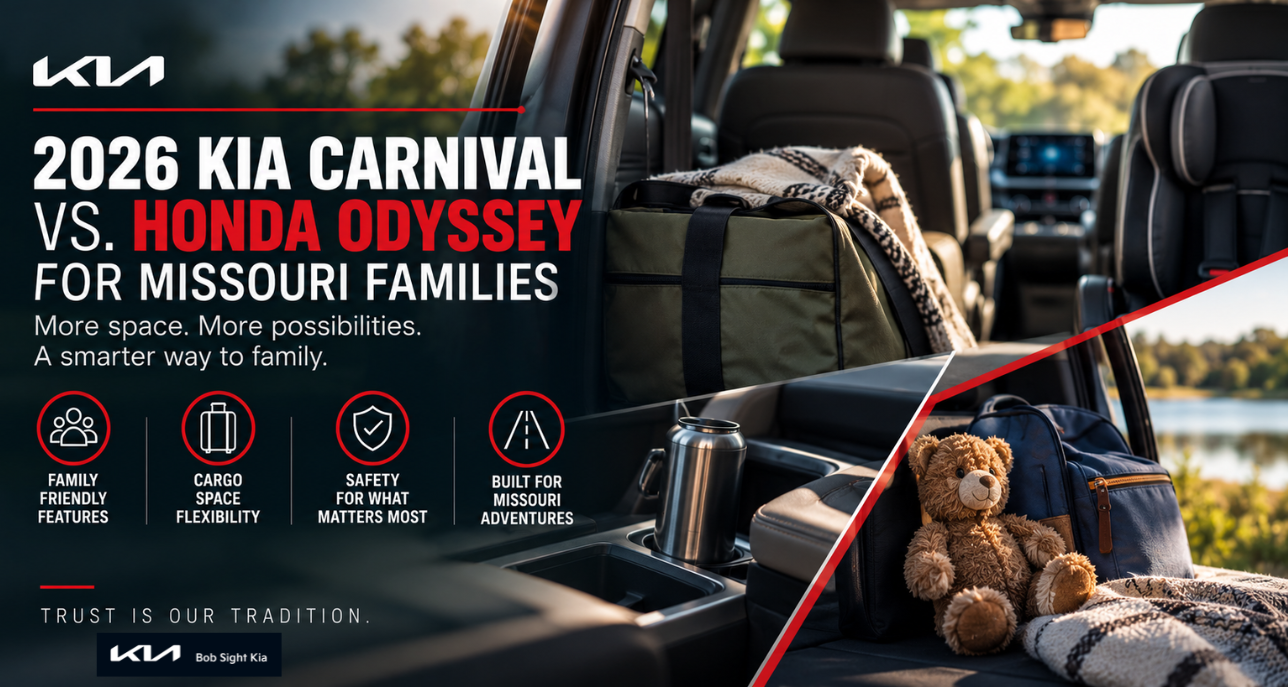
2026 Kia Carnival vs. Honda Odyssey: Which Minivan Works Best for Missouri Families?
Explore new Kia Carnival models at Bob Sight Kia
The 2026 Kia Carnival is a compelling choice for Missouri families who want flexible three-row seating, SUV-inspired styling, advanced cabin technology, and the option of an efficient hybrid powertrain. The Honda Odyssey remains a practical family vehicle with useful seating features, but the Carnival offers a broader range of powertrain choices and a distinctly modern approach to everyday transportation. At Bob Sight Kia in Independence, families from Blue Springs, Lee’s Summit, Raytown, Grain Valley, Liberty, and throughout the Kansas City Metro can explore how the Carnival fits school transportation, weekday commuting, weekend activities, and long-distance road trips.
Choosing between the 2026 Kia Carnival and Honda Odyssey requires more than comparing two specification sheets. Missouri families need to consider passenger comfort, cargo flexibility, fuel economy, safety technology, winter drivability, entertainment features, and long-term ownership support. This detailed comparison explains where each minivan stands out and why the Carnival may be the stronger match for many households around Jackson County.
In This Guide You’ll Learn
This comparison covers the most important factors Missouri families should evaluate before choosing their next minivan.
- How the 2026 Kia Carnival and Honda Odyssey compare in performance
- Which minivan offers the best seating arrangement for a growing family
- How cargo capacity and interior flexibility differ
- What technology and entertainment features are available
- How the Carnival Hybrid changes the fuel-economy comparison
- Which safety and driver-assistance technologies support Missouri driving
- Why local ownership support matters after the purchase
2026 Kia Carnival vs. Honda Odyssey Quick Comparison
The 2026 Kia Carnival offers Missouri families more powertrain variety, modern technology, and SUV-inspired design, while the Honda Odyssey emphasizes traditional minivan packaging and flexible second-row seating. Both vehicles can accommodate up to eight passengers when properly configured, and both provide the sliding doors and three-row usability families expect. The largest difference is that the Carnival is available with either a gasoline V6 or a hybrid powertrain, while the Odyssey uses a gasoline V6.
| Comparison Area | 2026 Kia Carnival | 2026 Honda Odyssey |
|---|---|---|
| Standard Engine | 3.5-liter V6 | 3.5-liter V6 |
| Gasoline Engine Output | 287 horsepower | 280 horsepower |
| Hybrid Option | Available 1.6-liter turbocharged hybrid system | Not available |
| Maximum Seating | Up to eight, depending on configuration | Up to eight, depending on configuration |
| Transmission | 8-speed automatic with V6 or 6-speed automatic with hybrid system | 10-speed automatic |
| Driven Wheels | Front-wheel drive | Front-wheel drive |
| Standout Family Feature | Available hybrid efficiency and available VIP Lounge Seats | Magic Slide second-row seats |
| Design Direction | SUV-inspired MPV styling | Traditional minivan styling |
The right choice depends on how a family actually uses its vehicle. A household commuting daily between Independence and downtown Kansas City may give fuel efficiency and driver-assistance technology greater weight. A family regularly transporting children, grandparents, sports equipment, and groceries may focus more heavily on seat access and cargo flexibility. Looking at these use cases together provides a clearer answer than choosing solely by maximum cargo figures or horsepower.
Trim content and individual feature availability can vary, so families should compare the exact vehicles they are considering. A visit to Bob Sight Kia gives shoppers the opportunity to sit in each row of the Carnival, test the sliding-door access, inspect cargo space, and evaluate technology in person. Those hands-on checks can reveal differences that are difficult to understand from online measurements alone.
Which Minivan Offers Better Performance for Missouri Driving?
The 2026 Kia Carnival provides strong everyday performance through its 287-horsepower 3.5-liter V6, while also offering a separate hybrid powertrain for families focused on efficiency. The Honda Odyssey uses a 3.5-liter V6 producing 280 horsepower and pairs it with a 10-speed automatic transmission. Both gasoline models provide smooth front-wheel-drive performance suited to suburban streets, interstate travel, and routine family transportation.
The Carnival’s V6 produces 260 pound-feet of torque and works with an eight-speed automatic transmission. That combination gives the Carnival confident acceleration when merging onto I-70, entering traffic from Noland Road, or carrying passengers and luggage toward Kansas City International Airport. The Odyssey’s V6 produces 262 pound-feet of torque, so the two gasoline minivans are closely matched in everyday pulling force. Neither vehicle is designed to feel like a performance car, but both deliver the predictable acceleration families need when traffic speeds change quickly.
The Carnival Hybrid uses a turbocharged 1.6-liter four-cylinder engine, an electric motor, and a lithium-ion battery. Its combined system output is 242 horsepower and 271 pound-feet of torque. Electric-motor torque arrives differently than power from a conventional gasoline engine, which can make low-speed response feel useful in stop-and-go driving around Independence Center or along busy stretches of Missouri Route 291. The hybrid system also gives Carnival shoppers an option the Odyssey lineup does not provide.
Neither minivan currently offers all-wheel drive, so tire selection remains important for Missouri winters. Front-wheel drive places the engine’s weight over the driven wheels, which can provide useful traction in ordinary rain and light snow when paired with appropriate tires. All-season tires may suit many Kansas City Metro drivers, while families who must travel before roads are cleared may want to discuss dedicated winter tires with a qualified service professional.
Families can compare performance in a useful way by following these steps:
- List the routes driven most often, including highways, neighborhood roads, and school pickup areas.
- Estimate how frequently the vehicle carries six or more passengers or a full cargo load.
- Decide whether stronger gasoline-engine output or hybrid fuel efficiency better supports those trips.
- Test-drive the vehicle on a route that includes low-speed turns, highway merging, and uneven pavement.
- Compare ride comfort and cabin noise from both the driver’s seat and rear rows.
For a family that wants familiar V6 performance, the gasoline Carnival is a direct Odyssey competitor. For a household that spends substantial time commuting or moving through city traffic, the Carnival Hybrid creates a different ownership path. That ability to select between two powertrain types is one of the Carnival lineup’s most meaningful advantages.
Which Minivan Has the Best Seating for Missouri Families?
Both the 2026 Kia Carnival and Honda Odyssey can seat up to eight passengers, but they approach second-row comfort and flexibility differently. The Carnival offers family-friendly configurations that may include a removable second-row center seat or available VIP Lounge Seats, depending on trim. The Odyssey is known for its Magic Slide second-row seats, which can move laterally when the center seat is removed.
The Carnival’s available eight-passenger layout works well for families who occasionally need room for an extra child, grandparent, or friend. Removing the second-row center seat can create a more open path toward the third row. Some Carnival configurations also prioritize second-row comfort through available VIP Lounge Seats with relaxation-style positioning and leg support. Those seats can appeal to families whose older children or adult passengers frequently travel in the second row, although shoppers should consider whether maximum passenger flexibility or lounge-style comfort matters more.
The Odyssey’s Magic Slide system addresses a different family need. After removing the second-row center seat, the outboard seats can slide toward the middle or toward the doors. Moving a seat inward can make it easier for a parent in the front to reach a young passenger, while sliding a seat sideways may improve third-row access from one side. The second-row seats can be removed, but they do not fold directly into the floor.
Child-restraint planning deserves close attention in either vehicle. Families should verify lower-anchor and tether locations in the exact trim they are considering, because seating configuration can affect where different car seats fit. A rear-facing seat, high-back booster, and adult passenger may create a very different layout challenge than three school-age children. Vehicle seating capacity alone does not guarantee that every car seat will fit correctly in every position.
For a realistic comparison, bring the family’s current child seats to the dealership and complete a supervised fit check before purchasing. Confirm that each seat can be installed according to both the vehicle owner’s manual and child-restraint manufacturer instructions. Make sure third-row passengers can enter without disturbing a securely installed seat. Then check that every occupant has an accessible seat belt and an appropriate head-restraint position.
A family near Blue Springs that carries eight people regularly may prefer the Carnival’s conventional eight-passenger flexibility. A household that frequently rearranges two second-row passengers to access the third row may appreciate the Odyssey’s lateral seat movement. Families seeking a more premium second-row experience may find the Carnival’s available VIP Lounge Seats more appealing. The best configuration is the one that supports the household’s real passenger pattern without requiring complicated daily adjustments.
Cargo Space and Everyday Flexibility
The Honda Odyssey offers a higher published maximum cargo figure, while the 2026 Kia Carnival provides substantial family cargo room and practical space behind its usable third row. Maximum-volume measurements do not tell the complete story because the second-row seats are handled differently in each vehicle. Missouri families should compare how easily each cabin changes from passenger duty to cargo duty.
The Carnival provides approximately 40.2 cubic feet of cargo volume behind the third row, depending on measurement standards and configuration. That space can handle groceries, backpacks, folding chairs, or several pieces of luggage without requiring a family to give up third-row seating. With the rear seating areas configured for cargo, the gasoline Carnival can provide up to approximately 145.1 cubic feet of maximum cargo volume. Exact usable space depends on whether second-row seats are removed and how the chosen trim is equipped.
The Odyssey publishes up to 155.8 cubic feet of total cargo space when the second-row seats are removed and the third row is stowed. Its one-motion 60/40-split third-row Magic Seat folds into the rear floor well, creating a broad loading area. This configuration can work well for moving large household items, but reaching the published maximum requires removing the second-row seats. Families should consider where those seats will be stored and whether they are comfortable lifting them.
Cargo-floor shape can matter as much as total volume. A deep well behind the third row helps contain grocery bags and smaller items, while a flatter expanded floor supports furniture, bicycles, or home-improvement supplies. Families making a Saturday trip to stores around Bolger Square or Independence Commons may care more about space behind the occupied third row than about the maximum number achieved with seats removed.
Use this process to compare cargo usability:
- Measure the stroller, sports equipment, mobility device, pet crate, or other large item carried most often.
- Check whether that item fits behind the third row without folding passenger seats.
- Fold the third row and examine whether the cargo floor is level enough for longer objects.
- Practice removing or repositioning the second-row seats if maximum space is important.
- Confirm that the power liftgate height and loading height work for every regular driver.
The Odyssey has the advantage when a shopper focuses strictly on published maximum cargo volume. The Carnival remains highly practical for everyday family hauling and offers generous room behind the third row. For many households, the easier question is not which minivan holds the most in an empty-cabin test, but which one holds everyday cargo while keeping the necessary seats available.
Technology and Entertainment for Long Family Drives
The 2026 Kia Carnival delivers a modern, screen-centered cabin with available family communication and entertainment features designed for daily travel and long Missouri road trips. The Odyssey also offers useful connectivity, CabinWatch, CabinTalk, and an available rear entertainment system. Feature availability varies by trim, so comparing equivalent configurations is essential.
The Carnival offers available panoramic display arrangements that visually connect the driver-information screen and infotainment interface. Wireless smartphone integration on compatible configurations helps reduce cable clutter during short trips around Jackson County. Available navigation, wireless charging, multiple USB charging ports, and connected services can help families coordinate changing schedules. The cabin design has a contemporary appearance that may appeal to shoppers who want their minivan to feel closer to a modern SUV.
Available Passenger View with Night Vision can help the Carnival driver monitor rear passengers through the center display. An available passenger communication system can amplify the driver’s voice through the rear speakers, reducing the need to turn around or speak loudly. These features can be useful when children in the third row need instructions during busy traffic near the I-70 and I-435 interchange. Available dual rear-screen entertainment can give passengers separate viewing options on longer trips.
The Odyssey offers its own family-focused tools. Available CabinWatch displays a view of rear passengers, including enhanced visibility in low-light conditions. CabinTalk allows the driver’s voice to be heard through connected headphones or rear speakers, depending on how the system is being used. The available rear entertainment system can help occupy passengers during trips across Missouri or holiday drives into Kansas.
The most important difference may be interface preference rather than the length of each feature list. Families should test menu response, physical controls, phone pairing, voice commands, and rear-seat visibility. A feature only adds value when the driver can use it without becoming distracted. Parents should also determine whether children can reach charging ports and operate entertainment controls appropriately from their assigned seats.
Before choosing a trim, connect the phone each adult driver uses and confirm that contacts, navigation, audio, and voice functions behave as expected. Sit in the third row to check screen visibility and headphone operation. Test how quickly the driver can activate a passenger-view camera or communication system. These practical checks can help a family choose technology that simplifies travel instead of adding another system to manage.
Carnival Hybrid vs. Odyssey Fuel Economy
The availability of the 2026 Kia Carnival Hybrid gives efficiency-minded families a major advantage that the gasoline-only Honda Odyssey cannot directly match. The gasoline Carnival and Odyssey have relatively similar fuel-economy profiles, but the hybrid Carnival is designed to reduce fuel use during commuting, errands, and stop-and-go driving. Actual mileage varies with temperature, traffic, passenger load, maintenance, and driving habits.
The gasoline Carnival carries EPA estimates of approximately 18 mpg city, 26 mpg highway, and 21 mpg combined. The Odyssey is rated at approximately 19 mpg city, 28 mpg highway, and 22 mpg combined. On uninterrupted highway travel, the Odyssey may hold a small numerical advantage over the gasoline Carnival. That difference should be considered alongside horsepower, technology, seating configuration, and the specific trim a family prefers.
The Carnival Hybrid carries EPA estimates of approximately 34 mpg city, 31 mpg highway, and 33 mpg combined. Its higher city rating reflects the way a hybrid system can recover energy during deceleration and use electric assistance under appropriate conditions. Regenerative braking converts some of the vehicle’s motion into electrical energy that can be stored in the hybrid battery. The driver does not plug in the Carnival Hybrid because it is a conventional hybrid rather than a plug-in hybrid.
Hybrid efficiency can be valuable for families who make repeated short trips between home, school, work, practices, and shopping areas. A driver traveling regularly along 39th Street, Noland Road, and Missouri Route 291 may encounter traffic signals and variable speeds where hybrid operation can be useful. Cold weather can temporarily reduce efficiency because the engine and cabin require more energy to warm up. Tire pressure also drops as temperatures fall, which can increase rolling resistance if it is not corrected.
| Powertrain | EPA City Estimate | EPA Highway Estimate | EPA Combined Estimate |
|---|---|---|---|
| Kia Carnival 3.5L V6 | Approximately 18 mpg | Approximately 26 mpg | Approximately 21 mpg |
| Kia Carnival Hybrid | Approximately 34 mpg | Approximately 31 mpg | Approximately 33 mpg |
| Honda Odyssey 3.5L V6 | Approximately 19 mpg | Approximately 28 mpg | Approximately 22 mpg |
Families who primarily take long highway trips may find the gasoline comparison relatively close. Drivers who spend more time in suburban traffic have a stronger reason to evaluate the Carnival Hybrid. Keeping tires properly inflated, removing unnecessary cargo, using smooth acceleration, and following the maintenance schedule can support efficient operation with any powertrain.
Safety and Driver-Assistance Technology
Both the 2026 Kia Carnival and Honda Odyssey offer extensive driver-assistance technology, but the Carnival provides a particularly broad collection of available systems for highway, parking, and everyday family driving. These technologies support an attentive driver rather than replacing one. Families should compare which features are standard on the exact trims under consideration.
The Carnival’s available Kia Drive Wise technologies may include Forward Collision-Avoidance Assist, Blind-Spot Collision-Avoidance Assist, Rear Cross-Traffic Collision-Avoidance Assist, Lane Keeping Assist, Lane Following Assist, Smart Cruise Control, and Highway Driving Assist. Some configurations may add enhanced intersection support, parking sensors, a Surround View Monitor, or a Blind-Spot View Monitor. The Blind-Spot View Monitor can display a camera image in the instrument cluster when a turn signal is activated.
The Odyssey includes the Honda Sensing suite of driver-assistance features. Depending on model specifications, these systems include Collision Mitigation Braking System, Road Departure Mitigation System, Adaptive Cruise Control with Low-Speed Follow, Lane Keeping Assist System, and Traffic Sign Recognition. Blind Spot Information with Cross Traffic Monitor also supports awareness around adjacent vehicles and parking-lot traffic.
Adaptive cruise control can reduce repeated speed adjustments on I-70, but the driver must remain prepared to brake or steer. Lane-centering support may reduce workload on clearly marked roads, but lane markings can become harder for cameras to interpret during heavy rain, snow, road construction, or glare. Automatic emergency braking is designed to assist in certain situations and does not eliminate the need for safe following distance.
Parking technology can be valuable in crowded school lots or shopping centers, where children, carts, and vehicles may enter the driving path unexpectedly. Camera systems provide additional viewpoints, but drivers should still check mirrors, look over their shoulders, and move slowly. Dirt, road salt, snow, and ice can also obstruct cameras and radar sensors, so keeping sensor areas clean is an important winter habit.
During a test drive, ask for a demonstration of each system rather than relying only on feature names. Confirm how warning sensitivity can be adjusted, where alerts appear, and whether the system uses sound, steering input, braking, or multiple responses. Understanding those behaviors before daily use can make the technology feel more predictable and useful.
Comfort, Ride Quality, and Missouri Weather
The Carnival and Odyssey are both designed for comfortable family travel, but the Carnival’s upscale cabin presentation and available comfort features help it stand apart. Ride quality depends on wheel size, tire construction, passenger load, road surface, and trim configuration. Missouri families should test both vehicles on the types of roads they drive most often.
The Kansas City Metro combines smooth interstate sections with patched pavement, expansion joints, construction zones, and neighborhood streets affected by freeze-thaw cycles. Larger wheels can sharpen steering response and enhance appearance, but tires with shorter sidewalls may transmit more impact from potholes. Families who prioritize ride comfort should compare trims with different wheel-and-tire packages instead of assuming every version drives identically.
The Carnival offers available heated and ventilated front seats, available heated and ventilated second-row seating, and available tri-zone climate control features. These options can help families manage humid summer afternoons and cold winter mornings. Remote-start capability can also allow the climate system to begin preparing the cabin before passengers enter, subject to safe operating conditions and local rules.
The Odyssey also offers tri-zone automatic climate control, remote engine start, available heated and ventilated front seats, and integrated sunshades on certain configurations. Its Magic Slide second-row seats provide a practical comfort benefit by allowing families to change passenger spacing. The ideal choice depends on whether a household values movable seating or the Carnival’s available lounge-oriented second-row experience.
Winter capability involves more than driven wheels. Quality tires, sufficient tread depth, correct inflation, functioning wiper blades, winter-rated windshield washer fluid, and a healthy 12-volt battery all contribute to dependable travel. A front-wheel-drive minivan with properly selected tires can be more predictable in snow than a vehicle with additional driven wheels but worn tires.
A thorough test drive should include a rough road, a highway entrance ramp, a tight parking maneuver, and time in every seating row. Ask a rear passenger to evaluate road noise, climate airflow, seat comfort, and outward visibility. These observations are important for families who regularly drive to activities in Lee’s Summit, visit relatives across the Kansas City Metro, or take longer trips through changing Midwest weather.
Which Minivan Is Better for Different Missouri Family Needs?
The 2026 Kia Carnival is the better fit for families seeking powertrain choice, contemporary technology, and SUV-inspired design, while the Odyssey may appeal to shoppers who prioritize Magic Slide seating and the largest published maximum cargo figure. The best minivan is determined by daily routines, not by one isolated specification. Different family structures can lead to different conclusions.
A commuting family may favor the Carnival Hybrid. Its estimated combined fuel economy can make a meaningful difference for a household completing school drop-offs, work commutes, grocery runs, and evening activities in the same day. The hybrid also preserves the sliding-door access and three-row seating that make a minivan practical. This creates an efficient family-vehicle option without moving to a smaller crossover.
A family focused on passenger comfort may prefer a Carnival trim with available VIP Lounge Seats. These seats can make longer drives more relaxing for older children or adults who regularly occupy the second row. The Carnival’s modern interior presentation and available dual rear entertainment screens also strengthen its appeal for road trips. Families should remember that a lounge-seat layout may not provide the same maximum flexibility as a conventional removable second-row configuration.
A household frequently rearranging second-row passengers may find the Odyssey’s Magic Slide system useful. The ability to move outboard seats laterally can help with third-row access and passenger placement. The Odyssey may also appeal to someone who regularly converts the cabin into maximum cargo mode and is comfortable removing the second-row seats. These strengths are real, but they do not give the Odyssey a hybrid alternative.
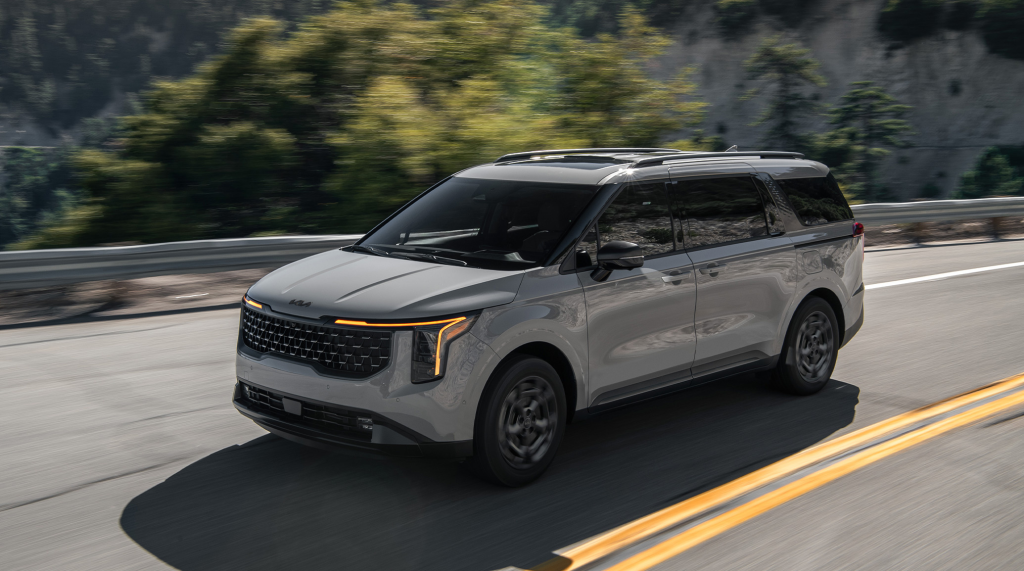
A style-conscious family may lean toward the Carnival because its long hood, bold grille, and more upright profile resemble an SUV. That design can appeal to shoppers who need minivan functionality but do not want traditional minivan styling. The visual difference is not simply cosmetic because the Carnival’s cabin and technology presentation follow the same modern direction.
Families should create a short requirements list before visiting a dealership. Separate nonnegotiable needs, such as the number of car-seat positions, from preferences, such as a particular screen size or wheel design. Then compare vehicles in equivalent trim levels and complete a real-world test drive. This process makes it easier to identify the vehicle that will remain useful as children grow and family routines change.
Quick Facts About the 2026 Kia Carnival and Honda Odyssey
The most important distinction is that the 2026 Kia Carnival offers both gasoline and hybrid choices, while the Honda Odyssey remains gasoline-only. Both minivans provide three rows, available eight-passenger seating, sliding rear doors, and family-oriented technology. Their differences become clearer when shoppers compare actual seating configurations and trim-specific equipment.
- The gasoline Carnival uses a 3.5-liter V6 producing 287 horsepower.
- The Carnival Hybrid combines a turbocharged 1.6-liter engine with electric assistance.
- The Carnival Hybrid produces 242 combined horsepower and 271 pound-feet of torque.
- The Odyssey uses a 3.5-liter V6 producing 280 horsepower.
- Both models use front-wheel drive.
- Both models can accommodate up to eight passengers when properly configured.
- The Carnival offers available VIP Lounge Seats on select configurations.
- The Odyssey offers Magic Slide second-row seats.
- The Carnival offers approximately 40.2 cubic feet of cargo space behind the third row.
- The Odyssey publishes up to 155.8 cubic feet of maximum cargo space with seats properly removed or stowed.
- The Carnival Hybrid has a significant estimated combined fuel-economy advantage over either V6 model.
- Safety and convenience features vary by trim and should be verified on the individual vehicle.
These facts provide a useful starting point, but the final decision should include a seating test, cargo demonstration, technology walkthrough, and test drive. A family that uses every seat has different needs from one that usually carries four people and large amounts of gear. Bob Sight Kia can help Independence-area shoppers compare Carnival configurations based on those real routines.
Ownership Planning for a Family Minivan
Good minivan ownership planning includes routine maintenance, seasonal inspections, tire care, and choosing a configuration that can adapt as the family changes. The Carnival and Odyssey both require maintenance according to their manufacturer guidance. Following the schedule can support reliability, safety, efficiency, and warranty documentation.
Engine-oil requirements should always be confirmed in the owner’s manual or on the oil-filler cap for the specific engine. Modern engines require oil that meets defined viscosity and performance standards, such as current API and ILSAC specifications. Using the correct oil matters because turbocharged hybrid engines and naturally aspirated V6 engines operate under different thermal and lubrication demands. A service department can identify the proper fluid and filter requirements using the vehicle identification number.
Missouri’s seasonal temperature changes make tire-pressure checks important. Tire pressure commonly decreases as outdoor temperature falls, and an underinflated tire can affect handling, tread wear, and efficiency. Families should inspect tires monthly, before long trips, and after major temperature swings. Measurements should be compared with the pressure label inside the driver’s door opening rather than the maximum pressure printed on the tire sidewall.
Brake inspections are also important for a heavily used family vehicle. Stop-and-go traffic, repeated school runs, highway congestion, and regular passenger loads can affect brake wear. Hybrid regenerative braking may reduce some use of the friction brakes under certain conditions, but the brake pads, rotors, fluid, and hardware still require inspection. Regenerative braking should never be interpreted as maintenance-free braking.
Bob Sight Kia provides a local destination for Kia maintenance, inspections, tires, parts, and service scheduling in Independence. Keeping service records in one place can help technicians recognize changes over time and verify completed maintenance. It can also make future trade-in preparation easier because organized records provide a clearer picture of vehicle care.
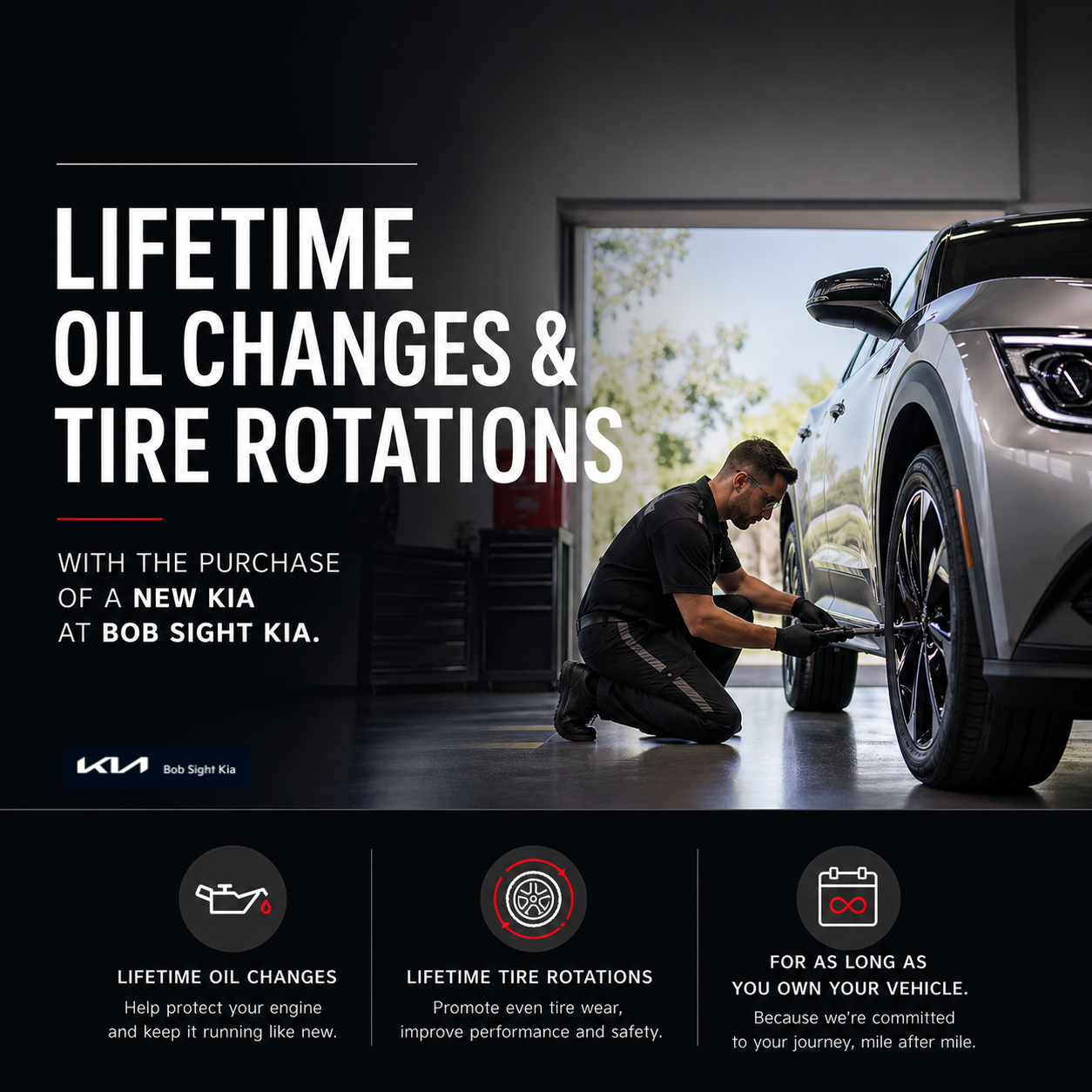
Ownership programs can add value only when drivers understand and follow their requirements. Families should review eligibility, maintenance conditions, service intervals, and documentation before relying on any program. At Bob Sight Kia, qualifying ownership benefits require required maintenance to be performed with the dealership, so shoppers should ask for the current written terms and confirm how the program applies to the vehicle they are considering.
Frequently Asked Questions
Is the 2026 Kia Carnival or Honda Odyssey better for a Missouri family?
The 2026 Kia Carnival is likely the better choice for a Missouri family that values powertrain options, modern technology, SUV-inspired styling, and available premium second-row comfort. The Odyssey remains a capable minivan with flexible Magic Slide seating and substantial maximum cargo capacity. The best answer depends on passenger arrangements, commute patterns, and cargo needs.
The Carnival offers both a 287-horsepower V6 and an available hybrid system, allowing families to choose between familiar gasoline performance and stronger fuel-economy potential. The Odyssey offers one V6 powertrain. Families driving frequently around Independence and Kansas City may find the Carnival Hybrid particularly relevant because hybrid systems can perform efficiently in variable-speed traffic.
A local test drive should include the roads the family uses regularly. Driving near the I-70 corridor can reveal merging response, while neighborhood streets can show ride comfort over repaired pavement. Every regular passenger should test seat access, visibility, climate airflow, and available charging connections before the family makes a final choice.
Does the 2026 Kia Carnival have more passenger room than the Honda Odyssey?
Both minivans offer spacious three-row cabins, but their passenger-room advantages depend on seating position and configuration rather than one overall measurement. Both can seat up to eight occupants when equipped with the appropriate layout. The Carnival emphasizes available second-row luxury, while the Odyssey emphasizes lateral seat movement.
The Carnival’s available VIP Lounge Seats can create a more relaxing second-row environment, but families needing eight seats should focus on a conventional configuration. The Odyssey’s Magic Slide seats can help change the path to the third row after the center seat is removed. Neither system is automatically better for every household.
Families using child restraints should test their exact seats in the vehicle. A configuration that looks spacious online may function differently after installing a rear-facing seat and booster. Bob Sight Kia shoppers can inspect Carnival seating in person and determine whether the second-row arrangement works with their daily pickup, drop-off, and third-row access needs.
Is the Kia Carnival Hybrid more efficient than the Honda Odyssey?
Yes, the 2026 Kia Carnival Hybrid has substantially higher EPA fuel-economy estimates than the gasoline Honda Odyssey. The Carnival Hybrid is rated at approximately 34 mpg city, 31 mpg highway, and 33 mpg combined. The Odyssey is rated at approximately 19 mpg city, 28 mpg highway, and 22 mpg combined.
The difference is most relevant for families that accumulate significant mileage in urban and suburban driving. Hybrid systems can recapture energy during deceleration and provide electric assistance under appropriate conditions. Actual results depend on speed, temperature, climate-control use, vehicle load, tire pressure, and driving technique.
A family making daily trips between Blue Springs and Independence may experience a different efficiency pattern than one spending most of its time at steady highway speeds. Missouri winter temperatures can also reduce efficiency until the engine and cabin reach operating temperature. Keeping the vehicle maintained and the tires correctly inflated helps support consistent results throughout the year.
Which minivan has better cargo space for road trips?
The Odyssey has a higher published maximum cargo figure, but the Carnival provides generous cargo room behind the third row and may be equally practical for many family road trips. Maximum volume only applies after seats are removed or stowed as required. Families should focus on the space available in the seating arrangement they will actually use.
The Carnival provides approximately 40.2 cubic feet behind the third row, which is useful when all three rows remain occupied. The Odyssey’s maximum cargo figure reaches 155.8 cubic feet when the second-row seats are removed and the third row is folded. Removing seats may not be practical when a trip requires space for six or more people.
Before a holiday trip, place representative luggage, a stroller, or sports equipment behind the third row. Check whether rear visibility remains clear and whether loose objects can be secured. Families traveling from Independence toward the Lake of the Ozarks or across Kansas may find that usable behind-the-row space matters more than the largest theoretical capacity.
Where can I test-drive a Kia Carnival near Kansas City?
Drivers can schedule a Kia Carnival test drive at Bob Sight Kia in Independence, Missouri. The dealership serves families from Blue Springs, Lee’s Summit, Raytown, Sugar Creek, Grain Valley, Liberty, Oak Grove, and communities across the Kansas City Metro. Inventory availability can change, so checking current listings before visiting is recommended.
A productive test drive should include more than a short loop. Ask to evaluate acceleration, braking, visibility, parking, infotainment controls, and ride quality. Families should also inspect the second and third rows, sliding-door openings, cargo well, seat-adjustment process, and child-restraint anchor locations.
Shoppers comparing gasoline and hybrid Carnival models should drive both when inventory allows. The two powertrains have different acceleration characteristics and efficiency priorities. Scheduling ahead gives the dealership an opportunity to confirm which configurations are available for comparison.
Why the 2026 Kia Carnival Stands Out for Kansas City Metro Families
The 2026 Kia Carnival stands out because it combines genuine minivan versatility with the design, technology, and powertrain choice many modern families want. Its available hybrid system gives Missouri shoppers an efficient alternative without giving up three-row seating or sliding-door convenience. The gasoline model remains available for drivers who prefer V6 performance.
Buying locally also makes it easier to evaluate the vehicle in the same regional conditions it will encounter every day. Independence drivers can assess visibility in busy shopping areas, acceleration near interstate entrances, and ride comfort on familiar roads. Families from nearby cities can make the short trip to compare seating and cargo arrangements in person rather than relying entirely on online descriptions.
Local service support becomes important after the purchase. Seasonal tire checks, scheduled maintenance, software questions, warning-light diagnosis, and parts needs are easier to address when drivers have an established relationship with a nearby dealership. Bob Sight Kia provides sales, service, financing, and parts resources in one Independence location.
The Odyssey continues to offer practical seating and cargo strengths, but the Carnival gives shoppers more ways to tailor the vehicle to their priorities. Families can choose a gasoline or hybrid powertrain, consider conventional or comfort-focused second-row seating, and select available technology based on how they travel. That flexibility makes the 2026 Kia Carnival a strong answer for many Missouri households comparing family minivans.
Visit Bob Sight Kia to explore current Carnival availability, compare trims, and schedule a test drive. A hands-on evaluation can help determine how the Carnival supports school routines, Kansas City commutes, weekend activities, and long-distance family travel. The right family vehicle should simplify everyday life while remaining comfortable and useful for years to come.
Helpful Links
- Shop New Kia Carnival Inventory
- Shop New Kia Carnival Hybrid Inventory
- Schedule a Test Drive
- Value Your Trade
- Get Pre-Approved
Proud to Be Part of the Bob Sight Auto Group
Bob Sight Kia is proud to serve Independence and the Kansas City Metro as part of the Bob Sight Auto Group. Our family of dealerships helps drivers shop, maintain, and care for vehicles across Missouri and Kansas. Each location shares a commitment to useful guidance, dependable support, and lasting customer relationships.
The Bob Sight Auto Group includes Bob Sight Kia in Independence, Missouri; Bob Sight Ford in Lee’s Summit, Missouri; Bob Sight Honda in Lawrence, Kansas; and Bob Sight CDJR in Lawrence, Kansas. Drivers can also turn to the Bob Sight Collision Center in Lee’s Summit for collision repair support.
Whether a family is comparing minivans, maintaining a current vehicle, or preparing for a future trade, the Bob Sight team is ready to help. For generations of local drivers, Trust Is Our Tradition.

 Warranties include 10-year/100,000-mile powertrain and 5-year/60,000-mile basic. All warranties and roadside assistance are limited. See retailer for warranty details.