

2026 Kia Sportage Hybrid for Independence, MO Drivers: Regenerative Braking, Available AWD, and Everyday Versatility
Browse new Kia SUVs available at Bob Sight Kia in Independence, Missouri.
The 2026 Kia Sportage Hybrid gives Independence and Kansas City-area drivers a practical combination of hybrid efficiency, flexible cargo space, modern technology, and available all-wheel drive. Its conventional hybrid system automatically blends gasoline and electric power, so drivers can enjoy an electrified SUV without adding a home-charging routine.
That combination can be especially useful during a commute that includes neighborhood streets, traffic lights, I-70 merging, stop-and-go congestion, and crowded parking areas. The Sportage Hybrid also offers adjustable regenerative braking, allowing drivers to select how much deceleration they feel when lifting off the accelerator under appropriate driving conditions.
This guide is designed for drivers comparing a 2026 Kia Sportage Hybrid near Independence, Blue Springs, Lee's Summit, Kansas City, Raytown, Sugar Creek, Liberty, Grain Valley, Oak Grove, and communities throughout Jackson County. It explains how the hybrid system, available AWD, cargo space, comfort, and technology may fit everyday Missouri driving.
In This Guide You'll Learn
- How the 2026 Kia Sportage Hybrid works without external charging
- What regenerative braking does during Kansas City commuting
- How front-wheel drive and available AWD compare
- What to evaluate when reviewing cargo and passenger space
- Which technology features may support a daily commute
- How Missouri winter conditions can affect hybrid operation
- What to check during a Sportage Hybrid test drive
2026 Kia Sportage Hybrid Quick Facts
The 2026 Kia Sportage Hybrid is a two-row compact SUV that uses a gasoline engine, an electric motor, and a hybrid battery without requiring the driver to plug it in. The vehicle manages its power sources automatically and recovers some energy through regenerative braking.
| Feature | What Independence Drivers Should Know |
|---|---|
| Powertrain | Conventional hybrid system combining gasoline and electric power |
| Charging | No external charging connection is required |
| Drivetrain | Front-wheel drive or available all-wheel drive, depending on configuration |
| Regenerative Braking | Helps recover energy while the vehicle slows under suitable conditions |
| Seating | Two rows with seating for up to five occupants |
| Cargo Room | Up to approximately 39.5 cubic feet behind the second row |
| Local Use | Designed to support commuting, errands, family transportation, and road trips |
Specifications and equipment can vary by trim and configuration. Shoppers should review the window sticker and confirm the features included with the exact Sportage Hybrid they are considering.
How the Sportage Hybrid Fits an Independence to Kansas City Commute
The Sportage Hybrid can fit drivers who want compact-SUV versatility and hybrid operation without planning their routine around a charging location. Drivers refuel it at a gas station just as they would a traditional gasoline vehicle.
A commute from Independence to downtown Kansas City may begin on residential streets before continuing onto US-24, I-70, I-435, or other heavily traveled routes. Those trips can involve frequent changes in speed, highway merging, construction zones, and periods of congestion.
The hybrid system automatically determines when to use the gasoline engine, electric assistance, or a combination of both. Its decisions can be influenced by acceleration, speed, battery charge, temperature, climate-control use, and current driving conditions.
This flexibility may appeal to commuters who live in an apartment, park outside, or do not have reliable access to home charging. It can also work for households that regularly travel beyond the Kansas City Metro and want to refuel without locating a charging station.
Real-world efficiency will vary. Driving speed, traffic, weather, tire pressure, passenger load, cargo, climate settings, and driving habits can all affect results. A short route through Independence may produce a different experience than a longer highway commute from Blue Springs or Oak Grove.
Consider these parts of your routine before choosing a hybrid SUV:
- Estimate your weekly mileage. Include commuting, errands, school transportation, and weekend trips.
- Identify your most common roads. Separate city, suburban, and highway driving.
- Review your passenger needs. Account for adults, children, car seats, and pets.
- Measure your regular cargo. Include strollers, sports equipment, work supplies, and luggage.
- Consider seasonal driving. Think about early departures, untreated roads, hills, and rural routes.
- Test the vehicle on familiar roads. Choose a route that resembles your normal commute.
How Regenerative Braking Works in the Sportage Hybrid
Regenerative braking uses the electric motor to convert some of the vehicle's motion into electrical energy while the SUV decelerates. That recovered energy can be returned to the hybrid battery and used later to assist the gasoline engine.
A conventional braking system primarily slows a vehicle by creating friction, which converts motion into heat. A hybrid can use both regenerative braking and traditional friction brakes. The Sportage Hybrid automatically blends the two systems based on braking demand, vehicle speed, battery condition, and road conditions.
Regenerative braking does not replace the brake pedal or conventional brakes. Drivers must continue to brake normally and maintain a safe following distance. The system may provide less regenerative deceleration when the battery is full, temperatures are extreme, or vehicle systems determine that a different response is necessary.
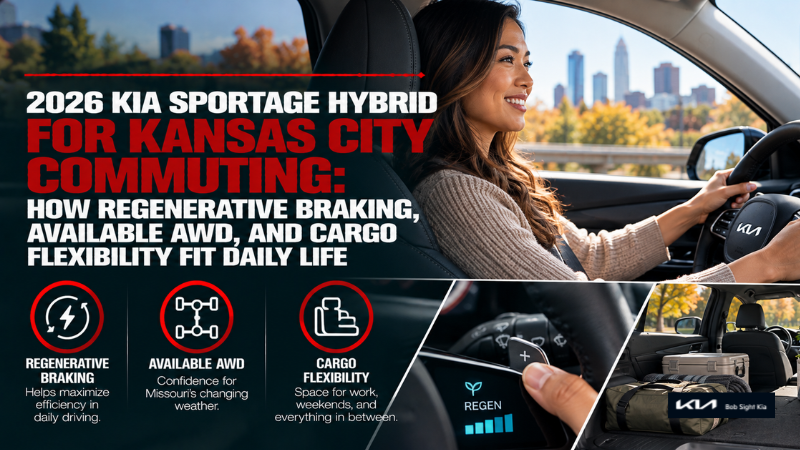
The Sportage Hybrid offers steering-wheel-mounted paddle controls that can adjust regenerative braking under appropriate conditions. The left paddle generally increases the selected regenerative level, while the right paddle reduces it. The current setting can be shown in the driver display.
A lighter setting may allow the vehicle to coast more freely. A stronger setting may produce more noticeable deceleration when the driver lifts off the accelerator. The ideal setting can change based on traffic, road surface, speed, and personal preference.
Learning the Regenerative Braking Settings
- Begin on a familiar road. Choose an area with light traffic and predictable conditions.
- Start with the default response. Notice how the vehicle slows when you release the accelerator.
- Increase regeneration gradually. Make one adjustment at a time and observe the difference.
- Practice smooth accelerator inputs. Gradual changes can make the system feel more natural.
- Use the brake pedal normally. Do not depend on regenerative braking to stop the vehicle.
- Adjust for current conditions. Avoid abrupt inputs on snow, ice, or wet pavement.
- Review the owner's manual. Confirm system availability, limitations, and proper operation.
Stop-and-go traffic around Independence Center, downtown Kansas City, or busy sections of I-70 may create frequent opportunities for regenerative braking. Open highway travel may feel more comfortable with a lighter response that allows additional coasting.
Front-Wheel Drive vs. Available AWD for Missouri Roads
Front-wheel drive may fit commuters who remain primarily on treated paved roads, while available AWD may provide additional traction support for drivers who regularly encounter snow, rain, gravel, hills, or less-maintained surfaces. Neither drivetrain is automatically right for every Missouri driver.
| Consideration | Front-Wheel Drive | Available AWD |
|---|---|---|
| Typical Driving | Paved city and highway routes | Mixed surfaces and changing weather |
| Winter Routine | May fit drivers who wait for roads to be treated | May help drivers who leave before roads are cleared |
| Rural Travel | Suitable for many maintained routes | May provide added support on gravel or loose surfaces |
| Driver Priority | Simplicity and potential efficiency benefits | Additional traction during acceleration |
Available AWD may be worth considering if you commute early in the morning, travel outside central Independence, have a steep or shaded driveway, or regularly visit rural areas around Grain Valley and Oak Grove. Some AWD configurations also provide terrain settings designed for conditions such as snow, mud, and sand.
AWD does not create unlimited traction and does not guarantee shorter stopping distances. Tires, speed, visibility, following distance, and driver decisions remain essential. A front-wheel-drive vehicle with suitable tires may perform more confidently than an AWD vehicle with worn or inappropriate tires.
During a test drive, ask to compare the drivetrain options available in current inventory. Consider whether AWD supports a recurring need or is simply a feature you may rarely use.
Cargo Space and Passenger Comfort for Daily Life
The Sportage Hybrid provides a flexible two-row layout for commuters who need more room than a sedan but do not regularly need a third-row SUV. Its cargo area can support groceries, work equipment, sports gear, luggage, pet supplies, and family essentials.
The 2026 Sportage Hybrid offers up to approximately 39.5 cubic feet of cargo room behind the second row. Published volume is helpful when comparing SUVs, but the shape and accessibility of the cargo area can be equally important.
Check the width between the wheel wells, height of the opening, lift-over height, tie-down locations, and rear-seat folding process. A wide cargo area may be more useful for a stroller or pet carrier, while a taller opening may help with bulky household items.
Bring measurements for the items you carry regularly. Families may want to check whether a stroller fits without folding the second row. Drivers carrying work supplies should confirm that the equipment can be secured while leaving passenger space available.
Passenger comfort should also be evaluated realistically. Adjust the driver's seat to the normal driving position, then sit directly behind it to check second-row legroom. Inspect headroom, door-opening width, child-seat anchor access, storage compartments, charging-port placement, and climate-control performance.
Drivers using I-70 or I-435 should listen for wind, tire, and road noise at highway speed. Turn the audio system down for part of the test drive so you can evaluate the cabin without music covering the sound.
Technology to Evaluate Before Choosing a Trim
The best Sportage Hybrid technology package is the one that provides useful daily features without requiring you to pay for equipment you will rarely use. Feature availability can differ by trim, package, drivetrain, and individual vehicle.
Depending on the selected configuration, shoppers may find technology supporting smartphone connectivity, navigation, charging, parking, highway travel, and driver awareness. Potential features can include Forward Collision-Avoidance Assist, Lane Keeping Assist, Lane Following Assist, Blind-Spot Collision Warning, Rear Cross-Traffic Collision-Avoidance Assist, Smart Cruise Control, parking sensors, and camera-based parking views.
Driver-assistance features are designed to support an alert driver. They do not replace careful observation, steering, braking, or appropriate following distance. Availability and operation can also be affected by weather, road markings, visibility, sensor condition, and other factors.
Use this checklist when reviewing a specific Sportage Hybrid:
- Pair your phone with the infotainment system
- Confirm whether smartphone integration is wired or wireless
- Test audio and call quality
- Locate charging ports for front and rear passengers
- Review the instrument and hybrid-energy displays
- Test the rearview camera and available parking views
- Ask how to adjust driver-assistance settings
- Confirm which features are standard on the selected trim
- Ask whether connected services require enrollment or a subscription
Do not assume that every Sportage Hybrid shown online has identical equipment. Review the exact vehicle listing and window sticker before making a comparison.
Missouri Winter Driving in a Sportage Hybrid
The Sportage Hybrid can operate throughout a Missouri winter, but cold temperatures, cabin-heating demands, tire condition, and road conditions can affect its performance and efficiency. Drivers should expect the vehicle to behave differently in freezing weather than it does during a mild fall commute.
The gasoline engine may operate more frequently while the powertrain warms, the cabin heater is in use, or the hybrid battery reaches an appropriate operating temperature. Short winter trips can be particularly affected because the vehicle may spend a larger portion of the drive warming its systems.
Cold weather may also change the amount of regenerative braking available. Battery temperature, charge level, traction conditions, and stability-control activity can all influence the system. Drivers should be prepared for braking feel to vary and should always use the brake pedal as needed.
Before winter arrives in Independence, consider these preparation steps:
- Inspect tire tread depth and overall tire condition.
- Check tire pressure regularly as temperatures fall.
- Confirm that the battery, lights, wipers, and defrosters operate properly.
- Use the correct windshield washer fluid for freezing conditions.
- Keep cameras and driver-assistance sensors clear of snow and ice.
- Schedule recommended maintenance before severe weather.
- Carry basic emergency supplies during longer winter trips.
Available AWD can assist with traction while accelerating, but it cannot overcome excessive speed or unsuitable tires. Allow additional stopping distance and use gradual accelerator, steering, and braking inputs on snow, slush, and ice.
How to Test-Drive a 2026 Kia Sportage Hybrid
A complete test drive should recreate the roads, speeds, passengers, and cargo demands that are part of your normal routine. A brief drive around the dealership may not reveal how the SUV feels during a commute or longer highway trip.
Begin on lower-speed streets to evaluate visibility, steering, braking, regenerative deceleration, and parking. Include a highway segment when possible so you can assess acceleration, merging, cabin noise, ride quality, and available driver-assistance features.
Evaluate the following items during the drive:
- Acceleration from a complete stop
- Power delivery during highway merging
- Brake-pedal response
- Different regenerative-braking settings
- Steering effort and turning radius
- Ride comfort over uneven pavement
- Visibility around the windshield pillars
- Camera and parking-sensor views
- Driver-seat support and control placement
- Rear-seat access and passenger room
- Cargo-floor height and rear-seat folding
Ask the product specialist to demonstrate the hybrid-energy display, regenerative-braking paddles, drive modes, and any terrain settings included with the vehicle. Confirm the drivetrain, trim, equipment, and technology on the exact model you drive.
If multiple household members will operate the vehicle, each person should test their normal seating position. Bring any car seats, mobility equipment, stroller measurements, or cargo dimensions that could affect the decision.
Ownership Planning for a Kia Sportage Hybrid
Planning for Sportage Hybrid ownership should include maintenance, tire care, insurance, financing, trade-in value, and the way the vehicle will be used throughout the year. Hybrid ownership still requires routine care even though the powertrain can recover energy during braking.
Follow the maintenance schedule provided for the vehicle and pay attention to time, mileage, driving environment, and operating conditions. Routine needs can include inspections, fluid checks, tire rotations, brake-system service, filter replacement, and other manufacturer-recommended maintenance.
Regenerative braking may reduce the amount of work performed by the friction brakes in some situations, but it does not eliminate brake maintenance. Brake components should still be inspected for wear, corrosion, proper operation, and fluid condition.
Tire care is especially important because tires affect traction, braking, ride quality, efficiency, and AWD performance. Maintain the recommended pressure, rotate tires as directed, and address uneven wear promptly.
Before choosing a vehicle, request insurance estimates for the exact trim and drivetrain. If you plan to finance, consider the complete ownership picture rather than focusing only on a monthly payment. Review your planned ownership period, annual mileage, trade-in, maintenance needs, and available financing terms.
Drivers from Blue Springs, Lee's Summit, and Kansas City can also review current dealership specials and the Bob Sight Kia Price Match Promise while comparing available vehicles and service options. Offers, inventory, eligibility, and program details can change, so confirm current information for the vehicle or service being considered.
Frequently Asked Questions About the 2026 Kia Sportage Hybrid
Does the 2026 Kia Sportage Hybrid need to be plugged in?
No. The conventional 2026 Kia Sportage Hybrid does not need to be connected to an external charger.
Its gasoline engine, electric motor, and hybrid battery work together automatically. The vehicle can recover some energy through regenerative braking and uses that energy to assist the powertrain when operating conditions allow.
This can be useful for Independence and Kansas City-area drivers who want an electrified SUV but do not have home charging or do not want to plan trips around charging availability. The Sportage Plug-In Hybrid is a separate model with external charging capability.
Does the 2026 Kia Sportage Hybrid offer AWD?
Yes. All-wheel drive is available on selected 2026 Kia Sportage Hybrid configurations.
Available AWD can help distribute power to support traction during acceleration on rain, snow, gravel, and other challenging surfaces. Selected AWD configurations may also include terrain settings for conditions such as snow, mud, and sand.
AWD may appeal to drivers traveling from Grain Valley, Oak Grove, Blue Springs, or other areas where rural roads and early winter commutes are common. Confirm the drivetrain on the exact vehicle because availability varies by configuration.
What does regenerative braking do?
Regenerative braking converts some of the Sportage Hybrid's motion into electrical energy while the vehicle decelerates.
The electric motor can function as a generator and return recovered energy to the hybrid battery. The system works with the vehicle's conventional friction brakes and may change its response based on battery condition, speed, traction, and braking demand.
During stop-and-go driving in Independence or Kansas City, drivers may have frequent opportunities to use regenerative deceleration. The brake pedal remains the primary control for slowing and stopping safely.
How much cargo space does the Sportage Hybrid provide?
The 2026 Kia Sportage Hybrid provides up to approximately 39.5 cubic feet of cargo room behind its second row.
The two-row layout can accommodate groceries, luggage, work supplies, strollers, pet equipment, and recreational gear. Actual usability depends on the dimensions of the items, passenger seating, and how cargo is arranged.
Kansas City-area shoppers should bring measurements or test commonly carried items before choosing a vehicle. This provides a clearer picture than relying only on a published cargo-volume figure.
Is the Sportage Hybrid a good SUV for commuting near Kansas City?
The Sportage Hybrid may be a strong fit for commuters who want hybrid operation, two-row versatility, modern technology, and available AWD without external charging.
Its compact-SUV dimensions can support parking and daily errands, while its passenger and cargo space can accommodate family transportation and weekend travel. The right configuration depends on drivetrain needs, desired features, and typical cargo.
Drivers commuting from Independence, Blue Springs, Lee's Summit, Raytown, or Sugar Creek should test the Sportage Hybrid on roads similar to their normal route. Pay close attention to seating comfort, regenerative braking, highway response, visibility, and cabin noise.
Find a 2026 Kia Sportage Hybrid Near Kansas City
Bob Sight Kia in Independence helps Missouri drivers compare the 2026 Kia Sportage Hybrid with other Kia SUVs based on commuting, passenger, cargo, drivetrain, and ownership needs. A personalized comparison can help determine whether the hybrid powertrain and available AWD match the way you drive.
Drivers searching for a Kia Sportage Hybrid near me can begin by reviewing current inventory, identifying preferred trims, and confirming whether front-wheel drive or AWD is available. Inventory can change, so contact the dealership before visiting if you are interested in a specific vehicle.
Bob Sight Kia serves drivers from Independence, Blue Springs, Lee's Summit, Kansas City, Raytown, Sugar Creek, Liberty, Grain Valley, Oak Grove, Jackson County, and communities throughout the Greater Kansas City Metro.
Schedule time to compare seating, cargo space, technology, regenerative braking, and drivetrain options in person. A thorough test drive can provide the clearest answer about whether the 2026 Kia Sportage Hybrid belongs in your daily routine.
Helpful Links
Proud to Be Part of the Bob Sight Auto Group
Bob Sight Kia is proud to be part of the family-owned Bob Sight Auto Group, serving vehicle shoppers and owners throughout the Kansas City region and Northeast Kansas. Families researching new or used vehicles can rely on Bob Sight Auto Group for new and pre-owned vehicle sales, trade-in resources, auto financing, certified service, parts, and collision repair.

 Warranties include 10-year/100,000-mile powertrain and 5-year/60,000-mile basic. All warranties and roadside assistance are limited. See retailer for warranty details.