
Today: 8:30AM - 6:00PM
Blog / Bob Sight Kia

Used Kia SUVs vs Buying New: Which Makes More Financial Sense?

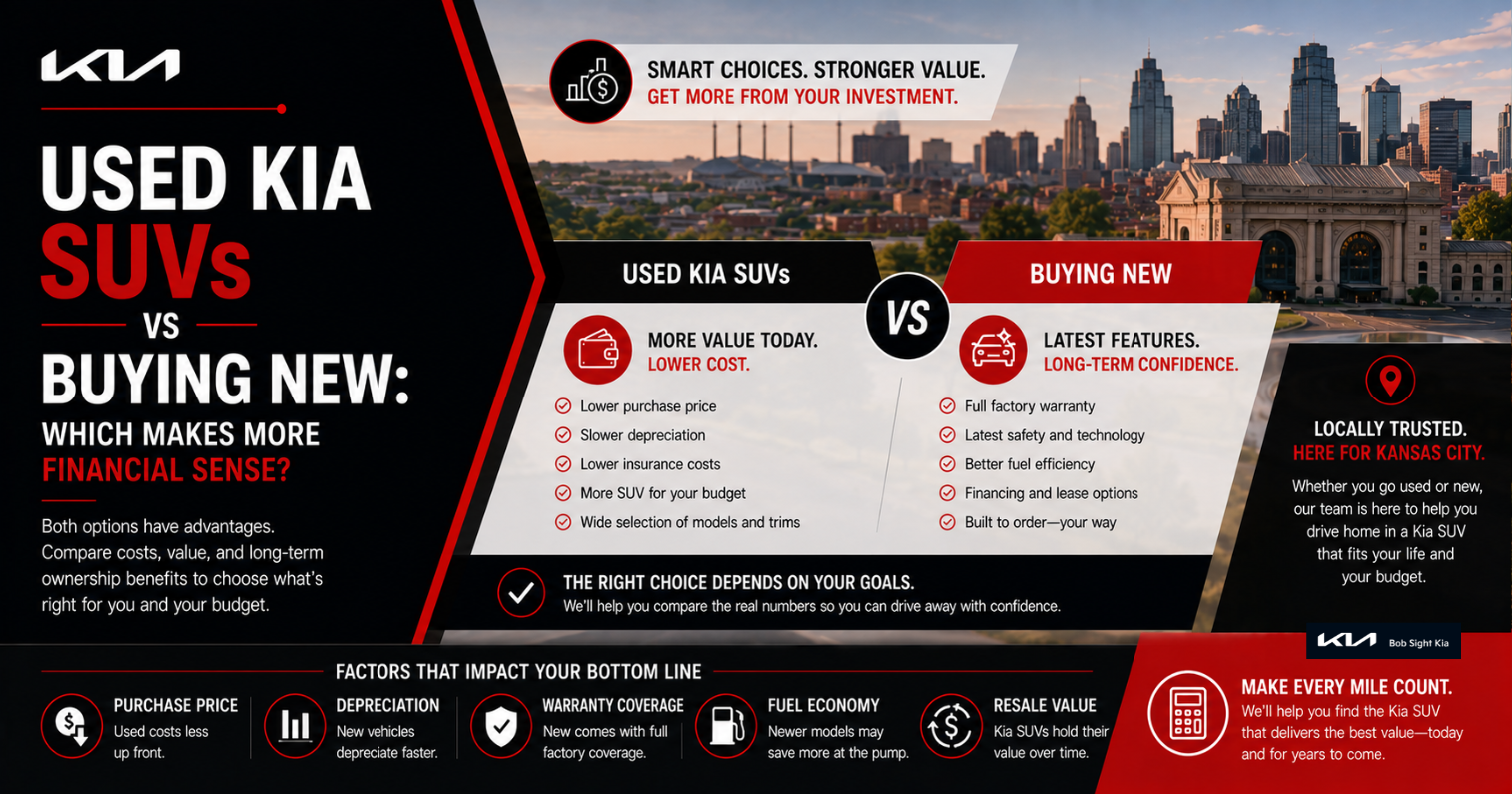
Bob Sight Kia comparison graphic explaining the differences between buying a used Kia SUV and purchasing a new Kia SUV, highlighting ownership costs, depreciation, warranty coverage, fuel economy, resale value, and long-term financial benefits for Kansas City area drivers.

Used Kia SUVs vs Buying New: Which Makes More Financial Sense?

Bob Sight Kia in Independence, MO breaks down whether buying a used Kia SUV vs buying new makes more financial sense for Kansas City metro area drivers. Navigating vehicle acquisition costs in Eastern Jackson County requires evaluating initial purchase pricing, long-term vehicle depreciation, interest rate structures, warranty coverage, and monthly ownership expenses. Whether you are commuting daily down Interstate 70, running family carpools through Lee's Summit and Blue Springs, or taking weekend trips across Jackson County, choosing between a brand-new Kia crossover and a pre-owned or Certified Pre-Owned (CPO) model impacts your household budget. Our local dealership provides transparent financial insights to guide your decision.

Explore Pre-Owned Kia SUV Inventory in Independence MO

In This Guide You'll Learn

Here is what you will discover in this comprehensive financial analysis comparing new Kia SUVs against pre-owned models:

  • How vehicle depreciation rates impact total long-term ownership costs during the first five years.
  • Why Kia Certified Pre-Owned (CPO) models offer the ideal middle ground with factory warranty reinstatements.
  • How financing interest rates, loan term lengths, and monthly payment structures differ between new and used SUVs.
  • Comparing auto insurance premiums, state vehicle taxes, and registration fees between new and pre-owned crossovers.
  • A step-by-step walkthrough on how to calculate your total cost of ownership before making a purchasing decision.
  • A side-by-side comparison matrix evaluating purchase pricing, warranty protection, interest rates, and depreciation.
  • Key FAQs addressing trade-in equity, vehicle history reports, routine maintenance costs, and local Independence service options.

Understanding the Financial Factors: Initial Price, Depreciation, and Value Retention

Understanding key financial factors like initial purchase price, initial depreciation, and value retention helps Kansas City drivers determine whether a new or used Kia SUV fits their budget best. Purchasing a vehicle represents one of the largest financial investments a household makes. Evaluating how a crossover retains its monetary value across 36 to 60 months of daily driving reveals significant differences in long-term capital retention.

Brand-new Kia SUVs, such as the Sportage, Sorento, Telluride, or all-electric EV9, offer zero-mile condition, custom factory order choices, the latest digital infotainment displays, and pristine mechanical hardware. However, new vehicles experience their highest rate of financial depreciation during the first two to three years of ownership. A new car typically loses approximately 15 percent to 20 percent of its market value within its first year on the road, tapering off into a more gradual depreciation curve thereafter.

Conversely, purchasing a pre-owned Kia SUV allows buyers to bypass that steep initial depreciation drop entirely. When you buy a two- or three-year-old pre-owned crossover, the previous owner has already absorbed the initial value decline. This lower initial purchase price allows budget-conscious shoppers in Independence, Liberty, and Raytown to access higher trim levels, leather upholstery, panoramic sunroofs, and advanced all-wheel-drive systems for the price of a base-tier new model.

Furthermore, Kia crossovers retain strong market demand across the Kansas City metro area due to their reputation for high build quality, top IIHS safety scores, and long-term mechanical reliability. Models like the Telluride and Sorento command high trade-in valuations in the pre-owned market. Understanding how initial purchase discounts offset depreciation helps buyers structure loans that preserve equity over time.

Comparing Financing: Interest Rates, Loan Terms, and Monthly Payment Impact

Comparing financing options reveals that new Kia SUVs often qualify for promotional manufacturer interest rates (APRs), while used Kia SUVs offer lower total principal loan balances. Securing favorable auto financing terms requires balancing the interest rate charged by lenders against the total amount of money borrowed. Evaluating how interest rates and loan principal interact helps you calculate your true monthly payment impact.

New vehicle purchases frequently benefit from special factory-backed financing incentives, such as low APR special financing rates or custom lease programs offered through Kia Finance. For buyers with prime credit profiles, securing a low promotional interest rate on a new Sportage or Sorento reduces the cumulative interest paid over a 48- or 60-month loan term. Low interest rates can sometimes bridge the monthly payment gap between a new vehicle and a slightly cheaper pre-owned car.

On the other hand, pre-owned vehicle loans typically carry slightly higher baseline interest rates from commercial banks and credit unions because used cars carry higher lending risk profiles. However, because the total purchase price (and principal loan amount borrowed) on a used Kia SUV is significantly lower, your total monthly payment amount may still be lower than financing a new model, even with a slightly higher interest rate.

Financial & Ownership AspectBrand-New Kia SUVCertified Pre-Owned (CPO) KiaStandard Used Kia SUV
Initial Purchase PriceFull Manufacturer MSRPDiscounted / Bypassed Initial DropLowest Upfront Purchase Cost
Vehicle Depreciation RateHighest in First 1 to 3 YearsGradual / Stabilized CurveLowest Annual Depreciation Rate
Financing Interest Rates (APR)Lowest (Promotional Rates)Competitive CPO RatesStandard Commercial Used Rates
Powertrain Warranty ProtectionFull 10-Yr / 100k-Mi CoverageReinstated 10-Yr / 100k-Mi Coverage
Auto Insurance PremiumsHigher Replacement Value CostsModerate Insurance PremiumsLowest Monthly Insurance Costs

As shown in the financial comparison table, each purchasing path offers distinct monetary advantages depending on your cash flow priorities. Buyers seeking lower monthly payment obligations and lower total debt exposure often lean toward pre-owned models. Meanwhile, buyers seeking bulletproof factory warranty coverage, zero miles, and low promotional APRs prefer purchasing new. Evaluating these metrics alongside your trade-in equity simplifies your decision.

The Certified Pre-Owned (CPO) Kia Solution: The Financial Sweet Spot

Kia Certified Pre-Owned (CPO) vehicles represent the ideal financial sweet spot by pairing pre-owned pricing with reinstated 10-Year/100,000-Mile Powertrain Limited Warranty protection. Many car shoppers want the financial savings of buying pre-owned but worry about taking on unexpected mechanical repair costs after taking delivery. Kia's factory CPO program eliminates this uncertainty entirely.

To qualify for CPO status, a pre-owned Kia SUV must be a late-model vehicle under six years old with fewer than 80,000 miles, backed by a clean CARFAX Vehicle History Report. Every candidate must successfully pass a comprehensive 165-point mechanical, structural, and cosmetic inspection conducted by factory-trained technicians at Bob Sight Kia. Wear items like brake pads, tires, battery terminals, and engine fluids are reconditioned or replaced using genuine OEM parts.

The primary financial advantage of purchasing a CPO Kia is warranty reinstatement. While standard used cars from third-party dealers lose the original 10-Year/100,000-Mile Powertrain Warranty upon resale, a Certified Pre-Owned Kia reinstates the remainder of that full factory powertrain warranty starting from the original in-service date. CPO buyers also receive 12 months or 12,000 miles of Platinum Comprehensive Coverage, 24/7 Roadside Assistance, and rental car reimbursement during covered warranty repairs.

For drivers in Blue Springs and Grain Valley, choosing a Certified Pre-Owned Telluride, Sorento, or Sportage means getting a meticulously inspected, warranty-protected crossover at a price point thousands of dollars below original window sticker MSRP. It combines the financial wisdom of bypassing initial depreciation with the peace of mind normally reserved for new car buyers.

Secondary Ownership Costs: Insurance Premiums, Taxes, and Registration Fees

Secondary ownership costs—including auto insurance premiums, state vehicle sales taxes, and annual personal property taxes—are significantly lower on used Kia SUVs than on new models. When calculating total monthly vehicle expenditure, buyers often focus solely on the principal loan payment while overlooking secondary recurring costs. Factoring in secondary operational expenses provides a complete picture of total financial impact.

Auto insurance providers calculate monthly comprehensive and collision premiums based on a vehicle's current actual cash value (ACV) and replacement cost. Because brand-new SUVs carry higher market replacement values and expensive digital glass components, monthly insurance premiums on new vehicles are naturally higher. Insurance premiums on a three-year-old pre-owned crossover are noticeably lower, saving owners hundreds of dollars annually across Jackson County.

State sales tax and annual Missouri personal property taxes also favor pre-owned vehicle buyers. Missouri sales tax is assessed as a percentage of the total vehicle net purchase price (after trade-in credit deductions). Purchasing a pre-owned SUV for $22,000 instead of a new model for $34,000 results in immediate upfront sales tax savings. Furthermore, local personal property tax assessments drop each year as a vehicle ages, lowering annual tax bills in Independence and Lee's Summit.

Routine vehicle maintenance costs represent another secondary expense to consider. While new Kia SUVs require fewer immediate wear-and-tear repairs during their initial years, routine synthetic oil changes and tire rotations remain virtually identical in cost between new and pre-owned models. Purchasing a new or CPO vehicle at Bob Sight Kia includes the option to enroll in value maintenance plans that keep routine service affordable.

Step-by-Step Guide: How to Calculate Your Total Cost of Vehicle Ownership

Calculating your total cost of vehicle ownership requires combining purchase principal, expected loan interest, insurance premiums, personal property taxes, and anticipated maintenance over a 60-month period. Performing a structured financial audit before visiting the showroom prevents budget strain and clarifies which purchasing path fits your household goals. Below is a six-step calculation process recommended by our finance specialists at Bob Sight Kia.

  1. Determine Net Purchase Price After Trade-In Credit: Subtract your current vehicle's trade-in value from the negotiated purchase price of the new or pre-owned SUV using our online value-your-trade tool to establish your base principal.
  2. Calculate Cumulative Loan Interest Charges: Multiply your principal loan balance by your estimated APR across your planned loan term length (e.g., 48 or 60 months) to determine total interest expenses.
  3. Obtain Real-World Auto Insurance Quotes: Contact your auto insurance agent to request exact monthly premium quotes for both the new and pre-owned Kia models you are evaluating.
  4. Estimate Missouri Sales Tax and Registration Fees: Calculate applicable state and local sales tax based on your net purchase price, adding local title and license plate registration charges.
  5. Estimate Annual Personal Property Taxes: Review local Jackson County personal property tax rate schedules based on the assessed valuation of the vehicle age and trim level you are considering.
  6. Sum All Expenses and Divide by Planned Months: Add total principal, loan interest, 5-year insurance totals, taxes, and routine maintenance costs together, then divide by 60 months to establish your true monthly cost of ownership.
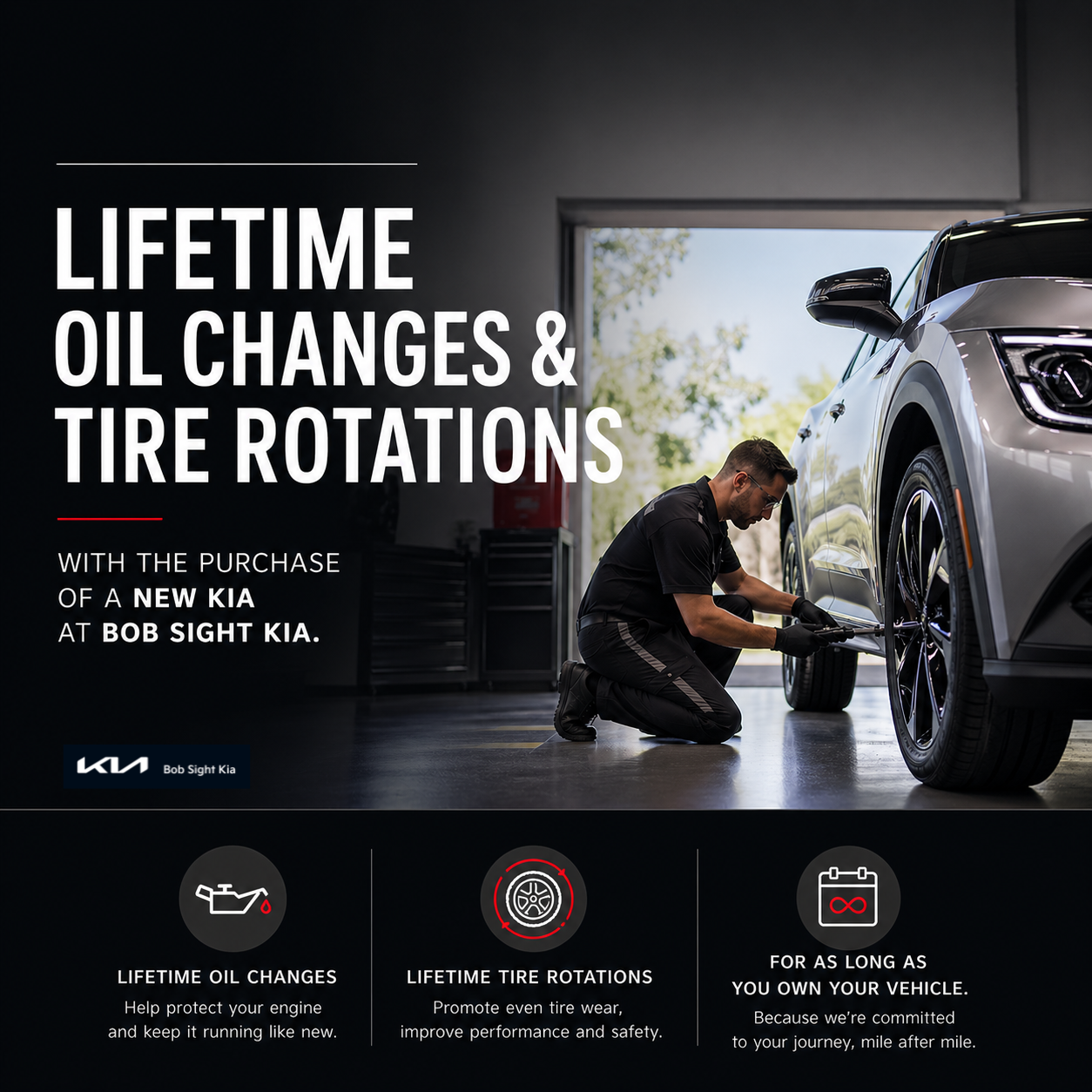
Bob Sight Kia service graphic highlighting lifetime oil changes and tire rotations for drivers in Independence MO

Understanding Automotive Finance Jargon: APR, Equity, CPO, and MSRP

Grasping essential automotive financial and retail terminology empowers buyers to navigate vehicle purchasing and auto loans with total confidence. Technical financial jargon can seem confusing without plain-language explanations. Below are definitions of key financial concepts every Kansas City car buyer should understand before finalizing a purchase.

Annual Percentage Rate (APR): APR represents the annualized cost of borrowing money for an auto loan, expressed as a percentage rate. This rate incorporates the base interest charge along with applicable finance fees, determining the total interest paid over the life of the loan. Securing a competitive APR based on your credit profile significantly lowers your monthly vehicle payment and overall financing costs.

Positive Trade-In Equity: Positive trade-in equity represents the net financial value of your current vehicle when applied toward purchasing another car. It is calculated by taking the current market appraisal value of your vehicle and subtracting any outstanding auto loan balance. If your car is appraised at $15,000 and you owe $10,000 to your lender, you hold $5,000 in positive equity to use directly as a down payment.

Manufacturer's Suggested Retail Price (MSRP): MSRP represents the official base sticker price set by the vehicle manufacturer for a brand-new car before dealer options, taxes, or trade-in credits are applied. Pre-owned and Certified Pre-Owned vehicles are priced based on current fair market valuation rather than original factory MSRP.

Mastering these financial concepts removes ambiguity when finalizing loan paperwork in our finance department. Knowing your trade-in equity in advance allows you to structure down payments that align with your budget. Our experienced finance specialists work with local Midwest banks and credit unions to secure competitive loan terms for drivers across Jackson County.

Step-by-Step Guide: How to Maintain Your Kia SUV to Preserve Resale Equity

Maintaining your Kia SUV to preserve future resale equity requires disciplined synthetic oil changes, regular tire rotations, and keeping complete digital service records at a certified dealership. Protecting your vehicle's mechanical health and physical appearance ensures that it commands maximum trade-in value when you decide to upgrade in the future. Below is a six-step maintenance routine for local vehicle owners.

  1. Schedule Synthetic Engine Oil Changes Every 7,500 Miles: Replace engine oil and filter using full-synthetic 0W-20 or 5W-30 oil meeting API SP standards at Bob Sight Kia to protect internal engine components against thermal breakdown.
  2. Rotate Tires Every 7,500 Miles: Rotate tires front-to-back and cross-wise during oil change appointments to balance out tread wear caused by front-wheel-drive or all-wheel-drive steering forces.
  3. Perform Annual Four-Wheel Alignments: Have certified technicians inspect and adjust wheel alignment yearly to counteract steering pull and uneven tread scrubbing caused by spring potholes along US-50.
  4. Replace Cabin and Engine Air Filters Annually: Swap out dirty cabin and engine air filters every 15,000 miles to preserve HVAC cooling airflow, prevent cabin odors, and protect engine fuel efficiency.
  5. Clean Undercarriage to Remove Road Salt in Winter: Wash vehicle wheel wells and underbody components thoroughly after snowstorms to remove corrosive road salt and liquid de-icing brine used on I-70.
  6. Keep Complete Digital Service Records at Bob Sight Kia: Maintain complete service records at our authorized dealership to provide verified proof of meticulous factory care, commanding top trade-in valuation down the road.

Quick Facts: Used vs New Kia SUV Financial Comparison

Comparing new and pre-owned Kia SUVs highlights distinct financial advantages in purchase pricing, depreciation, interest rates, and warranty coverage. Summarized below are essential financial benchmarks for Kansas City car shoppers.

  • Depreciation Offset: Buying a 2- to 3-year-old pre-owned Kia SUV bypasses the steepest initial 20% to 30% depreciation curve.
  • CPO Warranty Protection: Kia Certified Pre-Owned models reinstate the remainder of the 10-Year/100,000-Mile Powertrain Limited Warranty.
  • Promotional Financing Deals: Brand-new Kia SUVs frequently qualify for factory-subsidized low APR special financing rates.
  • Secondary Cost Savings: Pre-owned Kia SUVs carry lower monthly auto insurance premiums and lower Missouri personal property taxes.
  • Lifetime Maintenance Savings: Qualifying new and pre-owned purchases at Bob Sight Kia include option programs for covered oil changes and tire rotations.

These key financial metrics demonstrate why both new and pre-owned Kia SUVs represent strong automotive investments. Choosing between them depends on whether your priority is driving a zero-mile car with promotional interest rates or minimizing upfront purchase debt and personal property taxes. Visiting our dealership allows you to review financial figures transparently for both options.

Ownership Planning: Long-Term Reliability, Warranty Protection, and Dealership Care

Long-term ownership success relies on choosing a vehicle backed by comprehensive warranty coverage and maintaining complete service records at an authorized dealership. Purchasing a crossover is a significant financial investment intended to serve your household for many years. Partnering with a factory-certified dealership ensures your vehicle remains dependable while protecting its future trade-in value.

Kia's 10-Year/100,000-Mile Powertrain Limited Warranty provides unmatched financial peace of mind on new and CPO models, covering critical engine, transmission, and drivetrain components against unexpected factory defects for a decade. Combined with a 5-Year/60,000-Mile Basic Warranty and 5-Year/Unlimited-Mileage 24/7 Roadside Assistance, Kia surrounds your family with complete protection across Missouri.

Maintaining your vehicle at Bob Sight Kia's certified service center ensures that all service work is performed by factory-trained technicians using genuine OEM Kia replacement parts. Keeping complete digital service records at an authorized facility preserves full warranty protection and commands a premium price when you eventually trade in your vehicle. Potential pre-owned buyers value documented dealership care above all else.

For drivers who purchase a vehicle at Bob Sight Kia, our exclusive lifetime oil changes and tire rotations program delivers incredible ongoing savings. Covered oil changes and tire rotations eliminate out-of-pocket routine maintenance expenses, making it easy to keep your vehicle running at peak efficiency. This valuable program reinforces our commitment to supporting local families throughout their entire ownership journey.

Frequently Asked Questions

Does it make more financial sense to buy a new or used Kia SUV in Independence, MO?

Whether buying a new or used Kia SUV makes more financial sense depends on your individual priorities regarding initial purchase price, monthly debt exposure, financing interest rates, and desired warranty protection. Buying used or Certified Pre-Owned (CPO) makes superior financial sense if your goal is to minimize initial purchase debt, bypass steep first-year depreciation, and pay lower monthly auto insurance premiums and Missouri personal property taxes.

On the other hand, buying a brand-new Kia SUV makes financial sense if you plan to keep the vehicle for ten or more years, want zero miles with pristine mechanical condition, and qualify for promotional low APR financing rates through Kia Finance. Low new-car interest rates can sometimes offset the higher purchase price over a 60-month loan term.

Visiting Bob Sight Kia in Independence, MO allows you to review side-by-side payment quotes, trade-in valuations, and financing terms for both new and pre-owned inventory. Our finance team delivers transparent breakdowns so you can choose the exact option that aligns with your household budget.

What is the financial advantage of buying a Certified Pre-Owned (CPO) Kia SUV?

The primary financial advantage of buying a Certified Pre-Owned (CPO) Kia SUV is obtaining pre-owned pricing that bypasses initial depreciation while receiving a factory-reinstated 10-Year/100,000-Mile Powertrain Limited Warranty. Standard used cars lose their 10-year factory powertrain warranty upon resale, leaving buyers vulnerable to unexpected repair costs unless they purchase expensive third-party service contracts.

A CPO Kia includes the reinstated factory powertrain warranty, 12 months or 12,000 miles of Platinum Comprehensive Coverage, 24/7 Roadside Assistance, and a complimentary CARFAX Vehicle History Report. Every CPO Kia must also pass a rigorous 165-point mechanical inspection by factory-certified technicians before being offered for sale.

Choosing a CPO Telluride, Sorento, or Sportage gives you the monetary savings of buying pre-owned alongside the bulletproof mechanical security normally reserved for new car buyers. It represents one of the smartest value strategies in the automotive market today.

How does trading in my current car affect the purchase of a new or used Kia SUV?

Trading in your current car reduces the total net purchase price of your new or used Kia SUV, which lowers your total loan principal, monthly payments, and Missouri state sales tax liability. When you trade in a vehicle at Bob Sight Kia, our team conducts an in-person physical appraisal to provide a firm, competitive real-market trade offer.

In Missouri, state sales tax is calculated on the net purchase price after deducting your trade-in allowance. For example, if you purchase a pre-owned SUV for $25,000 and receive $10,000 for your trade-in car, you only pay sales tax on the remaining $15,000 balance. This tax credit saves you hundreds of dollars in upfront vehicle acquisition costs.

Local drivers can receive an instant estimated trade-in appraisal online using our secure value-your-trade tool. Applying positive trade equity toward your next purchase lowers your monthly financing costs and protects your budget against loan-to-value imbalances.

How does the Kia 10-Year/100,000-Mile Warranty protect my financial investment?

The Kia 10-Year/100,000-Mile Powertrain Limited Warranty protects your financial investment by eliminating out-of-pocket repair costs for major engine, transmission, and drivetrain failures for ten full years or 100,000 miles. Engine and transmission rebuilds can cost thousands of dollars out of pocket on non-warranted vehicles. Having factory warranty coverage provides complete financial predictability for household budgets.

In addition to powertrain coverage, new Kia vehicles include a 5-Year/60,000-Mile Bumper-to-Bumper Limited Warranty covering electrical systems, air conditioning, audio hardware, and suspension components. Complimentary 24/7 Roadside Assistance is also included for five years with unlimited mileage, offering flat tire changes, battery jump-starts, and emergency towing across Missouri.

Having long-term warranty protection ensures your daily transportation remains secure without sudden maintenance stress. Bringing your vehicle to Bob Sight Kia for certified service keeps all warranty conditions active while preserving maximum trade-in value. This bulletproof coverage allows parents to focus on family life with complete peace of mind.

Why Buying at Bob Sight Kia Matters for Kansas City Drivers

Purchasing and servicing your vehicle at Bob Sight Kia in Independence, MO ensures personalized customer care, factory-certified technical support, and long-standing community commitment. Choosing a local, family-owned dealership guarantees that your crossover is supported by certified specialists who understand the exact engineering specifications of your Kia model. Our state-of-the-art facility features specialized diagnostic equipment, genuine OEM parts, and factory-trained staff dedicated to keeping your family safe on the road.

Unlike distant online car sellers or third-party auto retailers, Bob Sight Kia provides ongoing support throughout your entire ownership journey. When your Sportage, Sorento, or Telluride requires routine synthetic oil changes, tire rotations, software updates, or state safety inspections, our service department provides fast, transparent care. We offer comfortable customer lounges with complimentary Wi-Fi and shuttle services to make service visits easy for busy parents in Independence, Blue Springs, and Lee's Summit.

Furthermore, supporting Bob Sight Kia reinvests your dollars directly back into Eastern Jackson County, supporting local employment and community initiatives. Whether you reside in Independence, Lee's Summit, Blue Springs, Liberty, or Raytown, visiting our showroom allows your family to test drive new and pre-owned Kia SUVs, explore trade-in options, and experience premier customer care. Visit Bob Sight Kia today to discover whether buying a new or used Kia SUV makes the best financial sense for your household.

Helpful Links

Explore these essential links on our website to research new and pre-owned Kia SUV inventory, value your trade-in, or schedule a test drive:

PROUD TO BE PART OF THE BOB SIGHT AUTO GROUP

Bob Sight Kia is a proud member of the Bob Sight Auto Group, a family-owned automotive network dedicated to serving drivers across Missouri and Kansas for generations. Grounded in integrity, transparency, and outstanding customer service, our auto group provides comprehensive inventory choices, competitive financing options, and factory-certified service across multiple locations in the region.

Explore our entire dealer group network below:

Posted in:

Related Posts

See what Trust Is Our Tradition means at Bob Sight Kia in Independence, MO, from clear vehicle comparisons and helpful answers to ongoing ownership support.

Trust Is Our Tradition at Bob Sight Kia in Independence, MO

Trust Is Our Tradition: What That Means When You Shop at Bob Sight Kia Browse New Kia Vehicles in Independence, MO At Bob Sight Kia in Independence, MO, “Trust Is Our Tradition” describes the relationship we want to build with you, starting with your first question and continuing through ownership. Shopping for a vehicle involves decisions about transportation, family routines, financing, and maintenance. You deserve clear explanations throughout that process. Whether you are visiting from Blue Springs, Lee’s Summit, Raytown, or another Kansas City Metro community, our goal is to help you understand your options and choose a Kia that fits your life. In This Guide You’ll Learn How listening to your needs creates a more useful shopping experience. What clear communication looks like when comparing Kia vehicles. Why understanding equipment and purchase documents matters. How to prepare for trade-in and financing conversations. What to ask about ownership benefits and maintenance. How a local dealership relationship can support you after delivery. Trust Starts With Listening to What You Need “Trust Is Our Tradition” starts with understanding how you will use your next vehicle. Your daily needs should guide the conversation about models, equipment, and next steps. You may arrive knowing the exact Kia you want, or you may only know what your current vehicle no longer does well. Both are useful starting points. Tell us whether you need easier passenger access, more room for equipment, or a vehicle that feels comfortable during a longer commute. Those details make the discussion more relevant than simply beginning with a list of available features. For example, an Independence driver traveling along Noland Road each morning may prioritize visibility, seat comfort, and straightforward controls. A family coming from Grain Valley may need to check how a stroller fits with the passenger seats in use. Someone replacing a vehicle after many years may want extra time to understand newer technology. Each situation calls for different questions. A helpful shopping conversation also recognizes the difference between a requirement and a preference. Space for your regular passengers may be essential, while a particular interior color may be flexible. Identifying those priorities early gives you a practical way to compare vehicles. It also helps you explain why one option feels more suitable than another. Before visiting Bob Sight Kia, think about what you would change about your current vehicle. Bring those observations into the conversation, even if they seem small. Difficulty reaching a control or loading a weekly grocery order can matter more in daily ownership than an unfamiliar feature name. Trust grows when the discussion stays connected to the life you actually lead. Clear Answers Make Kia Vehicle Comparisons More Useful A trustworthy vehicle comparison explains what each Kia includes and how those differences relate to your priorities. Model names alone do not tell you everything about a specific vehicle. Equipment can vary by model year, trim, package, and individual configuration. A trim is a version within a model lineup with a particular combination of equipment. A package can add a group of features to certain configurations. When a feature matters to your decision, check the window sticker and ask to see it on the actual vehicle. This matters when researching vehicles such as the Kia K4, Sportage, Sorento, Telluride, or Carnival. A model-level description may mention available equipment without saying that every version includes it. Ask whether the Kia you are considering has the feature, how it works, and whether you can try it. That turns a broad advertising statement into information you can use. A Blue Springs shopper comparing two SUVs might find that passenger access matters more than expected. A commuter from Raytown might discover that a different seating position feels better during the test drive. Neither observation is something a specification list can fully answer. Taking time to examine the vehicle helps you compare it against your own needs. Start with our new Kia inventory, then save the vehicles that interest you. Bring questions about equipment that is unclear in the listing. If you are also considering a previously owned vehicle, review its individual condition and history information separately. Clear answers should help you understand the specific vehicle rather than rely on assumptions about the model. A Test Drive Should Help You Answer Real Questions A useful test drive gives you time to evaluate comfort, visibility, controls, and everyday practicality. It should help you decide whether the vehicle works for you. Begin while the Kia is parked. Adjust the seat and mirrors, check how comfortably you reach the controls, and make sure you understand the basic driving functions. Ask for a demonstration before trying unfamiliar technology. Learning the layout first lets you give the road your attention once the drive begins. Think about the conditions you encounter regularly around Independence. You may spend time in traffic near Independence Center, park in a narrow garage, or carry passengers on weekend outings. Explain those needs when discussing the test drive. Ask what route is available and use the opportunity to observe the vehicle in ordinary driving situations. Passenger and cargo checks are useful before or after the drive. Sit in the seats your household expects to use and examine how easily people can enter and exit. Bring measurements for larger items or test their fit when practical. A vehicle that looks right online still needs to work for the people and belongings you transport. Adjust the driver’s position and confirm comfortable access to important controls. Ask for an explanation of unfamiliar features before driving. Observe visibility, seating comfort, and the driving experience on the available route. Check passenger access and cargo space with your normal needs in mind. Review unanswered questions with the team before deciding on the next step. You do not need to remember every detail immediately. Make a few notes after the vehicle is safely parked. Compare your impressions against your original priorities. That helps you make a considered decision based on what you experienced. Understanding the Purchase Matters as Much as Choosing the Vehicle Clear purchase communication means understanding what you are agreeing to before you sign. Questions about documents, optional products, and vehicle details deserve direct explanations. A vehicle purchase can involve several documents with different purposes. Some identify the vehicle and transaction, while others relate to financing or separately selected products. Ask the team to explain any document you do not recognize. Knowing what each agreement does makes the overall process easier to follow. Optional products should also be understood individually. For example, a service contract is a separate agreement describing specified coverage, conditions, and exclusions. It is different from the manufacturer’s warranty and from routine maintenance benefits. Review what a product covers, whether you want it, and the terms that apply before making your selection. If you are comparing qualifying local offers, our Price Match Promise provides published comparison requirements. Review those requirements and bring the complete written offer for the team to examine. The comparison depends on matching vehicle details and meeting the program terms. A screenshot that omits important information may leave questions unresolved. For a shopper visiting from Oak Grove, preparing documents and questions beforehand can make the conversation more focused. Save the listing for the Kia you want and identify any details you need clarified. Read the final documents carefully, even when a topic has already been discussed. Trust is supported by information you can understand and review. Trade-In and Financing Questions Belong in the Conversation You should understand how your current vehicle and any financing agreement fit into the purchase. Preparing a few details beforehand makes these discussions easier to follow. A trade-in is a vehicle you offer as part of a transaction for another vehicle. An appraisal evaluates that vehicle using factors such as mileage, condition, equipment, and market demand. If you have an existing loan, its payoff is a separate consideration. The appraisal and the outstanding loan balance serve different purposes and should be explained clearly. Our trade-in resource gives you a place to begin gathering information. Provide accurate details and note known issues with the vehicle. Have your lender information available if a loan remains. Ask what must be verified before a final appraisal or transaction can be completed. Financing involves a borrowing agreement, and approval depends on lender review of your application. Available terms vary with the individual situation. Ask the team to explain the proposed agreement and any unfamiliar wording. You can review our finance department information before visiting. Gather your current vehicle’s mileage and identifying information. Locate ownership documents and lender details, if applicable. Write down questions about the appraisal and any remaining loan. Ask which documents are needed for your financing application. Review each agreement and resolve questions before signing. A Lee’s Summit driver trading a vehicle with an existing loan may need different guidance from a first-time buyer in Sugar Creek. Explain your circumstances early. You do not need to arrive knowing every term. The conversation should help you understand the steps that apply to you. Ownership Planning Begins Before You Drive Home Trust continues when you understand your vehicle, included benefits, and maintenance needs before leaving the dealership. Delivery day is a useful time to establish that foundation. Bob Sight Kia offers lifetime oil changes and tire rotations with new Kia purchases under the program’s terms. Ask how the program works for your purchase, where included services are performed, and how to arrange visits. Keep the written details with your purchase records. Understanding the benefit at the beginning makes it easier to use later. Included oil changes and tire rotations are part of an ownership plan rather than a replacement for all maintenance. Your Kia may need other scheduled services based on its model, age, mileage, and use. The owner’s manual contains vehicle-specific maintenance information. Ask how your driving habits affect the schedule that applies to you. For example, frequent short trips around Jackson County can create a different usage pattern from regular longer highway drives. Describe how you expect to use the vehicle instead of relying only on an annual mileage estimate. Ask about service reminders and where to find the maintenance information. Keep records showing dates, mileage, and completed work. Before driving home, review the controls you expect to use immediately. That may include climate settings, phone connection, lighting, and the location of important vehicle information. If a question comes up later, contact the dealership for guidance. When maintenance is due, our online service scheduler provides a convenient starting point. Quick Facts About Trust Is Our Tradition at Bob Sight Kia “Trust Is Our Tradition” connects the shopping experience with clear information and ongoing local support. These points can help you prepare for your visit to Bob Sight Kia. Our dealership is located at 1700 South Noland Road in Independence, Missouri. Your passenger, cargo, comfort, and driving needs should guide vehicle comparisons. Important equipment should be verified on the specific Kia you are considering. Trade-in appraisals and existing loan payoffs are separate parts of the discussion. New Kia purchases include lifetime oil changes and tire rotations under program terms. Ownership planning includes understanding maintenance, keeping records, and knowing where to ask questions. Whether you are visiting from Independence or traveling from another Kansas City Metro community, bring the questions that matter to you. A useful dealership visit should leave you with a clearer understanding of your options. Frequently Asked Questions About Shopping at Bob Sight Kia What does Trust Is Our Tradition mean at Bob Sight Kia? “Trust Is Our Tradition” expresses Bob Sight Kia’s commitment to relationships built on clear communication and ongoing support. During shopping, that starts with understanding your needs. It continues through vehicle comparisons and purchase discussions. You should understand the information that affects your decision. Trust becomes practical when you can ask questions about equipment or documents. Ask for demonstrations and explanations whenever something is unclear. Confirm important details on the specific vehicle. Keep the written information that applies to your purchase. For Independence shoppers, the relationship can continue through maintenance and ownership questions. You may need help finding a setting or arranging a service visit. A local point of contact makes those conversations easier to begin. That ongoing connection gives the phrase meaning beyond delivery day. Can I visit Bob Sight Kia if I am still researching? Yes, you can contact or visit Bob Sight Kia while you are still comparing vehicles. You do not need to know the exact trim before asking questions. Explain what you need from your next vehicle. The discussion can begin with your daily routine. Research is often more useful when you combine online information with an in-person check. Seat comfort and cargo access are difficult to judge from photographs alone. Save a few listings before visiting. Confirm availability if you want to examine a particular vehicle. A Blue Springs family might need to compare passenger space before narrowing its options. A Raytown commuter might want to try different seating positions. Those are reasonable reasons to visit during research. Bring your priorities so the conversation stays focused. What should I bring when shopping at a Kia dealership near me? Bring your questions, saved vehicle listings, and any information relevant to a planned trade-in. Contact the dealership to confirm what is needed for a test drive or transaction. Requirements can depend on what you intend to complete. Preparing helps you use the visit effectively. If you plan to trade a vehicle, gather its mileage and ownership information. Have lender details available if an existing loan remains. Bring a qualifying written competing offer if you want it reviewed. Keep your questions organized by vehicle, trade-in, and financing. For a shopper traveling from Grain Valley, confirming vehicle availability can prevent an unnecessary trip. Let the team know which models you want to compare. Mention practical checks such as cargo fit or passenger access. Those details help shape a more useful visit. How does Bob Sight Kia support owners after the purchase? Bob Sight Kia provides a local resource for service scheduling and questions about your vehicle. New Kia purchases also include lifetime oil changes and tire rotations under program terms. Review those details during the purchase. Keep them accessible for future reference. Your owner’s manual remains important throughout ownership. Use it to locate model-specific information and maintenance requirements. Keep service records and note questions as they arise. Contact the dealership when you need help understanding the next step. A Kansas City Metro owner may have different needs as driving habits change. A new commute or a change in household routines can affect vehicle use. Share those changes when discussing maintenance. Ongoing communication helps keep ownership planning relevant. Shop at Bob Sight Kia With Your Questions Welcome At Bob Sight Kia in Independence, “Trust Is Our Tradition” means making clear communication part of the entire customer relationship. Your questions help guide that relationship from the start. Begin with the vehicle needs you know and the decisions you still want help understanding. Compare the actual equipment, take a purposeful test drive, and review the documents that apply to your purchase. Ask how included benefits work and how to arrange future service. Each step helps you move forward with useful information. Whether your daily drive takes you along Truman Road, across Independence, or between surrounding communities, your next Kia should fit that routine. Our team is here to discuss your options and help you understand the details. Explore our inventory and bring your questions to Bob Sight Kia. Trust starts with that conversation and continues through ownership. Helpful Links Browse New Kia Vehicles at Bob Sight Kia Review Our Price Match Promise Prepare for Your Trade-In Explore Financing Information Schedule Kia Service in Independence Proud to Be Part of the Bob Sight Auto Group Bob Sight Kia serves Independence, Missouri, and the Kansas City Metro as part of the Bob Sight Auto Group. Our dealership family includes Ford in Lee’s Summit, Kia in Independence, and Honda and Chrysler Dodge Jeep Ram in Lawrence, Kansas. Bob Sight Collision Center also serves Lee’s Summit and surrounding communities. Together, these locations connect local drivers with vehicle shopping and automotive support. Bob Sight Kia in Independence, MO Bob Sight Ford in Lee’s Summit, MO Bob Sight Honda in Lawrence, KS Bob Sight Chrysler Dodge Jeep Ram in Lawrence, KS

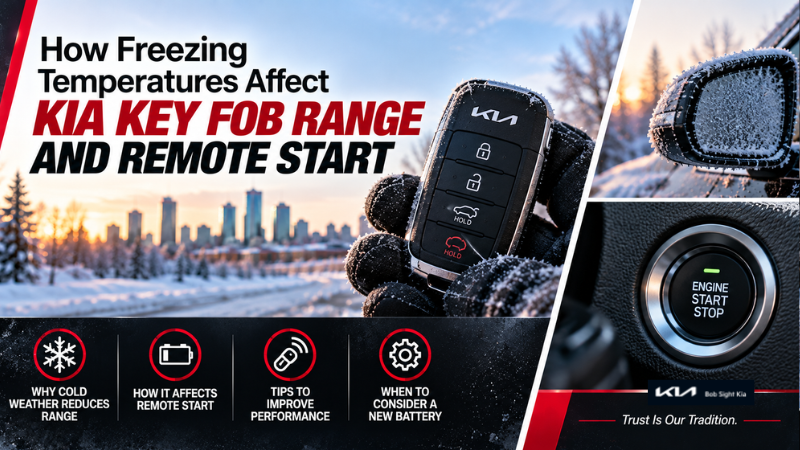
Driver holding Kia smart key fob attempting remote start on a frosty winter morning in Independence MO

How Freezing Temperatures Affect Kia Key Fob Range Remote Start

How Freezing Temperatures Affect Kia Key Fob Range and Remote Start When winter temperatures drop across Jackson County, Kia drivers may notice that their key fob does not respond as consistently as it did during warmer weather. Perhaps the doors unlock only when you stand closer to the vehicle, remote start works intermittently, or your Kia displays a smart key battery warning on a particularly cold morning. For drivers in Independence, Blue Springs, Lee's Summit, and the greater Kansas City metro, these situations can be frustrating when preparing for a winter commute. However, a key fob that responds poorly in freezing weather does not automatically mean the vehicle's receiver or remote-start system has failed. Cold temperatures can affect the performance of small batteries, including the coin-cell batteries used in many Kia smart keys. Winter conditions can also reveal weaknesses in the vehicle's 12-volt battery, while distance, physical obstructions, and electronic interference may influence remote command reception. Understanding these different factors can help you identify whether the concern involves the key fob, the vehicle's electrical system, remote-start operating conditions, or a connected service. At Bob Sight Kia in Independence, Missouri, our service department helps drivers address battery concerns, electrical system problems, and vehicle technology questions. Whether you travel along Interstate 70, Highway 291, or neighborhood streets throughout Jackson County, knowing how your Kia's keyless entry and remote-start features operate can make winter vehicle ownership easier. Schedule Kia Electrical System Service in Independence, MO In This Guide You'll Learn This guide explains the factors that can influence Kia key fob and remote-start performance during freezing weather. Why cold temperatures can reduce the performance of an aging key fob battery How key fob battery condition differs from radio signal transmission Why distance, walls, metal structures, and interference can affect remote commands Which vehicle conditions may prevent remote start from operating How key fob remote start differs from Kia Connect remote services How to identify the correct replacement key fob battery What to do when a Kia smart key battery is depleted Why the vehicle's 12-volt battery matters during winter When professional electrical diagnosis may be necessary The Electrochemistry of Cold Key Fob Batteries One of the most common explanations for reduced key fob performance during cold weather involves the battery inside the remote. Many Kia smart keys use a small lithium coin-cell battery to power their electronic functions. The exact battery type depends on the key design and vehicle application. These batteries generate electrical energy through chemical reactions inside the cell. When temperatures decrease, battery performance can change because the electrochemical processes responsible for delivering current become less effective under certain conditions. Why Cold Temperatures Affect Coin-Cell Batteries A battery's ability to deliver electrical current depends partly on temperature. At lower temperatures, internal resistance may increase, limiting the current available to connected electronic components. This effect can become more noticeable in an aging battery that already has reduced remaining capacity. When you press a button on the key fob, the electronic circuitry requires sufficient electrical power to process the command and operate the transmitter. If the battery cannot deliver the necessary power consistently, the fob may respond intermittently or stop functioning. However, a cold key fob does not necessarily have a permanently damaged battery. Battery performance may improve when the battery returns to a moderate temperature, although warming cannot restore capacity that has already been consumed through normal use. Why an Aging Battery May Show Problems First A relatively healthy key fob battery may continue functioning normally during winter. An older battery with limited remaining capacity may be more sensitive to the additional performance demands associated with low temperatures. Drivers may notice that the remote works reliably indoors but becomes inconsistent after being left in a cold coat pocket or garage. These symptoms can suggest that the battery should be checked or replaced. They do not prove that cold temperature is the only cause. Does Cold Weather Actually Reduce Key Fob Signal Range? Cold weather can indirectly reduce effective key fob range if the battery is unable to provide sufficient power for reliable operation. However, freezing temperatures do not meaningfully slow the radio waves traveling between the key fob and vehicle. The signal travels at essentially the same speed regardless of ordinary winter air temperatures. What may change is the reliability of the transmitter's operation when its power source is weak. There is no universal distance by which a Kia key fob's range decreases in freezing weather. Actual performance depends on the vehicle, remote, battery condition, surroundings, and interference. Should You Keep Your Kia Key Fob Indoors? Storing your key fob in a dry indoor location can help avoid prolonged exposure to extreme temperatures and moisture. It also reduces the chance of leaving the key inside an unattended vehicle. However, indoor storage does not guarantee maximum signal range or eliminate the need for battery replacement. If your key fob repeatedly becomes unreliable, checking the battery is a reasonable first troubleshooting step. How Cold Weather Impacts Radio Frequency Transmission Kia key fobs use wireless communication to send commands to compatible vehicle systems. Depending on the vehicle and function, these systems may involve different radio frequencies, antennas, and communication methods. While key fob batteries can be affected by cold, ordinary freezing weather is not itself a reliable explanation for substantial radio signal loss. Distance Between the Key Fob and Vehicle Remote commands become less reliable as the distance between the transmitter and receiver increases. The maximum operating distance depends on the specific vehicle and key system. If a key fob works near your Kia but not from farther away, distance may be contributing to the problem. A weak battery can also make reliable operation more difficult under marginal conditions. Buildings, Garage Doors, and Metal Structures Physical obstructions can affect wireless communication. Metal garage doors, reinforced building materials, parking structures, and other barriers may reduce signal strength or change how radio waves reach the vehicle. For example, a Kia parked outside a home in Independence may respond differently when the remote is used from the driveway compared with a room separated by several walls. This difference does not necessarily indicate a malfunction. Electronic Interference Wireless devices and nearby electronic equipment can sometimes interfere with keyless entry systems. Interference may be more noticeable in certain parking areas or near equipment that operates on overlapping or related frequencies. If your key fob works normally in most locations but becomes unreliable in one particular parking lot, the surrounding environment may be worth considering. What About Snow and Ice on the Vehicle? Snow, ice, and moisture can affect vehicle components in several ways. However, it is misleading to claim that a normal layer of frost on a windshield will consistently reduce Kia key fob range by a specific amount. Signal behavior depends on the complete environment, including nearby metal surfaces, barriers, transmitter location, and receiver design. When troubleshooting poor range, checking the battery and reducing distance or obstructions is generally more useful than assuming frost is blocking the signal. Practical Ways to Test Key Fob Range If your Kia key fob appears less responsive during winter, try a few basic observations. Test the remote from a shorter distance in a safe location. Compare performance when fewer walls or other barriers separate you from the vehicle. Check whether the problem occurs in multiple parking locations. Look for a low smart key battery warning, if your model provides one. Try a properly functioning spare key, if available. Verify the battery type and replacement procedure in the owner's manual. These observations may help distinguish a weak key battery from an environmental or vehicle-related issue. If the problem continues after replacing the correct battery, further diagnosis may be needed. Why Your Kia Remote Start Might Not Engage A Kia remote-start system may refuse a command even when the key fob itself is functioning. This is because remote start depends on more than wireless communication. The vehicle must also meet the operating conditions established for its particular remote-start system. These conditions vary by model, model year, equipment, and whether the feature uses a factory key fob or a connected service. Low Vehicle Battery Charge Cold weather can reduce the available performance of a vehicle's 12-volt battery. At the same time, starting an internal combustion engine may require more electrical effort in very cold conditions. A weak 12-volt battery can contribute to slow cranking, starting difficulty, or electrical system problems. Some remote-start systems may restrict operation when vehicle electrical conditions do not meet their requirements. However, there is no universal 11.8-volt remote-start cutoff that applies to every Kia. If remote start fails and the vehicle also cranks slowly during normal starting, battery testing may be appropriate. Doors, Hood, and Other Vehicle Conditions Factory remote-start systems may require certain doors, the hood, or other components to be properly secured. The exact requirements depend on the vehicle. A hood switch or other input that reports an open condition may prevent remote-start operation on some models. Drivers should review their owner's manual for the specific operating requirements. Transmission and Vehicle Readiness Conditions Remote-start systems may require the transmission to be in Park and the vehicle to meet other readiness conditions. Some systems also have restrictions involving ignition state, security status, or previous remote-start activity. These are vehicle-specific conditions rather than universal Kia rules. Warning Lights and Diagnostic Faults Certain vehicle faults may interfere with remote-start operation. However, not every illuminated warning light automatically disables every Kia remote-start system. The relationship between diagnostic faults and remote-start availability depends on the vehicle and system design. If a warning light is present, address the underlying vehicle concern rather than assuming the key fob is defective. Fuel Level and Remote-Start Duration Some remote-start systems have fuel-level restrictions or automatic shutoff timers. The exact conditions and duration vary. It is not accurate to assume that every Kia remote-start cycle lasts exactly 10 minutes or that all systems permit the same number of consecutive starts. Consult the owner's manual or the applicable Kia Connect documentation for your vehicle's operating limits. Why Flashing Hazard Lights Are Not a Universal Error Code Some vehicles provide exterior-light feedback when a remote command is received or processed. However, the meaning of a particular flash pattern depends on the vehicle and system. Two hazard-light flashes should not automatically be interpreted as proof that the vehicle rejected remote start because of a specific mechanical fault. Use the model-specific operating instructions when interpreting remote-start feedback. What to Check Before Scheduling Service If your Kia remote start is not responding, consider the following: Confirm that your vehicle is equipped with the remote-start feature you are attempting to use. Verify that you are following the correct button sequence or app procedure. Check whether the key fob operates the locks normally. Confirm that the vehicle is parked and secured according to the owner's manual. Review any warning messages or active vehicle concerns. Check the vehicle's 12-volt battery condition if other starting symptoms are present. Review Kia Connect activation and connectivity if using the app. If the issue continues, a professional inspection can help determine whether the concern involves the remote, vehicle battery, control system, or another component. Key Fob Remote Start vs. Kia Connect Smartphone App Some Kia vehicles offer remote-start functionality through the factory key fob, Kia Connect, or both. These systems use different communication methods and may have different requirements. Availability depends on the vehicle's model, model year, equipment, market, and connected-service eligibility. How Key Fob Remote Start Works Factory key fob remote start sends a wireless command directly from the remote to the vehicle. The command must be received successfully, and the vehicle must meet the conditions required for remote starting. Because this method uses direct radio communication, operating distance and surrounding obstructions matter. A key fob with a weak battery may also respond inconsistently. Key fob remote start does not inherently require a smartphone or cellular service. How Kia Connect Remote Start Works On compatible vehicles with eligible and active Kia Connect services, a smartphone app may allow the driver to request certain remote vehicle functions. Instead of relying on direct short-range communication from a key fob, the app sends commands through connected services and the vehicle's supported communication system. Successful operation depends on factors such as account status, service availability, network connectivity, and vehicle readiness. Remote commands may not work if the vehicle is outside supported coverage, has insufficient electrical power, or does not meet the required operating conditions. Kia Connect is not universally available on every Kia model, and feature availability can change based on the vehicle and service arrangement. Can Kia Connect Preheat the Cabin? Some compatible Kia vehicles support remote climate-related functions through Kia Connect. Available controls may include climate settings or other comfort features, depending on the model and equipment. However, not every vehicle supports remote heated-seat activation, rear defroster control, or the same climate customization options. Drivers should check the features available for their specific Kia rather than assuming all connected vehicles provide identical controls. Which Remote-Start Method Is Better in Winter? Neither method is universally more reliable in every situation. Key fob remote start may be convenient when the vehicle is nearby and direct radio communication is available. Kia Connect may offer additional convenience on supported vehicles when the connected service and network conditions are functioning. Both methods still depend on the vehicle being capable of completing the requested operation. A weak vehicle battery or unmet operating condition may affect either method. Step-by-Step: Replacing a Kia Key Fob Battery and Handling a Depleted Smart Key A weak key fob battery is often a relatively straightforward issue to investigate. However, Kia has used different key designs across its vehicle lineup. The correct battery, mechanical key access method, and backup starting procedure depend on the specific vehicle. Step 1: Identify Your Kia Key Fob Design Before opening the remote, review the owner's manual for your vehicle. Identify whether your key is a conventional remote, a smart key, or another supported design. Some Kia keys contain a removable mechanical key blade. Others have different access or emergency operation procedures. Step 2: Verify the Correct Battery Type Many automotive smart keys use lithium coin-cell batteries, including common types such as CR2032 or CR2025. However, these batteries are not interchangeable in every application. Use the battery type specified for your particular key. Do not select a replacement based only on the assumption that all Kia smart keys use the same battery. Step 3: Open the Key Fob According to the Manual Some key fobs have a release mechanism for the mechanical key and a designated opening point for the battery compartment. Follow the owner's manual instructions to avoid damaging the housing, internal contacts, or seals. Do not force the casing open or use excessive pressure against the circuit board. Step 4: Install the New Battery Correctly Remove the old battery according to the specified procedure. Install the replacement with the polarity indicated by the battery holder or manufacturer's instructions. Do not assume that the positive side faces upward in every key design. Avoid bending the battery contacts or contaminating the interior of the remote. Keep loose coin-cell batteries away from children and pets. Swallowed button or coin batteries can cause severe internal injuries and require immediate emergency medical attention. Step 5: Test the Remote After reassembling the key, test the lock and unlock functions in a safe location. If the vehicle supports key fob remote start, test that feature according to the owner's manual. If the key still behaves inconsistently, verify that the battery was installed correctly and that the replacement matches the required specification. Continued problems may require further diagnosis. Step 6: Use the Mechanical Key if Supported Some Kia smart keys include a mechanical key blade that can be used to unlock the driver's door when the electronic remote is unavailable. The location of the lock cylinder and the method of accessing it vary by vehicle. Follow the model-specific instructions rather than forcing a door handle cover or lock mechanism. Step 7: Follow the Correct Backup Starting Procedure Some Kia push-button-start vehicles provide a backup method for recognizing a smart key with a depleted battery. Depending on the model, this may involve positioning the smart key against the Engine Start/Stop button or following another specified procedure. This feature should not be described as universal NFC operation across every Kia. The vehicle's actual backup recognition method depends on its smart key system. Follow the owner's manual for the exact procedure, including any required brake pedal or transmission conditions. If the vehicle does not recognize the key using the documented method, professional assistance may be needed. Quick Facts: Winter Kia Key Fob and Remote Start Essentials Cold Battery Performance: Low temperatures can reduce the current available from an aging coin-cell battery. Signal Speed: Freezing temperatures do not meaningfully slow the radio waves used by the key fob. Operating Range: Distance, barriers, interference, and battery condition can influence remote reliability. Battery Type: Verify the correct coin-cell battery for your particular Kia key. Remote Start: Operating requirements and automatic shutoff behavior vary by model and system. Kia Connect: Remote services require compatible equipment, eligibility, activation, and supported connectivity. Backup Starting: Some Kia vehicles provide a method for recognizing a smart key with a depleted battery. Vehicle Battery: Cold weather can expose weakness in the vehicle's 12-volt electrical system. Professional Diagnosis: Persistent remote-start problems may require testing beyond a simple key fob battery replacement. Winter Electrical Readiness for Kia Owners Preparing your Kia for cold weather involves more than checking the battery inside the key fob. The vehicle's electrical system, starting performance, and available remote features all play a role in winter convenience. A practical maintenance approach can help you identify potential concerns before they interfere with daily transportation. Check Your Vehicle's 12-Volt Battery Condition Cold temperatures can reduce the available output of a vehicle's 12-volt battery. For gasoline-powered vehicles, a weak battery may contribute to slow engine cranking or starting difficulty. Hybrid and electric vehicles may use different electrical architectures and starting or readiness procedures, so battery concerns should be evaluated according to the specific model. If your Kia has experienced slow starts, repeated electrical warnings, or unexplained power problems, battery and electrical system testing may be appropriate. Understand What Battery Testing Can Reveal Depending on the vehicle and symptoms, technicians may evaluate battery condition, charging performance, electrical connections, and relevant diagnostic information. For applicable conventional starting batteries, testing may include an assessment of available starting capability. The exact procedures depend on the vehicle's electrical system. A battery test can help identify certain weaknesses, but no single test guarantees that a battery will never fail in the future. Review Your Kia's Remote-Start Instructions Before winter arrives, review the remote-start procedure for your particular model. Confirm the required button sequence, vehicle conditions, and operating limits. If you use Kia Connect, verify that your account and eligible services are active and that the app is functioning as expected. Knowing the correct procedure can prevent unnecessary troubleshooting when a command is not accepted. Use Remote Start Safely When equipped and used according to the manufacturer's instructions, factory remote start is designed as a vehicle convenience feature. However, remote starting should never be used in an enclosed garage or another poorly ventilated space where exhaust gases could accumulate. Carbon monoxide from an internal combustion engine can be deadly. Always follow the owner's manual and applicable local requirements for idling and remote-start use. Do not assume that prolonged idling is necessary to protect the engine during every cold start. Use the recommended engine oil and follow the manufacturer's operating guidance. Inspect Key Fob Performance Before Severe Cold Arrives If your remote has become less responsive, replacing its battery with the correct type may be a useful preventive step. However, there is no universal requirement to replace every Kia key fob battery annually. Battery life varies based on the key design, usage, storage conditions, and battery characteristics. Pay attention to reduced operating range, intermittent response, or a low key battery message if your model provides one. When to Request Professional Diagnosis If a new, correctly installed key fob battery does not resolve the problem, the concern may involve the remote itself, vehicle receiver, electrical system, software, or remote-start operating conditions. A service appointment can help determine which components or systems need further evaluation. Bob Sight Kia serves drivers throughout Independence, Blue Springs, Lee's Summit, Raytown, Sugar Creek, Grain Valley, Liberty, and the greater Kansas City metro. Drivers can review available offers through the Bob Sight Kia Service Specials page. Frequently Asked Questions About Kia Key Fobs and Remote Start in Cold Weather Why does my Kia key fob work up close but fail from my front porch in winter? If your Kia key fob works only when you stand closer to the vehicle, a weak coin-cell battery is one possible explanation. Cold temperatures can reduce the available performance of an aging battery, making intermittent operation more noticeable. Distance, building materials, metal garage doors, and electronic interference may also affect communication. Start by checking the correct battery type and replacement procedure for your key. If replacing the battery does not improve operation, compare performance in different locations and consider professional diagnosis. Do not assume that frost on the windshield is the primary reason the signal is not reaching the vehicle. Will remote starting my Kia in winter damage the engine or battery? Factory remote start is intended to operate within the conditions established by the vehicle manufacturer. Using the feature according to the owner's manual does not inherently mean the engine or battery will be damaged. However, remote start does not eliminate the importance of proper maintenance, a healthy vehicle battery, or the correct engine oil. Repeated or prolonged idling can consume fuel and may be subject to operating restrictions or local regulations. Follow the vehicle's instructions rather than relying on a universal three-minute or five-minute warm-up requirement. Never remote start an internal combustion engine in an enclosed garage or poorly ventilated area. Why do my Kia's hazard lights flash without the engine starting? Exterior-light flashes may indicate that the vehicle received or processed a remote command. However, the meaning of a particular flash pattern depends on the Kia model and remote-start system. Two flashes do not universally identify a failed remote-start attempt or a specific mechanical problem. Check that you are using the correct remote-start procedure and that the vehicle meets the operating conditions listed in the owner's manual. If the problem continues, a service inspection may help identify whether the concern involves vehicle readiness, electrical power, or another system. Can I leave my Kia key fob inside my cold car overnight? Leaving a key fob inside a vehicle is generally not recommended because it can create security concerns. Depending on the vehicle, an interior smart key may also affect locking behavior or key-detection functions. However, it is not accurate to claim that every Kia continuously drains its 12-volt battery whenever a smart key is left inside. Cold storage can temporarily affect coin-cell battery performance, but it does not automatically cause rapid permanent battery depletion. Keep your key in a secure, dry location and follow the vehicle's security guidance. How do I know if my Kia key fob battery is dying before winter arrives? Possible signs of a weakening key fob battery include reduced operating range, inconsistent lock or unlock response, or the need to press buttons more than once. Some Kia models may also display a low smart key battery message. These symptoms are not exclusive to battery problems, but they provide a reason to check the battery. Verify the correct replacement type and follow the instructions for your key design. If the symptoms remain after a correct battery replacement, additional diagnosis may be needed. Does my Kia key fob use a CR2032 battery? Some Kia key fobs use CR2032 lithium coin-cell batteries, while other key designs may require a different battery. The correct type depends on the vehicle and remote. Consult your owner's manual or the battery identification inside the key compartment before purchasing a replacement. Do not assume that CR2032 and CR2025 batteries are interchangeable simply because they have similar names. Can I start my Kia if the smart key battery is completely dead? Some Kia vehicles with push-button start provide a backup smart-key recognition procedure that can work when the key's coin-cell battery is depleted. Depending on the model, this may involve using the smart key to press or contact the Engine Start/Stop button. However, the exact procedure varies, and it should not be assumed to apply to every Kia. Refer to your vehicle's owner's manual for emergency entry and starting instructions. If the documented procedure does not work, professional assistance may be necessary. Why does Kia Connect remote start work when my key fob remote start does not? On a compatible vehicle, Kia Connect and key fob remote start may use different communication paths. The key fob sends a direct wireless command to the vehicle, while Kia Connect relies on supported connected services. If the app works but the key fob does not, the issue may involve key fob battery condition, distance, interference, or the remote itself. However, both systems still depend on the vehicle meeting the necessary operating conditions. Feature availability and troubleshooting procedures vary by model. Can a weak 12-volt battery prevent Kia remote start? A weak vehicle battery can contribute to starting difficulties and electrical system concerns. Some remote-start systems may restrict operation when vehicle electrical conditions are outside their requirements. However, no single voltage cutoff applies universally to every Kia remote-start system. If remote start fails and your vehicle also has slow cranking, battery warnings, or other electrical symptoms, arrange battery and electrical system testing. Does every Kia have remote start? No. Remote-start availability depends on the model, model year, trim, equipment, and applicable services. Some vehicles support factory key fob remote start, some support eligible Kia Connect functions, and others may not include the feature. Check your owner's manual, vehicle equipment information, and applicable Kia Connect availability to determine which functions your Kia supports. Schedule Kia Key Fob and Electrical System Service in Independence, MO Freezing temperatures can make an aging key fob battery less reliable, but cold weather is only one possible reason for reduced remote range or remote-start problems. Distance, electronic interference, vehicle electrical condition, operating requirements, and connected-service availability can all influence how these features perform. Understanding the difference between key fob battery problems and vehicle-side concerns can help you avoid unnecessary repairs and identify when professional testing is appropriate. If your Kia repeatedly fails to recognize its smart key, remote start does not operate as expected, or the vehicle shows signs of a weak 12-volt battery, Bob Sight Kia can help you schedule a service appointment. Our dealership serves drivers from Independence, Blue Springs, Lee's Summit, Raytown, Sugar Creek, Grain Valley, Liberty, and surrounding Kansas City communities. Visit Bob Sight Kia at 1700 S Noland Road, Independence, MO 64055, or schedule service online. Schedule Kia Electrical System Service at Bob Sight Kia Helpful Kia Service and Shopping Links Schedule Kia Service in Independence, MO Explore Kia Service Specials Browse New Kia Vehicles Shop Used Vehicles at Bob Sight Kia Value Your Trade Online Proud to Be Part of the Bob Sight Auto Group Bob Sight Kia is proud to be part of the Bob Sight Auto Group, serving drivers throughout Missouri and Kansas with automotive sales and service resources. Whether you are shopping for a new vehicle, exploring pre-owned inventory, or scheduling maintenance, our dealership family is committed to helping drivers find the information and services they need. Bob Sight Kia | Independence, MO Bob Sight Honda | Lawrence, KS Bob Sight CDJR | Lawrence, KS Bob Sight Ford | Lee's Summit, MO Trust Is Our Tradition.

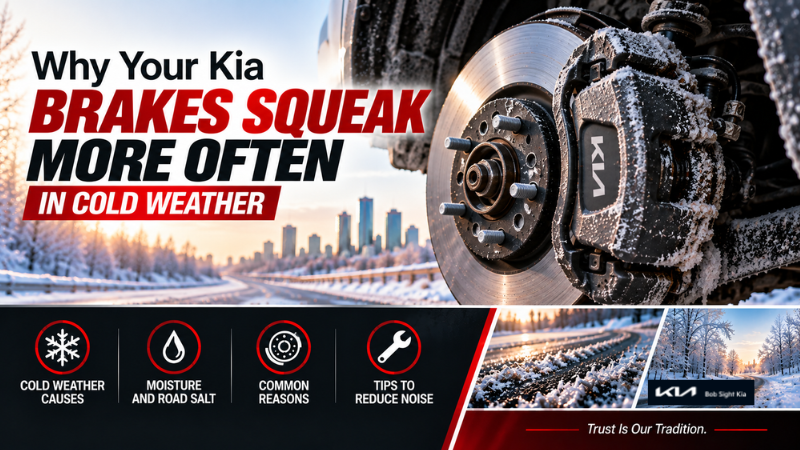
Certified Kia service technician inspecting brake rotor assembly and pads for cold weather squeaking in Independence MO

Why Your Kia Brakes Squeak More Often in Cold Weather: Fixes

Why Your Kia Brakes Squeak More Often in Cold Weather When winter temperatures drop across Jackson County, Kia drivers may begin noticing squeaking, squealing, or other unfamiliar brake noises during their morning commutes. Whether you are leaving your driveway in Independence, traveling through Blue Springs, or heading toward Kansas City on Interstate 70, a change in brake noise can raise questions about your vehicle's condition. Cold weather can influence brake noise in several ways. Moisture may collect on brake rotors overnight, changes in temperature can affect how friction materials behave, and winter road treatments can contribute to corrosion around certain brake components. Some noises are temporary and may disappear as the brakes are used, while others can indicate worn brake pads, sticking hardware, or another condition that needs professional attention. Understanding the difference matters because not every winter brake squeak indicates a mechanical failure, but unusual noises should never be dismissed without considering the circumstances. At Bob Sight Kia in Independence, Missouri, our service department helps local drivers address brake noise, maintenance, and seasonal vehicle concerns. Knowing what causes cold-weather brake squeaking can help you recognize warning signs, communicate symptoms to your service advisor, and make informed decisions about your Kia's braking system. Schedule Kia Brake Service at Bob Sight Kia in Independence, MO In This Guide You'll Learn This guide explores the mechanical and environmental factors that can contribute to brake noise during Missouri winters. How cold temperatures can influence brake friction and vibration Why moisture and overnight surface rust sometimes cause temporary morning brake noise How to distinguish occasional squeaking from symptoms that require inspection Why worn brake pads and brake wear indicators may produce persistent squealing How road salt and corrosion can affect caliper hardware and brake pad movement What Kia owners can safely check before scheduling brake service How ceramic and semi-metallic brake pad formulations differ Why brake fluid maintenance and seasonal inspections matter When professional brake diagnosis is the safest next step The Physics of Cold Weather Brake Noise Brake squeaking is often associated with vibration that develops as brake pads contact a rotating brake rotor. Under certain conditions, these vibrations can produce audible high-frequency sounds. When you press the brake pedal in a conventional hydraulic disc brake system, the caliper applies force to the brake pads. The pads contact the rotor, creating friction that slows the wheel and converts the vehicle's motion into heat. Although this process is straightforward in principle, the interaction between brake pads, rotors, mounting hardware, and other components is mechanically complex. Changes in temperature, moisture, friction material condition, and component movement can all influence the sounds produced during braking. Why Temperature Can Change Brake Noise Materials expand and contract as temperatures change. Their mechanical properties and friction behavior can also vary with temperature. During cold Missouri mornings, the brake pads, rotors, calipers, and mounting hardware may begin operating at temperatures significantly lower than those encountered during warmer weather. These conditions can influence friction characteristics and vibration behavior. However, cold weather does not automatically make every brake pad excessively hard or cause every brake system to squeal. Brake noise depends on the specific pad formulation, rotor condition, component design, hardware condition, and operating circumstances. How Brake Vibration Creates Squealing High-frequency brake squeal can occur when friction-related vibrations excite components within the brake assembly. The resulting sound may be influenced by the pad backing plate, caliper, rotor, shims, mounting hardware, and other parts of the system. Brake manufacturers use component design, material selection, and noise-control features to manage these vibrations. Even so, occasional brake noise can occur under certain operating conditions without automatically indicating a failed component. Persistent or worsening noise requires a different level of attention because it may indicate wear, damage, or improper component movement. Why Morning Braking Can Sound Different When a Kia sits parked overnight in Independence or elsewhere in the Kansas City metro, its brake components are exposed to changing temperatures and environmental moisture. Rain, snow, humidity, and condensation may affect the condition of the rotor surfaces before the vehicle is driven again. As the brakes are applied, the interaction between the pad and rotor may change as surface moisture is removed and operating conditions stabilize. This can explain why some drivers notice a temporary squeak during their first few braking events of the day. However, the absence or disappearance of noise does not confirm that every brake component is in good condition. Flash Rust and Overnight Humidity Buildup One common explanation for temporary brake noise after wet weather involves light surface rust on brake rotors. Many automotive brake rotors are made from cast iron, which can develop visible oxidation when exposed to moisture and oxygen. During winter, rain, melting snow, frost, and road spray can leave moisture on the rotor surface while a vehicle is parked. What Is Flash Rust? Flash rust refers to a thin layer of oxidation that may develop relatively quickly on exposed metal surfaces. On cast-iron brake rotors, this can appear as a light orange or brown discoloration. It may become visible after rain, a car wash, or an overnight period of damp weather. Because brake pads contact the rotor's friction surface during braking, light oxidation on that surface may be removed through normal brake use. Why Surface Rust Can Produce Noise A rotor surface covered with light oxidation may initially interact differently with the brake pads than a clean, dry rotor surface. This can produce temporary scraping, squeaking, or a slightly rough sensation under some conditions. As the pads contact the rotor, the friction surface may become cleaner and the noise may decrease. There is no universal rule that the sound must disappear after two or three stops or within a particular distance. The duration depends on the rotor condition, moisture exposure, braking conditions, and other factors. When Surface Rust Becomes More Concerning Light surface rust is different from substantial corrosion. If a vehicle remains parked for an extended period in wet conditions, corrosion may become more pronounced. Repeated exposure to moisture and road salt can also contribute to corrosion around rotor edges and other areas that do not receive regular contact from the brake pads. More serious rotor deterioration may include pitting, scaling, flaking, or damaged friction surfaces. If brake noise persists, braking feels uneven, or visible corrosion appears substantial, the rotor should be professionally evaluated. Depending on the condition and manufacturer specifications, service may involve additional inspection or component replacement. Normal Cold-Weather Squeaks vs. Mechanical Warning Signs One of the most useful ways to evaluate brake noise is to consider when it occurs, how long it lasts, and whether it is accompanied by other symptoms. A brief squeak after damp overnight parking may have a different explanation from continuous grinding or a noise that grows louder over several days. However, sound alone cannot reliably determine the condition of a braking system. Temporary Noise After Overnight Parking Some drivers notice light squeaking or scraping during initial braking after the vehicle has been parked in wet or cold conditions. If the sound disappears and braking performance otherwise feels normal, temporary moisture-related surface conditions may be involved. Continue paying attention to whether the noise returns, changes, or becomes more pronounced. If you are uncertain about the source, an inspection is appropriate. Persistent High-Pitched Squealing Persistent squealing may be associated with worn brake pads, brake wear indicators, friction material characteristics, or vibration involving brake hardware. Some brake pad designs include mechanical wear indicators that produce noise when the friction material approaches a specified wear condition. However, not every Kia brake assembly uses the same indicator arrangement or activation thickness. It is not accurate to assume that all Kia brake pads begin squealing at exactly 2 millimeters of remaining material. A technician can measure the friction material and determine whether replacement is needed based on the applicable specifications. Grinding or Harsh Metal-to-Metal Sounds Grinding can have several causes, including severe brake pad wear, damaged rotor surfaces, debris, or other mechanical problems. While light surface oxidation may produce temporary rough sounds, loud or persistent grinding should not be treated as normal winter behavior. If you hear harsh grinding, notice reduced braking performance, or experience other serious symptoms, stop driving as soon as it is safe and arrange professional assistance. Brake Pedal Pulsation or Vibration A pulsating sensation during braking may be associated with variations in rotor thickness, uneven friction deposits, rotor condition, or other braking system concerns. Some pedal feedback can also occur during normal anti-lock braking system operation when ABS activates on slippery pavement. These situations should not be confused. Repeated vibration during ordinary braking on dry pavement deserves inspection. Your Kia Pulls While Braking If your vehicle consistently pulls toward one side when you apply the brakes, the cause may involve uneven braking force or another vehicle condition. Possible contributors include a sticking caliper, uneven friction material condition, tire problems, or suspension concerns. Because several systems can produce similar symptoms, professional diagnosis is important. Changes in Brake Pedal Feel A brake pedal that suddenly becomes unusually soft, sinks farther than normal, or produces reduced braking response is a serious warning sign. Possible causes include hydraulic system problems or fluid leakage. If braking performance is compromised, stop in a safe location and arrange towing or other professional assistance rather than continuing a normal drive. The Impact of Road Salt and Winter Deicing Chemicals Winter road treatments can create additional challenges for exposed brake components. During snow and ice events, road crews may apply rock salt, brine, or other deicing products to help manage roadway conditions. As vehicles travel through wet slush, salt-containing spray can reach wheel wells and parts of the braking system. Repeated exposure can accelerate corrosion on susceptible metal components. How Salt Contributes to Brake Hardware Corrosion When salt dissolves in water, the resulting solution can accelerate electrochemical corrosion on exposed metal surfaces. Over time, corrosion may develop around brake caliper brackets, mounting hardware, rotor edges, and other susceptible areas. Protective coatings, component materials, environmental conditions, and maintenance all affect how much corrosion develops. Why Brake Pad Hardware Can Become Restricted Some disc brake assemblies use metal guide clips and mounting surfaces that allow brake pads to move correctly. Corrosion beneath or around these components can reduce clearance and interfere with normal pad movement. This may contribute to brake drag, uneven wear, or noise. In certain situations, expanding corrosion products around mounting hardware are described as rust jacking. Not every squeak during winter is caused by rust jacking, but it is one condition technicians may consider when inspecting sticking brake hardware. How Caliper Slide Pins Can Be Affected Many floating-caliper designs use slide pins to allow the caliper to move as intended. Protective boots and appropriate lubrication help shield these components from contamination. If a boot is damaged or contamination enters the sliding mechanism, corrosion may interfere with movement. A sticking slide pin can contribute to uneven brake pad wear, abnormal heat, or persistent noise. The specific symptoms depend on the brake design and the nature of the fault. Why Washing Helps but Does Not Guarantee Protection Removing accumulated road salt from accessible wheel wells and underbody surfaces can reduce continued exposure. However, washing does not reverse existing corrosion or guarantee that brake components will never bind. Cleaning habits should be combined with appropriate maintenance and inspections. For a more detailed explanation of corrosion, brake lines, rotors, and caliper hardware, see our related guide on how road salt affects Kia brake components during Kansas City winters. Step-by-Step: Winter Brake Inspection and Protection for Kia Owners Kia owners can perform several basic observations without disassembling the braking system. These checks can help identify symptoms that should be discussed with a service professional. Do not attempt brake repairs unless you have the appropriate training, tools, and model-specific service information. Step 1: Park Safely and Allow the Brakes to Cool Park on a level surface and secure the vehicle according to the owner's manual. Allow the wheels and brake assemblies to cool before performing any visual observations. Brake rotors and calipers can become extremely hot during normal driving. Never touch a brake component immediately after driving to determine whether it is overheating. Step 2: Look for Obvious Rotor Damage Where the wheel design allows visibility, look for obvious deep grooves, unusual scoring, or substantial corrosion on the visible rotor surface. Light orange surface rust after wet weather is common on many cast-iron rotors. However, significant pitting, flaking, or other visible deterioration may require inspection. A visual check through wheel spokes cannot establish whether a rotor meets all service specifications. Step 3: Pay Attention to Brake Pad Wear Brake pad thickness is an important maintenance measurement. However, it may be difficult or impossible to evaluate accurately through the wheel openings. The visible portion of a pad may not represent the condition of every pad in the assembly. Professional inspection can include measuring friction material thickness and checking for uneven wear. Follow the applicable Kia specifications rather than assuming every model requires replacement at the same thickness. Step 4: Observe Changes in Brake Noise Make a note of when the noise occurs. Does it happen only after the vehicle has been parked overnight? Does it occur when the brakes are applied or while the vehicle is moving without braking? Does the noise decrease after normal driving? Does it become louder during wet weather? Is it accompanied by vibration, pulling, or changes in pedal feel? These details can help a technician narrow down possible causes. Step 5: Wash Away Accessible Winter Road Residue After substantial road salt exposure, consider washing your Kia when weather conditions make cleaning practical. An underbody rinse may help remove salt residue from accessible areas. Avoid directing concentrated high-pressure spray into brake seals, electrical connectors, or other sensitive components. Do not crawl beneath an unsupported vehicle. Step 6: Avoid Applying Lubricants to Brake Friction Surfaces Never spray penetrating oil, general-purpose lubricant, or grease onto brake rotors or brake pad friction material to silence a squeak. Contaminating braking surfaces can interfere with friction performance. Brake hardware lubrication requires the correct product and application procedure for the specific component. Leave brake disassembly, lubrication, and adjustment to properly equipped service professionals. Step 7: Schedule Service When Symptoms Persist If your Kia develops recurring squealing, grinding, pulling, abnormal vibration, or unusual pedal behavior, arrange a brake inspection. Brake noise may have several causes, and replacing parts based only on the sound may not address the underlying problem. Schedule Kia Brake Inspection and Service Ceramic vs. Semi-Metallic Brake Pads in Midwest Cold Brake pad formulation can influence noise, dust production, wear characteristics, and friction behavior. Two commonly discussed categories are ceramic and semi-metallic brake pads. However, these categories include many different formulations, and performance varies by manufacturer and intended application. How Ceramic Brake Pads Work Ceramic brake pads typically use a ceramic-based friction formulation combined with other materials and reinforcing ingredients. Depending on the product, they may be designed to provide relatively low visible dust and controlled noise characteristics. However, not every ceramic brake pad performs identically. Cold-weather friction behavior depends on the specific formulation and the vehicle's braking system. It is misleading to claim that ceramic pads universally need to warm up before they can provide adequate stopping performance. Brake pads approved for a particular vehicle are intended to operate within the conditions specified for their application. How Semi-Metallic Brake Pads Work Semi-metallic brake pads contain metallic materials as part of their friction formulation. These materials can influence heat transfer, friction behavior, durability, and noise characteristics. Some semi-metallic formulations may produce more visible brake dust or noise than certain ceramic alternatives. However, the results depend on the specific product and operating conditions. Semi-metallic pads are not automatically the best choice for every Kia driven in cold Missouri weather. Does Brake Pad Material Determine Winter Squeaking? Pad material can contribute to brake noise, but it is only one factor. Rotor condition, hardware movement, pad installation, friction deposits, moisture, and brake design also matter. A squeaking brake system should not automatically be treated as evidence that the wrong pad material was installed. Choosing Replacement Brake Pads for Your Kia Replacement brake pads should be selected based on the vehicle's specifications and the intended application. Genuine Kia parts are one option for matching the vehicle's original equipment requirements. Other replacement parts may also be suitable when they meet the applicable specifications and quality requirements. Ask your service advisor about appropriate options for your specific Kia model rather than selecting pads solely on ceramic or semi-metallic labeling. Quick Facts: Cold-Weather Brake Squeak Essentials Temporary Morning Noise: Moisture and light rotor surface rust may contribute to brief squeaking after overnight parking. Brake Vibration: Friction-related vibration is one mechanism that can produce high-pitched brake squeal. Brake Pad Wear: Worn friction material or a mechanical wear indicator may cause persistent noise, depending on the brake design. Road Salt: Salt-containing moisture can accelerate corrosion on susceptible brake hardware. Caliper Movement: Sticking slide pins or pad hardware can contribute to uneven wear, drag, or noise. Grinding Sounds: Loud or persistent grinding should be inspected promptly rather than assumed to be normal. Brake Lubrication: Never apply general-purpose lubricants to rotor or pad friction surfaces. Seasonal Maintenance: Follow the Kia maintenance schedule and address changes in braking behavior as they develop. Winter Brake Maintenance for Long-Term Kia Reliability Winter brake care is most effective when it combines routine maintenance, awareness of changing symptoms, and attention to the conditions your vehicle encounters. For Kia drivers traveling through Independence, Sugar Creek, Grain Valley, Raytown, and the Kansas City metro, repeated exposure to wet pavement, road treatments, and changing temperatures can make seasonal brake maintenance worth discussing during service visits. Review Brake Condition Before Winter Before colder weather arrives, check whether your Kia is due for scheduled maintenance. If you have noticed squealing, vibration, uneven braking, or unusual pedal feel, mention these symptoms when arranging service. Depending on the concern, a brake inspection may include checking pad thickness, rotor condition, visible hardware deterioration, and other relevant components. Understand Why Brake Fluid Maintenance Matters Brake fluid plays an important role in transmitting hydraulic pressure through the braking system. Many automotive brake fluids are hygroscopic, meaning they can absorb moisture over time. Excess moisture can reduce the fluid's boiling performance and may contribute to corrosion within susceptible hydraulic components. However, it is not accurate to assume that ordinary winter temperatures routinely cause moisture pockets in brake fluid to freeze and expand, producing a soft brake pedal. Brake fluid maintenance should follow the schedule and specifications provided for the particular Kia model. Do not assume that every Kia requires a brake fluid flush at the same two-year or three-year interval. Why Professional Brake Inspections Are Useful A professional brake inspection can help identify conditions that may not be visible during a basic driveway check. Depending on the vehicle and symptoms, technicians may evaluate: Brake pad friction material thickness and wear patterns Brake rotor condition and measurements when appropriate Caliper and mounting hardware condition Signs of brake drag or abnormal heat Brake hoses and hydraulic components Visible corrosion or damage Relevant warning indicators or diagnostic information Not every inspection involves complete brake disassembly, lubrication, or testing of every ABS component. The scope of the service depends on the inspection requested, the vehicle, and the symptoms identified. How Winter Driving Habits Affect Brake Safety Proper brake maintenance is important, but stopping performance also depends on tire traction and roadway conditions. Snow, ice, and slush can reduce available grip even when the braking system is functioning correctly. Allow additional following distance, reduce speed when conditions warrant, and avoid abrupt driving inputs on slippery roads. Maintaining the brakes does not eliminate the need to adjust driving behavior for winter conditions. Keep Track of Recurring Symptoms If your Kia squeaks only after rain or overnight parking, make a note of the conditions. If the sound becomes persistent, occurs in dry weather, or is accompanied by vibration or pulling, arrange an inspection. Keeping track of symptoms can make it easier to explain the concern and determine whether it is changing over time. Drivers can also review available maintenance offers through the Bob Sight Kia Service Specials page. Frequently Asked Questions About Kia Brake Squeaking in Cold Weather Why do my Kia brakes squeak only in the morning when it's cold? Temporary morning brake squeaking may be associated with moisture on the rotors, light surface rust, or changes in friction behavior during cold conditions. When a Kia sits parked overnight, condensation, rain, or melting snow can leave moisture on exposed brake surfaces. Many cast-iron rotors can develop a thin layer of surface oxidation in these conditions. During subsequent braking, contact between the pads and rotors may change as the surface condition changes. This can cause a temporary noise in some situations. However, cold weather is not the only possible explanation. Brake pad wear, hardware movement, and other conditions can produce similar sounds. If the noise persists, becomes more pronounced, or occurs with changes in braking performance, schedule an inspection. Can cold weather cause my Kia brake pedal to feel soft or spongy? Cold weather alone should not be assumed to explain a significant change in brake pedal feel. A soft or spongy pedal may indicate air in the hydraulic system, a fluid leak, or another braking system concern. Moisture contamination in brake fluid can affect fluid performance and contribute to certain long-term problems, but it does not provide a reliable explanation for every soft pedal during winter. Corrosion-related brake line damage is another possible concern, although it is not the only cause. If your brake pedal suddenly feels unusually soft, travels farther than normal, or braking response decreases, stop driving as soon as it is safe. Arrange professional assistance or towing rather than attempting to drive carefully to the dealership with potentially compromised brakes. Is it safe to drive my Kia if the brakes squeak continuously? Continuous brake squeaking should not be ignored because it can indicate worn brake pads, a wear indicator contacting the rotor, hardware vibration, or another mechanical issue. However, persistent squeaking does not always mean the friction material has reached a specific thickness or that a caliper has seized. The sound alone cannot establish the cause. If the noise continues during normal driving, arrange a brake inspection promptly. If squeaking is accompanied by grinding, reduced braking response, abnormal heat, pulling, or significant pedal changes, stop driving when safe and seek professional assistance. Will washing my Kia in cold weather stop the brakes from squeaking? Washing can help remove accumulated dirt and road salt from accessible vehicle surfaces. This may reduce continued exposure to corrosive residue. However, washing does not guarantee that brake squeaking will stop. If the noise comes from worn pads, sticking hardware, or another mechanical concern, cleaning the exterior of the vehicle will not correct the underlying problem. Washing can also leave temporary moisture on cast-iron rotors, which may contribute to light surface rust after the vehicle is parked. Choose washing conditions carefully during freezing weather and avoid concentrated high-pressure spray on sensitive brake components. Why do my Kia brakes grind on cold mornings? Moisture-related rotor surface rust may sometimes cause a temporary rough sound during initial braking. However, grinding can also indicate significant brake pad wear, damaged rotors, trapped debris, or another mechanical problem. It is not safe to assume that grinding is harmless simply because it happens during cold weather. If the sound is loud, metallic, persistent, or accompanied by abnormal braking behavior, have the vehicle inspected promptly. Severe grinding or reduced braking performance may require stopping the vehicle and arranging towing. Can road salt cause my Kia brakes to squeak? Road salt can contribute indirectly to brake noise by accelerating corrosion on susceptible metal components. If corrosion interferes with brake pad guides, caliper movement, or other hardware, the braking system may develop noise, drag, or uneven wear. However, road salt is only one possible contributor to winter brake squeaking. A professional inspection can help distinguish corrosion-related concerns from normal surface moisture, worn friction material, or other problems. Do ceramic brake pads squeak less in cold weather? Some ceramic brake pad formulations are designed to provide controlled noise characteristics, but there is no universal guarantee that ceramic pads will be quieter in every cold-weather situation. Noise depends on the complete brake system, including rotor condition, pad formulation, installation, and hardware condition. Likewise, semi-metallic pads are not automatically louder or better suited to every winter application. Choose replacement pads that meet the specifications for your Kia rather than relying only on friction material category. How do I know whether my Kia brake pads need replacement? Brake pad replacement decisions should be based on the applicable vehicle specifications, measured friction material thickness, wear patterns, and overall component condition. Persistent squealing may indicate wear, but it is not a reliable measurement of remaining pad material. A technician can inspect the brake pads and determine whether replacement is recommended. Do not assume that every Kia uses the same wear indicator design or replacement threshold. Should I replace my Kia brake pads just because they squeak in winter? Not necessarily. Some brake noise can occur because of temporary moisture or operating conditions without requiring immediate pad replacement. Other noises may indicate worn friction material, damaged hardware, or a mechanical concern. The appropriate repair depends on the diagnosis. Replacing brake pads without identifying the cause may not resolve the squeaking if the underlying issue involves rotor condition, caliper movement, or another component. Schedule Kia Brake Service in Independence, MO Cold-weather brake squeaking can have several explanations, from temporary moisture-related surface conditions to worn brake pads or mechanical problems. Understanding when the noise occurs, whether it changes during driving, and whether other symptoms are present can help you determine when a professional inspection is appropriate. Persistent squealing, grinding, vehicle pulling, abnormal vibration, and changes in brake pedal feel should not be ignored. Bob Sight Kia serves drivers throughout Independence, Blue Springs, Lee's Summit, Raytown, Sugar Creek, Grain Valley, Liberty, and the greater Kansas City metro. If your Kia's brakes are making unusual noises or you have questions about seasonal brake maintenance, our service department can help you arrange an appointment to have the concern evaluated. Visit Bob Sight Kia at 1700 S Noland Road, Independence, MO 64055, or schedule service online. Schedule Kia Brake Service at Bob Sight Kia Helpful Kia Service and Shopping Links Schedule Kia Brake Service in Independence, MO Explore Kia Service Specials Browse New Kia Vehicles Shop Used Vehicles at Bob Sight Kia Value Your Trade Online Proud to Be Part of the Bob Sight Auto Group Bob Sight Kia is proud to be part of the Bob Sight Auto Group, serving drivers throughout Missouri and Kansas with automotive sales and service resources. Whether you are shopping for a new vehicle, exploring pre-owned inventory, or scheduling maintenance, our dealership family is committed to helping drivers find the information and services they need. Bob Sight Kia | Independence, MO Bob Sight Honda | Lawrence, KS Bob Sight CDJR | Lawrence, KS Bob Sight Ford | Lee's Summit, MO Trust Is Our Tradition.