

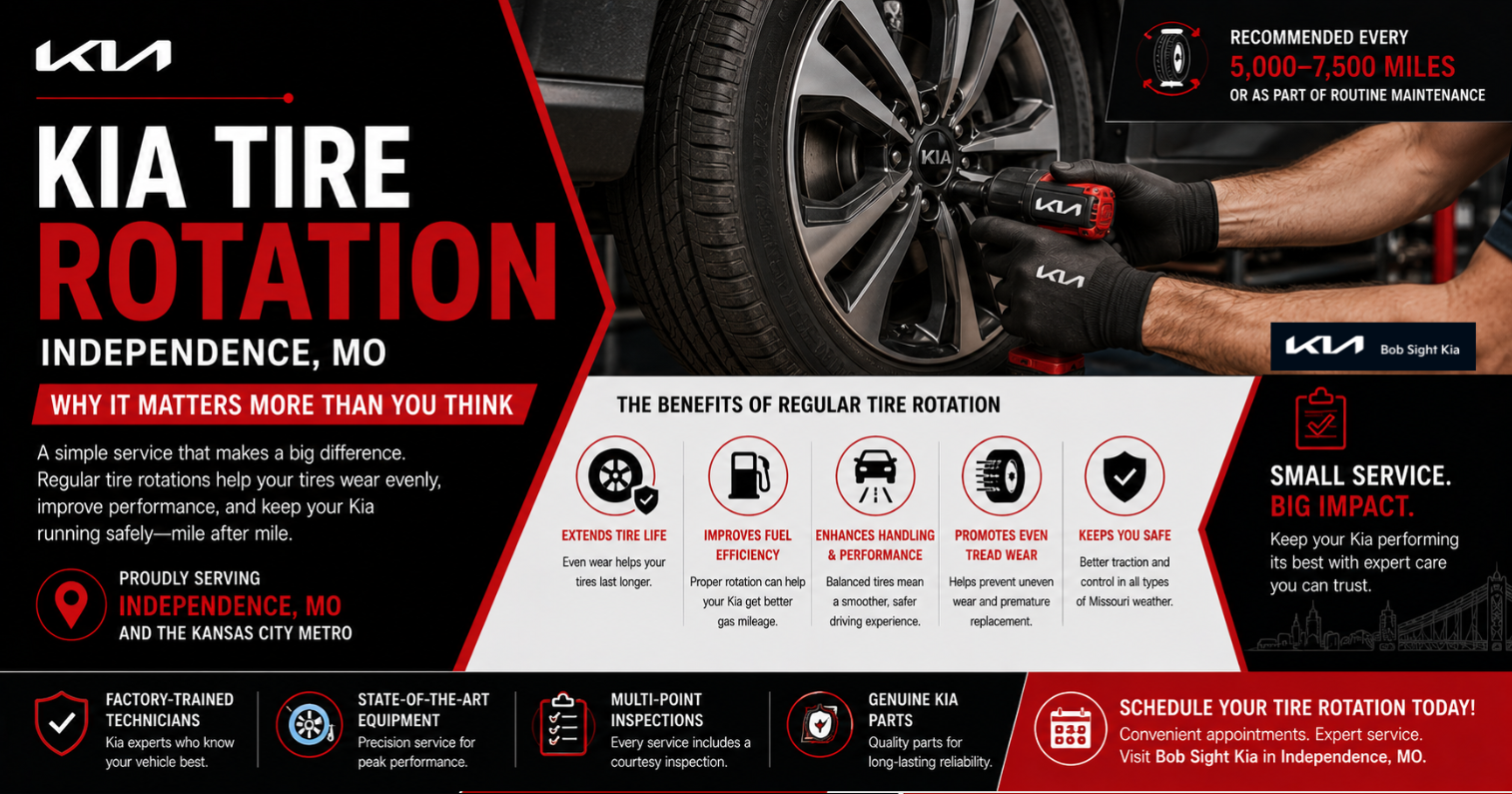
Kia Tire Rotation Independence MO: Why It Matters More Than You Think | Bob Sight Kia
Kia Tire Rotation Independence MO: Why It Matters More Than You Think for Kansas City Metro Drivers
Maintain optimal traction, fuel economy, and tire lifespan by scheduling certified Kia tire rotation in Independence, MO at Bob Sight Kia today.
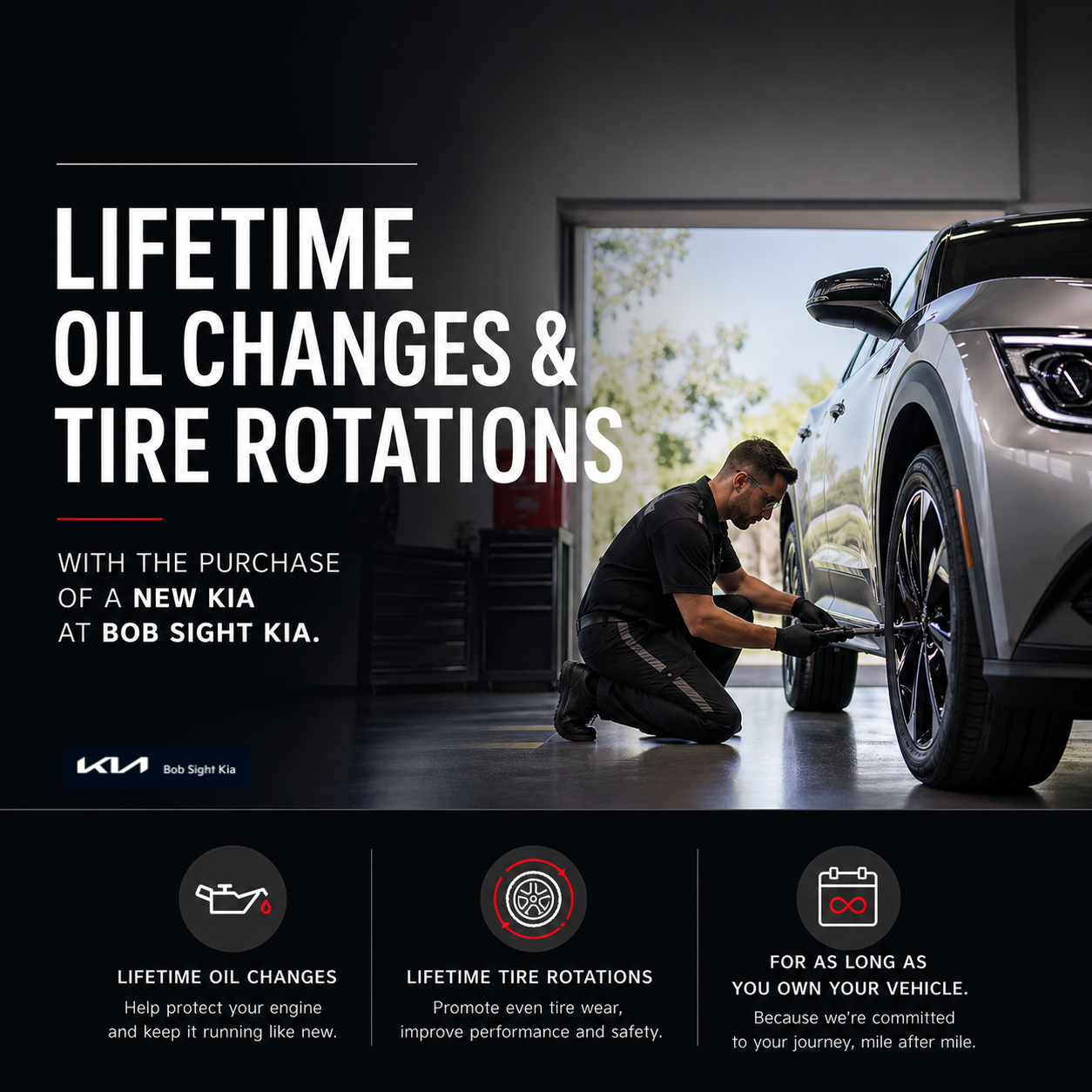
Routine tire rotations are one of the most vital yet frequently overlooked maintenance services required to keep your vehicle operating safely across Jackson County. Driving daily along busy highway corridors like Interstate 70, navigating stop-and-go commuter traffic on Highway 291 near the Independence Center, or taking family trips through Raytown, Blue Springs, and Lee’s Summit places continuous mechanical stress on your tires. Because engine placement, drivetrain configuration, steering forces, and weight distribution cause front and rear tires to wear down at vastly different rates, failing to rotate your tires regularly leads to premature tread degradation, reduced fuel efficiency, and compromised braking performance. At Bob Sight Kia, located conveniently in Independence, Missouri, our factory-certified service technicians specialize in comprehensive tire inspections, precision rotation patterns, wheel alignment checks, and dynamic wheel balancing. Understanding the physics of tread wear, recognizing early signs of uneven tire degradation, and adhering to recommended factory rotation schedules ensures your Kia Telluride, Sportage, Sorento, or K4 delivers maximum traction and long-term value on every Midwest road.
IN THIS GUIDE YOU’LL LEARN:
In this detailed technical guide, our Kia tire care specialists break down the mechanical reasons why tire rotations matter, exact factory rotation patterns, and proactive ownership strategies for local drivers.
- Why front and rear tires wear at uneven rates on Front-Wheel Drive and All-Wheel Drive Kia vehicles.
- How regular tire rotations extend overall tread life, improve fuel economy, and protect your vehicle’s drivetrain.
- The exact technical rotation patterns utilized for non-directional, directional, and staggered tire fitments.
- How local Missouri potholes, highway speeds, and severe seasonal weather swings accelerate rubber degradation.
- Key differences between routine tire rotation, wheel alignment, and dynamic tire balancing services.
- Step-by-step guidance on inspecting tire tread depth, checking cold inflation pressure, and resetting TPMS sensors.
1. Understanding Tire Rotation Mechanics and Tread Wear Physics
Regular tire rotations redistribute wear evenly across all four tires by swapping their physical axle positions at factory-recommended service intervals. On modern passenger vehicles, each tire position experiences distinct forces during daily operation. Front tires handle steering friction, carry the heavy weight of the front-mounted engine and transmission, and absorb the majority of braking forces, causing their tread blocks to wear down up to twice as fast as rear tires during routine city driving along Noland Road or Truman Road.
Tire rotation physically shifts tires between high-wear and low-wear axle positions before uneven degradation becomes permanent. On front-wheel-drive models, front tires experience heavy edge wear due to continuous scrubbing during low-speed turns in commercial parking lots. Meanwhile, rear tires follow straight along the rear axle, suffering minimal lateral friction but becoming susceptible to cupping or feathering if left in position indefinitely. Rotating front tires to the rear and rear tires to the front allows tread compounds to wear down symmetrically across all four contact patches.
Maintaining balanced tread wear across all four wheels preserves original handling characteristics, predictable braking response, and hydroplaning resistance on wet pavement. When tread depths remain uniform, all four tires contact the road surface with equal surface friction, ensuring electronic safety systems like Electronic Stability Control (ESC) and Anti-lock Braking Systems (ABS) operate as engineered. Skipping tire rotations results in diagonal tread scrubbing, loud cabin road noise, and the premature need to replace two tires at a time rather than enjoying a full set’s complete lifespan.
2. Drivetrain Differences: How FWD, AWD, and EV Kia Models Wear Tires Differently
Front-Wheel Drive (FWD), All-Wheel Drive (AWD), and All-Electric (EV) Kia vehicles place distinct mechanical demands on tires, requiring specific rotation schedules and patterns. On FWD models like the Kia K4 sedan or Soul crossover, the front wheels perform triple duty by delivering engine torque, steering the vehicle, and supplying over sixty percent of total braking force. Consequently, front tires wear down rapidly along their outer shoulder blocks, making 5,000 to 7,500-mile rotation intervals crucial for FWD drivers in Jackson County.
All-Wheel Drive models like the Kia Telluride AWD or Sportage AWD distribute engine power dynamically to all four wheels through an electro-hydraulic center coupling. While AWD improves traction on snow-covered roads near Blue Springs Lake, it subjects all four tires to continuous rotational torque. Crucially, AWD transfer cases and differential systems require all four tires to maintain nearly identical rolling circumferences. If tread depth varies by more than 2/32 of an inch between tires, the resulting difference in rotational speed forces internal differential gears to work constantly, causing friction heat that can damage expensive drivetrain components.
Electric vehicles like the Kia EV6 and EV9 present unique tire wear characteristics due to immediate electric motor torque delivery and heavy floor-mounted lithium-ion battery packs. The instant torque generated by electric drive motors creates high shear stress at the tire contact patch during acceleration. Furthermore, higher overall vehicle curb weight accelerates tread compression. Electric Kia owners should adhere strictly to 5,000-mile tire rotation schedules to prevent accelerated center-tread wear and preserve maximum electric driving range.
3. The Financial and Safety Consequences of Neglecting Regular Tire Rotations
Neglecting tire rotations leads to accelerated tread degradation, increased fuel consumption, compromised winter traction, and severe mechanical strain on steering components. When tires wear unevenly, the vehicle’s rolling resistance increases significantly. Un-rotated tires with irregular tread profiles create unnecessary drag against the road surface, forcing your internal combustion engine or electric motor to consume additional energy to maintain steady highway speeds along I-470.
Safety risks increase exponentially during severe Midwest weather events when tread depth is neglected. Irregular tread wear pattern development, such as heel-toe wear or diagonal scrubbing, prevents tire grooves from channeling standing water away from the contact patch during heavy summer rainstorms. This reduced water displacement capacity dramatically lowers hydroplaning thresholds, causing tires to lose contact with the road at speeds as low as 45 miles per hour. During winter cold snaps, unevenly worn tires fail to bite into packed snow or slush, resulting in extended stopping distances and reduced cornering grip.
From a financial perspective, skipping inexpensive tire rotations is a costly mistake. Modern premium replacement tires, such as OEM Michelin, Continental, Goodyear, or Hankook sets, represent a significant financial investment. Allowing front tires to wear out prematurely at 20,000 miles due to lack of rotation cuts potential tire lifespan in half, forcing owners to purchase replacement sets twice as often. Furthermore, tire manufacturers explicitly require documented routine rotation records to maintain treadwear warranty coverage.
4. Kia Tire Rotation Patterns: Forward Cross, X-Pattern, and Directional Guidelines
Selecting the correct tire rotation pattern depends on your Kia vehicle’s drivetrain layout and whether your tires feature directional or non-directional tread designs. Utilizing the wrong rotation pattern can cause handling instability or reverse the intended rolling direction of specialized tread compounds. Our factory-trained technicians inspect sidewall markings and tread geometry before executing every service.
To clarify how different drivetrains require specific rotation patterns, the comparison table below outlines standard factory guidelines for Kia vehicles:
| Drivetrain / Tire Type | Recommended Rotation Pattern | Front Tire Movement | Rear Tire Movement | Recommended Interval |
|---|---|---|---|---|
| Front-Wheel Drive (FWD) | Forward Cross Pattern | Move straight back to rear axles | Cross diagonally forward to opposite front sides | Every 5,000 to 7,500 Miles |
| All-Wheel Drive (AWD) | X-Pattern or Rearward Cross | Cross diagonally back to opposite rear sides | Cross diagonally forward to opposite front sides | Every 3,000 to 5,000 Miles |
| Directional Tread Tires | Straight / Front-to-Back | Move straight back on same side | Move straight forward on same side | Every 5,000 to 7,500 Miles |
| Staggered Fitment (Different Sizes) | Side-to-Side Pattern | Swap left front to right front | Swap left rear to right rear | Every 5,000 Miles |
Executing the Forward Cross pattern on FWD vehicles ensures that the rear tires, which experienced minimal shoulder wear, are crossed to opposite front positions where steering forces act on the opposite side of the tread block. For directional tires marked with sidewall rotation arrows, straight front-to-back swapping maintains the intended rolling direction required for rain evacuation. Following these precise technical patterns guarantees smooth performance and quiet operation.
5. Comprehensive Wheel Alignment and Dynamic Tire Balancing Integration
Combining tire rotations with routine wheel alignment checks and dynamic balancing ensures smooth ride comfort and eliminates high-speed steering wheel vibrations. While rotating tires changes their physical location on the vehicle, it does not correct mechanical misalignments in suspension geometry or weight imbalances within wheel and tire assemblies.
Follow these five critical steps executed during a complete tire maintenance procedure at Bob Sight Kia:
- Digital Tread Depth and Pressure Audit: Technicians measure tread depth at inner, center, and outer grooves using digital gauges and adjust cold inflation pressure to factory door-jamb specs (typically 33 to 36 PSI).
- Precision Tire Position Rotation: Wheels are dismounted and rotated according to specific FWD, AWD, or directional tread pattern requirements using certified lift equipment.
- Dynamic Wheel Balancing: Each wheel assembly is mounted on a high-speed computer balancer to detect microscopic weight heavy spots, applying precise clip-on or adhesive lead weights to eliminate high-speed wobble.
- Laser Suspension Alignment Inspection: The vehicle is placed on a computerized alignment rack to measure camber, caster, and toe angles against factory engineering specifications.
- TPMS Sensor Recalibration and Road Test: Tire Pressure Monitoring System (TPMS) locations are reset through the vehicle software menu, followed by a short road test to verify smooth tracking along I-70.
Integrating alignment checks with regular tire rotations prevents rapid shoulder wear caused by Jackson County pothole impacts along Highway 40 or Blue Ridge Boulevard. Proper suspension alignment keeps tires rolling completely flat against the pavement, maximizing traction and fuel economy.
6. How Missouri Seasonal Weather and Jackson County Road Hazards Accelerate Tread Wear
Extreme Midwest seasonal temperature swings combined with rough Jackson County road surfaces create harsh environmental conditions that degrade tire rubber compounds quickly. Missouri weather ranges from freezing winter cold snaps where temperatures drop below zero to scorching summer heat waves that drive asphalt surface temperatures past 130 degrees Fahrenheit. These extreme temperature swings cause continuous expansion and contraction of tire rubber compounds.
During cold winter months in Independence, ambient air pressure drops by approximately 1 PSI for every 10-degree decrease in outside temperature. Driving on underinflated tires during winter flexes tire sidewalls excessively, generating internal heat that weakens internal steel belts and accelerates shoulder wear. Conversely, summer heat combined with high-speed interstate driving along I-70 dries out rubber plasticizers, leading to microscopic sidewall cracking, dry rot, and accelerated tread compound breakdown.
Local road conditions introduce severe physical hazards to tires year-round. Freeze-thaw winter cycles create deep potholes, crumbling pavement edges, and loose gravel across regional commuting routes like Highway 291 and Noland Road. Hitting a sharp pothole at speed can sever internal tire cords, create dangerous sidewall bulges, or knock suspension toe angles out of alignment. Routine inspections at Bob Sight Kia ensure that hidden road damage is identified before it results in a sudden tire blowout.
7. Dealership Tire Service vs. Independent Tire Shops: Technical Comparison
Servicing your tires at an authorized Kia dealership guarantees factory-trained technical precision, specialized lifting procedures, and exact OEM replacement tire matching. While general tire retail chains perform quick rotations, authorized Kia service departments adhere strictly to manufacturer vehicle specifications, vehicle hoist lifting points, and specialized electronic TPMS programming routines.
Follow these five diagnostic and service steps performed during authorized Kia dealership tire maintenance:
- Vehicle Hoist Positioning at Factory Frame Points: Technicians place lift arms exclusively at reinforced frame lift points to prevent floor pan distortion or plastic rocker panel cracking.
- Precision Torque Wrench Lug Nut Tightening: Lug nuts are hand-torqued in a star pattern to exact factory torque specifications (typically 79 to 94 lb-ft) using calibrated torque wrenches to prevent brake rotor warping.
- Factory TPMS Re-Learning: Technicians connect specialized diagnostic tools to re-register TPMS sensor positions directly into the vehicle control module, ensuring accurate dashboard pressure displays.
- Suspension and Brake Component Visual Check: While wheels are removed, technicians inspect brake pad thickness, rotor surfaces, rubber CV axle boots, and tie-rod ends for wear.
- OEM Match Tire Recommendations: If replacement is required, technicians recommend tires engineered specifically for your Kia model’s original ride quality and noise insulation specs.
Proper lug nut torque is particularly critical. Independent shops frequently over-tighten lug nuts using uncalibrated pneumatic impact wrenches, which stretches wheel studs and warps brake rotors. Entrusting your vehicle to Bob Sight Kia ensures every lug nut is installed with exact mechanical torque precision.
8. Quick Facts: Kia Tire Care and Rotation Intervals
Adhering to regular tire rotation intervals is the single most cost-effective way to preserve vehicle handling, fuel economy, and occupant safety. Here are essential quick facts regarding tire maintenance for Kia owners in Independence, MO.
- Standard Rotation Interval: Kia recommends rotating tires every 5,000 to 7,500 miles, or every 6 months during routine synthetic oil changes.
- AWD & EV Rotation Interval: All-Wheel Drive and All-Electric Kia models require more frequent rotations, ideally every 3,000 to 5,000 miles due to high torque load distribution.
- Minimum Legal Tread Depth: Tires with 2/32 of an inch or less of remaining tread depth are legally worn out and must be replaced immediately.
- Replacement Safety Threshold: Wet weather traction drops significantly once tread depth reaches 4/32 of an inch, increasing hydroplaning risks on rain-slick highways.
- Treadwear Warranty Requirement: Major tire manufacturers require documented rotation receipts every 5,000 to 7,500 miles to validate tread life warranty claims.
These key facts underline why tire maintenance should remain a top priority for every driver across the Kansas City metro. Routine tire rotations save money while keeping your vehicle stopping safely in all driving conditions.
9. Long-Term Ownership Planning and Tire Maintenance Strategy
Developing a proactive tire care plan protects your financial investment and ensures consistent driving comfort through years of Midwest commuting. Long-term vehicle ownership requires establishing a routine care strategy that addresses tire wear before it impacts fuel economy or damages suspension components.
Coordinate your tire rotations directly with scheduled engine oil changes at Bob Sight Kia. Bundling tire rotations with routine oil changes ensures your vehicle is raised on a lift every 5,000 to 7,500 miles, allowing certified technicians to perform comprehensive multi-point inspections. Furthermore, checking cold tire inflation pressure monthly at home using an accurate digital pressure gauge helps maintain optimal contact patch geometry between service appointments. Drivers considering upgrading their current vehicle can use our online trade-in appraisal tool to see how consistent maintenance preserves overall vehicle equity.
Planning ahead for tire care keeps your maintenance costs predictable and manageable over time. To view active savings offers on tire rotations, alignments, and new tire sets, visit our dedicated service and parts specials page before booking your service visit. Our team at Bob Sight Kia is committed to delivering exceptional care for drivers throughout Independence, Blue Springs, Lee’s Summit, and surrounding communities.
10. Frequently Asked Questions About Kia Tire Rotation in Independence, MO
How often should I get my Kia tires rotated in Independence, MO?
Kia recommends having your tires rotated every 5,000 to 7,500 miles, which conveniently aligns with routine synthetic oil change service intervals. Following this timeline ensures that front and rear tires are swapped before minor wear variations develop into permanent tread cupping, diagonal scrubbing, or excessive shoulder degradation.
For drivers operating All-Wheel Drive (AWD) models like the Sportage AWD or Telluride AWD, or electric vehicles like the EV6, rotating tires every 3,000 to 5,000 miles is highly beneficial. AWD systems transmit continuous rotational torque to all four wheels, making uniform tread depth essential to protect internal differential gears from mechanical stress during highway commuting on I-70.
A service pro-tip from Bob Sight Kia: always check your vehicle’s driver-side door jamb sticker for exact cold tire pressure recommendations. Maintaining proper inflation pressure between rotation appointments prevents excessive edge wear and ensures your tires wear evenly across their entire tread face.
What happens if I never rotate the tires on my Kia?
Failing to rotate your tires causes front tires to wear down up to twice as fast as rear tires, resulting in premature tire replacement, reduced fuel economy, and severe cabin road noise. On Front-Wheel Drive vehicles, front tires absorb intense steering scrubbing and heavy braking loads, causing rapid shoulder wear while rear tires remain underutilized.
As tread depth differences expand between axles, your vehicle loses hydroplaning resistance and wet-weather traction during sudden summer rainstorms along Highway 291. Furthermore, severe irregular wear patterns like heel-toe feathering generate loud, rhythmic humming noises inside the cabin that mimic failing wheel bearings, ruining interior driving refinement.
On All-Wheel Drive models, neglecting tire rotations can lead to costly mechanical repairs. When front tires wear down significantly faster than rear tires, their overall rolling circumferences no longer match. This difference forces the AWD center coupling and transfer case to work constantly, generating excessive heat that degrades internal clutches and leads to premature drivetrain failure.
How do I know if my tires need a rotation or an alignment?
A tire rotation corrects front-to-rear tread depth wear differences, whereas a laser wheel alignment corrects misaligned suspension angles that cause directional pulling or severe inner-edge scrubbing. Inspecting tire tread faces and observing vehicle tracking along flat stretches of road helps identify which service your vehicle requires.
If your front tires show slightly faster outer shoulder wear than your rear tires but your vehicle tracks completely straight down the road, a standard tire rotation will balance tread wear across both axles. However, if your steering wheel vibrates at highway speeds, your car drifts toward the shoulder on straight roads, or one specific tire exhibits severe razor-thin wear along its inner edge, your suspension alignment angles are out of factory tolerance.
A diagnostic insight from our service bay: at Bob Sight Kia, our service drive includes computerized alignment audit equipment that checks your suspension geometry in seconds as you drive in. Combining a laser alignment with a routine tire rotation guarantees optimal handling and maximum tread lifespan.
Why does my TPMS light turn on after rotating my tires?
The Tire Pressure Monitoring System (TPMS) light may illuminate or display incorrect tire locations after a rotation if the vehicle’s electronic control unit has not relearned the new sensor locations. Modern Kia vehicles feature individual pressure sensors mounted inside each wheel assembly that transmit radio signals to the central instrument cluster display.
When wheels are moved to new axle positions during a Forward Cross or X-Pattern rotation, the computer module must be updated to recognize that the former left-rear sensor is now located on the right-front wheel hub. If this electronic reset step is skipped, the dashboard display may show low pressure alerts for the wrong wheel location or trigger a temporary system warning light.
Pro-tip for car owners: certified technicians at Bob Sight Kia use specialized OBD-II diagnostic tools to re-register sensor locations during every tire rotation service. This ensures your dashboard tire pressure display remains accurate, giving you reliable warnings if inflation drops while driving across Jackson County.
11. Why Jackson County Drivers Trust Bob Sight Kia for Certified Service
Bob Sight Kia has proudly served drivers across Independence, Blue Springs, Lee’s Summit, Raytown, and Liberty for generations with transparent automotive care, certified technical expertise, and fair pricing. As a locally owned dealership family deeply rooted in the Kansas City metro, we prioritize customer safety and long-term vehicle reliability above all else. Our service team is dedicated to providing straightforward recommendations without high-pressure sales tactics.
Our modern service center features state-of-the-art hydraulic lifts, digital laser alignment racks, high-speed computer wheel balancers, and factory-trained master technicians who know every technical detail of your vehicle’s engineering. We use specialized Kia equipment and OEM replacement components to preserve your vehicle’s factory warranty coverage and long-term resale value. Whether you need a quick tire rotation, wheel balancing, or a full set of new tires, our team delivers prompt, professional care.
Experience the peace of mind that comes with factory-certified automotive maintenance. Visit Bob Sight Kia in Independence today or conveniently schedule your tire service appointment online to keep your vehicle performing at its best on every Missouri road.
12. Helpful Links
- Schedule Certified Kia Tire Service Online
- Explore Current Service and Parts Specials
- Order Genuine OEM Kia Tires and Parts
- Browse New Kia Inventory in Independence, MO
- Value Your Trade-In Vehicle Online
13. PROUD TO BE PART OF THE BOB SIGHT AUTO GROUP
Bob Sight Kia is proud to be part of the Bob Sight Auto Group, serving drivers across Missouri and Kansas with quality vehicles, certified auto repair, and exceptional customer service. Explore our family of dealerships and service locations throughout the region:
Connect with us


Recent Blog Entries
- Used Cars Independence MO: Why More Drivers Choose Certified Kia Models for Kansas City Metro Drivers
- Kia Tire Rotation Independence MO: Why It Matters More Than You Think for Kansas City Metro Drivers
- Kia AWD SUV Guide for Winter and Summer Driving in Missouri for Kansas City Metro Drivers
- 2027 Kia Telluride Interior Features Families Will Love for Kansas City Metro Drivers
- Kia Dealer Near Grain Valley MO for Affordable SUV Shopping
Categories
 Warranties include 10-year/100,000-mile powertrain and 5-year/60,000-mile basic. All warranties and roadside assistance are limited. See retailer for warranty details.