Today: Closed
Blog / Independence Kia Dealer

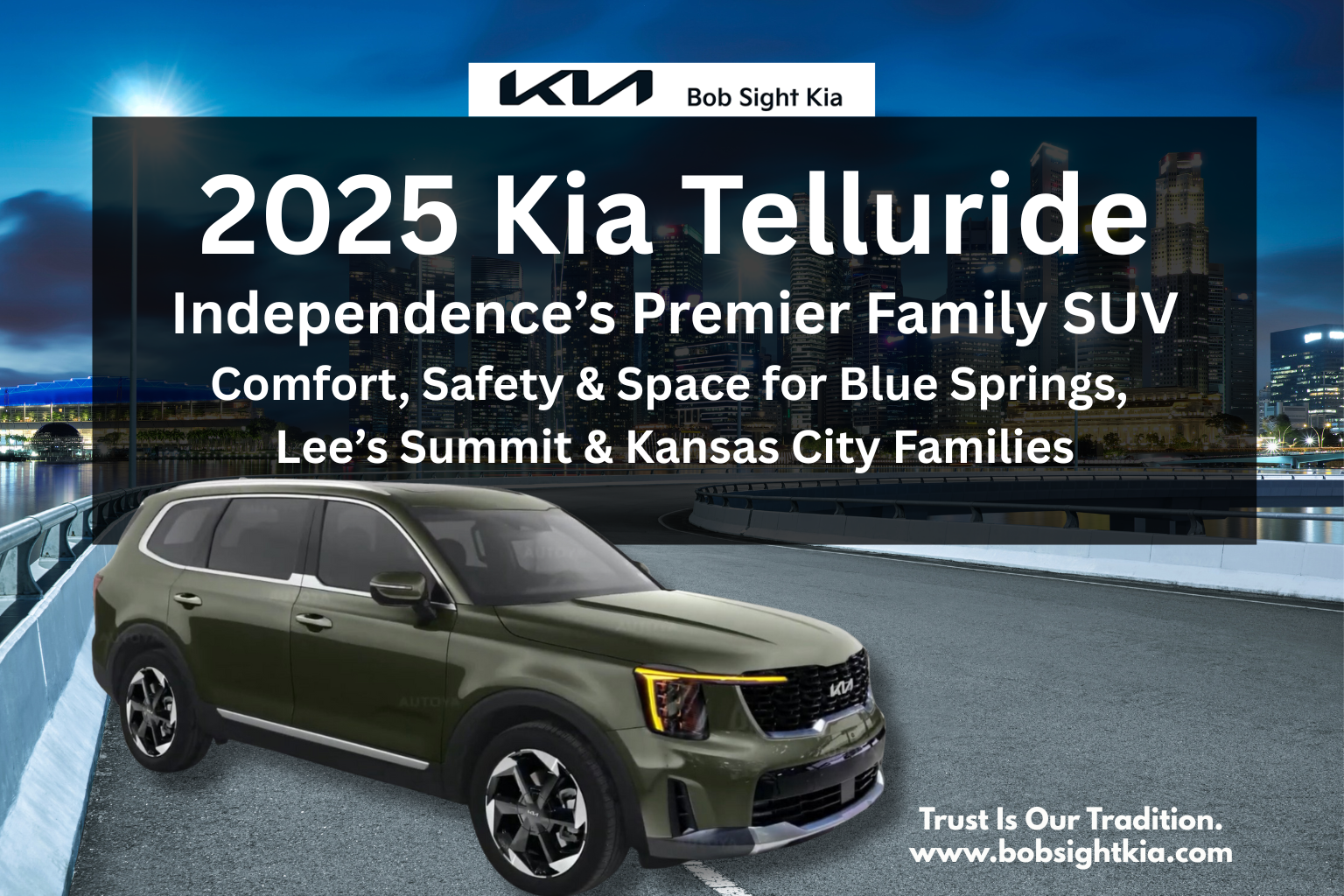
2025 Kia Telluride for Sale in Independence MO – The Ultimate SUV for Kansas City Families

2025 Kia Telluride SUV lineup parked at Bob Sight Kia in Independence MO, highlighting trims and features for Kansas City families.

Why the 2025 Kia Telluride is a Family Favorite in Missouri

The 2025 Kia Telluride has built a reputation as one of the best three-row SUVs in its class, offering unmatched comfort, safety, and versatility. At Bob Sight Kia in Independence, MO, we proudly serve drivers from Blue Springs, Lee’s Summit, and the Kansas City Metro who are searching for a vehicle that perfectly fits their family’s lifestyle.

Our Price Match Promise (details here) ensures you’re getting the best deal possible, so you can focus on choosing the Telluride trim that’s right for you.

Telluride Features Missouri Drivers Love

The 2025 Telluride offers plenty of space and comfort for every passenger, whether you’re running errands in Blue Springs or taking a weekend trip from Independence to the Ozarks. Standard features include:

  • Spacious three-row seating for up to eight passengers
  • Kia Drive Wise advanced driver-assistance technology
  • Premium materials and thoughtful cabin design
  • Strong V6 engine for confident performance

2025 Telluride Trim Options

The Telluride comes in a range of trims to suit every driver’s needs:

  • LX – Excellent value with standard safety and connectivity features
  • S – Sportier appearance and upgraded interior touches
  • EX – Premium finishes, advanced tech, and enhanced comfort
  • SX – Top-of-the-line luxury and performance with all available features

Key Trim Highlights

TrimSeatingKey Features
LX8 passengersKia Drive Wise, 8-inch display, Apple CarPlay® & Android Auto™
S7 passengersCaptain’s chairs, 20-inch wheels, sporty styling
EX8 passengersLeather seating, 10.25-inch display, Smart Power Liftgate™
SX7 passengersHarman Kardon® audio, dual sunroofs, Surround View Monitor

Comfort and Technology for Missouri Roads

Inside the Telluride, you’ll find plenty of space for both passengers and cargo. Families in Lee’s Summit appreciate the easy-to-access third row, while Kansas City commuters enjoy premium features like ventilated seats and a quiet ride.

Technology is also a highlight, with standard Apple CarPlay® and Android Auto™, plus available features like wireless charging and built-in navigation to make every drive easier.

The spacious interior design is complemented by a variety of storage solutions, making the Telluride perfect for family road trips. From cupholders to cubbies, every inch is designed with convenience in mind.

Performance and Capability

The Telluride’s V6 engine delivers smooth acceleration and plenty of power for highway merging or towing. Available all-wheel drive makes it a confident performer during Missouri winters, and multiple drive modes help tailor the SUV’s performance for different conditions.

Drivers in Independence appreciate the ride comfort even on rougher roads, while Blue Springs owners love the confidence AWD brings during winter conditions. Towing capabilities make it perfect for pulling small campers or boats for weekend getaways.

Family-Friendly Versatility

Families in Kansas City know that daily schedules can be unpredictable. The Telluride’s spacious layout and adjustable seating make it ready for anything, from transporting sports teams to packing for vacations. The second-row captain’s chairs in the S and SX trims make for easier access to the third row, which kids love.

The Smart Power Liftgate™ in the EX and SX trims makes loading groceries or gear simple, even when your hands are full. This feature is a game-changer for busy families.

Safety Confidence for Missouri Roads

Kia’s Drive Wise safety suite gives Missouri families confidence every time they get behind the wheel. Lane Keeping Assist, Forward Collision Avoidance, and Blind-Spot Monitoring come standard. The SX trim enhances safety further with the Surround View Monitor, giving drivers a 360-degree perspective when maneuvering in tight spaces.

Missouri drivers also appreciate additional features such as Rear Cross-Traffic Alert and Safe Exit Assist, which add more security for families with young passengers. Combined with high safety ratings, the Telluride stands out as a leader in family safety.

Competitor Comparisons: Telluride vs. the Competition

Many families shopping in Independence and the Kansas City Metro also compare the Telluride to SUVs like the Honda Pilot and the Hyundai Palisade. While those vehicles offer similar seating, the Telluride sets itself apart with:

  • A more upscale interior with premium finishes
  • Kia’s industry-leading warranty
  • A smoother, quieter ride ideal for Missouri highways
  • Strong resale value and lower overall cost of ownership

Shoppers who test drive the Telluride alongside its competitors often find that it delivers more value, making it the smarter choice for families.

Comfort for Long Missouri Drives

Whether it’s a trip to Lake of the Ozarks or a weekend getaway to Branson, the Telluride provides comfort for all passengers. The spacious third row accommodates adults more comfortably than most SUVs in its class, and the adjustable climate control in rear seating zones keeps everyone happy.

Road noise is kept to a minimum, making conversations and music more enjoyable. The combination of premium seating, smooth ride quality, and advanced sound insulation make the Telluride an ideal long-distance family vehicle.

Additional Everyday Advantages

The Telluride is built to handle more than just family errands. Blue Springs residents appreciate its hauling capacity for home projects, while Lee’s Summit drivers love how easily it transitions from daily commuting to weekend adventures. The roof rails provide extra versatility for carrying bikes, kayaks, or cargo boxes.

The spacious cargo hold can handle everything from sports equipment to luggage. When both rear rows are folded down, the flat loading floor makes transporting larger items much easier.

Why Shop Bob Sight Kia for the Telluride

Drivers from across the Kansas City Metro choose Bob Sight Kia for:

  • A wide selection of Telluride trims and colors
  • Competitive pricing backed by the Price Match Promise
  • Flexible financing options
  • Reliable service department for ongoing maintenance

Our dealership’s convenient location makes it easy for drivers from Independence, Blue Springs, Lee’s Summit, and beyond to explore the Telluride in person.

Drive Your Next Steps with Bob Sight Kia

Explore More from the Bob Sight Auto Group

About Bob Sight Kia

Bob Sight Kia is your trusted Kia dealership located in Independence, Missouri. We proudly serve drivers throughout Blue Springs, Lee’s Summit, and the greater Kansas City metro with new and used vehicle sales, certified Kia service, and genuine Kia parts. Our dealership is committed to delivering a pressure-free, customer-first experience.

Directions to Our Dealership

Visiting Bob Sight Kia is quick and convenient. You’ll find us at 1700 S Noland Rd, Independence, MO 64055, just minutes from major highways and easily accessible from nearby communities like Blue Springs, Lee’s Summit, and the greater Kansas City metro area.

If you’re coming from downtown Kansas City, take I-70 East toward Independence. Use exit 12 for Noland Road, then turn right onto S Noland Road. Continue for about a mile, and our dealership will be on your right.

From Blue Springs, take I-70 West toward Kansas City. Exit at Noland Road (Exit 12) and turn left. Head south for about a mile, and you’ll see Bob Sight Kia on your right.

Traveling from Lee’s Summit, take US-50 West toward Kansas City, then merge onto I-470 North. Continue onto I-70 East and take Exit 12 for Noland Road. Turn right, and our dealership will be just down the road on your right.

No matter where you’re coming from, our team is ready to help you find the right Kia, schedule your service, or explore our latest specials.

Posted in:

Related Posts

Kia dashboard defroster controls clearing a fogged windshield during cold weather near Independence, Missouri

Kia Heater or Defroster Not Working in Independence, MO? Common Causes and When to Schedule Service

Kia Heater or Defroster Not Working in Independence, MO? Common Causes and When to Schedule Service Schedule Kia heater or defroster service at Bob Sight Kia A Kia heater or defroster that is not working properly can affect both comfort and visibility during cold, damp weather in Independence, Missouri. Weak heat, limited airflow, persistent windshield fog, or a rear window that will not clear may point to an incorrect climate setting, low coolant, a thermostat problem, restricted airflow, an electrical fault, or another heating and ventilation concern. Because several systems work together, the symptom alone may not identify the exact cause. Drivers throughout Independence, Blue Springs, Raytown, Grain Valley, Sugar Creek, and the Kansas City Metro rely on their climate-control systems during freezing winter mornings and sudden temperature changes. A heater that produces only cool air can make the cabin uncomfortable, but a defroster problem creates a more immediate safety concern when condensation, frost, or ice interferes with the driver's view. At Bob Sight Kia in Independence, Missouri, trained technicians can inspect Kia heating, ventilation, cooling, and electrical components to determine why the system is not operating as expected. This guide explains common causes, how the front and rear defrosters differ, what drivers can check safely, and when professional Kia service should be scheduled. In This Guide You Will Learn This guide explains the most common reasons a Kia heater or defroster may stop working properly. It also identifies symptoms that can help technicians distinguish an airflow concern from a coolant, thermostat, heater-core, control, or electrical problem. How the Kia cabin heater and front defroster work Why the rear-window defroster uses a different system What low coolant or a thermostat problem may cause How blower motors, filters, vents, and climate controls affect airflow Why windshield fog may remain even when the heater produces warm air What drivers can inspect without taking unsafe repair steps When limited visibility or overheating symptoms require immediate attention Climate-control equipment can differ by Kia model, model year, trim, engine, and powertrain. A gasoline-powered Kia may use engine coolant as the primary heat source, while hybrid, plug-in hybrid, and electric models may use additional or different heating components. The owner's manual for the specific vehicle should remain the primary reference for operating instructions and warnings. This article is intended to help Kia owners recognize symptoms and communicate them clearly when scheduling service. It is not a substitute for hands-on diagnosis. Coolant systems can become extremely hot and pressurized, while electrical defroster circuits can require model-specific testing. How a Kia Heater and Front Defroster Work In many gasoline-powered Kia models, the cabin heater uses heat carried by engine coolant, while the front defroster directs conditioned air toward the windshield. Air temperature, airflow volume, vent direction, humidity removal, and engine operating temperature must work together for the system to clear glass effectively. As a gasoline engine reaches normal operating temperature, coolant absorbs engine heat and circulates through the cooling system. A portion of that heated coolant travels through a small heat exchanger commonly called the heater core. The climate-control blower moves cabin air across the heater core and sends the warmed air through the selected vents. The front windshield defrost or defog setting changes where that air is directed. It typically sends a large share of airflow toward the windshield and may activate the air-conditioning system to remove moisture from the cabin air. Air conditioning is useful in winter because drying humid air can clear interior fog more effectively than heat alone. A blend door inside the HVAC housing helps regulate air temperature by controlling how air moves through or around the heated portion of the system. A mode door controls whether air exits through the dashboard vents, floor vents, windshield outlets, or a combination. Electric actuators move these doors in many modern vehicles. HVAC stands for heating, ventilation, and air conditioning. The term describes the complete system responsible for cabin temperature, airflow, humidity management, and vent selection. A heater complaint may therefore originate from the engine cooling system, the airflow system, the electronic controls, or a combination of components. A driver leaving Blue Springs before sunrise may notice that the vents blow normally but never become warm during the trip toward Independence. Another driver may feel warm air at the floor while the windshield outlets receive very little airflow. Those symptoms sound similar at first, but they can lead technicians toward different diagnostic paths. Front Defroster vs. Rear Defroster: Why the Difference Matters The front windshield defroster uses the vehicle's HVAC airflow, while the rear-window defroster normally uses electrical heating conductors attached to the glass. A failure affecting one system may have no effect on the other, so drivers should identify which window is not clearing. The front defroster relies on the blower, vents, climate controls, air doors, and available heat. It may also use the air-conditioning compressor or other dehumidification strategy to reduce moisture. If the blower does not run, the air is cold, or the mode door does not direct air toward the windshield, front defrosting performance can suffer. The rear defroster uses thin conductive lines across the rear window. When activated, electrical current passes through those conductors and creates heat that helps remove fog, frost, and thin ice. On equipped models, heated outside mirrors may operate with the rear-window defroster. Kia owner guidance commonly notes that the rear defroster operates while the vehicle is on and turns itself off after a set period. This automatic shutoff helps manage electrical demand and prevents the system from remaining active unnecessarily. Drivers may need to reactivate it if fog or frost returns after the cycle ends. Damage to an individual grid line can leave a narrow uncleared strip across the rear window. A disconnected electrical tab, fuse concern, switch problem, wiring fault, or damaged grid may prevent a larger section or the entire window from heating. Abrasive cleaners, sharp scraping tools, adhesive removal, or careless cargo loading can damage the conductors attached to the glass. System How It Clears the Glass Possible Problem Areas Front Windshield Defroster Directs heated and dehumidified airflow toward the windshield Blower, coolant temperature, heater core, air doors, controls, vents, or air-conditioning operation Rear-Window Defroster Uses electrical conductors bonded to the rear glass Fuse, relay, switch, wiring, connector tab, or damaged grid lines Heated Outside Mirrors Uses electric heating elements on equipped vehicles Mirror heating element, wiring, connector, or shared defroster circuit This distinction is valuable when scheduling service at Bob Sight Kia. Telling the service team that the front windshield receives cold air, the blower does not operate, or only part of the rear glass clears provides more useful information than saying the defroster is broken. Common Reasons a Kia Heater Is Not Blowing Warm Air A Kia heater may blow cool or only slightly warm air because the engine has not reached operating temperature, coolant is low, the thermostat is not regulating temperature correctly, the heater core is restricted, or an HVAC door is not directing air properly. The correct diagnosis depends on engine temperature, coolant condition, airflow, warning indicators, and whether the symptom changes while driving. On a cold Independence morning, a gasoline engine needs time to warm. Short trips may end before the cooling system reaches a stable operating temperature, particularly when outside temperatures are very low. However, the air should normally become warmer as the engine reaches its expected temperature range. Low coolant can reduce the amount of heated fluid reaching the heater core. Coolant may become low because of a leak, improper previous service, or another cooling-system concern. Drivers should never remove a radiator or pressurized coolant cap while the engine is hot because escaping coolant and steam can cause severe burns. A thermostat controls coolant flow according to engine temperature. If it remains stuck open, the engine may take too long to warm or may run cooler than intended during winter driving. The cabin heater may then produce weak heat, particularly during a commute at steady speed on I-70 or I-435. A restricted heater core can limit the transfer of heat into the cabin. Internal deposits, contamination, or reduced coolant flow may contribute to the restriction. A leaking heater core can create other symptoms, including a sweet odor, damp carpeting, window film, or unexplained coolant loss. A temperature blend-door problem can create cold air even when the engine and coolant are warm. The HVAC system may have heat available, but the door or actuator may not route the air through the heated section correctly. Some drivers notice clicking behind the dashboard, inconsistent temperatures, or a difference between driver and passenger zones. Symptom Possible Cause Useful Detail to Report Heat remains weak during a long drive Thermostat, coolant, heater core, or temperature-control concern Whether the engine-temperature display reaches its normal range Heat changes when accelerating Possible coolant-flow or coolant-level concern Whether the temperature changes at idle versus highway speed One side is warm and the other is cold Blend-door, actuator, sensor, or dual-zone control concern Which vents and temperature zones are affected Sweet odor or damp carpeting Possible coolant or heater-core leak Where the odor or moisture is strongest Engine-temperature warning appears Potential cooling-system or overheating concern Stop safely and arrange inspection rather than continuing to drive Hybrid, plug-in hybrid, and electric Kia models may use different heating strategies, pumps, coolant circuits, or electric heating components. Owners should not assume that every no-heat symptom follows the same diagnostic path as a conventional gasoline model. Vehicle-specific service information is important. Why Airflow May Be Weak or Missing From the Vents Weak or missing airflow may result from a clogged cabin air filter, blower-motor problem, blower-control fault, obstructed intake, damaged air door, or an electrical issue. Air temperature and airflow are separate concerns, so drivers should note whether the air is cold, weak, misdirected, or completely absent. The blower motor pushes air through the HVAC housing and into the cabin. If it stops operating, no meaningful airflow may come from the vents even though the cooling system contains hot coolant. A blower that works only on certain settings may point technicians toward a control module, resistor, switch, wiring, or motor concern, depending on the vehicle. A cabin air filter helps capture dust, pollen, and other airborne material before air enters the passenger compartment. When heavily restricted, it can reduce airflow through the vents. The filter generally does not determine whether the air becomes hot, but reduced airflow can make the heater and defroster seem ineffective. Leaves, snow, ice, or debris near an exterior air intake may also limit ventilation. Drivers should clear accumulated snow from the base of the windshield before operating the system. Heavy snow should also be brushed from the rear window before the electric defroster is activated. A mode-door problem can send air to the wrong outlets. The blower may sound normal, yet little air reaches the windshield because most of it is being directed toward the floor or dashboard vents. Clicking, repeated tapping, or air that does not change direction when a new mode is selected may provide an important diagnostic clue. Use this safe preliminary airflow check before scheduling service: Start the vehicle in a well-ventilated outdoor area. Never idle a vehicle inside a closed garage because exhaust gases can create a deadly carbon monoxide hazard. Increase the fan through each setting. Listen for changes in blower speed and note whether airflow increases. Select each vent mode. Check the dashboard, floor, and windshield outlets to see whether the air changes direction. Set the temperature from cool to warm. Note whether the air temperature changes after the vehicle reaches normal operating temperature. Inspect accessible air intakes for snow or debris. Do not insert tools into vents or attempt to disassemble the dashboard. Check the maintenance history. Determine when the cabin air filter was last inspected or replaced. Record unusual noises or odors. Clicking, squealing, burning smells, or sweet odors should be reported to the service department. Weak airflow on a cold morning near Independence Center may seem like a minor comfort problem, but it can become a visibility concern if the windshield will not clear. If fog continues to obstruct the driver's view, move to a safe location and avoid continuing until visibility can be maintained. Why a Kia Windshield May Keep Fogging Up A windshield may continue fogging when humid cabin air contacts cold glass and the climate-control system cannot remove moisture quickly enough. Incorrect settings, recirculation mode, weak airflow, wet interior materials, air-conditioning problems, coolant leaks, or excessive cabin moisture can all contribute. Interior fog forms when moisture in the cabin condenses on a colder glass surface. Passengers' breath, wet shoes, snow-covered clothing, damp floor mats, and water tracked into the vehicle can raise humidity. A full vehicle traveling through the Kansas City Metro may fog more quickly than the same vehicle with one occupant. The front defrost setting should direct air toward the windshield. Many systems also activate air conditioning because the evaporator can remove moisture from the air before it is reheated and sent toward the glass. This is why air-conditioning performance can affect winter defogging even when cold cabin air is not desired. Recirculation mode keeps reusing air already inside the vehicle. That setting can help cool a cabin during summer, but it may trap moisture during cold weather. Selecting fresh outside air can support defogging when the outside air is colder but less humid than the air inside. A dirty interior windshield can collect a film that encourages moisture to spread unevenly. Cleaning the inside of the glass with a suitable nonabrasive automotive glass cleaner may improve clarity. Drivers should avoid applying products that leave an oily residue. Persistent fog accompanied by a sweet odor, oily windshield film, low coolant, or damp carpet may indicate a coolant or heater-core concern. That combination deserves professional inspection. Simply wiping the windshield may temporarily improve visibility without correcting the source of the moisture. Follow these steps when interior fog develops: Select the windshield defrost or defog mode. Use the settings described in the owner's manual for the specific Kia. Increase the fan speed. Stronger airflow can move more conditioned air across the glass. Select a warm temperature. Warm, dry air helps raise the glass temperature and remove condensation. Allow the air-conditioning system to operate if activated by the vehicle. It can help remove moisture from the airflow. Turn off recirculation when appropriate. Fresh outside air may reduce trapped cabin humidity. Remove wet items when practical. Dry soaked floor mats, clothing, umbrellas, and other moisture sources. Stop safely if visibility remains limited. Do not continue driving when the windshield cannot be kept clear. Drivers approaching the I-70 and Highway 291 interchange need a clear view of surrounding traffic, lane markings, and merging vehicles. A windshield that repeatedly fogs despite correct settings may indicate an HVAC problem that should be inspected before the next period of freezing or damp weather. Rear Defroster Problems and Electrical Warning Signs A rear defroster that does not clear the glass may have a damaged grid, separated connector, fuse issue, control problem, or wiring fault. If only one narrow section remains fogged, an individual conductive line may be damaged, while complete failure may indicate a broader circuit concern. The thin horizontal lines on the rear glass are part of the electrical heating grid. They are functional components rather than decorative markings. Current flows through the conductors and creates enough heat to remove fog, frost, or a thin layer of ice. Drivers should not scrape the inside of the rear glass with sharp tools. Abrasive cleaners and aggressive removal of stickers or adhesive can also damage the conductors. When cleaning, use products and methods appropriate for glass with an attached defroster grid. A small electrical tab generally connects wiring to the grid near the edge of the glass. Cargo, cleaning, window tint work, or impact can loosen or damage that connection. A technician can inspect the tab and test whether voltage is reaching the grid. If the indicator light does not illuminate when the rear-defroster button is pressed, the problem may involve the switch, fuse, control circuit, or power supply. If the indicator illuminates but the glass remains completely fogged, electrical testing can help determine where current is interrupted. Drivers may notice heated mirrors are also not clearing on Kia models equipped with mirror defrosters. Because those elements may operate with the rear defroster, simultaneous failure can provide another useful clue. Feature availability varies, so consult the owner's manual to confirm how the mirrors operate. Do not replace a fuse with one of a higher amperage rating. Fuses protect wiring and components from excessive current, and installing an incorrect fuse can create electrical damage or fire risk. If a correct replacement fuse fails again, the circuit should be inspected rather than repeatedly reset. When a Heater Problem May Signal a Cooling-System Concern A sudden loss of cabin heat can sometimes accompany a low-coolant or engine-cooling problem, particularly when warning lights, unusual temperature readings, steam, leaks, or a sweet odor are also present. These symptoms require more caution than a simple comfort complaint. Heated coolant must reach the heater core for many gasoline-powered vehicles to produce warm cabin air. If coolant becomes low, air may enter portions of the system and heater performance may become inconsistent. Drivers may notice that the air changes temperature during acceleration, cornering, or extended idling. Coolant does not normally disappear without a reason. A low level may point to leakage from a hose, connection, radiator, water pump, reservoir, heater core, or another cooling-system component. Evidence may include colored residue, drops beneath the vehicle, steam, or a distinctive sweet smell. An overheating engine may display a warning light, message, or abnormal temperature indication. Continuing to drive an overheating vehicle can cause serious engine damage. Follow the owner's manual, move to a safe location, turn off the vehicle when appropriate, and seek professional assistance. Never open a hot pressurized coolant cap. The cooling system can contain scalding fluid and steam even after the vehicle has stopped. Visual inspection of the ground beneath the vehicle or the exterior of an accessible translucent reservoir should only be performed when it can be done safely and according to owner-manual guidance. A thermostat stuck open can create the opposite temperature problem. Instead of overheating, the engine may run cooler than intended or warm very slowly. The temperature display may remain below its usual position, and heater output may weaken during highway driving in cold weather. An Independence driver traveling east toward Grain Valley may first notice reduced heat before any other symptom becomes obvious. Reporting when the heat failed, how the engine-temperature display behaved, and whether any odors or leaks appeared can help the service team plan the diagnosis. Quick Facts About Kia Heater and Defroster Problems Kia heater and defroster concerns can originate from separate mechanical, airflow, moisture-control, and electrical systems. Identifying which vents, windows, fan settings, temperatures, and operating conditions are affected can make diagnosis more efficient. The cabin heater in many gasoline-powered Kia vehicles uses heat from engine coolant. The front defroster uses HVAC airflow directed toward the windshield. Air conditioning may operate during defrost mode to remove moisture from the air. The rear defroster uses electrical conductors attached to the rear glass. Low coolant can reduce heat and may indicate a leak that requires inspection. A thermostat stuck open may cause slow warm-up and weak heat during cold weather. A clogged cabin air filter can reduce airflow but does not usually cause the air itself to remain cold. A blower problem may affect every vent and defrost mode. A blend-door or actuator concern can create incorrect or uneven temperatures. Wet carpeting and interior moisture can make windshield fogging worse. Sharp tools and abrasive cleaners can damage rear-defroster grid lines. Limited windshield visibility makes the vehicle unsafe to continue driving. The most useful first question is whether the problem involves heat, airflow, vent direction, moisture removal, or an electrical grid. A vehicle that blows strongly but stays cold has a different symptom from one that produces warm air with almost no airflow. A rear window that clears everywhere except one horizontal strip also points toward a different concern. Conditions around Independence can change quickly during winter. A clear afternoon may be followed by freezing overnight temperatures, while wet shoes and snow-covered coats add cabin moisture. Testing the heater and defrosters before severe weather arrives can prevent discovering a problem during an urgent morning commute. Owners should also remember that equipment varies across Kia cars, SUVs, hybrids, plug-in hybrids, and electric vehicles. The correct operating procedure and diagnostic path depend on the specific model. Keep the owner's manual available and provide the vehicle identification number when arranging service. When to Schedule Kia Heater or Defroster Service Schedule professional Kia service when correct climate settings do not restore heat or visibility, the blower behaves abnormally, coolant symptoms appear, the rear grid fails, or the problem returns repeatedly. Immediate attention is warranted when the windshield cannot be kept clear or the vehicle displays an overheating warning. A single slow warm-up after the vehicle has been parked outside in severe cold may not indicate a failure. Repeatedly weak heat after a full commute, however, deserves further evaluation. The same is true when heat changes suddenly with engine speed or disappears without explanation. Blower concerns should be inspected when the fan fails on every setting, works intermittently, operates only at certain speeds, or produces unusual squealing or scraping sounds. A burning odor should not be ignored. Turn the system off when safe and arrange an inspection. Rear-defroster service is appropriate when the indicator does not illuminate, the complete window stays fogged, individual grid sections remain uncleared, or heated mirrors fail at the same time on an equipped model. Electrical testing can identify whether power reaches the system and where continuity has been lost. Use this service-scheduling checklist: Identify the affected system. Specify the cabin heater, front windshield defroster, rear defroster, heated mirrors, or multiple systems. Describe the airflow. Report whether it is strong, weak, intermittent, misdirected, or absent. Describe the temperature. Explain whether the air remains cold, becomes warm slowly, or changes while driving. Note the operating conditions. Include outside temperature, engine warm-up time, fan setting, and whether the vehicle was moving or idling. Report warning indicators. Mention temperature warnings, low-coolant messages, electrical warnings, or check-engine lights. Report odors, moisture, or leaks. Include sweet odors, damp carpet, windshield film, steam, or spots beneath the vehicle. Share recent service history. Mention coolant service, battery replacement, HVAC repairs, windshield work, window tint, or cabin-filter replacement. Providing these details helps technicians reproduce the concern and select the appropriate tests. A precise description is more useful than trying to diagnose the failed part at home. Bob Sight Kia owners can use the online service scheduler to arrange an inspection in Independence. Ownership Planning for Reliable Heating and Defrosting Seasonal inspections, correct coolant maintenance, cabin air-filter care, clean glass, and early attention to warning signs can support dependable Kia heater and defroster performance. Preventive planning is more convenient than discovering a visibility problem during the first freezing morning of the season. Coolant should be inspected and serviced according to the maintenance guidance for the specific Kia. Different models can require different coolant formulations, capacities, and service procedures. Mixing incompatible coolant or using an unapproved product can reduce protection and create cooling-system problems. The cabin air filter should also be inspected at the recommended interval and sooner when operating conditions create heavy dust or debris. A filter exposed to construction dust, pollen, leaves, or frequent stop-and-go traffic may become restricted. Replacement intervals should follow the owner's manual and actual filter condition. Keep the inside and outside of the windshield clean. Replace damaged wiper blades, maintain washer fluid suitable for seasonal temperatures, and remove snow from exterior air intakes. These simple steps help the defroster work with a clear surface and unobstructed airflow. Inspect rear glass carefully after tint work, sticker removal, or cargo contact. If a narrow horizontal section stops clearing, schedule inspection before attempting a repair with household tools. Grid repairs require careful surface preparation and conductive materials intended for that use. Drivers should test climate functions before winter weather becomes severe. Select the heater, windshield defrost, rear defroster, and each fan setting during an ordinary drive. Confirm that airflow changes direction, heat develops normally, and the rear glass begins clearing. Bob Sight Kia serves drivers from Independence, Blue Springs, Raytown, Liberty, Sugar Creek, Grain Valley, Oak Grove, Lee's Summit, and across the Kansas City Metro. Planning service before a forecasted freeze can provide more flexibility than waiting until a heater or defroster fails during urgent travel. Frequently Asked Questions About Kia Heater and Defroster Problems Why is my Kia blowing cold air when the heater is on? A Kia may blow cold air because the engine is still warming, coolant is low, the thermostat is not regulating temperature correctly, the heater core has restricted flow, or a temperature-control door is not moving properly. The cause cannot be confirmed from the symptom alone because several systems influence cabin heat. Observe whether the air warms after the engine reaches its normal operating temperature. Also note whether heat changes at idle, during acceleration, or at highway speed. Those details can help a technician distinguish normal warm-up from a cooling-system or HVAC concern. If cold air is accompanied by an overheating warning, steam, coolant odor, visible leakage, or an abnormal temperature reading, move to a safe location and follow the owner's manual. Do not remove a hot coolant cap. Arrange professional inspection before continuing normal driving. Why is my Kia heater working but the windshield is not clearing? The windshield may stay fogged if airflow is not reaching the glass, the cabin contains excessive moisture, recirculation is trapping humid air, or the system is not dehumidifying effectively. Warm air alone may not clear condensation when cabin humidity remains high. Select the front defrost mode, increase fan speed, and use the settings recommended in the vehicle's owner's manual. Allow the air-conditioning function to operate if the vehicle activates it during defrost mode because it can help remove moisture from the air. Wet carpeting, snow-covered clothing, damp floor mats, or a coolant leak can continue adding moisture. If correct settings do not maintain clear glass, stop driving when safe and schedule service. Clear outward visibility is required for safe travel around Independence and the Kansas City Metro. Why does only part of my Kia rear window defrost? A narrow section that remains fogged may indicate a damaged electrical conductor in the rear-window defroster grid. The horizontal grid lines carry current across the glass, and a break can prevent one section from heating. Damage may occur from sharp objects, abrasive cleaning, sticker removal, cargo contact, or window work. Avoid scraping the inside surface or applying an unapproved repair material. Additional damage can make professional repair more difficult. If the complete rear window fails to clear, the problem may involve power, a fuse, a switch, wiring, a connector tab, or the control circuit. Heated mirrors that fail at the same time may provide another clue on equipped vehicles. A technician can test the circuit safely. Can a dirty cabin air filter stop my Kia heater from working? A heavily restricted cabin air filter can reduce airflow, but it does not normally prevent the engine coolant or heating element from producing heat. Drivers may interpret weak airflow as poor heater performance because very little warm air reaches the cabin. A restricted filter can also reduce the volume of air directed toward the windshield. This can make defogging and defrosting take longer during cold or damp weather. Filter condition therefore matters even when another component controls air temperature. Check the maintenance history to determine when the filter was last inspected. Replacement timing varies with the vehicle and operating conditions. Drivers exposed to dust, pollen, leaves, or construction debris may need inspection sooner than those driving in cleaner environments. Where can I schedule Kia heater or defroster service near me in Independence, MO? Kia owners can schedule heater, HVAC, and defroster service at Bob Sight Kia on South Noland Road in Independence, Missouri. The service department works with Kia owners from Blue Springs, Raytown, Grain Valley, Sugar Creek, Liberty, Oak Grove, and surrounding Kansas City Metro communities. Before the appointment, record which system is affected, how the fan behaves, whether the air becomes warm, and what weather conditions were present. Photos or video of intermittent warning messages, unusual vent behavior, or rear-grid clearing patterns may also help describe the concern. Use the Bob Sight Kia online service scheduler to request an appointment. If the engine is overheating or visibility cannot be maintained, avoid normal driving and arrange appropriate assistance rather than attempting to reach the dealership in an unsafe condition. Schedule Kia Heater or Defroster Service in Independence, MO A heater or defroster concern should be addressed before it compromises visibility, passenger comfort, or engine-cooling performance. The problem may be as simple as an incorrect climate setting or restricted cabin filter, but it may also involve coolant loss, a thermostat, heater core, blower motor, actuator, wiring, or rear-window grid. Local driving conditions make dependable climate control important. Freezing mornings, damp air, snow-covered clothing, and temperature swings across Jackson County can create frost and condensation quickly. Drivers need consistent heat and clear glass when merging onto I-70, navigating Highway 291, or traveling through busy Independence intersections. Professional diagnosis helps separate similar symptoms. A technician can inspect coolant condition, operating temperature, airflow, actuator response, blower performance, electrical circuits, and rear-grid continuity based on the specific Kia model. This approach avoids replacing components based only on assumptions. Bob Sight Kia provides service resources for Kia owners throughout Independence and the Kansas City Metro. Scheduling before severe winter weather arrives can help identify a weak heater, unreliable blower, damaged rear grid, or developing cooling-system concern before it interrupts an important trip. If your Kia is not producing heat, the windshield will not stay clear, or the rear defroster leaves fogged sections across the glass, schedule an inspection at Bob Sight Kia. Clear visibility and dependable climate control are essential parts of safe, comfortable Missouri driving. Helpful Links Schedule Kia Service in Independence, MO View Kia Service and Parts Specials Explore Genuine Kia Parts Learn About Lifetime Oil Changes and Tire Rotations Visit Bob Sight Kia in Independence, MO Proud to Be Part of the Bob Sight Auto Group Bob Sight Kia is proud to be part of the family-owned Bob Sight Auto Group, serving vehicle shoppers and owners throughout the Kansas City region and Northeast Kansas. Families researching new or used vehicles can rely on Bob Sight Auto Group for new and pre-owned vehicle sales, trade-in resources, auto financing, certified service, parts, and collision repair. Bob Sight Kia - Independence, MO Bob Sight Ford - Lee’s Summit, MO Bob Sight Honda - Lawrence, KS Bob Sight CDJR - Lawrence, KS Bob Sight Collision Center - Lee’s Summit, MO


Used Kia Sportage interior for 2022 vs. 2023 and newer model-year comparison at Bob Sight Kia in Independence, MO.

Used Kia Sportage Model-Year Guide: 2022 vs. 2023 and Newer Models for Independence, MO

Used Kia Sportage Model-Year Guide: 2022 vs. 2023 and Newer Models for Independence, MO Shop used vehicles at Bob Sight Kia in Independence, MO Used Kia Sportage shoppers in Independence, Missouri, should understand that the 2022 and 2023 models belong to two different vehicle generations. The 2022 Sportage represents the final year of the smaller fourth-generation design, while Kia completely redesigned the Sportage for 2023 with a longer wheelbase, more passenger room, greater cargo capacity, updated technology, and a new standard gasoline powertrain. These changes can make the two model groups feel considerably different even when their mileage and overall condition appear similar. For drivers traveling between Independence, Blue Springs, Raytown, Grain Valley, and downtown Kansas City, choosing the right generation depends on more than selecting the newest model available. A 2022 Sportage may appeal to shoppers who prefer compact exterior dimensions, traditional controls, and the possibility of a turbocharged SX configuration. A 2023 or newer Sportage may better serve households that prioritize rear-seat space, cargo flexibility, larger digital displays, and newer driver-assistance technology. At Bob Sight Kia in Independence, Missouri, used-SUV shoppers can compare available vehicles based on model year, trim, drivetrain, mileage, condition, and service history. This guide explains the most important generational differences so Kansas City Metro drivers can evaluate each Sportage as an individual vehicle rather than assuming every model year provides the same ownership experience. In This Guide You Will Learn This used Kia Sportage model-year guide explains how the 2022 model compares with the redesigned 2023 and newer models. It focuses on the differences that can affect daily driving, passenger comfort, cargo use, technology, maintenance planning, and long-term ownership around Independence and the Kansas City Metro. Why the 2023 Kia Sportage represents a major generational change How exterior dimensions and passenger space differ What changed in cargo capacity and everyday utility How the gasoline engines and transmissions compare Which technology and driver-assistance features to verify How front-wheel drive and all-wheel drive affect the decision What to inspect when comparing two used Sportage models Model year provides useful context, but it should never replace a review of the specific SUV. Trim level, optional equipment, maintenance history, accident history, tire condition, and prior use can create important differences between two vehicles from the same year. A newer model is not automatically the better choice if an older Sportage has been maintained more consistently and better matches the buyer's needs. This comparison centers primarily on gasoline-powered Sportage models because the conventional gasoline version is available on both sides of the generational change. The redesigned generation also introduced Sportage Hybrid and Sportage Plug-In Hybrid options, but those vehicles use different powertrains and require a separate comparison. Shoppers should confirm the exact engine, trim, and drivetrain listed for every vehicle they consider. What Changed Between the 2022 and 2023 Kia Sportage? The 2023 Kia Sportage was a complete redesign rather than a minor annual update. Kia moved the Sportage into a new generation with a larger body, a longer wheelbase, more interior room, updated styling, expanded technology, and a different standard engine and transmission combination. The 2022 Sportage belongs to the fourth generation sold in the United States. It has a compact footprint that can feel convenient in parking areas, older residential neighborhoods, and crowded shopping centers. Its design may suit drivers who want an SUV seating position and cargo hatch without moving into a vehicle that feels substantially larger than a compact car. The 2023 redesign increased the Sportage's overall length and stretched the wheelbase. Wheelbase means the distance between the centers of the front and rear wheels. A longer wheelbase can create more room between the axles for rear passengers and may contribute to a more settled ride over highway expansion joints and uneven pavement. The redesign is visible inside as well. Depending on trim and equipment, 2023 and newer models may feature a sweeping panoramic display layout, newer infotainment software, revised dashboard controls, and a more spacious second row. The cabin has a more contemporary appearance than the 2022 model, although some drivers may prefer the older model's more traditional control arrangement. Generation is different from model year. A model year identifies when a vehicle was marketed, while a vehicle generation describes a broader engineering and design platform shared across several years. The 2022 and 2023 Sportage models sit on opposite sides of that boundary, which is why their differences are more extensive than shoppers might expect from two consecutive years. For an Independence driver replacing an older sedan, either generation may provide the desired SUV versatility. A household carrying growing children, athletic equipment, or frequent road-trip luggage may find the extra room in the 2023 redesign more valuable. Someone prioritizing easy maneuverability near Independence Center or along busy sections of Noland Road may prefer the smaller dimensions of the 2022 model. Exterior Size, Passenger Space, and Cargo Capacity The redesigned 2023 Sportage is larger than the 2022 model and provides substantially more cargo capacity and rear passenger room. This is one of the most meaningful differences for Kansas City families, pet owners, commuters, and drivers who routinely carry bulky equipment. The 2022 Sportage has a 105.1-inch wheelbase and measures approximately 176.4 inches in overall length. The 2023 Sportage stretches the wheelbase to 108.5 inches and the overall length to approximately 183 inches. That increase of more than six inches in overall length makes the newer generation roomier but also changes how it fits into garages and parking spaces. Rear-seat legroom increased from approximately 38.2 inches in the 2022 model to approximately 41.3 inches in the redesigned 2023 Sportage. An increase of roughly three inches can be noticeable when adult passengers or growing teenagers regularly occupy the second row. It may also provide caregivers with more working space when securing a child in a properly installed car seat. Cargo capacity changed significantly as well. The 2022 Sportage provides approximately 30.7 cubic feet behind the second row and up to approximately 60.1 cubic feet with the rear seatbacks folded. The 2023 Sportage offers up to approximately 39.6 cubic feet behind the second row and approximately 74.1 cubic feet with the rear seats folded, depending on configuration. Dimension or Capacity 2022 Kia Sportage 2023 Kia Sportage Vehicle Generation Fourth generation Fifth generation redesign Wheelbase Approximately 105.1 inches Approximately 108.5 inches Overall Length Approximately 176.4 inches Approximately 183 inches Rear Legroom Approximately 38.2 inches Approximately 41.3 inches Cargo Space Behind Second Row Approximately 30.7 cubic feet Up to approximately 39.6 cubic feet Maximum Cargo Space Approximately 60.1 cubic feet Approximately 74.1 cubic feet Cargo specifications provide a helpful starting point, but shape and access also matter. Shoppers should open the liftgate, examine the floor height, fold the rear seats, and consider the objects they carry regularly. A stroller, mobility device, dog crate, golf bag, or set of folding chairs may reveal more about practical usability than a cubic-foot measurement alone. A Blue Springs family traveling west on I-70 for school, work, and activities may appreciate the additional capacity of the redesigned generation. A commuter who rarely uses the rear seat and wants an easier fit in a smaller garage may find the 2022 Sportage completely adequate. The best size is the one that supports normal use without creating unnecessary inconvenience. Engine and Transmission Differences by Generation The 2022 and 2023 gasoline-powered Sportage models use different standard engines and transmissions. The 2022 model uses a 2.4-liter four-cylinder engine with a six-speed automatic, while the redesigned 2023 model uses a 2.5-liter four-cylinder engine with an eight-speed automatic. Most 2022 Sportage trims use a naturally aspirated 2.4-liter Gasoline Direct Injection four-cylinder engine producing 181 horsepower and 175 pound-feet of torque. Gasoline Direct Injection, often shortened to GDI, delivers fuel directly into the combustion chamber at high pressure. The engine works with a conventional six-speed automatic transmission. The 2022 Sportage SX Turbo is an important exception. It uses a turbocharged 2.0-liter four-cylinder engine producing substantially more horsepower and torque than the standard engine. Shoppers seeking an older Sportage with stronger acceleration may find the SX Turbo appealing, but they should confirm maintenance history and understand that its performance and equipment differ from other 2022 trims. For 2023, the standard gasoline Sportage moved to a naturally aspirated 2.5-liter four-cylinder engine producing 187 horsepower and 178 pound-feet of torque. Kia paired it with an eight-speed automatic transmission. The additional transmission ratios help the vehicle select a gear suited to acceleration, steady cruising, or changing traffic conditions. Powertrain Detail 2022 Sportage 2023 Sportage Standard Gasoline Engine 2.4-liter GDI four-cylinder 2.5-liter GDI four-cylinder Standard Horsepower 181 horsepower 187 horsepower Standard Torque 175 pound-feet 178 pound-feet Standard Transmission Six-speed automatic Eight-speed automatic Performance Alternative Available 2.0-liter turbo in SX Turbo Hybrid and plug-in hybrid models introduced separately The standard horsepower difference between 2022 and 2023 is modest, so shoppers should not expect the redesign alone to create a dramatic acceleration advantage. The transmission tuning, vehicle size, drivetrain, tire selection, and cargo load can all affect how each SUV feels. A back-to-back test drive is more informative than comparing horsepower figures in isolation. During a test drive near Highway 291 or I-70, pay attention to response from a complete stop, transmission behavior during moderate acceleration, and engine sound while entering faster traffic. The best powertrain is not necessarily the one with the largest output. It is the one that responds predictably, operates smoothly, and matches the driver's expectations. Technology and Driver-Assistance Features to Compare The 2023 redesign introduced a more modern cabin and expanded technology availability, but equipment still varies by trim and option package. Used Sportage shoppers should test the specific vehicle rather than assuming every 2023 or newer model includes the largest screens or every driver-assistance feature. The 2022 Sportage offers a straightforward interior with an infotainment touchscreen, physical controls, smartphone integration on many configurations, and available convenience features. Depending on trim, shoppers may find heated or ventilated seats, premium audio, navigation, a panoramic sunroof, blind-spot assistance, rear cross-traffic alerts, and parking technology. The redesigned 2023 generation introduced a different dashboard architecture. Available configurations can include a panoramic curved display that visually combines a digital instrument cluster and a large center touchscreen. Lower trims may use a different screen arrangement, so photos or trim names should not substitute for examining the actual cabin. Driver-assistance features also developed between the generations. Depending on trim and equipment, newer models may provide systems such as Forward Collision-Avoidance Assist, Lane Keeping Assist, Lane Following Assist, Blind-Spot Collision-Avoidance Assist, Rear Cross-Traffic Collision-Avoidance Assist, Smart Cruise Control, and available Highway Driving Assist. These systems support driver awareness, but they do not replace attentive driving. Camera and radar performance can be affected by dirt, snow, heavy rain, glare, or blocked sensors. Missouri winter grime and road treatment can collect around cameras and sensors, making routine cleaning an important part of ownership. Use this process to compare technology in two used Sportage models: Confirm the exact trim and installed packages. Review the window sticker or vehicle-equipment listing when available. Start the vehicle and check for warning messages. Make sure the displays initialize correctly and no unexplained alerts remain illuminated. Pair a compatible phone. Test calling, audio, Apple CarPlay, Android Auto, and available navigation functions. Inspect every camera view. Look for a clear image without severe distortion, flickering, or damaged lenses. Test climate and seat controls. Confirm heating, ventilation, fan speeds, and temperature adjustments work properly. Review driver-assistance settings. Ask which features are installed and how they can be adjusted. Test charging connections. Inspect USB ports and wireless charging equipment if included. A driver commuting from Grain Valley to Kansas City may value smartphone integration and available adaptive cruise technology. A household using the Sportage primarily for short trips around Independence may prioritize simple controls and a clear backup camera. The right technology package depends on which features will be used consistently. Front-Wheel Drive vs. All-Wheel Drive in a Used Kia Sportage Both generations offer front-wheel-drive and all-wheel-drive configurations, so shoppers must verify the drivetrain of the individual vehicle. All-wheel drive can support traction during acceleration on slick surfaces, while front-wheel drive may suit drivers who primarily travel on treated streets and prioritize mechanical simplicity. Front-wheel drive sends engine power to the front wheels. Because the engine's weight is positioned over those wheels, a front-wheel-drive Sportage can provide dependable traction for many everyday situations. Drivers who stay mainly on Noland Road, I-70, Highway 291, and other regularly maintained routes may find it meets their needs. All-wheel drive can distribute power beyond the front axle when additional traction is needed. This may help a Sportage move from a stop on wet pavement, light snow, slush, loose gravel, or an inclined driveway. It can be useful for early-morning commuters who travel before neighborhood streets have been fully treated. AWD does not shorten braking distance by itself. Safe stopping continues to depend on tire condition, brake health, vehicle speed, following distance, and road surface. A front-wheel-drive Sportage with quality tires may perform more predictably than an AWD model with worn or mismatched tires. The redesigned 2023 Sportage also brought increased ground clearance to certain AWD configurations. Ground clearance measures the distance between the road surface and a vehicle's lowest relevant underbody point. Added clearance can help with deeper snow, uneven gravel, or rough entrances, but it does not transform a compact crossover into a dedicated off-road vehicle. When evaluating an AWD Sportage, check all four tires carefully. Significant differences in tire brand, size, tread depth, or wear can affect the way an AWD system operates. Ask whether the tires were replaced as a complete set and whether rotations were performed consistently. A driver living on a steep residential street near Raytown or traveling frequently on rural roads outside the Kansas City Metro may place greater value on AWD. A commuter using cleared urban routes may decide front-wheel drive is sufficient. The correct choice depends on the roads traveled, the times those roads are used, and the owner's approach to seasonal tire care. How to Inspect and Compare Used Sportage Model Years Compare condition and maintenance history before allowing model year alone to determine the better used Kia Sportage. A carefully maintained 2022 model may provide more ownership confidence than a newer vehicle with neglected service, damaged tires, unexplained warning lights, or incomplete records. Begin with the vehicle-history report and available maintenance documentation. Look for routine oil changes, tire rotations, brake service, battery replacement, and other scheduled care. A history report is useful, but it may not contain every service event or describe the current mechanical condition. Inspect the exterior in consistent lighting. Check for differences in paint color, uneven body-panel gaps, damaged trim, cracked lighting, windshield chips, and wheel damage. Normal cosmetic wear is expected on a used SUV, but the pattern and severity of that wear can help shoppers ask better questions. Move inside and test every major control. Examine seat bolsters, carpeting, door panels, cargo trim, headliner, and rear-seat areas. Extensive wear does not always indicate a mechanical problem, but it can reveal how the vehicle was used and whether its condition aligns with the listed mileage. Follow this step-by-step model-year comparison process: Verify the model year, trim, engine, and drivetrain. Do not rely only on exterior badges or a general inventory description. Review mileage in context. Consider vehicle age, maintenance history, condition, and how the SUV was driven. Inspect all four tires. Look for low tread, sidewall damage, mismatched tires, or uneven wear that may indicate alignment concerns. Check brake operation. Listen for grinding or squealing and note vibration, pulling, or an unusually soft pedal. Test the powertrain from a cold start when possible. Listen for unusual noises and observe whether warning lights turn off normally. Drive at several speeds. Include local streets and a safe highway segment that resembles your normal commute. Test cargo and passenger fit. Bring measurements for child seats, pet crates, mobility equipment, or other essential items. Ask about inspection and reconditioning. Understand what the dealership evaluated or replaced before offering the vehicle for sale. Discuss upcoming maintenance. Ask whether tires, brakes, fluids, filters, or other scheduled items may need attention soon. During the drive, notice steering alignment, braking response, transmission operation, suspension noise, cabin vibration, and highway tracking. A Sportage should feel stable and predictable. If something feels unusual, ask for clarification before making a decision. Shoppers comparing vehicles near Independence Center or South Noland Road should also test low-speed maneuverability and parking visibility. The larger 2023 design may feel more spacious inside, while the smaller 2022 model may feel easier to place in a confined parking space. Both impressions are relevant to long-term satisfaction. Quick Facts About 2022 vs. 2023 and Newer Kia Sportage Models The 2023 model year is the dividing line between two substantially different Kia Sportage generations. The 2022 model is smaller and offers a familiar fourth-generation layout, while the 2023 redesign adds passenger space, cargo volume, updated technology, and a new standard gasoline powertrain. The 2022 Sportage is the final model year of the fourth generation. The 2023 Sportage begins the larger fifth-generation design. The 2023 model has a wheelbase approximately 3.4 inches longer than the 2022 model. The redesigned generation provides approximately three additional inches of rear legroom. Cargo capacity increased substantially for the 2023 redesign. The 2022 standard engine is a 2.4-liter four-cylinder with a six-speed automatic. The 2023 standard gasoline engine is a 2.5-liter four-cylinder with an eight-speed automatic. The 2022 SX Turbo provides a performance-oriented engine not shared by every trim. Front-wheel drive and all-wheel drive can be found in both generations. Technology and safety equipment vary by trim, package, and model year. Condition and maintenance history remain more important than model year alone. These facts help narrow the search, but they should lead to a vehicle-specific comparison. A used Sportage listing may not show every package, driver-assistance feature, or maintenance event. Reviewing the equipment and driving the vehicle remain necessary steps. Shoppers should also avoid treating all 2023 and newer Sportage models as identical. Equipment can change across model years, trims, refreshes, and powertrain types. Gasoline, hybrid, and plug-in hybrid versions use different mechanical systems, so confirm which version appears in the used inventory. For a Kansas City commuter, the most useful quick comparison is simple. Choose the 2022 generation when smaller dimensions and traditional controls fit the priority. Consider the 2023 and newer generation when rear-seat room, cargo volume, and modern cabin technology carry more weight. Ownership Planning for a Used Kia Sportage in Missouri Used Kia Sportage ownership planning should account for maintenance history, future service needs, tire condition, warranty status, and seasonal Missouri driving. The model year helps identify the vehicle's generation, but long-term reliability depends heavily on how the individual SUV has been maintained. Ask for the owner's manual and confirm the maintenance schedule that applies to the engine and drivetrain. Service intervals can vary according to model year, driving pattern, and operating conditions. Frequent short trips, extended idling, dusty roads, heavy traffic, and repeated cold starts may place a vehicle under more demanding service conditions. Missouri temperature swings make battery and tire care important. Tire pressure can fall as outside temperatures decrease, and summer heat can accelerate battery wear. Drivers should check tire pressure when seasons change and have the battery evaluated if starting becomes slow or electrical behavior changes. Winter road treatment can also leave residue on wheels, suspension components, and the underbody. Routine washing during and after winter can help remove salt and grime. Shoppers examining a used Sportage should look beneath the vehicle when possible and ask about any visible corrosion or damaged protective panels. Warranty coverage requires careful verification. Remaining factory coverage depends on the vehicle's original in-service date, mileage, ownership status, and applicable Kia warranty terms. Kia Certified Pre-Owned coverage follows separate requirements, so shoppers should not assume that every used Kia receives the same protection. Before purchasing, ask for the warranty terms that apply to the specific vehicle in writing. Confirm what coverage remains, which components are included, when coverage expires, and what maintenance documentation may be required. Plain-language explanations are useful, but written terms govern the coverage. Owners can use the Bob Sight Kia service scheduler for routine maintenance and inspections in Independence. Building a relationship with a Kia service department can make it easier to track service history, address warning lights, and plan seasonal maintenance around a Kansas City driving schedule. Frequently Asked Questions About Used Kia Sportage Model Years Is the 2023 Kia Sportage much larger than the 2022 model? Yes, the redesigned 2023 Kia Sportage is meaningfully larger than the 2022 model. Its overall length increased by more than six inches, and its wheelbase grew from approximately 105.1 inches to approximately 108.5 inches. Those changes helped Kia create more passenger and cargo room. The size difference is most noticeable in the second row and cargo area. Rear legroom increased by approximately three inches, while the available cargo space behind the second row expanded considerably. Families carrying passengers, strollers, sports equipment, or travel bags may find the newer generation more accommodating. The larger exterior can also change maneuverability. A shopper who parks in a narrow garage or frequently visits crowded lots around Independence may prefer the smaller 2022 footprint. Test-driving and parking both generations can reveal whether the additional interior space is worth the increase in exterior length. Which used Kia Sportage model year is best for Kansas City families? The best used Kia Sportage model year depends on the family's passenger, cargo, technology, and ownership priorities. The 2023 and newer generation generally offers more rear-seat space and greater cargo capacity, making it a strong candidate for growing households. A 2022 Sportage may still fit a smaller family well. It provides an SUV seating position, a rear liftgate, folding rear seats, and manageable exterior dimensions. Families who do not require maximum cargo volume may prefer its compact proportions and more traditional cabin layout. Bring the equipment used during a normal week when comparing vehicles. Check child-seat placement, stroller fit, sports bags, pet supplies, and rear-passenger comfort. A real fit test at Bob Sight Kia can provide a more useful answer than selecting a model year from specifications alone. Should I choose a 2022 Sportage SX Turbo or a newer standard Sportage? Choose based on whether performance or newer-generation space and technology matter more to you. The 2022 SX Turbo uses a more powerful turbocharged engine, while a standard 2023 or newer gasoline Sportage emphasizes a larger cabin, greater cargo capacity, and updated technology. The SX Turbo may appeal to a driver who values acceleration and higher-level equipment from the earlier generation. Shoppers should review its maintenance history carefully because turbocharged engines depend on proper lubrication, timely oil service, and appropriate operating care. A newer standard Sportage may better fit a household carrying adult rear passengers or bulky cargo. Test both under similar conditions, including a safe I-70 entrance, steady highway travel, and lower-speed streets around Independence. The better vehicle will be the one that balances condition, performance, space, and ownership needs. Is AWD necessary in a used Kia Sportage near me in Independence, MO? AWD is not necessary for every Independence driver, but it may provide useful traction support during rain, snow, slush, and travel on loose surfaces. Front-wheel drive remains practical for many commuters using regularly maintained streets and highways. All-wheel drive helps distribute power when traction is limited, but it does not guarantee shorter stopping distances. Tires, brakes, speed, and following distance continue to determine how safely a vehicle can stop. Proper all-season or winter-capable tires remain essential regardless of drivetrain. Consider when and where you drive. An early-morning commuter leaving before neighborhood streets are treated may value AWD more than someone who can delay travel until roads improve. Drivers should also examine all four tires for matching size, similar tread depth, and consistent wear. Where can I compare used Kia Sportage models in Independence, Missouri? Used Kia Sportage shoppers can compare available vehicles at Bob Sight Kia on South Noland Road in Independence, Missouri. The dealership serves drivers from Blue Springs, Raytown, Lee's Summit, Liberty, Sugar Creek, Grain Valley, Oak Grove, and surrounding Kansas City Metro communities. Inventory changes as vehicles are purchased and new trade-ins become available. Reviewing the online used inventory can help shoppers identify current model years, trims, mileage ranges, and drivetrain options before visiting. Contacting the dealership can also confirm whether a particular Sportage is available for a test drive. When comparing vehicles, ask to review equipment, inspection information, service history, warranty status, and upcoming maintenance needs. Driving more than one Sportage can help reveal how the generations differ in passenger space, technology, visibility, and road behavior. Find the Right Used Kia Sportage at Bob Sight Kia The best used Kia Sportage is the one that combines the right generation, condition, equipment, and ownership history for your needs. The 2022 model offers smaller exterior dimensions and a familiar fourth-generation design, while the 2023 and newer generation provides additional passenger room, cargo capacity, and updated cabin technology. Buying locally makes it easier to compare the vehicles in the same environment where they will be driven. A test drive around Independence can include neighborhood streets, busier sections of Noland Road, and nearby highway access. That variety helps shoppers evaluate acceleration, visibility, braking, comfort, and maneuverability. Local dealership support can remain useful after the purchase. Maintenance records, Kia-specific service knowledge, parts access, and online service scheduling can simplify long-term ownership. Drivers who plan their maintenance around Missouri seasons can also prepare for temperature changes, winter road treatments, summer heat, and demanding commuter traffic. Bob Sight Kia helps used-SUV shoppers compare available vehicles without assuming that newer automatically means better. A well-maintained 2022 Sportage may be the right fit for one driver, while a redesigned 2023 or newer model may better serve another household. Condition, features, and daily usability should guide the final decision. Visit Bob Sight Kia at 1700 South Noland Road in Independence, Missouri, to explore used vehicle options near the Kansas City Metro. Comparing multiple model years in person can help you choose a Sportage that fits your passengers, cargo, commute, and long-term plans. Helpful Links Shop Used Vehicles at Bob Sight Kia Value Your Current Trade-In Get Pre-Approved for Financing Explore Kia Financing Resources Schedule Kia Service Online Proud to Be Part of the Bob Sight Auto Group Bob Sight Kia is proud to be part of the family-owned Bob Sight Auto Group, serving vehicle shoppers and owners throughout the Kansas City region and Northeast Kansas. Families researching new or used vehicles can rely on Bob Sight Auto Group for new and pre-owned vehicle sales, trade-in resources, auto financing, certified service, parts, and collision repair. Bob Sight Kia - Independence, MO Bob Sight Ford - Lee’s Summit, MO Bob Sight Honda - Lawrence, KS Bob Sight CDJR - Lawrence, KS Bob Sight Collision Center - Lee’s Summit, MO
2026 Kia K4 Hatchback GT-Line and GT-Line Turbo comparison for Kansas City drivers at Bob Sight Kia

2026 Kia K4 Hatchback GT-Line vs. GT-Line Turbo: Which Trim Fits Kansas City Drivers?

2026 Kia K4 Hatchback GT-Line vs. GT-Line Turbo: Which Trim Fits Kansas City Drivers? The 2026 Kia K4 Hatchback gives Kansas City drivers two sport-inspired trims to consider: the GT-Line and GT-Line Turbo. Both combine flexible hatchback cargo access, a modern digital cabin, distinctive styling, and practical dimensions for navigating Independence and the surrounding Kansas City Metro. The most important difference is found beneath the hood, where the GT-Line prioritizes smooth everyday performance and the GT-Line Turbo delivers considerably more horsepower and torque. Choosing between these two Kia K4 Hatchback trims depends on how and where you drive. A commuter traveling between Independence and downtown Kansas City may prioritize comfortable operation and predictable power delivery. A driver who frequently merges onto I-70, travels across I-435, or enjoys more responsive acceleration may find the turbocharged model better suited to those needs. At Bob Sight Kia in Independence, Missouri, shoppers can compare available Kia K4 models and determine which combination of performance, technology, comfort, and hatchback versatility works for their daily routine. Understanding the differences before visiting can make the test-drive and vehicle-selection process more productive. Explore new Kia K4 inventory at Bob Sight Kia In This Guide You Will Learn This guide compares the 2026 Kia K4 Hatchback GT-Line and GT-Line Turbo for drivers shopping near Kansas City. Rather than treating the trims as two nearly identical vehicles, it explains how their engines, transmissions, driving characteristics, and available features may affect everyday ownership. The right trim is not necessarily the one with the most power or the longest list of available equipment. It is the one that matches your commute, driving preferences, passenger needs, and expectations for long-term ownership. Comparing the trims by real-world use can help you avoid paying for performance you may not need or overlooking capability you would appreciate. The main differences between the GT-Line and GT-Line Turbo How their engines and transmissions compare Which trim better fits city and highway driving How the two trims may feel during a test drive What technology, comfort, and safety features to compare How hatchback cargo access supports daily Kansas City life Which trim may suit different types of Missouri drivers How to evaluate available K4 Hatchback models near Independence 2026 Kia K4 Hatchback GT-Line vs. GT-Line Turbo at a Glance The GT-Line is the more comfort-focused everyday choice, while the GT-Line Turbo is designed for drivers who want quicker acceleration and a more responsive powertrain. Both trims give shoppers a sport-inspired version of Kia’s compact hatchback with a flexible cargo area and a modern passenger compartment. The 2026 Kia K4 Hatchback GT-Line uses a naturally aspirated 2.0-liter four-cylinder engine producing 147 horsepower and 132 pound-feet of torque. It pairs that engine with an Intelligent Variable Transmission, commonly called an IVT. This combination is designed to deliver smooth and consistent performance for commuting, errands, and routine travel. The GT-Line Turbo replaces that powertrain with a turbocharged 1.6-liter four-cylinder engine producing 190 horsepower and 195 pound-feet of torque. It also uses an eight-speed automatic transmission instead of the IVT. The additional horsepower and torque create stronger acceleration when merging, passing, or traveling with passengers and cargo. Comparison Point 2026 K4 Hatchback GT-Line 2026 K4 Hatchback GT-Line Turbo Engine 2.0-liter four-cylinder Turbocharged 1.6-liter four-cylinder Horsepower 147 horsepower 190 horsepower Torque 132 pound-feet 195 pound-feet Transmission Intelligent Variable Transmission Eight-speed automatic transmission Driving Character Smooth and practical Quicker and more responsive Best Fit Everyday commuting and local driving Drivers who prioritize stronger performance Neither trim is automatically better for every shopper. The GT-Line provides plenty of capability for normal city, suburban, and highway driving. The GT-Line Turbo adds performance for drivers who will use and appreciate its stronger response. How Do the GT-Line and GT-Line Turbo Powertrains Compare? The largest difference between these Kia K4 Hatchback trims is how quickly and forcefully they respond when the driver presses the accelerator. The GT-Line’s naturally aspirated engine provides predictable power, while the GT-Line Turbo develops more torque across a broader range of driving situations. A naturally aspirated engine draws air into the combustion chamber without assistance from a turbocharger. In the GT-Line, this creates a straightforward power-delivery style suited to routine transportation. Acceleration builds progressively, which can feel smooth when leaving stoplights, moving through residential areas, or maintaining a steady speed on I-70. The GT-Line’s Intelligent Variable Transmission does not rely on a fixed set of traditional gears. It continuously adjusts its operating ratio to balance acceleration and efficient engine operation. Drivers who prioritize smoothness during stop-and-go traffic may appreciate how the IVT delivers power without frequent conventional gear changes. The GT-Line Turbo uses exhaust gases to power a turbocharger that forces additional air into the engine. This allows the 1.6-liter engine to produce more horsepower and substantially more torque than the 2.0-liter engine in the GT-Line. The result is quicker response when entering a highway, passing slower traffic, or accelerating while carrying multiple passengers. Its eight-speed automatic transmission also produces the recognizable gear changes many drivers expect from a traditional automatic. This can make acceleration feel more direct and engaging. Drivers who enjoy feeling the vehicle move through its gears may prefer this character over the smoother behavior of an IVT. Torque is an important distinction because it contributes to the pulling force a driver feels during acceleration. The increase from 132 pound-feet in the GT-Line to 195 pound-feet in the GT-Line Turbo is meaningful. It can make the Turbo feel more confident even when the driver is not using all 190 horsepower. Which K4 Hatchback Trim Fits Daily Kansas City Driving? The GT-Line fits relaxed everyday driving well, while the GT-Line Turbo better serves drivers who regularly encounter demanding highway merges or prefer stronger acceleration. Kansas City Metro travel often includes local streets, busy intersections, construction zones, interstate ramps, and stretches of steady highway driving within the same trip. The GT-Line may be the natural choice for someone who primarily travels around Independence, Blue Springs, Raytown, Sugar Creek, or nearby Jackson County communities. Its powertrain is appropriate for school transportation, shopping, work commutes, appointments, and other ordinary trips. It also retains the sport-inspired styling and hatchback utility that draw shoppers to the K4 Hatchback. A driver commuting west on I-70 toward downtown Kansas City may have different priorities. Highway entrances can require decisive acceleration, particularly when traffic is already moving quickly. The GT-Line Turbo’s additional torque may make those situations feel easier by helping the vehicle reach traffic speed more promptly. The Turbo may also appeal to drivers traveling regularly on I-435, Highway 291, U.S. 40, or U.S. 50. Its stronger passing response can be useful when traffic speeds change or when a driver needs to move around a slower vehicle. Additional power does not replace safe judgment, but it can make the vehicle feel less strained when acceleration is requested. Consider which of these descriptions sounds more like your routine: Choose the GT-Line if you mostly drive local streets and maintain consistent highway speeds. Consider the GT-Line Turbo if you frequently use busy highway entrances or value quicker passing response. Choose the GT-Line if smooth and predictable operation is more important than maximum power. Consider the GT-Line Turbo if you want your commuter vehicle to feel more energetic. Choose based on your normal driving, not an occasional trip that represents only a small part of ownership. Kansas City traffic can be unpredictable, but not every driver needs the most powerful option. Someone who rarely accelerates aggressively may find the GT-Line provides the right balance. A driver who notices and values powertrain response may prefer the GT-Line Turbo every time the road opens. How Do the GT-Line and GT-Line Turbo Feel Behind the Wheel? The GT-Line should feel smooth and controlled, while the GT-Line Turbo delivers a more immediate and energetic response. The difference is likely to become clearer during a back-to-back test drive than it appears when reading specifications online. In the GT-Line, acceleration should build gradually as the IVT adjusts to the driver’s input. This character can be comfortable during heavy traffic, neighborhood driving, and routine errands. It allows the K4 Hatchback to function as a practical daily vehicle without requiring the driver to manage an aggressive powertrain. The GT-Line Turbo should feel stronger earlier in the acceleration process. Its higher torque output gives the driver more immediate response when leaving a stop or increasing speed. The eight-speed automatic transmission can also make the driving experience feel more familiar to shoppers accustomed to traditional automatic gear changes. Both GT-Line versions use a multi-link rear suspension. A multi-link suspension uses several separate links to control wheel movement, which can help balance handling and ride comfort. This design supports the K4 Hatchback’s sport-inspired positioning while keeping the vehicle appropriate for everyday roads. Drivers may also appreciate steering-wheel-mounted paddle shifters when they want greater control over transmission response. Paddle shifters allow the driver to request simulated or actual gear changes without moving a hand to the center console. They can be useful on curving roads or when preparing to pass, although many owners may leave the transmission in its automatic setting most of the time. Neither trim is intended to sacrifice practicality for extreme performance. The GT-Line Turbo simply adds a stronger engine and a different transmission character to the same basic hatchback formula. This makes it possible to choose a more responsive K4 without giving up passenger room or rear cargo access. What Technology, Comfort, and Cargo Features Should Shoppers Compare? Both trims provide a modern cabin, but shoppers should compare the equipment installed on each individual vehicle because some features may depend on packages and configuration. A trim name identifies the basic model, but it does not always show every feature included on a particular K4 Hatchback. The K4 Hatchback offers a wide digital display area that organizes infotainment, vehicle information, and available climate controls. Wireless Apple CarPlay and Android Auto allow compatible smartphones to connect without requiring a cable for every trip. Drivers can access supported navigation, calling, messaging, music, and podcast applications through the vehicle’s central screen. Available comfort equipment may include heated and ventilated front seats, a heated steering wheel, driver-seat memory settings, upgraded seat materials, and a wide sunroof. Heated features can make winter mornings in Independence more comfortable, while ventilated seating may help during humid Missouri summers. Shoppers should also compare available audio, parking, camera, and highway-driving technology. One vehicle may include a package that adds features not installed on another vehicle of the same basic trim. Reviewing the window sticker is the simplest way to verify the exact factory equipment. The hatchback layout is a shared advantage. Rather than loading cargo through a traditional sedan trunk opening, owners can raise the entire rear hatch. This creates a taller and more accessible opening for groceries, luggage, sports equipment, pet supplies, work materials, or household purchases. Folding the rear seats expands the amount of usable space for longer items. That flexibility can make the K4 Hatchback appealing to shoppers who want more cargo versatility but do not need the height or overall footprint of an SUV. It may also provide an easier transition for someone downsizing from a crossover. Before choosing a vehicle, test the cargo area with your actual lifestyle in mind. Consider the stroller, golf clubs, athletic bags, folding chairs, work equipment, or luggage you carry regularly. Cargo measurements are helpful, but the shape of the opening and the way the rear seats fold can matter just as much. Which 2026 Kia K4 Hatchback Trim Should You Choose? Choose the GT-Line for balanced everyday usability or the GT-Line Turbo for stronger acceleration and a more engaging powertrain. The decision becomes easier when shoppers focus on their real habits instead of simply choosing the highest trim available. Who Should Choose the Kia K4 Hatchback GT-Line? The GT-Line may be the better match for commuters who want sport-inspired styling without requiring turbocharged performance. It delivers the appearance, technology, hatchback access, and passenger usability that make the K4 appealing while using a powertrain focused on smooth daily operation. It can work well for Independence residents who primarily travel on local roads or maintain predictable highway speeds. Drivers running errands along Noland Road, commuting to Blue Springs, or traveling between nearby Jackson County communities may find its 147-horsepower engine sufficient for their routine. The GT-Line may also make sense for shoppers who prioritize available cabin features over additional power. If your decision centers on seating comfort, connectivity, cargo access, or driver-assistance technology, compare the equipment on individual vehicles before assuming the Turbo is necessary. Drivers who prefer smooth and predictable acceleration Commuters whose routes are primarily local or suburban Shoppers who want GT-Line styling without a turbocharged engine Small households that need flexible cargo access Drivers moving from a compact sedan into a hatchback People who prioritize technology and comfort over maximum horsepower Who Should Choose the Kia K4 Hatchback GT-Line Turbo? The GT-Line Turbo is intended for drivers who want the strongest available K4 Hatchback performance. Its 190-horsepower engine and 195 pound-feet of torque provide a noticeable advantage during acceleration. That extra response can be useful even when the vehicle is not being driven aggressively. Drivers who regularly enter I-70 from shorter ramps, travel across the Kansas City Metro, or carry passengers and cargo may appreciate the additional torque. Vehicle weight affects acceleration, so a more powerful engine can feel more confident when the hatchback is fully loaded for a trip. The Turbo may also be the better emotional choice for someone who enjoys driving. A vehicle can be practical and still feel engaging. The stronger engine and eight-speed automatic help the GT-Line Turbo offer that combination without requiring the size of a performance-oriented SUV. Drivers who value quick and responsive acceleration Commuters who frequently use I-70, I-435, or Highway 291 Shoppers who prefer a traditional eight-speed automatic Owners who regularly carry passengers and cargo together Drivers who want the most performance-focused K4 Hatchback trim People who want everyday practicality with added driving energy How to Compare the K4 Hatchback GT-Line and GT-Line Turbo During a Test Drive Drive both trims on similar roads so you can directly compare acceleration, transmission behavior, comfort, visibility, and road noise. A short loop through a parking lot may reveal basic comfort, but it may not demonstrate why one powertrain is a better fit. A useful comparison should recreate the types of conditions you encounter during a normal week. Include lower-speed streets, several complete stops, a safe highway entrance, and a steady stretch at normal highway speed when possible. Driving both vehicles on the same route makes the differences easier to recognize. Pay attention to more than speed. Notice how quickly each trim responds when you press the accelerator, how smoothly the transmission operates, and whether the seat and steering position remain comfortable. Also compare outward visibility, screen placement, physical controls, and cabin noise. Adjust the seat, steering wheel, and mirrors. Begin each drive from a comfortable and consistent position. Start on lower-speed streets. Compare how the trims respond when leaving a stop and moving through ordinary traffic. Evaluate the transmissions. Notice the smooth operation of the GT-Line’s IVT and the traditional shifts of the Turbo’s eight-speed automatic. Use a safe highway entrance. Compare how confidently each vehicle reaches the speed of surrounding traffic. Request moderate passing power. When conditions allow, notice how quickly each engine responds at highway speed. Listen to the cabin. Compare engine, tire, and wind noise during steady travel. Test the technology. Connect your phone and try the displays, cameras, audio controls, and available safety settings. Examine the cargo area. Open the hatch, fold the rear seats, and consider the items you carry frequently. Repeat the route in the other trim. A direct comparison is more useful than testing the vehicles on different days or roads. After both drives, consider which differences you noticed without being prompted. If the Turbo’s quicker response immediately improved your confidence or enjoyment, it may be worth prioritizing. If the GT-Line felt comfortable and capable in every situation, its powertrain may already meet your needs. Drivers can contact Bob Sight Kia to ask about available K4 models and arrange a visit to the dealership on South Noland Road in Independence. How to Plan for Long-Term Kia K4 Hatchback Ownership Long-term ownership planning should include maintenance, financing, insurance, and the features you will continue using after the excitement of the initial purchase. Choosing the right trim is only one part of selecting a vehicle that will remain a good fit. Drivers considering the GT-Line Turbo may want to compare insurance estimates for both trims before making a final decision. Insurance costs depend on many personal and vehicle-related factors, but a more powerful engine can affect some quotes. Obtaining estimates in advance provides a clearer picture of the total ownership decision. Both engines require regular maintenance performed according to Kia’s recommendations. Engine oil, filters, tires, brakes, fluids, and other components all contribute to reliable operation. Turbocharged engines also depend on proper lubrication and timely service, making consistent maintenance particularly important. Missouri weather creates seasonal considerations for either trim. Temperature changes can affect tire pressure, battery performance, and fluid behavior. Winter road treatments may also make routine washing and underbody care useful, while summer heat places additional demand on the battery and climate-control system. Owners can use Bob Sight Kia’s online service scheduler when routine maintenance is due. Working with a Kia service department also gives owners access to technicians familiar with Kia systems, current service information, and model-specific maintenance procedures. Financing and trade-in planning can begin before selecting an individual vehicle. Shoppers may complete a Kia financing pre-approval application and review their current vehicle’s estimated trade-in value. These steps can help organize the purchase process before arriving at the dealership. Determine whether the standard or turbocharged engine better fits your driving. Compare the installed equipment on available vehicles. Request insurance estimates for the trims you are considering. Evaluate your current vehicle’s trade-in position. Review financing options based on your individual qualifications. Test-drive both trims under similar conditions. Plan for routine service and seasonal Missouri maintenance. Frequently Asked Questions About the 2026 Kia K4 Hatchback Trims What is the main difference between the 2026 Kia K4 Hatchback GT-Line and GT-Line Turbo? The main difference is the powertrain. The GT-Line uses a 147-horsepower 2.0-liter four-cylinder engine paired with an Intelligent Variable Transmission. The GT-Line Turbo uses a 190-horsepower turbocharged 1.6-liter engine paired with an eight-speed automatic transmission. The GT-Line produces 132 pound-feet of torque, while the GT-Line Turbo produces 195 pound-feet. This difference gives the Turbo stronger response when accelerating from a stop, merging onto a highway, or passing at higher speeds. Both trims retain the practical hatchback layout and sport-inspired GT-Line character. Shoppers should compare individual vehicles because available packages and installed equipment can create additional differences beyond the engines and transmissions. Is the Kia K4 Hatchback GT-Line powerful enough for highway driving? Yes, the K4 Hatchback GT-Line is capable of routine highway commuting and regional travel. Its 2.0-liter engine is designed to handle city, suburban, and highway conditions while delivering smooth and predictable power. A commuter traveling between Independence and Kansas City can use the GT-Line for regular I-70 driving. Drivers should still allow appropriate space when entering traffic and adjust their driving for congestion, construction, weather, and road conditions. The GT-Line Turbo may be more appealing to someone who wants quicker highway merging or passing response. That does not make the GT-Line inadequate. It simply means the two trims serve different performance preferences. Does the K4 Hatchback GT-Line Turbo require different driving habits? The GT-Line Turbo does not require an entirely different driving style, but its stronger torque may respond more quickly to accelerator input. Drivers may notice that less pedal movement is needed to build speed compared with the naturally aspirated GT-Line. Smooth acceleration remains useful for passenger comfort, traction, and efficient operation. The additional power should be used responsibly and adjusted for wet pavement, snow, heavy traffic, and changing Missouri road conditions. Owners should also follow Kia’s maintenance recommendations. Timely oil changes and proper fluid care are important for every engine, and consistent maintenance helps a turbocharged engine continue operating as designed. Is the 2026 Kia K4 Hatchback practical for Kansas City families? The K4 Hatchback can be practical for individuals, couples, and smaller families that want passenger room with flexible rear cargo access. Its hatch allows owners to load items through a taller opening than a conventional sedan trunk. The rear area can accommodate groceries, school supplies, work bags, sports equipment, luggage, and other everyday items. Folding the rear seatbacks creates additional flexibility when longer cargo needs to be transported. Families should bring commonly used child seats or measure bulky equipment before making a decision. A hands-on evaluation can confirm whether the passenger and cargo areas fit the household better than a sedan or whether a Kia SUV would be more appropriate. Where can I compare Kia K4 Hatchback trims near me in Independence, Missouri? Drivers can compare available Kia K4 models at Bob Sight Kia on South Noland Road in Independence, Missouri. The dealership serves shoppers from Blue Springs, Lee’s Summit, Raytown, Liberty, Sugar Creek, Grain Valley, Oak Grove, and communities throughout the Kansas City Metro. Shopping locally allows drivers to examine available configurations, review window stickers, compare installed packages, and test-drive different powertrains. This is important because the GT-Line and GT-Line Turbo may feel more different on the road than they appear in an online feature list. Shoppers can begin by browsing new Kia K4 inventory in Independence. Inventory and vehicle availability can change, so contacting the dealership can help confirm whether a particular trim or configuration is available for comparison. Compare the 2026 Kia K4 Hatchback at Bob Sight Kia The GT-Line offers an appealing balance of style, technology, versatility, and everyday performance, while the GT-Line Turbo adds the stronger acceleration sought by performance-focused drivers. The better trim depends on what you expect from your vehicle during daily Kansas City driving. If most of your trips involve local streets, routine commuting, errands, and steady highway travel, the GT-Line may provide everything you need. If you frequently merge into fast traffic, carry passengers and cargo, prefer a traditional automatic transmission, or simply enjoy stronger acceleration, the GT-Line Turbo may be the more satisfying choice. The best comparison happens from the driver’s seat. Drive both trims on similar roads, test the technology, examine the cargo area, and review the equipment installed on each vehicle. Those steps provide a clearer answer than choosing based on horsepower alone. Bob Sight Kia is located at 1700 South Noland Road in Independence, Missouri, with convenient access from I-70 and Highway 291. Our team can help Kansas City Metro shoppers compare available Kia K4 models and identify the configuration that fits their driving habits, passenger needs, and ownership priorities. Helpful Links Shop New Kia K4 Inventory in Independence, MO Explore All New Kia Vehicles Get Pre-Approved for Kia Financing Schedule Kia Service Online Contact Bob Sight Kia Proud to Be Part of the Bob Sight Auto Group Bob Sight Kia is proud to be part of the Bob Sight Auto Group, serving drivers across Missouri and Kansas with trusted automotive sales, financing resources, maintenance support, and collision repair services. Our family-owned dealership group is committed to helping local drivers throughout the vehicle-shopping and ownership process. Bob Sight Kia in Independence, MO Bob Sight Ford in Lee’s Summit, MO Bob Sight Honda in Lawrence, KS Bob Sight CDJR in Lawrence, KS Bob Sight Collision Center in Lee’s Summit, MO