

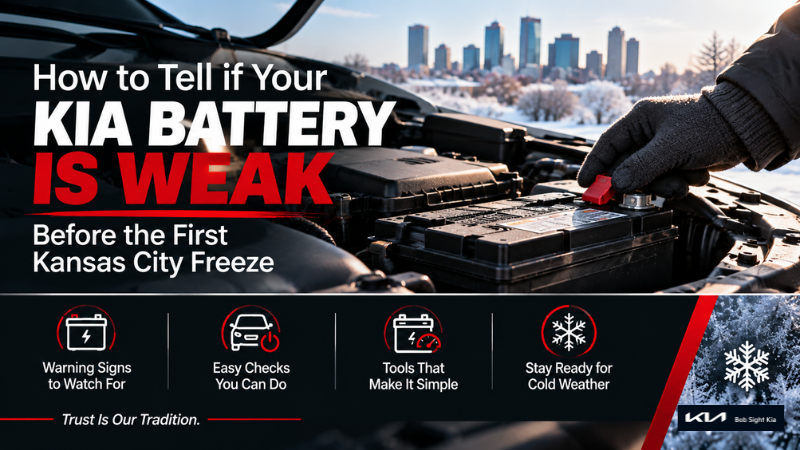
How to Tell if Your Kia Battery Is Weak Before the First Kansas City Freeze
Cold mornings in Independence, Missouri, can make an aging car battery work harder than usual. If your Kia has been starting slowly, making clicking noises, or showing unusual electrical symptoms, it may be time to have the battery checked before winter temperatures arrive.
Cold weather affects the amount of power a battery can deliver, while the engine may require more energy to start. A battery that performed normally throughout the summer can begin showing problems when temperatures drop. For drivers in Independence, Blue Springs, Lee's Summit, Raytown, and the greater Kansas City metro, recognizing these warning signs early can help reduce the chance of an unexpected no-start situation.
At Bob Sight Kia, our service team helps local drivers maintain their vehicles throughout Missouri's changing seasons. Understanding how your battery works and when to request testing is a practical part of preparing your Kia for winter.
Schedule Kia Battery Service at Bob Sight Kia
What You'll Learn About Kia Battery Health
- How cold temperatures affect your Kia's 12-volt battery
- Common warning signs of a weak or discharged battery
- How short trips and driving habits affect battery performance
- What you can safely inspect at home
- Why choosing the correct replacement battery matters
- When to schedule professional battery and charging-system testing
Why Cold Weather Can Make Your Kia Battery Struggle
Cold weather slows the chemical reactions inside a conventional 12-volt lead-acid battery. As temperatures fall, the battery becomes less capable of delivering the electrical current needed to start the engine.
According to AAA, freezing temperatures can significantly reduce a battery's available capacity. At the same time, colder engine oil can increase the amount of power needed to turn the engine over during startup.
This combination creates additional strain on batteries that are already aging, undercharged, or experiencing internal wear.
Why Battery Problems Often Appear After Summer
Although winter is when many drivers discover battery problems, summer heat can contribute to the deterioration that causes them.
High temperatures can accelerate internal corrosion and other chemical changes inside a lead-acid battery. Depending on the battery's construction, prolonged heat may also contribute to electrolyte loss.
A battery weakened during a hot Kansas City summer may still provide enough power to start your Kia during mild fall weather. Once overnight temperatures begin approaching freezing, the reduced starting capacity becomes more noticeable.
Cold weather does not automatically destroy a healthy battery. Instead, it can reveal weaknesses that were already developing.
Five Warning Signs Your Kia Battery May Be Weak
Battery problems do not always begin with a vehicle that refuses to start. Many drivers notice smaller changes in starting performance or electrical behavior first.
1. Your Kia Cranks More Slowly Than Normal
One of the most recognizable signs of a weak battery is a slow engine crank. You may notice that the engine turns over more slowly than usual before starting.
This can become more noticeable after your vehicle has been parked overnight during cold weather.
Although a weak battery is one possible cause, starter problems, poor electrical connections, and other mechanical issues can produce similar symptoms. Testing helps identify the actual problem.
2. You Hear Clicking When Trying to Start the Engine
A rapid clicking sound when attempting to start your Kia can indicate that the electrical system does not have enough available power to operate the starter properly.
A discharged battery, corroded terminals, or loose electrical connections are possible causes.
A single click without engine cranking can also point toward a starter-related problem. Rather than repeatedly attempting to start the vehicle, consider having the battery and starting system inspected.
3. Your Interior Lights or Electronics Behave Differently
Low system voltage can sometimes cause unusual electrical behavior, including dim interior lights, unexpected infotainment resets, or other electronic interruptions during startup.
However, these symptoms are not exclusive to battery problems. Wiring, charging-system, and individual component faults can also affect electrical performance.
If several electrical symptoms begin appearing together, a professional inspection can help determine whether the battery is involved.
4. Your Battery or Charging-System Warning Light Appears
The battery-shaped warning light on your dashboard generally relates to the vehicle's charging system. It does not automatically mean the battery itself needs replacement.
If this warning light remains illuminated while driving, the alternator, charging controls, wiring, or another electrical component may not be functioning properly.
A charging-system warning should be addressed promptly. If the system is not charging correctly, the vehicle may eventually lose electrical power or stop running.
5. Idle Stop and Go Stops Operating
Some Kia vehicles are equipped with Idle Stop and Go technology, which can automatically shut off the engine during certain stops and restart it when needed.
The system considers multiple operating conditions before activating. Battery state of charge is one factor, but cabin temperature demands, engine temperature, and other conditions can also affect operation.
If Idle Stop and Go stops functioning along with slow starting or other electrical symptoms, battery testing may be worthwhile.
How Short Trips Can Affect Your Kia Battery
Frequent short drives can make it more difficult for a vehicle's charging system to replenish the energy used during engine startup.
For example, drivers who primarily use their Kia for short trips around Independence, Raytown, or Sugar Creek may spend relatively little time driving between starts.
The battery must provide power to start the engine, while the charging system works to restore that energy once the engine is running.
When driving time is limited, the battery may not always return to a full state of charge. Repeated partial discharge can contribute to battery wear over time.
Does Highway Driving Help Recharge a Weak Battery?
Driving gives a properly functioning charging system an opportunity to replenish battery charge. However, there is no universal driving distance or time that guarantees a full recharge.
Battery condition, temperature, electrical demand, and charging-system operation all affect how quickly a battery can recover.
If your Kia frequently needs jump-starting or continues to crank slowly after normal driving, a longer trip is not a reliable solution.
A battery test and charging-system inspection can help determine whether the battery needs charging, replacement, or further diagnosis.
How to Check Your Kia Battery at Home
You can look for several visible warning signs without performing complicated electrical testing. Before inspecting the battery, consult your Kia owner's manual for its location and any model-specific safety instructions.
Not every Kia has a conventional 12-volt battery in the same location. Hybrid and electric models may have different battery arrangements and service procedures.
Start With a Visual Inspection
- Park your Kia on level ground, switch the vehicle off, and engage the parking brake.
- Locate the 12-volt battery using your owner's manual.
- Look for visible damage, including cracks, swelling, or leaks.
- Check accessible terminals for corrosion or obvious connection problems without touching damaged components.
- If you notice damage, leaking fluid, or significant corrosion, arrange professional inspection rather than attempting repairs yourself.
Do not attempt to open a sealed battery or handle leaking battery fluid. Battery electrolyte can be hazardous, and electrical connections should be serviced using appropriate safety procedures.
Can You Test Battery Voltage With a Multimeter?
A digital multimeter can provide useful information about the state of charge of a conventional 12-volt lead-acid battery when used correctly.
After the battery has been at rest, a fully charged conventional lead-acid battery commonly measures approximately 12.6 volts or slightly higher, depending on its type and conditions.
A substantially lower reading may indicate that the battery needs charging or further testing.
However, voltage alone cannot confirm battery health. A battery can show a reasonable resting voltage while still being unable to deliver sufficient current during engine startup.
For this reason, professional battery testing is more informative than relying on a single voltage measurement.
Why Professional Kia Battery Testing Matters
Professional battery testing helps determine whether a battery is simply undercharged or has lost enough performance to justify replacement.
Depending on the vehicle and diagnostic equipment, a technician may evaluate battery voltage, state of charge, available starting performance, and the operation of the charging system.
Testing can also help identify problems that resemble battery failure, including poor electrical connections or charging-system faults.
Cold battery temperature can affect test results, so technicians may need to account for temperature and battery condition when evaluating performance.
At Bob Sight Kia in Independence, drivers can schedule service to discuss starting problems, electrical concerns, or preventive winter battery maintenance.
Schedule a Kia Battery Inspection
AGM, EFB, and Conventional Batteries: Which Does Your Kia Need?
Not every Kia uses the same type of 12-volt battery. The correct replacement depends on the vehicle's model, model year, engine or powertrain configuration, and original equipment requirements.
Common automotive battery technologies include conventional flooded lead-acid batteries, Enhanced Flooded Batteries (EFB), and Absorbent Glass Mat (AGM) batteries.
Conventional Flooded Lead-Acid Batteries
Traditional flooded lead-acid batteries have been used in passenger vehicles for many years. They provide electrical energy for starting and other vehicle systems.
Their suitability depends on the vehicle's electrical requirements and manufacturer specifications.
Enhanced Flooded Batteries
EFB batteries are designed to offer improved cycling performance compared with many conventional flooded batteries.
They may be used in vehicles with increased electrical demands or certain engine stop-start systems.
Absorbent Glass Mat Batteries
AGM batteries use absorbent fiberglass separators to hold the electrolyte. They are designed to support demanding electrical applications and repeated charge-discharge cycles.
Some Kia models may require AGM batteries, but AGM technology should not be assumed to be necessary for every Kia with Idle Stop and Go or every hybrid vehicle.
Why Matching the Factory Battery Specification Matters
When replacing a battery, the correct type, physical size, terminal configuration, and electrical ratings are important.
Cold Cranking Amps (CCA) describe a battery's ability to provide starting current under standardized cold-temperature testing conditions. Reserve capacity is another specification that may be relevant to the vehicle's requirements.
Installing a battery that does not meet the manufacturer's specifications can contribute to poor performance or compatibility problems.
Consult your owner's manual or a qualified Kia service professional to identify the correct replacement battery for your vehicle.
How Long Does a Kia Battery Usually Last in Missouri?
Many conventional automotive 12-volt batteries last approximately three to five years, although actual service life varies.
Battery quality, driving habits, climate, charging-system condition, and how often the vehicle is used can all affect longevity.
In the Kansas City area, batteries experience both hot summer temperatures and freezing winter conditions. These seasonal changes can place additional demands on the battery over time.
If your Kia's battery is approaching three years of service, periodic testing can provide useful information about its condition.
An older battery does not automatically need replacement. Likewise, a newer battery can develop problems if it is repeatedly discharged or exposed to unfavorable conditions.
Testing is the most practical way to make an informed replacement decision.
How to Prepare Your Kia Battery for Winter
Preparing for winter does not require complicated maintenance. A few preventive habits can help reduce unnecessary battery strain and make it easier to identify problems before cold weather arrives.
- Have an aging battery tested. If your battery is several years old or has shown starting problems, schedule an inspection before temperatures regularly fall below freezing.
- Limit unnecessary electrical use while parked. Avoid leaving interior lights or accessories operating for extended periods when the vehicle is off.
- Pay attention to starting behavior. Slow cranking, repeated clicking, or intermittent no-start conditions deserve attention.
- Address charging-system warnings promptly. A charging problem can leave the battery discharged even when the battery itself is in good condition.
- Consider a compatible battery maintainer for extended storage. If your Kia will remain parked for several weeks, consult the owner's manual about an appropriate maintenance charger and connection procedure.
- Follow your Kia maintenance recommendations. Proper engine oil, regular inspections, and timely repairs support reliable cold-weather operation.
Parking in a garage may also help reduce exposure to very low temperatures. However, wind chill does not make an inanimate battery colder than the actual surrounding air temperature.
Should You Replace Your Kia Battery Before Winter?
Replacing a battery before winter may be appropriate if testing shows that it can no longer meet the vehicle's starting requirements.
Replacement may also be necessary when a battery has visible damage, repeated failures, or internal deterioration confirmed through testing.
However, replacing a battery solely because it is a certain age may not always be necessary.
A professional inspection can help distinguish between an aging battery that remains serviceable and one that is likely to create starting problems.
If the battery is healthy but frequently discharged, the underlying issue may involve driving habits, electrical draw, or the charging system.
Other Winter Maintenance Items Worth Checking
Your battery is only one part of preparing your Kia for Missouri winter driving.
Before colder weather arrives, consider reviewing the condition of your tires, windshield wipers, engine oil, coolant, and other important maintenance items.
Using the engine oil grade specified for your particular Kia helps support proper lubrication during cold starts. Tire pressure should also be checked regularly because pressure changes with temperature.
Windshield wipers and washer fluid are important for maintaining visibility during snow, sleet, and freezing precipitation.
Drivers commuting along Interstate 70, Highway 291, and other Kansas City-area roads can benefit from addressing these maintenance concerns before severe weather makes travel more difficult.
For additional maintenance needs, visit the Bob Sight Kia Service Specials page to review available offers.
Frequently Asked Questions About Kia Batteries
Why does my Kia struggle to start when it's cold outside?
Cold temperatures reduce the available starting performance of a conventional lead-acid battery while increasing the amount of power an engine may require to start.
If the battery is aging, discharged, or experiencing internal wear, the reduced performance may become noticeable during freezing weather.
However, starter problems, electrical connections, and other mechanical issues can also cause difficult starting. Testing is recommended when the problem continues.
Does a clicking sound mean my Kia battery is dead?
Not necessarily. Rapid clicking can occur when there is insufficient electrical power available to operate the starter properly.
A weak or discharged battery is a common possibility, but poor cable connections and starter-related problems can produce similar symptoms.
A battery and starting-system inspection can help identify the cause.
Can I safely jump-start my Kia?
Many conventional gasoline-powered Kia vehicles can be jump-started when the correct procedures are followed.
However, jump-starting instructions vary by model and powertrain. Some hybrid and electric vehicles have special 12-volt battery procedures or designated jump-start terminals.
Always consult your vehicle's owner's manual before attempting a jump-start. Never attempt to jump-start a battery that appears frozen, leaking, or physically damaged.
If you are uncertain about the procedure, roadside assistance is a safer option.
Will replacing my Kia battery reset my vehicle settings?
Disconnecting a 12-volt battery can reset certain electronic settings on some vehicles.
Depending on the Kia model and model year, this may affect clock settings, window functions, stored information, or other electronic features.
Some vehicles also have battery replacement or initialization procedures that should be followed.
Consult your owner's manual or a qualified service professional for instructions specific to your Kia.
Can a completely discharged Kia battery freeze?
Yes. A severely discharged conventional lead-acid battery can become more vulnerable to freezing because the electrolyte's composition changes as the battery loses charge.
Freezing can damage internal components or the battery case.
If you suspect a battery is frozen, do not attempt to charge or jump-start it. Have the battery inspected and follow appropriate safety procedures.
How often should I have my Kia battery tested?
Testing becomes increasingly useful as a battery ages or begins showing symptoms such as slow cranking, intermittent starting problems, or repeated discharge.
Many drivers choose to include battery testing in their regular maintenance routine, particularly before winter.
The appropriate testing interval depends on the battery's condition, age, and operating history.
Can I replace my Kia battery myself?
Battery replacement procedures vary by vehicle. Some conventional Kia models have relatively accessible 12-volt batteries, while others may require additional precautions, equipment, or initialization procedures.
Hybrid and electric vehicles can have more specialized electrical systems.
Before attempting replacement, consult the owner's manual and confirm the correct battery specification. Professional replacement is a practical option when the procedure is unfamiliar or the battery is difficult to access.
Schedule Kia Battery Service in Independence, MO
If your Kia has been slow to start, has needed repeated jump-starts, or is showing unusual electrical symptoms, having the battery checked before winter can help you understand what your vehicle needs.
Bob Sight Kia serves drivers throughout Independence, Blue Springs, Lee's Summit, Raytown, Sugar Creek, Grain Valley, and the greater Kansas City metro.
Our service department can assist with battery concerns and other maintenance needs to help you prepare for changing Missouri weather.
Visit Bob Sight Kia at 1700 S Noland Road, Independence, MO 64055, or use our online scheduling tool to request a service appointment.
Schedule Service at Bob Sight Kia
Helpful Kia Service and Shopping Links
- Schedule Kia Service in Independence, MO
- View Kia Service Specials
- Browse New Kia Inventory
- Shop Used Vehicles at Bob Sight Kia
- Value Your Trade
Explore the Bob Sight Auto Group
Bob Sight Kia is part of the Bob Sight Auto Group, serving drivers across the Kansas City metro and northeast Kansas. Our dealership locations offer vehicle sales, service, and automotive resources for drivers throughout the region.
- Bob Sight Kia | Independence, MO
- Bob Sight Ford | Lee's Summit, MO
- Bob Sight Honda | Lawrence, KS
- Bob Sight CDJR | Lawrence, KS
Trust Is Our Tradition.


 Warranties include 10-year/100,000-mile powertrain and 5-year/60,000-mile basic. All warranties and roadside assistance are limited. See retailer for warranty details.