

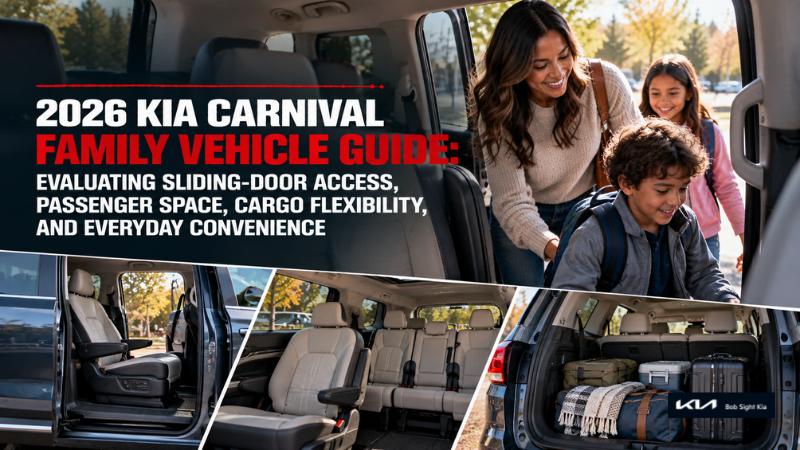
2026 Kia Carnival Family Vehicle Guide: Evaluating Sliding-Door Access, Passenger Space, Cargo Flexibility, and Everyday Convenience
Browse new Kia family vehicles at Bob Sight Kia in Independence, Missouri.
The 2026 Kia Carnival can be a strong family vehicle for households that need three-row seating, sliding-door access, flexible cargo space, and everyday features designed around passengers. It combines many of the practical qualities associated with a minivan with styling and technology that may appeal to families also considering three-row SUVs.
A family vehicle must handle more than the morning commute. It may need to support school drop-offs, carpools, grocery runs, sports practices, road trips, child seats, strollers, visiting relatives, and changing cargo needs. The Carnival's sliding rear doors and configurable interior can make those responsibilities easier to manage.
This guide helps families from Independence, Blue Springs, Lee's Summit, Kansas City, Raytown, Sugar Creek, Liberty, Grain Valley, Oak Grove, Jackson County, and the Greater Kansas City Metro evaluate whether the 2026 Kia Carnival fits their routine. It covers passenger access, seating arrangements, cargo flexibility, technology, road-trip comfort, test-drive priorities, and ownership planning.
In This Guide You'll Learn
- Why sliding rear doors can simplify family transportation
- How to evaluate Carnival seating configurations
- What to check when installing child seats
- How passenger space and cargo flexibility work together
- Which convenience and safety technologies may support families
- How the Carnival fits commuting and road trips
- What to evaluate during a family-focused test drive
2026 Kia Carnival Quick Facts
The 2026 Kia Carnival is a three-row multipurpose vehicle designed to provide family-friendly access, flexible seating, and substantial cargo capability. Seating capacity and equipment can vary by trim and configuration, so shoppers should confirm the specifications of the exact vehicle they are considering.
- Three-row passenger seating
- Seating for up to eight occupants on selected configurations
- Dual sliding rear doors for easier passenger access
- Flexible second-row seating options, depending on configuration
- Foldable third-row seating for expanded cargo capacity
- Gasoline and hybrid powertrain choices, depending on availability
- Available driver-assistance and parking technology
- Available passenger-comfort and rear-cabin convenience features
The Carnival is not simply an alternative for drivers who do not want an SUV. Its interior design and sliding-door access solve family transportation challenges differently from a traditional three-row crossover.
Families should compare seating capacity, second-row arrangement, cargo needs, powertrain, and trim equipment before choosing a specific Carnival. Features shown on one model may not be included on another.
Is the 2026 Kia Carnival a Good Family Vehicle?
Yes, the 2026 Kia Carnival can be a good family vehicle for households that value passenger access, three-row space, configurable seating, and room for everyday cargo. Its strongest advantages become clear when families regularly transport children, child seats, grandparents, friends, sports equipment, or travel gear.
Traditional rear doors can be difficult to open in narrow parking spaces. Sliding doors move along the side of the vehicle rather than swinging outward, helping passengers enter and exit without requiring as much clearance. This can be useful in school pickup lanes, crowded parking lots, garages, and spaces next to another vehicle.
The Carnival's cabin is designed around moving people and their belongings. Families can use the third row for additional passengers, fold seats when they need more cargo capacity, or select a configuration that emphasizes second-row comfort.
A family with young children may prioritize child-seat access and the ability to load passengers without wide-opening doors. A household with teenagers may focus more on legroom, charging access, climate comfort, and the ability to carry sports equipment. A multigenerational family may place greater value on step-in height and straightforward access to the second row.
The Carnival may fit your family if you:
- Regularly transport five or more people
- Use multiple child seats or booster seats
- Need easier access in narrow parking spaces
- Carry strollers, sports equipment, or mobility items
- Take frequent family road trips
- Participate in carpools
- Need flexible passenger and cargo arrangements
The Carnival may provide more space than a smaller crossover, but families should still test the exact seating arrangement. The right configuration depends on whether maximum seating capacity, second-row comfort, or cargo flexibility is the primary goal.
How Sliding Doors Help During Everyday Family Life
The Carnival's sliding rear doors can make passenger loading easier in situations where traditional doors would be difficult to open fully. This benefit is useful during daily errands, school transportation, medical appointments, and trips to busy Kansas City-area shopping centers.
A conventional rear door swings into the space next to the vehicle. A sliding door moves rearward along the vehicle's side. Children may have an easier time entering without pushing a door toward a neighboring vehicle, shopping cart, garage wall, or concrete pillar.
Sliding doors may help when:
- Loading a child into a rear-facing car seat
- Assisting an older passenger into the second row
- Parking in a narrow residential garage
- Using a crowded school pickup or drop-off lane
- Unloading near another parked vehicle
- Managing several children at the same time
- Accessing the cabin while carrying bags or equipment
Families should test the door controls during the dealership visit. Confirm how the exterior handles, interior switches, key fob, and available hands-free functions operate on the selected trim. Ask how to pause, reverse, or disable powered operation when needed.
Children should be taught to wait until the vehicle is parked and the driver confirms it is safe to exit. Sliding doors reduce the space needed beside the vehicle, but passengers must still watch for traffic, cyclists, shopping carts, and other hazards.
Door operation should also be evaluated in the family's actual parking environment. Measure the garage and confirm there is enough clearance around the vehicle. Check whether shelves, walls, equipment, or another vehicle could interfere with loading passengers.
Use this sliding-door evaluation process:
- Park beside another vehicle. Recreate the type of space you regularly use.
- Open each sliding door. Test the exterior handle, interior controls, and key fob.
- Practice loading a child seat. Check your reach and available standing room.
- Enter the second and third rows. Confirm that passengers can move through the cabin safely.
- Review child-safety controls. Ask how door locks and powered functions are managed.
- Test closing visibility. Make sure the driver can confirm that passengers and belongings are clear.
Passenger Space and Seating Configurations
The Carnival's seating flexibility allows families to prioritize maximum capacity, second-row access, or passenger comfort based on the selected configuration. Shoppers should not assume every Carnival has the same second-row layout or seating capacity.
Selected configurations can seat up to eight occupants. Other configurations may use second-row captain's chairs or comfort-focused seating that changes passenger capacity and interior flexibility. The correct layout depends on how many people usually travel together and who needs access to the third row.
An eight-passenger arrangement may fit larger households, carpools, or families that frequently travel with grandparents and friends. A seven-passenger arrangement with separated second-row seats may provide a center pathway and more personal space.
Child-seat installation can affect access. A seat that slides or folds easily when empty may move differently after a child restraint is secured. Families using multiple child seats should bring them to the dealership or check the exact dimensions and installation requirements.
Evaluate these seating questions:
- How many passengers travel with us most often?
- How frequently will the third row be occupied?
- Will adults or teenagers use the third row?
- How many child seats or boosters are needed?
- Can passengers reach the third row with child seats installed?
- Do we need a center second-row seating position?
- Would captain's chairs improve access or comfort?
- How easily can the seats be adjusted or removed?
Set the driver's seat to the normal driving position before evaluating the rear rows. Adjust the second row to a realistic location, then have someone sit in the third row. Check knee room, foot space, headroom, seatback position, window visibility, airflow, cupholders, and charging access.
Families with growing children should plan beyond their immediate needs. A seating arrangement that works for young children may feel different when they become teenagers or begin carrying larger school and sports equipment.
Cargo Flexibility for Strollers, Groceries, and Family Trips
The Carnival's cargo flexibility is one of its strongest family advantages because it can carry passengers, everyday supplies, and larger items in several configurations. The foldable third row allows families to create more cargo room when those seats are not needed.
The most useful cargo measurement depends on how the vehicle will be used. Maximum cargo capacity may be impressive, but a family using all three rows needs to know how much space remains behind the third row.
Test the cargo area with realistic items such as:
- Strollers and diaper bags
- Grocery bags and household supplies
- Sports bags, folding chairs, and coolers
- School projects and musical instruments
- Pet carriers and pet supplies
- Wheelchairs, walkers, or other mobility equipment
- Suitcases and holiday gifts
- Camping or outdoor equipment
The cargo area behind the third row may allow some items to sit lower than the rear opening, depending on the configuration. This can help contain grocery bags or smaller luggage, but families should still secure loose cargo.
When the third row is folded, the Carnival can provide a larger and flatter area for bulky items. Ask a product specialist to demonstrate the folding process and confirm whether head restraints, floor panels, or seatbelts require adjustment.
Drivers should never stack cargo in a way that blocks rear visibility or allows objects to move into the passenger area. Heavy items should be positioned carefully and secured using appropriate tie-down points.
Use this cargo test during the dealership visit:
- Keep all three rows upright. Measure the space available for a fully occupied trip.
- Place your largest regular item in the cargo area. A stroller or mobility device can reveal more than published volume.
- Fold one section of the third row. Determine whether passengers and longer cargo can travel together.
- Fold the full third row. Review floor shape, width, and loading height.
- Operate the liftgate. Check reach, opening height, and clearance in a garage.
- Locate storage compartments. Identify spaces for emergency supplies and smaller items.
The Carnival may be a good alternative to a three-row SUV for families that frequently choose between carrying more passengers and carrying more cargo.
Daily Driving Around Independence and Kansas City
The Carnival is designed to carry a family comfortably while remaining manageable for commuting, errands, parking, and highway travel. Its larger dimensions require awareness, but available cameras, sensors, and driver-assistance features may help drivers become more comfortable with the vehicle.
A normal day may include residential streets in Independence, traffic on I-70, shopping near Independence Center, school pickup lanes, and parking in downtown Kansas City. Families should test the Carnival in several of these environments rather than judging it only from a short drive around the dealership.
Pay attention to steering effort, turning radius, brake-pedal response, ride comfort, acceleration, visibility, and cabin noise. Test the vehicle at neighborhood speeds and on a highway when conditions allow.
Parking is a common concern for drivers moving from a sedan or compact SUV. During the test drive, use a normal parking space and practice backing into it. Review the rearview camera, available surround-view display, parking sensors, mirror visibility, and blind spots.
Families should also evaluate the vehicle while passengers are talking and climate controls are operating. A quiet solo test drive may not represent the normal cabin environment. Ask rear passengers whether they can hear conversations, feel climate airflow, and access cupholders or charging ports.
If more than one adult will drive the Carnival, each person should test it. Seating position, visibility, control access, and parking confidence can differ significantly between drivers.
The Carnival's design can provide a family-focused alternative for drivers who like the passenger capacity of a larger SUV but prefer sliding doors and a cabin built around easy access.
Family Technology and Driver-Assistance Features
The most useful Carnival technology is equipment that reduces everyday frustration, supports driver awareness, and keeps passengers comfortable without becoming distracting. Features vary by trim, so confirm what is installed on the exact vehicle.
Families may want to compare smartphone connectivity, navigation, charging ports, rear-cabin communication features, camera views, climate controls, and available passenger-entertainment equipment.
Charging access matters when several people carry phones, tablets, headphones, or gaming devices. Check the number and location of ports in all three rows. Make sure passengers can reach them without stretching cables across entry paths.
Potential driver-assistance technologies may support forward-collision awareness, blind-spot monitoring, lane positioning, rear cross-traffic awareness, highway driving, and parking. These systems support an attentive driver and do not replace careful observation or control of the vehicle.
Families should evaluate the following technology:
- Smartphone pairing and audio controls
- Navigation or smartphone-based directions
- Front and rear charging access
- Rearview and available surround-view cameras
- Parking sensors
- Blind-spot and rear cross-traffic alerts
- Available cabin communication features
- Rear climate-control access
- Available entertainment features
- Driver-assistance setting controls
Ask the product specialist to explain which features are standard, optional, or unavailable on the selected trim. Similar Carnival models may have meaningful equipment differences even when their exterior appearance is similar.
Parents should also review how rear entertainment and personal devices will be managed. Screens can help during long trips, but charging cables, headphones, storage, and content controls should be planned before travel.
Gasoline vs. Carnival Hybrid for Family Driving
The gasoline Carnival may appeal to drivers who prefer a familiar conventional powertrain, while the Carnival Hybrid may interest families seeking electrified assistance without a plug-in charging routine. Availability and equipment depend on the selected model and current inventory.
The conventional hybrid system combines a gasoline engine, electric motor, and hybrid battery. It manages the power sources automatically and does not require the driver to connect the vehicle to an external charger.
A family driving pattern may include short errands, school traffic, highway commuting, and occasional road trips. Each use can affect fuel consumption differently. Vehicle load, weather, speed, traffic, climate-control use, tire pressure, and driving style can influence real-world results.
Missouri winter temperatures may cause a hybrid vehicle's gasoline engine to operate more frequently while the cabin and powertrain warm. Summer air-conditioning use can also affect energy consumption.
Compare both powertrains based on the complete ownership routine:
- Typical daily mileage
- City and highway driving balance
- Passenger and cargo load
- Frequency of long-distance trips
- Preferred acceleration and braking feel
- Trim and feature availability
- Maintenance planning
A test drive should include normal acceleration, highway merging, braking, parking, and lower-speed traffic. Drivers comparing the hybrid should also pay attention to regenerative braking and the transitions between gasoline and electric assistance.
Road Trips and Changing Missouri Weather
The Carnival can support family road trips by combining three-row seating, flexible cargo room, passenger technology, and long-distance comfort. Preparation remains important when traveling with several people or driving during changing Missouri weather.
Before leaving Independence, check tire pressure, tread condition, exterior lights, wipers, washer fluid, battery condition, and fluid levels. Address active warning lights, unusual noises, braking concerns, or visible leaks before beginning a long trip.
Plan the passenger layout before loading cargo. Frequently needed items such as snacks, medications, wipes, charging cables, and extra clothing should remain accessible without allowing loose objects to move around the cabin.
Families traveling on I-70, I-35, I-435, or the Kansas Turnpike should consider how passengers will handle longer periods in each row. Test climate airflow, seat comfort, charging access, cupholders, window visibility, and the ability to communicate between rows.
Winter travel may require blankets, water, snacks, flashlights, charging equipment, and other emergency supplies. Cargo should be secured so that emergency items remain accessible.
The Carnival's passenger-focused layout can reduce some road-trip challenges, but the driver should still plan regular breaks. Stops allow passengers to move, use restrooms, reorganize belongings, and reduce cabin fatigue.
How to Test-Drive a Kia Carnival With Your Family
A family-focused Carnival test drive should include the people, child seats, cargo measurements, and road conditions that reflect your actual routine. Testing the vehicle alone may overlook the features and limitations that matter most.
Schedule enough time to examine all three rows before driving. Open each sliding door, move the second-row seats, enter the third row, fold the rear seats, and operate the liftgate.
Bring child seats or confirm their measurements and installation requirements. Check whether the selected seating configuration provides the required lower anchors, tether locations, and access. Follow the child-seat and vehicle manufacturers' instructions.
During the drive, evaluate:
- Driver seating position and outward visibility
- Acceleration and highway merging
- Brake response and steering effort
- Ride comfort over uneven pavement
- Road and wind noise
- Passenger communication between rows
- Rear climate performance
- Camera and parking-sensor views
- Turning radius and parking confidence
- Sliding-door and liftgate operation
Ask rear passengers for feedback. Children may notice charging access, cupholder placement, window visibility, or seat comfort that the driver cannot evaluate from the front row.
Blue Springs, Lee's Summit, and Kansas City shoppers can also review current Bob Sight Kia vehicle specials and the Price Match Promise when comparing available family vehicles. Inventory, offers, eligibility, and program details can change, so confirm current information for the specific Carnival under consideration.
Ownership Planning for a 2026 Kia Carnival
Carnival ownership planning should include routine maintenance, tire care, interior durability, insurance, financing, annual mileage, and the household's changing passenger needs. A vehicle that fits today should also support the family's expected routine over the next several years.
Follow the maintenance schedule provided for the selected powertrain and vehicle. Service requirements can vary based on mileage, time, driving environment, trip length, weather, passenger load, and other operating conditions.
Routine ownership needs may include oil and filter service, tire rotations, brake inspections, fluid checks, battery testing, filter replacement, and other recommended maintenance. Hybrid configurations may have different inspection or service requirements than gasoline models.
Tire care affects braking, traction, ride comfort, road noise, and efficiency. Maintain the recommended pressure, rotate tires as directed, and address uneven wear promptly. Families planning holiday or summer road trips should inspect tires before departure rather than waiting until the travel date.
Interior planning is also important. Floor protection, cargo liners, seatback organizers, and appropriate storage solutions may help manage mud, snacks, sports equipment, and school supplies. Accessories should not interfere with airbags, seat movement, child-seat installation, or visibility.
Request insurance estimates for the exact trim and powertrain being considered. If financing, review the complete ownership plan, including the trade-in, expected mileage, maintenance, insurance, and intended ownership period.
Keep maintenance records and repair invoices. Detailed documentation can help with future service planning and may provide useful information when the family eventually sells or trades the vehicle.
Frequently Asked Questions About the 2026 Kia Carnival
Is the 2026 Kia Carnival a minivan or an SUV?
The 2026 Kia Carnival is a multipurpose vehicle with three-row family functionality and sliding rear doors.
Its design incorporates SUV-inspired styling, but its passenger access and flexible interior provide many of the practical benefits commonly associated with a minivan. Families should evaluate it based on function rather than the category name alone.
For Independence and Kansas City-area households, the Carnival may provide a useful alternative to a traditional three-row SUV when sliding-door access and passenger flexibility are priorities.
How many people can the 2026 Kia Carnival seat?
The 2026 Kia Carnival can seat up to eight occupants in selected configurations.
Seating capacity depends on the trim and second-row arrangement. Some configurations prioritize maximum passenger capacity, while others may emphasize second-row comfort or access.
Families should confirm the seating capacity of the exact Carnival at Bob Sight Kia. Test the interior with normal passengers and child-seat needs before choosing a configuration.
Is the Kia Carnival good for families with car seats?
The Carnival can be well suited to families using child seats because its sliding doors and spacious rear access may make installation and loading easier.
Compatibility depends on the child restraint, seating position, second-row configuration, and the number of seats being installed. Always follow both the vehicle and child-seat manufacturers' instructions.
Bring child seats to the dealership when possible. This allows families to check anchor access, front-seat clearance, third-row entry, and the ability to load children in realistic parking conditions.
Does the 2026 Kia Carnival have enough cargo room for a family?
The Carnival provides useful family cargo capacity, but available space changes based on how many seating rows are in use.
Families using all three rows should evaluate the area behind the third row. Folding part or all of the third row creates additional room for larger items, luggage, sports equipment, or household supplies.
Bring stroller measurements, luggage dimensions, or other frequently carried items when visiting Bob Sight Kia. A physical cargo test provides more useful information than maximum cargo volume alone.
Is the Kia Carnival good for long road trips?
The Carnival can be a strong road-trip vehicle for families because it combines three-row seating, passenger access, flexible cargo space, and available comfort technology.
Road-trip suitability depends on the selected trim, seating configuration, passenger size, luggage requirements, and powertrain. Families should test rear climate airflow, charging access, seat comfort, and cargo room.
Drivers traveling from Independence, Blue Springs, Lee's Summit, Kansas City, or other Jackson County communities should test the Carnival at highway speed and confirm that every passenger row remains comfortable.
Find a 2026 Kia Carnival Near Kansas City
Bob Sight Kia in Independence helps Kansas City-area families compare available Carnival models based on seating, sliding-door access, cargo flexibility, powertrain, technology, and everyday convenience. A side-by-side review of configurations can help shoppers determine which model fits their household.
Drivers searching for a Kia Carnival near me can begin by reviewing current inventory and identifying preferred seating arrangements and features. Inventory can change, so confirm availability before visiting if you want to see a specific Carnival.
Bob Sight Kia serves families from Independence, Blue Springs, Lee's Summit, Kansas City, Raytown, Sugar Creek, Liberty, Grain Valley, Oak Grove, Jackson County, and communities throughout the Greater Kansas City Metro.
Bring your normal passengers, child-seat information, and cargo measurements to the dealership. A realistic test drive can help determine whether the 2026 Kia Carnival provides the access, passenger room, and flexibility your family needs.
Helpful Links
Proud to Be Part of the Bob Sight Auto Group
Bob Sight Kia is proud to be part of the family-owned Bob Sight Auto Group, serving vehicle shoppers and owners throughout the Kansas City region and Northeast Kansas. Families researching new or used vehicles can rely on Bob Sight Auto Group for new and pre-owned vehicle sales, trade-in resources, auto financing, certified service, parts, and collision repair.
 Warranties include 10-year/100,000-mile powertrain and 5-year/60,000-mile basic. All warranties and roadside assistance are limited. See retailer for warranty details.