
Today: 8:30AM - 6:00PM
Blog / Independence Kia Dealer

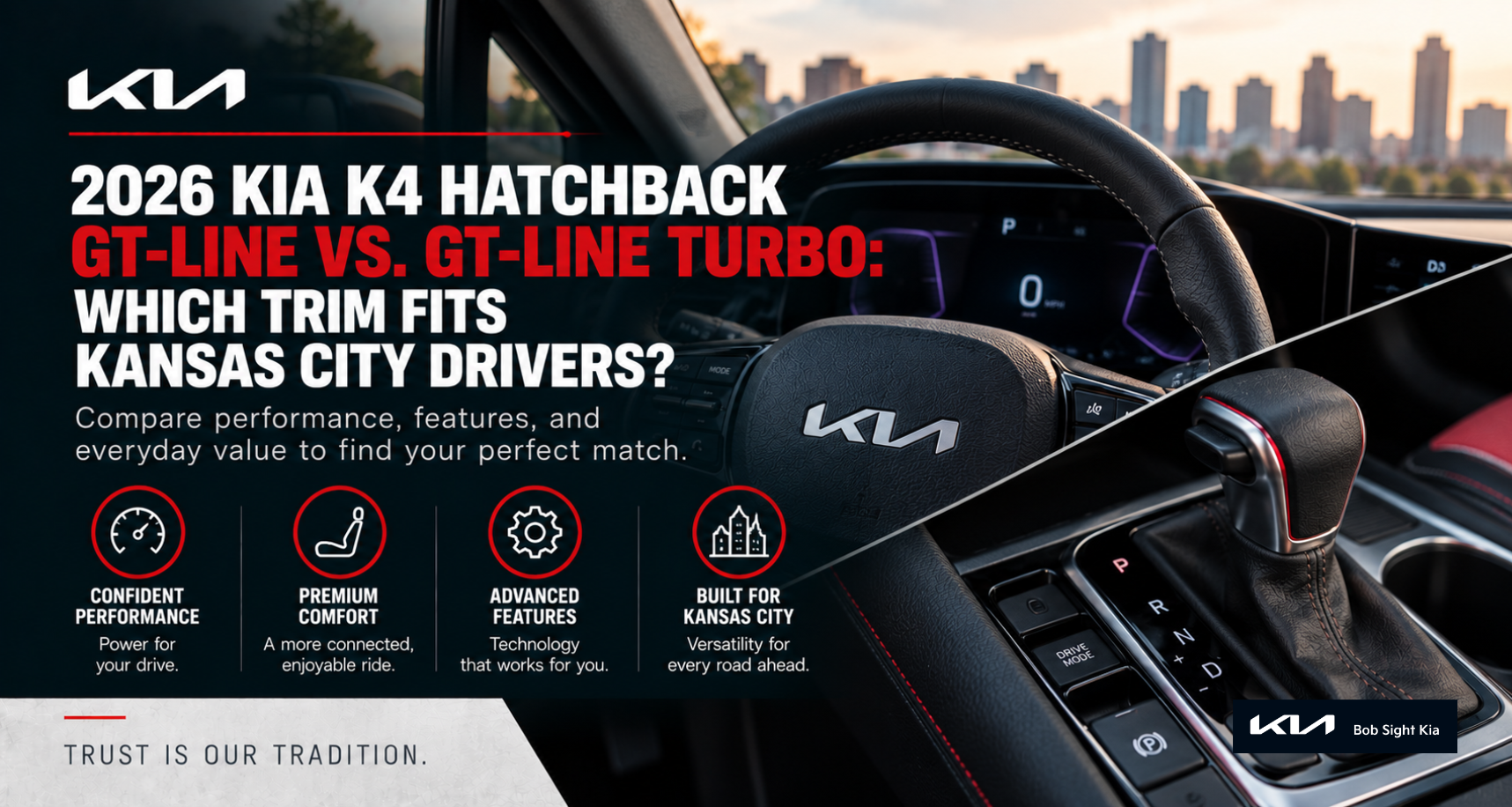
2026 Kia K4 Hatchback GT-Line vs. GT-Line Turbo: Which Trim Fits Kansas City Drivers?

2026 Kia K4 Hatchback GT-Line and GT-Line Turbo comparison for Kansas City drivers at Bob Sight Kia

2026 Kia K4 Hatchback GT-Line vs. GT-Line Turbo: Which Trim Fits Kansas City Drivers?

The 2026 Kia K4 Hatchback gives Kansas City drivers two sport-inspired trims to consider: the GT-Line and GT-Line Turbo. Both combine flexible hatchback cargo access, a modern digital cabin, distinctive styling, and practical dimensions for navigating Independence and the surrounding Kansas City Metro. The most important difference is found beneath the hood, where the GT-Line prioritizes smooth everyday performance and the GT-Line Turbo delivers considerably more horsepower and torque.

Choosing between these two Kia K4 Hatchback trims depends on how and where you drive. A commuter traveling between Independence and downtown Kansas City may prioritize comfortable operation and predictable power delivery. A driver who frequently merges onto I-70, travels across I-435, or enjoys more responsive acceleration may find the turbocharged model better suited to those needs.

At Bob Sight Kia in Independence, Missouri, shoppers can compare available Kia K4 models and determine which combination of performance, technology, comfort, and hatchback versatility works for their daily routine. Understanding the differences before visiting can make the test-drive and vehicle-selection process more productive.

Explore new Kia K4 inventory at Bob Sight Kia

In This Guide You Will Learn

This guide compares the 2026 Kia K4 Hatchback GT-Line and GT-Line Turbo for drivers shopping near Kansas City. Rather than treating the trims as two nearly identical vehicles, it explains how their engines, transmissions, driving characteristics, and available features may affect everyday ownership.

The right trim is not necessarily the one with the most power or the longest list of available equipment. It is the one that matches your commute, driving preferences, passenger needs, and expectations for long-term ownership. Comparing the trims by real-world use can help you avoid paying for performance you may not need or overlooking capability you would appreciate.

  • The main differences between the GT-Line and GT-Line Turbo
  • How their engines and transmissions compare
  • Which trim better fits city and highway driving
  • How the two trims may feel during a test drive
  • What technology, comfort, and safety features to compare
  • How hatchback cargo access supports daily Kansas City life
  • Which trim may suit different types of Missouri drivers
  • How to evaluate available K4 Hatchback models near Independence

2026 Kia K4 Hatchback GT-Line vs. GT-Line Turbo at a Glance

The GT-Line is the more comfort-focused everyday choice, while the GT-Line Turbo is designed for drivers who want quicker acceleration and a more responsive powertrain. Both trims give shoppers a sport-inspired version of Kia’s compact hatchback with a flexible cargo area and a modern passenger compartment.

The 2026 Kia K4 Hatchback GT-Line uses a naturally aspirated 2.0-liter four-cylinder engine producing 147 horsepower and 132 pound-feet of torque. It pairs that engine with an Intelligent Variable Transmission, commonly called an IVT. This combination is designed to deliver smooth and consistent performance for commuting, errands, and routine travel.

The GT-Line Turbo replaces that powertrain with a turbocharged 1.6-liter four-cylinder engine producing 190 horsepower and 195 pound-feet of torque. It also uses an eight-speed automatic transmission instead of the IVT. The additional horsepower and torque create stronger acceleration when merging, passing, or traveling with passengers and cargo.

Comparison Point 2026 K4 Hatchback GT-Line 2026 K4 Hatchback GT-Line Turbo
Engine 2.0-liter four-cylinder Turbocharged 1.6-liter four-cylinder
Horsepower 147 horsepower 190 horsepower
Torque 132 pound-feet 195 pound-feet
Transmission Intelligent Variable Transmission Eight-speed automatic transmission
Driving Character Smooth and practical Quicker and more responsive
Best Fit Everyday commuting and local driving Drivers who prioritize stronger performance

Neither trim is automatically better for every shopper. The GT-Line provides plenty of capability for normal city, suburban, and highway driving. The GT-Line Turbo adds performance for drivers who will use and appreciate its stronger response.

How Do the GT-Line and GT-Line Turbo Powertrains Compare?

The largest difference between these Kia K4 Hatchback trims is how quickly and forcefully they respond when the driver presses the accelerator. The GT-Line’s naturally aspirated engine provides predictable power, while the GT-Line Turbo develops more torque across a broader range of driving situations.

A naturally aspirated engine draws air into the combustion chamber without assistance from a turbocharger. In the GT-Line, this creates a straightforward power-delivery style suited to routine transportation. Acceleration builds progressively, which can feel smooth when leaving stoplights, moving through residential areas, or maintaining a steady speed on I-70.

The GT-Line’s Intelligent Variable Transmission does not rely on a fixed set of traditional gears. It continuously adjusts its operating ratio to balance acceleration and efficient engine operation. Drivers who prioritize smoothness during stop-and-go traffic may appreciate how the IVT delivers power without frequent conventional gear changes.

The GT-Line Turbo uses exhaust gases to power a turbocharger that forces additional air into the engine. This allows the 1.6-liter engine to produce more horsepower and substantially more torque than the 2.0-liter engine in the GT-Line. The result is quicker response when entering a highway, passing slower traffic, or accelerating while carrying multiple passengers.

Its eight-speed automatic transmission also produces the recognizable gear changes many drivers expect from a traditional automatic. This can make acceleration feel more direct and engaging. Drivers who enjoy feeling the vehicle move through its gears may prefer this character over the smoother behavior of an IVT.

Torque is an important distinction because it contributes to the pulling force a driver feels during acceleration. The increase from 132 pound-feet in the GT-Line to 195 pound-feet in the GT-Line Turbo is meaningful. It can make the Turbo feel more confident even when the driver is not using all 190 horsepower.

Which K4 Hatchback Trim Fits Daily Kansas City Driving?

The GT-Line fits relaxed everyday driving well, while the GT-Line Turbo better serves drivers who regularly encounter demanding highway merges or prefer stronger acceleration. Kansas City Metro travel often includes local streets, busy intersections, construction zones, interstate ramps, and stretches of steady highway driving within the same trip.

The GT-Line may be the natural choice for someone who primarily travels around Independence, Blue Springs, Raytown, Sugar Creek, or nearby Jackson County communities. Its powertrain is appropriate for school transportation, shopping, work commutes, appointments, and other ordinary trips. It also retains the sport-inspired styling and hatchback utility that draw shoppers to the K4 Hatchback.

A driver commuting west on I-70 toward downtown Kansas City may have different priorities. Highway entrances can require decisive acceleration, particularly when traffic is already moving quickly. The GT-Line Turbo’s additional torque may make those situations feel easier by helping the vehicle reach traffic speed more promptly.

The Turbo may also appeal to drivers traveling regularly on I-435, Highway 291, U.S. 40, or U.S. 50. Its stronger passing response can be useful when traffic speeds change or when a driver needs to move around a slower vehicle. Additional power does not replace safe judgment, but it can make the vehicle feel less strained when acceleration is requested.

Consider which of these descriptions sounds more like your routine:

  • Choose the GT-Line if you mostly drive local streets and maintain consistent highway speeds.
  • Consider the GT-Line Turbo if you frequently use busy highway entrances or value quicker passing response.
  • Choose the GT-Line if smooth and predictable operation is more important than maximum power.
  • Consider the GT-Line Turbo if you want your commuter vehicle to feel more energetic.
  • Choose based on your normal driving, not an occasional trip that represents only a small part of ownership.

Kansas City traffic can be unpredictable, but not every driver needs the most powerful option. Someone who rarely accelerates aggressively may find the GT-Line provides the right balance. A driver who notices and values powertrain response may prefer the GT-Line Turbo every time the road opens.

How Do the GT-Line and GT-Line Turbo Feel Behind the Wheel?

The GT-Line should feel smooth and controlled, while the GT-Line Turbo delivers a more immediate and energetic response. The difference is likely to become clearer during a back-to-back test drive than it appears when reading specifications online.

In the GT-Line, acceleration should build gradually as the IVT adjusts to the driver’s input. This character can be comfortable during heavy traffic, neighborhood driving, and routine errands. It allows the K4 Hatchback to function as a practical daily vehicle without requiring the driver to manage an aggressive powertrain.

The GT-Line Turbo should feel stronger earlier in the acceleration process. Its higher torque output gives the driver more immediate response when leaving a stop or increasing speed. The eight-speed automatic transmission can also make the driving experience feel more familiar to shoppers accustomed to traditional automatic gear changes.

Both GT-Line versions use a multi-link rear suspension. A multi-link suspension uses several separate links to control wheel movement, which can help balance handling and ride comfort. This design supports the K4 Hatchback’s sport-inspired positioning while keeping the vehicle appropriate for everyday roads.

Drivers may also appreciate steering-wheel-mounted paddle shifters when they want greater control over transmission response. Paddle shifters allow the driver to request simulated or actual gear changes without moving a hand to the center console. They can be useful on curving roads or when preparing to pass, although many owners may leave the transmission in its automatic setting most of the time.

Neither trim is intended to sacrifice practicality for extreme performance. The GT-Line Turbo simply adds a stronger engine and a different transmission character to the same basic hatchback formula. This makes it possible to choose a more responsive K4 without giving up passenger room or rear cargo access.

What Technology, Comfort, and Cargo Features Should Shoppers Compare?

Both trims provide a modern cabin, but shoppers should compare the equipment installed on each individual vehicle because some features may depend on packages and configuration. A trim name identifies the basic model, but it does not always show every feature included on a particular K4 Hatchback.

The K4 Hatchback offers a wide digital display area that organizes infotainment, vehicle information, and available climate controls. Wireless Apple CarPlay and Android Auto allow compatible smartphones to connect without requiring a cable for every trip. Drivers can access supported navigation, calling, messaging, music, and podcast applications through the vehicle’s central screen.

Available comfort equipment may include heated and ventilated front seats, a heated steering wheel, driver-seat memory settings, upgraded seat materials, and a wide sunroof. Heated features can make winter mornings in Independence more comfortable, while ventilated seating may help during humid Missouri summers.

Shoppers should also compare available audio, parking, camera, and highway-driving technology. One vehicle may include a package that adds features not installed on another vehicle of the same basic trim. Reviewing the window sticker is the simplest way to verify the exact factory equipment.

The hatchback layout is a shared advantage. Rather than loading cargo through a traditional sedan trunk opening, owners can raise the entire rear hatch. This creates a taller and more accessible opening for groceries, luggage, sports equipment, pet supplies, work materials, or household purchases.

Folding the rear seats expands the amount of usable space for longer items. That flexibility can make the K4 Hatchback appealing to shoppers who want more cargo versatility but do not need the height or overall footprint of an SUV. It may also provide an easier transition for someone downsizing from a crossover.

Before choosing a vehicle, test the cargo area with your actual lifestyle in mind. Consider the stroller, golf clubs, athletic bags, folding chairs, work equipment, or luggage you carry regularly. Cargo measurements are helpful, but the shape of the opening and the way the rear seats fold can matter just as much.

Which 2026 Kia K4 Hatchback Trim Should You Choose?

Choose the GT-Line for balanced everyday usability or the GT-Line Turbo for stronger acceleration and a more engaging powertrain. The decision becomes easier when shoppers focus on their real habits instead of simply choosing the highest trim available.

Who Should Choose the Kia K4 Hatchback GT-Line?

The GT-Line may be the better match for commuters who want sport-inspired styling without requiring turbocharged performance. It delivers the appearance, technology, hatchback access, and passenger usability that make the K4 appealing while using a powertrain focused on smooth daily operation.

It can work well for Independence residents who primarily travel on local roads or maintain predictable highway speeds. Drivers running errands along Noland Road, commuting to Blue Springs, or traveling between nearby Jackson County communities may find its 147-horsepower engine sufficient for their routine.

The GT-Line may also make sense for shoppers who prioritize available cabin features over additional power. If your decision centers on seating comfort, connectivity, cargo access, or driver-assistance technology, compare the equipment on individual vehicles before assuming the Turbo is necessary.

  • Drivers who prefer smooth and predictable acceleration
  • Commuters whose routes are primarily local or suburban
  • Shoppers who want GT-Line styling without a turbocharged engine
  • Small households that need flexible cargo access
  • Drivers moving from a compact sedan into a hatchback
  • People who prioritize technology and comfort over maximum horsepower

Who Should Choose the Kia K4 Hatchback GT-Line Turbo?

The GT-Line Turbo is intended for drivers who want the strongest available K4 Hatchback performance. Its 190-horsepower engine and 195 pound-feet of torque provide a noticeable advantage during acceleration. That extra response can be useful even when the vehicle is not being driven aggressively.

Drivers who regularly enter I-70 from shorter ramps, travel across the Kansas City Metro, or carry passengers and cargo may appreciate the additional torque. Vehicle weight affects acceleration, so a more powerful engine can feel more confident when the hatchback is fully loaded for a trip.

The Turbo may also be the better emotional choice for someone who enjoys driving. A vehicle can be practical and still feel engaging. The stronger engine and eight-speed automatic help the GT-Line Turbo offer that combination without requiring the size of a performance-oriented SUV.

  • Drivers who value quick and responsive acceleration
  • Commuters who frequently use I-70, I-435, or Highway 291
  • Shoppers who prefer a traditional eight-speed automatic
  • Owners who regularly carry passengers and cargo together
  • Drivers who want the most performance-focused K4 Hatchback trim
  • People who want everyday practicality with added driving energy

How to Compare the K4 Hatchback GT-Line and GT-Line Turbo During a Test Drive

Drive both trims on similar roads so you can directly compare acceleration, transmission behavior, comfort, visibility, and road noise. A short loop through a parking lot may reveal basic comfort, but it may not demonstrate why one powertrain is a better fit.

A useful comparison should recreate the types of conditions you encounter during a normal week. Include lower-speed streets, several complete stops, a safe highway entrance, and a steady stretch at normal highway speed when possible. Driving both vehicles on the same route makes the differences easier to recognize.

Pay attention to more than speed. Notice how quickly each trim responds when you press the accelerator, how smoothly the transmission operates, and whether the seat and steering position remain comfortable. Also compare outward visibility, screen placement, physical controls, and cabin noise.

  1. Adjust the seat, steering wheel, and mirrors. Begin each drive from a comfortable and consistent position.
  2. Start on lower-speed streets. Compare how the trims respond when leaving a stop and moving through ordinary traffic.
  3. Evaluate the transmissions. Notice the smooth operation of the GT-Line’s IVT and the traditional shifts of the Turbo’s eight-speed automatic.
  4. Use a safe highway entrance. Compare how confidently each vehicle reaches the speed of surrounding traffic.
  5. Request moderate passing power. When conditions allow, notice how quickly each engine responds at highway speed.
  6. Listen to the cabin. Compare engine, tire, and wind noise during steady travel.
  7. Test the technology. Connect your phone and try the displays, cameras, audio controls, and available safety settings.
  8. Examine the cargo area. Open the hatch, fold the rear seats, and consider the items you carry frequently.
  9. Repeat the route in the other trim. A direct comparison is more useful than testing the vehicles on different days or roads.

After both drives, consider which differences you noticed without being prompted. If the Turbo’s quicker response immediately improved your confidence or enjoyment, it may be worth prioritizing. If the GT-Line felt comfortable and capable in every situation, its powertrain may already meet your needs.

Drivers can contact Bob Sight Kia to ask about available K4 models and arrange a visit to the dealership on South Noland Road in Independence.

How to Plan for Long-Term Kia K4 Hatchback Ownership

Long-term ownership planning should include maintenance, financing, insurance, and the features you will continue using after the excitement of the initial purchase. Choosing the right trim is only one part of selecting a vehicle that will remain a good fit.

Drivers considering the GT-Line Turbo may want to compare insurance estimates for both trims before making a final decision. Insurance costs depend on many personal and vehicle-related factors, but a more powerful engine can affect some quotes. Obtaining estimates in advance provides a clearer picture of the total ownership decision.

Both engines require regular maintenance performed according to Kia’s recommendations. Engine oil, filters, tires, brakes, fluids, and other components all contribute to reliable operation. Turbocharged engines also depend on proper lubrication and timely service, making consistent maintenance particularly important.

Missouri weather creates seasonal considerations for either trim. Temperature changes can affect tire pressure, battery performance, and fluid behavior. Winter road treatments may also make routine washing and underbody care useful, while summer heat places additional demand on the battery and climate-control system.

Owners can use Bob Sight Kia’s online service scheduler when routine maintenance is due. Working with a Kia service department also gives owners access to technicians familiar with Kia systems, current service information, and model-specific maintenance procedures.

Financing and trade-in planning can begin before selecting an individual vehicle. Shoppers may complete a Kia financing pre-approval application and review their current vehicle’s estimated trade-in value. These steps can help organize the purchase process before arriving at the dealership.

  1. Determine whether the standard or turbocharged engine better fits your driving.
  2. Compare the installed equipment on available vehicles.
  3. Request insurance estimates for the trims you are considering.
  4. Evaluate your current vehicle’s trade-in position.
  5. Review financing options based on your individual qualifications.
  6. Test-drive both trims under similar conditions.
  7. Plan for routine service and seasonal Missouri maintenance.

Frequently Asked Questions About the 2026 Kia K4 Hatchback Trims

What is the main difference between the 2026 Kia K4 Hatchback GT-Line and GT-Line Turbo?

The main difference is the powertrain. The GT-Line uses a 147-horsepower 2.0-liter four-cylinder engine paired with an Intelligent Variable Transmission. The GT-Line Turbo uses a 190-horsepower turbocharged 1.6-liter engine paired with an eight-speed automatic transmission.

The GT-Line produces 132 pound-feet of torque, while the GT-Line Turbo produces 195 pound-feet. This difference gives the Turbo stronger response when accelerating from a stop, merging onto a highway, or passing at higher speeds.

Both trims retain the practical hatchback layout and sport-inspired GT-Line character. Shoppers should compare individual vehicles because available packages and installed equipment can create additional differences beyond the engines and transmissions.

Is the Kia K4 Hatchback GT-Line powerful enough for highway driving?

Yes, the K4 Hatchback GT-Line is capable of routine highway commuting and regional travel. Its 2.0-liter engine is designed to handle city, suburban, and highway conditions while delivering smooth and predictable power.

A commuter traveling between Independence and Kansas City can use the GT-Line for regular I-70 driving. Drivers should still allow appropriate space when entering traffic and adjust their driving for congestion, construction, weather, and road conditions.

The GT-Line Turbo may be more appealing to someone who wants quicker highway merging or passing response. That does not make the GT-Line inadequate. It simply means the two trims serve different performance preferences.

Does the K4 Hatchback GT-Line Turbo require different driving habits?

The GT-Line Turbo does not require an entirely different driving style, but its stronger torque may respond more quickly to accelerator input. Drivers may notice that less pedal movement is needed to build speed compared with the naturally aspirated GT-Line.

Smooth acceleration remains useful for passenger comfort, traction, and efficient operation. The additional power should be used responsibly and adjusted for wet pavement, snow, heavy traffic, and changing Missouri road conditions.

Owners should also follow Kia’s maintenance recommendations. Timely oil changes and proper fluid care are important for every engine, and consistent maintenance helps a turbocharged engine continue operating as designed.

Is the 2026 Kia K4 Hatchback practical for Kansas City families?

The K4 Hatchback can be practical for individuals, couples, and smaller families that want passenger room with flexible rear cargo access. Its hatch allows owners to load items through a taller opening than a conventional sedan trunk.

The rear area can accommodate groceries, school supplies, work bags, sports equipment, luggage, and other everyday items. Folding the rear seatbacks creates additional flexibility when longer cargo needs to be transported.

Families should bring commonly used child seats or measure bulky equipment before making a decision. A hands-on evaluation can confirm whether the passenger and cargo areas fit the household better than a sedan or whether a Kia SUV would be more appropriate.

Where can I compare Kia K4 Hatchback trims near me in Independence, Missouri?

Drivers can compare available Kia K4 models at Bob Sight Kia on South Noland Road in Independence, Missouri. The dealership serves shoppers from Blue Springs, Lee’s Summit, Raytown, Liberty, Sugar Creek, Grain Valley, Oak Grove, and communities throughout the Kansas City Metro.

Shopping locally allows drivers to examine available configurations, review window stickers, compare installed packages, and test-drive different powertrains. This is important because the GT-Line and GT-Line Turbo may feel more different on the road than they appear in an online feature list.

Shoppers can begin by browsing new Kia K4 inventory in Independence. Inventory and vehicle availability can change, so contacting the dealership can help confirm whether a particular trim or configuration is available for comparison.

Compare the 2026 Kia K4 Hatchback at Bob Sight Kia

The GT-Line offers an appealing balance of style, technology, versatility, and everyday performance, while the GT-Line Turbo adds the stronger acceleration sought by performance-focused drivers. The better trim depends on what you expect from your vehicle during daily Kansas City driving.

If most of your trips involve local streets, routine commuting, errands, and steady highway travel, the GT-Line may provide everything you need. If you frequently merge into fast traffic, carry passengers and cargo, prefer a traditional automatic transmission, or simply enjoy stronger acceleration, the GT-Line Turbo may be the more satisfying choice.

The best comparison happens from the driver’s seat. Drive both trims on similar roads, test the technology, examine the cargo area, and review the equipment installed on each vehicle. Those steps provide a clearer answer than choosing based on horsepower alone.

Bob Sight Kia is located at 1700 South Noland Road in Independence, Missouri, with convenient access from I-70 and Highway 291. Our team can help Kansas City Metro shoppers compare available Kia K4 models and identify the configuration that fits their driving habits, passenger needs, and ownership priorities.

Helpful Links

Proud to Be Part of the Bob Sight Auto Group

Bob Sight Kia is proud to be part of the Bob Sight Auto Group, serving drivers across Missouri and Kansas with trusted automotive sales, financing resources, maintenance support, and collision repair services. Our family-owned dealership group is committed to helping local drivers throughout the vehicle-shopping and ownership process.

Posted in:

Related Posts

Questions about lifetime oil changes and tire rotations with a new Kia? Get answers on eligibility, scheduling, and maintenance at Bob Sight Kia in Independence.

Lifetime Oil Changes and Tire Rotations With a New Kia | Independence, MO

Lifetime Oil Changes and Tire Rotations With a New Kia: Your Bob Sight Kia Questions Answered Explore New Kia Vehicles at Bob Sight Kia in Independence, MO Lifetime oil changes and tire rotations with a new Kia purchase at Bob Sight Kia give Independence, MO shoppers an ownership benefit that continues beyond delivery day. Knowing how to use that benefit is just as important as knowing it is available. Drivers from Blue Springs, Lee’s Summit, Raytown, and across the Kansas City Metro deserve straightforward answers about included services, scheduling, and ongoing vehicle care. This guide explains the maintenance basics and the questions to review with our team so you can start ownership with clear expectations. In This Guide You’ll Learn What to understand about lifetime oil changes and tire rotations with a new Kia. Which program details to review before completing your purchase. How oil changes and tire rotations support routine vehicle care. Why service timing depends on your specific Kia and driving habits. How to prepare for your first included maintenance visit. How these services fit into a complete ownership plan. What Does the Lifetime Oil Change and Tire Rotation Benefit Include? Eligible new Kia purchases at Bob Sight Kia include lifetime oil changes and tire rotations under the program’s terms. Review the written details for your purchase to understand eligibility and how to use the benefit. The benefit focuses on two recurring maintenance services. An oil change addresses the engine’s lubrication needs, while a tire rotation changes tire positions according to the vehicle’s applicable requirements. These tasks serve different purposes, even when they are arranged during the same appointment. Understanding both helps you recognize their place in routine ownership. The word “lifetime” should be understood through the written program information. Ask how the program defines its duration and what requirements apply to your vehicle and purchase. Also confirm where service is performed and how appointments are arranged. Clear answers at delivery prevent uncertainty when the first visit approaches. A driver commuting from Grain Valley on I-70 may accumulate mileage steadily throughout the year. Someone making shorter trips around Independence may reach time-based maintenance points before accumulating substantial mileage. Both owners need a plan that accounts for their actual use. Included services are most useful when you know when to arrange them and where to go. If you are still choosing your vehicle, browse our new Kia inventory in Independence and bring your program questions into the shopping conversation. Review the vehicle’s equipment and the ownership benefit as separate topics. You should understand both before completing the purchase. Keep the program information with the rest of your vehicle documents for later reference. What Should You Ask Before Purchasing Your New Kia? Before purchasing, confirm the program details for your specific transaction and ask how included maintenance visits work. A brief conversation can establish expectations for years of ownership. Begin with eligibility. Ask the team to confirm that the vehicle and purchase you are considering qualify. Do not assume that information about a new Kia purchase automatically applies to a used vehicle, lease, or another transaction type. Have the team explain your situation using the applicable written terms. Next, discuss the service process. Ask where to arrange included appointments, what information to provide, and how service timing is determined. If you anticipate moving or changing vehicles later, ask about those circumstances before assuming the benefit continues unchanged. Transferability and service at other locations should be confirmed rather than guessed. For a Blue Springs household comparing vehicles on a Saturday, these questions can be part of the same visit as the test drive. Bring a short list so the details do not get lost among equipment demonstrations and paperwork. Ask for clarification whenever a term is unfamiliar. You should leave knowing where the answers are documented. Confirm eligibility for the specific vehicle and purchase. Review how the written terms define the benefit’s duration and requirements. Ask where included services are performed and how to arrange appointments. Discuss service timing and how it relates to the vehicle’s maintenance schedule. Keep the program information with your purchase and service records. This process does not require automotive expertise. It simply connects the benefit you are considering with the steps you will take as an owner. That is a practical expression of “Trust Is Our Tradition.” Clear information helps you use the program confidently. Why Do Oil Changes Matter for Kia Engines? Oil changes are part of maintaining the lubrication system in a Kia equipped with a gasoline engine. The correct oil and service schedule depend on the specific engine and manufacturer requirements. Engine oil lubricates moving components and helps carry heat away from working surfaces. During operation, oil is exposed to heat and contamination. Scheduled oil service replaces used oil and addresses the filter as specified for the vehicle. A service reminder helps track maintenance, but it does not replace the owner’s manual. Oil specifications deserve attention because Kia vehicles do not all use one identical product. Viscosity describes an oil’s resistance to flow under specified conditions. Numbers such as those printed on an oil container identify a viscosity grade, but the correct choice must match the engine’s requirements. Ask the service team to verify the specification for your vehicle instead of selecting oil based on another Kia you previously owned. An Independence driver making repeated short trips along Noland Road may use the engine differently from someone regularly taking longer highway drives. Trip length, operating conditions, and elapsed time can matter alongside mileage. Describe your routine when discussing the maintenance schedule. Avoid assuming that low annual mileage eliminates the need for oil service. Hybrid ownership also requires an accurate understanding of the powertrain. A hybrid with a gasoline engine still has engine maintenance requirements, even though electric assistance changes how it operates. A fully electric vehicle does not have gasoline-engine oil changes. If you are comparing powertrains, ask how the ownership benefit applies to the specific vehicle rather than assuming every Kia has identical maintenance needs. What Does a Tire Rotation Do, and What Does It Not Do? A tire rotation moves tires between approved positions to help manage differences in wear. It does not replace tire inspections, correct every handling concern, or restore worn tread. Tires can wear differently depending on their positions and the vehicle’s design. Steering, braking, drivetrain layout, and loading all influence the work each tire performs. An appropriate rotation pattern helps distribute that wear. The correct pattern depends on the vehicle and tire configuration, including whether directional tires or different front and rear sizes are involved. A rotation is different from wheel alignment. Alignment concerns wheel angles relative to the vehicle and road. Tire balancing addresses uneven weight distribution in a tire and wheel assembly. These services solve different problems, so an included rotation should not be interpreted as automatically including alignment or balancing. Consider a Raytown driver who notices a vibration or a change in steering after encountering a rough section of road. Mention the symptom when scheduling instead of requesting only a routine rotation. The service team can determine what evaluation is appropriate. Moving tires to different positions may not address the underlying concern. Between visits, owners should still pay attention to tire condition and inflation. Follow the vehicle’s tire information label for recommended cold inflation pressure rather than treating the tire sidewall’s maximum pressure as the target. Report cuts, bulges, recurring pressure loss, or unusual wear. A maintenance benefit supports routine care, but it does not eliminate the need to respond to a developing problem. How Often Should You Schedule Oil Changes and Tire Rotations? Use the maintenance information for your exact Kia and confirm how the program’s service timing applies. There is no single manufacturer maintenance interval that should be assumed for every Kia model and driving situation. A service interval is the elapsed time or distance associated with a maintenance task. The manufacturer may specify both, with service due when the applicable limit is reached. Separate tasks can have separate requirements. Ask the team to distinguish the vehicle’s maintenance needs from the scheduling rules of an included-service program. Driving conditions can affect which maintenance schedule applies. Frequent short trips, repeated stop-and-go operation, towing, and other demanding use may be addressed in the manufacturer’s maintenance information. The relevant definitions are vehicle-specific. Describe your routine and ask the team to review it against the correct schedule. A Lee’s Summit owner driving regularly across the metro may accumulate mileage quickly. An owner in Sugar Creek who drives only a few days each week may need to watch elapsed time more closely. Neither should copy another driver’s service schedule without checking the vehicle’s requirements. Record both dates and mileage so you can follow the appropriate guidance. Dashboard reminders are helpful when they are set and maintained correctly. Ask what the reminder tracks and whether it needs adjustment for your vehicle’s use. After service, confirm the next recommended visit with the advisor. A documented recommendation is easier to follow than relying on memory several months later. How Do You Arrange Your First Included Service Visit? Start by contacting Bob Sight Kia or using the online service scheduler, and identify that you are requesting service under your new-vehicle maintenance benefit. Provide your vehicle details and confirm the appointment arrangements. Have your model, model year, current mileage, and purchase information available. Your vehicle identification number can help the team identify the exact configuration. If you have already completed a service visit, locate that record as well. Accurate information makes the scheduling conversation more useful. Use our Kia service scheduling page to begin arranging your visit. Explain whether you need included routine service, have an additional concern, or want help determining what is due. An online request should not be treated as confirmation of every requested detail. Verify the appointment time and arrangements with the dealership. A Grain Valley driver planning a visit around work may want to ask about the expected appointment process before traveling to Independence. Confirm whether you will wait or leave the vehicle and ask about timing. Do not assume transportation arrangements or immediate availability. Planning these details helps the visit fit your day. Gather your Kia’s identifying information, mileage, and available service records. Request an appointment and mention your included maintenance benefit. Describe any additional symptoms or questions separately. Confirm the appointment and discuss the work planned for the visit. Keep the completed service record and note the next recommended service point. At check-in, review the requested work with the advisor. If additional maintenance is recommended, ask what it addresses and whether it is included or separate. Understand the scope before authorizing additional work. That keeps the visit clear from arrival through completion. Quick Facts About Lifetime Oil Changes and Tire Rotations The benefit covers named recurring services under its written terms, while your vehicle’s complete care requirements remain important. These distinctions help Independence-area owners plan accurately. Confirm eligibility and program details for your specific new Kia purchase. Review service location, appointment procedures, and applicable requirements. Oil specifications and maintenance schedules depend on the vehicle. Tire rotations, alignment, balancing, and tire replacement are different services. Included routine services do not mean every repair or maintenance task is covered. Keep records of service dates, mileage, and completed work. Use this checklist when discussing your purchase or preparing for a visit from Blue Springs, Raytown, or another nearby community. Clear distinctions help prevent confusion between a maintenance benefit, a vehicle’s service schedule, and separate repair needs. Ownership Planning Beyond Oil Changes and Tire Rotations A complete Kia ownership plan includes the rest of the manufacturer’s maintenance schedule, attention to emerging concerns, and organized records. Included oil changes and tire rotations fit within that larger routine. Your Kia may require inspections, fluid service, filters, or other maintenance at different points. The applicable tasks depend on its equipment, age, mileage, and use. Ask which items are due now and which can be planned for later. Request an explanation that identifies the reason for a recommendation. Seasonal changes around Jackson County also create opportunities to review vehicle condition. Before colder weather, you may want to discuss tires, visibility, and any starting concerns. Before a longer summer trip, review upcoming service needs early enough to arrange an appointment. Preparation should reflect your vehicle’s condition rather than a generic list applied without context. Keep routine service records alongside notes about symptoms. If a concern appears only during a cold start or at a particular speed, describe that pattern accurately. Dates, conditions, and dashboard messages can help explain what you experienced. Avoid waiting for the next routine service if a warning requires prompt attention. When parts questions arise, our Kia parts department provides another starting point. Have the vehicle information available so compatibility can be checked. Review separate maintenance needs with the service team rather than assuming they belong to the included program. An organized approach makes ownership more manageable as the vehicle ages. Frequently Asked Questions About Lifetime Kia Maintenance Near Me Are lifetime oil changes and tire rotations included with a new Kia at Bob Sight Kia? Eligible new Kia purchases at Bob Sight Kia include lifetime oil changes and tire rotations under program terms. Confirm the details for your specific purchase. Ask how the benefit is documented. Keep that information with your ownership records. Review the service process before your first appointment. Ask where the work is performed and how scheduling works. Confirm how the program defines its duration. Do not infer additional coverage from the word “lifetime” alone. An Independence shopper can discuss these questions during the purchase visit. A buyer traveling from Blue Springs can prepare them beforehand. Clear answers make later appointments easier to arrange. They also help establish a useful service routine. Does lifetime maintenance mean every service or repair is included? No, the named oil change and tire rotation benefit should not be interpreted as complete coverage for every service or repair. Other work has its own requirements. Ask what is included before authorizing a visit. Review separate recommendations individually. A tire rotation is different from replacing a tire. An oil change is different from repairing an engine concern. Manufacturer warranty coverage is also a separate subject. Each has its own scope and applicable terms. A Raytown owner may combine several needs in one appointment. Tell the advisor which routine services and concerns you want addressed. Ask the team to distinguish included work from separate work. That helps everyone understand the visit’s scope. Should every Kia follow the same oil change schedule? No, Kia maintenance requirements vary by vehicle and operating conditions. Check the information for your model and model year. Consider both mileage and elapsed time. Confirm the applicable schedule with the service team. Your engine’s oil specification matters as well. Do not choose oil based only on another vehicle’s requirements. Ask how program timing relates to manufacturer guidance. Keep the next service recommendation with your records. A Lee’s Summit commuter may accumulate mileage faster than an occasional driver in Sugar Creek. Different routines can require different planning. Describe your normal trips accurately. That gives the service conversation useful context. Can I use the benefit at another dealership or transfer it to another owner? Service at another location and transferability must be confirmed through the written program terms. Do not assume either is included. Ask about your circumstances directly. Obtain clarification before making plans that depend on those details. A dealership-provided benefit should not automatically be treated as a nationwide manufacturer program. Ownership changes can also raise separate questions. The applicable agreement determines the answer. Keep a copy where you can refer to it later. A Grain Valley owner considering a move should discuss that situation with Bob Sight Kia. Someone planning a future vehicle transfer should ask about it too. Addressing the question early avoids relying on an assumption. It also helps you plan future maintenance. How do I schedule lifetime oil changes and tire rotations near me? Contact Bob Sight Kia in Independence or begin through the online service scheduler. Mention the maintenance benefit when requesting the visit. Provide your current mileage and vehicle information. Confirm the appointment arrangements before arriving. Explain any additional symptoms separately from routine maintenance. Ask what records you should bring if eligibility needs review. Discuss the work at check-in. Retain the completed service record afterward. Drivers across the Kansas City Metro can plan around work and household commitments. Ask about timing before traveling to the dealership. Schedule ahead of longer trips when possible. A little preparation makes the visit easier to organize. Start Your New Kia Ownership With Clear Maintenance Answers Lifetime oil changes and tire rotations are most useful when you understand the benefit and have a practical plan for using it. Bob Sight Kia is here to help Independence-area shoppers connect purchase questions with ongoing ownership. Review eligibility, service procedures, and written terms before delivery. Learn where to find the maintenance information for your specific Kia. Keep your records organized and ask about any recommendation you do not understand. These habits help you stay informed throughout ownership. Whether your routine involves Truman Road errands, a Blue Springs commute, or weekend travel beyond the metro, maintenance belongs in your vehicle decision. Explore the Kia that fits your needs and bring your ownership questions to our team. At Bob Sight Kia, “Trust Is Our Tradition” starts with clear information you can use. Helpful Links Browse New Kia Vehicles in Independence Schedule Kia Maintenance Explore Kia Parts Resources Review Current Service Specials for Separate Maintenance Needs Contact and Visit Bob Sight Kia Proud to Be Part of the Bob Sight Auto Group Bob Sight Kia proudly serves Independence, Missouri, and the Kansas City Metro as part of the Bob Sight Auto Group. Our dealership family includes Kia in Independence, Ford in Lee’s Summit, and Honda and Chrysler Dodge Jeep Ram in Lawrence, Kansas. Bob Sight Collision Center also serves Lee’s Summit and surrounding communities. These locations connect local drivers with vehicle shopping, service, and automotive support. Bob Sight Kia in Independence, MO Bob Sight Ford in Lee’s Summit, MO Bob Sight Honda in Lawrence, KS Bob Sight Chrysler Dodge Jeep Ram in Lawrence, KS

Buy your next Kia at Bob Sight Kia in Independence, MO. Explore transparent pricing, lifetime oil changes and tire rotations, and local ownership support.

Why Buy Your Next Kia at Bob Sight Kia in Independence, MO?

Why Buy Your Next Kia at Bob Sight Kia in Independence, MO? Explore New Kia Vehicles at Bob Sight Kia Buying your next Kia at Bob Sight Kia in Independence, MO means choosing a dealership that puts trust, clear communication, and ongoing ownership support at the center of the experience. For shoppers from Blue Springs, Lee’s Summit, Raytown, Grain Valley, and across the Kansas City Metro, the decision involves more than finding a vehicle with the right features. You also want to understand the purchase, feel comfortable asking questions, and know where to turn after you drive home. With our “Trust Is Our Tradition” approach and lifetime oil changes and tire rotations with a new Kia purchase, Bob Sight Kia gives local drivers practical reasons to consider the entire ownership relationship. In This Guide You’ll Learn What “Trust Is Our Tradition” means during the shopping process. How clear purchase information helps you make an informed decision. Why lifetime oil changes and tire rotations matter beyond delivery day. How to compare Kia vehicles around your actual driving needs. What to prepare when discussing a trade-in or financing. How buying locally connects shopping, maintenance, and ongoing support. Trust Is Our Tradition: A Clear Starting Point for Your Kia Purchase At Bob Sight Kia, “Trust Is Our Tradition” expresses our commitment to an ownership relationship built on honest conversations and clear information. For shoppers in Independence, that begins with understanding the vehicle and the steps involved before making a decision. Trust becomes useful when it shows up in everyday interactions. You should be able to ask what a feature does, whether a different model might fit better, or how a purchase document works. A helpful answer should address your question directly rather than send you searching through unfamiliar terminology. If you are replacing a vehicle you have driven for ten years, there is also no reason to feel rushed through the technology demonstration. Think about a driver from Sugar Creek visiting after work to compare a sedan and an SUV. That shopper may care more about easy parking, comfortable seats, and visibility than the equipment featured in a national advertisement. A useful conversation starts with those priorities and builds from there. Bringing a short list of daily frustrations with your current vehicle can make the visit more productive. Trust also means distinguishing between something a vehicle includes and something that is available on another configuration. Equipment can vary by model year, trim, package, and individual vehicle. Ask to see the window sticker and have the team demonstrate the features that matter to you. Confirming the details on the actual Kia you are considering gives you a stronger foundation than relying on a broad model description. For Kansas City Metro drivers, choosing a dealership is also choosing a place you may return to for years. Questions about dashboard settings, service reminders, and maintenance do not disappear after delivery. Starting with clear communication helps establish a useful point of contact for those later conversations. That continuity is a meaningful part of deciding why to buy your next Kia at Bob Sight Kia. Clear Purchase Information Helps You Shop With Confidence A transparent buying experience helps you understand the vehicle, purchase documents, and any products you are considering before you sign. Bob Sight Kia’s published Price Match Promise provides another concrete resource for shoppers comparing qualifying local offers. When you compare vehicles, make sure the comparison starts with matching equipment. Two Kia SUVs can share a model name while having different drivetrains, seating materials, convenience features, or technology packages. Those differences affect whether each vehicle meets your needs. Reviewing the window stickers side by side helps you understand what you are actually comparing. Our Price Match Promise outlines requirements for a qualifying comparison. These include a written offer from a local Kia dealership within 50 miles on an in-stock vehicle with the same year, model, and trim. The written offer must include all dealer fees. Review the published details with our team so the vehicles and documentation can be checked together. Clear communication also matters when discussing optional products. Ask what each product covers, whether you want it, and how its terms are documented. An optional service contract, for example, is a separate agreement with its own coverage and exclusions. Understanding that distinction helps you make a deliberate choice rather than treating every document as interchangeable. A Blue Springs shopper comparing information at home can organize questions before visiting Independence. Save the vehicle identification number, window sticker, and any written offer you want reviewed. Keep vehicle selection, trade-in questions, and financing questions clearly identified in your notes. This makes it easier to follow the conversation and recognize when a detail needs further explanation. Identify the exact Kia vehicle and confirm its model year, trim, and equipment. Request a clear written explanation of the proposed transaction. Ask which products are optional and review their separate terms. Bring any qualifying competing written offer for review under the Price Match Promise. Read the final documents and resolve questions before signing. Lifetime Oil Changes and Tire Rotations Support Ownership Beyond the Sale Bob Sight Kia offers lifetime oil changes and tire rotations with a new Kia purchase, giving local shoppers a tangible ownership benefit to consider. Review the program details for your purchase so you understand how to use these included services. These are recurring maintenance tasks, which is why they belong in the shopping conversation. Engine oil provides lubrication, and regular oil service is part of caring for a Kia equipped with a gasoline engine. Tire rotations help distribute wear among tire positions when performed according to the vehicle’s requirements. Neither service replaces the rest of the maintenance schedule, but both support a consistent ownership routine. Consider a Grain Valley driver who travels on I-70 throughout the workweek. Mileage accumulates through commuting, errands, and weekend activities, even when no single trip seems substantial. Having an established service destination makes it easier to plan those recurring visits. It also gives the owner a familiar place to ask about upcoming maintenance. Understanding the benefit is straightforward when you separate included services from other vehicle needs. Lifetime oil changes and tire rotations do not mean every repair, replacement part, or maintenance task is included. Brake work, alignment, filters, and other services have their own requirements. Ask the team to explain the program’s service location, scheduling process, eligibility, and written terms at purchase. Your Kia’s maintenance requirements still depend on the specific vehicle and its use. Do not assume every engine has the same oil specification or that every Kia follows one universal maintenance interval. The owner’s manual and manufacturer maintenance information should guide the conversation. If your driving includes frequent short trips or other demanding conditions, explain that pattern to the service team. This benefit makes the reason to buy locally more concrete. You are considering both the vehicle you want today and a routine you can maintain afterward. Before leaving with your new Kia, ask how to arrange the first visit and retain the program information with your purchase records. Clear expectations help turn an ownership benefit into something you can confidently use. Choose a Kia Around Your Real Independence Driving Needs The right Kia should fit your passengers, cargo, parking space, and daily routes. Shopping at Bob Sight Kia lets you connect online research with an in-person look at the vehicle you may actually drive home. Start with the tasks your current vehicle handles every week. A commuter may prioritize seating comfort and easy access to frequently used controls. A household with children may need to check child-seat access and space for a stroller. Someone transporting sports equipment should look beyond passenger capacity and examine the cargo area with the seats positioned for normal use. Depending on current availability, your research might include vehicles such as the Kia K4, Sportage, Sorento, Telluride, or Carnival. Treat these as starting points for different needs rather than assuming a larger vehicle is automatically a better choice. A sedan and a three-row family vehicle solve different transportation problems. The useful comparison is how each one works for your household. A Lee’s Summit family heading to activities near Cable Dahmer Arena may regularly carry passengers and bulky bags together. That is a different use case from an Independence commuter parking in a compact garage each evening. Bring measurements or the equipment you use most often when practical. An actual fit check can answer questions that a photograph leaves unresolved. Use the test drive to evaluate ordinary details. Adjust the driver’s seat, check mirror visibility, and spend time learning the controls before setting off. Notice how easily passengers enter and exit and whether everyone has adequate room. Ask for a demonstration of any feature that could influence your decision, then verify that it is included on the specific vehicle. You can begin by browsing our new Kia inventory in Independence. Save the vehicles that appear to match your priorities and confirm their availability before traveling. If you are also considering a previously owned vehicle, compare its condition, history information, equipment, and applicable coverage separately. A good choice starts with matching the vehicle to your life. Trade-In and Financing Conversations Should Be Easy to Follow Preparing your trade-in information and financing questions helps you understand each part of the purchase. Bob Sight Kia provides online resources that let Independence-area shoppers begin those conversations before arriving at the dealership. A trade-in is your current vehicle offered as part of the transaction for another vehicle. Its appraisal considers factors such as condition, mileage, equipment, history, and market demand. If you still have an auto loan, the outstanding balance is a separate detail that must also be addressed. Your vehicle’s estimated value and its loan payoff are different figures with different purposes. Start with our trade-in resource and provide accurate vehicle information. Describe the condition honestly and note relevant equipment or known issues. Gather your registration, available maintenance records, and lender information if applicable. An online estimate is a starting point, while a final appraisal may require verification and an inspection. Financing means borrowing under an agreement with repayment terms. Approval and available terms depend on lender review and your individual application. Ask the team to explain unfamiliar language and how any proposed agreement works. Review the full arrangement rather than focusing on a single part of the conversation. A Raytown driver replacing a vehicle with an existing loan may have different questions from a first-time buyer in Independence. Tell the team about your situation early so the relevant documents can be identified. You can also review our finance department information before visiting. Preparing does not require you to know every automotive term in advance. Collect your current vehicle’s mileage, identification information, and ownership documents. Locate lender details and payoff information if the vehicle has an outstanding loan. List your questions about trading, purchasing, and financing separately. Ask which documents are needed for your specific situation before the visit. Review the final appraisal and financing documents carefully before completing the transaction. Online Research and Local Shopping Work Well Together Online shopping helps you narrow your choices, while an in-person visit helps you confirm fit, equipment, and comfort. Combining both approaches can make your Bob Sight Kia visit more focused and useful. Begin online with practical filters rather than an endless list of possibilities. Decide whether passenger space, vehicle size, or a particular feature is a firm requirement. Save a few vehicles that meet those needs and record questions the listings do not answer. Confirm availability with the dealership before arranging your trip. Photos and descriptions are helpful, but some decisions need a physical check. Seat comfort, visibility over the hood, and the ease of reaching controls vary from person to person. A cargo area may look spacious until you try loading the item you carry every weekend. Seeing the actual vehicle helps connect published information with your expectations. For an Oak Grove shopper traveling into Independence, preparation can also make the visit easier to coordinate. Explain which vehicles you want to compare and whether you have a trade-in. Ask what to bring and allow time for a meaningful test drive. A focused appointment gives you room to investigate your priorities without trying to remember every question on arrival. Comparing a local dealership with an out-of-town retailer should include the ownership experience after delivery. Consider where you expect to arrange service and whom you would contact about a feature question. Think through the practical travel involved in returning for included benefits. A local relationship can be useful when your vehicle needs attention during an ordinary workweek. That does not mean every buying decision follows the same route. Some shoppers arrive after extensive research, while others need help choosing a vehicle category. Either starting point can lead to an informed purchase when the discussion stays clear. The goal is to leave with a Kia you understand and an ownership plan you can use. Ownership Planning for Kansas City Metro Kia Drivers Long-term Kia ownership is easier to manage when you plan maintenance, keep records, and understand the vehicle’s specific requirements. Bob Sight Kia can remain part of that routine after the purchase is complete. Start by locating the maintenance information for your exact model and model year. A service interval is the time or mileage point at which a maintenance task is recommended. Different tasks can have different intervals, and driving conditions may affect which schedule applies. A reminder on the dashboard should support your planning rather than replace the owner’s manual. Describe how you actually use your vehicle when discussing service. Frequent short trips around Independence, extended idling, and regular highway commuting are distinct driving patterns. Missouri weather also changes throughout the year, so seasonal preparation belongs in the conversation. The service team can help review the applicable maintenance information without relying on assumptions about your mileage alone. Keep service records together, whether you use a folder or digital storage. Record the date, mileage, and work completed at each visit. This makes it easier to review what has already been addressed and identify what may be approaching. Organized records are also useful when discussing a concern that appears intermittently. Your lifetime oil changes and tire rotations belong within this broader plan. Continue reviewing other scheduled tasks and ask for an explanation of any recommended work. If a service is outside the included program, understand what it addresses before authorizing it. This keeps the ownership conversation consistent with the clear communication you wanted during shopping. When you are ready, use our online Kia service scheduler to request an appointment. Share relevant symptoms, questions, and upcoming travel needs when arranging the visit. A family planning a longer trip from Blue Springs can discuss preparation before departure rather than waiting until the last moment. Planning makes service a manageable part of ownership. Quick Facts About Buying at Bob Sight Kia Bob Sight Kia combines new Kia shopping with local ownership support in Independence, Missouri. These points provide a useful starting checklist for your visit. Bob Sight Kia is located at 1700 South Noland Road in Independence, MO. “Trust Is Our Tradition” reflects our approach to customer relationships. New Kia purchases include lifetime oil changes and tire rotations under the program’s terms. The published Price Match Promise includes specific vehicle and written-offer requirements. Online resources support inventory browsing, trade-in preparation, financing research, and service scheduling. Drivers from Independence, Blue Springs, Lee’s Summit, Raytown, and surrounding communities can plan shopping and service locally. Use these facts to prepare questions specific to your situation. A Kansas City Metro commuter may focus on service access, while a growing family may spend more time comparing passenger and cargo space. Your priorities should guide the conversation from the beginning. Frequently Asked Questions About Buying a Kia in Independence, MO Why should I buy my next Kia at Bob Sight Kia? Bob Sight Kia gives shoppers a local place to compare vehicles, discuss their purchase, and plan ongoing maintenance. Our approach centers on “Trust Is Our Tradition.” New Kia purchases also include lifetime oil changes and tire rotations under the program terms. These are practical reasons to consider both the purchase and the relationship afterward. Your dealership choice should reflect what you need from the experience. You may want help understanding equipment, preparing a trade-in, or reviewing financing documents. Ask direct questions and check the details on the actual vehicle. Feeling informed is a useful measure of whether the process is working for you. For an Independence household, local support can fit into routines that continue long after delivery. You may return with a technology question or arrange maintenance between work and family commitments. Knowing where to begin makes those tasks easier to organize. That continuing connection is part of the value of buying locally. Do new Kia purchases include lifetime oil changes and tire rotations? Yes, Bob Sight Kia offers lifetime oil changes and tire rotations with new Kia purchases, subject to the program’s terms. Review the details for the vehicle you are purchasing. Ask how to schedule included visits and where the services are performed. Keep the written program information with your purchase documents. The benefit covers the services identified in the program. It should not be interpreted as coverage for every maintenance task or repair. Your Kia still needs its applicable manufacturer-recommended care. Ask the service team to explain how the included visits fit into that schedule. A commuter from Grain Valley may reach mileage-based service points differently from someone making occasional trips around Sugar Creek. Explain your driving pattern when discussing maintenance. Use the owner’s manual for vehicle-specific requirements. That combination helps you plan the benefit around actual ownership. Can Bob Sight Kia help me compare another local Kia dealership’s offer? Yes, Bob Sight Kia’s published Price Match Promise provides a process for reviewing qualifying competing written offers. The comparison must meet the program’s requirements. These include matching vehicle details, in-stock availability, and a qualifying local dealership. Review the complete terms before assuming an offer qualifies. Bring the full written offer rather than a cropped advertisement. Include information identifying the vehicle and its equipment. Ask the team to explain any differences between the two vehicles. A clear comparison depends on understanding exactly what each offer includes. A shopper from Blue Springs can gather these documents before visiting Independence. Keeping the vehicle identification details together helps avoid confusion between similar listings. Write down any questions that remain after reviewing the paperwork. The purpose is to make the comparison understandable before you decide. How do I choose a Kia dealership near me for long-term ownership? Choose a Kia dealership near you by evaluating communication, vehicle fit, service access, and the written details of ownership benefits. Distance is one consideration among several. Think about how you would use the dealership after delivery. A location that fits your normal routine can make future visits easier to plan. Ask how to arrange service and where to direct ownership questions. Review included benefits and distinguish them from manufacturer warranty coverage or separate products. Confirm the equipment on the vehicle you want. These questions help you evaluate the whole relationship rather than one shopping visit. For drivers in Lee’s Summit, Raytown, and Independence, the practical test is how the dealership fits everyday life. Consider work schedules, travel time, and your expected service needs. Bob Sight Kia provides a local starting point for those conversations. Bring your priorities so the team can help you evaluate them. Visit Bob Sight Kia in Independence With Your Questions Ready Buying your next Kia at Bob Sight Kia starts with a conversation about what you need and continues with support for ownership. Our Independence location gives Kansas City Metro drivers a place to connect vehicle research with practical, local assistance. Before visiting, identify the three things your next vehicle must do well. That might mean accommodating passengers, fitting your parking space, or making a daily commute more comfortable. Add the questions you want answered about the purchase and included maintenance. A clear list helps keep the visit centered on your needs. Bring a competing written offer if you want it reviewed under the Price Match Promise. Gather your trade-in information if you are replacing a current vehicle. Save the Kia listings that interest you and confirm availability before leaving home. Each preparation step gives you more useful information to work with. During the visit, take time to examine the actual vehicle and understand its equipment. Ask for demonstrations of features you expect to use. Review ownership documents and program terms while your questions are fresh. You should understand what you are choosing before completing the transaction. Whether you are coming from nearby Noland Road, Blue Springs, or another Jackson County community, the goal is a Kia that fits your life and a relationship that supports it. Explore our inventory, compare your options, and talk with our team about the details that matter to you. At Bob Sight Kia, “Trust Is Our Tradition” provides the starting point for that conversation. Helpful Links Browse New Kia Inventory Review the Bob Sight Kia Price Match Promise Start Your Trade-In Research Explore Kia Financing Information Schedule Kia Service in Independence Proud to Be Part of the Bob Sight Auto Group Bob Sight Kia proudly serves Independence, Missouri, and the Kansas City Metro as part of the Bob Sight Auto Group. Our dealership family includes Bob Sight Ford in Lee’s Summit, Bob Sight Kia in Independence, and Bob Sight Honda and Bob Sight Chrysler Dodge Jeep Ram in Lawrence, Kansas. Bob Sight Collision Center serves drivers in Lee’s Summit and surrounding communities. Across these locations, the Bob Sight name connects vehicle shopping with ongoing automotive support. Bob Sight Kia in Independence, MO Bob Sight Ford in Lee’s Summit, MO Bob Sight Honda in Lawrence, KS Bob Sight Chrysler Dodge Jeep Ram in Lawrence, KS

Certified Kia service technician testing 12-volt automotive battery health under hood in Independence MO

How to Tell if Your Kia Battery Is Weak Before First Kansas City Freeze

How to Tell if Your Kia Battery Is Weak Before the First Kansas City Freeze Cold mornings in Independence, Missouri, can make an aging car battery work harder than usual. If your Kia has been starting slowly, making clicking noises, or showing unusual electrical symptoms, it may be time to have the battery checked before winter temperatures arrive. Cold weather affects the amount of power a battery can deliver, while the engine may require more energy to start. A battery that performed normally throughout the summer can begin showing problems when temperatures drop. For drivers in Independence, Blue Springs, Lee's Summit, Raytown, and the greater Kansas City metro, recognizing these warning signs early can help reduce the chance of an unexpected no-start situation. At Bob Sight Kia, our service team helps local drivers maintain their vehicles throughout Missouri's changing seasons. Understanding how your battery works and when to request testing is a practical part of preparing your Kia for winter. Schedule Kia Battery Service at Bob Sight Kia What You'll Learn About Kia Battery Health How cold temperatures affect your Kia's 12-volt battery Common warning signs of a weak or discharged battery How short trips and driving habits affect battery performance What you can safely inspect at home Why choosing the correct replacement battery matters When to schedule professional battery and charging-system testing Why Cold Weather Can Make Your Kia Battery Struggle Cold weather slows the chemical reactions inside a conventional 12-volt lead-acid battery. As temperatures fall, the battery becomes less capable of delivering the electrical current needed to start the engine. According to AAA, freezing temperatures can significantly reduce a battery's available capacity. At the same time, colder engine oil can increase the amount of power needed to turn the engine over during startup. This combination creates additional strain on batteries that are already aging, undercharged, or experiencing internal wear. Why Battery Problems Often Appear After Summer Although winter is when many drivers discover battery problems, summer heat can contribute to the deterioration that causes them. High temperatures can accelerate internal corrosion and other chemical changes inside a lead-acid battery. Depending on the battery's construction, prolonged heat may also contribute to electrolyte loss. A battery weakened during a hot Kansas City summer may still provide enough power to start your Kia during mild fall weather. Once overnight temperatures begin approaching freezing, the reduced starting capacity becomes more noticeable. Cold weather does not automatically destroy a healthy battery. Instead, it can reveal weaknesses that were already developing. Five Warning Signs Your Kia Battery May Be Weak Battery problems do not always begin with a vehicle that refuses to start. Many drivers notice smaller changes in starting performance or electrical behavior first. 1. Your Kia Cranks More Slowly Than Normal One of the most recognizable signs of a weak battery is a slow engine crank. You may notice that the engine turns over more slowly than usual before starting. This can become more noticeable after your vehicle has been parked overnight during cold weather. Although a weak battery is one possible cause, starter problems, poor electrical connections, and other mechanical issues can produce similar symptoms. Testing helps identify the actual problem. 2. You Hear Clicking When Trying to Start the Engine A rapid clicking sound when attempting to start your Kia can indicate that the electrical system does not have enough available power to operate the starter properly. A discharged battery, corroded terminals, or loose electrical connections are possible causes. A single click without engine cranking can also point toward a starter-related problem. Rather than repeatedly attempting to start the vehicle, consider having the battery and starting system inspected. 3. Your Interior Lights or Electronics Behave Differently Low system voltage can sometimes cause unusual electrical behavior, including dim interior lights, unexpected infotainment resets, or other electronic interruptions during startup. However, these symptoms are not exclusive to battery problems. Wiring, charging-system, and individual component faults can also affect electrical performance. If several electrical symptoms begin appearing together, a professional inspection can help determine whether the battery is involved. 4. Your Battery or Charging-System Warning Light Appears The battery-shaped warning light on your dashboard generally relates to the vehicle's charging system. It does not automatically mean the battery itself needs replacement. If this warning light remains illuminated while driving, the alternator, charging controls, wiring, or another electrical component may not be functioning properly. A charging-system warning should be addressed promptly. If the system is not charging correctly, the vehicle may eventually lose electrical power or stop running. 5. Idle Stop and Go Stops Operating Some Kia vehicles are equipped with Idle Stop and Go technology, which can automatically shut off the engine during certain stops and restart it when needed. The system considers multiple operating conditions before activating. Battery state of charge is one factor, but cabin temperature demands, engine temperature, and other conditions can also affect operation. If Idle Stop and Go stops functioning along with slow starting or other electrical symptoms, battery testing may be worthwhile. How Short Trips Can Affect Your Kia Battery Frequent short drives can make it more difficult for a vehicle's charging system to replenish the energy used during engine startup. For example, drivers who primarily use their Kia for short trips around Independence, Raytown, or Sugar Creek may spend relatively little time driving between starts. The battery must provide power to start the engine, while the charging system works to restore that energy once the engine is running. When driving time is limited, the battery may not always return to a full state of charge. Repeated partial discharge can contribute to battery wear over time. Does Highway Driving Help Recharge a Weak Battery? Driving gives a properly functioning charging system an opportunity to replenish battery charge. However, there is no universal driving distance or time that guarantees a full recharge. Battery condition, temperature, electrical demand, and charging-system operation all affect how quickly a battery can recover. If your Kia frequently needs jump-starting or continues to crank slowly after normal driving, a longer trip is not a reliable solution. A battery test and charging-system inspection can help determine whether the battery needs charging, replacement, or further diagnosis. How to Check Your Kia Battery at Home You can look for several visible warning signs without performing complicated electrical testing. Before inspecting the battery, consult your Kia owner's manual for its location and any model-specific safety instructions. Not every Kia has a conventional 12-volt battery in the same location. Hybrid and electric models may have different battery arrangements and service procedures. Start With a Visual Inspection Park your Kia on level ground, switch the vehicle off, and engage the parking brake. Locate the 12-volt battery using your owner's manual. Look for visible damage, including cracks, swelling, or leaks. Check accessible terminals for corrosion or obvious connection problems without touching damaged components. If you notice damage, leaking fluid, or significant corrosion, arrange professional inspection rather than attempting repairs yourself. Do not attempt to open a sealed battery or handle leaking battery fluid. Battery electrolyte can be hazardous, and electrical connections should be serviced using appropriate safety procedures. Can You Test Battery Voltage With a Multimeter? A digital multimeter can provide useful information about the state of charge of a conventional 12-volt lead-acid battery when used correctly. After the battery has been at rest, a fully charged conventional lead-acid battery commonly measures approximately 12.6 volts or slightly higher, depending on its type and conditions. A substantially lower reading may indicate that the battery needs charging or further testing. However, voltage alone cannot confirm battery health. A battery can show a reasonable resting voltage while still being unable to deliver sufficient current during engine startup. For this reason, professional battery testing is more informative than relying on a single voltage measurement. Why Professional Kia Battery Testing Matters Professional battery testing helps determine whether a battery is simply undercharged or has lost enough performance to justify replacement. Depending on the vehicle and diagnostic equipment, a technician may evaluate battery voltage, state of charge, available starting performance, and the operation of the charging system. Testing can also help identify problems that resemble battery failure, including poor electrical connections or charging-system faults. Cold battery temperature can affect test results, so technicians may need to account for temperature and battery condition when evaluating performance. At Bob Sight Kia in Independence, drivers can schedule service to discuss starting problems, electrical concerns, or preventive winter battery maintenance. Schedule a Kia Battery Inspection AGM, EFB, and Conventional Batteries: Which Does Your Kia Need? Not every Kia uses the same type of 12-volt battery. The correct replacement depends on the vehicle's model, model year, engine or powertrain configuration, and original equipment requirements. Common automotive battery technologies include conventional flooded lead-acid batteries, Enhanced Flooded Batteries (EFB), and Absorbent Glass Mat (AGM) batteries. Conventional Flooded Lead-Acid Batteries Traditional flooded lead-acid batteries have been used in passenger vehicles for many years. They provide electrical energy for starting and other vehicle systems. Their suitability depends on the vehicle's electrical requirements and manufacturer specifications. Enhanced Flooded Batteries EFB batteries are designed to offer improved cycling performance compared with many conventional flooded batteries. They may be used in vehicles with increased electrical demands or certain engine stop-start systems. Absorbent Glass Mat Batteries AGM batteries use absorbent fiberglass separators to hold the electrolyte. They are designed to support demanding electrical applications and repeated charge-discharge cycles. Some Kia models may require AGM batteries, but AGM technology should not be assumed to be necessary for every Kia with Idle Stop and Go or every hybrid vehicle. Why Matching the Factory Battery Specification Matters When replacing a battery, the correct type, physical size, terminal configuration, and electrical ratings are important. Cold Cranking Amps (CCA) describe a battery's ability to provide starting current under standardized cold-temperature testing conditions. Reserve capacity is another specification that may be relevant to the vehicle's requirements. Installing a battery that does not meet the manufacturer's specifications can contribute to poor performance or compatibility problems. Consult your owner's manual or a qualified Kia service professional to identify the correct replacement battery for your vehicle. How Long Does a Kia Battery Usually Last in Missouri? Many conventional automotive 12-volt batteries last approximately three to five years, although actual service life varies. Battery quality, driving habits, climate, charging-system condition, and how often the vehicle is used can all affect longevity. In the Kansas City area, batteries experience both hot summer temperatures and freezing winter conditions. These seasonal changes can place additional demands on the battery over time. If your Kia's battery is approaching three years of service, periodic testing can provide useful information about its condition. An older battery does not automatically need replacement. Likewise, a newer battery can develop problems if it is repeatedly discharged or exposed to unfavorable conditions. Testing is the most practical way to make an informed replacement decision. How to Prepare Your Kia Battery for Winter Preparing for winter does not require complicated maintenance. A few preventive habits can help reduce unnecessary battery strain and make it easier to identify problems before cold weather arrives. Have an aging battery tested. If your battery is several years old or has shown starting problems, schedule an inspection before temperatures regularly fall below freezing. Limit unnecessary electrical use while parked. Avoid leaving interior lights or accessories operating for extended periods when the vehicle is off. Pay attention to starting behavior. Slow cranking, repeated clicking, or intermittent no-start conditions deserve attention. Address charging-system warnings promptly. A charging problem can leave the battery discharged even when the battery itself is in good condition. Consider a compatible battery maintainer for extended storage. If your Kia will remain parked for several weeks, consult the owner's manual about an appropriate maintenance charger and connection procedure. Follow your Kia maintenance recommendations. Proper engine oil, regular inspections, and timely repairs support reliable cold-weather operation. Parking in a garage may also help reduce exposure to very low temperatures. However, wind chill does not make an inanimate battery colder than the actual surrounding air temperature. Should You Replace Your Kia Battery Before Winter? Replacing a battery before winter may be appropriate if testing shows that it can no longer meet the vehicle's starting requirements. Replacement may also be necessary when a battery has visible damage, repeated failures, or internal deterioration confirmed through testing. However, replacing a battery solely because it is a certain age may not always be necessary. A professional inspection can help distinguish between an aging battery that remains serviceable and one that is likely to create starting problems. If the battery is healthy but frequently discharged, the underlying issue may involve driving habits, electrical draw, or the charging system. Other Winter Maintenance Items Worth Checking Your battery is only one part of preparing your Kia for Missouri winter driving. Before colder weather arrives, consider reviewing the condition of your tires, windshield wipers, engine oil, coolant, and other important maintenance items. Using the engine oil grade specified for your particular Kia helps support proper lubrication during cold starts. Tire pressure should also be checked regularly because pressure changes with temperature. Windshield wipers and washer fluid are important for maintaining visibility during snow, sleet, and freezing precipitation. Drivers commuting along Interstate 70, Highway 291, and other Kansas City-area roads can benefit from addressing these maintenance concerns before severe weather makes travel more difficult. For additional maintenance needs, visit the Bob Sight Kia Service Specials page to review available offers. Frequently Asked Questions About Kia Batteries Why does my Kia struggle to start when it's cold outside? Cold temperatures reduce the available starting performance of a conventional lead-acid battery while increasing the amount of power an engine may require to start. If the battery is aging, discharged, or experiencing internal wear, the reduced performance may become noticeable during freezing weather. However, starter problems, electrical connections, and other mechanical issues can also cause difficult starting. Testing is recommended when the problem continues. Does a clicking sound mean my Kia battery is dead? Not necessarily. Rapid clicking can occur when there is insufficient electrical power available to operate the starter properly. A weak or discharged battery is a common possibility, but poor cable connections and starter-related problems can produce similar symptoms. A battery and starting-system inspection can help identify the cause. Can I safely jump-start my Kia? Many conventional gasoline-powered Kia vehicles can be jump-started when the correct procedures are followed. However, jump-starting instructions vary by model and powertrain. Some hybrid and electric vehicles have special 12-volt battery procedures or designated jump-start terminals. Always consult your vehicle's owner's manual before attempting a jump-start. Never attempt to jump-start a battery that appears frozen, leaking, or physically damaged. If you are uncertain about the procedure, roadside assistance is a safer option. Will replacing my Kia battery reset my vehicle settings? Disconnecting a 12-volt battery can reset certain electronic settings on some vehicles. Depending on the Kia model and model year, this may affect clock settings, window functions, stored information, or other electronic features. Some vehicles also have battery replacement or initialization procedures that should be followed. Consult your owner's manual or a qualified service professional for instructions specific to your Kia. Can a completely discharged Kia battery freeze? Yes. A severely discharged conventional lead-acid battery can become more vulnerable to freezing because the electrolyte's composition changes as the battery loses charge. Freezing can damage internal components or the battery case. If you suspect a battery is frozen, do not attempt to charge or jump-start it. Have the battery inspected and follow appropriate safety procedures. How often should I have my Kia battery tested? Testing becomes increasingly useful as a battery ages or begins showing symptoms such as slow cranking, intermittent starting problems, or repeated discharge. Many drivers choose to include battery testing in their regular maintenance routine, particularly before winter. The appropriate testing interval depends on the battery's condition, age, and operating history. Can I replace my Kia battery myself? Battery replacement procedures vary by vehicle. Some conventional Kia models have relatively accessible 12-volt batteries, while others may require additional precautions, equipment, or initialization procedures. Hybrid and electric vehicles can have more specialized electrical systems. Before attempting replacement, consult the owner's manual and confirm the correct battery specification. Professional replacement is a practical option when the procedure is unfamiliar or the battery is difficult to access. Schedule Kia Battery Service in Independence, MO If your Kia has been slow to start, has needed repeated jump-starts, or is showing unusual electrical symptoms, having the battery checked before winter can help you understand what your vehicle needs. Bob Sight Kia serves drivers throughout Independence, Blue Springs, Lee's Summit, Raytown, Sugar Creek, Grain Valley, and the greater Kansas City metro. Our service department can assist with battery concerns and other maintenance needs to help you prepare for changing Missouri weather. Visit Bob Sight Kia at 1700 S Noland Road, Independence, MO 64055, or use our online scheduling tool to request a service appointment. Schedule Service at Bob Sight Kia Helpful Kia Service and Shopping Links Schedule Kia Service in Independence, MO View Kia Service Specials Browse New Kia Inventory Shop Used Vehicles at Bob Sight Kia Value Your Trade Explore the Bob Sight Auto Group Bob Sight Kia is part of the Bob Sight Auto Group, serving drivers across the Kansas City metro and northeast Kansas. Our dealership locations offer vehicle sales, service, and automotive resources for drivers throughout the region. Bob Sight Kia | Independence, MO Bob Sight Ford | Lee's Summit, MO Bob Sight Honda | Lawrence, KS Bob Sight CDJR | Lawrence, KS Trust Is Our Tradition.