

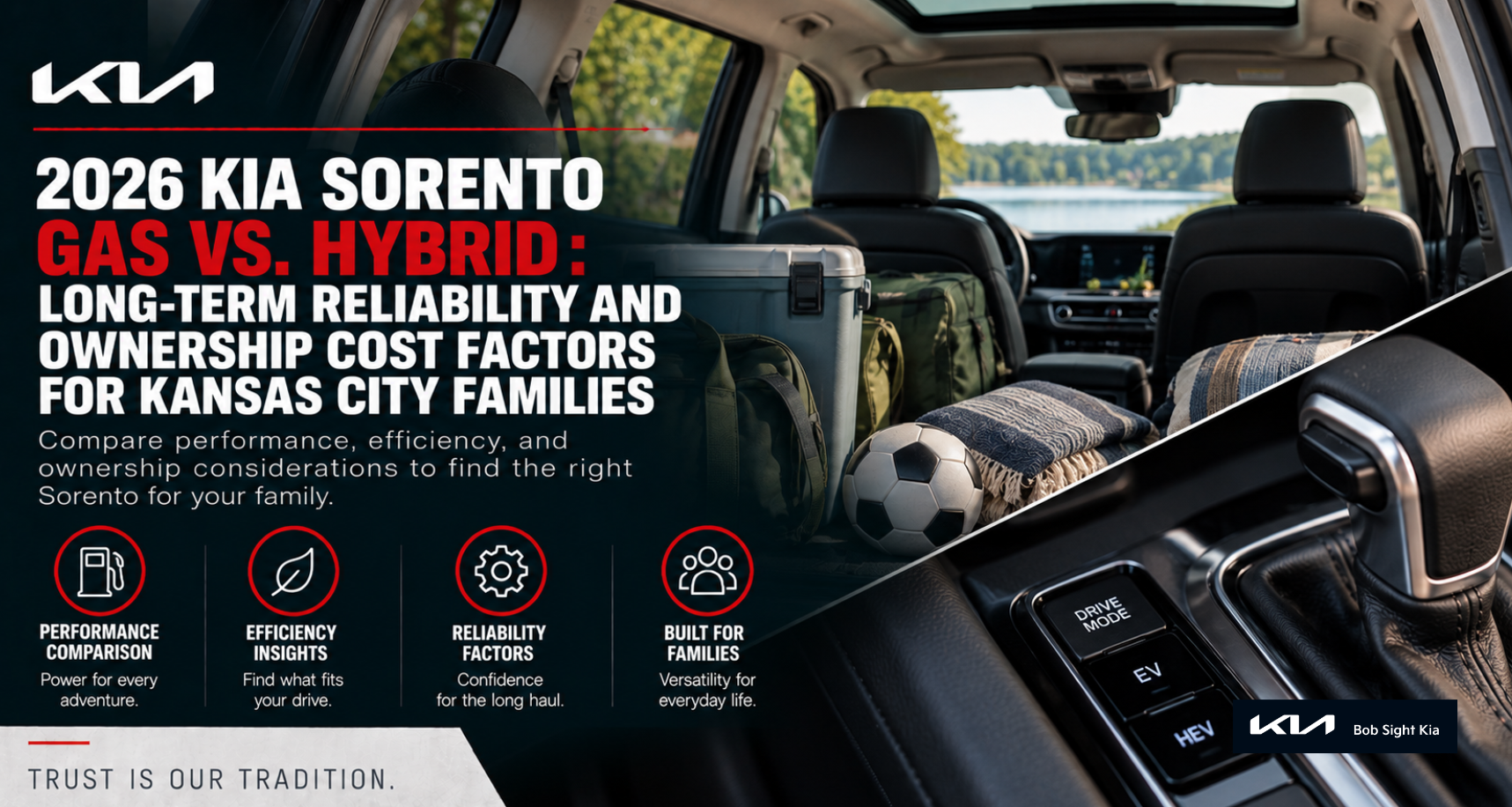
2026 Kia Sorento Gas vs. Hybrid: Long-Term Reliability and Ownership Cost Factors for Kansas City Families
Shop New Kia Sorento SUVs at Bob Sight Kia
Choosing between the 2026 Kia Sorento gas and Sorento Hybrid involves more than comparing fuel economy. Kansas City families should also consider powertrain design, daily driving patterns, maintenance requirements, warranty coverage, seasonal conditions, and the expenses that may develop over several years of ownership.
The right choice depends on how your household actually drives. A Sorento Hybrid may be attractive for frequent trips through Independence, stop-and-go commuting, school drop-offs, and errands around the Kansas City metro. A gas-powered Sorento may better suit families who prioritize a broader selection of configurations, straightforward highway travel, or the capability available with certain turbocharged models.
This guide explains the major long-term reliability and ownership cost factors without assuming that one powertrain is automatically best for every driver. You can also explore new Kia Sorento Hybrid inventory available through Bob Sight Kia in Independence, Missouri.
In This Guide You'll Learn
You will learn how the 2026 Sorento gas and hybrid powertrains differ, what each requires to maintain, and which ownership factors matter most for Kansas City driving.
- How the Sorento gas and hybrid powertrains operate
- What may influence long-term reliability
- How city and highway driving affect fuel consumption
- Which routine maintenance services both versions require
- How regenerative braking can affect brake use
- What to review in Kia warranty coverage
- How to estimate ownership costs for your household
2026 Kia Sorento Gas vs. Hybrid at a Glance
The gas Sorento offers a wider range of conventional powertrain choices, while the Sorento Hybrid combines a turbocharged engine with an electric motor to reduce fuel use during many everyday driving situations.
The standard gas-powered 2026 Kia Sorento uses a 2.5-liter four-cylinder engine paired with an eight-speed automatic transmission. It produces 191 horsepower and 181 pound-feet of torque. Kia also offers a turbocharged 2.5-liter engine on select configurations. That engine produces 281 horsepower and 311 pound-feet of torque and works with an eight-speed wet dual-clutch transmission.
The 2026 Kia Sorento Hybrid uses a turbocharged 1.6-liter gasoline engine, an electric motor, and a high-voltage hybrid battery. The system produces a combined 227 horsepower and 258 pound-feet of torque and uses a six-speed automatic transmission. Depending on the selected trim and availability, shoppers may find front-wheel-drive or all-wheel-drive configurations.
| Ownership Factor | 2026 Sorento Gas | 2026 Sorento Hybrid |
|---|---|---|
| Powertrain design | Gasoline engine with conventional or dual-clutch automatic transmission, depending on engine | Turbocharged gasoline engine, electric motor, hybrid battery, and six-speed automatic |
| Primary advantage | Broader range of configurations and available turbocharged performance | Reduced fuel consumption during many city and mixed-driving routines |
| Best driving pattern | Highway travel, varied family use, and drivers prioritizing available performance | Stop-and-go commuting, local errands, and frequent low-speed driving |
| Braking system | Traditional friction braking | Regenerative braking supported by conventional friction brakes |
| Additional components | Fewer electrified powertrain components | Electric motor, high-voltage battery, inverter, and hybrid control equipment |
| Fuel use | Varies by engine, drivetrain, trim, load, and driving conditions | Generally lower during city and mixed driving, with results varying by configuration and use |
Fuel economy estimates and equipment can differ by trim and drivetrain. Drivers should compare the window sticker and current specifications for the exact vehicle they are considering rather than relying on a single estimate for the entire model range.
How Powertrain Design Can Affect Long-Term Reliability
Neither Sorento powertrain is automatically more reliable because long-term results depend on maintenance, operating conditions, driving habits, and the specific configuration.
A gas Sorento has a familiar mechanical layout. The naturally aspirated 2.5-liter engine does not use a turbocharger, electric drive motor, or high-voltage hybrid battery. Some shoppers prefer this conventional design because it has fewer electrified systems to consider over a long ownership period.
The available turbocharged gas engine adds performance and torque but also includes a turbocharger and a dual-clutch transmission. Owners should follow the correct oil specification, service intervals, and operating guidance for their vehicle. Consistent maintenance is important for protecting turbocharger lubrication, cooling, and transmission performance.
The Sorento Hybrid has more powertrain components, including an electric motor, hybrid battery, power electronics, and associated cooling equipment. Additional components do not automatically mean the vehicle will be less dependable. Hybrid operation can reduce gasoline-engine idling, assist acceleration, and recover energy while slowing down.
Reliability discussions should account for more than the number of components. A properly maintained hybrid system may operate for many years, while a poorly maintained conventional vehicle can develop avoidable problems. Service history, fluid condition, correct replacement parts, warning-light diagnosis, and timely repairs remain important with either version.
Drivers planning to keep a Sorento well beyond the initial ownership period should build maintenance into their budget from the beginning. Records from a Kia service department can also help future technicians understand what has already been inspected or replaced.
Fuel Use for Kansas City Commuting and Family Travel
The Sorento Hybrid is most likely to deliver meaningful fuel savings for drivers who regularly encounter city traffic, while the difference may narrow during steady highway travel.
Hybrid systems can use the electric motor to assist the gasoline engine during acceleration and low-speed operation. They can also shut the engine off during certain stops and recover energy through regenerative braking. These functions can be useful during commutes on local streets in Independence, school pickup lines, shopping trips, and congested routes into Kansas City.
Highway driving changes the equation. At sustained speeds, the gasoline engine may operate more frequently, leaving fewer opportunities for electric assistance and regenerative braking. A household that spends most of its time on I-70, I-435, or other open highways may experience a smaller fuel-cost difference than a household making repeated short urban trips.
Cold weather can also affect efficiency. The engine may run longer to warm the cabin, maintain operating temperature, and support defrosting. Battery performance and tire pressure can change as temperatures fall. Hot Missouri weather can increase air-conditioning demand, while cargo, passengers, roof-mounted accessories, and all-wheel drive may also influence fuel use.
Use this process to estimate which powertrain better matches your routine:
- Record your typical weekly mileage instead of relying on an occasional road trip.
- Separate city, suburban, and highway miles as accurately as possible.
- Note how often you encounter extended idling or stop-and-go traffic.
- Account for school trips, sports travel, weekend errands, and seasonal vacations.
- Compare official fuel economy information for the exact trims and drivetrains under consideration.
- Estimate annual fuel use with a realistic local fuel-cost range.
- Repeat the calculation using several years of expected ownership.
This approach produces a more useful estimate than selecting the vehicle with the highest published fuel economy figure. Your route, weather, driving style, and annual mileage all affect the real result.
Maintenance Requirements for Gas and Hybrid Sorento Models
Both versions require scheduled maintenance, and the Sorento Hybrid still needs engine oil, filters, inspections, tires, fluids, and conventional mechanical service.
A hybrid is not an electric vehicle. Its gasoline engine still requires oil and filter changes according to the applicable maintenance schedule. It also has an engine cooling system, air filter, ignition components, fuel system, and exhaust system.
The hybrid adds systems that should be inspected and serviced by technicians familiar with high-voltage Kia vehicles. These may include the hybrid battery, electrical connections, power electronics, and dedicated cooling components. Owners should not attempt to open or repair high-voltage components themselves.
The gas Sorento also requires configuration-specific care. A turbocharged engine and dual-clutch transmission may have different operating characteristics and service requirements from the standard engine and conventional automatic transmission. The owner's manual and maintenance schedule for the exact vehicle should guide service decisions.
| Maintenance Area | Gas Sorento | Sorento Hybrid |
|---|---|---|
| Engine oil and filter | Required | Required |
| Engine air and cabin filters | Required | Required |
| Tire rotation and inspection | Required | Required |
| Brake inspection | Required | Required, even with regenerative braking |
| Transmission inspection or service | Depends on engine and transmission configuration | Applies to the six-speed automatic |
| Cooling-system inspection | Engine cooling system | Engine and hybrid-related cooling equipment |
| High-voltage system inspection | Not applicable | Applicable |
| Software and diagnostic checks | May apply | May apply to vehicle and hybrid control systems |
Driving conditions may change when services are due. Repeated short trips, heavy traffic, extensive idling, dusty roads, extreme temperatures, towing, and frequent operation with a full passenger or cargo load can place additional demands on the vehicle. Owners should review the normal and severe-use guidance supplied with their Sorento.
Bob Sight Kia drivers can schedule Kia service in Independence for maintenance, warning-light diagnosis, tire care, and powertrain inspections.
Regenerative Braking, Tires, AWD, and Missouri Weather
Regenerative braking may reduce friction-brake use, but tires, brake components, alignment, and all-wheel-drive maintenance still influence long-term ownership costs.
When a Sorento Hybrid slows down, its electric motor can operate as a generator and return energy to the high-voltage battery. This process can reduce how often the conventional brake pads must provide all the stopping force. Actual brake wear depends on driving style, traffic, terrain, vehicle load, and how frequently the friction brakes engage.
Reduced friction-brake use does not eliminate brake service. Brake rotors, pads, calipers, fluid, and related hardware still require inspection. Moisture, road treatment materials, and periods of limited friction-brake use can contribute to corrosion. An inspection can identify uneven wear, sticking components, vibration, or reduced braking performance.
Tires are another important cost factor for both versions. Tire pressure commonly drops as temperatures fall, which can reduce efficiency and create uneven wear. Potholes and damaged pavement around the Kansas City metro can also affect alignment, wheels, suspension components, and tire life.
All-wheel drive can provide additional traction when accelerating on rain, snow, or loose surfaces, but it does not shorten stopping distance. Drivers still need tires with appropriate tread depth and condition. Replacing tires with compatible sizes and similar wear levels is also important for proper all-wheel-drive operation.
A seasonal ownership plan should include:
- Check tire pressure when temperatures change significantly.
- Inspect tread depth and look for uneven shoulder or center wear.
- Rotate tires at the recommended intervals.
- Schedule an alignment inspection after a substantial pothole impact.
- Test the battery and inspect wiper blades before winter.
- Confirm that the heater, defroster, and climate controls operate correctly.
- Have brake components inspected even if the vehicle stops normally.
Kia Warranty and Hybrid Battery Coverage
Kia warranty coverage can reduce exposure to certain repair costs, but every owner should review the time limits, mileage limits, exclusions, and maintenance responsibilities for the exact vehicle.
Kia's new-vehicle warranty program includes a 10-year or 100,000-mile limited powertrain warranty, a 5-year or 60,000-mile limited basic warranty, a 5-year or 100,000-mile limited anti-perforation warranty, and a 5-year or 60,000-mile roadside assistance plan. Coverage is limited, and the applicable time or mileage limit is generally determined by whichever occurs first.
Hybrid shoppers should also review the Hybrid System Warranty section of the official warranty materials. Confirm which components are included, how coverage applies to the high-voltage battery, and whether any terms differ based on ownership status, vehicle use, or other conditions.
Warranty coverage is not a substitute for maintenance. Damage caused by neglected service, improper fluids, unauthorized modifications, collisions, environmental exposure, or other excluded conditions may not qualify. Owners should keep repair orders and maintenance receipts even when work is performed outside the dealership.
Used-vehicle shoppers should not assume every remaining portion of the original warranty transfers with identical terms. Ask a Kia representative to explain the coverage associated with the vehicle identification number and ownership situation before purchasing.
Long-Term Ownership Cost Factors Beyond Fuel Economy
The least expensive Sorento to fuel is not necessarily the least expensive Sorento to own because total cost also includes financing, insurance, maintenance, tires, repairs, depreciation, and resale value.
A hybrid may reduce fuel consumption, but the financial value of those savings depends on annual mileage and the type of driving completed. A low-mileage household may take longer to realize a meaningful difference. A high-mileage commuter dealing with frequent urban traffic may see a stronger benefit.
Insurance can vary based on trim, driver history, location, coverage level, safety equipment, repair procedures, and replacement value. Request insurance estimates for the exact gas and hybrid vehicles being considered rather than assuming the premiums will be the same.
Tires can also affect long-term expenses. Larger wheels may use different tire sizes than smaller-wheel configurations. Wheel size, tire type, brand, load rating, alignment, rotation habits, and driving conditions can all influence replacement frequency and cost.
Depreciation and resale value depend on market demand, mileage, condition, accident history, service records, equipment, color, and regional preferences. Fuel-efficient vehicles may attract certain used-vehicle shoppers, while other buyers may prioritize conventional powertrains or additional performance.
Build a complete ownership comparison with these categories:
- Determine the expected length of ownership.
- Estimate annual mileage using your current driving records.
- Calculate fuel use for city, highway, and mixed driving.
- Compare insurance estimates for the exact trims.
- Review scheduled maintenance requirements and severe-use conditions.
- Consider tire size, drivetrain, and expected replacement needs.
- Account for financing terms and the value of a trade-in.
- Consider likely resale value, vehicle condition, and accumulated mileage.
You can use the Bob Sight Kia trade-in tool to begin estimating the value of your current vehicle. Shoppers can also visit the Bob Sight Kia finance center to learn about available financing options.
Quick Facts About the 2026 Kia Sorento Gas and Hybrid
The most useful facts are the ones that connect powertrain specifications to how your family will use the SUV.
- The standard gas Sorento uses a 2.5-liter four-cylinder engine with 191 horsepower.
- An available turbocharged 2.5-liter gas engine produces 281 horsepower.
- The Sorento Hybrid combines a turbocharged 1.6-liter engine with an electric motor.
- The hybrid system produces a combined 227 horsepower and 258 pound-feet of torque.
- The Sorento Hybrid is not a plug-in vehicle and does not require routine external charging.
- Both versions still require regular inspections, tires, filters, fluids, and engine maintenance.
- Regenerative braking can reduce friction-brake use but does not eliminate brake inspections.
- Fuel economy varies by trim, drivetrain, load, traffic, temperature, and driving behavior.
- All-wheel drive supports traction but does not replace proper tires or careful winter driving.
- Warranty coverage has limits and exclusions that should be reviewed before purchase.
Ownership Planning: Which Sorento Fits Your Kansas City Family?
Choose the Sorento Hybrid if your routine includes substantial city driving and fuel efficiency is a major priority; choose a gas Sorento if you favor its broader configurations, conventional operation, or available turbocharged performance.
The Sorento Hybrid may be a strong match for parents making repeated short trips in Independence, commuters moving through congested Kansas City traffic, and households that keep vehicles long enough for accumulated fuel savings to matter. It also offers smooth electric assistance during many low-speed driving situations.
The standard gas Sorento may appeal to drivers who want a familiar naturally aspirated engine and conventional automatic transmission. It can also make sense for households with lower annual mileage, frequent steady-speed highway travel, or a purchase plan in which the hybrid's fuel savings are less significant.
The turbocharged gas Sorento is worth considering for drivers who prioritize stronger acceleration and torque. However, shoppers should evaluate that powertrain separately from the standard gas engine because its output, transmission, driving character, and service considerations are different.
A test drive should include more than a short loop around the dealership. Compare acceleration from a stop, low-speed smoothness, highway merging, visibility, braking response, ride quality, seating access, cargo space, and climate-control operation. If possible, drive gas and hybrid versions over similar roads.
Families traveling from Blue Springs, Lee's Summit, Liberty, Raytown, Grain Valley, Sugar Creek, Oak Grove, and other Jackson County communities can visit Bob Sight Kia in Independence to compare available configurations in person.
Frequently Asked Questions
Is the 2026 Kia Sorento Hybrid more reliable than the gas Sorento?
No universal answer applies to every owner. Reliability depends on maintenance, driving conditions, mileage, manufacturing variation, repair history, and how the vehicle is used.
The standard gas model has fewer electrified powertrain components, while the hybrid can reduce engine idling and use regenerative braking. Each design has different strengths and service considerations.
Following Kia's maintenance guidance, addressing warning lights promptly, and keeping complete service records are more useful reliability strategies than assuming one powertrain will always last longer.
Does the Kia Sorento Hybrid still need oil changes?
Yes. The Sorento Hybrid includes a gasoline engine, so it requires engine oil and filter changes according to the maintenance schedule that applies to the vehicle and its operating conditions.
Hybrid operation may allow the gasoline engine to shut off during certain driving situations, but that does not eliminate oil aging, contamination, or scheduled maintenance.
Owners should use the specified oil and filter and should not extend intervals solely because the vehicle sometimes operates with electric assistance.
Will regenerative braking make Sorento Hybrid brakes last longer?
Regenerative braking may reduce the workload placed on conventional brake pads and rotors, which can support longer component life in some driving patterns.
Actual wear varies. Hard stops, hills, vehicle load, road conditions, corrosion, and driving habits determine how frequently the friction brakes engage.
The brake system still needs regular inspection because reduced pad use does not prevent fluid deterioration, corrosion, sticking hardware, or damage from road conditions.
Is the Sorento Hybrid better for Kansas City highway driving?
The Sorento Hybrid can operate efficiently on the highway, but its largest advantage may occur in city and mixed driving where electric assistance and regenerative braking are used more frequently.
Drivers who spend most of their time at steady highway speeds should compare official fuel economy information for the exact gas and hybrid trims. The difference in annual fuel use may be smaller than it is for an urban commuter.
Wind, speed, temperature, elevation changes, passenger load, cargo, tires, and all-wheel drive can influence highway fuel economy in either version.
Do I need to plug in the 2026 Kia Sorento Hybrid?
No. The regular Sorento Hybrid is designed to recharge its hybrid battery through the gasoline engine and regenerative braking. It does not require routine connection to an external charging station.
This can make the hybrid convenient for drivers who want electrified assistance without installing home-charging equipment or planning daily charging sessions.
Kia may offer other electrified Sorento configurations with different charging requirements, so verify the exact model name and powertrain before purchasing.
How should I compare the ownership costs of a gas Sorento and Sorento Hybrid?
Start with annual mileage, city-to-highway driving ratio, expected ownership period, insurance estimates, financing, scheduled maintenance, tires, and likely fuel consumption.
Use the specifications and fuel economy information for the exact trim and drivetrain. Comparing a front-wheel-drive hybrid with an all-wheel-drive turbocharged gas model without accounting for equipment differences can produce a misleading result.
A Bob Sight Kia product specialist can help you compare available vehicles, but your own mileage and driving routine should remain the foundation of the decision.
Compare the 2026 Kia Sorento Gas and Hybrid at Bob Sight Kia
The best way to choose between the gas and hybrid Sorento is to compare exact configurations, review their ownership requirements, and drive both powertrains under similar conditions.
Bob Sight Kia helps Kansas City families evaluate Sorento seating, cargo flexibility, technology, drivetrain choices, and long-term ownership considerations. Our Independence location is convenient for drivers from Blue Springs, Lee's Summit, Kansas City, Liberty, Raytown, Grain Valley, Sugar Creek, Oak Grove, and surrounding communities.
Bring a realistic description of your commute, annual mileage, passenger needs, highway use, and expected ownership period. These details can help narrow the choice between the standard gas engine, available turbocharged engine, and Sorento Hybrid powertrain.
Browse current inventory online, value your trade, explore financing resources, or schedule a test drive. Inventory and configurations can change, so contact Bob Sight Kia to confirm current vehicle availability and specifications.
Helpful Links
- Visit Bob Sight Kia
- Shop New Kia Sorento Inventory
- Shop New Kia Sorento Hybrid Inventory
- Schedule a Test Drive
- View Kia Service and Parts Specials
Proud to Be Part of the Bob Sight Auto Group
Bob Sight Kia is proud to be part of the family-owned Bob Sight Auto Group, serving vehicle shoppers and owners throughout the Kansas City region and Northeast Kansas. Families researching new or used vehicles can rely on Bob Sight Auto Group for new and pre-owned vehicle sales, trade-in resources, auto financing, certified service, parts, and collision repair.

 Warranties include 10-year/100,000-mile powertrain and 5-year/60,000-mile basic. All warranties and roadside assistance are limited. See retailer for warranty details.