

Today: 8:30AM - 6:00PM
Blog / Independence Kia Dealer

Kia Service Specials in Independence, MO: How to Find Offers, Check Eligibility, and Plan Maintenance

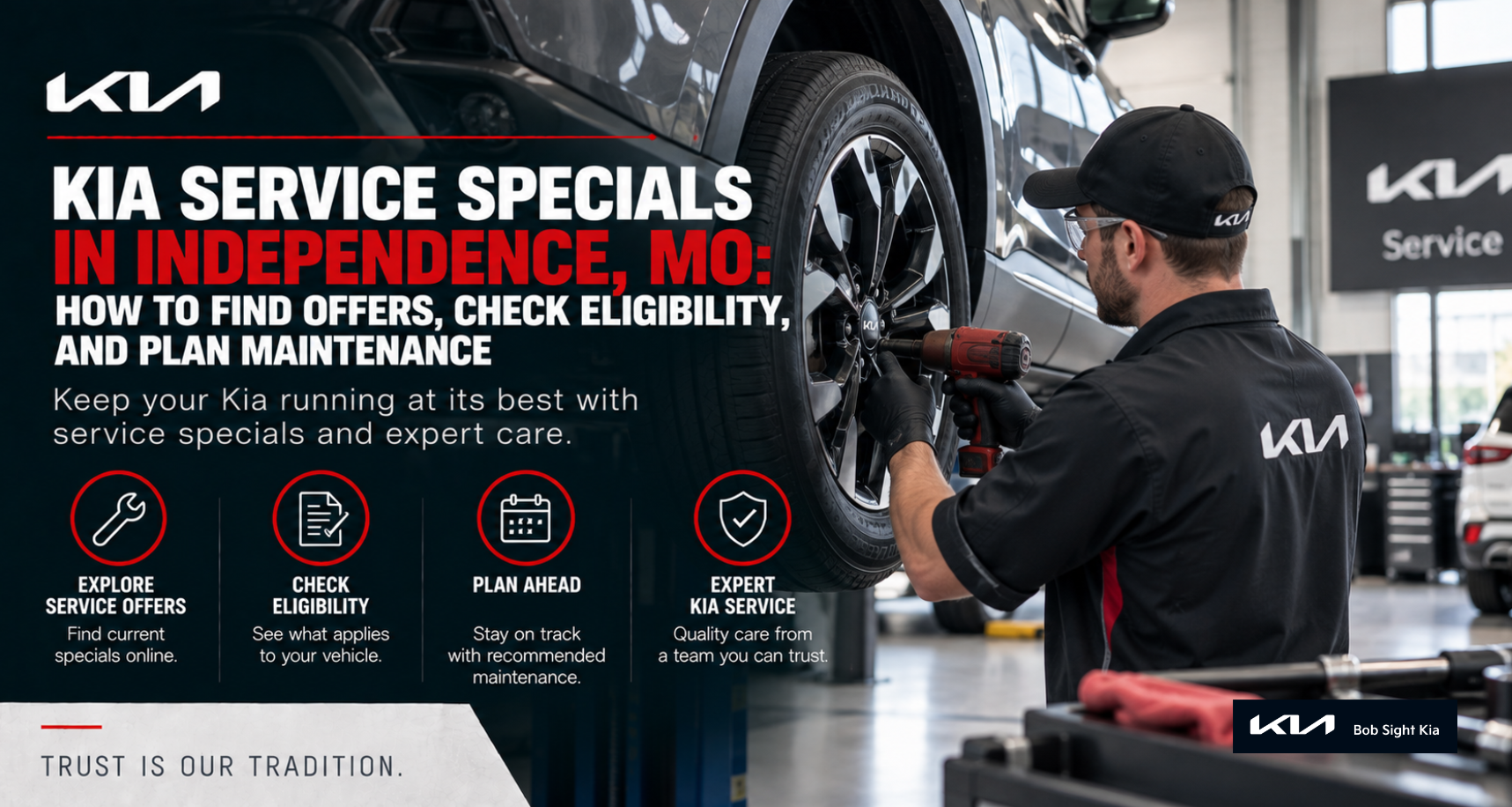
Kia service specials and maintenance planning at Bob Sight Kia in Independence, Missouri

Kia Service Specials in Independence, MO: How to Find Offers, Check Eligibility, and Plan Maintenance

View Current Kia Service and Parts Specials at Bob Sight Kia

Kia service specials can help Independence drivers plan routine vehicle care while taking advantage of available dealership offers. The challenge is knowing where to find current specials, which services they cover, whether your Kia qualifies, and what terms apply before your appointment.

Service offers may change throughout the year, so drivers should avoid relying on an old advertisement, saved screenshot, or expired social media post. The most reliable approach is to review the current service and parts specials published by Bob Sight Kia, read the offer details, and confirm eligibility when scheduling your visit.

This guide explains how to find Kia service specials in Independence, Missouri, how to evaluate the details, and how to coordinate available offers with your vehicle's actual maintenance needs. It also covers appointment planning for drivers traveling from Blue Springs, Lee's Summit, Liberty, Raytown, Grain Valley, Sugar Creek, Oak Grove, and communities throughout the Kansas City metro.

In This Guide You'll Learn

You will learn where to find current Kia service specials, how to interpret offer terms, and how to use available savings without postponing necessary maintenance.

  • Where Bob Sight Kia publishes current service and parts offers
  • Why service specials change and how to verify expiration dates
  • How to check vehicle, service, and appointment eligibility
  • Which maintenance categories may have dealership offers
  • How to match service specials with your Kia maintenance schedule
  • What information to gather before scheduling an appointment
  • How to avoid relying on expired or incomplete promotions

What Are Kia Service Specials?

Kia service specials are limited offers that may apply to qualifying maintenance, repairs, inspections, parts, or service packages at a participating dealership.

Dealership service departments may publish offers for different types of vehicle care throughout the year. These specials can vary based on season, parts availability, manufacturer programs, dealership participation, and local maintenance needs.

A service special is not automatically valid for every Kia model, service, part, or appointment. An offer may apply only to a particular maintenance category, qualifying vehicle, specified part, or service completed within a stated period. Some offers may require advance presentation, while others may need to be mentioned when the appointment is scheduled.

Drivers should read the full terms instead of relying only on the headline. A promotion title may describe the general service category, but the accompanying details explain what is included, which vehicles qualify, when the offer ends, and whether additional restrictions apply.

Service specials can be valuable planning tools, but they should not be treated as a replacement for the maintenance schedule. Your Kia's mileage, age, driving conditions, warning lights, and inspection results should determine which services are needed. The available offer may then help support the cost of qualifying work.

Where to Find Kia Service Specials in Independence, MO

The best place to find current Bob Sight Kia service offers is the dealership's official service and parts specials page.

Bob Sight Kia maintains a dedicated webpage for available maintenance and parts offers. Checking the official page helps reduce the risk of using an outdated advertisement from a third-party coupon site, an old email, or a social media post that is no longer current.

Start with the Bob Sight Kia service and parts specials page. Review the available offers, expiration information, service descriptions, and qualifying conditions. Because specials can change, check the page shortly before scheduling rather than assuming an offer you saw several weeks ago is still active.

You may also learn about service offers through dealership emails, social media posts, or conversations with a service advisor. These can be useful reminders, but the official specials page and service department should be used to confirm the current details.

Follow these steps when searching for a Kia service offer:

  1. Visit the official Bob Sight Kia service and parts specials page.
  2. Look for an offer related to the maintenance or repair your vehicle needs.
  3. Read the full description instead of stopping at the promotional headline.
  4. Check the expiration date and any appointment timing requirements.
  5. Review model, part, mileage, and service eligibility.
  6. Save or print the offer if the instructions require it.
  7. Mention the special when scheduling and confirm it with the service advisor.

If you are uncertain whether an offer applies, ask before the appointment. A service advisor can review the promotion, your vehicle information, and the requested work. This is more reliable than arriving with an expired or inapplicable offer and expecting it to apply automatically.

How to Read the Terms of a Kia Service Offer

The fine print explains whether a service special applies to your vehicle, appointment, requested maintenance, and selected parts.

Offer terms protect both the customer and dealership by defining what is included. Before scheduling, identify the service named in the promotion and determine whether the offer covers labor, parts, an inspection, a package, or a combination of those items.

Check whether the offer is limited to certain Kia models, model years, engines, drivetrains, or types of parts. For example, oil capacity and filter requirements can differ by engine. Tire offers may depend on brand, size, availability, or installation requirements. Battery offers may apply only to qualifying replacement batteries.

Expiration dates also matter. Some specials require the service to be completed before the listed date, not merely scheduled before it. If your appointment falls after the expiration date, ask whether the offer will remain valid. Do not assume scheduling during the promotional period guarantees eligibility.

Look for language regarding taxes, disposal fees, shop supplies, additional parts, diagnostic work, and combining promotions. A service special may not cover repairs identified during an inspection. It may also be limited to one offer per customer or vehicle and may not be combined with another discount.

Important details to review include:

  • The exact service, part, or maintenance package included
  • Eligible Kia models, engines, or vehicle configurations
  • Required appointment or completion dates
  • Whether the offer must be presented in advance
  • Parts, fluids, labor, or quantities included
  • Items that may result in an additional charge
  • Restrictions on combining offers
  • Whether prior purchases or completed services qualify

If any term is unclear, contact the dealership before authorizing work. A clear conversation at the beginning of the appointment can prevent confusion when the repair order is reviewed.

Matching Service Specials to Your Kia Maintenance Schedule

The right service special is one that supports maintenance your Kia currently needs, not an offer that encourages unnecessary work.

Your Kia owner's manual and maintenance schedule provide the foundation for routine care. Service timing may depend on mileage, time, engine type, driving conditions, and vehicle use. The maintenance requirements for a Kia Sportage may differ from those of a Telluride, Sorento Hybrid, Carnival, K4, or EV model.

Many Kansas City drivers may also fall under severe-use maintenance guidance. Conditions such as frequent short trips, repeated stop-and-go traffic, extended idling, dusty roads, towing, extreme temperatures, and regular operation with heavy passenger or cargo loads can affect service intervals.

Before choosing a special, review your maintenance records and current mileage. Determine which services have already been completed and which inspections are approaching. If you recently replaced the cabin air filter, for example, an offer related to that service may not be useful simply because it is available.

A service advisor can help compare your records with Kia maintenance recommendations. The advisor may also identify open recalls, recommended inspections, or maintenance items associated with your vehicle's mileage. Recall work is separate from a promotional service offer and should be discussed directly with the dealership.

Use the following process to connect specials with your maintenance plan:

  1. Check your Kia's current mileage and note any dashboard reminders.
  2. Review recent repair orders and maintenance receipts.
  3. Consult the maintenance information for your exact model and powertrain.
  4. List the services that are currently due or approaching.
  5. Compare that list with the offers on the dealership specials page.
  6. Ask whether the available promotion applies to your vehicle.
  7. Schedule needed work before the offer expires, when practical.

Do not delay safety-related repairs or urgent diagnostics while waiting for a promotion. Brake concerns, overheating, low oil pressure, steering problems, charging-system warnings, severe tire damage, or flashing warning lights may require prompt attention.

Common Types of Kia Service and Parts Specials

Kia service offers may cover routine maintenance, tires, batteries, brakes, filters, inspections, or qualifying parts, but available promotions can change.

Oil and filter service is one of the most common maintenance categories drivers search for. The correct oil specification, filter, and capacity depend on the Kia model and engine. Hybrid vehicles still have gasoline engines that require oil changes, while fully electric vehicles have different maintenance needs.

Tire-related specials may involve qualifying tire purchases, rotations, balances, alignments, or inspections. Eligibility may depend on tire brand, size, installation, and availability. Before selecting tires, confirm the correct size, load rating, speed rating, and compatibility with your Kia.

Battery offers may apply to qualifying replacement batteries or installation services. Missouri temperature changes can expose a weakening battery, and testing can help determine whether a slow start is related to the battery, charging system, starter, or another electrical issue.

Brake service promotions may relate to qualifying pads, rotors, inspections, or other components. A brake special should not replace diagnosis. Squealing, grinding, pulling, vibration, warning lights, or changes in pedal feel should be evaluated to determine what the vehicle actually needs.

Other specials may involve cabin air filters, engine air filters, wiper blades, fluid services, multipoint inspections, or seasonal preparation. Availability varies, which is why drivers should review the current dealership page instead of expecting a permanent list of offers.

The presence of a service special does not mean every related component needs replacement. Inspection results, maintenance history, measurements, fluid condition, and manufacturer guidance should support the recommendation.

How to Schedule Service With an Available Offer

Mention the service special while scheduling so the dealership can review eligibility and prepare for the requested work.

Online scheduling allows drivers to request an appointment at a convenient time. When completing the appointment form, select or describe the service your Kia needs. If there is a comments field, include the name of the offer you plan to use.

You can schedule Kia service online at Bob Sight Kia. Appointment availability can vary, so schedule in advance when your maintenance date is approaching or when an offer has a specific expiration date.

Gathering the right information can make the process more efficient. Have your Kia's year, model, mileage, and vehicle identification number available. Note any dashboard warnings, unusual sounds, recent repairs, or changes in performance.

Before the appointment, prepare the following:

  • Your vehicle's year, model, trim, engine, and current mileage
  • The service or symptom you want evaluated
  • A copy, screenshot, or description of the service special
  • Relevant maintenance records or recent repair orders
  • Your preferred appointment date and transportation needs
  • Questions about eligibility, included services, or offer restrictions

When you arrive, show the offer to the service advisor before work begins. Ask the advisor to confirm that it applies to the repair order. If an inspection identifies additional needs, request an explanation and review the updated estimate before authorizing more work.

Using Service Specials Without Delaying Necessary Repairs

Service specials should support timely vehicle care, not encourage drivers to postpone maintenance or safety repairs until a promotion appears.

It can be reasonable to plan nonurgent maintenance around an available offer when the timing aligns with your Kia's service needs. However, postponing required maintenance can contribute to wear, reduced performance, lower fuel efficiency, or more extensive repairs.

Warning lights deserve prompt attention. A steady check-engine light may indicate a range of issues, while a flashing check-engine light can signal a condition that may cause further damage. Oil-pressure, overheating, brake, charging-system, and steering warnings can also indicate problems that should not wait for a coupon.

Tire damage should be handled based on condition rather than promotional timing. A tire with exposed cords, a sidewall bulge, severe cracking, rapid pressure loss, or inadequate tread may be unsafe. The same principle applies to grinding brakes, fluid leaks, overheating, or significant steering changes.

If no current special matches the required service, ask whether another qualifying offer is available. The answer may still be no, but confirming with the dealership is better than delaying work or applying an unrelated promotion.

Drivers should also distinguish maintenance from diagnosis. A special for a routine service may not include the diagnostic labor required to investigate an intermittent warning light, vibration, electrical concern, or unusual noise. Describe the symptom accurately when scheduling so the appointment includes enough time for evaluation.

Planning Kia Service Around Kansas City Driving Conditions

Independence and Kansas City driving conditions can affect maintenance needs, so service planning should account for temperature changes, traffic, potholes, road treatments, and seasonal travel.

Cold weather can reduce tire pressure, weaken an aging battery, thicken fluids, and increase demand on heating and defrosting systems. Summer heat can place additional stress on batteries, cooling systems, air conditioning, tires, and engine fluids.

Potholes and rough pavement can affect tire condition, wheel alignment, suspension components, and steering response. If your Kia begins pulling to one side, the steering wheel sits off-center, or the tires develop uneven wear, an inspection may be appropriate.

Stop-and-go travel around Independence and the Greater Kansas City area can increase idling and repeated braking. Short trips may prevent the engine from reaching full operating temperature for long periods. These patterns can influence the maintenance guidance that applies to your vehicle.

Drivers traveling from Blue Springs, Lee's Summit, Raytown, Grain Valley, Oak Grove, Liberty, or Sugar Creek should consider travel time when booking an appointment. Combining several due maintenance items into one properly planned visit may be more convenient than making separate trips.

Seasonal planning can also help. Review tires, batteries, wipers, lights, brakes, and climate-control operation before winter. Before summer road trips, check fluid levels, cooling-system condition, tire pressure, tread depth, and any approaching maintenance intervals.

Service specials may align with seasonal needs, but maintenance decisions should remain based on vehicle condition and Kia recommendations. Checking current offers before each appointment can help you identify a relevant opportunity without allowing the promotion to determine whether the service is necessary.

Quick Facts About Kia Service Specials

Current offer details, eligibility, and expiration dates should always be confirmed before service begins.

  • Bob Sight Kia publishes current offers on its official service and parts specials page.
  • Available specials can change throughout the year.
  • An old advertisement may no longer be valid.
  • Offers may apply only to qualifying services, parts, vehicles, or appointment dates.
  • Some promotions must be presented or mentioned before work begins.
  • A scheduled appointment may need to occur before the expiration date.
  • Service specials may not be combined with other offers.
  • Routine maintenance needs vary by Kia model, powertrain, mileage, and driving conditions.
  • Hybrid Kia models still require gasoline-engine maintenance.
  • Urgent repairs should not be postponed while waiting for a promotion.

Frequently Asked Questions About Kia Service Specials

Where can I find current Kia service specials in Independence, MO?

Visit the official Bob Sight Kia service and parts specials page. It is the best starting point for reviewing currently published dealership offers.

Because promotions may change, check the page near the time you plan to schedule service. Avoid relying solely on an old email, screenshot, search result, or social media post.

If you have questions about an offer, contact the service department and provide your vehicle information before the appointment.

Do I need to print a Kia service coupon?

The requirements can vary by offer. Some specials may be displayed on a phone, mentioned during scheduling, or attached to the repair order by a service advisor.

Review the individual offer terms to determine whether it must be printed or presented. Saving a screenshot can also help identify the promotion you viewed.

Confirm the special before authorizing work so you understand whether it applies to your service.

Can I combine multiple Kia service specials?

Many dealership offers cannot be combined with other discounts or promotions. The exact restriction should appear in the terms associated with the special.

If your vehicle needs several services, ask which available offer provides the applicable benefit. Do not assume multiple promotions can be applied to the same repair order.

A service advisor can explain how the offer applies before work begins.

Can a service special be used after its expiration date?

An expired offer may no longer be valid. Some promotions require the service to be completed by the listed date rather than simply scheduled before it.

If appointment availability places your visit after the expiration date, ask the service department whether the offer can still be honored. Eligibility should be confirmed rather than assumed.

Current offers may replace expired promotions, so review the specials page again before your appointment.

Should I wait for a service special before scheduling maintenance?

No. Maintenance and repairs should be completed based on your Kia's schedule, condition, mileage, warning lights, and driving environment.

A relevant special can support a service that is already needed, but waiting too long may contribute to additional wear or create a safety concern.

Contact the service department promptly if your Kia has a warning light, fluid leak, overheating concern, brake problem, damaged tire, or major change in performance.

Find Kia Service Offers at Bob Sight Kia in Independence

Bob Sight Kia makes it easy to review current service specials and schedule maintenance for your Kia in Independence, Missouri.

Before your next appointment, check the official specials page, review your maintenance records, and identify the services your vehicle needs. Read the offer details carefully and confirm eligibility with a service advisor.

The Bob Sight Kia service department assists drivers from Independence, Blue Springs, Lee's Summit, Kansas City, Liberty, Raytown, Sugar Creek, Grain Valley, Oak Grove, and surrounding Jackson County communities. Whether your Kia needs routine maintenance, tire care, battery testing, brake service, or diagnosis, planning ahead can make the appointment more efficient.

Available specials may change, so return to the service and parts specials page before each visit. When you find a relevant offer, schedule your appointment and mention the promotion in advance.

Helpful Links

Proud to Be Part of the Bob Sight Auto Group

Bob Sight Kia is proud to be part of the family-owned Bob Sight Auto Group, serving vehicle shoppers and owners throughout the Kansas City region and Northeast Kansas. Families researching new or used vehicles can rely on Bob Sight Auto Group for new and pre-owned vehicle sales, trade-in resources, auto financing, certified service, parts, and collision repair.
Posted in:

Related Posts

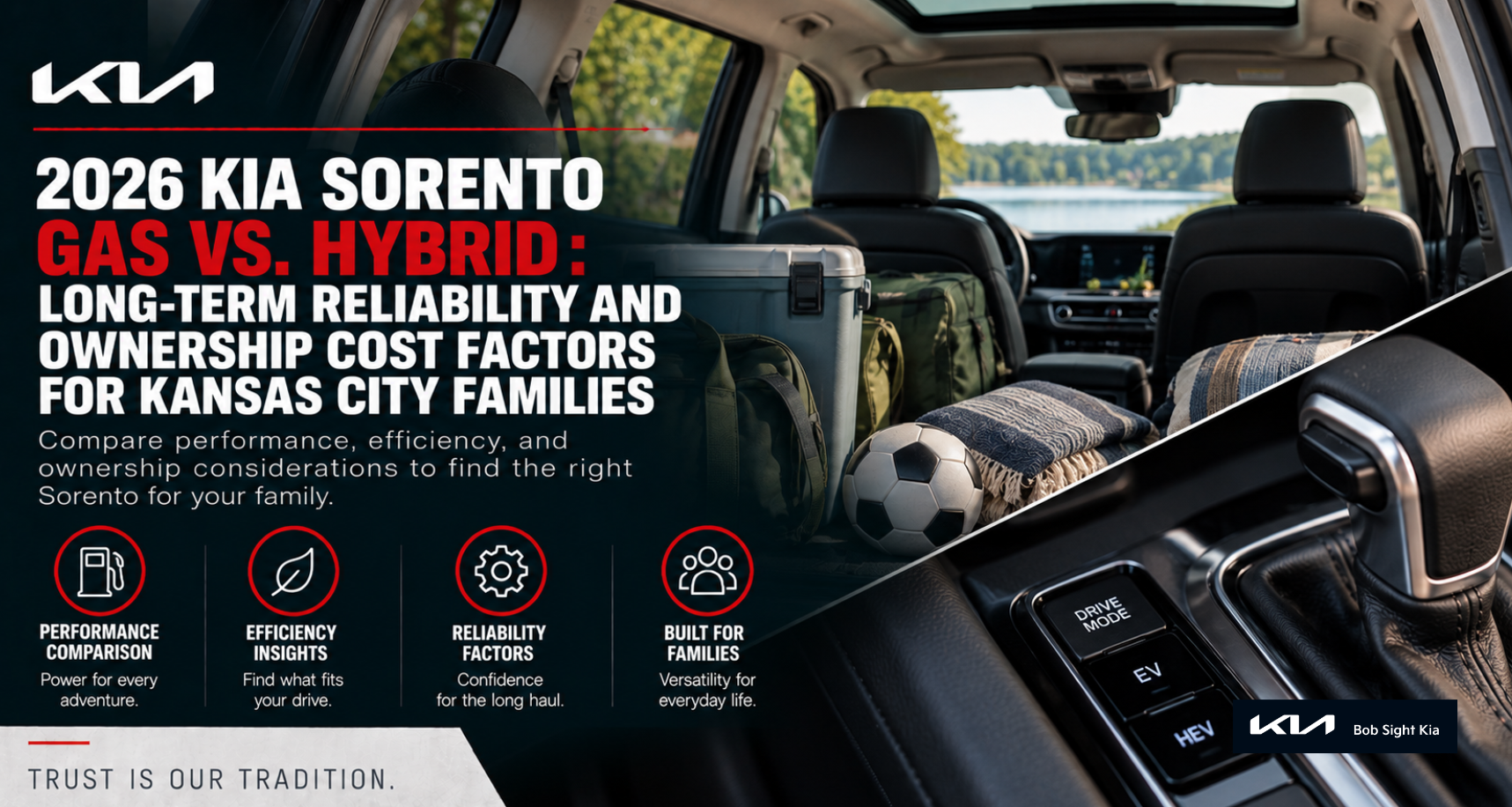
2026 Kia Sorento gas vs. hybrid reliability and ownership cost comparison for Kansas City families at Bob Sight Kia

2026 Kia Sorento Gas vs. Hybrid: Long-Term Reliability and Ownership Cost Factors for Kansas City Families

2026 Kia Sorento Gas vs. Hybrid: Long-Term Reliability and Ownership Cost Factors for Kansas City Families Shop New Kia Sorento SUVs at Bob Sight Kia Choosing between the 2026 Kia Sorento gas and Sorento Hybrid involves more than comparing fuel economy. Kansas City families should also consider powertrain design, daily driving patterns, maintenance requirements, warranty coverage, seasonal conditions, and the expenses that may develop over several years of ownership. The right choice depends on how your household actually drives. A Sorento Hybrid may be attractive for frequent trips through Independence, stop-and-go commuting, school drop-offs, and errands around the Kansas City metro. A gas-powered Sorento may better suit families who prioritize a broader selection of configurations, straightforward highway travel, or the capability available with certain turbocharged models. This guide explains the major long-term reliability and ownership cost factors without assuming that one powertrain is automatically best for every driver. You can also explore new Kia Sorento Hybrid inventory available through Bob Sight Kia in Independence, Missouri. In This Guide You'll Learn You will learn how the 2026 Sorento gas and hybrid powertrains differ, what each requires to maintain, and which ownership factors matter most for Kansas City driving. How the Sorento gas and hybrid powertrains operate What may influence long-term reliability How city and highway driving affect fuel consumption Which routine maintenance services both versions require How regenerative braking can affect brake use What to review in Kia warranty coverage How to estimate ownership costs for your household 2026 Kia Sorento Gas vs. Hybrid at a Glance The gas Sorento offers a wider range of conventional powertrain choices, while the Sorento Hybrid combines a turbocharged engine with an electric motor to reduce fuel use during many everyday driving situations. The standard gas-powered 2026 Kia Sorento uses a 2.5-liter four-cylinder engine paired with an eight-speed automatic transmission. It produces 191 horsepower and 181 pound-feet of torque. Kia also offers a turbocharged 2.5-liter engine on select configurations. That engine produces 281 horsepower and 311 pound-feet of torque and works with an eight-speed wet dual-clutch transmission. The 2026 Kia Sorento Hybrid uses a turbocharged 1.6-liter gasoline engine, an electric motor, and a high-voltage hybrid battery. The system produces a combined 227 horsepower and 258 pound-feet of torque and uses a six-speed automatic transmission. Depending on the selected trim and availability, shoppers may find front-wheel-drive or all-wheel-drive configurations. Ownership Factor 2026 Sorento Gas 2026 Sorento Hybrid Powertrain design Gasoline engine with conventional or dual-clutch automatic transmission, depending on engine Turbocharged gasoline engine, electric motor, hybrid battery, and six-speed automatic Primary advantage Broader range of configurations and available turbocharged performance Reduced fuel consumption during many city and mixed-driving routines Best driving pattern Highway travel, varied family use, and drivers prioritizing available performance Stop-and-go commuting, local errands, and frequent low-speed driving Braking system Traditional friction braking Regenerative braking supported by conventional friction brakes Additional components Fewer electrified powertrain components Electric motor, high-voltage battery, inverter, and hybrid control equipment Fuel use Varies by engine, drivetrain, trim, load, and driving conditions Generally lower during city and mixed driving, with results varying by configuration and use Fuel economy estimates and equipment can differ by trim and drivetrain. Drivers should compare the window sticker and current specifications for the exact vehicle they are considering rather than relying on a single estimate for the entire model range. How Powertrain Design Can Affect Long-Term Reliability Neither Sorento powertrain is automatically more reliable because long-term results depend on maintenance, operating conditions, driving habits, and the specific configuration. A gas Sorento has a familiar mechanical layout. The naturally aspirated 2.5-liter engine does not use a turbocharger, electric drive motor, or high-voltage hybrid battery. Some shoppers prefer this conventional design because it has fewer electrified systems to consider over a long ownership period. The available turbocharged gas engine adds performance and torque but also includes a turbocharger and a dual-clutch transmission. Owners should follow the correct oil specification, service intervals, and operating guidance for their vehicle. Consistent maintenance is important for protecting turbocharger lubrication, cooling, and transmission performance. The Sorento Hybrid has more powertrain components, including an electric motor, hybrid battery, power electronics, and associated cooling equipment. Additional components do not automatically mean the vehicle will be less dependable. Hybrid operation can reduce gasoline-engine idling, assist acceleration, and recover energy while slowing down. Reliability discussions should account for more than the number of components. A properly maintained hybrid system may operate for many years, while a poorly maintained conventional vehicle can develop avoidable problems. Service history, fluid condition, correct replacement parts, warning-light diagnosis, and timely repairs remain important with either version. Drivers planning to keep a Sorento well beyond the initial ownership period should build maintenance into their budget from the beginning. Records from a Kia service department can also help future technicians understand what has already been inspected or replaced. Fuel Use for Kansas City Commuting and Family Travel The Sorento Hybrid is most likely to deliver meaningful fuel savings for drivers who regularly encounter city traffic, while the difference may narrow during steady highway travel. Hybrid systems can use the electric motor to assist the gasoline engine during acceleration and low-speed operation. They can also shut the engine off during certain stops and recover energy through regenerative braking. These functions can be useful during commutes on local streets in Independence, school pickup lines, shopping trips, and congested routes into Kansas City. Highway driving changes the equation. At sustained speeds, the gasoline engine may operate more frequently, leaving fewer opportunities for electric assistance and regenerative braking. A household that spends most of its time on I-70, I-435, or other open highways may experience a smaller fuel-cost difference than a household making repeated short urban trips. Cold weather can also affect efficiency. The engine may run longer to warm the cabin, maintain operating temperature, and support defrosting. Battery performance and tire pressure can change as temperatures fall. Hot Missouri weather can increase air-conditioning demand, while cargo, passengers, roof-mounted accessories, and all-wheel drive may also influence fuel use. Use this process to estimate which powertrain better matches your routine: Record your typical weekly mileage instead of relying on an occasional road trip. Separate city, suburban, and highway miles as accurately as possible. Note how often you encounter extended idling or stop-and-go traffic. Account for school trips, sports travel, weekend errands, and seasonal vacations. Compare official fuel economy information for the exact trims and drivetrains under consideration. Estimate annual fuel use with a realistic local fuel-cost range. Repeat the calculation using several years of expected ownership. This approach produces a more useful estimate than selecting the vehicle with the highest published fuel economy figure. Your route, weather, driving style, and annual mileage all affect the real result. Maintenance Requirements for Gas and Hybrid Sorento Models Both versions require scheduled maintenance, and the Sorento Hybrid still needs engine oil, filters, inspections, tires, fluids, and conventional mechanical service. A hybrid is not an electric vehicle. Its gasoline engine still requires oil and filter changes according to the applicable maintenance schedule. It also has an engine cooling system, air filter, ignition components, fuel system, and exhaust system. The hybrid adds systems that should be inspected and serviced by technicians familiar with high-voltage Kia vehicles. These may include the hybrid battery, electrical connections, power electronics, and dedicated cooling components. Owners should not attempt to open or repair high-voltage components themselves. The gas Sorento also requires configuration-specific care. A turbocharged engine and dual-clutch transmission may have different operating characteristics and service requirements from the standard engine and conventional automatic transmission. The owner's manual and maintenance schedule for the exact vehicle should guide service decisions. Maintenance Area Gas Sorento Sorento Hybrid Engine oil and filter Required Required Engine air and cabin filters Required Required Tire rotation and inspection Required Required Brake inspection Required Required, even with regenerative braking Transmission inspection or service Depends on engine and transmission configuration Applies to the six-speed automatic Cooling-system inspection Engine cooling system Engine and hybrid-related cooling equipment High-voltage system inspection Not applicable Applicable Software and diagnostic checks May apply May apply to vehicle and hybrid control systems Driving conditions may change when services are due. Repeated short trips, heavy traffic, extensive idling, dusty roads, extreme temperatures, towing, and frequent operation with a full passenger or cargo load can place additional demands on the vehicle. Owners should review the normal and severe-use guidance supplied with their Sorento. Bob Sight Kia drivers can schedule Kia service in Independence for maintenance, warning-light diagnosis, tire care, and powertrain inspections. Regenerative Braking, Tires, AWD, and Missouri Weather Regenerative braking may reduce friction-brake use, but tires, brake components, alignment, and all-wheel-drive maintenance still influence long-term ownership costs. When a Sorento Hybrid slows down, its electric motor can operate as a generator and return energy to the high-voltage battery. This process can reduce how often the conventional brake pads must provide all the stopping force. Actual brake wear depends on driving style, traffic, terrain, vehicle load, and how frequently the friction brakes engage. Reduced friction-brake use does not eliminate brake service. Brake rotors, pads, calipers, fluid, and related hardware still require inspection. Moisture, road treatment materials, and periods of limited friction-brake use can contribute to corrosion. An inspection can identify uneven wear, sticking components, vibration, or reduced braking performance. Tires are another important cost factor for both versions. Tire pressure commonly drops as temperatures fall, which can reduce efficiency and create uneven wear. Potholes and damaged pavement around the Kansas City metro can also affect alignment, wheels, suspension components, and tire life. All-wheel drive can provide additional traction when accelerating on rain, snow, or loose surfaces, but it does not shorten stopping distance. Drivers still need tires with appropriate tread depth and condition. Replacing tires with compatible sizes and similar wear levels is also important for proper all-wheel-drive operation. A seasonal ownership plan should include: Check tire pressure when temperatures change significantly. Inspect tread depth and look for uneven shoulder or center wear. Rotate tires at the recommended intervals. Schedule an alignment inspection after a substantial pothole impact. Test the battery and inspect wiper blades before winter. Confirm that the heater, defroster, and climate controls operate correctly. Have brake components inspected even if the vehicle stops normally. Kia Warranty and Hybrid Battery Coverage Kia warranty coverage can reduce exposure to certain repair costs, but every owner should review the time limits, mileage limits, exclusions, and maintenance responsibilities for the exact vehicle. Kia's new-vehicle warranty program includes a 10-year or 100,000-mile limited powertrain warranty, a 5-year or 60,000-mile limited basic warranty, a 5-year or 100,000-mile limited anti-perforation warranty, and a 5-year or 60,000-mile roadside assistance plan. Coverage is limited, and the applicable time or mileage limit is generally determined by whichever occurs first. Hybrid shoppers should also review the Hybrid System Warranty section of the official warranty materials. Confirm which components are included, how coverage applies to the high-voltage battery, and whether any terms differ based on ownership status, vehicle use, or other conditions. Warranty coverage is not a substitute for maintenance. Damage caused by neglected service, improper fluids, unauthorized modifications, collisions, environmental exposure, or other excluded conditions may not qualify. Owners should keep repair orders and maintenance receipts even when work is performed outside the dealership. Used-vehicle shoppers should not assume every remaining portion of the original warranty transfers with identical terms. Ask a Kia representative to explain the coverage associated with the vehicle identification number and ownership situation before purchasing. Long-Term Ownership Cost Factors Beyond Fuel Economy The least expensive Sorento to fuel is not necessarily the least expensive Sorento to own because total cost also includes financing, insurance, maintenance, tires, repairs, depreciation, and resale value. A hybrid may reduce fuel consumption, but the financial value of those savings depends on annual mileage and the type of driving completed. A low-mileage household may take longer to realize a meaningful difference. A high-mileage commuter dealing with frequent urban traffic may see a stronger benefit. Insurance can vary based on trim, driver history, location, coverage level, safety equipment, repair procedures, and replacement value. Request insurance estimates for the exact gas and hybrid vehicles being considered rather than assuming the premiums will be the same. Tires can also affect long-term expenses. Larger wheels may use different tire sizes than smaller-wheel configurations. Wheel size, tire type, brand, load rating, alignment, rotation habits, and driving conditions can all influence replacement frequency and cost. Depreciation and resale value depend on market demand, mileage, condition, accident history, service records, equipment, color, and regional preferences. Fuel-efficient vehicles may attract certain used-vehicle shoppers, while other buyers may prioritize conventional powertrains or additional performance. Build a complete ownership comparison with these categories: Determine the expected length of ownership. Estimate annual mileage using your current driving records. Calculate fuel use for city, highway, and mixed driving. Compare insurance estimates for the exact trims. Review scheduled maintenance requirements and severe-use conditions. Consider tire size, drivetrain, and expected replacement needs. Account for financing terms and the value of a trade-in. Consider likely resale value, vehicle condition, and accumulated mileage. You can use the Bob Sight Kia trade-in tool to begin estimating the value of your current vehicle. Shoppers can also visit the Bob Sight Kia finance center to learn about available financing options. Quick Facts About the 2026 Kia Sorento Gas and Hybrid The most useful facts are the ones that connect powertrain specifications to how your family will use the SUV. The standard gas Sorento uses a 2.5-liter four-cylinder engine with 191 horsepower. An available turbocharged 2.5-liter gas engine produces 281 horsepower. The Sorento Hybrid combines a turbocharged 1.6-liter engine with an electric motor. The hybrid system produces a combined 227 horsepower and 258 pound-feet of torque. The Sorento Hybrid is not a plug-in vehicle and does not require routine external charging. Both versions still require regular inspections, tires, filters, fluids, and engine maintenance. Regenerative braking can reduce friction-brake use but does not eliminate brake inspections. Fuel economy varies by trim, drivetrain, load, traffic, temperature, and driving behavior. All-wheel drive supports traction but does not replace proper tires or careful winter driving. Warranty coverage has limits and exclusions that should be reviewed before purchase. Ownership Planning: Which Sorento Fits Your Kansas City Family? Choose the Sorento Hybrid if your routine includes substantial city driving and fuel efficiency is a major priority; choose a gas Sorento if you favor its broader configurations, conventional operation, or available turbocharged performance. The Sorento Hybrid may be a strong match for parents making repeated short trips in Independence, commuters moving through congested Kansas City traffic, and households that keep vehicles long enough for accumulated fuel savings to matter. It also offers smooth electric assistance during many low-speed driving situations. The standard gas Sorento may appeal to drivers who want a familiar naturally aspirated engine and conventional automatic transmission. It can also make sense for households with lower annual mileage, frequent steady-speed highway travel, or a purchase plan in which the hybrid's fuel savings are less significant. The turbocharged gas Sorento is worth considering for drivers who prioritize stronger acceleration and torque. However, shoppers should evaluate that powertrain separately from the standard gas engine because its output, transmission, driving character, and service considerations are different. A test drive should include more than a short loop around the dealership. Compare acceleration from a stop, low-speed smoothness, highway merging, visibility, braking response, ride quality, seating access, cargo space, and climate-control operation. If possible, drive gas and hybrid versions over similar roads. Families traveling from Blue Springs, Lee's Summit, Liberty, Raytown, Grain Valley, Sugar Creek, Oak Grove, and other Jackson County communities can visit Bob Sight Kia in Independence to compare available configurations in person. Frequently Asked Questions Is the 2026 Kia Sorento Hybrid more reliable than the gas Sorento? No universal answer applies to every owner. Reliability depends on maintenance, driving conditions, mileage, manufacturing variation, repair history, and how the vehicle is used. The standard gas model has fewer electrified powertrain components, while the hybrid can reduce engine idling and use regenerative braking. Each design has different strengths and service considerations. Following Kia's maintenance guidance, addressing warning lights promptly, and keeping complete service records are more useful reliability strategies than assuming one powertrain will always last longer. Does the Kia Sorento Hybrid still need oil changes? Yes. The Sorento Hybrid includes a gasoline engine, so it requires engine oil and filter changes according to the maintenance schedule that applies to the vehicle and its operating conditions. Hybrid operation may allow the gasoline engine to shut off during certain driving situations, but that does not eliminate oil aging, contamination, or scheduled maintenance. Owners should use the specified oil and filter and should not extend intervals solely because the vehicle sometimes operates with electric assistance. Will regenerative braking make Sorento Hybrid brakes last longer? Regenerative braking may reduce the workload placed on conventional brake pads and rotors, which can support longer component life in some driving patterns. Actual wear varies. Hard stops, hills, vehicle load, road conditions, corrosion, and driving habits determine how frequently the friction brakes engage. The brake system still needs regular inspection because reduced pad use does not prevent fluid deterioration, corrosion, sticking hardware, or damage from road conditions. Is the Sorento Hybrid better for Kansas City highway driving? The Sorento Hybrid can operate efficiently on the highway, but its largest advantage may occur in city and mixed driving where electric assistance and regenerative braking are used more frequently. Drivers who spend most of their time at steady highway speeds should compare official fuel economy information for the exact gas and hybrid trims. The difference in annual fuel use may be smaller than it is for an urban commuter. Wind, speed, temperature, elevation changes, passenger load, cargo, tires, and all-wheel drive can influence highway fuel economy in either version. Do I need to plug in the 2026 Kia Sorento Hybrid? No. The regular Sorento Hybrid is designed to recharge its hybrid battery through the gasoline engine and regenerative braking. It does not require routine connection to an external charging station. This can make the hybrid convenient for drivers who want electrified assistance without installing home-charging equipment or planning daily charging sessions. Kia may offer other electrified Sorento configurations with different charging requirements, so verify the exact model name and powertrain before purchasing. How should I compare the ownership costs of a gas Sorento and Sorento Hybrid? Start with annual mileage, city-to-highway driving ratio, expected ownership period, insurance estimates, financing, scheduled maintenance, tires, and likely fuel consumption. Use the specifications and fuel economy information for the exact trim and drivetrain. Comparing a front-wheel-drive hybrid with an all-wheel-drive turbocharged gas model without accounting for equipment differences can produce a misleading result. A Bob Sight Kia product specialist can help you compare available vehicles, but your own mileage and driving routine should remain the foundation of the decision. Compare the 2026 Kia Sorento Gas and Hybrid at Bob Sight Kia The best way to choose between the gas and hybrid Sorento is to compare exact configurations, review their ownership requirements, and drive both powertrains under similar conditions. Bob Sight Kia helps Kansas City families evaluate Sorento seating, cargo flexibility, technology, drivetrain choices, and long-term ownership considerations. Our Independence location is convenient for drivers from Blue Springs, Lee's Summit, Kansas City, Liberty, Raytown, Grain Valley, Sugar Creek, Oak Grove, and surrounding communities. Bring a realistic description of your commute, annual mileage, passenger needs, highway use, and expected ownership period. These details can help narrow the choice between the standard gas engine, available turbocharged engine, and Sorento Hybrid powertrain. Browse current inventory online, value your trade, explore financing resources, or schedule a test drive. Inventory and configurations can change, so contact Bob Sight Kia to confirm current vehicle availability and specifications. Helpful Links Visit Bob Sight Kia Shop New Kia Sorento Inventory Shop New Kia Sorento Hybrid Inventory Schedule a Test Drive View Kia Service and Parts Specials Proud to Be Part of the Bob Sight Auto Group Bob Sight Kia is proud to be part of the family-owned Bob Sight Auto Group, serving vehicle shoppers and owners throughout the Kansas City region and Northeast Kansas. Families researching new or used vehicles can rely on Bob Sight Auto Group for new and pre-owned vehicle sales, trade-in resources, auto financing, certified service, parts, and collision repair. Bob Sight Kia - Independence, MO Bob Sight Ford - Lee’s Summit, MO Bob Sight Honda - Lawrence, KS Bob Sight CDJR - Lawrence, KS Bob Sight Collision Center - Lee’s Summit, MO

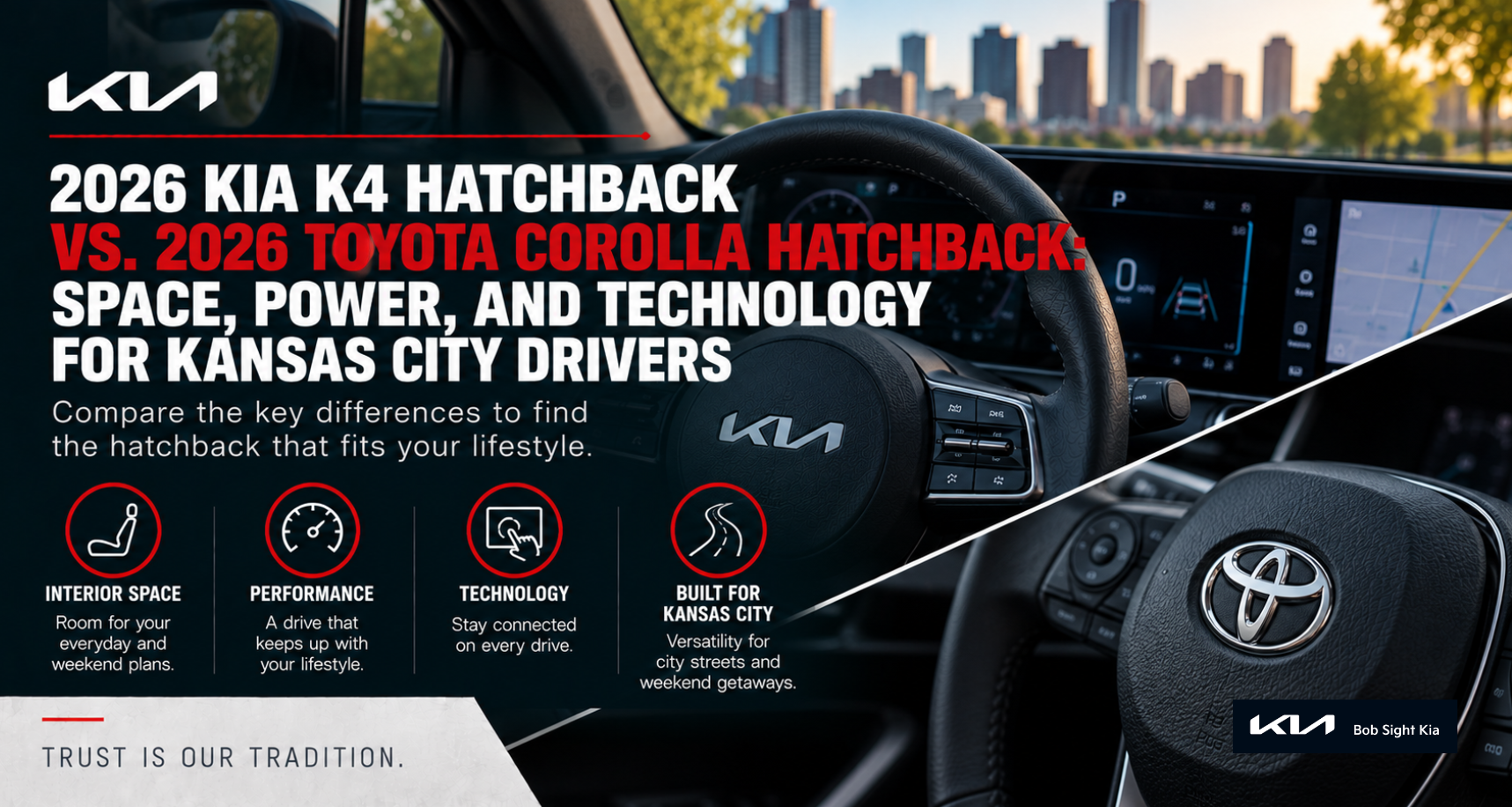
Interior, cargo, and performance details comparing the 2026 Kia K4 Hatchback with the 2026 Toyota Corolla Hatchback

2026 Kia K4 Hatchback vs. 2026 Toyota Corolla Hatchback: Space, Power, and Technology for Kansas City Drivers

2026 Kia K4 Hatchback vs. 2026 Toyota Corolla Hatchback: Space, Power, and Technology for Kansas City Drivers Explore new Kia K4 inventory at Bob Sight Kia The 2026 Kia K4 Hatchback and 2026 Toyota Corolla Hatchback give Kansas City drivers two compact alternatives to a traditional sedan or small SUV. Both offer rear hatch access, foldable rear seats, front-wheel drive, modern connectivity, and driver-assistance technology. Their differences become clearer when shoppers compare passenger space, cargo capacity, engine choices, transmission behavior, displays, and everyday driving priorities. The Toyota Corolla Hatchback uses one standard 2.0-liter engine focused on balanced daily operation. The Kia K4 Hatchback offers a 2.0-liter engine in its EX and GT-Line trims, plus an available turbocharged 1.6-liter engine in the GT-Line Turbo. The K4 Hatchback also provides considerably more rear-seat legroom and greater cargo volume behind the second row, making it appealing to drivers who want hatchback maneuverability without giving up practical passenger space. At Bob Sight Kia in Independence, Missouri, shoppers from Blue Springs, Raytown, Grain Valley, Sugar Creek, Liberty, Oak Grove, Lee's Summit, and the Kansas City Metro can explore the 2026 Kia K4 lineup. This comparison explains how the K4 Hatchback and Corolla Hatchback approach performance, comfort, cargo utility, and technology so shoppers can decide which design better fits their routine. In This Guide You Will Learn This comparison examines the 2026 Kia K4 Hatchback and 2026 Toyota Corolla Hatchback using the categories that matter most during daily ownership. It focuses on how specifications translate into passenger comfort, highway performance, cargo flexibility, technology use, and Kansas City commuting. How the standard and available engines compare Which hatchback offers more rear passenger space How cargo capacity and hatch access affect daily utility What drivers may notice about the IVT, CVT, and eight-speed automatic How their infotainment and digital displays differ Which driver-assistance features shoppers should compare How to test-drive both hatchbacks for Kansas City conditions The best hatchback depends on more than a single specification. A driver who usually travels alone may prioritize engine response, exterior size, or front-seat comfort. A household carrying adult rear passengers, children, work equipment, or sports gear may care more about back-seat room and cargo volume. Trim and equipment availability also matter. The K4 Hatchback is offered in EX, GT-Line, and GT-Line Turbo configurations, while the Corolla Hatchback lineup uses its own trim structure and available packages. Shoppers should compare the equipment installed on the specific vehicles they are considering rather than assuming every feature is standard. 2026 Kia K4 Hatchback vs. Toyota Corolla Hatchback at a Glance The Kia K4 Hatchback emphasizes passenger space, cargo flexibility, display technology, and an available turbocharged engine, while the Toyota Corolla Hatchback uses a single 2.0-liter powertrain in a smaller overall package. Both are front-wheel-drive compact hatchbacks designed for everyday roads. The standard K4 Hatchback powertrain combines a naturally aspirated 2.0-liter four-cylinder engine with Kia's Intelligent Variable Transmission. It produces 147 horsepower and 132 pound-feet of torque. The available K4 Hatchback GT-Line Turbo changes the experience with a turbocharged 1.6-liter engine, 190 horsepower, 195 pound-feet of torque, and an eight-speed automatic transmission. The Corolla Hatchback uses a naturally aspirated 2.0-liter Dynamic Force four-cylinder engine producing 169 horsepower and 151 pound-feet of torque. It pairs that engine with Toyota's Dynamic-Shift Continuously Variable Transmission. Unlike the K4 Hatchback, the conventional Corolla Hatchback does not offer a higher-output turbocharged trim for shoppers who want more acceleration. Comparison Area 2026 Kia K4 Hatchback 2026 Toyota Corolla Hatchback Standard Engine 2.0-liter four-cylinder 2.0-liter four-cylinder Standard Horsepower 147 horsepower 169 horsepower Standard Torque 132 pound-feet 151 pound-feet Standard Transmission Intelligent Variable Transmission Dynamic-Shift Continuously Variable Transmission Available Performance Engine 1.6-liter turbocharged four-cylinder No turbocharged engine in the conventional hatchback lineup Available Turbo Output 190 horsepower and 195 pound-feet of torque Not applicable Turbo Transmission Eight-speed automatic Not applicable Drivetrain Front-wheel drive Front-wheel drive The Corolla Hatchback has the stronger standard engine on paper, while the K4 Hatchback offers the most powerful available engine of the two. This creates two different comparison paths. Shoppers can compare the standard K4 trims with the Corolla Hatchback or evaluate the K4 GT-Line Turbo as the performance-focused alternative. Engine Performance and Kansas City Highway Driving The Corolla Hatchback produces more power than the standard K4 Hatchback, but the K4 GT-Line Turbo delivers the strongest horsepower and torque in this comparison. Kansas City drivers should decide whether smooth daily operation, standard-engine output, or available turbocharged response matters most. The standard K4 Hatchback's 2.0-liter engine produces 147 horsepower and works with an IVT. An Intelligent Variable Transmission adjusts its operating ratio continuously rather than shifting through a fixed set of conventional gears. This arrangement is designed to provide smooth power delivery during commuting, errands, and steady highway travel. The Corolla Hatchback's 2.0-liter Dynamic Force engine produces 169 horsepower and 151 pound-feet of torque. Its Dynamic-Shift CVT uses a physical launch gear to support initial acceleration before transitioning to continuously variable operation. Drivers may notice a different response from a stop compared with a conventional CVT design. The K4 Hatchback GT-Line Turbo changes the performance comparison. Its 1.6-liter turbocharged engine generates 190 horsepower and 195 pound-feet of torque. Turbocharging forces additional air into the engine, allowing it to produce greater output from a smaller displacement. Torque contributes to the pulling force drivers feel during acceleration. The GT-Line Turbo's 195 pound-feet can provide stronger response when entering I-70, passing on I-435, or accelerating with passengers and cargo. Its eight-speed automatic also produces conventional gear changes rather than continuously varying the drive ratio. Use this process to identify the better powertrain: List the roads you use most often. Separate local Independence trips from highway commuting and regional travel. Consider the typical passenger and cargo load. Additional weight can affect acceleration in every vehicle. Decide whether you prefer smooth variable operation or conventional gear changes. The K4 GT-Line Turbo is the only option here with an eight-speed automatic. Drive from a complete stop. Compare throttle response and how each transmission delivers power. Use a safe highway entrance. Evaluate how confidently each vehicle reaches traffic speed. Test moderate passing response. Notice how quickly each powertrain responds after the vehicle is already moving. Choose based on normal use. Avoid prioritizing performance you will rarely use or dismissing power you would appreciate every day. A commuter traveling between Independence and downtown Kansas City may find any of the available powertrains capable of the route. The meaningful question is how each one feels under real traffic conditions. A back-to-back test drive can reveal differences that horsepower figures alone cannot show. Rear-Seat Space and Passenger Comfort The 2026 Kia K4 Hatchback provides substantially more rear-seat legroom than the 2026 Toyota Corolla Hatchback. This difference may be decisive for households that regularly carry adults, teenagers, children, or rear-facing child restraints. The K4 Hatchback provides approximately 38 inches of rear legroom. The Corolla Hatchback lists approximately 29.9 inches. A difference of more than eight inches can affect knee room, ease of entry, and comfort during longer drives across the Kansas City Metro. Rear legroom is measured according to manufacturer procedures, but a specification does not tell the entire story. Front-seat position, seat shape, roofline, door opening, and floor design also influence comfort. Shoppers should place the front seat in a normal driving position before evaluating the space behind it. Families should inspect child-restraint access carefully. Check how widely the rear doors open, whether the seat can be installed according to its instructions, and how much front-passenger space remains. Never assume a child seat fits safely based only on a legroom number. The Corolla Hatchback's tighter rear area may still work for drivers who use the back seat occasionally. Someone who primarily commutes alone and wants a smaller hatchback may decide rear space is less important. The correct choice depends on how often the seats will be occupied and by whom. Passenger-Space Priority K4 Hatchback Consideration Corolla Hatchback Consideration Adult Rear Passengers Approximately 38 inches of rear legroom Approximately 29.9 inches of rear legroom Growing Teenagers Additional knee and leg space may support longer trips Best evaluated in person with the front seats adjusted Child-Seat Installation More rear legroom may provide added working space Physical fit must be tested with the intended seat Occasional Rear-Seat Use Offers additional flexibility May be sufficient for shoppers who rarely carry passengers A driver from Grain Valley who transports coworkers or family members into Kansas City may appreciate the K4 Hatchback's larger second row. A shopper who views the back seat primarily as additional cargo space may place more weight on exterior dimensions, styling, or engine response. Cargo Space and Hatchback Utility The Kia K4 Hatchback offers more cargo volume behind the second row than the Toyota Corolla Hatchback. The K4 provides approximately 22.2 cubic feet behind the rear seats, while the Corolla Hatchback provides approximately 17.8 cubic feet. That difference can matter when loading groceries, luggage, sports equipment, pet supplies, or work bags without folding the rear seats. A larger space behind the second row allows the vehicle to carry more while preserving all available passenger seating. Cubic-foot measurements do not describe the complete cargo experience. Hatch opening width, floor height, wheel-well intrusion, roofline, seat-folding design, and the shape of the items being loaded can all affect usability. Shoppers should inspect the physical space instead of relying only on published volume. Bring measurements for items that must fit regularly. A stroller, pet crate, folding wheelchair, golf bag, musical instrument, or set of athletic bags can reveal practical differences. It is better to test an essential item before choosing the vehicle than discover a poor fit after purchase. Both hatchbacks allow the rear seats to fold for longer or bulkier cargo. Folding seats increases flexibility but reduces available passenger capacity. Drivers who frequently need both rear seating and cargo room should prioritize the space available with the seats upright. Follow this cargo-comparison checklist: Open each hatch. Compare opening height, width, handle placement, and lift effort. Inspect the cargo floor. Look for steps, narrow areas, underfloor storage, and loading height. Place essential items inside. Use real cargo or accurate measurements. Fold the rear seats. Check the process and note whether the resulting floor fits longer items. Restore the seats. Confirm that seatbelts and head restraints return to the correct position. Check rear visibility. Make sure normal cargo will not unnecessarily block the driver's view. Consider weekly use. Choose the layout that fits ordinary errands, passengers, and equipment. A Kansas City shopper who wants hatchback utility as an alternative to a small SUV may find the K4's additional cargo capacity valuable. A driver who carries only a few bags and prefers a more compact cargo area may find the Corolla sufficient. The difference becomes most useful when connected to real ownership habits. Infotainment, Displays, and Everyday Technology The K4 Hatchback emphasizes a wide digital cabin with nearly 30 inches of available combined display area, while the Corolla Hatchback offers an available 10.5-inch multimedia screen and an available 12.3-inch digital gauge cluster. Both vehicles support modern connectivity, but their dashboard layouts and control strategies differ. The K4 Hatchback's available panoramic display arrangement integrates a digital instrument screen, climate-related display area, and central infotainment screen into a wide visual presentation. Depending on trim and package, shoppers may find navigation, Kia Connect services, camera technology, wireless smartphone integration, and additional convenience features. The Corolla Hatchback provides an eight-inch Toyota Audio Multimedia touchscreen on applicable configurations, with an available 10.5-inch screen on selected trims. An available 12.3-inch digital gauge cluster can place customizable vehicle information and alerts in front of the driver. Screen size is only one part of usability. Menu structure, responsiveness, physical controls, voice functions, steering-wheel buttons, and screen placement affect how the technology feels during everyday driving. A smaller interface that feels intuitive may be more useful to one driver than a larger system with unfamiliar controls. Bring a compatible smartphone and test the functions you use regularly. Connect Apple CarPlay or Android Auto, place a call while parked, open a navigation application, select an audio source, and locate common vehicle settings. Confirm whether the connection is wired or wireless on the specific trim. Charging access also matters. Count the number and type of USB ports, confirm which ports transfer data, and check whether rear passengers have convenient access. Available wireless charging can reduce cable use, although phone size, case design, and placement can affect performance. A commuter following navigation from Independence to Overland Park or another part of the Kansas City Metro may value a wide central display. Another shopper may prefer the Corolla's separate multimedia and gauge interfaces. The better system is the one the driver can operate with minimal distraction. Driver-Assistance and Parking Technology Both hatchbacks offer driver-assistance technology, but shoppers should compare the exact systems included on each trim. Feature names may sound similar while operating differently, and availability can depend on configuration or package. The Kia K4 Hatchback offers Kia Drive Wise technology that may include Forward Collision-Avoidance Assist, Lane Keeping Assist, Lane Following Assist, Blind-Spot Collision Warning or avoidance technology, Rear Cross-Traffic Collision-Avoidance Assist, Smart Cruise Control, and available Highway Driving Assist. Equipment should be confirmed on the individual vehicle. The Corolla Hatchback includes Toyota Safety Sense technology with systems such as a Pre-Collision System, Lane Departure Alert, Lane Tracing Assist, Road Sign Assist, Automatic High Beams, and Dynamic Radar Cruise Control. Exact functionality should be reviewed using Toyota's information for the specific trim. Forward-collision systems can support driver awareness and may provide braking assistance under defined conditions. They cannot prevent every collision and do not replace attentive driving. Lane-support systems also require visible road markings and appropriate conditions to operate as intended. Parking assistance and camera clarity deserve hands-on testing. Compare the rearview image, guidelines, sensor alerts, and available multi-camera technology. Busy lots near Independence Center or crowded neighborhood streets can make visibility and parking support meaningful daily features. Use this technology-evaluation process: Ask for the full feature list. Confirm which systems are standard, available, or installed. Locate the controls. Learn how assistance settings can be activated or adjusted. Inspect the camera image. Check clarity during daylight and ask about low-light operation. Review instrument alerts. Make sure visual and audible notifications are understandable. Discuss operating limits. Understand how weather, dirt, glare, and blocked sensors can affect performance. Keep responsibility with the driver. Assistance features support rather than replace safe vehicle operation. Missouri weather can cover cameras and sensors with rain, road grime, frost, or snow. Owners should keep sensor areas clean according to manufacturer guidance. A driver-assistance feature cannot function properly when its view of the road is obstructed. Ride Comfort, Maneuverability, and Daily Commuting The K4 Hatchback provides more passenger and cargo room, while the Corolla Hatchback's smaller dimensions may appeal to drivers prioritizing a compact urban footprint. The better daily commuter depends on route, parking conditions, passenger use, and preferred powertrain response. The Corolla Hatchback has a wheelbase of approximately 103.9 inches and an overall length of approximately 172 inches. The K4 Hatchback uses a wheelbase of approximately 107.1 inches and measures approximately 174 inches in length. The K4 is slightly longer overall and places its wheels farther apart. A longer wheelbase can support passenger room and may contribute to a settled highway feel. A shorter wheelbase can make a vehicle feel more compact when navigating tight parking areas. Steering calibration, tires, suspension tuning, and wheel size also influence maneuverability and ride comfort. The K4 GT-Line models use a multi-link rear suspension, which employs several links to manage rear-wheel movement. This design can help balance ride comfort and handling. Shoppers should compare actual vehicles because wheel and tire choices may change how road imperfections are transmitted into the cabin. Drive both hatchbacks on similar roads whenever possible. Include patched pavement, expansion joints, lower-speed turns, a parking exercise, and a safe highway segment. Listen for tire and wind noise while noting seat support and steering effort. Daily-Driving Priority K4 Hatchback Corolla Hatchback Rear Passenger Space Clear advantage in published rear legroom Better suited to occasional rear-seat use Cargo Behind Rear Seats Approximately 22.2 cubic feet Approximately 17.8 cubic feet Standard Engine Output 147 horsepower 169 horsepower Available Performance 190-horsepower GT-Line Turbo Single conventional engine choice Exterior Footprint Longer wheelbase with additional interior room Slightly shorter overall package A Raytown commuter who regularly transports family members may place more weight on the K4's rear room. Someone who drives alone and parks in confined areas may give greater consideration to the Corolla's dimensions. A direct test drive connects these measurements to actual use. Quick Facts About the K4 Hatchback and Corolla Hatchback The K4 Hatchback leads in rear legroom, cargo capacity, and available engine output, while the Corolla Hatchback provides more horsepower than the standard K4 engine. Both use front-wheel drive and offer modern safety, connectivity, and hatchback practicality. The standard K4 Hatchback engine produces 147 horsepower. The Corolla Hatchback engine produces 169 horsepower. The K4 GT-Line Turbo produces 190 horsepower and 195 pound-feet of torque. The standard K4 uses an Intelligent Variable Transmission. The Corolla uses a Dynamic-Shift Continuously Variable Transmission. The K4 GT-Line Turbo uses an eight-speed automatic transmission. The K4 Hatchback provides approximately 38 inches of rear legroom. The Corolla Hatchback provides approximately 29.9 inches of rear legroom. The K4 offers approximately 22.2 cubic feet of cargo space behind the second row. The Corolla offers approximately 17.8 cubic feet behind the second row. Both hatchbacks allow the rear seatbacks to fold for added cargo flexibility. Feature availability varies by trim and package. These specifications create clear advantages for different priorities. The Corolla's standard engine has more horsepower than the K4's standard engine. The K4 counters with substantially more passenger and cargo space plus the availability of a stronger turbocharged engine. Shoppers should resist choosing from one number alone. Horsepower does not describe transmission behavior, while cargo volume does not describe the shape of the cargo opening. Test each vehicle with real passengers, real equipment, and realistic driving conditions. The K4 Hatchback's broader range also creates more internal choice. EX and GT-Line trims suit shoppers considering the standard powertrain, while the GT-Line Turbo serves drivers seeking stronger acceleration. Comparing the K4 trims before evaluating the Toyota can make the final decision more precise. Which Hatchback Fits Different Kansas City Drivers? The K4 Hatchback is the stronger fit for shoppers prioritizing rear-seat space, cargo volume, display technology, or available turbo power, while the Corolla Hatchback may suit drivers wanting a smaller package with stronger standard horsepower. The decision should reflect everyday use rather than brand familiarity alone. The K4 Hatchback may better serve growing households and drivers who regularly carry passengers. Its published rear legroom advantage is significant, and its additional cargo capacity helps preserve passenger seating while loading everyday items. These qualities can make it function as an alternative to a compact SUV. The GT-Line Turbo may appeal to commuters who want hatchback practicality with more energetic acceleration. Its 190-horsepower engine and 195 pound-feet of torque provide a clear output advantage. The eight-speed automatic may also appeal to drivers who prefer conventional gear changes. The Corolla Hatchback may fit shoppers who rarely use the rear seat and want a smaller overall vehicle. Its 169-horsepower standard engine provides more output than the standard K4 powertrain. Its Dynamic-Shift CVT and compact dimensions create a different everyday-driving character. Consider the K4 Hatchback if you regularly need: Comfortable space for adult rear passengers More cargo volume with the rear seats upright An available turbocharged engine An available eight-speed automatic transmission A wide digital display arrangement Hatchback utility that approaches small-SUV practicality Consider the Corolla Hatchback if your priorities include: A slightly shorter exterior length More horsepower from the standard engine Occasional rather than frequent rear-seat use Toyota's multimedia and driver-assistance interfaces A single primary powertrain choice that simplifies comparison Neither list replaces an in-person evaluation. A vehicle can appear ideal by category and still have a seating position, control layout, or driving response that does not suit the shopper. Schedule enough time to inspect and drive the leading candidates. Ownership Planning Before Choosing a Compact Hatchback Long-term hatchback ownership planning should include maintenance, insurance, tire care, passenger needs, warranty terms, and seasonal Missouri driving. Choosing the right vehicle means considering how it will fit daily life after the initial test drive. Review the maintenance schedule for the exact model, engine, and transmission. The naturally aspirated K4, turbocharged K4, and Corolla use different powertrain components and manufacturer requirements. Follow the applicable owner's manual rather than assuming every compact hatchback follows the same service plan. Drivers considering the K4 GT-Line Turbo should understand the importance of correct engine oil, timely service, and proper maintenance documentation. Turbocharged engines operate with additional heat and rely on consistent lubrication. Use the oil specification and interval identified for the specific vehicle. Insurance should also be compared by exact trim. Engine output, safety equipment, repair costs, driver history, location, coverage, and many other factors can affect a quote. Requesting estimates before making a final decision provides a clearer ownership picture. Missouri temperature changes can affect tire pressure and battery performance. Check tire pressure as seasons change and inspect tread before winter. Front-wheel drive does not eliminate the need for tires suited to the weather and maintained at the correct pressure. Warranty coverage should be reviewed using the written terms for each vehicle. Ask when coverage begins, which components are included, what mileage or time limits apply, and which maintenance records should be retained. Avoid relying on a broad warranty statement without reading the applicable limitations. Bob Sight Kia owners can use the online Kia service scheduler for maintenance and inspections in Independence. Planning service around work and family schedules can make long-term ownership easier for drivers throughout Jackson County. Frequently Asked Questions About the K4 Hatchback vs. Corolla Hatchback Which has more cargo space, the Kia K4 Hatchback or Toyota Corolla Hatchback? The 2026 Kia K4 Hatchback provides more cargo space behind the rear seats than the 2026 Toyota Corolla Hatchback. The K4 offers approximately 22.2 cubic feet, while the Corolla Hatchback provides approximately 17.8 cubic feet. This difference allows the K4 to carry more cargo without folding the rear seats. That may be valuable for shoppers who regularly transport passengers along with groceries, luggage, work equipment, sports gear, or pet supplies. Cargo shape remains important. Kansas City shoppers should inspect the hatch opening, floor height, wheel-well intrusion, and seat-folding design. Bringing measurements for essential items can confirm which layout works better. Which is more powerful, the Kia K4 Hatchback or Corolla Hatchback? The Corolla Hatchback has more standard horsepower, while the K4 Hatchback offers the most powerful available engine. The Corolla produces 169 horsepower, compared with 147 horsepower from the standard K4 engine. The K4 GT-Line Turbo produces 190 horsepower and 195 pound-feet of torque. It also uses an eight-speed automatic transmission, distinguishing it from the variable transmissions used by the other powertrains in this comparison. Drivers should test acceleration on roads resembling their normal Kansas City routine. Standard horsepower, available torque, transmission behavior, passenger load, and personal preference all influence which powertrain feels better. Which hatchback has more rear-seat room? The Kia K4 Hatchback has considerably more published rear-seat legroom. It provides approximately 38 inches, while the Corolla Hatchback lists approximately 29.9 inches. The difference can benefit adult passengers, growing teenagers, and households installing child restraints. Shoppers should adjust the front seats normally and sit in the rear of both vehicles before deciding. A driver who rarely uses the back seat may place less importance on this advantage. A family traveling frequently between Independence and other Kansas City Metro communities may find the K4's additional room more useful. Is the Kia K4 Hatchback or Corolla Hatchback better for commuting? Both can serve as practical commuters, but the better choice depends on passenger use, cargo needs, preferred acceleration, and technology priorities. The Corolla provides stronger standard horsepower in a slightly shorter package, while the K4 offers more space and a turbocharged option. A solo commuter may focus on front-seat comfort, maneuverability, and powertrain response. A driver participating in carpools or handling family transportation may benefit more from the K4 Hatchback's rear legroom and cargo capacity. Test both vehicles on comparable routes. Include low-speed streets, parking, a highway entrance, steady cruising, and rough pavement when conditions allow. The right commuter should feel comfortable and predictable throughout the entire route. Where can I shop for a Kia K4 Hatchback near me in Independence, MO? Kansas City Metro shoppers can explore available Kia K4 models at Bob Sight Kia on South Noland Road in Independence, Missouri. The dealership serves drivers from Blue Springs, Raytown, Grain Valley, Sugar Creek, Liberty, Oak Grove, Lee's Summit, and nearby communities. Inventory can change, so shoppers should review the online selection or contact Bob Sight Kia before visiting. Confirm whether the available vehicle is a K4 sedan or K4 Hatchback and ask which trim and powertrain it uses. A visit allows shoppers to compare passenger room, cargo access, technology, and driving response in person. Testing the standard engine and GT-Line Turbo can also clarify which version of the K4 Hatchback best fits the driver. Compare the 2026 Kia K4 Hatchback at Bob Sight Kia The 2026 Kia K4 Hatchback stands out against the 2026 Toyota Corolla Hatchback with more rear-seat legroom, greater cargo capacity, a wider range of powertrain choices, and an available 190-horsepower turbocharged engine. The Corolla Hatchback counters with more standard horsepower and a slightly shorter overall package. For Kansas City drivers who regularly carry passengers or want hatchback utility without moving to an SUV, the K4's space advantage may be decisive. Its approximately 38 inches of rear legroom and 22.2 cubic feet of cargo volume provide practical flexibility for commuting, errands, family transportation, and weekend travel. The K4 lineup also allows shoppers to choose their preferred performance level. The standard 2.0-liter engine supports everyday driving, while the GT-Line Turbo adds stronger torque and an eight-speed automatic. This range gives shoppers more ways to match the vehicle to their routine. A careful test drive remains essential. Compare seat comfort, outward visibility, touchscreen operation, camera clarity, acceleration, braking, ride quality, and cargo access. Bring regular passengers or cargo measurements when those factors will influence the decision. Bob Sight Kia is located at 1700 South Noland Road in Independence, Missouri, with access from I-70 and Highway 291. Visit us to explore available Kia K4 models and determine whether the K4 Hatchback's combination of space, technology, and available turbo performance fits your Kansas City driving. Helpful Links Shop New Kia K4 Inventory Explore All New Kia Vehicles Schedule a Kia Test Drive Value Your Current Trade-In Get Pre-Approved for Kia Financing Proud to Be Part of the Bob Sight Auto Group Bob Sight Kia is proud to be part of the family-owned Bob Sight Auto Group, serving vehicle shoppers and owners throughout the Kansas City region and Northeast Kansas. Families researching new or used vehicles can rely on Bob Sight Auto Group for new and pre-owned vehicle sales, trade-in resources, auto financing, certified service, parts, and collision repair. Bob Sight Kia - Independence, MO Bob Sight Ford - Lee’s Summit, MO Bob Sight Honda - Lawrence, KS Bob Sight CDJR - Lawrence, KS Bob Sight Collision Center - Lee’s Summit, MO

Kansas City shopper reviewing Kia test-drive, trade-in, and financing information before visiting Bob Sight Kia

How to Prepare for a Kia Dealership Visit Near Kansas City: Test Drive, Trade-In, and Financing Checklist

How to Prepare for a Kia Dealership Visit Near Kansas City: Test Drive, Trade-In, and Financing Checklist Schedule a Kia test drive at Bob Sight Kia in Independence, MO Preparing for a Kia dealership visit near Kansas City can make it easier to compare vehicles, complete a meaningful test drive, evaluate a trade-in, and discuss financing options. Shoppers do not need to make every decision before arriving, but researching models, gathering useful documents, and identifying their priorities can create a more focused visit. This preparation is valuable whether you are exploring a new Kia, comparing used vehicles, or replacing a current car that no longer fits your routine. Bob Sight Kia is located on South Noland Road in Independence, Missouri, with convenient access for shoppers traveling from Blue Springs, Raytown, Grain Valley, Sugar Creek, Liberty, Lee's Summit, and throughout the Kansas City Metro. Planning ahead can help you spend more time evaluating vehicles and less time searching for information that could have been organized before the appointment. This guide covers the practical steps to take before visiting a Kia dealership, including inventory research, test-drive preparation, trade-in planning, financing documents, vehicle comparison, and ownership questions. It also explains which parts of the process can be started online before traveling to Bob Sight Kia in Independence, Missouri. In This Guide You Will Learn This Kia dealership visit checklist helps Kansas City shoppers prepare for each stage of the vehicle-shopping process. The goal is to arrive with enough information to make useful comparisons while remaining open to alternatives that may fit your driving needs better. How to narrow your Kia model and trim choices before visiting What to bring for a Kia test drive and dealership appointment How to prepare a current vehicle for trade-in evaluation Which financing documents may be requested How to compare window stickers, features, and vehicle configurations What questions to ask about warranties, service, and ownership support Which online tools can save time before your dealership visit A successful dealership visit does not require choosing a specific vehicle before you arrive. Online research helps create a useful starting point, but seating comfort, visibility, cargo access, technology, and driving behavior still need to be evaluated in person. A vehicle that looks ideal on a screen may feel different from behind the wheel. Shoppers should also distinguish between preferences and requirements. A preferred exterior color may be flexible, while passenger capacity, cargo room, drivetrain, child-seat fit, or accessibility needs may be essential. Writing these priorities down can prevent less important details from distracting from the features that affect daily ownership. Research Kia Models and Inventory Before Your Visit Begin by identifying two or three Kia models that fit your passenger, cargo, commuting, and ownership needs. Reviewing inventory before visiting helps you understand which models, trims, colors, and powertrains may be available for an in-person comparison. A commuter traveling between Independence and downtown Kansas City may prioritize efficiency, comfortable seating, driver-assistance technology, and easy parking. Kia cars and compact vehicles may fit those needs well. A household carrying children, pets, athletic equipment, or road-trip luggage may place more importance on rear-seat space and cargo access. Kia offers vehicles across several size and powertrain categories. Shoppers may compare a K4 or K5 for sedan-style commuting, a Soul or Seltos for compact versatility, a Sportage for two-row SUV space, a Sorento for flexible three-row capability, or a Telluride for additional passenger room. Carnival models may appeal to families prioritizing sliding-door access and passenger flexibility. Hybrid, plug-in hybrid, and electric Kia vehicles introduce another decision. The best powertrain depends on commute distance, charging access, regional travel, passenger needs, and driving habits. Shoppers should confirm that a particular powertrain is actually available for the model and trim they are considering. Use the following process to narrow your initial vehicle list: Count the seats you regularly use. Consider adult passengers, children, car seats, and occasional guests. List the cargo you carry most often. Include strollers, sports equipment, mobility devices, tools, luggage, or pet supplies. Review your normal routes. Think about neighborhood streets, I-70 commuting, Highway 291 traffic, and longer regional travel. Choose a preferred vehicle size. Decide whether easy parking, maximum interior room, or a balance of both matters most. Compare available powertrains. Consider gasoline, hybrid, plug-in hybrid, or electric choices when offered. Select two or three candidates. Keep the list focused enough for meaningful in-person comparison. Check current inventory. Confirm that examples of your preferred models or similar alternatives are available. Inventory can change as vehicles arrive, are reserved, or are purchased. Contacting Bob Sight Kia before leaving home can help confirm whether a specific vehicle remains available. If the exact configuration is unavailable, ask whether a similar trim can demonstrate the seating, technology, or driving characteristics you want to evaluate. What to Bring to a Kia Dealership Appointment Bring a valid driver's license, insurance information, your vehicle-priority list, and any items needed to test passenger or cargo fit. Additional documents may be useful if you plan to discuss financing or trade in a current vehicle during the same appointment. A current driver's license is normally needed before a test drive. The dealership may also request proof of insurance or other identifying information according to its policies. Bringing these items prevents an avoidable delay after you have found a vehicle you want to drive. Families may benefit from bringing a child restraint, stroller, athletic bag, or measurements for essential cargo. You do not need to fill the vehicle with every item you own, but testing one or two important objects can answer questions that cargo-volume specifications cannot. Follow proper child-restraint installation guidance and never place a child in an unsecured seat for a fit test. If another household member will regularly drive the vehicle, invite that person when possible. Differences in height, mobility, seating preference, and visibility can affect whether a vehicle works for everyone. Two drivers may also notice different aspects of steering, acceleration, control placement, and seat comfort. Item to Bring Why It May Be Useful Valid Driver's License Typically needed before completing a test drive Insurance Information May be requested during the test-drive or purchase process Vehicle Priority List Keeps essential needs separate from flexible preferences Trade-In Documents Helps organize ownership and vehicle information Financing Documents May support an application when financing is discussed Essential Cargo or Measurements Confirms that the vehicle fits real household needs Phone and Charging Cable Allows testing of smartphone integration and USB ports Keep sensitive documents secure and share them only when they are needed for an authorized dealership or lender process. Requirements can vary according to the transaction and applicant. Contacting the dealership in advance is the best way to confirm which documents apply to your situation. How to Prepare for a Meaningful Kia Test Drive A useful Kia test drive should recreate the types of traffic, speeds, parking situations, and passenger needs you experience around Kansas City. The purpose is not simply to confirm that the vehicle moves properly. It is to determine whether the seating, visibility, controls, performance, and ride fit your normal routine. Before leaving the dealership, adjust the driver's seat, steering wheel, mirrors, and climate controls. Do not begin in an uncomfortable position and assume it will improve later. Check whether controls can be reached naturally and whether the instrument display remains visible through the steering wheel. Evaluate visibility in every direction. Look at the windshield pillars, side mirrors, rear window, camera views, and blind-spot areas. Visibility affects highway merging, lane changes, school traffic, parking near Independence Center, and maneuvering through crowded lots. A local route can reveal low-speed steering and braking, while nearby highway access can demonstrate acceleration, lane tracking, cabin noise, and driver-assistance features. When road and traffic conditions permit, include a combination of surface streets and a safe highway segment. Follow dealership instructions and all traffic laws during the drive. Use this step-by-step test-drive checklist: Inspect entry and exit. Notice door opening, step-in height, head clearance, and seat accessibility. Set the driving position. Adjust the seat, steering wheel, mirrors, and safety settings before moving. Test low-speed control. Evaluate steering effort, brake response, turning radius, and parking visibility. Check acceleration. Observe how the vehicle responds when entering traffic without exceeding legal speeds. Drive at a steady speed. Listen for wind, road, and tire noise while checking ride comfort. Use familiar technology. Test the touchscreen, cameras, smartphone integration, and steering-wheel controls. Evaluate passenger space. Sit in the rear seats and check legroom, headroom, and door access. Inspect the cargo area. Open the liftgate or trunk, fold seats, and test any adjustable cargo features. Repeat key checks in another model. A direct comparison makes differences easier to recognize. Take notes immediately after each drive. The feel of two vehicles can blend together after several comparisons. Record seat comfort, visibility, control layout, ride quality, acceleration, cargo access, and any questions that need follow-up. How to Prepare Your Current Vehicle for a Trade-In Evaluation Bring basic ownership information, all available keys, and an honest summary of your current vehicle's condition when requesting a trade-in evaluation. A trade-in value is the amount a dealership may offer for your vehicle to be applied toward another vehicle transaction. Start by gathering the current registration, title information when applicable, loan or payoff information if money is still owed, service records, and all key fobs. Requirements depend on ownership status and state documentation, so confirm what Bob Sight Kia needs before your visit. Remove personal belongings from the cabin, cargo area, center console, door pockets, and trunk. A basic cleaning can make the vehicle easier to inspect, but extensive cosmetic work is not always necessary. Avoid concealing known damage or warning indicators. Be prepared to discuss mileage, accident history, mechanical concerns, tire condition, recent maintenance, and optional equipment. Transparency allows the appraisal team to evaluate the vehicle accurately. Vehicle history, condition, market demand, trim, drivetrain, and service needs can all influence the appraisal. If the vehicle has a loan, bring current lender information and the account details needed to request a payoff amount. A payoff is the amount required to satisfy the existing loan at a particular point in time. It may differ from the balance shown on an older statement because interest and other adjustments can change the amount. Drivers can begin the process through the Bob Sight Kia trade-in tool. An online estimate can provide a starting point, while the in-person appraisal confirms vehicle identity, mileage, equipment, and physical condition. Do not evaluate a vehicle choice solely through a monthly payment or trade difference. Review each part of the transaction clearly, including the vehicle selected, trade-in appraisal, financing terms, and applicable paperwork. Understanding each component separately makes comparison easier. Which Financing Documents May Be Useful? Kia financing applicants may be asked for identification, income information, residence details, insurance information, and documentation related to a trade-in or existing loan. Exact requirements vary according to the applicant, lender, transaction, and credit profile. Financing is the process of borrowing funds to purchase a vehicle and repaying them according to agreed terms. A lender typically evaluates information such as credit history, income, current obligations, loan structure, and the vehicle being financed. Approval and terms are determined by the lender. Shoppers may be asked to provide a valid driver's license, Social Security number or taxpayer identification information, current address, previous address when applicable, employment details, and proof of income. Accepted income documentation can vary, so ask the finance department which records apply before sharing sensitive information. Additional documentation may be necessary for self-employed applicants, recent job changes, variable income, limited credit history, or other individual circumstances. Bringing organized information does not guarantee approval, but it can help prevent delays when a lender requests verification. Possible Financing Information Purpose Government-Issued Identification Supports identity verification Current Address Information Supports residence verification Employment and Income Details Helps a lender evaluate repayment ability Insurance Information May be required before vehicle delivery Trade-In Loan Information Allows an accurate payoff request Co-Applicant Information Required when another person applies jointly Bob Sight Kia provides an online financing pre-approval application for shoppers who want to begin before visiting. Pre-approval generally means a lender has reviewed submitted information and identified potential financing terms, subject to applicable conditions and final verification. Protect personal information throughout the process. Use secure dealership forms rather than sending sensitive records through unverified channels. Ask questions whenever a requested document or form is unclear. How to Compare Kia Trims, Features, and Window Stickers Compare the exact equipment on individual vehicles because trim names alone may not reveal every installed feature or package. Two Kia vehicles with the same model name can differ in drivetrain, seating materials, displays, driver-assistance technology, convenience equipment, and exterior details. A window sticker for a new vehicle identifies the model, trim, powertrain, standard equipment, factory-installed options, destination information, and other required vehicle details. Used vehicles may have an equipment listing rather than the original window sticker. In either case, confirm the features on the physical vehicle. Begin with the features that affect daily function. Seating capacity, cargo access, drivetrain, towing capability when relevant, child-restraint compatibility, and powertrain type often matter more than cosmetic details. Once those needs are satisfied, compare comfort and convenience features. Technology should be tested rather than viewed only on a feature list. Pair a compatible phone, examine the camera image, adjust the climate controls, explore the driver display, and test charging ports. Make sure the system feels intuitive enough for regular use. Driver-assistance terminology can also vary by feature. Forward Collision-Avoidance Assist, Lane Keeping Assist, Lane Following Assist, Blind-Spot Collision-Avoidance Assist, Smart Cruise Control, and Highway Driving Assist perform different functions. Ask which systems are installed and review their operating limitations. Follow this comparison method: Confirm the full model and trim name. Include the engine, drivetrain, and powertrain type. Identify essential equipment. Verify every feature that cannot be compromised. Separate standard and optional features. Do not assume equipment shown on another vehicle is included. Test electronic features. Confirm screens, cameras, ports, seats, liftgates, and driver-assistance controls. Compare passenger and cargo use. Evaluate both measurements and physical access. Document meaningful differences. Keep notes or photos of allowed information for later review. A shopper traveling from Liberty may initially plan to compare only two trims of one model. After sitting in the vehicles, that shopper may determine that a different Kia model fits rear-seat or cargo needs better. Preparation creates direction without preventing a more suitable discovery. Questions to Ask About Warranty, Service, and Ownership Ask how warranty coverage, recommended maintenance, service scheduling, parts support, and ownership resources apply to the specific Kia you are considering. These questions help connect the purchase decision with the years of ownership that follow. Warranty terms can depend on whether the vehicle is new, used, or Kia Certified Pre-Owned. Coverage may also depend on the original in-service date, mileage, ownership status, component, and compliance with written terms. Request the warranty information that applies to the vehicle rather than relying on a general statement. Ask when the vehicle's first scheduled maintenance may be due and which driving conditions affect service timing. Frequent short trips, stop-and-go traffic, extended idling, towing, dusty roads, and temperature extremes can influence maintenance needs. The owner's manual and applicable Kia service information provide the correct schedule. Used-vehicle shoppers should ask what inspection or reconditioning was completed. Review available service records and discuss known upcoming maintenance. Tire tread, brake condition, battery health, fluids, filters, and warning indicators can all affect initial ownership planning. Useful ownership questions include: What warranty coverage applies to this specific vehicle? When did the applicable coverage begin? Which maintenance interval should I follow for my driving pattern? What inspection or reconditioning has been completed? How can I schedule service online? Are Genuine Kia Parts available through the parts department? What information should I keep with my service records? Which convenience resources are available after purchase? Bob Sight Kia offers online service scheduling and access to a Kia parts department for future ownership needs. Planning where routine service will be completed can be useful for commuters balancing work, school, and family schedules around Jackson County. Quick Facts for Your Kia Dealership Visit A productive Kia dealership visit begins with a short vehicle list, clear priorities, useful documents, and enough time for a real comparison. Completing initial research online can help shoppers focus on fit, driving behavior, equipment, and ownership support during the appointment. Choose two or three Kia models or trims to compare. Confirm availability before traveling to the dealership. Bring a valid driver's license for the test drive. Bring insurance information and any requested identification. Write down essential vehicle requirements and flexible preferences. Bring important cargo measurements or fit-test items. Gather registration, title, key, and loan details for a trade-in. Prepare employment, income, and residence information if applying for financing. Drive vehicles on comparable routes whenever possible. Test technology and safety features on the actual vehicle. Ask which warranty terms apply to the specific vehicle. Review the entire decision rather than focusing on one number. Shoppers do not need to memorize every specification. A simple written checklist can keep the visit organized and prevent important questions from being forgotten. Leave room on the list for notes from each test drive. Contact the dealership when you are uncertain about documents or vehicle availability. Requirements can vary by transaction, and an advance conversation can prevent unnecessary trips. This is useful for shoppers traveling from Oak Grove, Liberty, Lee's Summit, or other parts of the Kansas City Metro. Preparation should reduce pressure rather than create it. The purpose is to understand your needs, compare relevant vehicles, and gather enough information to make a confident decision. It is reasonable to ask follow-up questions or revisit a vehicle before moving forward. Ownership Planning Before Choosing Your Kia Consider maintenance, insurance, passenger needs, commute patterns, parking, and seasonal Missouri driving before selecting a Kia. A vehicle should support the complete ownership experience, not only feel appealing during a short dealership visit. Estimate how many miles you drive during a normal week and identify the routes that make up most of that travel. A daily I-70 commute creates different priorities from short neighborhood trips or frequent regional travel. Seating comfort, fuel or energy use, driver assistance, and cabin noise may become more important as time behind the wheel increases. Review insurance options for the specific model and trim before finalizing the decision. Insurance rates depend on many personal and vehicle-related factors, so one shopper's cost may not predict another's. Confirming coverage requirements early can help prevent a delay before vehicle delivery. Think through home parking and charging needs. Measure a garage when vehicle size is a concern. Shoppers considering a plug-in hybrid or electric Kia should evaluate home and public charging access, electrical capacity, commute length, and regional travel patterns. Missouri seasons also affect ownership. Winter temperatures influence batteries and tire pressure, summer heat increases demand on climate-control systems, and spring storms can create standing water and debris. Choosing the correct drivetrain and maintaining suitable tires are more important than assuming one feature eliminates every weather concern. Plan routine service before the first maintenance reminder appears. Keep maintenance documentation and learn how to schedule appointments online. Owners can use the Bob Sight Kia service scheduler when maintenance or inspections are needed. Long-term planning may confirm that your original vehicle choice is correct or point you toward a different model. A shopper focused on exterior size may realize cargo space matters more. Another may discover that a smaller Kia provides all the passenger room needed while making daily parking easier. Frequently Asked Questions About Visiting a Kia Dealership Near Kansas City Do I need an appointment to visit Bob Sight Kia? An appointment can help Bob Sight Kia prepare for your visit, although shoppers may also contact the dealership about current availability and visit options. Scheduling is particularly useful when you want to test-drive a specific model, trim, or used vehicle. Inventory can change throughout the day. Confirming availability before traveling can reduce the chance that a particular vehicle is unavailable when you arrive. The dealership may also identify a similar alternative for comparison. An appointment is helpful for shoppers traveling from Blue Springs, Grain Valley, Liberty, or Lee's Summit. It allows the visit to begin with a clear purpose and gives you time to gather the documents or fit-test items you want to bring. What should I bring for a Kia test drive near Kansas City? Bring a valid driver's license, requested insurance information, and a list of the features you want to evaluate. A phone, charging cable, cargo measurements, or essential family equipment may also make the test more useful. Adjust the vehicle before driving and take time to evaluate visibility, seating, acceleration, braking, controls, and technology. When possible, use a route that includes conditions similar to your normal driving while following dealership instructions. Kansas City drivers may want to evaluate both low-speed maneuverability and highway response. A vehicle that feels comfortable in a parking lot should also feel stable and predictable when entering faster traffic. What documents should I bring when trading in a vehicle? Bring current registration, ownership or title information when applicable, all available keys, and lender information if the vehicle has an outstanding loan. Exact requirements depend on ownership status and the transaction. Service records may help explain how the vehicle has been maintained. Remove personal belongings and be prepared to discuss mileage, accident history, equipment, mechanical concerns, and current condition. Drivers can start with the Bob Sight Kia online trade-in tool before visiting. The physical appraisal then confirms the vehicle's identity, mileage, equipment, and condition. Can I apply for Kia financing before visiting the dealership? Yes, shoppers can begin through the Bob Sight Kia online pre-approval application. Starting online may help organize financing information before selecting or finalizing a vehicle. A lender may request identity, residence, employment, income, and other information based on the application. Approval and available terms depend on the lender's review and applicable conditions. Use secure dealership forms for sensitive information. Contact the Bob Sight Kia finance department if you are unsure which documents may be needed for your individual circumstances. Where is Bob Sight Kia located for Kansas City Metro shoppers? Bob Sight Kia is located at 1700 South Noland Road in Independence, Missouri. The dealership serves shoppers throughout Independence, Blue Springs, Raytown, Grain Valley, Sugar Creek, Liberty, Oak Grove, Lee's Summit, and the Kansas City Metro. The location is accessible from I-70 and major Independence roads. Shoppers should review current directions and travel conditions before leaving, particularly during construction or severe Missouri weather. Contacting the dealership before the visit can help confirm inventory availability, appointment details, and which documents to bring. This is useful when traveling across Jackson County to compare vehicles. Plan Your Visit to Bob Sight Kia in Independence, MO Preparing for your Kia dealership visit can make every stage more focused, from the first test drive through trade-in, financing, and ownership planning. Start with a short vehicle list, confirm availability, and write down the needs that will determine whether a vehicle fits your household. Bring the documents needed for the activities you plan to complete. A driver's license supports the test-drive process, trade-in records help organize an appraisal, and financing information may prevent delays during a credit application. Contact Bob Sight Kia when you are unsure which documents apply. Use the dealership visit to test details that cannot be confirmed online. Seating comfort, outward visibility, cargo access, control placement, road noise, ride quality, and technology operation require hands-on evaluation. Comparing vehicles on similar routes produces more useful impressions. Bob Sight Kia serves drivers from Independence and communities throughout the Kansas City Metro. Our location on South Noland Road provides local shoppers with access to new Kia vehicles, used inventory, trade-in resources, financing assistance, service scheduling, and Kia parts support. Whether you are beginning your research or arriving with a specific Kia in mind, preparation helps you ask stronger questions and recognize meaningful differences. Schedule a test drive, organize your documents, and give yourself enough time to choose a vehicle that supports your daily Kansas City driving. Helpful Links Shop New Kia Vehicles in Independence, MO Explore Used Vehicles at Bob Sight Kia Schedule a Kia Test Drive Value Your Current Trade-In Get Pre-Approved for Kia Financing Proud to Be Part of the Bob Sight Auto Group Bob Sight Kia is proud to be part of the family-owned Bob Sight Auto Group, serving vehicle shoppers and owners throughout the Kansas City region and Northeast Kansas. Families researching new or used vehicles can rely on Bob Sight Auto Group for new and pre-owned vehicle sales, trade-in resources, auto financing, certified service, parts, and collision repair. Bob Sight Kia - Independence, MO Bob Sight Ford - Lee’s Summit, MO Bob Sight Honda - Lawrence, KS Bob Sight CDJR - Lawrence, KS Bob Sight Collision Center - Lee’s Summit, MO