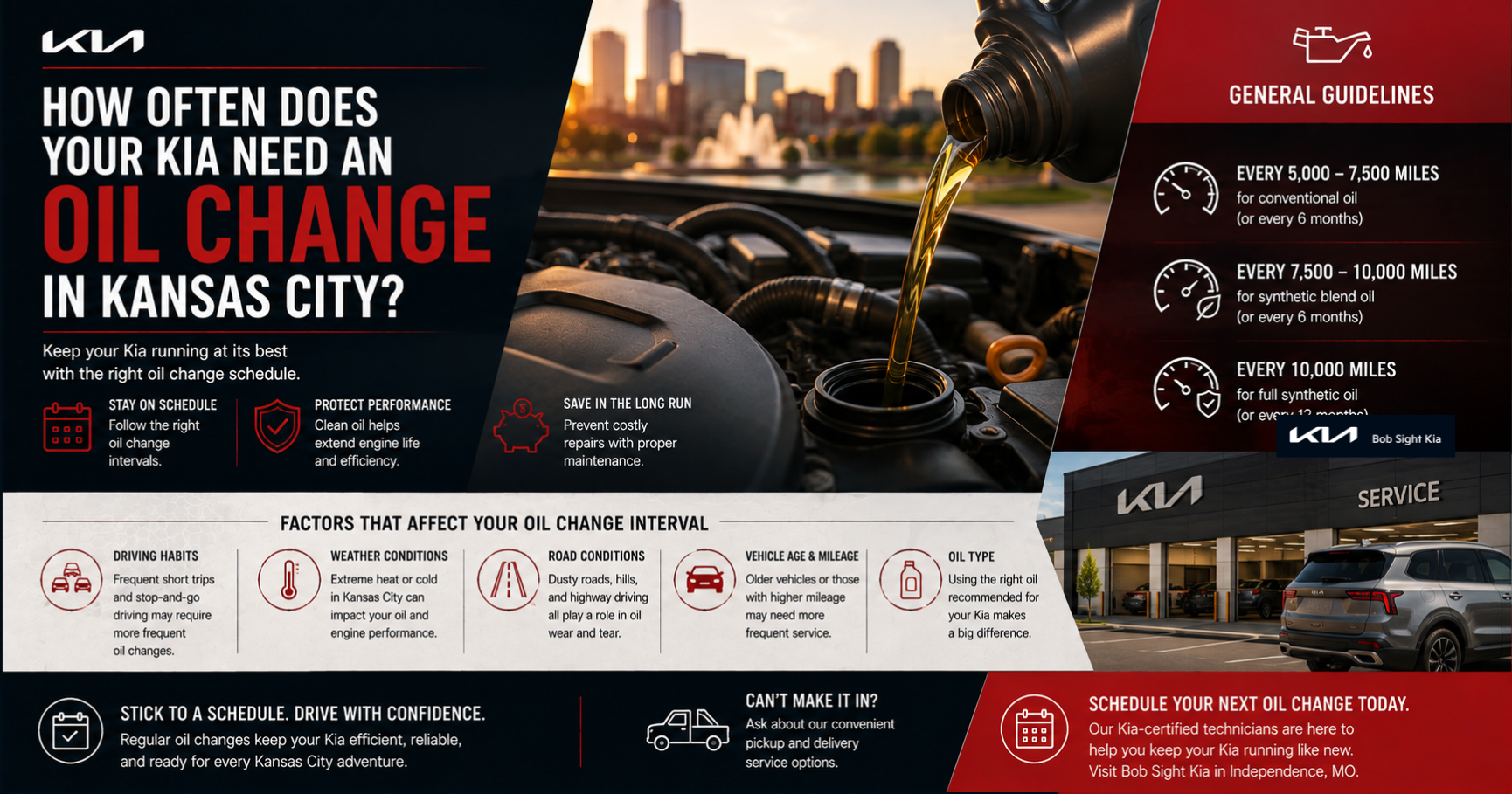
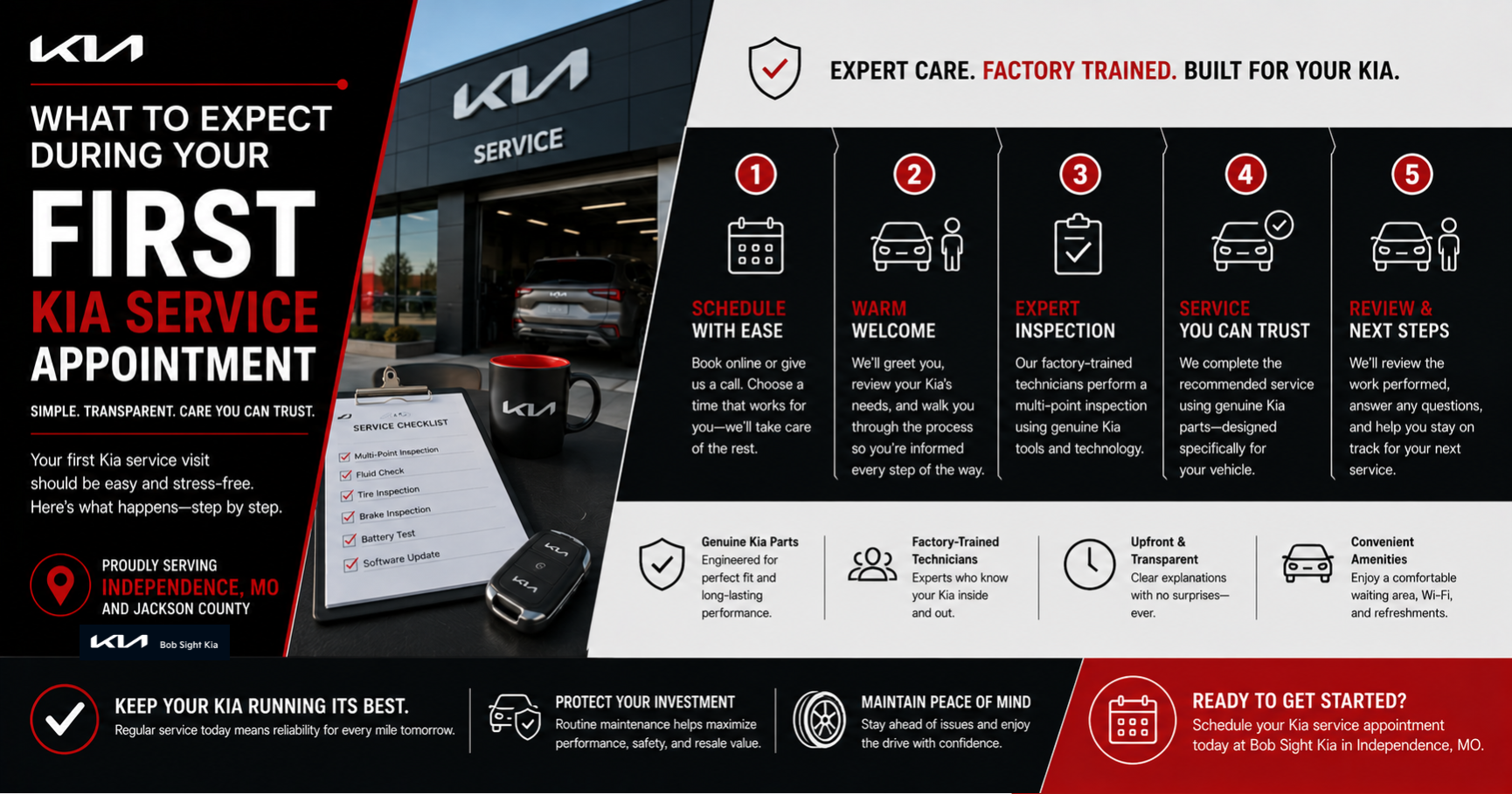
How Often Does Your Kia Need an Oil Change in Kansas City for Kansas City Metro Drivers Most modern Kia vehicles operating in the Kansas City metro area require a full synthetic oil change every 5,000 to 7,500 miles or every six months to maintain peak engine health and preserve factory warranty protection. While standard factory owner manuals list baseline intervals of 7,500 to 10,000 miles under ideal driving conditions, real-world Missouri driving habits frequently fall under manufacturer "severe service" guidelines. Navigating daily rush-hour stop-and-go traffic along Interstate 70, merging onto I-435, or coping with sub-zero winter cold starts in Independence strains motor oil significantly faster than continuous open-highway driving. At Bob Sight Kia, our factory-trained service team is dedicated to helping drivers across Independence, Lee's Summit, Blue Springs, Raytown, and the greater Kansas City area establish the ideal maintenance schedule for their specific driving routine. Schedule Certified Kia Oil Change Service at Bob Sight Kia in Independence, MO In This Guide You'll Learn Maintaining clean motor oil is the single most vital service required to protect your vehicle engine against thermal breakdown, sludge accumulation, and costly internal component wear. Here is what this detailed guide covers: How Missouri seasonal weather swings directly accelerate motor oil oxidation and thermal breakdown. Key differences between standard factory maintenance schedules and real-world severe driving condition intervals. Why modern Kia engines require OW-20 or 5W-30 full synthetic oil to preserve 10-Year/100,000-Mile warranty coverage. Step-by-step methods to check your vehicle engine oil level and evaluate oil condition at home. Comparing certified dealership oil changes against fast-lube chains and independent auto repair facilities. Understanding how intelligent Kia Oil Life Monitoring systems calculate real-world service alerts. Essential complementary multi-point checks that should accompany every routine oil change visit. 1. Understanding Baseline Kia Factory Oil Change Guidelines Baseline factory maintenance guidelines for modern gasoline-powered Kia models recommend a full synthetic oil change every 7,500 miles or 12 months under mild, ideal driving conditions. This standard interval represents the absolute maximum distance a vehicle should travel before fresh motor oil and a genuine OEM oil filter are installed. Adhering to at least this baseline frequency is mandatory for keeping your factory 10-Year/100,000-Mile Powertrain Limited Warranty active and fully enforceable across Jackson County. When fresh synthetic oil circulates through your engine, it creates a microscopic lubricating film over moving metallic surfaces, reducing friction between pistons, camshafts, and crankshaft bearings. Over time, heat, fuel dilution, and airborne microscopic debris alter the chemical structure of the oil, gradually diminishing its protective viscosity. Commuters traveling long distances on flat highways at steady speeds between Grain Valley, Blue Springs, and Liberty experience minimal thermal stress, allowing oil to remain clean closer to the full 7,500-mile mark. However, relying solely on maximum factory intervals without accounting for regional climate factors can expose your engine to subtle, cumulative wear. Even if your vehicle logs low annual mileage, motor oil naturally absorbs environmental moisture, unburned fuel vapors, and combustion byproducts over time. For this reason, the factory maintenance calendar enforces a six-month or twelve-month time limit regardless of total miles recorded on your digital odometer. 2. How Missouri Climate and Extreme Weather Shorten Motor Oil Lifespan Extreme seasonal weather swings in Missouri subject motor oil to severe thermal stress, requiring local drivers to follow a more proactive 5,000-mile oil change schedule. Weather conditions across Eastern Jackson County vary dramatically throughout the year, ranging from sub-zero winter cold snaps to scorching, humid summer heatwaves over 95 degrees Fahrenheit. These drastic ambient temperature changes directly impact how engine oil flows, lubricates, and resists internal oxidation during daily operation. During freezing winter mornings in Independence, Sugar Creek, and Raytown, thick motor oil resists initial movement, forcing starter motors to work harder while engine components operate with minimal initial lubrication. Short trips under ten miles—such as quick errands near Independence Center or local school runs—do not allow the engine block to reach full operating temperature long enough to burn off condensation. Moisture accumulated inside the crankcase mixes with oil deposits, creating thick, corrosive engine sludge that clogs narrow oil passages. Conversely, summer traffic delays on Highway 40, Highway 291, or I-70 expose motor oil to elevated thermal loads. High engine temperatures accelerate oil thinning and evaporation, reducing the protective oil film required to shield turbochargers and cylinder walls. Changing your motor oil every 5,000 miles or six months ensures fresh, heat-resistant synthetic fluid protects your engine against both freezing condensation and high-temperature thermal breakdown. 3. Identifying "Severe Driving Conditions" in the Kansas City Metro Most Kansas City metro commuters operate under manufacturer "severe driving" conditions due to frequent short trips, heavy traffic idling, and road salt exposure. Automotive owner manuals define severe driving not as extreme off-road driving, but as everyday suburban traffic patterns that place heightened mechanical stress on engine lubricants. Identifying these local driving factors helps owners make informed decisions about their maintenance cadence. Kia official factory manuals specify that service intervals should be reduced to 5,000 miles or six months if your driving routine regularly includes any of the following real-world scenarios: Driving Condition Real-World Kansas City Scenario Impact on Engine Oil Health Frequent Short Trips Driving under 8 miles in freezing weather around Blue Springs or Raytown Prevents oil from heating enough to burn off fuel and moisture contamination Extensive Engine Idling Stop-and-go rush-hour traffic jams on I-70 West or I-435 during peak hours Increases engine operating hours without adding odometer distance Corrosive Salt Exposure Driving on salt-treated roads during Jackson County winter storms Accelerates exterior engine component corrosion and air filter debris accumulation Rough / Dusty Roads Navigating unpaved rural roads or heavy construction zones near Highway 291 Introduces fine airborne silica particles that contaminate engine oil filters Heavy Hauling or Towing Pulling recreational trailers, boats, or fully loaded passenger SUVs Generates extreme internal oil temperatures that break down fluid viscosity Because the vast majority of Jackson County drivers experience at least two or three of these severe factors weekly, sticking to a 5,000-mile synthetic oil change interval provides the safest, most effective defense against premature engine wear. Proactive service prevents costly internal damage while maintaining maximum fuel economy on daily commutes. 4. Full Synthetic vs Conventional Oil: Why Modern Kia Engines Require Synthetic Modern Kia engines are engineered specifically for full synthetic OW-20 or 5W-30 oil to deliver superior thermal protection, optimal fuel efficiency, and complete warranty compliance. Advanced powertrain engineering incorporates tight internal mechanical tolerances, variable valve timing, and gasoline direct injection (GDI) technology. Utilizing outdated conventional oil in these high-precision engines causes rapid thermal breakdown, carbon buildup on intake valves, and hazardous oil sludge accumulation. Full synthetic motor oil is chemically synthesized from pure base stocks, creating uniform molecular structures that resist breakdown under high heat and extreme pressure. Synthetic formulas flow instantly during sub-zero cold starts in Missouri, lubricating vital overhead camshafts and turbocharger bearings seconds before conventional oil can even begin moving. Furthermore, full synthetic lubricants contain specialized detergent additives that actively suspend microscopic carbon soot until it reaches the oil filter. Kia requires full synthetic motor oil for all vehicles to keep factory warranty protections fully active. Using low-grade conventional or semi-synthetic oil can lead to premature engine failure, lower EPA-rated fuel economy, and denied warranty claims if mechanical issues arise. Investing in high-grade synthetic oil during every service visit guarantees that your engine operates at peak efficiency year after year. 5. Step-by-Step Guide to Checking Your Kia Oil Level at Home Checking your engine oil level monthly at home allows you to monitor fluid consumption, detect early leaks, and verify oil cleanliness between service visits. Even modern engines consume tiny amounts of oil during normal operation, especially during long highway trips across Missouri. Taking five minutes every month to inspect your dipstick ensures your engine never runs low on vital lubrication. Park on a Level Surface and Warm the Engine: Park your vehicle on a flat driveway in Independence, run the engine until it reaches normal operating temperature, turn off the ignition, and wait 5 to 10 minutes for oil to drain back into the pan. Locate and Withdraw the Dipstick: Pop the hood, locate the brightly colored engine oil dipstick handle, pull the dipstick out smoothly, and wipe the metal tip completely clean with a fresh lint-free paper towel. Reinsert the Dipstick Fully: Push the dipstick back into its tube until it seats fully, wait two seconds, and pull it back out smoothly to inspect the oil level line. Examine the Oil Level Markings: Verify that the oil level sits clearly between the "Full" (F) and "Low" (L) dots; if the fluid sits near or below the lower dot, add one quart of the exact synthetic viscosity specified on your oil filler cap. Inspect Oil Color and Smell: Check the fluid appearance; fresh synthetic oil displays an amber color, while extremely dark, gritty, or milky oil smelling strongly of gasoline indicates an immediate need for professional service. Performing this simple routine check prevents severe low-oil engine damage. If you notice your oil level dropping rapidly between 5,000-mile service intervals, visit Bob Sight Kia promptly so certified technicians can inspect your engine for minor valve cover or oil pan gasket leaks. 6. The Role of Kia Intelligent Oil Life Monitoring Systems Modern Kia vehicles feature computer-driven Oil Life Monitoring systems that calculate oil degradation based on real-world driving conditions, engine temperatures, and idle time. Rather than relying solely on a fixed odometer reading, this intelligent system continuously analyzes how your vehicle is driven daily across the Kansas City metro area. The onboard computer tracks engine load, cold starts, short trips, ambient temperatures, and highway cruising speeds to calculate remaining oil life percentage accurately. When the monitoring system detects that your oil is nearing the end of its protective lifespan, a maintenance reminder populates on your digital instrument cluster and sends a notification through the Kia Connect smartphone application. If your daily commute involves heavy stop-and-go traffic along I-70 or extended idling during cold winter mornings, the system will prompt you for service closer to 5,000 miles. Conversely, consistent long-distance highway travel at optimal operating temperatures allows the system to extend service prompts closer to the standard 7,500-mile mark. However, electronic monitoring systems cannot measure physical oil volume or detect visual contamination from blown head gaskets or dirt intrusion. Therefore, drivers should treat digital service reminders as a helpful safety net while continuing to perform monthly physical dipstick checks. Following both digital prompts and visual inspections guarantees maximum engine longevity. 7. Step-by-Step Guide to a Professional Dealership Oil Change Visit A certified dealership oil change at Bob Sight Kia combines factory-spec synthetic oil replacement with comprehensive multi-point safety inspections. Bringing your vehicle to an authorized service facility guarantees that your car receives specialized technical care that quick-lube chains simply cannot match. Factory-trained technicians handle every step of the service procedure using specialized tools and genuine OEM parts. Vehicle Arrival and Service Reception: Drive into our temperature-controlled service bay at Bob Sight Kia in Independence, where a service advisor checks your vehicle in, verifies active recall status, and reviews your maintenance history. Engine Inspection and Oil Drainage: Certified technicians raise the vehicle on a hydraulic lift, remove underbody splash shields, and drain old motor oil completely into specialized containment units. Genuine OEM Filter Replacement: Technicians remove the spent filter and install a fresh, genuine Kia OEM oil filter featuring exact anti-drainback valves and factory bypass spring tensions. Precision Refill with Full Synthetic Oil: The engine is refilled with the exact volume and viscosity of premium full synthetic oil specified by the manufacturer for your exact model engine. Comprehensive Multi-Point Safety Inspection: Technicians conduct a 21-point vehicle inspection covering brake pad thickness, tire tread depth, battery health, coolant concentration, wiper blades, and suspension linkages. Maintenance System Reset and Road Test: Technicians reset your digital dash oil life monitor, place a service reminder cling on your windshield, and perform a quick quality verification test before returning your clean vehicle. This structured service procedure provides total peace of mind for every mile driven across Missouri. Utilizing online scheduling tools like our schedule service tool allows you to book convenient appointment times that fit your daily schedule effortlessly. 8. Certified Dealership Care vs Independent Fast-Lube Chains Choosing an authorized Kia dealership over independent fast-lube outlets guarantees genuine OEM filters, correct fluid specifications, Master Technician expertise, and protected warranty records. Quick-lube centers frequently use low-cost universal oil filters that lack internal anti-drainback valves, leading to dry engine starts and severe valve train clatter over time. Furthermore, non-certified technicians may install incorrect oil weights or overtighten drain plugs, damaging delicate aluminum oil pans. Service Standard Bob Sight Kia Certified Service Independent Fast-Lube Outlets Technician Qualifications Kia Master Certified & Factory-Trained Experts Entry-Level General Technicians Oil Filter Quality 100% Genuine OEM Filters with Anti-Drainback Valves Generic Universal Aftermarket Filters Oil Specification Accuracy Exact Factory-Approved Synthetic Viscosities Bulk Synthetic Blends or Generic Oils Warranty Documentation Automatic Digital VIN Log directly tied to Kia Corporate Manual Paper Receipts Subject to Loss Facility & Recall Checks Automatic Inspection for Open Factory Recalls & TSBs No Access to Proprietary Kia Recall Databases Servicing your vehicle at Bob Sight Kia guarantees that every oil change record is stored permanently in Kia's national database. If you ever require warranty work under your 10-Year/100,000-Mile coverage, your maintenance history is instantly verifiable without searching through shoe boxes of paper receipts. Additionally, taking advantage of rotating dealer service promotions keeps certified care exceptionally affordable. Exploring current service and parts specials guarantees your vehicle receives top-tier factory service while keeping routine ownership expenses low across Jackson County. Quick Facts: Kia Oil Change Frequency in Kansas City Baseline Interval: 7,500 miles or 12 months under ideal, mild driving conditions with full synthetic oil. Severe Driving Interval: 5,000 miles or 6 months for Kansas City commuters facing short trips, severe weather, or heavy traffic. Mandatory Oil Type: Full synthetic OW-20 or 5W-30 oil required to preserve factory warranty protection. OEM Filter Protection: Genuine Kia oil filters prevent dry starts with built-in anti-drainback valves. Dipstick Verification: Monthly home oil checks ensure proper fluid levels and catch subtle leaks early. Following these simple maintenance guidelines protects your engine, optimizes fuel economy, and preserves long-term resale value across the Kansas City metro area. Ownership Planning for Kansas City Metro Drivers Proactive ownership planning is the most effective way to lower overall vehicle operating costs and maintain mechanical reliability over hundreds of thousands of miles. Missouri climate conditions deliver dramatic seasonal swings, ranging from freezing winter ice and road salt application along I-70 to intense summer heat that strains cooling systems. Aligning your oil change schedule with seasonal shifts ensures your engine remains protected through every environmental challenge. A smart strategy for local drivers is scheduling a pre-winter oil change in late autumn and a pre-summer oil change in late spring. Changing your oil before freezing winter weather arrives ensures fresh, low-viscosity synthetic oil flows effortlessly during sub-zero morning cold starts. Similarly, installing fresh synthetic oil before summer heatwaves arrive ensures maximum thermal breakdown resistance when idling in heavy rush-hour traffic near Independence Center or along I-435. Finally, combining routine oil changes with tire rotations every 5,000 to 7,500 miles maximizes tire tread life and protects all-wheel-drive transfer cases against uneven tire circumference strain. Utilizing genuine OEM filters, keeping detailed maintenance records, and partnering with certified technicians at Bob Sight Kia keeps your vehicle running smoothly, efficiently, and dependably year after year. Frequently Asked Questions How often should I change the oil in my Kia if I drive in Kansas City traffic daily? If you drive daily in heavy Kansas City traffic, you should change your oil every 5,000 miles or every six months using full synthetic oil. Stop-and-go driving along major corridors like I-70, I-435, and Highway 40 causes extensive engine idling, which accumulates engine operating hours without adding significant mileage to your odometer. Extensive idling increases internal engine temperatures and accelerates oil degradation, reducing the fluid's ability to lubricate vital components effectively. Furthermore, short daily commutes under 10 miles in cold winter weather prevent the engine from reaching full operating temperature, allowing condensation and unburned fuel to contaminate the oil supply. Following a 5,000-mile severe service schedule protects your engine against sludge accumulation, preserves fuel efficiency, and keeps your 10-Year/100,000-Mile Powertrain Limited Warranty fully active across Independence and surrounding suburban communities. What happens if I delay my Kia oil change past the recommended interval? Delaying your oil change allows motor oil to break down, forming thick engine sludge that clogs narrow oil passages, increases friction, and risks catastrophic internal engine damage. As synthetic oil ages past its protective lifespan, its detergent additives deplete, allowing unburned fuel, soot, and moisture to form gummy varnish on internal components. Over time, oil sludge starves vital engine parts—such as overhead camshafts, timing chain tensioners, and turbocharger bearings—of essential lubrication. This increased friction leads to valve train noise, decreased fuel economy, engine overheating, and eventual component failure that can cost thousands of dollars to repair. Additionally, skipping or delaying scheduled oil changes can jeopardize your factory warranty coverage. Sticking to a consistent 5,000 to 7,500-mile service schedule at Bob Sight Kia guarantees that your engine remains clean, efficient, and fully protected under factory warranty terms. Can I use conventional oil instead of full synthetic oil in my new Kia? No, modern Kia engines are engineered specifically for full synthetic oil, and using conventional oil can cause rapid thermal breakdown, carbon buildup, and potential warranty cancellation. Precision engineering in modern GDI and turbocharged Kia engines requires high-grade synthetic lubricants that maintain precise viscosity under extreme heat and pressure. Conventional motor oil lacks the refined chemical structure and advanced detergent packages needed to protect high-tech engines. Using conventional oil can lead to heavy carbon deposits on intake valves, clogged oil filter passages, decreased fuel economy, and severe dry-start wear during freezing Missouri winters. Kia factory maintenance guidelines mandate full synthetic OW-20 or 5W-30 motor oil for all recent model years. Servicing your vehicle at Bob Sight Kia in Independence guarantees that certified technicians fill your engine with factory-approved synthetic oil tailored to your exact model specifications. How do I know if my Kia is due for an oil change near Independence, MO? You can tell your Kia is due for an oil change by checking your digital dashboard service reminder, inspecting the dipstick, or noting if 5,000 miles or six months have passed since your last visit. Modern Kia models display a dashboard maintenance notification or send a alert via the Kia Connect smartphone app when oil life drops low. Physical warning signs that indicate an urgent need for fresh oil include dark, gritty fluid on the dipstick, persistent engine ticking or valve clatter upon startup, reduced fuel economy, or a burning oil smell inside the cabin. If your dashboard oil pressure warning light illuminates, you should pull over safely and turn off the engine immediately. Bringing your vehicle to Bob Sight Kia for a quick inspection allows certified technicians to check your oil level, evaluate fluid condition, and perform a complimentary multi-point safety inspection to keep your vehicle running smoothly across Eastern Jackson County. Why Bob Sight Kia Is Your Trusted Partner for Engine Maintenance Choosing Bob Sight Kia for your routine oil changes and engine maintenance means partnering with a local, family-owned dealership deeply committed to serving Independence and the greater Kansas City area. For generations, our automotive group has built its reputation on honest guidance, total pricing transparency, and outstanding customer care. We treat every guest who enters our service drive like a valued neighbor. Our state-of-the-art service center features modern hydraulic lifts, specialized Kia factory tools, and a complete inventory of genuine OEM filters and approved synthetic lubricants. Factory-trained Master Technicians handle every oil change procedure with exact precision, ensuring correct filter torque, proper fluid capacity, and thorough multi-point safety checks during every appointment. We are dedicated to making your service experience comfortable, fast, and stress-free. From easy online scheduling and comfortable waiting lounges with Wi-Fi to transparent pricing disclosures and rotating maintenance promotions, our team is here to support you through every mile of vehicle ownership. Visit Bob Sight Kia in Independence, MO today and experience certified customer service excellence firsthand. Helpful Links Explore these useful resources on our website to assist with your service and vehicle care needs: Schedule Certified Kia Oil Change Service Online Browse Current Parts and Service Specials Order Genuine Kia OEM Parts & Filters Search New Kia Vehicles in Independence, MO Calculate Your Vehicle Trade-In Value Proud to Be Part of the Bob Sight Auto Group Bob Sight Kia is proud to be a member of the Bob Sight Auto Group, serving drivers across Missouri and Kansas for generations with commitment, integrity, and exceptional service. Whether you are looking for new vehicles, quality pre-owned models, professional service, or certified collision repair, our family of dealerships is dedicated to meeting all your automotive needs across the Kansas City metro area. Bob Sight Kia - Independence, MO Bob Sight Ford - Lee's Summit, MO Bob Sight Honda - Lawrence, KS Bob Sight CDJR - Lawrence, KS Bob Sight Collision Center - Lee's Summit, MO


 Warranties include 10-year/100,000-mile powertrain and 5-year/60,000-mile basic. All warranties and roadside assistance are limited. See retailer for warranty details.