
Today: 8:30AM - 6:00PM
Blog / Bob Sight Independence Kia Service

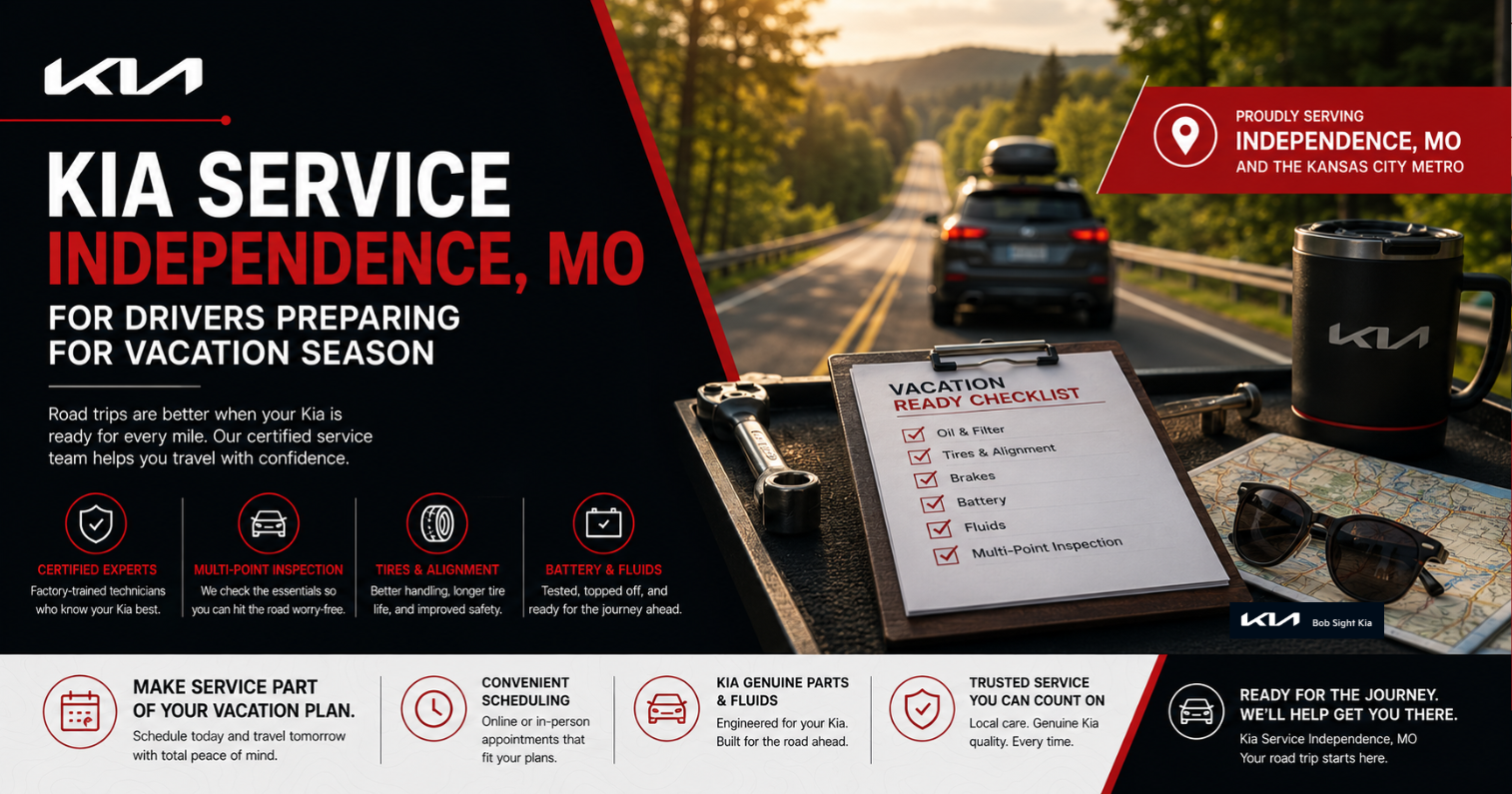
Kia Service Independence MO for Drivers Preparing for Vacation Season

Bob Sight Kia service center promoting vacation-ready Kia maintenance, including multi-point inspections, tire service, battery checks, and oil changes for drivers in Independence, MO and the Kansas City Metro.

Kia Service Independence MO for Drivers Preparing for Vacation Season

Bob Sight Kia in Independence, MO offers comprehensive vacation season maintenance and certified vehicle inspection services to ensure your Kia operates reliably during long-distance summer road trips. Preparing your vehicle for summer travel across Missouri and beyond requires addressing severe thermal loads, heavy passenger weights, and high-speed highway commuting. Whether your vacation plans involve navigating Interstate 70 toward St. Louis, driving south on Highway 65 to Branson, or taking a cross-country family journey, our factory-trained service team provides the technical precision needed for worry-free travel. Located conveniently near Noland Road and the Independence Center, we serve drivers throughout Blue Springs, Lee's Summit, Raytown, and Liberty with authentic OEM parts and specialized diagnostic care.

Schedule Your Vacation Service at Bob Sight Kia Today

In This Guide You'll Learn

Here is what you will discover in this comprehensive guide to preparing your Kia crossover, sedan, or EV for summer vacation travel:

  • Why summer heat, high-speed highway driving, and heavy cargo loads place exceptional stress on your engine and braking systems.
  • A complete pre-road trip mechanical checklist covering fluid levels, tire tread depth, and battery cold-cranking amps.
  • How high ambient temperatures accelerate engine oil oxidation, requiring high-viscosity synthetic protection like 0W-20 or 5W-30.
  • Step-by-step instructions for inspecting and replacing cabin air filters and conditioning your vehicle HVAC system for peak summer cooling.
  • A detailed comparison between routine local commuter maintenance and rigorous long-distance road trip preparation.
  • Plain-language explanations of technical service concepts such as thermal viscosity breakdown, brake pad friction limits, and cooling system pressure tolerances.
  • Key FAQs regarding vacation service scheduling, battery health testing, tire rotation frequency, and factory warranty protection.

Why Vacation Season Road Trips Demand Certified Kia Service in Independence MO

Scheduling a certified Kia vacation service in Independence, MO before embarking on long summer road trips prevents heat-related mechanical breakdowns, maximizes fuel economy, and protects your passengers across long highway stretches. High ambient summer temperatures across Jackson County regularly exceed 90 degrees Fahrenheit, causing under-hood engine temperatures to rise rapidly during sustained highway driving. When combined with heavy cargo loads, full passenger seating, and continuous air conditioning usage, minor fluid leaks or neglected components can quickly transform into major highway mechanical failures.

At Bob Sight Kia, our factory-certified technicians understand the unique environmental stress factors that Midwest summer driving places on your powertrain. Highway cruising along major travel corridors like I-70 or I-470 generates continuous thermal stress on motor oil, transmission fluid, and cooling assemblies. Bringing your Sorento, Telluride, or Sportage to our modern service department allows factory-trained specialists to inspect critical failure points, run digital battery diagnostics, and verify that your vehicle meets rigorous factory performance standards before you leave town.

In addition to preventing unexpected roadside breakdowns, proper pre-trip maintenance directly improves fuel efficiency and lowers travel costs. Clean engine air filters, properly inflated tires, and fresh synthetic motor oil reduce internal mechanical friction and aerodynamic rolling resistance. By ensuring your engine operates at peak thermal efficiency, you save money at the pump while driving through Kansas City, Blue Springs, or Grain Valley, leaving more of your travel budget available for family vacation fun.

Furthermore, certified dealership service preserves your vehicle long-term reliability and resale value. Using genuine Kia OEM filters, factory-specified fluid viscosities, and original equipment replacement parts guarantees that all maintenance conforms strictly to original factory specifications. Keeping a complete service history recorded at an authorized dealership maintains your 10-Year/100,000-Mile Powertrain Warranty and provides total peace of mind every mile of your journey.

Essential Pre-Road Trip Inspection Checklist for Long-Distance Midwest Travel

A thorough pre-road trip inspection evaluates your vehicle primary mechanical systems, including engine fluids, braking components, tire tread depth, and electrical systems. Completing a systematic inspection routine before leaving on vacation ensures that minor wear items are addressed before they compromise safety on the open highway. Below is a structured six-step checklist that our certified technicians perform during a vacation safety inspection at Bob Sight Kia.

  1. Inspect Engine Oil Level and Fluid Clarity: Verify that the engine oil level rests squarely between the dipstick indicator dots and confirm that the oil retains amber transparency without dark oxidation or burnt odors.
  2. Evaluate Cooling System and Radiator Fluid: Check the engine coolant overflow reservoir to ensure proper fluid levels and inspect upper and lower radiator hoses for rubber softening, cracking, or surface leaks.
  3. Perform Digital Battery Health and Charging Test: Test 12V battery cold-cranking amps (CCA) and alternator charging output using factory diagnostic tools to ensure reliable engine starts in high ambient summer heat.
  4. Inspect Brake Pads, Rotors, and Hydraulic Fluid: Measure front and rear brake friction pads to confirm minimum safe lining thickness above 4mm and check brake fluid for moisture contamination or dark discoloration.
  5. Check Tire Pressure, Tread Depth, and Wheel Balance: Adjust all four tires and the spare tire to recommended cold inflation pressures, verify tread depth across inner and outer ribs, and inspect for uneven tread wear.
  6. Test HVAC Cooling Efficiency and Replace Cabin Filter: Measure air conditioning outlet temperatures at the dashboard vents and inspect the cabin air filter to ensure unrestricted airflow and allergen filtration.

Protecting Drivetrain Integrity: Engine Oil, Transmission Fluid, and Cooling Systems

Protecting your drivetrain during high-temperature vacation travel requires fresh synthetic motor oil, clean transmission fluid, and a fully pressurized engine cooling system. Sustained speeds along open stretches of US-50 or Highway 13 place heavy torque demands on engine pistons, crankshaft bearings, and transmission clutches. When ambient temperatures rise, engine oil thins, reducing its ability to maintain a protective lubricating film between high-speed moving metal parts.

Modern Kia powertrains utilize advanced multi-viscosity full synthetic motor oils, such as 0W-20 or 5W-30 specifications, engineered to meet strict API SP and ILSAC GF-6A industry standards. These synthetic lubricants contain specialized detergent and anti-wear additive packages that prevent carbon deposit formation on intake valves and turbocharger bearings. Replacing old, heat-degraded oil before a long road trip ensures maximum fluid film strength, keeping internal engine components cool and protected under heavy loads.

Transmission fluid plays an equally vital role in drivetrain survival, serving as a hydraulic fluid, friction modifier, and internal coolant. Towing utility trailers, boat trailers, or pop-up campers down to the Ozarks subjects automatic and dual-clutch transmissions to severe thermal stress. Fresh transmission fluid maintains consistent hydraulic line pressure, prevents clutch slippage, and facilitates crisp gear changes during steep highway climbs near Raytown and Sugar Creek.

The engine cooling system represents your primary defense against catastrophic overheating during summer heat waves. Coolant mixtures consisting of 50 percent ethylene glycol and 50 percent distilled water elevate the boiling point of the cooling system while preventing internal aluminum corrosion. Technicians at Bob Sight Kia inspect radiator pressure caps, water pump operation, and cooling fan activation to guarantee that your cooling system can dump heat effectively during prolonged highway cruising.

Tire Safety, Wheel Alignment, and Brake System Inspection for Highway Commuting

Ensuring tire integrity, correct wheel alignment, and proper brake pad thickness is critical for maintaining highway handling stability and short emergency stopping distances. Your tires represent the sole contact patch between your vehicle and the road surface, making tire condition paramount during high-speed travel. High ambient pavement temperatures cause internal tire pressures to rise, accelerating tread wear and increasing the risk of high-speed blowouts if tires are damaged or underinflated.

Maintaining correct cold inflation pressure according to the door-jamb specification prevents excessive sidewall flexing and heat buildup inside the tire carcass. Our service department inspects tires for uneven wear patterns caused by misaligned suspension components or worn struts. Rotating your tires every 7,500 miles ensures even tread wear across all four positions, extending tire lifespan and maintaining optimal wet weather traction during sudden Midwest summer downpours.

Maintenance ComponentRoutine Suburban Driving RequirementSevere Vacation Travel Requirement
Engine Oil ServiceFull synthetic replacement every 7,500 miles.Fresh synthetic oil required before 1,000+ mile trips.
Tire Tread DepthMinimum safe depth of 3/32 inch.Recommended minimum depth of 5/32 inch for highway rain.
Brake Pad LiningReplacement required at 3mm thickness.Minimum 5mm lining recommended for mountain towing.
Engine Coolant ConditionFactory inspection every 15,000 miles.System pressure test & level check before summer trips.

Proper wheel alignment ensures that your vehicle tracks straight down the highway without pulling to one side or requiring constant steering corrections on I-70. Potholes encountered during spring driving across Jackson County roads can knock wheel alignment out of factory specifications, causing rapid tire scrubbing and reduced fuel economy. A precision computer alignment at Bob Sight Kia restores original steering geometry, delivering smooth, effortless tracking for long driving days.

Bob Sight Kia service graphic highlighting lifetime oil changes and tire rotations for drivers in Independence MO

Brake system inspection is equally vital when preparing for long-distance family travel with full cargo loads. Heavy vehicle weight increases kinetic energy, requiring brake pads and rotors to generate immense friction to slow the vehicle safely. Technicians measure brake pad thickness, inspect rotors for thermal scoring or warpage, and verify that brake fluid is free of moisture contamination that could cause pedal fade during prolonged braking down steep mountain grades.

Step-by-Step Guide: How to Prepare Your Vehicle HVAC and Cabin Air Systems for Summer Heat

Preparing your vehicle heating, ventilation, and air conditioning (HVAC) system ensures rapid cabin cooling and clean indoor air quality during hot summer travel. Driving for hours in severe summer heat without functional air conditioning causes extreme driver fatigue and discomfort for passengers. Following six straightforward maintenance steps restores peak HVAC cooling performance before you begin your vacation journey.

  1. Measure Dashboard Vent Temperature Output: Turn the HVAC controls to maximum cooling and verify that air discharging from the center dashboard vents reaches a crisp 38 to 45 degrees Fahrenheit at engine idle.
  2. Inspect the Cabin Air Filter for Debris: Access the cabin air filter housing behind the glove compartment and remove dirty, clogged filters filled with dust, pollen, and leaves accumulated during spring driving.
  3. Install a Fresh HEPA OEM Cabin Air Filter: Replace the old filter with a high-efficiency genuine Kia cabin filter to restore full airflow velocity and eliminate airborne allergens from entering the passenger compartment.
  4. Clean and Disinfect HVAC Evaporator Cores: Treat the climate control intake ducts with an antibacterial evaporator cleaner to eliminate mold, mildew, and unpleasant musty odors caused by humidity buildup.
  5. Check A/C Refrigerant Pressure and Compressor Operation: Connect specialized manifold gauges to measure high and low side refrigerant pressures, ensuring the system holds a full charge without micro-leaks.
  6. Inspect Condenser Fins for Road Debris and Obstructions: Clean dirt, bugs, and road grime from the exterior air conditioning condenser mounted in front of the radiator to allow maximum thermal heat dissipation.

Understanding Maintenance Terminology: Viscosity, Brake Friction Thresholds, and Thermal Breakdown

Grasping essential automotive maintenance terminology empowers vehicle owners to make informed decisions regarding fluid replacements, component repairs, and vacation preparation. Technical jargon can sometimes mask the critical function of underlying mechanical systems. Below are plain-language definitions of vital automotive concepts every driver should understand before embarking on a long trip.

Thermal Viscosity Breakdown: Thermal viscosity breakdown occurs when extreme engine heat weakens the chemical polymer chains in motor oil, causing the fluid to thin permanently below its engineered viscosity rating. When oil breaks down thermally, it can no longer maintain a high-pressure lubricating film between moving crankshaft and camshaft journals. Using full synthetic motor oils with advanced thermal stabilizers prevents breakdown during demanding highway driving.

Brake Friction Lining Threshold: The brake friction lining threshold refers to the minimum safe thickness of the friction material bonded to metal brake pad backing plates. While new brake pads measure roughly 10mm to 12mm in thickness, pads worn below 3mm lack sufficient thermal mass to dissipate braking heat effectively. Replacing worn pads before vacation trips prevents metal-to-metal rotor contact, brake fade, and costly rotor damage.

Cold-Cranking Amps (CCA): Cold-Cranking Amps measure a 12-volt battery capacity to deliver electric current to the starter motor at 0 degrees Fahrenheit for 30 seconds while maintaining minimum voltage. Although CCA measures cold performance, high summer heat is actually what degrades internal battery plates through accelerated chemical corrosion. Testing CCA before summer trips ensures your battery retains sufficient capacity to start your vehicle reliably during hot travel stops.

Mastering these basic technical terms allows drivers to communicate effectively with certified service advisors. Understanding why specific services are recommended builds trust and ensures your vehicle receives appropriate preventive care. Proper terminology awareness helps you prioritize safety-critical maintenance items before long-distance travel.

Quick Facts: Pre-Vacation Maintenance Benchmarks and Service Specs

Adhering to factory-recommended service benchmarks and technical specifications ensures optimal vehicle safety, efficiency, and longevity. Summarized below are essential maintenance metrics and technical specifications for Kia vacation preparation.

  • Engine Oil Specification: Full synthetic 0W-20 or 5W-30 meeting API SP and ILSAC GF-6A industry standards.
  • Standard Service Interval: Every 7,500 miles or 12 months for normal driving; 5,000 miles or 6 months for severe driving conditions.
  • Minimum Brake Pad Thickness: 4mm recommended for long-distance highway travel; mandatory replacement at 3mm lining.
  • Tire Inflation Pressure Standard: Always set to the cold PSI specification printed on the driver-side door jamb placard, not the maximum PSI on the tire sidewall.
  • Battery Lifespan Expectancy: Average battery lifespan in Midwest climate conditions ranges between 3 to 5 years due to summer heat degradation.

These key service metrics illustrate the exact engineering standards required to keep your vehicle performing at its best. Following factory maintenance thresholds guarantees that your crossover, sedan, or EV handles demanding summer travel without mechanical stress. Regular maintenance conducted at an authorized service center preserves these high operating standards.

Ownership Planning: Long-Term Vacation Reliability and Seasonal Vehicle Protection

Long-term ownership planning involves pairing seasonal vacation maintenance with proactive vehicle protection to maximize reliability and preserve trade-in equity. Preparing your vehicle for summer travel is part of a larger ongoing maintenance strategy that protects your automotive investment over hundreds of thousands of miles. Taking proper care of your vehicle before, during, and after long trips prevents cumulative wear and keeps mechanical systems operating smoothly.

Protecting your vehicle exterior and undercarriage after long road trips is an essential yet frequently overlooked aspect of maintenance. Highway travel exposes front bumpers, windshields, and side mirrors to bug splatter, road tar, and acidic bird droppings that can etch clear-coat paint if left unwashed. Washing your vehicle thoroughly upon returning home to Independence or Lee's Summit removes harmful residues and preserves your exterior finish.

Additionally, keeping meticulous, documented service records at an authorized dealership enhances resale and trade-in value when you decide to upgrade vehicles. Buyers in the pre-owned market seek vehicles with complete maintenance histories verifying regular synthetic oil changes, tire rotations, and brake inspections at certified facilities. Maintaining your vehicle at Bob Sight Kia provides a verified digital service history that commands premium market value.

For drivers who purchased their new vehicle at Bob Sight Kia, taking advantage of our lifetime oil changes and tire rotations program provides incredible ongoing savings. Covered oil changes and tire rotations eliminate routine maintenance costs, making it effortless to stay on schedule before every summer vacation. This valuable program guarantees that your engine and tires remain in top condition for as long as you own your vehicle.

Frequently Asked Questions

How far in advance of my vacation should I schedule Kia service in Independence, MO?

You should schedule your pre-vacation Kia service at least one to two weeks prior to your planned departure date. Scheduling your appointment in advance ensures you secure a convenient time slot that fits your busy travel preparation schedule at our Independence service center. It also provides a comfortable time buffer to complete any recommended preventive maintenance items, such as brake pad replacements or wheel alignments, without rushing before your trip.

Completing your vehicle service a week before leaving town gives you time to drive the car on routine local commutes around Independence, Blue Springs, or Lee's Summit. Driving the vehicle locally for a few days allows you to verify that air conditioning cooling, tire pressures, and engine operation feel completely smooth and responsive. It delivers total confidence that your crossover is fully prepped for long-distance highway driving.

Drivers can easily reserve a convenient service appointment using our online service scheduler. Our modern facility features comfortable customer amenities, fast check-in processes, and certified technicians ready to prepare your vehicle for summer travel. Booking early guarantees a stress-free service experience before your family vacation begins.

Why does summer heat weaken car batteries more than winter cold?

Summer heat weakens car batteries more than winter cold because high under-hood temperatures accelerate internal plate corrosion and cause liquid electrolyte evaporation. While winter cold slows chemical reactions and makes engine cranking difficult, it is intense summer heat that structurally damages internal lead plates and reduces overall battery life. Heat bakes the battery case, evaporating water from the internal acid solution and causing permanent capacity loss.

When autumn arrives and ambient temperatures drop, a battery that suffered heat damage during summer trips suddenly fails to supply required cold-cranking amps to start the engine. Testing your battery during a summer pre-vacation inspection identifies internal resistance and weak voltage before you get stranded at a highway rest stop hundreds of miles from home. Replacing an aging battery proactively prevents unexpected travel delays.

At Bob Sight Kia, our service department conducts automated digital battery load tests during every routine maintenance visit. Technicians evaluate reserve capacity, voltage stability, and terminal corrosion to ensure your electrical system operates reliably. If a replacement is necessary, we install genuine Kia batteries engineered specifically for your vehicle electrical demands.

Should I increase my tire pressure when driving with a full load of passengers and cargo?

Yes, you should adjust your tire inflation pressure to match the full load specification listed on your vehicle door jamb placard when carrying a full load of passengers and heavy cargo. Carrying heavy luggage, coolers, and a full cabin of passengers increases total vehicle mass, placing extra downward force on tire sidewalls. Increasing tire pressure to the manufacturer recommended heavy load PSI prevents excessive sidewall flexing, reduces internal heat buildup, and maintains stable highway handling.

Underinflated tires carrying heavy cargo generate extreme internal friction heat as the rubber flexes continuously against hot highway asphalt along I-70 or US-50. Over time, heat buildup weakens internal tire cords, increasing the probability of sudden tire failure or tread separation at highway speeds. Setting correct cold inflation pressures before loading your vehicle ensures even weight distribution across the tire contact patch.

Remember to always check tire pressures when the tires are cold, meaning the vehicle has been parked for at least three hours or driven less than one mile. Never deflate hot tires that show higher pressure readings after continuous highway driving, as pressure naturally increases with thermal expansion. Our technicians are happy to inspect and adjust your tire pressures during your pre-trip service visit.

What should I do if my engine temperature gauge rises while driving on the highway?

If your engine temperature gauge rises into the red zone or an engine coolant light illuminates, safely pull off the highway immediately, turn off the engine, and allow it to cool completely. Driving an overheating engine for even a few minutes can warp aluminum cylinder heads, blow head gaskets, and cause catastrophic internal engine failure. Once safely parked on the shoulder, turn on your hazard lights and pop the hood latch to assist under-hood heat dissipation.

Never attempt to unscrew or remove the radiator cap or coolant reservoir cap while the engine is hot. Boiling coolant and high-pressure steam can erupt from the reservoir, causing severe burns. Allow the vehicle to cool down for at least 30 to 45 minutes before visually checking coolant levels in the translucent overflow tank from a safe distance.

If coolant levels are low or visible leaks appear beneath the engine bay, contact emergency roadside assistance or our service department for guidance. Kia 24/7 Roadside Assistance is included with every new vehicle for five years, providing towing support to the nearest authorized dealership. Having your cooling system inspected thoroughly at Bob Sight Kia before leaving town prevents overheating emergencies from disrupting your vacation.

Why Local Vacation Service at Bob Sight Kia Matters for Independence Drivers

Servicing your vehicle locally at Bob Sight Kia in Independence, MO guarantees expert factory-certified care, genuine OEM parts, and a long-standing community commitment to customer satisfaction. Entrusting your vehicle to a trusted local family-owned dealership ensures that your car is serviced by certified technicians who understand the exact technical specifications of your Kia model. Our state-of-the-art service facility utilizes specialized diagnostic equipment, genuine Kia filters, and premium synthetic lubricants designed specifically for your powertrain.

Unlike third-party quick-lube shops that frequently use generic bulk oil and cheap aftermarket filters, Bob Sight Kia never compromises on quality. Generic oil filters often lack critical internal bypass valves and anti-drainback seals, leading to dry metal-on-metal engine starts and improper oil filtration. Our service department uses exclusively factory-approved filters and OEM components that preserve oil pressure, maintain cooling integrity, and protect your 10-Year/100,000-Mile warranty.

Furthermore, local dealership service offers unmatched convenience, transparent communication, and comfortable customer amenities. While your vehicle is inspected, you can relax in our quiet customer lounge with complimentary Wi-Fi and refreshments, or utilize our convenient local shuttle service to get back to your home or office in Independence, Blue Springs, or Lee's Summit. Schedule your pre-vacation Kia service at Bob Sight Kia today to experience premium customer care and keep your vehicle performing at its best.

Helpful Links

Explore these key links on our website to schedule your pre-vacation service appointment, browse current parts specials, or explore new inventory:

PROUD TO BE PART OF THE BOB SIGHT AUTO GROUP

Bob Sight Kia is a proud member of the Bob Sight Auto Group, a family-owned automotive network dedicated to serving drivers across Missouri and Kansas for generations. Grounded in integrity, transparency, and outstanding customer service, our auto group provides comprehensive inventory choices, competitive financing options, and factory-certified service across multiple locations in the region.

Explore our entire dealer group network below:

Posted in:

Related Posts

Bob Sight Kia service technician performing synthetic oil change and filter replacement in Independence MO

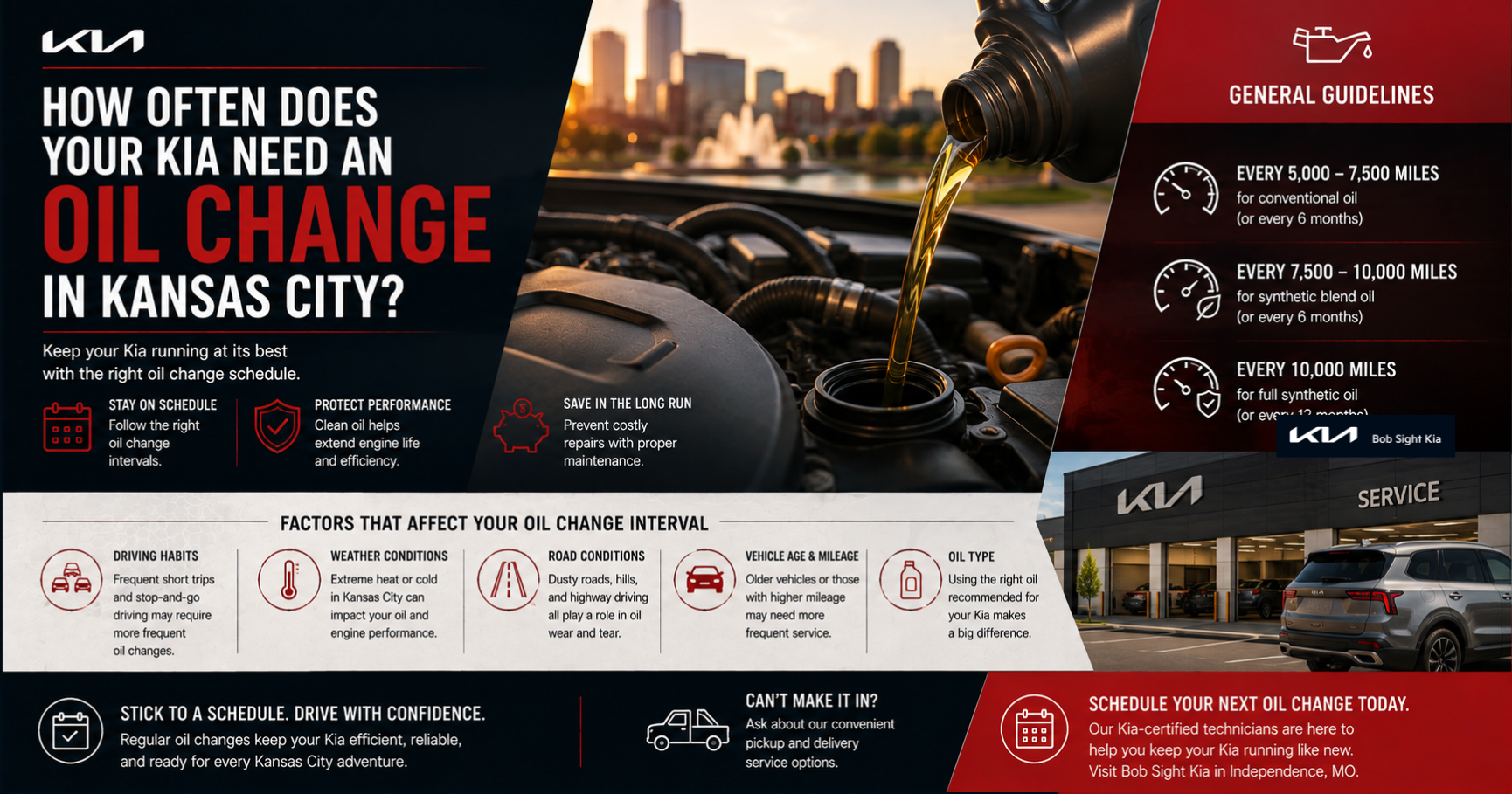
How Often Does Your Kia Need an Oil Change in Kansas City for Kansas City Metro Drivers

How Often Does Your Kia Need an Oil Change in Kansas City for Kansas City Metro Drivers Most modern Kia vehicles operating in the Kansas City metro area require a full synthetic oil change every 5,000 to 7,500 miles or every six months to maintain peak engine health and preserve factory warranty protection. While standard factory owner manuals list baseline intervals of 7,500 to 10,000 miles under ideal driving conditions, real-world Missouri driving habits frequently fall under manufacturer "severe service" guidelines. Navigating daily rush-hour stop-and-go traffic along Interstate 70, merging onto I-435, or coping with sub-zero winter cold starts in Independence strains motor oil significantly faster than continuous open-highway driving. At Bob Sight Kia, our factory-trained service team is dedicated to helping drivers across Independence, Lee's Summit, Blue Springs, Raytown, and the greater Kansas City area establish the ideal maintenance schedule for their specific driving routine. Schedule Certified Kia Oil Change Service at Bob Sight Kia in Independence, MO In This Guide You'll Learn Maintaining clean motor oil is the single most vital service required to protect your vehicle engine against thermal breakdown, sludge accumulation, and costly internal component wear. Here is what this detailed guide covers: How Missouri seasonal weather swings directly accelerate motor oil oxidation and thermal breakdown. Key differences between standard factory maintenance schedules and real-world severe driving condition intervals. Why modern Kia engines require OW-20 or 5W-30 full synthetic oil to preserve 10-Year/100,000-Mile warranty coverage. Step-by-step methods to check your vehicle engine oil level and evaluate oil condition at home. Comparing certified dealership oil changes against fast-lube chains and independent auto repair facilities. Understanding how intelligent Kia Oil Life Monitoring systems calculate real-world service alerts. Essential complementary multi-point checks that should accompany every routine oil change visit. 1. Understanding Baseline Kia Factory Oil Change Guidelines Baseline factory maintenance guidelines for modern gasoline-powered Kia models recommend a full synthetic oil change every 7,500 miles or 12 months under mild, ideal driving conditions. This standard interval represents the absolute maximum distance a vehicle should travel before fresh motor oil and a genuine OEM oil filter are installed. Adhering to at least this baseline frequency is mandatory for keeping your factory 10-Year/100,000-Mile Powertrain Limited Warranty active and fully enforceable across Jackson County. When fresh synthetic oil circulates through your engine, it creates a microscopic lubricating film over moving metallic surfaces, reducing friction between pistons, camshafts, and crankshaft bearings. Over time, heat, fuel dilution, and airborne microscopic debris alter the chemical structure of the oil, gradually diminishing its protective viscosity. Commuters traveling long distances on flat highways at steady speeds between Grain Valley, Blue Springs, and Liberty experience minimal thermal stress, allowing oil to remain clean closer to the full 7,500-mile mark. However, relying solely on maximum factory intervals without accounting for regional climate factors can expose your engine to subtle, cumulative wear. Even if your vehicle logs low annual mileage, motor oil naturally absorbs environmental moisture, unburned fuel vapors, and combustion byproducts over time. For this reason, the factory maintenance calendar enforces a six-month or twelve-month time limit regardless of total miles recorded on your digital odometer. 2. How Missouri Climate and Extreme Weather Shorten Motor Oil Lifespan Extreme seasonal weather swings in Missouri subject motor oil to severe thermal stress, requiring local drivers to follow a more proactive 5,000-mile oil change schedule. Weather conditions across Eastern Jackson County vary dramatically throughout the year, ranging from sub-zero winter cold snaps to scorching, humid summer heatwaves over 95 degrees Fahrenheit. These drastic ambient temperature changes directly impact how engine oil flows, lubricates, and resists internal oxidation during daily operation. During freezing winter mornings in Independence, Sugar Creek, and Raytown, thick motor oil resists initial movement, forcing starter motors to work harder while engine components operate with minimal initial lubrication. Short trips under ten miles—such as quick errands near Independence Center or local school runs—do not allow the engine block to reach full operating temperature long enough to burn off condensation. Moisture accumulated inside the crankcase mixes with oil deposits, creating thick, corrosive engine sludge that clogs narrow oil passages. Conversely, summer traffic delays on Highway 40, Highway 291, or I-70 expose motor oil to elevated thermal loads. High engine temperatures accelerate oil thinning and evaporation, reducing the protective oil film required to shield turbochargers and cylinder walls. Changing your motor oil every 5,000 miles or six months ensures fresh, heat-resistant synthetic fluid protects your engine against both freezing condensation and high-temperature thermal breakdown. 3. Identifying "Severe Driving Conditions" in the Kansas City Metro Most Kansas City metro commuters operate under manufacturer "severe driving" conditions due to frequent short trips, heavy traffic idling, and road salt exposure. Automotive owner manuals define severe driving not as extreme off-road driving, but as everyday suburban traffic patterns that place heightened mechanical stress on engine lubricants. Identifying these local driving factors helps owners make informed decisions about their maintenance cadence. Kia official factory manuals specify that service intervals should be reduced to 5,000 miles or six months if your driving routine regularly includes any of the following real-world scenarios: Driving Condition Real-World Kansas City Scenario Impact on Engine Oil Health Frequent Short Trips Driving under 8 miles in freezing weather around Blue Springs or Raytown Prevents oil from heating enough to burn off fuel and moisture contamination Extensive Engine Idling Stop-and-go rush-hour traffic jams on I-70 West or I-435 during peak hours Increases engine operating hours without adding odometer distance Corrosive Salt Exposure Driving on salt-treated roads during Jackson County winter storms Accelerates exterior engine component corrosion and air filter debris accumulation Rough / Dusty Roads Navigating unpaved rural roads or heavy construction zones near Highway 291 Introduces fine airborne silica particles that contaminate engine oil filters Heavy Hauling or Towing Pulling recreational trailers, boats, or fully loaded passenger SUVs Generates extreme internal oil temperatures that break down fluid viscosity Because the vast majority of Jackson County drivers experience at least two or three of these severe factors weekly, sticking to a 5,000-mile synthetic oil change interval provides the safest, most effective defense against premature engine wear. Proactive service prevents costly internal damage while maintaining maximum fuel economy on daily commutes. 4. Full Synthetic vs Conventional Oil: Why Modern Kia Engines Require Synthetic Modern Kia engines are engineered specifically for full synthetic OW-20 or 5W-30 oil to deliver superior thermal protection, optimal fuel efficiency, and complete warranty compliance. Advanced powertrain engineering incorporates tight internal mechanical tolerances, variable valve timing, and gasoline direct injection (GDI) technology. Utilizing outdated conventional oil in these high-precision engines causes rapid thermal breakdown, carbon buildup on intake valves, and hazardous oil sludge accumulation. Full synthetic motor oil is chemically synthesized from pure base stocks, creating uniform molecular structures that resist breakdown under high heat and extreme pressure. Synthetic formulas flow instantly during sub-zero cold starts in Missouri, lubricating vital overhead camshafts and turbocharger bearings seconds before conventional oil can even begin moving. Furthermore, full synthetic lubricants contain specialized detergent additives that actively suspend microscopic carbon soot until it reaches the oil filter. Kia requires full synthetic motor oil for all vehicles to keep factory warranty protections fully active. Using low-grade conventional or semi-synthetic oil can lead to premature engine failure, lower EPA-rated fuel economy, and denied warranty claims if mechanical issues arise. Investing in high-grade synthetic oil during every service visit guarantees that your engine operates at peak efficiency year after year. 5. Step-by-Step Guide to Checking Your Kia Oil Level at Home Checking your engine oil level monthly at home allows you to monitor fluid consumption, detect early leaks, and verify oil cleanliness between service visits. Even modern engines consume tiny amounts of oil during normal operation, especially during long highway trips across Missouri. Taking five minutes every month to inspect your dipstick ensures your engine never runs low on vital lubrication. Park on a Level Surface and Warm the Engine: Park your vehicle on a flat driveway in Independence, run the engine until it reaches normal operating temperature, turn off the ignition, and wait 5 to 10 minutes for oil to drain back into the pan. Locate and Withdraw the Dipstick: Pop the hood, locate the brightly colored engine oil dipstick handle, pull the dipstick out smoothly, and wipe the metal tip completely clean with a fresh lint-free paper towel. Reinsert the Dipstick Fully: Push the dipstick back into its tube until it seats fully, wait two seconds, and pull it back out smoothly to inspect the oil level line. Examine the Oil Level Markings: Verify that the oil level sits clearly between the "Full" (F) and "Low" (L) dots; if the fluid sits near or below the lower dot, add one quart of the exact synthetic viscosity specified on your oil filler cap. Inspect Oil Color and Smell: Check the fluid appearance; fresh synthetic oil displays an amber color, while extremely dark, gritty, or milky oil smelling strongly of gasoline indicates an immediate need for professional service. Performing this simple routine check prevents severe low-oil engine damage. If you notice your oil level dropping rapidly between 5,000-mile service intervals, visit Bob Sight Kia promptly so certified technicians can inspect your engine for minor valve cover or oil pan gasket leaks. 6. The Role of Kia Intelligent Oil Life Monitoring Systems Modern Kia vehicles feature computer-driven Oil Life Monitoring systems that calculate oil degradation based on real-world driving conditions, engine temperatures, and idle time. Rather than relying solely on a fixed odometer reading, this intelligent system continuously analyzes how your vehicle is driven daily across the Kansas City metro area. The onboard computer tracks engine load, cold starts, short trips, ambient temperatures, and highway cruising speeds to calculate remaining oil life percentage accurately. When the monitoring system detects that your oil is nearing the end of its protective lifespan, a maintenance reminder populates on your digital instrument cluster and sends a notification through the Kia Connect smartphone application. If your daily commute involves heavy stop-and-go traffic along I-70 or extended idling during cold winter mornings, the system will prompt you for service closer to 5,000 miles. Conversely, consistent long-distance highway travel at optimal operating temperatures allows the system to extend service prompts closer to the standard 7,500-mile mark. However, electronic monitoring systems cannot measure physical oil volume or detect visual contamination from blown head gaskets or dirt intrusion. Therefore, drivers should treat digital service reminders as a helpful safety net while continuing to perform monthly physical dipstick checks. Following both digital prompts and visual inspections guarantees maximum engine longevity. 7. Step-by-Step Guide to a Professional Dealership Oil Change Visit A certified dealership oil change at Bob Sight Kia combines factory-spec synthetic oil replacement with comprehensive multi-point safety inspections. Bringing your vehicle to an authorized service facility guarantees that your car receives specialized technical care that quick-lube chains simply cannot match. Factory-trained technicians handle every step of the service procedure using specialized tools and genuine OEM parts. Vehicle Arrival and Service Reception: Drive into our temperature-controlled service bay at Bob Sight Kia in Independence, where a service advisor checks your vehicle in, verifies active recall status, and reviews your maintenance history. Engine Inspection and Oil Drainage: Certified technicians raise the vehicle on a hydraulic lift, remove underbody splash shields, and drain old motor oil completely into specialized containment units. Genuine OEM Filter Replacement: Technicians remove the spent filter and install a fresh, genuine Kia OEM oil filter featuring exact anti-drainback valves and factory bypass spring tensions. Precision Refill with Full Synthetic Oil: The engine is refilled with the exact volume and viscosity of premium full synthetic oil specified by the manufacturer for your exact model engine. Comprehensive Multi-Point Safety Inspection: Technicians conduct a 21-point vehicle inspection covering brake pad thickness, tire tread depth, battery health, coolant concentration, wiper blades, and suspension linkages. Maintenance System Reset and Road Test: Technicians reset your digital dash oil life monitor, place a service reminder cling on your windshield, and perform a quick quality verification test before returning your clean vehicle. This structured service procedure provides total peace of mind for every mile driven across Missouri. Utilizing online scheduling tools like our schedule service tool allows you to book convenient appointment times that fit your daily schedule effortlessly. 8. Certified Dealership Care vs Independent Fast-Lube Chains Choosing an authorized Kia dealership over independent fast-lube outlets guarantees genuine OEM filters, correct fluid specifications, Master Technician expertise, and protected warranty records. Quick-lube centers frequently use low-cost universal oil filters that lack internal anti-drainback valves, leading to dry engine starts and severe valve train clatter over time. Furthermore, non-certified technicians may install incorrect oil weights or overtighten drain plugs, damaging delicate aluminum oil pans. Service Standard Bob Sight Kia Certified Service Independent Fast-Lube Outlets Technician Qualifications Kia Master Certified & Factory-Trained Experts Entry-Level General Technicians Oil Filter Quality 100% Genuine OEM Filters with Anti-Drainback Valves Generic Universal Aftermarket Filters Oil Specification Accuracy Exact Factory-Approved Synthetic Viscosities Bulk Synthetic Blends or Generic Oils Warranty Documentation Automatic Digital VIN Log directly tied to Kia Corporate Manual Paper Receipts Subject to Loss Facility & Recall Checks Automatic Inspection for Open Factory Recalls & TSBs No Access to Proprietary Kia Recall Databases Servicing your vehicle at Bob Sight Kia guarantees that every oil change record is stored permanently in Kia's national database. If you ever require warranty work under your 10-Year/100,000-Mile coverage, your maintenance history is instantly verifiable without searching through shoe boxes of paper receipts. Additionally, taking advantage of rotating dealer service promotions keeps certified care exceptionally affordable. Exploring current service and parts specials guarantees your vehicle receives top-tier factory service while keeping routine ownership expenses low across Jackson County. Quick Facts: Kia Oil Change Frequency in Kansas City Baseline Interval: 7,500 miles or 12 months under ideal, mild driving conditions with full synthetic oil. Severe Driving Interval: 5,000 miles or 6 months for Kansas City commuters facing short trips, severe weather, or heavy traffic. Mandatory Oil Type: Full synthetic OW-20 or 5W-30 oil required to preserve factory warranty protection. OEM Filter Protection: Genuine Kia oil filters prevent dry starts with built-in anti-drainback valves. Dipstick Verification: Monthly home oil checks ensure proper fluid levels and catch subtle leaks early. Following these simple maintenance guidelines protects your engine, optimizes fuel economy, and preserves long-term resale value across the Kansas City metro area. Ownership Planning for Kansas City Metro Drivers Proactive ownership planning is the most effective way to lower overall vehicle operating costs and maintain mechanical reliability over hundreds of thousands of miles. Missouri climate conditions deliver dramatic seasonal swings, ranging from freezing winter ice and road salt application along I-70 to intense summer heat that strains cooling systems. Aligning your oil change schedule with seasonal shifts ensures your engine remains protected through every environmental challenge. A smart strategy for local drivers is scheduling a pre-winter oil change in late autumn and a pre-summer oil change in late spring. Changing your oil before freezing winter weather arrives ensures fresh, low-viscosity synthetic oil flows effortlessly during sub-zero morning cold starts. Similarly, installing fresh synthetic oil before summer heatwaves arrive ensures maximum thermal breakdown resistance when idling in heavy rush-hour traffic near Independence Center or along I-435. Finally, combining routine oil changes with tire rotations every 5,000 to 7,500 miles maximizes tire tread life and protects all-wheel-drive transfer cases against uneven tire circumference strain. Utilizing genuine OEM filters, keeping detailed maintenance records, and partnering with certified technicians at Bob Sight Kia keeps your vehicle running smoothly, efficiently, and dependably year after year. Frequently Asked Questions How often should I change the oil in my Kia if I drive in Kansas City traffic daily? If you drive daily in heavy Kansas City traffic, you should change your oil every 5,000 miles or every six months using full synthetic oil. Stop-and-go driving along major corridors like I-70, I-435, and Highway 40 causes extensive engine idling, which accumulates engine operating hours without adding significant mileage to your odometer. Extensive idling increases internal engine temperatures and accelerates oil degradation, reducing the fluid's ability to lubricate vital components effectively. Furthermore, short daily commutes under 10 miles in cold winter weather prevent the engine from reaching full operating temperature, allowing condensation and unburned fuel to contaminate the oil supply. Following a 5,000-mile severe service schedule protects your engine against sludge accumulation, preserves fuel efficiency, and keeps your 10-Year/100,000-Mile Powertrain Limited Warranty fully active across Independence and surrounding suburban communities. What happens if I delay my Kia oil change past the recommended interval? Delaying your oil change allows motor oil to break down, forming thick engine sludge that clogs narrow oil passages, increases friction, and risks catastrophic internal engine damage. As synthetic oil ages past its protective lifespan, its detergent additives deplete, allowing unburned fuel, soot, and moisture to form gummy varnish on internal components. Over time, oil sludge starves vital engine parts—such as overhead camshafts, timing chain tensioners, and turbocharger bearings—of essential lubrication. This increased friction leads to valve train noise, decreased fuel economy, engine overheating, and eventual component failure that can cost thousands of dollars to repair. Additionally, skipping or delaying scheduled oil changes can jeopardize your factory warranty coverage. Sticking to a consistent 5,000 to 7,500-mile service schedule at Bob Sight Kia guarantees that your engine remains clean, efficient, and fully protected under factory warranty terms. Can I use conventional oil instead of full synthetic oil in my new Kia? No, modern Kia engines are engineered specifically for full synthetic oil, and using conventional oil can cause rapid thermal breakdown, carbon buildup, and potential warranty cancellation. Precision engineering in modern GDI and turbocharged Kia engines requires high-grade synthetic lubricants that maintain precise viscosity under extreme heat and pressure. Conventional motor oil lacks the refined chemical structure and advanced detergent packages needed to protect high-tech engines. Using conventional oil can lead to heavy carbon deposits on intake valves, clogged oil filter passages, decreased fuel economy, and severe dry-start wear during freezing Missouri winters. Kia factory maintenance guidelines mandate full synthetic OW-20 or 5W-30 motor oil for all recent model years. Servicing your vehicle at Bob Sight Kia in Independence guarantees that certified technicians fill your engine with factory-approved synthetic oil tailored to your exact model specifications. How do I know if my Kia is due for an oil change near Independence, MO? You can tell your Kia is due for an oil change by checking your digital dashboard service reminder, inspecting the dipstick, or noting if 5,000 miles or six months have passed since your last visit. Modern Kia models display a dashboard maintenance notification or send a alert via the Kia Connect smartphone app when oil life drops low. Physical warning signs that indicate an urgent need for fresh oil include dark, gritty fluid on the dipstick, persistent engine ticking or valve clatter upon startup, reduced fuel economy, or a burning oil smell inside the cabin. If your dashboard oil pressure warning light illuminates, you should pull over safely and turn off the engine immediately. Bringing your vehicle to Bob Sight Kia for a quick inspection allows certified technicians to check your oil level, evaluate fluid condition, and perform a complimentary multi-point safety inspection to keep your vehicle running smoothly across Eastern Jackson County. Why Bob Sight Kia Is Your Trusted Partner for Engine Maintenance Choosing Bob Sight Kia for your routine oil changes and engine maintenance means partnering with a local, family-owned dealership deeply committed to serving Independence and the greater Kansas City area. For generations, our automotive group has built its reputation on honest guidance, total pricing transparency, and outstanding customer care. We treat every guest who enters our service drive like a valued neighbor. Our state-of-the-art service center features modern hydraulic lifts, specialized Kia factory tools, and a complete inventory of genuine OEM filters and approved synthetic lubricants. Factory-trained Master Technicians handle every oil change procedure with exact precision, ensuring correct filter torque, proper fluid capacity, and thorough multi-point safety checks during every appointment. We are dedicated to making your service experience comfortable, fast, and stress-free. From easy online scheduling and comfortable waiting lounges with Wi-Fi to transparent pricing disclosures and rotating maintenance promotions, our team is here to support you through every mile of vehicle ownership. Visit Bob Sight Kia in Independence, MO today and experience certified customer service excellence firsthand. Helpful Links Explore these useful resources on our website to assist with your service and vehicle care needs: Schedule Certified Kia Oil Change Service Online Browse Current Parts and Service Specials Order Genuine Kia OEM Parts & Filters Search New Kia Vehicles in Independence, MO Calculate Your Vehicle Trade-In Value Proud to Be Part of the Bob Sight Auto Group Bob Sight Kia is proud to be a member of the Bob Sight Auto Group, serving drivers across Missouri and Kansas for generations with commitment, integrity, and exceptional service. Whether you are looking for new vehicles, quality pre-owned models, professional service, or certified collision repair, our family of dealerships is dedicated to meeting all your automotive needs across the Kansas City metro area. Bob Sight Kia - Independence, MO Bob Sight Ford - Lee's Summit, MO Bob Sight Honda - Lawrence, KS Bob Sight CDJR - Lawrence, KS Bob Sight Collision Center - Lee's Summit, MO

Bob Sight Kia service technician inspecting tire tread depth and battery condition for winter maintenance in Independence MO

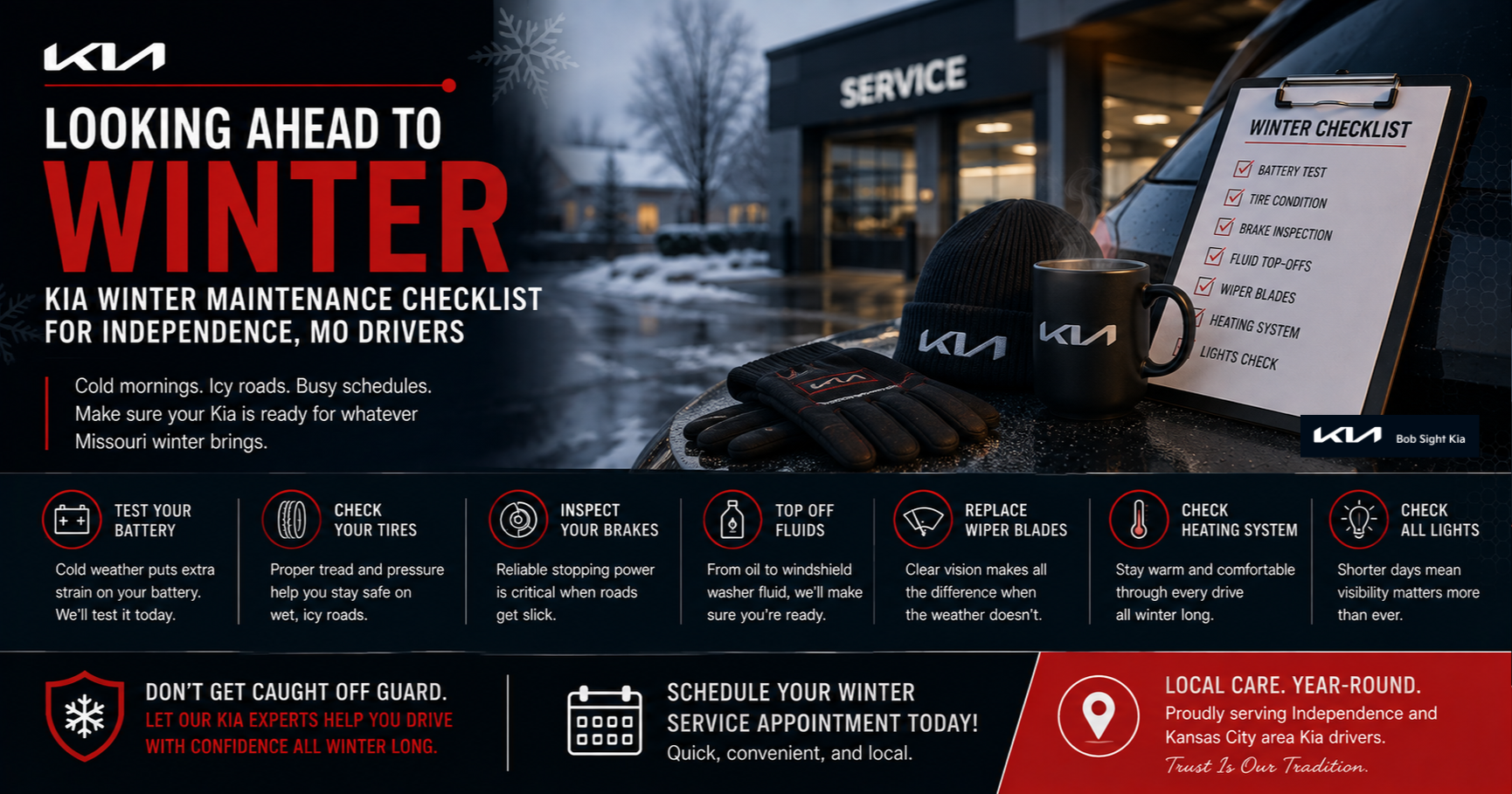
Looking Ahead to Winter: Kia Winter Maintenance Checklist for Kansas City Metro Drivers

Looking Ahead to Winter: Kia Winter Maintenance Checklist for Kansas City Metro Drivers Preparing your vehicle for freezing Midwest temperatures requires a comprehensive seasonal inspection covering battery health, tire traction, fluid viscosity, and heating systems across Jackson County. Navigating icy commutes along Interstate 70, handling winter slush near Independence Center, or driving down Highway 291 in sub-zero temperatures puts severe stress on your engine, electrical setup, and braking components. At Bob Sight Kia, our factory-trained service team is dedicated to keeping drivers in Independence, Lee's Summit, Blue Springs, Raytown, and the greater Kansas City area safe, warm, and confident on the road all winter long. Schedule Certified Kia Winter Maintenance at Bob Sight Kia in Independence, MO In This Guide You'll Learn Proactive winter preparation prevents unexpected breakdowns, protects internal engine components, and maintains optimal driving safety. Here is what this detailed guide covers: How freezing Missouri temperatures impact cold-cranking amps, battery chemistry, and electrical reliability. Step-by-step methods for inspecting tire tread depth, maintaining proper tire pressure, and choosing winter tires. Key differences between standard oil weights and low-viscosity synthetic engine oils for sub-zero starts. Understanding optimal 50/50 ethylene-glycol coolant mixtures and windshield washer anti-freeze protection. Critical brake pad, rotor, and suspension checks required for stopping safely on icy or slushy roads. How to test climate control defrosters, replace cabin air filters, and install winter wiper blades. Step-by-step instructions for assembling a functional vehicle winter emergency kit for Midwest highways. 1. Why Early Winter Preparation Matters for Independence Drivers Scheduling seasonal maintenance before the first hard freeze in Jackson County prevents cold-weather starting failures, preserves battery power, and ensures maximum tire traction on slick pavement. Winter weather in Eastern Jackson County brings sudden temperature drops, freezing rain, heavy snowfall, and dangerous black ice across major commuter corridors like I-70 and US-40. Waiting until a severe winter storm hits often leaves drivers stranded with dead batteries, frozen wiper lines, or inadequate tire grip when trying to get to work or school. Sub-zero winter blasts severely test every mechanical system inside modern gas, hybrid, and electric Kia models. Cold air causes engine oil to thicken, demands higher electrical output to crank cold engines, and causes tire pressure to drop rapidly. Commuters traveling between Raytown, Sugar Creek, and downtown Kansas City face extra hazards from road salt and chemical de-icers that accelerate chassis corrosion if proper protective steps are not taken prior to winter. Completing a thorough winter checkup early in the autumn gives local owners peace of mind and keeps service costs manageable. Addressing minor component wear before freezing weather arrives prevents minor issues from compounding into expensive winter repairs. Partnering with certified technicians ensures your vehicle receives factory-approved fluids, genuine OEM components, and specialized care tailored specifically for cold Midwest driving conditions. 2. Battery Health and Cold-Cranking Capacity Testing Testing your battery's cold-cranking amps (CCA) before winter is essential because freezing temperatures reduce battery chemical efficiency by up to 50 percent while demanding more starting power. A battery that performs adequately during mild summer months can fail suddenly during the first frosty morning in Independence. Engine starter motors require significantly higher electrical current to turn over cold engine oil, placing immense strain on aging battery plates and internal fluid capacity. During a professional electrical inspection at Bob Sight Kia, certified technicians conduct a comprehensive digital load test to measure total voltage output and cold-cranking reserve capacities. They also inspect battery terminals and cable connections for white or greenish corrosion buildup, which increases electrical resistance and prevents proper charging. Cleaning terminal connections and applying protective anti-corrosion grease ensures steady voltage flow throughout the winter season. If your battery is more than three years old, replacing it proactively before sub-zero winter temperatures arrive protects you from being stranded in icy parking lots near Independence Center. Drivers operating advanced Kia hybrids or electric vehicles like the EV6 or EV9 should also have their 12-volt auxiliary systems and high-voltage battery thermal management controls checked. Maintaining healthy battery systems guarantees instant engine starts and reliable operation for electronic safety systems during severe winter weather. 3. Tire Tread Inspection, Pressure Maintenance, and Winter Tire Selection Maintaining proper tire inflation and ensuring a minimum tread depth of 6/32 of an inch are critical for channeling snow, slush, and water away from the contact patch on slippery Missouri roads. Ambient outdoor temperatures directly affect tire pressure, with air pressure dropping approximately one to two pounds per square inch (PSI) for every 10-degree Fahrenheit drop in outside temperature. Driving on underinflated tires reduces fuel economy, causes uneven tread wear, and severely degrades steering response on icy highway ramps along Highway 291. Checking tire tread depth regularly using a depth gauge ensures your tires can bite into packed snow and slush without hydroplaning. While legal minimum tread limits are set at 2/32 of an inch, winter driving demands significantly deeper tread grooves to maintain adequate traction. If your tires show uneven wear patterns or shallow tread, scheduling a tire rotation and computerized wheel alignment restores handling stability and extends overall tread life. For drivers who commute frequently along open highway stretches in Grain Valley, Blue Springs, or Liberty, switching to dedicated winter tires offers unmatched cold-weather grip. Winter tires feature specialized soft rubber compounds that remain flexible in sub-freezing temperatures, alongside dense siping patterns designed to grip packed snow and ice. Local drivers can consult with our parts team to find OEM-recommended tire packages engineered specifically for their vehicle trim. 4. Step-by-Step Guide to Essential Winter Fluid Checks Verifying proper engine oil viscosity, coolant concentration levels, brake fluid purity, and low-temperature washer fluid prevents severe internal engine damage and visibility loss during winter storms. Fluids act as the lifeblood of your vehicle, and each fluid type behaves differently when exposed to frigid Midwest air. Following a methodical fluid inspection process keeps your engine, braking, and visibility systems operating perfectly throughout the coldest months of the year. Verify Engine Oil Grade and Viscosity: Check that your engine contains full synthetic oil (such as OW-20 or 5W-30 depending on model specifications) that flows easily during cold morning starts to protect vital internal engine components immediately upon turning the key. Test Engine Coolant and Antifreeze Concentration: Use a refractometer or hydrometer to confirm an exact 50/50 mixture of genuine Kia long-life ethylene-glycol coolant and distilled water, protecting the radiator and engine block against freezing down to -34 degrees Fahrenheit. Inspect Brake Fluid for Moisture Accumulation: Test brake fluid for moisture contamination, as absorbed water can freeze inside brake lines or cause internal corrosion, leading to a spongy brake pedal or reduced stopping power on icy roads. Fill Washer Reservoir with Sub-Zero De-Icing Fluid: Drain summer washing fluids and completely fill the reservoir with a winter-grade washer fluid rated for -20 degrees Fahrenheit or lower to melt windshield frost and prevent frozen fluid nozzles while driving on I-70. Check Transmission and Differential Fluids: Inspect driveline lubricants, especially on all-wheel-drive models, to ensure proper fluid levels and viscosity for smooth power transfer through snow and ice. Executing these vital fluid checks protects internal engine and transmission components from catastrophic cold-weather wear. Utilizing certified service facilities ensures your vehicle receives factory-specified fluids engineered to maintain exact viscosity tolerances. Keeping fluids topped off and clean guarantees optimal winter reliability across Jackson County. 5. Brake System Performance and Suspension Checks on Icy Roads Conducting a thorough brake and suspension evaluation ensures short, controlled stopping distances and predictable chassis stability when braking on slick pavement. Winter road conditions reduce tire traction dramatically, making smooth, precise braking performance essential for avoiding rear-end collisions during heavy traffic stops along Truman Road or Noland Road. Worn brake pads, warped rotors, or sticking calipers compromise stopping control and increase braking distances on icy road surfaces. During a comprehensive brake inspection, certified mechanics measure brake pad friction material thickness, inspect rotors for scoring or rust buildup, and verify that caliper slide pins move freely. Road salt and winter moisture can cause rust to form on brake components, leading to uneven pad wear or brake drag. Cleaning caliper slides and replacing worn pads with genuine Kia OEM brake components restores factory braking response and prevents premature rotor damage. Suspension components also play a vital role in maintaining tire contact with uneven, pothole-marked winter roads across the Kansas City metro. Struts, shocks, sway bar links, and control arm bushings must absorb impacts while maintaining proper wheel alignment geometry. Replacing worn suspension parts eliminates unwanted body sway and helps keep your vehicle planted firmly when navigating icy curves or sudden lane adjustments on regional interstates. 6. Heating, Defroster, Cabin Air Filter, and Wiper Blade Maintenance Inspecting climate control heating elements, rear window defrosters, cabin air filters, and heavy-duty winter wiper blades guarantees a warm cabin and clear visual awareness during snowfall. Clear visibility is your primary line of defense when navigating hazardous winter driving conditions in Eastern Jackson County. Streaking wiper blades or a slow-defrosting windshield compromise your ability to see pedestrians, brake lights, and lane markings clearly during heavy snow or freezing rain. Visibility & Heating System Common Winter Failures Recommended Preventive Maintenance Windshield Wiper Blades Streaking, Rubber Splitting, Ice Buildup on Frames Install Heavy-Duty Beam-Style Winter Wiper Blades Cabin Air Filter Reduced Heating Airflow, Musty Odors, Foggy Windows Replace Clogged Air Filter with Fresh OEM Filter Front & Rear Defrosters Inoperative Heating Grid Lines, Slow Moisture Clearing Inspect Heating Grid Element Continuity & Electrical Fuses HVAC Blower Motor Squeaking Noise, Weak Fan Speed, No Air Delivery Test Blower Motor Speeds & Climate Control Actuators Replacing standard windshield wipers with flexible, beam-style winter blades prevents ice and packed snow from building up inside the wiper frame. Beam-style blades apply uniform pressure across curved windshield glass, wiping away road spray and slush cleanly without leaving dangerous blind spots. Combining fresh winter blades with a clean cabin air filter ensures strong airflow through heater vents, allowing defrosters to clear glass rapidly on freezing mornings. Checking rear window heating grids and side mirror heaters is equally important for maintaining total visual awareness when backing out of driveways or changing lanes on busy roads. If defrosters operate slowly or fail to clear fog, certified technicians can inspect electrical relays, fuse panels, and heating elements to resolve issues quickly. Maintaining a warm, clear cabin keeps you comfortable and focused during difficult winter commutes. 7. All-Wheel Drive System Checks for Winter Traction Inspecting all-wheel-drive (AWD) coupling units, transfer cases, and rear differentials ensures instant torque distribution to wheels with traction when driving through snow. Modern Kia SUVs like the Telluride, Sorento, Sportage, and Seltos offer advanced Dynamax all-wheel-drive systems engineered to monitor road conditions and balance power between front and rear axles automatically. Proper maintenance guarantees that these sophisticated driveline components engage seamlessly on slick, snow-covered roads. Servicing all-wheel-drive systems involves checking fluid levels and condition inside the front transfer case and rear differential assemblies. Over time, gear oil degrades and loses its protective viscosity, especially under heavy loads or severe temperature changes. Changing driveline fluids at factory-recommended service intervals protects internal gears and bearings from friction wear, ensuring long-term reliability through harsh Midwest winters. Additionally, electronic AWD control modules rely on precise speed sensor inputs from all four wheels to detect wheel slippage instantly. Certified technicians use specialized Kia diagnostic equipment to check for stored fault codes and verify electronic sensor calibrations. Having an fully operational AWD system gives drivers total confidence when accelerating from stops or climbing steep, icy hills in suburban Independence neighborhoods. 8. Step-by-Step Guide to Assembling a Winter Emergency Kit Packing a dedicated vehicle emergency kit ensures driver and passenger safety in the event of unexpected highway delays, mechanical breakdowns, or accidental slide-offs. Even well-maintained vehicles can experience unexpected issues during severe winter weather, or become trapped behind traffic accidents on interstate highways like I-70 or I-435. Having proper emergency supplies stored inside your trunk keeps you warm, safe, and prepared until roadside assistance arrives. Pack High-Thermal Insulation Items: Store heavy fleece blankets, thermal sleeping bags, insulated gloves, knit hats, extra socks, and hand warmer packets in a waterproof storage tote inside your vehicle trunk. Assemble Light and Signaling Tools: Include a high-lumen LED flashlight with fresh extra batteries, reflective emergency safety vests, road flares, or LED emergency beacon lights to keep your vehicle visible to other drivers at night. Include Traction and Excavation Equipment: Carry a compact folding snow shovel, a sturdy ice scraper with a brass or rigid plastic edge, and a bag of sand, floor dry, or non-clumping kitty litter to provide instant tire traction on icy driveways. Gather Essential Mechanical and Power Tools: Pack a set of heavy-duty 8-gauge jumper cables or a portable lithium-ion jump-start power bank, basic hand tools, and a roll of heavy-duty duct tape for minor roadside repairs. Store Non-Perishable Food and Hydration: Keep non-perishable high-protein snack bars, dried fruit, nuts, and several bottles of drinking water inside the vehicle cabin, taking care not to let plastic water bottles freeze solid. Storing these critical safety items in an easily accessible trunk container ensures you are ready for severe weather emergencies. Reviewing kit contents annually before winter allows you to replace expired snacks, test flashlight batteries, and refresh clothing items. Preparation transforms scary winter breakdowns into manageable, safe situations for you and your family. Quick Facts: Kia Winter Maintenance Checklist Battery Capacity: Freezing outdoor air reduces battery capacity by up to 50 percent; professional load testing prevents sudden winter starting failures. Tire Pressure Loss: Tire pressure drops 1 to 2 PSI for every 10-degree drop in outside temperature; maintain proper inflation to preserve grip and fuel economy. Optimal Tread Depth: Ensure tire tread depth measures at least 6/32 of an inch to clear snow and slush effectively on icy Missouri roads. Synthetic Engine Oil: Full synthetic OW-20 engine oil flows rapidly during sub-zero cold starts, reducing internal friction and starter wear. Ethylene-Glycol Coolant: A precise 50/50 coolant and water mix protects engine blocks against internal freezing down to -34 degrees Fahrenheit. Following this seasonal checklist ensures your vehicle remains dependable, efficient, and safe through every winter storm in Eastern Jackson County. Ownership Planning for Missouri Winter Driving Proactive winter ownership planning protects your mechanical investment and preserves long-term vehicle trade-in equity. Missouri winters are notorious for unpredictable swings between freezing ice, heavy snowstorms, and muddy thaws. Establishing a consistent winter care routine—including frequent undercarriage car washes to remove road salt and de-icing chemicals—prevents rust formation on brake lines, exhaust pipes, and structural frame components. Planning your service appointments well in advance of peak winter months avoids last-minute scheduling delays at local service departments. Autumn is the ideal window to schedule oil changes, tire rotations, brake checks, and battery tests before winter weather arrives. Utilizing online scheduling tools like the schedule service tool at Bob Sight Kia allows you to select convenient appointment times that fit your daily calendar. Finally, keeping comprehensive service records and using genuine Kia OEM parts preserves factory warranty protection and enhances future vehicle value. Taking advantage of seasonal savings through service and parts specials keeps winter maintenance costs low. Thoughtful seasonal care guarantees that your Kia continues delivering comfortable, reliable performance through every Midwest winter season. Frequently Asked Questions Why is a battery test important before winter in Independence, MO? A battery test before winter is critical because cold temperatures severely degrade battery chemical capacity while demanding significantly more power to crank cold engine oil. Freezing air reduces a battery's available starting power by up to 50 percent, meaning an aging battery that started fine during summer can fail completely during the first freezing morning in Jackson County. Professional battery testing at Bob Sight Kia measures cold-cranking amps and internal resistance to determine if your battery can withstand winter starting demands. Technicians also clean battery posts and cable connections, removing corrosion that restricts electrical flow and prevents the alternator from fully charging the battery during short daily drives. Replacing a weak battery before sub-zero winter temperatures arrive protects you from being stranded in icy parking lots near Independence Center or along highway corridors like I-70. Routine electrical checks give drivers complete confidence during cold morning commutes across the Kansas City metro area. Should I switch to synthetic oil for winter driving in Missouri? Yes, switching to full synthetic oil with a low cold-viscosity rating like OW-20 guarantees rapid oil circulation during sub-zero cold engine starts. Conventional motor oil thickens significantly in freezing temperatures, causing engine components to run without proper lubrication for critical seconds after startup, which accelerates internal engine wear. Full synthetic oil remains fluid even in extreme sub-zero weather, flowing quickly to lubricate pistons, camshafts, and bearings immediately upon starting your engine. Synthetic oil also maintains its protective thermal properties longer, resisting oil breakdown and sludge formation during short winter drives where the engine may not reach full operating temperature. Servicing your vehicle at Bob Sight Kia guarantees that certified technicians fill your engine with factory-approved synthetic oil tailored to your exact engine specifications. Maintaining clean, high-grade synthetic oil protects your engine and supports maximum fuel economy all winter long. What tread depth do I need on my tires for winter driving on I-70? Tires should have a minimum tread depth of 6/32 of an inch to safely maintain traction, grip packed snow, and prevent hydroplaning on slushy highways. While legal minimum tread limits are set at 2/32 of an inch, shallow tread grooves cannot effectively channel heavy snow, slush, or freezing water away from the tire contact patch on fast-moving roads like I-70. Driving on worn tires dramatically increases braking distances and compromises steering control on icy pavement or wet highway ramps near Highway 291. Checking tread depth regularly with a depth gauge or having technicians measure tread during routine tire rotations ensures your tires offer adequate cold-weather grip. If your current tires are worn below safe winter thresholds, the parts specialists at Bob Sight Kia can help you select replacement all-season or dedicated winter tires engineered specifically for your Kia model. Proper tire selection keeps your family safe during hazardous winter travel across Eastern Jackson County. How does winter weather affect electric and hybrid Kia models? Freezing winter temperatures temporarily reduce electric vehicle driving range and hybrid battery efficiency because cold air slows battery chemical reactions and requires cabin heating energy. Lithium-ion batteries operate most efficiently in moderate temperatures, so running high-voltage cabin heaters in sub-zero weather draws energy directly from the traction battery pack. To maximize range during winter, drivers can utilize pre-conditioning features through Kia Connect while the vehicle is still plugged into a home charger, warming the battery and cabin using grid power. Utilizing heated seats and a heated steering wheel rather than blasting cabin heat also conserves battery energy for driving range during long commutes along I-435. Bringing your hybrid or EV to Bob Sight Kia for a pre-winter inspection ensures that high-voltage coolant systems, heat pumps, and 12-volt auxiliary batteries are operating perfectly. Certified technicians verify that thermal management systems keep your electric or hybrid vehicle performing efficiently all winter long. Why Bob Sight Kia Is Your Trusted Partner for Winter Service Choosing Bob Sight Kia for your seasonal vehicle maintenance means partnering with a family-owned dealership deeply committed to the safety and well-being of Independence drivers. For generations, our service center has provided transparent, high-quality automotive care built on honest advice, certified technical expertise, and fair pricing. We treat every customer who visits our service drive like a valued neighbor. Our state-of-the-art service facility features modern diagnostic technology, specialized Kia factory tools, and a complete inventory of genuine OEM parts designed specifically for your vehicle. Factory-trained Master Technicians handle every winter service procedure—from routine battery load tests and synthetic oil changes to complex brake repairs and all-wheel-drive servicing—with exact precision and care. We are dedicated to making your service experience comfortable, convenient, and completely stress-free. From online service scheduling and comfortable waiting lounges to clear pricing disclosures and helpful service advice, our team is here to support you through every mile of winter driving. Visit Bob Sight Kia in Independence, MO today to get your vehicle fully freeze-ready for the months ahead. Helpful Links Explore these useful resources on our website to assist with your winter service and vehicle research needs: Schedule Certified Kia Winter Maintenance Online Browse Current Parts and Service Specials Order Genuine Kia OEM Parts & Winter Accessories Explore New All-Wheel Drive Kia SUVs Calculate Your Vehicle Trade-In Value Proud to Be Part of the Bob Sight Auto Group Bob Sight Kia is proud to be a member of the Bob Sight Auto Group, serving drivers across Missouri and Kansas for generations with commitment, integrity, and exceptional service. Whether you are looking for new vehicles, quality pre-owned models, professional service, or certified collision repair, our family of dealerships is dedicated to meeting all your automotive needs across the Kansas City metro area. Bob Sight Kia - Independence, MO Bob Sight Ford - Lee's Summit, MO Bob Sight Honda - Lawrence, KS Bob Sight CDJR - Lawrence, KS Bob Sight Collision Center - Lee's Summit, MO

Bob Sight Kia service advisor assisting a customer during a first service check-in at the Independence MO service center

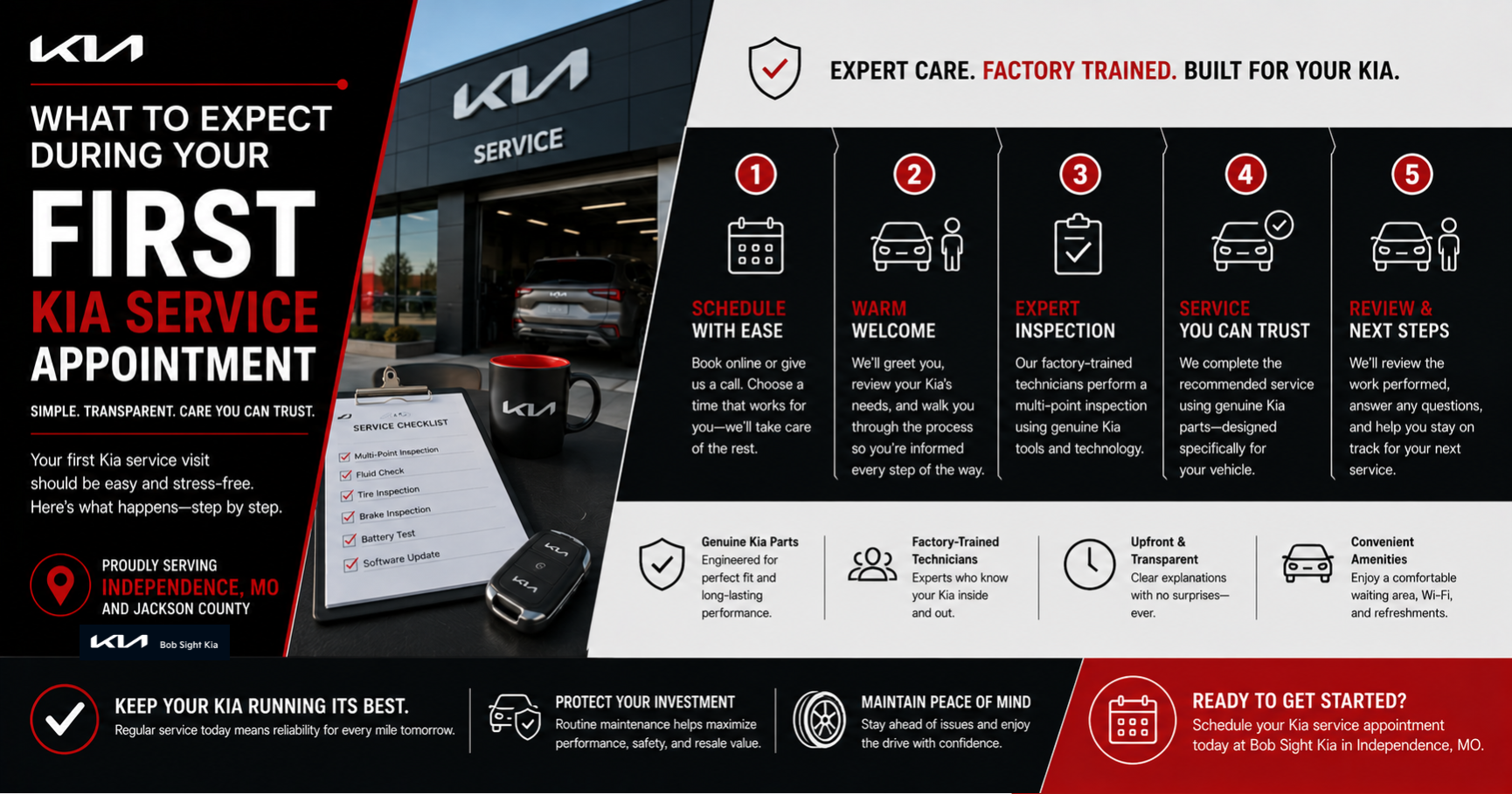
What to Expect During Your First Kia Service Appointment at Bob Sight Kia

What to Expect During Your First Kia Service Appointment at Bob Sight Kia Schedule Your First Kia Service Appointment at Bob Sight Kia in Independence MO Scheduling your initial maintenance visit ensures your new or pre-owned vehicle maintains peak fuel efficiency, factory reliability, and full warranty compliance across Jackson County. Drivers living in Independence, Missouri, subject their vehicles to demanding daily driving conditions, ranging from stop-and-go morning traffic on Interstate 70 to sudden winter freezes and humid Midwest summer commutes. Completing your first routine service appointment on time allows certified technicians to verify initial component wear, inspect critical fluid levels, and execute essential maintenance procedures recommended by Kia factory engineers. At Bob Sight Kia, our service team is dedicated to providing a transparent, efficient, and welcoming service experience for every first-time visitor. Whether you recently purchased a new Kia Telluride, Sportage, or K4, this comprehensive guide explains every step of your initial service appointment so you can arrive with complete confidence. In This Guide You'll Learn This comprehensive service guide covers everything first-time vehicle owners need to know about visiting the Bob Sight Kia service department in Independence: How to prepare your vehicle and documentation before arriving for your first scheduled maintenance visit. What happens during initial check-in with your dedicated Kia service advisor. A step-by-step breakdown of routine first-service procedures including oil changes, tire rotations, and fluid top-offs. How factory-trained technicians execute a comprehensive multi-point vehicle health inspection. Plain-language definitions of critical service terms like full synthetic oil viscosity, tire wear patterns, and brake lining thickness. A step-by-step guide to utilizing dealership amenities including local shuttle service and pickup options. A direct comparison table highlighting the advantages of factory-certified dealership service versus independent repair shops. Long-term maintenance planning strategies to preserve factory warranty coverage and trade-in value on Missouri roads. Preparing for Your First Kia Service Visit in Independence, Missouri Preparing for your first Kia service appointment involves gathering basic vehicle documentation, noting any driving observations, and selecting a convenient arrival time. Taking a few simple preparatory steps before driving to our Independence dealership streamlines the check-in process and ensures your service advisor addresses all your vehicle needs. Most initial service visits occur at 5,000 to 7,500 miles or six months of driving, depending on factory specifications for your specific Kia model and engine setup. Reviewing your owner manual maintenance schedule beforehand gives you a clear baseline understanding of required services. Before leaving your home in Lee's Summit, Blue Springs, or Raytown, gather essential documentation including your vehicle registration, current mileage reading, insurance card, and any specialized warranty papers. If you have experienced subtle driving changes—such as minor tire vibrations when merging onto Highway 291 or a slight squeak when braking on US-40—write down these details so your advisor can inform the service technician. Additionally, make sure to remove valuable personal items, sports equipment, or loose items from the front cabin area so technicians can access service ports and floor mats easily. Utilizing our user-friendly online service scheduling tool allows you to select an arrival window that fits your personal schedule without phone delays. When booking online, you can request specific services, choose your preferred service advisor, and indicate whether you plan to relax in our comfortable customer lounge or utilize our local shuttle service. Preparing your questions in advance ensures open communication between you and our service department, establishing a strong foundation for ongoing vehicle care throughout your ownership journey. Arriving at the Bob Sight Kia Service Center: Check-In and Service Advisor Consultation Upon arriving at Bob Sight Kia, you will pull directly into our climate-controlled service drive where a dedicated service advisor greets you immediately. Our service drive is designed to keep you sheltered from rain, snow, or summer heat as soon as you arrive at our Independence facility. Once you bring your vehicle to a stop inside the designated lane, an advisor will welcome you, record your current odometer mileage, and verify your contact details. This initial greeting sets a welcoming, professional tone for your service appointment. During the initial consultation, your service advisor will review your vehicle's factory-recommended maintenance schedule based on current mileage and age. They will discuss the planned service items line-by-line, explaining what maintenance will be performed and confirming whether you have experienced any specific driving concerns across Jackson County. If your vehicle is due for routine factory recall updates or software calibrations, your advisor will identify these items automatically through our connected Kia factory database and include them in your visit at zero charge. After confirming the scope of work, your advisor will provide a clear, transparent estimate of the time required to complete all inspections and maintenance tasks. You will receive a copy of the initial service order before your vehicle is escorted into our state-of-the-art service bays. From there, you can relax in our quiet customer waiting lounge—complete with complimentary Wi-Fi, fresh coffee, comfortable seating, and charging stations—or utilize our local shuttle service to run errands around Independence Center while our factory-certified technicians work on your car. Step-by-Step Breakdown of First Factory Scheduled Kia Maintenance First scheduled factory maintenance focuses on replacing engine oil, installing a fresh OEM filter, rotating tires, and inspecting vital mechanical components. Performing these foundational maintenance items on schedule removes break-in microscopic metal debris, prevents uneven tire tread wear, and ensures all mechanical assemblies function according to factory engineering standards. Following a systematic procedure ensures no detail is overlooked while your vehicle is on the service lift. Perform full synthetic engine oil and filter change: Drain worn engine oil, remove the factory oil filter, and refill the crankcase with premium full synthetic oil meeting exact Kia viscosity specifications (such as 0W-20 or 5W-30). Execute four-wheel tire rotation and pressure calibration: Remove all four wheels and rotate them according to specified directional patterns to promote uniform tread wear, adjusting tire air pressure to match driver door jamb specifications. Inspect and top off essential vehicle fluids: Check fluid levels and purity for windshield washer fluid, engine coolant, brake fluid, and power steering fluid, adding factory-approved fluids as needed. Inspect brake system hardware and friction pads: Measure front and rear brake pad lining thickness using precision digital calipers and inspect brake rotors, calipers, and hydraulic lines for signs of wear or leakage. Check engine air intake filter and cabin air filter condition: Remove filter elements to inspect for accumulated dirt, dust, or road debris, replacing them if restricted to maintain cabin air quality and engine efficiency. Perform battery terminal and charging system health test: Test cold-cranking ampers (CCA) battery output and clean battery terminal posts to ensure reliable engine starting during freezing Missouri winter weather. Completing these multi-point service steps protects internal engine clearances and preserves smooth power delivery during high-speed commuting along Interstate 70. Our factory-certified technicians utilize specialized Kia tools and genuine OEM replacement parts to guarantee exact mechanical fitment and original factory performance throughout your service visit. Understanding the Comprehensive Kia Multi-Point Inspection Process A Kia multi-point inspection is a thorough digital health check where technicians evaluate dozens of safety and performance components using a color-coded rating system. The multi-point inspection acts as an early warning system for your vehicle, identifying minor wear issues before they develop into inconvenient mechanical breakdowns on local roads. Technicians systematically examine under-hood components, steering linkages, suspension struts, exhaust systems, and underbody protection panels. Results from the multi-point inspection are categorized using a straightforward green, yellow, and red color system on your final digital report. Green indicates the component is in excellent condition and operating within factory specifications. Yellow signals that the component shows moderate wear and will require attention or replacement during an upcoming service visit. Red alerts you that immediate service or replacement is recommended to maintain vehicle safety, prevent mechanical damage, or preserve factory warranty compliance. Your service advisor will review the multi-point inspection report with you in detail upon completion of the service. You will receive a clear digital copy sent directly to your smartphone or email, complete with photos or video notes taken by the technician while your vehicle was on the lift. This complete transparency ensures you stay fully informed about your vehicle's mechanical condition without feeling pressured into unnecessary repairs. Plain-Language Definitions of Essential Kia Service and Maintenance Terminology Understanding common automotive service terms helps car owners communicate effectively with service advisors and make informed maintenance decisions. Service estimates and factory inspection reports contain specialized technical phrases. Plain-language definitions of essential maintenance terms clarify how routine service protects your vehicle on Midwest roads: Full Synthetic Oil Viscosity: A refined lubricant engineered to maintain consistent fluid thickness across extreme temperature ranges. Formulations like 0W-20 flow quickly during freezing winter morning starts in Independence while resisting heat breakdown during hot summer highway cruising. Tire Rotation Pattern: The systematic process of moving tires from one wheel position to another (e.g., front-to-rear or cross-forward) to balance tread wear across all four tires, extending total tire lifespan and protecting all-wheel-drive transfer cases. Brake Pad Lining Thickness: The remaining friction material depth measured in millimeters on brake pads. New brake pads typically measure 10mm to 12mm, while pads worn down to 3mm or less require prompt replacement to ensure safe stopping distances on wet or icy pavement. OEM Parts (Original Equipment Manufacturer): Replacement parts manufactured directly by or for Kia that match original factory specifications, materials, and engineering tolerances, preserving original vehicle reliability and warranty validity. Comparing Dealership Service vs Independent Repair Shops in Jackson County Servicing your vehicle at a certified dealership ensures work is performed by factory-trained master technicians using specialized tools and genuine OEM parts backed by factory warranty. While independent repair shops offer general automotive maintenance, they lack direct factory access to proprietary Kia diagnostic software, technical service bulletins, and specialized repair tools. Entrusting your new or pre-owned Kia to Bob Sight Kia guarantees that every procedure adheres strictly to factory engineering guidelines. The comparison matrix below highlights distinct operational differences between servicing your vehicle at Bob Sight Kia versus a generic independent repair shop in Jackson County: Service Feature / Standard Bob Sight Kia Service Center Independent Repair Shops Technician Certification Kia Factory Master Trained & Certified General ASE / Non-Specialized Technicians Diagnostic Equipment Proprietary Kia Factory Diagnostic Software Generic Multi-Brand Diagnostic Scanners Parts Quality 100% Genuine OEM Kia Replacement Parts Aftermarket or Generic Fitment Parts Warranty Claim Authorization Direct Factory Warranty Processing On-Site Cannot Perform or Authorize Factory Warranty Repairs Recall & Software Updates Automatic Factory Recall & Software Verification No Direct Access to Factory Software Updates Customer Amenities Comfortable Lounge, Wi-Fi, Shuttle & Pickup Varies (Often Limited Waiting Facilities) Choosing factory-certified dealership service preserves your vehicle's official warranty records, protects its resale trade-in value, and ensures your complex digital driver-assist safety systems remain correctly calibrated. Our commitment to specialized Kia care provides complete peace of mind during every maintenance visit. Step-by-Step Guide to Utilizing Kia Pickup, Delivery, and Shuttle Amenities Bob Sight Kia offers convenient local transportation options including courtesy shuttle services and pickup and delivery arrangements to make servicing your vehicle stress-free. We understand that busy work schedules, school drop-offs, and family commitments in Raytown, Blue Springs, and Lee's Summit can make waiting at a dealership inconvenient. Applying a structured scheduling process allows you to take advantage of our customer mobility programs seamlessly. Select your mobility preference when scheduling online: Choose between waiting in our customer lounge, requesting local courtesy shuttle transport, or booking premium pickup and delivery service. Confirm your transportation address with your service advisor: Verify your home or office address in Independence or surrounding areas during check-in so our shuttle drivers can plan efficient pickup routes. Receive automated SMS notifications regarding driver status: Receive real-time text message updates informing you when your shuttle driver or pickup valet is en route to your location. Review digital inspection reports while at work or home: Approve estimated maintenance work directly from your smartphone or laptop while our team completes your vehicle service. Enjoy seamless return transport upon service completion: Our shuttle driver will return you directly to the dealership to collect your freshly serviced and washed Kia vehicle. These thoughtful transportation amenities eliminate workweek disruptions, allowing local car owners to maintain their vehicles on schedule without sacrificing personal or professional time. Contact our service coordination team to verify shuttle boundary maps across Jackson County prior to your appointment. First Kia Maintenance Schedule and Inspection Quick Reference Adhering to factory-recommended service intervals keeps your vehicle operating smoothly while preventing premature wear on vital mechanical assemblies. The quick-reference guide below outlines typical service items required during early Kia maintenance milestones under normal driving conditions in Western Missouri: 7,500 Miles / 6 Months: Replace full synthetic engine oil and OEM oil filter, rotate all four tires, inspect brake pads and rotors, top off washer fluid, and perform initial multi-point health check. 15,000 Miles / 12 Months: Replace engine oil and filter, rotate tires, replace cabin air filter, inspect cooling system hoses, check steering gearbox, and inspect suspension ball joints. 22,500 Miles / 18 Months: Replace engine oil and filter, rotate tires, inspect brake lines and hydraulic connections, check exhaust system heat shields, and test battery output. 30,000 Miles / 24 Months: Replace engine oil and filter, rotate tires, replace engine air intake filter, replace cabin air filter, inspect drive belts, and perform complete brake fluid flush. Drivers who frequently navigate heavy stop-and-go commuter traffic along Interstate 470 or operate vehicles in extreme winter cold may follow severe maintenance schedules recommending slightly shorter intervals. Your Bob Sight Kia service advisor will help customize a maintenance timeline based on your specific daily driving habits in Independence. Quick Facts About First-Time Kia Service in Independence Reviewing essential quick facts highlights why routine initial service is vital for preserving vehicle performance, safety, and warranty protection. The summary points below detail key facts every first-time service customer should know: Warranty Protection Requirement: Documenting routine factory maintenance at regular intervals protects your original 10-year/100,000-mile factory powertrain warranty against claim denials. Genuine OEM Parts Guarantee: Every service performed at Bob Sight Kia utilizes genuine factory replacement parts engineered specifically for your exact vehicle model and trim. Factory Master Technicians: Our service team consists of factory-certified master technicians who undergo continuous training on the latest Kia mechanical and electrical systems. Complimentary Multi-Point Inspection: Every service visit includes a free digital health check with color-coded reports sent directly to your phone. Online Service Specials: Customers can access updated service and parts specials online to save on routine maintenance items like oil changes and tire rotations. These key service facts demonstrate why local drivers trust Bob Sight Kia for all their automotive maintenance needs. Having certified care paired with transparent pricing ensures a rewarding ownership experience from day one. Long-Term Ownership Planning and Seasonal Maintenance Strategy for Missouri Drivers Developing a long-term seasonal maintenance plan protects your Kia against Missouri's dramatic weather fluctuations while maximizing vehicle trade-in equity. Weather conditions across Jackson County range from summer humidity and scorching asphalt temperatures to freezing winter ice storms and heavy road salt application. Proactive care addresses seasonal environmental stress before it causes permanent damage to mechanical or aesthetic components. Preparing your vehicle for winter in late autumn involves testing battery cold-cranking capacity, inspecting wiper blade rubber, checking tire tread depth for snow traction, and verifying engine coolant freezing protection levels. Winter road salt applied along Highway 291 and Interstate 70 can cause underbody corrosion if left unwashed; scheduling regular undercarriage rinses at our dealership protects brake lines and suspension arms. In late spring, changing cabin air filters removes trapped seasonal pollen, ensuring clean cabin air during humid summer commutes. Maintaining complete, organized service records at Bob Sight Kia creates a documented history of professional maintenance that substantially boosts your vehicle's valuation when you decide to trade it in down the road. Prospective pre-owned buyers and dealership appraisers place high financial value on vehicles featuring documented factory service records. Investing in routine maintenance today yields lower long-term repair costs and higher future equity retention. Frequently Asked Questions About First Kia Service Visits How long does a first routine Kia service appointment typically take at Bob Sight Kia? A standard first routine service appointment—including synthetic oil change, tire rotation, fluid top-offs, and multi-point inspection—typically takes approximately 45 to 60 minutes to complete. Our service team works efficiently in dedicated quick-service bays to minimize your wait time while maintaining rigorous factory quality control standards. If your vehicle requires additional service items, such as factory recall software updates or specific driving concern diagnostics, your service advisor will inform you of the extended time estimate during initial check-in. You can relax comfortably in our customer lounge with free Wi-Fi and coffee or utilize our local shuttle service to run errands nearby in Independence. Scheduling your appointment online in advance allows our parts department to prep required filter elements and oil supplies prior to your arrival, ensuring the fastest possible turn-around time for your busy day. Do I need to take my vehicle to a Kia dealership to keep my 10-year warranty valid? While federal law permits you to have routine maintenance performed at any qualified shop, servicing your vehicle at a certified Kia dealership guarantees official factory record keeping and eliminates warranty claim disputes. Dealership service entries are logged directly into Kia's centralized national warranty database, providing instant proof of proper maintenance across all Kia locations nationwide. If you choose an independent shop, you must retain every detailed paper receipt, invoice, and parts receipt showing exact oil specifications used during every service interval. If a powertrain warranty claim arises in the future, missing or vague records from independent shops can complicate warranty authorization processes. Servicing your vehicle at Bob Sight Kia eliminates record-keeping hassles entirely while ensuring your car receives genuine OEM parts and factory master technician care on every visit. What should I bring with me to my first Kia service appointment? Bring your vehicle registration, current insurance card, driver's license, and a list of any specific driving observations or questions you want to discuss with your service advisor. Having your registration handy simplifies verifying contact details and owner database profiles during initial check-in. If you have noticed any subtle vehicle behavior changes—such as minor brake noise, steering pull on Interstate 70, or infotainment screen questions—having written notes ensures your advisor notes these items on the official technician work order. Additionally, remember to bring your Smart Key fob and wheel lock key if your vehicle is equipped with locking lug nuts, allowing technicians to remove wheels easily during tire rotation procedures. How do I know when my Kia is due for its first oil change and service? Your Kia is due for its first service at the mileage or time interval specified in your owner manual, typically occurring at 5,000 to 7,500 miles or 6 months of driving. Modern Kia vehicles also feature an automated instrument cluster service reminder that displays a notification icon when scheduled maintenance approaches. If your daily driving routine involves severe driving conditions—such as frequent short trips under 5 miles in cold weather, extensive idling in stop-and-go traffic along Highway 291, or driving in dusty conditions—factory guidelines recommend following shorter service intervals. Your Bob Sight Kia service advisor will review your specific driving patterns and recommend an ideal maintenance schedule tailored to your commute across Jackson County. Why Servicing Your Kia Locally at Bob Sight Kia Matters Servicing your vehicle locally at Bob Sight Kia connects you with a dedicated, family-owned dealership group that prioritizes customer trust, technical excellence, and community support. For generations, the Bob Sight Auto Group has served vehicle owners across Independence, Lee's Summit, Blue Springs, Raytown, and the greater Kansas City area. Our service philosophy centers on complete honesty, clear communication, and delivering exceptional technical quality on every visit. Our state-of-the-art service facility features factory-trained master technicians equipped with specialized diagnostic software, precision alignment machines, and complete inventories of genuine OEM parts. Whether you require routine synthetic oil changes, tire rotations, brake service, or complex warranty repairs, our team handles your vehicle with professional care and attention to detail. Comfortable lounge amenities, transparent digital inspection reports, and flexible transportation options make vehicle maintenance stress-free. Conveniently located in Independence, Missouri, Bob Sight Kia offers effortless access for drivers coming from across the Kansas City metro via Interstate 70 and Highway 291. We invite you to experience the difference factory-certified care makes for your vehicle. Schedule your first service appointment online today with the trusted team at Bob Sight Kia! Helpful Links Schedule Service Online at Bob Sight Kia Browse Current Service and Parts Specials Order Genuine OEM Kia Parts Online Value Your Current Vehicle Trade-In Online Explore New Kia Vehicle Inventory Proud to Be Part of the Bob Sight Auto Group Bob Sight Kia is proud to be a member of the Bob Sight Auto Group, serving drivers across Missouri and Kansas with high-quality automotive sales, financing, and service. Explore all of our dealership locations and specialized automotive services below: Bob Sight Ford Bob Sight Honda Bob Sight CDJR Bob Sight Kia Bob Sight Collision Center