

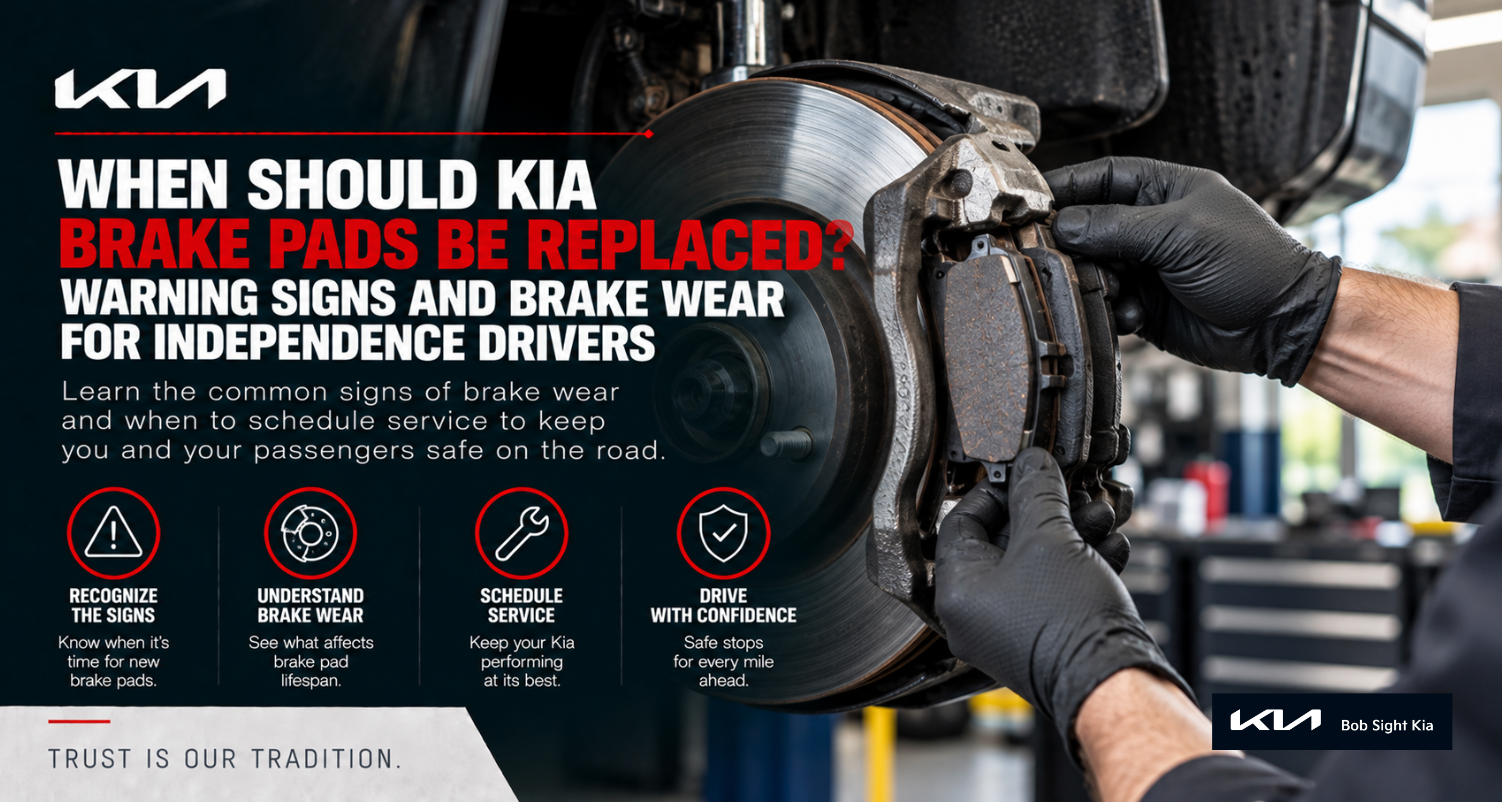
When Should Kia Brake Pads Be Replaced? Warning Signs and Brake Wear for Independence Drivers
Kia brake pads should be replaced when they become worn enough that braking performance, rotor protection, or safe stopping can be affected, rather than according to one universal mileage interval. Driving habits, traffic conditions, vehicle weight, road conditions, and the type of driving you do around Independence and the Kansas City Metro can all influence how quickly brake pads wear. Drivers who spend a lot of time in stop-and-go traffic along I-70, US-40, or busy streets near Independence Center may use their brakes differently from someone whose routine involves longer stretches of highway driving. Regular brake inspections are therefore one of the best ways to determine when your Kia actually needs new brake pads.
Schedule Kia brake service at Bob Sight Kia in Independence
In This Guide You'll Learn
This guide explains the warning signs of worn Kia brake pads, what affects brake wear, and how Independence drivers can decide when it is time to schedule a brake inspection.
- Why Kia brake pads do not have one universal replacement mileage
- Common warning signs that brake pads may be wearing out
- How brake pad thickness relates to replacement timing
- Why Kansas City traffic can affect brake wear
- How brake pads, rotors, calipers, and brake fluid work together
- What happens during a Kia brake inspection
- How to plan brake maintenance before longer trips or seasonal driving
When Should Kia Brake Pads Be Replaced?
Kia brake pads should generally be replaced based on their remaining friction material, braking behavior, and inspection results rather than automatically at a specific mileage. Brake pads are wear components, meaning they gradually lose friction material every time the brakes are applied. Two identical Kia vehicles can therefore require brake pad replacement at very different mileage depending on how they are driven. A driver commuting through frequent traffic lights and congestion in Independence may experience faster brake wear than someone who spends most of the week cruising at a steady speed.
This is why mileage should be treated as a reminder to inspect the braking system rather than a guaranteed replacement schedule. A Kia with frequent city use, school drop-offs, short errands, or repeated stop-and-go driving may use its brake pads more aggressively. Highway driving generally requires fewer braking events, although sudden stops, heavy traffic, hills, and vehicle loading can still affect wear. Even the driver's habits matter because gradual braking usually generates different wear patterns than repeatedly braking hard at the last moment.
The most reliable approach is to have brake pad thickness and the surrounding brake components inspected periodically. A technician can evaluate how much friction material remains, whether the inner and outer pads are wearing evenly, and whether the rotors show signs of scoring, excessive heat, or uneven contact. Caliper operation can also affect how quickly pads wear. If one pad is substantially more worn than another, the issue may involve more than simply installing a new set of pads.
Independence drivers should also pay attention between scheduled maintenance visits. Changes in pedal feel, stopping behavior, brake noise, vibration, or warning lights deserve attention even if the vehicle has relatively low mileage. If something about braking suddenly feels different while driving near Noland Road, US-24, I-70, or anywhere else around Jackson County, scheduling a professional inspection is a better strategy than waiting for an assumed mileage milestone.
What Are the Most Common Signs of Worn Kia Brake Pads?
Common signs that Kia brake pads may need attention include squealing or grinding noises, increased stopping distance, brake pedal changes, vibration during braking, and visible brake wear warnings. Not every sound automatically means the brake pads must be replaced, but a noticeable change in how the braking system sounds or feels should not be ignored. Brakes are a safety-critical system, so unusual symptoms deserve inspection rather than guesswork.
A high-pitched squeal during braking can occur when a wear indicator contacts the brake rotor or when certain operating conditions cause vibration between braking surfaces. Occasional noise can also result from moisture, road debris, temperature changes, or surface rust after the vehicle has been parked. The concern increases when squealing becomes persistent, occurs during most stops, or is accompanied by a change in braking performance. Grinding is more urgent because it can indicate that the friction material has worn significantly or that another braking component is contacting the rotor abnormally.
Pedal feel also matters. If your Kia suddenly requires more pedal travel, feels unusually soft, feels harder than normal, or seems to require more effort to slow down, have the braking system inspected. A pulling sensation under braking can indicate uneven braking force, although tires, suspension components, alignment, or road conditions can sometimes produce similar sensations. Steering wheel or pedal vibration during braking may point toward rotor irregularities or other brake-system concerns rather than brake pads alone.
Independence drivers should use the following warning signs as reasons to schedule an inspection:
- Listen for persistent squealing, scraping, or grinding when braking.
- Notice whether the vehicle seems to take longer to slow down.
- Pay attention to changes in brake pedal feel or travel.
- Watch for vibration through the steering wheel or brake pedal.
- Take brake or ABS warning lights seriously.
- Schedule an inspection if braking behavior changes suddenly or consistently.
If you notice any of these symptoms during a commute through Blue Springs, Raytown, Lee's Summit, or Independence, avoid assuming the cause based on noise alone. A proper inspection can identify whether the issue involves brake pads, rotors, calipers, brake fluid, tires, or another component of the braking system.
How Does Brake Pad Thickness Affect Replacement Timing?
Brake pad thickness is one of the most useful measurements for determining brake wear because it shows how much friction material remains between the braking surface and the pad backing plate. New brake pads begin with substantially more friction material than worn pads, and that material gradually decreases as the vehicle is driven. A technician can measure remaining thickness during an inspection and use that information along with wear patterns and braking performance to determine whether replacement is needed.
The friction material is the portion of the pad designed to press against the brake rotor when the brake pedal is applied. That contact creates friction, which converts the vehicle's motion into heat and slows the vehicle. As the friction material gets thinner, there is less usable material remaining before the pad reaches the end of its service life. Waiting until virtually no friction material remains can increase the risk of damaging the rotor and other components.
Brake-pad replacement decisions should not rely on thickness alone, however. A pad may have some friction material remaining while still showing abnormal wear, cracking, contamination, glazing, or uneven contact. Inner and outer pads can also wear at different rates if a caliper slide, piston, or related component is not operating correctly. That is why visually checking only the outside pad through the wheel does not always provide a complete picture of brake condition.
For drivers searching for Kia brake pad replacement in Independence, Missouri, the more useful question is not simply how many miles are on the vehicle. Ask how much usable pad material remains and whether the entire braking system is wearing evenly. A professional inspection at Bob Sight Kia can evaluate the pads alongside the rotors, calipers, hardware, and other components that influence braking performance. This creates a more complete maintenance decision than replacing parts according to mileage alone.
Why Can Kansas City Driving Cause Brake Pads to Wear at Different Rates?
Brake pad wear around the Kansas City Metro can vary significantly because stop-and-go traffic, short urban trips, hills, weather changes, and driving habits all change how often and how aggressively the brakes are used. A vehicle that repeatedly accelerates and stops through city traffic may accumulate brake wear differently from one covering the same number of miles on open highways. Mileage therefore tells only part of the brake-maintenance story.
Consider two Kia owners who each drive 10,000 miles in a year. One spends much of that mileage commuting along relatively open highway routes, while the other makes repeated short trips through Independence, school zones, shopping areas, and busy intersections. The second vehicle may experience far more braking events even though both odometers increase by the same amount. Frequent deceleration creates repeated friction and heat cycles at the brake pads and rotors.
Kansas City weather also adds variables. Rain can reduce road traction, winter moisture can contribute to surface corrosion on exposed braking components, and temperature swings can change how the vehicle behaves at the beginning of a drive. Road salt and winter debris can accumulate around suspension, wheel, and brake components. None of these conditions automatically means brake pads will fail early, but they make periodic visual inspections valuable for drivers who keep their vehicles through several Missouri seasons.
Driving style plays a major role as well. Leaving more following distance allows a driver to slow gradually instead of applying the brakes heavily at the last moment. Anticipating traffic lights and congestion can reduce repeated hard stops. On a busy afternoon near the I-70 and I-470 corridors, simply allowing additional space ahead can reduce how often aggressive braking is required.
These differences explain why a fixed mileage estimate cannot predict brake-pad life for every Kia in Independence. The best maintenance plan combines routine inspections with awareness of your actual driving conditions. Drivers who regularly face dense Kansas City traffic, frequent short trips, heavy passenger loads, or repeated urban stopping may want to pay closer attention to brake condition than drivers whose routes involve less braking.
Brake Pads vs. Rotors: What Is the Difference?
Brake pads are replaceable friction components that press against brake rotors, while the rotors are metal discs attached to the wheel hubs that provide the surface the pads clamp against to slow the vehicle. The two components work together every time you press the brake pedal. Understanding the difference can help Kia owners make sense of a brake inspection and understand why sometimes pads are replaced alone while other repairs may involve both pads and rotors.
When the driver presses the brake pedal, hydraulic pressure helps the brake caliper move the brake pads toward the rotor. Friction between the pads and rotor slows wheel rotation and creates heat. The pads are designed to wear gradually as part of normal operation. Rotors are more durable, but they are also subject to wear and can develop scoring, thickness variation, heat spots, corrosion, or other surface problems over time.
A worn brake pad does not automatically mean every rotor needs replacement. A technician should examine rotor condition and determine whether it remains serviceable. At the same time, continuing to drive after brake pads are excessively worn can damage a rotor that might otherwise have remained usable longer. This is one reason addressing brake-pad wear before grinding begins can help protect more of the braking system.
| Brake Component | Primary Function | What Technicians Check |
|---|---|---|
| Brake Pads | Create friction against the rotor | Thickness, even wear, glazing, cracking, contamination |
| Brake Rotors | Provide the braking surface | Surface condition, wear, scoring, heat damage, thickness |
| Brake Calipers | Apply the pads to the rotors | Movement, leaks, piston operation, slide operation |
| Brake Fluid | Transfers hydraulic force through the system | Condition, level, leaks, maintenance requirements |
For Kia owners in Independence, understanding these components can also make service recommendations easier to evaluate. If a brake inspection identifies worn pads plus rotor damage, ask which condition was observed and how it affects the repair recommendation. A brake service should be based on the condition of the system rather than automatically assuming every component needs replacement.
What Happens During a Kia Brake Inspection?
A Kia brake inspection should evaluate more than whether the vehicle still stops because technicians need to examine brake pad wear, rotor condition, caliper operation, brake-fluid concerns, and other components that affect braking performance. A vehicle can continue stopping while a component is beginning to wear abnormally. Identifying that wear before a severe symptom develops can make brake maintenance easier to plan.
The inspection process often begins with the symptoms reported by the driver. If you hear a noise only during the first stop of the morning, only while turning, or only after highway driving, tell the technician. Details such as speed, weather, pedal feel, and whether the sound comes from the front or rear can help narrow down the concern. A vague description such as "the brakes sound weird" gives less diagnostic information than describing when and how the symptom occurs.
A brake inspection may then include several steps:
- Review the driver's concern. Explain noises, vibration, pedal changes, or stopping differences you have noticed.
- Inspect brake pad condition. Remaining friction material and wear patterns can be evaluated.
- Check rotor surfaces. Rotors can be inspected for scoring, heat damage, corrosion, or other visible concerns.
- Inspect caliper operation and hardware. Uneven pad wear can sometimes point toward a problem with movement or contact.
- Check for leaks or fluid-related concerns. Hydraulic braking components should not be ignored during a comprehensive evaluation.
- Discuss findings before repairs. Ask what is worn, what requires attention now, and what can continue to be monitored.
This process is useful whether your Kia is used primarily for commuting along I-70, family driving around Blue Springs, or short errands throughout Independence. It also allows technicians to distinguish normal brake wear from a symptom caused by another component. Drivers can schedule Kia service online when a brake inspection is needed.
Should You Replace Kia Brake Pads Before They Start Grinding?
Brake pads should ideally be inspected and replaced before persistent grinding develops because grinding can indicate that the friction material is severely worn or that metal components are contacting surfaces they should not. Waiting for grinding to become the replacement signal can increase the possibility of additional brake-system damage. Earlier inspection gives drivers more information and more time to plan appropriate service.
A squeal and a grind are not the same sound. Squealing is generally higher-pitched and can have several possible causes, including brake wear indicators, vibration, moisture, or surface conditions. Grinding is typically harsher and should be treated more urgently. If braking suddenly sounds metallic or rough, continuing to drive extensively without inspection is not a good maintenance strategy.
Rotor protection is one reason timing matters. Brake pads are designed as wear items, while rotors provide the braking surface the pads contact. When the pad's usable friction material becomes excessively thin, the relationship between those components changes. Addressing brake wear before severe contact develops can reduce the likelihood that a simple wear issue turns into a more extensive repair involving additional components.
Drivers should also remember that brake symptoms do not always develop in a predictable order. One vehicle may produce noticeable noise while another may show changes in braking feel first. Some drivers may notice no dramatic warning until an inspection reveals significant wear. Relying exclusively on sound therefore is not a substitute for periodic inspection.
If your Kia begins grinding while traveling near Independence Center, along Noland Road, or elsewhere in the Kansas City Metro, arrange for the braking system to be evaluated promptly. If the vehicle's braking performance feels significantly reduced or unsafe, avoid continuing to drive it. Safety should take priority over trying to reach a preferred service destination under uncertain braking conditions.
How Can Kia Owners Help Reduce Unnecessary Brake Wear?
Kia owners can help reduce unnecessary brake wear by maintaining appropriate following distance, anticipating traffic, avoiding repeated aggressive stops, and keeping the vehicle's braking and tire systems properly maintained. Brake pads will always wear because friction is required to stop the vehicle, but driving technique can influence how quickly that wear occurs. Smooth, predictable braking can also make everyday driving more comfortable for passengers.
Following distance is one of the simplest factors drivers can control. When you leave adequate space between your Kia and the vehicle ahead, you have more time to slow gradually instead of braking sharply. This can be useful during rush-hour traffic on I-70 or when approaching congestion near busy Independence shopping corridors. Constantly accelerating toward stopped traffic and then braking heavily creates more frequent heat cycles than anticipating the slowdown earlier.
Vehicle loading matters as well. A Kia carrying several passengers and a full cargo area requires the braking system to manage more mass than the same vehicle with only the driver aboard. This does not mean families should avoid using their Kia's passenger or cargo capacity. It simply means drivers should account for increased weight by allowing additional following distance and braking smoothly.
Tires also affect the overall stopping process. Even perfectly maintained brakes depend on the tires to maintain contact with the road. Proper inflation, adequate tread, and appropriate tire condition are therefore part of braking safety. During Missouri rain, winter precipitation, or cold weather, reduced road traction can increase stopping distance even when the brake system itself is operating normally.
Routine inspection ties all of these habits together. Rather than trying to maximize brake-pad life at all costs, focus on predictable braking performance and appropriate maintenance. Brake pads are designed to wear. The goal is to identify normal wear at the right time, catch abnormal wear early, and maintain the entire braking system so it works consistently throughout everyday Kansas City driving.
Quick Facts About Kia Brake Pad Replacement
Kia brake-pad replacement timing depends primarily on actual wear and brake condition rather than one fixed mileage number for every vehicle. Drivers can make better maintenance decisions by combining routine inspections with awareness of braking symptoms and everyday driving conditions.
- Brake pads are normal wear components and gradually lose friction material during use.
- There is no single universal replacement mileage that applies to every Kia and every driving pattern.
- Frequent city and stop-and-go driving can create more braking events than steady highway travel.
- Persistent squealing can justify inspection even if braking still feels normal.
- Grinding should be addressed promptly because it may indicate severe wear or abnormal contact.
- Brake-pad thickness is an important measurement, but technicians should also evaluate wear patterns.
- Uneven pad wear can indicate a concern involving calipers, hardware, or another component.
- Brake rotors and pads work together but do not automatically require replacement at the same time.
- Changes in pedal feel, stopping distance, vibration, or warning lights deserve professional evaluation.
- Tire condition and road traction also influence how effectively a vehicle can stop.
For Independence drivers, these facts are more useful than choosing an arbitrary replacement interval. A Kia used daily in traffic around Jackson County may experience a very different brake-wear pattern from one driven primarily on longer highway trips. Inspection allows maintenance decisions to be based on the actual vehicle instead of a generic estimate.
Ownership Planning for Kia Brake Maintenance in Independence
The best long-term brake-maintenance strategy is to include brake inspections in your overall Kia ownership plan instead of waiting until severe noise or reduced braking performance appears. Brake pads are easier to monitor when their condition is checked periodically alongside other routine vehicle maintenance. This can also help drivers understand whether wear is progressing normally or whether one wheel is wearing differently from the others.
Seasonal changes provide useful opportunities to think about braking condition. Before winter, drivers may already be checking tires, battery condition, wiper blades, and other systems affected by cold weather. Adding brake inspection to that maintenance conversation can be useful because winter roads increase the importance of predictable braking and healthy tires. Spring can also be a good time to look for corrosion or wear after months of exposure to moisture, road treatment, and fluctuating temperatures.
Long trips deserve similar planning. If you are preparing to leave Independence for a road trip and the vehicle has developed brake noise, vibration, or another symptom, addressing it before departure is more useful than hoping the issue remains unchanged for hundreds of miles. Heavy luggage and additional passengers can increase vehicle weight, while unfamiliar routes may involve hills, congestion, or repeated braking.
Keep maintenance records as well. Knowing when brake pads, rotors, tires, and brake fluid were previously inspected or serviced provides useful context at future appointments. Documentation can make it easier to identify how quickly components are wearing and whether a pattern has changed over time.
Bob Sight Kia owners can also review available service and parts specials when planning maintenance. Brake service should still be based on the actual condition of the vehicle, but organizing maintenance ahead of time can make ownership more predictable. The goal is not to replace brake pads early without reason. It is to know their condition before they become an urgent repair.
Frequently Asked Questions About Kia Brake Pad Replacement
How many miles do Kia brake pads usually last?
There is no single mileage at which every Kia needs brake-pad replacement because brake wear depends heavily on driving conditions and vehicle use. Two Kia vehicles with similar mileage can have significantly different remaining brake-pad material. Stop-and-go driving, aggressive braking, traffic density, passenger and cargo weight, road conditions, and individual driving habits all influence wear.
Mileage is still useful as maintenance context. If a vehicle has accumulated substantial mileage since its last brake inspection, it makes sense to have pad condition checked even if no obvious symptom has appeared. The inspection provides actual information about remaining friction material and wear patterns rather than relying on a generalized mileage estimate.
Independence drivers who spend considerable time navigating traffic lights, school zones, shopping districts, and Kansas City congestion may experience a different wear pattern from drivers who primarily use open highway routes. Ask for the condition of the pads to be evaluated during routine service so you can track wear over time.
Why are my Kia brakes squeaking if the pads are not worn out?
Brake squeaking can occur for reasons other than worn-out pads, including moisture, light surface corrosion, brake dust, vibration, temperature changes, or characteristics of the pad and rotor surfaces. Noise alone does not prove that brake pads need replacement. Persistent or worsening noise should still be inspected because wear indicators or other brake conditions can also cause squealing.
For example, a Kia parked outside overnight may develop light surface oxidation on the brake rotors after rain or humid weather. The first few stops may make noise as the pads clean that surface. A brief morning squeak that disappears can therefore be different from a sound that occurs every time the brake pedal is applied.
Missouri's changing weather can make occasional brake noise more noticeable, but drivers should not dismiss persistent symptoms as weather-related without inspection. If squealing continues during normal driving around Independence or Blue Springs, schedule a brake evaluation so the source can be identified.
Do Kia brake pads and rotors need to be replaced together?
Brake pads and rotors do not automatically have to be replaced together because each component should be evaluated based on its condition and service requirements. Pads are designed to wear as friction material is consumed. Rotors are also subject to wear, but their replacement needs depend on factors such as thickness, surface condition, heat damage, scoring, and manufacturer specifications.
If brake pads are replaced while the rotors remain in appropriate condition, the technician may determine that rotor replacement is unnecessary. In other cases, damaged or excessively worn rotors may need attention at the same time as the pads. The correct approach depends on inspection findings rather than a blanket rule.
When discussing Kia brake service in Independence, ask what the technician observed on both the pads and rotors. Understanding which component is worn and why a particular repair is recommended helps drivers make better-informed maintenance decisions.
Can I keep driving if my Kia brakes are grinding?
Persistent grinding should be treated as a reason for prompt brake-system inspection rather than something to continue driving on indefinitely. Grinding can indicate severe brake-pad wear or another condition involving abnormal contact within the braking system. Continuing to drive may increase damage and can affect braking performance.
If the vehicle still appears to stop, that does not confirm that the braking system is in good condition. Braking components can deteriorate while the vehicle retains some stopping capability. Waiting for braking performance to become dramatically worse is not a safe maintenance strategy.
If grinding is accompanied by significantly reduced stopping ability, a brake warning light, unusual pedal behavior, or another serious symptom while driving in the Kansas City Metro, prioritize safety. Avoid continuing to operate a vehicle that does not feel safe to stop and have the condition properly evaluated.
Where can I schedule Kia brake service near Kansas City?
Drivers can schedule Kia brake service at Bob Sight Kia in Independence, Missouri, serving Kia owners throughout eastern Jackson County and the Kansas City Metro. An inspection can help determine whether the pads are worn, whether the rotors need attention, and whether another braking component is responsible for a noise or performance concern.
Before your appointment, note when the symptom occurs. Tell the service team whether you hear the noise during light braking, hard braking, the first stop of the day, highway driving, or every stop. Also mention vibration, pulling, pedal changes, or warning lights. These details can make the diagnostic process more efficient.
Drivers from Blue Springs, Raytown, Grain Valley, Lee's Summit, Liberty, and surrounding communities can use the Bob Sight Kia online service scheduler to request an appointment. Brake service should be based on the condition of your specific vehicle rather than a generic replacement schedule.
Schedule Kia Brake Service in Independence, Missouri
If your Kia is squealing, grinding, vibrating, taking longer to stop, or showing another change in braking behavior, a professional brake inspection can identify whether the pads or another component need attention. Brake-pad replacement is most effective when it is based on actual wear rather than waiting for a severe symptom or following a mileage estimate that may not match your driving habits.
Driving conditions around Independence and the Kansas City Metro can place very different demands on braking systems. Frequent traffic along I-70, short trips through eastern Jackson County, school pickups, crowded shopping areas, and changing Missouri weather all create different braking patterns. Understanding those patterns helps drivers recognize why their vehicle may require brake service sooner or later than another Kia with similar mileage.
Bob Sight Kia in Independence can inspect brake-pad condition, rotor surfaces, calipers, and related components to help determine what your Kia actually needs. Routine inspection also gives owners an opportunity to track wear before braking symptoms become disruptive. Whether you commute from Blue Springs, drive into Kansas City, or spend most of your time close to home in Independence, maintaining predictable braking performance should remain part of your long-term ownership plan.
Helpful Links
- Schedule Kia Service
- Kia Service and Parts Specials
- Kia Parts Department
- Bob Sight Kia
- Explore New Kia Vehicles
Proud to Be Part of the Bob Sight Auto Group
Bob Sight Kia in Independence is proud to be part of the Bob Sight Auto Group, serving drivers throughout the Kansas City Metro with vehicle sales, service, parts, and collision support. Whether you are maintaining your current Kia, researching your next vehicle, or looking for automotive resources close to home, the Bob Sight Auto Group serves communities throughout the greater Kansas City and Lawrence areas with a long-standing commitment to local drivers. Trust Is Our Tradition.


 Warranties include 10-year/100,000-mile powertrain and 5-year/60,000-mile basic. All warranties and roadside assistance are limited. See retailer for warranty details.