

Today: 8:30AM - 6:00PM
Blog / Independence Kia Dealer

Kia Dealer Near Raytown, MO | Bob Sight Kia

Raytown-area shoppers meeting with a Kia product specialist at Bob Sight Kia in nearby Independence, Missouri

Finding a Kia Dealer Near Raytown, MO

Visit Bob Sight Kia near Raytown, Missouri

Raytown drivers searching for a Kia dealer near me can visit Bob Sight Kia at 1700 South Noland Road in nearby Independence, Missouri. Our dealership provides access to new Kia vehicles, used and Certified Pre-Owned options, financing resources, trade-in support, Genuine Kia Parts, and Kia service for drivers throughout eastern Jackson County and the Kansas City Metro.

Choosing a dealership involves more than locating the closest inventory listing. A useful local Kia dealership should make it easy to compare vehicles, understand features, evaluate financing paths, maintain a current vehicle, and return for future ownership support. Raytown shoppers should consider both the initial buying experience and the relationship available after the vehicle leaves the dealership.

Bob Sight Kia is conveniently located on Noland Road with access from the I-70 corridor and surrounding Jackson County routes. Whether you are searching for a Kia Sportage, Sorento, Telluride, Seltos, Carnival, K4, K5, hybrid, plug-in hybrid, or electric vehicle, our team can help you compare available options based on your daily needs.

In This Guide You’ll Learn

This guide explains what Raytown shoppers should consider when choosing a nearby Kia dealership.

  • Where Raytown drivers can find Bob Sight Kia
  • What to compare when selecting a local Kia dealer
  • How new, used, and Certified Pre-Owned Kia options differ
  • Which Kia models fit common Kansas City lifestyles
  • How trade-in and financing tools support the buying process
  • Why local Kia service matters after the purchase
  • How to prepare for a productive dealership visit

Where Is the Nearest Bob Sight Kia Dealer to Raytown?

Bob Sight Kia is located at 1700 South Noland Road in Independence, Missouri, providing a convenient dealership option for Raytown-area Kia shoppers. The dealership is positioned near I-70 and can be reached from several commonly traveled eastern Jackson County routes. Drivers should check current traffic and construction conditions before leaving.

Raytown and Independence are neighboring communities connected by familiar roads throughout eastern Jackson County. Depending on the starting point, drivers may use routes involving Missouri Route 350, I-435, I-70, Blue Ridge Boulevard, Raytown Road, Sterling Avenue, or Noland Road. The most efficient route can change with traffic, weather, and road work.

Drivers approaching Bob Sight Kia from I-70 can exit toward Noland Road and travel north toward the dealership. Bob Sight Kia is located at 1700 South Noland Road, south of East 23rd Street. Shoppers should follow current navigation guidance because construction and traffic patterns can affect turn access.

The location makes it possible for Raytown residents to handle several automotive needs through one dealership relationship. A shopper can compare new and used Kia vehicles, discuss financing, receive a trade appraisal, schedule service, and order parts. That continuity can be helpful when questions arise after the sale.

For a Raytown commuter who regularly travels toward Independence, Blue Springs, or other Kansas City Metro destinations, choosing a dealership along familiar routes can make future visits easier. Routine oil changes, tire rotations, warranty concerns, recall work, and seasonal inspections become simpler to plan when the service department is reasonably accessible.

Before visiting, check dealership hours and confirm that the vehicle or service appointment you need is available. Hours, staffing, and inventory can change. Scheduling ahead allows the team to prepare for a test drive, appraisal, vehicle demonstration, or service concern.

What Should You Look for in a Kia Dealer Near Raytown?

A Kia dealer near Raytown should provide useful vehicle selection, transparent information, knowledgeable assistance, flexible shopping tools, and dependable service after the purchase. Location is important, but convenience should also include how easy it is to research, buy, maintain, and ask questions about a vehicle.

Begin by evaluating the dealership’s online inventory. Listings should make it possible to filter by model, body style, drivetrain, powertrain, trim, color, and other useful features. Because inventory changes frequently, contact the dealership to confirm availability before making a trip for one specific vehicle.

Next, evaluate how the dealership handles comparison questions. A useful product specialist should be able to explain differences between the Kia Sportage and Sorento, gasoline and hybrid powertrains, front-wheel drive and all-wheel drive, or two-row and three-row configurations. The explanation should connect specifications with the shopper’s actual routine.

Financing resources should also be easy to understand. A dealership can provide an online pre-approval application, trade-in tool, and access to available lenders. Final approval and terms depend on applicant qualifications, lender requirements, vehicle eligibility, and other factors.

Service capabilities matter even when the shopper is focused on purchasing. An authorized Kia dealership can complete eligible manufacturer warranty repairs, recall remedies, Kia-specific diagnostics, routine maintenance, and parts replacement. Kia-trained technicians also have access to manufacturer procedures and vehicle-specific information.

Use this checklist when comparing dealerships:

  1. Review new, used, and Certified Pre-Owned inventory online.
  2. Confirm that the dealership can explain Kia trims and powertrains clearly.
  3. Check whether trade-in and financing tools are available before visiting.
  4. Review service scheduling, parts access, and warranty-support capabilities.
  5. Evaluate whether the dealership communicates clearly before and after the visit.

A local dealership should help reduce confusion rather than create pressure. The best experience gives shoppers enough information to compare options, verify details, and make a decision that fits their household.

New Kia Vehicles for Raytown Drivers

Bob Sight Kia provides Raytown-area shoppers with access to a broad range of new Kia SUVs, sedans, minivans, hybrids, plug-in hybrids, and electric vehicles. Model and trim availability changes as vehicles arrive and sell. Browsing current inventory is the best way to see which configurations are available now.

The Kia Sportage is a practical option for commuters and small families who want two-row seating and useful cargo space. Available gasoline, hybrid, and plug-in hybrid powertrains allow shoppers to compare different ownership paths. Available all-wheel drive may appeal to drivers concerned about Missouri rain, snow, and changing road conditions.

The Kia Sorento offers available three-row seating in a footprint smaller than the Telluride. It can work well for families that need occasional extra passenger space without choosing a larger SUV. The Sorento lineup also includes gasoline, hybrid, and plug-in hybrid configurations.

The Kia Telluride provides three-row passenger space for larger families and road trips. Available all-wheel drive, flexible seating, cargo capacity, and advanced driver-assistance technology support a wide range of family routines. Shoppers should compare seven-passenger and eight-passenger seating configurations.

The Kia Seltos is a compact crossover that suits drivers who value maneuverability and available AWD. It can be easier to position in crowded parking areas while still offering a practical cargo area. Raytown commuters may find its dimensions useful on both neighborhood streets and Kansas City highways.

The Kia Carnival combines sliding-door access with three-row flexibility. It can serve families managing child restraints, school transportation, activities, and long-distance travel. Gasoline and hybrid availability gives Carnival shoppers more than one powertrain option.

Drivers seeking a sedan can compare the Kia K4 and K5. Electrified shoppers may also consider the Kia Niro family, EV6, or three-row EV9, depending on current inventory. The best model depends on passenger capacity, cargo needs, commute length, charging access, and drivetrain preferences.

Used and Certified Pre-Owned Kia Options Near Raytown

Used and Certified Pre-Owned Kia vehicles give Raytown shoppers additional choices across model years, trims, mileage levels, and features. A used vehicle can be a practical way to find a preferred configuration that may no longer be available new. Every vehicle should be evaluated based on its specific condition and history.

A conventional used vehicle may include a broad range of brands, ages, mileage levels, and equipment. Shoppers should review the vehicle-history report, available maintenance records, tire condition, feature operation, and inspection information. A test drive should include city traffic, highway acceleration, braking, steering, and parking.

A Kia Certified Pre-Owned vehicle must satisfy current Kia program eligibility requirements and complete the required certification process. Kia’s CPO program has included a comprehensive 164-point inspection and eligible limited warranty benefits. Exact coverage, terms, exclusions, mileage limits, and program benefits should be verified for the individual vehicle.

Certification does not mean that a vehicle will never require maintenance or repair. It provides an additional manufacturer-defined qualification process. Shoppers should still review the history, documentation, trim equipment, and current condition.

Vehicle Type What It Offers What to Verify
New Kia Current features, minimal accumulated mileage, and new-vehicle warranty eligibility Trim, options, drivetrain, and current warranty terms
Kia Certified Pre-Owned Program qualification, detailed inspection, and eligible CPO benefits Certification status, coverage terms, history, and mileage
Conventional Used Vehicle Broad selection across makes, years, mileage levels, and configurations Condition, history, inspection, remaining coverage, and service records

A Raytown family may compare a used Kia Sportage with a new one to decide whether current technology or a specific prior-year trim matters more. A shopper needing three rows may compare used Sorento, Telluride, and Carnival models. Looking at multiple paths can reveal which vehicle provides the best practical fit.

How to Choose the Right Kia Model for Your Lifestyle

The right Kia model should match your passenger needs, cargo requirements, commute, preferred powertrain, and normal driving conditions. Choosing by body style alone can lead shoppers toward a vehicle that is larger or smaller than necessary. A realistic needs assessment makes the inventory easier to navigate.

Start with passenger capacity. A commuter or couple may be comfortable in a K4, K5, Seltos, or Sportage. A growing family may need the second-row space of the Sportage or the available third row of the Sorento. Larger households may prefer the Telluride or Carnival.

Next, measure cargo needs. Consider grocery bags, strollers, sports equipment, mobility devices, pet crates, tools, or luggage. Cargo measurements provide useful context, but the shape of the opening and floor can determine whether a particular item fits.

Powertrain choice should reflect the driving routine. A conventional gasoline vehicle provides familiar operation. A hybrid uses gasoline and electric assistance without external charging. A plug-in hybrid adds a larger battery that can be charged, while a battery-electric vehicle relies entirely on stored electrical energy.

Drivetrain also matters. Front-wheel drive can perform well for everyday Kansas City Metro travel when equipped with suitable tires. Available all-wheel drive can improve acceleration and forward progress on wet, snowy, or loose surfaces. AWD does not eliminate the need for appropriate tires or safe speeds.

Use this process to narrow the options:

  1. List the number of passengers carried every week.
  2. Measure the largest cargo item transported regularly.
  3. Estimate daily and annual driving mileage.
  4. Determine whether home charging is available or desired.
  5. Identify required features such as AWD, heated seats, or a third row.
  6. Compare two or three models through back-to-back test drives.

A Raytown driver commuting on Missouri Route 350 and I-435 may prioritize highway comfort, efficiency, and driver-assistance technology. A family traveling between Raytown, Independence, and Blue Springs may place greater weight on passenger space and cargo flexibility. The same Kia model will not be right for every shopper.

Trade-In Support for Raytown Kia Shoppers

Trading a current vehicle can simplify the transition into a new or used Kia by combining the appraisal and purchase processes. Bob Sight Kia provides an online value-your-trade tool that allows Raytown drivers to begin gathering information before visiting. The final value requires an in-person vehicle evaluation.

Trade-in value is the amount a dealership offers for a vehicle as part of another transaction. It differs from private-party value because the dealership considers condition, mileage, demand, reconditioning needs, market data, title status, equipment, and resale expectations. An online estimate is a planning tool rather than a final offer.

Before an appraisal, gather the title or payoff information, registration, keys, service records, and details about options or accessories. Remove personal belongings and confirm that the vehicle identification number and mileage are accurate. Maintenance records can help explain how the vehicle has been cared for.

Normal wear does not automatically prevent a vehicle from being traded. Scratches, worn tires, warning lights, interior damage, and mechanical concerns should be disclosed so the appraisal can reflect the vehicle’s actual condition. Attempting a major repair immediately before trading is not always necessary.

If the vehicle has a loan balance, the dealership can request payoff information from the lender. The payoff is compared with the appraised value as part of the transaction. Positive or negative equity can affect how the next purchase is structured.

Raytown shoppers should evaluate the complete transaction rather than focusing on only one number. Vehicle selection, trade value, financing terms, amount financed, and required disclosures all work together. Reviewing each component clearly makes the decision easier to understand.

Kia Financing Near Raytown, Missouri

Bob Sight Kia offers financing resources for qualified Raytown shoppers purchasing eligible new or used vehicles. Financing options depend on credit history, income, lender requirements, vehicle eligibility, term length, and other application details. Online pre-approval can help start the process before the dealership visit.

Pre-approval is an early lender review based on the information provided in an application. It can help a shopper understand possible financing paths, but it is not always a final approval or guarantee. Final terms may depend on verified information and the selected vehicle.

Shoppers should review the annual percentage rate, amount financed, term length, payment schedule, and required disclosures. A longer term can change the monthly obligation while affecting the total amount paid over time. The right structure should fit both current needs and long-term plans.

A trade-in can be included in the financing process. If the current vehicle has an outstanding loan, the payoff amount is considered along with the appraised value. Drivers should provide accurate lender information so the dealership can request a current payoff.

Buying and leasing are different ownership paths. Buying builds ownership in the vehicle as the financing obligation is paid. Leasing provides use of the vehicle for a defined term and includes mileage, wear, return, and other contractual requirements.

A Raytown commuter who drives substantial annual mileage may evaluate leasing differently from someone with a predictable shorter route. A growing family may prefer the flexibility of ownership if passenger needs could change. The finance team can explain available paths without deciding which one is automatically best for every shopper.

Why Local Kia Service Matters After the Purchase

Local Kia service provides Raytown owners with convenient access to Kia-trained technicians, manufacturer procedures, Genuine Kia Parts, warranty support, recall work, and scheduled maintenance. The ownership relationship continues long after the initial purchase. Choosing a dealership with an accessible service department can make routine care easier to maintain.

Maintenance needs vary by Kia model, engine, drivetrain, model year, and operating conditions. A Sportage Hybrid, Telluride, K4, and EV9 do not follow identical schedules. Owners should use the manual and current Kia maintenance guidance for the exact vehicle.

Kansas City driving can include severe operating conditions as defined by manufacturer guidance. Frequent short trips, extended idling, stop-and-go traffic, dusty roads, temperature extremes, and heavy loading may require more frequent service. Raytown-area drivers can experience several of these conditions during ordinary use.

Engine oil must meet the viscosity and performance standards specified for the powertrain. Tire pressure should be checked against the label inside the driver’s door opening. Coolant, brake fluid, transmission fluid, filters, and other parts should meet the applicable Kia requirements.

Bob Sight Kia provides online service scheduling for routine maintenance and repair needs. Owners can describe warning lights, unusual noises, recent work, and driving symptoms when making an appointment. Clear information can help the service team prepare for diagnosis.
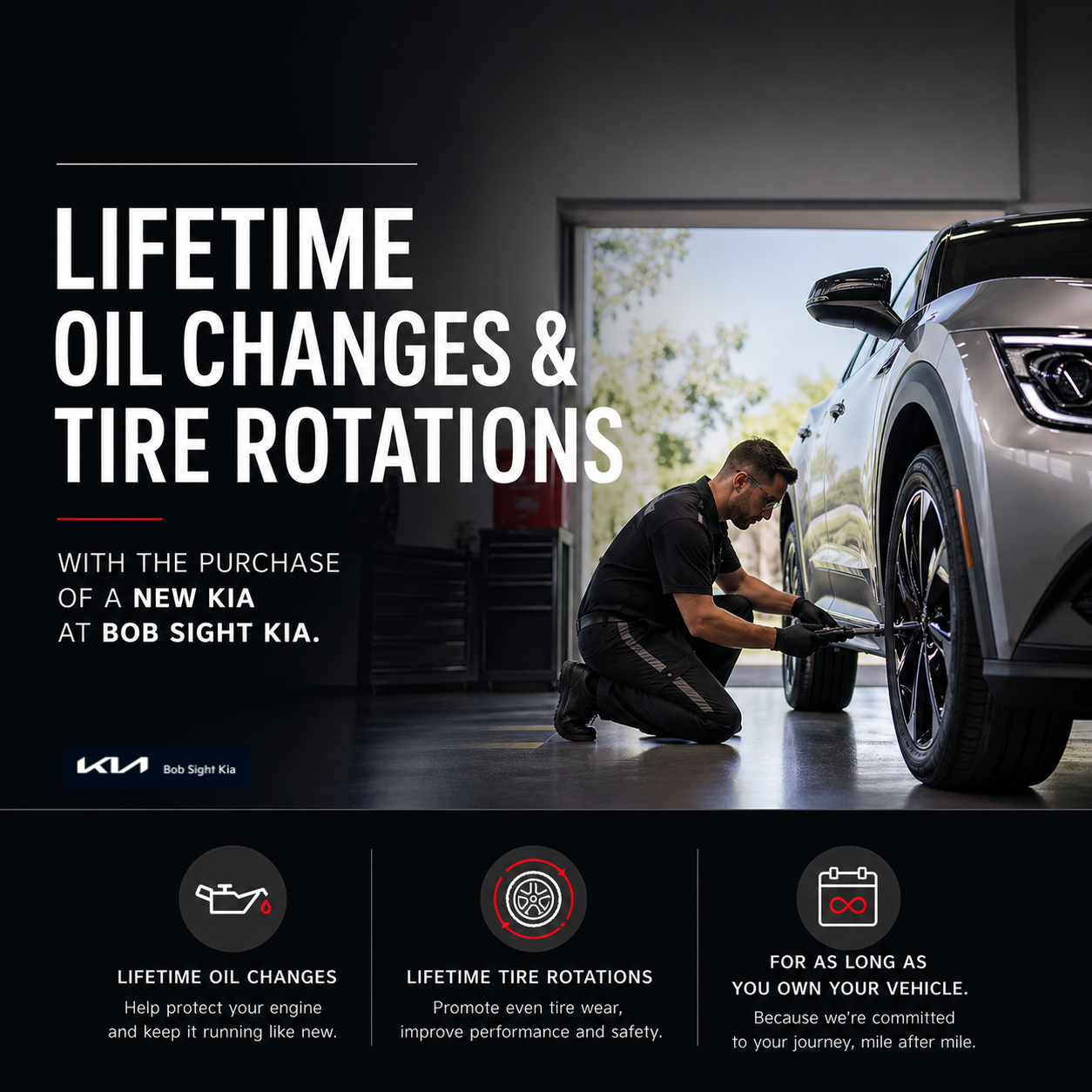
Bob Sight Kia ownership graphic showing lifetime oil changes and tire rotations for qualifying Kia drivers near Raytown Missouri

Qualifying Bob Sight Kia ownership benefits may include lifetime oil changes and tire rotations under current written terms. Participants must complete required maintenance with the dealership to maintain eligibility. Drivers should review the complete requirements and confirm how the program applies to their vehicle.

How to Prepare for Your Visit to Bob Sight Kia

A productive dealership visit begins with identifying your needs, confirming inventory, gathering documents, and scheduling enough time for a test drive. Preparation allows Raytown shoppers to focus on the vehicle and decision instead of searching for information during the appointment.

Begin by browsing new or used inventory online. Select a few vehicles that fit your passenger, cargo, drivetrain, and powertrain needs. Contact Bob Sight Kia to confirm current availability because online listings can change as vehicles are sold or added.

If you plan to trade a vehicle, bring the title or current payoff information, registration, keys, and service records. Remove valuables and personal information from the cabin, infotainment system, and connected apps. The vehicle does not need to be perfect, but it should be available for a complete evaluation.

Qualified shoppers interested in financing can begin with the online pre-approval form. Bring identification, insurance information, and any documents requested by the finance team. Requirements vary, so confirm what is needed before the appointment.

A useful test drive should include more than a short trip around the block. Evaluate acceleration, braking, visibility, steering, parking, road noise, seat comfort, climate control, and infotainment operation. Sit in every row that will be used regularly.

For a family vehicle, bring current child restraints or measure the space they require. For a cargo-focused vehicle, bring measurements of the stroller, mobility device, sports equipment, or other large item. This creates a realistic test rather than relying on assumptions.

Before making a final decision, verify the model year, trim, powertrain, drivetrain, factory equipment, and included features. Similar-looking Kia vehicles may have different technology or capability. Reviewing the individual vehicle details helps prevent confusion later.

Quick Facts for Raytown Kia Shoppers

Bob Sight Kia provides Raytown drivers with a nearby destination for new and used vehicles, financing, trade-ins, service, and Genuine Kia Parts. The dealership is located on Noland Road in Independence and serves communities throughout eastern Jackson County.

  • Bob Sight Kia is located at 1700 South Noland Road in Independence, Missouri.
  • The dealership is accessible from the I-70 corridor and surrounding Jackson County routes.
  • Raytown drivers can shop new Kia SUVs, sedans, minivans, hybrids, plug-in hybrids, and electric vehicles.
  • Used inventory may include Kia models and vehicles from other manufacturers.
  • Eligible Kia vehicles may qualify for the Kia Certified Pre-Owned program.
  • Online tools are available for trade-in planning and financing pre-approval.
  • Vehicle and trim availability changes frequently.
  • Scheduling a test drive can help confirm that the preferred vehicle is available.
  • The service department supports routine maintenance, diagnostics, warranty repairs, and applicable recalls.
  • The parts department provides access to Genuine Kia Parts.
  • Maintenance requirements vary by model, engine, drivetrain, and operating conditions.
  • Current dealership hours should be confirmed before visiting.

Raytown shoppers can begin most of the research process online and complete the vehicle evaluation in person. Combining digital tools with a thorough test drive makes it easier to compare options efficiently.

Ownership Planning for Raytown Kia Drivers

Long-term Kia ownership is easier when drivers plan maintenance, keep service records, inspect tires seasonally, and establish a relationship with a nearby Kia service department. Routine care supports reliability, efficiency, safety, and warranty documentation. It also helps identify developing concerns before they become more disruptive.

Keep repair orders and receipts showing the date, mileage, parts, fluids, and services completed. Records are useful when reviewing warranty concerns or preparing for a future trade. Digital records should be backed up with copies the owner can access independently.

Missouri weather makes seasonal inspections valuable. Summer heat can stress batteries and cooling systems, while winter cold reduces battery output and tire pressure. Heavy rain, snow, road salt, potholes, and freeze-thaw cycles affect tires, brakes, wipers, alignment, and suspension components.

Check tire pressure when tires are cold and use the recommended value on the driver-door label. The maximum pressure printed on the tire sidewall is not the normal inflation target. Uneven tread wear should be evaluated because it may indicate an inflation, alignment, or suspension concern.

Hybrid and electric Kia models have different maintenance needs from conventional gasoline vehicles. Electric vehicles do not require engine-oil changes, but they still need tire, brake, suspension, climate-system, filter, cooling-system, and low-voltage battery care. High-voltage work should be handled by qualified personnel.

Planning service before a long trip or major weather change reduces last-minute pressure. Raytown drivers can schedule maintenance at Bob Sight Kia and discuss what is due based on the vehicle’s history. A consistent maintenance plan supports the vehicle through daily commuting and regional travel.

Frequently Asked Questions About Finding a Kia Dealer Near Raytown

Where is Bob Sight Kia located near Raytown, MO?

Bob Sight Kia is located at 1700 South Noland Road in Independence, Missouri. The dealership provides new and used vehicle sales, financing support, trade appraisals, Kia service, and parts. Raytown drivers can reach the dealership using several nearby Jackson County routes.

Depending on the starting location and current traffic, a driver may use Missouri Route 350, I-435, I-70, Blue Ridge Boulevard, Raytown Road, Sterling Avenue, or Noland Road. Navigation should be checked before departure because road work and traffic can change the preferred route.

Contact Bob Sight Kia before visiting for one specific vehicle or service need. Inventory and appointment availability can change throughout the day. Scheduling ahead helps the team prepare for the visit.

Does Bob Sight Kia sell used and Certified Pre-Owned vehicles?

Yes, Bob Sight Kia offers used vehicles and may have eligible Kia Certified Pre-Owned vehicles available. Used inventory can include several makes, model years, mileage levels, and body styles. Certification status should be confirmed for the individual vehicle.

A Kia Certified Pre-Owned vehicle must meet current program eligibility requirements and complete the required inspection process. Eligible vehicles may include limited warranty and roadside benefits. Exact terms and exclusions should be reviewed before purchase.

Raytown shoppers should compare vehicle history, maintenance records, mileage, tires, features, and current condition. Certification provides added structure but does not replace a test drive. Availability changes as vehicles are acquired and sold.

Can I trade my current vehicle at Bob Sight Kia?

Yes, Raytown drivers can trade an eligible current vehicle at Bob Sight Kia. An online value-your-trade tool can help begin the process before visiting. A final appraisal requires the dealership to evaluate the vehicle.

Bring the title or payoff information, registration, keys, mileage, and available maintenance records. Condition, equipment, demand, title status, and reconditioning needs can affect the appraisal. Online estimates should be treated as planning information.

If the vehicle has an outstanding loan, the dealership can request a current payoff from the lender. The payoff and appraised value are considered as part of the transaction. The finance team can explain how trade equity affects the next purchase.

Can Raytown drivers schedule Kia service at Bob Sight Kia?

Yes, Raytown drivers can schedule Kia maintenance and repair at Bob Sight Kia in Independence. The service department supports oil changes, tires, brakes, batteries, diagnostics, eligible warranty repairs, recall remedies, and other vehicle needs. Service requirements vary by model.

Provide the model, model year, mileage, vehicle identification number, and reason for the appointment. Describe warning lights, sounds, vibrations, leaks, or performance changes accurately. Bring maintenance records when the vehicle was previously serviced elsewhere.

Scheduling service locally can make routine maintenance easier to complete consistently. A dealership history also allows advisors to review prior work and recommendations. Owners should retain their own copies of every repair order.

How can I test-drive a Kia near Raytown?

Raytown shoppers can schedule a Kia test drive through Bob Sight Kia’s online test-drive tool or contact the dealership directly. Confirming availability first is recommended. Popular models, trims, colors, and powertrains may sell or move before an unscheduled visit.

Bring a valid driver’s license and any other requested information. Plan enough time to evaluate acceleration, braking, visibility, parking, technology, passenger comfort, and cargo space. Ask to compare more than one model when the decision is not final.

A realistic route should include city traffic and highway driving when practical. Raytown and Independence road conditions can help reveal how the vehicle fits daily use. After driving, review the exact trim and equipment before moving to the next step.

Visit Bob Sight Kia Near Raytown, Missouri

Bob Sight Kia gives Raytown drivers a nearby resource for vehicle shopping, trade-ins, financing, maintenance, warranty support, and Genuine Kia Parts. Our Independence location provides access to the Kia lineup while remaining connected to familiar Jackson County routes.

Local dealership support can make the shopping process more efficient. Raytown drivers can research inventory online, contact the dealership to verify availability, complete financing steps, and schedule a test drive. The same location remains available for maintenance after the purchase.

Whether you need a compact Seltos, versatile Sportage, three-row Sorento, family-focused Telluride, spacious Carnival, efficient sedan, hybrid, plug-in hybrid, or electric Kia, our team can help you compare the available options. The goal is to connect vehicle features with your actual routine.

Visit Bob Sight Kia at 1700 South Noland Road in Independence, Missouri. Check current hours and inventory before leaving Raytown, and schedule ahead when you want to drive a specific vehicle. We proudly serve eastern Jackson County and communities across the Kansas City Metro.

At Bob Sight Kia, we believe a dealership relationship should continue throughout ownership. From the first test drive through future maintenance, our team is here to provide clear information and local support. Trust Is Our Tradition.

Helpful Links

Proud to Be Part of the Bob Sight Auto Group

Bob Sight Kia is proud to serve Raytown, Independence, and the Kansas City Metro as part of the Bob Sight Auto Group. Our family of dealerships helps drivers shop for vehicles, plan maintenance, and access automotive support across Missouri and Kansas. Each location shares a commitment to helpful guidance and long-term customer relationships.

The Bob Sight Auto Group includes Bob Sight Kia in Independence, Missouri; Bob Sight Ford in Lee’s Summit, Missouri; Bob Sight Honda in Lawrence, Kansas; and Bob Sight CDJR in Lawrence, Kansas. Drivers can also turn to the Bob Sight Collision Center in Lee’s Summit for collision-repair support.

Whether you are beginning a vehicle search, comparing financing options, or looking for Kia service near Raytown, the Bob Sight team is ready to help. For generations of local drivers, Trust Is Our Tradition.
Posted in:

Related Posts

Compact SUV interior and cargo details representing a 2026 Kia Sportage vs. Toyota RAV4 comparison from Bob Sight Kia in Independence Missouri

2026 Kia Sportage vs. Toyota RAV4 in Kansas City

2026 Kia Sportage vs. Toyota RAV4: Which Compact SUV Is Right for You? Explore new Kia Sportage models at Bob Sight Kia The 2026 Kia Sportage is a strong choice for Kansas City drivers who prioritize passenger space, cargo versatility, modern cabin technology, and the freedom to choose among gasoline, hybrid, and plug-in hybrid powertrains. The redesigned 2026 Toyota RAV4 is also a capable compact SUV, with an electrified-only powertrain lineup, available all-wheel drive, and several distinct trim personalities. The right choice depends on how much space, efficiency, capability, and technology you need for daily driving. Compact SUVs are popular across Independence, Blue Springs, Lee’s Summit, Raytown, Grain Valley, Liberty, and the Kansas City Metro because they balance passenger comfort with practical exterior dimensions. Both the Sportage and RAV4 can handle weekday commuting, grocery trips, family activities, winter weather, and regional road trips. However, they approach those needs differently. This detailed comparison examines powertrains, interior room, cargo capacity, technology, safety systems, all-wheel-drive capability, towing, and long-term ownership. Exact equipment and specifications vary by trim and drivetrain, so shoppers should confirm the details on the individual vehicle they are considering. In This Guide You’ll Learn This guide covers the most important differences between the 2026 Kia Sportage and 2026 Toyota RAV4. Which SUV offers more powertrain choices How passenger and cargo space compare Which model provides the best technology for daily driving How the Sportage and RAV4 handle Missouri winter conditions What hybrid and plug-in hybrid shoppers should consider How towing capability differs by configuration Which compact SUV better fits different Kansas City lifestyles 2026 Kia Sportage vs. Toyota RAV4 Quick Comparison The 2026 Kia Sportage provides more traditional powertrain flexibility and a spacious cabin, while the redesigned 2026 Toyota RAV4 focuses entirely on hybrid and plug-in hybrid performance. Both compact SUVs offer five-passenger seating, available all-wheel drive, advanced driver-assistance technology, and practical cargo areas. Their biggest differences involve powertrain strategy, interior packaging, and trim selection. Comparison Area 2026 Kia Sportage 2026 Toyota RAV4 Passenger Capacity Five Five Powertrain Choices Gasoline, hybrid, and plug-in hybrid Hybrid and plug-in hybrid Driven Wheels Front-wheel drive or available all-wheel drive Front-wheel drive or available all-wheel drive, depending on configuration Gasoline Model Output 187 horsepower No conventional gasoline-only model Maximum Cargo Space Behind Rear Seat Approximately 39.6 cubic feet, depending on configuration Up to approximately 37.8 cubic feet Standout Advantage Interior space and broad powertrain selection Electrified-only lineup and available higher towing capability The Sportage provides a straightforward gasoline option for drivers who do not want to change their fueling routine. It also offers hybrid and plug-in hybrid alternatives for shoppers who want electrified performance. This range allows Sportage buyers to select a powertrain based on commuting habits, charging access, and drivetrain preferences. The 2026 RAV4 moves to an entirely electrified lineup. Conventional hybrid models use a gasoline engine and electric motors without requiring external charging. Plug-in hybrid models add a larger battery that can be charged from an outside power source, allowing a portion of appropriate trips to use electric energy. For an Independence shopper, the decision may begin with a simple question: Do you want a traditional gasoline engine, or are you ready for an electrified powertrain? Drivers who want all three paths available within the same model family may find the Sportage easier to shop. Which SUV Has the Better Powertrain Options? The 2026 Kia Sportage offers the broader powertrain selection because shoppers can choose gasoline, hybrid, or plug-in hybrid performance. The 2026 Toyota RAV4 is offered as a hybrid or plug-in hybrid. Neither strategy is automatically better for every household. The gasoline Sportage uses a 2.5-liter four-cylinder engine producing 187 horsepower and 178 pound-feet of torque. It pairs with an eight-speed automatic transmission and is available with front-wheel drive or all-wheel drive. This powertrain suits drivers who prefer familiar operation and do not want to consider charging access or hybrid-specific equipment. The Sportage Hybrid combines a turbocharged 1.6-liter engine with an electric motor and battery system. Its combined output is approximately 232 horsepower for the 2026 model year. The hybrid uses regenerative braking to recover some energy during deceleration and does not need to be connected to an external charger. The Sportage Plug-In Hybrid uses a larger battery and external charging capability. It can complete appropriate trips using stored electrical energy before operating as a hybrid. Plug-in hybrid ownership works best when the driver can charge regularly at home, work, or another convenient location. The redesigned RAV4 uses an updated hybrid powertrain across its conventional lineup. Output varies by front-wheel-drive or all-wheel-drive configuration. RAV4 Plug-In Hybrid models offer stronger combined output and external charging capability, making them appealing to shoppers who want electric commuting combined with gasoline flexibility. A driver commuting between Independence and downtown Kansas City may benefit from either hybrid model because stop-and-go traffic provides opportunities for regenerative braking. A shopper whose daily mileage fits within a plug-in hybrid’s available electric range may reduce gasoline use by charging consistently. A driver who wants the simplest conventional setup may prefer the gasoline Sportage. Use this process to compare powertrains: Calculate the approximate mileage of your normal daily commute. Determine whether reliable home or workplace charging is available. Decide whether front-wheel drive or all-wheel drive better fits your routes. Compare fuel economy, electric range, and performance for the exact trims. Test-drive gasoline and electrified models to experience their different responses. Electric motors deliver torque differently from a conventional gasoline engine, so hybrid and plug-in hybrid models can feel more responsive at low speeds. A test drive that includes traffic, highway merging, hills, and parking maneuvers provides a clearer comparison than horsepower numbers alone. Sportage vs. RAV4 Interior and Passenger Space The 2026 Kia Sportage is a compelling choice for shoppers who prioritize rear-seat room and a spacious compact SUV cabin. Both vehicles seat five passengers, but measurements, seat shape, roof design, and center-console placement affect how roomy each one feels. Families should sit in both rows instead of relying only on total passenger-volume numbers. The Sportage offers approximately 41.3 inches of rear legroom in many configurations. That measurement is notable within the compact SUV segment and can make the second row more comfortable for adults, teenagers, or children in forward-facing restraints. The exact usable space changes with front-seat position and rear-seat angle. Rear-seat room matters for families using child restraints. A rear-facing child seat often requires more front-to-back space than shoppers expect. Parents should install their current restraint according to the vehicle manual and child-seat instructions before deciding whether the remaining front-passenger space is comfortable. The RAV4 also provides practical seating for five and introduces a redesigned cabin for 2026. It includes a standard 12.3-inch digital gauge cluster and an available 12.9-inch multimedia display. Seating materials, heated and ventilated functions, panoramic-roof availability, and adjustment features depend on trim. The Sportage cabin uses a modern horizontal layout with available panoramic display integration. Available heated and ventilated seating, dual-zone climate control, a panoramic sunroof, wireless charging, and premium audio can create an upscale daily-driving environment. Feature availability should be verified on the specific trim. A family traveling from Blue Springs to activities in Lee’s Summit may spend enough time in the vehicle for rear-seat comfort to become a major factor. Adults should sit behind their normal front-seat positions and check knee room, headroom, outward visibility, and climate airflow. Children should be able to access seat belts without twisting or reaching behind the seat. Storage details also affect daily usability. Door pockets, cupholders, center-console storage, seatback pockets, and charging-port placement influence how well the cabin manages phones, water bottles, school supplies, and small travel items. These practical details often matter more over several years than one decorative interior feature. Which Compact SUV Has More Cargo Space? The 2026 Kia Sportage offers approximately 39.6 cubic feet of cargo space behind the rear seats in applicable configurations, compared with up to approximately 37.8 cubic feet in the 2026 Toyota RAV4. The Sportage therefore holds a numerical advantage for behind-the-seat cargo capacity. Actual usability depends on cargo-floor shape, seat position, and powertrain packaging. Cargo space behind the rear seats is the most useful measurement for many households because it reflects the area available while all five seating positions remain usable. This is where shoppers place groceries, strollers, sports equipment, luggage, mobility devices, pet supplies, and work gear. Maximum cargo volume with the seats folded describes a different use case. The Sportage’s wide cargo opening and flexible rear area can make it easier to load bulky items. A dual-level cargo floor on applicable configurations may allow shoppers to prioritize a flatter loading surface or deeper storage. Hybrid and plug-in hybrid components can influence measurements and underfloor storage, so powertrains should be compared separately. The RAV4 provides up to approximately 37.8 cubic feet behind the rear seats. That remains a practical amount of room for a compact SUV. Toyota also offers available cargo-area features such as a rear 120-volt outlet on selected configurations, which may appeal to drivers carrying powered equipment or outdoor accessories. For a weekend shopping trip around Independence Commons or Bolger Square, both vehicles can manage typical household cargo. The difference becomes more noticeable when the cargo area must hold a large stroller, multiple suitcases, sports bags, or home-improvement supplies while rear passengers remain seated. Follow these steps during a cargo comparison: Measure the largest item carried regularly. Check whether it fits through the liftgate opening without tilting. Test cargo space with the rear seats upright and in normal passenger positions. Fold the seats and inspect whether the floor supports longer items. Confirm that luggage does not block rear visibility or interfere with the liftgate. The Sportage has the stronger cargo-space case for many families, but numbers should not replace a hands-on test. A slightly smaller area with a useful shape can sometimes work better than a larger but awkwardly configured space. Fuel Economy and Hybrid Driving Around Kansas City The 2026 RAV4 has an advantage for shoppers who want every trim to use an electrified powertrain, while the Sportage gives drivers the option to choose gasoline, hybrid, or plug-in hybrid efficiency. Fuel economy varies by drivetrain, wheels, trim, weather, traffic, and driving style. Compare EPA estimates for the exact vehicles rather than applying one rating to an entire model family. The RAV4 Hybrid can achieve an EPA estimate of up to 47 mpg city and 40 mpg highway in qualifying front-wheel-drive configurations. All-wheel-drive and adventure-oriented trims may have different ratings. The available Woodland configuration, for example, uses capability-focused equipment that changes its efficiency profile. The Sportage Hybrid combines a turbocharged gasoline engine with electric assistance and regenerative braking. Front-wheel-drive and all-wheel-drive configurations carry different EPA estimates. Wheel size, tires, climate-control use, speed, and passenger load can also change real-world results. A conventional hybrid does not require plugging in. The vehicle controls engine operation, electric assistance, and battery charging automatically. Regenerative braking captures some kinetic energy during deceleration and stores it in the hybrid battery for later use. A plug-in hybrid has a larger battery that can receive energy from an external charger. The vehicle can travel on electrical energy under appropriate conditions before relying more heavily on hybrid operation. Plug-in hybrid efficiency depends greatly on how often the driver charges. Cold Missouri temperatures can reduce fuel economy and electric range. Batteries operate less efficiently when cold, and heating the cabin requires additional energy. Tire pressure also drops as temperatures fall, increasing rolling resistance if the tires become underinflated. A commuter who spends significant time in traffic near the I-70 and I-435 interchange may benefit from hybrid operation. Someone who can charge overnight and drives a predictable distance each day may benefit from a plug-in hybrid. The gasoline Sportage remains useful for drivers who want conventional operation and a familiar refueling routine. All-Wheel Drive and Missouri Winter Performance Both the 2026 Kia Sportage and Toyota RAV4 offer all-wheel-drive configurations that can improve acceleration and forward progress on snow, slush, and wet pavement. AWD does not eliminate winter risk or shorten every stopping distance. Tire condition remains central to braking and cornering grip. The Sportage’s available Active All-Wheel Drive system can distribute power according to driving conditions. Selected configurations also provide terrain-oriented drive settings. These systems can help manage power delivery when a driver leaves an untreated Independence neighborhood and enters a cleared main road. The RAV4 offers different AWD arrangements depending on powertrain and trim. Hybrid systems can use an electric motor to provide rear-axle assistance. The available Woodland configuration adds equipment intended for drivers seeking a more rugged character, including all-terrain tires and additional exterior features. All-wheel drive is most useful when starting from a stop, climbing a slippery incline, or maintaining forward movement through loose snow. It cannot overcome the limited grip found on polished ice. Drivers must reduce speed, leave more following distance, and avoid abrupt steering or braking. Winter tires are designed to remain flexible in low temperatures and use tread patterns intended for snow and slush. Four matching winter tires can improve acceleration, braking, and turning for front-wheel-drive and all-wheel-drive vehicles. All-season tire performance varies by tread design, age, condition, and remaining depth. Bridges, ramps, and shaded sections around Jackson County can freeze before surrounding pavement. A Sportage or RAV4 may feel stable while accelerating, but that does not prove that strong braking grip is available. Drivers should assume conditions can change quickly near highway interchanges and elevated roadways. The Sportage X-Line and X-Pro configurations may appeal to shoppers who want a more adventure-oriented appearance and capability package. Trim equipment can include AWD, increased ground clearance, roof rails, and model-specific tires. Shoppers should verify whether the installed tire is designed primarily for all-season road use, all-terrain use, or severe winter conditions. Technology and Infotainment Comparison The 2026 Kia Sportage provides a polished, technology-focused cabin, while the redesigned RAV4 introduces updated displays and Toyota Safety Sense 4.0. Both vehicles offer smartphone connectivity, digital instrumentation, driver-assistance systems, and available convenience features. The better interface depends on driver preference. The Sportage offers an available panoramic display arrangement with two large screens positioned across the instrument panel. Depending on trim, features may include navigation, wireless smartphone integration, Kia Connect services, a wireless phone charger, multiple USB ports, and a premium audio system. Some connected services require compatible equipment, enrollment, cellular availability, or a subscription. The 2026 RAV4 includes a standard 12.3-inch digital gauge cluster and offers a 12.9-inch Toyota Audio Multimedia touchscreen on selected trims. Available equipment includes dual wireless chargers, connected services, a Panoramic View Monitor, Advanced Park, and Traffic Jam Assist. Some functions require an active trial or subscription. Screen size does not determine whether a system is easy to use. Menu structure, response speed, physical controls, voice recognition, phone pairing, and display visibility can matter more. Drivers should test the system while parked and learn essential controls before driving. Passenger charging needs should also be considered. A family may need several USB-C connections during a trip, while a commuter may prioritize one accessible wireless charger. Check whether ports provide charging only or also support media data. Drivers traveling through changing traffic on I-70 should avoid relying on touchscreens for frequent adjustments. Climate controls, steering-wheel buttons, and voice commands can reduce the time spent looking away from the road. The most advanced system is the one the driver can operate comfortably and responsibly. Before choosing a vehicle, pair the phone used most often and test calls, navigation, music, messages, and voice commands. Confirm whether preferred features require a subscription after an included trial ends. This prevents surprises after the vehicle becomes part of the daily routine. Safety and Driver-Assistance Features Both compact SUVs offer advanced driver-assistance technology designed to support an attentive driver. The 2026 Sportage uses available Kia Drive Wise systems, while the RAV4 introduces Toyota Safety Sense 4.0. Feature content and availability vary by trim. Kia Drive Wise features may include Forward Collision-Avoidance Assist, Lane Keeping Assist, Lane Following Assist, Blind-Spot Collision-Avoidance Assist, Rear Cross-Traffic Collision-Avoidance Assist, Smart Cruise Control, and Highway Driving Assist. Selected configurations may add a Surround View Monitor or Blind-Spot View Monitor. The Blind-Spot View Monitor can display a camera image of the adjacent lane in the digital instrument cluster when a turn signal is activated. This can provide an additional visual reference during a lane change. Drivers must still use mirrors, turn their head, and verify that the path is clear. Toyota Safety Sense 4.0 provides an updated collection of driver-assistance functions for the RAV4. Available systems may include collision mitigation, lane support, adaptive cruise functions, traffic-sign information, and other assistance features. Exact operation should be reviewed in the vehicle manual. Driver-assistance systems have limits. Heavy rain, snow, fog, road salt, faded markings, low sun, or blocked sensors can reduce performance. A vehicle may temporarily disable a feature when its camera or radar cannot operate correctly. Parking technology can help in crowded areas near Independence Center, but cameras may become covered by winter grime. Drivers should clean lenses and sensor areas without damaging them. A displayed camera view should supplement direct observation rather than replace it. During a test drive, ask for a demonstration of the main systems. Learn where alerts appear, how sensitivity can be adjusted, and what type of steering or braking response may occur. Familiarity helps drivers interpret assistance correctly instead of being surprised by an alert. Towing and Weekend Capability The 2026 RAV4 offers a higher published maximum towing capacity in qualifying configurations, while the Sportage provides practical light-trailer capability when properly equipped. Maximum ratings apply only when the vehicle, hitch, trailer, cargo, and passengers remain within all applicable limits. Not every trim carries the highest advertised rating. Towing capacity describes the maximum trailer weight a properly configured vehicle may be rated to tow. It does not tell the driver how much passenger and cargo capacity remains. Tongue weight, payload, axle limits, hitch rating, and trailer-brake requirements must also be considered. The RAV4 advertises towing capability of up to 3,500 pounds in qualifying configurations. The Sportage can tow up to approximately 2,500 pounds when properly equipped with trailer brakes, depending on powertrain and configuration. Ratings without trailer brakes may be lower. A small utility trailer, lightweight recreational trailer, or equipment trailer can vary greatly in loaded weight. Water, batteries, propane, tools, coolers, and cargo add weight beyond an empty trailer specification. Drivers should use verified loaded weights rather than an estimate based only on trailer size. Towing through Missouri changes vehicle behavior. Acceleration takes longer, braking distance increases, and crosswinds affect stability. Hills and high summer temperatures increase demands on the powertrain and cooling system. Before towing, confirm the exact rating for the vehicle identification number and configuration. Use appropriate hitch equipment, verify lighting, maintain tires, distribute cargo properly, and follow the manufacturer’s instructions. Drivers should not assume that adding a hitch increases the vehicle’s certified towing capacity. The RAV4 may be the stronger choice for a shopper whose compact SUV must regularly tow near the upper end of the segment. The Sportage remains suitable for lighter towing needs and may offer more cargo capacity inside the vehicle. The best solution depends on whether the equipment travels inside the SUV or behind it. Which SUV Is Better for Different Kansas City Drivers? The Sportage is the better choice for many drivers seeking interior space and powertrain flexibility, while the RAV4 may suit shoppers prioritizing an electrified-only lineup or maximum available towing capability. Matching the vehicle to a real routine produces a better answer than declaring one universal winner. A growing family may prefer the Sportage because of its rear-seat legroom and generous cargo capacity. Child restraints, strollers, sports bags, and groceries can quickly consume available space. Families should test their actual equipment before choosing. A commuter who wants a conventional gasoline engine may also prefer the Sportage because the RAV4 no longer offers a gasoline-only configuration for 2026. The Sportage allows that driver to keep a familiar ownership routine. Hybrid and plug-in hybrid Sportage models remain available if priorities later shift toward electrification during the shopping process. A hybrid-focused driver may find both vehicles compelling. The RAV4’s redesigned hybrid lineup offers high efficiency in qualifying configurations, while the Sportage Hybrid combines efficiency with a roomy cabin. A test drive can reveal differences in brake feel, acceleration, cabin noise, and control response. A shopper who regularly tows a recreational trailer may favor a properly equipped RAV4 configuration with the higher published maximum. Someone carrying bulky cargo inside the SUV may value the Sportage’s cargo advantage more. Both ratings and interior measurements should be matched to the actual equipment. A driver who values bold design and a screen-centered cabin may prefer the Sportage. A shopper drawn to the RAV4’s redesigned exterior, Woodland trim, or Toyota interface may prefer the RAV4. Styling is subjective, but daily comfort and control placement deserve the same attention. Build a short decision list before visiting a dealership: Choose gasoline, hybrid, or plug-in hybrid as the preferred powertrain. Measure passenger and cargo needs. Decide whether AWD is necessary. Identify required technology and comfort features. Confirm towing needs using loaded trailer weight. Test-drive equivalent trims on similar routes. This approach keeps the comparison focused on practical value. A vehicle that wins more specification categories may still be the wrong fit if it misses the feature or space requirement that matters most. Quick Facts About the 2026 Sportage and RAV4 The Sportage offers greater powertrain variety and slightly more published cargo room behind the second row, while the RAV4 provides an electrified-only lineup and higher maximum towing capability in qualifying configurations. Both models offer modern technology, available AWD, and five-passenger seating. The 2026 Sportage offers gasoline, hybrid, and plug-in hybrid powertrains. The 2026 RAV4 offers hybrid and plug-in hybrid powertrains. The gasoline Sportage produces 187 horsepower. The 2026 Sportage Hybrid produces approximately 232 combined horsepower. The Sportage provides approximately 39.6 cubic feet of cargo space behind the rear seats in applicable configurations. The RAV4 provides up to approximately 37.8 cubic feet behind the rear seats. Both compact SUVs offer front-wheel-drive or all-wheel-drive configurations. The Sportage provides approximately 41.3 inches of rear legroom in many configurations. The RAV4 offers Toyota Safety Sense 4.0. The Sportage offers available Kia Drive Wise technologies. The RAV4 can tow up to 3,500 pounds in qualifying configurations. The Sportage can tow up to approximately 2,500 pounds when properly equipped with trailer brakes. Specifications should be checked on the exact trim because wheels, drivetrain, powertrain, equipment, and towing preparation can change the numbers. Vehicle information may also be updated by the manufacturer during the model year. Ownership Planning for a Compact SUV Long-term ownership depends on choosing the right powertrain, following the maintenance schedule, maintaining tires, and understanding how local driving affects the vehicle. The Sportage and RAV4 both require routine inspections and service. Hybrid and plug-in hybrid models still have maintenance needs even when their gasoline engines operate less frequently. Engine-oil viscosity and performance standards must match the specific powertrain. The correct SAE viscosity, API category, and ILSAC specification should be confirmed in the owner’s manual. Turbocharged Sportage Hybrid and Plug-In Hybrid engines may have different requirements from the naturally aspirated gasoline engine. Hybrid vehicles include gasoline engines, cooling systems, brakes, tires, filters, fluids, low-voltage batteries, and high-voltage components. Plug-in hybrids add external charging equipment and a larger traction battery. High-voltage systems should be serviced only by properly trained personnel using appropriate safety procedures. Tire pressure commonly falls as temperatures drop. Drivers should check pressure when the tires are cold and use the specification on the driver-door label. The maximum pressure printed on the tire sidewall is not the recommended everyday setting. Missouri potholes can affect alignment, wheel condition, tires, steering, and suspension. A strong impact should be followed by an inspection if the vehicle begins pulling, vibrating, or producing unusual noise. Uneven tread wear can also indicate an inflation or alignment concern. Bob Sight Kia provides local service support for Sportage owners in Independence and the Kansas City Metro. Qualifying ownership benefits may include lifetime oil changes and tire rotations under current written terms. Participating owners must follow the program’s maintenance requirements, including completing required maintenance with the dealership. Frequently Asked Questions Is the 2026 Kia Sportage bigger inside than the Toyota RAV4? The 2026 Kia Sportage offers a strong interior-space advantage, including approximately 41.3 inches of rear legroom and about 39.6 cubic feet of cargo space behind the rear seats in applicable configurations. The 2026 RAV4 provides up to approximately 37.8 cubic feet behind its rear seats. Exact measurements vary by configuration. The Sportage can be appealing to families carrying adults, teenagers, or rear-facing child restraints. Rear legroom is only one factor because seat shape and front-seat position affect usable room. A hands-on seating test provides the most accurate answer. Families from Blue Springs or Lee’s Summit should bring their child restraints, stroller, or commonly carried equipment when comparing vehicles. Confirm that the rear passenger area remains comfortable after the driver’s seat is adjusted. Then test whether cargo fits without blocking visibility. Does the 2026 Kia Sportage have a hybrid option? Yes, the 2026 Kia Sportage is available with gasoline, hybrid, and plug-in hybrid powertrains. The conventional hybrid does not require external charging. The plug-in hybrid uses a larger battery that can be charged from an outside power source. The Sportage Hybrid combines a turbocharged gasoline engine with an electric motor and regenerative braking. The system automatically manages gasoline and electric operation. The plug-in hybrid can use stored electrical energy for appropriate trips before operating more like a conventional hybrid. A Kansas City commuter should compare daily mileage and charging access before choosing. A plug-in hybrid delivers its strongest ownership benefit when charged regularly. Drivers without convenient charging may find the standard Sportage Hybrid simpler. Is the Sportage or RAV4 better in Missouri snow? Both the Sportage and RAV4 can perform well in Missouri snow when equipped with AWD and suitable tires. The better choice depends on trim, tire condition, ground clearance, and driver needs. AWD improves acceleration but does not eliminate slippery braking conditions. The Sportage offers available Active All-Wheel Drive and terrain-related settings on selected configurations. The RAV4 offers AWD across applicable hybrid configurations and adventure-oriented equipment on the Woodland trim. Each system manages power differently. Drivers near Independence should consider whether neighborhood roads are plowed promptly and whether work travel can be delayed during storms. Winter tires may provide a greater improvement in braking and cornering than choosing one AWD brand over another. Safe speed remains essential. Which SUV has better technology, the Sportage or RAV4? The Sportage offers an attractive panoramic-display layout, while the redesigned RAV4 provides a standard 12.3-inch digital gauge cluster and available 12.9-inch multimedia screen. Both offer connected features and advanced driver-assistance technology. The better system depends on personal preference. Sportage shoppers may value available Kia Connect, the Blind-Spot View Monitor, Surround View Monitor, wireless charging, and an integrated display design. RAV4 shoppers may value Toyota Safety Sense 4.0, available Advanced Park, Traffic Jam Assist, dual wireless chargers, or its redesigned interface. Drivers should pair their phones and test the systems before purchasing. Confirm whether desired features are standard, optional, or subscription-based. The easiest interface is the one that requires the least distraction during Kansas City traffic. Where can I test-drive a 2026 Kia Sportage near Kansas City? Drivers can explore available Kia Sportage models and schedule a test drive at Bob Sight Kia in Independence, Missouri. The dealership serves Blue Springs, Lee’s Summit, Raytown, Liberty, Sugar Creek, Grain Valley, Oak Grove, and the Kansas City Metro. Inventory changes regularly. Ask to compare gasoline, hybrid, or plug-in hybrid configurations when available. Each powertrain has a different response, efficiency profile, and ownership routine. Confirm whether the exact vehicle uses front-wheel drive or all-wheel drive. A useful test drive should include low-speed traffic, highway merging, braking, parking, and uneven pavement. Sit in both rows and inspect cargo space before leaving. These checks provide a clearer answer than comparing online specifications alone. Choose the Right Compact SUV in Independence, MO The 2026 Kia Sportage is the stronger choice for many shoppers who value passenger room, cargo capacity, modern technology, and a choice of gasoline, hybrid, or plug-in hybrid powertrains. The redesigned RAV4 remains a strong competitor for drivers who want an electrified-only lineup and higher available towing capability. The Sportage’s practical advantages fit everyday life around Independence and the Kansas City Metro. Rear-seat space supports growing families, while the cargo area accommodates groceries, luggage, sports equipment, and weekend supplies. Its manageable size remains useful in parking areas and city traffic. Powertrain choice gives Sportage shoppers more control over the ownership experience. A gasoline model provides familiar operation, a hybrid supports efficiency without plugging in, and a plug-in hybrid can use externally charged electrical energy. That flexibility helps the Sportage serve a wider variety of drivers. Visit Bob Sight Kia to compare available Sportage trims and powertrains. Review the exact drivetrain, safety technology, comfort features, cargo configuration, and maintenance requirements. A real-world test drive can show how the Sportage fits your commute and household. Bob Sight Kia serves drivers throughout Independence, Jackson County, and the Kansas City Metro. Whether you are replacing a sedan, downsizing from a larger SUV, or choosing your first hybrid, our team can help you evaluate the available options. Trust Is Our Tradition. Helpful Links Shop Kia Sportage Inventory Shop Kia Sportage Hybrid Inventory Schedule a Test Drive Value Your Trade Get Pre-Approved Proud to Be Part of the Bob Sight Auto Group Bob Sight Kia is proud to serve Independence and the Kansas City Metro as part of the Bob Sight Auto Group. Our family of dealerships helps drivers shop for vehicles, plan maintenance, and access automotive support across Missouri and Kansas. Each location shares a commitment to helpful guidance and long-term customer relationships. The Bob Sight Auto Group includes Bob Sight Kia in Independence, Missouri; Bob Sight Ford in Lee’s Summit, Missouri; Bob Sight Honda in Lawrence, Kansas; and Bob Sight CDJR in Lawrence, Kansas. Drivers can also turn to the Bob Sight Collision Center in Lee’s Summit for collision-repair support. Whether you are comparing compact SUVs, choosing an electrified powertrain, or preparing to trade your current vehicle, the Bob Sight team is ready to help. For generations of local drivers, Trust Is Our Tradition.
Kia service technician performing warranty maintenance in a professional service bay at Bob Sight Kia in Independence Missouri

Is Dealership Service Better for Kia Warranty Maintenance?

Is Dealership Service Better for Kia Warranty Maintenance? Schedule Kia warranty maintenance at Bob Sight Kia Dealership service is often the most convenient and well-documented choice for Kia warranty maintenance because Kia-trained technicians can follow model-specific procedures, access current service information, install Genuine Kia Parts, and maintain organized service records. Federal warranty protections generally allow owners to obtain routine maintenance from an independent repair facility, but the work must still be completed correctly, on schedule, and with fluids and parts that satisfy Kia’s specifications. For Kia owners in Independence, Blue Springs, Lee’s Summit, Raytown, Grain Valley, Liberty, Sugar Creek, Oak Grove, and throughout the Kansas City Metro, the better service choice depends on the type of work being performed. Routine maintenance, a manufacturer warranty repair, a safety recall, and service completed under a separately offered dealership benefit are not the same thing. Each may involve different procedures and eligibility requirements. This guide explains when dealership service provides an advantage, when an independent repair shop may be appropriate, what documentation Kia owners should keep, and how maintenance decisions can affect warranty-related questions. It also explains why following the maintenance schedule matters more than simply choosing the closest repair facility. In This Guide You’ll Learn This guide covers the practical and warranty-related factors Kia owners should consider before choosing a service provider. Whether Kia owners must use a dealership for routine warranty maintenance Why Kia-trained technicians can provide a service advantage How Genuine Kia Parts and approved fluids support proper maintenance Why maintenance records matter during a warranty claim How warranty repairs differ from routine maintenance When an independent repair shop may be a reasonable option How dealership ownership benefits can have separate service requirements Do You Have to Use a Kia Dealership to Keep Your Warranty? You generally do not have to use a Kia dealership for every routine maintenance service to keep a manufacturer warranty in effect. Federal warranty rules generally prevent a manufacturer or dealer from denying warranty coverage solely because routine maintenance was performed by an independent repair shop. However, owners remain responsible for completing required maintenance correctly and keeping supporting records. Routine maintenance includes services such as engine-oil changes, filter replacement, tire rotations, fluid checks, and inspections. These services are different from a repair performed under the Kia New Vehicle Limited Warranty. An independent facility may complete routine maintenance, but the work should follow the schedule and specifications for the exact Kia model, model year, engine, drivetrain, and operating conditions. Warranty coverage can still be affected if improper maintenance, an incorrect fluid, a defective replacement part, or faulty workmanship causes damage. For example, using engine oil with the wrong viscosity or failing to install the correct amount could contribute to an engine problem. A warranty provider may evaluate whether the maintenance or installed part caused the specific failure under review. The Federal Trade Commission advises consumers that dealers generally cannot deny warranty coverage merely because routine maintenance or repairs were completed elsewhere. The FTC also emphasizes that owners should keep maintenance records. Receipts, repair orders, dates, mileage readings, part numbers, fluid specifications, and inspection results can help show that required vehicle care was completed. A separate maintenance plan, dealership benefit, or service contract may have different requirements from the manufacturer warranty. For example, a dealership-provided ownership program may require participating customers to complete specified maintenance at that dealership to remain eligible. Owners should review the written terms of every program instead of assuming that manufacturer warranty rules and dealership benefit requirements are identical. The simplest answer is that dealership service is usually not legally required for every routine maintenance visit, but it can make warranty maintenance easier to document and coordinate. Kia owners should consult their warranty booklet, owner’s manual, maintenance schedule, and any separate program agreements that apply to their vehicle. Why Dealership Service Can Be Better for Kia Warranty Maintenance Dealership service can be better for Kia warranty maintenance because the service department works directly with Kia-specific procedures, diagnostic systems, technical information, parts catalogs, and warranty processes. This specialization can reduce uncertainty when a vehicle requires model-specific maintenance or develops a concern that may qualify for warranty coverage. Kia-trained technicians regularly work with Kia engines, transmissions, hybrid systems, electric-vehicle systems, infotainment technology, driver-assistance equipment, and vehicle networks. Familiarity with a manufacturer’s systems can make it easier to recognize common symptoms and follow the correct diagnostic path. A technician who works across many unrelated brands may not encounter the same Kia-specific issue as frequently. Authorized Kia service departments can access current service procedures and manufacturer communications. These resources may include technical service bulletins, updated diagnostic instructions, software information, torque specifications, fluid requirements, and repair procedures. A technical service bulletin is manufacturer guidance that helps technicians diagnose or repair a known vehicle condition. It is not automatically the same as a safety recall or warranty extension. Dealership service also creates a direct path between maintenance and warranty evaluation. If a technician discovers a concern during an oil change or inspection, the dealership can determine whether the issue may fall under warranty coverage, a recall, a service campaign, or customer-paid maintenance. Additional authorization and diagnosis may still be required. For a Kia owner commuting along I-70, I-435, US-40, or Missouri Route 291, convenience matters when a vehicle develops a warning light or unusual symptom. Having maintenance history available through the same dealership can help the advisor understand what services were completed previously. That continuity can reduce the time an owner spends gathering records from several facilities. Dealership service is not a guarantee that every visit will be faster or that every repair will be covered. Warranty eligibility depends on the vehicle, coverage period, mileage, failure, exclusions, and diagnosis. The advantage is that Kia-specific maintenance and warranty processes can be handled through one service relationship. Dealership Service vs. an Independent Repair Shop A Kia dealership offers manufacturer-specific expertise and direct warranty coordination, while an independent repair shop may provide convenient routine maintenance based on its training, equipment, and experience. Both can perform quality work when technicians follow the correct procedures. Kia owners should compare capabilities rather than relying only on the type of business. Service Consideration Kia Dealership Independent Repair Shop Kia-Specific Training Access to Kia-focused training and procedures Varies by technician and facility Warranty Repairs Can process eligible Kia manufacturer warranty repairs Generally cannot submit Kia manufacturer warranty repairs directly Safety Recalls Can complete authorized Kia recall remedies Generally refers recall work to an authorized Kia dealership Parts Direct access to Genuine Kia Parts May use OEM, aftermarket, remanufactured, or customer-selected parts Diagnostic Information Access to Kia service information and manufacturer systems Access varies by subscriptions, equipment, and experience Service Records Records maintained within the dealership service system Owner may need to organize records from multiple sources Routine Maintenance Completed according to Kia-specific requirements Can be appropriate when Kia specifications are followed An independent repair shop may be a reasonable option for routine maintenance if the facility understands the vehicle, uses the correct specifications, documents the work, and has appropriate equipment. Owners should ask whether the shop regularly services modern Kia vehicles and whether it can document part numbers and fluid standards on the invoice. A dealership becomes more important when the vehicle needs a manufacturer warranty repair, recall remedy, software update, or diagnosis involving Kia-specific systems. Hybrid and electric Kia vehicles may also require specialized high-voltage training and safety equipment. Owners should confirm that any facility working on an electrified vehicle is qualified for the task. The best provider is one that completes the work correctly and communicates clearly. A convenient location near Independence Center does not compensate for incorrect oil, missing documentation, or incomplete diagnosis. The same principle applies to any service provider, including a dealership. How Kia-Trained Technicians Support Warranty Maintenance Kia-trained technicians support warranty maintenance by applying procedures developed for Kia vehicles and using diagnostic information tied to the specific model and system. This matters as vehicles add turbocharged engines, hybrid components, high-voltage batteries, advanced driver-assistance systems, digital controls, and connected technology. A modern Kia service visit may involve more than replacing a filter or draining oil. Technicians may need to check diagnostic trouble codes, review software information, inspect sensors, verify fluid condition, measure tire wear, test a battery, or evaluate electronic systems. The correct approach depends on the vehicle identification number and reported symptoms. Kia models can use different engine-oil viscosities and performance standards. A naturally aspirated engine, turbocharged engine, hybrid powertrain, and older Kia engine should not be assumed to have identical requirements. The owner’s manual and service information identify the correct SAE viscosity and applicable API or ILSAC standards. API refers to the American Petroleum Institute classification used to identify engine-oil performance categories. ILSAC refers to standards developed through the International Lubricant Standardization and Approval Committee. Using oil that meets the required viscosity and performance category helps support lubrication, fuel economy, emissions-system compatibility, and engine protection. Technicians also use torque specifications for drain plugs, wheels, filters, suspension fasteners, and other components. Excessive torque can damage threads or distort parts, while insufficient torque can allow movement or leakage. Model-specific procedures reduce the need to rely on general assumptions. For Kia owners traveling between Blue Springs and Independence, a familiar service team can help establish a maintenance pattern. Advisors can review prior recommendations, upcoming intervals, and changes in vehicle condition. That history can be useful when a new sound, vibration, warning, or performance concern appears. Why Genuine Kia Parts and Correct Fluids Matter Genuine Kia Parts and fluids that meet Kia specifications can simplify warranty maintenance because their fit, function, and application are designed for the vehicle. Federal warranty protections generally allow the use of compatible aftermarket parts, but an incorrect or defective part can create performance problems and complicate a warranty claim if it causes damage. An oil filter must provide the correct dimensions, sealing surfaces, bypass-valve operation, and filtration performance for the engine. A filter that appears to fit may still differ internally. The same principle applies to air filters, cabin filters, ignition components, belts, sensors, brake components, and electrical parts. Engine oil must meet both viscosity and performance requirements. For example, an owner should not substitute 5W-30 simply because another vehicle uses it when the Kia manual specifies a different viscosity. The numbers describe how the oil flows at lower and higher operating temperatures, but they do not communicate every additive or certification requirement. Coolant chemistry is also vehicle-specific. Mixing incompatible coolant formulas can reduce corrosion protection or create deposits within the cooling system. Transmission fluid, brake fluid, gear oil, and hybrid-system coolant must also meet the appropriate specifications. Aftermarket parts can be appropriate when they are correctly designed, properly installed, and suitable for the application. The important question is not simply whether a part came in a Kia box. Owners should know what part and fluid were used, why they were selected, and whether the invoice provides enough detail to document compliance. Bob Sight Kia has direct access to Genuine Kia Parts and model-specific parts information. This can be useful when a Kia Sportage, Sorento, Telluride, Seltos, Carnival, K4, K5, Niro, EV6, or EV9 requires maintenance or repair. The vehicle identification number helps the parts department confirm the appropriate application. Maintenance Records Can Protect Your Warranty Position Complete maintenance records help demonstrate that a Kia received required care at the correct mileage and time intervals. Warranty administrators may request evidence when evaluating whether maintenance history contributed to a failure. A receipt showing only a total amount may not provide enough useful detail. A strong maintenance record should identify the vehicle, service date, mileage, work completed, parts used, and fluids installed. For an oil change, the invoice should ideally show the oil viscosity, quantity, performance specification, and filter. For tire service, it should document rotation, pressure adjustment, condition, or alignment findings when applicable. Dealership records are usually stored within the dealership’s service system. That makes it easier to review prior repair orders and maintenance recommendations. Owners should still keep personal copies because they may move, sell the vehicle, visit another dealership, or need records when an electronic account is unavailable. Independent-shop receipts should be saved in the same organized way. Owners completing their own maintenance should retain receipts for fluids, filters, parts, and tools, along with the date and vehicle mileage. Photos and a maintenance log can provide additional support, but they do not replace the need to perform the work correctly. Follow these steps to build a useful maintenance file: Keep the warranty booklet and current maintenance schedule with your vehicle records. Save every repair order and receipt by date and mileage. Confirm that invoices list the parts, fluids, and specifications used. Record declined services and schedule them when they become due. Keep recall, warranty, diagnostic, and maintenance records in separate labeled sections. A driver completing frequent trips between Grain Valley and Kansas City may reach mileage-based intervals sooner than expected. Another owner who drives short distances around Sugar Creek may reach time-based intervals first. Organized records help both owners understand what has been completed and what is approaching. Warranty Repairs Are Different From Routine Maintenance A manufacturer warranty repair addresses a covered defect or malfunction, while routine maintenance addresses normal vehicle care and wear. Confusing these categories can create unrealistic expectations. Warranty coverage does not normally pay for every service a vehicle needs. Routine maintenance includes oil changes, tire rotations, filters, inspections, fluid replacement, and other scheduled services. Wear items such as tires, brake pads, wiper blades, and bulbs are also generally treated differently from covered defects, although separate warranties or service contracts may apply in some situations. A warranty repair begins with diagnosis. A warning light or symptom does not automatically identify the failed component or confirm coverage. A technician may need to reproduce the condition, scan modules, perform tests, inspect related systems, and compare results with Kia procedures. Coverage depends on the exact warranty, vehicle age, mileage, original in-service date, component, diagnosis, and exclusions. Kia’s new-vehicle warranty program includes several limited warranties with different terms. The 10-year or 100,000-mile limited powertrain warranty, for example, is not a blanket warranty covering every part for that entire period. Safety recalls are another separate category. A recall remedy addresses a specific safety-related condition identified by the manufacturer and the National Highway Traffic Safety Administration. Authorized Kia dealerships complete eligible recall remedies according to Kia instructions, generally without charging the owner for the recall repair. If a Kia develops a warning light or drivability concern, owners should schedule diagnosis instead of assuming the next routine maintenance service will resolve it. Continuing to drive with overheating, low oil pressure, a flashing check-engine light, a brake warning, or another serious condition can cause additional damage or create a safety risk. How Severe Driving Conditions Affect Kia Maintenance Many Kansas City driving routines can qualify as severe operating conditions under manufacturer maintenance guidance, which may require more frequent attention than the normal schedule. Severe service does not necessarily mean harsh or careless driving. It describes operating patterns that place additional demands on vehicle systems. Repeated short trips may prevent engine oil, coolant, and exhaust components from reaching full operating temperature. Stop-and-go traffic increases idle time and repeated acceleration. Dust, road salt, temperature extremes, towing, heavy loads, and extensive low-speed operation can also affect maintenance needs. A commuter traveling along I-70 may experience highway driving mixed with congestion near major interchanges. A parent completing several short school and activity trips around Independence may accumulate relatively few miles while still creating frequent cold starts. Each pattern can influence how maintenance should be scheduled. Missouri’s seasonal conditions add another layer. Summer heat places stress on batteries and cooling systems, while winter cold reduces battery output and tire pressure. Freeze-thaw cycles contribute to potholes that can affect tires, wheels, alignment, steering, and suspension components. Kia owners should review both the normal and severe maintenance schedules for their exact model. If driving conditions match the severe-use definitions, following the more frequent interval can support long-term reliability. Guessing based on a universal mileage number may not reflect the vehicle’s actual requirements. A Kia dealership can review the model, mileage, service history, and driving pattern before recommending maintenance. Owners should ask why a service is due and where it appears in Kia guidance. Clear explanations help separate manufacturer-recommended maintenance from optional services based on vehicle condition. Dealership Maintenance for Kia Hybrids and Electric Vehicles Dealership service can be particularly valuable for Kia hybrid, plug-in hybrid, and electric vehicles because these models use high-voltage systems, specialized cooling circuits, regenerative braking, and vehicle-specific diagnostic procedures. Routine tire and cabin-filter service may appear familiar, but other systems require specialized knowledge and safety precautions. A Kia hybrid combines a gasoline engine with an electric motor, battery, power electronics, and regenerative braking. A plug-in hybrid adds external charging capability and a larger battery. A battery-electric vehicle such as the Kia EV6, EV9, or Niro EV uses electric motors instead of a gasoline engine. High-voltage systems require appropriate training, insulated equipment, and defined safety procedures. Orange cables and high-voltage components should not be handled by someone without the proper qualifications. Even after the vehicle is switched off, stored electrical energy can remain within the system. Electric vehicles do not require engine-oil changes, but they still need maintenance. Tires, brakes, suspension, steering, climate systems, cabin filters, wiper blades, low-voltage batteries, cooling systems, and reduction-gear components require inspection or service according to the model’s schedule. Regenerative braking reduces some use of the friction brakes by converting motion into electrical energy. Brake pads may last longer under certain driving patterns, but brake components can still wear or corrode. Missouri moisture, road salt, and limited friction-brake use make physical brake inspections important. Software and diagnostic updates can also affect electrified vehicles. Kia dealership technicians can review whether manufacturer information applies to the vehicle identification number. This is useful for owners commuting through the Kansas City Metro or preparing an EV for a longer regional trip. Separate Dealership Benefits May Have Their Own Rules A dealership-provided maintenance benefit can require service at the participating dealership even though federal warranty protections generally allow routine maintenance elsewhere. The manufacturer warranty and the dealership benefit are separate agreements. Owners should follow the written requirements for each one. Bob Sight Kia offers qualifying ownership benefits that may include lifetime oil changes and tire rotations. Eligibility, vehicle qualifications, maintenance obligations, exclusions, and other conditions are controlled by the current written program terms. Customers should review those terms before relying on the benefit. Bob Sight Kia’s program requires participating owners to complete required maintenance with the dealership. That requirement applies to eligibility for the dealership-provided benefit rather than changing federal rules governing the Kia manufacturer warranty. Missing required dealership maintenance could affect the separate benefit even if the manufacturer warranty remains subject to its own terms. Service contracts and prepaid maintenance plans can also contain provider, authorization, recordkeeping, and maintenance requirements. A service contract is not automatically the same as a manufacturer warranty. Owners should identify who administers the contract and where covered service may be completed. Before choosing a service location, review these documents: The Kia warranty and consumer-information booklet The owner’s manual and maintenance schedule Any Kia Maintenance Plan agreement Any dealership-provided ownership benefit terms Any optional vehicle service contract or protection plan Keeping these agreements separate prevents confusion. An advisor at Bob Sight Kia can help explain which document applies to a particular maintenance visit or repair concern. Written terms remain the controlling source when program requirements differ. Quick Facts About Kia Warranty Maintenance Kia owners generally have flexibility when choosing where routine maintenance is performed, but dealership service provides useful advantages for Kia-specific documentation, diagnostics, warranty repairs, and recalls. Proper maintenance and complete records remain important regardless of the facility selected. Routine maintenance and manufacturer warranty repairs are different types of service. Kia owners generally do not have to use a dealership for every routine maintenance visit. Maintenance must still be completed correctly and according to Kia specifications. Incorrect parts, fluids, or workmanship can cause damage and affect related warranty coverage. Dealerships can process eligible Kia manufacturer warranty repairs. Authorized Kia dealerships complete applicable Kia safety recall remedies. Kia-trained technicians work with Kia-specific service procedures and diagnostic information. Genuine Kia Parts are designed for the intended Kia application. Owners should retain invoices showing dates, mileage, parts, fluids, and completed work. Severe driving conditions may require more frequent maintenance. Hybrid and electric Kia models have specialized service requirements. Dealership benefits and service contracts may have requirements separate from the manufacturer warranty. The correct service decision depends on the work being performed. An independent shop may handle properly documented routine maintenance, while a Kia dealership is generally the appropriate destination for a manufacturer warranty repair, recall, Kia-specific software concern, or high-voltage diagnosis. Ownership Planning for Kia Warranty and Maintenance A strong Kia ownership plan connects the maintenance schedule, driving conditions, service records, warranty terms, and dealership benefits. Owners should review these items before a service becomes urgent. Planning makes it easier to avoid missed intervals and incomplete documentation. Start by locating the maintenance schedule for the exact Kia model and model year. Do not assume that a Kia Telluride, Sportage Hybrid, K4, EV9, and Sorento Plug-In Hybrid have identical requirements. Engine, transmission, battery, cooling, and drivetrain designs create different service needs. Next, identify whether the vehicle’s regular use matches Kia’s severe-service definitions. Repeated short trips, idling, traffic congestion, temperature extremes, dusty roads, towing, and heavy loading may influence intervals. Independence-area driving can include several of these conditions during the same season. Schedule maintenance before a long trip or major weather change. A battery test, tire inspection, fluid check, and brake evaluation can reveal developing concerns before winter. Cooling-system and air-conditioning performance become important before the hottest Missouri weather arrives. Review every completed repair order before leaving the service facility. Confirm that the mileage is correct, requested work is listed, fluid and part information is documented, and future recommendations are understandable. Ask questions when a description is unclear. Finally, keep digital and paper copies of important records. The Kia Owners Portal may provide access to maintenance milestones, warranty information, owner’s manuals, recall information, and service scheduling for eligible vehicles. Personal copies provide an additional layer of organization. Frequently Asked Questions About Kia Warranty Maintenance Will using an independent mechanic void my Kia warranty? Using an independent mechanic for routine maintenance generally does not automatically void your Kia manufacturer warranty. The work must still be completed correctly and according to the vehicle’s maintenance and technical requirements. Owners should keep detailed records of every service. A manufacturer may evaluate whether an incorrect part, improper fluid, skipped maintenance, or faulty workmanship caused the failure being claimed. If outside work caused damage, coverage for that related damage may be denied. That does not necessarily cancel every unrelated warranty protection on the vehicle. An Independence driver using an independent shop should request an itemized invoice showing the date, mileage, oil viscosity, specifications, filter, parts, and work completed. Store the invoice with the vehicle’s warranty records. This documentation can be important if a future engine or drivetrain concern requires review. Should warranty repairs be completed at a Kia dealership? Eligible Kia manufacturer warranty repairs should generally be diagnosed and completed through an authorized Kia dealership. The dealership can verify coverage, follow Kia repair procedures, obtain authorization, and submit the warranty claim. Coverage is not determined solely by the presence of a warning light. The technician must identify the cause of the concern and determine whether a covered defect is responsible. Vehicle age, mileage, original in-service date, component, prior repairs, modifications, maintenance history, and exclusions may all affect the decision. Some diagnostic or repair costs may not be covered when the condition falls outside the warranty. Kia owners near Blue Springs, Raytown, or Grain Valley can schedule diagnosis at Bob Sight Kia in Independence. Bring maintenance records and describe when the symptom occurs. Clear information about sounds, warning messages, temperatures, speeds, or recent work can help the diagnostic process. Do I need receipts for Kia warranty maintenance? Yes, Kia owners should keep receipts and repair orders for all routine maintenance and repairs. Records help demonstrate that required care was completed at the appropriate time or mileage. They also help technicians understand the vehicle’s history. A useful receipt includes the vehicle identification number when possible, date, mileage, services performed, parts installed, and fluids used. Generic receipts with limited detail may be harder to use during a warranty review. Owners performing maintenance themselves should retain supply receipts and create a dated mileage log. Dealership service can simplify recordkeeping because prior repair orders remain available through the dealership system. Owners should still save personal copies. This is helpful if the vehicle is serviced at another Kia dealership during a trip or later transferred to a new owner. Are oil changes covered by the Kia warranty? Routine oil changes are maintenance services and are generally not paid for by the Kia manufacturer warranty. A warranty covers defined defects or malfunctions under its terms, while oil changes are part of normal ownership. A separate maintenance plan or dealership benefit may cover qualifying oil-change services. The correct oil-change interval depends on the Kia model, engine, mileage, time, and operating conditions. Owners should use the viscosity and API or ILSAC performance standard specified for the vehicle. Using a universal interval or an oil selected only by price may not satisfy the vehicle’s needs. Bob Sight Kia offers qualifying ownership benefits that may include lifetime oil changes and tire rotations under current written terms. Participants must follow the program’s maintenance requirements, including completing required maintenance with the dealership. Ask the service team to confirm eligibility and conditions for the specific vehicle. Where can I schedule Kia warranty maintenance near Kansas City? Kia owners can schedule warranty maintenance and service at Bob Sight Kia in Independence, Missouri. The service department supports drivers from Blue Springs, Lee’s Summit, Raytown, Liberty, Sugar Creek, Grain Valley, Oak Grove, and the Kansas City Metro. Appointment availability varies. When scheduling, provide the Kia model, model year, mileage, vehicle identification number, and reason for the visit. Mention warning lights, unusual sounds, performance changes, recent repairs, and warranty questions. This information helps the service team prepare for the appointment. Bring relevant maintenance records when the vehicle has been serviced elsewhere. The advisor can review the concern and explain whether the visit involves routine maintenance, diagnosis, recall work, or a possible warranty repair. Final coverage decisions depend on the applicable terms and completed diagnosis. Schedule Kia Warranty Maintenance in Independence, MO Dealership service is often the most straightforward choice for Kia warranty maintenance because it combines Kia-specific expertise, accurate service information, Genuine Kia Parts, organized records, and direct warranty support. Kia owners may have flexibility for routine maintenance, but convenience and continuity can make an authorized Kia dealership the better long-term option. Local service matters when your Kia supports daily travel across Independence and the Kansas City Metro. Commuting on I-70, navigating traffic near Independence Center, completing school trips through Blue Springs, and driving through Missouri weather all place demands on the vehicle. A maintenance plan should reflect those real operating conditions. Bob Sight Kia can help owners understand upcoming maintenance, severe-service recommendations, warranty questions, recall information, and vehicle-specific requirements. Our service team works with Kia vehicles every day and can review maintenance history before recommending the next step. Schedule your next Kia service appointment before a warning or missed interval creates uncertainty. Bring your records, ask questions, and review the completed repair order. Consistent maintenance provides the strongest foundation for reliability, warranty documentation, and long-term ownership. At Bob Sight Kia in Independence, we serve Kia drivers throughout Jackson County and the Kansas City Metro. Whether you drive a Sportage, Sorento, Telluride, Seltos, Carnival, K4, K5, Niro, EV6, or EV9, our team is ready to support your ownership needs. Trust Is Our Tradition. Helpful Links Schedule Kia Service View Parts and Service Specials Shop Genuine Kia Parts Explore Lifetime Oil Changes and Tire Rotations Visit Bob Sight Kia Proud to Be Part of the Bob Sight Auto Group Bob Sight Kia is proud to serve Independence and the Kansas City Metro as part of the Bob Sight Auto Group. Our family of dealerships helps drivers shop for vehicles, plan maintenance, and access automotive support across Missouri and Kansas. Each location shares a commitment to helpful guidance and long-term customer relationships. The Bob Sight Auto Group includes Bob Sight Kia in Independence, Missouri; Bob Sight Ford in Lee’s Summit, Missouri; Bob Sight Honda in Lawrence, Kansas; and Bob Sight CDJR in Lawrence, Kansas. Drivers can also turn to the Bob Sight Collision Center in Lee’s Summit for collision-repair support. Whether you need routine Kia maintenance, help with a warranty concern, or guidance about long-term vehicle care, the Bob Sight team is ready to help. For generations of local drivers, Trust Is Our Tradition.

Close-up of a Kia SUV wheel on a snowy Kansas City road for a winter weather model guide from Bob Sight Kia in Independence Missouri

Best Kia SUV for Kansas City Winter Weather

Which Kia SUV Is Best for Kansas City Winter Weather? Explore new Kia SUVs at Bob Sight Kia The 2027 Kia Telluride with available all-wheel drive is the best Kia SUV for many Kansas City families facing winter weather, while the 2026 Kia Sportage, Sorento, Seltos, and EV9 each serve different winter-driving needs. Families who need three spacious rows may prefer the Telluride, commuters can benefit from the Sportage, drivers balancing passenger space and maneuverability may choose the Sorento, and urban drivers may appreciate the compact Seltos. The all-electric EV9 adds an available all-wheel-drive option for families prepared to plan winter charging and range. Winter driving around Independence, Blue Springs, Lee’s Summit, Raytown, Grain Valley, and the wider Kansas City Metro can involve freezing rain, light snow, slush, black ice, potholes, and rapid temperature changes. Choosing the right SUV requires more than looking for the largest vehicle or the most powerful engine. Tires, ground clearance, drivetrain configuration, visibility, driver-assistance technology, and winter maintenance all affect how a vehicle performs when road conditions deteriorate. This guide compares the winter-driving strengths of Kia’s 2026 SUV lineup while covering the redesigned 2027 Kia Telluride as requested. Exact features vary by trim, powertrain, and drivetrain, so shoppers should verify equipment on the individual vehicle they are considering. In This Guide You’ll Learn This guide explains which Kia SUV may work best for your household and how to prepare it for Kansas City winter driving. Which Kia SUV is the strongest overall choice for Missouri winter weather How all-wheel drive helps on snow, slush, and wet pavement Why winter tires can matter more than vehicle size How the 2026 Kia Sportage, Sorento, Seltos, and EV9 compare What makes the 2027 Kia Telluride useful for winter family travel How hybrid and electric Kia SUVs behave during cold weather What maintenance should be completed before temperatures fall Best Kia SUVs for Kansas City Winter Weather at a Glance The best Kia SUV for Kansas City winter weather depends on whether you prioritize family space, commuting efficiency, maneuverability, or electric driving. The 2027 Kia Telluride is the strongest overall family choice, while the 2026 Kia Sportage is a practical two-row option. The 2026 Kia Sorento serves drivers needing three rows in a more manageable footprint. Kia SUV Best Winter Use Winter Advantage 2027 Kia Telluride Large families and winter road trips Available AWD, three-row space, and available X-Line or X-Pro capability 2026 Kia Sportage Daily commuting and two-row versatility Available AWD, useful cargo space, and multiple powertrain choices 2026 Kia Sorento Flexible three-row family driving Available AWD, available turbo power, and several electrified options 2026 Kia Seltos Urban driving and smaller households Compact size, available AWD, and easy maneuverability 2026 Kia EV9 Electric three-row winter travel Available dual-motor AWD and strong low-speed electric response 2026 Kia Niro Efficient commuting on treated roads Compact dimensions and efficient electrified powertrains The Telluride rises to the top for many families because it combines available all-wheel drive with passenger space, cargo flexibility, elevated ground clearance, and family-oriented technology. A driver regularly transporting children between Independence and Lee’s Summit may value those qualities when snow begins accumulating or roads become covered in slush. The Sportage may be the better answer for a smaller household. It is easier to maneuver than a large three-row SUV while still offering useful passenger and cargo space. Available all-wheel drive can provide additional traction when leaving a snowy neighborhood or entering traffic along Missouri Route 291. The Sorento fits between the Sportage and Telluride in both size and mission. Its available third row can handle occasional extra passengers without requiring the footprint of the larger Telluride. This can make it a versatile choice for drivers who need family flexibility but still spend significant time in parking lots, school lanes, and urban traffic. Why the 2027 Kia Telluride Is the Best Overall Winter Family SUV The 2027 Kia Telluride is the best overall Kia SUV for many Kansas City families because it combines available all-wheel drive, three-row seating, generous passenger room, and available adventure-oriented configurations. It is designed to support daily family transportation and longer winter trips without forcing shoppers into a smaller cabin. Available equipment varies across Telluride trims. The 2027 Telluride offers available all-wheel drive, which can distribute power based on driving conditions and detected wheel slip. AWD can improve acceleration from a stop on snow-covered pavement and help the vehicle maintain forward progress on slippery inclines. It does not shorten braking distances on ice, so appropriate tires and conservative driving remain essential. Kia offers X-Line and X-Pro configurations for drivers seeking a more rugged setup. These versions can add design, wheel, tire, ground-clearance, or capability changes depending on the exact trim. The 2027 Telluride X-Pro SX Prestige is positioned as the most adventure-oriented configuration within the lineup. Shoppers should review the individual window sticker because equipment can vary even when two vehicles share the Telluride name. Passenger space also matters during winter. Coats, boots, gloves, blankets, backpacks, sports equipment, and emergency supplies take up more room than warm-weather essentials. The Telluride’s available eight-passenger capacity and flexible cargo area help families carry winter gear without crowding the cabin. A family traveling from Independence to activities in Liberty or Lee’s Summit may encounter several types of road conditions during one trip. Main highways may be treated while neighborhood streets remain snow-covered. Bridges and elevated ramps can freeze before surrounding pavement. The Telluride’s available AWD and elevated driving position can add confidence, but the driver must continue monitoring surface conditions. The redesigned 2027 Telluride is also available in gasoline and hybrid forms, giving families more than one ownership path. Powertrain output, fuel-economy estimates, towing capability, and trim availability differ between versions. Shoppers should select the model based on passenger needs and normal driving rather than assuming the highest-output configuration is always best for winter. Why the 2026 Kia Sportage Is a Strong Winter Commuter The 2026 Kia Sportage is one of the best Kia SUVs for winter commuters because it offers available all-wheel drive, a practical two-row cabin, useful cargo capacity, and multiple powertrain choices. It is large enough for family routines but compact enough for crowded parking areas and daily Kansas City traffic. This balance can make it easier to use year-round. Available Active All-Wheel Drive can help the Sportage respond when traction changes. On a snowy morning, the system can support acceleration as a driver leaves an untreated residential street and transitions onto a cleared road. AWD operation is automatic, so the driver does not need to manually engage a traditional four-wheel-drive transfer case. Selected Sportage configurations provide additional ground clearance compared with front-wheel-drive versions. Ground clearance is the distance between the lowest relevant point under the vehicle and the road surface. Extra clearance can help when moving through moderate snow, but it does not make a crossover suitable for driving through deep drifts or roads that authorities have closed. The Sportage lineup includes gasoline, hybrid, and plug-in hybrid choices. The 2026 Sportage Hybrid pairs a turbocharged gasoline engine with electric assistance, while the plug-in hybrid adds a larger battery that can be charged externally. Electrified models can deliver useful low-speed torque, but winter temperature reduces battery efficiency and may increase engine use. A commuter traveling from Blue Springs toward downtown Kansas City may appreciate the Sportage Hybrid’s balance of efficiency and available AWD. Stop-and-go traffic can create opportunities for regenerative braking, which captures some energy during deceleration. Heating the cabin and defrosting the windshield require energy, so real-world winter efficiency may be lower than mild-weather results. The Sportage is also a practical choice for drivers who need room for groceries, work equipment, a stroller, or sports gear without using a third row. Rear-seat passengers have useful space, and the cargo area remains accessible through the liftgate. For many two-row shoppers, the Sportage provides the most balanced combination of size, winter traction, and everyday usability. Why the 2026 Kia Sorento Works for Flexible Three-Row Winter Driving The 2026 Kia Sorento is a strong winter choice for drivers who want available three-row seating and all-wheel drive without moving into a larger SUV. It fills the space between the two-row Sportage and the larger Telluride. The Sorento lineup also provides gasoline, hybrid, and plug-in hybrid powertrain choices. Gasoline Sorento configurations include an available turbocharged engine producing up to 281 horsepower. That output can provide confident highway merging while carrying passengers and cargo. Strong acceleration can be useful, but drivers should apply the accelerator smoothly on snow or ice because abrupt torque can overwhelm available tire grip. The Sorento Plug-In Hybrid includes standard all-wheel drive and Terrain Mode capability. Terrain settings can modify power delivery and vehicle-system responses for selected conditions. A Snow setting cannot create traction where none exists, but it may help deliver power more progressively and reduce unnecessary wheelspin. The available third row is useful for families that sometimes transport additional passengers. It is generally better suited to occasional use or smaller passengers than the roomier third row of the Telluride. When the third row is folded, the Sorento provides more cargo space for winter travel supplies, sports equipment, or luggage. A family in Grain Valley may use the Sorento for weekday commuting and weekend trips across the Kansas City Metro. Its manageable dimensions are helpful in school pickup lanes and busy shopping areas, while available AWD supports winter travel. The Sorento can also be easier to park than a larger three-row SUV. Drivers should compare the different Sorento powertrains carefully. A gasoline model, conventional hybrid, and plug-in hybrid have different outputs, efficiency estimates, cargo considerations, and ownership routines. Plug-in hybrid drivers gain the most benefit when they can charge regularly, while conventional hybrid drivers do not need to connect the vehicle to an external charger. Why the 2026 Kia Seltos Fits Urban Winter Driving The 2026 Kia Seltos is a useful winter-weather choice for drivers who want compact dimensions, available all-wheel drive, and practical crossover versatility. Its smaller footprint can simplify parking and maneuvering around Independence, Raytown, and other busy suburban areas. It can also provide more cargo flexibility than a traditional compact sedan. Available AWD supports traction when streets are wet, snowy, or covered in loose slush. The Seltos is not intended to function as a dedicated off-road vehicle, but its crossover ride height and available drivetrain can suit ordinary Missouri winter conditions. Drivers should avoid assuming that compact size means reduced winter capability. Maneuverability is one of the Seltos model’s strongest advantages. Snowbanks and reduced lane visibility can make parking lots feel tighter during winter. A smaller SUV may be easier to position around plowed snow, crowded school lanes, and narrow residential streets than a larger three-row model. Selected Seltos configurations offer a turbocharged engine with stronger acceleration than the standard powertrain. Drivers deciding between engines should consider their normal routes and priorities. A household completing mostly short local trips may value simplicity, while someone regularly merging onto I-70 may prefer the turbocharged response. Cabin and cargo space remain important even in a compact SUV. A small household may have enough room for grocery bags, winter coats, an emergency kit, and routine gear without needing a larger vehicle. Families using child restraints should bring their current seats and confirm rear-seat fit before choosing a configuration. The Seltos can be a smart option for a first-time SUV shopper, student, commuter, or smaller household. Its available AWD does not replace winter tires or safe driving habits. When fitted with proper tires and maintained correctly, it offers a practical way to gain crossover utility without selecting more vehicle than the household needs. How the 2026 Kia EV9 Handles Cold-Weather Family Travel The 2026 Kia EV9 is the best Kia SUV for Kansas City families who want three-row electric transportation with available dual-motor all-wheel drive. AWD EV9 configurations use electric motors to provide power at both axles. Electric motors deliver immediate torque, which can support smooth response when managed carefully on slippery roads. The EV9’s large cabin makes it useful for families carrying passengers and winter equipment. Available three-row seating allows it to perform many of the same family duties as a gasoline SUV. Its flat battery placement also contributes to a low center of gravity, although overall vehicle weight and momentum still require careful braking on slick pavement. Cold weather affects electric-vehicle efficiency because battery chemistry works less efficiently at low temperatures and cabin heat requires energy. Highway speeds, strong wind, snow, and low tire pressure can reduce driving range further. Winter EV planning should use a conservative range estimate instead of relying entirely on mild-weather figures. Preconditioning can warm the battery and cabin while the EV9 remains connected to a charger. This process can reduce the amount of stored battery energy needed to reach a comfortable cabin temperature after departure. Availability and operation depend on vehicle equipment, settings, charging conditions, and software configuration. Charging plans should account for winter conditions. A driver traveling from Independence to a distant destination should identify more than one compatible charging location and preserve a larger energy reserve than during mild weather. Snow, ice, charging-station availability, and slower travel can change the plan unexpectedly. Home charging gives many EV9 owners the most convenient routine. A properly installed Level 2 charging setup can replenish the battery overnight, subject to electrical capacity and charging conditions. Shoppers should evaluate their home, commute, travel patterns, and charging access before selecting an EV9 as their primary winter vehicle. Is the 2026 Kia Niro a Good Winter SUV? The 2026 Kia Niro can work well on treated Kansas City roads, but it is not the strongest Kia choice for shoppers who place all-wheel drive at the top of their winter checklist. The Niro family emphasizes efficiency and compact versatility. Its hybrid, plug-in hybrid, and electric variants use front-wheel-drive configurations. Front-wheel drive can provide dependable winter performance when paired with suitable tires because the engine or primary drive components place weight near the driven wheels. Many Kansas City drivers use front-wheel-drive vehicles successfully throughout winter. The limitation appears when deeper snow, steep untreated streets, or frequent rural travel demand additional traction. The Niro’s compact dimensions are useful in city driving. It is easy to maneuver in busy lots near Independence Center and along commercial areas around Noland Road. Its efficient powertrains can also support year-round commuting, although cold weather may reduce hybrid and electric efficiency. The Niro is best suited to drivers whose routes are plowed and treated promptly. A commuter using major roads may find it entirely practical, while someone living on a steep or poorly maintained road may prefer an AWD Sportage, Sorento, Seltos, Telluride, or EV9. Route conditions should guide the decision. Winter tires can meaningfully improve a front-wheel-drive Niro’s braking, turning, and acceleration on cold surfaces. Tires designed for winter use remain flexible at lower temperatures and use tread patterns intended to manage snow and slush. A tire professional can help determine whether dedicated winter tires make sense for the driver’s route and schedule. The Niro should not be dismissed simply because it lacks AWD. It offers an efficient ownership path for drivers whose winter exposure is moderate. However, shoppers seeking the most versatile Kia SUV for unpredictable Kansas City winter weather will generally find a better match among Kia’s AWD-capable models. All-Wheel Drive vs. Front-Wheel Drive in Missouri Snow All-wheel drive helps a Kia SUV accelerate and maintain forward progress on slippery surfaces, but winter tires have a greater direct effect on braking and cornering grip. AWD and tires serve different purposes. The strongest winter setup combines an appropriate drivetrain with properly selected, maintained tires. All-wheel drive automatically sends engine or motor torque to multiple wheels according to system design and detected conditions. If one tire begins to slip, the vehicle can adjust power distribution and may use brake-based traction control. This can help when starting on a snowy incline, leaving an unplowed parking space, or crossing a slushy intersection. AWD does not allow a vehicle to ignore the laws of traction. Braking depends on the grip available between all four tires and the road. A heavy AWD SUV traveling too quickly can require more distance to stop than a lighter front-wheel-drive vehicle equipped with high-quality winter tires. Front-wheel drive sends power to the front tires, which also steer the vehicle. This arrangement can perform effectively in light snow when the tires have sufficient tread and the driver uses smooth inputs. It may be less capable when climbing a steep, untreated road or moving through deeper snow. Drivers comparing drivetrains should follow this process: Identify whether neighborhood and work routes are cleared early or remain untreated for extended periods. Consider hills, bridges, rural roads, and parking areas encountered during a normal week. Determine whether travel can be delayed during severe weather. Compare AWD availability on the exact Kia models and trims under consideration. Choose tires based on temperature, precipitation, mileage, and storage options. A healthcare worker leaving before snowplows begin may benefit more from AWD and winter tires than a remote employee who can wait for roads to clear. A driver living near flat, heavily treated streets may be comfortable with front-wheel drive and quality all-season tires. Winter capability should match actual exposure rather than a generalized idea of what every Missouri driver needs. Winter Tires, Ground Clearance, and Drive Modes Winter tires, sufficient ground clearance, and appropriate vehicle settings work together to improve cold-weather usability. No single feature makes a Kia SUV invulnerable to ice or deep snow. Drivers should understand what each component can and cannot do. Winter tires use rubber compounds designed to remain more flexible in low temperatures. Their tread patterns include biting edges and channels that help manage snow, slush, and water. All-season tires offer year-round convenience, but their cold-weather grip varies by model, tread depth, and condition. Ground clearance helps prevent accumulated snow from contacting the underside of the vehicle. More clearance can be useful on residential streets where plows leave ridges near driveways. It does not protect against hidden ice, deep drifts, or objects concealed beneath snow. Snow or Terrain driving modes may alter throttle response, transmission behavior, traction-control logic, or AWD operation. A gentler accelerator response can make it easier to apply power without spinning the tires. Drivers should review the owner’s manual because the exact function varies by vehicle and powertrain. Electronic stability control can apply individual brakes or reduce engine power when it detects that the vehicle is not following the intended direction. Traction control limits excessive wheelspin during acceleration. These systems support the driver, but they cannot overcome excessive speed or inadequate tire grip. Before winter, inspect all four tires for tread depth, cracks, uneven wear, and damage. Confirm that they match in size and meet the vehicle manufacturer’s requirements. AWD systems can be sensitive to significant tire circumference differences, so replacing only one worn or damaged tire may require additional evaluation. Winter Safety Technology to Look for in a Kia SUV Useful winter technology includes heated visibility features, camera systems, collision-avoidance assistance, blind-spot monitoring, and driver alerts. These systems can improve awareness and comfort, but snow, road salt, frost, and ice can obstruct sensors. The driver remains responsible for controlling the vehicle. Available Kia Drive Wise systems may include Forward Collision-Avoidance Assist, Blind-Spot Collision-Avoidance Assist, Rear Cross-Traffic Collision-Avoidance Assist, Lane Keeping Assist, Lane Following Assist, and Smart Cruise Control. Exact technology varies by model and trim. Shoppers should review the window sticker and request a demonstration. Forward-facing cameras often rely on visible lane markings. Snow-covered roads, faded paint, glare, fog, and heavy precipitation can limit what the camera recognizes. Radar sensors can also be affected when ice or packed snow covers the sensor area. Heated side mirrors and rear-window defrosting help clear moisture, frost, and light ice. Available heated windshields or wiper areas can improve wiper performance on some vehicles. These features should supplement proper scraping and clearing rather than being used to melt heavy accumulation. Surround-view and blind-spot camera systems can support low-speed maneuvering, but lenses must remain clean. Road spray quickly coats cameras during winter travel along I-70 and I-435. Drivers should inspect camera and sensor areas before relying on the displayed image. Remote-start or cabin-preconditioning features can improve comfort and visibility before departure. Gasoline vehicles should never be started in an enclosed garage because exhaust contains carbon monoxide. EV owners can precondition while connected to a charger when supported by the vehicle and charging setup. Quick Facts About Choosing a Kia SUV for Winter The 2027 Telluride is the strongest overall family choice, while the 2026 Sportage offers one of the best combinations of winter capability and everyday maneuverability. The Sorento, Seltos, EV9, and Niro each fill more specialized roles. The correct choice depends on route, passenger count, and drivetrain needs. The 2027 Kia Telluride is a strong choice for large families and winter road trips. The 2026 Kia Sportage works well for two-row commuting and family versatility. The 2026 Kia Sorento offers available three-row seating in a smaller footprint than the Telluride. The 2026 Kia Seltos provides compact dimensions and available AWD. The 2026 Kia EV9 offers available dual-motor AWD in an electric three-row SUV. The 2026 Kia Niro prioritizes efficiency but does not provide an AWD option. AWD primarily improves acceleration and forward progress on slippery surfaces. Winter tires improve acceleration, braking, and cornering grip in cold conditions. Ground clearance helps with accumulated snow but does not eliminate winter-driving limits. Driver-assistance cameras and sensors may be obstructed by snow, salt, or ice. Cold weather can reduce hybrid and electric efficiency. Tire pressure commonly falls when temperatures drop. These facts provide a starting point, but trim-level details can change the recommendation. A front-wheel-drive Sportage and an AWD Sportage do not offer the same traction characteristics. Checking the drivetrain, tires, and included equipment on the exact vehicle is essential. Winter Ownership Planning for Your Kia SUV A dependable winter ownership plan includes tire care, battery testing, fluid checks, brake inspection, working visibility equipment, and an emergency kit. Winter preparation should occur before the first major freeze. Waiting until a storm arrives can make appointments, tires, batteries, and supplies harder to obtain. Tire pressure should be checked when tires are cold and compared with the specification on the driver-door label. The maximum pressure printed on the tire sidewall is not the normal inflation target. Significant underinflation can affect handling, tread wear, efficiency, and heat buildup. The 12-volt battery should be tested before winter, even on a hybrid or electric vehicle. Electrified vehicles still use a low-voltage battery to activate important systems and complete startup procedures. A battery weakened by summer heat may fail when cold temperatures reduce available output. Engine coolant should provide the correct freeze and corrosion protection for the specific Kia model. Drivers should use only the coolant type specified by Kia and should not mix incompatible coolant formulas. Engine oil must also meet the viscosity and performance standards listed in the owner’s manual. Winter windshield washer fluid should be rated for temperatures expected in Missouri. Wiper blades should clear the glass without streaking, skipping, or leaving unwiped sections. Headlights, brake lights, turn signals, and hazard lights should be checked because winter travel often occurs in reduced visibility. Bob Sight Kia provides maintenance and winter inspection support for Kia owners in Independence and surrounding communities. Qualifying ownership programs may require customers to complete required maintenance with the dealership. Drivers should review the current written terms to understand eligibility and ongoing requirements. Keep a winter emergency kit with a flashlight, phone-charging cable, blanket, gloves, scraper, small shovel, reflective markers, and appropriate emergency supplies. Secure every item so it cannot become a projectile during sudden braking. Adjust the kit based on passenger ages, medical needs, and the distance normally traveled. Frequently Asked Questions About Kia SUVs and Winter Weather Which Kia SUV is best for snow in Kansas City? The 2027 Kia Telluride with available AWD is the best Kia SUV for snow for many Kansas City families. It combines three-row seating, passenger space, useful ground clearance, and available X-Line or X-Pro capability. The Sportage may be a better choice for drivers who do not need three rows. The Telluride’s size provides room for passengers, winter clothing, emergency supplies, and luggage. Its available AWD can support acceleration on snow-covered roads. Proper tires remain necessary because AWD does not reduce every winter-driving risk. A family traveling from Independence to Liberty may benefit from the Telluride’s space and all-weather configuration. A solo commuter using treated roads may find the AWD Sportage or Seltos easier to maneuver. The best answer depends on the household rather than snow capability alone. Does all-wheel drive make a Kia SUV safe on ice? All-wheel drive can help a Kia SUV begin moving on ice, but it cannot guarantee safe braking or cornering. All four tires rely on the same limited road grip. Drivers must reduce speed and increase following distance. Black ice can form on bridges, ramps, shaded roads, and untreated surfaces even when nearby pavement appears clear. Temperatures near freezing can create rapidly changing conditions. AWD may not provide enough feedback to reveal how little braking grip remains. Approach elevated sections of I-70, I-435, and Missouri Route 291 carefully during freezing weather. Avoid abrupt acceleration, steering, and braking. If travel authorities recommend staying off the road, vehicle capability should not be treated as a reason to ignore that guidance. Does a Kia SUV need winter tires in Missouri? Not every Kia SUV owner needs dedicated winter tires, but they can provide valuable cold-weather grip for drivers who cannot delay travel during snow or ice. Many drivers use quality all-season tires successfully on treated Kansas City roads. Route conditions and schedule flexibility should determine the choice. Winter tires are designed to remain flexible in low temperatures and provide tread features for snow and slush. They benefit front-wheel-drive and all-wheel-drive vehicles. Four matching winter tires should be used because mixing tire types can create uneven handling. A healthcare worker commuting before roads are plowed may benefit more from winter tires than someone who works from home during storms. Drivers in hilly or less frequently treated areas should also consider them. Bob Sight Kia can help owners evaluate tire condition and seasonal needs. Which 2026 Kia SUV is best for a winter commute? The 2026 Kia Sportage with available AWD is the best all-around winter commuter for many Kansas City drivers. It combines manageable dimensions, useful cargo capacity, available all-wheel drive, and several powertrain options. The smaller Seltos is another strong option for urban driving. The Sportage is easier to park than a large three-row SUV but provides more passenger and cargo versatility than many compact vehicles. Hybrid availability can support commuting efficiency. Cold temperatures and cabin-heating demands may reduce winter fuel economy. Drivers traveling from Blue Springs or Grain Valley toward Independence can compare gasoline and hybrid Sportage configurations. A test drive should include highway acceleration, braking, parking, and rough pavement. The exact trim should be checked for AWD and desired heated features. Is the Kia EV9 good for Kansas City winters? The 2026 Kia EV9 can be a capable Kansas City winter vehicle when equipped with available dual-motor AWD and appropriate tires. It provides three-row passenger space and electric power. Owners must plan for reduced cold-weather range. Battery efficiency, cabin heating, speed, wind, and tire pressure all affect winter energy consumption. Preconditioning while connected to a charger can help prepare the cabin and battery before departure. Drivers should preserve a larger charging reserve during severe weather. Home charging can make winter EV ownership more convenient for Independence-area families. Longer trips require advance planning and backup charging locations. Shoppers should evaluate their commute, garage access, electrical setup, and travel patterns before choosing the EV9. Find the Right Kia SUV for Kansas City Winter Driving The best winter Kia SUV is the one that matches your passenger needs, normal route, available drivetrain, and ability to wait for roads to improve. The 2027 Telluride is the strongest overall family choice, while the 2026 Sportage offers an excellent two-row balance. The 2026 Sorento, Seltos, EV9, and Niro provide additional options for different households. Shopping locally makes it easier to evaluate a vehicle in the same environment where it will be driven. A test drive in Independence can include city traffic, highway access, parking maneuvers, and familiar road surfaces. These conditions reveal more about everyday usability than a list of features alone. Before purchasing, verify the exact drivetrain, tire size, wheel package, heated features, driver-assistance systems, seating configuration, and powertrain. Ask for a demonstration of drive modes and controls. Sit in every row and confirm that winter gear fits without blocking visibility. Bob Sight Kia serves drivers from Independence, Blue Springs, Lee’s Summit, Raytown, Liberty, Sugar Creek, Grain Valley, Oak Grove, and throughout the Kansas City Metro. Our team can help you compare available Kia SUVs and identify the model that fits your daily routine. Explore the current selection and schedule a test drive before winter weather arrives. Choosing the right SUV and maintaining it properly can help make cold-weather travel more predictable. At Bob Sight Kia, Trust Is Our Tradition. Helpful Links Shop New Kia Vehicles Shop Kia Seltos Inventory Shop Kia Sportage Inventory Shop Kia Sorento Inventory Shop Kia Telluride Inventory Proud to Be Part of the Bob Sight Auto Group Bob Sight Kia is proud to serve Independence and the Kansas City Metro as part of the Bob Sight Auto Group. Our family of dealerships helps drivers shop for vehicles, plan maintenance, and access automotive support across Missouri and Kansas. Each location shares a commitment to helpful guidance and long-term customer relationships. The Bob Sight Auto Group includes Bob Sight Kia in Independence, Missouri; Bob Sight Ford in Lee’s Summit, Missouri; Bob Sight Honda in Lawrence, Kansas; and Bob Sight CDJR in Lawrence, Kansas. Drivers can also turn to the Bob Sight Collision Center in Lee’s Summit for collision-repair support. Whether you are comparing AWD Kia SUVs, preparing your current vehicle for winter, or planning your next family vehicle, the Bob Sight team is ready to help. For generations of local drivers, Trust Is Our Tradition.