

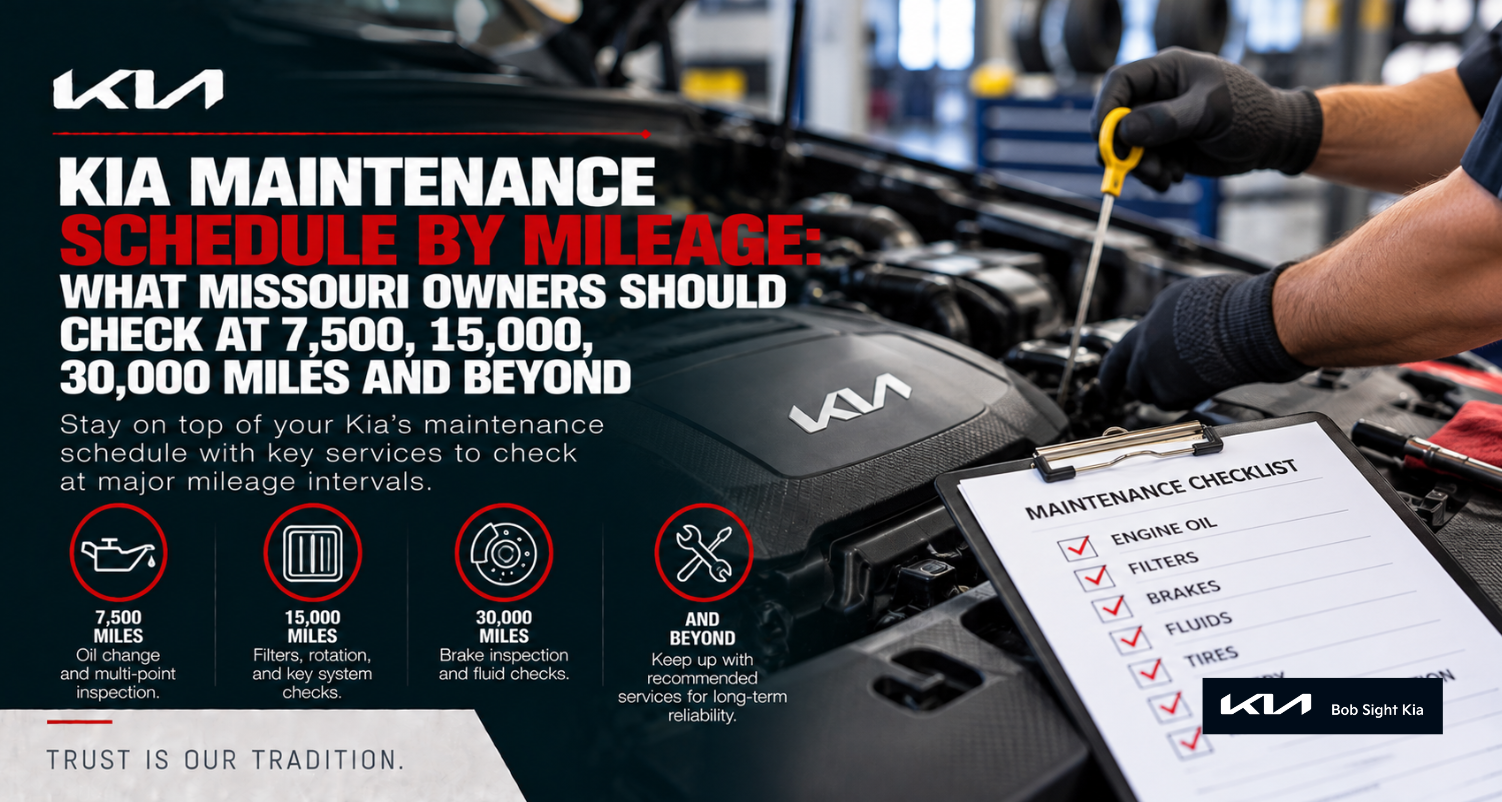
Kia Maintenance Schedule by Mileage: What Missouri Owners Should Check at 7,500, 15,000, 30,000 Miles and Beyond
Your Kia maintenance schedule should follow the requirements for your exact vehicle, with mileage milestones helping you plan ahead. Oil changes, tire rotations, filters, brake inspections, and fluid checks all play a role in ownership, but they do not follow one universal schedule across every Kia model.
For drivers in Independence, Blue Springs, Grain Valley, and throughout the Kansas City Metro, daily driving conditions also matter. Short trips, traffic on I-70, winter road treatments, and dusty construction areas can affect which maintenance schedule applies.
Bob Sight Kia in Independence also offers an ownership benefit worth including in your service planning: lifetime oil changes and tire rotations every 5,000 miles with eligible new Kia purchases, performed exclusively at Bob Sight Kia. Ask our team to confirm eligibility and program terms for your vehicle. Battery-electric Kia models do not require engine oil changes.
The 7,500-, 15,000-, and 30,000-mile checkpoints discussed below are planning references. They should not delay a service already due under your factory schedule, elapsed-time requirements, severe-use schedule, or applicable dealership maintenance program.
Schedule Kia maintenance at Bob Sight Kia in Independence
In This Guide You'll Learn
Understanding the difference between factory requirements, dealership benefits, and condition-based repairs makes Kia maintenance easier to manage. This guide covers:
- How to identify the correct maintenance schedule for your Kia
- How Bob Sight Kia's 5,000-mile lifetime maintenance benefit fits into ownership
- What to review around 7,500, 15,000, and 30,000 miles
- How Missouri driving conditions can affect service timing
- Which items to monitor between appointments
- How gasoline, hybrid, plug-in hybrid, and electric maintenance differs
- How to plan service beyond the first 30,000 miles
Does Every Kia Follow the Same Maintenance Schedule?
No. Kia maintenance requirements vary by model year, engine, powertrain, drivetrain, and operating conditions. Even two vehicles with the same model name can have different service requirements when their engines or powertrains differ.
A gasoline Kia Sportage and a Sportage Hybrid should each follow their own maintenance information. A battery-electric Kia has a different set of needs because it does not have a gasoline engine, engine oil filter, or spark plugs.
The correct starting point is your owner's manual and its scheduled maintenance section. Kia's Owner's Portal also provides access to vehicle information and maintenance milestones. Confirm that the information matches your model year and configuration.
When a maintenance item lists both mileage and time, follow whichever limit comes first as directed by the schedule. A low-mileage Kia may reach a calendar deadline before reaching the listed mileage. A frequent commuter may reach the mileage limit much sooner.
Keep these three categories separate when reviewing recommendations:
- Factory scheduled maintenance: Inspections and replacements specified by Kia for your vehicle and operating conditions.
- Dealership maintenance benefits: Services available under an applicable program, including Bob Sight Kia's lifetime oil changes and tire rotations every 5,000 miles with eligible new Kia purchases.
- Condition-based service: Work recommended because an inspection identifies wear, damage, contamination, or a developing concern.
Understanding which category applies helps you ask useful questions and maintain accurate records.
How Bob Sight Kia's Lifetime Oil Changes and Tire Rotations Fit Your Plan
Eligible new Kia purchases at Bob Sight Kia include lifetime oil changes and tire rotations every 5,000 miles, performed exclusively at our Independence dealership. This benefit gives qualifying owners a recurring service checkpoint to include in their ownership calendar.
For an eligible gasoline or hybrid Kia, those visits provide an opportunity to keep up with covered oil and tire services while discussing other maintenance that may be due. Confirm your enrollment, vehicle eligibility, and applicable program terms with the dealership.
The 5,000-mile benefit does not make every other maintenance item due at 5,000-mile intervals. Filters, coolant, spark plugs, brake fluid, and drivetrain components retain their own vehicle-specific requirements. Likewise, a factory time limit or severe-use requirement may call for attention before the next program mileage checkpoint.
Do not interpret the benefit as coverage for every maintenance item or repair. Ask which services are included and which additional recommendations come from Kia's schedule or the condition of your vehicle.
If you own a battery-electric Kia, engine oil changes do not apply. Ask our team which program benefits apply to your specific vehicle rather than assuming the same services apply to every powertrain.
Plan your next Kia service appointment
What Should Kia Owners Review Around 7,500 Miles?
Around 7,500 miles, review your service history and upcoming factory requirements rather than assuming every Kia needs an identical service package. If you participate in Bob Sight Kia's applicable 5,000-mile maintenance benefit, you may already have completed an earlier oil-change and tire-rotation visit.
For gasoline engines, including those in hybrids and plug-in hybrids, oil service must use the correct oil specification and filter for the vehicle. Do not select oil solely because another Kia owner uses it. Engine requirements can differ across models and years.
Tire maintenance also deserves attention. Rotation requirements and patterns depend on the vehicle and tire configuration. Directional tires or differing front and rear tire sizes can affect the appropriate procedure.
This checkpoint is also useful for reviewing tire pressure, tread condition, brake behavior, visible leaks, lighting, and wiper performance. An inspection may identify an issue that deserves attention, but inspection does not automatically mean replacement.
- Check your odometer and service date. Compare both with your vehicle's maintenance schedule.
- Review completed work. Include any earlier 5,000-mile program visit.
- Identify services actually due. Use the factory schedule and applicable driving conditions.
- Discuss symptoms. Mention new noises, warning lights, vibration, or changes in starting and braking.
- Save the service record. Record the date, mileage, and work completed.
For owners making frequent short trips along Noland Road or US-40, this is also a good time to review the severe-use definitions in the owner's manual.
What Changes Around 15,000 Miles?
The 15,000-mile checkpoint is a useful time to review recurring maintenance, filter condition, tires, and brakes against your Kia's actual requirements. It is not a universal replacement deadline for every component.
If your vehicle qualifies for Bob Sight Kia's lifetime maintenance program, 15,000 miles is also a recurring 5,000-mile program checkpoint. Confirm the appropriate timing with the service team and keep the factory schedule in view for additional requirements.
The cabin air filter is one item worth reviewing. It filters air entering the passenger compartment through the climate-control system. Dust, pollen, leaves, and other debris can accumulate over time, and a restricted filter can reduce airflow.
Replacement should follow the schedule and condition of the filter. Driving through construction areas or dusty environments may justify closer attention. Reduced airflow can also have causes beyond the filter, so persistent climate-control concerns deserve diagnosis.
Tires should be checked for uneven wear and damage. Edge wear, center wear, or a change in steering behavior can prompt evaluation of inflation, alignment, suspension, or other contributing factors.
Brake-pad replacement depends on measured wear and condition. A driver spending substantial time in Independence traffic may experience different brake wear from someone traveling mainly on uninterrupted highways. Mileage alone cannot determine how much usable brake material remains.
What Should Be Reviewed Around 30,000 Miles?
At approximately 30,000 miles, compare your service records with Kia's schedule to identify recurring maintenance and any additional items due. Avoid treating a generic 30,000-mile package as a factory requirement for every Kia.
Engine air-filter service may be part of the discussion for a gasoline or hybrid vehicle, depending on its schedule and filter condition. This filter serves the engine and is separate from the cabin air filter. Battery-electric vehicles do not have an engine combustion-air filter.
Other items may include inspections of belts, cooling-system components, steering, suspension, axle boots, or drivetrain components where specified. Their inspection and replacement requirements depend on your vehicle.
Fluid service also requires a specific explanation. Ask which fluid is being recommended, whether Kia specifies the service at the current mileage or age, and whether severe-use conditions or an inspection finding affect the recommendation.
At this stage, review the maintenance history as a whole:
- Have recurring oil and tire services been completed when applicable?
- Are any time-based requirements due?
- Were previous inspection findings resolved?
- Do filters need inspection or replacement under the schedule?
- Are tire wear and brake measurements being tracked?
- Does the severe-use schedule change any upcoming requirements?
For eligible program participants, 30,000 miles is another 5,000-mile maintenance checkpoint. Additional work should still be matched to factory requirements and actual condition.
What Counts as Severe Driving in Missouri?
Severe-use conditions can include ordinary driving routines, so review Kia's definitions before assuming the normal schedule applies. The relevant conditions and affected maintenance items are listed in your vehicle's manual.
Depending on the Kia, those conditions can include repeated short trips, extensive idling, heavy traffic, dusty roads, salt-treated roads, very cold weather, and towing or other demanding use.
A commute through I-70 congestion can involve substantial engine-running time without many miles accumulating. Repeated short errands around Independence can create a different operating pattern from a longer trip at steady speed.
Missouri winters also make the severe-use section worth reviewing. Some Kia manuals identify very cold weather and roads treated with salt or other corrosive materials among the relevant conditions.
Do not assume every maintenance item changes to the same shorter interval. Severe-use tables identify which items are affected and which conditions apply to them.
When discussing your maintenance plan, describe your actual routine: typical trip length, time spent idling, traffic, dusty-road use, and any towing within the vehicle's approved limits. Those details help the service team review the appropriate schedule.
What Should You Check Between Service Appointments?
Monitor your Kia between appointments because wear, warning lights, and vehicle symptoms do not wait for a mileage milestone. Scheduled maintenance works best alongside regular owner checks.
Follow the owner-maintenance guidance in your manual. For vehicles with an engine, this can include checking engine oil as directed. Tire pressure, exterior lighting, wipers, and visible leaks also deserve attention.
- Check cold tire pressure. Use the vehicle's tire placard and manual rather than the maximum pressure molded into the tire sidewall.
- Inspect visible tire condition. Look for uneven wear, cuts, bulges, cracking, or other damage.
- Watch for unexplained fluid loss. Repeated topping off should not replace investigating a leak.
- Notice braking changes. Grinding, pulling, vibration, or altered pedal feel warrants attention.
- Check lights and wipers. Maintain visibility during rain, snow, and shorter winter days.
- Respond to warning indicators. Follow the manual's instructions for the specific warning.
- Record symptoms. Note when a concern occurs and the conditions surrounding it.
Some warnings require stopping safely and obtaining assistance rather than continuing to drive. Do not wait for the next routine appointment when the manual calls for immediate action.
How Do Gasoline, Hybrid, and Electric Kia Maintenance Needs Differ?
Your powertrain determines which maintenance items apply, so a gasoline checklist should not be copied directly to every Kia. Shared model names do not guarantee shared service requirements.
Gasoline Kia Vehicles
Gasoline vehicles require engine-related maintenance, including oil and filter service, along with scheduled attention to items such as spark plugs and engine air filters. Exact intervals and specifications depend on the engine.
Hybrid and Plug-In Hybrid Kia Vehicles
Hybrids and plug-in hybrids still have gasoline engines and require applicable engine maintenance. Driving on electric power for part of a trip does not eliminate oil service or calendar-based requirements. Follow the schedule for the hybrid or plug-in hybrid configuration.
Hybrid-specific components may have their own inspection or service requirements. Do not substitute the schedule from a gasoline version of the same model.
Battery-Electric Kia Vehicles
Battery-electric Kia vehicles do not require engine oil changes or spark plugs. They still need maintenance involving tires, brakes, cabin filters, steering, suspension, cooling systems, and other applicable components.
Regenerative braking can reduce friction-brake use during some driving, but conventional brake components still require attention. Follow the EV's maintenance schedule rather than assuming reduced brake use eliminates inspection needs.
Planning Maintenance Beyond 30,000 Miles
Beyond 30,000 miles, continue recurring maintenance and add higher-mileage or time-based work as your Kia's schedule requires. There is no single replacement list that applies to every Kia at 60,000, 90,000, or 100,000 miles.
Items such as coolant, spark plugs, belts, and drivetrain fluids can have substantially different requirements across vehicles. Check the exact schedule before assuming a service is due or can be postponed.
Vehicle age matters alongside mileage. A seven-year-old Kia with relatively low mileage may need different attention from a newer Kia with the same odometer reading. Tires, batteries, rubber components, and other parts can deteriorate with time.
Keep records showing the service date, mileage, work completed, and relevant inspection results. Records help prevent duplicate work and make it easier to track changes in tire wear, brake measurements, and recurring concerns.
If you purchased a used Kia without complete records, discuss the missing history with the service team. The goal is to establish what can be verified and determine an appropriate maintenance plan for that vehicle.
Frequently Asked Questions About Kia Maintenance Schedules
Does every Kia need maintenance every 7,500 miles?
No. Kia maintenance intervals vary by model year, engine, powertrain, maintenance item, and driving conditions. Use the schedule for your exact vehicle and follow mileage or time limits as specified.
Does Bob Sight Kia offer lifetime oil changes and tire rotations?
Bob Sight Kia in Independence advertises lifetime oil changes and tire rotations every 5,000 miles with eligible new Kia purchases, performed exclusively at the dealership. Ask the team to confirm your vehicle's eligibility and applicable program terms. Battery-electric vehicles do not require engine oil changes.
What Kia maintenance should I review around 15,000 miles?
Review recurring oil and filter service where applicable, tire maintenance, brake inspections, fluid checks, and any cabin air-filter service specified for your vehicle. Reaching 15,000 miles does not create the same service requirements for every Kia.
What should be done to a Kia at 30,000 miles?
Review your Kia's maintenance schedule and service history to identify recurring maintenance and any additional inspections or replacements due. Engine air filters, cabin filters, fluids, and other components have vehicle-specific requirements rather than one universal 30,000-mile replacement rule.
What counts as severe driving for a Kia?
Depending on the vehicle's manual, severe-use conditions can include repeated short trips, extensive idling, heavy traffic, dusty or salt-treated roads, very cold weather, and towing or other demanding use. Follow the definitions and maintenance requirements for your exact Kia.
Schedule Kia Maintenance in Independence, Missouri
Bob Sight Kia can help you review your vehicle's maintenance requirements and plan your next service visit. Have your current mileage, model year, powertrain information, and service records available when discussing what is due.
If you are searching for Kia maintenance near me in Independence, Blue Springs, Grain Valley, Raytown, or the Kansas City Metro, start with a plan built around your actual vehicle and driving routine.
Remember to ask about lifetime oil changes and tire rotations every 5,000 miles with eligible new Kia purchases at Bob Sight Kia. Confirm the program terms and continue following all other applicable factory maintenance requirements.
Schedule your next Kia maintenance appointment
Helpful Links
- Schedule Kia Service
- Kia Service Specials
- Kia Parts Department
- Explore New Kia Vehicles
- Bob Sight Kia
Proud to Be Part of the Bob Sight Auto Group
Bob Sight Kia in Independence is proud to be part of the Bob Sight Auto Group. Explore our dealerships in Missouri and Kansas for vehicle shopping, service, and ownership resources.
- Bob Sight Honda in Lawrence, Kansas
- Bob Sight Chrysler Dodge Jeep Ram in Lawrence, Kansas
- Bob Sight Ford in Lee's Summit, Missouri
- Bob Sight Kia in Independence, Missouri
Trust Is Our Tradition.



 Warranties include 10-year/100,000-mile powertrain and 5-year/60,000-mile basic. All warranties and roadside assistance are limited. See retailer for warranty details.