

Today: 8:30AM - 6:00PM
Blog / Independence Kia Dealer

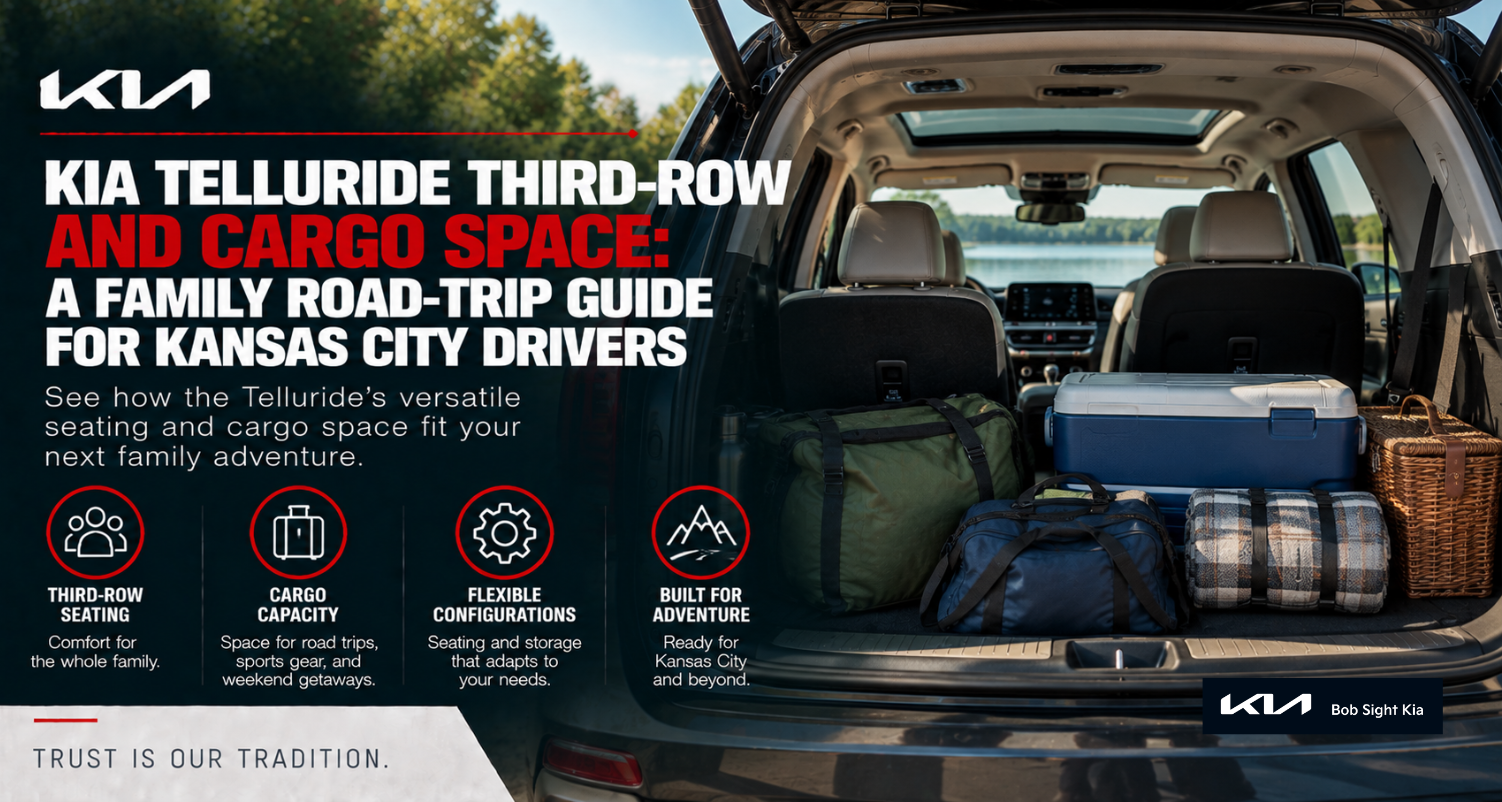
Kia Telluride Family SUV Guide: Third-Row Space, Cargo Flexibility, and Road-Trip Comfort for Kansas City Families

Explore Kia Telluride third-row and cargo space, seating flexibility, and road-trip practicality for Independence and Kansas City families.

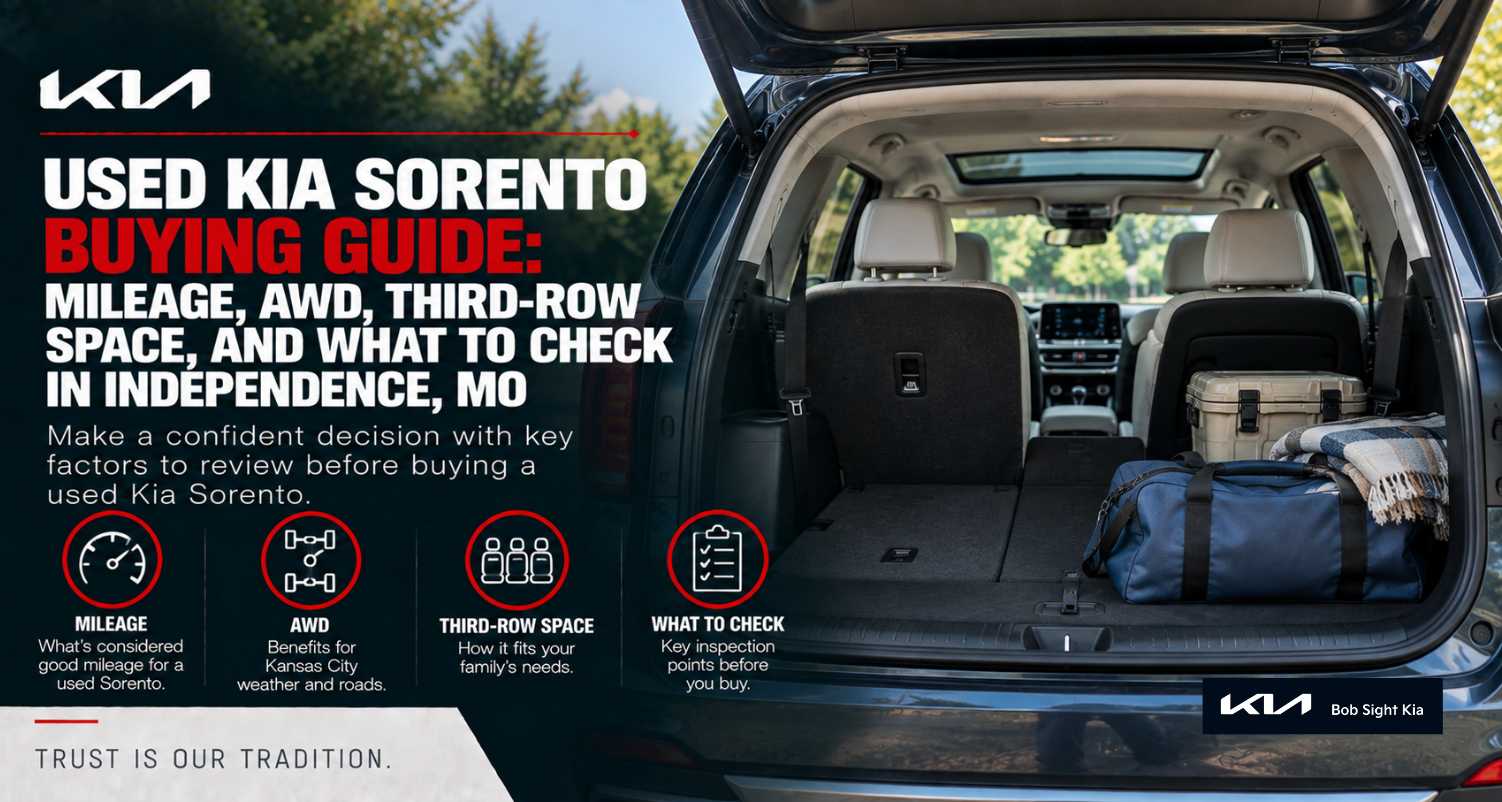
Used Kia Sorento Buying Guide: Mileage, AWD, Third-Row Space, and What to Check in Independence, MO

Buying a used Kia Sorento in Independence, Missouri, means looking beyond the model year and asking how the SUV was driven, maintained, equipped, and cared for before it reached the used-car lot. Mileage matters, but it is only one part of the decision. A well-maintained Sorento with documented service history may be a stronger choice than a lower-mileage example with inconsistent maintenance, while features such as available all-wheel drive, third-row seating, driver-assistance technology, and interior configuration can make a major difference for families and commuters around the Kansas City Metro.

Shop used vehicles at Bob Sight Kia in Independence

In This Guide You'll Learn

This used Kia Sorento buying guide focuses on the practical details Independence and Kansas City shoppers should evaluate before choosing a pre-owned Sorento.

  • How to evaluate mileage on a used Kia Sorento
  • Why maintenance history can matter as much as the odometer
  • How to decide whether available AWD fits your Missouri driving needs
  • What to check when evaluating Sorento third-row space
  • How model year, trim, and powertrain differences affect your decision
  • What to inspect during a used Sorento test drive
  • Which vehicle-history and service records are worth reviewing

How Much Mileage Is Too Much on a Used Kia Sorento?

There is no single mileage number that automatically makes a used Kia Sorento a good or bad purchase because maintenance history, previous use, vehicle age, and overall condition all matter. A Sorento with higher mileage that has been serviced consistently may deserve more consideration than a lower-mileage SUV with gaps in its maintenance record. Independence shoppers should treat mileage as one data point rather than the final verdict on a used vehicle.

Start by comparing the odometer reading with the age of the Sorento. A relatively new vehicle with unusually high mileage may have spent significant time on highways, while an older Sorento with very low mileage may have been driven infrequently or primarily on short trips. Neither pattern is automatically negative. Highway mileage can involve fewer stop-and-go cycles, while short trips may create more frequent starts, braking events, and temperature changes. The important question is whether the vehicle appears to have received appropriate maintenance throughout that use.

Condition should support what the odometer tells you. Look at the driver's seat, steering wheel, pedals, door handles, cargo area, and other high-contact surfaces. Heavy interior wear on a low-mileage vehicle can justify asking more questions about how the SUV was used. Conversely, a higher-mileage Sorento with a clean interior, consistent records, and evidence of routine maintenance may have been carefully owned.

For shoppers in Independence, Blue Springs, Grain Valley, and the Kansas City Metro, think about how much mileage you plan to add after purchase. A driver commuting daily on I-70 may accumulate miles quickly, while someone using the Sorento primarily for school transportation and weekend errands may add mileage more slowly. Your future driving habits should influence how much importance you place on the vehicle's current odometer reading.

Instead of asking only, "How many miles are too many?" ask a broader set of questions. How often was the vehicle serviced? Are there records? Does it drive smoothly? Are the tires wearing evenly? Have fluids and wear items been maintained? Does the vehicle's overall condition make sense for its mileage? Those questions provide a much stronger foundation for a used Kia Sorento purchase.

Why Is Maintenance History So Important When Buying a Used Sorento?

A documented maintenance history can tell you whether a used Kia Sorento received routine attention throughout its previous ownership, which is often more useful than mileage alone. Oil changes, tire rotations, brake inspections, fluid checks, battery service, and other routine maintenance can all affect how confidently you approach a pre-owned vehicle. A complete history is not always available, but any records that can be verified are worth reviewing.

Maintenance history helps create context. If a Sorento has accumulated substantial mileage but shows regular service over time, that history may indicate the previous owner stayed engaged with maintenance. If there are long gaps with no documentation, ask whether additional records are available elsewhere. A missing record does not prove that maintenance was skipped, but it does mean you have less information about the vehicle's past.

Service history can also reveal whether major wear items have already been addressed. Tires, brake pads, batteries, filters, and other components wear over time. Knowing whether these items were recently replaced can help you understand the vehicle's current maintenance position. It can also help prevent assumptions based only on the age of the vehicle.

Drivers around Independence should think about Missouri weather when reviewing records. Seasonal temperature changes, winter road treatments, summer heat, and repeated short trips can affect different vehicle systems. A Sorento that has spent years navigating Jackson County winters may benefit from careful inspection of tires, brakes, underbody areas, battery condition, and other components affected by climate and road conditions.

When reviewing a used Sorento, follow a simple process:

  1. Ask for available maintenance records. Look for consistent service rather than focusing on a single visit.
  2. Compare records with mileage. Make sure maintenance entries reasonably correspond with odometer progression.
  3. Look for repeated concerns. Multiple visits for the same symptom may deserve additional investigation.
  4. Check recent wear-item service. Tires, brakes, batteries, filters, and fluids may affect near-term ownership planning.
  5. Ask what has been inspected recently. A current inspection can help fill gaps that older records cannot.

If you purchase a used Sorento, maintaining your own records from the beginning is a smart ownership habit. Bob Sight Kia owners can use the online service scheduler when routine maintenance or inspection is needed after purchase.

Should You Buy a Used Kia Sorento With AWD?

A used Kia Sorento with available all-wheel drive can make sense for Missouri drivers who regularly travel in snow, rain, changing road conditions, or on routes where additional traction is useful, but AWD should not automatically be treated as mandatory. The better choice depends on your commute, weather tolerance, tire maintenance, and how frequently you drive before roads are fully treated after winter weather.

All-wheel drive can help distribute power to more than one axle when traction demands change. That can be useful when pulling away on slick pavement or traveling through variable road conditions. For a commuter leaving Independence early in the morning before neighborhood streets are cleared, available AWD may be more valuable than it is for someone who can delay travel until conditions improve.

AWD does not replace proper tires or careful driving. Tires provide the actual contact with the road, so tread depth, tire pressure, tire type, and overall condition remain central to wet- and winter-weather performance. AWD can help a vehicle accelerate, but it does not eliminate longer stopping distances on snow or ice. A front-wheel-drive Sorento with well-maintained tires may fit many Kansas City drivers perfectly well.

Used Sorento shoppers should also inspect all four tires closely when considering an AWD model. Ideally, the tires should be appropriately matched in size, type, and wear. Uneven tire wear can suggest alignment issues, suspension concerns, improper rotation, or previous replacement of only one or two tires. Because AWD systems depend on coordinated operation across the driveline, consistent tire condition deserves attention.

Use your actual routine to decide whether AWD is worth prioritizing. If you regularly commute from Blue Springs, Grain Valley, Liberty, or another part of the Metro into Kansas City regardless of winter conditions, it may be a meaningful feature. If most of your driving stays on treated roads and you have flexibility during severe weather, front-wheel drive may meet your needs while potentially simplifying your search.

Used Sorento Consideration Front-Wheel Drive Available All-Wheel Drive
Typical Daily Commuting Works well for many paved-road drivers Useful when conditions change frequently
Missouri Winter Driving Proper tires remain critical Can provide additional traction when accelerating
Tire Inspection Check tread and wear patterns Pay close attention to matching tire condition across all four wheels
Best Fit Drivers focused mainly on normal road use Drivers who regularly travel in variable weather

How Useful Is the Third Row in a Used Kia Sorento?

The Kia Sorento's available third-row seating can make it a practical choice for families who occasionally need additional passenger capacity without moving into a larger three-row SUV. The usefulness of that third row depends on passenger size, frequency of use, cargo requirements, and the specific model year and configuration being considered. Used shoppers should physically test the rear seating rather than relying on the fact that the vehicle is labeled as a three-row SUV.

For many households, the third row serves as occasional seating rather than a place where adults ride every day. Children, teenagers, visiting relatives, or extra passengers may use the rear row for short trips around Independence, school pickups, or weekend activities. Families expecting adults to spend significant time in the third row should pay closer attention to entry, legroom, headroom, and how easily the second-row seats move.

Cargo space also changes when the third row is in use. A Sorento may provide enough room for family travel when the rear seats are folded, but luggage capacity can feel different once all seating positions are occupied. Before purchasing, think about your busiest real-world scenario. If your family travels with six people plus suitcases, sports equipment, a stroller, or a cooler, evaluate that combination rather than considering seating and cargo separately.

This matters for Kansas City families because one vehicle often handles several roles in the same week. Monday may involve commuting on I-70, Wednesday could mean school pickup and soccer practice, and Saturday might include shopping near Independence Center or a drive to Lee's Summit. A third row that folds when not needed gives families flexibility without committing to a larger SUV every day.

During your used Sorento evaluation, ask every regular passenger to test their likely seating position. Adjust the driver's seat first, then the second row, then check the third row. Open the liftgate with all rows in position and visualize your normal cargo. This takes only a few minutes but can reveal whether the Sorento's three-row layout actually fits your household.

Which Used Kia Sorento Model Year or Trim Should You Choose?

The best used Kia Sorento model year and trim depends on the combination of features, powertrain, technology, seating, and drivetrain you want rather than simply choosing the newest Sorento within your search. The Sorento has changed over time, and equipment can vary significantly between model years and trims. Shoppers should therefore compare the exact vehicle rather than assume every Sorento with the same badge offers identical features.

Start with the features you use every day. If smartphone connectivity, heated seats, driver-assistance systems, a larger infotainment display, power seating, or a specific seating layout are priorities, confirm those features on the individual Sorento. Used-vehicle listings can sometimes summarize equipment broadly, while trim features can change from year to year. Physically checking the vehicle is the safest way to know what is included.

Powertrain differences deserve the same attention. Depending on model year and configuration, used Sorento inventory can include different engines, transmissions, drivetrains, and electrified options. A driver primarily commuting between Independence and Kansas City may prioritize efficiency and smooth everyday performance. Someone who regularly travels with several passengers or wants stronger acceleration may focus on a different configuration.

Trim level should support your needs rather than becoming the goal by itself. A higher trim may include desirable comfort and technology features, but a lower trim with the right mileage, service history, condition, and equipment may be a better overall fit for your household. Used shopping rewards flexibility because two vehicles from the same model year can have very different ownership histories.

When narrowing your options, use this step-by-step approach:

  1. Choose your must-have features. Decide whether AWD, third-row seating, heated seats, specific safety technology, or another feature is essential.
  2. Identify your preferred powertrain. Compare the exact engine and drivetrain available on each Sorento.
  3. Review mileage and maintenance together. Do not rank vehicles by odometer alone.
  4. Compare condition. Look at interior wear, body condition, tires, brakes, and overall presentation.
  5. Drive the strongest candidates. Real-world driving can reveal differences that listings cannot.
  6. Review vehicle history. Use available documentation to understand previous ownership and reported events.

This approach helps Independence shoppers avoid becoming overly focused on a single trim badge. The strongest used Sorento is the one whose history, condition, configuration, and features work together for your daily needs.

What Should You Inspect Before Buying a Used Kia Sorento?

A used Kia Sorento inspection should cover tires, brakes, body condition, lights, interior electronics, climate control, seating functions, cargo features, and the way the SUV behaves during a test drive. Used vehicles naturally show some wear, but the goal is to distinguish normal use from conditions that deserve further evaluation. Take your time and inspect the Sorento before becoming focused on one cosmetic feature or trim level.

Begin outside. Walk around the vehicle in good lighting and look at panel alignment, paint consistency, glass, lamps, wheels, and tires. Minor cosmetic marks are common on used vehicles, but larger differences between panels may justify asking about prior repairs. Inspect the tires for tread depth and even wear. One tire wearing much faster along an edge can indicate alignment, suspension, inflation, or driving-related issues.

Move inside and operate everything you expect to use. Test the infotainment screen, backup camera, climate controls, USB ports, seat adjustments, windows, locks, liftgate, steering-wheel controls, and available driver-assistance features. Fold and raise the second and third rows several times. If the Sorento has a feature that matters enough to influence your purchase, confirm that it works rather than assuming it does.

Pay attention to the condition of frequently touched surfaces. Worn seat bolsters, heavily scratched cargo trim, damaged floor coverings, or missing interior pieces can indicate how the vehicle was used. Normal wear is not necessarily a reason to avoid a Sorento, but it should make sense relative to the vehicle's age and mileage.

Finally, check the cargo area in the configuration you plan to use most often. Fold the third row, raise it again, and inspect under the cargo floor if accessible. Families around Jackson County may use the Sorento for groceries, sports equipment, luggage, pets, school supplies, and weekend projects. Testing that space before purchase can prevent discovering later that your normal gear does not fit the way you expected.

What Should You Look for During a Used Kia Sorento Test Drive?

A used Kia Sorento test drive should evaluate acceleration, braking, steering, transmission behavior, ride quality, visibility, cabin noise, warning lights, and the operation of major comfort and technology features. A quick loop around the dealership may confirm that the vehicle moves, but a thoughtful test drive can tell you much more about whether it fits your daily routine.

Start slowly. Pay attention as the vehicle moves away from a stop, shifts through lower speeds, and responds to light throttle. Listen for unusual sounds and notice whether acceleration feels consistent. The goal is not to diagnose every possible mechanical issue yourself. It is to notice anything that feels abrupt, inconsistent, noisy, or different enough to justify additional inspection.

Test the brakes in a safe setting. Braking should feel predictable without unusual vibration, grinding, or pulling. A slight sound after a vehicle has been sitting can have several causes, but persistent brake noise deserves attention. If the steering wheel shakes during braking or the vehicle pulls noticeably, mention it before moving forward with the purchase.

Find a faster road if the route allows. Highway-style driving can reveal road noise, steering stability, acceleration response, and ride comfort that may not appear at neighborhood speeds. For an Independence commuter who regularly merges onto I-70, evaluating the Sorento at normal highway speeds is far more relevant than spending the entire test drive below 35 mph.

Use the following checklist during the drive:

  1. Accelerate normally from several stops. Look for smooth, predictable response.
  2. Brake at different speeds. Pay attention to noise, vibration, and pedal feel.
  3. Make several turns. Listen for unusual noises and evaluate steering response.
  4. Drive over typical road surfaces. Notice rattles, suspension behavior, and cabin noise.
  5. Test highway merging if possible. Make sure the powertrain feels appropriate for your normal routes.
  6. Check driver visibility. Evaluate mirrors, blind spots, camera systems, and seating position.
  7. Watch the instrument cluster. Warning lights should not be ignored.

Do not rush the drive because another Sorento is available if the first one does not feel right. Used inventory varies, and comparing more than one vehicle can help you separate normal Sorento characteristics from something specific to an individual SUV.

How Should You Review a Used Sorento Vehicle History Report?

A vehicle history report can help identify reported ownership changes, mileage progression, service entries, title information, and reported damage, but it should be used together with a physical inspection and test drive rather than as a replacement for them. The report gives you another layer of information about the vehicle's past. It does not guarantee that every event or repair was reported.

Begin with mileage consistency. Odometer readings should generally progress logically over time. If the mileage pattern contains an unusual change or missing period, ask for clarification. Next, review the number of previous owners and the length of each ownership period. Multiple owners are not automatically negative, but they may make complete maintenance documentation harder to assemble.

Reported accidents or damage deserve careful review rather than an automatic yes or no decision. Ask what was repaired, whether documentation is available, and whether the current condition shows evidence of proper repair. A professional inspection can be particularly helpful if the report shows a significant previous event.

Service entries can provide additional value. They may show oil changes, tire service, brake work, inspections, or other maintenance. Not every service facility reports information to every history provider, so missing entries should not automatically be interpreted as skipped maintenance. Ask whether additional records are available from the previous owner, dealership, or service center.

Used Kia shoppers around Kansas City should think of the history report as one part of a larger picture:

  • Vehicle history report
  • Maintenance documentation
  • Current inspection findings
  • Physical condition
  • Tire and brake condition
  • Test-drive behavior
  • Feature and trim verification

When those pieces support one another, shoppers can make a much more informed decision than they could by relying on mileage or model year alone.

Quick Facts for Buying a Used Kia Sorento in Independence, MO

The strongest used Kia Sorento candidates combine appropriate mileage, consistent maintenance, useful features, good current condition, and a configuration that matches how you actually plan to use the SUV. These quick reminders can help Independence shoppers stay focused while comparing multiple used Sorento options.

  • There is no universal mileage cutoff that determines whether a used Sorento is worth considering.
  • Maintenance history can be as important as mileage.
  • Compare vehicle age and odometer reading rather than viewing mileage in isolation.
  • Available AWD may appeal to Missouri drivers who regularly travel in changing weather.
  • AWD does not replace proper tires or safe winter-driving habits.
  • Third-row usefulness depends on passenger size, frequency of use, and cargo needs.
  • Features and powertrains can vary significantly by model year and trim.
  • Review all four tires for tread condition and uneven wear.
  • Test braking, steering, acceleration, and transmission behavior during the drive.
  • Operate the infotainment, climate controls, seating, cameras, and other major features before purchase.
  • Review available vehicle-history and service records.
  • Choose based on overall condition and fit rather than trim level alone.

These points are particularly useful when comparing several vehicles online. Two Sorentos may appear similar in photos but differ significantly in mileage, drivetrain, service history, third-row condition, technology, and tire life. Looking beyond the headline details can help you narrow your list before visiting the dealership.

Ownership Planning After Buying a Used Kia Sorento

Used Kia Sorento ownership is easier to manage when you establish a maintenance baseline shortly after purchase and keep records from that point forward. Even when a vehicle comes with strong service documentation, knowing its current tire, brake, fluid, battery, and routine maintenance condition can help you plan future service instead of reacting to it.

Begin by reviewing the maintenance information applicable to your specific Sorento model year, engine, drivetrain, and usage. Used Sorentos can vary considerably in configuration, so maintenance should be based on the exact vehicle rather than a generic schedule copied from another model year. If previous records show recent work, keep that documentation with your own maintenance history.

Tires deserve regular attention in Missouri. Temperature swings can change tire pressure, while winter road conditions make tread condition particularly important. AWD Sorento owners should pay close attention to even tire wear and appropriate tire matching. Front-wheel-drive owners should also rotate tires as recommended and monitor tread patterns for signs of alignment or suspension concerns.

Brake condition matters for local driving as well. Frequent traffic around Independence, I-70, Noland Road, Blue Springs, and Kansas City can create repeated braking cycles. Listen for persistent changes in brake sound or feel and have the system inspected rather than assuming every noise is normal. The same principle applies to batteries, wipers, lights, climate control, and other systems you rely on during changing Midwest weather.

Keep records from your first service visit onward. Documentation can help you remember when tires were installed, when the battery was replaced, when brake components were inspected, and which maintenance items are due next. If you later trade or sell the Sorento, a documented history can also help demonstrate how the vehicle was cared for during your ownership.

Bob Sight Kia drivers can review Kia service and parts specials and schedule maintenance when needed. The objective is not to replace parts unnecessarily. It is to understand the condition of the used Sorento you purchased and build a predictable maintenance routine around it.

Frequently Asked Questions About Buying a Used Kia Sorento

Is a used Kia Sorento a good family SUV for Independence drivers?

A used Kia Sorento can be a practical family SUV for Independence drivers who want flexible seating, available three-row capability, manageable exterior dimensions, and a range of available features. Its suitability depends on the specific model year, seating arrangement, condition, and equipment. Families should evaluate the exact vehicle instead of assuming every Sorento offers the same interior configuration.

The third row can be useful for school transportation, occasional extra passengers, and family activities. When the rear row is not needed, folding it can create additional room for groceries, sports equipment, luggage, or other cargo. This flexibility can suit households that want more passenger capacity without moving into a much larger SUV.

For families around Independence, Blue Springs, Grain Valley, and Lee's Summit, the most useful test is to bring your real routine into the shopping process. Have children or regular passengers try the seats, check car-seat compatibility according to the appropriate instructions, and visualize the cargo you normally carry. The best family SUV is the one that works with your actual household rather than simply offering the longest feature list.

Is high mileage bad on a used Kia Sorento?

Higher mileage does not automatically make a used Kia Sorento a poor choice because maintenance history, condition, driving type, and vehicle age all affect how that mileage should be interpreted. A properly maintained higher-mileage Sorento may deserve consideration alongside lower-mileage alternatives. The odometer should begin the evaluation, not end it.

Review available service records and compare the mileage with the age of the vehicle. A Sorento that accumulated miles primarily through longer highway trips may have experienced a different type of use than one driven mainly on short urban trips. Neither pattern guarantees condition, which is why inspection remains important.

Kansas City shoppers should also think about their own mileage plans. If you expect to add substantial mileage commuting from eastern Jackson County into Kansas City, starting mileage may carry more weight in your decision. If your annual driving is relatively low, you may evaluate the same Sorento differently.

Should I choose AWD on a used Kia Sorento in Missouri?

AWD can be worthwhile for Missouri Sorento owners who regularly travel in snow, rain, or variable road conditions, but many drivers can also be well served by front-wheel drive and properly maintained tires. Your work schedule and typical routes should influence the decision more than the idea that every Midwest SUV automatically needs AWD.

If you must commute during winter weather before side streets and neighborhood roads are cleared, AWD may provide additional traction when accelerating. Drivers who can delay trips until major roads are treated may place less importance on the feature. In either case, safe driving and tire condition remain critical.

When shopping for an AWD Sorento near Independence, inspect all four tires for consistent size and wear. Ask about tire rotation history when documentation is available. A used AWD vehicle should be evaluated as a complete system rather than focusing on the AWD badge alone.

Is the Kia Sorento third row big enough for adults?

The usefulness of a Sorento third row for adults depends on passenger height, trip length, seating position, and the specific model year and configuration. Families expecting adults to ride in the rear regularly should test the third row in person before purchasing. A seat that works comfortably for a short Independence errand may feel different during a longer highway trip.

Second-row position also affects third-row comfort. Move the seats into realistic positions rather than maximizing rear space just for the test. Then ask the people likely to use the third row to enter, sit, buckle in, and exit on their own.

For many Kansas City families, the Sorento's third row is useful as flexible occasional seating. If your household needs three adult-friendly rows every day, compare the Sorento with larger three-row options as well. Choosing based on your most common use can prevent frustration later.

Where can I shop for a used Kia Sorento near Kansas City?

Shoppers can search used vehicles at Bob Sight Kia in Independence, Missouri, serving drivers throughout the Kansas City Metro and eastern Jackson County. Used inventory changes regularly, so checking current availability before visiting can help you identify Sorento options that match your preferred mileage, drivetrain, seating, and features.

Review each vehicle individually rather than assuming two Sorentos from the same model year are equivalent. Previous ownership, mileage, maintenance records, trim level, AWD availability, technology, tire condition, and interior wear can all differ. Those differences are central to used-vehicle shopping.

Drivers from Blue Springs, Grain Valley, Raytown, Liberty, Lee's Summit, and Kansas City can browse used inventory at Bob Sight Kia before making the trip to Independence. Creating a short list ahead of time makes it easier to compare the strongest candidates side by side.

Shop for a Used Kia Sorento in Independence With the Right Questions

The best way to shop for a used Kia Sorento is to evaluate the entire vehicle rather than making the decision from mileage, model year, or trim level alone. Maintenance history, AWD condition, third-row usability, tires, brakes, interior equipment, vehicle history, and test-drive behavior should all contribute to the decision. Used SUVs have individual histories, which means two similar-looking Sorentos can offer very different ownership prospects.

For Kansas City-area families, the Sorento's flexible size is part of its appeal. It can handle commuting along I-70, school transportation in Independence, weekend activities in Blue Springs, shopping trips around Jackson County, and occasional three-row passenger needs without automatically moving into a larger SUV. The key is finding a specific used Sorento whose history and configuration support those uses.

Take enough time to compare candidates carefully. Review documentation, test the seating, inspect the cargo area, drive at both neighborhood and highway speeds, and confirm the features you care about. If AWD is important, evaluate the tire condition and exact drivetrain. If the third row is important, put real passengers in it. If long-term mileage matters, focus on maintenance and current condition instead of treating the odometer as the only measure of value.

Bob Sight Kia in Independence can help shoppers compare available used Sorento options alongside other pre-owned vehicles that fit their needs. Whether you are moving from a sedan into your first three-row SUV or replacing another family vehicle, a thoughtful used-Sorento inspection can help you choose an SUV that fits the way you actually drive throughout Independence and the Kansas City Metro.

Helpful Links

Proud to Be Part of the Bob Sight Auto Group

Bob Sight Kia in Independence is proud to be part of the Bob Sight Auto Group, serving drivers throughout the Kansas City Metro with new and used vehicles, automotive service, parts support, and collision resources. Whether you are comparing a used Kia Sorento for your family, maintaining your current vehicle, or exploring other automotive options across the region, the Bob Sight Auto Group provides local resources for drivers throughout Missouri and Kansas. Trust Is Our Tradition.

Posted in:

Related Posts

Shop smarter for a used Kia Sorento in Independence, MO with tips on mileage, AWD, third-row space, maintenance history, and inspections.

Used Kia Sorento Buying Guide: Mileage, AWD, Third-Row Space, and What to Check in Independence, MO

Used Kia Sorento Buying Guide: Mileage, AWD, Third-Row Space, and What to Check in Independence, MO Buying a used Kia Sorento in Independence, Missouri, means looking beyond the model year and asking how the SUV was driven, maintained, equipped, and cared for before it reached the used-car lot. Mileage matters, but it is only one part of the decision. A well-maintained Sorento with documented service history may be a stronger choice than a lower-mileage example with inconsistent maintenance, while features such as available all-wheel drive, third-row seating, driver-assistance technology, and interior configuration can make a major difference for families and commuters around the Kansas City Metro. Shop used vehicles at Bob Sight Kia in Independence In This Guide You'll Learn This used Kia Sorento buying guide focuses on the practical details Independence and Kansas City shoppers should evaluate before choosing a pre-owned Sorento. How to evaluate mileage on a used Kia Sorento Why maintenance history can matter as much as the odometer How to decide whether available AWD fits your Missouri driving needs What to check when evaluating Sorento third-row space How model year, trim, and powertrain differences affect your decision What to inspect during a used Sorento test drive Which vehicle-history and service records are worth reviewing How Much Mileage Is Too Much on a Used Kia Sorento? There is no single mileage number that automatically makes a used Kia Sorento a good or bad purchase because maintenance history, previous use, vehicle age, and overall condition all matter. A Sorento with higher mileage that has been serviced consistently may deserve more consideration than a lower-mileage SUV with gaps in its maintenance record. Independence shoppers should treat mileage as one data point rather than the final verdict on a used vehicle. Start by comparing the odometer reading with the age of the Sorento. A relatively new vehicle with unusually high mileage may have spent significant time on highways, while an older Sorento with very low mileage may have been driven infrequently or primarily on short trips. Neither pattern is automatically negative. Highway mileage can involve fewer stop-and-go cycles, while short trips may create more frequent starts, braking events, and temperature changes. The important question is whether the vehicle appears to have received appropriate maintenance throughout that use. Condition should support what the odometer tells you. Look at the driver's seat, steering wheel, pedals, door handles, cargo area, and other high-contact surfaces. Heavy interior wear on a low-mileage vehicle can justify asking more questions about how the SUV was used. Conversely, a higher-mileage Sorento with a clean interior, consistent records, and evidence of routine maintenance may have been carefully owned. For shoppers in Independence, Blue Springs, Grain Valley, and the Kansas City Metro, think about how much mileage you plan to add after purchase. A driver commuting daily on I-70 may accumulate miles quickly, while someone using the Sorento primarily for school transportation and weekend errands may add mileage more slowly. Your future driving habits should influence how much importance you place on the vehicle's current odometer reading. Instead of asking only, "How many miles are too many?" ask a broader set of questions. How often was the vehicle serviced? Are there records? Does it drive smoothly? Are the tires wearing evenly? Have fluids and wear items been maintained? Does the vehicle's overall condition make sense for its mileage? Those questions provide a much stronger foundation for a used Kia Sorento purchase. Why Is Maintenance History So Important When Buying a Used Sorento? A documented maintenance history can tell you whether a used Kia Sorento received routine attention throughout its previous ownership, which is often more useful than mileage alone. Oil changes, tire rotations, brake inspections, fluid checks, battery service, and other routine maintenance can all affect how confidently you approach a pre-owned vehicle. A complete history is not always available, but any records that can be verified are worth reviewing. Maintenance history helps create context. If a Sorento has accumulated substantial mileage but shows regular service over time, that history may indicate the previous owner stayed engaged with maintenance. If there are long gaps with no documentation, ask whether additional records are available elsewhere. A missing record does not prove that maintenance was skipped, but it does mean you have less information about the vehicle's past. Service history can also reveal whether major wear items have already been addressed. Tires, brake pads, batteries, filters, and other components wear over time. Knowing whether these items were recently replaced can help you understand the vehicle's current maintenance position. It can also help prevent assumptions based only on the age of the vehicle. Drivers around Independence should think about Missouri weather when reviewing records. Seasonal temperature changes, winter road treatments, summer heat, and repeated short trips can affect different vehicle systems. A Sorento that has spent years navigating Jackson County winters may benefit from careful inspection of tires, brakes, underbody areas, battery condition, and other components affected by climate and road conditions. When reviewing a used Sorento, follow a simple process: Ask for available maintenance records. Look for consistent service rather than focusing on a single visit. Compare records with mileage. Make sure maintenance entries reasonably correspond with odometer progression. Look for repeated concerns. Multiple visits for the same symptom may deserve additional investigation. Check recent wear-item service. Tires, brakes, batteries, filters, and fluids may affect near-term ownership planning. Ask what has been inspected recently. A current inspection can help fill gaps that older records cannot. If you purchase a used Sorento, maintaining your own records from the beginning is a smart ownership habit. Bob Sight Kia owners can use the online service scheduler when routine maintenance or inspection is needed after purchase. Should You Buy a Used Kia Sorento With AWD? A used Kia Sorento with available all-wheel drive can make sense for Missouri drivers who regularly travel in snow, rain, changing road conditions, or on routes where additional traction is useful, but AWD should not automatically be treated as mandatory. The better choice depends on your commute, weather tolerance, tire maintenance, and how frequently you drive before roads are fully treated after winter weather. All-wheel drive can help distribute power to more than one axle when traction demands change. That can be useful when pulling away on slick pavement or traveling through variable road conditions. For a commuter leaving Independence early in the morning before neighborhood streets are cleared, available AWD may be more valuable than it is for someone who can delay travel until conditions improve. AWD does not replace proper tires or careful driving. Tires provide the actual contact with the road, so tread depth, tire pressure, tire type, and overall condition remain central to wet- and winter-weather performance. AWD can help a vehicle accelerate, but it does not eliminate longer stopping distances on snow or ice. A front-wheel-drive Sorento with well-maintained tires may fit many Kansas City drivers perfectly well. Used Sorento shoppers should also inspect all four tires closely when considering an AWD model. Ideally, the tires should be appropriately matched in size, type, and wear. Uneven tire wear can suggest alignment issues, suspension concerns, improper rotation, or previous replacement of only one or two tires. Because AWD systems depend on coordinated operation across the driveline, consistent tire condition deserves attention. Use your actual routine to decide whether AWD is worth prioritizing. If you regularly commute from Blue Springs, Grain Valley, Liberty, or another part of the Metro into Kansas City regardless of winter conditions, it may be a meaningful feature. If most of your driving stays on treated roads and you have flexibility during severe weather, front-wheel drive may meet your needs while potentially simplifying your search. Used Sorento Consideration Front-Wheel Drive Available All-Wheel Drive Typical Daily Commuting Works well for many paved-road drivers Useful when conditions change frequently Missouri Winter Driving Proper tires remain critical Can provide additional traction when accelerating Tire Inspection Check tread and wear patterns Pay close attention to matching tire condition across all four wheels Best Fit Drivers focused mainly on normal road use Drivers who regularly travel in variable weather How Useful Is the Third Row in a Used Kia Sorento? The Kia Sorento's available third-row seating can make it a practical choice for families who occasionally need additional passenger capacity without moving into a larger three-row SUV. The usefulness of that third row depends on passenger size, frequency of use, cargo requirements, and the specific model year and configuration being considered. Used shoppers should physically test the rear seating rather than relying on the fact that the vehicle is labeled as a three-row SUV. For many households, the third row serves as occasional seating rather than a place where adults ride every day. Children, teenagers, visiting relatives, or extra passengers may use the rear row for short trips around Independence, school pickups, or weekend activities. Families expecting adults to spend significant time in the third row should pay closer attention to entry, legroom, headroom, and how easily the second-row seats move. Cargo space also changes when the third row is in use. A Sorento may provide enough room for family travel when the rear seats are folded, but luggage capacity can feel different once all seating positions are occupied. Before purchasing, think about your busiest real-world scenario. If your family travels with six people plus suitcases, sports equipment, a stroller, or a cooler, evaluate that combination rather than considering seating and cargo separately. This matters for Kansas City families because one vehicle often handles several roles in the same week. Monday may involve commuting on I-70, Wednesday could mean school pickup and soccer practice, and Saturday might include shopping near Independence Center or a drive to Lee's Summit. A third row that folds when not needed gives families flexibility without committing to a larger SUV every day. During your used Sorento evaluation, ask every regular passenger to test their likely seating position. Adjust the driver's seat first, then the second row, then check the third row. Open the liftgate with all rows in position and visualize your normal cargo. This takes only a few minutes but can reveal whether the Sorento's three-row layout actually fits your household. Which Used Kia Sorento Model Year or Trim Should You Choose? The best used Kia Sorento model year and trim depends on the combination of features, powertrain, technology, seating, and drivetrain you want rather than simply choosing the newest Sorento within your search. The Sorento has changed over time, and equipment can vary significantly between model years and trims. Shoppers should therefore compare the exact vehicle rather than assume every Sorento with the same badge offers identical features. Start with the features you use every day. If smartphone connectivity, heated seats, driver-assistance systems, a larger infotainment display, power seating, or a specific seating layout are priorities, confirm those features on the individual Sorento. Used-vehicle listings can sometimes summarize equipment broadly, while trim features can change from year to year. Physically checking the vehicle is the safest way to know what is included. Powertrain differences deserve the same attention. Depending on model year and configuration, used Sorento inventory can include different engines, transmissions, drivetrains, and electrified options. A driver primarily commuting between Independence and Kansas City may prioritize efficiency and smooth everyday performance. Someone who regularly travels with several passengers or wants stronger acceleration may focus on a different configuration. Trim level should support your needs rather than becoming the goal by itself. A higher trim may include desirable comfort and technology features, but a lower trim with the right mileage, service history, condition, and equipment may be a better overall fit for your household. Used shopping rewards flexibility because two vehicles from the same model year can have very different ownership histories. When narrowing your options, use this step-by-step approach: Choose your must-have features. Decide whether AWD, third-row seating, heated seats, specific safety technology, or another feature is essential. Identify your preferred powertrain. Compare the exact engine and drivetrain available on each Sorento. Review mileage and maintenance together. Do not rank vehicles by odometer alone. Compare condition. Look at interior wear, body condition, tires, brakes, and overall presentation. Drive the strongest candidates. Real-world driving can reveal differences that listings cannot. Review vehicle history. Use available documentation to understand previous ownership and reported events. This approach helps Independence shoppers avoid becoming overly focused on a single trim badge. The strongest used Sorento is the one whose history, condition, configuration, and features work together for your daily needs. What Should You Inspect Before Buying a Used Kia Sorento? A used Kia Sorento inspection should cover tires, brakes, body condition, lights, interior electronics, climate control, seating functions, cargo features, and the way the SUV behaves during a test drive. Used vehicles naturally show some wear, but the goal is to distinguish normal use from conditions that deserve further evaluation. Take your time and inspect the Sorento before becoming focused on one cosmetic feature or trim level. Begin outside. Walk around the vehicle in good lighting and look at panel alignment, paint consistency, glass, lamps, wheels, and tires. Minor cosmetic marks are common on used vehicles, but larger differences between panels may justify asking about prior repairs. Inspect the tires for tread depth and even wear. One tire wearing much faster along an edge can indicate alignment, suspension, inflation, or driving-related issues. Move inside and operate everything you expect to use. Test the infotainment screen, backup camera, climate controls, USB ports, seat adjustments, windows, locks, liftgate, steering-wheel controls, and available driver-assistance features. Fold and raise the second and third rows several times. If the Sorento has a feature that matters enough to influence your purchase, confirm that it works rather than assuming it does. Pay attention to the condition of frequently touched surfaces. Worn seat bolsters, heavily scratched cargo trim, damaged floor coverings, or missing interior pieces can indicate how the vehicle was used. Normal wear is not necessarily a reason to avoid a Sorento, but it should make sense relative to the vehicle's age and mileage. Finally, check the cargo area in the configuration you plan to use most often. Fold the third row, raise it again, and inspect under the cargo floor if accessible. Families around Jackson County may use the Sorento for groceries, sports equipment, luggage, pets, school supplies, and weekend projects. Testing that space before purchase can prevent discovering later that your normal gear does not fit the way you expected. What Should You Look for During a Used Kia Sorento Test Drive? A used Kia Sorento test drive should evaluate acceleration, braking, steering, transmission behavior, ride quality, visibility, cabin noise, warning lights, and the operation of major comfort and technology features. A quick loop around the dealership may confirm that the vehicle moves, but a thoughtful test drive can tell you much more about whether it fits your daily routine. Start slowly. Pay attention as the vehicle moves away from a stop, shifts through lower speeds, and responds to light throttle. Listen for unusual sounds and notice whether acceleration feels consistent. The goal is not to diagnose every possible mechanical issue yourself. It is to notice anything that feels abrupt, inconsistent, noisy, or different enough to justify additional inspection. Test the brakes in a safe setting. Braking should feel predictable without unusual vibration, grinding, or pulling. A slight sound after a vehicle has been sitting can have several causes, but persistent brake noise deserves attention. If the steering wheel shakes during braking or the vehicle pulls noticeably, mention it before moving forward with the purchase. Find a faster road if the route allows. Highway-style driving can reveal road noise, steering stability, acceleration response, and ride comfort that may not appear at neighborhood speeds. For an Independence commuter who regularly merges onto I-70, evaluating the Sorento at normal highway speeds is far more relevant than spending the entire test drive below 35 mph. Use the following checklist during the drive: Accelerate normally from several stops. Look for smooth, predictable response. Brake at different speeds. Pay attention to noise, vibration, and pedal feel. Make several turns. Listen for unusual noises and evaluate steering response. Drive over typical road surfaces. Notice rattles, suspension behavior, and cabin noise. Test highway merging if possible. Make sure the powertrain feels appropriate for your normal routes. Check driver visibility. Evaluate mirrors, blind spots, camera systems, and seating position. Watch the instrument cluster. Warning lights should not be ignored. Do not rush the drive because another Sorento is available if the first one does not feel right. Used inventory varies, and comparing more than one vehicle can help you separate normal Sorento characteristics from something specific to an individual SUV. How Should You Review a Used Sorento Vehicle History Report? A vehicle history report can help identify reported ownership changes, mileage progression, service entries, title information, and reported damage, but it should be used together with a physical inspection and test drive rather than as a replacement for them. The report gives you another layer of information about the vehicle's past. It does not guarantee that every event or repair was reported. Begin with mileage consistency. Odometer readings should generally progress logically over time. If the mileage pattern contains an unusual change or missing period, ask for clarification. Next, review the number of previous owners and the length of each ownership period. Multiple owners are not automatically negative, but they may make complete maintenance documentation harder to assemble. Reported accidents or damage deserve careful review rather than an automatic yes or no decision. Ask what was repaired, whether documentation is available, and whether the current condition shows evidence of proper repair. A professional inspection can be particularly helpful if the report shows a significant previous event. Service entries can provide additional value. They may show oil changes, tire service, brake work, inspections, or other maintenance. Not every service facility reports information to every history provider, so missing entries should not automatically be interpreted as skipped maintenance. Ask whether additional records are available from the previous owner, dealership, or service center. Used Kia shoppers around Kansas City should think of the history report as one part of a larger picture: Vehicle history report Maintenance documentation Current inspection findings Physical condition Tire and brake condition Test-drive behavior Feature and trim verification When those pieces support one another, shoppers can make a much more informed decision than they could by relying on mileage or model year alone. Quick Facts for Buying a Used Kia Sorento in Independence, MO The strongest used Kia Sorento candidates combine appropriate mileage, consistent maintenance, useful features, good current condition, and a configuration that matches how you actually plan to use the SUV. These quick reminders can help Independence shoppers stay focused while comparing multiple used Sorento options. There is no universal mileage cutoff that determines whether a used Sorento is worth considering. Maintenance history can be as important as mileage. Compare vehicle age and odometer reading rather than viewing mileage in isolation. Available AWD may appeal to Missouri drivers who regularly travel in changing weather. AWD does not replace proper tires or safe winter-driving habits. Third-row usefulness depends on passenger size, frequency of use, and cargo needs. Features and powertrains can vary significantly by model year and trim. Review all four tires for tread condition and uneven wear. Test braking, steering, acceleration, and transmission behavior during the drive. Operate the infotainment, climate controls, seating, cameras, and other major features before purchase. Review available vehicle-history and service records. Choose based on overall condition and fit rather than trim level alone. These points are particularly useful when comparing several vehicles online. Two Sorentos may appear similar in photos but differ significantly in mileage, drivetrain, service history, third-row condition, technology, and tire life. Looking beyond the headline details can help you narrow your list before visiting the dealership. Ownership Planning After Buying a Used Kia Sorento Used Kia Sorento ownership is easier to manage when you establish a maintenance baseline shortly after purchase and keep records from that point forward. Even when a vehicle comes with strong service documentation, knowing its current tire, brake, fluid, battery, and routine maintenance condition can help you plan future service instead of reacting to it. Begin by reviewing the maintenance information applicable to your specific Sorento model year, engine, drivetrain, and usage. Used Sorentos can vary considerably in configuration, so maintenance should be based on the exact vehicle rather than a generic schedule copied from another model year. If previous records show recent work, keep that documentation with your own maintenance history. Tires deserve regular attention in Missouri. Temperature swings can change tire pressure, while winter road conditions make tread condition particularly important. AWD Sorento owners should pay close attention to even tire wear and appropriate tire matching. Front-wheel-drive owners should also rotate tires as recommended and monitor tread patterns for signs of alignment or suspension concerns. Brake condition matters for local driving as well. Frequent traffic around Independence, I-70, Noland Road, Blue Springs, and Kansas City can create repeated braking cycles. Listen for persistent changes in brake sound or feel and have the system inspected rather than assuming every noise is normal. The same principle applies to batteries, wipers, lights, climate control, and other systems you rely on during changing Midwest weather. Keep records from your first service visit onward. Documentation can help you remember when tires were installed, when the battery was replaced, when brake components were inspected, and which maintenance items are due next. If you later trade or sell the Sorento, a documented history can also help demonstrate how the vehicle was cared for during your ownership. Bob Sight Kia drivers can review Kia service and parts specials and schedule maintenance when needed. The objective is not to replace parts unnecessarily. It is to understand the condition of the used Sorento you purchased and build a predictable maintenance routine around it. Frequently Asked Questions About Buying a Used Kia Sorento Is a used Kia Sorento a good family SUV for Independence drivers? A used Kia Sorento can be a practical family SUV for Independence drivers who want flexible seating, available three-row capability, manageable exterior dimensions, and a range of available features. Its suitability depends on the specific model year, seating arrangement, condition, and equipment. Families should evaluate the exact vehicle instead of assuming every Sorento offers the same interior configuration. The third row can be useful for school transportation, occasional extra passengers, and family activities. When the rear row is not needed, folding it can create additional room for groceries, sports equipment, luggage, or other cargo. This flexibility can suit households that want more passenger capacity without moving into a much larger SUV. For families around Independence, Blue Springs, Grain Valley, and Lee's Summit, the most useful test is to bring your real routine into the shopping process. Have children or regular passengers try the seats, check car-seat compatibility according to the appropriate instructions, and visualize the cargo you normally carry. The best family SUV is the one that works with your actual household rather than simply offering the longest feature list. Is high mileage bad on a used Kia Sorento? Higher mileage does not automatically make a used Kia Sorento a poor choice because maintenance history, condition, driving type, and vehicle age all affect how that mileage should be interpreted. A properly maintained higher-mileage Sorento may deserve consideration alongside lower-mileage alternatives. The odometer should begin the evaluation, not end it. Review available service records and compare the mileage with the age of the vehicle. A Sorento that accumulated miles primarily through longer highway trips may have experienced a different type of use than one driven mainly on short urban trips. Neither pattern guarantees condition, which is why inspection remains important. Kansas City shoppers should also think about their own mileage plans. If you expect to add substantial mileage commuting from eastern Jackson County into Kansas City, starting mileage may carry more weight in your decision. If your annual driving is relatively low, you may evaluate the same Sorento differently. Should I choose AWD on a used Kia Sorento in Missouri? AWD can be worthwhile for Missouri Sorento owners who regularly travel in snow, rain, or variable road conditions, but many drivers can also be well served by front-wheel drive and properly maintained tires. Your work schedule and typical routes should influence the decision more than the idea that every Midwest SUV automatically needs AWD. If you must commute during winter weather before side streets and neighborhood roads are cleared, AWD may provide additional traction when accelerating. Drivers who can delay trips until major roads are treated may place less importance on the feature. In either case, safe driving and tire condition remain critical. When shopping for an AWD Sorento near Independence, inspect all four tires for consistent size and wear. Ask about tire rotation history when documentation is available. A used AWD vehicle should be evaluated as a complete system rather than focusing on the AWD badge alone. Is the Kia Sorento third row big enough for adults? The usefulness of a Sorento third row for adults depends on passenger height, trip length, seating position, and the specific model year and configuration. Families expecting adults to ride in the rear regularly should test the third row in person before purchasing. A seat that works comfortably for a short Independence errand may feel different during a longer highway trip. Second-row position also affects third-row comfort. Move the seats into realistic positions rather than maximizing rear space just for the test. Then ask the people likely to use the third row to enter, sit, buckle in, and exit on their own. For many Kansas City families, the Sorento's third row is useful as flexible occasional seating. If your household needs three adult-friendly rows every day, compare the Sorento with larger three-row options as well. Choosing based on your most common use can prevent frustration later. Where can I shop for a used Kia Sorento near Kansas City? Shoppers can search used vehicles at Bob Sight Kia in Independence, Missouri, serving drivers throughout the Kansas City Metro and eastern Jackson County. Used inventory changes regularly, so checking current availability before visiting can help you identify Sorento options that match your preferred mileage, drivetrain, seating, and features. Review each vehicle individually rather than assuming two Sorentos from the same model year are equivalent. Previous ownership, mileage, maintenance records, trim level, AWD availability, technology, tire condition, and interior wear can all differ. Those differences are central to used-vehicle shopping. Drivers from Blue Springs, Grain Valley, Raytown, Liberty, Lee's Summit, and Kansas City can browse used inventory at Bob Sight Kia before making the trip to Independence. Creating a short list ahead of time makes it easier to compare the strongest candidates side by side. Shop for a Used Kia Sorento in Independence With the Right Questions The best way to shop for a used Kia Sorento is to evaluate the entire vehicle rather than making the decision from mileage, model year, or trim level alone. Maintenance history, AWD condition, third-row usability, tires, brakes, interior equipment, vehicle history, and test-drive behavior should all contribute to the decision. Used SUVs have individual histories, which means two similar-looking Sorentos can offer very different ownership prospects. For Kansas City-area families, the Sorento's flexible size is part of its appeal. It can handle commuting along I-70, school transportation in Independence, weekend activities in Blue Springs, shopping trips around Jackson County, and occasional three-row passenger needs without automatically moving into a larger SUV. The key is finding a specific used Sorento whose history and configuration support those uses. Take enough time to compare candidates carefully. Review documentation, test the seating, inspect the cargo area, drive at both neighborhood and highway speeds, and confirm the features you care about. If AWD is important, evaluate the tire condition and exact drivetrain. If the third row is important, put real passengers in it. If long-term mileage matters, focus on maintenance and current condition instead of treating the odometer as the only measure of value. Bob Sight Kia in Independence can help shoppers compare available used Sorento options alongside other pre-owned vehicles that fit their needs. Whether you are moving from a sedan into your first three-row SUV or replacing another family vehicle, a thoughtful used-Sorento inspection can help you choose an SUV that fits the way you actually drive throughout Independence and the Kansas City Metro. Helpful Links Shop Used Vehicles Explore New Kia Sorento Inventory Value Your Trade Explore Kia Financing Schedule Kia Service Proud to Be Part of the Bob Sight Auto Group Bob Sight Kia in Independence is proud to be part of the Bob Sight Auto Group, serving drivers throughout the Kansas City Metro with new and used vehicles, automotive service, parts support, and collision resources. Whether you are comparing a used Kia Sorento for your family, maintaining your current vehicle, or exploring other automotive options across the region, the Bob Sight Auto Group provides local resources for drivers throughout Missouri and Kansas. Trust Is Our Tradition. Bob Sight Honda Bob Sight CDJR Bob Sight Ford Bob Sight Kia Bob Sight Collision Center
Compare Kia K4 vs. Kia K5 passenger space, fuel economy, performance, and daily driving features for Independence and Kansas City commuters.

Kia K4 vs. Kia K5: Passenger Space, Fuel Economy, and Daily Driving for Kansas City Commuters

Kia K4 vs. Kia K5: Passenger Space, Fuel Economy, and Daily Driving for Kansas City Commuters The Kia K4 and Kia K5 give Kansas City commuters two very different sedan choices, with the K4 emphasizing efficient everyday driving and surprisingly generous rear-seat space while the K5 offers a larger midsize footprint, stronger available performance, and available all-wheel drive. For drivers shopping at Bob Sight Kia in Independence, Missouri, the better fit often comes down to how much time you spend commuting, how many passengers regularly ride with you, whether winter traction matters, and how much performance you want from your sedan. Both models can work well for daily driving across Independence, Blue Springs, Lee's Summit, Raytown, and the greater Kansas City Metro, but their strengths are not identical. Explore new Kia sedans at Bob Sight Kia In This Guide You'll Learn This comparison focuses on the parts of Kia K4 vs. Kia K5 ownership that matter most during real Kansas City commuting rather than simply comparing trim names or styling. How the Kia K4 and Kia K5 differ in passenger space Which sedan offers stronger fuel-economy potential How their engines and driving characteristics compare Why available Kia K5 all-wheel drive may matter during Missouri winters How rear-seat comfort can affect commuters, families, and carpools Which sedan may fit long highway commutes versus shorter city driving How to compare the K4 and K5 during a test drive in Independence Kia K4 vs. Kia K5: What Is the Main Difference? The Kia K4 is a compact sedan designed around efficient everyday transportation and generous interior usability, while the Kia K5 is a midsize sedan with a larger overall presence, stronger available power, and available all-wheel drive. That basic distinction is the best place to begin because it affects nearly every other part of the comparison. A commuter primarily focused on fuel economy, maneuverability, and practical passenger room may approach the K4 differently from someone who wants more power, a larger midsize-sedan feel, or additional drivetrain choices. The 2026 Kia K4 is offered in LX, LXS, EX, GT-Line, and GT-Line Turbo trims. Most versions use a 2.0-liter four-cylinder engine producing 147 horsepower, while the GT-Line Turbo uses a 1.6-liter turbocharged four-cylinder producing 190 horsepower and 195 lb.-ft. of torque. Kia lists front-wheel drive across the K4 lineup. The standard-engine K4 is paired with an Intelligent Variable Transmission, while the GT-Line Turbo uses an eight-speed automatic transmission. The 2026 Kia K5 moves into midsize-sedan territory. Its standard 2.5-liter four-cylinder produces 191 horsepower and 181 lb.-ft. of torque, while the performance-oriented K5 GT uses a 2.5-liter turbocharged engine producing 290 horsepower and 311 lb.-ft. of torque. Kia also offers all-wheel drive on the K5 GT-Line, giving Kansas City drivers an option that the K4 sedan does not currently provide. For a commuter traveling between Independence and downtown Kansas City on I-70, those distinctions can influence the ownership experience every day. The K4 can appeal to someone who wants a smaller sedan that is easy to maneuver around parking lots, garages, and crowded commercial areas. The K5 may appeal more to a driver who spends significant time on faster highways, carries adults regularly, or wants additional acceleration and available AWD. The important point is that Kia K4 vs. Kia K5 is not simply a comparison between a less expensive sedan and a more upscale sedan. They serve somewhat different driving priorities. Choosing between them becomes easier once you identify whether efficiency, passenger use, performance, traction, or overall midsize comfort matters most. How Does Passenger Space Compare Between the Kia K4 and Kia K5? The Kia K4 is notably roomy for a compact sedan, while the Kia K5 provides the broader feel expected from a midsize model and offers 105.3 cubic feet of passenger volume. The K4 provides 42.3 inches of front legroom and 38.0 inches of rear legroom, dimensions that make its rear seat a meaningful part of the comparison rather than an afterthought. Kia describes the K4 as offering class-leading second-row legroom, which can make it appealing for commuters who regularly carry passengers. That rear-seat measurement matters in everyday Kansas City use. A driver may spend most weekdays alone, but weekends can involve friends, children, coworkers, or family members. If a commuter in Blue Springs occasionally drives coworkers into Kansas City or handles school pickup in Independence, rear-seat space becomes more important than it might seem while shopping alone. The K4's 38.0 inches of rear legroom gives it a strong advantage for shoppers who assume a compact sedan will automatically feel tight in back. The K5 approaches interior space differently. Kia lists 105.3 cubic feet of passenger room for the 2026 model and positions it as a roomy midsize sedan. The wider body and midsize proportions can create a more substantial cabin feel for drivers and passengers, particularly across the shoulders. Kia also offers features such as available second-row vents, heated and ventilated front seats on selected trims, and an available panoramic sunroof, depending on configuration. Passenger space should also be evaluated by who actually rides in the car. A household with taller teenagers may value rear legroom differently from a commuter who occasionally drives one adult passenger. Someone who frequently travels with three or four adults may care more about cabin width and overall midsize comfort. Someone who usually drives alone but wants a useful rear seat may find the K4's efficient use of interior space highly practical. When comparing the two at Bob Sight Kia in Independence, sit in both front and rear seats. Adjust the driver's seat to your normal position first, then move directly behind it. That simple test can reveal more about passenger space than looking at exterior dimensions alone. Which Gets Better Fuel Economy, the Kia K4 or Kia K5? The 2026 Kia K4 offers stronger fuel-economy potential in its standard configurations, making it particularly relevant for commuters who put substantial mileage on their vehicles throughout the Kansas City Metro. Kia lists EPA estimates of 29 mpg city, 39 mpg highway, and 33 mpg combined for the K4 LX, LXS, EX, and GT-Line. The more powerful K4 GT-Line Turbo is rated at 26 mpg city, 33 mpg highway, and 28 mpg combined. The 2026 Kia K5 remains competitive for a larger midsize sedan. Kia lists up to an EPA-estimated 37 mpg highway for certain standard K5 configurations, while other trims vary based on drivetrain, wheels, equipment, and performance level. The GT, which uses the 290-horsepower turbocharged engine, is rated lower than the efficiency-oriented versions because it prioritizes substantially more performance. Commuter Consideration 2026 Kia K4 2026 Kia K5 Standard Engine Focus Efficiency and everyday driving More standard horsepower and midsize performance EPA Highway Estimate Up to 39 mpg Up to 37 mpg on selected configurations Performance Option 190-hp GT-Line Turbo 290-hp K5 GT Available AWD No Yes, on selected configuration Daily Driving Emphasis Efficiency and maneuverability Comfort, power, and drivetrain choice For commuters, the difference becomes more meaningful as annual mileage increases. Someone traveling from Grain Valley or Blue Springs into Kansas City five days a week may put far more highway miles on a sedan than someone whose daily routine remains within Independence. Over time, a few miles per gallon can become noticeable simply because the vehicle is driven so often. Fuel economy should still be compared trim by trim rather than model by model. Choosing a K4 GT-Line Turbo because you want stronger acceleration changes the efficiency comparison. Choosing a K5 GT for its 290-horsepower turbocharged engine changes it even more. The most useful comparison is therefore between the exact configurations you would realistically buy, not between the highest fuel-economy K4 and the highest-performance K5. How Do the Kia K4 and Kia K5 Feel During Daily Kansas City Driving? The Kia K4 is positioned as a lighter, efficient compact sedan for everyday commuting, while the K5 provides a larger midsize driving experience with more standard power and broader performance options. Kansas City commuters should consider how each car behaves during the type of driving they do most often. A vehicle that feels ideal during a short test drive around Independence may feel different after an hour of highway commuting, stop-and-go traffic, or repeated merging. The K4's standard 2.0-liter engine produces 147 horsepower and 132 lb.-ft. of torque. It is paired with Kia's Intelligent Variable Transmission and front-wheel drive. Drivers wanting a stronger response can move to the GT-Line Turbo, where the 1.6-liter turbocharged engine produces 190 horsepower and 195 lb.-ft. of torque and works with an eight-speed automatic transmission. Kia also gives the GT-Line models a sport-tuned multi-link rear suspension, which changes the driving focus compared with the more efficiency-oriented trims. The K5 begins with more standard power. Its naturally aspirated 2.5-liter four-cylinder produces 191 horsepower and 181 lb.-ft. of torque with an eight-speed automatic transmission. The K5 GT significantly increases performance with a turbocharged 2.5-liter producing 290 horsepower and 311 lb.-ft. of torque through an eight-speed wet dual-clutch transmission. Kia also equips the GT with a sport-tuned suspension and offers performance-oriented Pirelli P Zero tires. For everyday commuting, however, maximum horsepower is not always the deciding factor. A driver spending most mornings in traffic near the I-70 and I-435 interchange may value smooth low-speed operation and efficiency more than high-output acceleration. Someone who frequently merges onto US-40, I-470, or higher-speed stretches of interstate may place greater value on stronger passing response. The best approach is to drive both vehicles over more than a short residential loop. Accelerate onto a faster road, spend time at lower speeds, test visibility, and see how easily you can judge the corners while parking. Daily satisfaction often comes from those small characteristics rather than a specification that looks impressive on paper. Does Available K5 All-Wheel Drive Matter for Missouri Commuters? The Kia K5 has an important advantage for shoppers who specifically want all-wheel drive because selected K5 configurations offer AWD, while the 2026 K4 sedan is front-wheel drive. Kia's available K5 AWD system can actively distribute torque between the front and rear axles to help provide additional traction and control in changing conditions. The K5 GT-Line AWD also includes Snow Mode. Available AWD can be appealing during Missouri winters, but it should be understood correctly. All-wheel drive can help a vehicle accelerate when traction is limited, but it does not eliminate the effects of ice, snow, cold pavement, or reduced visibility. Tires remain critical because they provide the actual contact between the vehicle and the road. AWD also does not allow drivers to ignore stopping distance or drive faster than conditions safely permit. For someone commuting before roads are fully cleared after overnight snowfall, the K5 GT-Line AWD may provide an additional layer of confidence. This may matter for drivers traveling from eastern Jackson County toward downtown Kansas City before sunrise or navigating neighborhood streets that are treated later than major highways. The K4's front-wheel-drive layout can still work well for many Missouri drivers, but it does not provide the same drivetrain choice. Use this process when deciding whether AWD deserves priority: Review your actual commute. Consider whether you regularly drive before snow and ice treatment is complete. Think about your schedule flexibility. Drivers who can delay travel during poor weather may value AWD differently from essential workers with fixed start times. Consider tire maintenance. Proper tire pressure and adequate tread remain essential with either drivetrain. Compare efficiency. AWD equipment can affect fuel consumption, so compare the exact K5 configuration you are considering. Test the vehicle year-round. AWD should complement the overall sedan you prefer rather than become the only deciding factor. For some commuters, AWD will be a meaningful reason to move toward the K5. For others, the K4's efficiency, rear-seat space, and simpler front-wheel-drive layout may align better with how they actually drive. Which Sedan Works Better for Long Kansas City Commutes? The K4 can be a strong choice for commuters prioritizing fuel efficiency and easy maneuverability, while the K5 may better fit drivers who value additional power, a larger midsize feel, and available comfort features during longer drives. The right answer depends less on the number of miles alone and more on what those miles look like. Consider a commuter traveling from Blue Springs or Grain Valley into downtown Kansas City. The trip can involve neighborhood streets, highway merging, long stretches on I-70, and congestion near major interchanges. In that situation, the K4's available 39-mpg highway estimate can be attractive because highway efficiency becomes relevant every weekday. The K4 also remains compact enough to feel manageable when parking in crowded garages or tighter urban spaces. A similar commuter may prefer the K5 because of its larger-car feel and stronger powertrain choices. A driver spending extended periods at highway speeds may appreciate the K5's 191-horsepower standard engine, available acoustic-laminated front-door glass on selected trims, available driver-assistance technology, and available seating comfort features. Selected K5 trims also offer Highway Driving Assist, Navigation-Based Smart Cruise Control with Stop & Go, and a larger dual panoramic display setup. Long commutes also make seat comfort more important. A seat that feels fine during a ten-minute test drive may feel different after 45 minutes. Drivers should adjust seat height, lumbar support where equipped, steering wheel position, mirrors, and climate controls before evaluating either sedan. Technology should also be tested with your own phone because wireless Apple CarPlay and Android Auto compatibility can become part of the everyday routine. Neither vehicle automatically becomes the stronger commuter simply because of its size. Someone who values efficiency and easy parking may genuinely prefer the K4 after driving both. Another shopper may find that the K5's power, available AWD, cabin feel, and available comfort equipment justify moving into the midsize sedan. Matching the vehicle to the commute is more useful than assuming bigger or smaller is inherently better. How Should You Compare the K4 and K5 During a Test Drive? A useful Kia K4 vs. Kia K5 test drive should recreate the situations you face during a normal week instead of focusing only on acceleration or exterior styling. The goal is to determine which sedan requires less compromise during commuting, passenger use, parking, and everyday errands. Testing both vehicles back to back can make differences in cabin space, visibility, seating position, acceleration, and overall size easier to recognize. Start by setting the driver's seat exactly where you would use it. Check forward visibility, mirror coverage, steering-wheel reach, access to climate controls, and the placement of the center display. Then move to the rear seat behind your own driving position. The K4's 38.0 inches of rear legroom can surprise shoppers who assume the smaller sedan automatically has a less useful rear seat. Next, evaluate normal driving rather than immediately testing maximum acceleration. Drive through lower-speed streets, stop at several traffic lights, and make ordinary turns. If possible, use a route that includes a faster road so you can evaluate merging and passing response. Compare the K4's standard engine with the K5's 191-horsepower engine, or compare the turbocharged versions if performance is important to you. A practical comparison can follow these steps: Set your normal seating position. Do not leave the dealership with a poorly adjusted seat and judge comfort from that setup. Check the rear seat. Sit behind your own driver's position and evaluate legroom, headroom, and entry. Test low-speed maneuvering. Make a few parking-lot turns and park both sedans. Evaluate highway merging. Compare throttle response and transmission behavior during normal acceleration. Try the technology. Connect your phone and use the infotainment system the way you would on a commute. Compare cabin noise and ride comfort. Pay attention to the differences at steady road speeds. Review the exact trim. Features can vary significantly between a K4 LX, K4 GT-Line Turbo, K5 GT-Line AWD, and K5 GT. Drivers visiting Bob Sight Kia from Independence, Raytown, Liberty, Blue Springs, or Lee's Summit should compare trims that realistically fit their ownership priorities. Comparing an efficiency-focused K4 against a performance-focused K5 GT can be useful, but it is not the same decision as comparing two everyday commuter trims. Quick Facts: Kia K4 vs. Kia K5 for Kansas City Commuters The K4 generally places more emphasis on efficiency and compact-sedan practicality, while the K5 offers more standard power, available AWD, and a broader performance range. These quick facts can help narrow the comparison before you explore specific trims. The 2026 Kia K4 is a compact sedan with seating for five passengers. The K4 provides 42.3 inches of front legroom and 38.0 inches of rear legroom. The K4 has 14.6 cubic feet of SAE trunk volume. Standard-engine K4 trims are EPA-estimated at up to 29 mpg city, 39 mpg highway, and 33 mpg combined. The K4 GT-Line Turbo produces 190 horsepower and 195 lb.-ft. of torque. The 2026 Kia K5 is a midsize sedan with 105.3 cubic feet of passenger room. The standard K5 2.5-liter engine produces 191 horsepower and 181 lb.-ft. of torque. The K5 GT produces 290 horsepower and 311 lb.-ft. of torque. Selected K5 configurations offer all-wheel drive. The K5 GT-Line AWD includes Snow Mode. The K4 sedan is front-wheel drive across its current lineup. Both models offer advanced driver-assistance and connectivity features that vary by trim. The numbers become most useful when connected to your routine. A commuter who drives hundreds of highway miles each week may focus heavily on the K4's fuel economy. A driver who wants available AWD for Missouri winter commuting may quickly narrow the decision toward the K5. Someone who carries rear passengers frequently may be surprised by how competitive the K4 feels despite its compact classification. Rather than treating this as a simple small-versus-large sedan decision, use the specifications to eliminate features you do not need and identify the ones that will affect you every day. That creates a much more useful comparison than selecting a car based on one headline specification. Ownership Planning for a K4 or K5 in the Kansas City Metro Long-term ownership planning should consider fuel use, maintenance, tire needs, passenger habits, winter driving, and how your commute could change over time. A sedan that fits today's drive to work should ideally remain practical if your job location, household, or daily responsibilities change. For K4 owners, efficiency may be one of the strongest long-term advantages. Drivers who rack up significant mileage around the Kansas City Metro can benefit from choosing a configuration focused on fuel economy rather than performance. The K4's useful rear-seat space also gives it flexibility if a solo commuter later begins transporting children, coworkers, or family members more frequently. K5 ownership introduces different considerations. Choosing a GT-Line AWD means maintaining an all-wheel-drive vehicle and paying closer attention to maintaining consistent tire condition across all four wheels. Choosing a K5 GT brings substantially more power and performance-focused hardware, which may matter more to an enthusiast than to someone simply commuting along US-40 every morning. Seasonal planning matters for both vehicles. Missouri temperature swings can affect tire pressure, battery performance, wiper effectiveness, and other everyday systems. Drivers should follow the maintenance schedule for their specific model and configuration rather than assuming every Kia sedan has identical requirements. Bob Sight Kia owners can schedule Kia service online when routine maintenance or inspection is due. Think about ownership in terms of several years rather than the first few weeks. If your commute could expand, fuel economy may become more valuable. If your household is growing, passenger space may rise in importance. If your job requires travel during poor weather, available AWD may become a stronger consideration. Choosing the sedan that aligns with those likely needs can reduce the urge to replace a vehicle simply because your routine changed. Frequently Asked Questions About the Kia K4 vs. Kia K5 Is the Kia K4 or Kia K5 better for commuting in Kansas City? The Kia K4 can be a strong fit for commuters prioritizing fuel economy and maneuverability, while the Kia K5 may suit commuters who want more power, a larger midsize feel, or available all-wheel drive. The better choice depends on the type of commute rather than simply the number of miles driven. A driver making a long highway commute from Blue Springs or Grain Valley may place greater value on the K4's available 39-mpg highway EPA estimate. Someone who frequently travels through winter weather or wants stronger highway acceleration may prefer the K5's available AWD or more powerful engine choices. For Independence shoppers, driving both on roads that resemble your normal route is the most useful way to decide. Evaluate seating comfort, acceleration, visibility, road noise, parking ease, and technology rather than focusing on only one specification. Which has more rear-seat legroom, the Kia K4 or Kia K5? The 2026 Kia K4 provides 38.0 inches of rear legroom, making rear-seat space one of its notable strengths within the compact-sedan category. Kia promotes the K4 as offering class-leading second-row legroom. The K5 is the larger midsize sedan and offers 105.3 cubic feet of overall passenger room, but overall cabin size and one individual legroom measurement are not the same thing. Drivers should evaluate shoulder room, seating position, roofline, seat shape, and entry as well as the published measurements. If you regularly carry adult passengers between Independence and Kansas City, sit in the rear of both vehicles before deciding. The K4 may feel roomier than expected, while the K5's broader midsize proportions may appeal to households that regularly carry several adults. Which gets better gas mileage, the Kia K4 or Kia K5? The 2026 Kia K4 offers the stronger maximum highway fuel-economy figure, with standard-engine trims rated at up to 39 mpg highway. Those trims are also EPA-estimated at 29 mpg city and 33 mpg combined. The K5 offers up to an EPA-estimated 37 mpg highway on selected configurations. Actual mileage varies with trim, driving habits, traffic, weather, vehicle condition, and other factors. Performance-focused versions of either sedan generally prioritize power over maximum efficiency. For Kansas City commuters, compare the exact trim you would purchase. A standard K4 and a K5 GT represent very different priorities, while an efficiency-oriented K4 and a standard-engine K5 create a more relevant daily-driving comparison. Does the Kia K4 come with all-wheel drive? The 2026 Kia K4 sedan is currently offered with front-wheel drive, while selected Kia K5 configurations offer all-wheel drive. This gives the K5 an additional drivetrain option for drivers who specifically want AWD for changing Missouri road conditions. The K5 GT-Line AWD also includes Snow Mode, which is intended to support driving in lower-traction conditions. AWD should still be paired with properly maintained tires and appropriate driving behavior because it cannot overcome the basic limits of road traction. If your Independence commute requires you to travel before roads are fully cleared after winter weather, this difference may matter. If you can work remotely, adjust your schedule, or primarily drive on treated roads, you may place more value on the K4's efficiency than on AWD availability. Where can I compare the Kia K4 and Kia K5 near Kansas City? Kansas City-area drivers can compare Kia K4 and Kia K5 availability at Bob Sight Kia in Independence, Missouri. Looking at both models during the same visit can make differences in seating position, interior width, technology, exterior size, and driving feel much easier to identify. Before visiting, review the exact trims available because equipment varies significantly. A K4 EX does not provide the same driving experience as a K4 GT-Line Turbo, and a standard K5 differs considerably from a K5 GT-Line AWD or K5 GT. Comparing similar-use trims creates the most meaningful decision. Shoppers from Blue Springs, Raytown, Grain Valley, Liberty, Lee's Summit, and surrounding Kansas City communities can review Kia K4 inventory and Kia K5 inventory before visiting Bob Sight Kia. Compare the Kia K4 and Kia K5 at Bob Sight Kia in Independence The Kia K4 and Kia K5 both work well as Kansas City commuter sedans, but they solve different daily-driving priorities. The K4 stands out for efficient commuting, compact dimensions, useful rear-seat legroom, and an available turbocharged option. The K5 moves into midsize territory with more standard horsepower, available all-wheel drive, additional performance potential, and a broader range of comfort-focused configurations. A driver traveling from Independence to Kansas City each weekday may value the K4's fuel economy and easier maneuverability. A commuter who wants more highway power or AWD for winter driving may lean toward the K5. Families and carpool drivers should also compare the rear seats carefully because exterior vehicle class does not always tell the full story about usable passenger space. Bob Sight Kia in Independence can help shoppers compare the K4 and K5 based on their actual commute rather than treating the decision as a generic sedan comparison. Sit in both rows, test the technology, drive at highway speed, evaluate parking visibility, and compare the trims that realistically fit your needs. That process can reveal whether efficiency and compact-sedan practicality or midsize comfort and greater performance flexibility matter more during everyday Kansas City driving. Helpful Links Shop Kia K4 Inventory Shop Kia K5 Inventory Explore New Kia Vehicles Value Your Trade Explore Kia Financing Proud to Be Part of the Bob Sight Auto Group Bob Sight Kia in Independence is proud to be part of the Bob Sight Auto Group, serving drivers across the Kansas City Metro with vehicle sales, service, parts, and collision support. Whether you are comparing the Kia K4 and Kia K5 for a daily commute, researching another Kia model, or maintaining the vehicle you already own, the Bob Sight Auto Group provides local automotive resources across Missouri and Kansas. Trust Is Our Tradition. Bob Sight Honda Bob Sight CDJR Bob Sight Ford Bob Sight Kia Bob Sight Collision Center

Know when Kia brake pads need replacement, common warning signs, and brake wear factors for Independence and Kansas City drivers.

When Should Kia Brake Pads Be Replaced? Warning Signs and Brake Wear for Independence Drivers

When Should Kia Brake Pads Be Replaced? Warning Signs and Brake Wear for Independence Drivers Kia brake pads should be replaced when they become worn enough that braking performance, rotor protection, or safe stopping can be affected, rather than according to one universal mileage interval. Driving habits, traffic conditions, vehicle weight, road conditions, and the type of driving you do around Independence and the Kansas City Metro can all influence how quickly brake pads wear. Drivers who spend a lot of time in stop-and-go traffic along I-70, US-40, or busy streets near Independence Center may use their brakes differently from someone whose routine involves longer stretches of highway driving. Regular brake inspections are therefore one of the best ways to determine when your Kia actually needs new brake pads. Schedule Kia brake service at Bob Sight Kia in Independence In This Guide You'll Learn This guide explains the warning signs of worn Kia brake pads, what affects brake wear, and how Independence drivers can decide when it is time to schedule a brake inspection. Why Kia brake pads do not have one universal replacement mileage Common warning signs that brake pads may be wearing out How brake pad thickness relates to replacement timing Why Kansas City traffic can affect brake wear How brake pads, rotors, calipers, and brake fluid work together What happens during a Kia brake inspection How to plan brake maintenance before longer trips or seasonal driving When Should Kia Brake Pads Be Replaced? Kia brake pads should generally be replaced based on their remaining friction material, braking behavior, and inspection results rather than automatically at a specific mileage. Brake pads are wear components, meaning they gradually lose friction material every time the brakes are applied. Two identical Kia vehicles can therefore require brake pad replacement at very different mileage depending on how they are driven. A driver commuting through frequent traffic lights and congestion in Independence may experience faster brake wear than someone who spends most of the week cruising at a steady speed. This is why mileage should be treated as a reminder to inspect the braking system rather than a guaranteed replacement schedule. A Kia with frequent city use, school drop-offs, short errands, or repeated stop-and-go driving may use its brake pads more aggressively. Highway driving generally requires fewer braking events, although sudden stops, heavy traffic, hills, and vehicle loading can still affect wear. Even the driver's habits matter because gradual braking usually generates different wear patterns than repeatedly braking hard at the last moment. The most reliable approach is to have brake pad thickness and the surrounding brake components inspected periodically. A technician can evaluate how much friction material remains, whether the inner and outer pads are wearing evenly, and whether the rotors show signs of scoring, excessive heat, or uneven contact. Caliper operation can also affect how quickly pads wear. If one pad is substantially more worn than another, the issue may involve more than simply installing a new set of pads. Independence drivers should also pay attention between scheduled maintenance visits. Changes in pedal feel, stopping behavior, brake noise, vibration, or warning lights deserve attention even if the vehicle has relatively low mileage. If something about braking suddenly feels different while driving near Noland Road, US-24, I-70, or anywhere else around Jackson County, scheduling a professional inspection is a better strategy than waiting for an assumed mileage milestone. What Are the Most Common Signs of Worn Kia Brake Pads? Common signs that Kia brake pads may need attention include squealing or grinding noises, increased stopping distance, brake pedal changes, vibration during braking, and visible brake wear warnings. Not every sound automatically means the brake pads must be replaced, but a noticeable change in how the braking system sounds or feels should not be ignored. Brakes are a safety-critical system, so unusual symptoms deserve inspection rather than guesswork. A high-pitched squeal during braking can occur when a wear indicator contacts the brake rotor or when certain operating conditions cause vibration between braking surfaces. Occasional noise can also result from moisture, road debris, temperature changes, or surface rust after the vehicle has been parked. The concern increases when squealing becomes persistent, occurs during most stops, or is accompanied by a change in braking performance. Grinding is more urgent because it can indicate that the friction material has worn significantly or that another braking component is contacting the rotor abnormally. Pedal feel also matters. If your Kia suddenly requires more pedal travel, feels unusually soft, feels harder than normal, or seems to require more effort to slow down, have the braking system inspected. A pulling sensation under braking can indicate uneven braking force, although tires, suspension components, alignment, or road conditions can sometimes produce similar sensations. Steering wheel or pedal vibration during braking may point toward rotor irregularities or other brake-system concerns rather than brake pads alone. Independence drivers should use the following warning signs as reasons to schedule an inspection: Listen for persistent squealing, scraping, or grinding when braking. Notice whether the vehicle seems to take longer to slow down. Pay attention to changes in brake pedal feel or travel. Watch for vibration through the steering wheel or brake pedal. Take brake or ABS warning lights seriously. Schedule an inspection if braking behavior changes suddenly or consistently. If you notice any of these symptoms during a commute through Blue Springs, Raytown, Lee's Summit, or Independence, avoid assuming the cause based on noise alone. A proper inspection can identify whether the issue involves brake pads, rotors, calipers, brake fluid, tires, or another component of the braking system. How Does Brake Pad Thickness Affect Replacement Timing? Brake pad thickness is one of the most useful measurements for determining brake wear because it shows how much friction material remains between the braking surface and the pad backing plate. New brake pads begin with substantially more friction material than worn pads, and that material gradually decreases as the vehicle is driven. A technician can measure remaining thickness during an inspection and use that information along with wear patterns and braking performance to determine whether replacement is needed. The friction material is the portion of the pad designed to press against the brake rotor when the brake pedal is applied. That contact creates friction, which converts the vehicle's motion into heat and slows the vehicle. As the friction material gets thinner, there is less usable material remaining before the pad reaches the end of its service life. Waiting until virtually no friction material remains can increase the risk of damaging the rotor and other components. Brake-pad replacement decisions should not rely on thickness alone, however. A pad may have some friction material remaining while still showing abnormal wear, cracking, contamination, glazing, or uneven contact. Inner and outer pads can also wear at different rates if a caliper slide, piston, or related component is not operating correctly. That is why visually checking only the outside pad through the wheel does not always provide a complete picture of brake condition. For drivers searching for Kia brake pad replacement in Independence, Missouri, the more useful question is not simply how many miles are on the vehicle. Ask how much usable pad material remains and whether the entire braking system is wearing evenly. A professional inspection at Bob Sight Kia can evaluate the pads alongside the rotors, calipers, hardware, and other components that influence braking performance. This creates a more complete maintenance decision than replacing parts according to mileage alone. Why Can Kansas City Driving Cause Brake Pads to Wear at Different Rates? Brake pad wear around the Kansas City Metro can vary significantly because stop-and-go traffic, short urban trips, hills, weather changes, and driving habits all change how often and how aggressively the brakes are used. A vehicle that repeatedly accelerates and stops through city traffic may accumulate brake wear differently from one covering the same number of miles on open highways. Mileage therefore tells only part of the brake-maintenance story. Consider two Kia owners who each drive 10,000 miles in a year. One spends much of that mileage commuting along relatively open highway routes, while the other makes repeated short trips through Independence, school zones, shopping areas, and busy intersections. The second vehicle may experience far more braking events even though both odometers increase by the same amount. Frequent deceleration creates repeated friction and heat cycles at the brake pads and rotors. Kansas City weather also adds variables. Rain can reduce road traction, winter moisture can contribute to surface corrosion on exposed braking components, and temperature swings can change how the vehicle behaves at the beginning of a drive. Road salt and winter debris can accumulate around suspension, wheel, and brake components. None of these conditions automatically means brake pads will fail early, but they make periodic visual inspections valuable for drivers who keep their vehicles through several Missouri seasons. Driving style plays a major role as well. Leaving more following distance allows a driver to slow gradually instead of applying the brakes heavily at the last moment. Anticipating traffic lights and congestion can reduce repeated hard stops. On a busy afternoon near the I-70 and I-470 corridors, simply allowing additional space ahead can reduce how often aggressive braking is required. These differences explain why a fixed mileage estimate cannot predict brake-pad life for every Kia in Independence. The best maintenance plan combines routine inspections with awareness of your actual driving conditions. Drivers who regularly face dense Kansas City traffic, frequent short trips, heavy passenger loads, or repeated urban stopping may want to pay closer attention to brake condition than drivers whose routes involve less braking. Brake Pads vs. Rotors: What Is the Difference? Brake pads are replaceable friction components that press against brake rotors, while the rotors are metal discs attached to the wheel hubs that provide the surface the pads clamp against to slow the vehicle. The two components work together every time you press the brake pedal. Understanding the difference can help Kia owners make sense of a brake inspection and understand why sometimes pads are replaced alone while other repairs may involve both pads and rotors. When the driver presses the brake pedal, hydraulic pressure helps the brake caliper move the brake pads toward the rotor. Friction between the pads and rotor slows wheel rotation and creates heat. The pads are designed to wear gradually as part of normal operation. Rotors are more durable, but they are also subject to wear and can develop scoring, thickness variation, heat spots, corrosion, or other surface problems over time. A worn brake pad does not automatically mean every rotor needs replacement. A technician should examine rotor condition and determine whether it remains serviceable. At the same time, continuing to drive after brake pads are excessively worn can damage a rotor that might otherwise have remained usable longer. This is one reason addressing brake-pad wear before grinding begins can help protect more of the braking system. Brake Component Primary Function What Technicians Check Brake Pads Create friction against the rotor Thickness, even wear, glazing, cracking, contamination Brake Rotors Provide the braking surface Surface condition, wear, scoring, heat damage, thickness Brake Calipers Apply the pads to the rotors Movement, leaks, piston operation, slide operation Brake Fluid Transfers hydraulic force through the system Condition, level, leaks, maintenance requirements For Kia owners in Independence, understanding these components can also make service recommendations easier to evaluate. If a brake inspection identifies worn pads plus rotor damage, ask which condition was observed and how it affects the repair recommendation. A brake service should be based on the condition of the system rather than automatically assuming every component needs replacement. What Happens During a Kia Brake Inspection? A Kia brake inspection should evaluate more than whether the vehicle still stops because technicians need to examine brake pad wear, rotor condition, caliper operation, brake-fluid concerns, and other components that affect braking performance. A vehicle can continue stopping while a component is beginning to wear abnormally. Identifying that wear before a severe symptom develops can make brake maintenance easier to plan. The inspection process often begins with the symptoms reported by the driver. If you hear a noise only during the first stop of the morning, only while turning, or only after highway driving, tell the technician. Details such as speed, weather, pedal feel, and whether the sound comes from the front or rear can help narrow down the concern. A vague description such as "the brakes sound weird" gives less diagnostic information than describing when and how the symptom occurs. A brake inspection may then include several steps: Review the driver's concern. Explain noises, vibration, pedal changes, or stopping differences you have noticed. Inspect brake pad condition. Remaining friction material and wear patterns can be evaluated. Check rotor surfaces. Rotors can be inspected for scoring, heat damage, corrosion, or other visible concerns. Inspect caliper operation and hardware. Uneven pad wear can sometimes point toward a problem with movement or contact. Check for leaks or fluid-related concerns. Hydraulic braking components should not be ignored during a comprehensive evaluation. Discuss findings before repairs. Ask what is worn, what requires attention now, and what can continue to be monitored. This process is useful whether your Kia is used primarily for commuting along I-70, family driving around Blue Springs, or short errands throughout Independence. It also allows technicians to distinguish normal brake wear from a symptom caused by another component. Drivers can schedule Kia service online when a brake inspection is needed. Should You Replace Kia Brake Pads Before They Start Grinding? Brake pads should ideally be inspected and replaced before persistent grinding develops because grinding can indicate that the friction material is severely worn or that metal components are contacting surfaces they should not. Waiting for grinding to become the replacement signal can increase the possibility of additional brake-system damage. Earlier inspection gives drivers more information and more time to plan appropriate service. A squeal and a grind are not the same sound. Squealing is generally higher-pitched and can have several possible causes, including brake wear indicators, vibration, moisture, or surface conditions. Grinding is typically harsher and should be treated more urgently. If braking suddenly sounds metallic or rough, continuing to drive extensively without inspection is not a good maintenance strategy. Rotor protection is one reason timing matters. Brake pads are designed as wear items, while rotors provide the braking surface the pads contact. When the pad's usable friction material becomes excessively thin, the relationship between those components changes. Addressing brake wear before severe contact develops can reduce the likelihood that a simple wear issue turns into a more extensive repair involving additional components. Drivers should also remember that brake symptoms do not always develop in a predictable order. One vehicle may produce noticeable noise while another may show changes in braking feel first. Some drivers may notice no dramatic warning until an inspection reveals significant wear. Relying exclusively on sound therefore is not a substitute for periodic inspection. If your Kia begins grinding while traveling near Independence Center, along Noland Road, or elsewhere in the Kansas City Metro, arrange for the braking system to be evaluated promptly. If the vehicle's braking performance feels significantly reduced or unsafe, avoid continuing to drive it. Safety should take priority over trying to reach a preferred service destination under uncertain braking conditions. How Can Kia Owners Help Reduce Unnecessary Brake Wear? Kia owners can help reduce unnecessary brake wear by maintaining appropriate following distance, anticipating traffic, avoiding repeated aggressive stops, and keeping the vehicle's braking and tire systems properly maintained. Brake pads will always wear because friction is required to stop the vehicle, but driving technique can influence how quickly that wear occurs. Smooth, predictable braking can also make everyday driving more comfortable for passengers. Following distance is one of the simplest factors drivers can control. When you leave adequate space between your Kia and the vehicle ahead, you have more time to slow gradually instead of braking sharply. This can be useful during rush-hour traffic on I-70 or when approaching congestion near busy Independence shopping corridors. Constantly accelerating toward stopped traffic and then braking heavily creates more frequent heat cycles than anticipating the slowdown earlier. Vehicle loading matters as well. A Kia carrying several passengers and a full cargo area requires the braking system to manage more mass than the same vehicle with only the driver aboard. This does not mean families should avoid using their Kia's passenger or cargo capacity. It simply means drivers should account for increased weight by allowing additional following distance and braking smoothly. Tires also affect the overall stopping process. Even perfectly maintained brakes depend on the tires to maintain contact with the road. Proper inflation, adequate tread, and appropriate tire condition are therefore part of braking safety. During Missouri rain, winter precipitation, or cold weather, reduced road traction can increase stopping distance even when the brake system itself is operating normally. Routine inspection ties all of these habits together. Rather than trying to maximize brake-pad life at all costs, focus on predictable braking performance and appropriate maintenance. Brake pads are designed to wear. The goal is to identify normal wear at the right time, catch abnormal wear early, and maintain the entire braking system so it works consistently throughout everyday Kansas City driving. Quick Facts About Kia Brake Pad Replacement Kia brake-pad replacement timing depends primarily on actual wear and brake condition rather than one fixed mileage number for every vehicle. Drivers can make better maintenance decisions by combining routine inspections with awareness of braking symptoms and everyday driving conditions. Brake pads are normal wear components and gradually lose friction material during use. There is no single universal replacement mileage that applies to every Kia and every driving pattern. Frequent city and stop-and-go driving can create more braking events than steady highway travel. Persistent squealing can justify inspection even if braking still feels normal. Grinding should be addressed promptly because it may indicate severe wear or abnormal contact. Brake-pad thickness is an important measurement, but technicians should also evaluate wear patterns. Uneven pad wear can indicate a concern involving calipers, hardware, or another component. Brake rotors and pads work together but do not automatically require replacement at the same time. Changes in pedal feel, stopping distance, vibration, or warning lights deserve professional evaluation. Tire condition and road traction also influence how effectively a vehicle can stop. For Independence drivers, these facts are more useful than choosing an arbitrary replacement interval. A Kia used daily in traffic around Jackson County may experience a very different brake-wear pattern from one driven primarily on longer highway trips. Inspection allows maintenance decisions to be based on the actual vehicle instead of a generic estimate. Ownership Planning for Kia Brake Maintenance in Independence The best long-term brake-maintenance strategy is to include brake inspections in your overall Kia ownership plan instead of waiting until severe noise or reduced braking performance appears. Brake pads are easier to monitor when their condition is checked periodically alongside other routine vehicle maintenance. This can also help drivers understand whether wear is progressing normally or whether one wheel is wearing differently from the others. Seasonal changes provide useful opportunities to think about braking condition. Before winter, drivers may already be checking tires, battery condition, wiper blades, and other systems affected by cold weather. Adding brake inspection to that maintenance conversation can be useful because winter roads increase the importance of predictable braking and healthy tires. Spring can also be a good time to look for corrosion or wear after months of exposure to moisture, road treatment, and fluctuating temperatures. Long trips deserve similar planning. If you are preparing to leave Independence for a road trip and the vehicle has developed brake noise, vibration, or another symptom, addressing it before departure is more useful than hoping the issue remains unchanged for hundreds of miles. Heavy luggage and additional passengers can increase vehicle weight, while unfamiliar routes may involve hills, congestion, or repeated braking. Keep maintenance records as well. Knowing when brake pads, rotors, tires, and brake fluid were previously inspected or serviced provides useful context at future appointments. Documentation can make it easier to identify how quickly components are wearing and whether a pattern has changed over time. Bob Sight Kia owners can also review available service and parts specials when planning maintenance. Brake service should still be based on the actual condition of the vehicle, but organizing maintenance ahead of time can make ownership more predictable. The goal is not to replace brake pads early without reason. It is to know their condition before they become an urgent repair. Frequently Asked Questions About Kia Brake Pad Replacement How many miles do Kia brake pads usually last? There is no single mileage at which every Kia needs brake-pad replacement because brake wear depends heavily on driving conditions and vehicle use. Two Kia vehicles with similar mileage can have significantly different remaining brake-pad material. Stop-and-go driving, aggressive braking, traffic density, passenger and cargo weight, road conditions, and individual driving habits all influence wear. Mileage is still useful as maintenance context. If a vehicle has accumulated substantial mileage since its last brake inspection, it makes sense to have pad condition checked even if no obvious symptom has appeared. The inspection provides actual information about remaining friction material and wear patterns rather than relying on a generalized mileage estimate. Independence drivers who spend considerable time navigating traffic lights, school zones, shopping districts, and Kansas City congestion may experience a different wear pattern from drivers who primarily use open highway routes. Ask for the condition of the pads to be evaluated during routine service so you can track wear over time. Why are my Kia brakes squeaking if the pads are not worn out? Brake squeaking can occur for reasons other than worn-out pads, including moisture, light surface corrosion, brake dust, vibration, temperature changes, or characteristics of the pad and rotor surfaces. Noise alone does not prove that brake pads need replacement. Persistent or worsening noise should still be inspected because wear indicators or other brake conditions can also cause squealing. For example, a Kia parked outside overnight may develop light surface oxidation on the brake rotors after rain or humid weather. The first few stops may make noise as the pads clean that surface. A brief morning squeak that disappears can therefore be different from a sound that occurs every time the brake pedal is applied. Missouri's changing weather can make occasional brake noise more noticeable, but drivers should not dismiss persistent symptoms as weather-related without inspection. If squealing continues during normal driving around Independence or Blue Springs, schedule a brake evaluation so the source can be identified. Do Kia brake pads and rotors need to be replaced together? Brake pads and rotors do not automatically have to be replaced together because each component should be evaluated based on its condition and service requirements. Pads are designed to wear as friction material is consumed. Rotors are also subject to wear, but their replacement needs depend on factors such as thickness, surface condition, heat damage, scoring, and manufacturer specifications. If brake pads are replaced while the rotors remain in appropriate condition, the technician may determine that rotor replacement is unnecessary. In other cases, damaged or excessively worn rotors may need attention at the same time as the pads. The correct approach depends on inspection findings rather than a blanket rule. When discussing Kia brake service in Independence, ask what the technician observed on both the pads and rotors. Understanding which component is worn and why a particular repair is recommended helps drivers make better-informed maintenance decisions. Can I keep driving if my Kia brakes are grinding? Persistent grinding should be treated as a reason for prompt brake-system inspection rather than something to continue driving on indefinitely. Grinding can indicate severe brake-pad wear or another condition involving abnormal contact within the braking system. Continuing to drive may increase damage and can affect braking performance. If the vehicle still appears to stop, that does not confirm that the braking system is in good condition. Braking components can deteriorate while the vehicle retains some stopping capability. Waiting for braking performance to become dramatically worse is not a safe maintenance strategy. If grinding is accompanied by significantly reduced stopping ability, a brake warning light, unusual pedal behavior, or another serious symptom while driving in the Kansas City Metro, prioritize safety. Avoid continuing to operate a vehicle that does not feel safe to stop and have the condition properly evaluated. Where can I schedule Kia brake service near Kansas City? Drivers can schedule Kia brake service at Bob Sight Kia in Independence, Missouri, serving Kia owners throughout eastern Jackson County and the Kansas City Metro. An inspection can help determine whether the pads are worn, whether the rotors need attention, and whether another braking component is responsible for a noise or performance concern. Before your appointment, note when the symptom occurs. Tell the service team whether you hear the noise during light braking, hard braking, the first stop of the day, highway driving, or every stop. Also mention vibration, pulling, pedal changes, or warning lights. These details can make the diagnostic process more efficient. Drivers from Blue Springs, Raytown, Grain Valley, Lee's Summit, Liberty, and surrounding communities can use the Bob Sight Kia online service scheduler to request an appointment. Brake service should be based on the condition of your specific vehicle rather than a generic replacement schedule. Schedule Kia Brake Service in Independence, Missouri If your Kia is squealing, grinding, vibrating, taking longer to stop, or showing another change in braking behavior, a professional brake inspection can identify whether the pads or another component need attention. Brake-pad replacement is most effective when it is based on actual wear rather than waiting for a severe symptom or following a mileage estimate that may not match your driving habits. Driving conditions around Independence and the Kansas City Metro can place very different demands on braking systems. Frequent traffic along I-70, short trips through eastern Jackson County, school pickups, crowded shopping areas, and changing Missouri weather all create different braking patterns. Understanding those patterns helps drivers recognize why their vehicle may require brake service sooner or later than another Kia with similar mileage. Bob Sight Kia in Independence can inspect brake-pad condition, rotor surfaces, calipers, and related components to help determine what your Kia actually needs. Routine inspection also gives owners an opportunity to track wear before braking symptoms become disruptive. Whether you commute from Blue Springs, drive into Kansas City, or spend most of your time close to home in Independence, maintaining predictable braking performance should remain part of your long-term ownership plan. Helpful Links Schedule Kia Service Kia Service and Parts Specials Kia Parts Department Bob Sight Kia Explore New Kia Vehicles Proud to Be Part of the Bob Sight Auto Group Bob Sight Kia in Independence is proud to be part of the Bob Sight Auto Group, serving drivers throughout the Kansas City Metro with vehicle sales, service, parts, and collision support. Whether you are maintaining your current Kia, researching your next vehicle, or looking for automotive resources close to home, the Bob Sight Auto Group serves communities throughout the greater Kansas City and Lawrence areas with a long-standing commitment to local drivers. Trust Is Our Tradition. Bob Sight Honda Bob Sight CDJR Bob Sight Ford Bob Sight Kia Bob Sight Collision Center