Today: 8:30AM - 6:00PM
Blog / Independence Kia Dealer

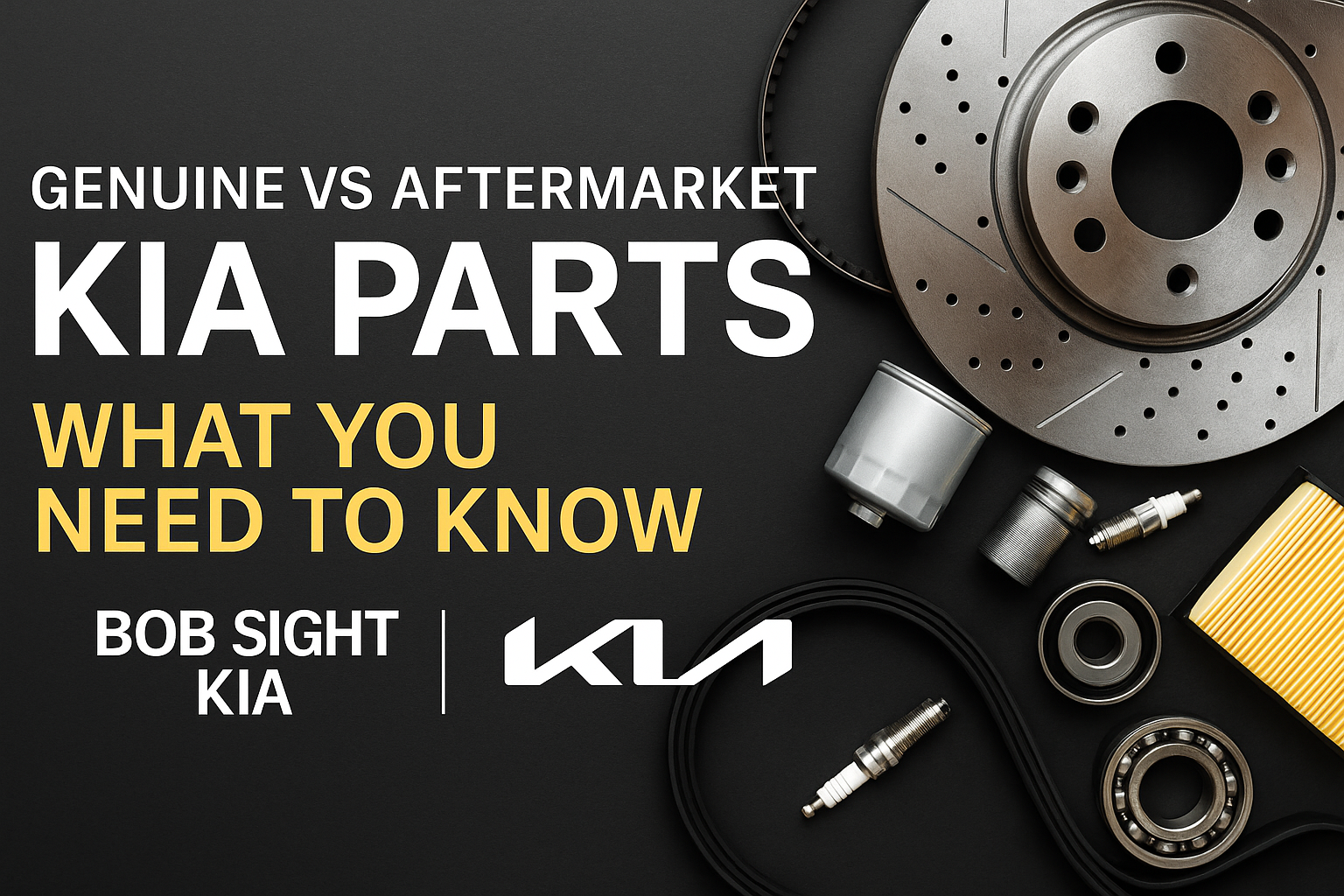
Genuine vs Aftermarket Kia Parts: What You Need to Know

Genuine Kia parts vs aftermarket comparison at Bob Sight Kia Independence MO

If you're a Kia owner near Independence, MO, you already know that keeping your vehicle in top shape means making the right choices. Especially when it comes to parts. Whether you’re doing a quick repair, a routine maintenance task, or a full replacement, you’ll need to decide: do I go with genuine Kia parts or aftermarket alternatives?

This guide will break down the pros and cons of both options and help you understand why Bob Sight Kia strongly recommends OEM (Original Equipment Manufacturer) parts for Kia drivers throughout Missouri and Kansas.

What Are Genuine Kia Parts?

Genuine Kia parts, also called OEM parts, are designed, tested, and produced by Kia or its trusted partners. They are made to match the exact specifications of your vehicle and are the same parts used during factory assembly.

Benefits:

  • Guaranteed fit and compatibility
  • Built to meet Kia’s quality and safety standards
  • Covered by a manufacturer warranty
  • Helps maintain your vehicle’s resale value

When installed by a certified Kia technician at Bob Sight Kia, these parts are backed by both the manufacturer and dealership, giving you total peace of mind.

What Are Aftermarket Parts?

Aftermarket parts are produced by third-party companies that are not affiliated with Kia. They can be used as replacements for various components in your vehicle, but they vary widely in terms of fit, quality, materials, and reliability.

Risks of Aftermarket Parts:

  • May not fit perfectly, causing installation or performance issues
  • Quality can vary, even within the same brand
  • May not meet Kia’s safety or performance standards
  • Typically not covered by your Kia warranty

Side-by-Side Comparison: Genuine vs Aftermarket

FeatureGenuine Kia PartsAftermarket Parts
Fit & CompatibilityExact matchVaries by manufacturer
Quality ControlFactory-testedInconsistent
WarrantyCovered by KiaRarely covered
CostSlightly higherMay be cheaper
LongevityBuilt to lastMay wear faster
InstallationSeamless at dealershipMay require modification

When Aftermarket Might Make Sense

There are cases where an aftermarket part could be a viable option:

  • You’re driving an older Kia model and cost is a major concern
  • The part is non-essential (like a cosmetic trim or mirror cap)
  • You’ve researched the aftermarket brand thoroughly and trust its quality

That said, even in these situations, we recommend checking with our Parts Department before making a purchase. We can help you weigh the risk vs. reward.

Warranty Protection: Don’t Risk It

Here’s the big catch: installing aftermarket parts can void portions of your Kia’s warranty, especially if the part causes damage or a failure. If you’re still under Kia’s bumper-to-bumper or powertrain warranty, always opt for genuine parts installed at a certified Kia service center.

Examples of Parts Where OEM Matters Most

Brake Pads and Rotors Aftermarket pads may squeak, wear unevenly, or reduce stopping power. Genuine Kia brake components are tested to work perfectly with your car’s weight, performance, and ABS system.

Suspension Components Struts, shocks, and bushings must match exact specs. Misalignment or poor damping from aftermarket parts can affect comfort, handling, and tire wear.

Engine Sensors and Electronics Aftermarket sensors often cause check engine lights, misreadings, or inconsistent behavior. Kia-certified sensors ensure your powertrain functions correctly.

Airbags and Crash Sensors Always use OEM. Aftermarket crash components may not deploy properly or at all. Safety isn’t worth compromising.

Filters and Fluids Even small components like oil filters, transmission fluid, and cabin air filters work best when sourced from Kia. Substandard filters can lead to engine wear or HVAC failure.

The Value of Expert Guidance

Not sure what part you need? Our team at Bob Sight Kia can:

  • Look up the exact part number for your VIN
  • Show you side-by-side comparisons
  • Provide pricing and installation quotes
  • Advise you on which parts are in stock or can be ordered

We also offer online parts ordering for added convenience.

Labor Costs: Saving Now vs Paying Later

While aftermarket parts may save you a few bucks upfront, they often lead to higher installation costs. Why?

  • More time required to fit or modify the part
  • Reinstall costs if the part fails prematurely
  • Higher likelihood of related issues down the road

When you choose OEM Kia parts, installation is faster, more precise, and less likely to result in callbacks or rework.

Internal Links for Better Ownership Experience

Explore more of our Kia support resources:

What Do Real Customers Say?

“I used a non-Kia filter from a national chain and had engine noise within weeks. Bob Sight Kia replaced it with the right OEM part, and the issue went away instantly.” — Sean M., Kansas City

“I was skeptical about the price difference at first, but after two failed aftermarket wiper blades, I only use genuine Kia blades now.” — Trina H., Independence

The Bob Sight Kia Advantage

  • Over 100 years of auto service expertise
  • OEM-trained technicians and advisors
  • Access to Kia engineering and repair documentation
  • Commitment to customer satisfaction every step of the way

Frequently Asked Questions About Kia Parts

Q: Are genuine Kia parts more expensive than aftermarket?
A: In many cases, yes, but they provide greater long-term value. OEM parts last longer, offer guaranteed fit, and help you avoid unexpected repairs caused by incompatible aftermarket components.

Q: Can aftermarket parts void my Kia warranty?
A: Yes. If a non-Kia part causes or contributes to a vehicle failure, Kia may deny warranty coverage for that component. That’s why we recommend always using OEM parts while your vehicle is under warranty.

Q: Are there any aftermarket parts that are okay to use?
A: For some non-essential accessories like seat covers or phone mounts, high-quality aftermarket options can work fine. But for critical components, especially those related to safety or performance, always go OEM.

Q: How can I verify if a part is genuine?
A: Look for Kia’s branding and part number, or purchase through a certified dealership like Bob Sight Kia. Our parts team will always ensure you receive authentic components.

Q: Is it cheaper to buy OEM parts online?
A: It depends. While some third-party websites offer discounts, you risk getting non-genuine or used parts. Buying directly from our dealership ensures authenticity, expert guidance, and warranty coverage.

How to Tell If a Part Needs Replacement

If your Kia is showing signs of trouble, it could be time to inspect or replace worn components. Watch for:

  • Unusual noises during acceleration or braking
  • Dashboard warning lights
  • Decreased fuel economy
  • Poor A/C or heating performance
  • Flickering headlights or interior lights

Not sure what’s wrong? Stop by Bob Sight Kia for a free multi-point inspection.

Easy Upgrades Using Genuine Kia Accessories

OEM parts aren’t just for repairs, they’re also the best way to enhance your Kia’s style and function. Some of our most popular factory accessories include:

  • Roof racks and crossbars
  • Cargo organizers and floor mats
  • Remote start kits
  • All-weather interior protection
  • Custom splash guards

Because they’re designed for your specific model, these parts fit perfectly and work seamlessly with your vehicle’s systems.

Supporting Vehicle Longevity with the Right Parts

Using genuine Kia parts is a key part of any long-term vehicle ownership strategy. Whether you plan to keep your vehicle for 10 years or trade it in after 5, using OEM components helps you:

  • Reduce unexpected breakdowns
  • Maintain consistent fuel efficiency
  • Preserve your vehicle’s trade-in value
  • Simplify repair and resale documentation

Dealerships and private buyers alike prefer vehicles with service histories that include OEM replacement parts. It’s a signal of care, consistency, and reliability.

How Bob Sight Kia Ensures OEM Quality Every Time

At Bob Sight Kia, we’ve built our service reputation by staying loyal to one thing, quality. That’s why our Parts Department is stocked only with genuine OEM Kia components. But our commitment doesn’t stop at stocking shelves. We go the extra mile by:

  • Verifying all part compatibility by VIN
  • Educating customers on installation timelines, options, and value
  • Working directly with Kia to stay updated on recalls, upgrades, and best practices
  • Maintaining clean, organized inventory to ensure part integrity

Our advisors aren’t here to sell, they’re here to inform and guide you toward the best, most cost-effective solution for your vehicle.

Future-Proofing Your Kia: Why OEM Matters More with Time

As Kia’s vehicles become more advanced, particularly with hybrid and EV models like the Niro, EV6, and Sorento Hybrid—precision matters more than ever. These vehicles rely heavily on electronic communication between systems, which means that a poorly calibrated or incompatible aftermarket sensor could affect not only performance, but also safety.

Even traditional systems like steering, braking, or climate control now include more computer-managed elements. OEM parts ensure your vehicle operates as intended, especially as your Kia ages and accumulates mileage.

OEM parts:

  • Integrate seamlessly with vehicle electronics
  • Communicate properly with sensors and onboard diagnostics
  • Are tested to work in all operating conditions
  • Often receive software compatibility checks from Kia

With technology playing a larger role in reliability and comfort, OEM is no longer a preference, it’s a necessity.

Environmental Impact of Choosing OEM Parts

While most people think of performance and cost when choosing auto parts, it’s worth considering the environmental impact, too. Genuine Kia parts are manufactured with more rigorous standards for quality control and material sourcing, which often means:

  • Less waste due to part failure
  • Longer life cycles, reducing landfill impact
  • Better material traceability and recycling programs

Aftermarket parts, on the other hand, are often made with cheaper materials, produced in facilities that may not meet environmental guidelines, and frequently require more replacements—leading to more waste.

At Bob Sight Kia, we also recycle used parts and fluids responsibly through certified programs. When you purchase and install OEM parts with us, you're making a smarter choice for the environment as well as your vehicle.

Education First: What We Do Differently at Bob Sight Kia

Some parts counters are focused on upselling. At Bob Sight Kia, we prioritize transparency and education. Our parts advisors:

  • Explain differences between OEM and aftermarket options without jargon
  • Walk you through service diagrams so you understand exactly what’s being replaced
  • Offer guidance on future service planning based on your driving habits

This helps customers make informed decisions and avoid unnecessary spending or future complications.

Accessory Packages and Upgrade Bundles

For drivers looking to personalize their Kia, we offer factory-approved accessory packages. These bundles include:

  • Appearance packages with trim, spoilers, and wheels
  • Utility packages with roof crossbars, cargo trays, and tow hitches
  • Cold-weather packages with remote start and heated steering wheel kits

Each bundle is designed specifically for your model and installed by factory-trained technicians. You won’t get the same assurance with third-party kits from chain stores.

Final Thoughts: Why Genuine Kia Parts Win

In almost every situation, choosing OEM Kia parts is the smart move. They offer better performance, longer life, and peace of mind. And when you work with Bob Sight Kia, you get the support of certified technicians, transparent pricing, and access to a trusted parts inventory.

Whether you’re replacing something small or major, come see why Kansas and Missouri drivers continue to trust us for their parts and service needs.

Order Genuine Kia Parts
Schedule Kia Service
Contact the Parts Department

Explore More from the Bob Sight Auto Group

Posted in:

Related Posts

Kia service technician inspecting tire tread at Bob Sight Kia in Independence, Missouri

Kia Tire Service Guide for Independence, MO Drivers

Kia Tire Service Guide for Independence, MO Drivers Your Kia’s tires affect nearly every drive through Independence and the Kansas City Metro. They influence steering response, braking, ride comfort, traction, fuel efficiency, and how confidently your vehicle handles changing Missouri weather. Routine Kia tire service can also help tires wear more evenly and reduce the chance that preventable damage interrupts your commute. Drivers searching for Kia tire service near me can visit Bob Sight Kia in Independence, Missouri, for tire inspections, rotations, balancing, alignment service, and replacement guidance. Our service center is located at 1700 South Noland Road and serves Kia owners from Independence, Blue Springs, Lee’s Summit, Raytown, Grain Valley, Sugar Creek, Liberty, Oak Grove, and communities across Jackson County. This guide explains when to schedule tire service, how to check your tires at home, what common wear patterns mean, and how Missouri driving conditions can affect tire performance. Why Is Routine Kia Tire Service Important? Routine Kia tire service supports safer handling, more predictable braking, a smoother ride, and longer-lasting tires. Tires are your vehicle’s direct point of contact with the road. When tire pressure, tread depth, balance, or alignment is incorrect, the vehicle may not respond as designed. Regular tire maintenance gives a technician an opportunity to identify wear before it becomes a more expensive or inconvenient problem. A simple inspection may uncover low pressure, a puncture, sidewall damage, uneven tread, or an alignment concern. Addressing these issues early can help protect the tire and other related components. Properly maintained tires can support: More consistent traction on dry and wet roads Predictable steering and braking response More even tread wear Reduced vibration at highway speeds Better ride quality Improved fuel efficiency Longer useful tire life Tire condition becomes even more important during heavy rain, summer heat, freezing temperatures, and sudden winter weather. Independence drivers regularly encounter all of these conditions throughout the year. Routine tire care also provides a chance to review how your tires are wearing relative to your driving habits. Frequent stop-and-go traffic, highway commuting, potholes, construction areas, and heavily loaded trips may all affect tire life. How Often Should Kia Tires Be Rotated? Kia owners should follow the tire rotation interval listed in the maintenance schedule for their exact model, year, powertrain, and tire configuration. Many drivers coordinate tire rotations with scheduled maintenance visits, but the correct interval should always come from the vehicle’s owner’s manual. Tire rotation changes each tire’s position on the vehicle. Front and rear tires often perform different jobs and may wear at different rates. On many vehicles, the front tires handle a larger share of steering and braking forces. Rotating the tires according to the recommended pattern can help distribute wear more evenly. The proper rotation pattern may depend on: Front-wheel drive, all-wheel drive, or rear-wheel drive Directional or non-directional tires Matching or staggered tire sizes Full-size spare tire availability Tire manufacturer instructions Vehicle-specific maintenance requirements Not every tire can be moved to every position. Directional tires, for example, are designed to rotate in a particular direction. Vehicles with different front and rear tire sizes may have additional restrictions. A Kia service technician can identify the proper pattern for your vehicle. You may need a tire inspection before the normal maintenance interval if you notice vibration, pulling, uneven wear, pressure loss, or unusual road noise. Tire service intervals should be treated as a baseline, not a reason to ignore a developing symptom. Owners can review vehicle-specific information through the official Kia owner’s manual resource or ask the service team at Bob Sight Kia for guidance. How Do You Check Tire Pressure Correctly? Check tire pressure when the tires are cold and use the pressure listed on the vehicle’s tire information label, not the number printed on the tire sidewall. The placard is commonly located on the driver’s doorjamb and lists the recommended cold inflation pressure for the original tire configuration. The pressure molded into a tire’s sidewall represents tire information and limits. It is not the normal inflation target for your particular Kia. Always use the vehicle manufacturer’s recommended pressure unless a qualified professional has provided configuration-specific instructions. Follow these steps to check tire pressure: Park the vehicle and allow the tires to cool. Locate the tire information placard on the driver’s doorjamb. Remove the valve cap from the first tire. Press a reliable tire pressure gauge firmly onto the valve stem. Compare the reading with the recommended cold pressure. Add air if the pressure is low. Release a small amount of air if the pressure is too high. Recheck the tire to confirm the final reading. Replace the valve cap and repeat the process on the remaining tires. Check the spare tire if your Kia includes one. The National Highway Traffic Safety Administration recommends checking tire pressure regularly, including before longer trips. A monthly check is a useful habit because tires can gradually lose air even when no obvious puncture is present. Temperature changes also affect tire pressure. A noticeable drop in outdoor temperature may cause the tire pressure monitoring system light to appear. Adding air based on the vehicle placard can correct normal seasonal pressure loss, but a tire that repeatedly loses air should be inspected for a puncture, valve issue, wheel damage, or sealing problem. Do not rely only on appearance. A tire may be underinflated without looking visibly low. A pressure gauge provides a much more reliable assessment. What Do Common Kia Tire Wear Patterns Mean? Uneven tire wear can point to pressure problems, alignment concerns, balance issues, worn suspension components, or delayed rotations. The location and shape of the wear provide useful clues, but a professional inspection is the best way to determine the cause. Wear Along Both Outer Edges Wear on both shoulders of a tire can be associated with underinflation. Driving while a tire is underinflated may cause the outer portions of the tread to carry more of the load. It can also increase heat buildup and rolling resistance. Wear Through the Center Excessive center tread wear may be linked to overinflation. When a tire carries too much pressure, the center of the tread may make greater contact with the road than the shoulders. Wear on One Edge Heavy wear on the inner or outer edge may indicate an alignment or suspension concern. A vehicle that pulls to one side or has an off-center steering wheel should be inspected. Cupping or Scalloped Wear Alternating high and low areas around the tread may be associated with balance problems, worn suspension parts, or another condition that allows the tire to move irregularly against the road. Flat Spots A localized flat area can develop after hard braking, prolonged storage, or certain tire and suspension conditions. Some temporary flat spotting may improve as the tire warms, while persistent vibration requires attention. Rapid Wear on One or Two Tires If one tire is wearing much faster than the others, do not assume rotation alone will solve the problem. A technician should check inflation, alignment, balance, suspension condition, and tire damage. Drivers can perform a quick visual check at home, but tread wear should be evaluated across the full width and circumference of each tire. Inner-edge wear may be difficult to see without the vehicle being lifted. When Does a Kia Need Wheel Alignment Service? Your Kia may need an alignment inspection when it pulls, the steering wheel sits off-center, or the tires develop uneven edge wear. Wheel alignment refers to the angles at which the wheels meet the road. Those angles help the tires track correctly and maintain consistent contact with the pavement. Alignment can change after hitting a pothole, striking a curb, driving through road construction, or encountering other impacts. Normal wear in steering and suspension components can also contribute to alignment changes over time. Common signs of a potential alignment problem include: The vehicle pulls left or right on a reasonably level road The steering wheel appears crooked while driving straight One tire edge wears faster than the other The vehicle feels less stable than normal Steering response has changed New tires begin wearing unevenly A vehicle may still need an alignment even if the driver does not feel a strong pull. Small changes can appear first as unusual tread wear. That is one reason tire inspections are useful during routine maintenance. An alignment is different from tire balancing. Alignment adjusts wheel angles, while balancing addresses weight distribution around the tire and wheel assembly. A Kia can need one service without needing the other, or it may benefit from both. Independence and Kansas City-area roads can be challenging after winter freeze-and-thaw cycles. Potholes along local streets or major routes such as I-70, I-435, Missouri Route 291, and U.S. Route 40 may place additional stress on tires, wheels, and suspension components. What Is Tire Balancing and When Is It Needed? Tire balancing helps the wheel and tire assembly rotate evenly and can reduce vibration, irregular wear, and stress on related components. During balancing service, a technician measures weight distribution and installs small wheel weights where needed. A tire and wheel assembly can become imbalanced as the tire wears. Balance can also change after tire installation, wheel repairs, impact damage, or the loss of a wheel weight. Possible signs of an imbalance include: Steering wheel vibration at certain speeds Vibration felt through the seat or floor Uneven or cupped tread wear A change in ride smoothness Vibration that becomes more noticeable on the highway Vibration has several possible causes, so balancing should not be treated as an automatic diagnosis. Tire damage, bent wheels, alignment concerns, suspension wear, debris buildup, and drivetrain issues can create similar symptoms. If your Kia begins vibrating after hitting a pothole or road hazard, safely reduce speed and arrange an inspection. A hard impact can damage more than balance. It may affect the tire structure, wheel, alignment, or suspension. Balancing is commonly performed when new tires are installed. It may also be recommended when a tire is repaired and remounted or when symptoms indicate that the assembly no longer rotates smoothly. When Should Kia Tires Be Replaced? Kia tires should be replaced when tread is worn to an unsafe or legally insufficient level, damage cannot be safely repaired, age has become a concern, or the tires no longer meet the vehicle’s needs. Tire replacement should be based on condition, age, performance, and professional evaluation rather than mileage alone. Replacement may be necessary when you find: Tread worn to the built-in wear indicators Cracks, cuts, bulges, bubbles, or exposed material A puncture outside a repairable tread area Repeated air loss Uneven wear that has significantly reduced usable tread Damage caused by driving while underinflated Age-related deterioration Persistent vibration linked to tire damage Treadwear indicators are raised bars located within the tread grooves. When the surrounding tread wears level with these bars, replacement is needed. Drivers should not wait for completely smooth tread. Wet-weather and winter traction can decline before the tire reaches its final wear limit. Tire age matters because rubber and internal materials change over time. The Department of Transportation identification code on the sidewall includes the tire’s production date. The final four digits identify the week and year of manufacture. For example, a code ending in 2425 indicates production during the 24th week of 2025. Age guidelines can vary by manufacturer, tire design, vehicle use, storage, climate, and condition. Ask a qualified technician to evaluate older tires rather than relying on appearance alone. If only one or two tires require replacement, the correct placement and compatibility depend on the vehicle and drivetrain. All-wheel-drive Kia models may have limits on acceptable tread-depth differences because the tires work together as part of the drivetrain. Consult the owner’s manual and a Kia service professional before mixing tires with substantially different wear levels. Are All-Season Tires Enough for Independence, Missouri? Quality all-season tires meet the needs of many Independence drivers, but all-weather or winter tires may provide added cold-weather capability for certain driving routines. The best choice depends on road conditions, commute timing, driving frequency, and whether you can delay travel during severe weather. All-season tires are designed to provide balanced performance in a range of conditions. They are a common choice for drivers who travel mainly on treated city streets and highways. However, their snow and ice performance varies by model. All-weather tires generally provide stronger winter capability than traditional all-season designs while remaining suitable for year-round use. Tires carrying the three-peak mountain snowflake symbol meet a specific performance standard for severe snow conditions. Dedicated winter tires use tread compounds and patterns designed for cold temperatures, snow, and ice. They may be worthwhile for: Drivers who must commute before roads are cleared Healthcare, public safety, and other essential workers Households that frequently travel on untreated roads Drivers who make regular winter trips outside the metro Owners who want the strongest available cold-weather traction All-wheel drive can help a vehicle accelerate in low-traction conditions, but it does not replace appropriate tires. Braking and cornering still depend heavily on tire grip. A front-wheel-drive vehicle with suitable winter tires may provide more controlled stopping than an all-wheel-drive vehicle on worn or unsuitable tires. Missouri drivers should also consider rain performance. Adequate tread helps move water away from the tire’s contact area. Worn tread can increase the risk of hydroplaning, making routine inspections valuable throughout the year rather than only before winter. How Can Independence Drivers Help Their Tires Last Longer? Maintaining correct pressure, scheduling rotations, correcting alignment problems, and avoiding unnecessary impacts can help extend tire life. Tire longevity depends on many factors, but consistent maintenance gives each tire a better opportunity to wear evenly. Use this tire-care routine: Check tire pressure at least monthly and before long trips. Use the cold pressure listed on the vehicle placard. Inspect the tread and sidewalls for visible damage. Schedule rotations according to the vehicle maintenance schedule. Investigate pulling, vibration, or steering changes promptly. Have alignment checked when uneven wear appears. Avoid striking curbs and slow down for unavoidable road hazards. Do not exceed the vehicle’s load rating. Keep service records for rotations, alignments, and repairs. Arrange seasonal inspections before demanding travel periods. Driving style can also influence tire life. Hard acceleration, abrupt braking, aggressive cornering, and high-speed impacts create additional stress and heat. Smooth inputs generally support more even wear. Vehicle loading matters as well. Carrying excessive weight can increase tire stress and change handling. Consult the tire and loading label or owner’s manual before carrying a heavy load or towing. Do not ignore a pressure warning light after adding air. If the same tire loses pressure again, it needs an inspection. Continuing to drive on an underinflated tire can create heat and internal damage that may not be visible from outside. Can a Punctured Kia Tire Be Repaired? Some punctures in the main tread area can be repaired, but sidewall damage, shoulder punctures, large holes, and tires driven while severely underinflated may require replacement. A technician must remove and inspect the tire to determine whether a safe repair is possible. A proper evaluation considers: The location of the puncture The size and angle of the damage Whether the tire was driven while low or flat Internal liner and structural condition Existing repairs Tread depth and overall tire age An external plug alone does not allow a technician to inspect the inside of the tire. Industry-accepted repair procedures commonly involve removing the tire from the wheel, inspecting it internally, and sealing both the injury channel and inner liner when the damage qualifies. If a tire suddenly loses pressure while driving: Hold the steering wheel firmly. Avoid abrupt braking or sharp steering. Reduce speed gradually. Move to a safe location away from traffic. Activate the hazard lights. Use roadside assistance if changing the tire would be unsafe. Have the damaged tire professionally inspected. Never crawl under a vehicle supported only by an emergency jack. Follow the vehicle owner’s manual for spare tire and lifting instructions. Why Choose Bob Sight Kia for Tire Service? Bob Sight Kia provides Kia-focused tire care, convenient online scheduling, and service guidance tailored to local driving conditions. Our service team can inspect your tires while considering how pressure, tread, balance, alignment, suspension condition, and driving habits work together. Available tire-related services may include: Tire inspections Tire rotations Wheel balancing Wheel alignment service Pressure checks and adjustments Tire pressure monitoring system evaluation Repairability assessments Replacement tire guidance Seasonal tire evaluations Using a Kia dealership for tire service can be convenient because technicians can evaluate the tires alongside the vehicle’s steering, suspension, braking, and electronic systems. The service department also has access to vehicle-specific information and manufacturer-informed procedures. Before booking, review the current Kia service and parts specials. Offers and eligibility can change, so read the current terms and confirm details with the dealership. Drivers can schedule Kia tire service online at a convenient time. When making the appointment, describe any pulling, vibration, pressure loss, noise, or recent road impact so the service team understands the concern. Frequently Asked Questions About Kia Tire Service Regular pressure checks, rotations, inspections, balancing, and alignment care form the foundation of Kia tire maintenance. The following answers address common questions from Independence-area drivers. How often should I check the tire pressure on my Kia? Checking tire pressure at least once a month and before longer trips is a practical routine. Measure pressure when the tires are cold and use the specification on the driver’s doorjamb label. If one tire repeatedly loses pressure, schedule an inspection rather than continuing to add air. How do I know if my Kia needs a tire rotation? Follow the maintenance schedule for your exact Kia model and year. You should also request an inspection if the front and rear tires appear to be wearing at different rates, you notice unusual road noise, or you are unsure when the last rotation was completed. What is the difference between balancing and alignment? Balancing corrects uneven weight distribution in a tire and wheel assembly. Alignment adjusts the angles at which the wheels meet the road. Vibration may suggest a balance issue, while pulling or one-sided tread wear may indicate an alignment concern, though a professional inspection is needed for an accurate diagnosis. Can all-wheel drive prevent tire slipping in winter? All-wheel drive can help a Kia accelerate when traction is limited, but it cannot replace suitable tires or careful driving. Turning and braking still depend on available tire grip. Adequate tread depth and a tire designed for the conditions remain important. Where can I get Kia tire service near me in Independence? Bob Sight Kia offers tire service at 1700 South Noland Road in Independence, Missouri. The dealership serves drivers from Blue Springs, Lee’s Summit, Raytown, Grain Valley, Sugar Creek, Liberty, Oak Grove, Jackson County, and the Greater Kansas City Metro. Schedule Kia Tire Service in Independence, MO Schedule tire service when your Kia needs a rotation, pressure check, balance, alignment inspection, repair assessment, or replacement tires. Taking action when symptoms first appear can help protect tire life and maintain predictable vehicle performance. Bob Sight Kia is conveniently located on South Noland Road near I-70 and is accessible to drivers throughout eastern Jackson County. Whether you drive a Kia Sportage, Sorento, Telluride, Seltos, Carnival, K4, K5, Niro, EV6, or EV9, our team can help you understand the tire requirements for your vehicle. Visit the Bob Sight Kia Service Center to learn more, or use our online service scheduler to request an appointment. Trust Is Our Tradition. Helpful Links Schedule Kia Service Explore the Bob Sight Kia Service Center View Service and Parts Specials Learn About Lifetime Oil Changes and Tire Rotations Find Your Kia Owner’s Manual About Bob Sight Auto Group Bob Sight Kia is part of the family-owned Bob Sight Auto Group serving drivers throughout the Greater Kansas City area and Northeast Kansas. Our dealership group is committed to straightforward guidance, dependable automotive care, and long-term customer relationships. The Bob Sight family includes Bob Sight Kia in Independence, Bob Sight Ford in Lee’s Summit, Bob Sight Honda and Bob Sight CDJR in Lawrence, and the Bob Sight Collision Center in Lee’s Summit. From routine tire maintenance to vehicle shopping and collision repair, our teams are here to support drivers throughout the ownership experience.

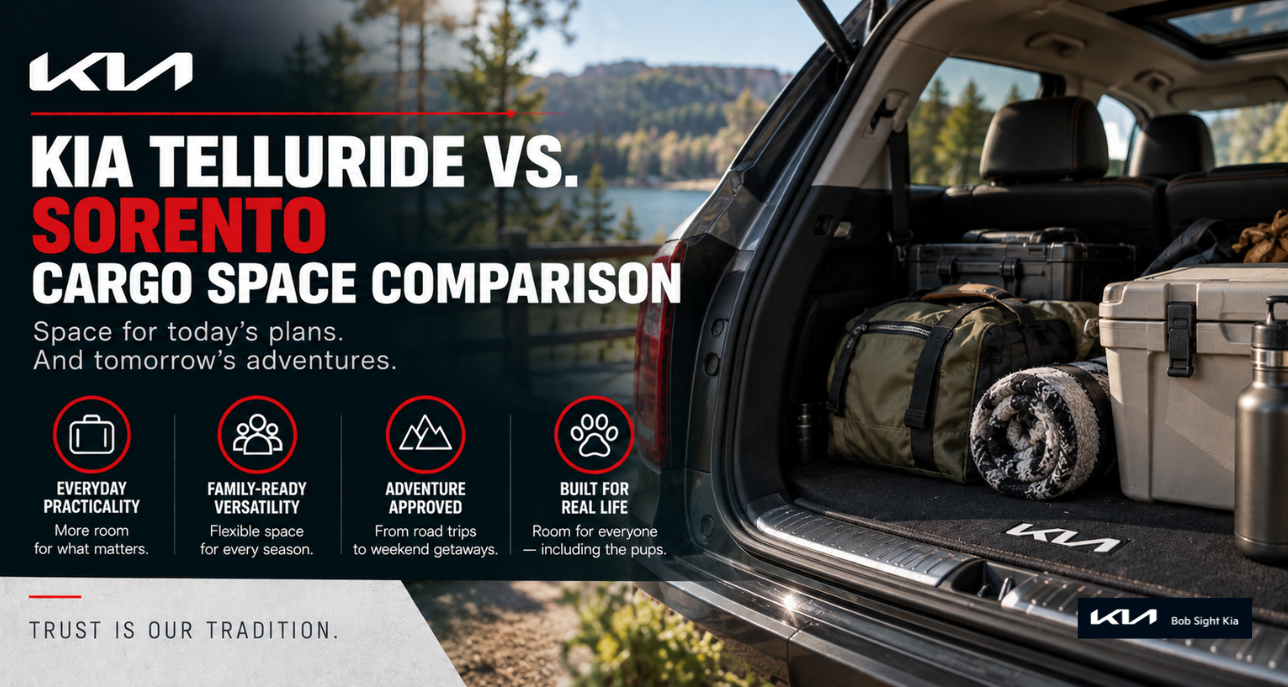
Comparison of the cargo areas inside a 2027 Kia Telluride and 2026 Kia Sorento

2027 Kia Telluride vs. 2026 Sorento Cargo Space

2027 Kia Telluride vs. 2026 Kia Sorento Cargo Space Comparison Choosing between the 2027 Kia Telluride and 2026 Kia Sorento often comes down to how much passenger room and cargo flexibility your household needs. Both Kia SUVs offer three rows of seating, versatile folding seats, and practical storage solutions, but they serve different types of drivers. The larger 2027 Telluride provides considerably more cargo capacity, while the midsize 2026 Sorento offers easier maneuverability and useful space in a more compact package. For families in Independence, Blue Springs, Lee’s Summit, Raytown, and the Kansas City Metro, cargo capacity can affect everything from school-day routines to holiday travel. This guide compares the cargo measurements, seating layouts, everyday usability, and ownership considerations of these two Kia SUVs. Drivers can visit Bob Sight Kia in Independence, Missouri, to explore available Kia SUVs and compare their interiors in person. Which Has More Cargo Space: the 2027 Kia Telluride or 2026 Kia Sorento? The 2027 Kia Telluride has more cargo space than the 2026 Kia Sorento behind every seating row. Kia lists the redesigned 2027 Telluride with approximately 22.3 cubic feet behind the third row, 48.7 cubic feet behind the second row, and up to 89.3 cubic feet when the rear seating area is folded. The 2026 Kia Sorento provides approximately 12.6 cubic feet behind its third row, 38.5 cubic feet behind its second row, and as much as 75.5 cubic feet behind the first row. Measurements can vary slightly by configuration, equipment, and the way manufacturers calculate cargo volume, so shoppers should confirm specifications for the exact trim they are considering. 2027 Kia Telluride behind the third row: Approximately 22.3 cubic feet 2026 Kia Sorento behind the third row: Approximately 12.6 cubic feet 2027 Kia Telluride behind the second row: Approximately 48.7 cubic feet 2026 Kia Sorento behind the second row: Approximately 38.5 cubic feet 2027 Kia Telluride maximum cargo volume: Approximately 89.3 cubic feet 2026 Kia Sorento maximum cargo volume: Approximately 75.5 cubic feet Those numbers make the Telluride the stronger choice when maximum cargo capacity is the priority. The Sorento remains highly versatile, but it is designed for drivers who want three-row functionality without moving into a larger SUV. The biggest practical difference appears when all three rows are in use. The Telluride offers nearly 10 additional cubic feet behind the third row. That extra room can make it easier to carry groceries, backpacks, sports gear, or small luggage while keeping every passenger seat available. How Much Fits Behind the Third Row? The 2027 Kia Telluride is better suited to carrying passengers and cargo at the same time. Its approximately 22.3 cubic feet behind the third row gives families more freedom to use all three rows without leaving most of their belongings at home. Behind the third row, the Telluride may accommodate several grocery bags, school bags, compact sports equipment, or a collection of smaller travel items. The area is also easier to organize when families use soft-sided bags, collapsible containers, or cargo organizers. The 2026 Sorento’s approximately 12.6 cubic feet behind the third row is useful for everyday essentials, but households should plan more carefully when all seats are occupied. It works well for groceries, backpacks, emergency supplies, or a few compact bags. Larger travel items may require folding one side of the third row. This difference matters for several common Kansas City-area driving situations: Taking six or more people to a youth sporting event Driving to Kansas City International Airport with luggage Carrying groceries while the third row is occupied Transporting school bags, instruments, and activity equipment Keeping winter safety supplies in the vehicle The Telluride is likely the better fit if your household regularly fills the third row. If the third row will only be used occasionally, the Sorento may provide enough room while giving you a smaller vehicle for daily driving. What Happens When the Third Row Is Folded? Folding the third row creates a large, practical cargo area in both SUVs, but the Telluride maintains an advantage. With its third row folded, the 2027 Telluride offers approximately 48.7 cubic feet of space. The 2026 Sorento provides approximately 38.5 cubic feet behind its second row. This configuration is useful for families that usually carry four or five people but want three-row seating available when needed. It creates room for larger grocery trips, strollers, sports bags, pet supplies, home improvement items, and weekend luggage. The second-row layout can also influence how you use the cabin. Depending on trim and configuration, shoppers may find a second-row bench or captain’s chairs. A bench can maximize passenger capacity, while captain’s chairs create a convenient path to the third row and give second-row occupants more personal space. To compare the cargo areas effectively during a dealership visit: Place the third-row seats in their upright position. Check whether your everyday bags fit behind them. Fold one side of the third row and examine the remaining passenger space. Fold the entire third row and inspect the cargo floor. Adjust the second-row seats to see how passenger legroom affects cargo room. Test the liftgate height and loading opening. This hands-on approach provides more useful information than cargo measurements alone. Two items with the same volume may have very different shapes, and a wide stroller or rigid storage container may fit better in one cargo area than another. Which SUV Is Better for Maximum Cargo Capacity? The 2027 Kia Telluride is the better choice for shoppers who frequently need the largest possible cargo area. Folding its second and third rows opens approximately 89.3 cubic feet, compared with approximately 75.5 cubic feet in the 2026 Sorento. With both rear rows folded, either vehicle can support errands and projects that would be difficult in a sedan. The Telluride’s additional capacity gives it an advantage for larger purchases, moving supplies, outdoor equipment, and multi-bag road trips. Potential uses for maximum cargo mode include: Transporting boxed furniture or household items Carrying camping equipment for a Missouri weekend Loading multiple suitcases for an extended trip Moving college supplies or apartment essentials Transporting pet crates or bulky recreation gear Picking up landscaping or home improvement supplies The Sorento still delivers strong utility for its size. Its maximum cargo area may be more than enough for drivers who use the third row occasionally and do not routinely transport bulky items. It provides a valuable middle ground between a compact two-row crossover and a larger three-row family SUV. When shopping, remember that maximum cargo capacity normally requires folding both rear rows. If you need to carry passengers and large items simultaneously, compare the space behind the second and third rows rather than relying only on the maximum figure. How Do Passenger Capacity and Seating Layout Affect Cargo Room? The Telluride generally provides greater flexibility for larger households, while the Sorento works well for smaller families that need occasional third-row seating. The Telluride can seat up to eight people in properly equipped configurations, while other versions use second-row captain’s chairs for seven-passenger seating. The Sorento can seat up to seven people, depending on its configuration. Some trims feature second-row captain’s chairs, reducing total capacity to six while improving access to the third row. A higher seating capacity does not automatically mean every configuration will suit every family. Parents should consider how frequently the third row will be occupied, whether child safety seats will be installed, and how much cargo must remain accessible. The Telluride may be the better match if you regularly transport: Three or more children Extended family members Carpool passengers Teammates and sports equipment Guests plus luggage The Sorento may be the better match if you usually carry: Two to four passengers Occasional third-row riders Daily groceries and school gear Weekend luggage for a smaller household One child safety seat with room for additional passengers Always follow the child safety seat manufacturer’s instructions and the vehicle owner’s manual. Families should test their actual child restraints when possible because seat contours, anchors, and passenger access can influence real-world usability. Which Kia SUV Is Easier to Drive Around Independence and Kansas City? The 2026 Kia Sorento is generally easier to maneuver because it packages three rows into a smaller footprint. That can be helpful when parking near Independence Center, navigating busy areas along Noland Road, or fitting into a residential garage. The Sorento can feel familiar to drivers moving up from a compact crossover. It provides an elevated seating position and available three-row flexibility without the dimensions of a larger family SUV. Drivers who commute on I-70, I-435, or Missouri Route 291 may appreciate its balance of interior utility and manageable size. The 2027 Telluride requires more parking and garage space, but many families find that worthwhile because of its larger cabin. Its size supports greater passenger comfort and more usable storage, which can be valuable on longer drives across the Kansas City Metro. Before choosing either model, check: Your garage length, width, and door clearance The dimensions of your regular parking space How confidently you can see around the vehicle Whether available parking assistance features meet your needs How easily passengers can enter the second and third rows Whether the liftgate can open fully inside your garage A test drive should include both neighborhood streets and a parking exercise. Cargo capacity matters, but the vehicle also needs to feel comfortable during the driving you do every day. Which Is Better for Road Trips and Family Activities? The 2027 Kia Telluride is the stronger road-trip option for larger families, while the 2026 Kia Sorento may be more efficient and convenient for smaller travel groups. The best choice depends on how many people travel with you and how much equipment they bring. For a full passenger load, the Telluride’s larger cargo area provides more flexibility for suitcases, coolers, blankets, and travel supplies. Its broader family-oriented cabin also makes it a natural choice for trips from Independence to the Lake of the Ozarks, Branson, or destinations beyond Missouri. The Sorento is appealing when a household wants three-row versatility but rarely uses every seat. A family of four could fold the third row and use approximately 38.5 cubic feet for luggage while retaining a comfortable second row. That can provide plenty of room for weekend travel without requiring a larger SUV throughout the rest of the year. Think about your busiest trip rather than your lightest errand. A vehicle that feels spacious during a short test drive can become crowded once passengers add coats, backpacks, charging cables, snacks, and luggage. Useful questions include: Can the vehicle carry everyone without stacking bags above the seatbacks? Will passengers have access to charging ports and storage? Can the third row remain in use with vacation luggage loaded? Is there a place for a stroller, cooler, or pet carrier? Can frequently used items remain accessible during the trip? If the answer regularly points toward needing more space, the Telluride is likely the better long-term choice. If your travel group is smaller and the third row is mainly a backup, the Sorento may offer the right balance. Should You Choose the 2027 Telluride or 2026 Sorento? Choose the 2027 Kia Telluride for maximum room and frequent three-row use, or choose the 2026 Kia Sorento for flexible seating in a more maneuverable SUV. Neither model is universally better because they solve different ownership needs. Consider the 2027 Kia Telluride if you: Regularly use all three rows Need meaningful storage behind the third row Transport a large family or frequent carpool Carry sports equipment and passengers together Take road trips with several people Want close to 90 cubic feet of maximum cargo capacity Consider the 2026 Kia Sorento if you: Usually carry four or fewer passengers Need a third row only from time to time Prefer a smaller vehicle for parking and commuting Want strong cargo versatility without moving to a larger SUV Plan to keep the third row folded during most trips Want to explore gas, hybrid, or plug-in hybrid configurations Powertrain availability may also shape the decision. The 2026 Sorento lineup includes gas, hybrid, and plug-in hybrid options. The redesigned 2027 Telluride is offered in gas and hybrid forms, giving shoppers another factor to evaluate alongside passenger and cargo space. Specifications can differ among powertrains and trims, so confirm the configuration of the exact vehicle you test. You can begin by browsing the new Kia inventory at Bob Sight Kia. Availability changes, so contact the dealership if you are looking for a specific seating layout, powertrain, color, or trim. How Should You Test Cargo Space at the Dealership? The best way to compare cargo space is to recreate your normal routine using the actual Telluride and Sorento interiors. Published measurements establish the size difference, but a physical test reveals whether your belongings fit conveniently. Bring measurements for your largest frequently carried items. If practical, bring an empty stroller, folded mobility device, sports bag, or storage container. You do not need to arrive with a full vacation load to learn whether the cargo area will work. During your comparison at Bob Sight Kia: Open the liftgate and examine the height and width of the opening. Check the cargo floor height to understand the lifting effort. Look for underfloor storage and organization features. Raise all three rows and evaluate the remaining cargo area. Fold only one section of the third row. Fold the complete third row and check floor continuity. Move the second-row seats into a comfortable passenger position. Sit in each row to evaluate access and personal space. Confirm that the liftgate can clear your garage or carport. Drive both SUVs on streets similar to your daily route. Shoppers replacing a current vehicle can also compare cargo openings and floor dimensions with what they own now. If you plan to trade, use the Bob Sight Kia trade-in tool before your visit. Drivers researching monthly payment options can complete the dealership’s online preapproval form. Preapproval can help you compare vehicle configurations within a comfortable budget while keeping the focus on the space and features your household needs. Where Can You Compare Kia SUVs Near Kansas City? Drivers can compare Kia SUVs at Bob Sight Kia, located at 1700 South Noland Road in Independence, Missouri. The dealership serves shoppers from Independence, Blue Springs, Lee’s Summit, Raytown, Grain Valley, Sugar Creek, Liberty, Oak Grove, Jackson County, and communities throughout the Kansas City Metro. Seeing the Telluride and Sorento close together makes their differences easier to understand. You can compare liftgate openings, third-row access, seating layouts, cargo-floor dimensions, visibility, and driving feel during one visit. Before visiting, consider making a short list of your priorities: Normal passenger count Maximum passenger count Items carried every week Largest items carried during trips Preferred second-row configuration Gas, hybrid, or plug-in hybrid preference Garage and parking limitations Desired comfort and technology features A product specialist can help identify available vehicles that match those priorities. If a particular configuration is not currently present, the team can explain inventory options and help you monitor availability. Long-term ownership also includes routine maintenance. Bob Sight Kia provides factory-informed care for Kia vehicles, and drivers can use the online tool to schedule Kia service in Independence. Frequently Asked Questions About Telluride and Sorento Cargo Space The most common questions involve maximum capacity, third-row usability, seating, and choosing the right size for everyday driving. These answers can help narrow your decision before visiting Bob Sight Kia. Does the 2027 Kia Telluride have more cargo space than the 2026 Kia Sorento? Yes. The 2027 Telluride offers approximately 22.3 cubic feet behind the third row, 48.7 cubic feet behind the second row, and 89.3 cubic feet with the rear rows folded. The 2026 Sorento provides approximately 12.6, 38.5, and 75.5 cubic feet in those configurations. Which Kia SUV is better when all three rows are occupied? The 2027 Telluride is generally better when all three rows are occupied because it leaves more cargo room behind the third row. That makes it easier to transport passengers along with groceries, backpacks, sports gear, or smaller travel bags. Is the Kia Sorento large enough for a family? Yes. The 2026 Sorento can be an excellent family SUV, particularly for households that usually carry four or fewer people but want an additional row when needed. Keeping the third row folded creates approximately 38.5 cubic feet of cargo space behind the second row. Does the Kia Telluride seat more people than the Kia Sorento? The 2027 Telluride can seat up to eight people in properly equipped configurations. The 2026 Sorento can seat up to seven. Models equipped with second-row captain’s chairs have lower total passenger capacity but can improve comfort and third-row access. Should I bring my stroller or cargo measurements to a test drive? Yes. Bringing an empty stroller or the measurements of frequently carried equipment can make the comparison more useful. It allows you to evaluate the cargo opening, floor shape, folding seats, and passenger space using your household’s actual needs. Compare the 2027 Kia Telluride and 2026 Kia Sorento at Bob Sight Kia The 2027 Kia Telluride is the cargo-space leader, while the 2026 Kia Sorento delivers practical three-row versatility in a smaller package. The Telluride is best suited to larger families, frequent third-row use, and trips that require passengers and luggage at the same time. The Sorento is a strong choice for shoppers who want occasional third-row seating, a useful cargo area, and easier everyday maneuverability. Visit Bob Sight Kia in Independence, MO, to explore Kia SUV options near you. Our team can help you compare seating configurations, cargo flexibility, powertrains, and available features so you can choose an SUV that fits your daily routine. Trust Is Our Tradition. Helpful Links Shop New Kia Vehicles Browse Used Vehicles Value Your Trade Get Preapproved Schedule Kia Service About the Bob Sight Auto Group Bob Sight Kia is part of the family-owned Bob Sight Auto Group serving drivers throughout the Greater Kansas City area and Northeast Kansas. Our dealership group is committed to creating straightforward automotive experiences built around helpful guidance and long-term relationships. In addition to Bob Sight Kia in Independence, the Bob Sight family includes Bob Sight Ford in Lee’s Summit, Bob Sight Honda and Bob Sight CDJR in Lawrence, and the Bob Sight Collision Center in Lee’s Summit. Whether you are shopping for a vehicle, scheduling maintenance, or arranging collision repairs, our teams are ready to help.

Raytown-area shoppers meeting with a Kia product specialist at Bob Sight Kia in nearby Independence, Missouri

Kia Dealer Near Raytown, MO | Bob Sight Kia

Finding a Kia Dealer Near Raytown, MO Visit Bob Sight Kia near Raytown, Missouri Raytown drivers searching for a Kia dealer near me can visit Bob Sight Kia at 1700 South Noland Road in nearby Independence, Missouri. Our dealership provides access to new Kia vehicles, used and Certified Pre-Owned options, financing resources, trade-in support, Genuine Kia Parts, and Kia service for drivers throughout eastern Jackson County and the Kansas City Metro. Choosing a dealership involves more than locating the closest inventory listing. A useful local Kia dealership should make it easy to compare vehicles, understand features, evaluate financing paths, maintain a current vehicle, and return for future ownership support. Raytown shoppers should consider both the initial buying experience and the relationship available after the vehicle leaves the dealership. Bob Sight Kia is conveniently located on Noland Road with access from the I-70 corridor and surrounding Jackson County routes. Whether you are searching for a Kia Sportage, Sorento, Telluride, Seltos, Carnival, K4, K5, hybrid, plug-in hybrid, or electric vehicle, our team can help you compare available options based on your daily needs. In This Guide You’ll Learn This guide explains what Raytown shoppers should consider when choosing a nearby Kia dealership. Where Raytown drivers can find Bob Sight Kia What to compare when selecting a local Kia dealer How new, used, and Certified Pre-Owned Kia options differ Which Kia models fit common Kansas City lifestyles How trade-in and financing tools support the buying process Why local Kia service matters after the purchase How to prepare for a productive dealership visit Where Is the Nearest Bob Sight Kia Dealer to Raytown? Bob Sight Kia is located at 1700 South Noland Road in Independence, Missouri, providing a convenient dealership option for Raytown-area Kia shoppers. The dealership is positioned near I-70 and can be reached from several commonly traveled eastern Jackson County routes. Drivers should check current traffic and construction conditions before leaving. Raytown and Independence are neighboring communities connected by familiar roads throughout eastern Jackson County. Depending on the starting point, drivers may use routes involving Missouri Route 350, I-435, I-70, Blue Ridge Boulevard, Raytown Road, Sterling Avenue, or Noland Road. The most efficient route can change with traffic, weather, and road work. Drivers approaching Bob Sight Kia from I-70 can exit toward Noland Road and travel north toward the dealership. Bob Sight Kia is located at 1700 South Noland Road, south of East 23rd Street. Shoppers should follow current navigation guidance because construction and traffic patterns can affect turn access. The location makes it possible for Raytown residents to handle several automotive needs through one dealership relationship. A shopper can compare new and used Kia vehicles, discuss financing, receive a trade appraisal, schedule service, and order parts. That continuity can be helpful when questions arise after the sale. For a Raytown commuter who regularly travels toward Independence, Blue Springs, or other Kansas City Metro destinations, choosing a dealership along familiar routes can make future visits easier. Routine oil changes, tire rotations, warranty concerns, recall work, and seasonal inspections become simpler to plan when the service department is reasonably accessible. Before visiting, check dealership hours and confirm that the vehicle or service appointment you need is available. Hours, staffing, and inventory can change. Scheduling ahead allows the team to prepare for a test drive, appraisal, vehicle demonstration, or service concern. What Should You Look for in a Kia Dealer Near Raytown? A Kia dealer near Raytown should provide useful vehicle selection, transparent information, knowledgeable assistance, flexible shopping tools, and dependable service after the purchase. Location is important, but convenience should also include how easy it is to research, buy, maintain, and ask questions about a vehicle. Begin by evaluating the dealership’s online inventory. Listings should make it possible to filter by model, body style, drivetrain, powertrain, trim, color, and other useful features. Because inventory changes frequently, contact the dealership to confirm availability before making a trip for one specific vehicle. Next, evaluate how the dealership handles comparison questions. A useful product specialist should be able to explain differences between the Kia Sportage and Sorento, gasoline and hybrid powertrains, front-wheel drive and all-wheel drive, or two-row and three-row configurations. The explanation should connect specifications with the shopper’s actual routine. Financing resources should also be easy to understand. A dealership can provide an online pre-approval application, trade-in tool, and access to available lenders. Final approval and terms depend on applicant qualifications, lender requirements, vehicle eligibility, and other factors. Service capabilities matter even when the shopper is focused on purchasing. An authorized Kia dealership can complete eligible manufacturer warranty repairs, recall remedies, Kia-specific diagnostics, routine maintenance, and parts replacement. Kia-trained technicians also have access to manufacturer procedures and vehicle-specific information. Use this checklist when comparing dealerships: Review new, used, and Certified Pre-Owned inventory online. Confirm that the dealership can explain Kia trims and powertrains clearly. Check whether trade-in and financing tools are available before visiting. Review service scheduling, parts access, and warranty-support capabilities. Evaluate whether the dealership communicates clearly before and after the visit. A local dealership should help reduce confusion rather than create pressure. The best experience gives shoppers enough information to compare options, verify details, and make a decision that fits their household. New Kia Vehicles for Raytown Drivers Bob Sight Kia provides Raytown-area shoppers with access to a broad range of new Kia SUVs, sedans, minivans, hybrids, plug-in hybrids, and electric vehicles. Model and trim availability changes as vehicles arrive and sell. Browsing current inventory is the best way to see which configurations are available now. The Kia Sportage is a practical option for commuters and small families who want two-row seating and useful cargo space. Available gasoline, hybrid, and plug-in hybrid powertrains allow shoppers to compare different ownership paths. Available all-wheel drive may appeal to drivers concerned about Missouri rain, snow, and changing road conditions. The Kia Sorento offers available three-row seating in a footprint smaller than the Telluride. It can work well for families that need occasional extra passenger space without choosing a larger SUV. The Sorento lineup also includes gasoline, hybrid, and plug-in hybrid configurations. The Kia Telluride provides three-row passenger space for larger families and road trips. Available all-wheel drive, flexible seating, cargo capacity, and advanced driver-assistance technology support a wide range of family routines. Shoppers should compare seven-passenger and eight-passenger seating configurations. The Kia Seltos is a compact crossover that suits drivers who value maneuverability and available AWD. It can be easier to position in crowded parking areas while still offering a practical cargo area. Raytown commuters may find its dimensions useful on both neighborhood streets and Kansas City highways. The Kia Carnival combines sliding-door access with three-row flexibility. It can serve families managing child restraints, school transportation, activities, and long-distance travel. Gasoline and hybrid availability gives Carnival shoppers more than one powertrain option. Drivers seeking a sedan can compare the Kia K4 and K5. Electrified shoppers may also consider the Kia Niro family, EV6, or three-row EV9, depending on current inventory. The best model depends on passenger capacity, cargo needs, commute length, charging access, and drivetrain preferences. Used and Certified Pre-Owned Kia Options Near Raytown Used and Certified Pre-Owned Kia vehicles give Raytown shoppers additional choices across model years, trims, mileage levels, and features. A used vehicle can be a practical way to find a preferred configuration that may no longer be available new. Every vehicle should be evaluated based on its specific condition and history. A conventional used vehicle may include a broad range of brands, ages, mileage levels, and equipment. Shoppers should review the vehicle-history report, available maintenance records, tire condition, feature operation, and inspection information. A test drive should include city traffic, highway acceleration, braking, steering, and parking. A Kia Certified Pre-Owned vehicle must satisfy current Kia program eligibility requirements and complete the required certification process. Kia’s CPO program has included a comprehensive 164-point inspection and eligible limited warranty benefits. Exact coverage, terms, exclusions, mileage limits, and program benefits should be verified for the individual vehicle. Certification does not mean that a vehicle will never require maintenance or repair. It provides an additional manufacturer-defined qualification process. Shoppers should still review the history, documentation, trim equipment, and current condition. Vehicle Type What It Offers What to Verify New Kia Current features, minimal accumulated mileage, and new-vehicle warranty eligibility Trim, options, drivetrain, and current warranty terms Kia Certified Pre-Owned Program qualification, detailed inspection, and eligible CPO benefits Certification status, coverage terms, history, and mileage Conventional Used Vehicle Broad selection across makes, years, mileage levels, and configurations Condition, history, inspection, remaining coverage, and service records A Raytown family may compare a used Kia Sportage with a new one to decide whether current technology or a specific prior-year trim matters more. A shopper needing three rows may compare used Sorento, Telluride, and Carnival models. Looking at multiple paths can reveal which vehicle provides the best practical fit. How to Choose the Right Kia Model for Your Lifestyle The right Kia model should match your passenger needs, cargo requirements, commute, preferred powertrain, and normal driving conditions. Choosing by body style alone can lead shoppers toward a vehicle that is larger or smaller than necessary. A realistic needs assessment makes the inventory easier to navigate. Start with passenger capacity. A commuter or couple may be comfortable in a K4, K5, Seltos, or Sportage. A growing family may need the second-row space of the Sportage or the available third row of the Sorento. Larger households may prefer the Telluride or Carnival. Next, measure cargo needs. Consider grocery bags, strollers, sports equipment, mobility devices, pet crates, tools, or luggage. Cargo measurements provide useful context, but the shape of the opening and floor can determine whether a particular item fits. Powertrain choice should reflect the driving routine. A conventional gasoline vehicle provides familiar operation. A hybrid uses gasoline and electric assistance without external charging. A plug-in hybrid adds a larger battery that can be charged, while a battery-electric vehicle relies entirely on stored electrical energy. Drivetrain also matters. Front-wheel drive can perform well for everyday Kansas City Metro travel when equipped with suitable tires. Available all-wheel drive can improve acceleration and forward progress on wet, snowy, or loose surfaces. AWD does not eliminate the need for appropriate tires or safe speeds. Use this process to narrow the options: List the number of passengers carried every week. Measure the largest cargo item transported regularly. Estimate daily and annual driving mileage. Determine whether home charging is available or desired. Identify required features such as AWD, heated seats, or a third row. Compare two or three models through back-to-back test drives. A Raytown driver commuting on Missouri Route 350 and I-435 may prioritize highway comfort, efficiency, and driver-assistance technology. A family traveling between Raytown, Independence, and Blue Springs may place greater weight on passenger space and cargo flexibility. The same Kia model will not be right for every shopper. Trade-In Support for Raytown Kia Shoppers Trading a current vehicle can simplify the transition into a new or used Kia by combining the appraisal and purchase processes. Bob Sight Kia provides an online value-your-trade tool that allows Raytown drivers to begin gathering information before visiting. The final value requires an in-person vehicle evaluation. Trade-in value is the amount a dealership offers for a vehicle as part of another transaction. It differs from private-party value because the dealership considers condition, mileage, demand, reconditioning needs, market data, title status, equipment, and resale expectations. An online estimate is a planning tool rather than a final offer. Before an appraisal, gather the title or payoff information, registration, keys, service records, and details about options or accessories. Remove personal belongings and confirm that the vehicle identification number and mileage are accurate. Maintenance records can help explain how the vehicle has been cared for. Normal wear does not automatically prevent a vehicle from being traded. Scratches, worn tires, warning lights, interior damage, and mechanical concerns should be disclosed so the appraisal can reflect the vehicle’s actual condition. Attempting a major repair immediately before trading is not always necessary. If the vehicle has a loan balance, the dealership can request payoff information from the lender. The payoff is compared with the appraised value as part of the transaction. Positive or negative equity can affect how the next purchase is structured. Raytown shoppers should evaluate the complete transaction rather than focusing on only one number. Vehicle selection, trade value, financing terms, amount financed, and required disclosures all work together. Reviewing each component clearly makes the decision easier to understand. Kia Financing Near Raytown, Missouri Bob Sight Kia offers financing resources for qualified Raytown shoppers purchasing eligible new or used vehicles. Financing options depend on credit history, income, lender requirements, vehicle eligibility, term length, and other application details. Online pre-approval can help start the process before the dealership visit. Pre-approval is an early lender review based on the information provided in an application. It can help a shopper understand possible financing paths, but it is not always a final approval or guarantee. Final terms may depend on verified information and the selected vehicle. Shoppers should review the annual percentage rate, amount financed, term length, payment schedule, and required disclosures. A longer term can change the monthly obligation while affecting the total amount paid over time. The right structure should fit both current needs and long-term plans. A trade-in can be included in the financing process. If the current vehicle has an outstanding loan, the payoff amount is considered along with the appraised value. Drivers should provide accurate lender information so the dealership can request a current payoff. Buying and leasing are different ownership paths. Buying builds ownership in the vehicle as the financing obligation is paid. Leasing provides use of the vehicle for a defined term and includes mileage, wear, return, and other contractual requirements. A Raytown commuter who drives substantial annual mileage may evaluate leasing differently from someone with a predictable shorter route. A growing family may prefer the flexibility of ownership if passenger needs could change. The finance team can explain available paths without deciding which one is automatically best for every shopper. Why Local Kia Service Matters After the Purchase Local Kia service provides Raytown owners with convenient access to Kia-trained technicians, manufacturer procedures, Genuine Kia Parts, warranty support, recall work, and scheduled maintenance. The ownership relationship continues long after the initial purchase. Choosing a dealership with an accessible service department can make routine care easier to maintain. Maintenance needs vary by Kia model, engine, drivetrain, model year, and operating conditions. A Sportage Hybrid, Telluride, K4, and EV9 do not follow identical schedules. Owners should use the manual and current Kia maintenance guidance for the exact vehicle. Kansas City driving can include severe operating conditions as defined by manufacturer guidance. Frequent short trips, extended idling, stop-and-go traffic, dusty roads, temperature extremes, and heavy loading may require more frequent service. Raytown-area drivers can experience several of these conditions during ordinary use. Engine oil must meet the viscosity and performance standards specified for the powertrain. Tire pressure should be checked against the label inside the driver’s door opening. Coolant, brake fluid, transmission fluid, filters, and other parts should meet the applicable Kia requirements. Bob Sight Kia provides online service scheduling for routine maintenance and repair needs. Owners can describe warning lights, unusual noises, recent work, and driving symptoms when making an appointment. Clear information can help the service team prepare for diagnosis. Qualifying Bob Sight Kia ownership benefits may include lifetime oil changes and tire rotations under current written terms. Participants must complete required maintenance with the dealership to maintain eligibility. Drivers should review the complete requirements and confirm how the program applies to their vehicle. How to Prepare for Your Visit to Bob Sight Kia A productive dealership visit begins with identifying your needs, confirming inventory, gathering documents, and scheduling enough time for a test drive. Preparation allows Raytown shoppers to focus on the vehicle and decision instead of searching for information during the appointment. Begin by browsing new or used inventory online. Select a few vehicles that fit your passenger, cargo, drivetrain, and powertrain needs. Contact Bob Sight Kia to confirm current availability because online listings can change as vehicles are sold or added. If you plan to trade a vehicle, bring the title or current payoff information, registration, keys, and service records. Remove valuables and personal information from the cabin, infotainment system, and connected apps. The vehicle does not need to be perfect, but it should be available for a complete evaluation. Qualified shoppers interested in financing can begin with the online pre-approval form. Bring identification, insurance information, and any documents requested by the finance team. Requirements vary, so confirm what is needed before the appointment. A useful test drive should include more than a short trip around the block. Evaluate acceleration, braking, visibility, steering, parking, road noise, seat comfort, climate control, and infotainment operation. Sit in every row that will be used regularly. For a family vehicle, bring current child restraints or measure the space they require. For a cargo-focused vehicle, bring measurements of the stroller, mobility device, sports equipment, or other large item. This creates a realistic test rather than relying on assumptions. Before making a final decision, verify the model year, trim, powertrain, drivetrain, factory equipment, and included features. Similar-looking Kia vehicles may have different technology or capability. Reviewing the individual vehicle details helps prevent confusion later. Quick Facts for Raytown Kia Shoppers Bob Sight Kia provides Raytown drivers with a nearby destination for new and used vehicles, financing, trade-ins, service, and Genuine Kia Parts. The dealership is located on Noland Road in Independence and serves communities throughout eastern Jackson County. Bob Sight Kia is located at 1700 South Noland Road in Independence, Missouri. The dealership is accessible from the I-70 corridor and surrounding Jackson County routes. Raytown drivers can shop new Kia SUVs, sedans, minivans, hybrids, plug-in hybrids, and electric vehicles. Used inventory may include Kia models and vehicles from other manufacturers. Eligible Kia vehicles may qualify for the Kia Certified Pre-Owned program. Online tools are available for trade-in planning and financing pre-approval. Vehicle and trim availability changes frequently. Scheduling a test drive can help confirm that the preferred vehicle is available. The service department supports routine maintenance, diagnostics, warranty repairs, and applicable recalls. The parts department provides access to Genuine Kia Parts. Maintenance requirements vary by model, engine, drivetrain, and operating conditions. Current dealership hours should be confirmed before visiting. Raytown shoppers can begin most of the research process online and complete the vehicle evaluation in person. Combining digital tools with a thorough test drive makes it easier to compare options efficiently. Ownership Planning for Raytown Kia Drivers Long-term Kia ownership is easier when drivers plan maintenance, keep service records, inspect tires seasonally, and establish a relationship with a nearby Kia service department. Routine care supports reliability, efficiency, safety, and warranty documentation. It also helps identify developing concerns before they become more disruptive. Keep repair orders and receipts showing the date, mileage, parts, fluids, and services completed. Records are useful when reviewing warranty concerns or preparing for a future trade. Digital records should be backed up with copies the owner can access independently. Missouri weather makes seasonal inspections valuable. Summer heat can stress batteries and cooling systems, while winter cold reduces battery output and tire pressure. Heavy rain, snow, road salt, potholes, and freeze-thaw cycles affect tires, brakes, wipers, alignment, and suspension components. Check tire pressure when tires are cold and use the recommended value on the driver-door label. The maximum pressure printed on the tire sidewall is not the normal inflation target. Uneven tread wear should be evaluated because it may indicate an inflation, alignment, or suspension concern. Hybrid and electric Kia models have different maintenance needs from conventional gasoline vehicles. Electric vehicles do not require engine-oil changes, but they still need tire, brake, suspension, climate-system, filter, cooling-system, and low-voltage battery care. High-voltage work should be handled by qualified personnel. Planning service before a long trip or major weather change reduces last-minute pressure. Raytown drivers can schedule maintenance at Bob Sight Kia and discuss what is due based on the vehicle’s history. A consistent maintenance plan supports the vehicle through daily commuting and regional travel. Frequently Asked Questions About Finding a Kia Dealer Near Raytown Where is Bob Sight Kia located near Raytown, MO? Bob Sight Kia is located at 1700 South Noland Road in Independence, Missouri. The dealership provides new and used vehicle sales, financing support, trade appraisals, Kia service, and parts. Raytown drivers can reach the dealership using several nearby Jackson County routes. Depending on the starting location and current traffic, a driver may use Missouri Route 350, I-435, I-70, Blue Ridge Boulevard, Raytown Road, Sterling Avenue, or Noland Road. Navigation should be checked before departure because road work and traffic can change the preferred route. Contact Bob Sight Kia before visiting for one specific vehicle or service need. Inventory and appointment availability can change throughout the day. Scheduling ahead helps the team prepare for the visit. Does Bob Sight Kia sell used and Certified Pre-Owned vehicles? Yes, Bob Sight Kia offers used vehicles and may have eligible Kia Certified Pre-Owned vehicles available. Used inventory can include several makes, model years, mileage levels, and body styles. Certification status should be confirmed for the individual vehicle. A Kia Certified Pre-Owned vehicle must meet current program eligibility requirements and complete the required inspection process. Eligible vehicles may include limited warranty and roadside benefits. Exact terms and exclusions should be reviewed before purchase. Raytown shoppers should compare vehicle history, maintenance records, mileage, tires, features, and current condition. Certification provides added structure but does not replace a test drive. Availability changes as vehicles are acquired and sold. Can I trade my current vehicle at Bob Sight Kia? Yes, Raytown drivers can trade an eligible current vehicle at Bob Sight Kia. An online value-your-trade tool can help begin the process before visiting. A final appraisal requires the dealership to evaluate the vehicle. Bring the title or payoff information, registration, keys, mileage, and available maintenance records. Condition, equipment, demand, title status, and reconditioning needs can affect the appraisal. Online estimates should be treated as planning information. If the vehicle has an outstanding loan, the dealership can request a current payoff from the lender. The payoff and appraised value are considered as part of the transaction. The finance team can explain how trade equity affects the next purchase. Can Raytown drivers schedule Kia service at Bob Sight Kia? Yes, Raytown drivers can schedule Kia maintenance and repair at Bob Sight Kia in Independence. The service department supports oil changes, tires, brakes, batteries, diagnostics, eligible warranty repairs, recall remedies, and other vehicle needs. Service requirements vary by model. Provide the model, model year, mileage, vehicle identification number, and reason for the appointment. Describe warning lights, sounds, vibrations, leaks, or performance changes accurately. Bring maintenance records when the vehicle was previously serviced elsewhere. Scheduling service locally can make routine maintenance easier to complete consistently. A dealership history also allows advisors to review prior work and recommendations. Owners should retain their own copies of every repair order. How can I test-drive a Kia near Raytown? Raytown shoppers can schedule a Kia test drive through Bob Sight Kia’s online test-drive tool or contact the dealership directly. Confirming availability first is recommended. Popular models, trims, colors, and powertrains may sell or move before an unscheduled visit. Bring a valid driver’s license and any other requested information. Plan enough time to evaluate acceleration, braking, visibility, parking, technology, passenger comfort, and cargo space. Ask to compare more than one model when the decision is not final. A realistic route should include city traffic and highway driving when practical. Raytown and Independence road conditions can help reveal how the vehicle fits daily use. After driving, review the exact trim and equipment before moving to the next step. Visit Bob Sight Kia Near Raytown, Missouri Bob Sight Kia gives Raytown drivers a nearby resource for vehicle shopping, trade-ins, financing, maintenance, warranty support, and Genuine Kia Parts. Our Independence location provides access to the Kia lineup while remaining connected to familiar Jackson County routes. Local dealership support can make the shopping process more efficient. Raytown drivers can research inventory online, contact the dealership to verify availability, complete financing steps, and schedule a test drive. The same location remains available for maintenance after the purchase. Whether you need a compact Seltos, versatile Sportage, three-row Sorento, family-focused Telluride, spacious Carnival, efficient sedan, hybrid, plug-in hybrid, or electric Kia, our team can help you compare the available options. The goal is to connect vehicle features with your actual routine. Visit Bob Sight Kia at 1700 South Noland Road in Independence, Missouri. Check current hours and inventory before leaving Raytown, and schedule ahead when you want to drive a specific vehicle. We proudly serve eastern Jackson County and communities across the Kansas City Metro. At Bob Sight Kia, we believe a dealership relationship should continue throughout ownership. From the first test drive through future maintenance, our team is here to provide clear information and local support. Trust Is Our Tradition. Helpful Links Shop New Kia Vehicles Shop Used Vehicles Value Your Trade Get Pre-Approved Schedule Kia Service Proud to Be Part of the Bob Sight Auto Group Bob Sight Kia is proud to serve Raytown, Independence, and the Kansas City Metro as part of the Bob Sight Auto Group. Our family of dealerships helps drivers shop for vehicles, plan maintenance, and access automotive support across Missouri and Kansas. Each location shares a commitment to helpful guidance and long-term customer relationships. The Bob Sight Auto Group includes Bob Sight Kia in Independence, Missouri; Bob Sight Ford in Lee’s Summit, Missouri; Bob Sight Honda in Lawrence, Kansas; and Bob Sight CDJR in Lawrence, Kansas. Drivers can also turn to the Bob Sight Collision Center in Lee’s Summit for collision-repair support. Whether you are beginning a vehicle search, comparing financing options, or looking for Kia service near Raytown, the Bob Sight team is ready to help. For generations of local drivers, Trust Is Our Tradition.