
Today: 9:00AM - 4:00PM
Blog

Kia Tire Rotation Independence MO: Why It Matters More Than You Think for Kansas City Metro Drivers

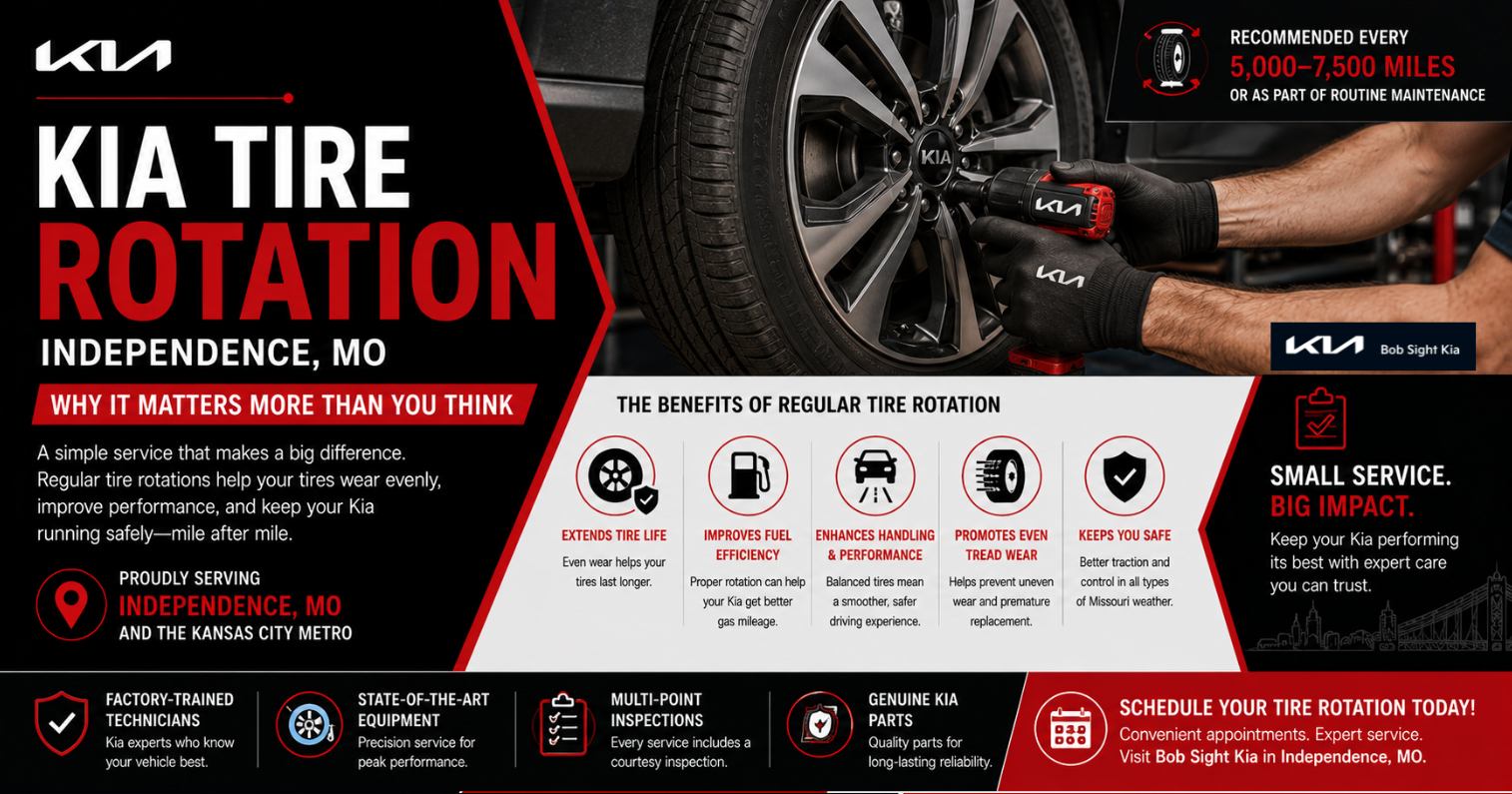
Bob Sight Kia graphic promoting tire rotation service in Independence, MO, explaining the benefits of regular tire rotations including longer tire life, improved fuel efficiency, enhanced handling, even tread wear, and safer driving while highlighting factory-trained technicians, genuine Kia parts, and recommended maintenance intervals.


Kia Tire Rotation Independence MO: Why It Matters More Than You Think | Bob Sight Kia

Kia Tire Rotation Independence MO: Why It Matters More Than You Think for Kansas City Metro Drivers

Maintain optimal traction, fuel economy, and tire lifespan by scheduling certified Kia tire rotation in Independence, MO at Bob Sight Kia today.
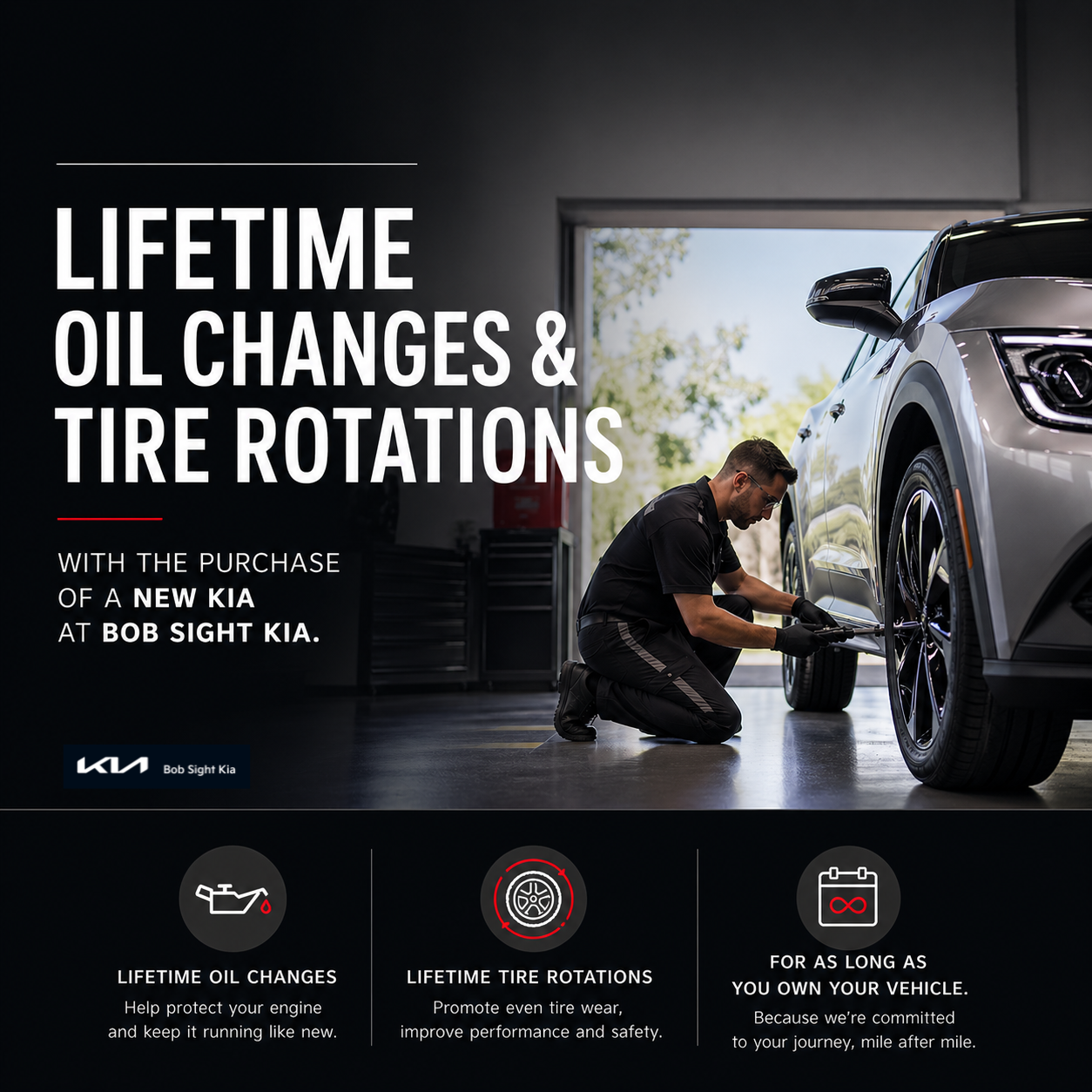
Bob Sight Kia Independence MO lifetime oil changes and tire rotations offer graphic

Routine tire rotations are one of the most vital yet frequently overlooked maintenance services required to keep your vehicle operating safely across Jackson County. Driving daily along busy highway corridors like Interstate 70, navigating stop-and-go commuter traffic on Highway 291 near the Independence Center, or taking family trips through Raytown, Blue Springs, and Lee's Summit places continuous mechanical stress on your tires. Because engine placement, drivetrain configuration, steering forces, and weight distribution cause front and rear tires to wear down at vastly different rates, failing to rotate your tires regularly leads to premature tread degradation, reduced fuel efficiency, and compromised braking performance. At Bob Sight Kia, located conveniently in Independence, Missouri, our factory-certified service technicians specialize in comprehensive tire inspections, precision rotation patterns, wheel alignment checks, and dynamic wheel balancing. Understanding the physics of tread wear, recognizing early signs of uneven tire degradation, and adhering to recommended factory rotation schedules ensures your Kia Telluride, Sportage, Sorento, or K4 delivers maximum traction and long-term value on every Midwest road.

IN THIS GUIDE YOU'LL LEARN:

In this detailed technical guide, our Kia tire care specialists break down the mechanical reasons why tire rotations matter, exact factory rotation patterns, and proactive ownership strategies for local drivers.

  • Why front and rear tires wear at uneven rates on Front-Wheel Drive and All-Wheel Drive Kia vehicles.
  • How regular tire rotations extend overall tread life, improve fuel economy, and protect your vehicle's drivetrain.
  • The exact technical rotation patterns utilized for non-directional, directional, and staggered tire fitments.
  • How local Missouri potholes, highway speeds, and severe seasonal weather swings accelerate rubber degradation.
  • Key differences between routine tire rotation, wheel alignment, and dynamic tire balancing services.
  • Step-by-step guidance on inspecting tire tread depth, checking cold inflation pressure, and resetting TPMS sensors.

1. Understanding Tire Rotation Mechanics and Tread Wear Physics

Regular tire rotations redistribute wear evenly across all four tires by swapping their physical axle positions at factory-recommended service intervals. On modern passenger vehicles, each tire position experiences distinct forces during daily operation. Front tires handle steering friction, carry the heavy weight of the front-mounted engine and transmission, and absorb the majority of braking forces, causing their tread blocks to wear down up to twice as fast as rear tires during routine city driving along Noland Road or Truman Road.

Tire rotation physically shifts tires between high-wear and low-wear axle positions before uneven degradation becomes permanent. On front-wheel-drive models, front tires experience heavy edge wear due to continuous scrubbing during low-speed turns in commercial parking lots. Meanwhile, rear tires follow straight along the rear axle, suffering minimal lateral friction but becoming susceptible to cupping or feathering if left in position indefinitely. Rotating front tires to the rear and rear tires to the front allows tread compounds to wear down symmetrically across all four contact patches.

Maintaining balanced tread wear across all four wheels preserves original handling characteristics, predictable braking response, and hydroplaning resistance on wet pavement. When tread depths remain uniform, all four tires contact the road surface with equal surface friction, ensuring electronic safety systems like Electronic Stability Control (ESC) and Anti-lock Braking Systems (ABS) operate as engineered. Skipping tire rotations results in diagonal tread scrubbing, loud cabin road noise, and the premature need to replace two tires at a time rather than enjoying a full set's complete lifespan.

2. Drivetrain Differences: How FWD, AWD, and EV Kia Models Wear Tires Differently

Front-Wheel Drive (FWD), All-Wheel Drive (AWD), and All-Electric (EV) Kia vehicles place distinct mechanical demands on tires, requiring specific rotation schedules and patterns. On FWD models like the Kia K4 sedan or Soul crossover, the front wheels perform triple duty by delivering engine torque, steering the vehicle, and supplying over sixty percent of total braking force. Consequently, front tires wear down rapidly along their outer shoulder blocks, making 5,000 to 7,500-mile rotation intervals crucial for FWD drivers in Jackson County.

All-Wheel Drive models like the Kia Telluride AWD or Sportage AWD distribute engine power dynamically to all four wheels through an electro-hydraulic center coupling. While AWD improves traction on snow-covered roads near Blue Springs Lake, it subjects all four tires to continuous rotational torque. Crucially, AWD transfer cases and differential systems require all four tires to maintain nearly identical rolling circumferences. If tread depth varies by more than 2/32 of an inch between tires, the resulting difference in rotational speed forces internal differential gears to work constantly, causing friction heat that can damage expensive drivetrain components.

Electric vehicles like the Kia EV6 and EV9 present unique tire wear characteristics due to immediate electric motor torque delivery and heavy floor-mounted lithium-ion battery packs. The instant torque generated by electric drive motors creates high shear stress at the tire contact patch during acceleration. Furthermore, higher overall vehicle curb weight accelerates tread compression. Electric Kia owners should adhere strictly to 5,000-mile tire rotation schedules to prevent accelerated center-tread wear and preserve maximum electric driving range.

3. The Financial and Safety Consequences of Neglecting Regular Tire Rotations

Neglecting tire rotations leads to accelerated tread degradation, increased fuel consumption, compromised winter traction, and severe mechanical strain on steering components. When tires wear unevenly, the vehicle's rolling resistance increases significantly. Un-rotated tires with irregular tread profiles create unnecessary drag against the road surface, forcing your internal combustion engine or electric motor to consume additional energy to maintain steady highway speeds along I-470.

Safety risks increase exponentially during severe Midwest weather events when tread depth is neglected. Irregular tread wear pattern development, such as heel-toe wear or diagonal scrubbing, prevents tire grooves from channeling standing water away from the contact patch during heavy summer rainstorms. This reduced water displacement capacity dramatically lowers hydroplaning thresholds, causing tires to lose contact with the road at speeds as low as 45 miles per hour. During winter cold snaps, unevenly worn tires fail to bite into packed snow or slush, resulting in extended stopping distances and reduced cornering grip.

From a financial perspective, skipping inexpensive tire rotations is a costly mistake. Modern premium replacement tires, such as OEM Michelin, Continental, Goodyear, or Hankook sets, represent a significant financial investment. Allowing front tires to wear out prematurely at 20,000 miles due to lack of rotation cuts potential tire lifespan in half, forcing owners to purchase replacement sets twice as often. Furthermore, tire manufacturers explicitly require documented routine rotation records to maintain treadwear warranty coverage.

4. Kia Tire Rotation Patterns: Forward Cross, X-Pattern, and Directional Guidelines

Selecting the correct tire rotation pattern depends on your Kia vehicle's drivetrain layout and whether your tires feature directional or non-directional tread designs. Utilizing the wrong rotation pattern can cause handling instability or reverse the intended rolling direction of specialized tread compounds. Our factory-trained technicians inspect sidewall markings and tread geometry before executing every service.

To clarify how different drivetrains require specific rotation patterns, the comparison table below outlines standard factory guidelines for Kia vehicles:

Drivetrain / Tire TypeRecommended Rotation PatternFront Tire MovementRear Tire MovementRecommended Interval
Front-Wheel Drive (FWD)Forward Cross PatternMove straight back to rear axlesCross diagonally forward to opposite front sidesEvery 5,000 to 7,500 Miles
All-Wheel Drive (AWD)X-Pattern or Rearward CrossCross diagonally back to opposite rear sidesCross diagonally forward to opposite front sidesEvery 3,000 to 5,000 Miles
Directional Tread TiresStraight / Front-to-BackMove straight back on same sideMove straight forward on same sideEvery 5,000 to 7,500 Miles
Staggered Fitment (Different Sizes)Side-to-Side PatternSwap left front to right frontSwap left rear to right rearEvery 5,000 Miles

Executing the Forward Cross pattern on FWD vehicles ensures that the rear tires, which experienced minimal shoulder wear, are crossed to opposite front positions where steering forces act on the opposite side of the tread block. For directional tires marked with sidewall rotation arrows, straight front-to-back swapping maintains the intended rolling direction required for rain evacuation. Following these precise technical patterns guarantees smooth performance and quiet operation.

5. Comprehensive Wheel Alignment and Dynamic Tire Balancing Integration

Combining tire rotations with routine wheel alignment checks and dynamic balancing ensures smooth ride comfort and eliminates high-speed steering wheel vibrations. While rotating tires changes their physical location on the vehicle, it does not correct mechanical misalignments in suspension geometry or weight imbalances within wheel and tire assemblies.

Follow these five critical steps executed during a complete tire maintenance procedure at Bob Sight Kia:

  1. Digital Tread Depth and Pressure Audit: Technicians measure tread depth at inner, center, and outer grooves using digital gauges and adjust cold inflation pressure to factory door-jamb specs (typically 33 to 36 PSI).
  2. Precision Tire Position Rotation: Wheels are dismounted and rotated according to specific FWD, AWD, or directional tread pattern requirements using certified lift equipment.
  3. Dynamic Wheel Balancing: Each wheel assembly is mounted on a high-speed computer balancer to detect microscopic weight heavy spots, applying precise clip-on or adhesive lead weights to eliminate high-speed wobble.
  4. Laser Suspension Alignment Inspection: The vehicle is placed on a computerized alignment rack to measure camber, caster, and toe angles against factory engineering specifications.
  5. TPMS Sensor Recalibration and Road Test: Tire Pressure Monitoring System (TPMS) locations are reset through the vehicle software menu, followed by a short road test to verify smooth tracking along I-70.

Integrating alignment checks with regular tire rotations prevents rapid shoulder wear caused by Jackson County pothole impacts along Highway 40 or Blue Ridge Boulevard. Proper suspension alignment keeps tires rolling completely flat against the pavement, maximizing traction and fuel economy.

6. How Missouri Seasonal Weather and Jackson County Road Hazards Accelerate Tread Wear

Extreme Midwest seasonal temperature swings combined with rough Jackson County road surfaces create harsh environmental conditions that degrade tire rubber compounds quickly. Missouri weather ranges from freezing winter cold snaps where temperatures drop below zero to scorching summer heat waves that drive asphalt surface temperatures past 130 degrees Fahrenheit. These extreme temperature swings cause continuous expansion and contraction of tire rubber compounds.

During cold winter months in Independence, ambient air pressure drops by approximately 1 PSI for every 10-degree decrease in outside temperature. Driving on underinflated tires during winter flexes tire sidewalls excessively, generating internal heat that weakens internal steel belts and accelerates shoulder wear. Conversely, summer heat combined with high-speed interstate driving along I-70 dries out rubber plasticizers, leading to microscopic sidewall cracking, dry rot, and accelerated tread compound breakdown.

Local road conditions introduce severe physical hazards to tires year-round. Freeze-thaw winter cycles create deep potholes, crumbling pavement edges, and loose gravel across regional commuting routes like Highway 291 and Noland Road. Hitting a sharp pothole at speed can sever internal tire cords, create dangerous sidewall bulges, or knock suspension toe angles out of alignment. Routine inspections at Bob Sight Kia ensure that hidden road damage is identified before it results in a sudden tire blowout.

7. Dealership Tire Service vs. Independent Tire Shops: Technical Comparison

Servicing your tires at an authorized Kia dealership guarantees factory-trained technical precision, specialized lifting procedures, and exact OEM replacement tire matching. While general tire retail chains perform quick rotations, authorized Kia service departments adhere strictly to manufacturer vehicle specifications, vehicle hoist lifting points, and specialized electronic TPMS programming routines.

Follow these five diagnostic and service steps performed during authorized Kia dealership tire maintenance:

  1. Vehicle Hoist Positioning at Factory Frame Points: Technicians place lift arms exclusively at reinforced frame lift points to prevent floor pan distortion or plastic rocker panel cracking.
  2. Precision Torque Wrench Lug Nut Tightening: Lug nuts are hand-torqued in a star pattern to exact factory torque specifications (typically 79 to 94 lb-ft) using calibrated torque wrenches to prevent brake rotor warping.
  3. Factory TPMS Re-Learning: Technicians connect specialized diagnostic tools to re-register TPMS sensor positions directly into the vehicle control module, ensuring accurate dashboard pressure displays.
  4. Suspension and Brake Component Visual Check: While wheels are removed, technicians inspect brake pad thickness, rotor surfaces, rubber CV axle boots, and tie-rod ends for wear.
  5. OEM Match Tire Recommendations: If replacement is required, technicians recommend tires engineered specifically for your Kia model's original ride quality and noise insulation specs.

Proper lug nut torque is particularly critical. Independent shops frequently over-tighten lug nuts using uncalibrated pneumatic impact wrenches, which stretches wheel studs and warps brake rotors. Entrusting your vehicle to Bob Sight Kia ensures every lug nut is installed with exact mechanical torque precision.

8. Quick Facts: Kia Tire Care and Rotation Intervals

Adhering to regular tire rotation intervals is the single most cost-effective way to preserve vehicle handling, fuel economy, and occupant safety. Here are essential quick facts regarding tire maintenance for Kia owners in Independence, MO.

  • Standard Rotation Interval: Kia recommends rotating tires every 5,000 to 7,500 miles, or every 6 months during routine synthetic oil changes.
  • AWD & EV Rotation Interval: All-Wheel Drive and All-Electric Kia models require more frequent rotations, ideally every 3,000 to 5,000 miles due to high torque load distribution.
  • Minimum Legal Tread Depth: Tires with 2/32 of an inch or less of remaining tread depth are legally worn out and must be replaced immediately.
  • Replacement Safety Threshold: Wet weather traction drops significantly once tread depth reaches 4/32 of an inch, increasing hydroplaning risks on rain-slick highways.
  • Treadwear Warranty Requirement: Major tire manufacturers require documented rotation receipts every 5,000 to 7,500 miles to validate tread life warranty claims.

These key facts underline why tire maintenance should remain a top priority for every driver across the Kansas City metro. Routine tire rotations save money while keeping your vehicle stopping safely in all driving conditions.

9. Long-Term Ownership Planning and Tire Maintenance Strategy

Developing a proactive tire care plan protects your financial investment and ensures consistent driving comfort through years of Midwest commuting. Long-term vehicle ownership requires establishing a routine care strategy that addresses tire wear before it impacts fuel economy or damages suspension components.

Coordinate your tire rotations directly with scheduled engine oil changes at Bob Sight Kia. Bundling tire rotations with routine oil changes ensures your vehicle is raised on a lift every 5,000 to 7,500 miles, allowing certified technicians to perform comprehensive multi-point inspections. Furthermore, checking cold tire inflation pressure monthly at home using an accurate digital pressure gauge helps maintain optimal contact patch geometry between service appointments. Drivers considering upgrading their current vehicle can use our online trade-in appraisal tool to see how consistent maintenance preserves overall vehicle equity.

Planning ahead for tire care keeps your maintenance costs predictable and manageable over time. To view active savings offers on tire rotations, alignments, and new tire sets, visit our dedicated service and parts specials page before booking your service visit. Our team at Bob Sight Kia is committed to delivering exceptional care for drivers throughout Independence, Blue Springs, Lee's Summit, and surrounding communities.

10. Frequently Asked Questions About Kia Tire Rotation in Independence, MO

How often should I get my Kia tires rotated in Independence, MO?

Kia recommends having your tires rotated every 5,000 to 7,500 miles, which conveniently aligns with routine synthetic oil change service intervals. Following this timeline ensures that front and rear tires are swapped before minor wear variations develop into permanent tread cupping, diagonal scrubbing, or excessive shoulder degradation.

For drivers operating All-Wheel Drive (AWD) models like the Sportage AWD or Telluride AWD, or electric vehicles like the EV6, rotating tires every 3,000 to 5,000 miles is highly beneficial. AWD systems transmit continuous rotational torque to all four wheels, making uniform tread depth essential to protect internal differential gears from mechanical stress during highway commuting on I-70.

A service pro-tip from Bob Sight Kia: always check your vehicle's driver-side door jamb sticker for exact cold tire pressure recommendations. Maintaining proper inflation pressure between rotation appointments prevents excessive edge wear and ensures your tires wear evenly across their entire tread face.

What happens if I never rotate the tires on my Kia?

Failing to rotate your tires causes front tires to wear down up to twice as fast as rear tires, resulting in premature tire replacement, reduced fuel economy, and severe cabin road noise. On Front-Wheel Drive vehicles, front tires absorb intense steering scrubbing and heavy braking loads, causing rapid shoulder wear while rear tires remain underutilized.

As tread depth differences expand between axles, your vehicle loses hydroplaning resistance and wet-weather traction during sudden summer rainstorms along Highway 291. Furthermore, severe irregular wear patterns like heel-toe feathering generate loud, rhythmic humming noises inside the cabin that mimic failing wheel bearings, ruining interior driving refinement.

On All-Wheel Drive models, neglecting tire rotations can lead to costly mechanical repairs. When front tires wear down significantly faster than rear tires, their overall rolling circumferences no longer match. This difference forces the AWD center coupling and transfer case to work constantly, generating excessive heat that degrades internal clutches and leads to premature drivetrain failure.

How do I know if my tires need a rotation or an alignment?

A tire rotation corrects front-to-rear tread depth wear differences, whereas a laser wheel alignment corrects misaligned suspension angles that cause directional pulling or severe inner-edge scrubbing. Inspecting tire tread faces and observing vehicle tracking along flat stretches of road helps identify which service your vehicle requires.

If your front tires show slightly faster outer shoulder wear than your rear tires but your vehicle tracks completely straight down the road, a standard tire rotation will balance tread wear across both axles. However, if your steering wheel vibrates at highway speeds, your car drifts toward the shoulder on straight roads, or one specific tire exhibits severe razor-thin wear along its inner edge, your suspension alignment angles are out of factory tolerance.

A diagnostic insight from our service bay: at Bob Sight Kia, our service drive includes computerized alignment audit equipment that checks your suspension geometry in seconds as you drive in. Combining a laser alignment with a routine tire rotation guarantees optimal handling and maximum tread lifespan.

Why does my TPMS light turn on after rotating my tires?

The Tire Pressure Monitoring System (TPMS) light may illuminate or display incorrect tire locations after a rotation if the vehicle's electronic control unit has not relearned the new sensor locations. Modern Kia vehicles feature individual pressure sensors mounted inside each wheel assembly that transmit radio signals to the central instrument cluster display.

When wheels are moved to new axle positions during a Forward Cross or X-Pattern rotation, the computer module must be updated to recognize that the former left-rear sensor is now located on the right-front wheel hub. If this electronic reset step is skipped, the dashboard display may show low pressure alerts for the wrong wheel location or trigger a temporary system warning light.

Pro-tip for car owners: certified technicians at Bob Sight Kia use specialized OBD-II diagnostic tools to re-register sensor locations during every tire rotation service. This ensures your dashboard tire pressure display remains accurate, giving you reliable warnings if inflation drops while driving across Jackson County.

11. Why Jackson County Drivers Trust Bob Sight Kia for Certified Service

Bob Sight Kia has proudly served drivers across Independence, Blue Springs, Lee's Summit, Raytown, and Liberty for generations with transparent automotive care, certified technical expertise, and fair pricing. As a locally owned dealership family deeply rooted in the Kansas City metro, we prioritize customer safety and long-term vehicle reliability above all else. Our service team is dedicated to providing straightforward recommendations without high-pressure sales tactics.

Our modern service center features state-of-the-art hydraulic lifts, digital laser alignment racks, high-speed computer wheel balancers, and factory-trained master technicians who know every technical detail of your vehicle's engineering. We use specialized Kia equipment and OEM replacement components to preserve your vehicle's factory warranty coverage and long-term resale value. Whether you need a quick tire rotation, wheel balancing, or a full set of new tires, our team delivers prompt, professional care.

Experience the peace of mind that comes with factory-certified automotive maintenance. Visit Bob Sight Kia in Independence today or conveniently schedule your tire service appointment online to keep your vehicle performing at its best on every Missouri road.

12. Helpful Links

13. PROUD TO BE PART OF THE BOB SIGHT AUTO GROUP

Bob Sight Kia is proud to be part of the Bob Sight Auto Group, serving drivers across Missouri and Kansas with quality vehicles, certified auto repair, and exceptional customer service. Explore our family of dealerships and service locations throughout the region:
Recommended Posts

Side by side comparison graphic of a Kia Sportage and Subaru Forester driving on Missouri roads near Independence

Kia Sportage vs Subaru Forester: Which SUV Is Better for Missouri Drivers?

Kia Sportage vs Subaru Forester: Which SUV Is Better for Missouri Drivers? Explore New Kia Sportage Inventory at Bob Sight Kia in Independence MO Comparing the Kia Sportage vs Subaru Forester highlights distinct engineering philosophies for Kansas City metro drivers seeking versatility, modern cabin technology, and dependable all-weather capability. Navigating daily commutes across Jackson County requires a vehicle that handles freezing winter morning commutes along Interstate 70, congested construction zones on Highway 291, and weekend road trips across Western Missouri. Both compact crossovers earn high praise for multi-season usability, but key differences in powertrain responsiveness, rear passenger legroom, infotainment technology, and warranty coverage create clear choices for local shoppers. At Bob Sight Kia in Independence, Missouri, we believe informed car buyers deserve transparent facts and detailed comparisons before making a long-term purchase decision. This head-to-head comparison breaks down performance specs, interior dimensions, cargo capacity, all-wheel-drive performance, and long-term ownership value to help you select the ideal compact SUV for your Midwest lifestyle. In This Guide You'll Learn This comprehensive comparison guide analyzes the key mechanical and practical differences between the Kia Sportage and Subaru Forester for Missouri drivers: How engine horsepower, torque output, and transmission engineering compare during highway merging along Interstate 470. The operational differences between Kia Active All-Wheel Drive and Subaru Symmetrical All-Wheel Drive in winter slush and ice. A detailed comparison of interior volume, rear-seat legroom, and cargo opening width for weekend road trips and daily grocery runs. How the Kia dual 12.3-inch panoramic display compares to the vertical touchscreen interface found in the Subaru Forester. Plain-language explanations of essential automotive terms including torque vectoring, continuous variable transmissions, and power-to-weight ratios. A step-by-step method for calculating overall long-term ownership value and warranty protection over ten years of driving. A side-by-side technical specification chart comparing horsepower, cargo capacity, fuel economy, and brake hardware. Engine Performance, Transmission Engineering, and Highway Driving Dynamics The Kia Sportage delivers superior engine horsepower and a more responsive 8-speed automatic transmission compared to the continuously variable transmission used in the Subaru Forester. Under the hood, the standard Kia Sportage features a robust 2.5-liter Gasoline Direct Injection 4-cylinder engine that generates 187 horsepower and 178 lb-ft of torque. Power is routed through an efficient 8-speed stepped automatic transmission, providing crisp, immediate gear shifts when merging onto fast-moving highway traffic along Interstate 70. In contrast, the Subaru Forester relies on a 2.5-liter BOXER 4-cylinder engine producing 180 horsepower, paired with a Lineartronic Continuously Variable Transmission (CVT). While CVTs offer smooth acceleration, they often create noticeable engine drone during steep uphill climbs near the Blue Springs reservoir or during hard acceleration on highway entrance ramps. Driving feel on Missouri highways differs significantly between these two compact crossovers due to transmission calibration and throttle tuning. The 8-speed automatic in the Kia Sportage downshifts predictably when pass-power is needed, providing an engaging and linear acceleration profile that drivers appreciate. The Forester's CVT tends to hold engine revolutions high during heavy throttle applications, creating a continuous humming sound throughout the cabin. Furthermore, the Sportage offers an available Sportage Hybrid powertrain featuring a 1.6-liter turbocharged engine paired with an electric motor, generating a muscular 227 combined horsepower. This hybrid setup provides immediate low-end electric torque, making city driving through downtown Independence exceptionally responsive and energetic. Handling and ride quality on uneven pavement also highlight contrasting engineering approaches between Kia and Subaru. The Sportage utilizes a longer 108.5-inch wheelbase paired with a tuned independent front MacPherson strut and rear multi-link suspension. This geometry absorbs harsh road impacts from potholes along US-40 and expansion joints across Jackson County highways with minimal cabin disturbance. The Subaru Forester features a shorter 105.1-inch wheelbase, which provides a tight turning circle but can feel slightly firmer over rapid road undulations. Drivers prioritizing a quiet, isolated, and refined highway cruising experience will find the Sportage offers outstanding high-speed composure. All-Wheel Drive Performance: Kia Active AWD vs Subaru Symmetrical AWD on Midwest Roads Kia Active All-Wheel Drive with Terrain Mode provides intelligent, on-demand electronic torque distribution that maximizes fuel efficiency without sacrificing winter traction in Jackson County. Winter weather in Western Missouri frequently delivers sudden shifts between freezing rain, packed slush, and black ice along major commuter corridors. The Kia Dynamax fully active all-wheel-drive system utilizes electronic sensors that monitor steering angle, vehicle speed, and wheel slippage thousands of times per second. When loss of grip is detected, the electro-hydraulic coupling instantly routes drive torque to the rear wheels before tire spin occurs. During dry highway cruising, the system disengages the rear axle to conserve fuel, providing the optimal balance of efficiency and road grip. Subaru features its proprietary Symmetrical All-Wheel Drive as standard equipment across the Forester model lineup. This full-time AWD system continuously sends engine power to all four wheels at all times, providing high levels of steady-state grip on unpaved gravel roads or deep snow. However, because all four wheels are continuously driven, mechanical drag is higher, which can diminish overall fuel economy during sunny summer driving. The Kia Sportage counters with selectable Drive Modes, including Normal, Smart, Sport, and Snow settings. Selecting Snow Mode adjusts throttle response and transmission shift points, preventing wheel spin when starting from a dead stop on icy suburban neighborhood hills in Raytown or Grain Valley. Ground clearance is another vital consideration for drivers who venture off the paved track or tackle deep snow drifts. The standard Kia Sportage AWD models offer a generous 8.3 inches of ground clearance, which easily clears heavy snow ridges left behind by local street plows. Dedicated off-road trims like the Sportage X-Line and X-Pro elevate capability further with rugged multi-terrain tires, revised front bumpers for steeper approach angles, and active downhill brake control. While the Subaru Forester standard models offer 8.7 inches of ground clearance, the Kia Sportage X-Pro matches real-world capability with refined, quiet interior noise dampening that makes daily pavement commuting far more pleasant. Interior Comfort, Rear Seat Legroom, and Cabin Dimensions The Kia Sportage provides class-leading rear passenger legroom and a modern, high-tech cabin environment that outshines the utilitarian layout of the Subaru Forester. Occupants stepping into the cabin of the Sportage are greeted by modern design aesthetics, soft-touch materials, and an available dual 12.3-inch panoramic curved display screen. Rear seat passengers enjoy an extraordinary 41.3 inches of rear legroom, allowing adult passengers or growing teenagers to stretch out comfortably during family trips across the Midwest. The Subaru Forester provides 39.4 inches of rear legroom, which is competitive but falls nearly two inches short of the spacious rear accommodation provided inside the Sportage. Front seat ergonomics and driver visibility are well executed in both crossovers, though their interior atmospheres target different buyer preferences. The Subaru Forester utilizes a traditional upright boxy greenhouse design with large side windows and an elevated roofline, prioritizing upright outward visibility over sleek interior styling. However, its dash layout uses a mix of analog gauge dials and a vertically oriented touchscreen that can feel dated compared to contemporary digital cockpits. The Sportage merges premium acoustic insulation, available SynTex synthetic leather seating, multi-color ambient interior lighting, and ventilated front seats to deliver an upscale environment rivaling entry-level luxury crossovers. Cabin quietness is a major factor for commuters spending hours each week in stop-and-go traffic along Highway 291 or Interstate 470. Kia engineers incorporated extensive sound-dampening insulation under the floorboards, within the front windshield glass, and behind the engine firewall of the Sportage. This acoustic package dramatically reduces wind roar and tire hum at 70 mph speeds compared to the Forester, where wind noise around the large side mirrors is more pronounced. For families seeking a serene, comfortable, and modern interior for daily driving around Lee's Summit and Independence, the Sportage establishes a clear lead. Cargo Space and Utility: Practicality for Jackson County Drivers The Kia Sportage delivers superior cargo volume behind the second row of seats compared to the Subaru Forester, making it more practical for hauling family gear. Having flexible cargo capacity is essential for shopping trips to Independence Center, loading sports equipment for weekend tournaments, or packing luggage for road trips. The Sportage provides an impressive 39.6 cubic feet of dedicated cargo space behind the second-row seats. By comparison, the Subaru Forester provides 29.6 cubic feet of rear cargo space, yielding a massive 10 cubic foot advantage for the Kia crossover. Fold the second-row seats flat, and the Sportage expands to an immense 74.1 cubic feet of maximum load volume. To maximize cargo usability when packing for camping trips to Fleming Park or loading heavy home improvement supplies, following a structured packing and organization process ensures safety and convenience: Utilize the dual-level cargo floor: Lower the adjustable rear floor board in the Sportage to gain extra vertical height for tall items like coolers or potted plants. Engage remote second-row seat release levers: Use the convenient side-wall handles located in the cargo area to fold the 60/40 split-folding rear seats flat without walking around to the side doors. Secure loose gear in hidden under-floor storage compartments: Stash valuable items, emergency tool kits, or first-aid supplies inside the dedicated storage tray located beneath the main cargo floor. Activate the Smart Power Tailgate: Approach the rear bumper with the Smart Key in your pocket or purse, allowing the liftgate to open automatically without requiring hands or foot-swiping gestures. The practical design of the Sportage cargo area extends beyond pure volume numbers to include floor width and opening shape. The wide rear liftgate opening makes loading bulky objects like furniture boxes or golf bags effortless without scratching the surrounding bumper trim. Furthermore, available heavy-duty roof rails allow owners to mount cargo boxes, bike racks, or kayak carriers easily for summer road trips across Missouri. The combination of superior rear cargo volume and thoughtful convenience features gives the Sportage a clear edge in daily practical utility. Infotainment, Digital Dash Displays, and Active Safety Technology The Kia Sportage features state-of-the-art dual 12.3-inch panoramic screens that seamlessly combine digital instrument gauges with central infotainment controls. Technology integration is a central focal point for modern car shoppers, and the Sportage sets a benchmark for clean display layout and user-friendly software. The sweeping curved glass panel houses a high-resolution driver display screen directly beside a sharp center touchscreen, bringing navigation maps, media options, and vehicle settings directly into the driver's natural line of sight. Wireless Apple CarPlay and Android Auto come standard, allowing instant smartphone mirroring without messy USB cords across the center console. The Subaru Forester utilizes an 11.6-inch vertically oriented touchscreen on most mid-tier and upper trims, flanked by traditional analog speedometer and tachometer dials. While functional, the vertical orientation can require deeper menu diving to adjust basic HVAC climate control settings or seat heaters while driving. In contrast, the Sportage includes an innovative dual-purpose touch switchable control panel located below the main display. With a simple tap, the physical control dials toggle seamlessly between climate temperature adjustments and media audio volume, keeping the console streamlined and intuitive to operate while navigating busy Kansas City street corridors. Active driver assistance features are robust on both crossovers, providing essential safety layers on crowded highways. The Sportage comes standard with Kia Drive Wise technology, incorporating Forward Collision-Avoidance Assist with Junction Turning Detection, Lane Following Assist, Rear Cross-Traffic Collision-Avoidance Assist, and Safe Exit Assist. Available Highway Driving Assist combines Smart Cruise Control with lane centering to control speed and steering distance automatically during highway travel along Interstate 70. Subaru equips the Forester with its EyeSight 4.0 safety suite, which operates effectively but uses windshield-mounted stereo cameras that can occasionally be temporarily blinded by heavy rain or low morning glare along east-bound commuter routes. Key Automotive Definitions for Crossover Buyers Understanding key automotive terms helps shoppers evaluate mechanical specifications, drivetrain capabilities, and tech systems with complete confidence. Decoding complex engineering terminology allows buyers to compare vehicle features objectively. Below are plain-language definitions of essential terms relevant to compact SUV comparison: Continuously Variable Transmission (CVT): An automatic transmission mechanism that uses a belt-and-pulley system instead of fixed mechanical gears to alter gear ratios continuously. While CVTs optimize engine RPM for fuel economy, they lack the crisp, stepped gear shifts provided by traditional multi-speed automatic transmissions. Torque Vectoring All-Wheel Drive: An advanced all-wheel-drive technology that dynamically varies mechanical rotational torque to individual left or right rear wheels. By sending extra power to the outside rear wheel during cornering, torque vectoring actively helps turn the vehicle, improving handling agility and stability on wet or slippery road surfaces. Gasoline Direct Injection (GDI): A fuel delivery system where fuel is sprayed at ultra-high pressure directly into the engine cylinder combustion chamber rather than the intake port. This process optimizes fuel atomization, enhances engine power output, improves combustion efficiency, and lowers tailpipe emissions. Powertrain Warranty: A manufacturer warranty guarantee that covers major mechanical components responsible for driving the vehicle forward, including the engine block, cylinder heads, internal gears, transmission cases, drive shafts, differentials, and axles against manufacturing defects. Step-by-Step Process for Choosing the Right Compact Crossover at Bob Sight Kia Selecting the ideal compact SUV requires evaluating your daily driving requirements, budget preferences, and desired tech features through a systematic vehicle evaluation process. Shopping for a new vehicle should be an exciting and stress-free experience. Following a structured multi-step shopping process ensures you make a fully informed decision when visiting Bob Sight Kia in Independence: Assess your primary driving environment and seasonal needs: Determine whether your weekly routine consists mainly of city commuting, highway travel, or winter snow driving across Jackson County to decide if Active AWD is necessary. Compare interior dimensions and passenger seating comfort: Bring family members to the dealership to sit in both front and rear rows, verifying adequate headroom, shoulder room, and legroom for long trips. Evaluate cargo opening dimensions with your gear: Test folding the rear seatbacks and check if your everyday items, strollers, or sports equipment fit effortlessly into the rear cargo hold. Schedule a comprehensive local test drive: Drive your chosen SUV trim on a mixed route including residential streets around Independence, commercial corridors on Highway 291, and high-speed lanes on Interstate 70. Review total warranty coverage and long-term service support: Compare manufacturer powertrain warranties and local service department amenities to ensure hassle-free vehicle ownership over the next decade. Our experienced automotive sales team at Bob Sight Kia is dedicated to guiding you through every step of this selection process without pressure. We encourage shoppers to test drive various Sportage trims, including the fuel-efficient Kia Sportage Hybrid, to experience the smooth acceleration, quiet cabin, and responsive handling firsthand. Taking a structured approach guarantees complete confidence when driving your new crossover home. Kia Sportage vs Subaru Forester Comparison Matrix Comparing side-by-side technical specifications highlights the distinct engineering advantages of the Kia Sportage across key mechanical, dimension, and warranty categories. The structured comparison chart below provides a direct overview of how the Kia Sportage compares against the Subaru Forester for Missouri car buyers: Specification / Feature Kia Sportage LX / EX / SX Subaru Forester Base / Premium Engine Type 2.5L Inline 4-Cylinder GDI 2.5L SUBARU BOXER 4-Cylinder Horsepower Output 187 hp @ 6,100 RPM 180 hp @ 5,800 RPM Transmission Type 8-Speed Automatic Transmission Lineartronic CVT Transmission Standard Drivetrain Front-Wheel Drive (AWD Available) Symmetrical All-Wheel Drive Rear Seat Legroom 41.3 Inches (Class-Leading) 39.4 Inches Cargo Space Behind 2nd Row 39.6 Cubic Feet 29.6 Cubic Feet Max Cargo Space (Seats Down) 74.1 Cubic Feet 74.4 Cubic Feet Display Screen Size Dual 12.3-Inch Panoramic Screens Available 11.6-Inch Vertical Screen Available Powertrain Warranty Coverage 10-Year / 100,000-Mile Limited Warranty 5-Year / 60,000-Mile Limited Warranty This technical summary demonstrates that while both compact crossovers offer impressive utility, the Kia Sportage delivers higher horsepower, more responsive transmission gearing, significantly larger rear cargo space behind the second row, superior rear legroom, and double the powertrain warranty length of the Subaru Forester. Warranty Coverage, Long-Term Reliability, and Ownership Costs Kia offers industry-leading 10-year/100,000-mile limited powertrain warranty protection that far exceeds the standard 5-year/60,000-mile coverage provided by Subaru. Long-term peace of mind is a major component of overall vehicle value. Investing in a crossover backed by a decade of factory warranty coverage protects owners against unforeseen mechanical repair expenses for years after final finance payments are complete. Kia also includes a 5-year/60,000-mile basic bumper-to-bumper warranty and 5 years of unlimited-mileage roadside assistance, ensuring help is always available if you experience a flat tire or battery issue on Missouri roads. In addition to factory warranty backing, routine maintenance costs for the Kia Sportage remain highly affordable over its lifecycle. Utilizing an 8-speed automatic transmission rather than a complex CVT reduces long-term fluid maintenance complexity. Standard 2.5-liter engines use readily available full synthetic oil and standard oil filters, making scheduled service appointments simple and economical at our Bob Sight Kia service department. Lower operational costs combined with higher standard feature content help the Sportage retain strong resale value across the pre-owned market. Choosing a brand that stands firmly behind its build quality gives Kansas City drivers absolute confidence during every season of ownership. Knowing that critical engine and transmission components are covered for up to 100,000 miles provides tangible financial security that Subaru simply does not match. For buyers planning to keep their SUV for five to ten years, the Kia warranty advantage represents thousands of dollars in potential warranty protection value. Quick Facts About Kia Sportage vs Subaru Forester Reviewing key quick facts summarizes why the Kia Sportage continues to gain popularity among compact crossover shoppers across Jackson County. The following key highlights detail why the Sportage stands out as a top-tier choice for local drivers: Superior Horsepower: The standard Kia Sportage 2.5-liter engine delivers 187 horsepower, outperforming the 180 horsepower rating of the Subaru Forester. Responsive 8-Speed Automatic: Kia utilizes a traditional stepped 8-speed automatic transmission for crisp gear changes instead of a continuously variable transmission (CVT). Unmatched Rear Cargo Space: The Sportage provides 39.6 cubic feet of cargo room behind the second-row seats compared to just 29.6 cubic feet in the Forester. Spacious Rear Cabin: Passengers enjoy 41.3 inches of rear seat legroom in the Sportage, offering nearly two inches more stretch-out room than the Forester. Double the Powertrain Warranty: Kia backs every new Sportage with a 10-year/100,000-mile powertrain warranty compared to Subaru's 5-year/60,000-mile coverage. These key comparison facts underscore the practical advantages of choosing the Sportage for your daily driver. From superior passenger comfort to unbeatable long-term warranty protection, the Sportage delivers an exceptional blend of modern features and practical value for Midwest families. Ownership Planning and Maintenance Strategy for Missouri Drivers Developing a proactive maintenance strategy ensures your Kia Sportage delivers maximum reliability, optimal fuel economy, and smooth performance through Midwest seasonal weather swings. Summer heat across Jackson County causes heavy thermal stress on engine oil, cooling systems, and air conditioning units. Winter cold snaps drop tire pressures and strain battery cranking power during freezing morning starts in Independence and Sugar Creek. Following factory maintenance guidelines preserves mechanical health and protects your vehicle's long-term trade-in value. Scheduling oil changes every 5,000 to 7,500 miles using high-grade full synthetic engine oil ensures internal components remain thoroughly lubricated during extreme operating temperatures. Rotating tires at every oil change interval promotes even tread wear across all four tires, which is essential for maintaining smooth torque transfer on Active AWD models. Additionally, replacing engine air filters and cabin air filters regularly ensures clean air intake for the engine and maintains fresh cabin air quality during high-pollen spring and summer seasons. At Bob Sight Kia, our service department features certified technicians trained directly by Kia factory master instructors. We use genuine OEM replacement parts, specialized diagnostic software, and precision wheel alignment machinery to maintain your Sportage according to strict factory specifications. Utilizing our convenient online service scheduler allows local drivers to maintain their vehicles easily without interrupting busy workweek schedules. Frequently Asked Questions About Kia Sportage vs Subaru Forester Does the Kia Sportage offer better fuel economy than the Subaru Forester in Missouri? The Kia Sportage offers highly competitive gas mileage, while the Kia Sportage Hybrid easily beats the Subaru Forester in overall fuel efficiency. Standard front-wheel-drive Kia Sportage models achieve up to an EPA-estimated 25 MPG city and 33 MPG highway, offering an economical option for highway commuters traveling along Interstate 70 between Independence and downtown Kansas City. When equipped with Active AWD, the Sportage delivers balanced efficiency while providing enhanced winter traction on icy roads. For drivers prioritizing maximum fuel savings, the Kia Sportage Hybrid pairs a 1.6-liter turbocharged engine with an electric motor to deliver up to an extraordinary 42 MPG combined. This far exceeds the fuel economy figures of the gas-powered Subaru Forester, which averages approximately 26 MPG city and 33 MPG highway with its standard AWD setup. Choosing the Sportage Hybrid allows commuters to save hundreds of dollars annually at the fuel pump during daily drives across Jackson County. Whether you select the standard gasoline powertrain or the advanced hybrid variant, the Sportage provides outstanding fuel efficiency tailored to your daily driving distance. Visiting Bob Sight Kia allows you to explore both powertrain options to identify the ideal balance of efficiency and performance for your commute. Is the Kia Sportage larger inside than the Subaru Forester? Yes, the Kia Sportage provides more rear passenger legroom and significantly more rear cargo space behind the second row than the Subaru Forester. Rear passengers in the Sportage enjoy an extraordinary 41.3 inches of legroom, making it one of the most spacious rear seating environments in the compact SUV class. By comparison, the Subaru Forester provides 39.4 inches of rear legroom, which can feel noticeably tighter for adult passengers on long highway trips. Cargo volume behind the rear seats is another major area where the Sportage excels, offering 39.6 cubic feet of space compared to 29.6 cubic feet in the Forester. This extra 10 cubic feet of storage allows families to carry extra suitcases, sports gear, or large grocery hauls without needing to fold down the rear seats. Fold the rear seats flat, and the Sportage expands to a total cargo capacity of 74.1 cubic feet. The combination of superior legroom and expanded cargo capacity makes the Sportage exceptionally versatile for growing families in Independence and surrounding communities like Lee's Summit and Blue Springs. Experiencing the spacious cabin in person at Bob Sight Kia clearly demonstrates its interior room advantage over competing compact crossovers. How does the Kia 10-year warranty compare to Subaru's warranty? The Kia warranty provides double the powertrain protection length of Subaru, covering engine and transmission components for 10 years or 100,000 miles. Subaru provides a standard 5-year/60,000-mile limited powertrain warranty on the Forester. Kia's industry-leading coverage gives owners five extra years or 40,000 additional miles of major mechanical protection against unexpected repair costs. Kia also includes a 5-year/60,000-mile basic limited bumper-to-bumper warranty and 5 years of 24/7 Roadside Assistance with no mileage limit. This comprehensive protection plan covers emergency towing, battery jump-starts, flat tire changes, and lockout assistance anywhere across Missouri and the continental United States. Having extensive factory backing ensures your vehicle remains protected long after your finance loan is paid off. For long-term vehicle ownership, the value of Kia's warranty coverage cannot be overstated. It reflects factory manufacturing confidence and provides tangible financial security that makes owning a Sportage a smart, worry-free investment for Kansas City families. Which SUV handles winter snow and ice better in Jackson County? Both crossovers perform exceptionally well in winter conditions, but the Kia Sportage Active AWD with Snow Mode offers predictive torque management tailored to Midwest winter roads. Kia's electro-hydraulic coupling system monitors sensor inputs continuously to predict wheel slip before it happens, sending instantaneous drive torque to the rear wheels when accelerating onto slick highway ramps along Highway 291 or US-40. The Subaru Forester features standard full-time Symmetrical AWD, which provides steady traction on unpaved gravel roads and deep snow. However, the Kia Sportage includes selectable Drive Modes that allow drivers to customize throttle response, steering weight, and transmission shift logic specifically for icy or slushy conditions. Engaging Snow Mode prevents wheel spin from a dead stop, ensuring smooth, controlled acceleration on slippery hills around Raytown and Liberty. Paired with 8.3 inches of ground clearance and advanced safety systems like Forward Collision-Avoidance Assist, the Sportage Active AWD provides supreme driver confidence during severe Missouri winter storms. Routine tire maintenance and quality seasonal tires further enhance winter performance across all driving conditions. Why Choosing Bob Sight Kia in Independence Matters for Local Drivers Buying and servicing your crossover at Bob Sight Kia connects you with a trusted, family-owned dealership group committed to serving Jackson County drivers with integrity and respect. For generations, the Bob Sight Auto Group has built long-lasting relationships with customers across Independence, Lee's Summit, Blue Springs, Raytown, and the greater Kansas City metropolitan area. Our transparent sales philosophy ensures you receive clear information, competitive trade-in values, and flexible financing solutions without stress or hidden fees. Our commitment to excellence extends far beyond the showroom floor into our state-of-the-art service department. Our certified Kia technicians utilize specialized factory tools, genuine OEM replacement parts, and advanced diagnostic software to keep your Sportage running at peak performance. Whether you require routine synthetic oil changes, tire rotations, brake pad replacements, or seasonal inspections, our team provides fast, professional service tailored to your schedule. We invite you to visit Bob Sight Kia in Independence, Missouri, to experience the Kia Sportage firsthand. Explore our extensive selection of new and certified pre-owned crossovers, take a test drive along Interstate 70, and discover why so many local drivers trust Bob Sight Kia for all their automotive needs. Schedule your test drive or service appointment online today to join our family of satisfied customers! Helpful Links Shop New Kia Sportage Inventory Shop New Kia Sportage Hybrid Inventory Value Your Trade-In Online Schedule Service at Bob Sight Kia Apply for Kia Auto Financing Proud to Be Part of the Bob Sight Auto Group Bob Sight Kia is proud to be a member of the Bob Sight Auto Group, serving drivers across Missouri and Kansas with high-quality automotive sales, financing, and service. Explore all of our dealership locations and specialized automotive services below: Bob Sight Ford Bob Sight Honda Bob Sight CDJR Bob Sight Kia Bob Sight Collision Center

Lineup of new Kia SUVs parked outside Bob Sight Kia dealership in Independence MO

How to Choose the Right Kia SUV for Your Lifestyle in Missouri: A Kansas City Metro Guide

How to Choose the Right Kia SUV for Your Lifestyle in Missouri: A Kansas City Metro Guide Explore Our New Kia SUV Inventory at Bob Sight Kia Selecting the ideal crossover or SUV requires balancing passenger seating capacity, cargo flexibility, drivetrain options, and local driving habits across Jackson County. Drivers living in Independence, Missouri, face a unique blend of driving environments that range from stop-and-go morning traffic along Interstate 70 to weekend trips across the rolling hills of Western Missouri. Choosing the right vehicle depends on how well a model matches your family size, weekly commuting distance, winter weather needs, and outdoor recreation plans. At Bob Sight Kia, we help local buyers navigate the full lineup of modern Kia crossovers and SUVs to identify the perfect fit. Whether you need an efficient daily commuter for trips into downtown Kansas City or a robust three-row vehicle for regional highway travel, this comprehensive guide provides the factual details, technical specs, and local insight needed to make a confident decision. In This Guide You'll Learn This comprehensive buying guide covers essential decision factors for drivers evaluating the Kia crossover and SUV family in the Kansas City metropolitan area: How to match your household size and cargo requirements to subcompact, compact, midsize, and three-row Kia SUV models. The mechanical and practical differences between traditional gasoline powertrains, self-charging hybrids, plug-in hybrids, and all-electric platforms. A step-by-step method for calculating necessary cargo space and towing capacity for Missouri outdoor trips and lake vacations. How Dynamax All-Wheel Drive and electronic drive modes improve traction during harsh Jackson County winter ice and snow events. A detailed step-by-step process for test driving and evaluating SUV comfort, visibility, and Kia Drive Wise active safety systems. Long-term ownership strategies to maximize vehicle longevity, fuel efficiency, and resale trade-in value on Midwest roads. Understanding the Kia SUV Lineup: From Subcompact Daily Commuters to Three-Row Family Cruisers The Kia SUV lineup spans seven distinct vehicle classes engineered to support diverse lifestyle demands across the Kansas City metro area. Modern drivers can select from subcompact urban crossovers like the Soul and Seltos, balanced compact crossovers like the Sportage, versatile midsize utility vehicles like the Sorento, and spacious three-row family flagships like the Telluride and EV9. Each vehicle is built upon a distinct chassis platform engineered to deliver specific performance characteristics, interior volumes, and efficiency ratings. Understanding where each model sits within the brand hierarchy allows shoppers to narrow down their choices quickly based on realistic space requirements and daily driving routines. Matching your physical garage dimensions and household footprint to the correct class prevents paying for unused capacity or buying a vehicle that feels cramped during family outings. Subcompact options like the Kia Soul and Kia Seltos deliver incredible maneuverability for tight parking spaces around Independence Square or busy commercial districts along Highway 291. The Soul features an iconic boxy silhouette that maximizes headroom and interior vertical volume despite its small footprint. Drivers seeking available all-wheel drive and elevated ground clearance up to 7.3 inches often choose the Seltos, which bridges the gap between urban agility and light trail capability. Moving up to the Kia Sportage introduces a true compact crossover layout featuring a longer wheelbase, expanded second-row legroom, and substantial cargo volume behind the rear seats. The Sportage serves as one of the most versatile dual-purpose vehicles for commuters who also require generous cargo capacity for luggage, groceries, and sports equipment. For growing families requiring extra seating capacity, midsize and full-size models offer flexible multi-row seating configurations. The Kia Sorento acts as a unique three-row midsize crossover that maintains compact exterior dimensions while offering seating for up to seven passengers across three rows. This makes the Sorento an excellent choice for navigating suburban neighborhoods in Blue Springs or Lee's Summit without driving an oversized vehicle. Families needing maximum shoulder room, expansive third-row legroom, and class-leading cargo space gravitate toward the award-winning Kia Telluride. Grounded with a standard V6 engine, available self-leveling rear suspension, and seating for up to eight occupants, the Telluride is built for long-distance highway travel and family road trips across Missouri. Additionally, dedicated electric models like the EV6 and three-row EV9 provide ultra-modern alternatives powered purely by advanced electric battery architectures. Matching Your Daily Driving Habits to the Right Kia SUV Size Choosing the correct SUV size requires evaluating your primary driving corridors, weekly passenger loads, and daily parking conditions throughout Jackson County. Drivers who spend most of their week commuting alone on Interstate 470 or searching for parallel parking near downtown Kansas City offices experience different daily demands than parents shuttling multiple children to soccer fields in Raytown or Liberty. Selecting a vehicle that matches your routine reduces weekly fuel expenditure and makes maneuvering through congested traffic stress-free. Evaluating how many passengers routinely sit in the second and third rows helps clarify whether a two-row or three-row vehicle is truly necessary. Factoring in garage depth, driveway slope, and local street widths also ensures your new vehicle fits comfortably into your home environment. Urban commuters who prioritize fuel economy, nimble handling, and tight turning radiuses find subcompact crossovers to be exceptionally practical options. The Kia Soul and Seltos allow drivers to weave through heavy construction corridors along US-40 with complete ease and exceptional visibility. Their compact footprints translate to reduced curb weight, which enhances brake responsiveness and tire longevity during repetitive stop-and-go driving. For drivers who frequently transport adult passengers or teenage children, moving up to the Sportage provides 41.3 inches of rear legroom, ensuring long rides remain comfortable for everyone on board. The Sportage also provides a smooth ride quality over cracked pavement and highway expansion joints along Interstate 70. When daily life involves carpooling, large dog crates, camping gear, or frequent group road trips, midsize and three-row crossovers become essential. The Sorento offers a compact three-row footprint that allows the rear seats to fold flat into the cargo floor when extra luggage room is needed, yielding maximum daily flexibility. For larger households or those who regularly travel with up to eight adults, the Telluride delivers uncompromised passenger space, offering 42.4 inches of front legroom and generous third-row headroom. Navigating suburban commercial corridors near Independence Center is effortless thanks to advanced multi-angle camera systems and parking sensors that simplify docking a large three-row vehicle into standard parking stalls. How to Choose Between Gas, Hybrid, Plug-in Hybrid, and All-Electric Kia SUVs Kia offers four powertrain technologies across its SUV lineup, allowing buyers to select the exact balance of fuel efficiency, electric range, and conventional refueling convenience. Gasoline engines provide straightforward maintenance schedules and immediate long-distance refueling convenience anywhere across the Midwest highway system. Self-charging hybrids pair efficient gasoline engines with electric traction motors and regenerative braking, boosting city fuel economy without requiring wall charging. Plug-in hybrid (PHEV) models feature larger battery packs capable of covering daily commutes on pure electric power before transitioning smoothly to gasoline power for longer trips. Fully electric vehicles (EVs) utilize high-voltage battery systems to eliminate gasoline altogether while delivering immediate electric torque and near-silent operation. Evaluating your typical driving patterns around Jackson County helps determine which powertrain delivers the highest financial and operational benefits. If your daily commute involves short trips around Independence or quick runs to local schools, a plug-in hybrid model like the Sportage PHEV or Sorento PHEV allows you to complete most weekday errands strictly on electric power. Owners can recharge overnight using a standard household outlet or dedicated Level 2 home charger. For high-mileage highway drivers who frequently travel across state lines without stopping to charge, traditional gasoline engines or self-charging hybrid variants like the Kia Sportage Hybrid offer exceptional highway cruising range exceeding 500 miles on a single tank of fuel. Drivers ready to transition away from fossil fuels entirely can explore advanced electric platforms including the crossover EV6 and the full-size three-row EV9. Built on dedicated 800-volt multi-charging architectures, these electric SUVs can recharge from 10 percent to 80 percent in under 20 minutes at ultra-fast DC fast-charging stations located along major interstate highways. Electric vehicles feature fewer moving powertrain components than internal combustion engines, eliminating traditional engine oil changes, spark plug replacements, and exhaust system repairs. However, drivers who regularly tow heavy travel trailers or live in rural areas with limited public charging infrastructure may find standard gasoline or hybrid utility vehicles more practical for their immediate regional travel needs. Step-by-Step Guide to Evaluating Towing Capacity and Cargo Flexibility for Missouri Road Trips Determining your required cargo volume and towing capacity ensures your chosen Kia SUV can safely haul trailers, outdoor equipment, and family gear across Missouri. Exceeding a vehicle's maximum gross vehicle weight rating or towing limit can accelerate brake wear, strain transmission components, and compromise highway handling stability. Following a systematic evaluation process helps you accurately calculate real-world load requirements before finalizing your vehicle selection. This structured approach prevents underestimating gear weight when planning weekend camping trips to Lake Jacomo or towing watercraft down to the Lake of the Ozarks. List your maximum passenger and cargo weight requirements: Calculate the combined weight of all regular passengers, pets, and packed luggage to determine required interior payload capacity. Measure large sports and recreation gear: Check the physical dimensions of strollers, golf bags, kayaks, camping coolers, or bicycle racks to verify required rear cargo floor length and opening height. Identify maximum trailer towing needs: Review the certified gross vehicle weight rating of any utility trailer, pop-up camper, or boat you intend to pull behind the vehicle. Account for tongue weight impact: Ensure the total trailer tongue weight does not exceed ten percent of the maximum rated towing capacity, which directly impacts rear axle suspension loads. Verify OEM towing package equipment: Confirm whether your chosen SUV trim includes factory-installed hitch receivers, trailer wiring harnesses, heavy-duty cooling systems, and trailer stability assist technology. Matching these step-by-step calculations against Kia SUV towing specifications clarifies which model class fits your recreational routine. Compact models like the Sportage offer towing capacities up to 2,500 pounds when properly equipped, making them ideal for light utility trailers, small jet skis, or bicycle carriers. Buyers needing to pull larger fiberglass ski boats, dual-axle camper trailers, or horse trailers should step up to the Telluride or Sorento, which offer robust towing ratings up to 5,500 pounds and 4,000 pounds respectively. Utilizing factory towing hardware guarantees optimal integration with electronic stability control systems, ensuring trailer sway control activates automatically when highway crosswinds occur along Interstate 70. Decoding Kia Drive Systems: Dynamax All-Wheel Drive vs Front-Wheel Drive for Midwest Winters Kia Dynamax All-Wheel Drive is an advanced electro-mechanical traction system designed to continuously monitor road conditions and distribute engine torque to all four wheels before tire slippage occurs. Unlike legacy four-wheel-drive systems that require manual driver engagement, electronic all-wheel drive actively processes steering angle, wheel speed, and throttle position inputs to optimize grip automatically. Understanding key drivetrain terms helps buyers decide whether standard front-wheel drive or intelligent all-wheel drive is best suited for winter commutes across Jackson County. Plain-language definitions of critical drivetrain concepts clarify how these components enhance vehicle safety and control during rain, mud, slush, and black ice events. Front-Wheel Drive (FWD): A mechanical layout where engine power is delivered exclusively to the two front wheels, which handle both power delivery and vehicle steering. This configuration minimizes vehicle curb weight, optimizes fuel efficiency, and provides good basic traction over wet roads because the engine weight rests directly over the drive wheels. Dynamax Fully Active All-Wheel Drive (AWD): An intelligent electronic all-wheel-drive system engineered by Magna Powertrain that continuously predicts traction needs. Utilizing an electro-hydraulic coupling on the rear axle, Dynamax seamlessly transfers drive torque between the front and rear wheels in milliseconds to maintain directional stability during sudden acceleration or low-friction cornering. Center Locking Differential Mode: A driver-selectable drivetrain setting that electronically locks the front and rear axles into a 50/50 torque split. This mode provides maximum low-speed traction when navigating deep snow drifts, mud, or steep unpaved driveways throughout rural Missouri areas. Choosing between FWD and AWD depends heavily on your daily schedule and winter driving obligations around Independence and surrounding communities. Standard front-wheel drive paired with modern traction control and quality winter tires provides adequate performance for drivers who can stay home during major winter storms. However, essential workers, early morning commuters, and families living in hilly neighborhoods near Raytown or Grain Valley benefit significantly from Dynamax AWD. The system provides instantaneous traction when accelerating onto slick highway ramps along Highway 291 or tackling unplowed suburban side streets following a sudden Midwest snowstorm. Evaluating Interior Comfort, Tech Features, and Kia Drive Wise Safety for Families Kia Drive Wise active safety technology incorporates advanced radar sensors, optical cameras, and ultrasonic detectors to monitor the vehicle perimeter and prevent potential collisions. Interior comfort and active driver assistance systems play a pivotal role in reducing driver fatigue during long daily commutes along the Kansas City highway loop. Modern Kia interiors combine premium materials, ergonomic seating structures, and intuitive digital interfaces to create an inviting cabin environment for driver and passengers alike. Comparing available technology packages ensures your chosen SUV includes the driver aids and connectivity features most important to your household. Standard across most Kia SUV trims, the Kia Drive Wise safety suite includes Forward Collision-Avoidance Assist with pedestrian and cyclist detection, Lane Keeping Assist, and Rear Cross-Traffic Collision-Avoidance Assist. Advanced trims introduce Highway Driving Assist, which combines Smart Cruise Control with Stop & Go and Lane Following Assist to control vehicle speed, distance, and steering alignment automatically on designated interstates. When navigating heavy stop-and-go commuter traffic near the Truman Sports Complex or through downtown interchange ramps, these automated driver aids significantly reduce stress and enhance safety by maintaining proper headway from surrounding traffic. Inside the cabin, available dual panoramic 12.3-inch display screens seamlessly unite digital driver instrument clusters with central infotainment touchscreens. Wireless Apple CarPlay and Android Auto integration allow occupants to access navigation, streaming music, and hands-free communications without cord clutter across the center console. Multi-zone automatic climate control, heated and ventilated front seats, heated second-row captain's chairs, and strategically positioned USB-C charging ports across all rows keep every passenger comfortable and connected during extended road trips across Missouri and neighboring states. Step-by-Step Process for Test Driving and Selecting Your SUV at Bob Sight Kia Conducting a thorough, structured test drive at Bob Sight Kia allows buyers to evaluate realistic seating comfort, cabin noise levels, visibility, and handling dynamics under real local driving conditions. Taking a standardized approach during your dealership visit ensures you test the features that matter most to your long-term ownership satisfaction. Following this practical evaluation process helps eliminate guesswork and ensures your chosen model handles daily Jackson County routes comfortably. Perform a complete static seating and comfort check: Adjust the driver seat, steering wheel column, and side mirrors to your ideal position, checking sightlines, headroom, legroom, and seat cushion thigh support. Evaluate second and third-row passenger room: Sit in every seating position to verify adequate knee room, footwell space, ingress/egress ease, and rear air conditioning vent placement for family members. Test real-world cargo configuration: Practice folding and raising the rear seatbacks to evaluate cargo floor flatness, lift-over height, and hands-free power tailgate operation. Drive a mixed-speed road route: Take the vehicle on a test route combining low-speed residential streets, suburban stop-and-go corridors, and high-speed merging lanes along Interstate 70. Assess cabin acoustics and ride comfort: Pay close attention to tire noise, wind suppression at 65 mph, suspension compliance over road bumps, and engine smoothness during hard acceleration. Test digital technology and safety interfaces: Pair your smartphone, test voice recognition responsiveness, evaluate backup camera clarity, and test blind-spot view monitor displays in real time. Taking the time to execute these practical test steps ensures you select an SUV that satisfies both practical utility requirements and personal comfort preferences. Our sales team at Bob Sight Kia encourages shoppers to bring child safety seats, sports gear, or personal items to test real-world fitting into various SUV models. Experiencing how an SUV handles local hills near Sugar Creek or heavy traffic along US-40 provides complete clarity before committing to a final purchase decision. Kia SUV Comparison Matrix: Performance, Specs, and Seating at a Glance Comparing core mechanical specifications, exterior dimensions, seating capacities, and interior volumes across the Kia SUV lineup helps streamline your decision process. The structured specification matrix below details key engineering metrics for primary Kia SUV models to help buyers compare performance capabilities directly against household needs. Kia SUV Model Seating Capacity Engine / Powertrain Options Max Towing Capacity Max Cargo Space (cu. ft.) Available Drivetrain Kia Seltos 5 Passengers 2.0L 4-Cyl / 1.6L Turbo 4-Cyl Not Recommended 62.8 cu. ft. FWD / Dynamax AWD Kia Sportage 5 Passengers 2.5L 4-Cyl / 1.6L Turbo Hybrid / PHEV Up to 2,500 lbs. 74.1 cu. ft. FWD / Active AWD Kia Sorento 6 to 7 Passengers 2.5L 4-Cyl / 2.5L Turbo / Hybrid / PHEV Up to 4,000 lbs. 75.5 cu. ft. FWD / Torque-Vectoring AWD Kia Telluride 7 to 8 Passengers 3.8L V6 Gas Engine Up to 5,500 lbs. 87.0 cu. ft. FWD / Active AWD w/ Lock Kia EV9 6 to 7 Passengers Single / Dual Motor Electric Platform Up to 5,000 lbs. 81.7 cu. ft. RWD / Dual-Motor AWD This side-by-side technical summary highlights clear progression steps across the Kia utility lineup. Drivers seeking maximum interior cargo capacity and towing power for heavy trailers naturally find the Telluride or EV9 to be the most capable options. Conversely, buyers prioritizing tight turning circles, easy suburban parking, and high urban fuel economy will find the subcompact Seltos or compact Sportage ideal for daily commutes around the Kansas City metro area. Quick Facts About Choosing a Kia SUV in Jackson County Reviewing key quick facts about Kia utility vehicles helps buyers evaluate core ownership perks, safety ratings, and regional usability. The following key points summarize essential ownership benefits for drivers in Independence and surrounding communities: Industry-Leading Warranty Coverage: Every new Kia SUV comes backed by a 10-year/100,000-mile limited powertrain warranty and a 5-year/60,000-mile bumper-to-bumper warranty. All-Weather All-Wheel Drive: Available Dynamax AWD provides predictive electronic torque distribution for outstanding handling on snow, ice, wet pavement, and gravel. Top Safety Recognition: Multiple Kia SUV models consistently earn top safety honors from the Insurance Institute for Highway Safety (IIHS) and National Highway Traffic Safety Administration (NHTSA). Versatile Multi-Row Options: The Kia SUV lineup provides true three-row seating capabilities in the Sorento, Telluride, and all-electric EV9. Advanced Powertrain Diversity: Buyers can choose between efficient naturally aspirated engines, powerful turbocharged units, self-charging hybrids, plug-in hybrids, and pure electric architectures. These core highlights demonstrate why Kia utility vehicles remain top choices for drivers living in Independence, Blue Springs, and Lee's Summit. Having comprehensive powertrain coverage paired with intelligent all-weather traction provides absolute peace of mind during fluctuating Midwest weather seasons. Long-Term Ownership Planning and Maintenance Strategies for Missouri Kia SUV Drivers Implementing a consistent, factory-recommended maintenance schedule protects your investment and ensures optimal reliability across Missouri's extreme seasonal temperature swings. Summers in Jackson County frequently feature high temperatures and humidity that stress engine cooling systems and air conditioning units. Conversely, winter freezes subject engine oil, battery cold-cranking capacity, and rubber suspension components to severe thermal stress. Establishing a disciplined maintenance plan with certified technicians keeps your Kia operating at peak efficiency throughout its multi-year ownership lifecycle. Adhering strictly to engine oil viscosity guidelines, such as synthetic 0W-20 or 5W-30 formulations specified by Kia engineers, ensures rapid lubrication flow during freezing winter morning starts while maintaining oil film strength during hot summer highway cruising. Changing full synthetic oil at regular 5,000 to 7,500-mile intervals removes harmful carbon deposits and prevents oil sludge accumulation inside high-compression or turbocharged engines. Regular tire rotations every 5,000 miles ensure uniform tread wear across all four tires, which is particularly vital for maintaining balanced torque transfer on Dynamax All-Wheel Drive models. Prioritizing seasonal inspections at Bob Sight Kia guarantees that critical safety items including brake pad thickness, brake fluid moisture levels, engine air filters, cabin air filters, and battery health are thoroughly verified. Utilizing genuine OEM parts ensures exact mechanical fitment and preserves original factory engineering tolerances. Taking proactive care of your vehicle preserves maximum trade-in value when you eventually decide to upgrade to a newer model down the road. Frequently Asked Questions About Buying a Kia SUV in Independence, MO Which Kia SUV offers the best fuel economy for daily commuters in Kansas City? The Kia Niro Hybrid and Kia Sportage Hybrid deliver the highest fuel economy ratings among non-EV utility models in the Kia lineup. The compact Niro Hybrid achieves up to 53 MPG combined in city and highway driving, making it an extraordinary choice for long commutes across the metro area. Drivers desiring a larger compact crossover footprint can choose the Sportage Hybrid, which delivers up to 43 MPG combined while offering elevated seating and expanded cargo volume. For drivers seeking to eliminate gasoline consumption completely, dedicated electric platforms like the Kia EV6 and three-row Kia EV9 offer impressive driving ranges exceeding 300 miles on a single charge depending on battery trim selection. Utilizing electric power dramatically lowers daily per-mile operating costs compared to traditional gasoline combustion engines during heavy weekly commuting schedules. commuting daily along Interstate 70 or US-40 from Independence into downtown Kansas City means saving substantial fuel expense over a multi-year ownership cycle. Choosing a hybrid or electric Kia crossover provides maximum protection against fluctuating fuel prices while delivering smooth, quiet highway performance. Is All-Wheel Drive necessary for driving a Kia SUV during Missouri winters? While front-wheel drive Kia models handle light winter weather well, Dynamax All-Wheel Drive provides significantly enhanced traction, stability, and driver confidence on icy or unplowed Missouri roads. Missouri winter storms frequently bring a combination of freezing rain, sleet, and heavy snow that can turn highway ramps and suburban hills into dangerous driving surfaces quickly. Dynamax AWD actively predicts slipping conditions and transfers engine torque to rear wheels instantly to maintain vehicle control. Front-wheel drive models rely on traction control systems that reduce engine power when wheels slip, which can make accelerating up steep, slick inclines difficult. In contrast, all-wheel-drive models push and pull the vehicle simultaneously, allowing you to pull out onto busy thoroughfares like Highway 291 safely during adverse weather. For residents living in hilly neighborhoods around Raytown, Lee's Summit, or rural Jackson County, choosing a Kia SUV equipped with all-wheel drive is highly recommended. The added winter traction ensures essential workers and families can travel safely regardless of overnight snowfall or morning ice buildup. How do I determine if the Sorento or Telluride is the right three-row SUV for my family? The primary decision factors between the Kia Sorento and Kia Telluride are overall vehicle size, third-row legroom requirements, towing needs, and seating capacity. The Sorento is a midsize three-row crossover that seats up to seven passengers, offering a slightly more compact footprint that is easy to park and maneuver in tight suburban settings. The Telluride is a full-size three-row SUV that comfortably seats up to eight adults with superior third-row legroom and expanded cargo volume behind the third row. Families with younger children or those who only need third-row seating occasionally often find the Sorento to be the ideal size for daily errands and carpools around Independence. However, families with older teenagers, those who regularly travel with adult passengers, or drivers who need to tow trailers over 4,000 pounds will appreciate the extra cabin space and standard V6 towing power of the Telluride. Visiting Bob Sight Kia to compare both vehicles side-by-side allows you to test rear-seat legroom, evaluate total rear cargo capacity with seats folded, and feel how each vehicle handles during a local road test along Interstate 70. What is the difference between a Kia Hybrid and a Kia Plug-in Hybrid (PHEV) SUV? A standard Kia hybrid recharges its electric battery automatically through regenerative braking and engine operation, whereas a Plug-in Hybrid features a larger battery that can be plugged into an electrical outlet to provide dedicated pure-electric driving range. Standard Kia hybrids operate seamlessly without requiring owners to ever plug the vehicle into a wall charger. Plug-in hybrids offer the flexibility of driving 25 to 34 miles purely on electric power before switching automatically to standard hybrid gasoline operation for longer trips. For drivers with short daily commutes around Independence or Lee's Summit, a PHEV model like the Sportage PHEV allows you to complete daily errands without spending any money on gasoline during the workweek. Recharging can be completed overnight using a simple standard 120V household wall outlet or faster Level 2 charging stations. Both hybrid platforms deliver exceptional total driving range, reduced tailpipe emissions, and responsive low-speed acceleration. Evaluating your daily commute distance and access to home charging helps clarify whether a standard hybrid or plug-in hybrid model offers the most convenience for your lifestyle. Why Choosing Your Local Kia Dealer in Independence Matters for Kansas City Drivers Buying and servicing your SUV locally at Bob Sight Kia ensures you receive dedicated customer care, certified technical expertise, and long-term support grounded in the Jackson County community. Our family-owned dealership group has served Kansas City metro drivers for generations, building a reputation based on transparency, fair dealing, and deep automotive knowledge. When you work with a local team, you gain a trusted partner committed to keeping your vehicle safe, reliable, and performing at its best for years to come. Local ownership brings distinct advantages, including direct access to factory-trained Kia technicians who understand the specific wear patterns and maintenance requirements caused by Midwest weather conditions. Our service department utilizes state-of-the-art diagnostic equipment and genuine OEM replacement parts engineered specifically for your vehicle model. Furthermore, our sales team takes the time to understand your daily commute, family space needs, and budget priorities without pushing high-pressure sales tactics. Conveniently located in Independence, Missouri, Bob Sight Kia provides effortless access for drivers coming from Lee's Summit, Blue Springs, Liberty, Raytown, and surrounding communities. Whether you are exploring new SUV models, scheduling routine maintenance, or evaluating your current vehicle's trade-in value, visiting your local dealer guarantees personalized service tailored to your exact driving needs. We invite you to visit our showroom today to experience the complete Kia utility lineup firsthand. Helpful Links Shop New Kia SUV Inventory Browse Certified Pre-Owned & Used SUVs Value Your Current Vehicle Trade-In Schedule Kia SUV Service Online Apply for Kia Financing Online Proud to Be Part of the Bob Sight Auto Group Bob Sight Kia is proud to be a member of the Bob Sight Auto Group, serving drivers across Missouri and Kansas with high-quality automotive sales, financing, and service. Explore all of our dealership locations and specialized automotive services below: Bob Sight Ford Bob Sight Honda Bob Sight CDJR Bob Sight Kia Bob Sight Collision Center

Bob Sight Kia comparison graphic featuring the 2026 Kia Carnival and Toyota Sienna, highlighting passenger space, flexible seating, family-focused technology, cargo capacity, warranty coverage, and overall value to help Independence, MO families choose the minivan that best fits their lifestyle.

2026 Kia Carnival vs Toyota Sienna: Which Family Van Offers More Value for Kansas City Metro Drivers

2026 Kia Carnival vs Toyota Sienna: Which Family Van Offers More Value? | Bob Sight Kia 2026 Kia Carnival vs Toyota Sienna: Which Family Van Offers More Value for Kansas City Metro Drivers Compare the 2026 Kia Carnival and Toyota Sienna to discover which family vehicle provides superior value, interior space, and tech at Bob Sight Kia in Independence, MO today. Selecting the perfect family vehicle for daily driving across the Kansas City metropolitan area requires balancing seating capacity, cargo flexibility, passenger comfort, and long-term operating costs. Commuting along Interstate 70, taking weekend road trips through Jackson County, or managing busy afternoon school pickups near the Independence Center demands a spacious vehicle that simplifies daily life. For years, traditional minivans have dominated family transportation, but modern buyers want SUV-inspired styling paired with slide-door convenience. The 2026 Kia Carnival Multi-Purpose Vehicle (MPV) and the 2026 Toyota Sienna represent two of the most popular three-row family haulers available today. While both vehicles seat up to eight passengers and offer modern amenities, they take vastly different approaches to performance, interior design, digital technology, and overall value. At Bob Sight Kia, located conveniently in Independence, Missouri, we help drivers from Blue Springs, Lee's Summit, Raytown, and Liberty evaluate real-world vehicle capabilities so you can choose the best fit for your family. IN THIS GUIDE YOU'LL LEARN: In this detailed vehicle comparison, our family auto specialists break down key performance metrics, interior space measurements, technology features, and total cost of ownership factors. How the 287-horsepower V6 and available hybrid powertrains in the 2026 Kia Carnival stack up against the Toyota Sienna. Cargo capacity and passenger room measurements that give the Kia Carnival a best-in-class advantage. Key differences in standard digital technology, touchscreen sizing, and rear-seat entertainment options. A detailed comparison table breaking down horsepower, towing, cargo space, and factory warranty terms. Plain-language explanations of warranty coverage, total cost of ownership, and vehicle value metrics. Step-by-step guidance on selecting the right trim, evaluating trade-in equity, and test-driving family vans in Independence, MO. Comparing Powertrain Options and Performance: 287-HP V6 vs. Hybrid Efficiency The 2026 Kia Carnival delivers superior standard engine performance with a 3.5-liter V6 engine producing 287 horsepower, whereas the Toyota Sienna is available exclusively with a 245-horsepower 4-cylinder hybrid setup. For Kansas City drivers who prioritize confident highway acceleration when merging onto I-70 or passing slow traffic along Highway 291, the Carnival's standard V6 engine connected to an 8-speed automatic transmission provides responsive, linear power. Drivers seeking maximum fuel efficiency can also opt for the 2026 Kia Carnival Hybrid, which pairs a 1.6-liter turbocharged engine with an electric motor to generate 242 horsepower and up to 32 MPG combined. The Toyota Sienna relies entirely on a naturally aspirated 2.5-liter four-cylinder engine paired with an electronic Continuously Variable Transmission (eCVT) and electric motors. While the Sienna achieves an EPA-estimated 36 MPG combined, its gas-electric powertrain can sound coarse under heavy acceleration when climbing hills near Blue Springs Lake or carrying a full load of seven passengers and heavy sports gear. In contrast, the Kia Carnival V6 provides smooth, quiet power delivery across all RPM ranges, making long highway drives across Missouri quiet and effortless. Towing capacity is another area where family haulers are tested during weekend camping trips or lake outings. When properly equipped, the 2026 Kia Carnival V6 is rated to tow up to 3,500 pounds, allowing you to haul small boats, pop-up campers, or utility trailers with ease. The Carnival's 8-speed automatic transmission holds gears intelligently on descending highway grades, providing confident engine braking. Having the choice between a robust V6 or a turbocharged hybrid gives Kia buyers the flexibility to tailor their vehicle's powertrain directly to their family's driving habits. Interior Space and Cargo Versatility for Jackson County Families The 2026 Kia Carnival offers a best-in-class maximum cargo capacity of 145.1 cubic feet, significantly outclassing the Toyota Sienna's restricted rear cargo hold. Interior room is often the deciding factor for growing families in Independence and Raytown who need space for stroller equipment, sports bags, and grocery runs. Even with all three seating rows in active use, the Kia Carnival provides 40.2 cubic feet of deep cargo space behind the third row, allowing you to stack luggage vertically without obscuring rear visibility. Seating versatility inside the Kia Carnival is anchored by the available Slide-Flex seating system in 8-passenger configurations. The middle seat in the second row slides forward to give front-passenger parents easy access to a child in a safety seat, or it can fold down into a functional console table equipped with cup holders. For luxury-focused buyers, the top-tier Carnival SX Prestige features available VIP Lounge Seating with second-row power-reclining captain's chairs, heating, ventilation, and pop-up leg rests that create a first-class travel experience during family road trips across the Midwest. By comparison, the Toyota Sienna's interior utility is limited by fixed second-row seats that cannot be removed completely from the vehicle. Because the Sienna's second-row captain's chairs house integrated seatbelt airbags, they can only slide forward against the front seats, capping maximum usable cargo volume at roughly 101 cubic feet. If you frequently haul bulky cargo, flat-pack furniture, or camping gear around Lee's Summit, the Kia Carnival's massive, easily accessible floor plan provides unmatched utility. Cabin Technology, Screen Real Estate, and Infotainment Capabilities Every 2026 Kia Carnival comes standard with a large 12.3-inch touchscreen display, whereas the entry-level Toyota Sienna starts with a smaller 8-inch screen. Modern families rely heavily on digital connectivity to navigate commuters around traffic delays on I-470 or keep children entertained during extended highway trips. Kia equips the Carnival cabin with an available dual 12.3-inch panoramic display screen that seamlessly merges the digital instrument cluster with the central infotainment hub under a single curved glass panel. Passenger entertainment in the Kia Carnival reaches new heights with available dual 14.6-inch rear-seat entertainment monitors mounted to the back of the front headrests. These high-definition displays support wireless streaming apps, allowing second-row passengers to watch movies or play video games independently. The Sienna offers an optional single drop-down ceiling screen, but its central placement can block the driver's rearview mirror sightline and limits second-row passengers to sharing a single media source. Convenience technology inside the Carnival extends to cabin communication systems like Passenger Talk, which amplifies the driver's voice through the rear speakers so you never have to shout to be heard in the third row. A built-in Passenger View camera with night vision feeds live video to the central display, allowing parents to monitor sleeping toddlers in the back during evening drives through Sugar Creek. These thoughtful electronic features make daily parenting on the road safer and far less distracting. Standard Safety Technology and Active Driver-Assistance Systems The 2026 Kia Carnival includes comprehensive Kia Drive Wise driver-assist technology as standard equipment across every trim level to protect your family on Missouri roadways. Navigating high-speed traffic merging onto the Kansas City metro interstate loop requires active sensing systems that monitor blind spots, detect pedestrian activity, and assist with lane positioning. Kia's suite of active safety tech uses radar and optical camera sensors to create a protective shield around the vehicle. Standard safety systems on the 2026 Kia Carnival include Forward Collision-Avoidance Assist with Junction Turning detection, which can apply emergency brakes automatically if an oncoming vehicle turns across your path at an intersection. Blind-Spot Collision-Avoidance Assist, Rear Cross-Traffic Collision-Avoidance Assist, and Lane Keeping Assist work continuously to prevent accidental lane drifts or parking lot collisions. Upper trims add Highway Driving Assist 2, which combines adaptive cruise control with automated lane-changing capabilities for relaxed highway cruising. Toyota equips the Sienna with its Toyota Safety Sense package, which provides comparable basic driver-assist features like lane departure alerts and adaptive cruise control. However, Kia's blind-spot system includes an available Blind-Spot View Monitor that displays a live video feed of your side lanes directly within the instrument cluster when you activate your turn signal. This visual clarity eliminates dangerous blind spots when changing lanes near heavy commercial truck traffic along I-70. Comparing Powertrain Paths: Traditional V6 Power vs. Hybrid Commuting Strategy Choosing between a traditional gasoline V6 powertrain and a gas-electric hybrid setup depends on your annual driving mileage, upfront vehicle budget, and towing needs. Evaluating how your family utilizes a vehicle across Jackson County reveals distinct financial and mechanical advantages for each engineering path. Understanding these two operational strategies helps shoppers choose the right model variant at Bob Sight Kia. The table below provides a detailed side-by-side technical comparison between the 2026 Kia Carnival and the 2026 Toyota Sienna across key specifications: Specification / Feature 2026 Kia Carnival V6 2026 Kia Carnival Hybrid 2026 Toyota Sienna Hybrid Standard Engine Type 3.5L V6 Engine 1.6L Turbocharged 4-Cylinder Hybrid 2.5L 4-Cylinder Hybrid Total System Horsepower 287 hp 242 hp 245 hp Transmission Type 8-Speed Automatic 6-Speed Automatic Electronic CVT (eCVT) Maximum Cargo Volume 145.1 cu ft 145.1 cu ft ~101.0 cu ft Standard Touchscreen Size 12.3-inch Display 12.3-inch Display 8.0-inch Display Powertrain Warranty Coverage 10 Years / 100,000 Miles 10 Years / 100,000 Miles 5 Years / 60,000 Miles Maximum Towing Capacity 3,500 lbs 2,500 lbs 3,500 lbs Shoppers who select the traditional 3.5L V6 Carnival enjoy smooth, immediate power, a lower starting entry price, and proven mechanical simplicity that avoids high-voltage battery components. On the other hand, families driving high annual mileage across the Kansas City metro can select the Kia Carnival inventory in Independence to lower weekly fuel expenses. Having both powertrain paths under one model badge gives Kia buyers complete freedom to align their purchase with their household budget. Understanding Vehicle Warranty Coverage and Long-Term Value Definitions Kia backs the 2026 Carnival with an industry-leading 10-Year/100,000-Mile Limited Powertrain Warranty, providing double the powertrain coverage offered by Toyota. When buying a family vehicle intended to last through years of school commutes, youth sports seasons, and family vacations, warranty protection is a critical factor in calculating total cost of ownership. A superior manufacturer warranty shields owners from unexpected out-of-pocket repair bills long after the vehicle is paid off. Plain-language definitions of key ownership and warranty terms help first-time family van shoppers evaluate long-term value clearly: Powertrain Limited Warranty: Manufacturer coverage that pays for repairs to internal engine components, transmission gears, driveshafts, and differential assemblies if mechanical defects occur. Kia provides 10 years or 100,000 miles of protection, whereas Toyota caps coverage at 5 years or 60,000 miles. Bumper-to-Bumper Limited Warranty: Comprehensive coverage that protects electronic components, air conditioning units, power sliding doors, and infotainment screens. Kia includes 5 years or 60,000 miles of bumper-to-bumper protection compared to Toyota's 3-year or 36,000-mile limit. Total Cost of Ownership (TCO): The complete financial investment required to own and operate a vehicle over time, including initial purchase price, loan interest, insurance premiums, routine maintenance, fuel, and projected depreciation. Retained Equity: The remaining monetary value your vehicle holds relative to your outstanding loan balance when you decide to trade in or sell down the road. Understanding these terms clarifies why the Kia Carnival represents such a compelling value proposition. Starting at a lower price point while offering nearly double the factory warranty length means Carnival owners keep significantly more money in their pockets over a typical five-to-seven-year ownership cycle. Step-by-Step Guide to Choosing the Right Family Van at Bob Sight Kia Selecting the ideal 2026 Kia Carnival trim level involves matching seating configurations, luxury features, and tech packages to your daily household routine. With multiple trim options ranging from the feature-packed LX to the ultra-luxurious SX Prestige, following a structured evaluation process ensures you select the right vehicle for your family. Follow these five simple steps when choosing your 2026 Kia Carnival in Independence, MO: Determine Your Required Seating Capacity: Decide whether your family needs 8-passenger capacity with the versatile Slide-Flex middle row or 7-passenger capacity featuring second-row captain's chairs. Choose Your Preferred Powertrain: Evaluate your weekly commuting mileage to choose between the responsive 287-hp 3.5L V6 engine or the high-efficiency turbocharged hybrid setup. Select Key Interior Comfort Features: Determine if your routine calls for durable SynTex synthetic leather seating, power-sliding doors, dual sunroofs, or ventilated front-and-second-row seats. Explore Technology and Safety Upgrades: Test drive trims equipped with the dual 12.3-inch panoramic displays, Surround View Monitor 360-degree cameras, and rear-seat entertainment screens. Schedule an In-Person Test Drive: Visit Bob Sight Kia to test acceleration, check rear cargo loading heights, and practice child seat installation on our showroom floor. Our experienced sales staff is always available to walk you through trim differences, demonstrate smart power sliding door settings, and help you pair your smartphone to Apple CarPlay or Android Auto before you leave the lot. Step-by-Step Guide to Evaluating Trade-In Equity and Financing Your Family Van Securing competitive auto financing and maximizing your trade-in allowance makes upgrading to a 2026 Kia Carnival seamless and affordable. Taking time to prepare your trade-in vehicle and review loan options online saves valuable time at the dealership and helps lock in low monthly payments. Follow these four operational steps to finalize your purchase with complete financial clarity: Obtain an Online Trade-In Valuation: Use our simple online tool to value your trade-in online, obtaining a fair market appraisal based on real-time Jackson County vehicle market data. Get Pre-Approved for Auto Financing: Submit a secure finance application to get pre-approved for financing online, allowing our finance team to shop competitive interest rates on your behalf. Gather Vehicle Records and Spare Keys: Collect maintenance receipts, vehicle title documents, and both sets of remote keys to ensure you receive top market dollar for your trade-in. Review Clear Purchase Terms with Our Finance Team: Finalize your purchase contract, explore competitive loan rates through our finance department, and select optional extended protection plans. This transparent financing structure eliminates surprises and ensures your monthly vehicle investment stays comfortably within your household budget. Our finance specialists work with all credit profiles to secure favorable terms. Quick Facts: 2026 Kia Carnival vs Toyota Sienna Comparison Highlights The 2026 Kia Carnival stands out as the ultimate value-focused family vehicle, outperforming the Toyota Sienna across key ownership metrics. Here is a summary of the core advantages the Carnival offers family van shoppers in Independence, MO. Higher Standard Horsepower: The Carnival's 3.5L V6 engine delivers 287 horsepower compared to the Sienna's 245 total system horsepower. Best-in-Class Cargo Capacity: Offers up to 145.1 cubic feet of maximum cargo space compared to the Sienna's restricted ~101 cubic feet. Superior Standard Screen Size: Features a standard 12.3-inch touchscreen display compared to the Sienna's standard 8-inch unit. Double the Powertrain Warranty: Backed by Kia's 10-Year/100,000-Mile Limited Powertrain Warranty vs. Toyota's 5-Year/60,000-Mile limit. Lower Starting Entry Price: Starting MSRP for the Kia Carnival is approximately $3,400 lower than the base Toyota Sienna LE. These key comparison highlights demonstrate why automotive critics and family drivers consistently rate the Kia Carnival as a top choice in the segment. Investing in a vehicle that offers more features for less money is a smart financial move for any family. Long-Term Ownership Planning and Preventative Maintenance for Family MPVs Planning a consistent preventative maintenance schedule ensures your family MPV delivers reliable performance and safe transportation over hundreds of thousands of miles. Family vehicles endure heavy daily usage, carrying full passenger loads, idling in school pickup lanes, and braving severe Midwest seasonal weather swings from freezing winter ice to scorching summer heat. To preserve engine health and smooth transmission shifts, schedule oil changes every 5,000 to 7,500 miles using full synthetic lubricants engineered for tight engine tolerances. Regular tire rotations promote even tread wear across all four wheels, preserving multi-season traction on wet roads near Liberty and Grandview. Furthermore, inspecting brake system pads and replacing air filters on schedule prevents unnecessary mechanical strain. Drivers can easily schedule service online with Bob Sight Kia to keep their vehicle operating in peak factory condition. Utilizing genuine OEM replacement parts during routine care ensures that every filter, brake pad, and sensor matches original factory specifications. To save on routine maintenance costs, explore our current service and parts specials before your next appointment. Taking proper care of your Kia Carnival protects your investment and ensures your family travels safely on every journey. Frequently Asked Questions About 2026 Kia Carnival vs Toyota Sienna in Independence, MO Is the 2026 Kia Carnival bigger inside than the Toyota Sienna? Yes, the 2026 Kia Carnival provides substantially more usable interior passenger and cargo volume than the Toyota Sienna. Rear cargo measurements highlight a massive advantage for Kia, with the Carnival delivering 145.1 cubic feet of maximum cargo space compared to approximately 101 cubic feet in the Sienna. Even with all eight passenger seats in position, the Carnival offers 40.2 cubic feet of deep rear trunk space behind the third row. The Sienna's interior capacity is restricted by its second-row seat architecture. Because Toyota built side-seat airbags directly into the second-row frame, the captain's chairs cannot be removed from the vehicle without triggering safety warnings and wiring faults. The Kia Carnival's second-row seats can be easily folded, slid, or removed in non-VIP configurations, creating a wide, flat cargo floor perfect for hauling plywood sheets or camping gear across Jackson County. A practical tip from our delivery team at Bob Sight Kia: when packing for family vacations, utilize the Carnival's deep rear luggage well behind the third row to store heavy suitcases vertically. This leaves the upper cabin clear, preserving driver visibility through the rearview mirror when driving along I-70 toward St. Louis or Kansas City. Does the 2026 Kia Carnival offer a hybrid powertrain option? Yes, the 2026 Kia Carnival gives shoppers the choice between a powerful 3.5-liter V6 gas engine and an ultra-efficient 1.6-liter turbocharged hybrid powertrain. The Carnival Hybrid pairs a responsive turbo 4-cylinder engine with a 54 kW electric motor to output a combined 242 horsepower and 271 lb-ft of torque. It achieves an EPA-estimated 32 MPG combined, delivering strong fuel savings for urban commuting across the Kansas City metro. While the Toyota Sienna is available exclusively as a hybrid, Kia gives buyers the choice to select the powertrain that best matches their driving needs and budget. Families who prefer the smooth, quiet power delivery and 3,500-pound towing capability of a traditional non-hybrid V6 can choose the standard Carnival. Those prioritizing high miles per gallon for long commutes can opt for the Carnival Hybrid without sacrificing interior space. A hybrid efficiency pro-tip: Carnival Hybrid models feature adjustable regenerative braking paddles on the steering wheel. Drivers commuting in stop-and-go traffic along Highway 291 or Noland Road can increase regeneration levels to capture deceleration energy, topping off the hybrid battery while reducing brake pad wear. Which family van has a better factory warranty, the Kia Carnival or Toyota Sienna? The 2026 Kia Carnival offers significantly better factory warranty coverage, providing double the powertrain protection included with the Toyota Sienna. Every new Kia Carnival sold at Bob Sight Kia is backed by a 10-Year/100,000-Mile Limited Powertrain Warranty alongside a 5-Year/60,000-Mile Bumper-to-Bumper Limited Warranty and 5 years of 24/7 roadside assistance. Toyota caps its powertrain warranty at 5 years or 60,000 miles and offers basic bumper-to-bumper protection for only 3 years or 36,000 miles. For a family planning to hold their vehicle for seven to ten years, Kia's extended warranty offers thousands of dollars in potential savings on unexpected mechanical or electronic repairs. It reflects Kia's complete confidence in the build quality and engineering reliability of the Carnival. An ownership insight from our service bay: Kia's 10-Year/100,000-Mile warranty covers essential internal engine components, transmission gearsets, electronic control modules, and hybrid drive systems. Maintaining your vehicle at an authorized service center like Bob Sight Kia keeps your complete factory warranty intact for total peace of mind. How much can the 2026 Kia Carnival tow compared to the Toyota Sienna? When properly equipped with a factory hitch, the 2026 Kia Carnival V6 is rated to tow up to 3,500 pounds, matching the maximum towing capacity of the Toyota Sienna. This 3,500-pound towing threshold allows Midwest families to easily haul pop-up campers, jet skis, small fishing boats, or utility trailers loaded with lawn equipment or dirt bikes for weekend adventures. The Carnival's standard 8-speed automatic transmission provides distinct towing advantages over the Sienna's electronic Continuously Variable Transmission (eCVT). Traditional gear sets allow the driver to hold specific gear ratios manually, preventing gear hunting when pulling heavy loads up steep highway inclines near Blue Springs or through the Ozark hills. The Carnival's wider stance and long wheelbase also provide excellent stability while trailering at highway speeds. A helpful towing recommendation: if you plan to tow regularly, select a Carnival model equipped with the 3.5L V6 engine and have our authorized parts department install a genuine Kia trailer hitch and wiring harness. Genuine accessories integrate directly with your vehicle's electronic stability control and blind-spot detection systems for maximum safety. Why Kansas City Families Choose Bob Sight Kia in Independence, MO Bob Sight Kia has proudly served families across Independence, Blue Springs, Lee's Summit, Raytown, and Liberty for generations with honest pricing, transparent sales, and superior customer care. As a locally owned dealership family, we understand that purchasing a new family vehicle is a significant milestone. Our team is dedicated to providing a relaxed, pressure-free environment where you can explore options and make informed decisions. When you choose Bob Sight Kia, you gain access to an extensive inventory of new Kia models, competitive auto financing rates, and a state-of-the-art service facility staffed by factory-certified technicians. We take pride in building long-term relationships with our customers, supporting you through every step of your ownership journey from your initial test drive to routine scheduled maintenance. Experience the superior value, space, and technology of the 2026 Kia Carnival today. Visit Bob Sight Kia in Independence, MO to take a test drive, or browse our complete online inventory to find the perfect family vehicle for your driveway. Helpful Links Shop New 2026 Kia Carnival Inventory in Independence, MO Browse Complete New Kia Inventory Apply for Auto Financing Pre-Approval Online Value Your Trade-In Vehicle Online Schedule Certified Kia Maintenance Online PROUD TO BE PART OF THE BOB SIGHT AUTO GROUP Bob Sight Kia is proud to be part of the Bob Sight Auto Group, serving drivers across Missouri and Kansas with quality vehicles, certified auto repair, and exceptional customer service. Explore our family of dealerships and service locations throughout the region: Bob Sight Honda Bob Sight CDJR Bob Sight Ford Bob Sight Kia Bob Sight Collision Center