Today: 8:30AM - 6:00PM
Blog

Kia Tire Service and Coupons in Missouri: Save More with Bob Sight Kia’s Price Match Promise

A bold digital graphic promoting tire service and coupons at Bob Sight Kia in Independence MO, including the dealership's 100-year legacy and Price Match Promise.

Your tires are one of the most important parts of your vehicle — and at Bob Sight Kia, we take them seriously. Whether you’re commuting through Independence MO, planning a family road trip from Lee’s Summit MO, or just need routine maintenance in Blue Springs MO, having the right tires — properly balanced, rotated, and aligned — makes a major difference in your safety, fuel economy, and driving experience.

This post will walk you through everything Missouri drivers need to know about Kia tire service, seasonal care, and how to save with our coupons and Price Match Promise, now expanded to include tire purchases. If you drive a Kia in the Kansas City area, this is the tire guide you didn’t know you needed.


Why Tire Service Matters for Your Kia

Your Kia is engineered for performance and efficiency — and the right tires ensure that performance continues mile after mile. Here's why staying on top of tire care is crucial:

  • Tire wear directly affects braking, traction, and stability.
  • Improper inflation reduces fuel economy and increases risk of a blowout.
  • Regular tire rotations extend the life of your tires and help you get the most from your investment.
  • Missouri weather can be tough — summer heat, spring storms, and winter potholes all impact your tires.

If you’re driving a Kia Sorento, Sportage, Telluride, K5, or Forte, each model has specific tire needs — and our certified team knows exactly what your vehicle requires.


How Often Should You Rotate or Replace Kia Tires?

At Bob Sight Kia, we recommend:

  • Tire rotations every 5,000 to 7,500 miles (typically with every oil change)
  • Tire replacements every 30,000 to 50,000 miles, depending on treadwear, alignment, and tire brand
  • Seasonal checks at the start of winter and summer — especially for Missouri’s changing weather patterns

Signs you might need tire service include:

  • Uneven or rapid tread wear
  • Vibration in the steering wheel
  • Squealing or humming noise at speed
  • Low tire pressure light coming on frequently
  • Difficulty handling on wet or icy roads

If you're seeing any of these signs, schedule a tire inspection today.


What Tires Are Best for Kia Vehicles?

We only use OEM-approved and name-brand tires that are specifically matched to your Kia’s suspension, weight balance, and performance specs.

Top brands we recommend:

  • Michelin
  • Kumho (often used on Kia OEM builds)
  • Hankook
  • Goodyear
  • Bridgestone

Choosing the right tire depends on your:

  • Model and trim level
  • Driving style
  • Typical mileage per year
  • Missouri terrain and seasonal road conditions

Not sure what’s right for you? We’ll help you find the perfect fit — and make sure you don’t overpay.


Save More with Our Kia Tire Coupons

At Bob Sight Kia, we offer rotating monthly coupons and service specials, including:

  • Buy 3 tires, get the 4th for $1
  • Tire rotation and balance specials
  • Alignment checks with tire purchase
  • Free tire inspections with any service
  • Bundle offers for brakes and tires together

Our Kia tire coupons are designed with Missouri drivers in mind. Whether you’re gearing up for back-to-school driving in the fall or preparing for icy winter roads, we’ve got you covered.

Pro tip: Always ask about our current specials when scheduling service. You can also call our service advisors at 816-461-0200 for current offers or check online.


The Bob Sight Kia Price Match Promise – Now Including Tires

We’re proud to offer one of the most trusted service value guarantees in the region. Our Price Match Promise now includes tires, meaning:

If you find the same tires for less at another local shop — same brand, size, and warranty — we’ll match the price.

You shouldn’t have to shop around just to get a fair deal. With Bob Sight Kia, you always do better — and now you can save on OEM-quality tires with certified Kia installation at a matched price.

This offer is valid across all major tire brands and applies to most Kia models. Whether you’re replacing worn-out all-seasons or upgrading to performance tires, we’ve got your back.


Why Trust Bob Sight Kia for Your Tire Service?

1. Certified Kia Technicians

Our service team is factory-trained to know every detail about your Kia. From tread specs to TPMS sensors, we get it done right the first time.

2. OEM Equipment and Trusted Brands

We don’t cut corners. Our tire replacements, rotations, alignments, and balances are done using tools that meet Kia factory standards.

3. Transparent Pricing

No surprises here. We provide full quotes up front and now back our value with the Price Match Promise — including tires.

4. Fast, Friendly, Local

Located in Independence MO and proudly serving Lee’s Summit MO, Blue Springs MO, and the greater Kansas City area, we’re a family-owned dealership with 100 years of history.

5. Top 10 Nationwide in Customer Satisfaction

We’re not just saying we care — we’ve been ranked nationally for how well we treat our customers, both in sales and service.


Schedule Your Kia Tire Service Today

Ready to rotate your tires, check your alignment, or get a competitive quote on a new set?

👉 Schedule your tire service now
👉 Order genuine Kia tires and parts
👉 Call 816-461-0200 to speak with a certified service advisor

We offer same-day appointments when available and can often complete tire installs and alignments in under 90 minutes.


Serving Independence MO, Lee’s Summit MO, and Blue Springs MO

If you're in the Kansas City area and looking for trusted Kia tire service near you, Bob Sight Kia is your go-to destination. Our location in Independence MO is easy to access, and we proudly serve drivers throughout Jackson County.

And with 100 years of family-owned service under our belt, you know we’ll still be here the next time your tires need a check.


Explore More from the Bob Sight Auto Group

Bob Sight Kia is part of the Bob Sight Auto Group — proudly serving Missouri drivers for a century.

Check out our sister stores:


Final Word: Don’t Skip Tire Care — Save With Us Instead

Missouri roads can be rough. From winter potholes to summer heatwaves, your tires take a beating. But that doesn’t mean tire service has to be expensive.

At Bob Sight Kia, we make it easy to keep your Kia safe, efficient, and ready for the road — with:

  • Monthly tire coupons
  • A Price Match Promise that now includes tires
  • Factory-trained technicians
  • Transparent, local service you can count on

Schedule your appointment today and experience the difference at Bob Sight Kia.

Recommended Posts

Shopper reviewing a Certified Pre-Owned Kia inspection and vehicle history at Bob Sight Kia in Independence Missouri

Certified Pre-Owned Kia Benefits in Independence, MO

Benefits of Buying a Certified Pre-Owned Kia in Independence, MO Shop used Kia vehicles at Bob Sight Kia Buying a Certified Pre-Owned Kia in Independence, Missouri, can give drivers added confidence through manufacturer-backed qualification standards, a comprehensive inspection process, limited warranty coverage, and ownership benefits. For shoppers comparing used cars in Independence, Blue Springs, Lee’s Summit, Raytown, Grain Valley, and the Kansas City Metro, a Kia Certified Pre-Owned vehicle can provide a useful middle ground between buying a new vehicle and choosing a conventional used vehicle. A Certified Pre-Owned Kia is not simply any used Kia displayed on a dealership lot. It must meet program eligibility requirements and complete Kia’s certification process before it can be represented as a Kia Certified Pre-Owned vehicle. That distinction matters for drivers who want the value and selection of the used market while seeking additional inspection, documentation, and coverage protections. Understanding what certification includes can help you decide whether a CPO Kia Sportage, Sorento, Telluride, Seltos, Carnival, K5, K4, or another eligible model fits your driving needs. This guide explains the major benefits, how certification differs from an ordinary used vehicle, what shoppers should verify, and why buying from a local Kia dealership can make ownership more convenient. In This Guide You’ll Learn This guide covers the most important details to consider when shopping for a Certified Pre-Owned Kia near Kansas City. What qualifies a vehicle as Kia Certified Pre-Owned How the Kia inspection and reconditioning process supports buyer confidence What limited warranty benefits may accompany an eligible CPO Kia How Certified Pre-Owned vehicles compare with conventional used and new vehicles Why vehicle-history information and maintenance records matter How to compare CPO Kia models based on Missouri driving needs Why local Kia service support remains valuable after the purchase What Does Certified Pre-Owned Kia Mean? A Certified Pre-Owned Kia is an eligible used Kia that has satisfied manufacturer-established requirements, completed a detailed inspection, and been approved for the Kia CPO program. Certification is a defined process rather than a general description of a clean or well-maintained used vehicle. The dealership must verify that the vehicle qualifies before presenting it as Kia Certified Pre-Owned. The term “certified” can mean different things across the automotive market. A dealership may perform its own inspection and describe a vehicle as dealer-certified, but that does not automatically make it manufacturer-certified. A Kia Certified Pre-Owned vehicle must follow the standards of the Kia CPO program. Shoppers should look for program documentation and ask the dealership to confirm the vehicle’s certification status. Eligibility typically considers factors such as vehicle age, accumulated mileage, title status, history, condition, and completion of required inspection procedures. Not every used Kia will qualify. A vehicle could still be a useful conventional used-car option even if it falls outside CPO eligibility, but it should not be assumed to include the same benefits or limited warranty coverage. This distinction matters when comparing used cars for sale in Independence, MO. Two Kia Sportage models may appear similar based on year, trim, and mileage, yet one may be Kia Certified Pre-Owned while the other is sold as a traditional used vehicle. The certified model may include additional program protections, but shoppers should still compare condition, equipment, service history, and the written terms that apply to each vehicle. For a commuter traveling between Independence and downtown Kansas City, certification can reduce some uncertainty around a used purchase. It does not guarantee that a vehicle will never require maintenance or repair. It does provide an additional qualification process and a clearer framework for evaluating what the vehicle has completed before being offered for sale. How the Kia Certified Pre-Owned Inspection Process Helps Shoppers The Kia Certified Pre-Owned inspection process helps shoppers by requiring an eligible vehicle to complete a detailed evaluation before certification. Kia’s CPO program has promoted a 164-point inspection that reviews major vehicle systems, operation, condition, and appearance. Any current vehicle should be confirmed against the program standards and documentation provided at the time of purchase. A comprehensive inspection generally extends beyond checking whether the engine starts or warning lights are absent. Technicians review mechanical, electrical, safety, convenience, and cosmetic areas according to the certification checklist. Items may include engine operation, transmission performance, braking components, steering, suspension, tires, exterior lighting, interior controls, climate functions, glass, safety equipment, and visible condition. Tire inspection is particularly relevant in Missouri because traction changes quickly during rain, freezing temperatures, and winter precipitation. Tread depth, tire condition, tire-pressure monitoring operation, and correct tire sizing all affect how a vehicle responds. A CPO inspection provides a structured review, but owners should continue checking tire pressure monthly and before long trips. Brake and suspension condition also matter on roads affected by freeze-thaw cycles. Potholes and rough pavement around Jackson County can contribute to alignment concerns, tire damage, or worn suspension components over time. A detailed inspection helps establish the vehicle’s condition at certification, while a test drive lets the shopper evaluate braking feel, steering response, vibration, and ride quality. The inspection process can be understood in five steps: The dealership confirms that the used Kia meets current CPO eligibility requirements. A qualified technician evaluates the vehicle using Kia’s required inspection checklist. Items that do not satisfy program standards are addressed according to certification requirements. Vehicle-history information and identifying details are reviewed for consistency. The dealership documents certification and provides the applicable program information to the buyer. Certification should support an informed decision, not replace one. Shoppers should still inspect the vehicle, review its history, test every major feature, and complete a meaningful test drive. The strongest buying process combines Kia’s certification requirements with the shopper’s own evaluation of how the vehicle fits daily life. Manufacturer-Backed Limited Warranty Coverage One of the most significant benefits of buying a Kia Certified Pre-Owned vehicle is access to eligible manufacturer-backed limited warranty coverage. Coverage can help protect against certain covered repairs during the applicable term. Exact limits, start dates, deductibles, exclusions, transferability, and covered components should always be verified in the written CPO warranty documents. Kia’s CPO program has included powertrain limited warranty protection connected to the vehicle’s original in-service date and mileage. Powertrain coverage generally focuses on defined internal components within major systems such as the engine, transmission, and drivetrain. It does not mean that every vehicle component, maintenance item, or repair is covered. CPO program materials may also include Platinum Coverage for a defined period following the certified purchase. This broader form of limited coverage can apply to specified vehicle systems beyond the core powertrain, subject to the contract’s terms. Shoppers should ask which coverage applies to the exact vehicle, when it begins, when it ends, and whether a deductible is required for a covered repair. Limited warranty is a technical term that describes coverage restricted by time, mileage, components, conditions, and exclusions. It is not the same as unlimited protection. Brake pads, tires, wiper blades, filters, fluids, cosmetic damage, and other wear or maintenance items may not be covered unless a separate plan specifically includes them. Damage resulting from misuse, collision, neglect, improper maintenance, or outside causes may also be excluded. For a driver commuting on I-70 or making regular trips between Independence and Lee’s Summit, eligible coverage can provide additional reassurance. A warranty-related concern can still be inconvenient, but manufacturer-backed procedures create a defined path for diagnosing and processing covered repairs. Maintaining service records and following the required maintenance schedule can help preserve eligibility for coverage. Before signing, request the full written warranty information and review it carefully. Ask the dealership to explain coverage using the vehicle identification number rather than relying on general program descriptions. Current Kia CPO terms control, and those terms may change over time or vary based on the vehicle and sale date. Roadside and Travel Benefits Can Add Confidence Eligible Kia Certified Pre-Owned vehicles may include roadside, towing, rental, or travel-related benefits that provide additional support when a covered problem interrupts a trip. These services can be valuable for families, commuters, and drivers who regularly travel beyond the Kansas City Metro. Availability, limits, reimbursement procedures, and qualifying conditions are governed by the current program documents. Roadside assistance may help with certain common situations, such as a disabled vehicle, flat tire, depleted battery, lockout, or the need for towing. The exact services and limits should be verified before purchase. Drivers should save the roadside-assistance contact information in their phone and keep a copy with the vehicle documents. Towing benefits may direct an eligible vehicle to an authorized Kia dealership or another approved repair location under qualifying circumstances. This can be helpful if a vehicle becomes disabled on I-435, US-40, Missouri Route 291, or another busy regional corridor. Drivers should move to a safe location when possible and contact emergency services first if the situation presents an immediate hazard. Rental-car or alternate-transportation benefits may apply when a covered repair meets specific conditions. Trip-interruption assistance may also be available when a qualifying breakdown occurs a defined distance from home and requires an extended repair. These benefits usually involve limits, documentation, and reimbursement rules, so owners should not assume every delay automatically qualifies. Before relying on a travel benefit, confirm the process: Locate the current CPO roadside-assistance and warranty contact information. Call the designated provider before arranging towing or alternate transportation when conditions allow. Record the vehicle’s location, mileage, symptoms, and warning messages. Keep receipts and repair documents required for possible reimbursement. Follow the claim instructions and submit documentation within the required time. A driver heading from Independence toward the Lake of the Ozarks, Columbia, or another regional destination may value these benefits more than someone who rarely leaves the immediate area. Even then, roadside support can be useful close to home. The key is understanding the current coverage before it is needed. Certified Pre-Owned Kia vs. a Conventional Used Kia A Certified Pre-Owned Kia generally offers a manufacturer-defined qualification process and added ownership benefits, while a conventional used Kia can include a wider range of ages, mileage levels, conditions, and coverage arrangements. Neither path is universally right for every shopper. The better choice depends on priorities, driving needs, and tolerance for uncertainty. A conventional used Kia may appeal to someone who wants the broadest possible selection. Vehicles that are older, have accumulated more miles, or do not meet a CPO program requirement can still provide dependable transportation when properly inspected and maintained. The shopper should evaluate condition, service history, title information, and any separately available coverage. A Certified Pre-Owned Kia can appeal to a shopper who values a more structured purchase. Manufacturer-established eligibility, a detailed inspection, limited warranty coverage, and program benefits can make the vehicle easier to evaluate. These features do not eliminate the need for future maintenance, but they can provide additional context and protection. Certified Pre-Owned Kia: Must satisfy Kia program requirements and complete the required certification process. Conventional used Kia: May fall outside CPO age, mileage, history, or inspection requirements. Certified Pre-Owned Kia: May include eligible Kia-backed limited warranty and roadside benefits. Conventional used Kia: Coverage depends on remaining factory warranty, dealer terms, or separately purchased protection. Certified Pre-Owned Kia: Usually represents a narrower, more selectively qualified group of vehicles. Conventional used Kia: Can provide a broader selection across model years, mileage levels, and configurations. For a family searching for a used Kia Sorento or used Kia Sportage in Independence, the CPO path may be appealing because those vehicles can serve demanding daily roles. School transportation, commuting, winter driving, and family travel place different demands on a vehicle than occasional local use. Added inspection and coverage information can make it easier to evaluate long-term suitability. Shoppers should compare similar vehicles rather than assuming the CPO label alone decides the outcome. Review trim level, drivetrain, safety features, mileage, tires, service history, and condition. A careful side-by-side comparison will reveal whether the certification benefits align with how the vehicle will be used. Certified Pre-Owned Kia vs. Buying New A Certified Pre-Owned Kia can offer many desirable modern features and manufacturer-backed benefits, while a new Kia provides the latest design, technology, full new-vehicle warranty eligibility, and the ability to select from current configurations. Both paths can be sensible. The right choice depends on whether the shopper prioritizes current-generation availability or a carefully qualified pre-owned option. Buying new allows shoppers to explore the newest Kia technology, available powertrains, current safety systems, colors, trims, and factory options. A new vehicle begins with minimal accumulated mileage and the new-vehicle warranty program. It may also be easier to identify a precise configuration when current inventory provides several choices. A CPO Kia may provide access to a higher trim or additional equipment from an earlier model year. Features such as heated seating, a panoramic display, premium audio, driver-assistance technology, a power liftgate, or all-wheel drive may be available depending on the model. Feature availability must be verified on the specific vehicle because names and packages can change between model years. Technology compatibility deserves close attention. Confirm whether the vehicle supports Apple CarPlay, Android Auto, Bluetooth, navigation, remote functions, digital-key capability, or Kia Connect services. Some connected features require an active subscription, compatible equipment, cellular availability, or account enrollment. A dealership representative can demonstrate what is active on the vehicle being considered. Missouri weather can also influence the new-versus-CPO decision. A shopper looking for available all-wheel drive may compare CPO versions of the Kia Sportage, Sorento, Telluride, or Seltos. All-wheel drive can support acceleration on slippery surfaces, but braking and cornering still depend heavily on tire condition, speed, and driver input. A useful approach is to test-drive one new Kia and one CPO Kia that meet the same primary need. Compare seating, visibility, technology, ride quality, powertrain response, and cargo access. This creates a practical comparison based on ownership value rather than model year alone. Vehicle History and Maintenance Records Still Matter Certification adds meaningful safeguards, but buyers should still review vehicle-history information and available maintenance records before choosing a Certified Pre-Owned Kia. A history report can identify reported ownership, registration, mileage, title, service, or damage information. It should be treated as one source of evidence rather than a complete record of everything that has happened to the vehicle. Not every repair, maintenance visit, or incident is reported to every database. A clean history report does not prove that a vehicle has never sustained damage. A reported incident also does not automatically mean a vehicle should be rejected, because the type of damage, quality of repair, and current condition all matter. Maintenance records can show whether the vehicle received routine services at appropriate intervals. These may include engine-oil and filter changes, tire rotations, brake-fluid service, coolant service, transmission-fluid service, cabin and engine air-filter replacement, and other model-specific items. Required intervals vary by year, engine, drivetrain, and operating conditions. Severe operating conditions are a manufacturer-defined category that may call for more frequent maintenance. Frequent short trips, extended idling, repeated stop-and-go traffic, dusty conditions, very cold operation, and heavy loading can affect service needs. Many Independence and Kansas City drivers experience a mixture of these conditions during normal use. Ask the dealership to review the vehicle’s current maintenance position. A vehicle may have passed certification and still be approaching a future scheduled service based on age or mileage. Understanding what is due next helps buyers create an ownership plan without discussing or relying on a specific repair price. Drivers should also check for open safety recalls using the vehicle identification number. Recall status can change, and some remedies depend on parts availability or manufacturer procedures. A dealership can explain whether a recall applies and what steps are required to complete the remedy. Choosing the Right CPO Kia for Independence Driving The best Certified Pre-Owned Kia is the model that matches your passenger needs, cargo requirements, commute, preferred features, and seasonal driving conditions. A compact sedan, crossover, three-row SUV, and minivan solve different transportation problems. Starting with daily use can narrow the search more effectively than choosing by appearance alone. A CPO Kia K4, Forte, or K5 may work well for commuters who prioritize maneuverability and passenger comfort. Sedans can be convenient on I-70, US-40, and surface streets around Independence. Shoppers should compare rear-seat room, trunk access, driver-assistance features, and highway ride quality. A CPO Kia Seltos or Sportage can provide crossover versatility for drivers who need easier cargo access and available all-wheel drive on certain configurations. These models can support commuting, grocery trips, outdoor activities, and small-family transportation. Confirm cargo dimensions if the vehicle needs to carry a stroller, mobility equipment, pet crate, or sports gear. A CPO Kia Sorento or Telluride may fit families that need three rows. The Sorento can offer a more manageable footprint, while the Telluride emphasizes passenger and cargo room. Third-row access, child-restraint placement, and cargo room behind the occupied third row should be tested before purchasing. A CPO Kia Carnival can serve families who value sliding-door access, flexible seating, and generous interior space. A used Kia Niro, Sportage Hybrid, or Sorento Hybrid may appeal to drivers interested in fuel-efficient commuting, depending on availability and certification eligibility. Hybrid shoppers should verify the model’s powertrain, equipment, and applicable coverage rather than assuming all electrified Kia vehicles have identical terms. Follow these steps to select a CPO Kia: Write down the number of passengers and child restraints carried regularly. Measure the largest cargo items the vehicle needs to accommodate. Identify required features such as all-wheel drive, heated seats, or specific driver-assistance systems. Compare available CPO models and review each vehicle’s history and certification documentation. Test-drive the strongest candidates on roads that represent your normal travel. A shopper from Grain Valley may prioritize highway comfort and fuel economy, while a family in Blue Springs may place more emphasis on passenger space and school transportation. A driver traveling between Liberty and Independence may want advanced cruise and lane-support technology. Matching the vehicle to the route creates a more useful ownership decision. Quick Facts About Kia Certified Pre-Owned Vehicles Kia Certified Pre-Owned vehicles are selectively qualified used Kia models that complete a manufacturer-defined certification process. They can provide additional inspection, coverage, and ownership benefits compared with many conventional used vehicles. Exact benefits are controlled by the current written Kia CPO program terms. A Kia CPO vehicle must satisfy current program eligibility requirements. Not every used Kia qualifies for manufacturer certification. Kia’s certification process has included a comprehensive 164-point inspection. Eligible vehicles may include limited powertrain and additional limited warranty coverage. Coverage has time, mileage, component, condition, and exclusion limits. Roadside, towing, rental, or trip-interruption benefits may be included under qualifying circumstances. A vehicle-history report remains important even when a Kia is certified. Shoppers should request the inspection and warranty documentation before purchasing. Maintenance and wear items are not automatically covered by a limited warranty. Future maintenance should follow the schedule for the exact model, engine, and drivetrain. A test drive and feature demonstration remain essential parts of the buying process. Current CPO inventory changes as eligible vehicles are acquired and certified. These points explain why certification can be valuable without suggesting that every CPO vehicle is identical. Mileage, trim, condition, prior use, equipment, and remaining coverage can vary. Reviewing the exact vehicle documentation at Bob Sight Kia will provide the clearest picture of what is included. Ownership Planning After Buying a Certified Pre-Owned Kia A strong CPO ownership plan starts with understanding the vehicle’s maintenance schedule, current mileage, warranty responsibilities, and upcoming service needs. Certification establishes the vehicle’s condition at a point in time, but continued reliability depends on regular care. Owners should follow the guidance in the manual for the specific model and powertrain. Engine-oil requirements vary across Kia models. The correct SAE viscosity, API service category, and ILSAC specification should be confirmed using the owner’s manual and oil-filler cap. Turbocharged engines, naturally aspirated engines, hybrid systems, and high-mileage operating patterns can have different service considerations. Tire maintenance deserves year-round attention in Missouri. Check pressure when tires are cold and use the specification on the driver-door label, not the maximum number printed on the tire sidewall. Rotate tires at the recommended interval, inspect tread depth, and address uneven wear that may indicate an alignment, inflation, or suspension concern. Seasonal planning should also include battery testing, wiper inspection, washer-fluid checks, exterior lighting, brake evaluation, and coolant protection. The first cold snap in Jackson County can reveal a weakened 12-volt battery that seemed normal during warm weather. Summer heat can also accelerate battery wear and place greater demand on the cooling and air-conditioning systems. Bob Sight Kia provides local access to Kia service, maintenance, tires, parts, and vehicle-specific guidance. Qualifying dealership ownership benefits may have maintenance and eligibility requirements, including completing required maintenance with Bob Sight Kia. Owners should review the current written terms to understand how a program applies to their vehicle. Keep maintenance invoices, inspection results, warranty documents, and roadside-assistance information together. Organized records can make future warranty questions easier to address and help demonstrate consistent care when the vehicle is eventually traded. Long-term ownership becomes more manageable when routine services are planned instead of delayed until a warning appears. Frequently Asked Questions About Certified Pre-Owned Kia Vehicles Is a Certified Pre-Owned Kia better than a regular used Kia? A Certified Pre-Owned Kia may be better for a shopper who values manufacturer-established qualification, a detailed inspection, eligible limited warranty coverage, and roadside benefits. A regular used Kia may offer broader selection across more model years and mileage levels. The better option depends on the buyer’s priorities. Certification can reduce some uncertainty by creating a defined process the vehicle must complete. However, it does not make every CPO vehicle identical or remove the need for maintenance. Buyers should compare mileage, trim, condition, history, equipment, and written coverage. For someone commuting daily near Independence Center or along I-70, manufacturer-backed benefits may add useful confidence. A shopper purchasing a secondary vehicle for limited local use may weigh those benefits differently. Reviewing both CPO and conventional used inventory can clarify which path provides the right combination of features and protection. What inspection does a Kia Certified Pre-Owned vehicle receive? Kia’s Certified Pre-Owned program has included a comprehensive 164-point inspection covering important mechanical, safety, electrical, interior, exterior, and operational areas. The exact current checklist should be confirmed with the dealership. A vehicle must satisfy certification requirements before being represented as Kia CPO. The inspection may address areas such as the engine, transmission, brakes, steering, suspension, tires, lighting, climate control, safety equipment, convenience features, and visible condition. A technician also checks whether systems operate as intended. Items that do not meet program requirements must be addressed according to the certification standards. Missouri shoppers should still complete a test drive on varied road surfaces. Listen for unusual sounds, check braking response, confirm straight tracking, and operate the climate system and electronics. Combining the certification checklist with a personal evaluation provides a stronger buying decision. Does a Kia Certified Pre-Owned vehicle include a warranty? Eligible Kia Certified Pre-Owned vehicles include defined limited warranty coverage under the current Kia CPO program. The exact coverage depends on program terms, original in-service date, mileage, component eligibility, and other conditions. Buyers should request the written documents for the specific vehicle. Powertrain coverage generally applies to specified internal components within major systems. Additional limited coverage may apply to certain other assemblies for a defined term. Neither form of coverage should be interpreted as protection for every repair or routine maintenance item. Before driving home to Blue Springs, Raytown, or another Kansas City community, ask when each coverage period begins and ends. Confirm the mileage limit, deductible, covered systems, excluded items, claim process, and participating repair locations. Written terms should guide the ownership plan. Can I finance a Certified Pre-Owned Kia in Independence, MO? Qualified shoppers can explore financing options for Certified Pre-Owned Kia vehicles through the finance department at Bob Sight Kia in Independence. Approval, lender requirements, terms, and vehicle eligibility vary. Completing a pre-approval application can help begin the process before visiting. Financing a CPO Kia follows many of the same basic steps as financing another vehicle. The dealership gathers the application information, reviews available lending options, and presents eligible terms. A trade-in can also be evaluated and applied as part of the transaction when appropriate. Shoppers should focus on the full structure of the financing agreement rather than one isolated figure. Review the amount financed, term length, annual percentage rate, payment schedule, and required disclosures. The Bob Sight Kia finance team can explain the available options for an eligible vehicle and applicant. Where can I find a Certified Pre-Owned Kia near Kansas City? Shoppers can explore available used and Certified Pre-Owned Kia vehicles at Bob Sight Kia in Independence, Missouri. Inventory changes as vehicles are acquired, inspected, certified, sold, or traded. Contacting the dealership can help confirm whether a listed vehicle carries current Kia CPO certification. Bob Sight Kia serves drivers from Independence, Blue Springs, Lee’s Summit, Raytown, Liberty, Sugar Creek, Grain Valley, Oak Grove, and the Kansas City Metro. The dealership’s location makes it convenient to compare multiple Kia body styles and discuss certification documents. Shoppers can also begin by browsing used inventory online. Before visiting, identify preferred models, features, passenger capacity, and drivetrain. Ask the dealership to confirm that the vehicle is available and certified. Scheduling a test drive can provide enough time for a complete inspection, technology demonstration, and review of the applicable ownership benefits. Why Buy a Certified Pre-Owned Kia Locally in Independence? Buying a Certified Pre-Owned Kia locally gives Independence-area drivers convenient access to the vehicle, certification records, financing support, Kia service, and future maintenance resources. A local relationship can remain useful throughout ownership. It also allows shoppers to evaluate the vehicle in the region where they will actually drive it. A test drive near Bob Sight Kia can include city streets, highway access, changing traffic speeds, and familiar pavement conditions. These routes provide more useful information than evaluating a vehicle only in a parking lot. Drivers can assess acceleration, braking, visibility, road noise, seat comfort, and driver-assistance technology in realistic conditions. Local service support matters after the purchase because maintenance needs continue regardless of certification. Oil changes, tire rotations, brake inspections, battery testing, fluid services, recall work, software questions, and diagnostic concerns may arise over time. Working with a Kia service department provides access to model-specific information and service procedures. Bob Sight Kia also understands the seasonal conditions experienced throughout Jackson County. Summer heat, winter cold, heavy rain, potholes, road salt, and temperature swings all affect vehicle care. A locally grounded maintenance plan can address those conditions instead of treating every ownership environment the same. Certified Pre-Owned inventory can be limited because qualifying vehicles must meet program requirements. If a preferred model is not available today, used inventory may change as trade-ins and eligible vehicles arrive. Sharing your desired model, trim, features, and mileage range with the dealership can help focus the search. Visit Bob Sight Kia in Independence to compare available used and Certified Pre-Owned Kia vehicles. Review the inspection, history, warranty terms, and ownership benefits for the exact vehicle you are considering. Trust Is Our Tradition, and our goal is to help Kansas City Metro drivers make informed decisions they can feel confident carrying into ownership. Helpful Links Shop Used Kia Vehicles Value Your Trade Explore Kia Financing Schedule Kia Service View Parts and Service Specials Proud to Be Part of the Bob Sight Auto Group Bob Sight Kia is proud to serve Independence and the Kansas City Metro as part of the Bob Sight Auto Group. Our family of dealerships helps drivers shop for vehicles, plan maintenance, and access automotive support across Missouri and Kansas. Each location shares a commitment to helpful guidance and long-term customer relationships. The Bob Sight Auto Group includes Bob Sight Kia in Independence, Missouri; Bob Sight Ford in Lee’s Summit, Missouri; Bob Sight Honda in Lawrence, Kansas; and Bob Sight CDJR in Lawrence, Kansas. Drivers can also turn to the Bob Sight Collision Center in Lee’s Summit for collision-repair support. Whether you are shopping for a Certified Pre-Owned Kia, maintaining your current vehicle, or preparing for a future trade, the Bob Sight team is ready to help. For generations of local drivers, Trust Is Our Tradition. { "@context": "https://schema.org", "@type": "FAQPage", "mainEntity": [ { "@type": "Question", "name": "Is a Certified Pre-Owned Kia better than a regular used Kia?", "acceptedAnswer": { "@type": "Answer", "text": "A Certified Pre-Owned Kia may be better for a shopper who values manufacturer-established qualification, a detailed inspection, eligible limited warranty coverage, and roadside benefits. A regular used Kia may offer a broader selection across more model years and mileage levels. The better option depends on the buyer's priorities." } }, { "@type": "Question", "name": "What inspection does a Kia Certified Pre-Owned vehicle receive?", "acceptedAnswer": { "@type": "Answer", "text": "Kia's Certified Pre-Owned program has included a comprehensive 164-point inspection covering important mechanical, safety, electrical, interior, exterior, and operational areas. The current checklist and certification requirements should be confirmed with the dealership for the specific vehicle." } }, { "@type": "Question", "name": "Does a Kia Certified Pre-Owned vehicle include a warranty?", "acceptedAnswer": { "@type": "Answer", "text": "Eligible Kia Certified Pre-Owned vehicles include defined limited warranty coverage under the current Kia CPO program. Exact coverage depends on program terms, the original in-service date, mileage, component eligibility, exclusions, and other conditions. Buyers should review the written coverage documents for the specific vehicle." } }, { "@type": "Question", "name": "Can I finance a Certified Pre-Owned Kia in Independence, MO?", "acceptedAnswer": { "@type": "Answer", "text": "Qualified shoppers can explore financing options for Certified Pre-Owned Kia vehicles through the finance department at Bob Sight Kia in Independence. Approval, lender requirements, terms, and vehicle eligibility vary." } }, { "@type": "Question", "name": "Where can I find a Certified Pre-Owned Kia near Kansas City?", "acceptedAnswer": { "@type": "Answer", "text": "Shoppers can explore available used and Certified Pre-Owned Kia vehicles at Bob Sight Kia in Independence, Missouri. The dealership serves Blue Springs, Lee's Summit, Raytown, Liberty, Sugar Creek, Grain Valley, Oak Grove, and the greater Kansas City Metro." } } ] }

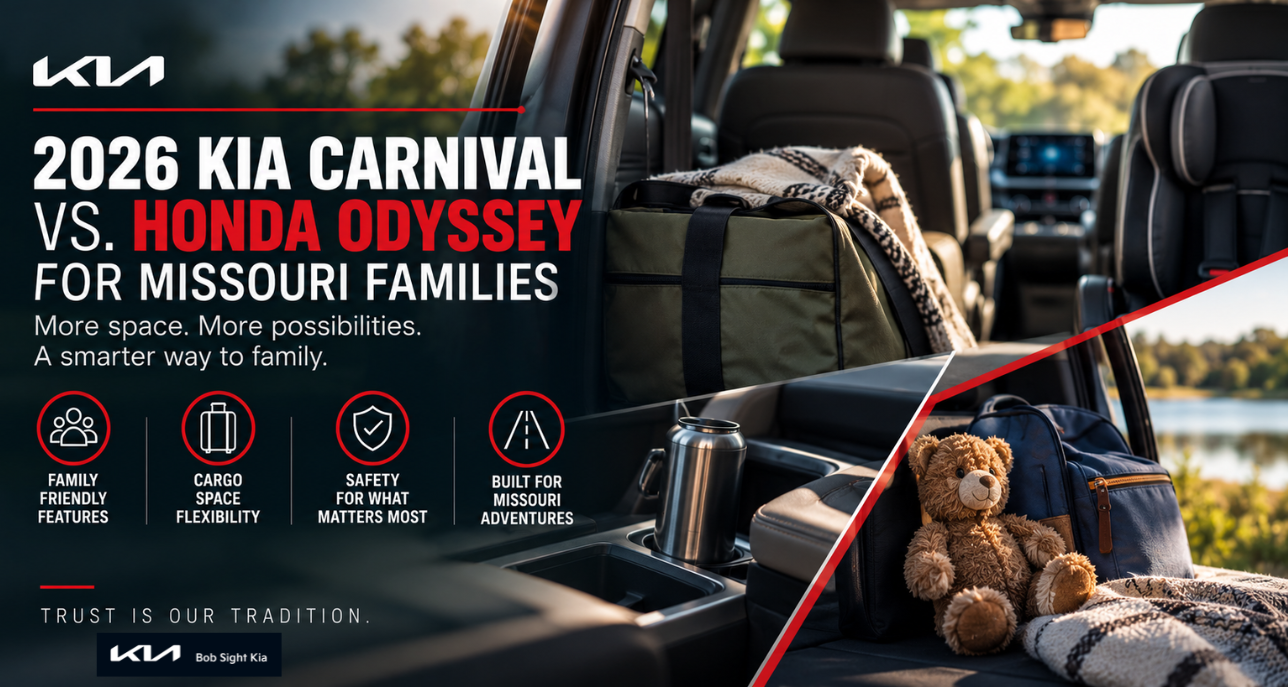
Missouri family loading a modern minivan for a 2026 Kia Carnival vs. Honda Odyssey comparison from Bob Sight Kia in Independence MO

2026 Kia Carnival vs. Honda Odyssey for Missouri Families

2026 Kia Carnival vs. Honda Odyssey: Which Minivan Works Best for Missouri Families? Explore new Kia Carnival models at Bob Sight Kia The 2026 Kia Carnival is a compelling choice for Missouri families who want flexible three-row seating, SUV-inspired styling, advanced cabin technology, and the option of an efficient hybrid powertrain. The Honda Odyssey remains a practical family vehicle with useful seating features, but the Carnival offers a broader range of powertrain choices and a distinctly modern approach to everyday transportation. At Bob Sight Kia in Independence, families from Blue Springs, Lee’s Summit, Raytown, Grain Valley, Liberty, and throughout the Kansas City Metro can explore how the Carnival fits school transportation, weekday commuting, weekend activities, and long-distance road trips. Choosing between the 2026 Kia Carnival and Honda Odyssey requires more than comparing two specification sheets. Missouri families need to consider passenger comfort, cargo flexibility, fuel economy, safety technology, winter drivability, entertainment features, and long-term ownership support. This detailed comparison explains where each minivan stands out and why the Carnival may be the stronger match for many households around Jackson County. In This Guide You’ll Learn This comparison covers the most important factors Missouri families should evaluate before choosing their next minivan. How the 2026 Kia Carnival and Honda Odyssey compare in performance Which minivan offers the best seating arrangement for a growing family How cargo capacity and interior flexibility differ What technology and entertainment features are available How the Carnival Hybrid changes the fuel-economy comparison Which safety and driver-assistance technologies support Missouri driving Why local ownership support matters after the purchase 2026 Kia Carnival vs. Honda Odyssey Quick Comparison The 2026 Kia Carnival offers Missouri families more powertrain variety, modern technology, and SUV-inspired design, while the Honda Odyssey emphasizes traditional minivan packaging and flexible second-row seating. Both vehicles can accommodate up to eight passengers when properly configured, and both provide the sliding doors and three-row usability families expect. The largest difference is that the Carnival is available with either a gasoline V6 or a hybrid powertrain, while the Odyssey uses a gasoline V6. Comparison Area 2026 Kia Carnival 2026 Honda Odyssey Standard Engine 3.5-liter V6 3.5-liter V6 Gasoline Engine Output 287 horsepower 280 horsepower Hybrid Option Available 1.6-liter turbocharged hybrid system Not available Maximum Seating Up to eight, depending on configuration Up to eight, depending on configuration Transmission 8-speed automatic with V6 or 6-speed automatic with hybrid system 10-speed automatic Driven Wheels Front-wheel drive Front-wheel drive Standout Family Feature Available hybrid efficiency and available VIP Lounge Seats Magic Slide second-row seats Design Direction SUV-inspired MPV styling Traditional minivan styling The right choice depends on how a family actually uses its vehicle. A household commuting daily between Independence and downtown Kansas City may give fuel efficiency and driver-assistance technology greater weight. A family regularly transporting children, grandparents, sports equipment, and groceries may focus more heavily on seat access and cargo flexibility. Looking at these use cases together provides a clearer answer than choosing solely by maximum cargo figures or horsepower. Trim content and individual feature availability can vary, so families should compare the exact vehicles they are considering. A visit to Bob Sight Kia gives shoppers the opportunity to sit in each row of the Carnival, test the sliding-door access, inspect cargo space, and evaluate technology in person. Those hands-on checks can reveal differences that are difficult to understand from online measurements alone. Which Minivan Offers Better Performance for Missouri Driving? The 2026 Kia Carnival provides strong everyday performance through its 287-horsepower 3.5-liter V6, while also offering a separate hybrid powertrain for families focused on efficiency. The Honda Odyssey uses a 3.5-liter V6 producing 280 horsepower and pairs it with a 10-speed automatic transmission. Both gasoline models provide smooth front-wheel-drive performance suited to suburban streets, interstate travel, and routine family transportation. The Carnival’s V6 produces 260 pound-feet of torque and works with an eight-speed automatic transmission. That combination gives the Carnival confident acceleration when merging onto I-70, entering traffic from Noland Road, or carrying passengers and luggage toward Kansas City International Airport. The Odyssey’s V6 produces 262 pound-feet of torque, so the two gasoline minivans are closely matched in everyday pulling force. Neither vehicle is designed to feel like a performance car, but both deliver the predictable acceleration families need when traffic speeds change quickly. The Carnival Hybrid uses a turbocharged 1.6-liter four-cylinder engine, an electric motor, and a lithium-ion battery. Its combined system output is 242 horsepower and 271 pound-feet of torque. Electric-motor torque arrives differently than power from a conventional gasoline engine, which can make low-speed response feel useful in stop-and-go driving around Independence Center or along busy stretches of Missouri Route 291. The hybrid system also gives Carnival shoppers an option the Odyssey lineup does not provide. Neither minivan currently offers all-wheel drive, so tire selection remains important for Missouri winters. Front-wheel drive places the engine’s weight over the driven wheels, which can provide useful traction in ordinary rain and light snow when paired with appropriate tires. All-season tires may suit many Kansas City Metro drivers, while families who must travel before roads are cleared may want to discuss dedicated winter tires with a qualified service professional. Families can compare performance in a useful way by following these steps: List the routes driven most often, including highways, neighborhood roads, and school pickup areas. Estimate how frequently the vehicle carries six or more passengers or a full cargo load. Decide whether stronger gasoline-engine output or hybrid fuel efficiency better supports those trips. Test-drive the vehicle on a route that includes low-speed turns, highway merging, and uneven pavement. Compare ride comfort and cabin noise from both the driver’s seat and rear rows. For a family that wants familiar V6 performance, the gasoline Carnival is a direct Odyssey competitor. For a household that spends substantial time commuting or moving through city traffic, the Carnival Hybrid creates a different ownership path. That ability to select between two powertrain types is one of the Carnival lineup’s most meaningful advantages. Which Minivan Has the Best Seating for Missouri Families? Both the 2026 Kia Carnival and Honda Odyssey can seat up to eight passengers, but they approach second-row comfort and flexibility differently. The Carnival offers family-friendly configurations that may include a removable second-row center seat or available VIP Lounge Seats, depending on trim. The Odyssey is known for its Magic Slide second-row seats, which can move laterally when the center seat is removed. The Carnival’s available eight-passenger layout works well for families who occasionally need room for an extra child, grandparent, or friend. Removing the second-row center seat can create a more open path toward the third row. Some Carnival configurations also prioritize second-row comfort through available VIP Lounge Seats with relaxation-style positioning and leg support. Those seats can appeal to families whose older children or adult passengers frequently travel in the second row, although shoppers should consider whether maximum passenger flexibility or lounge-style comfort matters more. The Odyssey’s Magic Slide system addresses a different family need. After removing the second-row center seat, the outboard seats can slide toward the middle or toward the doors. Moving a seat inward can make it easier for a parent in the front to reach a young passenger, while sliding a seat sideways may improve third-row access from one side. The second-row seats can be removed, but they do not fold directly into the floor. Child-restraint planning deserves close attention in either vehicle. Families should verify lower-anchor and tether locations in the exact trim they are considering, because seating configuration can affect where different car seats fit. A rear-facing seat, high-back booster, and adult passenger may create a very different layout challenge than three school-age children. Vehicle seating capacity alone does not guarantee that every car seat will fit correctly in every position. For a realistic comparison, bring the family’s current child seats to the dealership and complete a supervised fit check before purchasing. Confirm that each seat can be installed according to both the vehicle owner’s manual and child-restraint manufacturer instructions. Make sure third-row passengers can enter without disturbing a securely installed seat. Then check that every occupant has an accessible seat belt and an appropriate head-restraint position. A family near Blue Springs that carries eight people regularly may prefer the Carnival’s conventional eight-passenger flexibility. A household that frequently rearranges two second-row passengers to access the third row may appreciate the Odyssey’s lateral seat movement. Families seeking a more premium second-row experience may find the Carnival’s available VIP Lounge Seats more appealing. The best configuration is the one that supports the household’s real passenger pattern without requiring complicated daily adjustments. Cargo Space and Everyday Flexibility The Honda Odyssey offers a higher published maximum cargo figure, while the 2026 Kia Carnival provides substantial family cargo room and practical space behind its usable third row. Maximum-volume measurements do not tell the complete story because the second-row seats are handled differently in each vehicle. Missouri families should compare how easily each cabin changes from passenger duty to cargo duty. The Carnival provides approximately 40.2 cubic feet of cargo volume behind the third row, depending on measurement standards and configuration. That space can handle groceries, backpacks, folding chairs, or several pieces of luggage without requiring a family to give up third-row seating. With the rear seating areas configured for cargo, the gasoline Carnival can provide up to approximately 145.1 cubic feet of maximum cargo volume. Exact usable space depends on whether second-row seats are removed and how the chosen trim is equipped. The Odyssey publishes up to 155.8 cubic feet of total cargo space when the second-row seats are removed and the third row is stowed. Its one-motion 60/40-split third-row Magic Seat folds into the rear floor well, creating a broad loading area. This configuration can work well for moving large household items, but reaching the published maximum requires removing the second-row seats. Families should consider where those seats will be stored and whether they are comfortable lifting them. Cargo-floor shape can matter as much as total volume. A deep well behind the third row helps contain grocery bags and smaller items, while a flatter expanded floor supports furniture, bicycles, or home-improvement supplies. Families making a Saturday trip to stores around Bolger Square or Independence Commons may care more about space behind the occupied third row than about the maximum number achieved with seats removed. Use this process to compare cargo usability: Measure the stroller, sports equipment, mobility device, pet crate, or other large item carried most often. Check whether that item fits behind the third row without folding passenger seats. Fold the third row and examine whether the cargo floor is level enough for longer objects. Practice removing or repositioning the second-row seats if maximum space is important. Confirm that the power liftgate height and loading height work for every regular driver. The Odyssey has the advantage when a shopper focuses strictly on published maximum cargo volume. The Carnival remains highly practical for everyday family hauling and offers generous room behind the third row. For many households, the easier question is not which minivan holds the most in an empty-cabin test, but which one holds everyday cargo while keeping the necessary seats available. Technology and Entertainment for Long Family Drives The 2026 Kia Carnival delivers a modern, screen-centered cabin with available family communication and entertainment features designed for daily travel and long Missouri road trips. The Odyssey also offers useful connectivity, CabinWatch, CabinTalk, and an available rear entertainment system. Feature availability varies by trim, so comparing equivalent configurations is essential. The Carnival offers available panoramic display arrangements that visually connect the driver-information screen and infotainment interface. Wireless smartphone integration on compatible configurations helps reduce cable clutter during short trips around Jackson County. Available navigation, wireless charging, multiple USB charging ports, and connected services can help families coordinate changing schedules. The cabin design has a contemporary appearance that may appeal to shoppers who want their minivan to feel closer to a modern SUV. Available Passenger View with Night Vision can help the Carnival driver monitor rear passengers through the center display. An available passenger communication system can amplify the driver’s voice through the rear speakers, reducing the need to turn around or speak loudly. These features can be useful when children in the third row need instructions during busy traffic near the I-70 and I-435 interchange. Available dual rear-screen entertainment can give passengers separate viewing options on longer trips. The Odyssey offers its own family-focused tools. Available CabinWatch displays a view of rear passengers, including enhanced visibility in low-light conditions. CabinTalk allows the driver’s voice to be heard through connected headphones or rear speakers, depending on how the system is being used. The available rear entertainment system can help occupy passengers during trips across Missouri or holiday drives into Kansas. The most important difference may be interface preference rather than the length of each feature list. Families should test menu response, physical controls, phone pairing, voice commands, and rear-seat visibility. A feature only adds value when the driver can use it without becoming distracted. Parents should also determine whether children can reach charging ports and operate entertainment controls appropriately from their assigned seats. Before choosing a trim, connect the phone each adult driver uses and confirm that contacts, navigation, audio, and voice functions behave as expected. Sit in the third row to check screen visibility and headphone operation. Test how quickly the driver can activate a passenger-view camera or communication system. These practical checks can help a family choose technology that simplifies travel instead of adding another system to manage. Carnival Hybrid vs. Odyssey Fuel Economy The availability of the 2026 Kia Carnival Hybrid gives efficiency-minded families a major advantage that the gasoline-only Honda Odyssey cannot directly match. The gasoline Carnival and Odyssey have relatively similar fuel-economy profiles, but the hybrid Carnival is designed to reduce fuel use during commuting, errands, and stop-and-go driving. Actual mileage varies with temperature, traffic, passenger load, maintenance, and driving habits. The gasoline Carnival carries EPA estimates of approximately 18 mpg city, 26 mpg highway, and 21 mpg combined. The Odyssey is rated at approximately 19 mpg city, 28 mpg highway, and 22 mpg combined. On uninterrupted highway travel, the Odyssey may hold a small numerical advantage over the gasoline Carnival. That difference should be considered alongside horsepower, technology, seating configuration, and the specific trim a family prefers. The Carnival Hybrid carries EPA estimates of approximately 34 mpg city, 31 mpg highway, and 33 mpg combined. Its higher city rating reflects the way a hybrid system can recover energy during deceleration and use electric assistance under appropriate conditions. Regenerative braking converts some of the vehicle’s motion into electrical energy that can be stored in the hybrid battery. The driver does not plug in the Carnival Hybrid because it is a conventional hybrid rather than a plug-in hybrid. Hybrid efficiency can be valuable for families who make repeated short trips between home, school, work, practices, and shopping areas. A driver traveling regularly along 39th Street, Noland Road, and Missouri Route 291 may encounter traffic signals and variable speeds where hybrid operation can be useful. Cold weather can temporarily reduce efficiency because the engine and cabin require more energy to warm up. Tire pressure also drops as temperatures fall, which can increase rolling resistance if it is not corrected. Powertrain EPA City Estimate EPA Highway Estimate EPA Combined Estimate Kia Carnival 3.5L V6 Approximately 18 mpg Approximately 26 mpg Approximately 21 mpg Kia Carnival Hybrid Approximately 34 mpg Approximately 31 mpg Approximately 33 mpg Honda Odyssey 3.5L V6 Approximately 19 mpg Approximately 28 mpg Approximately 22 mpg Families who primarily take long highway trips may find the gasoline comparison relatively close. Drivers who spend more time in suburban traffic have a stronger reason to evaluate the Carnival Hybrid. Keeping tires properly inflated, removing unnecessary cargo, using smooth acceleration, and following the maintenance schedule can support efficient operation with any powertrain. Safety and Driver-Assistance Technology Both the 2026 Kia Carnival and Honda Odyssey offer extensive driver-assistance technology, but the Carnival provides a particularly broad collection of available systems for highway, parking, and everyday family driving. These technologies support an attentive driver rather than replacing one. Families should compare which features are standard on the exact trims under consideration. The Carnival’s available Kia Drive Wise technologies may include Forward Collision-Avoidance Assist, Blind-Spot Collision-Avoidance Assist, Rear Cross-Traffic Collision-Avoidance Assist, Lane Keeping Assist, Lane Following Assist, Smart Cruise Control, and Highway Driving Assist. Some configurations may add enhanced intersection support, parking sensors, a Surround View Monitor, or a Blind-Spot View Monitor. The Blind-Spot View Monitor can display a camera image in the instrument cluster when a turn signal is activated. The Odyssey includes the Honda Sensing suite of driver-assistance features. Depending on model specifications, these systems include Collision Mitigation Braking System, Road Departure Mitigation System, Adaptive Cruise Control with Low-Speed Follow, Lane Keeping Assist System, and Traffic Sign Recognition. Blind Spot Information with Cross Traffic Monitor also supports awareness around adjacent vehicles and parking-lot traffic. Adaptive cruise control can reduce repeated speed adjustments on I-70, but the driver must remain prepared to brake or steer. Lane-centering support may reduce workload on clearly marked roads, but lane markings can become harder for cameras to interpret during heavy rain, snow, road construction, or glare. Automatic emergency braking is designed to assist in certain situations and does not eliminate the need for safe following distance. Parking technology can be valuable in crowded school lots or shopping centers, where children, carts, and vehicles may enter the driving path unexpectedly. Camera systems provide additional viewpoints, but drivers should still check mirrors, look over their shoulders, and move slowly. Dirt, road salt, snow, and ice can also obstruct cameras and radar sensors, so keeping sensor areas clean is an important winter habit. During a test drive, ask for a demonstration of each system rather than relying only on feature names. Confirm how warning sensitivity can be adjusted, where alerts appear, and whether the system uses sound, steering input, braking, or multiple responses. Understanding those behaviors before daily use can make the technology feel more predictable and useful. Comfort, Ride Quality, and Missouri Weather The Carnival and Odyssey are both designed for comfortable family travel, but the Carnival’s upscale cabin presentation and available comfort features help it stand apart. Ride quality depends on wheel size, tire construction, passenger load, road surface, and trim configuration. Missouri families should test both vehicles on the types of roads they drive most often. The Kansas City Metro combines smooth interstate sections with patched pavement, expansion joints, construction zones, and neighborhood streets affected by freeze-thaw cycles. Larger wheels can sharpen steering response and enhance appearance, but tires with shorter sidewalls may transmit more impact from potholes. Families who prioritize ride comfort should compare trims with different wheel-and-tire packages instead of assuming every version drives identically. The Carnival offers available heated and ventilated front seats, available heated and ventilated second-row seating, and available tri-zone climate control features. These options can help families manage humid summer afternoons and cold winter mornings. Remote-start capability can also allow the climate system to begin preparing the cabin before passengers enter, subject to safe operating conditions and local rules. The Odyssey also offers tri-zone automatic climate control, remote engine start, available heated and ventilated front seats, and integrated sunshades on certain configurations. Its Magic Slide second-row seats provide a practical comfort benefit by allowing families to change passenger spacing. The ideal choice depends on whether a household values movable seating or the Carnival’s available lounge-oriented second-row experience. Winter capability involves more than driven wheels. Quality tires, sufficient tread depth, correct inflation, functioning wiper blades, winter-rated windshield washer fluid, and a healthy 12-volt battery all contribute to dependable travel. A front-wheel-drive minivan with properly selected tires can be more predictable in snow than a vehicle with additional driven wheels but worn tires. A thorough test drive should include a rough road, a highway entrance ramp, a tight parking maneuver, and time in every seating row. Ask a rear passenger to evaluate road noise, climate airflow, seat comfort, and outward visibility. These observations are important for families who regularly drive to activities in Lee’s Summit, visit relatives across the Kansas City Metro, or take longer trips through changing Midwest weather. Which Minivan Is Better for Different Missouri Family Needs? The 2026 Kia Carnival is the better fit for families seeking powertrain choice, contemporary technology, and SUV-inspired design, while the Odyssey may appeal to shoppers who prioritize Magic Slide seating and the largest published maximum cargo figure. The best minivan is determined by daily routines, not by one isolated specification. Different family structures can lead to different conclusions. A commuting family may favor the Carnival Hybrid. Its estimated combined fuel economy can make a meaningful difference for a household completing school drop-offs, work commutes, grocery runs, and evening activities in the same day. The hybrid also preserves the sliding-door access and three-row seating that make a minivan practical. This creates an efficient family-vehicle option without moving to a smaller crossover. A family focused on passenger comfort may prefer a Carnival trim with available VIP Lounge Seats. These seats can make longer drives more relaxing for older children or adults who regularly occupy the second row. The Carnival’s modern interior presentation and available dual rear entertainment screens also strengthen its appeal for road trips. Families should remember that a lounge-seat layout may not provide the same maximum flexibility as a conventional removable second-row configuration. A household frequently rearranging second-row passengers may find the Odyssey’s Magic Slide system useful. The ability to move outboard seats laterally can help with third-row access and passenger placement. The Odyssey may also appeal to someone who regularly converts the cabin into maximum cargo mode and is comfortable removing the second-row seats. These strengths are real, but they do not give the Odyssey a hybrid alternative. A style-conscious family may lean toward the Carnival because its long hood, bold grille, and more upright profile resemble an SUV. That design can appeal to shoppers who need minivan functionality but do not want traditional minivan styling. The visual difference is not simply cosmetic because the Carnival’s cabin and technology presentation follow the same modern direction. Families should create a short requirements list before visiting a dealership. Separate nonnegotiable needs, such as the number of car-seat positions, from preferences, such as a particular screen size or wheel design. Then compare vehicles in equivalent trim levels and complete a real-world test drive. This process makes it easier to identify the vehicle that will remain useful as children grow and family routines change. Quick Facts About the 2026 Kia Carnival and Honda Odyssey The most important distinction is that the 2026 Kia Carnival offers both gasoline and hybrid choices, while the Honda Odyssey remains gasoline-only. Both minivans provide three rows, available eight-passenger seating, sliding rear doors, and family-oriented technology. Their differences become clearer when shoppers compare actual seating configurations and trim-specific equipment. The gasoline Carnival uses a 3.5-liter V6 producing 287 horsepower. The Carnival Hybrid combines a turbocharged 1.6-liter engine with electric assistance. The Carnival Hybrid produces 242 combined horsepower and 271 pound-feet of torque. The Odyssey uses a 3.5-liter V6 producing 280 horsepower. Both models use front-wheel drive. Both models can accommodate up to eight passengers when properly configured. The Carnival offers available VIP Lounge Seats on select configurations. The Odyssey offers Magic Slide second-row seats. The Carnival offers approximately 40.2 cubic feet of cargo space behind the third row. The Odyssey publishes up to 155.8 cubic feet of maximum cargo space with seats properly removed or stowed. The Carnival Hybrid has a significant estimated combined fuel-economy advantage over either V6 model. Safety and convenience features vary by trim and should be verified on the individual vehicle. These facts provide a useful starting point, but the final decision should include a seating test, cargo demonstration, technology walkthrough, and test drive. A family that uses every seat has different needs from one that usually carries four people and large amounts of gear. Bob Sight Kia can help Independence-area shoppers compare Carnival configurations based on those real routines. Ownership Planning for a Family Minivan Good minivan ownership planning includes routine maintenance, seasonal inspections, tire care, and choosing a configuration that can adapt as the family changes. The Carnival and Odyssey both require maintenance according to their manufacturer guidance. Following the schedule can support reliability, safety, efficiency, and warranty documentation. Engine-oil requirements should always be confirmed in the owner’s manual or on the oil-filler cap for the specific engine. Modern engines require oil that meets defined viscosity and performance standards, such as current API and ILSAC specifications. Using the correct oil matters because turbocharged hybrid engines and naturally aspirated V6 engines operate under different thermal and lubrication demands. A service department can identify the proper fluid and filter requirements using the vehicle identification number. Missouri’s seasonal temperature changes make tire-pressure checks important. Tire pressure commonly decreases as outdoor temperature falls, and an underinflated tire can affect handling, tread wear, and efficiency. Families should inspect tires monthly, before long trips, and after major temperature swings. Measurements should be compared with the pressure label inside the driver’s door opening rather than the maximum pressure printed on the tire sidewall. Brake inspections are also important for a heavily used family vehicle. Stop-and-go traffic, repeated school runs, highway congestion, and regular passenger loads can affect brake wear. Hybrid regenerative braking may reduce some use of the friction brakes under certain conditions, but the brake pads, rotors, fluid, and hardware still require inspection. Regenerative braking should never be interpreted as maintenance-free braking. Bob Sight Kia provides a local destination for Kia maintenance, inspections, tires, parts, and service scheduling in Independence. Keeping service records in one place can help technicians recognize changes over time and verify completed maintenance. It can also make future trade-in preparation easier because organized records provide a clearer picture of vehicle care. Ownership programs can add value only when drivers understand and follow their requirements. Families should review eligibility, maintenance conditions, service intervals, and documentation before relying on any program. At Bob Sight Kia, qualifying ownership benefits require required maintenance to be performed with the dealership, so shoppers should ask for the current written terms and confirm how the program applies to the vehicle they are considering. Frequently Asked Questions Is the 2026 Kia Carnival or Honda Odyssey better for a Missouri family? The 2026 Kia Carnival is likely the better choice for a Missouri family that values powertrain options, modern technology, SUV-inspired styling, and available premium second-row comfort. The Odyssey remains a capable minivan with flexible Magic Slide seating and substantial maximum cargo capacity. The best answer depends on passenger arrangements, commute patterns, and cargo needs. The Carnival offers both a 287-horsepower V6 and an available hybrid system, allowing families to choose between familiar gasoline performance and stronger fuel-economy potential. The Odyssey offers one V6 powertrain. Families driving frequently around Independence and Kansas City may find the Carnival Hybrid particularly relevant because hybrid systems can perform efficiently in variable-speed traffic. A local test drive should include the roads the family uses regularly. Driving near the I-70 corridor can reveal merging response, while neighborhood streets can show ride comfort over repaired pavement. Every regular passenger should test seat access, visibility, climate airflow, and available charging connections before the family makes a final choice. Does the 2026 Kia Carnival have more passenger room than the Honda Odyssey? Both minivans offer spacious three-row cabins, but their passenger-room advantages depend on seating position and configuration rather than one overall measurement. Both can seat up to eight occupants when equipped with the appropriate layout. The Carnival emphasizes available second-row luxury, while the Odyssey emphasizes lateral seat movement. The Carnival’s available VIP Lounge Seats can create a more relaxing second-row environment, but families needing eight seats should focus on a conventional configuration. The Odyssey’s Magic Slide seats can help change the path to the third row after the center seat is removed. Neither system is automatically better for every household. Families using child restraints should test their exact seats in the vehicle. A configuration that looks spacious online may function differently after installing a rear-facing seat and booster. Bob Sight Kia shoppers can inspect Carnival seating in person and determine whether the second-row arrangement works with their daily pickup, drop-off, and third-row access needs. Is the Kia Carnival Hybrid more efficient than the Honda Odyssey? Yes, the 2026 Kia Carnival Hybrid has substantially higher EPA fuel-economy estimates than the gasoline Honda Odyssey. The Carnival Hybrid is rated at approximately 34 mpg city, 31 mpg highway, and 33 mpg combined. The Odyssey is rated at approximately 19 mpg city, 28 mpg highway, and 22 mpg combined. The difference is most relevant for families that accumulate significant mileage in urban and suburban driving. Hybrid systems can recapture energy during deceleration and provide electric assistance under appropriate conditions. Actual results depend on speed, temperature, climate-control use, vehicle load, tire pressure, and driving technique. A family making daily trips between Blue Springs and Independence may experience a different efficiency pattern than one spending most of its time at steady highway speeds. Missouri winter temperatures can also reduce efficiency until the engine and cabin reach operating temperature. Keeping the vehicle maintained and the tires correctly inflated helps support consistent results throughout the year. Which minivan has better cargo space for road trips? The Odyssey has a higher published maximum cargo figure, but the Carnival provides generous cargo room behind the third row and may be equally practical for many family road trips. Maximum volume only applies after seats are removed or stowed as required. Families should focus on the space available in the seating arrangement they will actually use. The Carnival provides approximately 40.2 cubic feet behind the third row, which is useful when all three rows remain occupied. The Odyssey’s maximum cargo figure reaches 155.8 cubic feet when the second-row seats are removed and the third row is folded. Removing seats may not be practical when a trip requires space for six or more people. Before a holiday trip, place representative luggage, a stroller, or sports equipment behind the third row. Check whether rear visibility remains clear and whether loose objects can be secured. Families traveling from Independence toward the Lake of the Ozarks or across Kansas may find that usable behind-the-row space matters more than the largest theoretical capacity. Where can I test-drive a Kia Carnival near Kansas City? Drivers can schedule a Kia Carnival test drive at Bob Sight Kia in Independence, Missouri. The dealership serves families from Blue Springs, Lee’s Summit, Raytown, Sugar Creek, Grain Valley, Liberty, Oak Grove, and communities across the Kansas City Metro. Inventory availability can change, so checking current listings before visiting is recommended. A productive test drive should include more than a short loop. Ask to evaluate acceleration, braking, visibility, parking, infotainment controls, and ride quality. Families should also inspect the second and third rows, sliding-door openings, cargo well, seat-adjustment process, and child-restraint anchor locations. Shoppers comparing gasoline and hybrid Carnival models should drive both when inventory allows. The two powertrains have different acceleration characteristics and efficiency priorities. Scheduling ahead gives the dealership an opportunity to confirm which configurations are available for comparison. Why the 2026 Kia Carnival Stands Out for Kansas City Metro Families The 2026 Kia Carnival stands out because it combines genuine minivan versatility with the design, technology, and powertrain choice many modern families want. Its available hybrid system gives Missouri shoppers an efficient alternative without giving up three-row seating or sliding-door convenience. The gasoline model remains available for drivers who prefer V6 performance. Buying locally also makes it easier to evaluate the vehicle in the same regional conditions it will encounter every day. Independence drivers can assess visibility in busy shopping areas, acceleration near interstate entrances, and ride comfort on familiar roads. Families from nearby cities can make the short trip to compare seating and cargo arrangements in person rather than relying entirely on online descriptions. Local service support becomes important after the purchase. Seasonal tire checks, scheduled maintenance, software questions, warning-light diagnosis, and parts needs are easier to address when drivers have an established relationship with a nearby dealership. Bob Sight Kia provides sales, service, financing, and parts resources in one Independence location. The Odyssey continues to offer practical seating and cargo strengths, but the Carnival gives shoppers more ways to tailor the vehicle to their priorities. Families can choose a gasoline or hybrid powertrain, consider conventional or comfort-focused second-row seating, and select available technology based on how they travel. That flexibility makes the 2026 Kia Carnival a strong answer for many Missouri households comparing family minivans. Visit Bob Sight Kia to explore current Carnival availability, compare trims, and schedule a test drive. A hands-on evaluation can help determine how the Carnival supports school routines, Kansas City commutes, weekend activities, and long-distance family travel. The right family vehicle should simplify everyday life while remaining comfortable and useful for years to come. Helpful Links Shop New Kia Carnival Inventory Shop New Kia Carnival Hybrid Inventory Schedule a Test Drive Value Your Trade Get Pre-Approved Proud to Be Part of the Bob Sight Auto Group Bob Sight Kia is proud to serve Independence and the Kansas City Metro as part of the Bob Sight Auto Group. Our family of dealerships helps drivers shop, maintain, and care for vehicles across Missouri and Kansas. Each location shares a commitment to useful guidance, dependable support, and lasting customer relationships. The Bob Sight Auto Group includes Bob Sight Kia in Independence, Missouri; Bob Sight Ford in Lee’s Summit, Missouri; Bob Sight Honda in Lawrence, Kansas; and Bob Sight CDJR in Lawrence, Kansas. Drivers can also turn to the Bob Sight Collision Center in Lee’s Summit for collision repair support. Whether a family is comparing minivans, maintaining a current vehicle, or preparing for a future trade, the Bob Sight team is ready to help. For generations of local drivers, Trust Is Our Tradition. { "@context": "https://schema.org", "@type": "FAQPage", "mainEntity": [ { "@type": "Question", "name": "Is the 2026 Kia Carnival or Honda Odyssey better for a Missouri family?", "acceptedAnswer": { "@type": "Answer", "text": "The 2026 Kia Carnival is likely the better choice for a Missouri family that values powertrain options, modern technology, SUV-inspired styling, and available premium second-row comfort. The Odyssey remains a capable minivan with flexible Magic Slide seating and substantial maximum cargo capacity. The best choice depends on passenger arrangements, commute patterns, and cargo needs." } }, { "@type": "Question", "name": "Does the 2026 Kia Carnival have more passenger room than the Honda Odyssey?", "acceptedAnswer": { "@type": "Answer", "text": "Both minivans offer spacious three-row cabins, but their passenger-room advantages depend on seating position and configuration. Both can seat up to eight occupants when properly equipped. The Carnival emphasizes available second-row comfort, while the Odyssey emphasizes lateral second-row seat movement." } }, { "@type": "Question", "name": "Is the Kia Carnival Hybrid more efficient than the Honda Odyssey?", "acceptedAnswer": { "@type": "Answer", "text": "Yes. The 2026 Kia Carnival Hybrid has EPA estimates of approximately 34 mpg city, 31 mpg highway, and 33 mpg combined. The gasoline Honda Odyssey is rated at approximately 19 mpg city, 28 mpg highway, and 22 mpg combined." } }, { "@type": "Question", "name": "Which minivan has better cargo space for road trips?", "acceptedAnswer": { "@type": "Answer", "text": "The Honda Odyssey has a higher published maximum cargo figure, while the Kia Carnival provides generous cargo room behind its usable third row. Families should compare cargo space in the seating configuration they will use rather than relying only on maximum-volume measurements." } }, { "@type": "Question", "name": "Where can I test-drive a Kia Carnival near Kansas City?", "acceptedAnswer": { "@type": "Answer", "text": "Drivers can schedule a Kia Carnival test drive at Bob Sight Kia in Independence, Missouri. The dealership serves Blue Springs, Lee’s Summit, Raytown, Sugar Creek, Grain Valley, Liberty, Oak Grove, and the greater Kansas City Metro." } } ] }

Kia K4 maintenance service scene for Kansas City drivers at Bob Sight Kia in Independence, Missouri

Kia K4 Maintenance Schedule: Essential Service Guide for Kansas City Drivers

Kia K4 Maintenance Schedule and Essential Service Guide for Kansas City Drivers Schedule Kia K4 service at Bob Sight Kia in Independence, Missouri Following the Kia K4 maintenance schedule helps protect everyday performance, tire life, braking, reliability, and long-term ownership. For current K4 models under normal driving conditions, Kia generally organizes scheduled maintenance around 8,000-mile or 12-month intervals, whichever comes first, while certain severe driving conditions can require more frequent service. That distinction is important for drivers around Independence and the Kansas City Metro because short trips, heavy traffic, stop-and-go driving, very cold weather, and salt-treated roads are among the conditions Kia identifies when determining whether more frequent maintenance may be appropriate. A maintenance schedule should not be treated as a generic checklist that applies identically to every K4. The Kia K4 is available with different powertrains, and some components have different service requirements depending on engine and transmission. Your exact model year, engine, mileage, driving conditions, vehicle alerts, and owner's documentation should always take priority when determining what your individual K4 needs. This guide explains the major K4 maintenance milestones, what commonly happens at each stage, which items differ by powertrain, and why Kansas City driving can affect your service routine. It is designed to help K4 owners understand the schedule rather than simply memorize a list of mileage numbers. In This Guide You'll Learn The Kia K4 maintenance schedule combines recurring services with inspections and longer-term replacement intervals. Understanding the difference between an inspection and a required replacement can make it much easier to plan maintenance throughout ownership. What happens around the first 8,000-mile K4 service interval How often Kia recommends rotating K4 tires When engine oil and the oil filter are normally serviced Why some Kansas City driving can qualify as severe usage When the climate control and engine air filters are typically replaced When brake fluid becomes a scheduled replacement item Why spark plug intervals differ between K4 powertrains Which maintenance items owners should monitor between dealership visits How to build a long-term K4 service routine around commuting and seasonal Missouri driving What Is the Kia K4 Maintenance Schedule? Under Kia's normal maintenance schedule for current K4 models, many recurring maintenance items are organized around 8,000-mile or 12-month intervals, whichever comes first. Engine oil and filter service and tire rotation are key recurring items, while other components are inspected or replaced at different milestones. The phrase "whichever comes first" is important. A K4 that reaches 8,000 miles in eight months may be ready for its mileage-based maintenance before a year has passed. A K4 driven only 5,000 miles during an entire year may still reach a time-based service point. Mileage is therefore only one part of maintenance planning. Kia also distinguishes between "inspect" and "replace" in its maintenance schedule. An inspection means the component should be evaluated and adjusted, cleaned, corrected, or replaced if necessary. A replacement interval means Kia specifies changing that component or fluid at the stated mileage or time. That distinction prevents owners from assuming every item listed during a maintenance visit automatically needs replacement. Brake components, suspension parts, steering components, hoses, tires, and other systems may be inspected repeatedly throughout ownership so developing wear can be identified before it becomes a larger concern. For someone commuting from Independence toward Kansas City on I-70, mileage can accumulate much faster than expected. Another owner who primarily makes short trips around Independence may accumulate fewer miles but operate the engine under conditions Kia classifies differently. Both owners need maintenance, but the appropriate timing may not always be identical. What Should Be Done Around 8,000 Miles on a Kia K4? Around 8,000 miles or 12 months under normal operating conditions, a Kia K4 reaches an important recurring maintenance milestone that includes engine oil and filter service, tire rotation, and several inspections. This interval establishes the basic rhythm owners will see repeatedly throughout the normal maintenance schedule. Engine oil performs several jobs inside the engine. It lubricates moving components, helps manage heat, carries contaminants toward the filter, and provides protection against wear. Oil gradually deteriorates through heat, time, engine operation, and contamination, which is why replacing both the oil and filter is part of routine gasoline-engine maintenance. Tire rotation is also recommended every 8,000 miles or 12 months under the normal schedule, or sooner if irregular wear develops. Tires do not necessarily wear evenly at all four positions because steering, braking, drivetrain forces, alignment, road conditions, and vehicle loading can influence tread wear. Moving tires to appropriate positions can help promote more even wear over time. The 8,000-mile service interval also creates an opportunity to inspect other vehicle systems. The exact list should follow the maintenance schedule for your K4, but recurring inspections can help evaluate brakes, tires, steering and suspension components, fluid condition, and other items that contribute to dependable operation. For a K4 regularly driven between Independence, Blue Springs, Lee's Summit, Raytown, and Kansas City, 8,000 miles may arrive surprisingly quickly. Commuters should watch mileage rather than waiting for a particular season or assuming annual service will always occur before the mileage threshold. How Often Does a Kia K4 Need an Oil Change? Under the normal maintenance schedule for current Kia K4 models, engine oil and the engine oil filter are replaced at 8,000-mile or 12-month intervals, whichever comes first, while qualifying severe usage can require more frequent service. Owners should also pay attention to the K4's Oil Life Management System when equipped and follow vehicle-specific alerts and owner's documentation. The Oil Life Management System can estimate oil life using driving history. This is useful because two K4s with similar odometer readings can experience different operating conditions. If oil deteriorates more quickly because of how the vehicle is driven, the system can alert the owner before the maximum normal interval. Kia also instructs owners to check engine oil level regularly. An oil-life monitor is designed to estimate oil condition and service timing, but it does not eliminate the need to maintain the correct oil level. The system also assumes the recommended engine oil is being used. If the recommended oil specification is not used, Kia directs owners toward the severe-usage oil replacement schedule. Using the proper specification therefore matters for more than simply choosing between conventional and synthetic terminology. The engine is designed around particular lubricant requirements, and the owner's documentation should be used when determining the correct oil for the specific K4 powertrain. After an oil change, the Oil Life Management System should also be reset when applicable. Otherwise, the remaining oil-life calculation may no longer correspond with the fresh oil in the engine. If you have your K4 serviced professionally, confirming that the maintenance indicator has been properly reset can prevent confusion later. Does Kansas City Driving Count as Severe Usage for a Kia K4? Some Kansas City driving patterns can meet Kia's definition of severe usage, including repeated short trips, heavy traffic, stop-and-go driving, very cold weather, and travel on salt-treated roads. Whether your K4 actually requires the severe maintenance schedule depends on how regularly it experiences the conditions Kia identifies. "Severe" does not necessarily mean aggressive or abusive driving. In automotive maintenance, severe usage refers to operating conditions that can place additional demands on certain components or cause fluids and filters to deteriorate more quickly. A perfectly careful driver can still operate under severe conditions simply because of commute length, traffic, climate, or road environment. Kia identifies repeated trips shorter than approximately five miles in normal temperatures or ten miles in freezing temperatures as one severe-use condition. Extensive idling, low-speed driving, heavy traffic, repeated stop-and-go operation, rough or dusty roads, salt-treated roads, and very cold weather also appear among the listed conditions. That makes the distinction relevant in Independence. A K4 owner making frequent short trips around Noland Road, Independence Center, school pickup lines, and nearby neighborhoods may operate differently from someone who starts the vehicle and spends most of the trip cruising steadily on I-70. Winter driving adds another consideration when road salt and freezing temperatures become part of normal travel. For qualifying severe usage, Kia specifies engine oil and filter replacement as frequently as every 5,000 miles or six months for certain listed severe-use conditions. Other components may also require more frequent inspection or replacement. Owners should compare their actual driving with the severe-use definitions in the owner's manual rather than automatically assuming either schedule applies. How Should You Plan Kia K4 Maintenance Step by Step? The easiest way to manage Kia K4 maintenance is to combine mileage tracking, time-based intervals, vehicle alerts, owner inspections, and seasonal planning. A simple process can prevent routine service from becoming something you only think about after a warning light or noticeable problem appears. Confirm your exact K4 model year and powertrain. Engine and transmission configuration can affect specific maintenance requirements. Review your current mileage. Compare the odometer with the maintenance schedule rather than relying on memory. Track elapsed time. Remember that many intervals use mileage or months, whichever occurs first. Evaluate your driving conditions. Determine whether repeated short trips, stop-and-go traffic, cold weather, salt-treated roads, or other severe-use conditions regularly apply. Watch the Oil Life Management System and vehicle alerts. Do not ignore a maintenance notification simply because you have not reached the maximum normal interval. Check tires and fluids between services. Maintenance is not limited to dealership appointments. Keep service records. Documentation makes it easier to understand what has already been completed and what is approaching next. This method works well for Kansas City commuters because annual mileage can change. Someone may begin ownership working from home and later start commuting five days a week. A move from Independence to Blue Springs or a new job in downtown Kansas City can also significantly change annual mileage. Service planning should change when vehicle usage changes. A maintenance schedule is not simply a calendar created on the day you purchase the K4. It is a framework that should be compared with the way the vehicle is actually being driven throughout ownership. Drivers who prefer professional maintenance can schedule Kia K4 service at Bob Sight Kia in Independence. Bringing previous service information and mentioning changes in your driving pattern can help provide useful context during a maintenance visit. When Do Kia K4 Filters and Brake Fluid Need Service? The K4 maintenance schedule includes different intervals for the climate control air filter, engine air cleaner filter, and brake fluid rather than replacing all filters and fluids at every visit. Knowing these longer-term intervals can help owners anticipate maintenance beyond routine oil changes and tire rotations. Under the normal schedule for current K4 models, the climate control air filter is inspected around 8,000 miles and replaced around 16,000 miles, with that inspect-and-replace pattern continuing at subsequent intervals. This filter helps remove particles from air entering the passenger compartment through the heating and air-conditioning system. The engine air cleaner filter follows a different pattern. It is inspected at earlier intervals and normally replaced around 24,000 miles, then again at later corresponding intervals. Driving in dusty conditions can require more frequent replacement, which is another reason vehicle usage matters when interpreting the schedule. Brake fluid is inspected regularly and, under the normal schedule, is replaced around 48,000 miles or 48 months. Brake fluid is part of the hydraulic braking system and should not be confused with brake-pad wear. Brake pads can wear at very different rates depending on driving style, traffic, mileage, terrain, and operating conditions. A K4 spending much of its time in Kansas City stop-and-go traffic may experience braking demands differently from a vehicle accumulating mostly steady highway miles. Kia calls for brake-system inspections as part of scheduled maintenance so wear can be evaluated based on actual vehicle condition rather than an assumed universal brake-pad replacement mileage. What Changes at 16,000, 24,000, and 48,000 Miles? Kia K4 maintenance builds on the recurring 8,000-mile service rhythm, with additional filter, fluid, and powertrain-specific items appearing as mileage increases. Thinking in milestones can make the schedule easier to understand than viewing it as one long maintenance chart. Approximate Normal-Service Milestone Key K4 Maintenance Items 8,000 miles / 12 months Engine oil and filter service, tire rotation, scheduled inspections 16,000 miles / 24 months Recurring oil and tire service plus climate control air filter replacement and applicable inspections 24,000 miles / 36 months Recurring service plus normal engine air cleaner filter replacement and applicable inspections 32,000 miles / 48 months Recurring service, climate control air filter replacement, and applicable inspections 48,000 miles / 48 months or applicable mileage/time point Brake fluid replacement under the normal schedule, recurring maintenance, and powertrain-specific items This chart is intended as a planning overview rather than a replacement for the maintenance schedule associated with your exact K4. Individual inspection items and powertrain-specific requirements should still be followed according to the owner's documentation. The 48,000-mile range is particularly important because powertrain differences begin to matter more. Current K4 models equipped with the Smartstream 1.6-liter turbocharged GDI engine have a different spark-plug replacement interval than models using the Smartstream 2.0-liter engine. For the 1.6-liter turbocharged engine, Kia specifies spark plug replacement at 48,000 miles under the normal schedule. For the 2.0-liter engine, the normal spark-plug replacement interval extends to 96,000 miles. This is a clear example of why copying a maintenance schedule from another K4 without confirming the engine can lead to incorrect service planning. As mileage grows, owners should become increasingly familiar with their vehicle's maintenance history. Knowing whether filters, brake fluid, spark plugs, tires, and other items have already been serviced makes future maintenance much easier to plan. What Should Kia K4 Owners Check Between Scheduled Services? K4 owners should monitor tires, fluid levels, exterior lighting, wipers, warning indicators, and changes in vehicle behavior between scheduled maintenance visits. Routine owner checks can identify developing concerns before the next scheduled mileage interval arrives. Start with tires. Check inflation when the tires are cold and use the pressure specification provided for the vehicle rather than the maximum pressure printed on the tire sidewall. Tire pressure can fall as outside temperatures decrease, which makes this particularly important during the transition from fall into winter in Missouri. Inspect tread and look for obvious damage, cuts, bulges, or uneven wear. Kia recommends tire rotation every 8,000 miles or 12 months under normal conditions, or sooner when irregular wear develops. Uneven wear can sometimes indicate pressure, balance, alignment, suspension, or driving-condition concerns that deserve inspection. Engine oil level should also be checked regularly. Do not assume an oil-life indicator is an oil-level sensor. Oil life and oil quantity are different measurements, and maintaining the proper level remains an owner responsibility. Pay attention to visibility items as well. Wiper blades that streak across the windshield may be inconvenient during a light Independence rain but become much more significant during a highway storm on I-70. Washer fluid, exterior lights, and windshield condition all contribute to safe visibility. Finally, notice changes in how the K4 feels. New vibration, pulling, unusual noises, changes in braking response, warning indicators, difficult starting, or unexpected changes in steering should not automatically wait for the next scheduled service. Mileage intervals provide a maintenance framework, but vehicle condition can create a reason for earlier inspection. How Can You Prepare a Kia K4 for Missouri Winter Driving? Preparing a Kia K4 for Missouri winter driving should include checking tires, battery condition, wipers, fluids, brakes, exterior lighting, and scheduled maintenance before colder weather becomes routine. Winter preparation complements the regular Kia K4 maintenance schedule rather than replacing it. Begin with the tires because temperature affects inflation pressure. A significant drop in outside temperature can reduce tire pressure, and an underinflated tire can affect handling, tread wear, and efficiency. Inspect tread condition at the same time and address irregular wear before snow or ice makes traction more challenging. Battery performance deserves attention before winter as well. Cold temperatures increase the importance of dependable starting performance, and a battery that seemed adequate during warm weather may reveal weakness after temperatures fall. Battery testing can help evaluate condition before a cold morning leaves you unexpectedly unable to start the vehicle. Visibility should also be part of the checklist. Replace worn wiper blades, keep washer fluid appropriate for seasonal temperatures, verify exterior lights, and make sure the windshield can be cleared effectively. Missouri winter travel can involve snow, freezing rain, road spray, darkness, and salt residue, sometimes during the same week. Drivers should also consider whether their routine includes conditions Kia categorizes as severe usage. Very cold weather and driving on salt-treated roads appear in Kia's severe-use definitions. A K4 driven regularly through Kansas City winter traffic may therefore need maintenance planning that differs from a vehicle operated primarily in moderate conditions. A seasonal inspection can be useful even when no warning light is illuminated. Preventive maintenance is about identifying wear and preparing for upcoming conditions rather than waiting until a component fails. Why Tire Rotations Matter on a Kia K4 Kia recommends rotating K4 tires every 8,000 miles or 12 months under normal conditions because rotation helps promote more even tread wear. Kia also recommends rotating sooner if irregular wear develops, making tire condition just as important as the mileage number. Front and rear tires perform different jobs. Steering forces affect the front tires, braking can distribute loads unevenly, and drivetrain forces can influence how tread wears. Rotation changes tire positions so one set of tires does not remain in the same wear pattern throughout its entire life. Kia recommends checking tire balance during rotation and inspecting for uneven wear or damage. Abnormal wear can be associated with incorrect pressure, alignment issues, wheel imbalance, severe braking, or aggressive cornering. Visible bulges, exposed cord, or other significant tire damage require attention regardless of scheduled mileage. For K4 drivers around Independence, road conditions can change throughout the year. Freeze-thaw cycles can contribute to potholes, construction can create rough pavement, and daily travel across I-70 or local streets can expose tires to repeated impacts. If the steering wheel begins vibrating or the vehicle develops unusual tire wear, waiting until the next scheduled rotation may not be the best approach. Tire rotation appointments are also a useful opportunity to inspect the brakes because the wheels are already being addressed. Kia recommends inspecting disc brake pads for wear when tires are rotated. Combining related inspections can make routine maintenance more useful than simply checking a box on the service schedule. Kia K4 Maintenance Quick Facts Current Kia K4 maintenance follows a predictable pattern under normal conditions, but the exact schedule depends on powertrain, vehicle age, mileage, and how the vehicle is driven. These quick facts can help owners understand the major milestones without replacing their vehicle-specific maintenance information. Normal recurring interval: Many scheduled items are organized around 8,000 miles or 12 months, whichever comes first. Engine oil and filter: Replaced at recurring normal-service intervals for current gasoline K4 models. Tire rotation: Every 8,000 miles or 12 months under normal conditions, or sooner if irregular wear develops. Severe-use oil service: Certain qualifying conditions can call for oil and filter replacement every 5,000 miles or six months. Climate control air filter: Normally replaced at alternating 16,000-mile intervals after intermediate inspections. Engine air cleaner filter: Normally replaced around 24,000-mile intervals under the normal schedule. Brake fluid: Inspected regularly and replaced around 48,000 miles or 48 months under the normal schedule. 1.6L turbo spark plugs: Normally replaced at 48,000 miles. 2.0L engine spark plugs: Normally replaced at 96,000 miles. Owner responsibility: Continue monitoring engine oil level, tire pressure, tire condition, lights, wipers, fluids, and warning indicators between scheduled visits. Owners should always verify these intervals against the maintenance information for their exact K4. Kia can update vehicle information across model years, and different powertrains can require different procedures. The owner's manual and vehicle-specific maintenance information remain the final reference. Kia K4 Ownership Planning for Independence and Kansas City Drivers A good Kia K4 ownership plan combines scheduled maintenance with seasonal inspections and accurate service records. This approach is particularly useful for Kansas City-area drivers because annual mileage and driving conditions can vary significantly from one owner to another. Start by estimating how quickly you accumulate mileage. A commuter traveling from Independence into Kansas City several days per week may reach 8,000-mile service milestones more than once in a year. Someone who works close to home may reach the 12-month time limit first. Neither owner should ignore the schedule simply because the other reaches maintenance differently. Then account for seasonal conditions. Spring storms place attention on tires and wipers, summer heat can make cooling and air-conditioning performance more noticeable, and fall is a useful time to prepare the battery and tires for colder temperatures. Winter brings cold starts, road salt, changing tire pressure, and potentially slick roads. Keep maintenance documentation organized as the vehicle ages. Record oil and filter changes, tire rotations, filters, brake fluid, spark plugs, tire replacements, battery replacement, and other repairs. Good records reduce uncertainty when later mileage milestones arrive and can help you avoid accidentally repeating or overlooking maintenance. Bob Sight Kia in Independence can serve as a local maintenance resource for K4 owners throughout eastern Jackson County and the Kansas City Metro. Drivers can use the dealership's service and parts specials when planning eligible maintenance and schedule service online when an appointment is needed. The goal of a maintenance schedule is not to make ownership complicated. It creates a predictable framework so the K4 can be inspected and serviced before routine wear becomes an unexpected interruption to commuting, family responsibilities, or travel. Frequently Asked Questions About the Kia K4 Maintenance Schedule How often should I service my Kia K4? Under normal operating conditions, many current Kia K4 maintenance items are organized around 8,000 miles or 12 months, whichever comes first. Engine oil and filter service and tire rotation are key recurring items, while filters, brake fluid, spark plugs, and other components follow their own inspection or replacement intervals. Your exact schedule depends on the K4's model year, engine, mileage, time, and driving conditions. Owners who regularly operate under Kia's severe-use conditions may need certain services more frequently than the normal schedule indicates. For an Independence commuter driving frequently on I-70, mileage may determine service timing. A driver making repeated short local trips may reach the time interval first and may also need to consider whether the severe-use schedule applies. Check the maintenance information for your specific vehicle rather than relying on mileage alone. How often should a Kia K4 get an oil change? Current K4 models under normal driving conditions generally have engine oil and filter replacement at 8,000 miles or 12 months, whichever comes first, while qualifying severe usage can require shorter intervals. Kia specifies oil and filter replacement as frequently as 5,000 miles or six months for certain severe-use conditions. The vehicle's Oil Life Management System, when equipped, can also alert the driver when oil deterioration indicates earlier service. Owners should not ignore that alert simply because the odometer has not reached the maximum normal interval. Heavy traffic, stop-and-go operation, repeated short trips, very cold weather, and salt-treated roads are among the conditions owners around Kansas City should compare with Kia's severe-use definitions. The correct interval should reflect the way your individual K4 is actually driven. How often should I rotate the tires on my Kia K4? Kia recommends tire rotation every 8,000 miles or 12 months under normal conditions, or sooner if irregular tire wear develops. Regular rotation helps promote more even tread wear across the vehicle. During rotation, tires should also be checked for proper inflation, balance, damage, and abnormal wear. Kia recommends inspecting disc brake pads for wear when the tires are rotated, making this recurring service a useful opportunity to evaluate more than the tread alone. Independence and Kansas City drivers should pay additional attention after hitting significant potholes or noticing vibration, pulling, or unusual wear. Those symptoms can justify inspection before the next scheduled tire rotation. Does my Kia K4 need more frequent maintenance if I drive in Kansas City traffic? It may, because Kia identifies heavy traffic and frequent stop-and-go driving among the conditions considered when determining severe usage. Other listed conditions include repeated short trips, very cold weather, rough or dusty roads, and roads treated with salt or corrosive materials. Not every trip through Kansas City automatically means your K4 requires the severe schedule. The question is whether your normal driving routinely involves the conditions Kia identifies. Owners should compare their typical use with the definitions in their vehicle's maintenance information. A K4 used for daily commuting through congested parts of the metro may have a different maintenance profile from a K4 accumulating most of its mileage during steady highway travel. Discussing your normal driving conditions during service can help provide context when maintenance is planned. Where can I schedule Kia K4 maintenance near Kansas City? Kia K4 owners near Kansas City can schedule maintenance at Bob Sight Kia in Independence, Missouri. The dealership serves Kia drivers from Independence, Blue Springs, Lee's Summit, Raytown, Grain Valley, Sugar Creek, and communities throughout the Kansas City Metro. When scheduling service, provide the K4's current mileage and mention any warning indicators, unusual noises, tire concerns, or changes in vehicle behavior. If you recently purchased the vehicle used, bringing available maintenance records can also help establish what service has already been completed. Drivers can schedule Kia service online before visiting. Following a consistent service routine can make maintenance easier to anticipate as mileage accumulates. Stay Ahead of Your Kia K4 Maintenance in Kansas City The Kia K4 maintenance schedule is easiest to manage when you treat it as an ongoing ownership plan rather than a list you check only when the dashboard reminds you. Normal service revolves around recurring mileage and time intervals, while filters, brake fluid, spark plugs, tires, and other components have their own inspection and replacement points. Driving conditions matter just as much as the odometer. Short Independence errands, congested Kansas City commutes, winter cold, road salt, and repeated stop-and-go travel can influence which maintenance schedule applies. Understanding that distinction helps owners avoid stretching normal-service intervals into situations where Kia recommends more frequent attention. The K4's specific powertrain matters too. A 2.0-liter K4 and a 1.6-liter turbocharged K4 do not have identical long-term maintenance requirements, which is why vehicle-specific documentation should always be checked before a major service milestone. For owners around Independence, Blue Springs, Lee's Summit, Raytown, Grain Valley, and the Kansas City Metro, planning service before it becomes urgent can make everyday ownership easier. Keep records, watch mileage, pay attention to vehicle alerts, inspect basic items between appointments, and adjust your maintenance plan when your driving routine changes. Bob Sight Kia in Independence is available as a local Kia service resource when your K4 reaches its next maintenance milestone. Consistent maintenance does not guarantee that a vehicle will never need a repair, but it provides the foundation for monitoring wear, addressing scheduled items, and keeping your K4 prepared for the daily miles ahead. Helpful Links Schedule Kia Service Kia Service & Parts Specials Shop Kia Parts Shop Kia K4 Inventory Shop New Kia Vehicles Proud to Be Part of the Bob Sight Auto Group Bob Sight Kia in Independence is proud to be part of the Bob Sight Auto Group, serving Kia owners throughout Independence and the Kansas City Metro with vehicle shopping, maintenance, parts, and long-term automotive resources. Whether your K4 is approaching its first scheduled service or has already accumulated years of commuting miles, having a consistent maintenance plan can make ownership easier to manage. Trust Is Our Tradition. The Bob Sight family includes Bob Sight Kia in Independence, Bob Sight Ford in Lee's Summit, Bob Sight Honda in Lawrence, Bob Sight CDJR in Lawrence, and the Bob Sight Collision Center in Lee's Summit. Together, these locations provide automotive resources for drivers across the Kansas City region and surrounding communities. { "@context": "https://schema.org", "@type": "FAQPage", "mainEntity": [ { "@type": "Question", "name": "How often should I service my Kia K4?", "acceptedAnswer": { "@type": "Answer", "text": "Under normal operating conditions, many current Kia K4 maintenance items are organized around 8,000 miles or 12 months, whichever comes first. Exact requirements depend on model year, powertrain, mileage, time, and driving conditions." } }, { "@type": "Question", "name": "How often should a Kia K4 get an oil change?", "acceptedAnswer": { "@type": "Answer", "text": "Current Kia K4 models under normal driving conditions generally have engine oil and filter replacement at 8,000 miles or 12 months, whichever comes first. Certain qualifying severe-use conditions can require oil and filter replacement as frequently as every 5,000 miles or six months." } }, { "@type": "Question", "name": "How often should I rotate the tires on my Kia K4?", "acceptedAnswer": { "@type": "Answer", "text": "Kia recommends rotating the tires every 8,000 miles or 12 months under normal conditions, or sooner if irregular wear develops. Tire condition, inflation, balance, and brake-pad wear should also be checked during rotation." } }, { "@type": "Question", "name": "Does my Kia K4 need more frequent maintenance if I drive in Kansas City traffic?", "acceptedAnswer": { "@type": "Answer", "text": "It may. Kia identifies conditions including heavy traffic, frequent stop-and-go driving, repeated short trips, very cold weather, and driving on salt-treated roads when determining severe usage. Owners should compare their normal driving with the severe-use conditions in their vehicle's maintenance information." } }, { "@type": "Question", "name": "Where can I schedule Kia K4 maintenance near Kansas City?", "acceptedAnswer": { "@type": "Answer", "text": "Kia K4 owners near Kansas City can schedule maintenance at Bob Sight Kia in Independence, Missouri. The dealership serves Kia drivers from Independence and communities throughout the Kansas City Metro." } } ] }