Today: Closed
Blog / Independence Kia Dealer

Unveiling the 2025 Kia Sorento: The Ultimate SUV for Style, Tech, and Performance

The 2025 Kia Sorento is setting new standards in the midsize SUV segment, offering a combination of bold design, cutting-edge technology, and top-tier performance. If you’re searching for a versatile and stylish SUV, look no further than BobSight Kia, your go-to dealership for the latest Kia models. Let’s dive into what makes the 2025 Kia Sorento a must-have for drivers who demand excellence.

Sleek and Sophisticated Design

The 2025 Kia Sorento boasts an aggressive yet refined exterior that turns heads on the road. Its signature tiger-nose grille, sleek LED headlights, and aerodynamic profile give it a modern and commanding presence. Whether you’re commuting through the city or embarking on a weekend road trip, the Sorento’s design reflects sophistication and adventure in equal measure.

Inside, the Sorento’s premium cabin offers a perfect blend of comfort and convenience. With available Nappa leather seating, customizable ambient lighting, and a panoramic sunroof, this SUV ensures a luxurious experience for both drivers and passengers. Plus, the three-row seating configuration makes it ideal for families, offering ample space for up to seven passengers.

State-of-the-Art Technology

At BobSight Kia, we know that modern drivers value technology, and the 2025 Kia Sorento delivers in every aspect.

  • 12.3-inch Touchscreen Display: A high-resolution infotainment system that puts navigation, music, and vehicle controls at your fingertips.
  • Apple CarPlay® & Android Autoâ„¢: Seamlessly integrate your smartphone for hands-free calls, messaging, and entertainment.
  • Wi-Fi Hotspot: Stay connected on the go with fast and reliable internet access.
  • Wireless Charging Pad: Forget the cords—simply place your phone on the charging pad for hassle-free power-ups.

Safety and Driver Assistance Features

At BobSight Kia, we understand that safety is a top priority. That’s why the 2025 Kia Sorento comes equipped with an array of advanced driver-assist features that give you peace of mind on every journey.

  • Forward Collision-Avoidance Assist (FCA): Detects potential hazards and automatically applies the brakes if necessary.
  • Blind-Spot Collision-Avoidance Assist: Alerts you of vehicles in your blind spots and provides steering assistance if needed.
  • Lane Keeping Assist (LKA): Helps keep your Sorento centered in its lane.
  • Rear Cross-Traffic Collision-Avoidance Assist: Detects approaching vehicles when reversing and can apply brakes if needed.

Performance and Efficiency

The 2025 Kia Sorento is built for those who crave power without sacrificing fuel efficiency. Under the hood, you’ll find a 2.5L Turbocharged Engine that delivers 281 horsepower, providing smooth acceleration and confident highway performance.

  • 8-speed Automatic Transmission: Enjoy responsive and seamless gear shifts.
  • Available All-Wheel Drive (AWD): Enhanced traction and control for all road conditions.
  • Up to 29 MPG Highway: Impressive fuel economy, making it a cost-effective choice for daily driving and long trips.

Why Buy from BobSight Kia?

When you choose BobSight Kia, you’re not just getting a vehicle—you’re getting an exceptional car-buying experience. We offer:

  • A wide selection of 2025 Kia Sorento models to suit your lifestyle.
  • Competitive financing options tailored to fit your budget.
  • Expert customer service dedicated to helping you find the perfect SUV.
  • A stress-free test drive experience so you can feel confident in your choice.

Test Drive the 2025 Kia Sorento Today!

Don’t wait—visit BobSight Kia today to experience the 2025 Kia Sorento for yourself! Whether you’re in the market for a family-friendly vehicle or a stylish and capable SUV, the Sorento is ready to exceed your expectations.

Stop by our dealership or schedule a test drive online to see why the 2025 Kia Sorento is the ultimate SUV choice

Posted in:

Related Posts

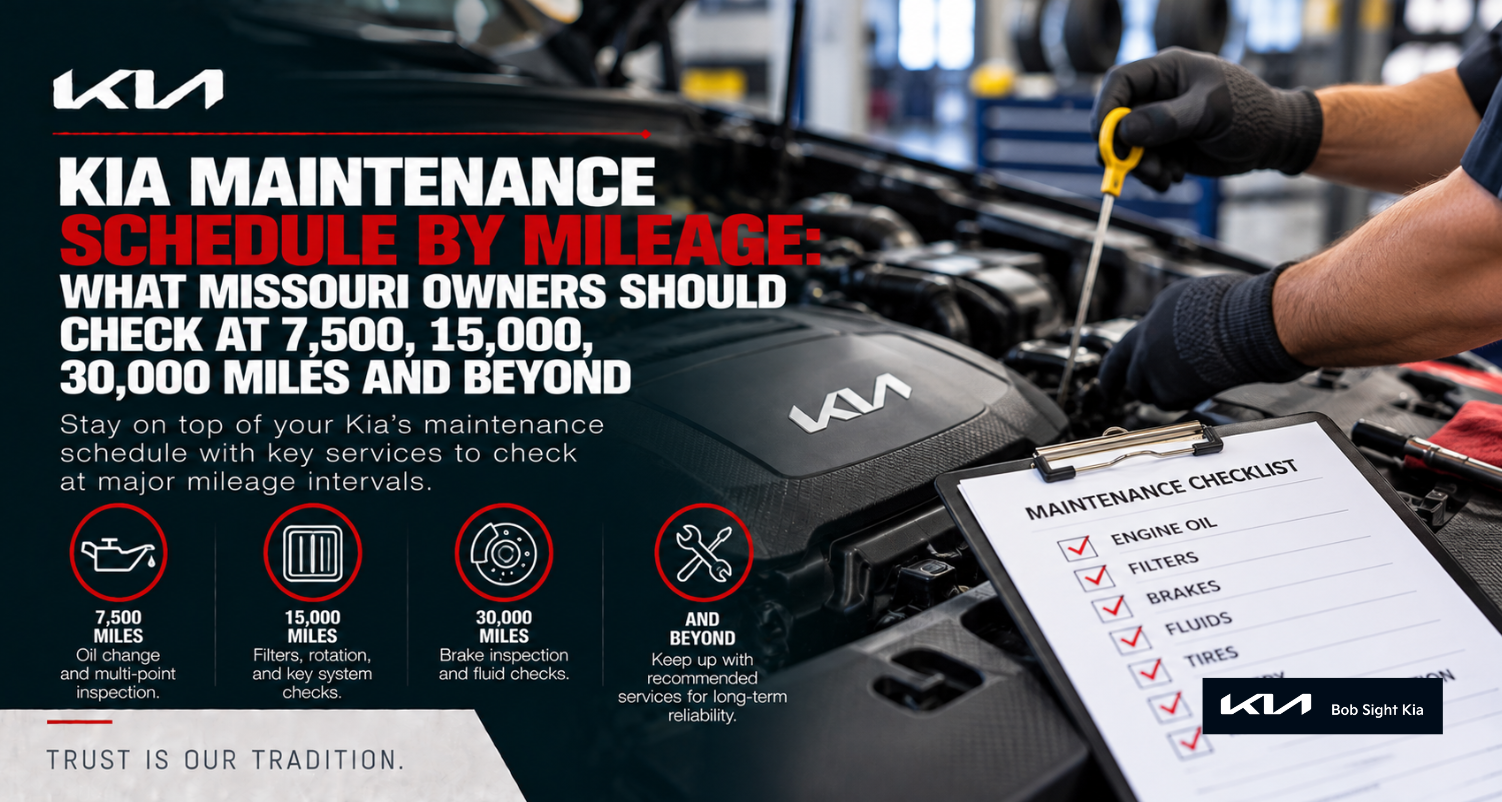
See Kia maintenance by mileage, including 7,500, 15,000, and 30,000-mile checkpoints for Independence and Missouri drivers.

Kia Maintenance Schedule by Mileage: What Missouri Owners Should Check at 7,500, 15,000, 30,000 Miles and Beyond

Kia Maintenance Schedule by Mileage: What Missouri Owners Should Check at 7,500, 15,000, 30,000 Miles and Beyond Your Kia maintenance schedule should follow the requirements for your exact vehicle, with mileage milestones helping you plan ahead. Oil changes, tire rotations, filters, brake inspections, and fluid checks all play a role in ownership, but they do not follow one universal schedule across every Kia model. For drivers in Independence, Blue Springs, Grain Valley, and throughout the Kansas City Metro, daily driving conditions also matter. Short trips, traffic on I-70, winter road treatments, and dusty construction areas can affect which maintenance schedule applies. Bob Sight Kia in Independence also offers an ownership benefit worth including in your service planning: lifetime oil changes and tire rotations every 5,000 miles with eligible new Kia purchases, performed exclusively at Bob Sight Kia. Ask our team to confirm eligibility and program terms for your vehicle. Battery-electric Kia models do not require engine oil changes. The 7,500-, 15,000-, and 30,000-mile checkpoints discussed below are planning references. They should not delay a service already due under your factory schedule, elapsed-time requirements, severe-use schedule, or applicable dealership maintenance program. Schedule Kia maintenance at Bob Sight Kia in Independence In This Guide You'll Learn Understanding the difference between factory requirements, dealership benefits, and condition-based repairs makes Kia maintenance easier to manage. This guide covers: How to identify the correct maintenance schedule for your Kia How Bob Sight Kia's 5,000-mile lifetime maintenance benefit fits into ownership What to review around 7,500, 15,000, and 30,000 miles How Missouri driving conditions can affect service timing Which items to monitor between appointments How gasoline, hybrid, plug-in hybrid, and electric maintenance differs How to plan service beyond the first 30,000 miles Does Every Kia Follow the Same Maintenance Schedule? No. Kia maintenance requirements vary by model year, engine, powertrain, drivetrain, and operating conditions. Even two vehicles with the same model name can have different service requirements when their engines or powertrains differ. A gasoline Kia Sportage and a Sportage Hybrid should each follow their own maintenance information. A battery-electric Kia has a different set of needs because it does not have a gasoline engine, engine oil filter, or spark plugs. The correct starting point is your owner's manual and its scheduled maintenance section. Kia's Owner's Portal also provides access to vehicle information and maintenance milestones. Confirm that the information matches your model year and configuration. When a maintenance item lists both mileage and time, follow whichever limit comes first as directed by the schedule. A low-mileage Kia may reach a calendar deadline before reaching the listed mileage. A frequent commuter may reach the mileage limit much sooner. Keep these three categories separate when reviewing recommendations: Factory scheduled maintenance: Inspections and replacements specified by Kia for your vehicle and operating conditions. Dealership maintenance benefits: Services available under an applicable program, including Bob Sight Kia's lifetime oil changes and tire rotations every 5,000 miles with eligible new Kia purchases. Condition-based service: Work recommended because an inspection identifies wear, damage, contamination, or a developing concern. Understanding which category applies helps you ask useful questions and maintain accurate records. How Bob Sight Kia's Lifetime Oil Changes and Tire Rotations Fit Your Plan Eligible new Kia purchases at Bob Sight Kia include lifetime oil changes and tire rotations every 5,000 miles, performed exclusively at our Independence dealership. This benefit gives qualifying owners a recurring service checkpoint to include in their ownership calendar. For an eligible gasoline or hybrid Kia, those visits provide an opportunity to keep up with covered oil and tire services while discussing other maintenance that may be due. Confirm your enrollment, vehicle eligibility, and applicable program terms with the dealership. The 5,000-mile benefit does not make every other maintenance item due at 5,000-mile intervals. Filters, coolant, spark plugs, brake fluid, and drivetrain components retain their own vehicle-specific requirements. Likewise, a factory time limit or severe-use requirement may call for attention before the next program mileage checkpoint. Do not interpret the benefit as coverage for every maintenance item or repair. Ask which services are included and which additional recommendations come from Kia's schedule or the condition of your vehicle. If you own a battery-electric Kia, engine oil changes do not apply. Ask our team which program benefits apply to your specific vehicle rather than assuming the same services apply to every powertrain. Plan your next Kia service appointment What Should Kia Owners Review Around 7,500 Miles? Around 7,500 miles, review your service history and upcoming factory requirements rather than assuming every Kia needs an identical service package. If you participate in Bob Sight Kia's applicable 5,000-mile maintenance benefit, you may already have completed an earlier oil-change and tire-rotation visit. For gasoline engines, including those in hybrids and plug-in hybrids, oil service must use the correct oil specification and filter for the vehicle. Do not select oil solely because another Kia owner uses it. Engine requirements can differ across models and years. Tire maintenance also deserves attention. Rotation requirements and patterns depend on the vehicle and tire configuration. Directional tires or differing front and rear tire sizes can affect the appropriate procedure. This checkpoint is also useful for reviewing tire pressure, tread condition, brake behavior, visible leaks, lighting, and wiper performance. An inspection may identify an issue that deserves attention, but inspection does not automatically mean replacement. Check your odometer and service date. Compare both with your vehicle's maintenance schedule. Review completed work. Include any earlier 5,000-mile program visit. Identify services actually due. Use the factory schedule and applicable driving conditions. Discuss symptoms. Mention new noises, warning lights, vibration, or changes in starting and braking. Save the service record. Record the date, mileage, and work completed. For owners making frequent short trips along Noland Road or US-40, this is also a good time to review the severe-use definitions in the owner's manual. What Changes Around 15,000 Miles? The 15,000-mile checkpoint is a useful time to review recurring maintenance, filter condition, tires, and brakes against your Kia's actual requirements. It is not a universal replacement deadline for every component. If your vehicle qualifies for Bob Sight Kia's lifetime maintenance program, 15,000 miles is also a recurring 5,000-mile program checkpoint. Confirm the appropriate timing with the service team and keep the factory schedule in view for additional requirements. The cabin air filter is one item worth reviewing. It filters air entering the passenger compartment through the climate-control system. Dust, pollen, leaves, and other debris can accumulate over time, and a restricted filter can reduce airflow. Replacement should follow the schedule and condition of the filter. Driving through construction areas or dusty environments may justify closer attention. Reduced airflow can also have causes beyond the filter, so persistent climate-control concerns deserve diagnosis. Tires should be checked for uneven wear and damage. Edge wear, center wear, or a change in steering behavior can prompt evaluation of inflation, alignment, suspension, or other contributing factors. Brake-pad replacement depends on measured wear and condition. A driver spending substantial time in Independence traffic may experience different brake wear from someone traveling mainly on uninterrupted highways. Mileage alone cannot determine how much usable brake material remains. What Should Be Reviewed Around 30,000 Miles? At approximately 30,000 miles, compare your service records with Kia's schedule to identify recurring maintenance and any additional items due. Avoid treating a generic 30,000-mile package as a factory requirement for every Kia. Engine air-filter service may be part of the discussion for a gasoline or hybrid vehicle, depending on its schedule and filter condition. This filter serves the engine and is separate from the cabin air filter. Battery-electric vehicles do not have an engine combustion-air filter. Other items may include inspections of belts, cooling-system components, steering, suspension, axle boots, or drivetrain components where specified. Their inspection and replacement requirements depend on your vehicle. Fluid service also requires a specific explanation. Ask which fluid is being recommended, whether Kia specifies the service at the current mileage or age, and whether severe-use conditions or an inspection finding affect the recommendation. At this stage, review the maintenance history as a whole: Have recurring oil and tire services been completed when applicable? Are any time-based requirements due? Were previous inspection findings resolved? Do filters need inspection or replacement under the schedule? Are tire wear and brake measurements being tracked? Does the severe-use schedule change any upcoming requirements? For eligible program participants, 30,000 miles is another 5,000-mile maintenance checkpoint. Additional work should still be matched to factory requirements and actual condition. What Counts as Severe Driving in Missouri? Severe-use conditions can include ordinary driving routines, so review Kia's definitions before assuming the normal schedule applies. The relevant conditions and affected maintenance items are listed in your vehicle's manual. Depending on the Kia, those conditions can include repeated short trips, extensive idling, heavy traffic, dusty roads, salt-treated roads, very cold weather, and towing or other demanding use. A commute through I-70 congestion can involve substantial engine-running time without many miles accumulating. Repeated short errands around Independence can create a different operating pattern from a longer trip at steady speed. Missouri winters also make the severe-use section worth reviewing. Some Kia manuals identify very cold weather and roads treated with salt or other corrosive materials among the relevant conditions. Do not assume every maintenance item changes to the same shorter interval. Severe-use tables identify which items are affected and which conditions apply to them. When discussing your maintenance plan, describe your actual routine: typical trip length, time spent idling, traffic, dusty-road use, and any towing within the vehicle's approved limits. Those details help the service team review the appropriate schedule. What Should You Check Between Service Appointments? Monitor your Kia between appointments because wear, warning lights, and vehicle symptoms do not wait for a mileage milestone. Scheduled maintenance works best alongside regular owner checks. Follow the owner-maintenance guidance in your manual. For vehicles with an engine, this can include checking engine oil as directed. Tire pressure, exterior lighting, wipers, and visible leaks also deserve attention. Check cold tire pressure. Use the vehicle's tire placard and manual rather than the maximum pressure molded into the tire sidewall. Inspect visible tire condition. Look for uneven wear, cuts, bulges, cracking, or other damage. Watch for unexplained fluid loss. Repeated topping off should not replace investigating a leak. Notice braking changes. Grinding, pulling, vibration, or altered pedal feel warrants attention. Check lights and wipers. Maintain visibility during rain, snow, and shorter winter days. Respond to warning indicators. Follow the manual's instructions for the specific warning. Record symptoms. Note when a concern occurs and the conditions surrounding it. Some warnings require stopping safely and obtaining assistance rather than continuing to drive. Do not wait for the next routine appointment when the manual calls for immediate action. How Do Gasoline, Hybrid, and Electric Kia Maintenance Needs Differ? Your powertrain determines which maintenance items apply, so a gasoline checklist should not be copied directly to every Kia. Shared model names do not guarantee shared service requirements. Gasoline Kia Vehicles Gasoline vehicles require engine-related maintenance, including oil and filter service, along with scheduled attention to items such as spark plugs and engine air filters. Exact intervals and specifications depend on the engine. Hybrid and Plug-In Hybrid Kia Vehicles Hybrids and plug-in hybrids still have gasoline engines and require applicable engine maintenance. Driving on electric power for part of a trip does not eliminate oil service or calendar-based requirements. Follow the schedule for the hybrid or plug-in hybrid configuration. Hybrid-specific components may have their own inspection or service requirements. Do not substitute the schedule from a gasoline version of the same model. Battery-Electric Kia Vehicles Battery-electric Kia vehicles do not require engine oil changes or spark plugs. They still need maintenance involving tires, brakes, cabin filters, steering, suspension, cooling systems, and other applicable components. Regenerative braking can reduce friction-brake use during some driving, but conventional brake components still require attention. Follow the EV's maintenance schedule rather than assuming reduced brake use eliminates inspection needs. Planning Maintenance Beyond 30,000 Miles Beyond 30,000 miles, continue recurring maintenance and add higher-mileage or time-based work as your Kia's schedule requires. There is no single replacement list that applies to every Kia at 60,000, 90,000, or 100,000 miles. Items such as coolant, spark plugs, belts, and drivetrain fluids can have substantially different requirements across vehicles. Check the exact schedule before assuming a service is due or can be postponed. Vehicle age matters alongside mileage. A seven-year-old Kia with relatively low mileage may need different attention from a newer Kia with the same odometer reading. Tires, batteries, rubber components, and other parts can deteriorate with time. Keep records showing the service date, mileage, work completed, and relevant inspection results. Records help prevent duplicate work and make it easier to track changes in tire wear, brake measurements, and recurring concerns. If you purchased a used Kia without complete records, discuss the missing history with the service team. The goal is to establish what can be verified and determine an appropriate maintenance plan for that vehicle. Frequently Asked Questions About Kia Maintenance Schedules Does every Kia need maintenance every 7,500 miles? No. Kia maintenance intervals vary by model year, engine, powertrain, maintenance item, and driving conditions. Use the schedule for your exact vehicle and follow mileage or time limits as specified. Does Bob Sight Kia offer lifetime oil changes and tire rotations? Bob Sight Kia in Independence advertises lifetime oil changes and tire rotations every 5,000 miles with eligible new Kia purchases, performed exclusively at the dealership. Ask the team to confirm your vehicle's eligibility and applicable program terms. Battery-electric vehicles do not require engine oil changes. What Kia maintenance should I review around 15,000 miles? Review recurring oil and filter service where applicable, tire maintenance, brake inspections, fluid checks, and any cabin air-filter service specified for your vehicle. Reaching 15,000 miles does not create the same service requirements for every Kia. What should be done to a Kia at 30,000 miles? Review your Kia's maintenance schedule and service history to identify recurring maintenance and any additional inspections or replacements due. Engine air filters, cabin filters, fluids, and other components have vehicle-specific requirements rather than one universal 30,000-mile replacement rule. What counts as severe driving for a Kia? Depending on the vehicle's manual, severe-use conditions can include repeated short trips, extensive idling, heavy traffic, dusty or salt-treated roads, very cold weather, and towing or other demanding use. Follow the definitions and maintenance requirements for your exact Kia. Schedule Kia Maintenance in Independence, Missouri Bob Sight Kia can help you review your vehicle's maintenance requirements and plan your next service visit. Have your current mileage, model year, powertrain information, and service records available when discussing what is due. If you are searching for Kia maintenance near me in Independence, Blue Springs, Grain Valley, Raytown, or the Kansas City Metro, start with a plan built around your actual vehicle and driving routine. Remember to ask about lifetime oil changes and tire rotations every 5,000 miles with eligible new Kia purchases at Bob Sight Kia. Confirm the program terms and continue following all other applicable factory maintenance requirements. Schedule your next Kia maintenance appointment Helpful Links Schedule Kia Service Kia Service Specials Kia Parts Department Explore New Kia Vehicles Bob Sight Kia Proud to Be Part of the Bob Sight Auto Group Bob Sight Kia in Independence is proud to be part of the Bob Sight Auto Group. Explore our dealerships in Missouri and Kansas for vehicle shopping, service, and ownership resources. Bob Sight Honda in Lawrence, Kansas Bob Sight Chrysler Dodge Jeep Ram in Lawrence, Kansas Bob Sight Ford in Lee's Summit, Missouri Bob Sight Kia in Independence, Missouri Trust Is Our Tradition.

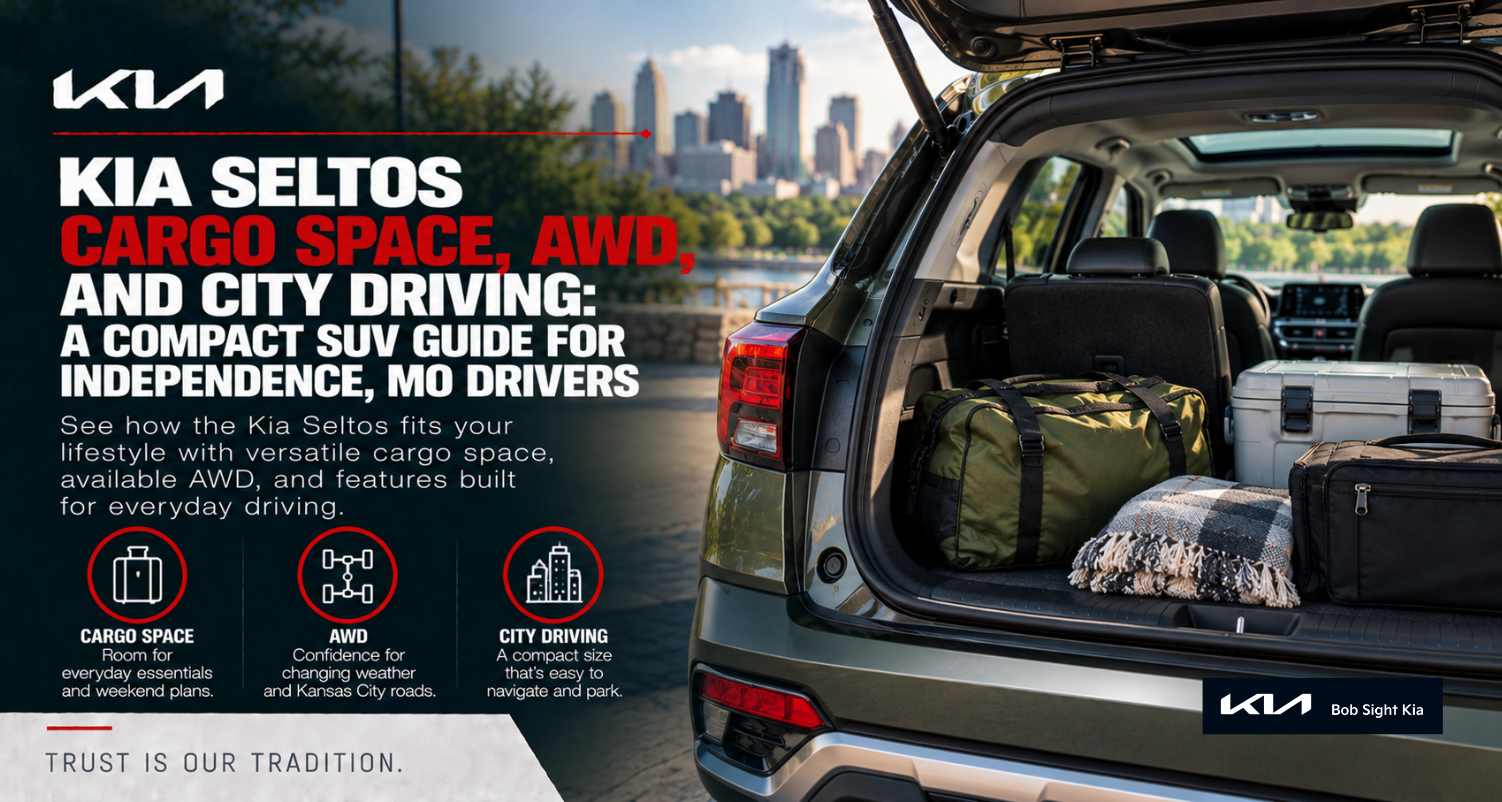
Explore Kia Seltos cargo space, AWD, fuel economy, and city-driving practicality for Independence and Kansas City drivers.

Kia Seltos Cargo Space, AWD, and City Driving: A Compact SUV Guide for Independence, MO Drivers

Kia Seltos Cargo Space, AWD, and City Driving: A Compact SUV Guide for Independence, MO Drivers The Kia Seltos gives Independence drivers the maneuverability of a compact SUV while still providing useful cargo capacity, available all-wheel drive, and enough everyday versatility for commuting, errands, passengers, and weekend travel. For drivers navigating Noland Road, I-70, US-40, Blue Springs, downtown Kansas City, and busy suburban parking areas, the Seltos can offer a practical middle ground between a sedan and a larger SUV. The 2026 Seltos provides up to 62.8 cubic feet of cargo room behind the first row, offers available torque-vectoring all-wheel drive with Lock Mode, and can be equipped with a 190-horsepower turbocharged engine. Explore Kia Seltos inventory at Bob Sight Kia In This Guide You'll Learn This Kia Seltos guide focuses on how the compact SUV works for everyday life in Independence and across the Kansas City Metro rather than providing a broad overview of every available feature. How much cargo space the Kia Seltos provides How available all-wheel drive works and when it may be useful How the Seltos fits city and suburban driving around Kansas City How standard and turbocharged powertrains differ Why compact exterior dimensions can help with everyday maneuverability How passengers and cargo can share the cabin What Independence drivers should evaluate during a Seltos test drive How Much Cargo Space Does the Kia Seltos Have? The 2026 Kia Seltos provides up to 62.8 cubic feet of cargo room behind the first row when the rear seating is folded, giving drivers substantial flexibility within a compact SUV footprint. That maximum capacity can be useful when carrying larger shopping loads, luggage, recreational gear, household items, or equipment that would be difficult to fit into a traditional sedan trunk. Kia also emphasizes that cargo should be evenly distributed, properly secured, and never stacked higher than the seatback. The maximum number tells only part of the story. Most Independence drivers will not spend every day with the rear seats folded. A typical week may involve commuting alone in the morning, transporting passengers in the afternoon, loading groceries after work, and carrying sports equipment or luggage on the weekend. The usefulness of the Seltos comes from being able to adapt the rear area as those needs change. A compact SUV cargo area also provides a different loading experience from a sedan trunk. Taller or bulkier objects can often be easier to position through the rear liftgate, and folding rear seating can create additional length when necessary. A driver who occasionally transports boxes, folding chairs, pet supplies, small pieces of furniture, or home-improvement purchases may appreciate having a more flexible opening than a conventional trunk provides. Families should think about cargo shape rather than volume alone. A stroller, grocery bags, sports equipment, suitcase, cooler, and backpack all occupy space differently. Two items may use the same theoretical volume but require completely different floor dimensions or vertical clearance. That is why measuring the objects you carry most often can be more useful than relying entirely on cubic-foot specifications. The Seltos also offers an available Smart Power Liftgate on selected configurations, which can make loading more convenient when your hands are occupied with bags or gear. For someone making frequent stops around Independence Center, grocery stores along US-40, or shopping areas throughout eastern Jackson County, small convenience features can become meaningful because they are used repeatedly throughout the week. Seltos Cargo Consideration Why It Matters Up to 62.8 cu. ft. behind the first row Provides flexibility for larger loads when rear seating is not needed Rear liftgate access Makes taller and bulkier items easier to load than many sedan trunks Folding rear seating Allows drivers to adjust passenger and cargo priorities Available Smart Power Liftgate Can simplify loading when carrying bags or equipment How Does Available AWD Work on the Kia Seltos? The 2026 Kia Seltos offers available torque-vectoring all-wheel drive with Lock Mode, giving drivers another traction option when road conditions become wet, snowy, muddy, or otherwise less predictable. Kia explains that AWD Lock Mode can distribute power 50/50 between the front and rear wheels at the push of a button in appropriate low-traction conditions. The system can be useful for Missouri drivers who travel during winter weather, heavy rain, or other conditions where additional traction while accelerating may be valuable. A commuter leaving Independence before roads are fully treated after overnight snow may encounter neighborhood streets that are more slippery than I-70 or other major corridors. Available AWD gives Seltos shoppers a choice that can better align with that type of driving schedule. AWD should not be confused with unlimited winter capability. Tires still determine how the vehicle contacts the pavement, and all-wheel drive cannot eliminate the effects of ice or reduce stopping distance to what you would experience on a dry road. Drivers should maintain appropriate tire pressure and tread, slow down when conditions require it, and leave additional following distance regardless of drivetrain. The Kia Seltos AWD system can also be useful beyond winter precipitation. Kia notes that Lock Mode is designed for conditions that can include wet pavement, snow-covered roads, unpaved roads, sand, mud, and steeper grades. Most Independence owners may rarely encounter all of those conditions, but the system provides additional flexibility for drivers whose routines extend beyond dry suburban pavement. Before prioritizing AWD, think about your actual week. A driver who works remotely during severe weather and primarily uses well-treated roads may value fuel economy or another feature more highly. Someone who has a fixed early-morning schedule, drives throughout Jackson County regardless of weather, or regularly leaves paved roads may place AWD much higher on the list. For shoppers comparing Seltos configurations, remember that AWD availability varies by trim and package. The 2026 EX offers available AWD, while the SX includes AWD with its turbocharged powertrain. Checking the exact vehicle rather than assuming every Seltos has the same drivetrain can prevent confusion during the shopping process. Why Does the Kia Seltos Work Well for Independence City Driving? The Kia Seltos can fit city and suburban driving well because it combines an elevated compact-SUV layout with dimensions that remain manageable in parking lots, neighborhood streets, and congested commercial areas. Drivers do not always need a large SUV to gain useful cargo access, available AWD, and flexible rear seating. For many Independence commuters, the Seltos can provide SUV practicality without creating the same parking and maneuvering considerations as a larger three-row model. Think about a normal Saturday in Independence. You might leave a neighborhood near Little Blue Parkway, drive toward Independence Center, navigate a crowded shopping-center parking lot, stop for groceries, and later travel toward Blue Springs or Lee's Summit. Those trips involve more low-speed turns, parking maneuvers, merging, and short-distance acceleration than long stretches of open highway. A compact SUV can be useful in that environment because drivers still benefit from a hatch-style cargo area and a more upright seating position without carrying more exterior vehicle than they need. The Seltos can also make sense for someone moving out of a sedan who wants additional versatility but does not routinely need three seating rows. Parking deserves more attention than it usually gets during vehicle shopping. You may park several times in a normal day but only use maximum cargo capacity occasionally. During a test drive, pull into a normal parking space, back into another, make a three-point turn, and drive through a tighter parking aisle. Test the vehicle in the situations you will repeat every week rather than evaluating it only on an open road. Visibility also matters in urban and suburban traffic. Adjust the driver's seat and mirrors properly, then evaluate how easily you can see pedestrians, adjacent traffic, curbs, and vehicles around the Seltos. Selected trims add technology such as Blind-Spot Detection, Rear Cross-Traffic Collision-Avoidance Assist, rear parking sensors, and additional driver-assistance features. These systems support the driver but do not replace visual checks or careful operation. The result is a vehicle category that can make sense for people who spend more time navigating real Kansas City traffic than driving across remote terrain. A compact SUV does not need to behave like a large adventure vehicle to be useful. For many owners, everyday maneuverability, cargo access, efficient operation, and flexible seating are the capabilities that matter most. 2026 Kia Seltos Standard Engine vs. Turbo: What Is the Difference? The 2026 Kia Seltos offers two distinct performance approaches, with a 2.0-liter four-cylinder producing 147 horsepower in mainstream trims and an available 1.6-liter turbocharged four-cylinder producing 190 horsepower and 195 lb.-ft. of torque in the SX. The standard powertrain focuses on everyday efficiency, while the turbocharged configuration provides stronger acceleration and additional performance. The LX, S, and EX configurations use the 2.0-liter engine with an Intelligent Variable Transmission. For a driver primarily commuting around Independence, running errands, and making regular highway trips, this powertrain is designed around practical daily transportation. Kia lists EPA-estimated highway fuel economy of up to 34 mpg for selected 2026 Seltos configurations using the standard engine. The SX changes the personality of the Seltos. Its turbocharged 1.6-liter engine produces 190 horsepower and 195 lb.-ft. of torque and is paired with an eight-speed automatic transmission. AWD is included on that configuration. Kia lists an EPA-estimated 27 mpg highway figure for the 2026 SX. For Kansas City drivers, the decision comes down to priorities. Someone who spends considerable time commuting and wants to prioritize efficiency may be satisfied with the standard engine. A shopper who values stronger acceleration when entering I-70, passing at highway speeds, or driving with passengers and cargo may prefer the turbocharged SX. 2026 Seltos Powertrain Standard 2.0L 1.6L Turbo Horsepower 147 hp 190 hp Torque 132 lb.-ft. 195 lb.-ft. Transmission Intelligent Variable Transmission 8-speed automatic AWD Available on selected configurations Included on SX Primary Focus Everyday efficiency and commuting Stronger acceleration and performance Do not choose by specification alone. Drive both powertrains if they are available and relevant to your budget and needs. Some drivers value stronger acceleration enough to accept a lower fuel-economy rating, while others would rarely use the additional output and would rather prioritize everyday efficiency. How Practical Is the Kia Seltos for Passengers and Everyday Cargo? The Seltos is most practical for drivers who want five-passenger flexibility and an adaptable rear cargo area without moving into a larger midsize or three-row SUV. It works well when passenger and cargo needs change throughout the week because the rear seating can remain available for people or be folded when more carrying space is needed. A commuter may spend Monday through Friday driving alone, which leaves the entire passenger cabin available when cargo needs arise. On the weekend, the rear seats may be occupied by family or friends. That pattern is common among compact-SUV owners because they want more versatility than a sedan without routinely filling a larger SUV. Families with younger children should evaluate how car seats or boosters fit in the specific seating positions they intend to use. Always follow the vehicle owner's manual and child-restraint manufacturer's instructions rather than assuming a restraint is compatible based only on visible seat width. Once installed correctly, check whether front-seat occupants can still achieve comfortable seating positions. Adult passengers should also test the rear seat. A specification sheet cannot tell you whether a particular person's leg position, headroom, or seat comfort will work for an hour-long drive across the Kansas City Metro. Sit behind the driver's normal position and evaluate the space rather than leaving the front seat artificially far forward. When cargo is involved, think about the mix of people and belongings. A four-person household heading to a weekend activity in Blue Springs may need passenger seating plus sports bags and folding chairs. A solo owner making a home-improvement run may fold the rear seats and prioritize maximum cargo room. Both uses can occur in the same vehicle within a few days. The available 62.8 cubic feet behind the first row becomes most meaningful in those occasional maximum-cargo situations. For everyday use, however, the more important trait may simply be that the Seltos lets drivers reconfigure the interior when needs change instead of forcing them to choose permanently between passenger room and utility. Is Seltos AWD Worth Considering for Kansas City Winters? Seltos AWD can be useful for Kansas City drivers who regularly travel during snow, freezing precipitation, heavy rain, or other low-traction conditions, but proper tires and safe driving remain more important than the AWD badge alone. Kia's available torque-vectoring AWD system with Lock Mode can provide additional traction when conditions require it, and the Lock Mode is designed to distribute power between the front and rear wheels when selected. Missouri winters are not defined by constant deep snow. Drivers are often dealing with a mix of cold rain, overnight freezing, patchy ice, light snow, slush, and roads that have been treated at different times. A major highway may be clear while a residential street or parking lot remains slick. That variation is where drivers may appreciate having an AWD option. However, AWD does not improve every part of winter driving equally. It can support acceleration when traction is limited, but braking still depends on tire grip and road conditions. If you enter an icy curve too quickly or follow another vehicle too closely, having all four wheels driven cannot override the available friction between the tires and pavement. Tire condition should therefore be part of any AWD conversation. Check tread, pressure, visible damage, and consistent wear. On an AWD vehicle, maintaining appropriately matched tires is important because all four corners work together through the driveline. Follow Kia's tire rotation and maintenance guidance for the specific Seltos you own. Use your schedule to decide whether AWD deserves priority: Consider when you drive. Early-morning commuters may encounter untreated roads more often. Review your normal routes. Neighborhood streets, hills, and less-traveled roads may differ from major highways. Think about schedule flexibility. Drivers who can delay travel during poor weather may need AWD less often. Evaluate tires equally. AWD should complement good tire maintenance, not replace it. Compare exact trims. Drivetrain availability and equipment vary across Seltos configurations. A driver commuting from Grain Valley or Blue Springs into Independence regardless of weather may evaluate AWD differently from someone who works primarily from home. Neither decision is universally correct. The goal is to match the drivetrain with your actual driving rather than paying for or skipping AWD based solely on the fact that you live in Missouri. How Does the Kia Seltos Fit a Kansas City Commute? The Kia Seltos can fit a Kansas City commute well because shoppers can choose between efficiency-focused configurations and a more powerful turbocharged model while retaining compact-SUV cargo versatility. Drivers commuting from Independence toward downtown Kansas City often encounter a mix of neighborhood streets, freeway merging, congestion, construction, and parking, which means no single specification determines commuter suitability. Fuel economy can matter to drivers covering substantial mileage. Selected 2026 Seltos configurations are EPA-estimated at up to 34 mpg highway, while actual mileage will vary with equipment, weather, traffic, driving habits, and vehicle condition. A driver making the same I-70 commute five days per week may value that efficiency more strongly than someone whose workplace is only a few miles from home. Acceleration may matter more to another shopper. Merging onto I-70 during traffic, entering US-40, or passing at highway speed can make engine response a noticeable part of the commute. The available 190-horsepower turbocharged engine gives the SX significantly more output than the 147-horsepower standard engine. Technology can also affect daily comfort. Depending on trim, the Seltos offers available dual 10.25-inch displays, navigation, Kia Connect, heated and ventilated front seating, wireless phone charging, USB-C charging access, Smart Cruise Control with Stop & Go, and Highway Driving Assist. Equipment varies, so shoppers should verify the exact configuration rather than assuming every Seltos includes the same features. Commuter comfort is personal. Before deciding, sit in the driver's seat for more than a few minutes. Adjust the seat, steering wheel, mirrors, and climate controls. Connect your phone. Drive at highway speed. Spend time in traffic if possible. The most useful commuter vehicle is the one that remains comfortable and easy to operate during the routine you repeat hundreds of times each year. How Should Independence Drivers Test a Kia Seltos Before Buying? A useful Kia Seltos test drive should include city streets, parking maneuvers, highway-style acceleration, passenger-space checks, and a close look at the cargo area. Because the Seltos is designed to balance compact dimensions with SUV utility, shoppers should test both sides of that equation rather than focusing only on acceleration or technology. Begin in the driver's seat and adjust everything properly. Make sure you can reach the steering wheel and pedals comfortably and that the seating position provides clear outward visibility. Test mirror placement and look over your shoulder before relying on available blind-spot technology. Driver-assistance features are designed to support the driver, not replace awareness. Next, drive through the kind of environment where the Seltos may spend much of its life. Navigate a parking lot, make several tight turns, pull into a standard space, and back out again. Drivers who live or work near crowded shopping areas may perform these maneuvers far more often than they ever use maximum horsepower. Then find an appropriate higher-speed road. Evaluate how the standard or turbocharged powertrain accelerates, how the transmission responds, and whether the vehicle feels comfortable at normal highway speeds. If AWD is important to you, confirm the specific Seltos you are driving actually includes the system. Use this test-drive checklist: Adjust the driver's seat normally. Do not compromise your own position to make another area appear larger. Check the second row. Sit behind your normal driver's position and evaluate passenger room. Open the cargo area. Visualize groceries, luggage, strollers, sports gear, or other regular items. Fold the rear seats. See how the maximum cargo configuration would work for larger loads. Drive at low speeds. Evaluate steering, parking, and visibility. Test highway acceleration. Make sure the selected engine fits your normal commute. Try the technology. Connect your phone and use the features you expect to rely on daily. Confirm the drivetrain. Verify whether the vehicle is front-wheel drive or AWD. Shoppers visiting Bob Sight Kia from Independence, Raytown, Blue Springs, Grain Valley, Liberty, or Lee's Summit can use this process to evaluate whether the Seltos feels appropriately sized for their routine. The goal is not simply to confirm that you like the SUV. It is to determine whether its size and configuration solve your everyday transportation needs. Quick Facts About the 2026 Kia Seltos The 2026 Kia Seltos combines compact-SUV flexibility with available AWD, two engine choices, and up to 62.8 cubic feet of maximum cargo room. These quick specifications provide useful reference points for Independence drivers comparing Seltos configurations. Maximum cargo room behind the first row: 62.8 cubic feet Standard engine: 2.0-liter four-cylinder Standard engine output: 147 horsepower and 132 lb.-ft. of torque Available turbo engine: 1.6-liter turbocharged four-cylinder Turbo engine output: 190 horsepower and 195 lb.-ft. of torque Standard-engine transmission: Intelligent Variable Transmission Turbocharged SX transmission: eight-speed automatic Available torque-vectoring all-wheel drive with Lock Mode AWD Lock Mode can distribute power 50/50 between front and rear wheels when engaged in appropriate conditions Selected standard-engine configurations offer up to an EPA-estimated 34 mpg highway 2026 Seltos SX is EPA-estimated at 27 mpg highway Nine driver-assistance technologies are standard according to Kia's 2026 model information Available Smart Power Liftgate on selected configurations Available heated and ventilated front seating on selected configurations Available dual 10.25-inch panoramic display setup on selected configurations These specifications should be evaluated by trim rather than treated as though every Seltos includes every feature. A standard-engine front-wheel-drive model has a different ownership focus from a turbocharged AWD SX. The strongest choice depends on whether efficiency, traction, acceleration, comfort equipment, or technology carries more weight in your routine. Ownership Planning for a Kia Seltos in Independence, Missouri Long-term Seltos ownership is easier to plan when drivers choose the drivetrain and powertrain that match their normal use and maintain the vehicle according to its specific Kia maintenance requirements. A compact SUV used primarily for commuting has different priorities from one that regularly handles winter travel, heavy cargo, or frequent weekend trips. Tire maintenance deserves consistent attention because tires affect efficiency, traction, steering, and braking. Missouri temperature changes can cause tire-pressure readings to vary throughout the year, particularly when fall temperatures drop quickly. Check pressure against the placard on the vehicle and monitor tread wear regularly. AWD owners should be particularly attentive to maintaining consistent tire condition across all four positions. Rotate tires according to the applicable maintenance guidance and investigate unusual wear rather than letting one tire become significantly different from the others. AWD can support traction, but it works best as part of a properly maintained vehicle. Drivers selecting the turbocharged SX should follow the maintenance requirements for that exact engine and drivetrain rather than assuming service is identical to the 2.0-liter Seltos. Oil specifications, service procedures, and maintenance schedules should always come from information applicable to the exact vehicle. The same principle applies when comparing current Seltos models with older model years. City driving can also influence maintenance patterns. Repeated short trips, stop-and-go traffic, frequent braking, and extended idling can place different demands on a vehicle than long highway drives. If most of your mileage comes from short trips around Independence rather than open Interstate travel, mention your driving pattern when discussing maintenance needs. Bob Sight Kia owners can use the online Kia service scheduler when routine maintenance or inspection is due. Keeping service records from the beginning can also help track tires, brakes, battery condition, fluid maintenance, and other ownership items as the Seltos accumulates mileage. Frequently Asked Questions About the Kia Seltos How much cargo space does the 2026 Kia Seltos have? The 2026 Kia Seltos provides up to 62.8 cubic feet of maximum cargo space behind the first row with the rear seating folded. That gives drivers substantial flexibility for a compact SUV when passenger seating is not required. Maximum cargo volume is most useful for larger loads such as luggage, boxes, recreational gear, or household items. During normal daily driving, many owners will keep the rear seats available for passengers, so practical cargo usability depends on the seating configuration being used at the time. Independence shoppers should bring measurements for large items they carry frequently. A stroller, sports bag, cooler, or other bulky object can reveal more about everyday cargo usefulness than a cubic-foot number alone. Folding and raising the seats during a dealership visit can also show how easily the Seltos transitions between passenger and cargo duty. Does the Kia Seltos come with all-wheel drive? The 2026 Kia Seltos offers available torque-vectoring all-wheel drive, and AWD is standard on the SX configuration. Kia's AWD system includes a Lock Mode designed to support traction in conditions such as wet pavement, snow-covered roads, unpaved surfaces, sand, mud, and steeper grades. When AWD Lock Mode is selected in appropriate conditions, the system can distribute power between the front and rear wheels. Drivers should still adjust speed and following distance for road conditions because AWD cannot overcome limited tire grip during braking or cornering. For Kansas City-area drivers, AWD can be useful when travel schedules require driving during winter weather or before roads are fully treated. Shoppers who primarily drive well-maintained roads and have more schedule flexibility may determine that another Seltos configuration better fits their priorities. Is the Kia Seltos good for driving around Independence and Kansas City? The Seltos can be a practical choice for Independence and Kansas City driving because it combines compact-SUV maneuverability, flexible cargo space, available AWD, and multiple powertrain choices. It can work well for commuters who want more utility than a sedan without moving into a larger SUV. City and suburban drivers regularly deal with crowded parking lots, changing traffic speeds, tight turns, and frequent errands. A manageable compact SUV can make those everyday situations easier while retaining a rear liftgate and folding seating for larger loads. During a test drive, evaluate the Seltos in those exact situations. Park it, back it out of a space, merge onto a faster road, and drive through normal traffic. Real-world testing around Independence can be far more informative than evaluating the vehicle only on an open highway. What is the difference between the standard and turbocharged Kia Seltos engines? The standard 2026 Kia Seltos engine is a 2.0-liter four-cylinder producing 147 horsepower and 132 lb.-ft. of torque, while the available 1.6-liter turbocharged engine produces 190 horsepower and 195 lb.-ft. of torque. The standard engine uses an Intelligent Variable Transmission, while the turbocharged SX uses an eight-speed automatic. The standard engine is oriented toward everyday transportation and stronger fuel-economy potential. Selected configurations offer up to an EPA-estimated 34 mpg highway. The turbocharged SX provides noticeably more output and comes with AWD, but Kia lists a lower EPA-estimated highway fuel economy figure for that configuration. Kansas City commuters should choose based on their priorities rather than assuming more horsepower automatically makes the better vehicle. Drivers who value efficiency may prefer the standard powertrain, while shoppers who want stronger highway acceleration may appreciate the turbocharged SX. Where can I see a Kia Seltos near Kansas City? Kansas City-area shoppers can check Kia Seltos availability at Bob Sight Kia in Independence, Missouri. Comparing available configurations in person can help drivers evaluate cargo space, front-wheel drive versus AWD, engine choices, passenger room, and available technology. Before visiting, identify the features that matter most to your routine. If AWD is essential, verify which available vehicles include it. If fuel economy carries more weight, focus on configurations equipped with the standard 2.0-liter engine. If stronger acceleration is a priority, consider testing the turbocharged SX as well. Drivers from Blue Springs, Grain Valley, Raytown, Liberty, Lee's Summit, and throughout the Kansas City Metro can browse Kia Seltos inventory at Bob Sight Kia before visiting Independence. Comparing the exact vehicles available can make it easier to find a configuration that fits everyday driving. See How the Kia Seltos Fits Everyday Independence Driving The Kia Seltos stands out as a compact SUV for drivers who want useful cargo flexibility, available AWD, and city-friendly dimensions without moving into a larger vehicle than their daily routine requires. Its maximum 62.8 cubic feet of cargo capacity gives drivers room to adapt the interior for larger loads, while available torque-vectoring AWD adds another option for changing Missouri road conditions. The powertrain choice helps further define the Seltos. Standard 2.0-liter models emphasize everyday efficiency and provide up to an EPA-estimated 34 mpg highway in selected configurations, while the turbocharged SX increases output to 190 horsepower and 195 lb.-ft. of torque. That gives commuters the ability to prioritize either stronger efficiency potential or additional performance. For Independence drivers, the Seltos makes the most sense when evaluated in everyday situations. Think about parking near Independence Center, merging onto I-70, carrying groceries, transporting a few passengers, navigating winter weather, and loading gear for a weekend outside the city. Those routine scenarios provide a better measure of compact-SUV usefulness than a single specification. Bob Sight Kia in Independence can help Kansas City-area shoppers compare Seltos trims, drivetrains, engines, cargo configurations, and available technology. Take the time to fold the seats, inspect the cargo area, sit in the rear, drive at highway speed, and maneuver through a parking lot. A hands-on comparison can show whether the Seltos provides the balance of compact size and SUV versatility that fits your everyday life. Helpful Links Shop Kia Seltos Inventory Explore New Kia Vehicles Value Your Trade Explore Kia Financing Schedule Kia Service Proud to Be Part of the Bob Sight Auto Group Bob Sight Kia in Independence is proud to be part of the Bob Sight Auto Group, serving drivers throughout the Kansas City Metro with new and used vehicles, automotive service, parts support, and collision resources. Whether you are researching a Kia Seltos for commuting around Independence, comparing another Kia model, or maintaining the vehicle you already own, the Bob Sight Auto Group provides local automotive resources throughout Missouri and Kansas. Trust Is Our Tradition. Bob Sight Honda Bob Sight CDJR Bob Sight Ford Bob Sight Kia Bob Sight Collision Center


Prepare your Kia for holiday travel with tire, battery, brake, fluid, and winter checks for Independence and Kansas City drivers.

Kia Holiday Road Trip Checklist: Tires, Battery, Brakes, Fluids, and Winter Prep for Kansas City Drivers

Kia Holiday Road Trip Checklist: Tires, Battery, Brakes, Fluids, and Winter Prep for Kansas City Drivers Preparing your Kia for a holiday road trip means checking the systems most likely to affect safety, reliability, visibility, and comfort before winter travel begins. For drivers in Independence, Missouri, and throughout the Kansas City Metro, that means paying close attention to tires, the 12-volt battery, brakes, fluids, wiper performance, exterior lighting, and cold-weather readiness before loading the vehicle with passengers and luggage. Holiday travel often combines colder temperatures, heavier traffic, longer highway drives, and changing road conditions, so a pre-trip inspection can help catch maintenance concerns before they interrupt a drive across Missouri, Kansas, or farther from home. Schedule Kia service before your holiday road trip In This Guide You'll Learn This holiday road-trip checklist focuses on practical Kia maintenance items Kansas City drivers can review before winter travel. How to inspect tire pressure, tread, and overall tire condition Why cold weather can reveal a weak 12-volt battery Which brake warning signs deserve attention before a road trip Which fluids and under-hood items should be checked How wipers, lights, and defrosters affect winter visibility What to inspect before carrying extra passengers and luggage How to prepare your Kia for Interstate travel during Missouri winter weather Why Should You Prepare Your Kia Before a Holiday Road Trip? A holiday road-trip inspection helps identify maintenance concerns before they become problems far from home, when cold weather, heavy traffic, and extended driving can place additional demands on your Kia. A vehicle that feels completely normal during short trips around Independence may behave differently after several continuous hours on I-70, I-35, I-49, or another regional highway. Longer drives increase the importance of tire condition, dependable battery performance, predictable brakes, functioning climate control, and proper fluid levels. Holiday travel also changes how many families use their vehicles. A normal weekday may involve one driver and a light cargo load, while a December trip can include several passengers, suitcases, gifts, winter clothing, coolers, and other gear. Increased vehicle weight can affect braking distance, acceleration, tire loading, and overall handling. None of that means a properly maintained Kia cannot handle holiday travel. It simply makes pre-trip preparation more valuable. Kansas City weather adds another variable. Late fall and winter can bring cold mornings, freezing rain, snow, wet pavement, strong winds, and quick temperature swings. A road can be dry in Independence and noticeably different an hour later as you travel toward another part of Missouri or Kansas. Drivers should prepare for the conditions they could encounter along the entire trip rather than only the forecast at the departure point. A pre-trip check also gives you time to address concerns on your own schedule. Discovering worn tires, weak wiper blades, a battery nearing the end of its useful life, or a brake issue several days before departure gives you more flexibility than discovering it the night before leaving. The objective is not to replace parts unnecessarily. It is to know the condition of the vehicle before asking it to handle a longer and potentially more demanding drive. Drivers around Independence, Blue Springs, Grain Valley, Raytown, Liberty, and Lee's Summit can use the week before holiday travel as a natural maintenance checkpoint. Review your Kia's maintenance information, check items you can safely inspect yourself, and schedule professional service if something feels, sounds, or looks different than normal. How Should You Check Your Kia Tires Before a Holiday Road Trip? Your Kia's tires should be checked for proper inflation, adequate tread, even wear, visible damage, and overall condition before a winter road trip. Tires affect acceleration, braking, steering, and road grip, making them one of the most important pre-trip maintenance items. Cold weather can also reduce tire pressure, so a tire that appeared properly inflated during warmer weather may show a lower reading after a significant temperature drop. Tire pressure should be checked when the tires are cold and compared with the vehicle manufacturer's recommended pressure listed on the tire information placard, usually found on the driver's door jamb. Do not use the maximum pressure printed on the tire sidewall as the normal inflation target. The placard specification is based on the vehicle and tire configuration, while the sidewall figure identifies a different limit. Pressure naturally changes with temperature. As outdoor temperatures fall, the air inside the tire contracts and the measured pressure may decrease. Kansas City drivers often notice this during the first strong cold snap of the season when the tire-pressure monitoring system may activate. If a warning appears, check the pressures rather than simply adding air without measuring each tire. Tread condition matters just as much as inflation. Inspect the tread across the width of each tire and look for uneven wear, unusually smooth areas, cuts, cracking, bulges, exposed cords, or embedded objects. Uneven wear can sometimes indicate incorrect inflation, alignment issues, suspension concerns, or inconsistent tire rotation. A tire that looks noticeably different from the other three deserves attention before a long trip. Use this process before holiday travel: Check pressure when the tires are cold. Compare each tire with the pressure listed on the Kia's tire placard. Inspect tread depth. Make sure the tread is appropriate for the road and weather conditions you expect. Look for uneven wear. Compare the inside, center, and outside sections of the tread. Inspect for damage. Look for cuts, cracking, bulges, punctures, or other visible concerns. Check all four tires. Do not assume similar appearance means identical pressure or condition. Review the spare or mobility equipment. Know what your specific Kia provides and how to access it. For Independence drivers heading west toward Kansas City or east on I-70, tire condition becomes more important as speeds and travel distance increase. Wet pavement, snow, and cold temperatures can reduce available traction, so tire maintenance should be considered part of the safety plan rather than simply a fuel-economy concern. Why Does Your Kia Battery Matter More During Cold Weather? Cold weather can expose a weak 12-volt battery because low temperatures reduce available battery output at the same time the vehicle may require more energy to start and operate electrical systems. A battery that seemed adequate during warm weather may begin cranking more slowly after the first colder mornings in Jackson County. Holiday travel is a poor time to discover that the battery has been weakening gradually. Drivers should pay attention to changes in starting behavior. Slow cranking, repeated hesitation before the engine starts, dim exterior or interior lights, flickering electronics, or an intermittent electrical concern can justify a battery and charging-system inspection. These symptoms can have more than one cause, so testing is more useful than assuming the battery needs replacement based solely on age. Modern Kia vehicles rely on multiple electronic systems, and electrical demand increases during winter. Headlights may be used more often because daylight hours are shorter. Heated seats, rear-window defrosters, climate control, blower motors, phone charging, infotainment, and other accessories can all be operating at the same time. A healthy electrical system is therefore particularly useful on a long winter drive. Battery condition should be evaluated along with the terminals and charging system. Corrosion or loose connections can interfere with electrical performance even when the battery itself is still functional. A technician can test battery state and charging performance to determine whether the system is operating within specification. If your Kia has an electrified powertrain, such as a hybrid or electric model, do not assume every battery-related maintenance concern is the same. High-voltage traction batteries and the low-voltage electrical system serve different purposes. Follow the owner's manual and Kia service information for your specific vehicle rather than applying a generic battery rule from a gasoline-only model. For Kansas City families leaving early in the morning for a holiday drive, dependable starting becomes especially important. A weak battery that fails in your driveway is inconvenient. The same issue at a rest stop several hours away in freezing weather can become much more disruptive. Testing a battery that has shown any warning signs before departure can provide useful information when you still have time to address the concern. What Brake Checks Should You Make Before Winter Travel? Your Kia's brakes should provide smooth, predictable stopping without grinding, persistent squealing, unusual vibration, pulling, warning lights, or significant changes in pedal feel. Holiday traffic can involve frequent speed changes, sudden congestion, wet pavement, and heavier vehicle loads, so predictable braking performance matters before you begin a longer trip. Brake pads are wear components, and there is no single mileage that determines when every Kia needs replacement. Driving style, traffic conditions, vehicle weight, road environment, and previous maintenance all influence wear. A Kia used primarily for stop-and-go driving around Independence may experience different brake wear than one that accumulates much of its mileage on open highways. Listen for persistent changes. A brief sound after overnight moisture can have several explanations, but consistent squealing, grinding, scraping, or metallic noise deserves inspection. Grinding can indicate severe pad wear or another condition involving unwanted metal contact. Waiting until braking performance becomes dramatically worse is not a good maintenance strategy. Pedal feel is another important clue. If the brake pedal suddenly travels farther than normal, feels unusually soft, feels harder to press, pulsates, or requires noticeably more effort, schedule an inspection. Steering-wheel vibration during braking may also indicate a brake or rotor concern. Pulling to one side can have several causes, including brakes, tires, suspension, or road surface conditions, so diagnosis is better than guessing. Before holiday travel, think about how your Kia will be loaded. Passengers, suitcases, gifts, and other cargo increase vehicle mass, and additional mass can affect stopping distance. Leave more following distance in heavy Kansas City traffic and increase that distance again when pavement is wet, icy, or snow-covered. If your Kia has developed a brake symptom before a road trip, have it evaluated rather than assuming it will remain unchanged. Drivers can schedule Kia brake service at Bob Sight Kia before heading out of Independence for longer holiday travel. Which Fluids Should You Check Before a Kia Road Trip? Before a holiday road trip, drivers should review engine oil, engine coolant, windshield washer fluid, and any other service fluids applicable to their specific Kia and powertrain. Fluid requirements can vary by model, engine, transmission, hybrid system, and model year, so always follow the owner's manual or Kia service information for your exact vehicle rather than relying on a universal specification. Engine oil is one of the first items to review on gasoline-powered and applicable hybrid Kia models. If an oil change is due according to the maintenance schedule, taking care of it before a long trip may be more convenient than postponing service until after adding hundreds of highway miles. If your Kia allows owner-level oil checks, follow the procedure described in the owner's manual because some engines and configurations have specific checking requirements. Coolant helps regulate engine temperature during both hot and cold weather. Drivers sometimes associate cooling-system maintenance only with summer heat, but the cooling system remains important during winter. The correct coolant mixture also helps protect against freezing and supports proper temperature management. If you see a low-coolant warning, visible leakage, unusual temperature behavior, or repeated coolant loss, have the system inspected rather than simply topping it off repeatedly. Windshield washer fluid becomes particularly important during Midwest winter travel. Wet roads, road-treatment residue, dirt, slush, and spray from other vehicles can coat the windshield quickly. Make sure the reservoir is filled with an appropriate washer fluid for the temperatures you expect to encounter. Plain water can freeze in cold weather and is not a suitable substitute for winter conditions. Brake fluid and transmission-related fluids should also be maintained according to Kia recommendations for the specific model. These systems generally are not treated as casual roadside top-off items. If you suspect a leak, see a warning indicator, or notice an unusual fluid spot under the vehicle, have the concern inspected before leaving on a road trip. Fluid or System What to Review Why It Matters on a Road Trip Engine Oil Service status and proper level where owner checking is applicable Supports engine lubrication during extended driving Engine Coolant Level, leaks, warnings, and correct coolant type Supports temperature control and freeze protection Windshield Washer Fluid Reservoir level and cold-weather suitability Helps maintain visibility in road spray and winter grime Brake Fluid Condition and system inspection as required Supports hydraulic braking performance Other Powertrain Fluids Follow model-specific Kia maintenance guidance Requirements vary by engine, transmission, and drivetrain Drivers preparing for a trip from Independence to another part of Missouri, Kansas, or beyond should address leaks before departure. A small fluid spot in the garage may be easy to overlook during everyday driving, but longer highway operation can make an unresolved problem much more inconvenient. How Should You Prepare Wipers, Lights, and Defrosters for Winter Driving? Good winter visibility depends on effective wiper blades, properly functioning exterior lights, a working windshield defroster, and enough cold-weather washer fluid to keep the windshield clear. These systems may receive less attention than tires or brakes, but visibility can become one of the biggest challenges during snow, freezing rain, nighttime driving, and wet Interstate traffic. Inspect the wiper blades before leaving. Look for cracked rubber, torn edges, skipping, streaking, chatter, or areas the blades fail to clear. A blade that seems acceptable on a dry morning may perform poorly during sustained rain or highway road spray. If the wipers leave large streaks or reduce rather than improve visibility, replacement before a trip is worth considering. Check the front and rear washer systems where equipped. Make sure fluid sprays correctly and does not merely dribble at the bottom of the glass. Winter road residue can accumulate rapidly behind trucks and other vehicles, particularly when roads have been treated. A full reservoir and functional spray system allow drivers to clear the windshield without waiting for the next fuel stop. Exterior lights should be checked as well. Headlights, brake lights, taillights, turn signals, hazard lights, and license-plate lighting all contribute to your visibility and to other drivers seeing your Kia. Winter travel often begins before sunrise or continues after dark, making functional lighting more important than during a short daytime commute. The front defroster and rear-window defogger should be tested before departure. Do not wait for the morning of the trip to discover that airflow is weak or the rear glass does not clear properly. Climate-control operation also matters for passenger comfort during a long drive. If the system is not heating normally or a blower issue has developed, investigate it before several family members spend hours in the vehicle. For Kansas City commuters accustomed to familiar routes, reduced visibility may feel manageable because they know the roads. Road trips are different. Unfamiliar exits, lane changes, construction zones, and nighttime travel all require clear outward visibility. Preparing these basic systems supports safer decision-making when conditions become less predictable. What Should You Check Under the Hood Before Leaving Kansas City? A pre-trip under-hood inspection should focus on obvious changes such as leaks, damaged components, loose connections, unusual residue, worn visible belts where applicable, and anything that looks different from your Kia's normal condition. Drivers do not need to perform advanced mechanical diagnosis at home, but noticing an obvious concern before departure can provide time for professional inspection. Begin only when the vehicle is safely parked and cooled according to the procedures in the owner's manual. Do not open pressurized cooling-system components when hot. Look around the engine compartment for signs of fluid leakage, disconnected components, frayed wiring, debris, or anything that appears out of place. If you are unfamiliar with the engine compartment, avoid touching components simply to see whether they are tight. Visible hoses and belts, where applicable, should not show obvious cracking, severe deterioration, or damage. Modern Kia vehicles can use different belt layouts and powertrain designs, so do not assume every model has the same service points. Hybrid and electrified vehicles also include high-voltage components that should not be serviced by untrained owners. Look under the vehicle after it has been parked for several hours. Water from air-conditioning condensation can be normal, but colored, oily, sweet-smelling, or persistent fluid spots may justify further inspection. If you are unsure what a fluid is, avoid assuming it is harmless simply because the vehicle currently drives normally. A pre-trip under-hood check is also a good time to verify that maintenance is current. If your oil change, inspection, or another scheduled item is approaching, handling it before the road trip can reduce the likelihood of arriving home already overdue for service. Follow the maintenance information for the exact model year, engine, and drivetrain. Drivers who prefer not to inspect these systems themselves can have a professional review the vehicle before traveling. Bob Sight Kia in Independence can inspect common pre-trip maintenance areas and help identify whether a concern needs attention before you add substantial holiday mileage. How Should You Prepare Your Kia for Missouri Winter Road Conditions? Preparing a Kia for Missouri winter driving means combining proper vehicle maintenance with realistic planning for snow, ice, cold pavement, reduced visibility, and changing road conditions. No vehicle technology can eliminate the physical limits of traction. AWD, traction control, stability control, and driver-assistance systems can support the driver, but tires, speed, following distance, and judgment remain central to winter safety. Start with the tires because every acceleration, steering, and braking action ultimately depends on the contact patches between the tires and road. Correct inflation and adequate tread are important throughout the year, but cold and precipitation make those factors more noticeable. Drivers with all-wheel-drive Kia models should pay close attention to consistent tire size, type, and wear across all four positions. Increase following distance when roads are wet, snowy, or icy. A Kia may accelerate confidently even when available braking traction remains limited. This is a common misunderstanding with AWD vehicles. All-wheel drive can assist acceleration by distributing power, but it does not allow the vehicle to stop on ice as though the road were dry. Use speed appropriate for the conditions rather than simply matching the posted speed limit. Bridges, overpasses, ramps, and shaded areas can freeze before surrounding pavement. Kansas City drivers leaving Independence on I-70 may encounter one road condition locally and another farther along the route as elevation, precipitation, or road treatment changes. Before traveling in questionable weather, check the route and forecast for the entire drive. A clear morning in Jackson County does not guarantee clear conditions several hours away. Build time into the schedule so you do not feel pressured to maintain an unsafe speed just because holiday plans are running late. A winter-prepared vehicle also includes basic emergency supplies. Depending on your trip, consider appropriate warm clothing, gloves, blankets, phone charging equipment, a flashlight, water, basic first-aid items, and other supplies suited to the conditions. Keep them accessible rather than buried underneath luggage at the bottom of the cargo area. How Should You Pack Your Kia for a Holiday Road Trip? Holiday road-trip packing should keep heavy items low and secure, preserve driver visibility, respect cargo and passenger limits, and leave frequently needed items accessible without creating loose objects around the cabin. A properly organized load can improve comfort and reduce distractions while helping the vehicle handle more predictably. Begin with passenger count. Confirm which seating positions will be occupied before loading gifts or luggage. In a three-row model such as the Kia Telluride, Sorento, or Carnival, the number of occupied rear seats can dramatically change available cargo room. Set the seats first and then plan the load around the configuration you will actually use. Place heavier luggage toward the floor and avoid stacking heavy objects high enough that they could move into the passenger area during hard braking. Secure cargo when appropriate and follow the vehicle's instructions regarding cargo placement and load limits. Do not exceed the Kia's specified carrying capacity simply because additional objects physically fit. Separate road-trip items from destination items. Suitcases can remain farther back, while medications, phone chargers, snacks, children's supplies, winter clothing, and emergency equipment should be easier to access. This prevents the common problem of unloading the entire cargo area at a rest stop because one frequently used item is buried underneath luggage. Use this loading sequence: Set the passenger configuration first. Keep all required seats accessible and properly positioned. Load the heaviest bags low. Avoid unnecessarily raising the vehicle's center of gravity. Secure large or rigid items. Prevent them from shifting during braking and turns. Protect rear visibility. Avoid stacking luggage so high that it blocks the driver's view. Keep travel essentials accessible. Separate them from bags that will stay packed until arrival. Check doors and liftgate clearance. Make sure nothing interferes with proper closing. Recheck tire pressure if the vehicle is heavily loaded. Follow Kia guidance for your specific model. Holiday shopping can also increase cargo during the return trip. A vehicle that was carefully packed when leaving Independence may have additional gifts or purchases on the way home. Leave some flexibility rather than using every inch of cargo space before the trip even begins. Quick Facts for a Kia Holiday Road Trip A successful holiday road trip starts with confirming that your Kia's tires, battery, brakes, fluids, visibility systems, and scheduled maintenance are ready for longer winter driving. The checklist does not need to be complicated, but it should be completed early enough that any problems can be addressed before departure. Check tire pressure when the tires are cold. Use the tire pressure listed on the vehicle placard, not the maximum sidewall pressure. Inspect all four tires for tread wear, cuts, cracks, bulges, or other damage. Pay attention to slow starting or other signs of a weak 12-volt battery. Investigate persistent brake squealing, grinding, vibration, or pedal changes. Review oil and coolant status according to your specific Kia's maintenance information. Fill the washer reservoir with fluid suitable for expected winter temperatures. Check wiper blades, headlights, brake lights, turn signals, and hazard lights. Test the windshield defroster and rear defogger before departure. Inspect for visible leaks before a long drive. Secure luggage and heavy cargo. Do not let cargo block rear visibility or passenger movement. Increase following distance in rain, snow, ice, or heavy holiday traffic. Check weather and road conditions for the entire route, not just Independence. Follow your specific Kia model's owner's manual and maintenance schedule. These steps are useful whether your trip is a short drive across the Kansas City Metro or several hundred miles on Interstate highways. The farther you travel from home, the more useful it becomes to know that routine maintenance items have already been reviewed. Ownership Planning: Use Holiday Travel as a Maintenance Checkpoint Holiday travel can serve as a useful seasonal maintenance checkpoint because it naturally occurs when colder temperatures, winter weather, increased mileage, and family transportation demands begin to overlap. Instead of treating every maintenance item as a separate task, drivers can use the weeks before holiday trips to review several systems at once. Start with your Kia's maintenance schedule and current mileage. Determine whether routine service is already due or will become due during the trip. If you are within a short distance of a scheduled maintenance milestone and expect to add substantial highway mileage, completing the service before departure may simplify ownership planning. Keep records of what was checked or replaced. Knowing when tires were installed, when the battery was tested, when brake pads were inspected, and when routine maintenance was performed helps create a clearer picture of the vehicle's condition in future seasons. This is useful for both newer Kia models and vehicles that have accumulated more years and mileage. Winter also provides a natural opportunity to monitor tire pressure more frequently. Significant temperature changes can affect pressure readings, which may trigger a tire-pressure monitoring warning. Rather than waiting for the light, drivers can build tire-pressure checks into fuel stops or seasonal maintenance routines. Families who rely on one Kia for commuting, school transportation, errands, and holiday travel may benefit most from preventative planning. The vehicle has little downtime in that type of household. Catching a weak battery or worn wiper blade several days before departure is much easier than reacting when the vehicle is packed and everyone is ready to leave. Bob Sight Kia in Independence can help drivers keep maintenance organized throughout the year. Use the Kia service scheduler when your vehicle is due for routine maintenance, inspection, or another service concern before holiday travel. Frequently Asked Questions About Kia Holiday Road-Trip Preparation What should I check on my Kia before a long road trip? Before a long road trip, check your Kia's tires, 12-volt battery, brakes, fluids, wipers, exterior lighting, climate controls, and maintenance status. These systems directly affect safety, reliability, visibility, and comfort during extended travel. The exact service items may vary by model year and powertrain, so consult the maintenance information for your specific Kia. Also think about how the vehicle will be used during the trip. A Kia carrying several passengers and luggage may behave differently from the same vehicle during a light weekday commute. Tire condition and pressure, braking performance, and secure cargo placement become even more important when the vehicle is loaded. For Kansas City drivers, complete this check early enough to schedule service if something needs attention. A warning light, new noise, slow battery crank, leaking fluid, or badly worn tire is easier to address in Independence than several hours into a holiday drive. Does cold weather lower Kia tire pressure? Cold temperatures can lower measured tire pressure because the air inside the tire contracts as temperature drops. This is why some Kansas City drivers first notice a tire-pressure warning during the first major cold snap of the season. Check the tires when they are cold and compare the readings with the recommended pressure on the vehicle's tire placard. Do not inflate tires based on the maximum pressure printed on the tire sidewall. The Kia's placard provides the recommended cold-tire inflation information for the vehicle. If one tire repeatedly loses pressure while the others remain stable, have it inspected for a leak rather than repeatedly adding air. Independence weather can change quickly during late fall and winter, so regular pressure checks are useful before road trips. A tire that was properly inflated during warmer October weather may show a noticeably different pressure after a December temperature drop. Should I have my Kia battery tested before a winter road trip? A battery test is worth considering before winter travel if the vehicle is cranking slowly, the battery is older, electrical behavior has changed, or you simply want to confirm its condition before a longer trip. Cold temperatures can reduce available battery output, which is why weak batteries often become more noticeable during winter. A proper test can provide more information than battery age alone. Electrical starting concerns can involve the battery, connections, charging system, or another component, so testing helps avoid replacing parts based only on an assumption. Corroded terminals or loose connections can also affect performance. For families leaving Independence early on a cold holiday morning, battery reliability is worth confirming before departure. Being proactive can reduce the chance of discovering a weak electrical system at a hotel, restaurant, fuel stop, or family member's home far from Kansas City. Should I get my Kia brakes inspected before holiday travel? A brake inspection is a good idea before holiday travel if you have noticed persistent squealing, grinding, vibration, pulling, warning lights, longer stopping distances, or changes in brake pedal feel. Brake pad replacement should be based on actual wear and inspection findings rather than one universal mileage interval. Holiday travel often means more people and cargo in the vehicle, and added mass can increase stopping distance. Heavy traffic can also create more frequent braking than a normal highway commute. Predictable braking becomes particularly important in rain, snow, freezing temperatures, or congested Interstate traffic. If braking feels different before leaving Independence, have the system evaluated rather than hoping the concern disappears. Drivers can schedule brake service at Bob Sight Kia before beginning a longer drive through Missouri or Kansas. Where can I schedule Kia service before a holiday road trip near Kansas City? Kansas City-area drivers can schedule Kia service at Bob Sight Kia in Independence, Missouri, before beginning holiday travel. A service visit can help review maintenance items such as tires, battery condition, brakes, fluids, wipers, and other vehicle-specific concerns before adding significant road-trip mileage. When scheduling, mention any symptoms you have noticed rather than simply requesting a generic inspection. Slow starting, unusual brake noise, tire-pressure changes, vibration, fluid spots, weak heat, or dashboard warnings can help the service team understand what needs additional attention. Drivers from Blue Springs, Grain Valley, Raytown, Liberty, Lee's Summit, and surrounding Kansas City communities can use the Bob Sight Kia online service scheduler to request an appointment before holiday travel. Scheduling ahead can provide more flexibility during busy travel weeks. Prepare Your Kia for Holiday Travel From Independence, Missouri A Kia holiday road-trip checklist should focus on the systems that help your vehicle start reliably, maintain traction, stop predictably, stay visible, and remain comfortable throughout winter travel. Tires, battery condition, brakes, fluids, wipers, lights, defrosters, and basic maintenance all deserve attention before your family begins a longer drive. For Independence drivers, winter road-trip preparation is also about recognizing how quickly conditions can change outside the Kansas City Metro. Dry streets at home can become wet, snowy, or icy farther along the route. Short local trips can become several hours of continuous highway driving. A lightly loaded commuter vehicle can become a fully packed family SUV once luggage and passengers are added. Preparing early gives you time to respond to what you find. Low tire pressure can be corrected. Worn blades can be replaced. A weak battery can be tested. Brake symptoms can be inspected. Maintenance that is already due can be handled before travel instead of waiting until after the vehicle has accumulated additional mileage. Bob Sight Kia in Independence can help drivers prepare their Kia vehicles for holiday travel throughout Kansas City, eastern Jackson County, and beyond. Whether you are headed across Missouri, into Kansas, or several states away, starting with a properly maintained vehicle can make the trip easier to manage. Review your Kia's condition, follow the maintenance information for your exact model, pack carefully, and give yourself enough time to adjust to winter road conditions throughout the journey. Helpful Links Schedule Kia Service Kia Service and Parts Specials Kia Parts Department Bob Sight Kia Explore New Kia Vehicles Proud to Be Part of the Bob Sight Auto Group Bob Sight Kia in Independence is proud to be part of the Bob Sight Auto Group, serving drivers throughout the Kansas City Metro with vehicle sales, automotive service, parts support, and collision resources. Whether you are preparing your Kia for holiday travel, maintaining your everyday commuter, or researching another vehicle for your family, the Bob Sight Auto Group provides local automotive resources throughout Missouri and Kansas. Trust Is Our Tradition. Bob Sight Honda Bob Sight CDJR Bob Sight Ford Bob Sight Kia Bob Sight Collision Center