

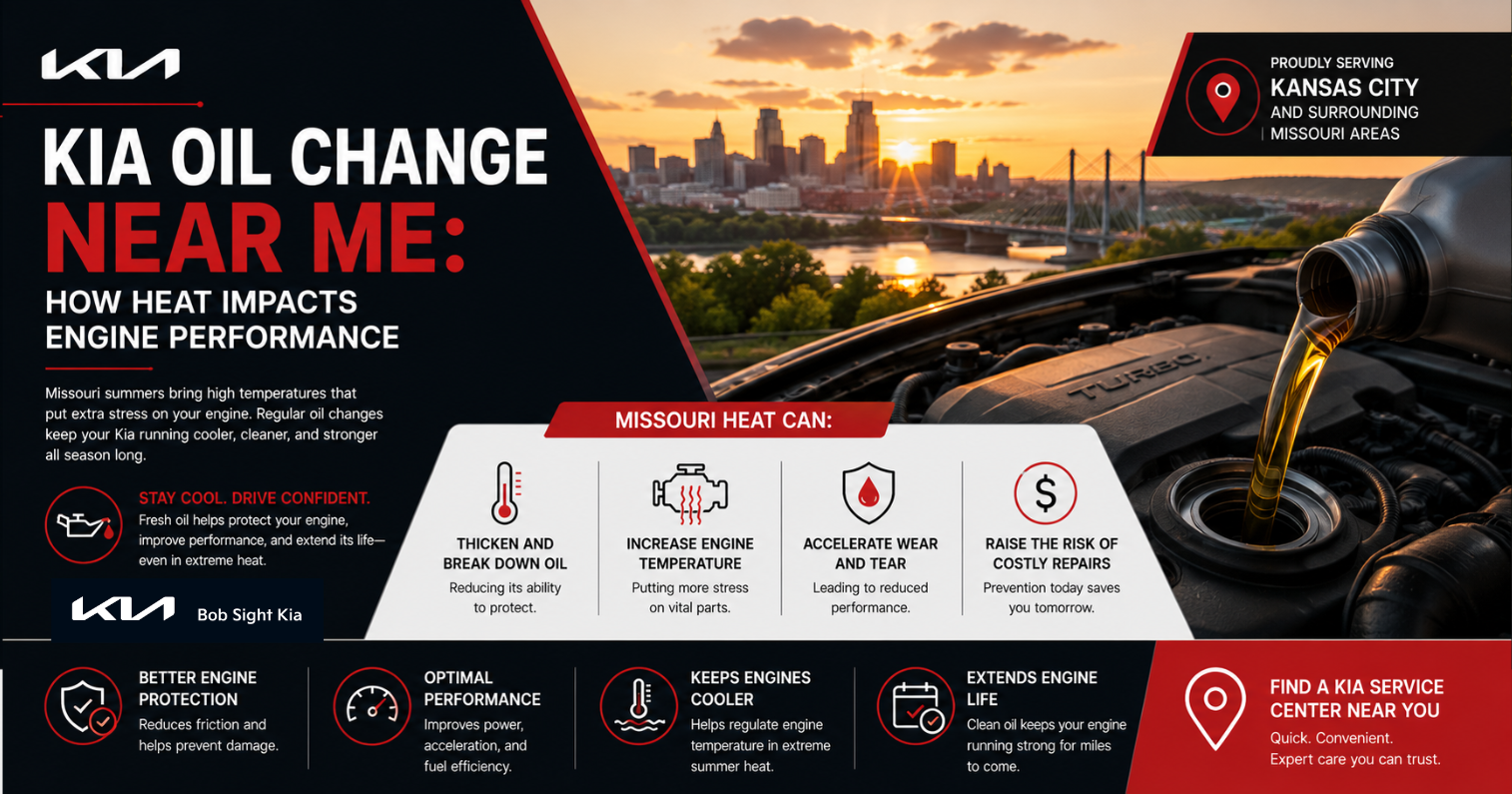
Kia Oil Change Near Me: How Heat Impacts Engine Performance
Bob Sight Kia in Independence, MO is your trusted destination for a certified Kia oil change near me to protect your vehicle against extreme summer heat and engine thermal breakdown. High ambient temperatures across the Kansas City metro area place significant thermal stress on your engine oil, reducing its ability to lubricate vital internal components. Whether you commute daily down Interstate 70, travel along Noland Road, or navigate stop-and-go traffic near the Independence Center, regular synthetic oil changes preserve engine health and maintain optimal fuel efficiency. Our factory-trained service technicians deliver precision oil changes using genuine Kia filters and OEM-certified lubricants tailored to your driving habits in Jackson County.
Schedule Your Kia Oil Change at Bob Sight Kia Today
In This Guide You’ll Learn
Here is what you will learn in this detailed guide on how extreme heat affects engine performance and why routine oil changes matter for local drivers:
- How high temperatures cause oil oxidation, thermal breakdown, and engine sludge buildup.
- The importance of selecting the correct oil viscosity ratings like 0W-20 and 5W-30 for Kia engines.
- Key warning signs that your engine oil has degraded due to severe thermal stress.
- A step-by-step walkthrough of a professional certified Kia oil change service.
- A detailed comparison between full synthetic and conventional motor oils under high heat conditions.
- How local Jackson County road conditions and traffic patterns accelerate oil degradation.
- Step-by-step instructions for checking your engine oil level and clarity at home.
- Frequently asked questions regarding oil change intervals, synthetic blend options, and warranty coverage.
The Physics of Thermal Degradation: How Heat Breaks Down Engine Oil
Extreme heat causes engine oil to undergo thermal breakdown, a chemical process where high temperatures break molecular bonds and cause oxidation, viscosity loss, and sludge formation. When engine oil operates above its ideal thermal threshold, lighter hydrocarbon molecules evaporate while heavier compounds oxidize and thicken. This degradation turns fresh, golden oil into a dark, sticky sludge that restricts internal fluid passages and starves critical components of required lubrication. Understanding how heat alters fluid chemistry helps drivers appreciate why timely maintenance is necessary during hot Missouri summers.
During normal operation along Highway 40 or I-470, internal combustion engine temperatures quickly exceed 200 degrees Fahrenheit. Under heavy acceleration or prolonged idling in severe heat, localized cylinder head temperatures can spike much higher. If the engine oil lacks sufficient thermal stability, oxidation accelerates rapidly, forming harmful carbon deposits on intake valves, piston rings, and turbocharger bearings. Over time, these deposits restrict oil flow, increase friction, and reduce overall engine efficiency across all driving conditions.
Furthermore, degraded engine oil loses its critical shear strength, which is the fluid ability to maintain a protective film between high-speed moving metal parts. When shear breakdown occurs, metal components like camshaft lobes, crankshaft journals, and connecting rod bearings come into direct contact. This metal-on-metal friction generates even more heat, creating a destructive feedback loop that can lead to catastrophic engine failure if left uncorrected. Regular oil changes restore fluid film strength and flush out suspended contaminants before permanent mechanical damage occurs.
Modern Kia engines utilize tight manufacturing tolerances and variable valve timing systems that rely heavily on clean, unoxidized oil pressure. Hydraulic actuators that adjust timing shafts require instant, unobstructed oil flow to operate smoothly. When heat-induced sludge enters these sensitive hydraulic channels, engine timing can slip, triggering check engine lights and sluggish acceleration. Maintaining fresh synthetic oil ensures these delicate electronic-hydraulic systems function flawlessly during intense heat waves.
Understanding Engine Oil Viscosity and OEM Specifications for Kia Vehicles
Engine oil viscosity measures a fluid resistance to flow at specific temperatures, with ratings like 0W-20 and 5W-30 defining cold-start fluidity and high-temperature protection. The first number followed by the letter W indicates winter flow characteristics at freezing temperatures, while the second number represents fluid thickness at normal operating temperatures of 212 degrees Fahrenheit. Selecting the exact OEM-recommended viscosity grade ensures your Kia engine receives rapid lubrication upon startup while retaining a durable protective layer during hot summer drives around Blue Springs and Lee’s Summit.
Kia engine engineers specify exact oil standards, including API SP and ILSAC GF-6A certifications, to protect modern gasoline direct injection (GDI) and turbocharged powertrains. These modern standards are specifically engineered to prevent Low-Speed Pre-Ignition (LSPI), an abnormal combustion event that can cause severe piston damage in small-displacement turbocharged engines. Using generic or non-compliant engine oil that lacks these anti-wear additives compromises performance and puts your vehicle at risk of internal mechanical stress during high-load highway driving.
Full synthetic oils engineered to 0W-20 or 5W-30 specifications maintain molecular uniformity much longer than conventional mineral oils under extreme heat. Synthetic molecules resist thermal breakdown and shearing, remaining fluid at sub-zero temperatures while resisting thinning when stuck in heavy traffic along Noland Road. This dual-capability ensures your engine remains protected whether starting up on a chilly morning or pulling a heavy load up steep hills in Raytown during peak summer afternoon heat.
Consulting your owner manual or speaking with our certified service advisors clarifies which exact oil specification your vehicle requires. Models featuring 1.6L Turbo, 2.5L GDI, or 3.8L V6 engines each have precise oil volume and viscosity guidelines designed to optimize fuel economy and power output. Using the correct manufacturer-approved oil grade keeps your factory warranty fully intact while maximizing total engine longevity across thousands of miles.
Recognizing the Warning Signs of Heat-Damaged Engine Oil
Common warning signs of heat-damaged engine oil include dark gritty fluid texture, persistent burning oil odors, elevated engine operating temperatures, and loud ticking noises from under the hood. As motor oil oxidizes under severe heat, it loses its clear amber clarity and turns thick and black while developing a burnt aroma. Recognizing these symptoms early allows drivers in Liberty and Independence to schedule a professional oil change before internal engine components suffer irreversible wear.
A primary indicator of thermal breakdown is increased valvetrain noise, often heard as a distinct metallic ticking or tapping sound when idling at traffic lights. When heat thins engine oil beyond its recommended viscosity, hydraulic valve lifters cannot maintain proper oil pressure, resulting in audible mechanical play between valve components. If you notice unusual ticking noises after extended highway driving on I-70, your oil has likely lost its high-temperature protective thickness and needs immediate replacement.
Another clear warning sign is an illuminated oil pressure warning light or check engine light on your dashboard display. Low oil pressure can occur when extreme heat causes engine oil to thin excessively or when heavy sludge blocks the oil pickup screen inside the oil pan. Ignoring an illuminated oil light can result in total engine seizure within minutes, making prompt service at a certified facility critical for vehicle survival.
Additionally, drivers may observe higher engine temperature gauge readings or frequent cooling fan activation during routine commutes. While cooling systems manage overall engine heat, fresh oil plays a vital supporting role by carrying thermal energy away from internal pistons and bearings. When oil degrades and loses heat-dissipation capability, the engine runs noticeably hotter, placing extra stress on the radiator, water pump, and coolant hoses.
Step-by-Step Guide: What Happens During a Professional Kia Certified Oil Change
A certified Kia oil change involves a systematic multi-point maintenance procedure designed to refresh vital engine fluids and inspect key safety components. Entrusting your vehicle to factory-trained technicians ensures every step is executed to strict manufacturer specifications using specialized tools and genuine OEM parts. Below is the step-by-step process conducted during a routine service appointment at Bob Sight Kia.
- Vehicle Inspection and Service Prep: The technician drives the vehicle onto a hydraulic lift, installs protective seat and floor covers, and connects diagnostic tools to verify no active engine fault codes exist.
- Safely Drain Spent Engine Oil: The vehicle is elevated, the underbody splash shield is removed, and the oil pan drain plug is loosened to allow hot, contaminated oil to drain completely into a specialized collection container.
- Replace Spent Filter with Genuine Kia OEM Filter: The old oil filter is removed, the mounting surface is cleaned and inspected, and a new genuine Kia oil filter with an anti-drainback valve is installed and torqued to factory specifications.
- Reinstall Drain Plug and Fill Fresh Synthetic Oil: A new crush washer is installed on the drain plug, the plug is torqued securely, and the engine is refilled with the exact volume and viscosity of premium full synthetic oil.
- Start Engine and Verify Leak-Free Seal: The engine is started and run for several minutes to build full oil pressure, allowing technicians to inspect the drain plug and oil filter housing for any leaks.
- Check Fluid Levels and Reset Maintenance Monitor: The dipstick is checked to verify precise oil level, tire pressures are adjusted, additional under-hood fluids are topped off, and the instrument cluster service reminder is reset.
Comparing Synthetic vs Conventional Oil Performance Under Extreme Heat
Full synthetic engine oil outperforms conventional motor oil in high-heat environments by providing higher thermal resistance, lower evaporation rates, and longer service life. Synthetic lubricants are chemically synthesized from refined base oils to create uniform molecular structures that resist breakdown at high temperatures. Conventional oils contain irregular molecular chains that breakdown quickly when exposed to severe summer heat, leading to rapid viscosity loss and sludge accumulation.
In extreme heat testing, full synthetic oil retains its protective viscosity film up to temperatures exceeding 400 degrees Fahrenheit, whereas conventional oil begins oxidizing and breaking down rapidly around 275 degrees Fahrenheit. This higher thermal ceiling makes synthetic oil essential for modern turbocharged engines, where oil cools turbo bearings spinning at over 100,000 RPM. Synthetic oil continues flowing smoothly to absorb heat without charring or forming hard carbon deposits.
| Performance Property | Full Synthetic Engine Oil | Conventional Motor Oil |
|---|---|---|
| Thermal Breakdown Resistance | Superior resistance up to 400+ degrees Fahrenheit. | Breaks down rapidly above 275 degrees Fahrenheit. |
| Evaporation Rate at High Heat | Very low volatile oil loss under high load. | Higher evaporation, requiring frequent top-offs. |
| Sludge and Deposit Prevention | Advanced detergent package prevents carbon buildup. | Prone to rapid sludge buildup in hot conditions. |
| Recommended Service Interval | 7,500 miles or 12 months under normal driving. | 3,000 to 5,000 miles maximum service life. |
Another major advantage of synthetic oil is its significantly lower volatility rate when subjected to sustained high temperatures. Conventional oil loses lighter molecules to evaporation during hot highway commuting along I-70, leading to gradual oil level drops between scheduled maintenance appointments. Full synthetic formulations minimize volatile oil consumption, ensuring your dipstick level remains stable between regular service visits.

Investing in full synthetic oil changes delivers substantial long-term value by extending internal engine component life and maintaining factory fuel economy. Because synthetic molecules create less internal fluid friction, the engine turns over easier, generating less internal heat while consuming less fuel. Over tens of thousands of miles, these operational savings far exceed the small price difference between synthetic and basic conventional oil.
Local Driving Conditions in Jackson County That Accelerate Oil Oxidation
Local driving habits in Jackson County, including frequent stop-and-go commuting, high summer humidity, and extended idling, significantly accelerate oil oxidation and breakdown. While long highway miles allow engine oil to reach a steady, efficient operating temperature, short trips and heavy suburban traffic subject motor oil to severe thermal cycling. Understanding local environmental stress factors helps drivers adjust maintenance schedules to protect their engines effectively.
Navigating congested corridors like Highway 291 or Truman Road during peak afternoon rush hours creates extreme heat under the hood. When a vehicle idles in traffic with ambient summer temperatures hovering near 90 or 100 degrees Fahrenheit, airflow through the front radiator grille drops dramatically. This reduced airflow causes under-hood temperatures to rise rapidly, baking the static engine oil in the oil pan and accelerating thermal oxidation.
Short driving trips under five miles, such as quick runs to local schools or grocery stores around Sugar Creek or Raytown, present a different kind of maintenance challenge. During short winter or spring trips, the engine oil never reaches full operating temperature, allowing fuel vapors and condensation to accumulate in the crankcase. This moisture mixes with oxidized oil residues, forming acidic sludge that corrodes internal engine bearings and causes premature wear.
Additionally, towing trailers, carrying heavy passenger loads, or driving through hilly terrain near Little Blue Parkway forces the engine to operate under high load conditions. High engine load generates intense internal pressure and thermal stress, requiring maximum shear protection from your motor oil. Drivers who regularly subject their vehicles to these severe driving conditions should follow shortened oil change intervals to keep their engines running smoothly.
Step-by-Step Guide: How to Check Your Kia Engine Oil Level and Condition
Checking your engine oil level and fluid clarity at home is a simple five-minute maintenance habit that prevents low-oil operation and severe engine damage. Regularly monitoring your dipstick allows you to catch minor oil leaks or gradual fluid consumption before low pressure threatens internal components. Below is a simple step-by-step procedure for checking engine oil accurately on your driveway.
- Park Vehicle on Level Ground and Turn Off Engine: Park your car on a completely flat surface, turn off the ignition, and wait five to ten minutes for the engine oil to drain back down into the oil pan.
- Open Hood and Locate Bright Yellow Dipstick: Safely pop the hood latch, secure the hood prop rod, and identify the engine oil dipstick handle, which is typically bright yellow or orange.
- Remove Dipstick and Wipe Clean with a Cloth: Pull the dipstick straight out of its tube, use a clean paper towel or lint-free rag to wipe off all old oil, and inspect the markings at the tip.
- Reinsert Dipstick Fully and Pull Back Out: Push the dipstick all the way back into the guide tube until it seats fully, then pull it out smoothly to read the fresh oil level indicator line.
- Check Oil Level Between Minimum and Maximum Marks: Verify that the oil level sits comfortably between the lower MIN (or L) and upper MAX (or F) indicator dots; add oil if the reading is near or below the lower line.
- Inspect Oil Color and Wipe Clean: Examine the oil color on the paper towel; fresh oil appears light amber and translucent, while dark, gritty, or milky oil indicates severe degradation or coolant contamination requiring immediate service.
Quick Facts: Kia Engine Oil Specifications and Maintenance Guidelines
Following factory engine oil specifications and maintenance guidelines ensures peak fuel efficiency, quiet engine operation, and total warranty protection. Summarized below are essential facts and technical standards for maintaining your Kia vehicle in Missouri.
- Recommended Oil Change Interval: Every 7,500 miles or 12 months under normal driving conditions using full synthetic oil.
- Severe Driving Change Interval: Every 5,000 miles or 6 months for heavy stop-and-go commuting, towing, or short-trip winter driving.
- Approved Industry Certifications: Requires API SP, API SN Plus, or ILSAC GF-6A certified engine oils to prevent Low-Speed Pre-Ignition (LSPI).
- Common Viscosity Grades: 0W-20 for maximum fuel economy in modern engines; 5W-30 for high-load turbocharged models.
- Genuine OEM Filters: Genuine Kia oil filters feature internal silicone anti-drainback valves that prevent dry engine starts upon initial ignition.
These key facts emphasize the technical precision required to maintain modern Kia powertrains. Adhering to these manufacturer guidelines prevents unnecessary wear and guarantees that your vehicle delivers quiet, efficient performance throughout its operational life. Bringing your car to a certified dealership guarantees these exact standards are met on every visit.
Ownership Planning: Developing a Proactive Seasonal Maintenance Strategy
A proactive seasonal maintenance strategy involves pairing timely summer oil changes with comprehensive multi-point vehicle inspections to prevent unexpected roadside breakdowns. Seasonal weather transitions in Missouri place fluctuating demands on vehicle systems, shifting from freezing winter restarts to severe summer heat stress. Aligning your routine oil changes with seasonal changes ensures your battery, cooling system, and tires are inspected before severe weather arrives.
During a spring or summer oil change appointment, certified technicians do far more than simply replace engine oil. Technicians conduct complete visual inspections of radiator hoses, serpentine belts, cabin air filters, and engine air filters. Replacing a clogged engine air filter during an oil change improves engine airflow, helping the combustion process run cooler and more efficiently during hot summer drives along US-40.
In addition, maintaining a complete record of documented oil changes at an authorized dealership protects your vehicle resale equity and supports future warranty claims. Potential used car buyers pay a premium for pre-owned vehicles with documented service histories from factory-certified facilities. Knowing your vehicle has been serviced exclusively with OEM-approved fluids gives future buyers complete confidence in its long-term reliability.
Drivers purchasing a new Kia at Bob Sight Kia enjoy even greater long-term value thanks to our lifetime oil changes and tire rotations program. Having routine oil changes covered for the lifetime of your new vehicle eliminates out-of-pocket maintenance stress and encourages staying on schedule. This valuable program makes prioritizing vehicle health simple, affordable, and worry-free for Kansas City metro drivers.
Frequently Asked Questions
How often should I get an oil change near me if I drive in heavy Kansas City traffic?
If you regularly drive in heavy stop-and-go traffic across the Kansas City metro, you should change your oil every 5,000 miles or six months under Kia severe driving guidelines. Heavy traffic, frequent idling, high ambient heat, and short commutes under five miles prevent engine oil from operating at optimal temperatures while accelerating fluid oxidation and contamination. Shortening your service interval prevents harmful sludge buildup and protects vital internal components against premature friction wear.
While standard factory guidelines recommend service every 7,500 miles for highway driving, local Midwest commuting often qualifies as severe service due to seasonal weather shifts and urban traffic congestion along I-70 and I-470. During extended idling at traffic lights, the engine generates internal heat without receiving cooling airflow through the grille, baking static oil in the crankcase. Following a 5,000-mile schedule ensures your oil retains protective detergent and shear properties year-round.
Drivers living in Independence, Blue Springs, or Lee’s Summit can easily consult with our service advisors at Bob Sight Kia to evaluate their daily driving habits. Our team helps you establish a custom maintenance schedule tailored specifically to your route, ensuring maximum engine protection without unnecessary maintenance expenses.
What happens if I delay my Kia oil change during hot summer months?
Delaying an oil change during hot summer months leads to accelerated oil oxidation, severe sludge accumulation, increased engine friction, and potential mechanical failure due to thermal breakdown. As summer temperatures rise, old engine oil that has already lost its protective additive package thins rapidly and evaporates lighter lubricating compounds. This leaves behind a sticky carbon residue that clogs narrow oil passages, starves bearings, and causes internal engine temperatures to spike dangerously.
Additionally, degraded oil loses its ability to carry heat away from high-stress internal components like pistons and valve trains. Without fresh synthetic oil absorbing thermal energy, internal engine components expand excessively, leading to scuffed cylinder walls, damaged piston rings, and loud valvetrain noise. Over time, running on heat-damaged oil destroys fuel economy and can result in total engine failure that requires expensive engine rebuilds or replacements.
Protecting your vehicle against heat damage is as simple as scheduling a routine oil change at our Independence service center. Our factory-trained technicians flush out old, heat-damaged fluid and install fresh full synthetic oil engineered to withstand Missouri summer heat. Taking prompt action keeps your crossover running smoothly and preserves long-term vehicle dependability.
Is full synthetic oil necessary for my Kia, or can I use a synthetic blend?
Full synthetic oil is strongly recommended for modern Kia engines because it offers superior high-temperature stability, advanced sludge protection, and longer service life compared to synthetic blends. While synthetic blends combine conventional mineral oil with synthetic base stocks to offer moderate protection, they breakdown much faster under extreme thermal stress. Full synthetic lubricants are engineered entirely from high-purity synthetic molecules, delivering uniform protection across extreme heat and sub-zero cold.
For Kia models equipped with turbocharged engines or gasoline direct injection (GDI) systems, full synthetic oil meeting API SP or ILSAC GF-6A standards is required to maintain warranty compliance and prevent Low-Speed Pre-Ignition (LSPI). Turbochargers operate at extreme temperatures that instantly vaporize lower-grade synthetic blends, causing hard carbon deposits to bake onto turbo shaft bearings. Full synthetic oil resists vaporization, ensuring continuous cooling and lubrication to delicate turbo assemblies.
While synthetic blend oil may carry a slightly lower initial service cost, full synthetic oil delivers far greater long-term value by extending service intervals to 7,500 miles and protecting expensive engine hardware. Choosing full synthetic during your oil change at Bob Sight Kia guarantees maximum fuel efficiency, quiet operation, and peace of mind during hot summer driving.
Why is my Kia engine consuming more oil during summer road trips?
Higher oil consumption during summer road trips is caused by elevated thermal evaporation of oil molecules, sustained high-RPM highway driving, and increased engine operating temperatures. When driving at high speeds along Interstate 70 for extended periods in summer heat, internal oil temperatures remain elevated, causing lighter hydrocarbon fractions in older or lower-grade oil to boil off through the crankcase ventilation system. This normal thermal volatility results in a gradual dip on your dipstick over long distances.
Additionally, sustained high-load driving while carrying heavy luggage or towing trailers increases crankcase pressure, forcing small amounts of oil vapor past piston rings and valve guides to be burned in the combustion chamber. If your engine oil is past its recommended service interval, degraded viscosity additives allow fluid to thin excessively, increasing oil consumption rates even further during long highway stretches.
To prevent low-oil operation during summer travel across Missouri, always check your dipstick level before leaving on long trips and carry an extra quart of OEM-recommended full synthetic oil in your trunk. If you notice significant oil loss between services, visit our certified technicians at Bob Sight Kia to inspect your PCV valve, valve cover gaskets, and oil pan seals for minor leaks.
Why Local Service at Bob Sight Kia Matters for Independence Drivers
Servicing your vehicle locally at Bob Sight Kia in Independence, MO guarantees expert factory-certified care, genuine OEM parts, and a long-standing community commitment to customer satisfaction. Choosing a local family-owned dealership for your routine oil changes ensures your car is cared for by certified technicians who understand the exact engineering specs of your Kia model. Our state-of-the-art service facility utilizes specialized diagnostic equipment, genuine Kia oil filters, and premium synthetic lubricants designed specifically for your engine.
Unlike quick-lube facilities or independent repair shops that often use generic bulk oil and cheap aftermarket filters, Bob Sight Kia never compromises on quality. Generic oil filters often lack critical internal bypass valves and anti-drainback seals, leading to dry metal-on-metal engine starts and improper oil filtration. Our service department uses exclusively factory-approved filters that preserve oil pressure and maintain full 10-Year/100,000-Mile warranty protection.
Furthermore, local dealership service offers unmatched convenience, transparent communication, and comfortable customer amenities. While your vehicle is serviced, you can relax in our quiet lounge with complimentary Wi-Fi and refreshments, or utilize our convenient local shuttle service to get back to your home or office in Independence, Blue Springs, or Lee’s Summit. Schedule your Kia oil change near me at Bob Sight Kia today to experience premium customer care and keep your engine performing at its best.
Helpful Links
Explore these key links on our website to schedule your next service appointment, explore current maintenance offers, or learn more about our dealership:
- Schedule a Certified Kia Oil Change Online
- Browse Current Service and Parts Specials
- Explore Bob Sight Kia Service Department Features
- Order Genuine Kia OEM Parts Online
- View Our Kia Service Price Match Promise
PROUD TO BE PART OF THE BOB SIGHT AUTO GROUP
Bob Sight Kia is a proud member of the Bob Sight Auto Group, a family-owned automotive network dedicated to serving drivers across Missouri and Kansas for generations. Grounded in integrity, transparency, and outstanding customer service, our auto group provides comprehensive inventory choices, competitive financing options, and factory-certified service across multiple locations in the region.
Explore our entire dealer group network below:
- Bob Sight Kia (Independence, MO)
- Bob Sight Ford (Lee’s Summit, MO)
- Bob Sight Honda (Lawrence, KS)
- Bob Sight CDJR (Lawrence, KS)
- Bob Sight Collision Center (Lee’s Summit, MO)
Connect with us


Recent Blog Entries
- Kia Oil Change Near Me: How Heat Impacts Engine Performance
- Kia Sportage vs RAV4 Fuel Economy Comparison for Missouri Drivers
- Kia EV9 Family Road Trip Features Explained for Kansas City Metro Drivers
- Kia Dealership Near Kansas City for Drivers Wanting More SUV Choices
- Kia SUV Comparison Guide for Kansas City Families in Independence and Beyond
Categories
 Warranties include 10-year/100,000-mile powertrain and 5-year/60,000-mile basic. All warranties and roadside assistance are limited. See retailer for warranty details.