

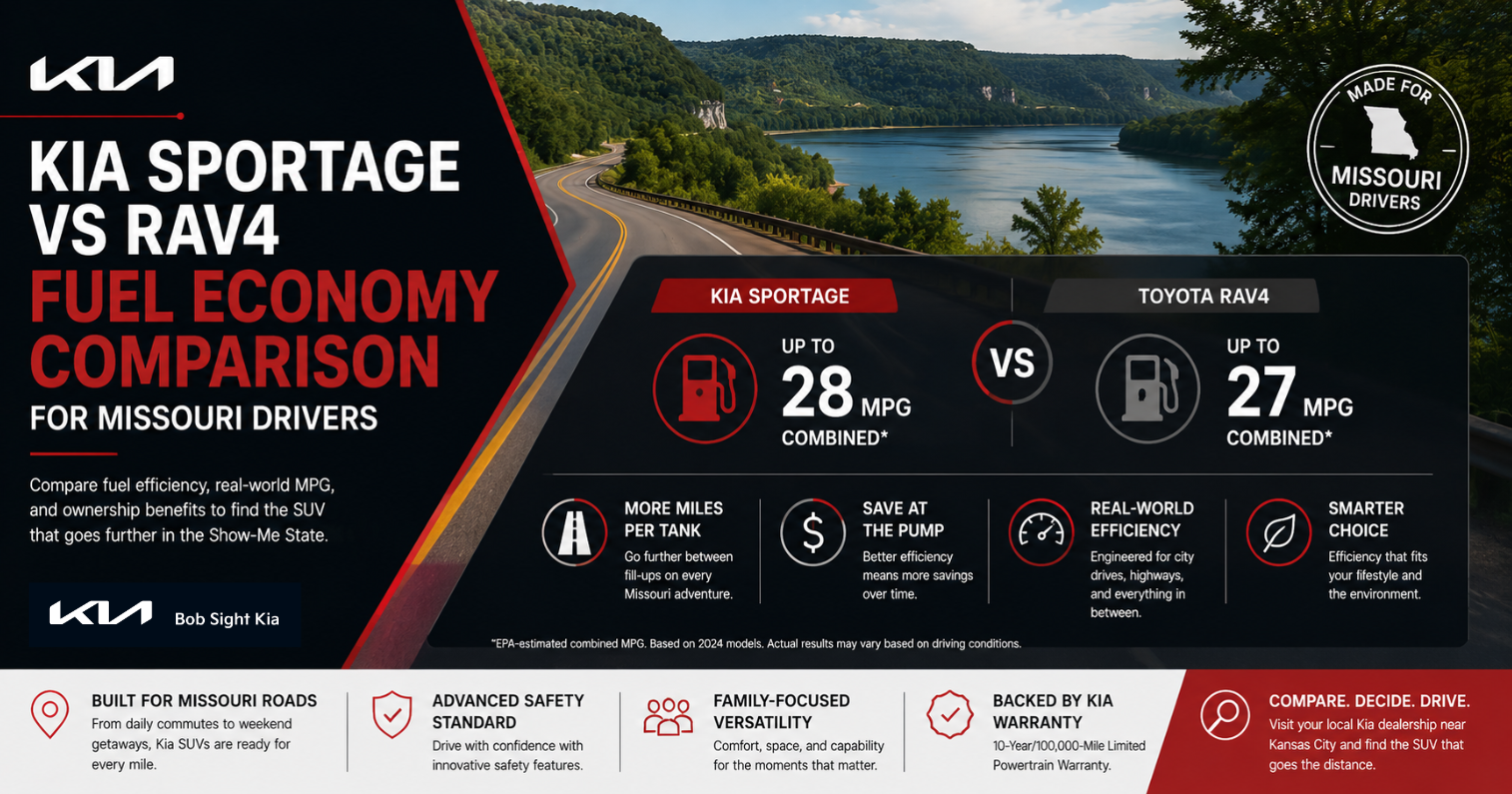
Kia Sportage vs RAV4 Fuel Economy Comparison for Missouri Drivers
Bob Sight Kia in Independence, MO provides a comprehensive fuel economy comparison between the Kia Sportage and Toyota RAV4 to help Kansas City drivers make informed purchasing decisions. Navigating daily commutes down Interstate 70, stop-and-go traffic around the Independence Center, and long highway trips across Jackson County requires an efficient crossover that balances power with low fuel costs. Whether you are considering traditional gas models or high-efficiency hybrid powertrains, comparing real-world MPG ratings, tank ranges, and drivetrain options reveals which compact SUV offers the greatest long-term savings for Missouri households.
Explore New Kia Sportage Inventory Near Kansas City
In This Guide You’ll Learn
Here is what you will discover in this detailed fuel economy comparison guide between the Kia Sportage and Toyota RAV4:
- How EPA fuel economy ratings for gas, hybrid, and plug-in hybrid variants compare under real Midwest driving conditions.
- How Kia’s 1.6L Turbo Hybrid engine delivers higher combined horsepower and torque while achieving up to 43 MPG combined.
- How seasonal Missouri weather shifts impact hybrid battery efficiency, tire rolling resistance, and highway driving range.
- Step-by-step guidance on calculating annual fuel costs and evaluating long-term vehicle ownership value.
- Clear definitions of essential automotive efficiency terms including EPA estimates, MPGe, and regenerative braking.
- How local commuter routes across Lee’s Summit, Blue Springs, and Liberty affect real-world fuel consumption.
- Key FAQs regarding hybrid battery warranties, highway passing power, and routine maintenance intervals in Jackson County.
Overview of Kia Sportage vs Toyota RAV4 Powertrains and Efficiency
The Kia Sportage and Toyota RAV4 represent two of the most popular compact crossovers in Missouri, offering distinct powertrain choices designed for fuel efficiency and daily utility. Comparing fuel economy between these two models requires looking closely at standard gasoline engines as well as electrified hybrid powertrains. While both manufacturers prioritize low fuel consumption, differences in engine design, transmission hardware, and hybrid technology create distinct performance characteristics on the road.
The standard gas-powered Kia Sportage utilizes an efficient 2.5-liter 4-cylinder engine generating 187 horsepower and 178 lb-ft of torque, paired with a smooth-shifting 8-speed automatic transmission. Front-wheel-drive Sportage models achieve an EPA-estimated 25 MPG city, 33 MPG highway, and 28 MPG combined, while all-wheel-drive configurations earn 23 MPG city, 28 MPG highway, and 25 MPG combined. This setup offers dependable highway cruising power along I-470 while maintaining consistent fuel economy for daily drivers.
For shoppers seeking maximum fuel savings, the Kia Sportage Hybrid upgrades performance with a 1.6-liter turbocharged 4-cylinder engine paired with a 44 kW electric motor. This advanced hybrid powertrain produces a combined 227 horsepower and 258 lb-ft of torque, significantly outpowering standard non-hybrid crossovers. In front-wheel-drive LX trim, the Sportage Hybrid earns an extraordinary EPA-estimated 42 MPG city, 44 MPG highway, and 43 MPG combined, making it one of the most fuel-efficient vehicles in its class.
The Toyota RAV4 offers a traditional 2.5-liter 4-cylinder engine on gas models and a 2.5-liter naturally aspirated hybrid system on electrified grades. While the RAV4 Hybrid delivers competitive EPA figures, the Sportage Hybrid provides superior combined horsepower and much stronger low-end torque thanks to its turbocharged design. Missouri drivers who frequently merge onto busy highways like Highway 350 appreciate the quick, responsive power delivery of the Sportage Hybrid without sacrificing exceptional fuel efficiency.
Real-World Fuel Economy on Kansas City Highway and Suburban Routes
Real-world fuel economy for Missouri drivers depends heavily on commuting patterns, traffic congestion along major highways, and regional terrain shifts across Jackson County. Official EPA laboratory testing provides a helpful baseline for vehicle comparison, but daily driving conditions in the Kansas City metro area often test fuel efficiency under real-world stress. High-speed highway travel, hilly terrain near Raytown, and winter climate shifts all influence how many miles you get out of every tank of fuel.
Commuting along Interstate 70 or US-50 at steady highway speeds allows the Kia Sportage gas and hybrid models to achieve optimal aerodynamic efficiency. The Sportage aerodynamic body styling and intelligent transmission shift logic keep engine RPMs low during steady-state cruising. Drivers making the daily run from Grain Valley or Blue Springs into downtown Kansas City can consistently meet or exceed factory highway MPG figures when maintaining steady speeds.
Suburban stop-and-go driving around local shopping corridors like Summit Fair or Independence Center is where the Sportage Hybrid truly shines. During low-speed decelerations and frequent stops, the hybrid electric motor absorbs kinetic energy and shuts off the gasoline engine completely. Operating on pure electric power during heavy traffic jams reduces local emissions, minimizes fuel waste, and keeps your monthly fuel expenses remarkably low.
Furthermore, Missouri’s rolling hills and fluctuating weather conditions place unique demands on vehicle drivetrains. The Sportage Hybrid’s turbocharged torque allows the vehicle to climb highway inclines effortlessly without requiring harsh downshifts or high engine revs. By maintaining smooth engine operation across varied elevation changes, the Sportage protects fuel efficiency where atmospheric drag and gravity normally drain energy reserves.
Step-by-Step Guide: How to Calculate Your Annual Fuel Savings
Calculating your annual fuel savings between different crossover models helps you evaluate long-term financial value before completing your purchase. Fuel costs represent one of the largest ongoing expenses of vehicle ownership over a five-to-seven-year period. Following a simple mathematical process enables Missouri shoppers to calculate exact savings based on local gas prices and personal driving habits.
- Determine Your Total Annual Driving Mileage: Estimate your total yearly mileage by reviewing your current odometer growth or multiplying your average weekly commute distance across Lee’s Summit and Independence by 52 weeks.
- Identify the Combined EPA MPG Rating for Each Model: Locate the official combined city/highway MPG figures for the specific trim levels you are comparing, such as 43 MPG for the Sportage Hybrid vs. 28 MPG for a standard gas crossover.
- Calculate Total Annual Gallons Required: Divide your total annual mileage by the combined MPG rating of each vehicle to determine how many gallons of gasoline each crossover will burn per year.
- Determine Current Local Fuel Costs in Jackson County: Check current local unleaded gasoline prices across Independence or Kansas City to establish a realistic cost per gallon baseline for your calculations.
- Multiply Gallons by Local Fuel Prices: Multiply the annual gallons required for each vehicle by the price per gallon to establish your total estimated yearly fuel expenditure for both choices.
- Subtract the Costs to Calculate Total Net Savings: Subtract the lower annual fuel cost from the higher figure to determine your net yearly savings, then multiply by five years to see long-term ownership value.
Comparing Powertrain Configurations: Front-Wheel Drive vs All-Wheel Drive Efficiency
Choosing between front-wheel drive and all-wheel drive involves balancing maximum fuel economy with enhanced traction for severe Midwest weather. Front-wheel drive (FWD) configurations offer lower vehicle curb weight and reduced mechanical drag, delivering the highest overall MPG numbers. However, all-wheel drive (AWD) systems provide essential stability when driving across snow-covered roads or wet asphalt during spring rainstorms in Missouri.
In the Kia Sportage lineup, FWD hybrid models achieve segment-leading EPA ratings up to 43 MPG combined, making them ideal for budget-focused commuters who prioritize maximum fuel range. For drivers who require enhanced traction, the Sportage Hybrid AWD model utilizes an active electronical all-wheel-drive system. Even with AWD engaged, the Sportage Hybrid maintains an impressive EPA-estimated 38 MPG combined, giving drivers winter peace of mind without a massive fuel economy penalty.
| Model & Drivetrain Configuration | EPA City MPG | EPA Highway MPG | EPA Combined MPG |
|---|---|---|---|
| Kia Sportage 2.5L Gas FWD | 25 MPG | 33 MPG | 28 MPG |
| Kia Sportage 2.5L Gas AWD | 23 MPG | 28 MPG | 25 MPG |
| Kia Sportage Hybrid 1.6T FWD | 42 MPG | 44 MPG | 43 MPG |
| Kia Sportage Hybrid 1.6T AWD | 38 MPG | 38 MPG | 38 MPG |
| Toyota RAV4 Hybrid 2.5L AWD | 41 MPG | 38 MPG | 39 MPG |
The Toyota RAV4 Hybrid comes standard with electric all-wheel drive across its hybrid trims, achieving an EPA rating of 39 MPG combined. While this offers consistent baseline traction, it deprives shoppers of a ultra-high-efficiency front-wheel-drive hybrid option. Kia gives Missouri shoppers the power of choice, allowing them to select either maximum 43 MPG FWD thrift or robust 38 MPG AWD capability.

Furthermore, Kia’s Active AWD system includes driver-selectable drive modes, such as Snow Mode, Smart Mode, and Sport Mode. Smart Mode automatically monitors driving behavior and road conditions, disconnecting power to the rear wheels when extra traction is unnecessary to conserve fuel. This intelligent power distribution ensures that all-wheel-drive models remain remarkably efficient during dry highway cruising.
Understanding Automotive Efficiency Terminology: MPG, MPGe, and Regenerative Braking
Understanding automotive efficiency terminology helps car buyers accurately compare traditional fuel economy figures against hybrid and plug-in metrics. Technical acronyms and rating systems can sometimes feel confusing when shopping for a new vehicle. Below are plain-language definitions of key efficiency terms every Kansas City shopper should understand.
Miles Per Gallon (MPG): Miles Per Gallon represents the distance in miles that a vehicle can travel on a single gallon of conventional fuel. EPA ratings are divided into City, Highway, and Combined metrics to reflect varied driving environments. A higher combined MPG rating directly translates to lower fuel consumption, fewer gas station visits, and reduced operating costs over the life of the vehicle.
Miles Per Gallon Equivalent (MPGe): MPGe is a standardized energy efficiency metric developed by the EPA to compare electric and plug-in hybrid vehicles against conventional gasoline cars. It calculates how far a vehicle can travel using an amount of electrical energy equal to the energy content of one gallon of gasoline (33.7 kWh). Plug-in hybrid models like the Sportage PHEV display high MPGe numbers when operating in pure electric mode.
Regenerative Braking System: Regenerative braking is an advanced energy recovery mechanism used in hybrid and electric vehicles that converts kinetic momentum into stored battery power during deceleration. Instead of wasting energy as friction heat through traditional brake pads, the electric motor acts as a generator when you lift off the accelerator or press the brake pedal. This harvested energy recharges the hybrid battery, improving fuel economy and significantly extending brake pad life.
Grasping these concepts allows buyers to evaluate vehicles based on real-world utility rather than surface-level marketing claims. Recognizing how regenerative braking functions encourages smoother driving habits that further maximize fuel range. Whether analyzing standard MPG or plug-in MPGe, informed buyers make smarter automotive investments.
Step-by-Step Guide: How to Maximize Fuel Economy in Your Kia Sportage
Driving habits and proper routine maintenance play a vital role in achieving peak fuel economy from your Kia Sportage crossover. Even the most efficient powertrain requires thoughtful operation to deliver its maximum rated MPG. Following these six simple driving and maintenance steps ensures you extract every mile of value out of every tank of gas in Jackson County.
- Utilize Smart and Eco Drive Modes: Select Eco Mode or Smart Mode using the center console drive mode dial to optimize throttle response and transmission shift points for maximum fuel conservation.
- Practice Smooth Acceleration and Anticipatory Braking: Accelerate gently from traffic lights and look ahead down the road to coast gradually toward stops, allowing the regenerative braking system to maximize energy recovery.
- Maintain Correct Tire Inflation Pressures: Check tire pressures monthly with a quality digital pressure gauge, keeping tires inflated to factory specifications to eliminate excess rolling resistance and tread wear.
- Minimize Extended Engine Idling: Avoid leaving your vehicle idling for prolonged periods during cold winter mornings or school drop-offs in Liberty, as idling burns fuel while achieving zero miles per gallon.
- Remove Excess Cargo Weight and Roof Racks: Clean unnecessary heavy items out of the cargo area and remove unused roof rack crossbars to reduce vehicle weight and improve aerodynamic highway efficiency.
- Schedule Regular Maintenance at Bob Sight Kia: Keep up with factory oil changes using synthetic 0W-20 or 5W-30 engine oil and replace dirty air filters to ensure your engine operates at peak thermal efficiency.
Quick Facts: Kia Sportage vs Toyota RAV4 Specs and Features
The Kia Sportage delivers superior interior space, stronger warranty coverage, and higher hybrid fuel economy than the Toyota RAV4. Summarized below are key technical metrics and feature comparisons between these leading compact crossovers.
- Maximum Hybrid Fuel Economy: Kia Sportage Hybrid earns up to 43 MPG combined (FWD), compared to 39 MPG combined for standard Toyota RAV4 Hybrid AWD models.
- Combined Powertrain Output: Sportage Hybrid delivers 227 combined horsepower and 258 lb-ft of torque, outpowering the RAV4 Hybrid 219 horsepower system.
- Second-Row Legroom: Sportage leads the class with 41.3 inches of rear legroom, compared to just 37.8 inches in the Toyota RAV4.
- Maximum Cargo Capacity: Sportage provides up to 74.1 cubic feet of total cargo space with rear seats folded, exceeding the RAV4 69.8 cubic feet capacity.
- Industry-Leading Warranty: Kia backs every new Sportage with a 10-Year/100,000-Mile Powertrain Limited Warranty, compared to Toyota 5-Year/60,000-Mile powertrain coverage.
These factual specifications demonstrate why the Kia Sportage continues to gain popularity among Midwest families. Offering greater passenger comfort, larger cargo utility, higher hybrid fuel economy, and double the powertrain warranty coverage, the Sportage represents exceptional long-term ownership value. Testing these features in person highlights the premium craftsmanship built into every Kia crossover.
Ownership Planning: Long-Term Value and Maintenance Protection
Long-term ownership value is maximized when combining high fuel efficiency with proactive maintenance and manufacturer warranty protection. Purchasing a fuel-efficient crossover is an effective strategy to lower daily living expenses across Missouri, but protecting mechanical components ensures those savings continue over hundreds of thousands of miles. Adhering to factory service intervals preserves engine efficiency, fuel delivery systems, and hybrid battery performance.
Kia’s legendary 10-Year/100,000-Mile Powertrain Limited Warranty provides an unmatched safety net against unexpected mechanical repairs. Hybrid components, including the high-voltage battery pack, electric motor, and power control unit, are fully covered under this comprehensive factory warranty. This long-term protection provides peace of mind for drivers commuting daily along I-70 or planning cross-country family road trips.
Furthermore, scheduling routine maintenance at an authorized facility guarantees that your vehicle receives genuine OEM parts, exact oil viscosities, and factory software updates. Certified technicians inspect tire wear patterns, evaluate hybrid cooling systems, and test 12V auxiliary batteries to prevent unexpected breakdowns. Protecting your investment through regular maintenance at our Bob Sight Kia service center ensures your crossover delivers top-tier fuel economy for years to come.
Frequently Asked Questions
Is the Kia Sportage Hybrid more fuel efficient than the Toyota RAV4 Hybrid?
Yes, the Kia Sportage Hybrid FWD earns an EPA-estimated 43 MPG combined, which is higher than the Toyota RAV4 Hybrid rating of 39 MPG combined. The Sportage Hybrid achieves 42 MPG in the city and 44 MPG on the highway in front-wheel-drive form, making it exceptionally thrifty for daily suburban commuting around Independence and Kansas City. Even when equipped with all-wheel drive, the Sportage Hybrid achieves a robust 38 MPG combined while providing 227 combined horsepower.
The secret behind the Sportage Hybrid superior efficiency and responsive performance lies in its sophisticated powertrain design. By pairing a 1.6-liter turbocharged gasoline engine with an electric motor and a 6-speed automatic transmission, the Sportage avoids the continuous drone of traditional CVT transmissions. This setup delivers 258 lb-ft of low-end torque, giving drivers brisk acceleration when merging onto I-470 while maintaining segment-leading fuel economy figures.
For local Missouri drivers, higher combined fuel economy means fewer stops at local gas stations during busy workweeks. Over five years of normal driving across Jackson County, the extra miles per gallon delivered by the Sportage Hybrid translate into noticeable fuel savings. Combined with a larger, more comfortable interior and higher standard tech, the Sportage Hybrid offers a compelling value package.
What is the real-world driving range of a Kia Sportage on a single tank of gas?
A Kia Sportage Hybrid can travel over 500 miles on a single 13.7-gallon tank of gas under normal driving conditions. Gas-powered Sportage FWD models equipped with a 14.3-gallon fuel tank offer an impressive highway driving range of over 470 miles per tank. This extended driving range makes the Sportage an exceptional choice for long road trips across Missouri without requiring constant refueling stops.
Achieving maximum driving range depends on maintaining steady speeds, utilizing Eco mode, and keeping tires properly inflated to factory specifications. On highway routes like I-70 between Kansas City and Columbia, the Sportage aerodynamic profile minimizes drag to stretch fuel reserves further. In suburban environments around Lee’s Summit, the hybrid system frequently shuts off the gas engine during coasting to preserve fuel.
Having a vehicle with over 500 miles of available range provides incredible convenience for busy families. Whether managing daily carpools, running weekend errands across Blue Springs, or driving out to Lake Jacomo, you can go weeks between fill-ups. The digital instrument cluster continuously monitors remaining range so you can plan fuel stops at your convenience.
How does winter weather in Missouri affect hybrid vehicle fuel economy?
Winter weather in Missouri can reduce hybrid vehicle fuel economy by 10 percent to 20 percent due to lower battery chemical efficiency, engine warm-up cycles, and cabin heating demands. In freezing temperatures, the gas engine must run more frequently to generate heat for the passenger cabin and bring the hybrid battery up to optimal operating temperature. Additionally, cold outdoor air is denser, increasing aerodynamic drag on highway trips along US-50.
Despite cold-weather efficiency drops, hybrid crossovers like the Sportage Hybrid still deliver significantly higher fuel economy during winter than conventional gas-powered SUVs. Features like heated front seats and a heated steering wheel allow drivers to stay warm while reducing reliance on high cabin heater settings. Utilizing synthetic engine oil and maintaining proper tire inflation further helps minimize winter range loss.
Local drivers in Independence and Raytown can also maximize winter fuel economy by parking in a garage when possible. Starting your vehicle in a shielded environment reduces the time needed for the engine and battery to reach efficient operating temperatures. Once up to temperature, the Sportage Hybrid intelligent thermal management system restores smooth, efficient hybrid operation.
Does the Kia Sportage require premium gasoline to achieve its rated fuel economy?
No, the Kia Sportage gas, hybrid, and plug-in hybrid models are all engineered to run efficiently on standard 87-octane regular unleaded gasoline. You do not need to spend extra money on premium fuel at the pump to achieve factory EPA horsepower or fuel economy ratings. This engineering choice keeps routine fill-up costs lower for Missouri owners compared to luxury crossovers that mandate premium fuel.
Using regular unleaded fuel saves drivers significant money over the lifespan of the vehicle. While some turbocharged engines from competing automakers require 91 or 93 octane fuel to prevent engine knock and deliver advertised performance, Kia’s advanced direct-injection and turbocharger technology is fully optimized for regular fuel. You get maximum 227 horsepower performance and peak MPG without paying premium prices.
When filling up at local gas stations across Jackson County, simply select standard 87-octane unleaded fuel. Avoiding higher fuel grade costs directly enhances your overall ownership savings. Combined with competitive purchase pricing and long warranty coverage, the Sportage remains one of the most cost-effective crossovers on the market.
Why Buying Local at Bob Sight Kia Matters for Missouri Drivers
Purchasing your Kia Sportage locally at Bob Sight Kia ensures personalized customer care, local market expertise, and ongoing factory-certified service support in Independence, MO. Buying a vehicle is a major milestone, and working with a family-owned dealership that understands Midwest driving conditions makes a meaningful difference. Our team takes the time to help you evaluate gas vs. hybrid options, compare trim levels, and structure financing tailored to your lifestyle.
Out-of-town car sellers and digital retailers cannot match the long-term support provided by a local dealership. When you purchase from Bob Sight Kia, you gain access to our modern service department equipped with specialized diagnostic tools, genuine OEM parts, and factory-trained technicians. Whether you need routine tire rotations, hybrid system checks, or state inspection renewals, our local service team handles everything with care and efficiency.
Supporting a local dealership also reinvests your hard-earned dollars directly back into Eastern Jackson County, supporting local employment and community programs. Whether you live in Independence, Lee’s Summit, Blue Springs, or Liberty, visiting our showroom allows you to test drive the Sportage on local highways and evaluate your trade-in in person. Visit Bob Sight Kia today to discover why the Kia Sportage is the ultimate fuel-efficient crossover for Missouri drivers.
Helpful Links
Explore these essential resources on our website to research Kia Sportage models, evaluate trade-in value, or schedule your next maintenance service:
- Search New Kia Sportage Inventory
- Explore Kia Sportage Hybrid Inventory
- Value Your Trade-In Online
- Apply for Fast Online Finance Pre-Approval
- Schedule Certified Kia Service in Independence
PROUD TO BE PART OF THE BOB SIGHT AUTO GROUP
Bob Sight Kia is a proud member of the Bob Sight Auto Group, a family-owned automotive network dedicated to serving drivers across Missouri and Kansas for generations. Grounded in integrity, transparency, and outstanding customer service, our auto group provides comprehensive inventory choices, competitive financing options, and factory-certified service across multiple locations in the region.
Explore our entire dealer group network below:
- Bob Sight Kia (Independence, MO)
- Bob Sight Ford (Lee’s Summit, MO)
- Bob Sight Honda (Lawrence, KS)
- Bob Sight CDJR (Lawrence, KS)
- Bob Sight Collision Center (Lee’s Summit, MO)
Connect with us


Recent Blog Entries
- Kia Sportage vs RAV4 Fuel Economy Comparison for Missouri Drivers
- Kia EV9 Family Road Trip Features Explained for Kansas City Metro Drivers
- Kia Dealership Near Kansas City for Drivers Wanting More SUV Choices
- Kia SUV Comparison Guide for Kansas City Families in Independence and Beyond
- Kia K4 Hatchback vs Hyundai Elantra for Young Professionals in the Kansas City Metro
Categories
 Warranties include 10-year/100,000-mile powertrain and 5-year/60,000-mile basic. All warranties and roadside assistance are limited. See retailer for warranty details.