

Kia Tire Service Independence MO: Signs You Need New Tires
Bob Sight Kia is your premier destination for certified Kia tire service in Independence, MO, helping drivers identify early warning signs of tread wear, sidewall damage, and alignment friction before safety is compromised. Driving across the Kansas City metro area subjects your tires to extreme temperature shifts, harsh potholes, and varied road surfaces from Interstate 70 to the busy parking lots near the Independence Center. Whether you pilot a Kia Telluride, Sportage, Sorento, or K4 sedan, maintaining proper tire tread depth, correct inflation pressure, and precise wheel alignment is essential for stopping safety and fuel efficiency. Our factory-trained service technicians offer comprehensive tire inspections, dynamic wheel balancing, and replacement tires from OEM-recommended brands like Michelin, Goodyear, Continental, Kumho, and Hankook.
Schedule Certified Kia Tire Service in Independence MO
In This Guide You’ll Learn
Here is what you will discover in this comprehensive guide to Kia tire service and maintenance in Independence, MO:
- How to identify critical warning signs that indicate your vehicle requires immediate tire replacement or service.
- Why tread depth thresholds like 2/32 of an inch impact wet-weather stopping distances on local highways like I-470.
- How uneven tread wear patterns reveal underlying suspension misalignment, improper inflation, or worn shocks.
- A step-by-step walkthrough of a professional certified tire inspection and dynamic wheel balancing service.
- How seasonal Midwest weather changes affect tire pressure retention and rubber compound elasticity.
- Plain-language definitions of essential tire technical terms including load ratings, speed ratings, and TPMS sensors.
- Key FAQs regarding tire rotation frequency, Price Match Promise coverage, and seasonal tire storage in Jackson County.
Recognizing the Critical Warning Signs That You Need New Tires
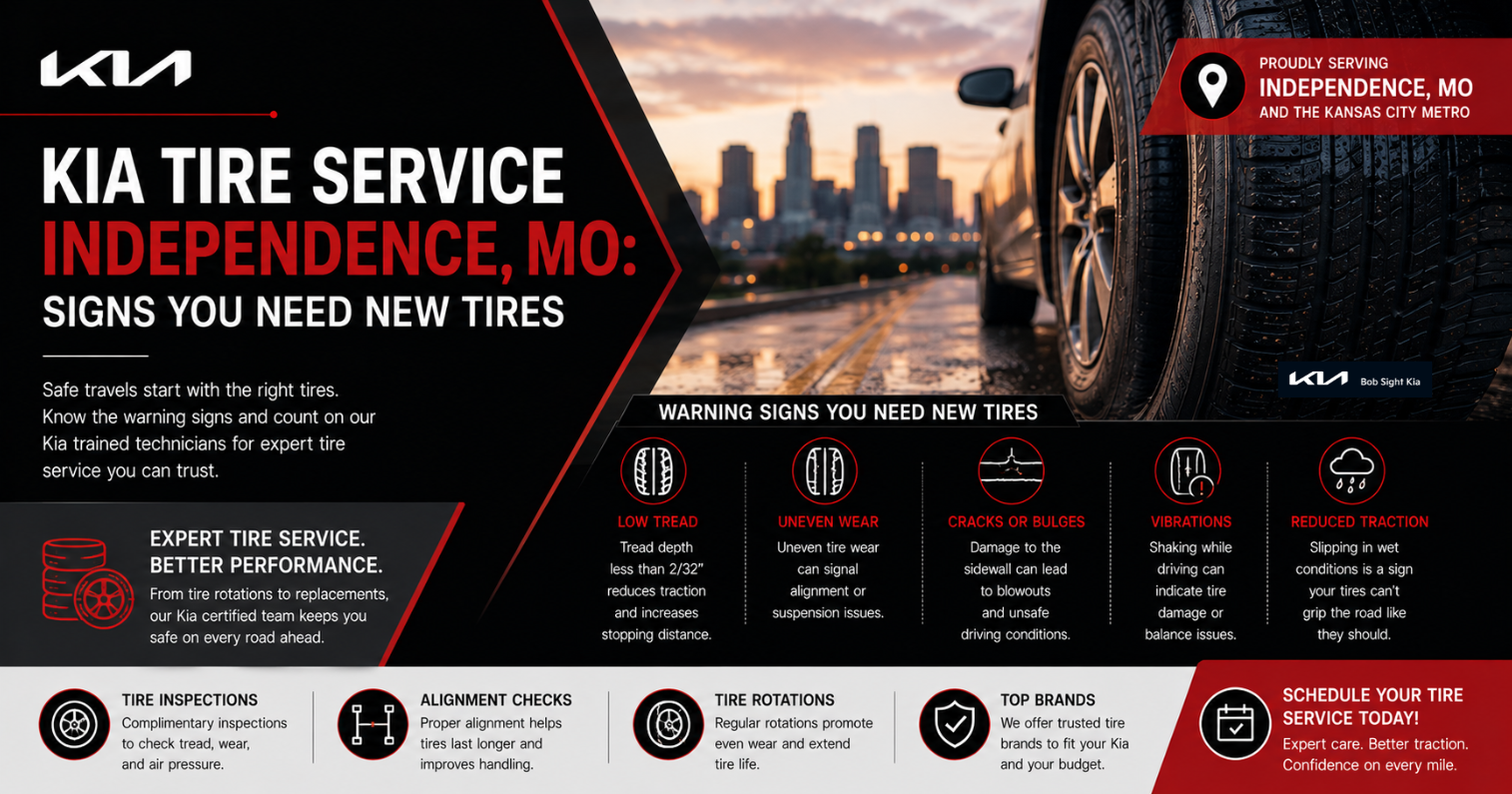
The primary signs that you need new tires include shallow tread depth below 2/32 of an inch, visible sidewall bulges or cracks, persistent vibration through the steering wheel, and frequent air pressure drops. Ignoring these visual and mechanical warning signs significantly increases your risk of experiencing a sudden blowout or skidding on wet pavement during sudden Midwest rainstorms. Regularly inspecting your tires allows you to address wear issues before they compromise safety during daily commutes along Noland Road or US-40.
One of the most obvious visual indicators of severe tire degradation is low tread depth across the tread ribs. As tires roll across thousands of miles of asphalt, the raised rubber tread blocks gradually wear down, reducing their ability to channel water away from the tire contact patch. When tread depth drops to 2/32 of an inch or less, built-in rubber tread wear indicator bars become flush with the surrounding tread ribs, signaling that the tire is legally worn out and dangerously susceptible to hydroplaning at highway speeds on I-70.
Physical damage to the sidewall represents another severe safety hazard that requires immediate replacement. Sidewall bulges, bubbles, or deep cuts indicate that the internal fabric cords and steel belts inside the tire casing have ruptured due to impact with deep potholes along Highway 291 or curbs near the Little Blue Parkway. A compromised sidewall can no longer contain internal air pressure safely under load, creating an immediate risk of a high-speed blowout that could result in loss of vehicle control.
Unusual mechanical vibrations felt through the steering wheel or vehicle floorboard during steady highway cruising also indicate tire or wheel distress. While mild vibrations can sometimes stem from minor wheel weight loss, persistent shaking often signals internal belt separation, out-of-round tire carcass distortion, or severe wheel rim damage. Bringing your crossover or sedan to our certified service bay allows technicians to diagnose vibration causes using computer-guided wheel balancers before additional suspension components are damaged.
Understanding Tread Depth Thresholds and the Penny Test
Maintaining safe tire tread depth is essential because tire tread grooves prevent hydroplaning by channeling water out from beneath the tire contact patch on wet roads. New passenger car and crossover tires typically feature starting tread depths between 10/32 and 12/32 of an inch, providing deep channels for water evacuation and maximum grip. As rubber wears down over time, stopping distances on wet asphalt increase dramatically, long before the tire reaches the legal minimum limit.
Drivers can perform a quick, reliable tread depth check on their driveway using a standard U.S. penny. Insert the penny head-first into several tread grooves across the width of the tire with Abraham Lincoln’s head facing down toward the tire casing. If the top of Lincoln’s head remains entirely visible above the tread block, your tread depth has worn to or below 2/32 of an inch, indicating that the tire must be replaced immediately to maintain safe wet-weather braking performance.
For enhanced safety during heavy spring downpours or winter slush in Jackson County, tire safety experts recommend replacing tires when tread depth reaches 4/32 of an inch. At 4/32 of an inch, a tire retains only a fraction of its original water discharge capacity, resulting in stopping distances that can be up to two car lengths longer at 60 miles per hour compared to new tires. Performing regular penny tests across inner, center, and outer tread ribs helps you catch uneven wear early.
At Bob Sight Kia, our service department utilizes digital depth gauges to measure tread wear across all four tires during complimentary multi-point inspections. Our certified technicians provide detailed color-coded tread reports showing exact measurements in thirty-seconds of an inch. This transparent documentation allows local drivers in Blue Springs and Lee’s Summit to plan tire replacements proactively before wet-weather safety is compromised.
Deciphering Uneven Tread Wear Patterns: Alignment, Balance, and Inflation Issues
Uneven tire tread wear patterns reveal specific mechanical issues, such as wheel misalignment, dynamic imbalance, worn suspension bushings, or incorrect tire inflation pressure. Inspecting the physical surface of your tires provides valuable diagnostic clues about the health of your vehicle’s steering and suspension systems. Identifying and correcting these underlying mechanical issues when installing new tires prevents premature wear on your new rubber investment.
Edge wear, where either the inner or outer shoulder of the tire wears down significantly faster than the center tread, typically points to wheel misalignment or improper camber angles. Hitting deep winter potholes along US-50 or striking concrete parking curbs can knock steering linkages out of factory specifications, causing the tire to scrub continuously against the road surface. A precision four-wheel computer alignment at our Independence facility restores original factory geometry, ensuring even tread contact.
Center wear occurs when the middle portion of the tread face wears down faster than the outer shoulders, indicating persistent over-inflation. Running tire pressures significantly higher than the vehicle door-jamb recommendation causes the center of the tread to bulge outward, concentrating vehicle weight on a narrow strip of rubber. Conversely, under-inflation causes edge wear on both shoulders simultaneously because the soft tire sags in the middle, forcing the outer edges to carry the entire vehicle load.
Cupping or scalloping wear appears as a series of high and low dips around the edge of the tread blocks, creating a rhythmic humming noise at highway speeds. This distinct wear pattern is caused by worn shock absorbers, loose wheel bearings, or severe wheel imbalance that allows the tire to bounce slightly as it rolls. Replacing worn suspension components and performing dynamic balancing restores smooth tire rotation and eliminates annoying cabin hums.
Step-by-Step Guide: What Happens During a Professional Kia Tire Service
A professional Kia tire service involves a comprehensive multi-point inspection, precision mounting, dynamic computer balancing, and alignment verification conducted by factory-certified technicians. Entrusting your vehicle to a factory-authorized service center guarantees that your replacement tires are selected, mounted, and balanced according to strict OEM engineering standards. Below is a step-by-step breakdown of the tire installation process at Bob Sight Kia.
- Vehicle Inspection and Service Hoist Staging: The technician elevates the vehicle on a hydraulic lift, inspects all four tires for physical damage, and checks current inflation pressures and tread depth measurements.
- Wheel Removal and Tire Demounting: Wheel assemblies are unbolted, tire valve cores are removed to deflate air, and specialized tire changing machinery carefully demounts the old tire without damaging the alloy rim.
- Inspection and Servicing of TPMS Sensors: Technicians inspect the Tire Pressure Monitoring System (TPMS) valve stems, replace rubber sealing gaskets and valve cores, and verify electronic sensor battery signals.
- Precision Mounting of New OEM-Approved Tire: The new tire from top brands like Michelin, Goodyear, or Kumho is lubricated, mounted onto the wheel rim, and inflated to exact factory cold-pressure specifications.
- Dynamic Computer Wheel Balancing: The wheel assembly is mounted on a high-speed digital balancer that detects weight imbalances, guiding the technician to place adhesive weights precisely for vibration-free rotation.
- Wheel Reinstallation and Four-Wheel Alignment Check: Wheels are bolted back onto the vehicle hubs, lug nuts are torqued by hand to factory foot-pound specs, and a computer alignment check confirms straight tracking.
Choosing the Right Replacement Tires: All-Season, Performance, and Winter Options
Selecting the right replacement tires requires matching your Kia model’s factory specifications with your personal driving habits, seasonal weather expectations, and budget priorities. Modern Kia vehicles require specific tire sizes, load indexes, and speed ratings to ensure optimal handling stability and active safety system calibration. Choosing between all-season, ultra-high-performance, and winter tires shapes your vehicle’s traction capabilities across changing Midwest seasons.
All-season tires represent the most popular choice for drivers in Independence and Raytown, offering a versatile balance of long tread life, quiet ride comfort, and reliable traction across wet and dry pavement. Premium all-season tires from brands like Michelin, Continental, and Goodyear feature advanced silica tread compounds that remain flexible in moderate cold while resisting wear during hot Missouri summers. They provide dependable year-round performance for daily commuting along I-70.
For drivers seeking enhanced steering precision and high-speed cornering stability, performance tires engineered for models like the Stinger or K5 GT offer stiffer sidewalls and sticky tread compounds. These tires maximize dry grip and braking response during warm weather driving. However, performance summer tires stiffen significantly when ambient temperatures drop below 45 degrees Fahrenheit, making them unsuitable for winter travel across snow or ice.
| Tire Category | Optimal Operating Temperature | Primary Performance Advantage | Recommended Use Case |
|---|---|---|---|
| All-Season Tires | Above 40 degrees Fahrenheit | Versatile year-round traction and long tread life. | Daily suburban commuting and highway travel. |
| All-Weather Tires | Sub-zero to hot summer heat | 3-Peak Mountain Snowflake winter traction rated. | Year-round Midwest driving without seasonal swaps. |
| Performance Tires | Above 50 degrees Fahrenheit | Maximum dry/wet cornering grip and steering response. | Sport sedans and high-horsepower highway driving. |
| Dedicated Winter Tires | Below 45 degrees Fahrenheit | Specialized rubber flexibility for snow, slush, and ice. | Severe winter driving on unplowed rural roads. |
All-weather tires have emerged as an excellent compromise for Midwest drivers wanting genuine winter capability without swapping tires twice a year. Certified with the 3-Peak Mountain Snowflake (3PMSF) rating, all-weather tires utilize aggressive siping patterns that grip packed snow and ice while delivering durable tread wear during hot summer months. Consulting our parts specialists helps you choose the perfect tire category for your driving routine.
Additionally, participating in the Kia Price Match Promise guarantees that you receive competitive pricing on top tire brands. Our dealership matches valid local estimates on eligible tires from Michelin, Goodyear, Continental, Hankook, Kumho, Pirelli, Yokohama, and Toyo. This price guarantee ensures local buyers receive factory-certified service and genuine OEM tires at the best possible price in Jackson County.
Understanding Tire Terminology: Size Specifications, Load Ratings, and Speed Ratings
Understanding tire sidewall markings empowers vehicle owners to decode size specifications, load indices, speed ratings, and manufacturing date codes accurately. Reading a tire sidewall can seem complex without clear definitions. Below are plain-language explanations of vital tire technical specifications every Kia owner should understand when replacing tires.
Tire Size Sequence (e.g., 235/55R19): The first three-digit number (235) represents the tire width in millimeters from sidewall to sidewall. The second two-digit number (55) is the aspect ratio, indicating that the sidewall height equals 55 percent of the tire width. The letter R indicates radial construction, and the final two-digit number (19) designates the wheel rim diameter in inches.
Load Index and Speed Rating (e.g., 101V): The load index (101) is a numerical code specifying the maximum weight capacity the tire can support safely when inflated to recommended pressures. The following letter (V) represents the speed rating, indicating the maximum sustained speed capability of the tire under laboratory testing. Installing tires with lower load or speed ratings than original factory specifications can compromise stability during high-speed highway travel.
Department of Transportation (DOT) Date Code: The DOT code stamped near the wheel rim edge provides manufacturing origin data and the exact week and year of production. The final four digits represent the production date, with digits like 2425 indicating the tire was manufactured during the 24th week of the year 2025. Tires older than six years require frequent professional inspection because internal rubber compounds degrade over time regardless of remaining tread depth.
Grasping these sidewall specifications ensures you select replacement tires that preserve factory acceleration, braking calibrations, and speedometer accuracy. Matching exact OEM load and speed metrics keeps electronic safety systems functioning correctly. Our service team is always available to verify sidewall codes before you purchase new tires.
Step-by-Step Guide: How to Properly Maintain Your New Tires for Maximum Mileage
Maintaining new tires requires disciplined monthly inflation checks, regular 7,500-mile rotations, and periodic alignment inspections. Proactive tire care maximizes tread life, preserves smooth ride quality, and protects your financial investment across tens of thousands of miles. Following these six steps ensures your new tires deliver optimal performance throughout their operational lifespan.
- Check Cold Inflation Pressure Monthly with a Digital Gauge: Measure tire pressures in the morning before driving, adjusting inflation to match the recommended PSI listed on the driver-side door jamb placard.
- Schedule Tire Rotations Every 7,500 Miles: Rotate tires front-to-back and cross-wise according to drive type to distribute tread wear evenly across all four positions.
- Inspect Tread Depths and Wear Patterns Periodically: Conduct visual penny checks monthly across inner, center, and outer tread ribs to detect early alignment issues or uneven wear.
- Perform Four-Wheel Alignments Annually: Have certified technicians check and adjust wheel alignment yearly or whenever your vehicle strikes deep potholes along Highway 350.
- Avoid Overloading Vehicle Beyond Maximum Gross Ratings: Respect your vehicle gross vehicle weight rating (GVWR) to prevent excess heat buildup and sidewall stress during heavy family road trips.
- Clean Tires with Mild Soap and Water: Wash tire sidewalls with gentle automotive soap to remove brake dust and road salt without stripping protective anti-aging chemicals from the rubber compound.
Quick Facts: Kia Tire Care Guidelines and Price Match Promise
Following factory tire maintenance schedules and utilizing dealership price match programs guarantees optimal vehicle performance and exceptional value. Summarized below are essential facts and service standards for Kia tire care in Independence, MO.
- Recommended Rotation Interval: Every 7,500 miles or 12 months, ideally conducted during routine synthetic oil change appointments.
- Minimum Legal Tread Depth: 2/32 of an inch; replacement strongly recommended at 4/32 of an inch for wet safety.
- Kia Price Match Promise: Matches valid local estimates on top OEM tire brands including Michelin, Goodyear, Continental, Hankook, and Kumho.
- TPMS Sensor Calibration: Electronic sensors require reset programming following tire replacement or rotation to ensure accurate dashboard pressure alerts.
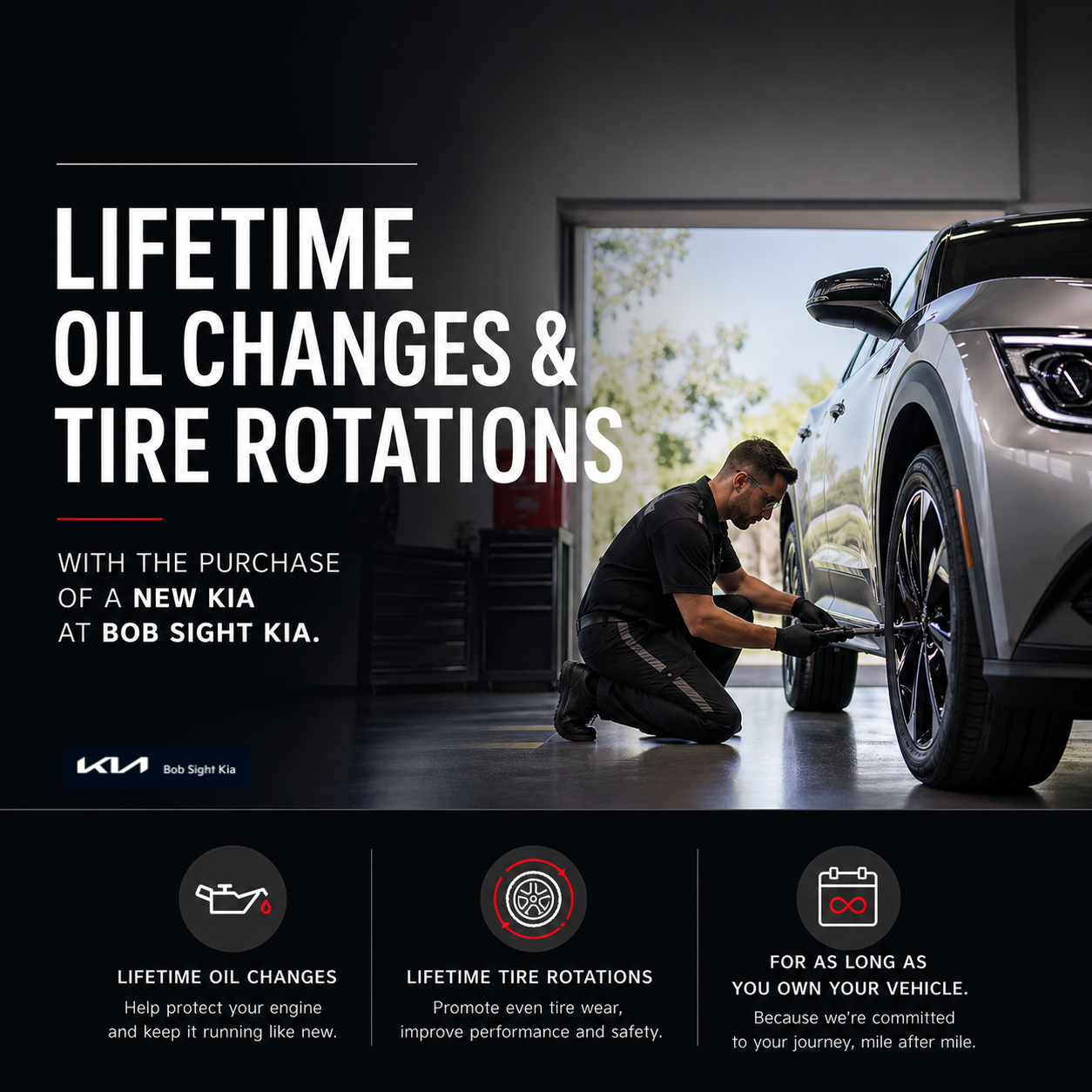
- Lifetime Rotation Program: Available to qualifying buyers at Bob Sight Kia, covering routine tire rotations for the lifetime of your vehicle.
These key service facts emphasize the importance of maintaining proper tire health. Adhering to regular rotation schedules and taking advantage of local price match guarantees ensures you receive maximum tire life at competitive prices. Bringing your vehicle to an authorized dealership guarantees expert care on every visit.
Ownership Planning: Protecting Your Tire Investment Across Midwest Seasons
Long-term tire ownership planning involves adapting maintenance habits to severe Midwest seasonal weather transitions across Jackson County. Summer heat waves accelerate chemical degradation and volatile oil loss inside tire rubber compounds, while winter freezes cause internal inflation pressures to drop significantly. Developing seasonal protection habits ensures your tires remain safe and durable year-round.
During cold autumn snaps, ambient temperatures drop quickly, causing tire inflation pressure to fall approximately 1 PSI for every 10-degree dip in outdoor temperature. Driving on underinflated winter tires increases rolling resistance, degrades fuel economy, and generates internal friction heat that damages tire casings. Checking tire inflation monthly during seasonal transitions prevents low-pressure operation and protects tire longevity.
In addition, protecting wheels and tires from corrosive winter road chemicals is essential for preventing air leaks around the bead seat. De-icing brine and road salt used on I-70 and US-40 can cause aluminum alloy wheels to oxidize near the tire sealing lip, resulting in persistent slow air leaks. Regular underbody and wheel washes during winter remove trapped salt residues, protecting wheel finishes and valve stem seals.
For drivers who purchase a new vehicle at Bob Sight Kia, our exclusive lifetime oil changes and tire rotations program provides incredible long-term savings. Having routine tire rotations covered eliminates out-of-pocket maintenance expenses, encouraging local owners to stay strictly on schedule. Regular rotations ensure your tires wear evenly, delivering maximum safety and value throughout your ownership journey.
Frequently Asked Questions
How often should I get a Kia tire rotation near me in Independence, MO?
You should get a Kia tire rotation every 7,500 miles or 12 months, whichever comes first, under normal driving conditions in Independence, MO. Rotating your tires regularly moves front tires to the rear and vice versa, balancing out the distinct friction loads experienced by front steer tires versus rear trailing tires. Regular rotations promote uniform tread wear across all four tires, extending total tread life and maintaining predictable handling stability.
Front-wheel-drive vehicles like the Kia K4 or Carnival place heavy acceleration, braking, and steering forces on the front axle, causing front tires to wear down significantly faster than rear tires. If left unrotated, front tires will require replacement long before rear tires, resulting in mismatched tread depths and handling imbalances. Combining tire rotations with routine synthetic oil changes at Bob Sight Kia makes staying on schedule simple and convenient.
For local drivers commuting daily along congested routes like Noland Road or Highway 291, frequent stop-and-go driving accelerates shoulder tread wear. Bringing your crossover or sedan to our Independence service bay ensures technicians inspect wear patterns and perform precise tire rotations. Keeping your tires properly rotated maximizes safety and protects your long-term tire investment.
What is covered under the Kia Tire Price Match Promise at Bob Sight Kia?
The Kia Price Match Promise covers major OEM-approved tire brands including Michelin, Goodyear, Continental, Hankook, Kumho, Pirelli, Yokohama, Bridgestone, Toyo, and Uniroyal. If you find a lower written estimate or advertised price on an exact matching tire line, size, load rating, and speed rating from a local competitor within 30 days of purchase, Bob Sight Kia will match the price or refund the difference. This guarantee ensures local buyers receive competitive pricing alongside certified factory service.
Purchasing tires through an authorized Kia dealer also guarantees that you receive brand-new tires with recent DOT manufacturing dates, proper load indices, and full manufacturer treadwear warranties. Our parts specialists assist you in selecting the exact tire model engineered for your specific Kia crossover, sedan, or EV platform. You enjoy total price confidence alongside expert installation by factory-trained technicians.
Local shoppers in Lee’s Summit, Blue Springs, and Liberty can request a tire quote online or bring a competitive estimate directly to our service department near Noland Road. Our team verifies part numbers and applies eligible promotional discounts immediately. It represents the easiest way to secure top-tier replacement tires at unbeatable local prices.
Why is my Tire Pressure Monitoring System (TPMS) light coming on during cold mornings?
Your TPMS light comes on during cold mornings because ambient temperature drops cause internal tire air pressure to decrease, triggering low-pressure warning sensors. Tire pressure drops approximately 1 PSI for every 10-degree Fahrenheit drop in outdoor temperature. When a cold autumn night drops local temperatures by 20 or 30 degrees, your tires may drop below the sensor threshold, causing the yellow warning light to illuminate on your dashboard.
As you drive your vehicle down the highway along I-70, internal friction and pavement contact warm the air inside the tire, causing pressure to expand and sometimes extinguishing the TPMS light. However, if the light stays illuminated continuously or flashes upon ignition startup, your tire requires inflation adjustment or has suffered a slow puncture from a nail or screw. Checking inflation pressures when tires are cold resolves seasonal pressure alerts.
If your TPMS light continues flashing after setting correct cold pressures, an electronic sensor battery may be depleted or requiring re-calibration. Bringing your vehicle to our Bob Sight Kia service center allows technicians to scan TPMS sensor frequencies, clear fault codes, and replace faulty sensor units quickly. Keeping your TPMS operational ensures reliable pressure alerts year-round.
Can driving on misaligned wheels ruin a new set of tires?
Yes, driving on misaligned wheels can ruin a new set of tires in as little as a few thousand miles by causing rapid, uneven tread scrubbing across inner or outer shoulders. Wheel misalignment forces tires to drag sideways down the road rather than rolling straight, generating intense friction heat and accelerating tread rubber removal. Even minor alignment deviations can reduce total tire lifespan by up to 50 percent.
Impacting potholes along US-40 or striking concrete parking curbs around the Independence Center can knock steering tie rods, control arms, and strut angles out of factory specifications. If you notice your steering wheel pulling to one side or observe feathering wear on your tire tread blocks, your vehicle requires an immediate computer alignment check. Correcting alignment geometry restores straight tracking and protects your new tire investment.
At Bob Sight Kia, our service bay features advanced digital laser alignment systems that measure wheel angles against factory specifications with extreme precision. Technicians adjust caster, camber, and toe settings to restore exact original alignment parameters. Inspecting alignment whenever you install new tires guarantees maximum tread life, quiet highway cruising, and optimal fuel economy.
Why Local Tire Service at Bob Sight Kia Matters for Independence Drivers
Servicing your tires locally at Bob Sight Kia in Independence, MO guarantees expert factory-certified care, genuine OEM parts, and a long-standing community commitment to customer satisfaction. Entrusting your vehicle to a trusted local family-owned dealership ensures that your tires are mounted, balanced, and aligned by certified technicians who understand the exact engineering specifications of your Kia model. Our state-of-the-art service facility utilizes specialized mounting machinery, digital wheel balancers, and precision laser alignment systems.
Unlike third-party tire chains or quick-lube shops that frequently use generic wheel weights and universal alignment guidelines, Bob Sight Kia never compromises on quality. Generic equipment can scratch alloy wheel rims or fail to calibrate delicate electronic stability control sensors correctly during alignment adjustments. Our service department follows strict OEM protocols that preserve wheel finishes, maintain steering sensor calibrations, and protect your vehicle warranty.
Furthermore, local dealership service offers unmatched convenience, transparent communication, and comfortable customer amenities. While your vehicle is serviced, you can relax in our quiet customer lounge with complimentary Wi-Fi and refreshments, or utilize our convenient local shuttle service to get back to your home or office in Independence, Blue Springs, or Lee’s Summit. Schedule your Kia tire service at Bob Sight Kia today to experience premium customer care and keep your vehicle rolling safely.
Helpful Links
Explore these essential links on our website to schedule your next tire service appointment, browse current parts specials, or explore new inventory:
- Schedule Certified Kia Tire Service Online
- Browse Current Service and Parts Specials
- Order Genuine Kia OEM Parts & Tires Online
- Explore Our Kia Tire Price Match Promise
- Search New Kia Vehicle Inventory in Independence
PROUD TO BE PART OF THE BOB SIGHT AUTO GROUP
Bob Sight Kia is a proud member of the Bob Sight Auto Group, a family-owned automotive network dedicated to serving drivers across Missouri and Kansas for generations. Grounded in integrity, transparency, and outstanding customer service, our auto group provides comprehensive inventory choices, competitive financing options, and factory-certified service across multiple locations in the region.
Explore our entire dealer group network below:
- Bob Sight Kia (Independence, MO)
- Bob Sight Ford (Lee’s Summit, MO)
- Bob Sight Honda (Lawrence, KS)
- Bob Sight CDJR (Lawrence, KS)
- Bob Sight Collision Center (Lee’s Summit, MO)
Connect with us


Recent Blog Entries
- Kia Tire Service Independence MO: Signs You Need New Tires
- Kia Dealership Independence MO for Drivers Searching Kia Near Me
- Kia Family SUV Buying Guide for Missouri Drivers
- Kia K4 Hatchback vs Mazda 3 Hatchback Cargo Space Comparison for Kansas City Drivers
- Kia Carnival vs Toyota Sienna for Large Kansas City Families
Categories
 Warranties include 10-year/100,000-mile powertrain and 5-year/60,000-mile basic. All warranties and roadside assistance are limited. See retailer for warranty details.