

Today: 8:30AM - 6:00PM
Blog / Independence Kia Dealer

2026 Kia AWD SUV Guide: Comparing the Seltos, Sportage, and Sorento for Missouri Rain, Snow, and Daily Driving

Compare the 2026 Kia Seltos, Sportage, and Sorento AWD for Missouri rain, snow, commuting, cargo, and family driving at Bob Sight Kia.

2026 Kia AWD SUV Guide for Kansas City Metro Drivers: Comparing the Seltos, Sportage, and Sorento for Missouri Rain, Snow, and Daily Driving

Browse New Kia AWD SUVs at Bob Sight Kia in Independence

The 2026 Kia Seltos, Sportage, and Sorento offer distinct combinations of available all-wheel drive, passenger space, cargo flexibility, and power for Kansas City Metro drivers. Bob Sight Kia in Independence helps shoppers from Blue Springs, Lee's Summit, Raytown, Sugar Creek, Liberty, Grain Valley, Oak Grove, and surrounding Jackson County communities compare these Kia SUVs for daily commuting, family travel, winter weather, and weekend activities.

The Seltos is the smallest and easiest to maneuver, making it a practical choice for commuters and smaller households. The Sportage adds more two-row passenger and cargo space without moving into a three-row layout. The Sorento provides three-row seating, available turbocharged power, and greater flexibility for families who regularly carry additional passengers or equipment.

All-wheel drive can support traction while accelerating on wet, snowy, slushy, gravel, or otherwise loose surfaces. It does not replace proper tires, careful driving, or additional stopping distance. This guide explains how the three Kia AWD SUVs differ and what Missouri drivers should evaluate before choosing one.

In This Guide You'll Learn

This guide compares the 2026 Kia Seltos, Sportage, and Sorento through the priorities that matter during daily Missouri driving. The goal is to help shoppers choose the right vehicle size and AWD configuration instead of assuming the largest or most powerful SUV is automatically the best choice.

  • How Kia all-wheel drive supports traction in changing road conditions
  • Why the Seltos AWD may fit commuters and smaller households
  • How the Sportage AWD balances two-row space and maneuverability
  • Why the Sorento AWD works for three-row passenger flexibility
  • How power, ground clearance, seating, and cargo needs differ
  • What AWD can and cannot do during Missouri winter weather
  • How to test-drive Kia AWD SUVs near Kansas City

A driver commuting from Sugar Creek to Independence may value easy parking and a compact exterior size. A family traveling from Blue Springs to Kansas City for school, work, and weekend activities may need more cargo space. A household carrying six or seven passengers may find that a three-row Sorento supports daily life more effectively than a smaller crossover.

Each vehicle should be evaluated in the exact trim and drivetrain configuration under consideration. AWD availability, engine output, terrain settings, convenience equipment, and driver-assistance technology can vary by model and trim. Reviewing current inventory and testing the actual vehicle provides more useful information than comparing model names alone.

Quick Facts About the 2026 Kia AWD SUV Lineup

The 2026 Seltos, Sportage, and Sorento cover three different SUV size and ownership needs within the Kia lineup. The Seltos prioritizes maneuverability, the Sportage provides expanded two-row versatility, and the Sorento adds three-row seating and available turbocharged performance.

  • 2026 Kia Seltos: A smaller crossover with available AWD, a standard 147-horsepower 2.0-liter engine, and an available 190-horsepower turbocharged engine on the SX AWD.
  • 2026 Kia Sportage: A two-row compact SUV with a 2.5-liter four-cylinder engine, available Active AWD, and available Snow, Mud, and Sand terrain settings on AWD configurations.
  • 2026 Kia Sorento: A three-row SUV with a standard 191-horsepower 2.5-liter engine or an available 281-horsepower turbocharged engine.
  • AWD benefit: AWD can distribute power between the front and rear wheels to support traction during acceleration.
  • Winter limitation: AWD does not guarantee shorter stopping distances on snow or ice.
  • Tire importance: Tread depth, tire type, tire pressure, and overall condition affect available grip.
  • Terrain modes: Selected AWD Sportage and Sorento configurations offer Snow, Mud, and Sand settings.
  • Passenger differences: The Seltos and Sportage use two-row layouts, while the Sorento provides three rows.

These quick facts provide a starting point rather than a final decision. A compact footprint may be more useful than a third row for a driver navigating downtown Kansas City parking structures. A family regularly carrying children, grandparents, or teammates may value the Sorento's additional seating more than the Seltos or Sportage's smaller dimensions.

Missouri drivers should also consider seasonal use. Thunderstorms can leave standing water on portions of I-70 and I-435, while freezing rain can create slick intersections throughout Jackson County. Available AWD can support traction, but safe speed, proper tires, clear visibility, and smooth inputs remain essential.

How Kia All-Wheel Drive Supports Missouri Driving

Kia all-wheel-drive systems can direct power to the front and rear wheels when the vehicle detects that additional traction support may be useful. This operation can help during acceleration on wet pavement, light snow, slush, gravel, and other surfaces where available grip changes.

All-wheel drive is different from four-wheel drive. AWD generally operates automatically and is designed to support everyday road use across changing conditions. Four-wheel-drive systems are often associated with vehicles built for more specialized off-road or heavy-duty applications, although system designs differ among manufacturers.

Kia AWD systems monitor information such as wheel speed, accelerator input, steering position, and road response. The system can adjust power distribution based on current conditions. The driver does not need to manually predict every traction change before the system responds.

Some Kia AWD SUVs provide a center-lock function intended to support a more balanced power distribution at lower speeds when additional traction is needed. Selected models also offer Snow, Mud, and Sand terrain settings. These modes adjust vehicle responses for the chosen surface but do not transform a crossover into a dedicated off-road vehicle.

AWD may be useful in several Kansas City-area scenarios:

  • Accelerating from a slick intersection after freezing rain
  • Traveling on untreated residential streets after light snowfall
  • Leaving a steep or shaded driveway during cold weather
  • Driving on gravel roads outside the central metro area
  • Crossing wet pavement during a heavy Missouri thunderstorm
  • Reaching outdoor destinations with loose or uneven access roads

AWD does not create unlimited traction. Every vehicle depends on the contact between its tires and the road. Worn tires, improper inflation, excessive speed, and abrupt steering or braking can overwhelm available grip even when all four wheels receive power.

Drivers should also understand that AWD primarily supports acceleration and forward movement. The braking system and tires determine how effectively the vehicle slows. On snow or ice, an AWD SUV can accelerate confidently but may require the same careful stopping distance as another vehicle using comparable tires.

Local road conditions change quickly. Wet leaves on hills in Raytown can reduce traction during fall, and winter temperature swings can turn melted snow into ice overnight. Choosing AWD should be part of a broader plan that includes tires, maintenance, attentive driving, and realistic expectations.

2026 Kia Seltos AWD for Commuting and Maneuverability

The 2026 Kia Seltos AWD is the most compact option in this comparison and fits drivers who prioritize maneuverability, easier parking, and useful two-row cargo flexibility. It can work well for commuters, couples, smaller households, and drivers moving from a sedan into their first SUV.

The standard 2.0-liter four-cylinder engine produces 147 horsepower. Drivers seeking stronger acceleration can consider the SX AWD, which uses a turbocharged 1.6-liter engine producing 190 horsepower. The turbocharged configuration may appeal to drivers who frequently merge onto I-70, travel with additional cargo, or prefer a quicker response when passing.

The Seltos has a smaller exterior footprint than the Sportage and Sorento. That difference can be helpful in parking structures, narrow driveways, crowded shopping areas, and older neighborhoods. Drivers commuting between Independence and downtown Kansas City may appreciate an SUV that provides an elevated seating position without feeling unnecessarily large.

Available AWD adds traction support for Missouri rain, winter weather, and loose surfaces. The Seltos remains a road-focused crossover rather than a heavy-duty off-road vehicle. Its strengths come from balancing manageable dimensions with the versatility of a rear liftgate and folding second-row seating.

Who Should Consider the 2026 Kia Seltos AWD?

  • Drivers who regularly carry one to four people
  • Commuters who value easier parking and maneuverability
  • Small households that need more cargo flexibility than a sedan
  • Drivers who want available AWD for changing Missouri weather
  • Shoppers interested in available turbocharged performance
  • Owners who do not need a third row
  • Drivers who frequently travel through urban and suburban areas

The Seltos may be a strong match for a Sugar Creek driver who spends most of the week traveling between home, work, stores, and local appointments. Its dimensions can make routine parking easier while still providing room for groceries, luggage, pet supplies, or sports bags. The available AWD system adds flexibility when roads become wet or lightly covered.

Shoppers should still test rear-seat and cargo space with their own needs in mind. A vehicle that works well for two adults may feel different when child seats, taller rear passengers, or large equipment become part of the routine. Bring measurements or important cargo items during the test drive.

Browse the current Kia Seltos inventory at Bob Sight Kia to compare available trims and drivetrains. Availability changes, so confirm the exact vehicle before planning a visit around a specific configuration.

2026 Kia Sportage AWD for Two-Row Versatility

The 2026 Kia Sportage AWD provides more passenger and cargo room than the Seltos while retaining a manageable two-row compact-SUV layout. It fits households that need flexible interior space but do not regularly require the third row offered by the Sorento.

The gasoline-powered Sportage uses a 2.5-liter four-cylinder engine paired with an eight-speed automatic transmission. Active AWD is available on selected trims and standard on AWD-focused X-Line and X-Pro Prestige configurations. AWD models also offer Terrain Mode settings for Snow, Mud, and Sand.

The Active AWD system uses an electro-hydraulic coupling to help distribute power between the front and rear wheels based on road and driving conditions. A center-lock function can support traction when the driver needs a more deliberate power split at appropriate speeds. The system works automatically during normal driving, allowing the driver to focus on traffic and road conditions.

The Sportage occupies the middle position among these three SUVs. It offers more room for passengers, pets, luggage, work supplies, and sports equipment than the Seltos without moving into a larger three-row configuration. This balance may fit families whose needs have outgrown a smaller crossover but do not justify the Sorento's additional seating.

Who Should Consider the 2026 Kia Sportage AWD?

  • Households that want a spacious two-row SUV
  • Drivers carrying children, pets, passengers, or cargo regularly
  • Commuters who want available AWD without a third row
  • Shoppers who value Snow, Mud, and Sand terrain settings
  • Drivers balancing weekday travel with weekend activities
  • Owners who need more cargo flexibility than a smaller crossover
  • Families that want manageable exterior dimensions

A Lee's Summit household traveling around the metro for school, work, sports, and errands may find the Sportage's two-row layout practical. It can provide room for passengers and equipment without adding a third row that remains folded most of the time. The compact-SUV dimensions can also remain comfortable for parking near Independence Center or in busier Kansas City districts.

Drivers should test the cargo area rather than relying only on a published volume. Examine the height of the load floor, width between the wheel wells, shape of the liftgate opening, and ease of folding the rear seats. A stroller, pet carrier, cooler, or work bin may fit differently based on its shape.

Browse the current Kia Sportage inventory at Bob Sight Kia to review available trims and AWD configurations. Confirm the drivetrain, terrain modes, comfort features, and driver-assistance equipment on the exact vehicle being considered.

2026 Kia Sorento AWD for Three-Row Flexibility

The 2026 Kia Sorento AWD is the strongest choice among these three models for drivers who need three rows, greater passenger flexibility, or available turbocharged performance. It provides additional seating without requiring the exterior dimensions of many larger full-size SUVs.

The Sorento offers a naturally aspirated 2.5-liter four-cylinder engine producing 191 horsepower and an available turbocharged 2.5-liter engine producing 281 horsepower and 311 pound-feet of torque. The turbocharged engine may appeal to families that regularly carry passengers and cargo or prefer stronger merging and passing response.

AWD is available on multiple Sorento configurations and standard on designated AWD-focused trims. AWD-equipped models offer Snow, Mud, and Sand terrain settings. The system also includes a center-locking differential function intended to support traction when road or surface conditions call for a more balanced distribution of power.

AWD Sorento models provide 8.2 inches of ground clearance. That clearance may be useful for deeper snow, uneven gravel driveways, or rough access roads. Ground clearance does not replace careful route selection, and drivers should remain within the vehicle's intended capability.

Who Should Consider the 2026 Kia Sorento AWD?

  • Families that regularly use three rows of seating
  • Drivers who transport children, relatives, teammates, or carpools
  • Shoppers seeking available 281-horsepower turbocharged performance
  • Owners who want Snow, Mud, and Sand terrain settings
  • Households needing flexible passenger and cargo configurations
  • Drivers who value additional ground clearance
  • Families that want more room without moving to a full-size SUV

The third row should be tested with the people who will actually use it. Legroom, headroom, access, and seating position can feel different for children, teenagers, and adults. If the rear row will be used frequently, do not evaluate it only by looking through an open liftgate.

Cargo room behind the third row also deserves attention. A three-row SUV may carry more passengers but offer less room for their belongings when every seat is occupied. Families traveling from Liberty to Kansas City for events should test whether bags, strollers, or sports equipment fit with the third row upright.

Browse the current Kia Sorento inventory at Bob Sight Kia to compare available engines, trims, seating layouts, and AWD configurations. Inventory changes, so confirm that a specific vehicle includes the features and drivetrain you want.

2026 Seltos vs. Sportage vs. Sorento AWD Comparison

The Seltos, Sportage, and Sorento differ most clearly in exterior size, passenger capacity, cargo flexibility, engine choices, and the type of household each vehicle supports. Choosing among them should begin with daily needs rather than selecting the largest model by default.

Comparison Point 2026 Kia Seltos AWD 2026 Kia Sportage AWD 2026 Kia Sorento AWD
General Size Smaller crossover Compact two-row SUV Midsize three-row SUV
Seating Layout Two rows Two rows Three rows
Primary Strength Maneuverability Two-row versatility Passenger flexibility
Engine Direction Standard or available turbocharged engine 2.5-liter four-cylinder Standard or available turbocharged engine
Best Fit Commuters and smaller households Families not needing a third row Families needing three rows
Parking Ease Strongest of the three Balanced Requires more space

The Seltos is the logical starting point for shoppers who prioritize a compact exterior footprint. Its smaller size can simplify parking and neighborhood driving while providing crossover cargo access. The Sportage adds room for passengers and equipment, making it a broader all-purpose option for many households.

The Sorento serves a different need by adding a third row and available turbocharged performance. It may be more vehicle than a solo commuter requires, but it can be the most practical choice for a family transporting six or seven people. The ability to fold the rear rows creates several passenger and cargo combinations.

Use this process to narrow the comparison:

  1. Choose the required number of rows. Eliminate three-row models if two rows meet every regular need.
  2. Measure normal cargo. Include child gear, sports equipment, pet carriers, work supplies, and luggage.
  3. Evaluate parking space. Measure your garage and consider frequent destinations.
  4. Review your daily roads. Include highways, gravel, hills, and winter routes.
  5. Compare power needs. Decide whether standard output or a turbocharged engine better fits your routine.
  6. Confirm AWD features. Availability and terrain settings can differ by model and trim.
  7. Test-drive every finalist. Use similar roads so the differences are easier to recognize.

A Grain Valley household using rural roads and carrying equipment may reach a different conclusion than an Independence commuter parking in tighter spaces. Neither answer is universally correct. The best Kia AWD SUV is the one whose size and capability align with the driver's real routine.

Which Kia AWD SUV Is Best for Missouri Rain and Snow?

The best Kia AWD SUV for Missouri weather is the model that combines suitable traction technology with the correct size, tires, visibility, and driving characteristics for your routine. The Seltos, Sportage, and Sorento can all support traction, but their different dimensions and seating layouts affect how they fit daily life.

The Seltos AWD may be useful for drivers who want easier maneuverability around snowbanks, crowded parking lots, or narrow residential streets. The Sportage AWD adds passenger and cargo room while retaining compact-SUV proportions. The Sorento AWD adds three-row seating, available turbocharged power, and 8.2 inches of ground clearance.

Missouri weather can change within a single commute. A morning may begin with rain, followed by falling temperatures and freezing conditions after sunset. Bridges, shaded streets, untreated neighborhood roads, and elevated highway ramps can become slick before surrounding pavement.

Prepare any SUV for winter by checking:

  • Tire tread depth, age, condition, and compatibility
  • Cold-weather tire pressure
  • Battery condition and starting performance
  • Windshield wipers and winter washer fluid
  • Exterior lights and camera lenses
  • Brake condition and fluid level
  • Engine coolant level and freeze protection
  • Cabin heat and windshield defrosting

Tires are central to winter performance because they create the physical connection between the SUV and the road. AWD can distribute power, but it cannot create grip where the tire cannot hold the surface. Worn tread or unsuitable tires can limit acceleration, steering, and braking.

Drivers should also understand the available terrain controls before poor weather arrives. Learn how to select Snow Mode, recognize the AWD display, use the defroster, and adjust driver-assistance settings. Trying to locate unfamiliar controls during a storm adds unnecessary distraction.

On snow or ice, use gradual accelerator input, gentle steering, and additional following distance. Avoid abrupt regeneration, braking, or lane changes. AWD can help the SUV move, but safe stopping continues to depend on speed, tires, road conditions, and driver awareness.

How to Test-Drive a Kia AWD SUV Near Kansas City

A useful Kia AWD SUV test drive should compare comfort, maneuverability, acceleration, braking, visibility, cargo access, and technology under conditions similar to daily driving. Driving the Seltos, Sportage, and Sorento on comparable routes makes their differences easier to recognize.

Begin by adjusting the seat, steering wheel, and mirrors. Check your view through the windshield, side windows, and rear glass. Confirm that you can reach the climate, infotainment, drive-mode, and camera controls without leaning away from the seat.

Start with low-speed streets and parking. Evaluate the turning radius, steering effort, brake response, camera clarity, and visibility around the vehicle. A Sugar Creek or Independence driver using compact shopping areas may notice a meaningful difference among the three exterior sizes.

Include a highway segment when possible. Test normal merging response, passing power, straight-line tracking, ride comfort, and wind noise. Drivers who use I-70, I-435, Highway 40, or Missouri Route 291 should understand how the SUV feels at the speeds they encounter regularly.

Follow this step-by-step test-drive process:

  1. Adjust the driving position. Confirm comfort, visibility, and control access.
  2. Test low-speed maneuverability. Include turns, parking, and reversing.
  3. Evaluate acceleration. Notice response from a stop and during highway merging.
  4. Drive over varied pavement. Compare ride comfort and listen for excessive noise.
  5. Test braking. Evaluate predictability and pedal feel during normal stops.
  6. Check the rear seats. Sit behind the normal driver position and test third-row access when applicable.
  7. Inspect cargo usability. Fold seats and test important equipment or measurements.
  8. Review AWD controls. Ask for a demonstration of drive and terrain modes.
  9. Test technology. Pair a phone and review cameras and driver-assistance displays.

Bring the people and items that influence the purchase. Install a child seat, measure for a pet carrier, or bring a stroller if those tasks will be part of regular ownership. A cargo area can appear large while still having an opening or floor height that does not fit a specific item.

Ask which AWD features are included on the exact trim. Terrain modes, center-lock functions, heated features, cameras, and driver-assistance technology can vary. Confirming the equipment prevents general model information from being mistaken for the specifications of one vehicle.

Ownership Planning for a Kia AWD SUV in Missouri

Long-term Kia AWD ownership planning should include tire care, drivetrain maintenance, seasonal inspections, and a service schedule matched to the exact model and powertrain. Consistent maintenance helps the vehicle's traction, steering, braking, and safety systems perform as designed.

AWD vehicles depend on compatible tires. Follow the correct tire size and inflation information for the vehicle, rotate the tires at the recommended intervals, and monitor tread depth across all four positions. Large differences in tire circumference can affect some AWD systems, so replacement decisions should consider the complete set.

Cold weather reduces tire pressure as the air inside the tire contracts. Drivers may notice a Tire Pressure Monitoring System alert after the first strong temperature drop in Jackson County. Check pressures when the tires are cold and use the specification listed on the vehicle's tire-information label rather than the maximum pressure printed on the tire sidewall.

Follow the model-specific maintenance schedule for fluids, filters, brakes, engine oil, and drivetrain inspections. The Seltos, Sportage, and Sorento do not all use the same engines or transmissions. Turbocharged and naturally aspirated configurations may also have different specifications or service considerations.

Seasonal inspections should include:

  • Tire pressure, tread depth, and wear patterns
  • Brake condition and fluid
  • Battery strength
  • Coolant level and freeze protection
  • Wiper blades and washer fluid
  • Exterior lights and cameras
  • Heating and defrosting performance
  • Visible fluid leaks or damaged components

Drivers can schedule Kia service in Independence when routine maintenance or a seasonal inspection is needed. Keeping service records creates a useful ownership history and makes it easier to track completed work.

Missouri road conditions make suspension and alignment awareness important. Potholes after winter freeze-and-thaw cycles can affect steering, tire wear, and ride quality. Schedule an inspection if the SUV begins pulling to one side, the steering wheel no longer sits straight, or the tires develop uneven wear.

Ownership planning also means learning the vehicle before severe weather arrives. Review the owner's manual, identify the drive modes, understand dashboard warnings, and locate the spare tire or mobility kit. Familiarity can make a stressful roadside situation easier to manage.

Frequently Asked Questions About Kia AWD SUVs

Which 2026 Kia AWD SUV is best for commuting in Kansas City?

The 2026 Kia Seltos AWD is the strongest starting point for commuters who prioritize maneuverability, while the Sportage AWD fits drivers who need more passenger and cargo room. The Sorento AWD may be more suitable when the commute also includes regular family or carpool responsibilities. The right answer depends on seating, cargo, parking, and power needs.

The Seltos has the smallest footprint and may be easier to park in crowded areas. The Sportage provides a larger two-row interior that can support children, pets, luggage, or work equipment. The Sorento adds a third row and available turbocharged power but requires more parking and garage space.

An Independence driver traveling downtown on I-70 may value the Seltos for maneuverability or the Sportage for added comfort and cargo space. A Lee's Summit parent carrying several passengers may find the Sorento more practical. Test all relevant models on similar roads before deciding.

Which 2026 Kia AWD SUV has three rows?

The 2026 Kia Sorento is the three-row SUV in this comparison. The Seltos and Sportage use two-row layouts. The Sorento provides additional passenger flexibility for families, carpools, and drivers who occasionally carry more people.

The third row should be tested for access, legroom, headroom, and comfort. Passenger height and second-row position can change the experience significantly. Cargo room behind the third row should also be reviewed when all seats are occupied.

A Liberty family carrying children and grandparents may use the Sorento's seating differently than a household that needs the third row only a few times each month. Bring regular passengers to the test drive when possible. Fold and raise the seats to confirm that the process fits your routine.

Do 2026 Kia AWD SUVs offer Snow Mode?

Selected AWD-equipped 2026 Kia Sportage and Sorento configurations offer terrain settings that include Snow Mode. Availability depends on the model and trim. Shoppers should confirm the drive modes on the exact vehicle they are considering.

Snow Mode can adjust vehicle responses to support traction and smoother power delivery on slippery surfaces. It does not guarantee control on ice or replace winter-ready tires. Driver input, speed, visibility, and following distance remain essential.

Before the first winter storm in Jackson County, ask for a demonstration of the controls. Practice selecting the available modes while the vehicle is stationary. Knowing the system in advance prevents unnecessary distraction during freezing rain or snowfall.

Is AWD necessary for driving in Missouri?

AWD is not necessary for every Missouri driver, but it can support traction for people who regularly encounter snow, slush, gravel, steep driveways, or untreated roads. Front-wheel drive may meet the needs of drivers who remain on treated streets and use suitable tires. The decision should reflect the driver's real schedule and destinations.

AWD adds capability but may also affect fuel use, vehicle weight, tire considerations, and maintenance. Compare those factors with how often the added traction will be useful. Avoid choosing AWD only because it appears on a feature list.

An Oak Grove driver using rural roads before sunrise may value AWD more than someone making short trips on cleared streets in central Independence. Missouri weather remains unpredictable, so tires and safe driving matter with either drivetrain. Evaluate the complete ownership picture before choosing.

Does AWD help a Kia SUV stop faster in snow?

AWD does not guarantee shorter stopping distances in snow because braking performance depends primarily on tires, speed, road conditions, and the braking system. AWD is designed mainly to help distribute power during acceleration. Drivers must still allow additional room to stop.

An AWD SUV may move away from a snowy intersection with less wheelspin, which can create a false sense of security. The same vehicle can slide if the driver approaches a stop too quickly. Proper tires and gradual braking remain essential.

On I-435 ramps, shaded streets, or bridges around Kansas City, conditions can change quickly. Slow down before reaching a slick section rather than making abrupt inputs after entering it. No drive mode or AWD system can overcome every road condition or driver error.

Compare Kia AWD SUVs at Bob Sight Kia in Independence

Bob Sight Kia gives Kansas City Metro shoppers a local place to compare the 2026 Seltos, Sportage, and Sorento AWD based on real passenger, cargo, commute, and weather needs. Comparing these SUVs in person can reveal differences that specifications alone cannot communicate.

Shopping locally allows drivers to test vehicles on familiar roads and consider the conditions they encounter throughout the year. A test drive near Independence can include low-speed streets, shopping-area traffic, uneven pavement, and highway merging. Those situations provide useful context for daily ownership.

Drivers can browse the new Kia inventory before visiting. Create a short list that includes the preferred model, drivetrain, and trim, then confirm availability. Inventory changes as vehicles arrive and sell.

If you have a current vehicle, use the online Value Your Trade tool to begin preparing for an appraisal. Bring registration, payoff information when applicable, both keys, and available service records. Organized documentation can make the dealership visit more efficient.

Blue Springs, Lee's Summit, and Kansas City shoppers can also review Bob Sight Kia's Price Match Promise while comparing available AWD SUVs. Review the current terms and applicable details for the specific vehicle under consideration.

If financing will be part of the purchase, visit the Bob Sight Kia finance department to explore available resources. Financing terms depend on individual approval and other factors, so review the complete agreement carefully.

The Seltos AWD is built around compact maneuverability. The Sportage AWD balances two-row space with manageable exterior dimensions. The Sorento AWD adds three-row flexibility, greater ground clearance, and available turbocharged performance. The right choice is the model whose strengths match your daily life.

Helpful Links

Proud to Be Part of the Bob Sight Auto Group

Bob Sight Kia is proud to be part of the family-owned Bob Sight Auto Group, serving vehicle shoppers and owners throughout the Kansas City region and Northeast Kansas. Families researching new or used vehicles can rely on Bob Sight Auto Group for new and pre-owned vehicle sales, trade-in resources, auto financing, certified service, parts, and collision repair.
Posted in:

Related Posts

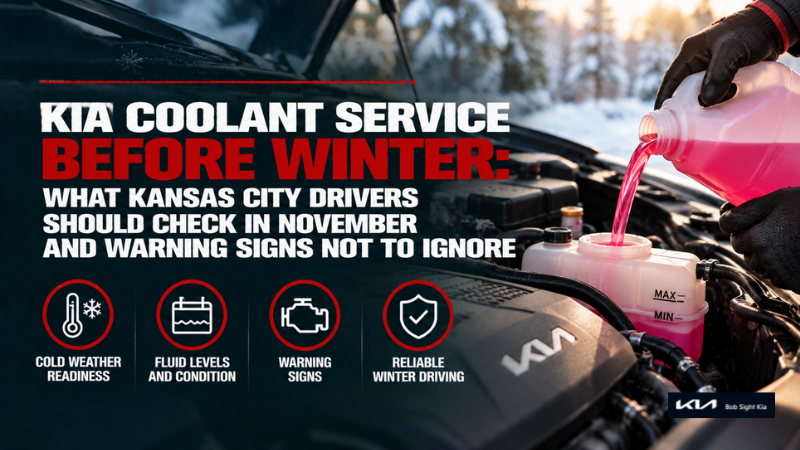
Prepare your Kia for winter with a November coolant check. Learn warning signs, freeze-protection needs, and when to schedule service near Kansas City.

Kia Coolant Service Before Winter: What Kansas City Drivers Should Check in November and Warning Signs Not to Ignore

Kia Coolant Service Before Winter: What Kansas City Drivers Should Check in November and Warning Signs Not to Ignore Schedule Kia Coolant Service in Independence Before Winter November is a practical time for Kansas City drivers to check their Kia's coolant level, freeze protection, hoses, and overall cooling-system condition before sustained winter temperatures arrive. Bob Sight Kia in Independence helps owners from Blue Springs, Lee's Summit, Raytown, Sugar Creek, Liberty, Grain Valley, Oak Grove, and surrounding Jackson County communities prepare their vehicles for Missouri's freezing mornings, rapid temperature changes, snow, and ice. Engine coolant performs important work throughout the year. It helps regulate engine temperature, protects internal components against corrosion, supports freeze protection, and contributes to cabin heating in many gasoline and hybrid vehicles. Low coolant, an incorrect mixture, deteriorated fluid, or a cooling-system leak can create problems during winter even when outside temperatures are cold. Coolant specifications and replacement intervals vary by Kia model, model year, engine, and powertrain. Gasoline, hybrid, plug-in hybrid, and electric Kia vehicles may use different cooling-system designs or multiple coolant circuits. Owners should follow the maintenance schedule and fluid requirements for their exact vehicle rather than applying one universal recommendation to every Kia. In This Guide You'll Learn This guide explains how coolant protects a Kia during winter, what drivers can check safely, and when professional cooling-system service may be needed. The information is designed to help Kansas City-area owners prepare before freezing weather rather than discovering a coolant concern during a cold commute. Why engine coolant matters during Missouri winter weather What freeze protection, corrosion protection, and heat transfer mean When a Kia may need a coolant inspection, exchange, or related repair What owners should check in November before colder weather arrives Which coolant warning signs should not be ignored Why the correct Kia coolant specification and concentration matter When to schedule Kia coolant service near Kansas City A driver commuting from Blue Springs to Independence may depend on reliable cabin heat and windshield defrosting before sunrise. A family traveling from Lee's Summit across the Kansas City Metro may want confidence that the cooling system is ready for a longer winter drive. A November inspection creates time to evaluate the system before a weather event places greater demands on the engine, heater, and defroster. Drivers can perform a limited visual coolant-level check on many Kia vehicles when the engine is completely cool. Testing freeze protection, diagnosing leaks, replacing fluid, bleeding air from the system, and servicing specialized hybrid or electric cooling circuits should be handled according to Kia procedures and the vehicle's exact requirements. Quick Facts About Kia Coolant Service Before Winter Kia coolant service should be based on the vehicle's exact maintenance schedule, fluid specification, current condition, and cooling-system test results. November is a useful inspection point because Kia guidance recommends checking coolant level and antifreeze protection at the beginning of the winter season. Coolant is used year-round: It supports temperature control during summer and freeze protection during winter. Coolant and antifreeze are related terms: Automotive coolant typically combines antifreeze concentrate, appropriate water, and protective additives. Replacement timing varies: Follow the schedule for the exact Kia model, model year, engine, and powertrain. Color is not a specification: Coolant should not be selected or mixed based only on appearance. Low coolant deserves attention: Repeatedly adding fluid may indicate a leak or another cooling-system concern. Never open a hot cooling system: Pressurized coolant and steam can cause serious burns. Cabin heat can provide a clue: Weak or inconsistent heat may occur with some coolant or circulation problems, although other causes are possible. Specialized powertrains differ: Hybrid, plug-in hybrid, and electric Kia vehicles may use multiple cooling circuits or specialized fluids. Coolant should normally remain within the reservoir markings identified for a cool engine. If the level repeatedly drops, the system needs more than another top-off. A technician should identify whether the loss is related to a hose, connection, reservoir, radiator, water pump, heater core, gasket, or another component. Missouri's late-fall temperature swings can reveal concerns that were less noticeable during mild weather. Rubber hoses, plastic fittings, seals, clamps, and metal components experience repeated heating and cooling cycles. An issue that leaves only a small amount of residue in October may develop into more obvious fluid loss after several freezing nights. Why Engine Coolant Matters During a Kansas City Winter Engine coolant protects a Kia during winter by resisting freezing, supporting heat transfer, and helping prevent internal corrosion. It does more than prevent overheating, which is why cooling-system condition remains important even when outside temperatures are below freezing. A gasoline engine produces substantial heat during operation regardless of the weather. Coolant absorbs heat from the engine and carries it through the cooling system so it can be released through the radiator. If the level is too low or circulation is restricted, the engine can overheat during winter just as it can during summer. The antifreeze portion of the coolant mixture lowers the fluid's freezing point. Plain water expands when it freezes, which can damage a cooling system. The correct coolant mixture helps protect the engine, radiator, heater core, hoses, and other components during cold Missouri nights. Coolant also contains additives that help protect aluminum and other cooling-system materials against corrosion. Kia owner guidance for applicable vehicles commonly specifies a phosphate-based ethylene-glycol coolant intended to protect aluminum engine components. The exact fluid requirement should always be verified in the owner's manual for the specific model. Cabin heat in many gasoline-powered and hybrid Kia vehicles depends partly on heated engine coolant flowing through a heater core. Air moves across that component and enters the cabin through the climate system. Low coolant or poor circulation may contribute to weak, inconsistent, or delayed heat. Windshield defrosting also makes cabin-heating performance important. A driver leaving Grain Valley before sunrise needs a clear windshield and predictable heat during a cold commute. Weak heat may have several possible causes, including low coolant, a thermostat issue, trapped air, a restricted heater core, a blower concern, or a climate-control problem. Kansas City weather can change quickly. A mild afternoon may be followed by a freezing night, and rain can become ice as pavement temperatures fall. Inspecting coolant level and freeze protection in November gives drivers time to address concerns before a strong cold front reaches Jackson County. Coolant inspection is only one part of winter preparation. Tires, battery strength, wiper blades, washer fluid, lights, brakes, and cabin heat also deserve attention. Together, these systems help a Kia remain dependable during the seasonal conditions drivers encounter on I-70, I-435, Highway 40, and local Independence streets. What Coolant, Antifreeze, and Freeze Protection Mean Coolant is the working fluid that circulates through the cooling system, while antifreeze is the component that helps lower the freezing point and raise the boiling point. In normal automotive use, the terms are often used interchangeably, but understanding the mixture helps explain why concentration matters. Coolant typically combines an antifreeze base with appropriate water and protective additives. The mixture must transfer heat effectively while resisting freezing and corrosion. Too little antifreeze can reduce cold-weather protection, while an overly concentrated mixture may not transfer heat or protect the system as intended. Freeze protection describes the lowest temperature at which the tested coolant mixture is expected to remain adequately protected. A technician can use suitable testing equipment to evaluate concentration and freeze protection. Looking at the fluid cannot provide the same information. Water quality matters when water must be used with the specified coolant. Kia guidance for applicable vehicles calls for deionized, distilled, or suitable soft water rather than hard water. Minerals in hard water can contribute to deposits and cooling-system concerns. Coolant color should not be treated as proof of compatibility. Different products can use similar colors while meeting different specifications, and compatible products may not always look identical. Adding fluid based only on color can result in an incorrect mixture. Use this plain-language comparison: Term What It Means Why It Matters Before Winter Coolant The fluid circulating through the vehicle's cooling system Supports heat transfer, freeze protection, and corrosion protection Antifreeze The chemical base that helps resist freezing and boiling Protects the system when Missouri temperatures fall Coolant Concentration The proportion of antifreeze and water in the mixture An incorrect concentration can reduce protection Freeze Protection The tested cold-temperature protection of the mixture Helps determine whether the coolant is ready for winter Coolant Specification The formulation required for the exact vehicle Protects compatibility with system materials and components Drivers searching for Kia coolant service near me should look for a service department that verifies the vehicle identification number, model year, engine, and powertrain before selecting fluid. This is particularly important for hybrid, plug-in hybrid, and electric Kia vehicles that may use more than one coolant circuit. A November cooling-system inspection can include a level check, freeze-protection test, visible-condition review, and inspection of hoses and connections. These checks provide more useful information than assuming coolant is ready for winter because its color appears normal. When Does a Kia Need Coolant Service? A Kia needs coolant service when the model-specific maintenance schedule calls for replacement, testing shows inadequate protection, the fluid is contaminated, or the cooling system has been opened for repair. There is no single replacement interval that applies to every Kia model and powertrain. A newer Kia may use a different coolant specification or replacement schedule than an older model. Gasoline, hybrid, plug-in hybrid, and electric vehicles can also use different cooling-system designs. Owners should review the maintenance section of the exact owner's manual or vehicle-specific Kia information. Coolant service may be appropriate when: The factory maintenance schedule calls for replacement Freeze-protection testing shows inadequate cold-weather protection The coolant is contaminated or contains visible debris The system repeatedly requires additional coolant A hose, radiator, thermostat, water pump, or related component was replaced The cooling system was opened during another repair A technician identifies corrosion, deposits, leakage, or circulation concerns The vehicle's maintenance history is incomplete or unknown Replacement intervals should not be guessed based on vehicle age alone. Some coolant formulations are designed for extended service, while others follow different maintenance schedules. The correct interval can also depend on whether the vehicle operates under normal or severe conditions defined by the manufacturer. A coolant service recommendation should explain what was found. Ask whether the service is due by schedule, whether testing showed weak protection, whether contamination is present, or whether another repair requires coolant replacement. Understanding the reason helps separate routine maintenance from problem diagnosis. Drivers who purchased a used Kia without complete records may benefit from a cooling-system evaluation. A technician can inspect the level, visible condition, hoses, connections, reservoir, radiator, and freeze protection. The results can help establish a reliable maintenance baseline. Do not assume that adding coolant resolves the reason it became low. A sealed cooling system should not require frequent additions. Repeated fluid loss indicates that the system should be inspected for leakage or another concern. For a Kansas City commuter, timing matters. Addressing a cooling-system concern in November may be more convenient than responding to an overheating warning during a January commute on I-70. Preventive inspection creates an opportunity to diagnose the system before severe weather makes travel and roadside delays more difficult. What Kansas City Drivers Should Check in November A November coolant check should focus on the reservoir level, freeze protection, visible leaks, hose condition, cabin heat, and the vehicle's maintenance history. Owners can perform a limited visual review when the engine is fully cool, but testing and repairs require appropriate procedures and equipment. Never remove a radiator cap or pressurized coolant cap while the engine is hot. The cooling system can retain heat and pressure after the vehicle has been turned off. Hot coolant or steam can escape suddenly and cause serious burns. Follow this basic November coolant checklist: Park safely on a level surface. Turn off the vehicle and allow the engine to cool completely. Consult the owner's manual. Identify the correct reservoir and model-specific inspection instructions. Check the reservoir markings. The coolant should be within the designated range for a cool engine. Do not overfill. The reservoir needs appropriate space for expansion as the coolant warms. Look beneath the vehicle. Check for fresh fluid, wet areas, or dried residue that may indicate leakage. Inspect visible hoses and connections. Look for swelling, cracking, deterioration, or damp areas without touching hot components. Review the maintenance history. Determine whether coolant replacement or another cooling-system service is due. Test cabin heat during a normal drive. Notice whether heat becomes warm and remains consistent. Request professional testing. Ask for coolant concentration and freeze protection to be checked if the condition is uncertain. A visual check cannot measure the protective strength of the mixture. Fluid can appear clean while its concentration or additives no longer provide the intended protection. Testing adds information that color and level alone cannot provide. Cabin heat should be evaluated after the engine has had time to reach its normal operating temperature. Weak heat during the first moments of a cold start may be normal. Heat that never becomes warm, changes unexpectedly, or disappears while driving deserves inspection. Check the instrument panel for warning lights or temperature messages. A warning should be taken seriously even if the vehicle appears to drive normally. The owner's manual explains what specific indicators mean and what immediate action may be required. Local ownership patterns affect this checklist. A Liberty driver preparing for a holiday road trip may want a full inspection before leaving the metro. A Raytown commuter who recently noticed inconsistent heat may need diagnosis rather than a simple fluid check. Warning Signs Your Kia May Need Cooling-System Service Low coolant, repeated fluid loss, visible leaks, a sweet odor, weak cabin heat, steam, or an abnormal temperature warning can indicate that a Kia needs cooling-system service. These symptoms can have different causes, so diagnosis is more dependable than guessing or repeatedly adding fluid. Repeatedly Low Coolant A coolant level below the appropriate reservoir mark may indicate a leak, incomplete previous service, trapped air, or another concern. One observation does not identify the cause. Repeatedly adding coolant without finding the source can allow a developing problem to continue. Temperature Warning or Rising Gauge An abnormal temperature reading or overheating warning requires prompt attention. Move to a safe location as soon as conditions permit and turn off the vehicle. Continuing to drive an overheating engine can cause extensive damage. Visible Fluid or Dried Residue Fresh fluid beneath the front of the vehicle or colored residue near hoses and connections may be associated with a coolant leak. Water from the air-conditioning system can also drip beneath a vehicle, so appearance alone is not a reliable diagnosis. Keep children and pets away from any leaked automotive fluid. Sweet or Unusual Odor A sweet smell around the engine compartment or inside the cabin may occur with some coolant leaks. An interior odor combined with window fogging or damp carpeting can warrant prompt inspection. A heater-core problem is one possible cause, but a technician should confirm the source. Weak or Inconsistent Cabin Heat Low coolant can contribute to poor cabin heat in vehicles that use heated engine coolant through a heater core. Other causes include a thermostat issue, trapped air, a restricted heater core, a blower problem, or a climate-control component. Testing is needed to separate these possibilities. Steam From the Engine Compartment Steam can indicate overheating or escaping coolant. Pull over safely, shut off the vehicle, and remain clear of the hot cooling system. Do not remove a cap or reach into the engine compartment while steam is present. Follow these steps if a temperature warning appears: Reduce stress on the vehicle. Turn off unnecessary accessories when safe to do so. Move away from traffic. Stop in a safe location as soon as conditions permit. Turn off the vehicle. Allow the cooling system to cool naturally. Do not open a hot cap. Pressurized coolant can escape and cause burns. Observe from a safe distance. Note steam, fluid, odors, or warning messages for the technician. Arrange assistance. Do not continue driving an overheating vehicle. Have the cause diagnosed. Correct the underlying problem rather than only refilling the reservoir. A driver on I-435 may not have immediate access to a service facility when a warning appears. Safety comes first. Move away from active traffic, use hazard lights, and arrange roadside assistance rather than risking engine damage or personal injury. Coolant Inspection vs. Exchange vs. Flush A coolant inspection, coolant exchange, and coolant flush are different services, and the correct choice depends on the maintenance schedule and condition of the cooling system. Owners should ask what procedure is being recommended and what inspection result supports it. Service Typical Purpose When It May Be Recommended Coolant Inspection Checks level, visible condition, freeze protection, hoses, and leaks Before winter, during routine maintenance, or when symptoms appear Coolant Top-Off Restores a slightly low level with the correct compatible fluid Only after determining why the level is low and confirming compatibility Coolant Exchange Removes old coolant and replaces it with the correct fresh coolant At the model-specific replacement interval or after certain repairs Coolant Flush Uses a more extensive process to move fluid or cleaner through the system When condition or contamination supports the procedure Cooling-System Repair Corrects a leak, circulation issue, or failed component When testing identifies a mechanical problem A coolant inspection does not automatically mean that replacement is required. The technician may find that the fluid level, concentration, freeze protection, and visible condition remain acceptable. Inspection provides the information needed to make the next decision. A coolant exchange generally removes old fluid and replaces it with coolant meeting the vehicle's specification. The exact procedure can vary based on the cooling-system design and equipment used. Air may need to be bled from the system according to the manufacturer's procedure. A coolant flush is not automatically the correct service every time coolant is due. The term may describe a more extensive cleaning or fluid-circulation process. Ask why a flush is recommended instead of a standard exchange and whether contamination or deposits were found. Before authorizing service, ask: Is coolant replacement due under the maintenance schedule? What did the concentration or freeze-protection test show? Is the coolant contaminated or deteriorated? Was a leak or failed component identified? Which Kia coolant specification will be used? Does the vehicle use more than one cooling circuit? Will the system be inspected after filling and bleeding? A qualified recommendation should connect the procedure to the vehicle's schedule or condition. The goal is not to choose the most extensive service. It is to complete the procedure that the exact Kia and its cooling system require. Why the Correct Kia Coolant Specification Matters Using the correct Kia coolant specification protects compatibility with the engine, radiator, heater core, seals, hoses, and other cooling-system materials. Coolant should not be chosen by color, packaging claims, or convenience alone. Kia owner guidance for applicable vehicles commonly identifies a phosphate-based ethylene-glycol coolant for protection against freezing and corrosion. Owners must still check the manual for the exact vehicle because specifications can vary. A recommendation for one model or powertrain should not automatically be applied to another. Mixing incompatible coolants can reduce protection or contribute to deposits and other system concerns. If the existing coolant cannot be identified, a technician should determine the correct next step. Adding a "universal" product without confirming compatibility may create more uncertainty. Hybrid and plug-in hybrid Kia vehicles can use specialized cooling arrangements for the engine, electric components, or inverter. Electric vehicles also use thermal-management systems that differ from a conventional gasoline cooling system. Owners should not assume that every visible reservoir contains the same fluid. Never open or service a high-voltage component. Hybrid, plug-in hybrid, and electric systems require specific training, tools, and safety procedures. A Kia service professional can identify the correct coolant circuit and service method using the vehicle identification number and powertrain information. Correct concentration is as important as correct chemistry. Too little antifreeze can reduce freeze protection, while excessive concentration may reduce heat-transfer performance. Testing can determine whether the mixture is appropriate for expected temperatures. Missouri drivers traveling to colder destinations should mention those plans during the inspection. A winter trip north of the Kansas City Metro may expose the vehicle to lower temperatures than it normally experiences in Independence. Testing before departure provides a clearer picture of the current protection. Using the correct coolant and procedure also helps protect serviceability. Detailed records should identify what fluid was installed and when. This makes future maintenance easier and reduces uncertainty for the next technician. Ownership Planning for Your Kia Cooling System Long-term cooling-system planning means following the model-specific maintenance schedule, monitoring fluid level, addressing leaks promptly, and documenting every service. A consistent plan supports reliability and helps owners avoid reacting only after an overheating warning appears. Begin with the owner's manual and the vehicle's known service history. Record the date and mileage of coolant inspections, exchanges, repairs, hose replacements, thermostat work, radiator service, and water-pump replacement. Clear records make it easier to identify what is due next. Check the coolant level periodically when the engine is completely cool and according to the owner's manual. A stable level provides reassurance, while repeated loss signals the need for inspection. Do not make frequent additions part of normal ownership without determining why the fluid is disappearing. Seasonal inspections can align with other maintenance. A November appointment may include coolant freeze-protection testing, battery testing, tire-pressure adjustment, wiper inspection, brake review, and a check of cabin heat and defrosting. Combining related checks can make winter preparation more convenient. Use this year-round ownership plan: Review the maintenance schedule. Follow the interval for the exact model and powertrain. Check the level when cool. Use the reservoir markings and owner's manual instructions. Watch for changes. Note odors, leaks, weak heat, warning lights, or unusual temperature readings. Test before winter. Confirm coolant concentration and freeze protection when condition is uncertain. Use the correct fluid. Verify the Kia specification instead of relying on color. Repair the cause of fluid loss. Do not rely on repeated top-offs. Keep service records. Document coolant type, procedure, mileage, and related repairs. Kansas City driving places different demands on a vehicle throughout the year. Summer traffic on I-70 can expose the cooling system to heat, while winter travel requires suitable freeze protection and dependable cabin heat. Year-round planning recognizes both conditions. Drivers can schedule Kia service at Bob Sight Kia when an inspection or model-specific maintenance is due. When scheduling, describe any symptoms clearly so the service team can prepare for diagnosis rather than assuming the visit is only a routine fluid exchange. Ownership planning is particularly important after purchasing a used Kia with incomplete records. Establishing a baseline can reduce uncertainty and help the owner follow a clear schedule moving forward. A professional inspection can identify whether the system needs maintenance, repair, or only continued monitoring. Frequently Asked Questions About Kia Coolant Service Should I check my Kia's coolant before winter? Yes, Kia owners should check coolant level and antifreeze protection before winter according to the instructions for their specific vehicle. November is a practical time for Kansas City drivers to complete this check. It provides time to address a concern before freezing temperatures become consistent. The inspection should include the coolant level with the engine completely cool, visible hose condition, evidence of leakage, cabin-heat performance, and maintenance history. A professional test can measure coolant concentration and freeze protection. A visual check alone cannot confirm the mixture's protective strength. A Blue Springs commuter preparing for early morning travel on I-70 may benefit from completing this inspection before the first significant cold front. Reliable coolant protection supports engine-temperature control and cabin heat. Winter preparation should also include tires, battery condition, wipers, lights, brakes, and washer fluid. How often does a Kia need coolant replacement? Kia coolant replacement timing varies by model, model year, engine, and powertrain. Owners should follow the maintenance schedule in the exact owner's manual rather than using one interval for every Kia. Testing or a cooling-system repair may also create a reason for earlier service. A technician may recommend replacement when the scheduled interval arrives, freeze protection is inadequate, the fluid is contaminated, or the system has been opened for repair. The recommendation should explain which condition applies. Coolant color alone is not enough to determine whether replacement is due. Drivers with incomplete service records should consider a professional cooling-system evaluation. An Independence service advisor can review the vehicle identification number, mileage, model year, and powertrain. That information provides a more accurate answer than a general mileage estimate found online. Can low coolant cause weak cabin heat? Low coolant can contribute to weak or inconsistent cabin heat in vehicles that use heated engine coolant through a heater core. Insufficient fluid or trapped air may interfere with proper circulation. Weak heat can also have several unrelated causes. Possible causes include a thermostat problem, restricted heater core, blower concern, climate-control actuator, trapped air, or another cooling-system issue. A technician should evaluate the complete system instead of assuming that adding coolant will solve the problem. Repeatedly low coolant also requires leak diagnosis. Weak heat becomes more than a comfort concern during a Missouri winter because the climate system supports windshield clearing. A driver traveling through Raytown during freezing rain needs dependable defrosting. Schedule an inspection if the heat changes unexpectedly, never becomes warm, or is accompanied by an odor, leak, or temperature warning. Can I add any coolant to my Kia? No, coolant must meet the specification required for the exact Kia model and powertrain. Do not choose a product only because its color resembles the existing fluid. Similar colors do not prove chemical compatibility. Mixing incompatible coolants can reduce corrosion protection or contribute to deposits and other system concerns. Kia guidance for applicable vehicles may specify phosphate-based ethylene-glycol coolant and appropriate water quality. Hybrid, plug-in hybrid, and electric vehicles may use specialized coolants or multiple cooling circuits. If you do not know which coolant is already installed, ask a qualified service professional before adding another product. Bring the vehicle identification number when purchasing fluid or scheduling service. Correct identification is safer than relying on a generic "universal" label. What should I do if my Kia starts overheating? Move to a safe location, turn off the vehicle, and do not open a hot coolant or radiator cap. An overheating warning requires prompt attention even during cold weather. Continuing to drive may cause significant engine damage. Allow the system to cool naturally and remain clear if steam is present. Note warning messages, odors, visible fluid, or changes in cabin heat so you can describe them to a technician. Arrange roadside assistance when the vehicle cannot be driven safely. If overheating occurs on I-435, I-70, or another busy Kansas City route, personal safety comes first. Pull as far from active traffic as conditions allow and use hazard lights. The underlying cause should be diagnosed before the vehicle returns to normal use. Schedule Kia Coolant Service in Independence Before Winter Bob Sight Kia provides cooling-system inspections and model-specific Kia maintenance for drivers preparing for winter in Independence and the Greater Kansas City Metro. Scheduling in November creates time to identify low coolant, inadequate freeze protection, deteriorated hoses, leaks, or overdue maintenance before colder weather becomes consistent. Local service access can make seasonal maintenance easier for drivers from Blue Springs, Lee's Summit, Kansas City, Raytown, Sugar Creek, Liberty, Grain Valley, and Oak Grove. Owners can explain symptoms directly, return for recommended work, and maintain a consistent service history close to home. When scheduling, mention any repeated coolant loss, weak cabin heat, sweet odor, visible fluid, warning light, or changing temperature reading. These details help distinguish routine maintenance from a diagnostic concern. A vehicle with symptoms may need testing beyond a standard coolant exchange. Bob Sight Kia can identify model-specific information using the vehicle identification number, model year, engine, and powertrain. This is important because a Kia Seltos, Sportage, Sorento, Telluride, Carnival, K4, K5, Niro, EV6, or EV9 may not use the same cooling-system design or service procedure. Drivers can also review current Kia service specials before scheduling. Offers and eligibility can change, so confirm current details for the service being considered. Specials should support the correct maintenance decision rather than determine which procedure the vehicle receives. If replacement components or approved fluids are needed, visit the Bob Sight Kia parts department for vehicle-specific assistance. Correct fluid selection and proper filling and bleeding procedures help protect the system after service. A November coolant inspection is a practical part of winter preparation. It supports engine-temperature control, freeze protection, corrosion protection, cabin heat, and windshield defrosting. Addressing concerns before winter can reduce the chance of discovering a problem during a cold commute or holiday trip. Helpful Links Schedule Kia Service View Kia Service Specials Visit the Kia Parts Department Browse New Kia Inventory Visit Bob Sight Kia Proud to Be Part of the Bob Sight Auto Group Bob Sight Kia in Independence is proud to be part of the Bob Sight Auto Group, serving drivers throughout the Kansas City Metro with new and used vehicles, automotive service, parts support, and collision resources. Whether you are preparing your Kia for winter, maintaining your everyday commuter, or researching another vehicle for your family, the Bob Sight Auto Group provides local automotive resources throughout Missouri and Kansas. Trust Is Our Tradition. Bob Sight Honda Bob Sight CDJR Bob Sight Ford Bob Sight Kia Bob Sight Collision Center

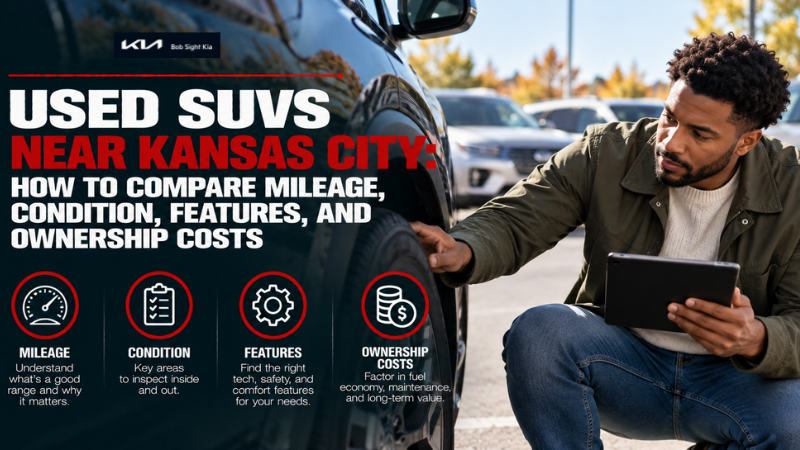
Compare used SUVs near Kansas City by mileage, condition, features, space, and ownership costs. Shop confidently at Bob Sight Kia in Independence.

Used SUVs Near Kansas City: How to Compare Mileage, Condition, Features, and Ownership Costs

Used SUVs Near Kansas City: How to Compare Mileage, Condition, Features, and Ownership Costs Browse Used SUVs Near Kansas City at Bob Sight Kia Shopping for used SUVs near Kansas City requires comparing mileage, physical condition, maintenance history, features, and expected ownership costs together. Bob Sight Kia in Independence helps drivers from Blue Springs, Lee's Summit, Sugar Creek, Raytown, Liberty, Grain Valley, Oak Grove, and communities across Jackson County explore used SUVs for commuting, family travel, cargo needs, and everyday Missouri driving. An odometer reading cannot tell you everything about a pre-owned SUV. A well-maintained vehicle with higher mileage may be a stronger candidate than a lower-mileage SUV that missed important services or experienced excessive wear. The most useful comparison combines the vehicle's age, documented history, present condition, equipment, upcoming maintenance needs, and performance during a thorough test drive. This guide walks through the process step by step. It can help you prepare before browsing online inventory, comparing vehicles at a dealership, requesting an appraisal for your trade, or searching for used SUVs for sale near me in the Greater Kansas City Metro. In This Guide You'll Learn This guide explains the major factors Kansas City shoppers should evaluate before choosing a used SUV. Each factor provides a different piece of the ownership picture, so the strongest decision comes from reviewing them together instead of relying on one number or feature. How to choose the right used SUV size for your household How to compare mileage with vehicle age and maintenance history What to inspect inside, outside, and beneath a used SUV How to review vehicle-history and service records Which safety, comfort, and technology features to test How to estimate fuel, insurance, maintenance, and repair needs What to evaluate during a used SUV test drive near Kansas City A shopper commuting from Blue Springs to Independence may prioritize fuel use, seat comfort, and highway technology. A family driving between Lee's Summit and Kansas City may place more value on rear-seat access, cargo flexibility, and available all-wheel drive. Starting with your real routine makes it easier to identify which specifications and features deserve the most attention. Quick Facts About Comparing Used SUVs Near Kansas City The best used SUV is not automatically the newest vehicle or the one with the fewest miles. The right choice is the SUV whose size, condition, history, equipment, and anticipated ownership requirements align with your daily driving and long-term plans. Mileage needs context: Vehicle age, service records, driving environment, and current condition help explain an odometer reading. Condition matters: Tires, brakes, suspension, interior wear, electronics, glass, body panels, and visible leaks should be reviewed. History reports are useful but not complete: A report should support a physical inspection and test drive rather than replace them. Trim levels can change the experience: Two SUVs from the same model year may include different safety, comfort, and connectivity equipment. Ownership costs extend beyond financing: Fuel, insurance, tires, scheduled maintenance, registration, and repairs affect the long-term budget. Space should be tested: Published cargo volume does not show how well strollers, pet carriers, sports equipment, or work gear will fit. All-wheel drive is not required for everyone: Your roads, schedule, tires, winter travel, and traction needs should guide the decision. A test drive should reflect daily use: Include parking, low-speed roads, highway merging, braking, and uneven pavement when possible. Local driving conditions add another layer to the comparison. Stop-and-go traffic near Independence Center, highway travel on I-70, winter weather across Jackson County, and potholes after freeze-and-thaw cycles can expose different strengths and weaknesses. A used SUV that feels comfortable during those situations is more likely to support your actual routine. Choose the Right Used SUV Size for Your Routine Choose a used SUV category by evaluating passenger capacity, cargo requirements, parking conditions, and the roads you drive most often. Subcompact, compact, midsize, and three-row SUVs offer different balances of maneuverability, seating, storage, fuel use, and capability. A subcompact SUV may suit a driver who wants a higher seating position and flexible cargo room without giving up easy parking. This category can work well for commuting through Independence, navigating shopping areas near Noland Road, or finding space in downtown Kansas City parking structures. Rear-seat and cargo dimensions vary, so shoppers should test whether the vehicle can carry their normal passengers and equipment. Compact SUVs generally add passenger and cargo room while remaining manageable for daily use. These vehicles can fit households that carry children, pets, groceries, sports bags, or luggage but do not need a third row. A compact SUV may also provide available all-wheel drive, roof-rack capability, and driver-assistance technology without the exterior dimensions of a larger model. Midsize and three-row SUVs serve drivers who need more seating flexibility or frequently carry additional passengers. The presence of a third row does not guarantee that it will fit every adult comfortably. Shoppers should test access, legroom, headroom, child-seat positioning, and cargo space with all seats upright because some three-row SUVs have limited storage behind the last row. Use this process to identify the right SUV size: Count regular passengers. Focus on the people you carry weekly, not only occasional trips. List routine cargo. Include strollers, pet carriers, sports gear, work equipment, groceries, or mobility devices. Measure large items. Record height, width, and length rather than relying only on published cargo volume. Review parking conditions. Consider your garage, driveway, workplace, and common shopping destinations. Evaluate road use. Compare city traffic, highway travel, gravel roads, hills, and winter driving. Confirm capability. If towing is planned, verify the exact vehicle's engine, drivetrain, equipment, and rated capacity. This process prevents a common shopping mistake: choosing an SUV that is larger or smaller than the household truly needs. A Sugar Creek commuter may prefer easier maneuverability, while a growing family traveling between Liberty and Kansas City may value additional passenger space. The correct category creates a stronger starting point for every comparison that follows. How to Compare Used SUV Mileage and Vehicle Age Used SUV mileage should be evaluated alongside age, maintenance history, driving patterns, and current mechanical condition. No single odometer reading automatically makes a vehicle dependable or unsuitable, because the way those miles were accumulated can influence wear. A newer SUV with higher mileage may have spent much of its life on highways, where steady-speed travel can produce a different wear pattern than repeated short trips. An older SUV with unusually low mileage may have experienced long storage periods, limited maintenance, or repeated cold starts. Neither situation is automatically positive or negative without additional information. Average annual mileage can provide a reference, but it should not become a pass-or-fail rule. Divide the odometer reading by the vehicle's approximate age to understand its annual use, then compare that result with the available service records and physical condition. Look for a logical relationship among mileage, pedal wear, seat condition, steering-wheel wear, tire history, and recorded maintenance. Higher mileage can also mean that certain scheduled services are approaching or have recently been completed. Depending on the model, those services may involve fluids, spark plugs, filters, belts, brakes, or other components. Review the manufacturer's maintenance schedule for the exact model year, engine, and drivetrain rather than applying one universal interval to every used SUV. Follow these steps when evaluating mileage: Confirm the odometer reading. Compare it with the listing, vehicle-history report, and service records. Calculate approximate annual mileage. Use it as context rather than an automatic judgment. Review documented maintenance. Look for regular oil changes, tire rotations, inspections, and model-specific services. Compare physical wear. Interior and exterior condition should make reasonable sense for the recorded mileage. Identify upcoming maintenance. Determine whether a major service interval is approaching. Estimate your future use. A long-distance Kansas City commuter may add mileage more quickly than a local Independence driver. A Blue Springs driver using I-70 five days a week may add substantially more annual mileage than someone making short trips near Independence. That future usage affects how current mileage should be viewed. The most helpful question is not simply, "Is this mileage too high?" It is, "Does this vehicle's history and condition support the mileage, and does it fit the amount I expect to drive?" Inspect the Condition of a Used SUV Carefully A complete used SUV inspection should cover the exterior, interior, tires, glass, technology, cargo area, and visible mechanical components. Condition can reveal maintenance needs, previous damage, or wear that an online listing and odometer reading cannot fully explain. Begin with the exterior in natural or bright lighting. View the SUV from several angles and look for inconsistent paint, unusual reflections, uneven panel gaps, damaged trim, cracked lenses, windshield chips, and corrosion. Minor cosmetic wear may be normal for a used vehicle, but larger inconsistencies deserve questions about previous repairs. Tires provide valuable information about how the SUV has been maintained. Check tread depth, age, cracking, sidewall damage, and wear across the full width of each tire. Uneven wear may be related to alignment, tire pressure, suspension condition, driving habits, or missed rotations. On an all-wheel-drive SUV, compatible tires and similar tread depths can be important to drivetrain operation. Inside the cabin, test every control you expect to use. Operate the windows, locks, mirrors, seat adjustments, climate system, infotainment screen, charging ports, liftgate, cameras, and interior lights. Look at seat bolsters, carpeting, headliner, door panels, storage areas, and cargo trim for wear that may not appear in listing photos. Use this inspection checklist: Body panels, paint consistency, trim, and corrosion Headlights, taillights, turn signals, and exterior lenses Windshield, windows, mirrors, and camera lenses Tire tread, age, size, type, and wear pattern Seat condition, carpeting, headliner, and interior odors Climate controls, heated features, and defrosters Infotainment, Bluetooth, smartphone integration, and charging ports Rear-seat access, child-seat anchors, and seat-folding functions Cargo floor, liftgate, spare tire, and included accessories Visible fluid leaks, damaged panels, or unusual corrosion beneath the vehicle Missouri's weather makes this review important. Summer heat, winter road treatments, heavy rain, and repeated freeze-and-thaw cycles can affect tires, batteries, wipers, paint, suspension components, and exposed metal. A vehicle driven around Grain Valley or Oak Grove may also have encountered gravel or rural roads, while a Kansas City commuter may show more parking and traffic-related wear. A visual inspection does not replace professional evaluation. If you have concerns about a vehicle's condition, ask whether it can be inspected by a qualified technician. A pre-purchase inspection can provide additional information about the brakes, suspension, leaks, diagnostic systems, and components that are difficult to assess during a walkaround. Review Vehicle History, Maintenance Records, and Features A vehicle-history report, service documentation, and equipment review provide the context needed to compare similar used SUVs accurately. These records can reveal ownership changes, mileage entries, reported damage, maintenance patterns, and differences between trim levels. Start by confirming that the vehicle identification number on the report matches the SUV. Review the recorded mileage chronologically and look for inconsistencies. Examine title information, ownership periods, registration history, reported accidents, and available service entries. A report without a damage record does not guarantee that damage never occurred, so the physical inspection remains necessary. Maintenance records can help explain how the SUV was cared for. Regular oil changes, tire rotations, brake inspections, battery replacement, and fluid services may show consistent attention. Missing records do not automatically prove that maintenance was neglected, but they create uncertainty that should be considered when comparing otherwise similar vehicles. Reported damage also needs context. Ask which areas were affected, what repairs were completed, and whether documentation is available. The quality of a repair and the SUV's current structural, mechanical, and cosmetic condition matter more than a vague assumption based on a single report entry. Features should be verified on the exact vehicle because trim levels and option packages can vary. Depending on the model and year, a used SUV may include: Blind-spot monitoring or collision assistance Rear cross-traffic warning or intervention Forward collision warning and automatic emergency braking Lane-departure or lane-keeping technology Adaptive cruise control Parking sensors and multi-angle cameras Apple CarPlay, Android Auto, navigation, or wireless charging Heated or ventilated seats Remote start or connected-vehicle services Power liftgate, roof rails, or towing equipment Bring your phone and cable to confirm connectivity. Pair the device, make a call, play audio, and test charging. A touchscreen may be present without supporting every smartphone feature a shopper expects, and some connected services may require enrollment or an active subscription. Safety technology supports an attentive driver but does not replace observation or control. Ask for a demonstration of unfamiliar systems and learn where alerts appear. This can be valuable when driving through busy areas near Independence Center, merging onto I-435, or navigating crowded parking areas across the Kansas City Metro. Compare Fuel, Insurance, Maintenance, and Repair Considerations Used SUV ownership costs include fuel, insurance, registration, tires, scheduled maintenance, and potential repairs in addition to the vehicle transaction. Comparing these factors before choosing an SUV can reveal meaningful differences between vehicles that initially look similar. Fuel use depends on the engine, drivetrain, vehicle size, aerodynamics, traffic, weather, cargo load, and driving style. A larger engine or AWD system may support a household's capability needs but may use more fuel than a smaller front-wheel-drive configuration. Compare information for the exact model year, engine, and drivetrain rather than relying on a general figure for the model name. Insurance should be estimated using the specific vehicle identification number when possible. Premiums can vary based on safety equipment, repair costs, theft data, driver history, coverage selections, and location. A newer vehicle with more advanced technology may offer useful safety features while also carrying different sensor or component replacement considerations. Tires can create another substantial difference. Larger wheels often use different tire sizes than entry-level trims, and performance-oriented or specialized tires may have distinct replacement needs. Ask about tread depth, tire age, brand, matching sets, and whether replacement is expected soon. For AWD vehicles, maintaining compatible tires can be particularly important. Compare ownership factors using the same assumptions: Estimate annual mileage. Use your actual commute and regular travel. Compare fuel requirements. Review the correct engine and drivetrain. Request insurance estimates. Use the VIN for each finalist when possible. Review the maintenance schedule. Identify services approaching by mileage or age. Inspect tires and brakes. Consider their current condition and remaining useful life. Review warranty coverage. Confirm whether any original or additional coverage applies. Create an ownership reserve. Plan for routine maintenance and unexpected repairs. Ownership cost does not mean predicting every future expense with perfect accuracy. It means comparing likely needs consistently so one vehicle does not appear stronger simply because upcoming maintenance was overlooked. A used SUV with recently replaced tires and completed scheduled service may present a different near-term ownership picture than one approaching those needs. Local conditions matter here as well. Stop-and-go traffic through Kansas City can affect fuel use and brake wear. Winter potholes and road treatments across Jackson County may increase the importance of tire, alignment, suspension, and underbody inspections. Understanding these factors helps shoppers choose a vehicle that fits both their transportation needs and ownership strategy. How to Conduct a Useful Used SUV Test Drive A useful used SUV test drive should evaluate comfort, visibility, power delivery, braking, steering, ride quality, technology, and cargo usability. The route should include driving conditions similar to those you encounter around Independence and the Greater Kansas City Metro. Before moving, adjust the seat, steering wheel, mirrors, and climate controls. Confirm that you can see clearly, reach common controls, and find a comfortable position. Sit in the second row behind your normal driving position to evaluate realistic passenger space rather than viewing the rear seat with the front seat pushed forward. Start with low-speed driving and parking. Notice steering effort, turning radius, brake response, camera clarity, blind spots, and how easily the SUV fits into a normal parking space. Drivers who frequently visit downtown Kansas City, shopping centers, or school pickup areas should not overlook maneuverability. Include a road with uneven pavement to listen for suspension noises and evaluate ride comfort. When safe, include a highway segment to assess merging, passing response, transmission operation, wind noise, and straight-line tracking. A vehicle that feels acceptable at neighborhood speeds may reveal different characteristics on I-70 or Highway 40. Follow this test-drive sequence: Start the SUV while it is cool when possible. Listen for unusual sounds and watch the instrument panel. Test low-speed controls. Evaluate steering, braking, cameras, and parking visibility. Accelerate normally. Notice engine response, transmission shifts, and hesitation. Drive over varied pavement. Listen for rattles, clunks, or excessive tire noise. Include highway travel. Assess merging, tracking, passing, and cabin comfort. Test technology. Connect your phone and operate important controls. Inspect the SUV again. Look for warning messages, odors, or fresh fluid beneath the vehicle. Bring items that affect the decision. A stroller, child seat, pet carrier, sports bag, mobility device, or work equipment can show whether the cargo area is genuinely useful. Published volume cannot fully communicate the height of the floor, width of the opening, angle of the rear seats, or ease of loading. Use the same route and checklist for every finalist. Consistency makes comparisons easier after several test drives. Write down observations immediately because differences in ride, noise, seat comfort, and controls can become difficult to remember later. Used SUV Ownership Planning for Kansas City Drivers Long-term ownership planning begins with understanding the SUV's maintenance schedule, present condition, expected annual mileage, and service needs. A strong plan can help Kansas City drivers protect reliability, prepare for routine maintenance, and recognize concerns before they become larger problems. Request the maintenance schedule for the exact model year and powertrain. Modern SUVs may use different engine oils, transmission fluids, coolant specifications, spark-plug intervals, or drivetrain maintenance requirements. AWD systems, hybrid powertrains, turbocharged engines, and towing use may also affect service considerations. Create a baseline after purchase when service history is incomplete. A qualified technician can inspect the oil, filters, tires, brakes, battery, fluids, belts, hoses, suspension, lights, and wipers. This does not mean every component needs replacement. It means establishing a clear picture of the vehicle's current needs. Seasonal planning is useful in Missouri. Before winter, check battery strength, tire tread, tire pressure, coolant freeze protection, wipers, washer fluid, exterior lights, and cabin heat. Before summer, inspect air-conditioning performance, tires, coolant, and other heat-sensitive components. These checks can be valuable for drivers commuting between Lee's Summit and Kansas City or traveling beyond the metro. Keep records of every service and repair. Documentation helps you follow the maintenance schedule, understand recurring concerns, and provide useful information if you later trade or sell the SUV. Records may also help a technician avoid duplicating recently completed work. Bob Sight Kia provides online service scheduling in Independence for drivers who need routine maintenance or an inspection. Even when a used SUV is from another manufacturer, maintaining a consistent service history and addressing warning lights promptly remain important ownership practices. Plan for tires and brakes based on condition rather than waiting for a convenient calendar date. Tire pressure can change as temperatures fall across Jackson County, and freeze-and-thaw cycles can create rough pavement that affects alignment and suspension. Regular inspections help drivers identify wear before a commute on I-70 or a winter trip becomes more difficult. Ownership planning also includes understanding the vehicle's features. Review the owner's manual, learn how driver-assistance systems work, locate the spare tire or mobility kit, and understand dashboard warnings. Familiarity can make daily driving easier and help you respond more confidently when the SUV communicates a maintenance or safety concern. Frequently Asked Questions About Used SUVs Near Kansas City What mileage is too high for a used SUV? There is no universal mileage limit that automatically makes a used SUV unsuitable. Mileage should be compared with the vehicle's age, maintenance history, mechanical condition, previous use, and the amount you expect to drive. A higher-mileage SUV with consistent service may be a stronger candidate than a lower-mileage vehicle with neglected maintenance. Review the maintenance schedule to determine which services should already have been completed and which may be approaching. Compare recorded mileage entries on the vehicle-history report with the odometer and available service documentation. Interior wear, pedal condition, tires, and other physical details should also make reasonable sense for the mileage. A Blue Springs commuter traveling on I-70 every weekday may add miles more quickly than a driver making short trips around Independence. Consider how the current mileage will combine with your future use. The better question is whether the SUV's condition and history support continued ownership for your expected driving. Is vehicle age or mileage more important when buying a used SUV? Vehicle age and mileage should be evaluated together because each describes a different type of exposure. Mileage reflects how much the SUV has been driven, while age can affect rubber components, fluids, seals, electronics, corrosion, paint, and other materials. Neither measurement tells the complete story independently. An older, low-mileage SUV may have spent long periods parked or completed many short trips that did not fully warm the engine. A newer, higher-mileage vehicle may have accumulated steady highway miles and received regular maintenance. Service documentation, inspection findings, and the test drive help explain which history is more favorable. Missouri conditions make age-related inspection important. Heat, freezing temperatures, moisture, road treatments, and potholes can affect batteries, hoses, tires, suspension components, and exposed metal. Kansas City shoppers should compare chronological age, mileage, and environmental wear before deciding. What should I inspect before buying a used SUV near me? Inspect the used SUV's body, tires, glass, interior, technology, cargo area, visible mechanical components, and service documentation. Complete a thorough test drive and consider a professional pre-purchase inspection when additional mechanical information is needed. Online photos and history reports should support this process, not replace it. Test every major feature, including the climate system, windows, locks, cameras, seat adjustments, infotainment, charging ports, liftgate, and driver-assistance alerts. Examine tire tread and wear patterns, look for fluid leaks, and compare interior wear with the recorded mileage. Ask about recent reconditioning, included keys, accessories, and warranty coverage. When shopping for a used SUV near Kansas City, include local driving conditions in the evaluation. Test low-speed maneuverability for crowded Independence shopping areas, highway response for I-435 travel, and ride quality over uneven pavement. A vehicle should work well where you actually drive it. Should Kansas City drivers choose a used SUV with all-wheel drive? All-wheel drive may benefit Kansas City drivers who regularly encounter snow, slush, gravel roads, hills, or changing traction conditions. It is not required for every driver, and it does not replace appropriate tires, safe speeds, or additional stopping distance. Your normal roads and travel schedule should guide the decision. AWD systems can distribute power to support traction during acceleration, but system designs vary among manufacturers and models. Maintenance requirements may also differ, and compatible tires can be important. Confirm how the exact system operates and review its service schedule. A driver leaving Oak Grove before winter roads are cleared may value AWD differently than someone commuting only on treated streets in central Independence. Compare your schedule, driveway, destinations, and willingness to travel during poor weather. Front-wheel drive with suitable tires may meet many local drivers' needs, while AWD can provide additional confidence for others. How can I compare the ownership costs of two used SUVs? Compare ownership costs by using the same annual mileage, insurance coverage, maintenance assumptions, and ownership period for each SUV. Include fuel, insurance, registration, tires, scheduled service, and anticipated repairs. A consistent method creates a fairer comparison. Request insurance estimates using each VIN and review fuel requirements for the exact engine and drivetrain. Inspect tire and brake condition and identify upcoming maintenance intervals. Also confirm whether any warranty coverage remains or whether additional protection is included. For a Kansas City commuter, fuel and tire needs may carry more weight than they would for a low-mileage local driver. Winter travel, highway mileage, cargo loads, and road conditions can also affect expenses. Compare the complete ownership picture rather than judging vehicles by one payment or one advertised feature. Why Shopping Locally Matters for Used SUV Buyers Shopping locally gives Kansas City-area drivers the opportunity to evaluate a used SUV in familiar conditions and maintain a convenient relationship with nearby dealership resources. Bob Sight Kia in Independence serves shoppers from communities across Jackson County who want to compare vehicles, value a trade, review financing, and prepare for ownership close to home. A local test drive can include the same types of roads you use regularly. Drivers can assess acceleration for I-70, maneuverability near Independence Center, ride comfort over Missouri pavement, and visibility in busy shopping areas. This provides more relevant information than evaluating a vehicle only on unfamiliar roads. Local access can also make follow-up questions, trade documentation, and service planning more convenient. Shoppers can return with another household driver, bring a child seat or cargo item, and compare additional vehicles without organizing a long-distance trip. Convenience should not replace careful research, but it can improve the quality of the process. Begin by reviewing the current used inventory at Bob Sight Kia. Inventory changes as vehicles arrive and sell, so confirm availability before planning a visit around one specific SUV. Create a short list that includes alternatives with similar size, mileage, equipment, or drivetrain. If you have a vehicle to exchange, use the online Value Your Trade tool before visiting. Bring current registration, payoff information when applicable, both keys, and available service records. Preparing these items can make the appraisal and comparison process more efficient. Drivers evaluating used SUVs can also review Bob Sight Kia's Price Match Promise while considering their options. Blue Springs, Lee's Summit, and Kansas City shoppers should review the current terms and applicable details for the vehicle they are considering. The strongest used SUV decision comes from combining research with direct evaluation. Mileage, condition, features, ownership costs, history, and test-drive performance should all support the same conclusion. When those factors align with your household's needs, the vehicle is more likely to remain useful beyond the initial purchase. Helpful Links Browse Used Vehicles at Bob Sight Kia Value Your Trade Explore Financing Resources Schedule a Used Vehicle Test Drive Visit Bob Sight Kia Proud to Be Part of the Bob Sight Auto Group Bob Sight Kia is proud to be part of the family-owned Bob Sight Auto Group, serving vehicle shoppers and owners throughout the Kansas City region and Northeast Kansas. Families researching new or used vehicles can rely on Bob Sight Auto Group for new and pre-owned vehicle sales, trade-in resources, auto financing, certified service, parts, and collision repair. Bob Sight Kia - Independence, MO Bob Sight Ford - Lee’s Summit, MO Bob Sight Honda - Lawrence, KS Bob Sight CDJR - Lawrence, KS Bob Sight Collision Center - Lee’s Summit, MO
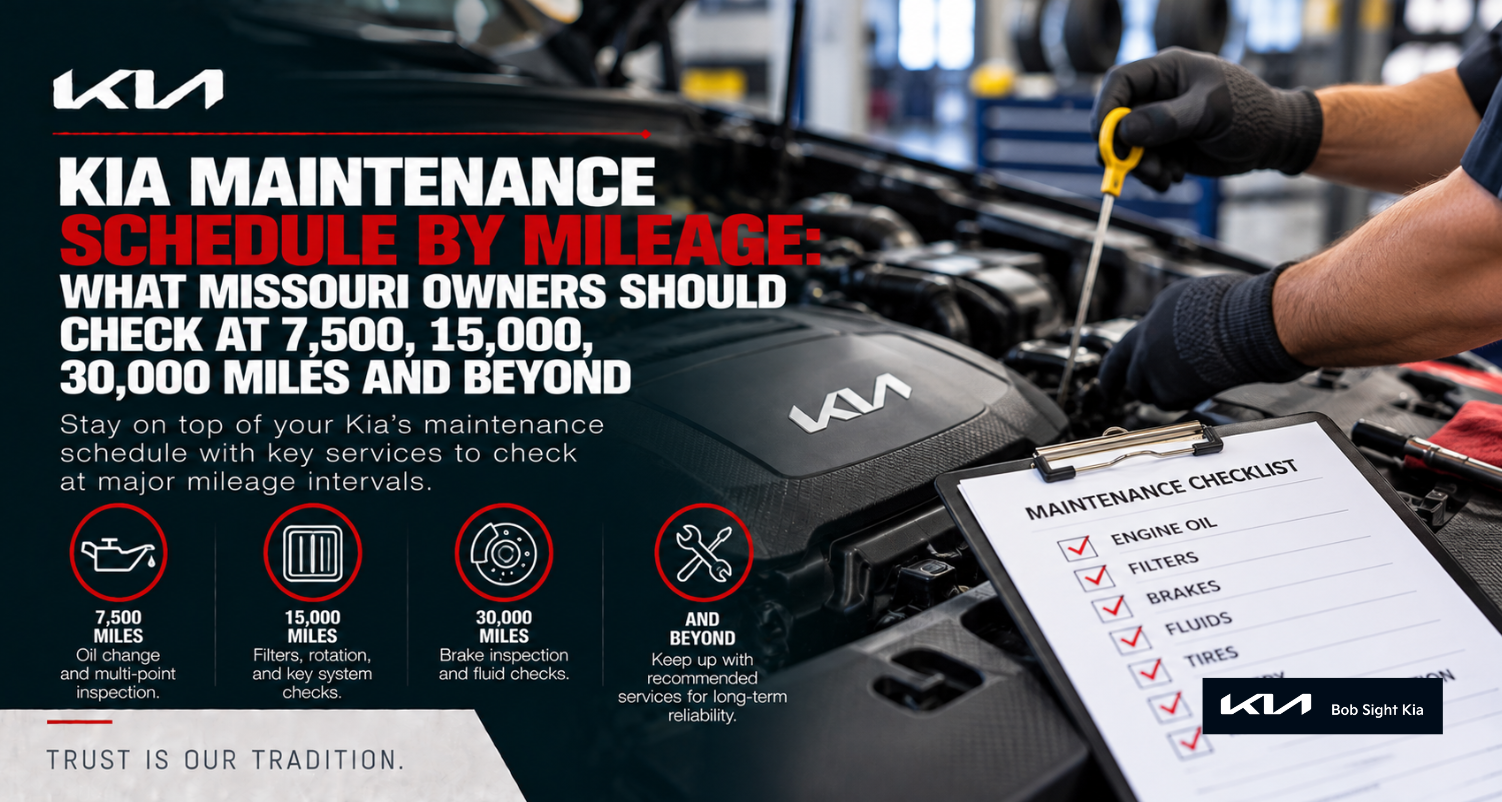
See Kia maintenance by mileage, including 7,500, 15,000, and 30,000-mile checkpoints for Independence and Missouri drivers.

Kia Maintenance Schedule by Mileage: What Missouri Owners Should Check at 7,500, 15,000, 30,000 Miles and Beyond

Kia Maintenance Schedule by Mileage: What Missouri Owners Should Check at 7,500, 15,000, 30,000 Miles and Beyond Your Kia maintenance schedule should follow the requirements for your exact vehicle, with mileage milestones helping you plan ahead. Oil changes, tire rotations, filters, brake inspections, and fluid checks all play a role in ownership, but they do not follow one universal schedule across every Kia model. For drivers in Independence, Blue Springs, Grain Valley, and throughout the Kansas City Metro, daily driving conditions also matter. Short trips, traffic on I-70, winter road treatments, and dusty construction areas can affect which maintenance schedule applies. Bob Sight Kia in Independence also offers an ownership benefit worth including in your service planning: lifetime oil changes and tire rotations every 5,000 miles with eligible new Kia purchases, performed exclusively at Bob Sight Kia. Ask our team to confirm eligibility and program terms for your vehicle. Battery-electric Kia models do not require engine oil changes. The 7,500-, 15,000-, and 30,000-mile checkpoints discussed below are planning references. They should not delay a service already due under your factory schedule, elapsed-time requirements, severe-use schedule, or applicable dealership maintenance program. Schedule Kia maintenance at Bob Sight Kia in Independence In This Guide You'll Learn Understanding the difference between factory requirements, dealership benefits, and condition-based repairs makes Kia maintenance easier to manage. This guide covers: How to identify the correct maintenance schedule for your Kia How Bob Sight Kia's 5,000-mile lifetime maintenance benefit fits into ownership What to review around 7,500, 15,000, and 30,000 miles How Missouri driving conditions can affect service timing Which items to monitor between appointments How gasoline, hybrid, plug-in hybrid, and electric maintenance differs How to plan service beyond the first 30,000 miles Does Every Kia Follow the Same Maintenance Schedule? No. Kia maintenance requirements vary by model year, engine, powertrain, drivetrain, and operating conditions. Even two vehicles with the same model name can have different service requirements when their engines or powertrains differ. A gasoline Kia Sportage and a Sportage Hybrid should each follow their own maintenance information. A battery-electric Kia has a different set of needs because it does not have a gasoline engine, engine oil filter, or spark plugs. The correct starting point is your owner's manual and its scheduled maintenance section. Kia's Owner's Portal also provides access to vehicle information and maintenance milestones. Confirm that the information matches your model year and configuration. When a maintenance item lists both mileage and time, follow whichever limit comes first as directed by the schedule. A low-mileage Kia may reach a calendar deadline before reaching the listed mileage. A frequent commuter may reach the mileage limit much sooner. Keep these three categories separate when reviewing recommendations: Factory scheduled maintenance: Inspections and replacements specified by Kia for your vehicle and operating conditions. Dealership maintenance benefits: Services available under an applicable program, including Bob Sight Kia's lifetime oil changes and tire rotations every 5,000 miles with eligible new Kia purchases. Condition-based service: Work recommended because an inspection identifies wear, damage, contamination, or a developing concern. Understanding which category applies helps you ask useful questions and maintain accurate records. How Bob Sight Kia's Lifetime Oil Changes and Tire Rotations Fit Your Plan Eligible new Kia purchases at Bob Sight Kia include lifetime oil changes and tire rotations every 5,000 miles, performed exclusively at our Independence dealership. This benefit gives qualifying owners a recurring service checkpoint to include in their ownership calendar. For an eligible gasoline or hybrid Kia, those visits provide an opportunity to keep up with covered oil and tire services while discussing other maintenance that may be due. Confirm your enrollment, vehicle eligibility, and applicable program terms with the dealership. The 5,000-mile benefit does not make every other maintenance item due at 5,000-mile intervals. Filters, coolant, spark plugs, brake fluid, and drivetrain components retain their own vehicle-specific requirements. Likewise, a factory time limit or severe-use requirement may call for attention before the next program mileage checkpoint. Do not interpret the benefit as coverage for every maintenance item or repair. Ask which services are included and which additional recommendations come from Kia's schedule or the condition of your vehicle. If you own a battery-electric Kia, engine oil changes do not apply. Ask our team which program benefits apply to your specific vehicle rather than assuming the same services apply to every powertrain. Plan your next Kia service appointment What Should Kia Owners Review Around 7,500 Miles? Around 7,500 miles, review your service history and upcoming factory requirements rather than assuming every Kia needs an identical service package. If you participate in Bob Sight Kia's applicable 5,000-mile maintenance benefit, you may already have completed an earlier oil-change and tire-rotation visit. For gasoline engines, including those in hybrids and plug-in hybrids, oil service must use the correct oil specification and filter for the vehicle. Do not select oil solely because another Kia owner uses it. Engine requirements can differ across models and years. Tire maintenance also deserves attention. Rotation requirements and patterns depend on the vehicle and tire configuration. Directional tires or differing front and rear tire sizes can affect the appropriate procedure. This checkpoint is also useful for reviewing tire pressure, tread condition, brake behavior, visible leaks, lighting, and wiper performance. An inspection may identify an issue that deserves attention, but inspection does not automatically mean replacement. Check your odometer and service date. Compare both with your vehicle's maintenance schedule. Review completed work. Include any earlier 5,000-mile program visit. Identify services actually due. Use the factory schedule and applicable driving conditions. Discuss symptoms. Mention new noises, warning lights, vibration, or changes in starting and braking. Save the service record. Record the date, mileage, and work completed. For owners making frequent short trips along Noland Road or US-40, this is also a good time to review the severe-use definitions in the owner's manual. What Changes Around 15,000 Miles? The 15,000-mile checkpoint is a useful time to review recurring maintenance, filter condition, tires, and brakes against your Kia's actual requirements. It is not a universal replacement deadline for every component. If your vehicle qualifies for Bob Sight Kia's lifetime maintenance program, 15,000 miles is also a recurring 5,000-mile program checkpoint. Confirm the appropriate timing with the service team and keep the factory schedule in view for additional requirements. The cabin air filter is one item worth reviewing. It filters air entering the passenger compartment through the climate-control system. Dust, pollen, leaves, and other debris can accumulate over time, and a restricted filter can reduce airflow. Replacement should follow the schedule and condition of the filter. Driving through construction areas or dusty environments may justify closer attention. Reduced airflow can also have causes beyond the filter, so persistent climate-control concerns deserve diagnosis. Tires should be checked for uneven wear and damage. Edge wear, center wear, or a change in steering behavior can prompt evaluation of inflation, alignment, suspension, or other contributing factors. Brake-pad replacement depends on measured wear and condition. A driver spending substantial time in Independence traffic may experience different brake wear from someone traveling mainly on uninterrupted highways. Mileage alone cannot determine how much usable brake material remains. What Should Be Reviewed Around 30,000 Miles? At approximately 30,000 miles, compare your service records with Kia's schedule to identify recurring maintenance and any additional items due. Avoid treating a generic 30,000-mile package as a factory requirement for every Kia. Engine air-filter service may be part of the discussion for a gasoline or hybrid vehicle, depending on its schedule and filter condition. This filter serves the engine and is separate from the cabin air filter. Battery-electric vehicles do not have an engine combustion-air filter. Other items may include inspections of belts, cooling-system components, steering, suspension, axle boots, or drivetrain components where specified. Their inspection and replacement requirements depend on your vehicle. Fluid service also requires a specific explanation. Ask which fluid is being recommended, whether Kia specifies the service at the current mileage or age, and whether severe-use conditions or an inspection finding affect the recommendation. At this stage, review the maintenance history as a whole: Have recurring oil and tire services been completed when applicable? Are any time-based requirements due? Were previous inspection findings resolved? Do filters need inspection or replacement under the schedule? Are tire wear and brake measurements being tracked? Does the severe-use schedule change any upcoming requirements? For eligible program participants, 30,000 miles is another 5,000-mile maintenance checkpoint. Additional work should still be matched to factory requirements and actual condition. What Counts as Severe Driving in Missouri? Severe-use conditions can include ordinary driving routines, so review Kia's definitions before assuming the normal schedule applies. The relevant conditions and affected maintenance items are listed in your vehicle's manual. Depending on the Kia, those conditions can include repeated short trips, extensive idling, heavy traffic, dusty roads, salt-treated roads, very cold weather, and towing or other demanding use. A commute through I-70 congestion can involve substantial engine-running time without many miles accumulating. Repeated short errands around Independence can create a different operating pattern from a longer trip at steady speed. Missouri winters also make the severe-use section worth reviewing. Some Kia manuals identify very cold weather and roads treated with salt or other corrosive materials among the relevant conditions. Do not assume every maintenance item changes to the same shorter interval. Severe-use tables identify which items are affected and which conditions apply to them. When discussing your maintenance plan, describe your actual routine: typical trip length, time spent idling, traffic, dusty-road use, and any towing within the vehicle's approved limits. Those details help the service team review the appropriate schedule. What Should You Check Between Service Appointments? Monitor your Kia between appointments because wear, warning lights, and vehicle symptoms do not wait for a mileage milestone. Scheduled maintenance works best alongside regular owner checks. Follow the owner-maintenance guidance in your manual. For vehicles with an engine, this can include checking engine oil as directed. Tire pressure, exterior lighting, wipers, and visible leaks also deserve attention. Check cold tire pressure. Use the vehicle's tire placard and manual rather than the maximum pressure molded into the tire sidewall. Inspect visible tire condition. Look for uneven wear, cuts, bulges, cracking, or other damage. Watch for unexplained fluid loss. Repeated topping off should not replace investigating a leak. Notice braking changes. Grinding, pulling, vibration, or altered pedal feel warrants attention. Check lights and wipers. Maintain visibility during rain, snow, and shorter winter days. Respond to warning indicators. Follow the manual's instructions for the specific warning. Record symptoms. Note when a concern occurs and the conditions surrounding it. Some warnings require stopping safely and obtaining assistance rather than continuing to drive. Do not wait for the next routine appointment when the manual calls for immediate action. How Do Gasoline, Hybrid, and Electric Kia Maintenance Needs Differ? Your powertrain determines which maintenance items apply, so a gasoline checklist should not be copied directly to every Kia. Shared model names do not guarantee shared service requirements. Gasoline Kia Vehicles Gasoline vehicles require engine-related maintenance, including oil and filter service, along with scheduled attention to items such as spark plugs and engine air filters. Exact intervals and specifications depend on the engine. Hybrid and Plug-In Hybrid Kia Vehicles Hybrids and plug-in hybrids still have gasoline engines and require applicable engine maintenance. Driving on electric power for part of a trip does not eliminate oil service or calendar-based requirements. Follow the schedule for the hybrid or plug-in hybrid configuration. Hybrid-specific components may have their own inspection or service requirements. Do not substitute the schedule from a gasoline version of the same model. Battery-Electric Kia Vehicles Battery-electric Kia vehicles do not require engine oil changes or spark plugs. They still need maintenance involving tires, brakes, cabin filters, steering, suspension, cooling systems, and other applicable components. Regenerative braking can reduce friction-brake use during some driving, but conventional brake components still require attention. Follow the EV's maintenance schedule rather than assuming reduced brake use eliminates inspection needs. Planning Maintenance Beyond 30,000 Miles Beyond 30,000 miles, continue recurring maintenance and add higher-mileage or time-based work as your Kia's schedule requires. There is no single replacement list that applies to every Kia at 60,000, 90,000, or 100,000 miles. Items such as coolant, spark plugs, belts, and drivetrain fluids can have substantially different requirements across vehicles. Check the exact schedule before assuming a service is due or can be postponed. Vehicle age matters alongside mileage. A seven-year-old Kia with relatively low mileage may need different attention from a newer Kia with the same odometer reading. Tires, batteries, rubber components, and other parts can deteriorate with time. Keep records showing the service date, mileage, work completed, and relevant inspection results. Records help prevent duplicate work and make it easier to track changes in tire wear, brake measurements, and recurring concerns. If you purchased a used Kia without complete records, discuss the missing history with the service team. The goal is to establish what can be verified and determine an appropriate maintenance plan for that vehicle. Frequently Asked Questions About Kia Maintenance Schedules Does every Kia need maintenance every 7,500 miles? No. Kia maintenance intervals vary by model year, engine, powertrain, maintenance item, and driving conditions. Use the schedule for your exact vehicle and follow mileage or time limits as specified. Does Bob Sight Kia offer lifetime oil changes and tire rotations? Bob Sight Kia in Independence advertises lifetime oil changes and tire rotations every 5,000 miles with eligible new Kia purchases, performed exclusively at the dealership. Ask the team to confirm your vehicle's eligibility and applicable program terms. Battery-electric vehicles do not require engine oil changes. What Kia maintenance should I review around 15,000 miles? Review recurring oil and filter service where applicable, tire maintenance, brake inspections, fluid checks, and any cabin air-filter service specified for your vehicle. Reaching 15,000 miles does not create the same service requirements for every Kia. What should be done to a Kia at 30,000 miles? Review your Kia's maintenance schedule and service history to identify recurring maintenance and any additional inspections or replacements due. Engine air filters, cabin filters, fluids, and other components have vehicle-specific requirements rather than one universal 30,000-mile replacement rule. What counts as severe driving for a Kia? Depending on the vehicle's manual, severe-use conditions can include repeated short trips, extensive idling, heavy traffic, dusty or salt-treated roads, very cold weather, and towing or other demanding use. Follow the definitions and maintenance requirements for your exact Kia. Schedule Kia Maintenance in Independence, Missouri Bob Sight Kia can help you review your vehicle's maintenance requirements and plan your next service visit. Have your current mileage, model year, powertrain information, and service records available when discussing what is due. If you are searching for Kia maintenance near me in Independence, Blue Springs, Grain Valley, Raytown, or the Kansas City Metro, start with a plan built around your actual vehicle and driving routine. Remember to ask about lifetime oil changes and tire rotations every 5,000 miles with eligible new Kia purchases at Bob Sight Kia. Confirm the program terms and continue following all other applicable factory maintenance requirements. Schedule your next Kia maintenance appointment Helpful Links Schedule Kia Service Kia Service Specials Kia Parts Department Explore New Kia Vehicles Bob Sight Kia Proud to Be Part of the Bob Sight Auto Group Bob Sight Kia in Independence is proud to be part of the Bob Sight Auto Group. Explore our dealerships in Missouri and Kansas for vehicle shopping, service, and ownership resources. Bob Sight Honda in Lawrence, Kansas Bob Sight Chrysler Dodge Jeep Ram in Lawrence, Kansas Bob Sight Ford in Lee's Summit, Missouri Bob Sight Kia in Independence, Missouri Trust Is Our Tradition.