

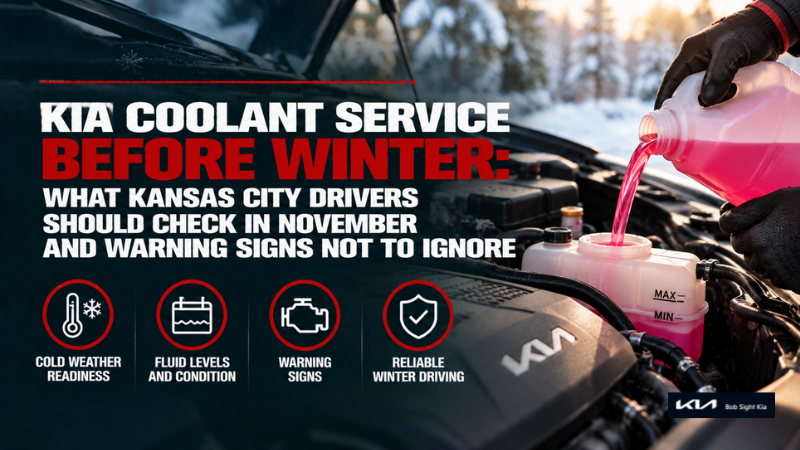
Kia Coolant Service Before Winter: What Kansas City Drivers Should Check in November and Warning Signs Not to Ignore
Schedule Kia Coolant Service in Independence Before Winter
November is a practical time for Kansas City drivers to check their Kia's coolant level, freeze protection, hoses, and overall cooling-system condition before sustained winter temperatures arrive. Bob Sight Kia in Independence helps owners from Blue Springs, Lee's Summit, Raytown, Sugar Creek, Liberty, Grain Valley, Oak Grove, and surrounding Jackson County communities prepare their vehicles for Missouri's freezing mornings, rapid temperature changes, snow, and ice.
Engine coolant performs important work throughout the year. It helps regulate engine temperature, protects internal components against corrosion, supports freeze protection, and contributes to cabin heating in many gasoline and hybrid vehicles. Low coolant, an incorrect mixture, deteriorated fluid, or a cooling-system leak can create problems during winter even when outside temperatures are cold.
Coolant specifications and replacement intervals vary by Kia model, model year, engine, and powertrain. Gasoline, hybrid, plug-in hybrid, and electric Kia vehicles may use different cooling-system designs or multiple coolant circuits. Owners should follow the maintenance schedule and fluid requirements for their exact vehicle rather than applying one universal recommendation to every Kia.
In This Guide You'll Learn
This guide explains how coolant protects a Kia during winter, what drivers can check safely, and when professional cooling-system service may be needed. The information is designed to help Kansas City-area owners prepare before freezing weather rather than discovering a coolant concern during a cold commute.
- Why engine coolant matters during Missouri winter weather
- What freeze protection, corrosion protection, and heat transfer mean
- When a Kia may need a coolant inspection, exchange, or related repair
- What owners should check in November before colder weather arrives
- Which coolant warning signs should not be ignored
- Why the correct Kia coolant specification and concentration matter
- When to schedule Kia coolant service near Kansas City
A driver commuting from Blue Springs to Independence may depend on reliable cabin heat and windshield defrosting before sunrise. A family traveling from Lee's Summit across the Kansas City Metro may want confidence that the cooling system is ready for a longer winter drive. A November inspection creates time to evaluate the system before a weather event places greater demands on the engine, heater, and defroster.
Drivers can perform a limited visual coolant-level check on many Kia vehicles when the engine is completely cool. Testing freeze protection, diagnosing leaks, replacing fluid, bleeding air from the system, and servicing specialized hybrid or electric cooling circuits should be handled according to Kia procedures and the vehicle's exact requirements.
Quick Facts About Kia Coolant Service Before Winter
Kia coolant service should be based on the vehicle's exact maintenance schedule, fluid specification, current condition, and cooling-system test results. November is a useful inspection point because Kia guidance recommends checking coolant level and antifreeze protection at the beginning of the winter season.
- Coolant is used year-round: It supports temperature control during summer and freeze protection during winter.
- Coolant and antifreeze are related terms: Automotive coolant typically combines antifreeze concentrate, appropriate water, and protective additives.
- Replacement timing varies: Follow the schedule for the exact Kia model, model year, engine, and powertrain.
- Color is not a specification: Coolant should not be selected or mixed based only on appearance.
- Low coolant deserves attention: Repeatedly adding fluid may indicate a leak or another cooling-system concern.
- Never open a hot cooling system: Pressurized coolant and steam can cause serious burns.
- Cabin heat can provide a clue: Weak or inconsistent heat may occur with some coolant or circulation problems, although other causes are possible.
- Specialized powertrains differ: Hybrid, plug-in hybrid, and electric Kia vehicles may use multiple cooling circuits or specialized fluids.
Coolant should normally remain within the reservoir markings identified for a cool engine. If the level repeatedly drops, the system needs more than another top-off. A technician should identify whether the loss is related to a hose, connection, reservoir, radiator, water pump, heater core, gasket, or another component.
Missouri's late-fall temperature swings can reveal concerns that were less noticeable during mild weather. Rubber hoses, plastic fittings, seals, clamps, and metal components experience repeated heating and cooling cycles. An issue that leaves only a small amount of residue in October may develop into more obvious fluid loss after several freezing nights.
Why Engine Coolant Matters During a Kansas City Winter
Engine coolant protects a Kia during winter by resisting freezing, supporting heat transfer, and helping prevent internal corrosion. It does more than prevent overheating, which is why cooling-system condition remains important even when outside temperatures are below freezing.
A gasoline engine produces substantial heat during operation regardless of the weather. Coolant absorbs heat from the engine and carries it through the cooling system so it can be released through the radiator. If the level is too low or circulation is restricted, the engine can overheat during winter just as it can during summer.
The antifreeze portion of the coolant mixture lowers the fluid's freezing point. Plain water expands when it freezes, which can damage a cooling system. The correct coolant mixture helps protect the engine, radiator, heater core, hoses, and other components during cold Missouri nights.
Coolant also contains additives that help protect aluminum and other cooling-system materials against corrosion. Kia owner guidance for applicable vehicles commonly specifies a phosphate-based ethylene-glycol coolant intended to protect aluminum engine components. The exact fluid requirement should always be verified in the owner's manual for the specific model.
Cabin heat in many gasoline-powered and hybrid Kia vehicles depends partly on heated engine coolant flowing through a heater core. Air moves across that component and enters the cabin through the climate system. Low coolant or poor circulation may contribute to weak, inconsistent, or delayed heat.
Windshield defrosting also makes cabin-heating performance important. A driver leaving Grain Valley before sunrise needs a clear windshield and predictable heat during a cold commute. Weak heat may have several possible causes, including low coolant, a thermostat issue, trapped air, a restricted heater core, a blower concern, or a climate-control problem.
Kansas City weather can change quickly. A mild afternoon may be followed by a freezing night, and rain can become ice as pavement temperatures fall. Inspecting coolant level and freeze protection in November gives drivers time to address concerns before a strong cold front reaches Jackson County.
Coolant inspection is only one part of winter preparation. Tires, battery strength, wiper blades, washer fluid, lights, brakes, and cabin heat also deserve attention. Together, these systems help a Kia remain dependable during the seasonal conditions drivers encounter on I-70, I-435, Highway 40, and local Independence streets.
What Coolant, Antifreeze, and Freeze Protection Mean
Coolant is the working fluid that circulates through the cooling system, while antifreeze is the component that helps lower the freezing point and raise the boiling point. In normal automotive use, the terms are often used interchangeably, but understanding the mixture helps explain why concentration matters.
Coolant typically combines an antifreeze base with appropriate water and protective additives. The mixture must transfer heat effectively while resisting freezing and corrosion. Too little antifreeze can reduce cold-weather protection, while an overly concentrated mixture may not transfer heat or protect the system as intended.
Freeze protection describes the lowest temperature at which the tested coolant mixture is expected to remain adequately protected. A technician can use suitable testing equipment to evaluate concentration and freeze protection. Looking at the fluid cannot provide the same information.
Water quality matters when water must be used with the specified coolant. Kia guidance for applicable vehicles calls for deionized, distilled, or suitable soft water rather than hard water. Minerals in hard water can contribute to deposits and cooling-system concerns.
Coolant color should not be treated as proof of compatibility. Different products can use similar colors while meeting different specifications, and compatible products may not always look identical. Adding fluid based only on color can result in an incorrect mixture.
Use this plain-language comparison:
| Term | What It Means | Why It Matters Before Winter |
|---|---|---|
| Coolant | The fluid circulating through the vehicle's cooling system | Supports heat transfer, freeze protection, and corrosion protection |
| Antifreeze | The chemical base that helps resist freezing and boiling | Protects the system when Missouri temperatures fall |
| Coolant Concentration | The proportion of antifreeze and water in the mixture | An incorrect concentration can reduce protection |
| Freeze Protection | The tested cold-temperature protection of the mixture | Helps determine whether the coolant is ready for winter |
| Coolant Specification | The formulation required for the exact vehicle | Protects compatibility with system materials and components |
Drivers searching for Kia coolant service near me should look for a service department that verifies the vehicle identification number, model year, engine, and powertrain before selecting fluid. This is particularly important for hybrid, plug-in hybrid, and electric Kia vehicles that may use more than one coolant circuit.
A November cooling-system inspection can include a level check, freeze-protection test, visible-condition review, and inspection of hoses and connections. These checks provide more useful information than assuming coolant is ready for winter because its color appears normal.
When Does a Kia Need Coolant Service?
A Kia needs coolant service when the model-specific maintenance schedule calls for replacement, testing shows inadequate protection, the fluid is contaminated, or the cooling system has been opened for repair. There is no single replacement interval that applies to every Kia model and powertrain.
A newer Kia may use a different coolant specification or replacement schedule than an older model. Gasoline, hybrid, plug-in hybrid, and electric vehicles can also use different cooling-system designs. Owners should review the maintenance section of the exact owner's manual or vehicle-specific Kia information.
Coolant service may be appropriate when:
- The factory maintenance schedule calls for replacement
- Freeze-protection testing shows inadequate cold-weather protection
- The coolant is contaminated or contains visible debris
- The system repeatedly requires additional coolant
- A hose, radiator, thermostat, water pump, or related component was replaced
- The cooling system was opened during another repair
- A technician identifies corrosion, deposits, leakage, or circulation concerns
- The vehicle's maintenance history is incomplete or unknown
Replacement intervals should not be guessed based on vehicle age alone. Some coolant formulations are designed for extended service, while others follow different maintenance schedules. The correct interval can also depend on whether the vehicle operates under normal or severe conditions defined by the manufacturer.
A coolant service recommendation should explain what was found. Ask whether the service is due by schedule, whether testing showed weak protection, whether contamination is present, or whether another repair requires coolant replacement. Understanding the reason helps separate routine maintenance from problem diagnosis.
Drivers who purchased a used Kia without complete records may benefit from a cooling-system evaluation. A technician can inspect the level, visible condition, hoses, connections, reservoir, radiator, and freeze protection. The results can help establish a reliable maintenance baseline.
Do not assume that adding coolant resolves the reason it became low. A sealed cooling system should not require frequent additions. Repeated fluid loss indicates that the system should be inspected for leakage or another concern.
For a Kansas City commuter, timing matters. Addressing a cooling-system concern in November may be more convenient than responding to an overheating warning during a January commute on I-70. Preventive inspection creates an opportunity to diagnose the system before severe weather makes travel and roadside delays more difficult.
What Kansas City Drivers Should Check in November
A November coolant check should focus on the reservoir level, freeze protection, visible leaks, hose condition, cabin heat, and the vehicle's maintenance history. Owners can perform a limited visual review when the engine is fully cool, but testing and repairs require appropriate procedures and equipment.
Never remove a radiator cap or pressurized coolant cap while the engine is hot. The cooling system can retain heat and pressure after the vehicle has been turned off. Hot coolant or steam can escape suddenly and cause serious burns.
Follow this basic November coolant checklist:
- Park safely on a level surface. Turn off the vehicle and allow the engine to cool completely.
- Consult the owner's manual. Identify the correct reservoir and model-specific inspection instructions.
- Check the reservoir markings. The coolant should be within the designated range for a cool engine.
- Do not overfill. The reservoir needs appropriate space for expansion as the coolant warms.
- Look beneath the vehicle. Check for fresh fluid, wet areas, or dried residue that may indicate leakage.
- Inspect visible hoses and connections. Look for swelling, cracking, deterioration, or damp areas without touching hot components.
- Review the maintenance history. Determine whether coolant replacement or another cooling-system service is due.
- Test cabin heat during a normal drive. Notice whether heat becomes warm and remains consistent.
- Request professional testing. Ask for coolant concentration and freeze protection to be checked if the condition is uncertain.
A visual check cannot measure the protective strength of the mixture. Fluid can appear clean while its concentration or additives no longer provide the intended protection. Testing adds information that color and level alone cannot provide.
Cabin heat should be evaluated after the engine has had time to reach its normal operating temperature. Weak heat during the first moments of a cold start may be normal. Heat that never becomes warm, changes unexpectedly, or disappears while driving deserves inspection.
Check the instrument panel for warning lights or temperature messages. A warning should be taken seriously even if the vehicle appears to drive normally. The owner's manual explains what specific indicators mean and what immediate action may be required.
Local ownership patterns affect this checklist. A Liberty driver preparing for a holiday road trip may want a full inspection before leaving the metro. A Raytown commuter who recently noticed inconsistent heat may need diagnosis rather than a simple fluid check.
Warning Signs Your Kia May Need Cooling-System Service
Low coolant, repeated fluid loss, visible leaks, a sweet odor, weak cabin heat, steam, or an abnormal temperature warning can indicate that a Kia needs cooling-system service. These symptoms can have different causes, so diagnosis is more dependable than guessing or repeatedly adding fluid.
Repeatedly Low Coolant
A coolant level below the appropriate reservoir mark may indicate a leak, incomplete previous service, trapped air, or another concern. One observation does not identify the cause. Repeatedly adding coolant without finding the source can allow a developing problem to continue.
Temperature Warning or Rising Gauge
An abnormal temperature reading or overheating warning requires prompt attention. Move to a safe location as soon as conditions permit and turn off the vehicle. Continuing to drive an overheating engine can cause extensive damage.
Visible Fluid or Dried Residue
Fresh fluid beneath the front of the vehicle or colored residue near hoses and connections may be associated with a coolant leak. Water from the air-conditioning system can also drip beneath a vehicle, so appearance alone is not a reliable diagnosis. Keep children and pets away from any leaked automotive fluid.
Sweet or Unusual Odor
A sweet smell around the engine compartment or inside the cabin may occur with some coolant leaks. An interior odor combined with window fogging or damp carpeting can warrant prompt inspection. A heater-core problem is one possible cause, but a technician should confirm the source.
Weak or Inconsistent Cabin Heat
Low coolant can contribute to poor cabin heat in vehicles that use heated engine coolant through a heater core. Other causes include a thermostat issue, trapped air, a restricted heater core, a blower problem, or a climate-control component. Testing is needed to separate these possibilities.
Steam From the Engine Compartment
Steam can indicate overheating or escaping coolant. Pull over safely, shut off the vehicle, and remain clear of the hot cooling system. Do not remove a cap or reach into the engine compartment while steam is present.
Follow these steps if a temperature warning appears:
- Reduce stress on the vehicle. Turn off unnecessary accessories when safe to do so.
- Move away from traffic. Stop in a safe location as soon as conditions permit.
- Turn off the vehicle. Allow the cooling system to cool naturally.
- Do not open a hot cap. Pressurized coolant can escape and cause burns.
- Observe from a safe distance. Note steam, fluid, odors, or warning messages for the technician.
- Arrange assistance. Do not continue driving an overheating vehicle.
- Have the cause diagnosed. Correct the underlying problem rather than only refilling the reservoir.
A driver on I-435 may not have immediate access to a service facility when a warning appears. Safety comes first. Move away from active traffic, use hazard lights, and arrange roadside assistance rather than risking engine damage or personal injury.
Coolant Inspection vs. Exchange vs. Flush
A coolant inspection, coolant exchange, and coolant flush are different services, and the correct choice depends on the maintenance schedule and condition of the cooling system. Owners should ask what procedure is being recommended and what inspection result supports it.
| Service | Typical Purpose | When It May Be Recommended |
|---|---|---|
| Coolant Inspection | Checks level, visible condition, freeze protection, hoses, and leaks | Before winter, during routine maintenance, or when symptoms appear |
| Coolant Top-Off | Restores a slightly low level with the correct compatible fluid | Only after determining why the level is low and confirming compatibility |
| Coolant Exchange | Removes old coolant and replaces it with the correct fresh coolant | At the model-specific replacement interval or after certain repairs |
| Coolant Flush | Uses a more extensive process to move fluid or cleaner through the system | When condition or contamination supports the procedure |
| Cooling-System Repair | Corrects a leak, circulation issue, or failed component | When testing identifies a mechanical problem |
A coolant inspection does not automatically mean that replacement is required. The technician may find that the fluid level, concentration, freeze protection, and visible condition remain acceptable. Inspection provides the information needed to make the next decision.
A coolant exchange generally removes old fluid and replaces it with coolant meeting the vehicle's specification. The exact procedure can vary based on the cooling-system design and equipment used. Air may need to be bled from the system according to the manufacturer's procedure.
A coolant flush is not automatically the correct service every time coolant is due. The term may describe a more extensive cleaning or fluid-circulation process. Ask why a flush is recommended instead of a standard exchange and whether contamination or deposits were found.
Before authorizing service, ask:
- Is coolant replacement due under the maintenance schedule?
- What did the concentration or freeze-protection test show?
- Is the coolant contaminated or deteriorated?
- Was a leak or failed component identified?
- Which Kia coolant specification will be used?
- Does the vehicle use more than one cooling circuit?
- Will the system be inspected after filling and bleeding?
A qualified recommendation should connect the procedure to the vehicle's schedule or condition. The goal is not to choose the most extensive service. It is to complete the procedure that the exact Kia and its cooling system require.
Why the Correct Kia Coolant Specification Matters
Using the correct Kia coolant specification protects compatibility with the engine, radiator, heater core, seals, hoses, and other cooling-system materials. Coolant should not be chosen by color, packaging claims, or convenience alone.
Kia owner guidance for applicable vehicles commonly identifies a phosphate-based ethylene-glycol coolant for protection against freezing and corrosion. Owners must still check the manual for the exact vehicle because specifications can vary. A recommendation for one model or powertrain should not automatically be applied to another.
Mixing incompatible coolants can reduce protection or contribute to deposits and other system concerns. If the existing coolant cannot be identified, a technician should determine the correct next step. Adding a "universal" product without confirming compatibility may create more uncertainty.
Hybrid and plug-in hybrid Kia vehicles can use specialized cooling arrangements for the engine, electric components, or inverter. Electric vehicles also use thermal-management systems that differ from a conventional gasoline cooling system. Owners should not assume that every visible reservoir contains the same fluid.
Never open or service a high-voltage component. Hybrid, plug-in hybrid, and electric systems require specific training, tools, and safety procedures. A Kia service professional can identify the correct coolant circuit and service method using the vehicle identification number and powertrain information.
Correct concentration is as important as correct chemistry. Too little antifreeze can reduce freeze protection, while excessive concentration may reduce heat-transfer performance. Testing can determine whether the mixture is appropriate for expected temperatures.
Missouri drivers traveling to colder destinations should mention those plans during the inspection. A winter trip north of the Kansas City Metro may expose the vehicle to lower temperatures than it normally experiences in Independence. Testing before departure provides a clearer picture of the current protection.
Using the correct coolant and procedure also helps protect serviceability. Detailed records should identify what fluid was installed and when. This makes future maintenance easier and reduces uncertainty for the next technician.
Ownership Planning for Your Kia Cooling System
Long-term cooling-system planning means following the model-specific maintenance schedule, monitoring fluid level, addressing leaks promptly, and documenting every service. A consistent plan supports reliability and helps owners avoid reacting only after an overheating warning appears.
Begin with the owner's manual and the vehicle's known service history. Record the date and mileage of coolant inspections, exchanges, repairs, hose replacements, thermostat work, radiator service, and water-pump replacement. Clear records make it easier to identify what is due next.
Check the coolant level periodically when the engine is completely cool and according to the owner's manual. A stable level provides reassurance, while repeated loss signals the need for inspection. Do not make frequent additions part of normal ownership without determining why the fluid is disappearing.
Seasonal inspections can align with other maintenance. A November appointment may include coolant freeze-protection testing, battery testing, tire-pressure adjustment, wiper inspection, brake review, and a check of cabin heat and defrosting. Combining related checks can make winter preparation more convenient.
Use this year-round ownership plan:
- Review the maintenance schedule. Follow the interval for the exact model and powertrain.
- Check the level when cool. Use the reservoir markings and owner's manual instructions.
- Watch for changes. Note odors, leaks, weak heat, warning lights, or unusual temperature readings.
- Test before winter. Confirm coolant concentration and freeze protection when condition is uncertain.
- Use the correct fluid. Verify the Kia specification instead of relying on color.
- Repair the cause of fluid loss. Do not rely on repeated top-offs.
- Keep service records. Document coolant type, procedure, mileage, and related repairs.
Kansas City driving places different demands on a vehicle throughout the year. Summer traffic on I-70 can expose the cooling system to heat, while winter travel requires suitable freeze protection and dependable cabin heat. Year-round planning recognizes both conditions.
Drivers can schedule Kia service at Bob Sight Kia when an inspection or model-specific maintenance is due. When scheduling, describe any symptoms clearly so the service team can prepare for diagnosis rather than assuming the visit is only a routine fluid exchange.
Ownership planning is particularly important after purchasing a used Kia with incomplete records. Establishing a baseline can reduce uncertainty and help the owner follow a clear schedule moving forward. A professional inspection can identify whether the system needs maintenance, repair, or only continued monitoring.
Frequently Asked Questions About Kia Coolant Service
Should I check my Kia's coolant before winter?
Yes, Kia owners should check coolant level and antifreeze protection before winter according to the instructions for their specific vehicle. November is a practical time for Kansas City drivers to complete this check. It provides time to address a concern before freezing temperatures become consistent.
The inspection should include the coolant level with the engine completely cool, visible hose condition, evidence of leakage, cabin-heat performance, and maintenance history. A professional test can measure coolant concentration and freeze protection. A visual check alone cannot confirm the mixture's protective strength.
A Blue Springs commuter preparing for early morning travel on I-70 may benefit from completing this inspection before the first significant cold front. Reliable coolant protection supports engine-temperature control and cabin heat. Winter preparation should also include tires, battery condition, wipers, lights, brakes, and washer fluid.
How often does a Kia need coolant replacement?
Kia coolant replacement timing varies by model, model year, engine, and powertrain. Owners should follow the maintenance schedule in the exact owner's manual rather than using one interval for every Kia. Testing or a cooling-system repair may also create a reason for earlier service.
A technician may recommend replacement when the scheduled interval arrives, freeze protection is inadequate, the fluid is contaminated, or the system has been opened for repair. The recommendation should explain which condition applies. Coolant color alone is not enough to determine whether replacement is due.
Drivers with incomplete service records should consider a professional cooling-system evaluation. An Independence service advisor can review the vehicle identification number, mileage, model year, and powertrain. That information provides a more accurate answer than a general mileage estimate found online.
Can low coolant cause weak cabin heat?
Low coolant can contribute to weak or inconsistent cabin heat in vehicles that use heated engine coolant through a heater core. Insufficient fluid or trapped air may interfere with proper circulation. Weak heat can also have several unrelated causes.
Possible causes include a thermostat problem, restricted heater core, blower concern, climate-control actuator, trapped air, or another cooling-system issue. A technician should evaluate the complete system instead of assuming that adding coolant will solve the problem. Repeatedly low coolant also requires leak diagnosis.
Weak heat becomes more than a comfort concern during a Missouri winter because the climate system supports windshield clearing. A driver traveling through Raytown during freezing rain needs dependable defrosting. Schedule an inspection if the heat changes unexpectedly, never becomes warm, or is accompanied by an odor, leak, or temperature warning.
Can I add any coolant to my Kia?
No, coolant must meet the specification required for the exact Kia model and powertrain. Do not choose a product only because its color resembles the existing fluid. Similar colors do not prove chemical compatibility.
Mixing incompatible coolants can reduce corrosion protection or contribute to deposits and other system concerns. Kia guidance for applicable vehicles may specify phosphate-based ethylene-glycol coolant and appropriate water quality. Hybrid, plug-in hybrid, and electric vehicles may use specialized coolants or multiple cooling circuits.
If you do not know which coolant is already installed, ask a qualified service professional before adding another product. Bring the vehicle identification number when purchasing fluid or scheduling service. Correct identification is safer than relying on a generic "universal" label.
What should I do if my Kia starts overheating?
Move to a safe location, turn off the vehicle, and do not open a hot coolant or radiator cap. An overheating warning requires prompt attention even during cold weather. Continuing to drive may cause significant engine damage.
Allow the system to cool naturally and remain clear if steam is present. Note warning messages, odors, visible fluid, or changes in cabin heat so you can describe them to a technician. Arrange roadside assistance when the vehicle cannot be driven safely.
If overheating occurs on I-435, I-70, or another busy Kansas City route, personal safety comes first. Pull as far from active traffic as conditions allow and use hazard lights. The underlying cause should be diagnosed before the vehicle returns to normal use.
Schedule Kia Coolant Service in Independence Before Winter
Bob Sight Kia provides cooling-system inspections and model-specific Kia maintenance for drivers preparing for winter in Independence and the Greater Kansas City Metro. Scheduling in November creates time to identify low coolant, inadequate freeze protection, deteriorated hoses, leaks, or overdue maintenance before colder weather becomes consistent.
Local service access can make seasonal maintenance easier for drivers from Blue Springs, Lee's Summit, Kansas City, Raytown, Sugar Creek, Liberty, Grain Valley, and Oak Grove. Owners can explain symptoms directly, return for recommended work, and maintain a consistent service history close to home.
When scheduling, mention any repeated coolant loss, weak cabin heat, sweet odor, visible fluid, warning light, or changing temperature reading. These details help distinguish routine maintenance from a diagnostic concern. A vehicle with symptoms may need testing beyond a standard coolant exchange.
Bob Sight Kia can identify model-specific information using the vehicle identification number, model year, engine, and powertrain. This is important because a Kia Seltos, Sportage, Sorento, Telluride, Carnival, K4, K5, Niro, EV6, or EV9 may not use the same cooling-system design or service procedure.
Drivers can also review current Kia service specials before scheduling. Offers and eligibility can change, so confirm current details for the service being considered. Specials should support the correct maintenance decision rather than determine which procedure the vehicle receives.
If replacement components or approved fluids are needed, visit the Bob Sight Kia parts department for vehicle-specific assistance. Correct fluid selection and proper filling and bleeding procedures help protect the system after service.
A November coolant inspection is a practical part of winter preparation. It supports engine-temperature control, freeze protection, corrosion protection, cabin heat, and windshield defrosting. Addressing concerns before winter can reduce the chance of discovering a problem during a cold commute or holiday trip.
Helpful Links
- Schedule Kia Service
- View Kia Service Specials
- Visit the Kia Parts Department
- Browse New Kia Inventory
- Visit Bob Sight Kia
Proud to Be Part of the Bob Sight Auto Group
Bob Sight Kia in Independence is proud to be part of the Bob Sight Auto Group, serving drivers throughout the Kansas City Metro with new and used vehicles, automotive service, parts support, and collision resources. Whether you are preparing your Kia for winter, maintaining your everyday commuter, or researching another vehicle for your family, the Bob Sight Auto Group provides local automotive resources throughout Missouri and Kansas. Trust Is Our Tradition.


 Warranties include 10-year/100,000-mile powertrain and 5-year/60,000-mile basic. All warranties and roadside assistance are limited. See retailer for warranty details.