
Today: 8:30AM - 6:00PM
Blog / Bob Sight Kia

Best Kia SUVs for Kansas City Weather Year Round

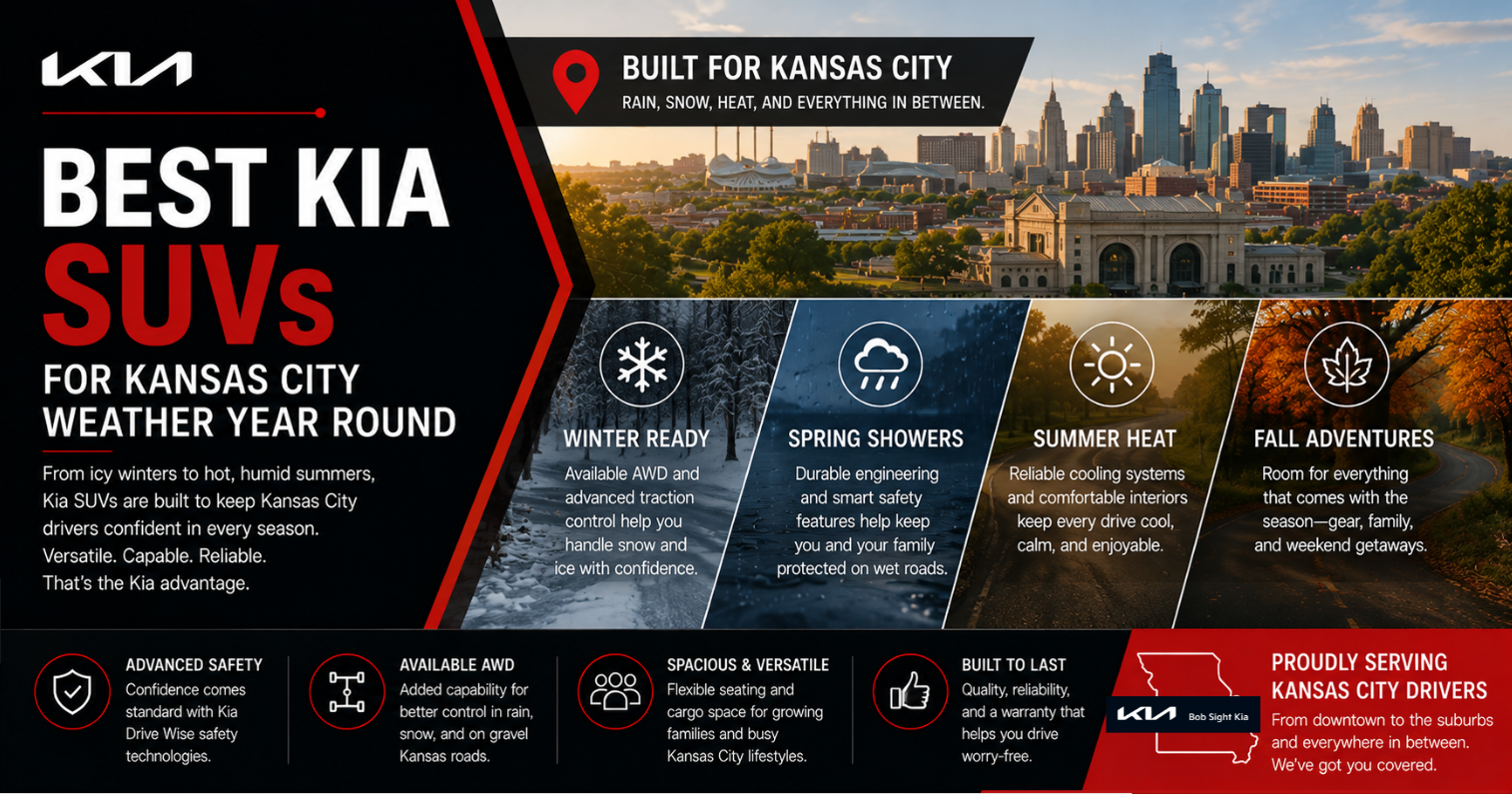
Bob Sight Kia graphic highlighting the best Kia SUVs for Kansas City weather year-round, featuring winter-ready AWD capability, spring wet-weather confidence, summer comfort, fall adventure versatility, advanced safety, and dependable performance for Missouri drivers in every season.

Best Kia SUVs for Kansas City Weather Year Round

Bob Sight Kia in Independence, MO provides the ultimate guide to the best Kia SUVs for Kansas City weather year round, helping drivers navigate freezing winter snow, torrential spring rains, and severe summer heat. Driving across Eastern Jackson County and the broader Kansas City metro area requires a versatile vehicle that delivers active all-wheel-drive traction, advanced climate control systems, high ground clearance, and robust mechanical durability. Whether you commute daily down Interstate 70, navigate suburban traffic near the Independence Center, or take weekend family trips through Lee's Summit and Blue Springs, selecting the right Kia crossover or SUV ensures year-round safety and comfort. Our local dealership provides expert guidance, live vehicle inventory, and factory-certified service to keep your family moving smoothly across all four Midwest seasons.

Explore New Kia SUV Inventory Near Kansas City

In This Guide You'll Learn

Here is what you will discover in this comprehensive guide to choosing the best Kia SUV for Kansas City's changing weather:

  • Why Kansas City's extreme temperature swings demand versatile all-wheel-drive capability and adaptive climate features.
  • How models like the Sportage, Sorento, Telluride, and all-electric EV9 manage severe winter ice and heavy summer downpours.
  • How Kia Dynamax All-Wheel Drive and driver-selectable terrain modes maintain continuous traction on slick Midwest highways like I-470.
  • A step-by-step guide to preparing your crossover for severe seasonal shifts between winter freezes and summer heat waves.
  • Clear comparisons between in-store showroom shopping and convenient online vehicle ordering for local buyers.
  • Plain-language explanations of essential weather-related automotive terms like torque vectoring, ground clearance, and synthetic oil viscosity.
  • Frequently asked questions regarding cold-weather battery health, all-weather tire recommendations, and factory warranty coverage.

Why Kansas City Weather Requires Year-Round SUV Versatility

Kansas City drivers require year-round SUV versatility because regional weather conditions shift rapidly between sub-zero winter freezes, heavy spring thunderstorms, and scorching summer heat waves. Commuting across Jackson County involves facing unpredictable road environments, from icy morning merges along Highway 291 to flooded suburban intersections after sudden downpours on US-50. A crossover or three-row SUV equipped with intelligent all-wheel drive, elevated ground clearance, and active safety sensors ensures consistent control through every weather scenario.

During winter months, freezing rain and heavy snowfall turn major commuter corridors like I-70 and I-470 into hazardous driving zones. Vehicles with low ground clearance or front-wheel-drive configurations can struggle to pull away from icy intersections or clear unplowed neighborhood streets in Blue Springs and Liberty. Having an SUV with electronic torque distribution and specialized Snow Modes gives drivers necessary traction and directional stability when road conditions deteriorate.

Spring downpours and summer heat waves present a different set of driving challenges across Eastern Jackson County. Heavy rainstorms create hydroplaning risks on high-speed highways, requiring deep tire tread channels and active electronic stability control to maintain road contact. Meanwhile, summer heat waves pushing ambient temperatures above 90 degrees Fahrenheit place immense thermal stress on engine cooling systems, air conditioning compressors, and 12-volt car batteries.

Furthermore, indoor cabin comfort plays a major role in driver wellness and reduced fatigue throughout the year. Features like multi-stage heated and ventilated front seats, heated steering wheels, dual-zone automatic climate control, and remote engine starting with cabin pre-conditioning make daily travel enjoyable regardless of outdoor temperatures. Choosing a Kia SUV engineered for these environmental demands guarantees long-term reliability and peace of mind for local families.

Top Kia SUVs for Managing Kansas City Seasons

The Kia crossover and SUV lineup offers specialized models engineered to handle Midwest weather, ranging from nimble subcompact crossovers to spacious three-row flagships. Each vehicle combines robust chassis construction, advanced climate technology, and available all-wheel-drive capability to ensure effortless performance across changing Midwest seasons.

For commuters seeking compact efficiency and agile winter maneuverability, the Kia Seltos subcompact SUV serves as an outstanding choice. The Seltos offers an available 195-horsepower turbocharged engine paired with Dynamax All-Wheel Drive featuring an electronic center-locking differential. With 7.3 inches of ground clearance, heated front seats, and up to 62.8 cubic feet of cargo space, the Seltos handles snowy neighborhood roads in Raytown while remaining easy to park in downtown Kansas City.

Stepping up to the midsize category, the Kia Sportage and three-row Kia Sorento offer expanded passenger space and diverse powertrain options. The Sportage features class-leading rear legroom of 41.3 inches, available 8.3 inches of ground clearance on X-Pro trims, and high-efficiency Hybrid (HEV) and Plug-in Hybrid (PHEV) powertrains. The Sorento adds 6- or 7-passenger seating flexibility, making it ideal for carpooling students to school during rainy spring mornings or snowstorms.

At the top of the lineup, the award-winning Kia Telluride and all-electric Kia EV9 represent the ultimate all-weather family cruisers. The Telluride boasts a robust 291-horsepower V6 engine, 8.4 inches of ground clearance, self-leveling rear suspension, and multi-terrain drive modes that make driving through winter blizzards or towing boats to Lake Jacomo effortless. Meanwhile, the EV9 provides futuristic three-row electric luxury, featuring dual-motor e-AWD, heat-pump battery warming systems, and instant electric torque for supreme ice traction.

Kia Dynamax All-Wheel Drive and Weather-Driving Technologies

Kia Dynamax All-Wheel Drive (AWD) uses electronic sensors to monitor road traction continuously and distribute engine torque between front and rear axles before wheel slip occurs. Unlike traditional four-wheel-drive systems that require manual driver engagement, Kia's intelligent AWD operates automatically in the background. By monitoring wheel speed, steering angle, and throttle input hundreds of times per second, the system maintains optimal road grip across wet, icy, or dry pavement.

When accelerating onto frozen highway ramps along Highway 350 or pulling away from slick traffic lights in Independence, Dynamax AWD instantly transfers up to 50 percent of engine torque to the rear wheels. This proactive torque distribution prevents front wheelspin, improves acceleration stability, and reduces uneven tire tread wear. During steady highway cruising on dry asphalt, the system routes power primarily to the front wheels to maximize fuel efficiency.

For severe off-road driving or heavy snow accumulation, models like the Sportage X-Pro, Sorento X-Pro, and Telluride X-Pro feature a driver-selectable AWD Lock Mode and Multi-Terrain Modes. Pressing the AWD Lock button locks the center differential, splitting torque evenly (50/50) between front and rear axles at low speeds for maximum traction through unplowed snowdrifts. Terrain modes calibrate engine throttle response, transmission shift points, and traction control parameters specifically for Snow, Mud, or Sand.

Additionally, active driver-assistance features work in harmony with the AWD hardware to protect your family during severe weather. Electronic Stability Control (ESC), Vehicle Stability Management (VSM), and Anti-Lock Brakes (ABS) intervene in milliseconds if a vehicle begins to skid on black ice. Automatic defogging systems continuously monitor windshield humidity, engaging the air conditioning compressor to clear fogged glass and preserve unobstructed driver visibility.

Step-by-Step Guide: How to Prepare Your Kia SUV for Midwest Seasonal Shifts

Preparing your Kia SUV for Midwest seasonal shifts involves conducting systematic fluid inspections, checking tire inflation pressures, and testing battery performance. Proactive vehicle care before extreme weather arrives prevents sudden roadside breakdowns and preserves long-term mechanical reliability. Below is a six-step seasonal preparation routine recommended by certified technicians at Bob Sight Kia.

  1. Monitor and Adjust Tire Pressures Monthly: Check cold tire inflation pressures using a digital gauge, adjusting levels to match the door-jamb PSI specification; tire pressure drops roughly 1 PSI for every 10-degree decrease in outdoor temperature.
  2. Inspect Tread Depth and Wear Patterns: Conduct visual penny tests across inner, center, and outer tread ribs, ensuring tread depth remains above 4/32 of an inch for safe wet-weather water evacuation and snow traction.
  3. Test 12-Volt Battery Cold-Cranking Amps (CCA): Have your battery load-tested at our service bay before severe summer heat waves or winter freezes to ensure adequate starting power and electrical voltage.
  4. Inspect and Replace Engine Oil with Synthetic Lubricants: Schedule regular oil changes using full-synthetic 0W-20 or 5W-30 motor oil meeting API SP standards to protect internal engine components against thermal breakdown.
  5. Replace Engine Air Filters and HEPA Cabin Filters: Swap out dirty cabin and engine air filters annually to maintain strong HVAC airflow velocity, ensure clear windshield defogging, and protect engine intake efficiency.
  6. Inspect Wiper Blades and Fill Washer Reservoirs: Replace streak-prone rubber wiper blades and keep windshield washer fluid reservoirs filled with freeze-resistant cleaning solution to handle road salt spray and summer bug splatter.
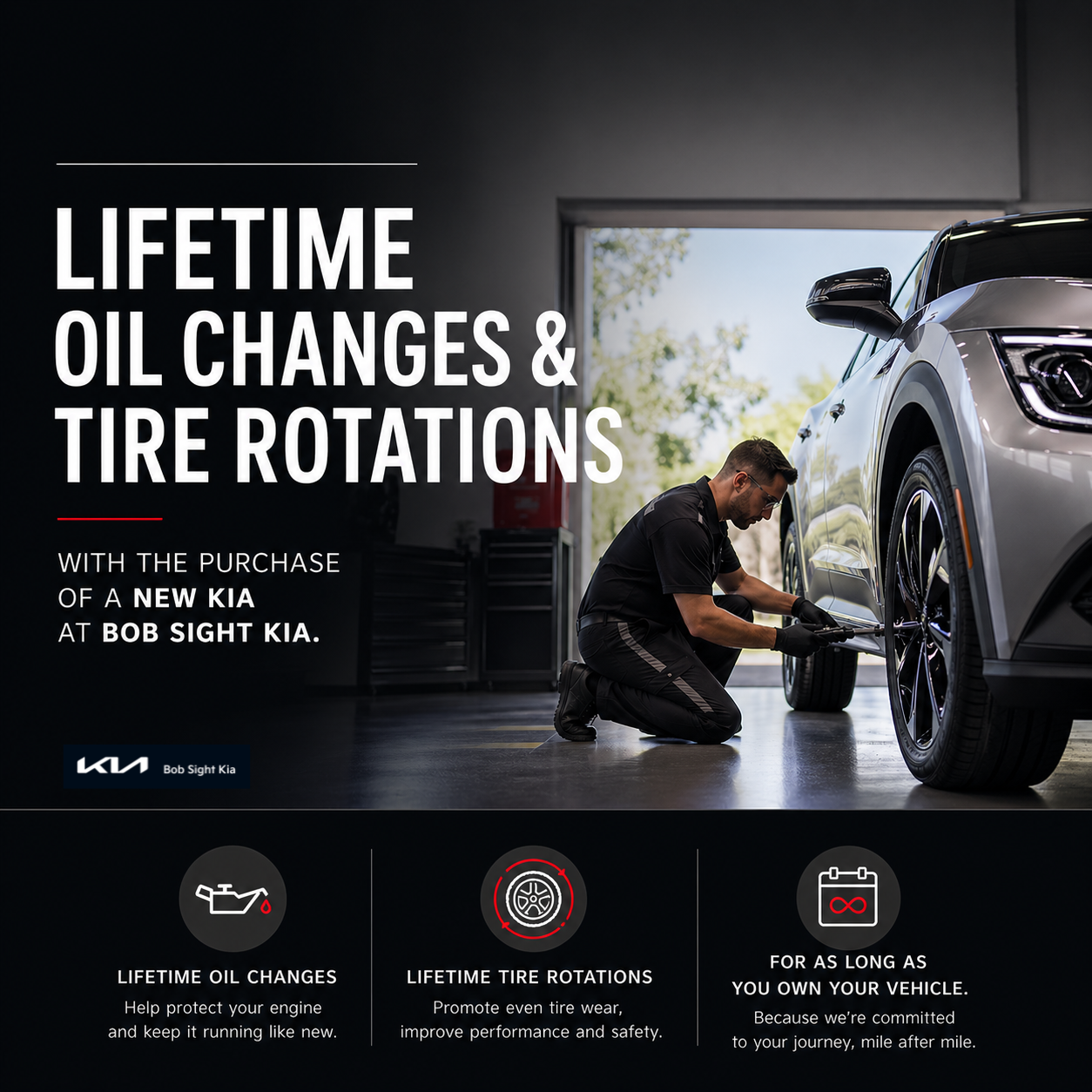
Bob Sight Kia service graphic highlighting lifetime oil changes and tire rotations for drivers in Independence MO

Comparing Buying Options: Purchasing In-Store vs. Digital Ordering

Choosing between an in-store showroom visit and digital online ordering allows Kansas City shoppers to structure their vehicle acquisition around personal schedule convenience and hands-on validation. Both purchasing paths deliver full access to new Kia inventory, transparent pricing, and competitive financing terms. Evaluating how each path operates helps local buyers select the shopping experience that best fits their expectations.

Visiting Bob Sight Kia in person provides the immediate benefit of physical vehicle evaluation and face-to-face expert guidance. Sitting in different trim levels, feeling SynTex versus genuine leather seating materials, and testing climate control response in real time cannot be replicated on a computer screen. Working directly with our knowledgeable brand specialists allows you to take immediate test drives along local roads like Highway 350 and receive instant, firm trade-in appraisals.

Shopping Feature / AspectIn-Store Showroom ExperienceDigital Online Purchasing
Vehicle EvaluationImmediate physical test drive and ergonomic fit check.Virtual 360-degree photo tours and digital spec reviews.
Delivery TimingDrive home same-day from live dealership inventory.Scheduled home delivery or convenient dealership pickup.
Trade-In ProcessIn-person physical inspection and firm trade offer.Digital condition assessment and remote valuation.
Personalized SetupHands-on tech orientation with a product specialist.Self-guided digital onboarding and video guides.

Conversely, utilizing our online purchasing tools allows busy parents in Liberty or Lee's Summit to complete vehicle research, structure financing, and apply for credit from home. Digital tools enable you to calculate monthly lease or loan payments, upload trade-in documentation, and customize protection packages on your personal schedule. Many customers prefer a hybrid approach, starting their financing online and visiting our Independence showroom for a final test drive.

Regardless of the shopping path you choose, Bob Sight Kia guarantees total pricing transparency and consistent customer support. We ensure that vehicle pricing, available incentives, and trade-in valuations remain clear whether negotiated online or in our showroom. Our goal is to deliver an enjoyable, stress-free experience from your initial search through vehicle delivery.

Understanding Weather-Related Automotive Terms: Ground Clearance, Viscosity, and Torque Vectoring

Grasping essential weather-related automotive terminology empowers vehicle buyers to evaluate specs and safety features with complete clarity. Technical terms can feel confusing without simple definitions. Below are plain-language explanations of vital automotive concepts every Missouri car buyer should understand.

Ground Clearance: Ground clearance is the distance between the lowest structural point of the vehicle chassis and the flat road surface beneath it. Higher ground clearance, such as the 8.4 inches found on the Kia Telluride, allows an SUV to clear deep unplowed snowdrifts, road debris, and standing water without scraping the underbody or damaging mechanical linkages.

Engine Oil Thermal Viscosity: Oil viscosity measures a lubricant's resistance to flow across varying operating temperatures, indicated by ratings like 0W-20. The first number (0W) indicates cold-flow fluidity during sub-zero winter restarts, while the second number (20) represents high-temperature protective thickness during hot summer highway driving. Using correct synthetic viscosity grades protects internal engine bearings from friction wear year-round.

Torque Vectoring All-Wheel Drive: Torque vectoring is an advanced electronic capability built into all-wheel-drive systems that actively manages power distribution to individual left and right wheels. By applying slight braking force to inner wheels or routing extra torque to outer wheels during sharp turns on wet or icy roads, torque vectoring counters understeer and keeps the vehicle tracking along its intended path.

Mastering these basic technical terms removes ambiguity during your vehicle search. Recognizing why ground clearance matters helps you choose the right SUV for winter neighborhood driving. Understanding synthetic oil viscosity guarantees proper maintenance care across all four Midwest seasons.

Step-by-Step Guide: Essential Seasonal Maintenance for Kansas City Drivers

Essential seasonal maintenance involves conducting targeted inspections before severe summer heat waves and winter freezes arrive across Missouri. Extreme climate shifts subject automotive components to continuous thermal expansion and contraction. Following these six simple maintenance steps keeps your Kia operating reliably year-round.

  1. Test 12-Volt Battery Voltage and Cold-Cranking Amps: Have your battery load-tested at Bob Sight Kia before winter cold or summer heat waves, replacing weak batteries before capacity loss leaves you stranded.
  2. Inspect Engine Coolant Freezing and Boiling Protection: Verify that engine coolant levels are full and test fluid chemical concentration to ensure proper freezing protection down to sub-zero temperatures.
  3. Rotate Tires Every 7,500 Miles: Rotate tires front-to-back and cross-wise during routine synthetic oil changes to balance out tread wear caused by front-wheel steering and braking forces.
  4. Inspect Brake Friction Pads and Hydraulic Fluid: Measure brake pad lining thickness in millimeters and check brake fluid for moisture contamination that could cause pedal fade during high-temperature summer driving.
  5. Perform Annual Four-Wheel Alignments: Have certified technicians inspect and adjust wheel alignment yearly to counteract steering pull and uneven tire wear caused by spring potholes along US-50.
  6. Clean Exterior Camera Lenses and Bumper Radar Sensors: Wipe front grille radar sensors, windshield camera housing, and rearview camera lenses clean after winter salting to ensure active safety systems operate accurately.

Quick Facts: Kia All-Weather Capabilities and Specifications

Kia crossovers and SUVs deliver industry-leading all-weather engineering, robust warranties, and advanced driver assistance systems. Summarized below are key operational statistics across the Kia all-weather lineup.

  • Elevated Ground Clearance: Up to 8.4 inches of ground clearance on rugged trims like the Telluride X-Pro for deep snow capability.
  • Intelligent Dynamax AWD: Proactive electronic torque distribution with driver-selectable AWD Lock and Snow Mode settings.
  • Advanced Battery Pre-Conditioning: Thermal management systems on electrified models like the EV9 preserve charging speed and cabin warmth in sub-zero cold.
  • Standard Active Driver Assistance: Includes Forward Collision-Avoidance Assist, Blind-Spot Collision-Avoidance, and Automatic Defogging Systems.
  • 10-Year/100,000-Mile Warranty: Unmatched factory powertrain warranty coverage that protects internal mechanical components through severe weather driving.

These standout metrics demonstrate why Kia crossovers and SUVs continue to earn top reliability awards and glowing reviews from Midwest families. Combining all-weather mechanical grip with high-tech cabin comfort and double the powertrain warranty duration of many competitors, Kia represents an exceptional overall value. Testing these features in person demonstrates why they lead their respective classes.

Ownership Planning: Preserving Long-Term Reliability and Resale Value

Long-term ownership success relies on choosing a vehicle backed by strong factory warranty coverage and maintaining complete service records at an authorized dealership. Purchasing an all-weather crossover is a significant financial investment intended to serve your household for many years. Partnering with a factory-certified dealership ensures your vehicle remains dependable while protecting its future trade-in value.

Kia's 10-Year/100,000-Mile Powertrain Limited Warranty provides unmatched financial peace of mind, covering critical engine, transmission, and drivetrain components against unexpected factory defects for a decade. Combined with a 5-Year/60,000-Mile Basic Warranty and 5-Year/Unlimited-Mileage 24/7 Roadside Assistance, Kia surrounds your family with complete protection across Missouri.

Maintaining your vehicle at Bob Sight Kia's certified service center ensures that all service work is performed by factory-trained technicians using genuine OEM Kia replacement parts. Keeping complete digital service records at an authorized facility preserves full warranty protection and commands a premium price when you eventually trade in your vehicle. Potential pre-owned buyers value documented dealership care above all else.

For drivers who purchase a new Kia SUV at Bob Sight Kia, our exclusive lifetime oil changes and tire rotations program delivers incredible ongoing savings. Covered oil changes and tire rotations eliminate out-of-pocket routine maintenance expenses, making it easy to keep your vehicle running at peak efficiency. This valuable program reinforces our commitment to supporting your family throughout your entire ownership journey.

Frequently Asked Questions

What is the best Kia SUV for driving in winter snow and ice around Kansas City?

The best Kia SUV for winter snow and ice in Kansas City is any model equipped with Kia Dynamax All-Wheel Drive, such as the Sportage X-Pro, Sorento X-Pro, or Telluride X-Pro. These models combine intelligent proactive torque distribution with elevated ground clearance up to 8.4 inches, enabling them to clear unplowed snowdrifts and maintain grip on ice-coated asphalt. Specialized Snow Mode settings refine throttle sensitivity and transmission shift logic specifically for slick roads.

Equipping your vehicle with dynamic AWD allows the drivetrain to automatically send up to 50 percent of engine torque to the rear wheels the moment front wheel slip is detected. This seamless intervention provides stable acceleration when pulling onto icy intersections near the Highway 291 split or climbing steep neighborhood hills during winter storms. Paired with standard vehicle stability management systems, these crossovers deliver exceptional traction across all four seasons.

From a local driving perspective, winter road maintenance in Jackson County often leaves thick slush and hidden black ice along major commuter corridors like I-470. Having an SUV engineered with intelligent all-wheel drive, heated side mirrors, and automatic defogging systems ensures clear visibility and total driver control. Taking advantage of multi-terrain drive modes gives local drivers total confidence regardless of winter weather forecasts.

How do Kia hybrid and electric SUVs perform in freezing winter weather?

Kia hybrid, plug-in hybrid, and electric SUVs like the EV9 perform exceptionally well in freezing winter weather, utilizing advanced thermal management systems, battery heaters, and electronic AWD. Electrified Kia SUVs automatically monitor battery temperatures and utilize integrated warm-up modes to preserve driving range and charging efficiency in freezing temperatures.

Models like the EV9 and Sportage PHEV incorporate available energy-saving heat pumps that scavenge waste heat from electrical components to warm the passenger cabin without draining the drive battery. Pre-conditioning features allow owners to warm the vehicle interior and battery pack while connected to home chargers before departing in the morning. This ensures full regenerative braking performance and optimal cabin warmth right from startup.

Furthermore, instant electric motor torque combined with electronic all-wheel drive delivers exceptional traction on slick, icy roads. Drivetrain systems can modulate power to individual wheels in milliseconds, preventing wheelspin on unplowed suburban streets in Blue Springs or Liberty. Driving a Kia hybrid or electric SUV provides winter confidence alongside impressive fuel savings.

Are all-season tires sufficient for Kansas City winter driving on a Kia SUV?

Yes, high-quality factory all-season tires combined with Kia Dynamax All-Wheel Drive are sufficient for most Kansas City winter driving conditions. Factory all-season tires feature tread patterns designed to channel away light snow, slush, and rainwater while maintaining long tread life during hot summer months.

However, for drivers living in rural areas of Eastern Jackson County or those who commute early in the morning before snowplows clear major highways like US-50, upgrading to 3-Peak Mountain Snowflake (3PMSF) rated all-weather tires provides superior winter grip. All-weather tires utilize specialized rubber compounds that remain flexible in sub-zero temperatures, shortening braking distances on packed snow and ice.

Checking tire tread depth regularly and maintaining proper cold inflation pressures is critical for winter safety. Our service department at Bob Sight Kia inspects tire condition during routine maintenance, ensuring your tires retain sufficient tread depth to navigate Midwest winters safely.

How does the Kia 10-Year/100,000-Mile Warranty protect buyers against severe weather wear?

The Kia 10-Year/100,000-Mile Powertrain Limited Warranty protects buyers by covering major internal engine, transmission, and all-wheel-drive mechanical components against factory defects for a full decade. Severe weather driving places extra thermal loads on cooling systems, transfer cases, and drive axles, making long-term warranty protection essential for peace of mind.

In addition to powertrain coverage, every new Kia includes a 5-Year/60,000-Mile Bumper-to-Bumper Limited Warranty covering electronics, climate control systems, digital displays, and suspension hardware. Complimentary 24/7 Roadside Assistance is also included for five years with unlimited mileage. If your family experiences a dead battery, flat tire, or lockout during a winter storm, factory dispatch support is available with a simple phone call.

Having long-term warranty coverage ensures your family transportation remains secure without sudden maintenance stress. Bringing your vehicle to Bob Sight Kia for certified service keeps all warranty conditions active while preserving maximum trade-in value. This bulletproof coverage allows parents to focus on family life with complete peace of mind.

Why Buying Local at Bob Sight Kia Matters for Kansas City Drivers

Purchasing and servicing your all-weather SUV at Bob Sight Kia in Independence, MO ensures personalized customer care, factory-certified maintenance, and long-standing community support. Choosing a local, family-owned dealership guarantees that your crossover is supported by certified technicians who understand the exact technical specifications of your Kia model. Our state-of-the-art facility features specialized diagnostic equipment, genuine OEM parts, and factory-trained staff dedicated to keeping your family safe on the road.

Unlike distant online car sellers or third-party auto retailers, Bob Sight Kia provides ongoing support throughout your entire ownership journey. When your Sportage, Sorento, or Telluride requires routine synthetic oil changes, tire rotations, brake service, or state safety inspections, our service department provides fast, transparent care. We offer comfortable customer lounges with complimentary Wi-Fi and shuttle services to make service visits easy for busy parents in Independence, Blue Springs, and Lee's Summit.

Furthermore, supporting Bob Sight Kia reinvests your dollars directly back into Eastern Jackson County, supporting local employment and community initiatives. Whether you reside in Independence, Lee's Summit, Blue Springs, Liberty, or Raytown, visiting our showroom allows your family to test drive our all-weather SUV lineup, explore trade-in options, and experience premier service. Visit Bob Sight Kia today to discover why we are the top choice for Kansas City drivers seeking year-round vehicle capability.

Helpful Links

Explore these essential links on our website to research Kia all-weather SUV inventory, value your trade-in, or schedule a test drive:

PROUD TO BE PART OF THE BOB SIGHT AUTO GROUP

Bob Sight Kia is a proud member of the Bob Sight Auto Group, a family-owned automotive network dedicated to serving drivers across Missouri and Kansas for generations. Grounded in integrity, transparency, and outstanding customer service, our auto group provides comprehensive inventory choices, competitive financing options, and factory-certified service across multiple locations in the region.

Explore our entire dealer group network below:

Posted in:

Related Posts

See what Trust Is Our Tradition means at Bob Sight Kia in Independence, MO, from clear vehicle comparisons and helpful answers to ongoing ownership support.

Trust Is Our Tradition at Bob Sight Kia in Independence, MO

Trust Is Our Tradition: What That Means When You Shop at Bob Sight Kia Browse New Kia Vehicles in Independence, MO At Bob Sight Kia in Independence, MO, “Trust Is Our Tradition” describes the relationship we want to build with you, starting with your first question and continuing through ownership. Shopping for a vehicle involves decisions about transportation, family routines, financing, and maintenance. You deserve clear explanations throughout that process. Whether you are visiting from Blue Springs, Lee’s Summit, Raytown, or another Kansas City Metro community, our goal is to help you understand your options and choose a Kia that fits your life. In This Guide You’ll Learn How listening to your needs creates a more useful shopping experience. What clear communication looks like when comparing Kia vehicles. Why understanding equipment and purchase documents matters. How to prepare for trade-in and financing conversations. What to ask about ownership benefits and maintenance. How a local dealership relationship can support you after delivery. Trust Starts With Listening to What You Need “Trust Is Our Tradition” starts with understanding how you will use your next vehicle. Your daily needs should guide the conversation about models, equipment, and next steps. You may arrive knowing the exact Kia you want, or you may only know what your current vehicle no longer does well. Both are useful starting points. Tell us whether you need easier passenger access, more room for equipment, or a vehicle that feels comfortable during a longer commute. Those details make the discussion more relevant than simply beginning with a list of available features. For example, an Independence driver traveling along Noland Road each morning may prioritize visibility, seat comfort, and straightforward controls. A family coming from Grain Valley may need to check how a stroller fits with the passenger seats in use. Someone replacing a vehicle after many years may want extra time to understand newer technology. Each situation calls for different questions. A helpful shopping conversation also recognizes the difference between a requirement and a preference. Space for your regular passengers may be essential, while a particular interior color may be flexible. Identifying those priorities early gives you a practical way to compare vehicles. It also helps you explain why one option feels more suitable than another. Before visiting Bob Sight Kia, think about what you would change about your current vehicle. Bring those observations into the conversation, even if they seem small. Difficulty reaching a control or loading a weekly grocery order can matter more in daily ownership than an unfamiliar feature name. Trust grows when the discussion stays connected to the life you actually lead. Clear Answers Make Kia Vehicle Comparisons More Useful A trustworthy vehicle comparison explains what each Kia includes and how those differences relate to your priorities. Model names alone do not tell you everything about a specific vehicle. Equipment can vary by model year, trim, package, and individual configuration. A trim is a version within a model lineup with a particular combination of equipment. A package can add a group of features to certain configurations. When a feature matters to your decision, check the window sticker and ask to see it on the actual vehicle. This matters when researching vehicles such as the Kia K4, Sportage, Sorento, Telluride, or Carnival. A model-level description may mention available equipment without saying that every version includes it. Ask whether the Kia you are considering has the feature, how it works, and whether you can try it. That turns a broad advertising statement into information you can use. A Blue Springs shopper comparing two SUVs might find that passenger access matters more than expected. A commuter from Raytown might discover that a different seating position feels better during the test drive. Neither observation is something a specification list can fully answer. Taking time to examine the vehicle helps you compare it against your own needs. Start with our new Kia inventory, then save the vehicles that interest you. Bring questions about equipment that is unclear in the listing. If you are also considering a previously owned vehicle, review its individual condition and history information separately. Clear answers should help you understand the specific vehicle rather than rely on assumptions about the model. A Test Drive Should Help You Answer Real Questions A useful test drive gives you time to evaluate comfort, visibility, controls, and everyday practicality. It should help you decide whether the vehicle works for you. Begin while the Kia is parked. Adjust the seat and mirrors, check how comfortably you reach the controls, and make sure you understand the basic driving functions. Ask for a demonstration before trying unfamiliar technology. Learning the layout first lets you give the road your attention once the drive begins. Think about the conditions you encounter regularly around Independence. You may spend time in traffic near Independence Center, park in a narrow garage, or carry passengers on weekend outings. Explain those needs when discussing the test drive. Ask what route is available and use the opportunity to observe the vehicle in ordinary driving situations. Passenger and cargo checks are useful before or after the drive. Sit in the seats your household expects to use and examine how easily people can enter and exit. Bring measurements for larger items or test their fit when practical. A vehicle that looks right online still needs to work for the people and belongings you transport. Adjust the driver’s position and confirm comfortable access to important controls. Ask for an explanation of unfamiliar features before driving. Observe visibility, seating comfort, and the driving experience on the available route. Check passenger access and cargo space with your normal needs in mind. Review unanswered questions with the team before deciding on the next step. You do not need to remember every detail immediately. Make a few notes after the vehicle is safely parked. Compare your impressions against your original priorities. That helps you make a considered decision based on what you experienced. Understanding the Purchase Matters as Much as Choosing the Vehicle Clear purchase communication means understanding what you are agreeing to before you sign. Questions about documents, optional products, and vehicle details deserve direct explanations. A vehicle purchase can involve several documents with different purposes. Some identify the vehicle and transaction, while others relate to financing or separately selected products. Ask the team to explain any document you do not recognize. Knowing what each agreement does makes the overall process easier to follow. Optional products should also be understood individually. For example, a service contract is a separate agreement describing specified coverage, conditions, and exclusions. It is different from the manufacturer’s warranty and from routine maintenance benefits. Review what a product covers, whether you want it, and the terms that apply before making your selection. If you are comparing qualifying local offers, our Price Match Promise provides published comparison requirements. Review those requirements and bring the complete written offer for the team to examine. The comparison depends on matching vehicle details and meeting the program terms. A screenshot that omits important information may leave questions unresolved. For a shopper visiting from Oak Grove, preparing documents and questions beforehand can make the conversation more focused. Save the listing for the Kia you want and identify any details you need clarified. Read the final documents carefully, even when a topic has already been discussed. Trust is supported by information you can understand and review. Trade-In and Financing Questions Belong in the Conversation You should understand how your current vehicle and any financing agreement fit into the purchase. Preparing a few details beforehand makes these discussions easier to follow. A trade-in is a vehicle you offer as part of a transaction for another vehicle. An appraisal evaluates that vehicle using factors such as mileage, condition, equipment, and market demand. If you have an existing loan, its payoff is a separate consideration. The appraisal and the outstanding loan balance serve different purposes and should be explained clearly. Our trade-in resource gives you a place to begin gathering information. Provide accurate details and note known issues with the vehicle. Have your lender information available if a loan remains. Ask what must be verified before a final appraisal or transaction can be completed. Financing involves a borrowing agreement, and approval depends on lender review of your application. Available terms vary with the individual situation. Ask the team to explain the proposed agreement and any unfamiliar wording. You can review our finance department information before visiting. Gather your current vehicle’s mileage and identifying information. Locate ownership documents and lender details, if applicable. Write down questions about the appraisal and any remaining loan. Ask which documents are needed for your financing application. Review each agreement and resolve questions before signing. A Lee’s Summit driver trading a vehicle with an existing loan may need different guidance from a first-time buyer in Sugar Creek. Explain your circumstances early. You do not need to arrive knowing every term. The conversation should help you understand the steps that apply to you. Ownership Planning Begins Before You Drive Home Trust continues when you understand your vehicle, included benefits, and maintenance needs before leaving the dealership. Delivery day is a useful time to establish that foundation. Bob Sight Kia offers lifetime oil changes and tire rotations with new Kia purchases under the program’s terms. Ask how the program works for your purchase, where included services are performed, and how to arrange visits. Keep the written details with your purchase records. Understanding the benefit at the beginning makes it easier to use later. Included oil changes and tire rotations are part of an ownership plan rather than a replacement for all maintenance. Your Kia may need other scheduled services based on its model, age, mileage, and use. The owner’s manual contains vehicle-specific maintenance information. Ask how your driving habits affect the schedule that applies to you. For example, frequent short trips around Jackson County can create a different usage pattern from regular longer highway drives. Describe how you expect to use the vehicle instead of relying only on an annual mileage estimate. Ask about service reminders and where to find the maintenance information. Keep records showing dates, mileage, and completed work. Before driving home, review the controls you expect to use immediately. That may include climate settings, phone connection, lighting, and the location of important vehicle information. If a question comes up later, contact the dealership for guidance. When maintenance is due, our online service scheduler provides a convenient starting point. Quick Facts About Trust Is Our Tradition at Bob Sight Kia “Trust Is Our Tradition” connects the shopping experience with clear information and ongoing local support. These points can help you prepare for your visit to Bob Sight Kia. Our dealership is located at 1700 South Noland Road in Independence, Missouri. Your passenger, cargo, comfort, and driving needs should guide vehicle comparisons. Important equipment should be verified on the specific Kia you are considering. Trade-in appraisals and existing loan payoffs are separate parts of the discussion. New Kia purchases include lifetime oil changes and tire rotations under program terms. Ownership planning includes understanding maintenance, keeping records, and knowing where to ask questions. Whether you are visiting from Independence or traveling from another Kansas City Metro community, bring the questions that matter to you. A useful dealership visit should leave you with a clearer understanding of your options. Frequently Asked Questions About Shopping at Bob Sight Kia What does Trust Is Our Tradition mean at Bob Sight Kia? “Trust Is Our Tradition” expresses Bob Sight Kia’s commitment to relationships built on clear communication and ongoing support. During shopping, that starts with understanding your needs. It continues through vehicle comparisons and purchase discussions. You should understand the information that affects your decision. Trust becomes practical when you can ask questions about equipment or documents. Ask for demonstrations and explanations whenever something is unclear. Confirm important details on the specific vehicle. Keep the written information that applies to your purchase. For Independence shoppers, the relationship can continue through maintenance and ownership questions. You may need help finding a setting or arranging a service visit. A local point of contact makes those conversations easier to begin. That ongoing connection gives the phrase meaning beyond delivery day. Can I visit Bob Sight Kia if I am still researching? Yes, you can contact or visit Bob Sight Kia while you are still comparing vehicles. You do not need to know the exact trim before asking questions. Explain what you need from your next vehicle. The discussion can begin with your daily routine. Research is often more useful when you combine online information with an in-person check. Seat comfort and cargo access are difficult to judge from photographs alone. Save a few listings before visiting. Confirm availability if you want to examine a particular vehicle. A Blue Springs family might need to compare passenger space before narrowing its options. A Raytown commuter might want to try different seating positions. Those are reasonable reasons to visit during research. Bring your priorities so the conversation stays focused. What should I bring when shopping at a Kia dealership near me? Bring your questions, saved vehicle listings, and any information relevant to a planned trade-in. Contact the dealership to confirm what is needed for a test drive or transaction. Requirements can depend on what you intend to complete. Preparing helps you use the visit effectively. If you plan to trade a vehicle, gather its mileage and ownership information. Have lender details available if an existing loan remains. Bring a qualifying written competing offer if you want it reviewed. Keep your questions organized by vehicle, trade-in, and financing. For a shopper traveling from Grain Valley, confirming vehicle availability can prevent an unnecessary trip. Let the team know which models you want to compare. Mention practical checks such as cargo fit or passenger access. Those details help shape a more useful visit. How does Bob Sight Kia support owners after the purchase? Bob Sight Kia provides a local resource for service scheduling and questions about your vehicle. New Kia purchases also include lifetime oil changes and tire rotations under program terms. Review those details during the purchase. Keep them accessible for future reference. Your owner’s manual remains important throughout ownership. Use it to locate model-specific information and maintenance requirements. Keep service records and note questions as they arise. Contact the dealership when you need help understanding the next step. A Kansas City Metro owner may have different needs as driving habits change. A new commute or a change in household routines can affect vehicle use. Share those changes when discussing maintenance. Ongoing communication helps keep ownership planning relevant. Shop at Bob Sight Kia With Your Questions Welcome At Bob Sight Kia in Independence, “Trust Is Our Tradition” means making clear communication part of the entire customer relationship. Your questions help guide that relationship from the start. Begin with the vehicle needs you know and the decisions you still want help understanding. Compare the actual equipment, take a purposeful test drive, and review the documents that apply to your purchase. Ask how included benefits work and how to arrange future service. Each step helps you move forward with useful information. Whether your daily drive takes you along Truman Road, across Independence, or between surrounding communities, your next Kia should fit that routine. Our team is here to discuss your options and help you understand the details. Explore our inventory and bring your questions to Bob Sight Kia. Trust starts with that conversation and continues through ownership. Helpful Links Browse New Kia Vehicles at Bob Sight Kia Review Our Price Match Promise Prepare for Your Trade-In Explore Financing Information Schedule Kia Service in Independence Proud to Be Part of the Bob Sight Auto Group Bob Sight Kia serves Independence, Missouri, and the Kansas City Metro as part of the Bob Sight Auto Group. Our dealership family includes Ford in Lee’s Summit, Kia in Independence, and Honda and Chrysler Dodge Jeep Ram in Lawrence, Kansas. Bob Sight Collision Center also serves Lee’s Summit and surrounding communities. Together, these locations connect local drivers with vehicle shopping and automotive support. Bob Sight Kia in Independence, MO Bob Sight Ford in Lee’s Summit, MO Bob Sight Honda in Lawrence, KS Bob Sight Chrysler Dodge Jeep Ram in Lawrence, KS

Driver holding Kia smart key fob attempting remote start on a frosty winter morning in Independence MO

How Freezing Temperatures Affect Kia Key Fob Range Remote Start

How Freezing Temperatures Affect Kia Key Fob Range and Remote Start When winter temperatures drop across Jackson County, Kia drivers may notice that their key fob does not respond as consistently as it did during warmer weather. Perhaps the doors unlock only when you stand closer to the vehicle, remote start works intermittently, or your Kia displays a smart key battery warning on a particularly cold morning. For drivers in Independence, Blue Springs, Lee's Summit, and the greater Kansas City metro, these situations can be frustrating when preparing for a winter commute. However, a key fob that responds poorly in freezing weather does not automatically mean the vehicle's receiver or remote-start system has failed. Cold temperatures can affect the performance of small batteries, including the coin-cell batteries used in many Kia smart keys. Winter conditions can also reveal weaknesses in the vehicle's 12-volt battery, while distance, physical obstructions, and electronic interference may influence remote command reception. Understanding these different factors can help you identify whether the concern involves the key fob, the vehicle's electrical system, remote-start operating conditions, or a connected service. At Bob Sight Kia in Independence, Missouri, our service department helps drivers address battery concerns, electrical system problems, and vehicle technology questions. Whether you travel along Interstate 70, Highway 291, or neighborhood streets throughout Jackson County, knowing how your Kia's keyless entry and remote-start features operate can make winter vehicle ownership easier. Schedule Kia Electrical System Service in Independence, MO In This Guide You'll Learn This guide explains the factors that can influence Kia key fob and remote-start performance during freezing weather. Why cold temperatures can reduce the performance of an aging key fob battery How key fob battery condition differs from radio signal transmission Why distance, walls, metal structures, and interference can affect remote commands Which vehicle conditions may prevent remote start from operating How key fob remote start differs from Kia Connect remote services How to identify the correct replacement key fob battery What to do when a Kia smart key battery is depleted Why the vehicle's 12-volt battery matters during winter When professional electrical diagnosis may be necessary The Electrochemistry of Cold Key Fob Batteries One of the most common explanations for reduced key fob performance during cold weather involves the battery inside the remote. Many Kia smart keys use a small lithium coin-cell battery to power their electronic functions. The exact battery type depends on the key design and vehicle application. These batteries generate electrical energy through chemical reactions inside the cell. When temperatures decrease, battery performance can change because the electrochemical processes responsible for delivering current become less effective under certain conditions. Why Cold Temperatures Affect Coin-Cell Batteries A battery's ability to deliver electrical current depends partly on temperature. At lower temperatures, internal resistance may increase, limiting the current available to connected electronic components. This effect can become more noticeable in an aging battery that already has reduced remaining capacity. When you press a button on the key fob, the electronic circuitry requires sufficient electrical power to process the command and operate the transmitter. If the battery cannot deliver the necessary power consistently, the fob may respond intermittently or stop functioning. However, a cold key fob does not necessarily have a permanently damaged battery. Battery performance may improve when the battery returns to a moderate temperature, although warming cannot restore capacity that has already been consumed through normal use. Why an Aging Battery May Show Problems First A relatively healthy key fob battery may continue functioning normally during winter. An older battery with limited remaining capacity may be more sensitive to the additional performance demands associated with low temperatures. Drivers may notice that the remote works reliably indoors but becomes inconsistent after being left in a cold coat pocket or garage. These symptoms can suggest that the battery should be checked or replaced. They do not prove that cold temperature is the only cause. Does Cold Weather Actually Reduce Key Fob Signal Range? Cold weather can indirectly reduce effective key fob range if the battery is unable to provide sufficient power for reliable operation. However, freezing temperatures do not meaningfully slow the radio waves traveling between the key fob and vehicle. The signal travels at essentially the same speed regardless of ordinary winter air temperatures. What may change is the reliability of the transmitter's operation when its power source is weak. There is no universal distance by which a Kia key fob's range decreases in freezing weather. Actual performance depends on the vehicle, remote, battery condition, surroundings, and interference. Should You Keep Your Kia Key Fob Indoors? Storing your key fob in a dry indoor location can help avoid prolonged exposure to extreme temperatures and moisture. It also reduces the chance of leaving the key inside an unattended vehicle. However, indoor storage does not guarantee maximum signal range or eliminate the need for battery replacement. If your key fob repeatedly becomes unreliable, checking the battery is a reasonable first troubleshooting step. How Cold Weather Impacts Radio Frequency Transmission Kia key fobs use wireless communication to send commands to compatible vehicle systems. Depending on the vehicle and function, these systems may involve different radio frequencies, antennas, and communication methods. While key fob batteries can be affected by cold, ordinary freezing weather is not itself a reliable explanation for substantial radio signal loss. Distance Between the Key Fob and Vehicle Remote commands become less reliable as the distance between the transmitter and receiver increases. The maximum operating distance depends on the specific vehicle and key system. If a key fob works near your Kia but not from farther away, distance may be contributing to the problem. A weak battery can also make reliable operation more difficult under marginal conditions. Buildings, Garage Doors, and Metal Structures Physical obstructions can affect wireless communication. Metal garage doors, reinforced building materials, parking structures, and other barriers may reduce signal strength or change how radio waves reach the vehicle. For example, a Kia parked outside a home in Independence may respond differently when the remote is used from the driveway compared with a room separated by several walls. This difference does not necessarily indicate a malfunction. Electronic Interference Wireless devices and nearby electronic equipment can sometimes interfere with keyless entry systems. Interference may be more noticeable in certain parking areas or near equipment that operates on overlapping or related frequencies. If your key fob works normally in most locations but becomes unreliable in one particular parking lot, the surrounding environment may be worth considering. What About Snow and Ice on the Vehicle? Snow, ice, and moisture can affect vehicle components in several ways. However, it is misleading to claim that a normal layer of frost on a windshield will consistently reduce Kia key fob range by a specific amount. Signal behavior depends on the complete environment, including nearby metal surfaces, barriers, transmitter location, and receiver design. When troubleshooting poor range, checking the battery and reducing distance or obstructions is generally more useful than assuming frost is blocking the signal. Practical Ways to Test Key Fob Range If your Kia key fob appears less responsive during winter, try a few basic observations. Test the remote from a shorter distance in a safe location. Compare performance when fewer walls or other barriers separate you from the vehicle. Check whether the problem occurs in multiple parking locations. Look for a low smart key battery warning, if your model provides one. Try a properly functioning spare key, if available. Verify the battery type and replacement procedure in the owner's manual. These observations may help distinguish a weak key battery from an environmental or vehicle-related issue. If the problem continues after replacing the correct battery, further diagnosis may be needed. Why Your Kia Remote Start Might Not Engage A Kia remote-start system may refuse a command even when the key fob itself is functioning. This is because remote start depends on more than wireless communication. The vehicle must also meet the operating conditions established for its particular remote-start system. These conditions vary by model, model year, equipment, and whether the feature uses a factory key fob or a connected service. Low Vehicle Battery Charge Cold weather can reduce the available performance of a vehicle's 12-volt battery. At the same time, starting an internal combustion engine may require more electrical effort in very cold conditions. A weak 12-volt battery can contribute to slow cranking, starting difficulty, or electrical system problems. Some remote-start systems may restrict operation when vehicle electrical conditions do not meet their requirements. However, there is no universal 11.8-volt remote-start cutoff that applies to every Kia. If remote start fails and the vehicle also cranks slowly during normal starting, battery testing may be appropriate. Doors, Hood, and Other Vehicle Conditions Factory remote-start systems may require certain doors, the hood, or other components to be properly secured. The exact requirements depend on the vehicle. A hood switch or other input that reports an open condition may prevent remote-start operation on some models. Drivers should review their owner's manual for the specific operating requirements. Transmission and Vehicle Readiness Conditions Remote-start systems may require the transmission to be in Park and the vehicle to meet other readiness conditions. Some systems also have restrictions involving ignition state, security status, or previous remote-start activity. These are vehicle-specific conditions rather than universal Kia rules. Warning Lights and Diagnostic Faults Certain vehicle faults may interfere with remote-start operation. However, not every illuminated warning light automatically disables every Kia remote-start system. The relationship between diagnostic faults and remote-start availability depends on the vehicle and system design. If a warning light is present, address the underlying vehicle concern rather than assuming the key fob is defective. Fuel Level and Remote-Start Duration Some remote-start systems have fuel-level restrictions or automatic shutoff timers. The exact conditions and duration vary. It is not accurate to assume that every Kia remote-start cycle lasts exactly 10 minutes or that all systems permit the same number of consecutive starts. Consult the owner's manual or the applicable Kia Connect documentation for your vehicle's operating limits. Why Flashing Hazard Lights Are Not a Universal Error Code Some vehicles provide exterior-light feedback when a remote command is received or processed. However, the meaning of a particular flash pattern depends on the vehicle and system. Two hazard-light flashes should not automatically be interpreted as proof that the vehicle rejected remote start because of a specific mechanical fault. Use the model-specific operating instructions when interpreting remote-start feedback. What to Check Before Scheduling Service If your Kia remote start is not responding, consider the following: Confirm that your vehicle is equipped with the remote-start feature you are attempting to use. Verify that you are following the correct button sequence or app procedure. Check whether the key fob operates the locks normally. Confirm that the vehicle is parked and secured according to the owner's manual. Review any warning messages or active vehicle concerns. Check the vehicle's 12-volt battery condition if other starting symptoms are present. Review Kia Connect activation and connectivity if using the app. If the issue continues, a professional inspection can help determine whether the concern involves the remote, vehicle battery, control system, or another component. Key Fob Remote Start vs. Kia Connect Smartphone App Some Kia vehicles offer remote-start functionality through the factory key fob, Kia Connect, or both. These systems use different communication methods and may have different requirements. Availability depends on the vehicle's model, model year, equipment, market, and connected-service eligibility. How Key Fob Remote Start Works Factory key fob remote start sends a wireless command directly from the remote to the vehicle. The command must be received successfully, and the vehicle must meet the conditions required for remote starting. Because this method uses direct radio communication, operating distance and surrounding obstructions matter. A key fob with a weak battery may also respond inconsistently. Key fob remote start does not inherently require a smartphone or cellular service. How Kia Connect Remote Start Works On compatible vehicles with eligible and active Kia Connect services, a smartphone app may allow the driver to request certain remote vehicle functions. Instead of relying on direct short-range communication from a key fob, the app sends commands through connected services and the vehicle's supported communication system. Successful operation depends on factors such as account status, service availability, network connectivity, and vehicle readiness. Remote commands may not work if the vehicle is outside supported coverage, has insufficient electrical power, or does not meet the required operating conditions. Kia Connect is not universally available on every Kia model, and feature availability can change based on the vehicle and service arrangement. Can Kia Connect Preheat the Cabin? Some compatible Kia vehicles support remote climate-related functions through Kia Connect. Available controls may include climate settings or other comfort features, depending on the model and equipment. However, not every vehicle supports remote heated-seat activation, rear defroster control, or the same climate customization options. Drivers should check the features available for their specific Kia rather than assuming all connected vehicles provide identical controls. Which Remote-Start Method Is Better in Winter? Neither method is universally more reliable in every situation. Key fob remote start may be convenient when the vehicle is nearby and direct radio communication is available. Kia Connect may offer additional convenience on supported vehicles when the connected service and network conditions are functioning. Both methods still depend on the vehicle being capable of completing the requested operation. A weak vehicle battery or unmet operating condition may affect either method. Step-by-Step: Replacing a Kia Key Fob Battery and Handling a Depleted Smart Key A weak key fob battery is often a relatively straightforward issue to investigate. However, Kia has used different key designs across its vehicle lineup. The correct battery, mechanical key access method, and backup starting procedure depend on the specific vehicle. Step 1: Identify Your Kia Key Fob Design Before opening the remote, review the owner's manual for your vehicle. Identify whether your key is a conventional remote, a smart key, or another supported design. Some Kia keys contain a removable mechanical key blade. Others have different access or emergency operation procedures. Step 2: Verify the Correct Battery Type Many automotive smart keys use lithium coin-cell batteries, including common types such as CR2032 or CR2025. However, these batteries are not interchangeable in every application. Use the battery type specified for your particular key. Do not select a replacement based only on the assumption that all Kia smart keys use the same battery. Step 3: Open the Key Fob According to the Manual Some key fobs have a release mechanism for the mechanical key and a designated opening point for the battery compartment. Follow the owner's manual instructions to avoid damaging the housing, internal contacts, or seals. Do not force the casing open or use excessive pressure against the circuit board. Step 4: Install the New Battery Correctly Remove the old battery according to the specified procedure. Install the replacement with the polarity indicated by the battery holder or manufacturer's instructions. Do not assume that the positive side faces upward in every key design. Avoid bending the battery contacts or contaminating the interior of the remote. Keep loose coin-cell batteries away from children and pets. Swallowed button or coin batteries can cause severe internal injuries and require immediate emergency medical attention. Step 5: Test the Remote After reassembling the key, test the lock and unlock functions in a safe location. If the vehicle supports key fob remote start, test that feature according to the owner's manual. If the key still behaves inconsistently, verify that the battery was installed correctly and that the replacement matches the required specification. Continued problems may require further diagnosis. Step 6: Use the Mechanical Key if Supported Some Kia smart keys include a mechanical key blade that can be used to unlock the driver's door when the electronic remote is unavailable. The location of the lock cylinder and the method of accessing it vary by vehicle. Follow the model-specific instructions rather than forcing a door handle cover or lock mechanism. Step 7: Follow the Correct Backup Starting Procedure Some Kia push-button-start vehicles provide a backup method for recognizing a smart key with a depleted battery. Depending on the model, this may involve positioning the smart key against the Engine Start/Stop button or following another specified procedure. This feature should not be described as universal NFC operation across every Kia. The vehicle's actual backup recognition method depends on its smart key system. Follow the owner's manual for the exact procedure, including any required brake pedal or transmission conditions. If the vehicle does not recognize the key using the documented method, professional assistance may be needed. Quick Facts: Winter Kia Key Fob and Remote Start Essentials Cold Battery Performance: Low temperatures can reduce the current available from an aging coin-cell battery. Signal Speed: Freezing temperatures do not meaningfully slow the radio waves used by the key fob. Operating Range: Distance, barriers, interference, and battery condition can influence remote reliability. Battery Type: Verify the correct coin-cell battery for your particular Kia key. Remote Start: Operating requirements and automatic shutoff behavior vary by model and system. Kia Connect: Remote services require compatible equipment, eligibility, activation, and supported connectivity. Backup Starting: Some Kia vehicles provide a method for recognizing a smart key with a depleted battery. Vehicle Battery: Cold weather can expose weakness in the vehicle's 12-volt electrical system. Professional Diagnosis: Persistent remote-start problems may require testing beyond a simple key fob battery replacement. Winter Electrical Readiness for Kia Owners Preparing your Kia for cold weather involves more than checking the battery inside the key fob. The vehicle's electrical system, starting performance, and available remote features all play a role in winter convenience. A practical maintenance approach can help you identify potential concerns before they interfere with daily transportation. Check Your Vehicle's 12-Volt Battery Condition Cold temperatures can reduce the available output of a vehicle's 12-volt battery. For gasoline-powered vehicles, a weak battery may contribute to slow engine cranking or starting difficulty. Hybrid and electric vehicles may use different electrical architectures and starting or readiness procedures, so battery concerns should be evaluated according to the specific model. If your Kia has experienced slow starts, repeated electrical warnings, or unexplained power problems, battery and electrical system testing may be appropriate. Understand What Battery Testing Can Reveal Depending on the vehicle and symptoms, technicians may evaluate battery condition, charging performance, electrical connections, and relevant diagnostic information. For applicable conventional starting batteries, testing may include an assessment of available starting capability. The exact procedures depend on the vehicle's electrical system. A battery test can help identify certain weaknesses, but no single test guarantees that a battery will never fail in the future. Review Your Kia's Remote-Start Instructions Before winter arrives, review the remote-start procedure for your particular model. Confirm the required button sequence, vehicle conditions, and operating limits. If you use Kia Connect, verify that your account and eligible services are active and that the app is functioning as expected. Knowing the correct procedure can prevent unnecessary troubleshooting when a command is not accepted. Use Remote Start Safely When equipped and used according to the manufacturer's instructions, factory remote start is designed as a vehicle convenience feature. However, remote starting should never be used in an enclosed garage or another poorly ventilated space where exhaust gases could accumulate. Carbon monoxide from an internal combustion engine can be deadly. Always follow the owner's manual and applicable local requirements for idling and remote-start use. Do not assume that prolonged idling is necessary to protect the engine during every cold start. Use the recommended engine oil and follow the manufacturer's operating guidance. Inspect Key Fob Performance Before Severe Cold Arrives If your remote has become less responsive, replacing its battery with the correct type may be a useful preventive step. However, there is no universal requirement to replace every Kia key fob battery annually. Battery life varies based on the key design, usage, storage conditions, and battery characteristics. Pay attention to reduced operating range, intermittent response, or a low key battery message if your model provides one. When to Request Professional Diagnosis If a new, correctly installed key fob battery does not resolve the problem, the concern may involve the remote itself, vehicle receiver, electrical system, software, or remote-start operating conditions. A service appointment can help determine which components or systems need further evaluation. Bob Sight Kia serves drivers throughout Independence, Blue Springs, Lee's Summit, Raytown, Sugar Creek, Grain Valley, Liberty, and the greater Kansas City metro. Drivers can review available offers through the Bob Sight Kia Service Specials page. Frequently Asked Questions About Kia Key Fobs and Remote Start in Cold Weather Why does my Kia key fob work up close but fail from my front porch in winter? If your Kia key fob works only when you stand closer to the vehicle, a weak coin-cell battery is one possible explanation. Cold temperatures can reduce the available performance of an aging battery, making intermittent operation more noticeable. Distance, building materials, metal garage doors, and electronic interference may also affect communication. Start by checking the correct battery type and replacement procedure for your key. If replacing the battery does not improve operation, compare performance in different locations and consider professional diagnosis. Do not assume that frost on the windshield is the primary reason the signal is not reaching the vehicle. Will remote starting my Kia in winter damage the engine or battery? Factory remote start is intended to operate within the conditions established by the vehicle manufacturer. Using the feature according to the owner's manual does not inherently mean the engine or battery will be damaged. However, remote start does not eliminate the importance of proper maintenance, a healthy vehicle battery, or the correct engine oil. Repeated or prolonged idling can consume fuel and may be subject to operating restrictions or local regulations. Follow the vehicle's instructions rather than relying on a universal three-minute or five-minute warm-up requirement. Never remote start an internal combustion engine in an enclosed garage or poorly ventilated area. Why do my Kia's hazard lights flash without the engine starting? Exterior-light flashes may indicate that the vehicle received or processed a remote command. However, the meaning of a particular flash pattern depends on the Kia model and remote-start system. Two flashes do not universally identify a failed remote-start attempt or a specific mechanical problem. Check that you are using the correct remote-start procedure and that the vehicle meets the operating conditions listed in the owner's manual. If the problem continues, a service inspection may help identify whether the concern involves vehicle readiness, electrical power, or another system. Can I leave my Kia key fob inside my cold car overnight? Leaving a key fob inside a vehicle is generally not recommended because it can create security concerns. Depending on the vehicle, an interior smart key may also affect locking behavior or key-detection functions. However, it is not accurate to claim that every Kia continuously drains its 12-volt battery whenever a smart key is left inside. Cold storage can temporarily affect coin-cell battery performance, but it does not automatically cause rapid permanent battery depletion. Keep your key in a secure, dry location and follow the vehicle's security guidance. How do I know if my Kia key fob battery is dying before winter arrives? Possible signs of a weakening key fob battery include reduced operating range, inconsistent lock or unlock response, or the need to press buttons more than once. Some Kia models may also display a low smart key battery message. These symptoms are not exclusive to battery problems, but they provide a reason to check the battery. Verify the correct replacement type and follow the instructions for your key design. If the symptoms remain after a correct battery replacement, additional diagnosis may be needed. Does my Kia key fob use a CR2032 battery? Some Kia key fobs use CR2032 lithium coin-cell batteries, while other key designs may require a different battery. The correct type depends on the vehicle and remote. Consult your owner's manual or the battery identification inside the key compartment before purchasing a replacement. Do not assume that CR2032 and CR2025 batteries are interchangeable simply because they have similar names. Can I start my Kia if the smart key battery is completely dead? Some Kia vehicles with push-button start provide a backup smart-key recognition procedure that can work when the key's coin-cell battery is depleted. Depending on the model, this may involve using the smart key to press or contact the Engine Start/Stop button. However, the exact procedure varies, and it should not be assumed to apply to every Kia. Refer to your vehicle's owner's manual for emergency entry and starting instructions. If the documented procedure does not work, professional assistance may be necessary. Why does Kia Connect remote start work when my key fob remote start does not? On a compatible vehicle, Kia Connect and key fob remote start may use different communication paths. The key fob sends a direct wireless command to the vehicle, while Kia Connect relies on supported connected services. If the app works but the key fob does not, the issue may involve key fob battery condition, distance, interference, or the remote itself. However, both systems still depend on the vehicle meeting the necessary operating conditions. Feature availability and troubleshooting procedures vary by model. Can a weak 12-volt battery prevent Kia remote start? A weak vehicle battery can contribute to starting difficulties and electrical system concerns. Some remote-start systems may restrict operation when vehicle electrical conditions are outside their requirements. However, no single voltage cutoff applies universally to every Kia remote-start system. If remote start fails and your vehicle also has slow cranking, battery warnings, or other electrical symptoms, arrange battery and electrical system testing. Does every Kia have remote start? No. Remote-start availability depends on the model, model year, trim, equipment, and applicable services. Some vehicles support factory key fob remote start, some support eligible Kia Connect functions, and others may not include the feature. Check your owner's manual, vehicle equipment information, and applicable Kia Connect availability to determine which functions your Kia supports. Schedule Kia Key Fob and Electrical System Service in Independence, MO Freezing temperatures can make an aging key fob battery less reliable, but cold weather is only one possible reason for reduced remote range or remote-start problems. Distance, electronic interference, vehicle electrical condition, operating requirements, and connected-service availability can all influence how these features perform. Understanding the difference between key fob battery problems and vehicle-side concerns can help you avoid unnecessary repairs and identify when professional testing is appropriate. If your Kia repeatedly fails to recognize its smart key, remote start does not operate as expected, or the vehicle shows signs of a weak 12-volt battery, Bob Sight Kia can help you schedule a service appointment. Our dealership serves drivers from Independence, Blue Springs, Lee's Summit, Raytown, Sugar Creek, Grain Valley, Liberty, and surrounding Kansas City communities. Visit Bob Sight Kia at 1700 S Noland Road, Independence, MO 64055, or schedule service online. Schedule Kia Electrical System Service at Bob Sight Kia Helpful Kia Service and Shopping Links Schedule Kia Service in Independence, MO Explore Kia Service Specials Browse New Kia Vehicles Shop Used Vehicles at Bob Sight Kia Value Your Trade Online Proud to Be Part of the Bob Sight Auto Group Bob Sight Kia is proud to be part of the Bob Sight Auto Group, serving drivers throughout Missouri and Kansas with automotive sales and service resources. Whether you are shopping for a new vehicle, exploring pre-owned inventory, or scheduling maintenance, our dealership family is committed to helping drivers find the information and services they need. Bob Sight Kia | Independence, MO Bob Sight Honda | Lawrence, KS Bob Sight CDJR | Lawrence, KS Bob Sight Ford | Lee's Summit, MO Trust Is Our Tradition.

Certified Kia service technician inspecting brake rotor assembly and pads for cold weather squeaking in Independence MO

Why Your Kia Brakes Squeak More Often in Cold Weather: Fixes

Why Your Kia Brakes Squeak More Often in Cold Weather When winter temperatures drop across Jackson County, Kia drivers may begin noticing squeaking, squealing, or other unfamiliar brake noises during their morning commutes. Whether you are leaving your driveway in Independence, traveling through Blue Springs, or heading toward Kansas City on Interstate 70, a change in brake noise can raise questions about your vehicle's condition. Cold weather can influence brake noise in several ways. Moisture may collect on brake rotors overnight, changes in temperature can affect how friction materials behave, and winter road treatments can contribute to corrosion around certain brake components. Some noises are temporary and may disappear as the brakes are used, while others can indicate worn brake pads, sticking hardware, or another condition that needs professional attention. Understanding the difference matters because not every winter brake squeak indicates a mechanical failure, but unusual noises should never be dismissed without considering the circumstances. At Bob Sight Kia in Independence, Missouri, our service department helps local drivers address brake noise, maintenance, and seasonal vehicle concerns. Knowing what causes cold-weather brake squeaking can help you recognize warning signs, communicate symptoms to your service advisor, and make informed decisions about your Kia's braking system. Schedule Kia Brake Service at Bob Sight Kia in Independence, MO In This Guide You'll Learn This guide explores the mechanical and environmental factors that can contribute to brake noise during Missouri winters. How cold temperatures can influence brake friction and vibration Why moisture and overnight surface rust sometimes cause temporary morning brake noise How to distinguish occasional squeaking from symptoms that require inspection Why worn brake pads and brake wear indicators may produce persistent squealing How road salt and corrosion can affect caliper hardware and brake pad movement What Kia owners can safely check before scheduling brake service How ceramic and semi-metallic brake pad formulations differ Why brake fluid maintenance and seasonal inspections matter When professional brake diagnosis is the safest next step The Physics of Cold Weather Brake Noise Brake squeaking is often associated with vibration that develops as brake pads contact a rotating brake rotor. Under certain conditions, these vibrations can produce audible high-frequency sounds. When you press the brake pedal in a conventional hydraulic disc brake system, the caliper applies force to the brake pads. The pads contact the rotor, creating friction that slows the wheel and converts the vehicle's motion into heat. Although this process is straightforward in principle, the interaction between brake pads, rotors, mounting hardware, and other components is mechanically complex. Changes in temperature, moisture, friction material condition, and component movement can all influence the sounds produced during braking. Why Temperature Can Change Brake Noise Materials expand and contract as temperatures change. Their mechanical properties and friction behavior can also vary with temperature. During cold Missouri mornings, the brake pads, rotors, calipers, and mounting hardware may begin operating at temperatures significantly lower than those encountered during warmer weather. These conditions can influence friction characteristics and vibration behavior. However, cold weather does not automatically make every brake pad excessively hard or cause every brake system to squeal. Brake noise depends on the specific pad formulation, rotor condition, component design, hardware condition, and operating circumstances. How Brake Vibration Creates Squealing High-frequency brake squeal can occur when friction-related vibrations excite components within the brake assembly. The resulting sound may be influenced by the pad backing plate, caliper, rotor, shims, mounting hardware, and other parts of the system. Brake manufacturers use component design, material selection, and noise-control features to manage these vibrations. Even so, occasional brake noise can occur under certain operating conditions without automatically indicating a failed component. Persistent or worsening noise requires a different level of attention because it may indicate wear, damage, or improper component movement. Why Morning Braking Can Sound Different When a Kia sits parked overnight in Independence or elsewhere in the Kansas City metro, its brake components are exposed to changing temperatures and environmental moisture. Rain, snow, humidity, and condensation may affect the condition of the rotor surfaces before the vehicle is driven again. As the brakes are applied, the interaction between the pad and rotor may change as surface moisture is removed and operating conditions stabilize. This can explain why some drivers notice a temporary squeak during their first few braking events of the day. However, the absence or disappearance of noise does not confirm that every brake component is in good condition. Flash Rust and Overnight Humidity Buildup One common explanation for temporary brake noise after wet weather involves light surface rust on brake rotors. Many automotive brake rotors are made from cast iron, which can develop visible oxidation when exposed to moisture and oxygen. During winter, rain, melting snow, frost, and road spray can leave moisture on the rotor surface while a vehicle is parked. What Is Flash Rust? Flash rust refers to a thin layer of oxidation that may develop relatively quickly on exposed metal surfaces. On cast-iron brake rotors, this can appear as a light orange or brown discoloration. It may become visible after rain, a car wash, or an overnight period of damp weather. Because brake pads contact the rotor's friction surface during braking, light oxidation on that surface may be removed through normal brake use. Why Surface Rust Can Produce Noise A rotor surface covered with light oxidation may initially interact differently with the brake pads than a clean, dry rotor surface. This can produce temporary scraping, squeaking, or a slightly rough sensation under some conditions. As the pads contact the rotor, the friction surface may become cleaner and the noise may decrease. There is no universal rule that the sound must disappear after two or three stops or within a particular distance. The duration depends on the rotor condition, moisture exposure, braking conditions, and other factors. When Surface Rust Becomes More Concerning Light surface rust is different from substantial corrosion. If a vehicle remains parked for an extended period in wet conditions, corrosion may become more pronounced. Repeated exposure to moisture and road salt can also contribute to corrosion around rotor edges and other areas that do not receive regular contact from the brake pads. More serious rotor deterioration may include pitting, scaling, flaking, or damaged friction surfaces. If brake noise persists, braking feels uneven, or visible corrosion appears substantial, the rotor should be professionally evaluated. Depending on the condition and manufacturer specifications, service may involve additional inspection or component replacement. Normal Cold-Weather Squeaks vs. Mechanical Warning Signs One of the most useful ways to evaluate brake noise is to consider when it occurs, how long it lasts, and whether it is accompanied by other symptoms. A brief squeak after damp overnight parking may have a different explanation from continuous grinding or a noise that grows louder over several days. However, sound alone cannot reliably determine the condition of a braking system. Temporary Noise After Overnight Parking Some drivers notice light squeaking or scraping during initial braking after the vehicle has been parked in wet or cold conditions. If the sound disappears and braking performance otherwise feels normal, temporary moisture-related surface conditions may be involved. Continue paying attention to whether the noise returns, changes, or becomes more pronounced. If you are uncertain about the source, an inspection is appropriate. Persistent High-Pitched Squealing Persistent squealing may be associated with worn brake pads, brake wear indicators, friction material characteristics, or vibration involving brake hardware. Some brake pad designs include mechanical wear indicators that produce noise when the friction material approaches a specified wear condition. However, not every Kia brake assembly uses the same indicator arrangement or activation thickness. It is not accurate to assume that all Kia brake pads begin squealing at exactly 2 millimeters of remaining material. A technician can measure the friction material and determine whether replacement is needed based on the applicable specifications. Grinding or Harsh Metal-to-Metal Sounds Grinding can have several causes, including severe brake pad wear, damaged rotor surfaces, debris, or other mechanical problems. While light surface oxidation may produce temporary rough sounds, loud or persistent grinding should not be treated as normal winter behavior. If you hear harsh grinding, notice reduced braking performance, or experience other serious symptoms, stop driving as soon as it is safe and arrange professional assistance. Brake Pedal Pulsation or Vibration A pulsating sensation during braking may be associated with variations in rotor thickness, uneven friction deposits, rotor condition, or other braking system concerns. Some pedal feedback can also occur during normal anti-lock braking system operation when ABS activates on slippery pavement. These situations should not be confused. Repeated vibration during ordinary braking on dry pavement deserves inspection. Your Kia Pulls While Braking If your vehicle consistently pulls toward one side when you apply the brakes, the cause may involve uneven braking force or another vehicle condition. Possible contributors include a sticking caliper, uneven friction material condition, tire problems, or suspension concerns. Because several systems can produce similar symptoms, professional diagnosis is important. Changes in Brake Pedal Feel A brake pedal that suddenly becomes unusually soft, sinks farther than normal, or produces reduced braking response is a serious warning sign. Possible causes include hydraulic system problems or fluid leakage. If braking performance is compromised, stop in a safe location and arrange towing or other professional assistance rather than continuing a normal drive. The Impact of Road Salt and Winter Deicing Chemicals Winter road treatments can create additional challenges for exposed brake components. During snow and ice events, road crews may apply rock salt, brine, or other deicing products to help manage roadway conditions. As vehicles travel through wet slush, salt-containing spray can reach wheel wells and parts of the braking system. Repeated exposure can accelerate corrosion on susceptible metal components. How Salt Contributes to Brake Hardware Corrosion When salt dissolves in water, the resulting solution can accelerate electrochemical corrosion on exposed metal surfaces. Over time, corrosion may develop around brake caliper brackets, mounting hardware, rotor edges, and other susceptible areas. Protective coatings, component materials, environmental conditions, and maintenance all affect how much corrosion develops. Why Brake Pad Hardware Can Become Restricted Some disc brake assemblies use metal guide clips and mounting surfaces that allow brake pads to move correctly. Corrosion beneath or around these components can reduce clearance and interfere with normal pad movement. This may contribute to brake drag, uneven wear, or noise. In certain situations, expanding corrosion products around mounting hardware are described as rust jacking. Not every squeak during winter is caused by rust jacking, but it is one condition technicians may consider when inspecting sticking brake hardware. How Caliper Slide Pins Can Be Affected Many floating-caliper designs use slide pins to allow the caliper to move as intended. Protective boots and appropriate lubrication help shield these components from contamination. If a boot is damaged or contamination enters the sliding mechanism, corrosion may interfere with movement. A sticking slide pin can contribute to uneven brake pad wear, abnormal heat, or persistent noise. The specific symptoms depend on the brake design and the nature of the fault. Why Washing Helps but Does Not Guarantee Protection Removing accumulated road salt from accessible wheel wells and underbody surfaces can reduce continued exposure. However, washing does not reverse existing corrosion or guarantee that brake components will never bind. Cleaning habits should be combined with appropriate maintenance and inspections. For a more detailed explanation of corrosion, brake lines, rotors, and caliper hardware, see our related guide on how road salt affects Kia brake components during Kansas City winters. Step-by-Step: Winter Brake Inspection and Protection for Kia Owners Kia owners can perform several basic observations without disassembling the braking system. These checks can help identify symptoms that should be discussed with a service professional. Do not attempt brake repairs unless you have the appropriate training, tools, and model-specific service information. Step 1: Park Safely and Allow the Brakes to Cool Park on a level surface and secure the vehicle according to the owner's manual. Allow the wheels and brake assemblies to cool before performing any visual observations. Brake rotors and calipers can become extremely hot during normal driving. Never touch a brake component immediately after driving to determine whether it is overheating. Step 2: Look for Obvious Rotor Damage Where the wheel design allows visibility, look for obvious deep grooves, unusual scoring, or substantial corrosion on the visible rotor surface. Light orange surface rust after wet weather is common on many cast-iron rotors. However, significant pitting, flaking, or other visible deterioration may require inspection. A visual check through wheel spokes cannot establish whether a rotor meets all service specifications. Step 3: Pay Attention to Brake Pad Wear Brake pad thickness is an important maintenance measurement. However, it may be difficult or impossible to evaluate accurately through the wheel openings. The visible portion of a pad may not represent the condition of every pad in the assembly. Professional inspection can include measuring friction material thickness and checking for uneven wear. Follow the applicable Kia specifications rather than assuming every model requires replacement at the same thickness. Step 4: Observe Changes in Brake Noise Make a note of when the noise occurs. Does it happen only after the vehicle has been parked overnight? Does it occur when the brakes are applied or while the vehicle is moving without braking? Does the noise decrease after normal driving? Does it become louder during wet weather? Is it accompanied by vibration, pulling, or changes in pedal feel? These details can help a technician narrow down possible causes. Step 5: Wash Away Accessible Winter Road Residue After substantial road salt exposure, consider washing your Kia when weather conditions make cleaning practical. An underbody rinse may help remove salt residue from accessible areas. Avoid directing concentrated high-pressure spray into brake seals, electrical connectors, or other sensitive components. Do not crawl beneath an unsupported vehicle. Step 6: Avoid Applying Lubricants to Brake Friction Surfaces Never spray penetrating oil, general-purpose lubricant, or grease onto brake rotors or brake pad friction material to silence a squeak. Contaminating braking surfaces can interfere with friction performance. Brake hardware lubrication requires the correct product and application procedure for the specific component. Leave brake disassembly, lubrication, and adjustment to properly equipped service professionals. Step 7: Schedule Service When Symptoms Persist If your Kia develops recurring squealing, grinding, pulling, abnormal vibration, or unusual pedal behavior, arrange a brake inspection. Brake noise may have several causes, and replacing parts based only on the sound may not address the underlying problem. Schedule Kia Brake Inspection and Service Ceramic vs. Semi-Metallic Brake Pads in Midwest Cold Brake pad formulation can influence noise, dust production, wear characteristics, and friction behavior. Two commonly discussed categories are ceramic and semi-metallic brake pads. However, these categories include many different formulations, and performance varies by manufacturer and intended application. How Ceramic Brake Pads Work Ceramic brake pads typically use a ceramic-based friction formulation combined with other materials and reinforcing ingredients. Depending on the product, they may be designed to provide relatively low visible dust and controlled noise characteristics. However, not every ceramic brake pad performs identically. Cold-weather friction behavior depends on the specific formulation and the vehicle's braking system. It is misleading to claim that ceramic pads universally need to warm up before they can provide adequate stopping performance. Brake pads approved for a particular vehicle are intended to operate within the conditions specified for their application. How Semi-Metallic Brake Pads Work Semi-metallic brake pads contain metallic materials as part of their friction formulation. These materials can influence heat transfer, friction behavior, durability, and noise characteristics. Some semi-metallic formulations may produce more visible brake dust or noise than certain ceramic alternatives. However, the results depend on the specific product and operating conditions. Semi-metallic pads are not automatically the best choice for every Kia driven in cold Missouri weather. Does Brake Pad Material Determine Winter Squeaking? Pad material can contribute to brake noise, but it is only one factor. Rotor condition, hardware movement, pad installation, friction deposits, moisture, and brake design also matter. A squeaking brake system should not automatically be treated as evidence that the wrong pad material was installed. Choosing Replacement Brake Pads for Your Kia Replacement brake pads should be selected based on the vehicle's specifications and the intended application. Genuine Kia parts are one option for matching the vehicle's original equipment requirements. Other replacement parts may also be suitable when they meet the applicable specifications and quality requirements. Ask your service advisor about appropriate options for your specific Kia model rather than selecting pads solely on ceramic or semi-metallic labeling. Quick Facts: Cold-Weather Brake Squeak Essentials Temporary Morning Noise: Moisture and light rotor surface rust may contribute to brief squeaking after overnight parking. Brake Vibration: Friction-related vibration is one mechanism that can produce high-pitched brake squeal. Brake Pad Wear: Worn friction material or a mechanical wear indicator may cause persistent noise, depending on the brake design. Road Salt: Salt-containing moisture can accelerate corrosion on susceptible brake hardware. Caliper Movement: Sticking slide pins or pad hardware can contribute to uneven wear, drag, or noise. Grinding Sounds: Loud or persistent grinding should be inspected promptly rather than assumed to be normal. Brake Lubrication: Never apply general-purpose lubricants to rotor or pad friction surfaces. Seasonal Maintenance: Follow the Kia maintenance schedule and address changes in braking behavior as they develop. Winter Brake Maintenance for Long-Term Kia Reliability Winter brake care is most effective when it combines routine maintenance, awareness of changing symptoms, and attention to the conditions your vehicle encounters. For Kia drivers traveling through Independence, Sugar Creek, Grain Valley, Raytown, and the Kansas City metro, repeated exposure to wet pavement, road treatments, and changing temperatures can make seasonal brake maintenance worth discussing during service visits. Review Brake Condition Before Winter Before colder weather arrives, check whether your Kia is due for scheduled maintenance. If you have noticed squealing, vibration, uneven braking, or unusual pedal feel, mention these symptoms when arranging service. Depending on the concern, a brake inspection may include checking pad thickness, rotor condition, visible hardware deterioration, and other relevant components. Understand Why Brake Fluid Maintenance Matters Brake fluid plays an important role in transmitting hydraulic pressure through the braking system. Many automotive brake fluids are hygroscopic, meaning they can absorb moisture over time. Excess moisture can reduce the fluid's boiling performance and may contribute to corrosion within susceptible hydraulic components. However, it is not accurate to assume that ordinary winter temperatures routinely cause moisture pockets in brake fluid to freeze and expand, producing a soft brake pedal. Brake fluid maintenance should follow the schedule and specifications provided for the particular Kia model. Do not assume that every Kia requires a brake fluid flush at the same two-year or three-year interval. Why Professional Brake Inspections Are Useful A professional brake inspection can help identify conditions that may not be visible during a basic driveway check. Depending on the vehicle and symptoms, technicians may evaluate: Brake pad friction material thickness and wear patterns Brake rotor condition and measurements when appropriate Caliper and mounting hardware condition Signs of brake drag or abnormal heat Brake hoses and hydraulic components Visible corrosion or damage Relevant warning indicators or diagnostic information Not every inspection involves complete brake disassembly, lubrication, or testing of every ABS component. The scope of the service depends on the inspection requested, the vehicle, and the symptoms identified. How Winter Driving Habits Affect Brake Safety Proper brake maintenance is important, but stopping performance also depends on tire traction and roadway conditions. Snow, ice, and slush can reduce available grip even when the braking system is functioning correctly. Allow additional following distance, reduce speed when conditions warrant, and avoid abrupt driving inputs on slippery roads. Maintaining the brakes does not eliminate the need to adjust driving behavior for winter conditions. Keep Track of Recurring Symptoms If your Kia squeaks only after rain or overnight parking, make a note of the conditions. If the sound becomes persistent, occurs in dry weather, or is accompanied by vibration or pulling, arrange an inspection. Keeping track of symptoms can make it easier to explain the concern and determine whether it is changing over time. Drivers can also review available maintenance offers through the Bob Sight Kia Service Specials page. Frequently Asked Questions About Kia Brake Squeaking in Cold Weather Why do my Kia brakes squeak only in the morning when it's cold? Temporary morning brake squeaking may be associated with moisture on the rotors, light surface rust, or changes in friction behavior during cold conditions. When a Kia sits parked overnight, condensation, rain, or melting snow can leave moisture on exposed brake surfaces. Many cast-iron rotors can develop a thin layer of surface oxidation in these conditions. During subsequent braking, contact between the pads and rotors may change as the surface condition changes. This can cause a temporary noise in some situations. However, cold weather is not the only possible explanation. Brake pad wear, hardware movement, and other conditions can produce similar sounds. If the noise persists, becomes more pronounced, or occurs with changes in braking performance, schedule an inspection. Can cold weather cause my Kia brake pedal to feel soft or spongy? Cold weather alone should not be assumed to explain a significant change in brake pedal feel. A soft or spongy pedal may indicate air in the hydraulic system, a fluid leak, or another braking system concern. Moisture contamination in brake fluid can affect fluid performance and contribute to certain long-term problems, but it does not provide a reliable explanation for every soft pedal during winter. Corrosion-related brake line damage is another possible concern, although it is not the only cause. If your brake pedal suddenly feels unusually soft, travels farther than normal, or braking response decreases, stop driving as soon as it is safe. Arrange professional assistance or towing rather than attempting to drive carefully to the dealership with potentially compromised brakes. Is it safe to drive my Kia if the brakes squeak continuously? Continuous brake squeaking should not be ignored because it can indicate worn brake pads, a wear indicator contacting the rotor, hardware vibration, or another mechanical issue. However, persistent squeaking does not always mean the friction material has reached a specific thickness or that a caliper has seized. The sound alone cannot establish the cause. If the noise continues during normal driving, arrange a brake inspection promptly. If squeaking is accompanied by grinding, reduced braking response, abnormal heat, pulling, or significant pedal changes, stop driving when safe and seek professional assistance. Will washing my Kia in cold weather stop the brakes from squeaking? Washing can help remove accumulated dirt and road salt from accessible vehicle surfaces. This may reduce continued exposure to corrosive residue. However, washing does not guarantee that brake squeaking will stop. If the noise comes from worn pads, sticking hardware, or another mechanical concern, cleaning the exterior of the vehicle will not correct the underlying problem. Washing can also leave temporary moisture on cast-iron rotors, which may contribute to light surface rust after the vehicle is parked. Choose washing conditions carefully during freezing weather and avoid concentrated high-pressure spray on sensitive brake components. Why do my Kia brakes grind on cold mornings? Moisture-related rotor surface rust may sometimes cause a temporary rough sound during initial braking. However, grinding can also indicate significant brake pad wear, damaged rotors, trapped debris, or another mechanical problem. It is not safe to assume that grinding is harmless simply because it happens during cold weather. If the sound is loud, metallic, persistent, or accompanied by abnormal braking behavior, have the vehicle inspected promptly. Severe grinding or reduced braking performance may require stopping the vehicle and arranging towing. Can road salt cause my Kia brakes to squeak? Road salt can contribute indirectly to brake noise by accelerating corrosion on susceptible metal components. If corrosion interferes with brake pad guides, caliper movement, or other hardware, the braking system may develop noise, drag, or uneven wear. However, road salt is only one possible contributor to winter brake squeaking. A professional inspection can help distinguish corrosion-related concerns from normal surface moisture, worn friction material, or other problems. Do ceramic brake pads squeak less in cold weather? Some ceramic brake pad formulations are designed to provide controlled noise characteristics, but there is no universal guarantee that ceramic pads will be quieter in every cold-weather situation. Noise depends on the complete brake system, including rotor condition, pad formulation, installation, and hardware condition. Likewise, semi-metallic pads are not automatically louder or better suited to every winter application. Choose replacement pads that meet the specifications for your Kia rather than relying only on friction material category. How do I know whether my Kia brake pads need replacement? Brake pad replacement decisions should be based on the applicable vehicle specifications, measured friction material thickness, wear patterns, and overall component condition. Persistent squealing may indicate wear, but it is not a reliable measurement of remaining pad material. A technician can inspect the brake pads and determine whether replacement is recommended. Do not assume that every Kia uses the same wear indicator design or replacement threshold. Should I replace my Kia brake pads just because they squeak in winter? Not necessarily. Some brake noise can occur because of temporary moisture or operating conditions without requiring immediate pad replacement. Other noises may indicate worn friction material, damaged hardware, or a mechanical concern. The appropriate repair depends on the diagnosis. Replacing brake pads without identifying the cause may not resolve the squeaking if the underlying issue involves rotor condition, caliper movement, or another component. Schedule Kia Brake Service in Independence, MO Cold-weather brake squeaking can have several explanations, from temporary moisture-related surface conditions to worn brake pads or mechanical problems. Understanding when the noise occurs, whether it changes during driving, and whether other symptoms are present can help you determine when a professional inspection is appropriate. Persistent squealing, grinding, vehicle pulling, abnormal vibration, and changes in brake pedal feel should not be ignored. Bob Sight Kia serves drivers throughout Independence, Blue Springs, Lee's Summit, Raytown, Sugar Creek, Grain Valley, Liberty, and the greater Kansas City metro. If your Kia's brakes are making unusual noises or you have questions about seasonal brake maintenance, our service department can help you arrange an appointment to have the concern evaluated. Visit Bob Sight Kia at 1700 S Noland Road, Independence, MO 64055, or schedule service online. Schedule Kia Brake Service at Bob Sight Kia Helpful Kia Service and Shopping Links Schedule Kia Brake Service in Independence, MO Explore Kia Service Specials Browse New Kia Vehicles Shop Used Vehicles at Bob Sight Kia Value Your Trade Online Proud to Be Part of the Bob Sight Auto Group Bob Sight Kia is proud to be part of the Bob Sight Auto Group, serving drivers throughout Missouri and Kansas with automotive sales and service resources. Whether you are shopping for a new vehicle, exploring pre-owned inventory, or scheduling maintenance, our dealership family is committed to helping drivers find the information and services they need. Bob Sight Kia | Independence, MO Bob Sight Honda | Lawrence, KS Bob Sight CDJR | Lawrence, KS Bob Sight Ford | Lee's Summit, MO Trust Is Our Tradition.