


Today: 8:30AM - 6:00PM
Blog / Independence Kia Dealer

Kia Financing Deals in Kansas City: A Shopper’s Guide

Kansas City-area shopper reviewing Kia financing options with a specialist at Bob Sight Kia in Independence, Missouri

Kia Financing Deals in Kansas City: A Shopper’s Guide

Finding the right Kia is only one part of the vehicle-shopping process. The financing structure you choose can also influence your monthly payment, total interest cost, and overall ownership budget. Understanding common financing terms before visiting a dealership can help you compare options with greater confidence.

Drivers searching for Kia financing deals in Kansas City can work with the finance team at Bob Sight Kia in Independence, Missouri. Our dealership serves shoppers from Independence, Blue Springs, Lee’s Summit, Raytown, Grain Valley, Sugar Creek, Liberty, Oak Grove, Jackson County, and the Greater Kansas City Metro.

This guide explains how Kia financing offers work, which factors affect approval and interest rates, how trade-in value changes the amount financed, and what to review before signing a vehicle contract. Because vehicle offers, lender programs, eligibility requirements, and inventory change, shoppers should confirm current details directly with the dealership.

What Are Kia Financing Deals?

Kia financing deals are purchase programs that may provide qualified shoppers with promotional interest rates, customer incentives, or other terms on eligible vehicles. These offers are designed to help shoppers finance a new Kia under specific program conditions.

A financing deal is not always the same as a vehicle discount. One program may reduce the interest rate, while another may provide purchase assistance or customer cash. In some cases, shoppers may need to choose between promotional financing and a separate incentive. The best option depends on the vehicle, approval terms, amount financed, loan length, and total cost.

Common types of automotive offers include:

  • Promotional annual percentage rates for qualified applicants
  • Customer cash or purchase incentives
  • Model-specific financing programs
  • Loyalty or competitive-owner programs when available
  • Military or other eligibility-based offers
  • Lease programs with model-specific terms
  • Dealership discounts on select inventory

Not every buyer or vehicle qualifies for every program. Promotional rates may require approved credit through a designated lender, and individual offers may have different expiration dates or eligibility rules. Taxes, registration expenses, optional products, and other charges may also affect the final amount.

Rather than evaluating an offer only by its headline rate or advertised savings, compare the complete transaction. Ask how the offer changes the amount financed, monthly payment, total payments, and total interest over the life of the loan.

Bob Sight Kia maintains a page for current new Kia offers and incentives. Review the current disclosures and contact the dealership to confirm availability for the specific vehicle you are considering.

How Does Kia Financing Work?

Kia financing allows an approved buyer to borrow money for a vehicle and repay it through scheduled payments over an agreed loan term. The lender pays the financed portion of the transaction, and the buyer agrees to repay the principal plus applicable interest and charges.

The basic financing process usually includes:

  1. Selecting a vehicle that fits your needs and budget
  2. Completing a credit application
  3. Providing requested identity, income, residence, and employment information
  4. Reviewing available lender decisions and terms
  5. Applying a down payment, trade-in value, or both
  6. Selecting an appropriate loan structure
  7. Reviewing the retail installment contract
  8. Signing the completed documents
  9. Making payments according to the lender’s instructions

The amount financed normally begins with the agreed vehicle price and eligible additional costs. A cash down payment, positive trade equity, or applicable incentive may reduce that amount. Interest is then determined by factors such as the annual percentage rate, loan length, and payment structure.

Approval terms are individualized. Two shoppers looking at the same Kia may receive different offers because their credit profiles, income, down payments, loan terms, and lender requirements differ.

The finance team at Bob Sight Kia can present available options and explain how each structure affects the transaction. Shoppers can begin from home by completing the dealership’s online preapproval application.

What Is the Difference Between Interest Rate and APR?

The interest rate describes the cost of borrowing the principal, while the annual percentage rate provides a broader yearly measure that may reflect certain finance charges. Because the two numbers serve different purposes, shoppers should review the APR when comparing auto loan offers.

A lower monthly payment does not automatically mean a lower-cost loan. The payment may be reduced by extending the repayment period, which can increase the total interest paid. Comparing APR, term length, amount financed, and total of payments provides a clearer picture.

Important financing figures include:

  • Vehicle price: The agreed price before financing calculations
  • Down payment: Money paid upfront to reduce the amount borrowed
  • Trade allowance: The value assigned to the vehicle being traded
  • Trade payoff: The amount still owed on the current vehicle
  • Amount financed: The balance financed through the lender
  • Interest rate: The rate used to calculate interest
  • APR: A standardized measure of borrowing cost
  • Loan term: The number of months used to repay the loan
  • Finance charge: The total cost of credit stated in the contract
  • Total of payments: The combined amount of scheduled payments

The Consumer Financial Protection Bureau encourages auto shoppers to compare the total cost of loan options rather than focusing only on the monthly payment. A payment that looks manageable may come with a longer obligation and a higher overall borrowing cost.

Ask the finance representative to explain any number you do not understand. Do not rely on verbal estimates when the completed written agreement provides the actual terms.

What Factors Affect Kia Financing Approval?

Credit history, income, existing debt, down payment, vehicle choice, and loan term can all affect Kia financing approval. Lenders use multiple factors to evaluate whether a proposed loan fits their guidelines.

Credit scores may influence the rate and terms offered, but they are not the only consideration. Lenders may also review credit history, payment patterns, recent inquiries, debt obligations, employment, residence stability, and the relationship between income and proposed payment.

Factors commonly considered include:

  • Credit score and credit-report history
  • Income and ability to repay
  • Current monthly debt obligations
  • Length and stability of employment
  • Residence history
  • Requested loan amount
  • Vehicle age, mileage, and value
  • Down payment or trade equity
  • Requested loan term
  • Presence of a qualified co-applicant

A larger down payment may reduce the amount a lender is asked to finance. Choosing a more affordable vehicle may also improve the relationship between the loan amount and the applicant’s financial profile. Neither action guarantees approval, but both may affect available options.

Shoppers should provide accurate information on the credit application. A lender or dealership may request documents such as identification, proof of income, proof of residence, insurance information, or references. Requirements vary by applicant and lender.

If your credit history is limited or has past challenges, speak openly with the finance team. The goal should be to identify realistic choices within your budget rather than stretch toward a payment that may become difficult to maintain.

Does Getting Preapproved Help Before Shopping?

Preapproval can help Kansas City shoppers understand a possible budget and financing range before selecting a Kia. It may also make it easier to compare vehicles based on the amount you are comfortable financing.

Preapproval is generally an initial lender decision based on the information available at that time. Final approval may still depend on verification, the selected vehicle, loan-to-value requirements, insurance, and other lender conditions.

Potential benefits of starting with preapproval include:

  • A clearer estimate of your borrowing range
  • More focused vehicle selection
  • A better understanding of possible loan terms
  • Less paperwork after choosing a vehicle
  • An opportunity to identify credit-report questions early
  • A more complete monthly budget before the test drive

Before submitting an application, review your estimated transportation budget. Include more than the vehicle payment. Insurance, fuel or charging, maintenance, registration, parking, and personal property taxes may all affect the true monthly cost of ownership.

To prepare for preapproval:

  1. Review your household income and recurring obligations.
  2. Check your credit reports for incorrect information.
  3. Determine how much cash you want to use upfront.
  4. Estimate the value and payoff of your trade.
  5. Choose a comfortable monthly transportation budget.
  6. Gather any documents the lender may request.
  7. Submit complete and accurate application information.

You can use the online payment calculator to explore general scenarios. Calculator results are estimates and should not be treated as a financing offer or final approval.

How Does a Trade-In Affect Kia Financing?

A trade-in can reduce the amount financed when its value exceeds any outstanding loan payoff. If you still owe money on the vehicle, the difference between its appraised value and payoff determines whether you have positive or negative equity.

Positive equity means the trade value is greater than the payoff. That difference may be applied to the next transaction. Negative equity means the payoff is greater than the trade value. Depending on lender approval and transaction details, negative equity may need to be paid separately or included in the new amount financed.

For example, consider the following general situations:

  • Vehicle owned outright: The eligible trade value may reduce the amount you need to finance.
  • Positive equity: The trade value exceeds the payoff, leaving an amount that may be applied to the purchase.
  • Break-even position: The trade value and payoff are close to equal.
  • Negative equity: The payoff exceeds the trade value, creating a balance that must be addressed.

Rolling negative equity into another loan can increase the new balance and total borrowing cost. It may also make it harder to build equity in the replacement vehicle. Ask for a clear written explanation of how the trade payoff is handled.

Trade value depends on condition, mileage, age, equipment, history, mechanical condition, and current market demand. An online estimate can provide a starting point, but a physical appraisal is normally required for a final value.

Kansas City-area drivers can begin with the Bob Sight Kia trade appraisal tool. Bring your current registration, title information when applicable, loan-account details, keys, and service records to make the appraisal process easier.

Should You Choose a Shorter or Longer Auto Loan?

A shorter loan term usually creates a higher monthly payment but may reduce total interest, while a longer term can lower the payment but may increase the total borrowing cost. The right term should balance monthly affordability with long-term financial goals.

A longer term may make a particular vehicle appear more affordable because the principal is divided across more payments. However, the borrower may remain in debt longer and pay more interest. A slower payoff can also increase the time before the vehicle develops meaningful positive equity.

A shorter loan may offer:

  • Less total interest under comparable rate assumptions
  • Faster equity building
  • An earlier end to monthly payments
  • Less time exposed to an upside-down loan balance

A longer loan may offer:

  • A lower scheduled monthly payment
  • More room in the immediate household budget
  • Access to a vehicle with features needed for work or family use

Do not choose a loan term based only on the lowest available payment. Review the total of payments and the finance charge shown in the contract. Compare how much the same vehicle could cost under different terms.

If you plan to make extra payments, ask the lender how additional amounts are applied and review the contract for relevant terms. Never assume all lenders process extra payments in the same way.

Is Financing or Leasing a Kia Better?

Financing is generally better for drivers who want long-term ownership, while leasing may suit shoppers who prefer a newer vehicle on a shorter cycle and can follow mileage and condition requirements. The choice depends on driving habits, ownership goals, and budget.

Financing May Be a Good Fit If You:

  • Want to own the Kia after completing the loan
  • Drive more than typical lease mileage allowances
  • Plan to keep the vehicle for many years
  • Want the freedom to sell or trade when you choose
  • Prefer not to manage lease-end wear guidelines
  • Want to customize the vehicle within legal and warranty limits

Leasing May Be a Good Fit If You:

  • Prefer driving a newer vehicle every few years
  • Have predictable annual mileage
  • Take good care of vehicle interiors and exteriors
  • Are comfortable returning or purchasing the vehicle at lease end
  • Understand mileage, disposition, and wear-related terms

A lease payment may be lower than a finance payment for the same vehicle, but the transactions are fundamentally different. Financing payments work toward ownership. Lease payments cover the agreed use and expected depreciation of the vehicle during the lease period, along with applicable rent charges, taxes, and fees.

Review the allowed mileage, excess-mileage charge, maintenance expectations, insurance requirements, potential disposition fee, and purchase option before entering a lease. Shoppers can review additional considerations through the Bob Sight Kia buying versus leasing resource.

How Do You Compare Kia Financing Offers?

Compare Kia financing offers by reviewing the same vehicle price, down payment, loan term, APR, amount financed, and total cost. Changing multiple variables at once can make one offer look better even when it costs more overall.

Use this process when evaluating options:

  1. Confirm the exact vehicle and agreed selling price.
  2. Identify each incentive included in the transaction.
  3. Verify whether an incentive can be combined with promotional financing.
  4. Use the same down payment for each comparison.
  5. Use the same trade value and payoff figures.
  6. Compare APRs over equal loan terms.
  7. Review the amount financed.
  8. Compare monthly payments and total payments.
  9. Review optional products separately.
  10. Read the completed contract before signing.

Ask whether the quoted payment includes estimated taxes, registration costs, applicable fees, and any selected optional products. A payment based on an incomplete amount may change once the full transaction is calculated.

Optional protection products and services should be clearly identified. Review what each product covers, how long the coverage lasts, the exclusions, the cost, and whether it is included in the amount financed. Ask questions before accepting or declining any option.

Current Kia programs may vary by model and trim. A Kia Sportage, Sorento, Telluride, Seltos, Carnival, K4, K5, Niro, EV6, or EV9 may have different incentives at the same time. Inventory status and lender criteria can also affect availability.

What Should You Bring to the Kia Finance Department?

Bring identification, insurance information, income details, address history, and documents for any trade-in when visiting the Kia finance department. Having the correct information available can help prevent delays.

Your specific situation may require different documents, but a useful checklist includes:

  • Valid driver’s license or accepted identification
  • Current automobile insurance information
  • Recent proof of income when requested
  • Current address and previous address information
  • Employer name and contact information
  • Down payment method
  • Trade-in registration
  • Trade-in title when applicable
  • Trade lender and payoff-account information
  • All keys and remotes for the trade-in
  • Eligibility documentation for a qualifying incentive
  • Co-applicant information when applicable

Contact the dealership before your appointment if you are unsure which documents are required. Requirements can vary depending on lender, applicant, vehicle, and program.

Do not submit inaccurate income, employment, residence, or identity information. The credit application and purchase documents should reflect the true transaction.

Why Finance a Kia at Bob Sight Kia in Independence?

Bob Sight Kia gives Kansas City-area shoppers one place to compare vehicles, trade-in options, available financing programs, and ownership resources. Our finance team can explain lender decisions and help shoppers review available structures without reducing the conversation to a single monthly payment.

Bob Sight Kia is located at 1700 South Noland Road in Independence, near I-70 and convenient to drivers traveling from communities throughout eastern Jackson County. Our location supports shoppers from Blue Springs, Lee’s Summit, Raytown, Grain Valley, Sugar Creek, Oak Grove, Liberty, and Kansas City.

Online resources allow shoppers to complete several steps before visiting:

Because vehicle programs can change, the current specials page and finance team are the best sources for offer details. Confirm the expiration date, eligible vehicle, approval requirements, and whether the offer can be combined with other programs.

Frequently Asked Questions About Kia Financing

Kia financing terms are based on the applicant, selected vehicle, lender criteria, and programs available at the time of purchase. These answers address common questions from Kansas City-area shoppers.

What credit score is needed to finance a Kia?

There is no single credit score that guarantees approval or determines every available term. Lenders may consider credit history, income, debt, down payment, requested loan amount, vehicle value, employment, and other factors. A completed application is required for an individualized decision.

Can I finance a Kia with a trade-in that still has a loan?

Yes, in many cases. The dealership will compare the vehicle’s appraised value with the current payoff. Positive equity may reduce the next transaction, while negative equity must be addressed through payment or an approved financing structure.

Does preapproval guarantee that I can buy any Kia?

No. Preapproval is typically conditional. Final approval may depend on verification, the selected vehicle, amount financed, loan-to-value guidelines, insurance, and other lender requirements.

Are Kia financing deals available on every model?

Not necessarily. Programs may apply only to certain models, trims, model years, or inventory units. Offers can also have different eligibility requirements and expiration dates. Review the current program details before choosing a vehicle based on an advertised offer.

Where can I find Kia financing near me in Kansas City?

Bob Sight Kia offers automotive financing support at 1700 South Noland Road in Independence, Missouri. The dealership serves Kia shoppers from Kansas City, Independence, Blue Springs, Lee’s Summit, Raytown, Grain Valley, and surrounding communities.

Start Your Kia Financing Process Near Kansas City

Start by choosing a realistic total budget, estimating your trade value, and requesting preapproval before comparing available Kia financing options. These steps can help you evaluate offers based on total cost and long-term affordability rather than the monthly payment alone.

Visit Bob Sight Kia in Independence, MO, to explore Kia vehicles and speak with the finance team. Whether you are considering a sedan, crossover, three-row SUV, hybrid, plug-in hybrid, or electric Kia, our team can help you review available purchase and lease options.

All financing is subject to lender approval. Offers, rates, incentives, vehicle availability, and eligibility requirements may change. Review all terms and disclosures before signing a contract.

Trust Is Our Tradition.

Helpful Links

Proud to Be Part of the Bob Sight Auto Group

Bob Sight Kia is proud to be part of the family-owned Bob Sight Auto Group, serving vehicle shoppers and owners throughout the Kansas City region and Northeast Kansas. Families researching new or used vehicles can rely on Bob Sight Auto Group for new and pre-owned vehicle sales, trade-in resources, auto financing, certified service, parts, and collision repair.
Posted in:

Related Posts

2026 Kia K4 Hatchback GT-Line and GT-Line Turbo comparison for Kansas City drivers at Bob Sight Kia

2026 Kia K4 Hatchback GT-Line vs. GT-Line Turbo: Which Trim Fits Kansas City Drivers?

2026 Kia K4 Hatchback GT-Line vs. GT-Line Turbo: Which Trim Fits Kansas City Drivers? The 2026 Kia K4 Hatchback gives Kansas City drivers two sport-inspired trims to consider: the GT-Line and GT-Line Turbo. Both combine flexible hatchback cargo access, a modern digital cabin, distinctive styling, and practical dimensions for navigating Independence and the surrounding Kansas City Metro. The most important difference is found beneath the hood, where the GT-Line prioritizes smooth everyday performance and the GT-Line Turbo delivers considerably more horsepower and torque. Choosing between these two Kia K4 Hatchback trims depends on how and where you drive. A commuter traveling between Independence and downtown Kansas City may prioritize comfortable operation and predictable power delivery. A driver who frequently merges onto I-70, travels across I-435, or enjoys more responsive acceleration may find the turbocharged model better suited to those needs. At Bob Sight Kia in Independence, Missouri, shoppers can compare available Kia K4 models and determine which combination of performance, technology, comfort, and hatchback versatility works for their daily routine. Understanding the differences before visiting can make the test-drive and vehicle-selection process more productive. Explore new Kia K4 inventory at Bob Sight Kia In This Guide You Will Learn This guide compares the 2026 Kia K4 Hatchback GT-Line and GT-Line Turbo for drivers shopping near Kansas City. Rather than treating the trims as two nearly identical vehicles, it explains how their engines, transmissions, driving characteristics, and available features may affect everyday ownership. The right trim is not necessarily the one with the most power or the longest list of available equipment. It is the one that matches your commute, driving preferences, passenger needs, and expectations for long-term ownership. Comparing the trims by real-world use can help you avoid paying for performance you may not need or overlooking capability you would appreciate. The main differences between the GT-Line and GT-Line Turbo How their engines and transmissions compare Which trim better fits city and highway driving How the two trims may feel during a test drive What technology, comfort, and safety features to compare How hatchback cargo access supports daily Kansas City life Which trim may suit different types of Missouri drivers How to evaluate available K4 Hatchback models near Independence 2026 Kia K4 Hatchback GT-Line vs. GT-Line Turbo at a Glance The GT-Line is the more comfort-focused everyday choice, while the GT-Line Turbo is designed for drivers who want quicker acceleration and a more responsive powertrain. Both trims give shoppers a sport-inspired version of Kia’s compact hatchback with a flexible cargo area and a modern passenger compartment. The 2026 Kia K4 Hatchback GT-Line uses a naturally aspirated 2.0-liter four-cylinder engine producing 147 horsepower and 132 pound-feet of torque. It pairs that engine with an Intelligent Variable Transmission, commonly called an IVT. This combination is designed to deliver smooth and consistent performance for commuting, errands, and routine travel. The GT-Line Turbo replaces that powertrain with a turbocharged 1.6-liter four-cylinder engine producing 190 horsepower and 195 pound-feet of torque. It also uses an eight-speed automatic transmission instead of the IVT. The additional horsepower and torque create stronger acceleration when merging, passing, or traveling with passengers and cargo. Comparison Point 2026 K4 Hatchback GT-Line 2026 K4 Hatchback GT-Line Turbo Engine 2.0-liter four-cylinder Turbocharged 1.6-liter four-cylinder Horsepower 147 horsepower 190 horsepower Torque 132 pound-feet 195 pound-feet Transmission Intelligent Variable Transmission Eight-speed automatic transmission Driving Character Smooth and practical Quicker and more responsive Best Fit Everyday commuting and local driving Drivers who prioritize stronger performance Neither trim is automatically better for every shopper. The GT-Line provides plenty of capability for normal city, suburban, and highway driving. The GT-Line Turbo adds performance for drivers who will use and appreciate its stronger response. How Do the GT-Line and GT-Line Turbo Powertrains Compare? The largest difference between these Kia K4 Hatchback trims is how quickly and forcefully they respond when the driver presses the accelerator. The GT-Line’s naturally aspirated engine provides predictable power, while the GT-Line Turbo develops more torque across a broader range of driving situations. A naturally aspirated engine draws air into the combustion chamber without assistance from a turbocharger. In the GT-Line, this creates a straightforward power-delivery style suited to routine transportation. Acceleration builds progressively, which can feel smooth when leaving stoplights, moving through residential areas, or maintaining a steady speed on I-70. The GT-Line’s Intelligent Variable Transmission does not rely on a fixed set of traditional gears. It continuously adjusts its operating ratio to balance acceleration and efficient engine operation. Drivers who prioritize smoothness during stop-and-go traffic may appreciate how the IVT delivers power without frequent conventional gear changes. The GT-Line Turbo uses exhaust gases to power a turbocharger that forces additional air into the engine. This allows the 1.6-liter engine to produce more horsepower and substantially more torque than the 2.0-liter engine in the GT-Line. The result is quicker response when entering a highway, passing slower traffic, or accelerating while carrying multiple passengers. Its eight-speed automatic transmission also produces the recognizable gear changes many drivers expect from a traditional automatic. This can make acceleration feel more direct and engaging. Drivers who enjoy feeling the vehicle move through its gears may prefer this character over the smoother behavior of an IVT. Torque is an important distinction because it contributes to the pulling force a driver feels during acceleration. The increase from 132 pound-feet in the GT-Line to 195 pound-feet in the GT-Line Turbo is meaningful. It can make the Turbo feel more confident even when the driver is not using all 190 horsepower. Which K4 Hatchback Trim Fits Daily Kansas City Driving? The GT-Line fits relaxed everyday driving well, while the GT-Line Turbo better serves drivers who regularly encounter demanding highway merges or prefer stronger acceleration. Kansas City Metro travel often includes local streets, busy intersections, construction zones, interstate ramps, and stretches of steady highway driving within the same trip. The GT-Line may be the natural choice for someone who primarily travels around Independence, Blue Springs, Raytown, Sugar Creek, or nearby Jackson County communities. Its powertrain is appropriate for school transportation, shopping, work commutes, appointments, and other ordinary trips. It also retains the sport-inspired styling and hatchback utility that draw shoppers to the K4 Hatchback. A driver commuting west on I-70 toward downtown Kansas City may have different priorities. Highway entrances can require decisive acceleration, particularly when traffic is already moving quickly. The GT-Line Turbo’s additional torque may make those situations feel easier by helping the vehicle reach traffic speed more promptly. The Turbo may also appeal to drivers traveling regularly on I-435, Highway 291, U.S. 40, or U.S. 50. Its stronger passing response can be useful when traffic speeds change or when a driver needs to move around a slower vehicle. Additional power does not replace safe judgment, but it can make the vehicle feel less strained when acceleration is requested. Consider which of these descriptions sounds more like your routine: Choose the GT-Line if you mostly drive local streets and maintain consistent highway speeds. Consider the GT-Line Turbo if you frequently use busy highway entrances or value quicker passing response. Choose the GT-Line if smooth and predictable operation is more important than maximum power. Consider the GT-Line Turbo if you want your commuter vehicle to feel more energetic. Choose based on your normal driving, not an occasional trip that represents only a small part of ownership. Kansas City traffic can be unpredictable, but not every driver needs the most powerful option. Someone who rarely accelerates aggressively may find the GT-Line provides the right balance. A driver who notices and values powertrain response may prefer the GT-Line Turbo every time the road opens. How Do the GT-Line and GT-Line Turbo Feel Behind the Wheel? The GT-Line should feel smooth and controlled, while the GT-Line Turbo delivers a more immediate and energetic response. The difference is likely to become clearer during a back-to-back test drive than it appears when reading specifications online. In the GT-Line, acceleration should build gradually as the IVT adjusts to the driver’s input. This character can be comfortable during heavy traffic, neighborhood driving, and routine errands. It allows the K4 Hatchback to function as a practical daily vehicle without requiring the driver to manage an aggressive powertrain. The GT-Line Turbo should feel stronger earlier in the acceleration process. Its higher torque output gives the driver more immediate response when leaving a stop or increasing speed. The eight-speed automatic transmission can also make the driving experience feel more familiar to shoppers accustomed to traditional automatic gear changes. Both GT-Line versions use a multi-link rear suspension. A multi-link suspension uses several separate links to control wheel movement, which can help balance handling and ride comfort. This design supports the K4 Hatchback’s sport-inspired positioning while keeping the vehicle appropriate for everyday roads. Drivers may also appreciate steering-wheel-mounted paddle shifters when they want greater control over transmission response. Paddle shifters allow the driver to request simulated or actual gear changes without moving a hand to the center console. They can be useful on curving roads or when preparing to pass, although many owners may leave the transmission in its automatic setting most of the time. Neither trim is intended to sacrifice practicality for extreme performance. The GT-Line Turbo simply adds a stronger engine and a different transmission character to the same basic hatchback formula. This makes it possible to choose a more responsive K4 without giving up passenger room or rear cargo access. What Technology, Comfort, and Cargo Features Should Shoppers Compare? Both trims provide a modern cabin, but shoppers should compare the equipment installed on each individual vehicle because some features may depend on packages and configuration. A trim name identifies the basic model, but it does not always show every feature included on a particular K4 Hatchback. The K4 Hatchback offers a wide digital display area that organizes infotainment, vehicle information, and available climate controls. Wireless Apple CarPlay and Android Auto allow compatible smartphones to connect without requiring a cable for every trip. Drivers can access supported navigation, calling, messaging, music, and podcast applications through the vehicle’s central screen. Available comfort equipment may include heated and ventilated front seats, a heated steering wheel, driver-seat memory settings, upgraded seat materials, and a wide sunroof. Heated features can make winter mornings in Independence more comfortable, while ventilated seating may help during humid Missouri summers. Shoppers should also compare available audio, parking, camera, and highway-driving technology. One vehicle may include a package that adds features not installed on another vehicle of the same basic trim. Reviewing the window sticker is the simplest way to verify the exact factory equipment. The hatchback layout is a shared advantage. Rather than loading cargo through a traditional sedan trunk opening, owners can raise the entire rear hatch. This creates a taller and more accessible opening for groceries, luggage, sports equipment, pet supplies, work materials, or household purchases. Folding the rear seats expands the amount of usable space for longer items. That flexibility can make the K4 Hatchback appealing to shoppers who want more cargo versatility but do not need the height or overall footprint of an SUV. It may also provide an easier transition for someone downsizing from a crossover. Before choosing a vehicle, test the cargo area with your actual lifestyle in mind. Consider the stroller, golf clubs, athletic bags, folding chairs, work equipment, or luggage you carry regularly. Cargo measurements are helpful, but the shape of the opening and the way the rear seats fold can matter just as much. Which 2026 Kia K4 Hatchback Trim Should You Choose? Choose the GT-Line for balanced everyday usability or the GT-Line Turbo for stronger acceleration and a more engaging powertrain. The decision becomes easier when shoppers focus on their real habits instead of simply choosing the highest trim available. Who Should Choose the Kia K4 Hatchback GT-Line? The GT-Line may be the better match for commuters who want sport-inspired styling without requiring turbocharged performance. It delivers the appearance, technology, hatchback access, and passenger usability that make the K4 appealing while using a powertrain focused on smooth daily operation. It can work well for Independence residents who primarily travel on local roads or maintain predictable highway speeds. Drivers running errands along Noland Road, commuting to Blue Springs, or traveling between nearby Jackson County communities may find its 147-horsepower engine sufficient for their routine. The GT-Line may also make sense for shoppers who prioritize available cabin features over additional power. If your decision centers on seating comfort, connectivity, cargo access, or driver-assistance technology, compare the equipment on individual vehicles before assuming the Turbo is necessary. Drivers who prefer smooth and predictable acceleration Commuters whose routes are primarily local or suburban Shoppers who want GT-Line styling without a turbocharged engine Small households that need flexible cargo access Drivers moving from a compact sedan into a hatchback People who prioritize technology and comfort over maximum horsepower Who Should Choose the Kia K4 Hatchback GT-Line Turbo? The GT-Line Turbo is intended for drivers who want the strongest available K4 Hatchback performance. Its 190-horsepower engine and 195 pound-feet of torque provide a noticeable advantage during acceleration. That extra response can be useful even when the vehicle is not being driven aggressively. Drivers who regularly enter I-70 from shorter ramps, travel across the Kansas City Metro, or carry passengers and cargo may appreciate the additional torque. Vehicle weight affects acceleration, so a more powerful engine can feel more confident when the hatchback is fully loaded for a trip. The Turbo may also be the better emotional choice for someone who enjoys driving. A vehicle can be practical and still feel engaging. The stronger engine and eight-speed automatic help the GT-Line Turbo offer that combination without requiring the size of a performance-oriented SUV. Drivers who value quick and responsive acceleration Commuters who frequently use I-70, I-435, or Highway 291 Shoppers who prefer a traditional eight-speed automatic Owners who regularly carry passengers and cargo together Drivers who want the most performance-focused K4 Hatchback trim People who want everyday practicality with added driving energy How to Compare the K4 Hatchback GT-Line and GT-Line Turbo During a Test Drive Drive both trims on similar roads so you can directly compare acceleration, transmission behavior, comfort, visibility, and road noise. A short loop through a parking lot may reveal basic comfort, but it may not demonstrate why one powertrain is a better fit. A useful comparison should recreate the types of conditions you encounter during a normal week. Include lower-speed streets, several complete stops, a safe highway entrance, and a steady stretch at normal highway speed when possible. Driving both vehicles on the same route makes the differences easier to recognize. Pay attention to more than speed. Notice how quickly each trim responds when you press the accelerator, how smoothly the transmission operates, and whether the seat and steering position remain comfortable. Also compare outward visibility, screen placement, physical controls, and cabin noise. Adjust the seat, steering wheel, and mirrors. Begin each drive from a comfortable and consistent position. Start on lower-speed streets. Compare how the trims respond when leaving a stop and moving through ordinary traffic. Evaluate the transmissions. Notice the smooth operation of the GT-Line’s IVT and the traditional shifts of the Turbo’s eight-speed automatic. Use a safe highway entrance. Compare how confidently each vehicle reaches the speed of surrounding traffic. Request moderate passing power. When conditions allow, notice how quickly each engine responds at highway speed. Listen to the cabin. Compare engine, tire, and wind noise during steady travel. Test the technology. Connect your phone and try the displays, cameras, audio controls, and available safety settings. Examine the cargo area. Open the hatch, fold the rear seats, and consider the items you carry frequently. Repeat the route in the other trim. A direct comparison is more useful than testing the vehicles on different days or roads. After both drives, consider which differences you noticed without being prompted. If the Turbo’s quicker response immediately improved your confidence or enjoyment, it may be worth prioritizing. If the GT-Line felt comfortable and capable in every situation, its powertrain may already meet your needs. Drivers can contact Bob Sight Kia to ask about available K4 models and arrange a visit to the dealership on South Noland Road in Independence. How to Plan for Long-Term Kia K4 Hatchback Ownership Long-term ownership planning should include maintenance, financing, insurance, and the features you will continue using after the excitement of the initial purchase. Choosing the right trim is only one part of selecting a vehicle that will remain a good fit. Drivers considering the GT-Line Turbo may want to compare insurance estimates for both trims before making a final decision. Insurance costs depend on many personal and vehicle-related factors, but a more powerful engine can affect some quotes. Obtaining estimates in advance provides a clearer picture of the total ownership decision. Both engines require regular maintenance performed according to Kia’s recommendations. Engine oil, filters, tires, brakes, fluids, and other components all contribute to reliable operation. Turbocharged engines also depend on proper lubrication and timely service, making consistent maintenance particularly important. Missouri weather creates seasonal considerations for either trim. Temperature changes can affect tire pressure, battery performance, and fluid behavior. Winter road treatments may also make routine washing and underbody care useful, while summer heat places additional demand on the battery and climate-control system. Owners can use Bob Sight Kia’s online service scheduler when routine maintenance is due. Working with a Kia service department also gives owners access to technicians familiar with Kia systems, current service information, and model-specific maintenance procedures. Financing and trade-in planning can begin before selecting an individual vehicle. Shoppers may complete a Kia financing pre-approval application and review their current vehicle’s estimated trade-in value. These steps can help organize the purchase process before arriving at the dealership. Determine whether the standard or turbocharged engine better fits your driving. Compare the installed equipment on available vehicles. Request insurance estimates for the trims you are considering. Evaluate your current vehicle’s trade-in position. Review financing options based on your individual qualifications. Test-drive both trims under similar conditions. Plan for routine service and seasonal Missouri maintenance. Frequently Asked Questions About the 2026 Kia K4 Hatchback Trims What is the main difference between the 2026 Kia K4 Hatchback GT-Line and GT-Line Turbo? The main difference is the powertrain. The GT-Line uses a 147-horsepower 2.0-liter four-cylinder engine paired with an Intelligent Variable Transmission. The GT-Line Turbo uses a 190-horsepower turbocharged 1.6-liter engine paired with an eight-speed automatic transmission. The GT-Line produces 132 pound-feet of torque, while the GT-Line Turbo produces 195 pound-feet. This difference gives the Turbo stronger response when accelerating from a stop, merging onto a highway, or passing at higher speeds. Both trims retain the practical hatchback layout and sport-inspired GT-Line character. Shoppers should compare individual vehicles because available packages and installed equipment can create additional differences beyond the engines and transmissions. Is the Kia K4 Hatchback GT-Line powerful enough for highway driving? Yes, the K4 Hatchback GT-Line is capable of routine highway commuting and regional travel. Its 2.0-liter engine is designed to handle city, suburban, and highway conditions while delivering smooth and predictable power. A commuter traveling between Independence and Kansas City can use the GT-Line for regular I-70 driving. Drivers should still allow appropriate space when entering traffic and adjust their driving for congestion, construction, weather, and road conditions. The GT-Line Turbo may be more appealing to someone who wants quicker highway merging or passing response. That does not make the GT-Line inadequate. It simply means the two trims serve different performance preferences. Does the K4 Hatchback GT-Line Turbo require different driving habits? The GT-Line Turbo does not require an entirely different driving style, but its stronger torque may respond more quickly to accelerator input. Drivers may notice that less pedal movement is needed to build speed compared with the naturally aspirated GT-Line. Smooth acceleration remains useful for passenger comfort, traction, and efficient operation. The additional power should be used responsibly and adjusted for wet pavement, snow, heavy traffic, and changing Missouri road conditions. Owners should also follow Kia’s maintenance recommendations. Timely oil changes and proper fluid care are important for every engine, and consistent maintenance helps a turbocharged engine continue operating as designed. Is the 2026 Kia K4 Hatchback practical for Kansas City families? The K4 Hatchback can be practical for individuals, couples, and smaller families that want passenger room with flexible rear cargo access. Its hatch allows owners to load items through a taller opening than a conventional sedan trunk. The rear area can accommodate groceries, school supplies, work bags, sports equipment, luggage, and other everyday items. Folding the rear seatbacks creates additional flexibility when longer cargo needs to be transported. Families should bring commonly used child seats or measure bulky equipment before making a decision. A hands-on evaluation can confirm whether the passenger and cargo areas fit the household better than a sedan or whether a Kia SUV would be more appropriate. Where can I compare Kia K4 Hatchback trims near me in Independence, Missouri? Drivers can compare available Kia K4 models at Bob Sight Kia on South Noland Road in Independence, Missouri. The dealership serves shoppers from Blue Springs, Lee’s Summit, Raytown, Liberty, Sugar Creek, Grain Valley, Oak Grove, and communities throughout the Kansas City Metro. Shopping locally allows drivers to examine available configurations, review window stickers, compare installed packages, and test-drive different powertrains. This is important because the GT-Line and GT-Line Turbo may feel more different on the road than they appear in an online feature list. Shoppers can begin by browsing new Kia K4 inventory in Independence. Inventory and vehicle availability can change, so contacting the dealership can help confirm whether a particular trim or configuration is available for comparison. Compare the 2026 Kia K4 Hatchback at Bob Sight Kia The GT-Line offers an appealing balance of style, technology, versatility, and everyday performance, while the GT-Line Turbo adds the stronger acceleration sought by performance-focused drivers. The better trim depends on what you expect from your vehicle during daily Kansas City driving. If most of your trips involve local streets, routine commuting, errands, and steady highway travel, the GT-Line may provide everything you need. If you frequently merge into fast traffic, carry passengers and cargo, prefer a traditional automatic transmission, or simply enjoy stronger acceleration, the GT-Line Turbo may be the more satisfying choice. The best comparison happens from the driver’s seat. Drive both trims on similar roads, test the technology, examine the cargo area, and review the equipment installed on each vehicle. Those steps provide a clearer answer than choosing based on horsepower alone. Bob Sight Kia is located at 1700 South Noland Road in Independence, Missouri, with convenient access from I-70 and Highway 291. Our team can help Kansas City Metro shoppers compare available Kia K4 models and identify the configuration that fits their driving habits, passenger needs, and ownership priorities. Helpful Links Shop New Kia K4 Inventory in Independence, MO Explore All New Kia Vehicles Get Pre-Approved for Kia Financing Schedule Kia Service Online Contact Bob Sight Kia Proud to Be Part of the Bob Sight Auto Group Bob Sight Kia is proud to be part of the Bob Sight Auto Group, serving drivers across Missouri and Kansas with trusted automotive sales, financing resources, maintenance support, and collision repair services. Our family-owned dealership group is committed to helping local drivers throughout the vehicle-shopping and ownership process. Bob Sight Kia in Independence, MO Bob Sight Ford in Lee’s Summit, MO Bob Sight Honda in Lawrence, KS Bob Sight CDJR in Lawrence, KS Bob Sight Collision Center in Lee’s Summit, MO

Kia service technician inspecting tire tread at Bob Sight Kia in Independence, Missouri

Kia Tire Service Guide for Independence, MO Drivers

Kia Tire Service Guide for Independence, MO Drivers Your Kia’s tires affect nearly every drive through Independence and the Kansas City Metro. They influence steering response, braking, ride comfort, traction, fuel efficiency, and how confidently your vehicle handles changing Missouri weather. Routine Kia tire service can also help tires wear more evenly and reduce the chance that preventable damage interrupts your commute. Drivers searching for Kia tire service near me can visit Bob Sight Kia in Independence, Missouri, for tire inspections, rotations, balancing, alignment service, and replacement guidance. Our service center is located at 1700 South Noland Road and serves Kia owners from Independence, Blue Springs, Lee’s Summit, Raytown, Grain Valley, Sugar Creek, Liberty, Oak Grove, and communities across Jackson County. This guide explains when to schedule tire service, how to check your tires at home, what common wear patterns mean, and how Missouri driving conditions can affect tire performance. Why Is Routine Kia Tire Service Important? Routine Kia tire service supports safer handling, more predictable braking, a smoother ride, and longer-lasting tires. Tires are your vehicle’s direct point of contact with the road. When tire pressure, tread depth, balance, or alignment is incorrect, the vehicle may not respond as designed. Regular tire maintenance gives a technician an opportunity to identify wear before it becomes a more expensive or inconvenient problem. A simple inspection may uncover low pressure, a puncture, sidewall damage, uneven tread, or an alignment concern. Addressing these issues early can help protect the tire and other related components. Properly maintained tires can support: More consistent traction on dry and wet roads Predictable steering and braking response More even tread wear Reduced vibration at highway speeds Better ride quality Improved fuel efficiency Longer useful tire life Tire condition becomes even more important during heavy rain, summer heat, freezing temperatures, and sudden winter weather. Independence drivers regularly encounter all of these conditions throughout the year. Routine tire care also provides a chance to review how your tires are wearing relative to your driving habits. Frequent stop-and-go traffic, highway commuting, potholes, construction areas, and heavily loaded trips may all affect tire life. How Often Should Kia Tires Be Rotated? Kia owners should follow the tire rotation interval listed in the maintenance schedule for their exact model, year, powertrain, and tire configuration. Many drivers coordinate tire rotations with scheduled maintenance visits, but the correct interval should always come from the vehicle’s owner’s manual. Tire rotation changes each tire’s position on the vehicle. Front and rear tires often perform different jobs and may wear at different rates. On many vehicles, the front tires handle a larger share of steering and braking forces. Rotating the tires according to the recommended pattern can help distribute wear more evenly. The proper rotation pattern may depend on: Front-wheel drive, all-wheel drive, or rear-wheel drive Directional or non-directional tires Matching or staggered tire sizes Full-size spare tire availability Tire manufacturer instructions Vehicle-specific maintenance requirements Not every tire can be moved to every position. Directional tires, for example, are designed to rotate in a particular direction. Vehicles with different front and rear tire sizes may have additional restrictions. A Kia service technician can identify the proper pattern for your vehicle. You may need a tire inspection before the normal maintenance interval if you notice vibration, pulling, uneven wear, pressure loss, or unusual road noise. Tire service intervals should be treated as a baseline, not a reason to ignore a developing symptom. Owners can review vehicle-specific information through the official Kia owner’s manual resource or ask the service team at Bob Sight Kia for guidance. How Do You Check Tire Pressure Correctly? Check tire pressure when the tires are cold and use the pressure listed on the vehicle’s tire information label, not the number printed on the tire sidewall. The placard is commonly located on the driver’s doorjamb and lists the recommended cold inflation pressure for the original tire configuration. The pressure molded into a tire’s sidewall represents tire information and limits. It is not the normal inflation target for your particular Kia. Always use the vehicle manufacturer’s recommended pressure unless a qualified professional has provided configuration-specific instructions. Follow these steps to check tire pressure: Park the vehicle and allow the tires to cool. Locate the tire information placard on the driver’s doorjamb. Remove the valve cap from the first tire. Press a reliable tire pressure gauge firmly onto the valve stem. Compare the reading with the recommended cold pressure. Add air if the pressure is low. Release a small amount of air if the pressure is too high. Recheck the tire to confirm the final reading. Replace the valve cap and repeat the process on the remaining tires. Check the spare tire if your Kia includes one. The National Highway Traffic Safety Administration recommends checking tire pressure regularly, including before longer trips. A monthly check is a useful habit because tires can gradually lose air even when no obvious puncture is present. Temperature changes also affect tire pressure. A noticeable drop in outdoor temperature may cause the tire pressure monitoring system light to appear. Adding air based on the vehicle placard can correct normal seasonal pressure loss, but a tire that repeatedly loses air should be inspected for a puncture, valve issue, wheel damage, or sealing problem. Do not rely only on appearance. A tire may be underinflated without looking visibly low. A pressure gauge provides a much more reliable assessment. What Do Common Kia Tire Wear Patterns Mean? Uneven tire wear can point to pressure problems, alignment concerns, balance issues, worn suspension components, or delayed rotations. The location and shape of the wear provide useful clues, but a professional inspection is the best way to determine the cause. Wear Along Both Outer Edges Wear on both shoulders of a tire can be associated with underinflation. Driving while a tire is underinflated may cause the outer portions of the tread to carry more of the load. It can also increase heat buildup and rolling resistance. Wear Through the Center Excessive center tread wear may be linked to overinflation. When a tire carries too much pressure, the center of the tread may make greater contact with the road than the shoulders. Wear on One Edge Heavy wear on the inner or outer edge may indicate an alignment or suspension concern. A vehicle that pulls to one side or has an off-center steering wheel should be inspected. Cupping or Scalloped Wear Alternating high and low areas around the tread may be associated with balance problems, worn suspension parts, or another condition that allows the tire to move irregularly against the road. Flat Spots A localized flat area can develop after hard braking, prolonged storage, or certain tire and suspension conditions. Some temporary flat spotting may improve as the tire warms, while persistent vibration requires attention. Rapid Wear on One or Two Tires If one tire is wearing much faster than the others, do not assume rotation alone will solve the problem. A technician should check inflation, alignment, balance, suspension condition, and tire damage. Drivers can perform a quick visual check at home, but tread wear should be evaluated across the full width and circumference of each tire. Inner-edge wear may be difficult to see without the vehicle being lifted. When Does a Kia Need Wheel Alignment Service? Your Kia may need an alignment inspection when it pulls, the steering wheel sits off-center, or the tires develop uneven edge wear. Wheel alignment refers to the angles at which the wheels meet the road. Those angles help the tires track correctly and maintain consistent contact with the pavement. Alignment can change after hitting a pothole, striking a curb, driving through road construction, or encountering other impacts. Normal wear in steering and suspension components can also contribute to alignment changes over time. Common signs of a potential alignment problem include: The vehicle pulls left or right on a reasonably level road The steering wheel appears crooked while driving straight One tire edge wears faster than the other The vehicle feels less stable than normal Steering response has changed New tires begin wearing unevenly A vehicle may still need an alignment even if the driver does not feel a strong pull. Small changes can appear first as unusual tread wear. That is one reason tire inspections are useful during routine maintenance. An alignment is different from tire balancing. Alignment adjusts wheel angles, while balancing addresses weight distribution around the tire and wheel assembly. A Kia can need one service without needing the other, or it may benefit from both. Independence and Kansas City-area roads can be challenging after winter freeze-and-thaw cycles. Potholes along local streets or major routes such as I-70, I-435, Missouri Route 291, and U.S. Route 40 may place additional stress on tires, wheels, and suspension components. What Is Tire Balancing and When Is It Needed? Tire balancing helps the wheel and tire assembly rotate evenly and can reduce vibration, irregular wear, and stress on related components. During balancing service, a technician measures weight distribution and installs small wheel weights where needed. A tire and wheel assembly can become imbalanced as the tire wears. Balance can also change after tire installation, wheel repairs, impact damage, or the loss of a wheel weight. Possible signs of an imbalance include: Steering wheel vibration at certain speeds Vibration felt through the seat or floor Uneven or cupped tread wear A change in ride smoothness Vibration that becomes more noticeable on the highway Vibration has several possible causes, so balancing should not be treated as an automatic diagnosis. Tire damage, bent wheels, alignment concerns, suspension wear, debris buildup, and drivetrain issues can create similar symptoms. If your Kia begins vibrating after hitting a pothole or road hazard, safely reduce speed and arrange an inspection. A hard impact can damage more than balance. It may affect the tire structure, wheel, alignment, or suspension. Balancing is commonly performed when new tires are installed. It may also be recommended when a tire is repaired and remounted or when symptoms indicate that the assembly no longer rotates smoothly. When Should Kia Tires Be Replaced? Kia tires should be replaced when tread is worn to an unsafe or legally insufficient level, damage cannot be safely repaired, age has become a concern, or the tires no longer meet the vehicle’s needs. Tire replacement should be based on condition, age, performance, and professional evaluation rather than mileage alone. Replacement may be necessary when you find: Tread worn to the built-in wear indicators Cracks, cuts, bulges, bubbles, or exposed material A puncture outside a repairable tread area Repeated air loss Uneven wear that has significantly reduced usable tread Damage caused by driving while underinflated Age-related deterioration Persistent vibration linked to tire damage Treadwear indicators are raised bars located within the tread grooves. When the surrounding tread wears level with these bars, replacement is needed. Drivers should not wait for completely smooth tread. Wet-weather and winter traction can decline before the tire reaches its final wear limit. Tire age matters because rubber and internal materials change over time. The Department of Transportation identification code on the sidewall includes the tire’s production date. The final four digits identify the week and year of manufacture. For example, a code ending in 2425 indicates production during the 24th week of 2025. Age guidelines can vary by manufacturer, tire design, vehicle use, storage, climate, and condition. Ask a qualified technician to evaluate older tires rather than relying on appearance alone. If only one or two tires require replacement, the correct placement and compatibility depend on the vehicle and drivetrain. All-wheel-drive Kia models may have limits on acceptable tread-depth differences because the tires work together as part of the drivetrain. Consult the owner’s manual and a Kia service professional before mixing tires with substantially different wear levels. Are All-Season Tires Enough for Independence, Missouri? Quality all-season tires meet the needs of many Independence drivers, but all-weather or winter tires may provide added cold-weather capability for certain driving routines. The best choice depends on road conditions, commute timing, driving frequency, and whether you can delay travel during severe weather. All-season tires are designed to provide balanced performance in a range of conditions. They are a common choice for drivers who travel mainly on treated city streets and highways. However, their snow and ice performance varies by model. All-weather tires generally provide stronger winter capability than traditional all-season designs while remaining suitable for year-round use. Tires carrying the three-peak mountain snowflake symbol meet a specific performance standard for severe snow conditions. Dedicated winter tires use tread compounds and patterns designed for cold temperatures, snow, and ice. They may be worthwhile for: Drivers who must commute before roads are cleared Healthcare, public safety, and other essential workers Households that frequently travel on untreated roads Drivers who make regular winter trips outside the metro Owners who want the strongest available cold-weather traction All-wheel drive can help a vehicle accelerate in low-traction conditions, but it does not replace appropriate tires. Braking and cornering still depend heavily on tire grip. A front-wheel-drive vehicle with suitable winter tires may provide more controlled stopping than an all-wheel-drive vehicle on worn or unsuitable tires. Missouri drivers should also consider rain performance. Adequate tread helps move water away from the tire’s contact area. Worn tread can increase the risk of hydroplaning, making routine inspections valuable throughout the year rather than only before winter. How Can Independence Drivers Help Their Tires Last Longer? Maintaining correct pressure, scheduling rotations, correcting alignment problems, and avoiding unnecessary impacts can help extend tire life. Tire longevity depends on many factors, but consistent maintenance gives each tire a better opportunity to wear evenly. Use this tire-care routine: Check tire pressure at least monthly and before long trips. Use the cold pressure listed on the vehicle placard. Inspect the tread and sidewalls for visible damage. Schedule rotations according to the vehicle maintenance schedule. Investigate pulling, vibration, or steering changes promptly. Have alignment checked when uneven wear appears. Avoid striking curbs and slow down for unavoidable road hazards. Do not exceed the vehicle’s load rating. Keep service records for rotations, alignments, and repairs. Arrange seasonal inspections before demanding travel periods. Driving style can also influence tire life. Hard acceleration, abrupt braking, aggressive cornering, and high-speed impacts create additional stress and heat. Smooth inputs generally support more even wear. Vehicle loading matters as well. Carrying excessive weight can increase tire stress and change handling. Consult the tire and loading label or owner’s manual before carrying a heavy load or towing. Do not ignore a pressure warning light after adding air. If the same tire loses pressure again, it needs an inspection. Continuing to drive on an underinflated tire can create heat and internal damage that may not be visible from outside. Can a Punctured Kia Tire Be Repaired? Some punctures in the main tread area can be repaired, but sidewall damage, shoulder punctures, large holes, and tires driven while severely underinflated may require replacement. A technician must remove and inspect the tire to determine whether a safe repair is possible. A proper evaluation considers: The location of the puncture The size and angle of the damage Whether the tire was driven while low or flat Internal liner and structural condition Existing repairs Tread depth and overall tire age An external plug alone does not allow a technician to inspect the inside of the tire. Industry-accepted repair procedures commonly involve removing the tire from the wheel, inspecting it internally, and sealing both the injury channel and inner liner when the damage qualifies. If a tire suddenly loses pressure while driving: Hold the steering wheel firmly. Avoid abrupt braking or sharp steering. Reduce speed gradually. Move to a safe location away from traffic. Activate the hazard lights. Use roadside assistance if changing the tire would be unsafe. Have the damaged tire professionally inspected. Never crawl under a vehicle supported only by an emergency jack. Follow the vehicle owner’s manual for spare tire and lifting instructions. Why Choose Bob Sight Kia for Tire Service? Bob Sight Kia provides Kia-focused tire care, convenient online scheduling, and service guidance tailored to local driving conditions. Our service team can inspect your tires while considering how pressure, tread, balance, alignment, suspension condition, and driving habits work together. Available tire-related services may include: Tire inspections Tire rotations Wheel balancing Wheel alignment service Pressure checks and adjustments Tire pressure monitoring system evaluation Repairability assessments Replacement tire guidance Seasonal tire evaluations Using a Kia dealership for tire service can be convenient because technicians can evaluate the tires alongside the vehicle’s steering, suspension, braking, and electronic systems. The service department also has access to vehicle-specific information and manufacturer-informed procedures. Before booking, review the current Kia service and parts specials. Offers and eligibility can change, so read the current terms and confirm details with the dealership. Drivers can schedule Kia tire service online at a convenient time. When making the appointment, describe any pulling, vibration, pressure loss, noise, or recent road impact so the service team understands the concern. Frequently Asked Questions About Kia Tire Service Regular pressure checks, rotations, inspections, balancing, and alignment care form the foundation of Kia tire maintenance. The following answers address common questions from Independence-area drivers. How often should I check the tire pressure on my Kia? Checking tire pressure at least once a month and before longer trips is a practical routine. Measure pressure when the tires are cold and use the specification on the driver’s doorjamb label. If one tire repeatedly loses pressure, schedule an inspection rather than continuing to add air. How do I know if my Kia needs a tire rotation? Follow the maintenance schedule for your exact Kia model and year. You should also request an inspection if the front and rear tires appear to be wearing at different rates, you notice unusual road noise, or you are unsure when the last rotation was completed. What is the difference between balancing and alignment? Balancing corrects uneven weight distribution in a tire and wheel assembly. Alignment adjusts the angles at which the wheels meet the road. Vibration may suggest a balance issue, while pulling or one-sided tread wear may indicate an alignment concern, though a professional inspection is needed for an accurate diagnosis. Can all-wheel drive prevent tire slipping in winter? All-wheel drive can help a Kia accelerate when traction is limited, but it cannot replace suitable tires or careful driving. Turning and braking still depend on available tire grip. Adequate tread depth and a tire designed for the conditions remain important. Where can I get Kia tire service near me in Independence? Bob Sight Kia offers tire service at 1700 South Noland Road in Independence, Missouri. The dealership serves drivers from Blue Springs, Lee’s Summit, Raytown, Grain Valley, Sugar Creek, Liberty, Oak Grove, Jackson County, and the Greater Kansas City Metro. Schedule Kia Tire Service in Independence, MO Schedule tire service when your Kia needs a rotation, pressure check, balance, alignment inspection, repair assessment, or replacement tires. Taking action when symptoms first appear can help protect tire life and maintain predictable vehicle performance. Bob Sight Kia is conveniently located on South Noland Road near I-70 and is accessible to drivers throughout eastern Jackson County. Whether you drive a Kia Sportage, Sorento, Telluride, Seltos, Carnival, K4, K5, Niro, EV6, or EV9, our team can help you understand the tire requirements for your vehicle. Visit the Bob Sight Kia Service Center to learn more, or use our online service scheduler to request an appointment. Trust Is Our Tradition. Helpful Links Schedule Kia Service Explore the Bob Sight Kia Service Center View Service and Parts Specials Learn About Lifetime Oil Changes and Tire Rotations Find Your Kia Owner’s Manual Proud to Be Part of the Bob Sight Auto Group Bob Sight Kia is proud to be part of the family-owned Bob Sight Auto Group, serving vehicle shoppers and owners throughout the Kansas City region and Northeast Kansas. Families researching new or used vehicles can rely on Bob Sight Auto Group for new and pre-owned vehicle sales, trade-in resources, auto financing, certified service, parts, and collision repair. Bob Sight Kia - Independence, MO Bob Sight Ford - Lee’s Summit, MO Bob Sight Honda - Lawrence, KS Bob Sight CDJR - Lawrence, KS Bob Sight Collision Center - Lee’s Summit, MO
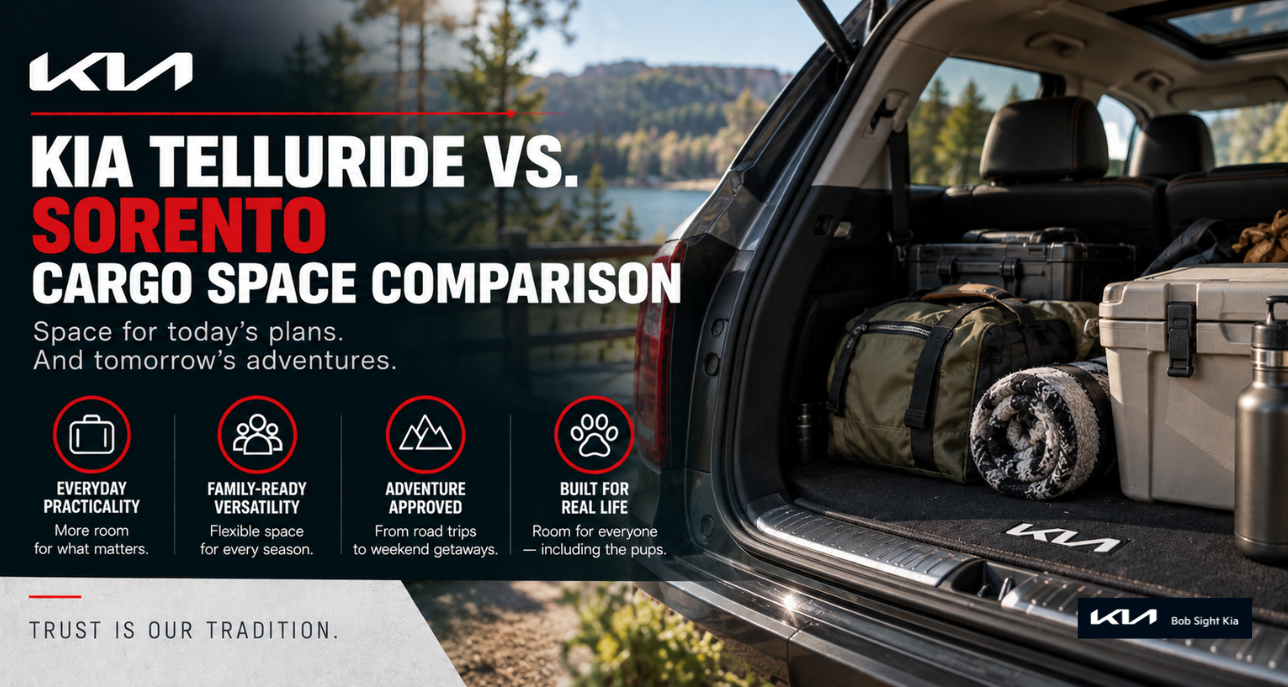
Comparison of the cargo areas inside a 2027 Kia Telluride and 2026 Kia Sorento

2027 Kia Telluride vs. 2026 Sorento Cargo Space

2027 Kia Telluride vs. 2026 Kia Sorento Cargo Space Comparison Choosing between the 2027 Kia Telluride and 2026 Kia Sorento often comes down to how much passenger room and cargo flexibility your household needs. Both Kia SUVs offer three rows of seating, versatile folding seats, and practical storage solutions, but they serve different types of drivers. The larger 2027 Telluride provides considerably more cargo capacity, while the midsize 2026 Sorento offers easier maneuverability and useful space in a more compact package. For families in Independence, Blue Springs, Lee’s Summit, Raytown, and the Kansas City Metro, cargo capacity can affect everything from school-day routines to holiday travel. This guide compares the cargo measurements, seating layouts, everyday usability, and ownership considerations of these two Kia SUVs. Drivers can visit Bob Sight Kia in Independence, Missouri, to explore available Kia SUVs and compare their interiors in person. Which Has More Cargo Space: the 2027 Kia Telluride or 2026 Kia Sorento? The 2027 Kia Telluride has more cargo space than the 2026 Kia Sorento behind every seating row. Kia lists the redesigned 2027 Telluride with approximately 22.3 cubic feet behind the third row, 48.7 cubic feet behind the second row, and up to 89.3 cubic feet when the rear seating area is folded. The 2026 Kia Sorento provides approximately 12.6 cubic feet behind its third row, 38.5 cubic feet behind its second row, and as much as 75.5 cubic feet behind the first row. Measurements can vary slightly by configuration, equipment, and the way manufacturers calculate cargo volume, so shoppers should confirm specifications for the exact trim they are considering. 2027 Kia Telluride behind the third row: Approximately 22.3 cubic feet 2026 Kia Sorento behind the third row: Approximately 12.6 cubic feet 2027 Kia Telluride behind the second row: Approximately 48.7 cubic feet 2026 Kia Sorento behind the second row: Approximately 38.5 cubic feet 2027 Kia Telluride maximum cargo volume: Approximately 89.3 cubic feet 2026 Kia Sorento maximum cargo volume: Approximately 75.5 cubic feet Those numbers make the Telluride the stronger choice when maximum cargo capacity is the priority. The Sorento remains highly versatile, but it is designed for drivers who want three-row functionality without moving into a larger SUV. The biggest practical difference appears when all three rows are in use. The Telluride offers nearly 10 additional cubic feet behind the third row. That extra room can make it easier to carry groceries, backpacks, sports gear, or small luggage while keeping every passenger seat available. How Much Fits Behind the Third Row? The 2027 Kia Telluride is better suited to carrying passengers and cargo at the same time. Its approximately 22.3 cubic feet behind the third row gives families more freedom to use all three rows without leaving most of their belongings at home. Behind the third row, the Telluride may accommodate several grocery bags, school bags, compact sports equipment, or a collection of smaller travel items. The area is also easier to organize when families use soft-sided bags, collapsible containers, or cargo organizers. The 2026 Sorento’s approximately 12.6 cubic feet behind the third row is useful for everyday essentials, but households should plan more carefully when all seats are occupied. It works well for groceries, backpacks, emergency supplies, or a few compact bags. Larger travel items may require folding one side of the third row. This difference matters for several common Kansas City-area driving situations: Taking six or more people to a youth sporting event Driving to Kansas City International Airport with luggage Carrying groceries while the third row is occupied Transporting school bags, instruments, and activity equipment Keeping winter safety supplies in the vehicle The Telluride is likely the better fit if your household regularly fills the third row. If the third row will only be used occasionally, the Sorento may provide enough room while giving you a smaller vehicle for daily driving. What Happens When the Third Row Is Folded? Folding the third row creates a large, practical cargo area in both SUVs, but the Telluride maintains an advantage. With its third row folded, the 2027 Telluride offers approximately 48.7 cubic feet of space. The 2026 Sorento provides approximately 38.5 cubic feet behind its second row. This configuration is useful for families that usually carry four or five people but want three-row seating available when needed. It creates room for larger grocery trips, strollers, sports bags, pet supplies, home improvement items, and weekend luggage. The second-row layout can also influence how you use the cabin. Depending on trim and configuration, shoppers may find a second-row bench or captain’s chairs. A bench can maximize passenger capacity, while captain’s chairs create a convenient path to the third row and give second-row occupants more personal space. To compare the cargo areas effectively during a dealership visit: Place the third-row seats in their upright position. Check whether your everyday bags fit behind them. Fold one side of the third row and examine the remaining passenger space. Fold the entire third row and inspect the cargo floor. Adjust the second-row seats to see how passenger legroom affects cargo room. Test the liftgate height and loading opening. This hands-on approach provides more useful information than cargo measurements alone. Two items with the same volume may have very different shapes, and a wide stroller or rigid storage container may fit better in one cargo area than another. Which SUV Is Better for Maximum Cargo Capacity? The 2027 Kia Telluride is the better choice for shoppers who frequently need the largest possible cargo area. Folding its second and third rows opens approximately 89.3 cubic feet, compared with approximately 75.5 cubic feet in the 2026 Sorento. With both rear rows folded, either vehicle can support errands and projects that would be difficult in a sedan. The Telluride’s additional capacity gives it an advantage for larger purchases, moving supplies, outdoor equipment, and multi-bag road trips. Potential uses for maximum cargo mode include: Transporting boxed furniture or household items Carrying camping equipment for a Missouri weekend Loading multiple suitcases for an extended trip Moving college supplies or apartment essentials Transporting pet crates or bulky recreation gear Picking up landscaping or home improvement supplies The Sorento still delivers strong utility for its size. Its maximum cargo area may be more than enough for drivers who use the third row occasionally and do not routinely transport bulky items. It provides a valuable middle ground between a compact two-row crossover and a larger three-row family SUV. When shopping, remember that maximum cargo capacity normally requires folding both rear rows. If you need to carry passengers and large items simultaneously, compare the space behind the second and third rows rather than relying only on the maximum figure. How Do Passenger Capacity and Seating Layout Affect Cargo Room? The Telluride generally provides greater flexibility for larger households, while the Sorento works well for smaller families that need occasional third-row seating. The Telluride can seat up to eight people in properly equipped configurations, while other versions use second-row captain’s chairs for seven-passenger seating. The Sorento can seat up to seven people, depending on its configuration. Some trims feature second-row captain’s chairs, reducing total capacity to six while improving access to the third row. A higher seating capacity does not automatically mean every configuration will suit every family. Parents should consider how frequently the third row will be occupied, whether child safety seats will be installed, and how much cargo must remain accessible. The Telluride may be the better match if you regularly transport: Three or more children Extended family members Carpool passengers Teammates and sports equipment Guests plus luggage The Sorento may be the better match if you usually carry: Two to four passengers Occasional third-row riders Daily groceries and school gear Weekend luggage for a smaller household One child safety seat with room for additional passengers Always follow the child safety seat manufacturer’s instructions and the vehicle owner’s manual. Families should test their actual child restraints when possible because seat contours, anchors, and passenger access can influence real-world usability. Which Kia SUV Is Easier to Drive Around Independence and Kansas City? The 2026 Kia Sorento is generally easier to maneuver because it packages three rows into a smaller footprint. That can be helpful when parking near Independence Center, navigating busy areas along Noland Road, or fitting into a residential garage. The Sorento can feel familiar to drivers moving up from a compact crossover. It provides an elevated seating position and available three-row flexibility without the dimensions of a larger family SUV. Drivers who commute on I-70, I-435, or Missouri Route 291 may appreciate its balance of interior utility and manageable size. The 2027 Telluride requires more parking and garage space, but many families find that worthwhile because of its larger cabin. Its size supports greater passenger comfort and more usable storage, which can be valuable on longer drives across the Kansas City Metro. Before choosing either model, check: Your garage length, width, and door clearance The dimensions of your regular parking space How confidently you can see around the vehicle Whether available parking assistance features meet your needs How easily passengers can enter the second and third rows Whether the liftgate can open fully inside your garage A test drive should include both neighborhood streets and a parking exercise. Cargo capacity matters, but the vehicle also needs to feel comfortable during the driving you do every day. Which Is Better for Road Trips and Family Activities? The 2027 Kia Telluride is the stronger road-trip option for larger families, while the 2026 Kia Sorento may be more efficient and convenient for smaller travel groups. The best choice depends on how many people travel with you and how much equipment they bring. For a full passenger load, the Telluride’s larger cargo area provides more flexibility for suitcases, coolers, blankets, and travel supplies. Its broader family-oriented cabin also makes it a natural choice for trips from Independence to the Lake of the Ozarks, Branson, or destinations beyond Missouri. The Sorento is appealing when a household wants three-row versatility but rarely uses every seat. A family of four could fold the third row and use approximately 38.5 cubic feet for luggage while retaining a comfortable second row. That can provide plenty of room for weekend travel without requiring a larger SUV throughout the rest of the year. Think about your busiest trip rather than your lightest errand. A vehicle that feels spacious during a short test drive can become crowded once passengers add coats, backpacks, charging cables, snacks, and luggage. Useful questions include: Can the vehicle carry everyone without stacking bags above the seatbacks? Will passengers have access to charging ports and storage? Can the third row remain in use with vacation luggage loaded? Is there a place for a stroller, cooler, or pet carrier? Can frequently used items remain accessible during the trip? If the answer regularly points toward needing more space, the Telluride is likely the better long-term choice. If your travel group is smaller and the third row is mainly a backup, the Sorento may offer the right balance. Should You Choose the 2027 Telluride or 2026 Sorento? Choose the 2027 Kia Telluride for maximum room and frequent three-row use, or choose the 2026 Kia Sorento for flexible seating in a more maneuverable SUV. Neither model is universally better because they solve different ownership needs. Consider the 2027 Kia Telluride if you: Regularly use all three rows Need meaningful storage behind the third row Transport a large family or frequent carpool Carry sports equipment and passengers together Take road trips with several people Want close to 90 cubic feet of maximum cargo capacity Consider the 2026 Kia Sorento if you: Usually carry four or fewer passengers Need a third row only from time to time Prefer a smaller vehicle for parking and commuting Want strong cargo versatility without moving to a larger SUV Plan to keep the third row folded during most trips Want to explore gas, hybrid, or plug-in hybrid configurations Powertrain availability may also shape the decision. The 2026 Sorento lineup includes gas, hybrid, and plug-in hybrid options. The redesigned 2027 Telluride is offered in gas and hybrid forms, giving shoppers another factor to evaluate alongside passenger and cargo space. Specifications can differ among powertrains and trims, so confirm the configuration of the exact vehicle you test. You can begin by browsing the new Kia inventory at Bob Sight Kia. Availability changes, so contact the dealership if you are looking for a specific seating layout, powertrain, color, or trim. How Should You Test Cargo Space at the Dealership? The best way to compare cargo space is to recreate your normal routine using the actual Telluride and Sorento interiors. Published measurements establish the size difference, but a physical test reveals whether your belongings fit conveniently. Bring measurements for your largest frequently carried items. If practical, bring an empty stroller, folded mobility device, sports bag, or storage container. You do not need to arrive with a full vacation load to learn whether the cargo area will work. During your comparison at Bob Sight Kia: Open the liftgate and examine the height and width of the opening. Check the cargo floor height to understand the lifting effort. Look for underfloor storage and organization features. Raise all three rows and evaluate the remaining cargo area. Fold only one section of the third row. Fold the complete third row and check floor continuity. Move the second-row seats into a comfortable passenger position. Sit in each row to evaluate access and personal space. Confirm that the liftgate can clear your garage or carport. Drive both SUVs on streets similar to your daily route. Shoppers replacing a current vehicle can also compare cargo openings and floor dimensions with what they own now. If you plan to trade, use the Bob Sight Kia trade-in tool before your visit. Drivers researching monthly payment options can complete the dealership’s online preapproval form. Preapproval can help you compare vehicle configurations within a comfortable budget while keeping the focus on the space and features your household needs. Where Can You Compare Kia SUVs Near Kansas City? Drivers can compare Kia SUVs at Bob Sight Kia, located at 1700 South Noland Road in Independence, Missouri. The dealership serves shoppers from Independence, Blue Springs, Lee’s Summit, Raytown, Grain Valley, Sugar Creek, Liberty, Oak Grove, Jackson County, and communities throughout the Kansas City Metro. Seeing the Telluride and Sorento close together makes their differences easier to understand. You can compare liftgate openings, third-row access, seating layouts, cargo-floor dimensions, visibility, and driving feel during one visit. Before visiting, consider making a short list of your priorities: Normal passenger count Maximum passenger count Items carried every week Largest items carried during trips Preferred second-row configuration Gas, hybrid, or plug-in hybrid preference Garage and parking limitations Desired comfort and technology features A product specialist can help identify available vehicles that match those priorities. If a particular configuration is not currently present, the team can explain inventory options and help you monitor availability. Long-term ownership also includes routine maintenance. Bob Sight Kia provides factory-informed care for Kia vehicles, and drivers can use the online tool to schedule Kia service in Independence. Frequently Asked Questions About Telluride and Sorento Cargo Space The most common questions involve maximum capacity, third-row usability, seating, and choosing the right size for everyday driving. These answers can help narrow your decision before visiting Bob Sight Kia. Does the 2027 Kia Telluride have more cargo space than the 2026 Kia Sorento? Yes. The 2027 Telluride offers approximately 22.3 cubic feet behind the third row, 48.7 cubic feet behind the second row, and 89.3 cubic feet with the rear rows folded. The 2026 Sorento provides approximately 12.6, 38.5, and 75.5 cubic feet in those configurations. Which Kia SUV is better when all three rows are occupied? The 2027 Telluride is generally better when all three rows are occupied because it leaves more cargo room behind the third row. That makes it easier to transport passengers along with groceries, backpacks, sports gear, or smaller travel bags. Is the Kia Sorento large enough for a family? Yes. The 2026 Sorento can be an excellent family SUV, particularly for households that usually carry four or fewer people but want an additional row when needed. Keeping the third row folded creates approximately 38.5 cubic feet of cargo space behind the second row. Does the Kia Telluride seat more people than the Kia Sorento? The 2027 Telluride can seat up to eight people in properly equipped configurations. The 2026 Sorento can seat up to seven. Models equipped with second-row captain’s chairs have lower total passenger capacity but can improve comfort and third-row access. Should I bring my stroller or cargo measurements to a test drive? Yes. Bringing an empty stroller or the measurements of frequently carried equipment can make the comparison more useful. It allows you to evaluate the cargo opening, floor shape, folding seats, and passenger space using your household’s actual needs. Compare the 2027 Kia Telluride and 2026 Kia Sorento at Bob Sight Kia The 2027 Kia Telluride is the cargo-space leader, while the 2026 Kia Sorento delivers practical three-row versatility in a smaller package. The Telluride is best suited to larger families, frequent third-row use, and trips that require passengers and luggage at the same time. The Sorento is a strong choice for shoppers who want occasional third-row seating, a useful cargo area, and easier everyday maneuverability. Visit Bob Sight Kia in Independence, MO, to explore Kia SUV options near you. Our team can help you compare seating configurations, cargo flexibility, powertrains, and available features so you can choose an SUV that fits your daily routine. Trust Is Our Tradition. Helpful Links Shop New Kia Vehicles Browse Used Vehicles Value Your Trade Get Preapproved Schedule Kia Service Proud to Be Part of the Bob Sight Auto Group Bob Sight Kia is proud to be part of the family-owned Bob Sight Auto Group, serving vehicle shoppers and owners throughout the Kansas City region and Northeast Kansas. Families researching new or used vehicles can rely on Bob Sight Auto Group for new and pre-owned vehicle sales, trade-in resources, auto financing, certified service, parts, and collision repair. Bob Sight Kia - Independence, MO Bob Sight Ford - Lee’s Summit, MO Bob Sight Honda - Lawrence, KS Bob Sight CDJR - Lawrence, KS Bob Sight Collision Center - Lee’s Summit, MO