

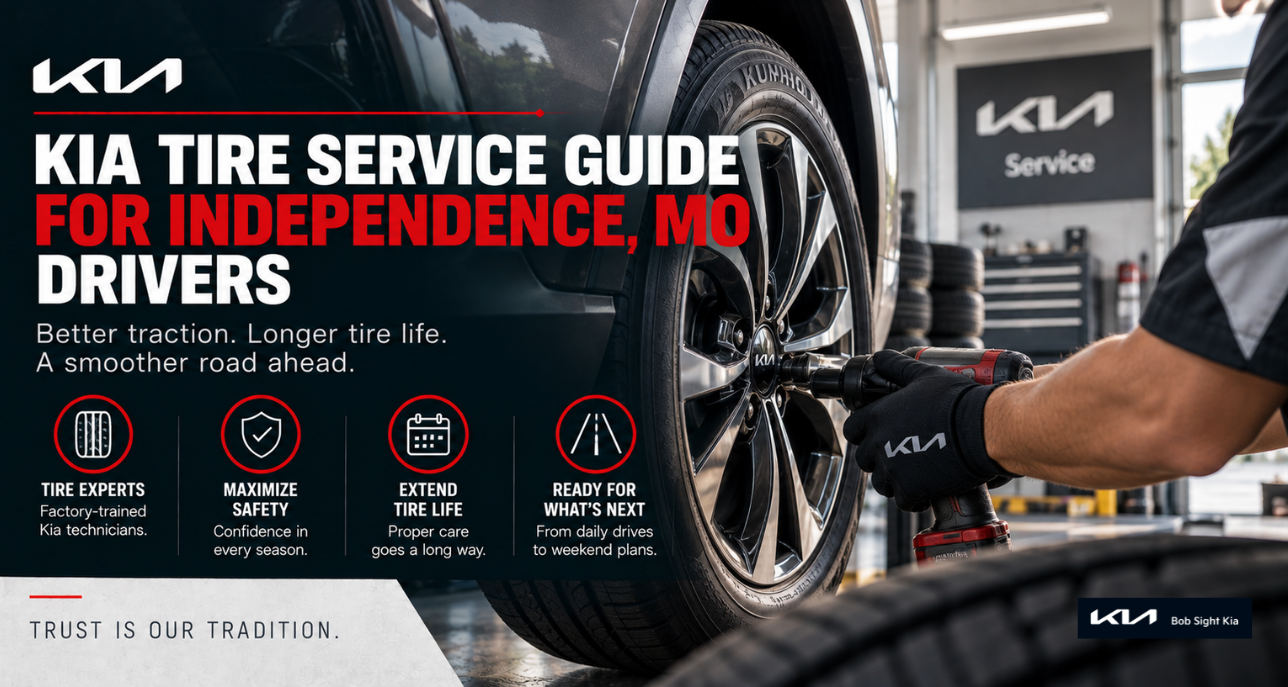
Kia Tire Service Guide for Independence, MO Drivers
Your Kia’s tires affect nearly every drive through Independence and the Kansas City Metro. They influence steering response, braking, ride comfort, traction, fuel efficiency, and how confidently your vehicle handles changing Missouri weather. Routine Kia tire service can also help tires wear more evenly and reduce the chance that preventable damage interrupts your commute.
Drivers searching for Kia tire service near me can visit Bob Sight Kia in Independence, Missouri, for tire inspections, rotations, balancing, alignment service, and replacement guidance. Our service center is located at 1700 South Noland Road and serves Kia owners from Independence, Blue Springs, Lee’s Summit, Raytown, Grain Valley, Sugar Creek, Liberty, Oak Grove, and communities across Jackson County.
This guide explains when to schedule tire service, how to check your tires at home, what common wear patterns mean, and how Missouri driving conditions can affect tire performance.
Why Is Routine Kia Tire Service Important?
Routine Kia tire service supports safer handling, more predictable braking, a smoother ride, and longer-lasting tires. Tires are your vehicle’s direct point of contact with the road. When tire pressure, tread depth, balance, or alignment is incorrect, the vehicle may not respond as designed.
Regular tire maintenance gives a technician an opportunity to identify wear before it becomes a more expensive or inconvenient problem. A simple inspection may uncover low pressure, a puncture, sidewall damage, uneven tread, or an alignment concern. Addressing these issues early can help protect the tire and other related components.
Properly maintained tires can support:
- More consistent traction on dry and wet roads
- Predictable steering and braking response
- More even tread wear
- Reduced vibration at highway speeds
- Better ride quality
- Improved fuel efficiency
- Longer useful tire life
Tire condition becomes even more important during heavy rain, summer heat, freezing temperatures, and sudden winter weather. Independence drivers regularly encounter all of these conditions throughout the year.
Routine tire care also provides a chance to review how your tires are wearing relative to your driving habits. Frequent stop-and-go traffic, highway commuting, potholes, construction areas, and heavily loaded trips may all affect tire life.
How Often Should Kia Tires Be Rotated?
Kia owners should follow the tire rotation interval listed in the maintenance schedule for their exact model, year, powertrain, and tire configuration. Many drivers coordinate tire rotations with scheduled maintenance visits, but the correct interval should always come from the vehicle’s owner’s manual.
Tire rotation changes each tire’s position on the vehicle. Front and rear tires often perform different jobs and may wear at different rates. On many vehicles, the front tires handle a larger share of steering and braking forces. Rotating the tires according to the recommended pattern can help distribute wear more evenly.
The proper rotation pattern may depend on:
- Front-wheel drive, all-wheel drive, or rear-wheel drive
- Directional or non-directional tires
- Matching or staggered tire sizes
- Full-size spare tire availability
- Tire manufacturer instructions
- Vehicle-specific maintenance requirements
Not every tire can be moved to every position. Directional tires, for example, are designed to rotate in a particular direction. Vehicles with different front and rear tire sizes may have additional restrictions. A Kia service technician can identify the proper pattern for your vehicle.
You may need a tire inspection before the normal maintenance interval if you notice vibration, pulling, uneven wear, pressure loss, or unusual road noise. Tire service intervals should be treated as a baseline, not a reason to ignore a developing symptom.
Owners can review vehicle-specific information through the official Kia owner’s manual resource or ask the service team at Bob Sight Kia for guidance.
How Do You Check Tire Pressure Correctly?
Check tire pressure when the tires are cold and use the pressure listed on the vehicle’s tire information label, not the number printed on the tire sidewall. The placard is commonly located on the driver’s doorjamb and lists the recommended cold inflation pressure for the original tire configuration.
The pressure molded into a tire’s sidewall represents tire information and limits. It is not the normal inflation target for your particular Kia. Always use the vehicle manufacturer’s recommended pressure unless a qualified professional has provided configuration-specific instructions.
Follow these steps to check tire pressure:
- Park the vehicle and allow the tires to cool.
- Locate the tire information placard on the driver’s doorjamb.
- Remove the valve cap from the first tire.
- Press a reliable tire pressure gauge firmly onto the valve stem.
- Compare the reading with the recommended cold pressure.
- Add air if the pressure is low.
- Release a small amount of air if the pressure is too high.
- Recheck the tire to confirm the final reading.
- Replace the valve cap and repeat the process on the remaining tires.
- Check the spare tire if your Kia includes one.
The National Highway Traffic Safety Administration recommends checking tire pressure regularly, including before longer trips. A monthly check is a useful habit because tires can gradually lose air even when no obvious puncture is present.
Temperature changes also affect tire pressure. A noticeable drop in outdoor temperature may cause the tire pressure monitoring system light to appear. Adding air based on the vehicle placard can correct normal seasonal pressure loss, but a tire that repeatedly loses air should be inspected for a puncture, valve issue, wheel damage, or sealing problem.
Do not rely only on appearance. A tire may be underinflated without looking visibly low. A pressure gauge provides a much more reliable assessment.
What Do Common Kia Tire Wear Patterns Mean?
Uneven tire wear can point to pressure problems, alignment concerns, balance issues, worn suspension components, or delayed rotations. The location and shape of the wear provide useful clues, but a professional inspection is the best way to determine the cause.
Wear Along Both Outer Edges
Wear on both shoulders of a tire can be associated with underinflation. Driving while a tire is underinflated may cause the outer portions of the tread to carry more of the load. It can also increase heat buildup and rolling resistance.
Wear Through the Center
Excessive center tread wear may be linked to overinflation. When a tire carries too much pressure, the center of the tread may make greater contact with the road than the shoulders.
Wear on One Edge
Heavy wear on the inner or outer edge may indicate an alignment or suspension concern. A vehicle that pulls to one side or has an off-center steering wheel should be inspected.
Cupping or Scalloped Wear
Alternating high and low areas around the tread may be associated with balance problems, worn suspension parts, or another condition that allows the tire to move irregularly against the road.
Flat Spots
A localized flat area can develop after hard braking, prolonged storage, or certain tire and suspension conditions. Some temporary flat spotting may improve as the tire warms, while persistent vibration requires attention.
Rapid Wear on One or Two Tires
If one tire is wearing much faster than the others, do not assume rotation alone will solve the problem. A technician should check inflation, alignment, balance, suspension condition, and tire damage.
Drivers can perform a quick visual check at home, but tread wear should be evaluated across the full width and circumference of each tire. Inner-edge wear may be difficult to see without the vehicle being lifted.
When Does a Kia Need Wheel Alignment Service?
Your Kia may need an alignment inspection when it pulls, the steering wheel sits off-center, or the tires develop uneven edge wear. Wheel alignment refers to the angles at which the wheels meet the road. Those angles help the tires track correctly and maintain consistent contact with the pavement.
Alignment can change after hitting a pothole, striking a curb, driving through road construction, or encountering other impacts. Normal wear in steering and suspension components can also contribute to alignment changes over time.
Common signs of a potential alignment problem include:
- The vehicle pulls left or right on a reasonably level road
- The steering wheel appears crooked while driving straight
- One tire edge wears faster than the other
- The vehicle feels less stable than normal
- Steering response has changed
- New tires begin wearing unevenly
A vehicle may still need an alignment even if the driver does not feel a strong pull. Small changes can appear first as unusual tread wear. That is one reason tire inspections are useful during routine maintenance.
An alignment is different from tire balancing. Alignment adjusts wheel angles, while balancing addresses weight distribution around the tire and wheel assembly. A Kia can need one service without needing the other, or it may benefit from both.
Independence and Kansas City-area roads can be challenging after winter freeze-and-thaw cycles. Potholes along local streets or major routes such as I-70, I-435, Missouri Route 291, and U.S. Route 40 may place additional stress on tires, wheels, and suspension components.
What Is Tire Balancing and When Is It Needed?
Tire balancing helps the wheel and tire assembly rotate evenly and can reduce vibration, irregular wear, and stress on related components. During balancing service, a technician measures weight distribution and installs small wheel weights where needed.
A tire and wheel assembly can become imbalanced as the tire wears. Balance can also change after tire installation, wheel repairs, impact damage, or the loss of a wheel weight.
Possible signs of an imbalance include:
- Steering wheel vibration at certain speeds
- Vibration felt through the seat or floor
- Uneven or cupped tread wear
- A change in ride smoothness
- Vibration that becomes more noticeable on the highway
Vibration has several possible causes, so balancing should not be treated as an automatic diagnosis. Tire damage, bent wheels, alignment concerns, suspension wear, debris buildup, and drivetrain issues can create similar symptoms.
If your Kia begins vibrating after hitting a pothole or road hazard, safely reduce speed and arrange an inspection. A hard impact can damage more than balance. It may affect the tire structure, wheel, alignment, or suspension.
Balancing is commonly performed when new tires are installed. It may also be recommended when a tire is repaired and remounted or when symptoms indicate that the assembly no longer rotates smoothly.
When Should Kia Tires Be Replaced?
Kia tires should be replaced when tread is worn to an unsafe or legally insufficient level, damage cannot be safely repaired, age has become a concern, or the tires no longer meet the vehicle’s needs. Tire replacement should be based on condition, age, performance, and professional evaluation rather than mileage alone.
Replacement may be necessary when you find:
- Tread worn to the built-in wear indicators
- Cracks, cuts, bulges, bubbles, or exposed material
- A puncture outside a repairable tread area
- Repeated air loss
- Uneven wear that has significantly reduced usable tread
- Damage caused by driving while underinflated
- Age-related deterioration
- Persistent vibration linked to tire damage
Treadwear indicators are raised bars located within the tread grooves. When the surrounding tread wears level with these bars, replacement is needed. Drivers should not wait for completely smooth tread. Wet-weather and winter traction can decline before the tire reaches its final wear limit.
Tire age matters because rubber and internal materials change over time. The Department of Transportation identification code on the sidewall includes the tire’s production date. The final four digits identify the week and year of manufacture. For example, a code ending in 2425 indicates production during the 24th week of 2025.
Age guidelines can vary by manufacturer, tire design, vehicle use, storage, climate, and condition. Ask a qualified technician to evaluate older tires rather than relying on appearance alone.
If only one or two tires require replacement, the correct placement and compatibility depend on the vehicle and drivetrain. All-wheel-drive Kia models may have limits on acceptable tread-depth differences because the tires work together as part of the drivetrain. Consult the owner’s manual and a Kia service professional before mixing tires with substantially different wear levels.
Are All-Season Tires Enough for Independence, Missouri?
Quality all-season tires meet the needs of many Independence drivers, but all-weather or winter tires may provide added cold-weather capability for certain driving routines. The best choice depends on road conditions, commute timing, driving frequency, and whether you can delay travel during severe weather.
All-season tires are designed to provide balanced performance in a range of conditions. They are a common choice for drivers who travel mainly on treated city streets and highways. However, their snow and ice performance varies by model.
All-weather tires generally provide stronger winter capability than traditional all-season designs while remaining suitable for year-round use. Tires carrying the three-peak mountain snowflake symbol meet a specific performance standard for severe snow conditions.
Dedicated winter tires use tread compounds and patterns designed for cold temperatures, snow, and ice. They may be worthwhile for:
- Drivers who must commute before roads are cleared
- Healthcare, public safety, and other essential workers
- Households that frequently travel on untreated roads
- Drivers who make regular winter trips outside the metro
- Owners who want the strongest available cold-weather traction
All-wheel drive can help a vehicle accelerate in low-traction conditions, but it does not replace appropriate tires. Braking and cornering still depend heavily on tire grip. A front-wheel-drive vehicle with suitable winter tires may provide more controlled stopping than an all-wheel-drive vehicle on worn or unsuitable tires.
Missouri drivers should also consider rain performance. Adequate tread helps move water away from the tire’s contact area. Worn tread can increase the risk of hydroplaning, making routine inspections valuable throughout the year rather than only before winter.
How Can Independence Drivers Help Their Tires Last Longer?
Maintaining correct pressure, scheduling rotations, correcting alignment problems, and avoiding unnecessary impacts can help extend tire life. Tire longevity depends on many factors, but consistent maintenance gives each tire a better opportunity to wear evenly.
Use this tire-care routine:
- Check tire pressure at least monthly and before long trips.
- Use the cold pressure listed on the vehicle placard.
- Inspect the tread and sidewalls for visible damage.
- Schedule rotations according to the vehicle maintenance schedule.
- Investigate pulling, vibration, or steering changes promptly.
- Have alignment checked when uneven wear appears.
- Avoid striking curbs and slow down for unavoidable road hazards.
- Do not exceed the vehicle’s load rating.
- Keep service records for rotations, alignments, and repairs.
- Arrange seasonal inspections before demanding travel periods.
Driving style can also influence tire life. Hard acceleration, abrupt braking, aggressive cornering, and high-speed impacts create additional stress and heat. Smooth inputs generally support more even wear.
Vehicle loading matters as well. Carrying excessive weight can increase tire stress and change handling. Consult the tire and loading label or owner’s manual before carrying a heavy load or towing.
Do not ignore a pressure warning light after adding air. If the same tire loses pressure again, it needs an inspection. Continuing to drive on an underinflated tire can create heat and internal damage that may not be visible from outside.
Can a Punctured Kia Tire Be Repaired?
Some punctures in the main tread area can be repaired, but sidewall damage, shoulder punctures, large holes, and tires driven while severely underinflated may require replacement. A technician must remove and inspect the tire to determine whether a safe repair is possible.
A proper evaluation considers:
- The location of the puncture
- The size and angle of the damage
- Whether the tire was driven while low or flat
- Internal liner and structural condition
- Existing repairs
- Tread depth and overall tire age
An external plug alone does not allow a technician to inspect the inside of the tire. Industry-accepted repair procedures commonly involve removing the tire from the wheel, inspecting it internally, and sealing both the injury channel and inner liner when the damage qualifies.
If a tire suddenly loses pressure while driving:
- Hold the steering wheel firmly.
- Avoid abrupt braking or sharp steering.
- Reduce speed gradually.
- Move to a safe location away from traffic.
- Activate the hazard lights.
- Use roadside assistance if changing the tire would be unsafe.
- Have the damaged tire professionally inspected.
Never crawl under a vehicle supported only by an emergency jack. Follow the vehicle owner’s manual for spare tire and lifting instructions.
Why Choose Bob Sight Kia for Tire Service?
Bob Sight Kia provides Kia-focused tire care, convenient online scheduling, and service guidance tailored to local driving conditions. Our service team can inspect your tires while considering how pressure, tread, balance, alignment, suspension condition, and driving habits work together.
Available tire-related services may include:
- Tire inspections
- Tire rotations
- Wheel balancing
- Wheel alignment service
- Pressure checks and adjustments
- Tire pressure monitoring system evaluation
- Repairability assessments
- Replacement tire guidance
- Seasonal tire evaluations
Using a Kia dealership for tire service can be convenient because technicians can evaluate the tires alongside the vehicle’s steering, suspension, braking, and electronic systems. The service department also has access to vehicle-specific information and manufacturer-informed procedures.
Before booking, review the current Kia service and parts specials. Offers and eligibility can change, so read the current terms and confirm details with the dealership.
Drivers can schedule Kia tire service online at a convenient time. When making the appointment, describe any pulling, vibration, pressure loss, noise, or recent road impact so the service team understands the concern.
Frequently Asked Questions About Kia Tire Service
Regular pressure checks, rotations, inspections, balancing, and alignment care form the foundation of Kia tire maintenance. The following answers address common questions from Independence-area drivers.
How often should I check the tire pressure on my Kia?
Checking tire pressure at least once a month and before longer trips is a practical routine. Measure pressure when the tires are cold and use the specification on the driver’s doorjamb label. If one tire repeatedly loses pressure, schedule an inspection rather than continuing to add air.
How do I know if my Kia needs a tire rotation?
Follow the maintenance schedule for your exact Kia model and year. You should also request an inspection if the front and rear tires appear to be wearing at different rates, you notice unusual road noise, or you are unsure when the last rotation was completed.
What is the difference between balancing and alignment?
Balancing corrects uneven weight distribution in a tire and wheel assembly. Alignment adjusts the angles at which the wheels meet the road. Vibration may suggest a balance issue, while pulling or one-sided tread wear may indicate an alignment concern, though a professional inspection is needed for an accurate diagnosis.
Can all-wheel drive prevent tire slipping in winter?
All-wheel drive can help a Kia accelerate when traction is limited, but it cannot replace suitable tires or careful driving. Turning and braking still depend on available tire grip. Adequate tread depth and a tire designed for the conditions remain important.
Where can I get Kia tire service near me in Independence?
Bob Sight Kia offers tire service at 1700 South Noland Road in Independence, Missouri. The dealership serves drivers from Blue Springs, Lee’s Summit, Raytown, Grain Valley, Sugar Creek, Liberty, Oak Grove, Jackson County, and the Greater Kansas City Metro.
Schedule Kia Tire Service in Independence, MO
Schedule tire service when your Kia needs a rotation, pressure check, balance, alignment inspection, repair assessment, or replacement tires. Taking action when symptoms first appear can help protect tire life and maintain predictable vehicle performance.
Bob Sight Kia is conveniently located on South Noland Road near I-70 and is accessible to drivers throughout eastern Jackson County. Whether you drive a Kia Sportage, Sorento, Telluride, Seltos, Carnival, K4, K5, Niro, EV6, or EV9, our team can help you understand the tire requirements for your vehicle.
Visit the Bob Sight Kia Service Center to learn more, or use our online service scheduler to request an appointment.
Trust Is Our Tradition.
Helpful Links
- Schedule Kia Service
- Explore the Bob Sight Kia Service Center
- View Service and Parts Specials
- Learn About Lifetime Oil Changes and Tire Rotations
- Find Your Kia Owner’s Manual
About Bob Sight Auto Group
Bob Sight Kia is part of the family-owned Bob Sight Auto Group serving drivers throughout the Greater Kansas City area and Northeast Kansas. Our dealership group is committed to straightforward guidance, dependable automotive care, and long-term customer relationships.
The Bob Sight family includes Bob Sight Kia in Independence, Bob Sight Ford in Lee’s Summit, Bob Sight Honda and Bob Sight CDJR in Lawrence, and the Bob Sight Collision Center in Lee’s Summit. From routine tire maintenance to vehicle shopping and collision repair, our teams are here to support drivers throughout the ownership experience.


 Warranties include 10-year/100,000-mile powertrain and 5-year/60,000-mile basic. All warranties and roadside assistance are limited. See retailer for warranty details.