

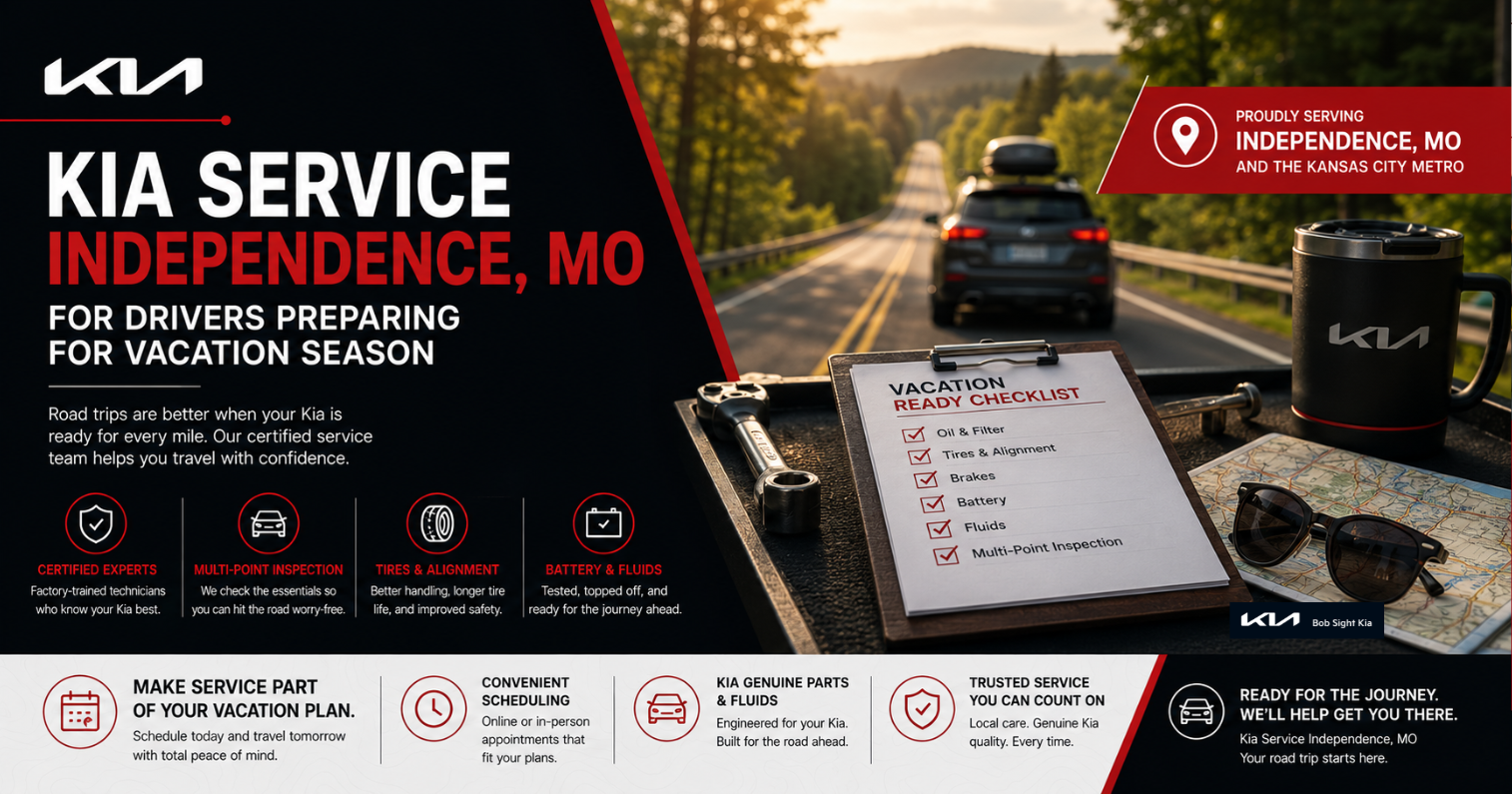
Kia Service Independence MO for Drivers Preparing for Vacation Season
Bob Sight Kia in Independence, MO offers comprehensive vacation season maintenance and certified vehicle inspection services to ensure your Kia operates reliably during long-distance summer road trips. Preparing your vehicle for summer travel across Missouri and beyond requires addressing severe thermal loads, heavy passenger weights, and high-speed highway commuting. Whether your vacation plans involve navigating Interstate 70 toward St. Louis, driving south on Highway 65 to Branson, or taking a cross-country family journey, our factory-trained service team provides the technical precision needed for worry-free travel. Located conveniently near Noland Road and the Independence Center, we serve drivers throughout Blue Springs, Lee’s Summit, Raytown, and Liberty with authentic OEM parts and specialized diagnostic care.
Schedule Your Vacation Service at Bob Sight Kia Today
In This Guide You’ll Learn
Here is what you will discover in this comprehensive guide to preparing your Kia crossover, sedan, or EV for summer vacation travel:
- Why summer heat, high-speed highway driving, and heavy cargo loads place exceptional stress on your engine and braking systems.
- A complete pre-road trip mechanical checklist covering fluid levels, tire tread depth, and battery cold-cranking amps.
- How high ambient temperatures accelerate engine oil oxidation, requiring high-viscosity synthetic protection like 0W-20 or 5W-30.
- Step-by-step instructions for inspecting and replacing cabin air filters and conditioning your vehicle HVAC system for peak summer cooling.
- A detailed comparison between routine local commuter maintenance and rigorous long-distance road trip preparation.
- Plain-language explanations of technical service concepts such as thermal viscosity breakdown, brake pad friction limits, and cooling system pressure tolerances.
- Key FAQs regarding vacation service scheduling, battery health testing, tire rotation frequency, and factory warranty protection.
Why Vacation Season Road Trips Demand Certified Kia Service in Independence MO
Scheduling a certified Kia vacation service in Independence, MO before embarking on long summer road trips prevents heat-related mechanical breakdowns, maximizes fuel economy, and protects your passengers across long highway stretches. High ambient summer temperatures across Jackson County regularly exceed 90 degrees Fahrenheit, causing under-hood engine temperatures to rise rapidly during sustained highway driving. When combined with heavy cargo loads, full passenger seating, and continuous air conditioning usage, minor fluid leaks or neglected components can quickly transform into major highway mechanical failures.
At Bob Sight Kia, our factory-certified technicians understand the unique environmental stress factors that Midwest summer driving places on your powertrain. Highway cruising along major travel corridors like I-70 or I-470 generates continuous thermal stress on motor oil, transmission fluid, and cooling assemblies. Bringing your Sorento, Telluride, or Sportage to our modern service department allows factory-trained specialists to inspect critical failure points, run digital battery diagnostics, and verify that your vehicle meets rigorous factory performance standards before you leave town.
In addition to preventing unexpected roadside breakdowns, proper pre-trip maintenance directly improves fuel efficiency and lowers travel costs. Clean engine air filters, properly inflated tires, and fresh synthetic motor oil reduce internal mechanical friction and aerodynamic rolling resistance. By ensuring your engine operates at peak thermal efficiency, you save money at the pump while driving through Kansas City, Blue Springs, or Grain Valley, leaving more of your travel budget available for family vacation fun.
Furthermore, certified dealership service preserves your vehicle long-term reliability and resale value. Using genuine Kia OEM filters, factory-specified fluid viscosities, and original equipment replacement parts guarantees that all maintenance conforms strictly to original factory specifications. Keeping a complete service history recorded at an authorized dealership maintains your 10-Year/100,000-Mile Powertrain Warranty and provides total peace of mind every mile of your journey.
Essential Pre-Road Trip Inspection Checklist for Long-Distance Midwest Travel
A thorough pre-road trip inspection evaluates your vehicle primary mechanical systems, including engine fluids, braking components, tire tread depth, and electrical systems. Completing a systematic inspection routine before leaving on vacation ensures that minor wear items are addressed before they compromise safety on the open highway. Below is a structured six-step checklist that our certified technicians perform during a vacation safety inspection at Bob Sight Kia.
- Inspect Engine Oil Level and Fluid Clarity: Verify that the engine oil level rests squarely between the dipstick indicator dots and confirm that the oil retains amber transparency without dark oxidation or burnt odors.
- Evaluate Cooling System and Radiator Fluid: Check the engine coolant overflow reservoir to ensure proper fluid levels and inspect upper and lower radiator hoses for rubber softening, cracking, or surface leaks.
- Perform Digital Battery Health and Charging Test: Test 12V battery cold-cranking amps (CCA) and alternator charging output using factory diagnostic tools to ensure reliable engine starts in high ambient summer heat.
- Inspect Brake Pads, Rotors, and Hydraulic Fluid: Measure front and rear brake friction pads to confirm minimum safe lining thickness above 4mm and check brake fluid for moisture contamination or dark discoloration.
- Check Tire Pressure, Tread Depth, and Wheel Balance: Adjust all four tires and the spare tire to recommended cold inflation pressures, verify tread depth across inner and outer ribs, and inspect for uneven tread wear.
- Test HVAC Cooling Efficiency and Replace Cabin Filter: Measure air conditioning outlet temperatures at the dashboard vents and inspect the cabin air filter to ensure unrestricted airflow and allergen filtration.
Protecting Drivetrain Integrity: Engine Oil, Transmission Fluid, and Cooling Systems
Protecting your drivetrain during high-temperature vacation travel requires fresh synthetic motor oil, clean transmission fluid, and a fully pressurized engine cooling system. Sustained speeds along open stretches of US-50 or Highway 13 place heavy torque demands on engine pistons, crankshaft bearings, and transmission clutches. When ambient temperatures rise, engine oil thins, reducing its ability to maintain a protective lubricating film between high-speed moving metal parts.
Modern Kia powertrains utilize advanced multi-viscosity full synthetic motor oils, such as 0W-20 or 5W-30 specifications, engineered to meet strict API SP and ILSAC GF-6A industry standards. These synthetic lubricants contain specialized detergent and anti-wear additive packages that prevent carbon deposit formation on intake valves and turbocharger bearings. Replacing old, heat-degraded oil before a long road trip ensures maximum fluid film strength, keeping internal engine components cool and protected under heavy loads.
Transmission fluid plays an equally vital role in drivetrain survival, serving as a hydraulic fluid, friction modifier, and internal coolant. Towing utility trailers, boat trailers, or pop-up campers down to the Ozarks subjects automatic and dual-clutch transmissions to severe thermal stress. Fresh transmission fluid maintains consistent hydraulic line pressure, prevents clutch slippage, and facilitates crisp gear changes during steep highway climbs near Raytown and Sugar Creek.
The engine cooling system represents your primary defense against catastrophic overheating during summer heat waves. Coolant mixtures consisting of 50 percent ethylene glycol and 50 percent distilled water elevate the boiling point of the cooling system while preventing internal aluminum corrosion. Technicians at Bob Sight Kia inspect radiator pressure caps, water pump operation, and cooling fan activation to guarantee that your cooling system can dump heat effectively during prolonged highway cruising.
Tire Safety, Wheel Alignment, and Brake System Inspection for Highway Commuting
Ensuring tire integrity, correct wheel alignment, and proper brake pad thickness is critical for maintaining highway handling stability and short emergency stopping distances. Your tires represent the sole contact patch between your vehicle and the road surface, making tire condition paramount during high-speed travel. High ambient pavement temperatures cause internal tire pressures to rise, accelerating tread wear and increasing the risk of high-speed blowouts if tires are damaged or underinflated.
Maintaining correct cold inflation pressure according to the door-jamb specification prevents excessive sidewall flexing and heat buildup inside the tire carcass. Our service department inspects tires for uneven wear patterns caused by misaligned suspension components or worn struts. Rotating your tires every 7,500 miles ensures even tread wear across all four positions, extending tire lifespan and maintaining optimal wet weather traction during sudden Midwest summer downpours.
| Maintenance Component | Routine Suburban Driving Requirement | Severe Vacation Travel Requirement |
|---|---|---|
| Engine Oil Service | Full synthetic replacement every 7,500 miles. | Fresh synthetic oil required before 1,000+ mile trips. |
| Tire Tread Depth | Minimum safe depth of 3/32 inch. | Recommended minimum depth of 5/32 inch for highway rain. |
| Brake Pad Lining | Replacement required at 3mm thickness. | Minimum 5mm lining recommended for mountain towing. |
| Engine Coolant Condition | Factory inspection every 15,000 miles. | System pressure test & level check before summer trips. |
Proper wheel alignment ensures that your vehicle tracks straight down the highway without pulling to one side or requiring constant steering corrections on I-70. Potholes encountered during spring driving across Jackson County roads can knock wheel alignment out of factory specifications, causing rapid tire scrubbing and reduced fuel economy. A precision computer alignment at Bob Sight Kia restores original steering geometry, delivering smooth, effortless tracking for long driving days.
Brake system inspection is equally vital when preparing for long-distance family travel with full cargo loads. Heavy vehicle weight increases kinetic energy, requiring brake pads and rotors to generate immense friction to slow the vehicle safely. Technicians measure brake pad thickness, inspect rotors for thermal scoring or warpage, and verify that brake fluid is free of moisture contamination that could cause pedal fade during prolonged braking down steep mountain grades.
Step-by-Step Guide: How to Prepare Your Vehicle HVAC and Cabin Air Systems for Summer Heat
Preparing your vehicle heating, ventilation, and air conditioning (HVAC) system ensures rapid cabin cooling and clean indoor air quality during hot summer travel. Driving for hours in severe summer heat without functional air conditioning causes extreme driver fatigue and discomfort for passengers. Following six straightforward maintenance steps restores peak HVAC cooling performance before you begin your vacation journey.
- Measure Dashboard Vent Temperature Output: Turn the HVAC controls to maximum cooling and verify that air discharging from the center dashboard vents reaches a crisp 38 to 45 degrees Fahrenheit at engine idle.
- Inspect the Cabin Air Filter for Debris: Access the cabin air filter housing behind the glove compartment and remove dirty, clogged filters filled with dust, pollen, and leaves accumulated during spring driving.
- Install a Fresh HEPA OEM Cabin Air Filter: Replace the old filter with a high-efficiency genuine Kia cabin filter to restore full airflow velocity and eliminate airborne allergens from entering the passenger compartment.
- Clean and Disinfect HVAC Evaporator Cores: Treat the climate control intake ducts with an antibacterial evaporator cleaner to eliminate mold, mildew, and unpleasant musty odors caused by humidity buildup.
- Check A/C Refrigerant Pressure and Compressor Operation: Connect specialized manifold gauges to measure high and low side refrigerant pressures, ensuring the system holds a full charge without micro-leaks.
- Inspect Condenser Fins for Road Debris and Obstructions: Clean dirt, bugs, and road grime from the exterior air conditioning condenser mounted in front of the radiator to allow maximum thermal heat dissipation.
Understanding Maintenance Terminology: Viscosity, Brake Friction Thresholds, and Thermal Breakdown
Grasping essential automotive maintenance terminology empowers vehicle owners to make informed decisions regarding fluid replacements, component repairs, and vacation preparation. Technical jargon can sometimes mask the critical function of underlying mechanical systems. Below are plain-language definitions of vital automotive concepts every driver should understand before embarking on a long trip.
Thermal Viscosity Breakdown: Thermal viscosity breakdown occurs when extreme engine heat weakens the chemical polymer chains in motor oil, causing the fluid to thin permanently below its engineered viscosity rating. When oil breaks down thermally, it can no longer maintain a high-pressure lubricating film between moving crankshaft and camshaft journals. Using full synthetic motor oils with advanced thermal stabilizers prevents breakdown during demanding highway driving.
Brake Friction Lining Threshold: The brake friction lining threshold refers to the minimum safe thickness of the friction material bonded to metal brake pad backing plates. While new brake pads measure roughly 10mm to 12mm in thickness, pads worn below 3mm lack sufficient thermal mass to dissipate braking heat effectively. Replacing worn pads before vacation trips prevents metal-to-metal rotor contact, brake fade, and costly rotor damage.
Cold-Cranking Amps (CCA): Cold-Cranking Amps measure a 12-volt battery capacity to deliver electric current to the starter motor at 0 degrees Fahrenheit for 30 seconds while maintaining minimum voltage. Although CCA measures cold performance, high summer heat is actually what degrades internal battery plates through accelerated chemical corrosion. Testing CCA before summer trips ensures your battery retains sufficient capacity to start your vehicle reliably during hot travel stops.
Mastering these basic technical terms allows drivers to communicate effectively with certified service advisors. Understanding why specific services are recommended builds trust and ensures your vehicle receives appropriate preventive care. Proper terminology awareness helps you prioritize safety-critical maintenance items before long-distance travel.
Quick Facts: Pre-Vacation Maintenance Benchmarks and Service Specs
Adhering to factory-recommended service benchmarks and technical specifications ensures optimal vehicle safety, efficiency, and longevity. Summarized below are essential maintenance metrics and technical specifications for Kia vacation preparation.
- Engine Oil Specification: Full synthetic 0W-20 or 5W-30 meeting API SP and ILSAC GF-6A industry standards.
- Standard Service Interval: Every 7,500 miles or 12 months for normal driving; 5,000 miles or 6 months for severe driving conditions.
- Minimum Brake Pad Thickness: 4mm recommended for long-distance highway travel; mandatory replacement at 3mm lining.
- Tire Inflation Pressure Standard: Always set to the cold PSI specification printed on the driver-side door jamb placard, not the maximum PSI on the tire sidewall.
- Battery Lifespan Expectancy: Average battery lifespan in Midwest climate conditions ranges between 3 to 5 years due to summer heat degradation.
These key service metrics illustrate the exact engineering standards required to keep your vehicle performing at its best. Following factory maintenance thresholds guarantees that your crossover, sedan, or EV handles demanding summer travel without mechanical stress. Regular maintenance conducted at an authorized service center preserves these high operating standards.
Ownership Planning: Long-Term Vacation Reliability and Seasonal Vehicle Protection
Long-term ownership planning involves pairing seasonal vacation maintenance with proactive vehicle protection to maximize reliability and preserve trade-in equity. Preparing your vehicle for summer travel is part of a larger ongoing maintenance strategy that protects your automotive investment over hundreds of thousands of miles. Taking proper care of your vehicle before, during, and after long trips prevents cumulative wear and keeps mechanical systems operating smoothly.
Protecting your vehicle exterior and undercarriage after long road trips is an essential yet frequently overlooked aspect of maintenance. Highway travel exposes front bumpers, windshields, and side mirrors to bug splatter, road tar, and acidic bird droppings that can etch clear-coat paint if left unwashed. Washing your vehicle thoroughly upon returning home to Independence or Lee’s Summit removes harmful residues and preserves your exterior finish.
Additionally, keeping meticulous, documented service records at an authorized dealership enhances resale and trade-in value when you decide to upgrade vehicles. Buyers in the pre-owned market seek vehicles with complete maintenance histories verifying regular synthetic oil changes, tire rotations, and brake inspections at certified facilities. Maintaining your vehicle at Bob Sight Kia provides a verified digital service history that commands premium market value.
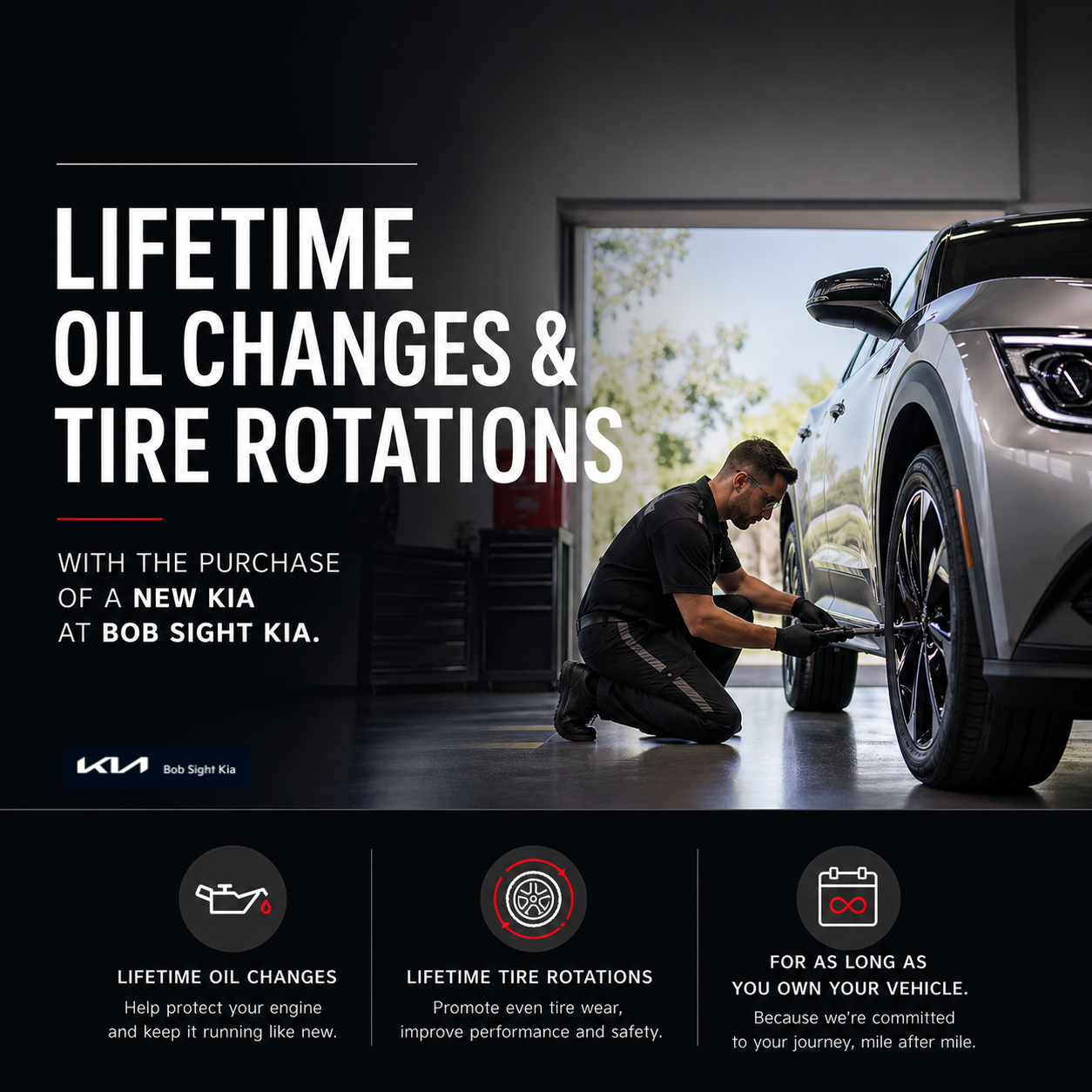
For drivers who purchased their new vehicle at Bob Sight Kia, taking advantage of our lifetime oil changes and tire rotations program provides incredible ongoing savings. Covered oil changes and tire rotations eliminate routine maintenance costs, making it effortless to stay on schedule before every summer vacation. This valuable program guarantees that your engine and tires remain in top condition for as long as you own your vehicle.
Frequently Asked Questions
How far in advance of my vacation should I schedule Kia service in Independence, MO?
You should schedule your pre-vacation Kia service at least one to two weeks prior to your planned departure date. Scheduling your appointment in advance ensures you secure a convenient time slot that fits your busy travel preparation schedule at our Independence service center. It also provides a comfortable time buffer to complete any recommended preventive maintenance items, such as brake pad replacements or wheel alignments, without rushing before your trip.
Completing your vehicle service a week before leaving town gives you time to drive the car on routine local commutes around Independence, Blue Springs, or Lee’s Summit. Driving the vehicle locally for a few days allows you to verify that air conditioning cooling, tire pressures, and engine operation feel completely smooth and responsive. It delivers total confidence that your crossover is fully prepped for long-distance highway driving.
Drivers can easily reserve a convenient service appointment using our online service scheduler. Our modern facility features comfortable customer amenities, fast check-in processes, and certified technicians ready to prepare your vehicle for summer travel. Booking early guarantees a stress-free service experience before your family vacation begins.
Why does summer heat weaken car batteries more than winter cold?
Summer heat weakens car batteries more than winter cold because high under-hood temperatures accelerate internal plate corrosion and cause liquid electrolyte evaporation. While winter cold slows chemical reactions and makes engine cranking difficult, it is intense summer heat that structurally damages internal lead plates and reduces overall battery life. Heat bakes the battery case, evaporating water from the internal acid solution and causing permanent capacity loss.
When autumn arrives and ambient temperatures drop, a battery that suffered heat damage during summer trips suddenly fails to supply required cold-cranking amps to start the engine. Testing your battery during a summer pre-vacation inspection identifies internal resistance and weak voltage before you get stranded at a highway rest stop hundreds of miles from home. Replacing an aging battery proactively prevents unexpected travel delays.
At Bob Sight Kia, our service department conducts automated digital battery load tests during every routine maintenance visit. Technicians evaluate reserve capacity, voltage stability, and terminal corrosion to ensure your electrical system operates reliably. If a replacement is necessary, we install genuine Kia batteries engineered specifically for your vehicle electrical demands.
Should I increase my tire pressure when driving with a full load of passengers and cargo?
Yes, you should adjust your tire inflation pressure to match the full load specification listed on your vehicle door jamb placard when carrying a full load of passengers and heavy cargo. Carrying heavy luggage, coolers, and a full cabin of passengers increases total vehicle mass, placing extra downward force on tire sidewalls. Increasing tire pressure to the manufacturer recommended heavy load PSI prevents excessive sidewall flexing, reduces internal heat buildup, and maintains stable highway handling.
Underinflated tires carrying heavy cargo generate extreme internal friction heat as the rubber flexes continuously against hot highway asphalt along I-70 or US-50. Over time, heat buildup weakens internal tire cords, increasing the probability of sudden tire failure or tread separation at highway speeds. Setting correct cold inflation pressures before loading your vehicle ensures even weight distribution across the tire contact patch.
Remember to always check tire pressures when the tires are cold, meaning the vehicle has been parked for at least three hours or driven less than one mile. Never deflate hot tires that show higher pressure readings after continuous highway driving, as pressure naturally increases with thermal expansion. Our technicians are happy to inspect and adjust your tire pressures during your pre-trip service visit.
What should I do if my engine temperature gauge rises while driving on the highway?
If your engine temperature gauge rises into the red zone or an engine coolant light illuminates, safely pull off the highway immediately, turn off the engine, and allow it to cool completely. Driving an overheating engine for even a few minutes can warp aluminum cylinder heads, blow head gaskets, and cause catastrophic internal engine failure. Once safely parked on the shoulder, turn on your hazard lights and pop the hood latch to assist under-hood heat dissipation.
Never attempt to unscrew or remove the radiator cap or coolant reservoir cap while the engine is hot. Boiling coolant and high-pressure steam can erupt from the reservoir, causing severe burns. Allow the vehicle to cool down for at least 30 to 45 minutes before visually checking coolant levels in the translucent overflow tank from a safe distance.
If coolant levels are low or visible leaks appear beneath the engine bay, contact emergency roadside assistance or our service department for guidance. Kia 24/7 Roadside Assistance is included with every new vehicle for five years, providing towing support to the nearest authorized dealership. Having your cooling system inspected thoroughly at Bob Sight Kia before leaving town prevents overheating emergencies from disrupting your vacation.
Why Local Vacation Service at Bob Sight Kia Matters for Independence Drivers
Servicing your vehicle locally at Bob Sight Kia in Independence, MO guarantees expert factory-certified care, genuine OEM parts, and a long-standing community commitment to customer satisfaction. Entrusting your vehicle to a trusted local family-owned dealership ensures that your car is serviced by certified technicians who understand the exact technical specifications of your Kia model. Our state-of-the-art service facility utilizes specialized diagnostic equipment, genuine Kia filters, and premium synthetic lubricants designed specifically for your powertrain.
Unlike third-party quick-lube shops that frequently use generic bulk oil and cheap aftermarket filters, Bob Sight Kia never compromises on quality. Generic oil filters often lack critical internal bypass valves and anti-drainback seals, leading to dry metal-on-metal engine starts and improper oil filtration. Our service department uses exclusively factory-approved filters and OEM components that preserve oil pressure, maintain cooling integrity, and protect your 10-Year/100,000-Mile warranty.
Furthermore, local dealership service offers unmatched convenience, transparent communication, and comfortable customer amenities. While your vehicle is inspected, you can relax in our quiet customer lounge with complimentary Wi-Fi and refreshments, or utilize our convenient local shuttle service to get back to your home or office in Independence, Blue Springs, or Lee’s Summit. Schedule your pre-vacation Kia service at Bob Sight Kia today to experience premium customer care and keep your vehicle performing at its best.
Helpful Links
Explore these key links on our website to schedule your pre-vacation service appointment, browse current parts specials, or explore new inventory:
- Schedule Pre-Vacation Kia Service Online
- Browse Current Service and Parts Specials
- Order Genuine Kia OEM Parts Online
- Explore Our Kia Service Price Match Promise
- Search New Kia Vehicle Inventory in Independence
PROUD TO BE PART OF THE BOB SIGHT AUTO GROUP
Bob Sight Kia is a proud member of the Bob Sight Auto Group, a family-owned automotive network dedicated to serving drivers across Missouri and Kansas for generations. Grounded in integrity, transparency, and outstanding customer service, our auto group provides comprehensive inventory choices, competitive financing options, and factory-certified service across multiple locations in the region.
Explore our entire dealer group network below:
- Bob Sight Kia (Independence, MO)
- Bob Sight Ford (Lee’s Summit, MO)
- Bob Sight Honda (Lawrence, KS)
- Bob Sight CDJR (Lawrence, KS)
- Bob Sight Collision Center (Lee’s Summit, MO)
Connect with us


Recent Blog Entries
- Kia Service Independence MO for Drivers Preparing for Vacation Season
- Best Kia Vehicles for Teen Drivers and First-Time Owners: K4, Seltos, and Sportage
- Kia Oil Change Near Me: How Heat Impacts Engine Performance
- Kia Sportage vs RAV4 Fuel Economy Comparison for Missouri Drivers
- Kia EV9 Family Road Trip Features Explained for Kansas City Metro Drivers
Categories
 Warranties include 10-year/100,000-mile powertrain and 5-year/60,000-mile basic. All warranties and roadside assistance are limited. See retailer for warranty details.