

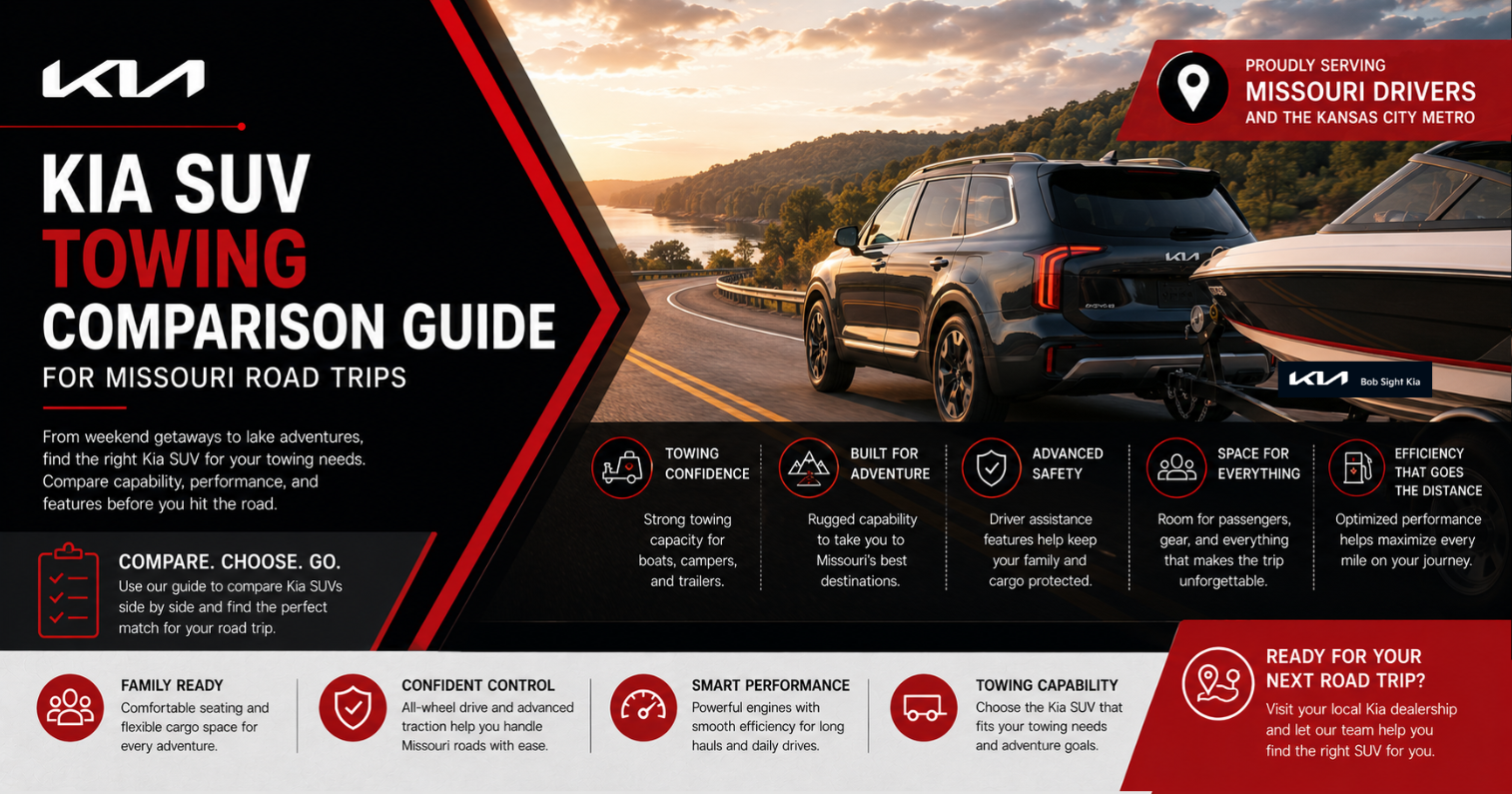
Kia SUV Towing Comparison Guide for Missouri Road Trips
Bob Sight Kia in Independence, MO presents the definitive Kia SUV towing comparison guide to help Kansas City drivers select the right crossover or three-row vehicle for Missouri road trips. Transporting campers, utility trailers, boats, or jet skis across the Show-Me State requires balancing maximum towing capacities, engine torque outputs, tongue weight limits, and intelligent trailering technology. Whether you plan to haul a boat out to Lake Jacomo, pull a travel trailer down to Table Rock Lake in the Ozarks, or tow camping gear along Interstate 70, choosing between models like the Sportage, Sorento, Telluride, and all-electric EV9 shapes your travel experience. Our local dealership in Independence provides families across Lee’s Summit, Blue Springs, Liberty, and Raytown with transparent towing specifications and expert advice.
Explore New Kia SUV Inventory Near Kansas City
In This Guide You’ll Learn
Here is what you will discover in this comprehensive guide to Kia SUV towing capabilities and road trip preparation:
- How maximum towing capacities vary across the Kia crossover and SUV lineup, ranging from 2,500 pounds to 5,500 pounds.
- Which Kia models feature heavy-duty factory tow packages, self-leveling rear suspensions, and Trailer Stability Assist technology.
- How gasoline V6 engines, turbocharged powertrains, and dual-motor electric drivetrains perform under heavy towing loads.
- A step-by-step walkthrough on how to hitch, hook up electrical harnesses, and safely calibrate your trailer setup.
- Plain-language explanations of essential towing terms including Gross Vehicle Weight Rating (GVWR), Gross Combined Weight Rating (GCWR), and tongue weight limits.
- A detailed step-by-step pre-trip trailering inspection checklist to keep your vehicle and cargo safe on Missouri highways.
- Frequently asked questions regarding towing range impact on electric SUVs, factory hitch installation, and drivetrain maintenance in Jackson County.
Why Towing Capacity Matters for Missouri Family Road Trips
Selecting an SUV with sufficient towing capacity ensures that your vehicle can pull heavy recreational loads safely while maintaining steering control, braking stability, and drivetrain cooling. Driving across Missouri presents a variety of terrain challenges, from undulating hills along US-50 to long highway inclines along Highway 65 heading south toward Branson. An underpowered or improperly equipped tow vehicle can suffer from excessive transmission overheating, brake fade, and dangerous trailer sway when encountering sudden crosswinds or emergency stopping situations.
At Bob Sight Kia in Independence, MO, we understand that real-world towing involves much more than simply pulling a trailer on flat ground. Carrying a full cabin of passengers, packed luggage in the trunk, and a loaded trailer behind the bumper pushes a vehicle’s mechanical systems to their thermal limits. Choosing a vehicle with a towing rating that exceeds your combined trailer and cargo weight delivers essential safety margins during hot Midwest summer trips.
Furthermore, local driving environments around Jackson County subject trailering setups to unique stresses. Navigating heavy suburban traffic near the Independence Center, merging onto high-speed lanes on I-470, or launching a pontoon boat at Blue Springs Lake requires responsive low-end engine torque. Having an SUV equipped with specialized Tow Modes and dynamic all-wheel drive ensures smooth power delivery and firm traction on slippery boat ramps or gravel campsites.
Evaluating your household’s long-term travel plans before selecting a crossover prevents the need for costly vehicle upgrades down the road. Whether you plan to pull a lightweight utility trailer with lawn equipment or a heavy 24-foot camper, Kia engineers a wide range of utility vehicles tailored to your specific trailering demands. Understanding how each model handles heavy loads empowers local drivers to shop with complete confidence.
Model-by-Model Kia SUV Towing Capacity Breakdown
The Kia SUV lineup offers a versatile spectrum of maximum towing capacities, ranging from 2,500 pounds on the compact Sportage up to 5,500 pounds on the flagship Telluride. Each vehicle within the lineup features distinct powertrain outputs, chassis structures, and brake system sizes calibrated for specific trailering classes. Matching your trailer’s Gross Vehicle Weight Rating (GVWR) with the appropriate Kia model ensures safe, effortless highway travel.
For drivers seeking lightweight recreational utility, the popular Kia Sportage provides a maximum towing capacity of up to 2,500 pounds when equipped with trailer brakes and an approved tow hitch. Powered by a standard 2.5-liter 4-cylinder engine or an available Turbo Hybrid powertrain, the Sportage easily handles small utility trailers, pair of personal watercraft, or lightweight pop-up campers. Its compact footprint makes it ideal for weekend getaways while remaining easy to maneuver around suburban streets in Raytown and Sugar Creek.
Moving into the midsize class, the Kia Sorento upgrades trailering performance significantly with available maximum towing capacity up to 4,500 pounds on X-Pro trims. Models featuring the 2.5-liter Turbocharged engine producing 281 horsepower and 311 lb-ft of torque deliver exceptional low-end pulling power. The Sorento is ideal for families who need three-row seating and the capability to pull midsize fiberglass boats, travel trailers, or enclosed cargo trailers across Missouri highway corridors.
At the top of the combustion lineup stands the award-winning Kia Telluride, boasting a maximum towing capacity of up to 5,500 pounds on X-Pro models. Driven by a robust 3.8-liter V6 engine generating 291 horsepower and 262 lb-ft of torque, the Telluride handles heavy dual-axle campers, horse trailers, and large ski boats with ease. For drivers interested in electric performance, the flagship three-row Kia EV9 delivers up to 5,000 pounds of towing capacity with dual-motor e-AWD, providing instant electric torque for smooth highway hauling.
Understanding Key Towing Features: Trailer Stability Assist and Self-Leveling Suspension
Kia SUVs incorporate advanced chassis control technologies, including Trailer Stability Assist and self-leveling rear suspension, to maintain vehicle stability and headlight alignment while towing. Pulling heavy loads behind a vehicle alters suspension geometry, placing extra weight on the rear axle while lightening the front steering wheels. Specialized engineering features counteract these weight shifts to deliver a composed, predictable driving experience.
Trailer Stability Assist (TSA) works in tandem with the vehicle’s Electronic Stability Control (ESC) network to monitor trailer sway continuously. If sudden crosswinds on I-70 or abrupt steering maneuvers cause the trailer to oscillate, TSA detects the movement through yaw-rate sensors. The system automatically applies individual wheel brakes and reduces engine torque to tame the sway before it can compromise vehicle stability.
Available self-leveling rear suspension systems on models like the Telluride and Sorento automatically adjust rear ride height when heavy trailer tongue weight is applied. Internal hydraulic dampers pump up as the vehicle moves, restoring a flat, level chassis profile without requiring manual air compressor pumps. Maintaining a level vehicle profile prevents rear suspension sagging, ensures proper front tire contact for steering control, and keeps headlights aimed correctly at the road ahead.
Additionally, Kia’s intelligent Tow Mode recalibrates transmission shift schedules and throttle response curves when towing heavy loads. In combustion models, Tow Mode holds lower transmission gears longer during steep climbs along Highway 65, preventing gear hunting and reducing transmission fluid heat buildup. In electric models like the EV9, Tow Mode adjusts regenerative braking forces and recalibrates real-time battery range estimates to reflect trailer drag accurately.
Step-by-Step Guide: How to Safely Hitch and Prep Your Kia SUV for Towing
Safely hitching and preparing your Kia SUV for towing involves securing the coupler, connecting safety chains, plugging in electrical wiring, and verifying turn signal function. Taking time to execute a structured hitching routine prevents catastrophic accidental uncoupling events on public highways. Below is a six-step guide to properly securing your trailer before setting off on a Missouri road trip.
- Align the Vehicle Receiver with the Trailer Coupler: Utilize your Kia surround-view camera or rear backup camera with dynamic hitch guidelines to line up the hitch ball directly beneath the trailer coupler.
- Lower the Coupler and Engage the Locking Latch: Lower the trailer tongue jack until the coupler rests fully over the hitch ball, press the locking latch down, and insert a safety pin or lock to prevent accidental opening.
- Attach Heavy-Duty Safety Chains in a Crossover Pattern: Attach both safety chains to the vehicle receiver hitch loops, crossing them underneath the trailer tongue to create a protective cradle if the coupler ever detaches.
- Connect the 4-Pin or 7-Pin Electrical Wiring Harness: Plug the trailer electrical connector into the vehicle bumper harness socket, verifying that the cord has enough slack for sharp turns without dragging on the pavement.
- Attach the Emergency Breakaway Cable: For trailers equipped with electric or surge brakes, clip the emergency breakaway cable securely to the vehicle hitch frame to engage trailer brakes if separation occurs.
- Perform a Complete Lighting and Brake Check: Have a helper stand behind the trailer while you test running lights, left and right turn signals, hazard flashers, and brake light illumination.
Comparing Towing Paths: Gas V6 vs Turbocharged vs Electric SUV Towing
Comparing gas V6, turbocharged 4-cylinder, and all-electric powertrains reveals distinct advantages in low-end torque delivery, high-altitude towing efficiency, and refueling convenience. Choosing the right engine type for your trailering lifestyle depends on how frequently you tow, total trailer weight, and preferred road trip distances across the Midwest.
Naturally aspirated gasoline V6 engines, like the 3.8-liter V6 in the Kia Telluride, offer linear power delivery and proven long-distance durability. With 291 horsepower, the V6 provides smooth, confident acceleration on open highway stretches while maintaining predictable cooling under heavy loads. V6 powertrains excel for traditional long-distance road trips where gas station availability is abundant and trailer weights exceed 5,000 pounds.
Turbocharged 4-cylinder powertrains, found in the Sorento and Sportage Hybrid, generate impressive low-end torque at low engine speeds. The Sorento 2.5-liter Turbo delivers 311 lb-ft of torque starting at just 1,700 RPM, providing effortless pulling power off the line when towing up steep inclines. Turbocharged engines maintain high volumetric efficiency across elevation changes, making them a fantastic choice for midsize travel trailers.
| Kia SUV Model | Engine / Powertrain Type | Horsepower / Torque Output | Max Towing Capacity | Key Towing Technology |
|---|---|---|---|---|
| Kia Sportage | 2.5L 4-Cylinder Gas | 187 hp / 178 lb-ft | 2,500 lbs | Compact Chassis, Drive Mode Select |
| Kia Sorento | 2.5L Turbocharged 4-Cyl | 281 hp / 311 lb-ft | 4,500 lbs | Available X-Pro Package, AWD Lock |
| Kia Telluride | 3.8L V6 Gas Engine | 291 hp / 262 lb-ft | 5,500 lbs | Self-Leveling Rear Suspension, Tow Mode |
| Kia EV9 | Dual-Motor Electric e-AWD | 379 hp / 516 lb-ft | 5,000 lbs | Instant Torque, 800V DC Fast Charging |
Electric SUVs like the dual-motor Kia EV9 deliver unparalleled instant torque, generating 516 lb-ft of torque immediately from a dead stop. Pulling a heavy 5,000-pound boat up a steep, slippery boat ramp at Blue Springs Lake becomes effortless because electric motors deliver maximum power without gear hunting or engine revving. Combined with ultra-fast 800-volt DC fast charging, the EV9 offers a revolutionary trailering experience for modern families.
Understanding Towing Terminology: GVWR, Tongue Weight, Payload, and GCWR
Grasping core trailering terminology empowers vehicle owners to calculate exact weight limits and prevent illegal or unsafe vehicle overloading. Navigating tow specifications can feel confusing without plain-language definitions. Below are essential weight ratings every Missouri driver should understand before hitching a trailer.
Gross Vehicle Weight Rating (GVWR): GVWR represents the absolute maximum allowable total weight of the vehicle itself, including curb weight, passengers, cargo, fluids, and the downward tongue weight exerted by the attached trailer. Exceeding your vehicle’s GVWR overloads tires, suspension springs, and brakes, compromising overall safety and voiding warranty coverage.
Trailer Tongue Weight: Tongue weight is the downward force that the trailer tongue exerts directly onto the vehicle hitch ball, typically recommended to be between 10 percent and 15 percent of total loaded trailer weight. Too little tongue weight causes dangerous high-speed trailer sway, while excessive tongue weight causes rear suspension sagging and lightens front steering wheel contact.
Gross Combined Weight Rating (GCWR): GCWR is the maximum permissible total combined weight of the fully loaded tow vehicle and the fully loaded trailer combined. Calculating GCWR ensures that your vehicle’s cooling systems, frame, and transmission can manage the combined mass safely while climbing steep highway grades along I-70.
Mastering these weight definitions eliminates dangerous guesswork when packing for road trips. Weighing your loaded setup at a local commercial vehicle scale gives you total peace of mind before embarking on long journeys. Staying comfortably within factory weight thresholds keeps your family safe and preserves vehicle dependability.
Step-by-Step Guide: Pre-Trip Towing Inspection and Safety Checklist
Performing a thorough pre-trip trailering inspection prevents mechanical breakdowns, tire failures, and hazardous highway incidents. Trailering subjects vehicle tires, brakes, and cooling systems to intense mechanical stress. Below is a structured six-step inspection routine to complete before leaving your driveway in Independence.
- Check Vehicle and Trailer Cold Tire Pressures: Measure inflation pressures on all vehicle and trailer tires using a digital gauge, adjusting levels to match sidewall or door-jamb PSI specifications.
- Inspect Trailer Wheel Lug Nuts for Proper Torque: Use a calibrated torque wrench to verify that trailer wheel lug nuts are tightened securely to manufacturer foot-pound specifications.
- Examine Trailer Coupler, Safety Pin, and Latch: Confirm that the coupler is fully seated over the hitch ball, the locking latch is pinned shut, and safety chains are crossed properly.
- Test Trailer Electric or Surge Brake Operation: Pull the vehicle forward at slow speeds and manually engage the trailer brake controller to verify that trailer brakes squeeze firmly and smoothly.
- Inspect Hitch Receiver Bolts and Frame Mounts: Inspect the vehicle receiver hitch structure beneath the rear bumper to ensure all mounting bolts are tight and free of rust or cracking.
- Verify Load Securement and Weight Distribution: Confirm that cargo inside or on the trailer is strapped down tightly and distributed so that 60 percent of cargo weight rests forward of the trailer axle.
Quick Facts: Kia SUV Towing Capabilities and Specs
Kia crossovers and SUVs deliver industry-leading towing specs, robust warranties, and advanced trailering engineering. Summarized below are key operational statistics across the Kia towing lineup.
- Maximum Lineup Towing Capacity: Up to 5,500 lbs on the Kia Telluride X-Pro equipped with factory tow package.
- Electric Towing Performance: Up to 5,000 lbs towing capacity on the all-electric Kia EV9 with 516 lb-ft of instant electric torque.
- Midsize Turbo Towing Capability: Up to 4,500 lbs max towing capacity on the Kia Sorento X-Pro featuring a 2.5L Turbo engine.
- Standard Active Trailering Safety: Includes Trailer Stability Assist (TSA), Electronic Stability Control (ESC), and dynamic rearview camera hitch guidelines.
- 10-Year/100,000-Mile Warranty: Unmatched factory powertrain warranty coverage that protects internal engine and transmission components during heavy trailering.
These standout metrics highlight why Kia vehicles continue to earn top ratings from automotive experts and outdoor enthusiasts alike. Whether pulling a small utility trailer around Grain Valley or hauling a travel camper down to the Ozarks, Kia SUVs deliver engineered strength. Testing these vehicles in person demonstrates their impressive towing refinement.
Ownership Planning: Protecting Your Drivetrain During Heavy Towing
Protecting your vehicle’s drivetrain during heavy towing relies on proactive maintenance, timely fluid replacements, and using OEM-certified replacement parts. Pulling heavy trailers increases internal thermal loads within engine oil, transmission fluid, differential gear oil, and brake assemblies. Establishing a disciplined maintenance plan ensures your vehicle withstands severe towing demands without mechanical breakdown.
Under heavy towing conditions, engine oil and transmission fluid break down significantly faster due to sustained thermal stress. Following Kia’s severe maintenance schedule recommends shortening synthetic engine oil changes to every 5,000 miles and inspecting automatic transmission fluid regularly. Using full-synthetic 0W-20 or 5W-30 engine oil meeting API SP standards prevents carbon deposit formation on vital engine bearings.
Additionally, inspecting rear differential fluid and transfer case lubricants on all-wheel-drive models is critical for trailering longevity. Servicing differential gears removes microscopic metal wear particles and maintains oil viscosity under high torque loads. Bringing your vehicle to our certified service department at Bob Sight Kia guarantees that all fluids and parts meet strict factory specifications.
For drivers who purchased their new vehicle at Bob Sight Kia, taking advantage of our lifetime oil changes and tire rotations program provides incredible ongoing savings. Covered routine maintenance makes staying on schedule simple and affordable, ensuring your tow vehicle remains in peak mechanical condition for every Midwest family road trip.
Frequently Asked Questions
Can you tow a travel trailer with a Kia Telluride?
Yes, you can tow a travel trailer with a Kia Telluride, which offers a maximum towing capacity of up to 5,500 pounds when equipped with the factory tow package or X-Pro trim. The Telluride’s 291-horsepower 3.8-liter V6 engine generates robust pulling power, making it capable of hauling midsize single-axle or light double-axle travel campers, pop-up trailers, and teardrop campers across Missouri.
Equipping the Telluride with the factory tow package adds a heavy-duty frame receiver hitch, a 7-pin electrical wiring harness, and a self-leveling rear suspension system. The self-leveling suspension automatically maintains a flat vehicle ride height when heavy tongue weight is applied, ensuring stable steering contact and proper headlight aiming on dark highway routes like US-50.
When planning a road trip with a travel trailer, always ensure that the total loaded weight of the camper, water tanks, and gear remains comfortably under the 5,500-pound maximum threshold. Utilizing a weight-distribution hitch and an electronic brake controller further enhances high-speed stability when driving through hilly terrain near the Ozarks.
How does towing affect the driving range of the all-electric Kia EV9?
Towing a heavy trailer reduces the driving range of the all-electric Kia EV9 by approximately 30 percent to 50 percent, depending on trailer weight, frontal surface area, and travel speed. Pulling heavy loads increases aerodynamic drag and electrical energy consumption from the 99.8 kWh battery pack. The EV9’s intelligent navigation system automatically recalibrates real-time range estimates when Tow Mode is engaged to help you plan charging stops accurately.
Despite range reduction, the EV9 offers an extraordinary trailering experience thanks to its 516 lb-ft of instant electric torque and dual-motor all-wheel drive. Pulling a 5,000-pound boat up steep highway inclines occurs silently and smoothly without transmission gear hunting. When stopping at public fast chargers along I-70, the EV9’s 800-volt charging architecture replenishes the battery from 10 percent to 80 percent in as little as 24 minutes.
To maximize electric towing range, maintain steady highway speeds around 60 to 65 miles per hour, keep trailer tires inflated to correct PSI limits, and utilize regenerative braking settings on downhill stretches. Planning charging stops every 120 to 150 miles while towing ensures a seamless, stress-free road trip across Missouri.
Do I need a brake controller to tow with a Kia SUV in Missouri?
Yes, Missouri state law requires trailers with a gross weight of 3,000 pounds or more to be equipped with independent braking systems, which require an electronic brake controller inside the tow vehicle. An electronic brake controller activates the electric brakes on your trailer in sync with your Kia SUV’s brake pedal, preventing the heavy momentum of the trailer from pushing against the back of the tow vehicle during sudden stops.
Kia SUVs equipped with factory 7-pin trailer wiring harnesses feature pre-wired connectors beneath the dashboard that allow for clean, plug-and-play installation of aftermarket proportional brake controllers. Proportional brake controllers use internal accelerometers to sense how quickly your vehicle is slowing down, sending smooth, proportional electrical voltage to the trailer brakes for balanced stopping power.
Driving without a brake controller when hauling heavy trailers severely increases stopping distances and causes excessive thermal wear on your SUV’s brake pads and rotors. Visiting our certified service department at Bob Sight Kia ensures your trailer hitch, wiring harness, and brake controller are installed correctly before your next road trip.
What is included in a factory Kia tow package?
A factory Kia tow package typically includes a structural Class III frame receiver hitch, a multi-pin electrical wiring harness, a self-leveling rear suspension system, and recalibrated drive mode software. Choosing a factory-installed or dealer-installed OEM tow package guarantees that all hardware integrates seamlessly with your vehicle’s bumper fascia, wiring harness, and electronic stability control systems.
Unlike universal aftermarket hitches that can hang low and reduce rear ground clearance, genuine Kia receiver hitches are custom-engineered to fit the exact frame geometry of your crossover or SUV. The included 7-pin or 4-pin wiring connector integrates directly into the vehicle’s electrical system, powering trailer running lights, turn signals, and brake lights without splicing factory wires.
Furthermore, factory tow packages on models like the Telluride and Sorento include heavy-duty cooling upgrades, such as higher-capacity engine radiator fans and transmission fluid coolers. These cooling enhancements prevent drivetrain overheating during severe thermal conditions, fully preserving your 10-Year/100,000-Mile Powertrain Warranty protection.
Why Buying Local at Bob Sight Kia Matters for Missouri Drivers
Purchasing and servicing your tow vehicle locally at Bob Sight Kia in Independence, MO guarantees expert factory-certified care, genuine OEM trailering accessories, and dedicated community support. Choosing a local, family-owned dealership ensures that your vehicle is backed by certified specialists who understand the exact trailering demands of Midwest drivers. Our team takes the time to review your specific towing requirements, recommend appropriate hitch packages, and help you select the ideal vehicle configuration.
Distant online car sellers and third-party retailers cannot match the personal service and long-term accountability provided by a local dealership. When you purchase from Bob Sight Kia, our state-of-the-art service department provides ongoing maintenance support, genuine OEM replacement parts, and factory warranty repairs. Whether you need routine synthetic oil changes, brake inspections, or hitch installations, our local staff handles everything professionally.
Furthermore, supporting Bob Sight Kia reinvests your dollars directly into Eastern Jackson County, supporting local employment and community programs. Whether you reside in Independence, Lee’s Summit, Blue Springs, Liberty, or Raytown, visiting our showroom allows you to test drive our SUV lineup, evaluate trade-in values in person, and experience top-tier customer care. Visit Bob Sight Kia today to find the ultimate Kia SUV for your Missouri road trips.
Helpful Links
Explore these essential resources on our website to search Kia SUV inventory, value your trade-in, or schedule certified service:
- Search New Kia Telluride Inventory in Independence
- Explore New Kia Sorento Inventory
- Value Your Trade-In Online
- Apply for Fast Online Finance Approval
- Schedule Certified Kia Service & Maintenance
PROUD TO BE PART OF THE BOB SIGHT AUTO GROUP
Bob Sight Kia is a proud member of the Bob Sight Auto Group, a family-owned automotive network dedicated to serving drivers across Missouri and Kansas for generations. Grounded in integrity, transparency, and outstanding customer service, our auto group provides comprehensive inventory choices, competitive financing options, and factory-certified service across multiple locations in the region.
Explore our entire dealer group network below:
- Bob Sight Kia (Independence, MO)
- Bob Sight Ford (Lee’s Summit, MO)
- Bob Sight Honda (Lawrence, KS)
- Bob Sight CDJR (Lawrence, KS)
- Bob Sight Collision Center (Lee’s Summit, MO)
Connect with us


Recent Blog Entries
- Kia SUV Towing Comparison Guide for Missouri Road Trips
- Kia Tire Service Independence MO: Signs You Need New Tires
- Kia Dealership Independence MO for Drivers Searching Kia Near Me
- Kia Family SUV Buying Guide for Missouri Drivers
- Kia K4 Hatchback vs Mazda 3 Hatchback Cargo Space Comparison for Kansas City Drivers
Categories
 Warranties include 10-year/100,000-mile powertrain and 5-year/60,000-mile basic. All warranties and roadside assistance are limited. See retailer for warranty details.