
Today: Closed

Blog

All Independence Kia Dealer Bob Sight Kia Bob Sight Kia News New Inventory Bob Sight Independence Kia Service Independence Kia Service Kia Dealerships Near Me Car Buying Tips New Kia Models New Models Local Kia Service Liberty Car Service Local Kia Dealerships New Telluride New Kia Sportage Service & Maintenance Kia K4 Kia Sorento Blue Springs Car Buyers Independence Used Cars Missouri Vehicle Tips 2026 New Kia Sportage Pre-Owned Vehicle Inventory Pre-Owned Kia Inventory Kia Maintenance & Repair Kia Carnival Kia parts Car Shopping K5 Kia Buying Guides Kansas City Metro Auto Kia Model Comparisons Maintenance SUV Research Used Cars Used Vehicles 2026 Kia Sorento Kia Finance Finance 2026 Kia Sorento Hybrid New Kia Sportage Hybrid Servicio y Mantenimiento 2027 Kia Sportage Seasonal Car Care Family Vehicles Hybrid Kia K4 Hatcback New Kia K5 Inventory Seltos Compra de Autos Modelos Kia Noticias del Concesionario Safety Comunidad Local Events Kia Sedan Features
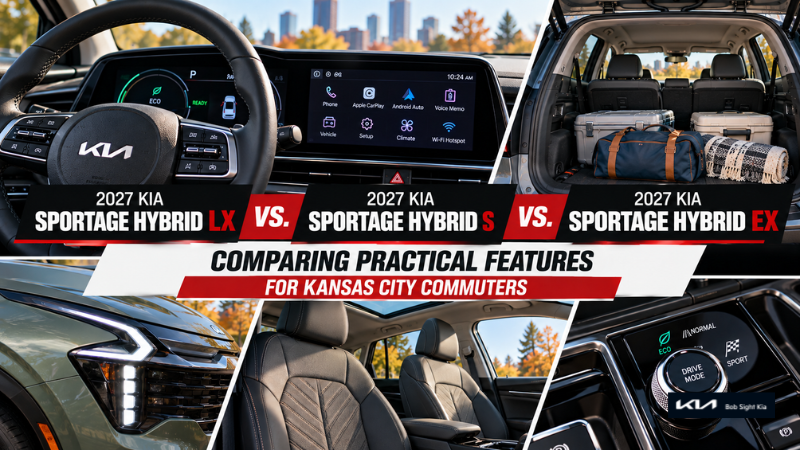
Compare 2027 Kia Sportage Hybrid LX vs S vs EX trims for Kansas City commuters. Find your ideal balance of 41 MPG efficiency, AWD, and tech at Bob Sight Kia.

2027 Kia Sportage Hybrid LX vs. S vs. EX: Comparing Practical Features for Kansas City Commuters

2027 Kia Sportage Hybrid LX vs. S vs. EX: Comparing Practical Features for Kansas City Commuters Selecting between the 2027 Kia Sportage Hybrid LX, S, and EX trims comes down to how seat adjustability, interior upholstery, safety tech, and active all-wheel drive capability align with your daily commute across Jackson County and the Kansas City Metro. While every 2027 Sportage Hybrid delivers a responsive 232-horsepower turbocharged hybrid powertrain and outstanding fuel economy, each trim targets a distinct balance of upfront value and daily driving comfort. At Bob Sight Kia in Independence, MO, we help local commuters, growing families, and daily drivers compare these three popular entry-to-mid-level hybrid configurations so you can select the ideal crossover for your weekly routes along Interstate 70, Highway 40, and I-470. Explore our current inventory of new Kia hybrid crossovers and schedule your test drive today at Bob Sight Kia Sportage Inventory. In This Guide You'll Learn Here is what you will discover in this detailed three-trim comparison guide: The shared 232-horsepower turbocharged hybrid powertrain mechanics and dual-efficiency performance across all three trims. How the entry-level LX delivers maximum fuel efficiency up to 41 MPG combined for budget-focused commuters. Why the sport-styled S trim represents a balanced sweet spot with standard Active AWD, heated seats, and blind-spot monitoring. Key interior luxury upgrades on the EX trim, including SynTex synthetic leather, a 10-way power driver seat, and a Smart Power Liftgate. Differences in display screens, smartphone connectivity, wireless device charging, and center console convenience. A structured side-by-side technical specification matrix comparing seating, safety tech, drivetrain options, and climate controls. Long-term hybrid battery warranty coverage, routine maintenance guidelines, and local financing options at Bob Sight Kia. Overview: The 2027 Kia Sportage Hybrid Trim Hierarchy The 2027 Kia Sportage Hybrid lineup gives drivers three distinct feature tiers in its core commuter range, starting with the high-efficiency LX, moving to the sport-styled S, and stepping up to the well-appointed EX. All three configurations share the exact same advanced hybrid powertrain, combining a 1.6-liter Turbocharged Gasoline Direct Injection (GDI) 4-cylinder engine with a 44-kW electric drive motor and a 1.49-kWh lithium-ion battery pack. Managed by a smooth 6-speed automatic transmission, this setup delivers a stout 232 horsepower and 271 lb-ft of torque. This provides eager passing power when merging onto I-35 or accelerating past slower traffic on US-40 near the Independence Center. The LX trim serves as the entry point, offered in standard Front-Wheel Drive (FWD) or available Active All-Wheel Drive (AWD). The FWD LX configuration delivers the absolute highest fuel economy in the lineup, achieving an EPA-estimated 42 MPG city, 41 MPG highway, and 41 MPG combined. It is built for drivers who want maximum fuel savings and essential digital displays without paying for extra luxury options. Positioned right above the LX, the S trim adds standard Active AWD with an electro-hydraulic locking center differential and selectable Terrain Modes (Snow, Mud, Sand). It enhances curb appeal with 18-inch dark alloy wheels, gloss-black exterior trim accents, roof rails, and standard driver-comfort features like heated front seats and Blind-Spot Collision-Avoidance Assist. The EX trim sits at the top of this core group, adding SynTex synthetic leather seating, a 10-way power driver seat with power lumbar support, dual-zone automatic climate control, wireless device charging, and a Smart Power Liftgate. Fuel Economy vs. All-Weather Traction: FWD LX vs. Standard AWD on S and EX Deciding between these three hybrid trims requires balancing maximum open-highway MPG against the added winter traction of Kia's Active All-Wheel Drive system. For local drivers whose primary goal is minimizing fuel expenses during long daily commutes from Grain Valley or Oak Grove into downtown Kansas City, the Sportage Hybrid LX FWD offers unbeatable efficiency. Achieving up to 41 MPG combined, the FWD LX maximizes every gallon of gasoline during mild weather driving. However, midwestern seasonal realities often bring sudden winter snowstorms, freezing rain, and slick road conditions along I-70 and I-470. Recognizing this, Kia equips both the S and EX trims with standard Active AWD featuring an electro-hydraulic center locking coupling. The AWD system continuously monitors wheel speed and steering inputs, instantly routing torque to the rear wheels when front traction decreases. Additionally, AWD models gain over 8 inches of ground clearance (compared to 7.1 inches on FWD models) and selectable Terrain Modes to navigate snow-covered suburban streets in Raytown and Lee's Summit. While Active AWD models adjust fuel economy slightly to an EPA-estimated 35 MPG city, 36 MPG highway, and 35 MPG combined, that extra traction provides immense confidence during hazardous winter commutes. Drivers who choose the LX can also opt for available Active AWD, giving budget-conscious buyers the flexibility to select their preferred drivetrain. Interior Seating Comfort and Material Touchpoints Cabin comfort varies noticeably as you progress from the woven cloth manual seating in the LX to the heated cloth/SynTex combination in the S, up to full SynTex power seating in the EX. In the base LX trim, seating surfaces are upholstered in durable, breathable woven cloth fabric. Driver seat adjustments are handled manually using 6-way mechanical levers. While comfortable and resilient against daily wear, the LX lacks power lumbar adjustments and heated seat elements. The sport-focused S trim elevates cold-weather driving comfort by introducing standard multi-stage heated front seats. The seating surfaces feature an upgraded cloth upholstery with synthetic leather bolsters, providing firm side support during highway cornering while heating up rapidly during freezing January mornings in Sugar Creek. The driver seat retains manual adjustment controls, keeping vehicle operation simple and intuitive. Stepping up to the 2027 Sportage Hybrid EX transforms overall ergonomics by replacing cloth with complete SynTex synthetic leather upholstery. SynTex delivers a supple, premium feel while offering superior spill resistance and effortless cleaning, making it an ideal option for local parents and pet owners. Furthermore, the EX upgrades the driver seat to a 10-way power adjustment setup with 2-way power lumbar support. The power lumbar control can be electronically extended to match your lower back curve, significantly reducing spine fatigue during extended rush-hour traffic jams along I-35. Infotainment, Navigation, and Center Console Tech Digital display layouts and smartphone integration methods differ across the three trims, catering to different technology preferences. The LX and S trims feature Kia's sleek dashboard layout housing dual 12.3-inch display panels. The center touchscreen interface on the LX and S supports standard wireless Apple CarPlay and Android Auto integration. This allows drivers to mirror smartphone mapping, music apps, and voice calls onto the central display without needing to connect a physical USB charging cable. The EX trim upgrades the central display to Kia's ccNC navigation-equipped 12.3-inch system featuring built-in factory GPS mapping, real-time traffic updates, Kia Connect telematics, and over-the-air software updating. Because of the direct processing demands of integrated factory navigation, Apple CarPlay and Android Auto on the EX trim operate via a high-speed wired USB-C connection, ensuring zero mapping latency while simultaneously fast-charging your smartphone device. Center console convenience also receives key functional additions on the EX. While the LX and S offer multiple front USB-C data and charging ports, the EX adds a Qi-enabled wireless smartphone charging pad on the center console tray. The EX also includes additional USB-C charging ports built directly into the backs of the front seats, allowing second-row passengers to keep personal tablets and phones fully powered during family road trips across Missouri. Safety Systems and Driver Assistance Technology While all three trims include robust standard active safety features, the S and EX trims introduce key blind-spot monitoring and rear traffic alert systems as standard equipment. Every 2027 Sportage Hybrid includes Kia Drive Wise safety tech, including Forward Collision-Avoidance Assist with Pedestrian and Cyclist Detection, Lane Keeping Assist, Lane Following Assist, Rear Park Distance Warning, and Driver Attention Warning. Starting on the S trim, Kia adds essential side and rear radar safety coverage through standard Blind-Spot Collision-Avoidance Assist and Rear Cross-Traffic Collision-Avoidance Assist. When changing lanes on busy multi-lane highways like I-70 or backing out of blind parking stalls at crowded shopping centers, these systems actively monitor approaching traffic in your blind spots. If you attempt to change lanes or reverse into the path of an oncoming vehicle, the system emits audible alerts and can apply subtle braking force to prevent a collision. The EX trim builds further upon this safety foundation by adding Highway Driving Assist (HDA) in select option configurations. HDA combines Smart Cruise Control with Stop & Go and Lane Following Assist, automatically maintaining preset follow distances and keeping the Sportage centered in its lane during long highway stretches between Independence and Columbia. Step-by-Step Guide: Evaluating Which Hybrid Trim Fits Your Lifestyle Determining whether the high-efficiency LX, the all-weather S, or the feature-packed EX best fits your budget and commuting requirements is easy when following this structured evaluation process: Calculate Your Weekly Commute Distance and Fuel Budget: If you log over 300 highway miles per week and prioritize maximum fuel savings above all else, the 41 MPG combined rating on the FWD LX trim will deliver immediate long-term savings at the pump. Assess Winter Weather Driving Priorities: Consider how often you must drive during active snowstorms. If all-weather traction and elevated ground clearance are non-negotiable for your job, choose the S or EX trim with standard Active AWD and Terrain Modes. Evaluate Driver Ergonomics and Seating Touchpoints: Visit Bob Sight Kia to test the driver seating positions. Compare the manual cloth seat on the LX and S against the 10-way power driver seat with power lumbar support and SynTex synthetic leather on the EX. Determine Wireless Charging and Liftgate Needs: Consider daily utility tasks. If hands-free grocery loading via a Smart Power Liftgate and wireless smartphone charging are essential for your routine, the EX trim provides those exact features. Review Total Monthly Financing and Purchase Incentives: Work with our finance specialists at Bob Sight Kia to calculate monthly lease or purchase payments across all three trims. Balance the small monthly payment variance against the added convenience features of higher trims. Side-by-Side Specifications Matrix: 2027 Kia Sportage Hybrid LX vs. S vs. EX To help you visualize how equipment, seating, safety, and options scale across these three popular hybrid trims, review our direct comparison breakdown below. Feature Category 2027 Sportage Hybrid LX 2027 Sportage Hybrid S 2027 Sportage Hybrid EX Combined Horsepower 232 hp @ 5,500 RPM 232 hp @ 5,500 RPM 232 hp @ 5,500 RPM Drivetrain Availability FWD (Std) / Available Active AWD Standard Active AWD Standard Active AWD EPA Fuel Economy (FWD) 42 City / 41 Hwy / 41 Cbnd N/A (Standard AWD) N/A (Standard AWD) EPA Fuel Economy (AWD) 35 City / 36 Hwy / 35 Cbnd 35 City / 36 Hwy / 35 Cbnd 35 City / 36 Hwy / 35 Cbnd Seating Material Woven Cloth Upholstery Sport Cloth w/ SynTex Bolsters Full SynTex Synthetic Leather Driver Seat Adjustments 6-Way Manual Adjuster 6-Way Manual Adjuster 10-Way Power w/ Power Lumbar Heated Front Seats Not Available Standard Multi-Stage Heated Standard Multi-Stage Heated Climate Control System Dual-Zone Auto Climate Dual-Zone Auto Climate Dual-Zone Auto Climate w/ Auto Defog Infotainment Screen 12.3-inch Touchscreen 12.3-inch Touchscreen 12.3-inch Navigation Touchscreen Smartphone Integration Wireless Apple CarPlay/Android Auto Wireless Apple CarPlay/Android Auto Wired Apple CarPlay/Android Auto Blind-Spot Collision Tech Available in Packages Standard Blind-Spot Warning Standard Blind-Spot Warning Wireless Phone Charger Not Available Not Available Standard Qi Wireless Charger Smart Power Liftgate Not Available Not Available Standard Smart Power Liftgate This side-by-side matrix shows how each trim level fulfills specific driver priorities. The LX offers unmatched entry value and fuel efficiency, the S introduces essential all-weather traction and heated seating, and the EX delivers luxury-tier convenience for daily commuters. Step-by-Step Guide: Optimizing Hybrid Drive Modes for Daily Commuting When taking delivery of your 2027 Kia Sportage Hybrid from Bob Sight Kia, learning how to switch drive modes helps you maximize fuel efficiency and traction during different driving scenarios. Follow these simple operational steps: Engage Eco Mode for Everyday Commuting: Turn the center console Drive Mode dial to "Eco" for standard city and highway driving. This mode optimizes engine throttle mapping, electric motor assistance, and transmission shift points to maximize MPG. Switch to Sport Mode for Highway Merging: When accelerating onto short highway entrance ramps along I-470 or passing slower traffic, rotate the dial to "Sport Mode." This sharpens throttle response and holds gear ratios longer for maximum acceleration. Activate Snow Mode During Winter Weather: On AWD-equipped S and EX models, select "Snow Mode" on the Terrain Mode dial during winter weather. This recalibrates torque distribution and traction control to prevent wheel spin on slippery ice and slush. Utilize Smart Mode for Adaptive Driving: Select "Smart Mode" to allow the vehicle onboard computer to monitor your throttle inputs and automatically alternate between Eco and Sport modes based on real-time driving conditions. Monitor Energy Flow Displays: Access the "Hybrid" tab on your 12.3-inch touchscreen to view real-time energy flow diagrams showing battery charging status, engine power delivery, and regenerative braking energy capture. Quick Facts: 2027 Kia Sportage Hybrid Core Lineup Here are the essential quick facts regarding the 2027 Kia Sportage Hybrid LX, S, and EX models: 232 Total Horsepower: All three hybrid trims share the same 1.6L turbocharged engine and electric motor combination. Self-Charging Hybrid Tech: None of these three trims require plugging into an electrical outlet; the battery recharges automatically through driving. Class-Leading Rear Legroom: All trims provide an expansive 41.3 inches of second-row legroom for passenger comfort. Generous Cargo Utility: Provides approximately 40 cubic feet of cargo volume behind the second row and up to 74 cubic feet with rear seats folded flat. Standard Active Safety: Forward Collision-Avoidance Assist, Lane Keeping Assist, and Rear Park Distance Warning come standard on all trims. Convenient Hands-Free Cargo Access: A Smart Power Liftgate comes standard on the EX trim for effortless hands-free loading. 10-Year Battery Warranty: Backed by Kia's 10-Year/100,000-Mile Powertrain and Hybrid System Warranty. Ownership Strategy: Hybrid Battery Warranties, Service, and Value Retention Long-term confidence is central to the 2027 Kia Sportage Hybrid ownership experience, backed by one of the automotive industry's most comprehensive factory warranty packages. Every new Sportage Hybrid purchased at Bob Sight Kia includes Kia's 10-Year/100,000-Mile Powertrain Limited Warranty alongside a dedicated 10-Year/100,000-Mile Hybrid System Warranty. This coverage protects high-voltage components including the 1.49-kWh lithium-ion battery, electric motor, power control unit, and hybrid system sensors. Additionally, a 5-Year/60,000-Mile Basic Limited Warranty and 5-Year/60,000-Mile Roadside Assistance are included standard. Maintenance for the 1.6L turbocharged hybrid engine follows standard, predictable service intervals. Synthetic engine oil and filter changes are recommended every 7,500 miles or 12 months. Because the electric drive motor handles a substantial portion of initial braking force via regenerative braking, brake pad and rotor wear on hybrid models is often significantly lower than on traditional gas-only vehicles. However, routine brake inspections, tire rotations every 7,500 miles, and replacing cabin air filters every 15,000 miles remain essential to keep your crossover operating at peak efficiency. From a resale and trade-in standpoint, compact hybrid crossovers hold strong residual value in the Kansas City regional market. Used car shoppers actively seek out fuel-efficient hybrid models with standard all-wheel drive, heated seats, and modern safety technology. Maintaining your vehicle exclusively at Bob Sight Kia ensures all factory services are documented on your vehicle history report, helping preserve maximum trade-in equity when you decide to upgrade in the future. Frequently Asked Questions What is the main difference between the 2027 Kia Sportage Hybrid LX, S, and EX trims? The main differences between the LX, S, and EX trims center around drivetrain availability, interior seating materials, climate controls, and active driver assistance technologies. The LX is the high-efficiency base trim offered in FWD (41 MPG combined) or available AWD, featuring woven cloth manual seats and wireless Apple CarPlay/Android Auto. The S trim introduces standard Active AWD, 18-inch dark alloy wheels, heated front seats, and standard Blind-Spot Collision-Avoidance Assist. The EX trim sits as the premium choice, adding SynTex synthetic leather seating, a 10-way power driver seat, dual-zone automatic climate control, a Smart Power Liftgate, and a wireless phone charger. All three trims share the exact same 232-horsepower 1.6L turbocharged hybrid powertrain and 6-speed automatic transmission, ensuring matching engine power and performance regardless of trim level. You can compare seating materials and test screen interfaces across all three trims in person at Bob Sight Kia in Independence. Does the 2027 Kia Sportage Hybrid S or EX get better gas mileage than the LX trim? The Front-Wheel Drive (FWD) Sportage Hybrid LX gets the highest gas mileage in the lineup at an EPA-estimated 42 MPG city, 41 MPG highway, and 41 MPG combined. The S and EX trims come standard with Active All-Wheel Drive (AWD), which adjusts fuel economy to an EPA-estimated 35 MPG city, 36 MPG highway, and 35 MPG combined due to the mechanical drag and added traction components of the AWD system. If you choose the LX trim with available Active AWD, its fuel economy matches the S and EX trims at 35 MPG combined. Therefore, if maximum fuel savings above 40 MPG is your primary goal, the FWD LX trim is the optimal configuration. However, many Jackson County commuters find that the added winter driving confidence provided by standard Active AWD on the S and EX trims easily justifies the small difference in MPG. Do I need to plug in the 2027 Kia Sportage Hybrid to charge the battery? No, none of the standard 2027 Sportage Hybrid trims (LX, S, or EX) require plug-in charging. The 1.49-kWh lithium-ion battery pack recharges automatically while you drive through regenerative braking and engine power generation. You simply fill up the gas tank at standard gasoline stations as you would with a conventional gas vehicle. The hybrid system continuously manages energy flow behind the scenes, using the electric motor to assist acceleration, coasting on electric power during low-speed city driving, and capturing braking energy to recharge the battery. If you are specifically seeking a vehicle with a larger battery that offers dedicated plug-in electric driving range, you can explore the Sportage Plug-In Hybrid (PHEV) models available at Bob Sight Kia. Is a power driver seat standard on the Sportage Hybrid S trim? No, a power-adjustable driver seat is not included on the Sportage Hybrid S trim; it is a feature that begins on the EX trim. Both the LX and S trims feature 6-way manually adjustable driver and front passenger seats. The EX trim introduces a 10-way power-adjustable driver seat with 2-way power lumbar support. The power lumbar adjustment on the EX trim allows drivers to electronically adjust lower back support, which helps reduce driver fatigue during long daily commutes across the Kansas City region. However, the S trim does include standard multi-stage heated front seats, giving drivers warm seating comfort during cold winter months. What is covered under the 10-Year/100,000-Mile Kia Hybrid Warranty? Kia's 10-Year/100,000-Mile Hybrid System Warranty covers all major high-voltage electric components against manufacturing defects. Covered components include the 1.49-kWh lithium-ion battery pack, electric drive motor, power control unit, and onboard hybrid system software control modules. This hybrid warranty runs concurrently with Kia's famed 10-Year/100,000-Mile Powertrain Warranty, which protects the 1.6L turbocharged engine and transmission. Combined with a 5-Year/60,000-Mile Basic Warranty and Roadside Assistance, Kia provides exceptional long-term peace of mind. Our factory-trained technicians at Bob Sight Kia perform routine diagnostics during scheduled service visits to ensure your hybrid system functions at peak efficiency throughout your ownership. Why Buying Local at Bob Sight Kia Matters for Independence Drivers Purchasing your 2027 Kia Sportage Hybrid locally from Bob Sight Kia guarantees personalized service, ongoing regional support, and deep community commitment that major online retailers and out-of-town dealer chains cannot match. As a family-owned dealership serving Independence, Lee's Summit, Blue Springs, Raytown, and the greater Kansas City Metro for decades, we understand the specific needs of midwestern drivers. From selecting the right drivetrain configuration for winter snow to navigating local vehicle titling and trade-in valuations, our experienced sales and finance teams provide transparent, stress-free assistance every step of the way. When you buy local, your relationship with Bob Sight Kia extends far beyond the day you drive off our lot. Our factory-certified Kia service department utilizes state-of-the-art diagnostic equipment, specialized tools, and genuine Kia OEM parts engineered specifically for your Sportage Hybrid. Whether you are coming in for routine synthetic oil changes, tire rotations, brake pad replacements, or multi-point seasonal inspections, our factory-trained technicians ensure your crossover performs at peak safety and efficiency throughout its entire lifetime. Supporting a local dealership also keeps your investment grounded within the Jackson County community. We take pride in building long-term relationships with local families across Liberty, Sugar Creek, and Grain Valley. Visit our showroom on Highway 40 in Independence today to experience our commitment to customer care, compare the Sportage Hybrid LX, S, and EX trims in person, and discover why Kansas City drivers trust Bob Sight Kia for all their automotive needs. Helpful Links Explore these key resources on our website to research inventory, schedule service, or start your purchasing process: New Kia Sportage Inventory in Independence, MO Value Your Trade-In Online at Bob Sight Kia Apply for Online Auto Financing and Pre-Approval Schedule Kia Service and Maintenance Online Current Kia Service and Parts Specials Proud to Be Part of the Bob Sight Auto Group Bob Sight Kia is a proud member of the Bob Sight Auto Group, a family-owned automotive network dedicated to serving drivers across Missouri and Kansas with integrity, quality vehicles, and exceptional customer service for generations. Whether you are shopping for a new Kia crossover, a reliable pre-owned car, certified service, or collision repair, our dealership family is here to support all your automotive needs across the Kansas City region. Visit any of our convenient Bob Sight Auto Group locations: Bob Sight Kia - Independence, MO Bob Sight Ford - Lee's Summit, MO Bob Sight Honda - Lawrence, KS Bob Sight CDJR - Lawrence, KS Bob Sight Collision Center - Lee's Summit, MO
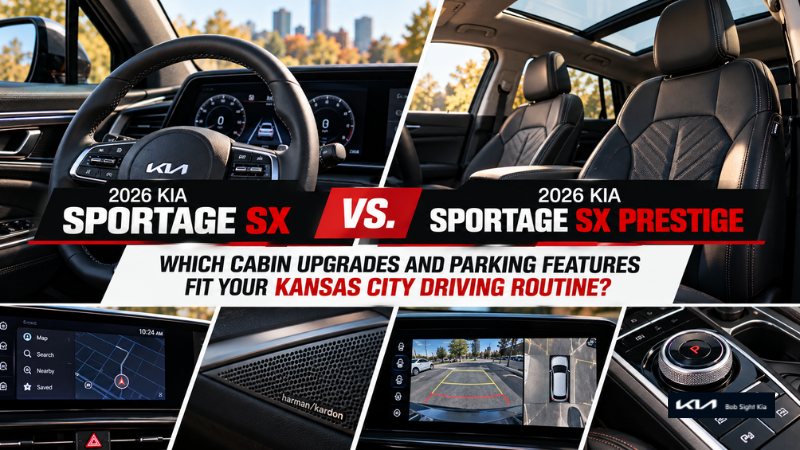
Compare 2026 Kia Sportage SX vs SX Prestige cabin upgrades, ventilated seats, and Remote Smart Parking Assist for Kansas City drivers at Bob Sight Kia.

2026 Kia Sportage SX vs. SX Prestige: Which Cabin Upgrades and Parking Features Fit Your Kansas City Driving Routine?

2026 Kia Sportage SX vs. SX Prestige: Which Cabin Upgrades and Parking Features Fit Your Kansas City Driving Routine? Choosing between the 2026 Kia Sportage SX and the top-tier SX Prestige comes down to how high-end interior luxury, advanced digital displays, and automated parking technologies enhance your daily drive across Jackson County and the Kansas City Metro. While both trims share a sport-styled exterior design, standard Active All-Wheel Drive options, and Kia's powerful 2.5-liter engine, the SX Prestige adds exclusive driver-assist upgrades like the Surround View Monitor, Blind-Spot View Monitor, and Remote Smart Parking Assist. At Bob Sight Kia in Independence, MO, we assist local commuters and crossover enthusiasts in comparing these high-end configurations to choose the ultimate setup for navigating tight downtown Kansas City parking garages, busy suburban shopping districts, and daily highway routes along I-70 and I-470. Explore our current inventory of new Kia crossovers and schedule your test drive today at Bob Sight Kia Sportage Inventory. In This Guide You'll Learn Here is what you will discover in this detailed trim comparison guide: The structural and mechanical similarities shared by the 2026 Kia Sportage SX and SX Prestige models. Key cabin luxury enhancements, including ventilation features, memory seating, and interior trim finishes. How exclusive camera-based driver assistance tech like Surround View and Blind-Spot View Monitors operate in real-world driving. Using Remote Smart Parking Assist (RSPA) for tight parking spaces in downtown Kansas City and local parking garages. Audio performance differences, digital gauge cluster customization, and interior lighting control setups. A structured side-by-side technical matrix comparing interior features, safety sensors, and seating tech. Long-term vehicle maintenance, warranty protection, and financing advice at Bob Sight Kia. Overview: High-Tier Luxury in the 2026 Kia Sportage Lineup The SX and SX Prestige trims represent the pinnacle of comfort, technology, and style in the 2026 Kia Sportage lineup, built for drivers who want premium features without luxury-brand pricing. Both configurations are powered by a dependable 2.5-liter Inline 4-cylinder Gasoline Direct Injection (GDI) engine paired with a smooth 8-speed automatic transmission. Generating 187 horsepower and 178 lb-ft of torque, both trims deliver confident acceleration whether you are merging onto I-470 near Summit Fair or heading east toward Grain Valley. Active All-Wheel Drive with an electro-hydraulic locking center differential is available on both trims to ensure optimal traction on icy Missouri roads. While lower trims focus on essential utility and core convenience, the SX and SX Prestige elevate every daily touchpoint. The SX trim introduces sophisticated features like dual 12.3-inch panoramic display screens, driver's seat memory settings, hands-free Smart Power Liftgate, and Harman Kardon premium audio. It serves as a near-luxury crossover designed for long-distance highway comfort and refined everyday driving around Independence and Lee's Summit. The SX Prestige goes a step further, adding advanced automated parking features and top-tier interior comfort. Upgrades include multi-stage ventilated front seats, a heated steering wheel, a power-adjustable front passenger seat, and an array of active parking cameras and sensors. Deciding between the SX and SX Prestige involves weighing these specialized camera technologies and climate-controlled seating enhancements against your daily parking routines and commuting habits across the Kansas City region. Interior Seating, Materials, and Temperature Management While both trims feature premium SynTex synthetic leather seating, the SX Prestige elevates daily driving comfort with ventilated front seats, a heated steering wheel, and a 8-way power front passenger seat. In the Sportage SX, the driver enjoys a 10-way power seat with 2-way power lumbar support and 2-position driver memory settings, while the front passenger relies on a 4-way manual adjustment setup. Heated front seats come standard on both trims, offering rapid warmth during freezing winter mornings in Sugar Creek and Raytown. Stepping up to the SX Prestige transforms overall cabin climate control for both front occupants. The addition of multi-stage front seat ventilation utilizes internal fans to circulate cool air through the perforated SynTex material, keeping you cool during humid midwestern summer afternoons. The front passenger seat receives an upgrade to an 8-way power adjustment system, allowing your co-pilot to easily fine-tune their seating position during long road trips down I-70 or trips across state lines into Kansas. Steering wheel comfort and interior touchpoints also see key upgrades on the top trim. The SX Prestige includes a heated, leather-wrapped steering wheel that warms quickly at the touch of a button, providing welcome comfort during bitter January frost. Furthermore, LED interior overhead lighting comes standard on the SX Prestige, illuminating the spacious cabin with crisp, clean light that enhances the upscale feel of the interior environment. Advanced Camera Systems: Surround View vs. Standard Rearview The most notable technology difference between the SX and SX Prestige is the addition of Kia's Surround View Monitor (SVM) and Blind-Spot View Monitor (BVM) on the Prestige trim. The standard Sportage SX features a dynamic rearview monitor with parking guidance gridlines, along with Rear Park Distance Warning sensors to alert you to obstacles directly behind the vehicle when reversing out of a driveway or parking space. The SX Prestige replaces the standard setup with a comprehensive 360-degree Surround View Monitor system. Utilizing four exterior wide-angle cameras mounted in the front grille, side mirrors, and rear liftgate, the system generates a virtual bird's-eye view of your Sportage on the central 12.3-inch navigation screen. This feature eliminates blind spots when maneuvering around tight curb corners, parking near high curbs at Independence Center, or positioning the crossover perfectly within narrow parking garage stalls in downtown Kansas City. Additionally, the SX Prestige features Kia's innovative Blind-Spot View Monitor. When you activate your turn signal to switch lanes on I-35 or I-70, a high-resolution live video feed of your left or right blind spot projects directly onto the 12.3-inch digital instrument cluster. This visual feed complements the standard Blind-Spot Collision-Avoidance Assist, providing immediate visual confirmation that your turn or lane change is completely clear before you execute the maneuver. Automated Parking Tech: Remote Smart Parking Assist (RSPA) Explained Exclusive to the 2026 Sportage SX Prestige, Remote Smart Parking Assist (RSPA) allows drivers to maneuver the vehicle into or out of tight parking spaces using the Smart Key fob while standing outside the car. Tight parking spaces in crowded parking structures or narrow residential garages often make opening vehicle doors difficult. RSPA addresses this challenge by automating straight-line forward and reverse parking maneuvers via key fob controls. To operate RSPA, the driver positions the Sportage aligned with a target parking stall, exits the cabin, and presses and holds the dedicated forward or reverse button on the Smart Key fob. Utilizing its suite of front, side, and rear ultrasonic parking sensors, the vehicle controls steering, acceleration, braking, and gear shifting automatically. It glides safely into or out of the spot while continually monitoring for pedestrians, passing vehicles, or low-hanging obstacles. If the sensors detect an approaching object or obstacle within the vehicle's path, the system automatically applies the brakes and halts movement instantly. For drivers who regularly park in tight spaces across Kansas City or who want to avoid door dings in crowded retail lots along Noland Road, RSPA provides unmatched convenience and protection for your crossover investment. Audio Performance and Display Tech Both the SX and SX Prestige feature Kia's flagship curved glass display housing twin 12.3-inch screens, paired with a Harman Kardon premium audio system. The driver instrument cluster and central infotainment screen sit under a continuous curved glass panel that gives the dashboard a modern, high-tech look. The 12.3-inch infotainment system includes factory navigation, Kia Connect telematics, over-the-air updates, and wired Apple CarPlay and Android Auto integration. A standard highlight on both trims is the 400-watt Harman Kardon Premium Audio system featuring 8 strategically placed speakers, including a dedicated center speaker and a cargo-mounted subwoofer. Utilizing Clari-Fi music restoration technology, this audio setup delivers rich bass and clear high-frequency performance across all music genres, turning daily highway commutes along I-470 into an enjoyable listening experience. Where the SX Prestige distinguishes itself within the digital cabin is through enhanced display integration and expanded driver customization. The 12.3-inch instrument cluster on the SX Prestige seamlessly integrates the Blind-Spot View Monitor video feeds, while dynamic color-themed gauge layouts shift based on selected Drive Modes (Normal, Sport, Smart, and Snow). Integrated ambient interior lighting with customizable color palettes allows Prestige drivers to tailor cabin lighting to match their driving mood. Step-by-Step Guide: Choosing Between the SX and SX Prestige If you are deciding whether the standard luxury of the SX or the advanced technology of the SX Prestige best aligns with your driving habits, follow this step-by-step selection process: Evaluate Your Daily Parking Environment: If you frequently park in narrow garages in downtown Kansas City, tight parking stalls at work, or crowded lots along Highway 40, the Surround View Monitor, front parking sensors, and Remote Smart Parking Assist on the SX Prestige provide essential maneuverability benefits. Assess Seasonal Temperature Preferences: Consider how much you value summer cooling. While both trims feature heated front seats, the multi-stage ventilated front seats and heated steering wheel on the SX Prestige deliver year-round climate comfort during hot Missouri summers and cold winter freezes. Factor in Front Passenger Comfort: If you regularly travel with a partner or adult passenger, the 8-way power front passenger seat on the SX Prestige provides superior adjustability compared to the 4-way manual seat on the SX trim. Test Advanced Driver Assist Features: Visit Bob Sight Kia to experience the Blind-Spot View Monitor and Surround View system in person. Seeing live camera feeds project directly onto the gauge cluster during a turn signal test drive often clarifies the value of the Prestige safety suite. Compare Total Monthly Investment: Work with our finance team to review purchasing and leasing options. Evaluate the small difference in monthly financing against the added safety, convenience, and higher long-term resale value offered by the SX Prestige trim. Side-by-Side Feature Matrix: 2026 Kia Sportage SX vs. SX Prestige To help you compare key features across both upper-tier trims, we have created a direct breakdown of seating, tech, and parking features below. Both models include standard safety tech like Forward Collision-Avoidance Assist with Junction Turning and Highway Driving Assist, but diverge in camera systems and cabin convenience. Feature Category 2026 Kia Sportage SX 2026 Kia Sportage SX Prestige Front Seating Material Perforated SynTex Synthetic Leather Premium Perforated SynTex Synthetic Leather Heated & Ventilated Front Seats Heated Front Seats Only Heated & Multi-Stage Ventilated Front Seats Front Passenger Seat Adjustment 4-Way Manual Adjustment 8-Way Power Adjustment Heated Steering Wheel Not Available Standard Leather-Wrapped Heated Steering Wheel Driver Memory System 2-Position Driver Seat Memory 2-Position Driver Seat Memory Parking Camera System Rearview Camera with Dynamic Gridlines 360-Degree Surround View Monitor (SVM) Blind-Spot Display Tech Blind-Spot Collision-Avoidance Assist Blind-Spot View Monitor (BVM) in Cluster Remote Parking Assistant Not Available Remote Smart Parking Assist (RSPA) via Key Fob Parking Distance Sensors Rear Parking Sensors Only Front, Rear, and Side Parking Distance Sensors Reverse Safety Assist Rear Cross-Traffic Collision Assist Parking Collision-Avoidance Assist Reverse (PCA-R) Premium Audio System 8-Speaker Harman Kardon Sound System 8-Speaker Harman Kardon Sound System Panoramic Sunroof Standard Power Panoramic Sunroof Standard Power Panoramic Sunroof This comparison highlights how the SX Prestige concentrates its upgrades on automated maneuverability, active surround vision, and upgraded cabin temperature control. While the SX provides a luxurious baseline, the Prestige configuration caters to drivers who want top-tier technology and convenience. Step-by-Step Guide: Utilizing Remote Smart Parking Assist and Surround View When taking delivery of your 2026 Kia Sportage SX Prestige from Bob Sight Kia, learning how to operate its camera systems and remote parking functions ensures maximum safety and ease of use. Follow these simple steps when parking in tight spaces across Independence: Activating Surround View Monitor when Parking: When shifting into Reverse, the Surround View Monitor activates automatically on the 12.3-inch central display. To activate camera views when pulling forward into a tight space, press the physical "P View" button located on the center console near the shift dial. Customizing Camera Angle Perspectives: On the Surround View screen, touch the screen icons on the left side to switch between overhead 360-degree views, wide front views, side wheel clearance views, or a 3D rotatable exterior rendering to verify proximity to obstacles. Initiating Remote Smart Parking Assist (Straight-Line): Position your Sportage directly aligned with the target parking space, shift into Park, and turn off the engine. Exit the vehicle with the Smart Key in your hand and close all doors. Operating Forward / Reverse Key Controls: Stand within 10 feet of the vehicle. Press and hold the "Forward" or "Reverse" button on the side of the Smart Key fob. The engine will start remotely, and the vehicle will begin moving slowly into or out of the parking spot, steering automatically to avoid obstacles. Completing the Maneuver and Shutting Down: Release the key fob button once the vehicle reaches your desired position. The brakes engage automatically. Lock the vehicle using the key fob; the engine shuts off and the electronic parking brake sets automatically. Quick Facts: 2026 Kia Sportage SX vs. SX Prestige Here are the key takeaways regarding the 2026 Kia Sportage SX and SX Prestige models for Independence and Kansas City buyers: Powertrain Unity: Both trims share the 187-hp 2.5L 4-cylinder engine and 8-speed automatic transmission with available Active AWD. Full Panoramic Cockpit: Dual 12.3-inch screens with built-in navigation and wired Apple CarPlay/Android Auto come standard on both trims. Ventilated Seating Exclusive: Front seat ventilation is exclusive to the SX Prestige, while both trims offer standard heated front seats. Remote Parking Tech: Remote Smart Parking Assist (RSPA) key fob operation is available only on the SX Prestige model. Complete Camera Vision: The SX Prestige upgrades from a standard rearview camera to a 360-degree Surround View Monitor and Blind-Spot View Monitor. Premium Sound Standard: An 8-speaker Harman Kardon premium audio system with a subwoofer comes standard on both SX and SX Prestige trims. Panoramic Sky Views: A power panoramic sunroof with a power sunshade comes standard on both upper-tier models. Ownership Strategy: Maintenance, Warranty Protection, and Resale Value Long-term ownership of a feature-packed crossover like the 2026 Kia Sportage SX or SX Prestige is supported by Kia's industry-leading warranty coverage and straightforward maintenance schedules. Every new Sportage includes Kia's 10-Year/100,000-Mile Powertrain Limited Warranty, a 5-Year/60,000-Mile Basic Limited Warranty, and 5-Year/60,000-Mile Roadside Assistance. This extensive safety net protects your investment against unforeseen repair costs across your initial years of driving. Maintaining the sophisticated electronics, active camera sensors, and mechanical systems of these top trims requires following factory-recommended maintenance intervals. Engine oil and filter replacements are scheduled every 7,500 miles or 12 months using synthetic 0W-20 engine oil. At each service interval, technicians perform tire rotations, inspect brake hardware, check fluid levels, and ensure front and rear camera lenses remain properly aligned and calibrated for accurate Surround View and driver-assist performance. In terms of trade-in value and market retention, high-trim crossovers like the SX Prestige hold exceptional value on the secondary market in the Kansas City region. Pre-owned buyers actively seek out features like 360-degree cameras, ventilated seats, and remote parking tech. Servicing your Sportage exclusively at Bob Sight Kia ensures all maintenance visits are recorded on your vehicle history report, maximizing long-term trade-in value when you decide to upgrade down the road. Frequently Asked Questions Does the 2026 Kia Sportage SX or SX Prestige come with a Surround View camera system? The 360-degree Surround View Monitor (SVM) is exclusive to the top-tier 2026 Kia Sportage SX Prestige trim and is not available on the standard SX model. The Surround View system utilizes four exterior cameras positioned around the front grille, side mirrors, and rear liftgate to generate a seamless bird's-eye view of your vehicle on the central 12.3-inch navigation screen. This feature allows drivers to easily navigate tight parking spaces, see low obstacles, and avoid curbing wheels in crowded downtown Kansas City parking garages. In contrast, the standard Sportage SX includes a high-definition rearview camera with dynamic parking guidance gridlines and Rear Parking Distance Warning sensors. While the standard setup provides excellent rearward visibility when backing up, it lacks the multi-angle front and side camera perspectives offered by the Prestige trim's Surround View system. If clear visibility when parking in tight spaces is a priority for your daily driving routine, testing the Surround View Monitor at Bob Sight Kia in Independence will showcase how much confidence it adds to everyday maneuvers. How does Remote Smart Parking Assist work on the 2026 Sportage SX Prestige? Remote Smart Parking Assist (RSPA) allows the driver to move the 2026 Sportage SX Prestige forward into or backward out of tight parking spaces using the key fob while standing outside the vehicle. By holding the dedicated forward or reverse button on the Smart Key, the vehicle starts remotely and controls steering, acceleration, and braking automatically using its ultrasonic sensors to glide into or out of a parking spot. If the vehicle's sensors detect a pedestrian, adjacent vehicle, or obstacle within its path, the RSPA system automatically applies the brakes and halts movement instantly. This feature is especially useful when parking in narrow home garages or tight public parking stalls where opening vehicle doors would be difficult. RSPA is exclusive to the SX Prestige trim and cannot be added to the standard SX model. Our sales team at Bob Sight Kia can demonstrate this automated parking feature during your showroom visit. Are ventilated front seats standard on the 2026 Kia Sportage SX? No, multi-stage ventilated front seats are not included on the standard 2026 Sportage SX trim; they are an exclusive standard feature on the SX Prestige model. Both the SX and SX Prestige come standard with multi-stage heated front seats and durable SynTex synthetic leather upholstery, but only the SX Prestige adds internal seat ventilation fans that blow cool air through the perforated seat surfaces during warm summer weather. Ventilated front seats provide exceptional cooling comfort during hot, humid midwestern summers in Jackson County, helping keep drivers cool after the vehicle has been parked in the sun. On the SX Prestige, drivers and front passengers can choose between three speed settings for both heating and cooling. If ventilated seating is a must-have feature for your summer commutes along I-70, upgrading to the SX Prestige trim ensures you enjoy year-round cabin climate comfort. What is the difference in front passenger seat adjustments between the SX and SX Prestige? The 2026 Sportage SX features a 4-way manual front passenger seat, whereas the SX Prestige upgrades to an 8-way power-adjustable front passenger seat. On the standard SX trim, the front passenger uses manual levers to adjust fore-and-aft seat position and seatback recline angle. On the SX Prestige, power seat controls allow the front passenger to easily adjust seat height, thigh support, recline angle, and fore-and-aft positioning at the push of a button. Both trims feature an identical 10-way power driver's seat with 2-way power lumbar support and 2-position driver memory settings. The memory system saves preferred seat and side mirror positions for two distinct drivers, allowing couples or shared drivers in Independence to restore their driving preferences instantly. For buyers who frequently travel with adult passengers or family members on long road trips across Missouri, the added power adjustability on the SX Prestige passenger seat provides significant comfort benefits. Do both the SX and SX Prestige include the Harman Kardon audio system? Yes, an 8-speaker Harman Kardon premium audio system comes standard on both the 2026 Kia Sportage SX and SX Prestige trims. This high-performance audio setup features a dedicated center channel speaker, door-mounted midrange speakers, pillar-mounted tweeters, and a custom subwoofer housed in the rear cargo area, powered by a 400-watt digital amplifier. The system incorporates Harman's Clari-Fi digital audio restoration technology, which analyzes compressed digital audio files in real time to restore rich detail, clear high frequencies, and deep bass performance. Whether streaming music via Apple CarPlay, Android Auto, or SiriusXM satellite radio, both trims deliver an exceptional listening experience. You can test the audio clarity and acoustic performance of the Harman Kardon system in both trims at Bob Sight Kia in Independence. Why Buying Local at Bob Sight Kia Matters for Independence Drivers Purchasing your 2026 Kia Sportage locally from Bob Sight Kia guarantees personalized service, ongoing regional support, and deep community commitment that major online retailers and out-of-town dealer chains cannot match. As a family-owned dealership serving Independence, Lee's Summit, Blue Springs, Raytown, and the greater Kansas City Metro for decades, we understand the specific needs of midwestern drivers. From selecting the right drivetrain configuration for winter snow to navigating local vehicle titling and trade-in valuations, our experienced sales and finance teams provide transparent, stress-free assistance every step of the way. When you buy local, your relationship with Bob Sight Kia extends far beyond the day you drive off our lot. Our factory-certified Kia service department utilizes state-of-the-art diagnostic equipment, specialized tools, and genuine Kia OEM parts engineered specifically for your Sportage SX or SX Prestige. Whether you are coming in for routine synthetic oil changes, tire rotations, brake pad replacements, or multi-point seasonal inspections, our factory-trained technicians ensure your crossover performs at peak safety and efficiency throughout its entire lifetime. Supporting a local dealership also keeps your investment grounded within the Jackson County community. We take pride in building long-term relationships with local families across Liberty, Sugar Creek, and Grain Valley. Visit our showroom on Highway 40 in Independence today to experience our commitment to customer care, compare the Sportage SX and SX Prestige trims in person, and discover why Kansas City drivers trust Bob Sight Kia for all their automotive needs. Helpful Links Explore these key resources on our website to research inventory, schedule service, or start your purchasing process: New Kia Sportage Inventory in Independence, MO Value Your Trade-In Online at Bob Sight Kia Apply for Online Auto Financing and Pre-Approval Schedule Kia Service and Maintenance Online Current Kia Service and Parts Specials Proud to Be Part of the Bob Sight Auto Group Bob Sight Kia is a proud member of the Bob Sight Auto Group, a family-owned automotive network dedicated to serving drivers across Missouri and Kansas with integrity, quality vehicles, and exceptional customer service for generations. Whether you are shopping for a new Kia crossover, a reliable pre-owned car, certified service, or collision repair, our dealership family is here to support all your automotive needs across the Kansas City region. Visit any of our convenient Bob Sight Auto Group locations: Bob Sight Kia - Independence, MO Bob Sight Ford - Lee's Summit, MO Bob Sight Honda - Lawrence, KS Bob Sight CDJR - Lawrence, KS Bob Sight Collision Center - Lee's Summit, MO
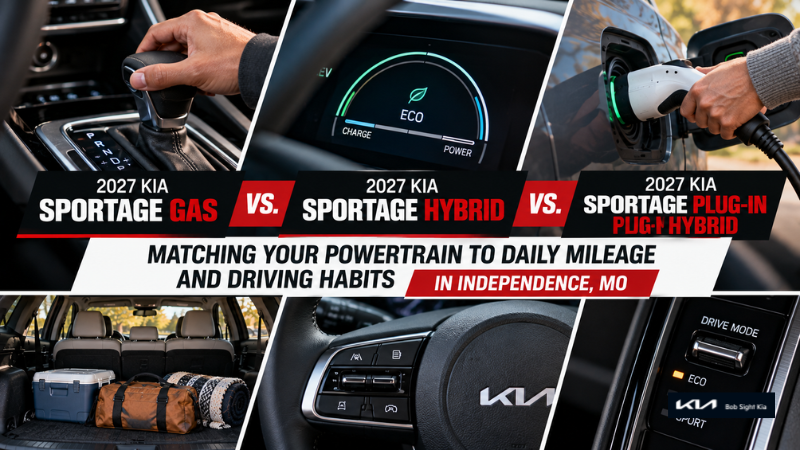
Compare 2027 Kia Sportage Gas, Hybrid, and Plug-In Hybrid powertrains for Independence, MO drivers. Find your ideal efficiency and range at Bob Sight Kia.

2027 Kia Sportage Gas vs. Hybrid vs. Plug-In Hybrid: Matching Your Powertrain to Daily Mileage and Driving Habits in Independence, MO

2027 Kia Sportage Gas vs. Hybrid vs. Plug-In Hybrid: Matching Your Powertrain to Daily Mileage and Driving Habits in Independence, MO Choosing between the 2027 Kia Sportage Gas, Hybrid (HEV), and Plug-In Hybrid (PHEV) models comes down to your weekly driving mileage, charging access, and commute patterns across Jackson County and the greater Kansas City Metro. While all three variants share the same bold styling, spacious cabin, and advanced safety technology, their underlying powertrains deliver vastly different performance, fuel economy, and operational characteristics. At Bob Sight Kia in Independence, MO, we help local commuters, growing families, and long-distance drivers calculate total cost of ownership and select the exact powertrain configuration that fits their lifestyle along I-70, I-470, and US-40. Explore our current inventory of new Kia crossovers and schedule your test drive today at Bob Sight Kia Sportage Inventory. In This Guide You'll Learn Here is what you will discover in this comprehensive powertrain comparison guide: The mechanical specifications, horsepower ratings, and transmission setups for Gas, Hybrid, and PHEV models. How daily mileage thresholds in Independence and surrounding suburbs determine real-world fuel savings. Charging requirements, home Level 1 and Level 2 logistics, and all-electric driving range for the Sportage PHEV. Performance variations, passing power on Missouri highways, and standard versus available Active AWD systems. Interior cargo volume differences across all three battery and fuel tank packaging setups. A structured side-by-side technical comparison table covering fuel economy, towing, and battery specs. Long-term ownership considerations, hybrid battery warranty coverage, and maintenance strategies at Bob Sight Kia. Overview: Understanding the 2027 Kia Sportage Powertrain Lineup The 2027 Kia Sportage lineup gives buyers three distinct propulsion choices built around traditional internal combustion, self-charging hybrid power, and plug-in electric capability. The traditional Sportage Gas model relies on a proven 2.5-liter Inline 4-cylinder GDI engine paired with an 8-speed automatic transmission. Delivering 187 horsepower and 178 lb-ft of torque, this powertrain offers an accessible entry price, straightforward mechanical simplicity, and available Front-Wheel Drive or Active All-Wheel Drive. It is an ideal baseline for drivers who want classic crossover capability without electrification. The 2027 Sportage Hybrid (HEV) elevates efficiency by pairing a 1.6-liter Turbocharged GDI engine with a 44-kW electric motor and a 1.49-kWh lithium-ion battery pack. Managed by a responsive 6-speed automatic transmission, this combination generates a combined 232 horsepower and a stout 271 lb-ft of torque. The hybrid system recharges automatically through regenerative braking during normal driving, eliminating the need to ever plug in. With EPA-estimated fuel economy reaching up to 41 MPG combined on FWD models, the Sportage Hybrid targets high-mileage commuters driving daily across the Kansas City Metro. At the top of the electrified range stands the 2027 Sportage Plug-In Hybrid (PHEV). The PHEV uses the same 1.6-liter Turbo engine but expands electric hardware to a larger 66.9-kW electric motor and a 13.8-kWh high-capacity battery pack. Combined system output reaches 268 horsepower and 271 lb-ft of torque, with Active AWD included as standard equipment. The key advantage of the PHEV is its Kia-estimated 34 miles of pure electric range, allowing local drivers to complete daily errands around Independence without consuming a single drop of gasoline. Daily Commute Analysis: Matching Powertrains to Your Independence Driving Habits Matching the right 2027 Sportage powertrain to your lifestyle requires calculating your typical daily round-trip mileage and evaluating your primary driving routes. Local driving patterns in Jackson County vary widely between short suburban stop-and-go trips and high-speed highway cruising down I-70 toward downtown Kansas City or east toward Oak Grove. Understanding how each powertrain handles these scenarios ensures you maximize efficiency and driving enjoyment. For drivers with short daily commutes under 30 miles—such as dropping kids off at school in Independence, commuting to local healthcare centers, or running errands around Noland Road—the Sportage PHEV provides unmatched efficiency. By charging overnight in a standard home garage, you can operate almost entirely in EV mode during the week. When weekend trips take you farther down the highway, the gasoline engine seamlessly engages, converting the vehicle into a standard hybrid with over 430 miles of total combined driving range. For mid-to-high-mileage drivers who cover 40 to 100+ miles daily across the metro area—including regional sales reps, rideshare drivers, or daily commuters from Blue Springs, Grain Valley, or Lee's Summit—the standard Sportage Hybrid is the sweetest spot. It delivers up to 41 MPG combined without requiring access to a charging outlet. Meanwhile, drivers who log lower annual mileage (under 10,000 miles per year) or who prefer lower upfront acquisition costs often find the classic Sportage Gas engine provides the best financial balance over a traditional loan term. Charging Logistics: Home Level 1, Level 2, and Public Infrastructure in Jackson County Operating the 2027 Kia Sportage PHEV is simple, giving owners flexible charging options using standard home electrical outlets or dedicated Level 2 wall boxes. Because the Sportage PHEV battery is engineered for localized daily driving, recharge times are fast and easily integrated into typical evening routines. You do not need expensive commercial charging gear to keep the battery replenished. Using the included Level 1 charging cable plugged into a standard 120-volt household outlet in your garage, the Sportage PHEV fully recharges from empty in approximately 10 to 12 hours. This means plugging in when you get home from work at 6:00 PM ensures a full 34 miles of electric range by 6:00 AM the following morning. If you install a 240-volt Level 2 home charger, full recharge time drops to approximately 2 hours and 15 minutes via the on-board 7.2-kW charger. Across Independence and the Kansas City Metro, public charging infrastructure continues to expand rapidly. Level 2 public chargers located near shopping centers, municipal buildings, and commuter hubs offer convenient topping-off opportunities while running errands. However, one of the greatest benefits of the Sportage PHEV is total range security: if you ever run out of electric charge away from an outlet, the vehicle operates automatically as a standard gas-electric hybrid without interruption. Performance Dynamics: Passing Power, Highway Merging, and AWD Traction While fuel efficiency is a major deciding factor, driving performance and passing power differ substantially between the three Sportage models. The standard 2.5-liter gas engine provides smooth, linear power delivery that is well-suited for suburban neighborhoods and casual highway cruising. However, drivers who regularly merge onto busy highways or climb steep grades along the Missouri River bluffs will notice the immediate low-end punch offered by the turbocharged hybrid models. Both the Sportage Hybrid (232 hp / 271 lb-ft torque) and Sportage PHEV (268 hp / 271 lb-ft torque) benefit from instant torque delivered by their electric motors. When accelerating from a stoplight or pulling out onto Highway 40, the electric motor fills in low-RPM power before the turbocharger builds boost. This provides eager, confident throttle response. Furthermore, both hybrid models use a conventional 6-speed automatic transmission rather than a Continuously Variable Transmission (CVT), preserving natural gear shifts under hard acceleration. All-Wheel Drive capability is another crucial consideration for midwestern winter weather. Active AWD with electro-hydraulic locking center differentials is available on Sportage Gas and Hybrid trims, and comes standard on all PHEV models. On electrified trims, the hybrid system instantly channels power between front and rear wheels to maintain traction through winter slush, icy highway ramps, and heavy spring rain across Sugar Creek and Raytown. Interior Space and Packaging: Cargo Volume Across All Three Models Kia engineers successfully packaged the hybrid battery systems beneath the cabin floor, preserving class-leading legroom and maximum utility across the Sportage lineup. All three 2027 Sportage models feature an identical extended wheelbase, providing 41.3 inches of second-row legroom so adult passengers can stretch out comfortably during long trips. Cargo capacity varies slightly based on the size of the onboard battery pack. The Sportage Gas and standard Hybrid models lead the compact crossover segment with up to 39.6 to 40.0 cubic feet of dedicated cargo space behind the second row, expanding to 74.1 cubic feet with the 60/40 split rear seats folded flat. In the Sportage PHEV, the larger 13.8-kWh lithium-ion battery slightly raises the rear floor area, yielding 34.5 cubic feet behind the second row and 65.5 cubic feet total cargo capacity. Despite this small packaging adjustment in the PHEV, all three variants accommodate bulky items like stroller systems, camping gear for weekend trips to Fleming Park, or large dog crates with ease. A dual-level cargo floor on Gas and HEV models allows drivers to lower the floor height for extra tall cargo or keep it flush with folded seatbacks for easy loading. Step-by-Step Guide: How to Calculate Your Ideal Sportage Powertrain Determining whether the Gas, Hybrid, or Plug-In Hybrid model offers the best financial and practical fit for your household is simple when using this step-by-step decision framework: Audit Your Daily Driving Distance: Track your daily mileage for two weeks. If your daily driving stays under 35 miles and you have garage outlet access, the Sportage PHEV allows you to complete almost all weekday commuting on pure electric power. Evaluate Home Charging Feasibility: Inspect your parking setup. If you own a garage or dedicated driveway with access to an exterior 120V outlet or space for a 240V Level 2 charger, the PHEV is a seamless addition. If you park street-side or in an apartment complex without charging access, choose the standard Hybrid or Gas trim. Calculate Annual Fuel Savings: Estimate your annual driving mileage. If you drive more than 12,000 miles annually, the standard Hybrid's 41 MPG rating will deliver significant monthly fuel savings over a traditional gas model. Consider Performance and Towing Needs: If you want rapid acceleration or maximum horsepower for highway merging, the 232-hp Hybrid or 268-hp PHEV provide superior driving dynamics over the 187-hp gas engine. Gas models carry up to a 2,500 lb tow rating (with trailer brakes), while HEV and PHEV models are rated up to 2,000 lbs. Review Purchase Budget and Incentives: Work with the finance specialists at Bob Sight Kia to compare upfront monthly payments, current lease specials, and potential utility company rebates for home charging station installations. Side-by-Side Specifications Comparison: 2027 Kia Sportage Gas vs. HEV vs. PHEV To help you compare core technical attributes across all three 2027 Kia Sportage powertrains, we have summarized key specifications in the comprehensive breakdown below. Specification Feature 2027 Sportage Gas 2027 Sportage Hybrid (HEV) 2027 Sportage Plug-In Hybrid (PHEV) Engine Type 2.5L 4-Cylinder GDI 1.6L Turbocharged 4-Cylinder 1.6L Turbocharged 4-Cylinder Electric Motor Output N/A 44 kW Electric Motor 66.9 kW Electric Motor Battery Pack Capacity Standard 12V Battery 1.49 kWh Lithium-Ion 13.8 kWh Lithium-Ion Combined Horsepower 187 hp @ 6,100 RPM 232 hp @ 5,500 RPM 268 hp @ 5,500 RPM Combined Torque 178 lb-ft @ 4,000 RPM 271 lb-ft @ 1,500-4,500 RPM 271 lb-ft @ 1,500-4,500 RPM Transmission 8-Speed Automatic 6-Speed Automatic 6-Speed Automatic Drivetrain Availability FWD or Available Active AWD FWD or Available Active AWD Standard Active AWD EPA Fuel Economy (FWD) 25 City / 33 Hwy / 28 Cbnd 42 City / 41 Hwy / 41 Cbnd N/A (AWD Only) EPA Fuel Economy (AWD) 23 City / 28 Hwy / 25 Cbnd 38 City / 38 Hwy / 38 Cbnd 35 City / 36 Hwy / 84 MPGe All-Electric EV Range N/A N/A Kia-Est. 34 Miles Cargo Space (Behind 2nd Row) 39.6 cu. ft. 39.6 - 40.0 cu. ft. 34.5 - 35.0 cu. ft. Max Towing Capacity Up to 2,500 lbs (w/ brakes) Up to 2,000 lbs (w/ brakes) Up to 2,000 lbs (w/ brakes) This comparison shows how Kia has structured the Sportage family to serve every type of driver. Whether you prioritize lower initial cost, maximum open-highway fuel economy, or daily grid-powered electric driving, there is a dedicated Sportage trim designed for your exact habits. Step-by-Step Guide: Maximizing Electrified Range and Hybrid Efficiency If you choose the 2027 Sportage Hybrid or Plug-In Hybrid, adopting smart driving techniques helps you extract maximum range and efficiency during your daily commute. Follow these practical operational steps to optimize fuel economy across Jackson County: Utilize Regenerative Braking Modes: Take advantage of regenerative braking when decelerating toward stoplights along Noland Road or Little Blue Parkway. Coasting early allows the electric motor to convert kinetic energy back into stored battery power. Select Eco Drive Mode for Daily Routes: Set your Drive Mode selector dial to "Eco" for standard commuting. This smooths out throttle response and optimizes climate system energy draw to extend battery utility. Pre-Condition Cabin Temperature While Plugged In (PHEV): On Sportage PHEV models, use the Kia Connect app to pre-heat or pre-cool the cabin while the vehicle is still connected to your home charger. This uses grid electricity to adjust interior temperature, preserving 100% of your battery range for driving. Engage Smart Cruise Control on Highways: When driving long stretches of I-70 or I-470, activate Smart Cruise Control with Stop & Go. The system manages acceleration smoothly, avoiding unnecessary throttle bursts that consume excess fuel. Maintain Proper Tire Inflation: Check tire pressure monthly, especially during seasonal autumn and winter temperature swings in Independence. Keeping tires inflated to recommended door-jamb pressures minimizes rolling resistance and optimizes MPG. Quick Facts: 2027 Kia Sportage Powertrain Comparison Here are the essential quick facts regarding the 2027 Kia Sportage Gas, Hybrid, and Plug-In Hybrid models: No Plug Required for HEV: The standard Sportage Hybrid recharges its battery automatically through driving and braking, filling up at normal gas stations. 34-Mile EV Range on PHEV: The Sportage PHEV offers a Kia-estimated 34 miles of pure electric driving before switching seamlessly to gas-hybrid mode. Highest Performance: The PHEV is the most powerful Sportage variant, generating 268 horsepower and 271 lb-ft of torque. Standard AWD on PHEV: Active All-Wheel Drive with center locking capability comes standard on every Sportage PHEV trim. Fast Level 2 Charging: The PHEV battery fully recharges in roughly 2 hours and 15 minutes using a 240V Level 2 charger. Identical Rear Legroom: All three powertrains preserve an identical 41.3 inches of rear seat legroom. 10-Year Warranty Coverage: Every Sportage model is backed by Kia's 10-Year/100,000-Mile Limited Powertrain Warranty, with electrified models receiving matching 10-Year/100,000-Mile Hybrid/EV System Warranty protection. Ownership Strategy: Maintenance Schedules and Battery Warranty Protection Long-term reliability and peace of mind are central to the 2027 Kia Sportage ownership experience across all three powertrain choices. Kia backs every new Sportage with its industry-leading warranty package, including a 10-Year/100,000-Mile Powertrain Limited Warranty, a 5-Year/60,000-Mile Limited Basic Warranty, and 5-Year/60,000-Mile Roadside Assistance. On Sportage Hybrid and PHEV models, Kia includes a dedicated 10-Year/100,000-Mile Hybrid/EV System Warranty covering the high-voltage battery pack, electric motor, power control unit, and onboard charger. Routine maintenance schedules remain straightforward regardless of electrification. Standard oil and filter changes for all engines are recommended at 7,500-mile or 12-month intervals using full synthetic motor oil. On hybrid and PHEV models, brake pad wear is often significantly reduced because regenerative braking handles a large portion of daily slowing force. However, routine brake fluid flushes and multi-point inspections remain essential to maintain system performance. Proper battery cooling system maintenance is also critical for electrified models. Servicing coolant loops according to factory intervals ensures battery temperatures remain regulated during hot midwestern summers and freezing winter nights. Bringing your vehicle to the certified technicians at Bob Sight Kia guarantees that factory-trained specialists inspect high-voltage connections, update system control software, and preserve full warranty validity throughout your ownership lifetime. Frequently Asked Questions Does the standard 2027 Kia Sportage Hybrid need to be plugged in to charge? No, the standard 2027 Kia Sportage Hybrid (HEV) does not need to be plugged in and does not feature an external charging port. Its onboard 1.49-kWh lithium-ion battery recharges automatically while you drive through regenerative braking and engine operation. You simply fill up the gas tank at standard gas stations as you would with a conventional vehicle. Only the Sportage Plug-In Hybrid (PHEV) model features an external charging port to replenish its larger 13.8-kWh battery pack from household outlets or public charging stations. This self-charging design makes the standard Sportage Hybrid an excellent option for buyers who want high fuel efficiency up to 41 MPG combined without changing their daily driving routines or installing home charging equipment. The hybrid system automatically manages energy flow between the gas engine and electric motor to optimize fuel economy during city stop-and-go driving across Independence. If you prefer driving on 100% electric power for daily errands while retaining gasoline flexibility for longer road trips, the Sportage PHEV is the variant specifically designed for plug-in charging. You can compare both hybrid display screens in person at Bob Sight Kia. What happens if the battery runs out of charge in the Sportage PHEV while driving? If the high-voltage battery in the 2027 Sportage PHEV reaches its minimum threshold while driving, the vehicle automatically switches into standard hybrid mode without any disruption in power. The 1.6-liter turbocharged gasoline engine starts smoothly, and the vehicle operates just like a regular Sportage Hybrid, generating 35 MPG city and 36 MPG highway. You will never be stranded on the side of the road simply because the electric battery has been depleted. This dual capability gives the Sportage PHEV maximum versatility for midwestern families. You can complete your daily work commute around Jackson County on pure grid electricity, and then head out on a 500-mile cross-country road trip without ever needing to stop or search for an available public EV charger. Our sales team at Bob Sight Kia can demonstrate how the PHEV seamlessly manages energy modes using the center console toggle switch during your test drive. How long does it take to charge the 2027 Kia Sportage Plug-In Hybrid at home? Charging the 2027 Sportage PHEV at home takes approximately 10 to 12 hours using a standard 120-volt Level 1 household outlet, or roughly 2 hours and 15 minutes using a 240-volt Level 2 home charger. Because the 13.8-kWh battery is smaller than those found in full battery-electric vehicles (EVs), Level 1 charging via a normal garage wall outlet is completely practical for overnight replenishment. Plugging in when you return home from work ensures that your battery is fully topped off with 34 miles of all-electric range by the next morning. For drivers who want faster turnaround times between daytime errands, installing a 240V Level 2 charging station allows you to fully recharge the vehicle in just over two hours. Bob Sight Kia can provide recommendations for licensed local electricians in Independence and Lee's Summit to assist with Level 2 home charger installations and utility rebate applications. Is Active All-Wheel Drive available on all three Sportage powertrains? Yes, Active All-Wheel Drive (AWD) is available across all three Sportage powertrain configurations, and comes completely standard on every Sportage PHEV model. On the Sportage Gas and Sportage Hybrid models, buyers can choose between Front-Wheel Drive (FWD) for maximum fuel economy or Active AWD for added traction during midwestern winter weather. Kia's Active AWD system features an electro-hydraulic center locking differential that continuously monitors road conditions and wheel slip. When driving on snow-covered roads or wet pavement along I-70, the system automatically redistributes torque between the front and rear axles to maintain stability. Additionally, AWD models feature up to 8.3 inches of ground clearance and selectable Drive Modes, including dedicated Snow Mode settings to tackle winter weather across Jackson County. How do battery warranties compare on Sportage Hybrid and PHEV models? Both the 2027 Kia Sportage Hybrid and Sportage PHEV are backed by Kia's outstanding 10-Year/100,000-Mile Hybrid/EV System Warranty. This factory warranty covers all major high-voltage components, including the lithium-ion battery pack, electric drive motor, power control unit, and onboard charger system against manufacturing defects. This long-term coverage matches Kia's famed 10-Year/100,000-Mile Powertrain Warranty, giving electrified vehicle owners complete long-term protection. Modern Kia lithium-ion batteries are engineered with advanced thermal management systems to preserve capacity over years of daily usage. When you service your vehicle at Bob Sight Kia, our certified technicians perform routine battery health checks during scheduled maintenance to ensure optimal performance over the lifespan of your vehicle. Why Buying Local at Bob Sight Kia Matters for Independence Drivers Purchasing your 2027 Kia Sportage locally from Bob Sight Kia guarantees personalized service, ongoing regional support, and deep community commitment that major online retailers and out-of-town dealer chains cannot match. As a family-owned dealership serving Independence, Lee's Summit, Blue Springs, Raytown, and the greater Kansas City Metro for decades, we understand the specific needs of midwestern drivers. From selecting the right drivetrain configuration for winter snow to navigating local vehicle titling and trade-in valuations, our experienced sales and finance teams provide transparent, stress-free assistance every step of the way. When you buy local, your relationship with Bob Sight Kia extends far beyond the day you drive off our lot. Our factory-certified Kia service department utilizes state-of-the-art diagnostic equipment, specialized tools, and genuine Kia OEM parts engineered specifically for your Sportage Gas, Hybrid, or PHEV. Whether you are coming in for routine synthetic oil changes, tire rotations, brake pad replacements, or multi-point seasonal inspections, our factory-trained technicians ensure your crossover performs at peak safety and efficiency throughout its entire lifetime. Supporting a local dealership also keeps your investment grounded within the Jackson County community. We take pride in building long-term relationships with local families across Liberty, Sugar Creek, and Grain Valley. Visit our showroom on Highway 40 in Independence today to experience our commitment to customer care, compare all three Sportage powertrains in person, and discover why Kansas City drivers trust Bob Sight Kia for all their automotive needs. Helpful Links Explore these key resources on our website to research inventory, schedule service, or start your purchasing process: New Kia Sportage Inventory in Independence, MO Value Your Trade-In Online at Bob Sight Kia Apply for Online Auto Financing and Pre-Approval Schedule Kia Service and Maintenance Online Current Kia Service and Parts Specials Proud to Be Part of the Bob Sight Auto Group Bob Sight Kia is a proud member of the Bob Sight Auto Group, a family-owned automotive network dedicated to serving drivers across Missouri and Kansas with integrity, quality vehicles, and exceptional customer service for generations. Whether you are shopping for a new Kia crossover, a reliable pre-owned car, certified service, or collision repair, our dealership family is here to support all your automotive needs across the Kansas City region. Visit any of our convenient Bob Sight Auto Group locations: Bob Sight Kia - Independence, MO Bob Sight Ford - Lee's Summit, MO Bob Sight Honda - Lawrence, KS Bob Sight CDJR - Lawrence, KS Bob Sight Collision Center - Lee's Summit, MO

Compare 2026 Kia Sportage LX vs EX interior comfort, seat adjustments, and tech for Independence, MO drivers. Find your ideal crossover at Bob Sight Kia today.

2026 Kia Sportage LX vs. EX: Comparing Everyday Comfort, Seat Adjustments, and Convenience Features for Independence, MO Drivers

2026 Kia Sportage LX vs. EX: Comparing Everyday Comfort, Seat Adjustments, and Convenience Features for Independence, MO Drivers Choosing between the entry-level 2026 Kia Sportage LX and the upgraded EX trim comes down to how everyday comfort, interior seat adjustments, and daily convenience technology fit your commute across Jackson County and the greater Kansas City Metro. Both trim levels deliver exceptional value, standard safety tech, and a spacious cabin, but the EX adds key daily enhancements like SynTex synthetic leather seating, a 10-way power driver's seat with lumbar support, dual-zone automatic climate control, and dual 12.3-inch panoramic display screens. At Bob Sight Kia in Independence, MO, we help local commuters, growing families, and daily drivers evaluate these exact interior differences so you can select the perfect compact crossover for your daily routes along Interstate 70 and Highway 40. Explore our current inventory of new Kia crossovers and schedule your test drive today at Bob Sight Kia Sportage Inventory. In This Guide You'll Learn Here is what you will discover in this comprehensive trim level comparison guide: The direct mechanical and dimension similarities shared between the 2026 Kia Sportage LX and EX trims. How the LX woven cloth manual seating compares to the EX SynTex power-adjustable seating during long Missouri commutes. Key differences in climate control, cabin heating, and winter driving comfort across Jackson County winters. Infotainment display size upgrades, wireless media integration, and center console convenience changes. Keyless access, smart key proximity ignition, and remote start functional comparisons for everyday convenience. A structured side-by-side comparison matrix covering seating, infotainment, climate, and convenience specs. Long-term ownership considerations, resale value trends, and financing evaluations at Bob Sight Kia. Overview: Understanding the 2026 Kia Sportage Trim Hierarchy The 2026 Kia Sportage lineup is engineered to offer distinct value points, with the LX serving as the well-equipped base tier and the EX standing as the premier mid-level comfort upgrade. Both configurations utilize the exact same standard powertrain, featuring a 2.5-liter Inline 4-cylinder Gasoline Direct Injection (GDI) engine paired with an 8-speed automatic transmission. This reliable engine setup generates 187 horsepower and 178 lb-ft of torque, delivering clean acceleration whether you are merging onto I-470 near the Summit Fair exit or cruising along US-40 near the Independence Center. Both trims are available in standard Front-Wheel Drive (FWD) or available Active Just-in-Time All-Wheel Drive (AWD) with an electro-hydraulic locking center differential for added traction on icy Missouri roads. While the mechanical underpinnings, exterior dimensions, and fundamental safety architecture remain identical, the cabin experience separates these two vehicles significantly. The LX is built for budget-conscious buyers who want maximum utility, standard Kia Drive Wise driver assistance, and low operating costs without paying for extra luxury items. In contrast, the EX targets suburban commuters who view their crossover as a mobile office and daily sanctuary, adding multi-stage heated front seats, power seat adjustments, enhanced interior soft-touch trim, and integrated glass cockpit displays that drastically elevate daily driving satisfaction. Evaluating these differences requires looking past the window sticker and looking at how you interact with your vehicle every single morning. From the physical touchpoints on the steering wheel to how quickly the windshield defrosters clear frost during a January morning in Sugar Creek, the EX integrates several convenience features that address midwestern climate realities. Deciding whether to step up from the LX to the EX involves measuring the value of those daily touchpoints against your overall automotive financing goals. Front Seat Comfort and Adjustability: Manual Cloth vs. Power SynTex The primary physical difference inside the cabin is the transition from 6-way manual woven cloth seating in the LX to a 10-way power-adjustable driver seat with SynTex synthetic leather in the EX. In the base LX trim, driver seat adjustments are made using manual levers for fore-and-aft sliding, recline angle, and vertical height adjustment. While the LX woven cloth upholstery is durable, breathable, and easy to clean, it lacks dedicated power lumbar adjustment, which can lead to lower back fatigue during extended highway drives across the Kansas City Metro or longer road trips down to the Lake of the Ozarks. Stepping up to the 2026 Sportage EX completely transforms driver ergonomics through its 10-way power driver seat, which includes 2-way power lumbar support. The lumbar bolster can be extended or retracted electronically to match the natural curvature of your spine, offering crucial support during stop-and-go traffic on I-35 or long commutes down Highway 290. Additionally, the EX replaces the manual passenger seat with a 4-way power passenger configuration in select package configurations, while upgrading the trim material to premium SynTex artificial leather. SynTex provides the plush, upscale feel of natural leather while offering superior resistance to spills, mud, and everyday wear, making it an excellent option for local parents and dog owners in Raytown and Blue Springs. For midwestern seasonal shifts, seat temperature management is another major factor. The LX cloth seating naturally resists ambient temperature extremes, meaning the seats rarely feel freezing cold in January or blistering hot during July. However, the EX comes standard with multi-stage heated front seats that warm up rapidly, providing immediate physical comfort while the engine coolant warms up to heat the cabin. Combined with the supple SynTex surface, the EX front seating environment offers a noticeably more refined and supportive daily driving experience. Climate Control Systems and Missouri Seasonal Readiness The 2026 Kia Sportage LX utilizes a standard single-zone manual climate system, whereas the Sportage EX features a dual-zone automatic climate control system with auto de-fogging capabilities. The standard manual HVAC system in the LX relies on traditional dial controls to regulate blower speed, air distribution mode, and temperature. While simple, effective, and reliable, manual systems require frequent adjustments as the vehicle interior warms up or cools down, especially during unpredictable spring and autumn weather across Jackson County. The dual-zone automatic system in the EX allows both the driver and front passenger to select their own individual temperature preferences down to the exact degree. Once set, the vehicle automatically adjusts fan speeds, airflow distribution, and cabin air recirculation to maintain that exact comfort level without constant manual intervention. Furthermore, the EX system incorporates an automatic windshield defogging sensor. When the internal sensor detects humidity building on the inner surface of the glass during cold mornings in Grain Valley, it automatically engages the air conditioning compressor and redirects airflow to clear the windshield before visibility becomes impaired. Rear passenger comfort also receives an upgrade when moving up the trim hierarchy. While both trims feature rear floor air vents fed by the main heating unit, the EX adds dedicated center console rear air vents. This allows rear-seat passengers—whether kids heading to school in Liberty or adult passengers on a carpool commute—to receive direct cooling air or heat far faster than in the base model, ensuring total cabin thermal equilibrium regardless of outside conditions. Dashboard Tech and Touchscreen Interface: 8-Inch vs. Dual 12.3-Inch Screens The 2026 Sportage LX comes equipped with an 8.0-inch touchscreen infotainment display paired with a standard digital gauge cluster, while the EX features dual 12.3-inch panoramic screens under a single curved glass panel. In the LX, the center display offers crisp visual clarity and dedicated physical knobs for audio volume and tuning. A notable advantage of the LX 8.0-inch system is its support for standard wireless Apple CarPlay and Android Auto integration, allowing drivers to mirror their smartphone navigation and media apps without plugging in a physical USB cable. The EX trim replaces this setup with Kia's dramatic panoramic dual-screen cockpit array, pairing a 12.3-inch driver information display with a matching 12.3-inch center navigation screen. This system features built-in Kia Connect navigation, real-time traffic updates, and over-the-air software updating capabilities. Because of the higher processing power and integrated factory navigation software in the 12.3-inch system, Apple CarPlay and Android Auto utilize a high-speed wired USB connection, ensuring lag-free mapping data while charging your device simultaneously. Beyond screen size, the EX dashboard incorporates Kia's innovative dual-purpose touch-switchable control panel. Located directly beneath the central display, this sleek panel allows you to toggle between audio system controls and climate control inputs with the press of a single capacitive button. This design removes visual clutter from the dashboard while keeping essential controls easily accessible without burying them inside complex touchscreen menus, allowing Independence drivers to keep their eyes focused safely on the road ahead. Convenience and Access Features: Traditional Key vs. Smart Key with Remote Start Entering and starting the 2026 Kia Sportage LX requires a traditional flip-key fob with remote keyless entry, whereas the Sportage EX introduces Smart Key proximity entry with push-button ignition and remote engine start. On the LX trim, unlock signals are sent by pressing a button on the physical key fob, after which the driver inserts the key into the steering column ignition switch to start the vehicle. While reliable and straightforward, this standard setup requires retrieving your keys from your pocket or bag before unlocking the doors or starting the car. The Smart Key system standard on the EX trim elevates daily convenience significantly through proximity sensors built into the exterior front door handles. As long as the key fob is in your pocket, purse, or briefcase, you can approach the vehicle and press the door handle touch sensor to unlock the car instantly. Once inside, starting the 2026 Sportage EX is as simple as pressing the brake pedal and pushing the illuminated engine start/stop button on the dashboard. Remote vehicle preparation is another key operational difference. The EX includes factory-integrated remote engine start directly on the key fob and through the Kia Connect mobile application. During severe winter freezes in Sugar Creek or scorching mid-summer heatwaves in North Kansas City, EX owners can remotely start the engine from inside their home or office. This pre-conditions the cabin temperature, activates the heated seats, and defrosts the glass before you ever step outside, making every daily journey noticeably more pleasant. Step-by-Step Guide: Evaluating Which Trim Fits Your Daily Routine If you are trying to decide whether the LX or EX is the ideal compact crossover for your household, working through a structured evaluation process can clarify your exact needs. Follow these five practical steps when shopping at Bob Sight Kia: Calculate Your Daily Commute Duration: If your daily drive along I-70, I-470, or through downtown Kansas City exceeds 30 minutes each way, the 10-way power driver seat with lumbar support and multi-stage heated seating on the EX will provide tangible ergonomic benefits that reduce driver fatigue over time. Assess Passenger and Climate Requirements: Consider who regularly rides in your vehicle. If you frequently transport family members or rear-seat passengers, the dual-zone automatic climate control and rear center console air vents on the EX deliver superior whole-cabin comfort compared to the single-zone manual system on the LX. Evaluate Tech Preferences and Smartphone Integration: Determine whether you prefer the seamless convenience of wireless Apple CarPlay/Android Auto on an 8.0-inch screen (LX) or the immersive visual real estate, factory navigation, and modern aesthetic of the dual 12.3-inch panoramic display screens (EX). Test Keyless Entry and Remote Start Convenience: Visit our Independence showroom to physically test the difference between traditional key ignition on the LX and Smart Key proximity entry with push-button start on the EX. Factor in how much you value remote pre-heating during cold Jackson County winters. Compare Total Ownership Value and Monthly Financing: Review our competitive financing rates, dealer incentives, and transparent pricing models with our finance team. Weigh the incremental monthly payment difference of the EX trim against the added everyday luxury and higher long-term resale value it provides. Side-by-Side Feature Comparison: 2026 Kia Sportage LX vs. EX To help you visualize how these two popular trim levels compare across core comfort, convenience, and tech categories, we have compiled a direct feature breakdown below. Both vehicles share the same safety foundation, including Forward Collision-Avoidance Assist, Lane Keeping Assist, and Rear Occupant Alert, but diverge significantly in interior accommodations and driver convenience equipment. Feature Category 2026 Kia Sportage LX 2026 Kia Sportage EX Seating Material Woven Cloth Upholstery Premium SynTex Synthetic Leather Driver Seat Adjustment 6-Way Manual Adjustment 10-Way Power Adjustment with 2-Way Lumbar Heated Front Seats Not Available Standard Multi-Stage Heated Front Seats Climate Control System Single-Zone Manual HVAC Dual-Zone Automatic Climate with Auto De-fog Infotainment Display 8.0-inch Color Touchscreen 12.3-inch Panoramic Navigation Touchscreen Driver Gauge Cluster 4.2-inch Digital Instrument Display 12.3-inch Full Digital Gauge Cluster Smartphone Integration Wireless Apple CarPlay & Android Auto Wired Apple CarPlay & Android Auto Key Access & Ignition Remote Keyless Entry with Flip Key Smart Key Proximity Entry & Push-Button Start Remote Engine Start Not Available on Fob Standard on Key Fob & Kia Connect App Rear Passenger Vents Under-Seat Floor Vents Only Rear Center Console Air Vents Steering Wheel Trim Urethane Steering Wheel Leather-Wrapped Steering Wheel USB Charging Ports Front USB-C Ports Front & Rear Seatback Mounted USB-C Ports This comparison highlights how the EX trim builds upon the robust engineering foundation of the LX by targeting driver touchpoints, climate regulation, and visual cabin technology. While the LX delivers everything required for dependable daily transportation, the EX provides an elevated ownership environment that pays daily dividends in driver comfort. Step-by-Step Guide: Setting Up Interior Comfort and Technology Settings When taking delivery of your new 2026 Kia Sportage from Bob Sight Kia, properly configuring your seat position, climate defaults, and digital displays ensures optimal daily comfort. Follow these step-by-step instructions to personalize your vehicle settings before driving home to Lee's Summit or Liberty: Position the Driver Seat and Lumbar Support: Sit in the driver seat with your back flat against the seatback. On the EX trim, use the lower side controls to adjust seat height, distance from the pedals, and seatback angle. Adjust the 2-way lumbar toggle until you feel firm, comfortable support across your lower spine. Adjust Side Mirrors and Steering Column: Release the manual tilt-and-telescoping steering wheel lever beneath the column. Position the wheel so you can comfortably rest your wrists on top of the steering rim while viewing the entire gauge cluster clearly. Adjust your power exterior side mirrors to eliminate blind spots. Configure Automatic Climate and Auto-Defog: On EX models, set your primary temperature preference using the driver-side dial (e.g., 72 degrees Fahrenheit) and press the "AUTO" button. Access the vehicle setup menu on the central touchscreen, navigate to "Climate," and ensure "Auto Defog" and "Smart Recirculation" options are checked. Pair Your Smartphone Device: Navigate to the "Setup" menu on the main touchscreen and select "Device Connections." Enable Bluetooth on your smartphone and select your Kia Sportage. Follow the on-screen prompts to enable Apple CarPlay or Android Auto mapping and hands-free calling. Set Up Smart Key Proximity and Lock Profiles: In the vehicle customization settings menu, select "Door/Tailgate." Enable "Two-Stage Unlock" for added personal security in public parking lots, or disable it if you prefer all doors to unlock simultaneously when touching the driver door handle sensor. Quick Facts: 2026 Kia Sportage LX vs. EX Comparison Here are the key takeaways and fast facts regarding the 2026 Kia Sportage LX and EX models for Independence and Kansas City buyers: Engine and Performance: Both trims share the standard 2.5L 4-cylinder engine generating 187 hp and 178 lb-ft of torque paired with an 8-speed automatic transmission. Drivetrain Options: Both LX and EX can be configured in FWD or Active AWD with Drive Mode Select (Normal, Sport, Smart, and Snow modes). Driver Ergonomics: The EX features a 10-way power driver seat with power lumbar support, whereas the LX utilizes a 6-way manual driver seat. Winter Readiness: Heated front seats, heated side mirrors with LED turn signals, and dual-zone auto climate control are standard on the EX trim. Screen Interface: The LX uses an 8-inch display with wireless smartphone integration; the EX uses dual 12.3-inch panoramic screens with integrated navigation. Keyless Access: Smart Key proximity entry with push-button start and remote start on the key fob comes standard on the EX. Cargo Capability: Both trims offer identical interior space, providing 39.6 cubic feet of cargo room behind the second row and up to 74.1 cubic feet with rear seats folded flat. These core facts show that while the physical interior space and mechanical driving dynamics are identical across both models, the EX trim concentrates its upgrades on daily convenience, tactile luxury, and digital technology integration. Ownership Planning: Maintenance, Warranty, and Resale Strategy Planning for long-term ownership of either a 2026 Kia Sportage LX or EX involves understanding routine service schedules, warranty protection, and prospective resale dynamics across Jackson County. Both trim levels are backed by Kia's industry-leading 10-Year/100,000-Mile Powertrain Limited Warranty, along with a 5-Year/60,000-Mile Limited Basic Warranty and 5-Year/60,000-Mile Roadside Assistance coverage. This comprehensive safety net ensures peace of mind whether you are driving locally in Independence or commuting across state lines into Kansas. Maintaining long-term reliability and protecting your investment requires following factory-recommended service intervals. Routine maintenance for the 2.5L engine includes engine oil and filter changes every 7,500 miles or 12 months using full synthetic 0W-20 oil meeting API SP / ILSAC GF-6 standards. Tire rotations should be performed at every oil change interval to promote even tread wear across all four tires, particularly on AWD models. Additional regular services include replacing the cabin air filter every 15,000 miles to keep the HVAC system running efficiently and changing the engine air filter every 30,000 miles. When considering resale value and trade-in retention, mid-level trims like the Sportage EX historically retain a slightly higher percentage of their original value compared to base models. Used car buyers in the Kansas City Metro market actively search for features like power leatherette seating, heated seats, push-button start, and larger screen displays. While the LX offers lower upfront cost and excellent long-term durability, the extra comfort options built into the EX make it an exceptionally popular choice on the secondary market. Utilizing our service center at Bob Sight Kia ensures all maintenance is recorded on your vehicle history report, maximizing trade-in value when you are ready to upgrade in the future. Frequently Asked Questions Is the 2026 Kia Sportage LX or EX better for cold weather driving in Missouri? The 2026 Kia Sportage EX is significantly better equipped for cold midwestern winter weather due to its standard multi-stage heated front seats, dual-zone automatic climate control with auto windshield defogging, and heated side mirrors. While both the LX and EX offer Kia's Active All-Wheel Drive system with dedicated Snow Mode for enhanced traction on icy roads, the EX adds physical comfort features that immediately warm the driver and passenger before the engine reaches operating temperature. Remote engine start on the EX key fob also allows you to pre-heat the cabin while your car is still parked in your driveway. Additionally, the automatic defogging system on the EX active HVAC unit continuously monitors interior windshield humidity during freezing conditions across Independence and Sugar Creek. When condensation begins to form, the system automatically adjusts airflow and engages defrost settings without requiring driver intervention. On the LX, drivers must manually adjust fan speed, temperature dials, and airflow modes to clear foggy glass. For drivers who frequently face harsh Missouri winters, the integrated heating and climate tech on the EX provides a noticeably safer and more comfortable daily experience. Our service department at Bob Sight Kia also recommends equipping either trim with proper winter maintenance precautions. Ensuring your washer fluid is rated for sub-zero temperatures and keeping your battery tested prior to seasonal temperature drops will keep your Sportage performing reliably regardless of trim choice. Can I get power seats and leatherette upholstery on the base Sportage LX? No, 10-way power seat adjustments and SynTex synthetic leather upholstery cannot be added as standalone factory options on the base 2026 Sportage LX trim. The LX trim is engineered to keep purchasing costs affordable by featuring standard 6-way manual driver adjustments and durable woven cloth seating. If power seat adjustments, driver lumbar support, or easy-to-clean leatherette seating surfaces are essential features for your daily commute, you must step up to the Sportage EX trim or higher in the model lineup. However, many drivers find that the LX cloth seating offers excellent breathability and comfort for everyday driving across Jackson County. The woven fabric resists temperature extremes, staying cooler during hot summer afternoons at Blue Springs Lake and warmer during chilly winter mornings. If you prefer manual seat adjusters that are simple and quick to shift between different drivers, the LX provides a highly functional cabin layout without extra electrical complexity. If you are unsure whether manual cloth seating or power SynTex seating best suits your physical needs, we invite you to visit Bob Sight Kia in Independence. Sitting in both models side-by-side in our showroom allows you to test lumbar support, seat height ranges, and material textures before making your final purchasing decision. Does the 2026 Kia Sportage EX have wireless Apple CarPlay and Android Auto? The 2026 Kia Sportage EX utilizes a wired USB connection for Apple CarPlay and Android Auto, whereas the base Sportage LX offers wireless Apple CarPlay and Android Auto functionality. This setup occurs because the EX features Kia's upgraded 12.3-inch panoramic display screen with built-in factory navigation and Kia Connect services. To ensure maximum data transfer speeds, high-resolution mapping render times, and stable connectivity, Kia utilizes a direct wired connection for smartphone projection on all 12.3-inch navigation-equipped displays. In contrast, the 8.0-inch display system found in the LX trim does not include onboard factory navigation software, allowing it to utilize a dedicated wireless connection protocol for mirroring smartphone mapping apps like Google Maps, Apple Maps, or Waze. On the EX trim, plugging your phone into the illuminated front USB-C data port instantly launches your smartphone interface while simultaneously high-speed charging your battery, ensuring your device remains fully powered during long trips across the Kansas City Metro. For drivers who prefer a clean cable-free center console in the EX, wireless aftermarket USB adapters are widely available, or you can rely entirely on the native Kia Connect voice command and navigation system built into the 12.3-inch display. You can test both infotainment interfaces in person at Bob Sight Kia to see which software layout aligns with your technology preferences. How do the cargo space and rear seat dimensions compare between the LX and EX? The 2026 Kia Sportage LX and EX trims offer identical interior passenger dimensions, legroom, headroom, and overall cargo capacity. Both models benefit from Kia's extended wheelbase design, providing a class-leading 41.3 inches of rear seat legroom and 39.6 cubic feet of dedicated rear cargo space behind the second row. When you fold the 60/40 split-folding rear seatbacks flat using the quick-release handles in the cargo area, total storage volume expands to an expansive 74.1 cubic feet across both trim levels. The primary difference in rear-seat passenger comfort comes down to convenience amenities rather than physical dimensions. The Sportage EX adds dedicated rear center console air vents, dual USB-C charging ports built directly into the back of the front seats, and rear coat hooks. These extra touchpoints make the EX rear cabin significantly more convenient for kids, teenagers, or adult passengers charging electronics on long road trips down I-70 toward Columbia or St. Louis. Whether you choose the LX or EX, both compact crossovers easily accommodate large dog crates, stroller systems, golf bags, or camping gear for weekend trips to Fleming Park and Lake Jacomo. You can inspect the rear seat folding mechanisms and measure cargo dimensions yourself at our Independence dealership. What is the difference in factory key fobs and starting procedures between LX and EX? The Sportage LX uses a traditional fold-out mechanical key fob with remote button locks, while the EX utilizes a Smart Key proximity fob with push-button ignition and integrated remote engine start. On the LX, starting the engine requires inserting the ignition key into the steering column key cylinder and turning it manually. Unlocking the vehicle requires pressing the unlock button on the key fob before pulling the exterior door handle. The EX Smart Key system eliminates the need to handle your keys when entering or starting the vehicle. As long as the Smart Key is present in your pocket or bag, approaching the vehicle illuminates welcome lighting, and pressing the small button on the front door handle instantly unlocks the door. Once inside, starting the vehicle requires only pressing the brake pedal and pushing the engine start button on the dashboard panel. Furthermore, the EX Smart Key fob includes a dedicated remote start button. Holding this button from inside your home allows the vehicle to start remotely, engaging your pre-set climate settings and seat heaters before you open the front door. This operational upgrade is one of the most highly appreciated convenience features for daily drivers in Raytown and Lee's Summit during winter weather. Why Buying Local at Bob Sight Kia Matters for Independence Drivers Purchasing your 2026 Kia Sportage locally from Bob Sight Kia guarantees personalized service, ongoing regional support, and deep community commitment that major online retailers and out-of-town dealer chains cannot match. As a family-owned dealership serving Independence, Lee's Summit, Blue Springs, Raytown, and the greater Kansas City Metro for decades, we understand the specific needs of midwestern drivers. From selecting the right drivetrain configuration for winter snow to navigating local vehicle titling and trade-in valuations, our experienced sales and finance teams provide transparent, stress-free assistance every step of the way. When you buy local, your relationship with Bob Sight Kia extends far beyond the day you drive off our lot. Our factory-certified Kia service department utilizes state-of-the-art diagnostic equipment, specialized tools, and genuine Kia OEM parts engineered specifically for your Sportage LX or EX. Whether you are coming in for routine synthetic oil changes, tire rotations, brake pad replacements, or multi-point seasonal inspections, our factory-trained technicians ensure your crossover performs at peak safety and efficiency throughout its entire lifetime. Supporting a local dealership also keeps your investment grounded within the Jackson County community. We take pride in building long-term relationships with local families across Liberty, Sugar Creek, and Grain Valley. Visit our showroom on Highway 40 in Independence today to experience our commitment to customer care, compare the Sportage LX and EX trims in person, and discover why Kansas City drivers trust Bob Sight Kia for all their automotive needs. Helpful Links Explore these key resources on our website to research inventory, schedule service, or start your purchasing process: New Kia Sportage Inventory in Independence, MO Value Your Trade-In Online at Bob Sight Kia Apply for Online Auto Financing and Pre-Approval Schedule Kia Service and Maintenance Online Current Kia Service and Parts Specials Proud to Be Part of the Bob Sight Auto Group Bob Sight Kia is a proud member of the Bob Sight Auto Group, a family-owned automotive network dedicated to serving drivers across Missouri and Kansas with integrity, quality vehicles, and exceptional customer service for generations. Whether you are shopping for a new Kia crossover, a reliable pre-owned car, certified service, or collision repair, our dealership family is here to support all your automotive needs across the Kansas City region. Visit any of our convenient Bob Sight Auto Group locations: Bob Sight Kia - Independence, MO Bob Sight Ford - Lee's Summit, MO Bob Sight Honda - Lawrence, KS Bob Sight CDJR - Lawrence, KS Bob Sight Collision Center - Lee's Summit, MO
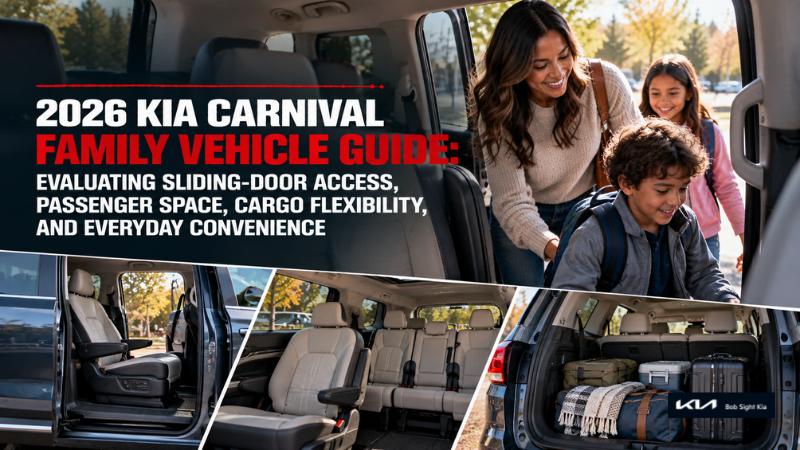
Family loading children and cargo through the sliding door of a 2026 Kia Carnival in Independence, Missouri

2026 Kia Carnival Family Vehicle Guide: Evaluating Sliding-Door Access, Passenger Space, Cargo Flexibility, and Everyday Convenience

2026 Kia Carnival Family Vehicle Guide: Evaluating Sliding-Door Access, Passenger Space, Cargo Flexibility, and Everyday Convenience Browse new Kia family vehicles at Bob Sight Kia in Independence, Missouri. The 2026 Kia Carnival can be a strong family vehicle for households that need three-row seating, sliding-door access, flexible cargo space, and everyday features designed around passengers. It combines many of the practical qualities associated with a minivan with styling and technology that may appeal to families also considering three-row SUVs. A family vehicle must handle more than the morning commute. It may need to support school drop-offs, carpools, grocery runs, sports practices, road trips, child seats, strollers, visiting relatives, and changing cargo needs. The Carnival's sliding rear doors and configurable interior can make those responsibilities easier to manage. This guide helps families from Independence, Blue Springs, Lee's Summit, Kansas City, Raytown, Sugar Creek, Liberty, Grain Valley, Oak Grove, Jackson County, and the Greater Kansas City Metro evaluate whether the 2026 Kia Carnival fits their routine. It covers passenger access, seating arrangements, cargo flexibility, technology, road-trip comfort, test-drive priorities, and ownership planning. In This Guide You'll Learn Why sliding rear doors can simplify family transportation How to evaluate Carnival seating configurations What to check when installing child seats How passenger space and cargo flexibility work together Which convenience and safety technologies may support families How the Carnival fits commuting and road trips What to evaluate during a family-focused test drive 2026 Kia Carnival Quick Facts The 2026 Kia Carnival is a three-row multipurpose vehicle designed to provide family-friendly access, flexible seating, and substantial cargo capability. Seating capacity and equipment can vary by trim and configuration, so shoppers should confirm the specifications of the exact vehicle they are considering. Three-row passenger seating Seating for up to eight occupants on selected configurations Dual sliding rear doors for easier passenger access Flexible second-row seating options, depending on configuration Foldable third-row seating for expanded cargo capacity Gasoline and hybrid powertrain choices, depending on availability Available driver-assistance and parking technology Available passenger-comfort and rear-cabin convenience features The Carnival is not simply an alternative for drivers who do not want an SUV. Its interior design and sliding-door access solve family transportation challenges differently from a traditional three-row crossover. Families should compare seating capacity, second-row arrangement, cargo needs, powertrain, and trim equipment before choosing a specific Carnival. Features shown on one model may not be included on another. Is the 2026 Kia Carnival a Good Family Vehicle? Yes, the 2026 Kia Carnival can be a good family vehicle for households that value passenger access, three-row space, configurable seating, and room for everyday cargo. Its strongest advantages become clear when families regularly transport children, child seats, grandparents, friends, sports equipment, or travel gear. Traditional rear doors can be difficult to open in narrow parking spaces. Sliding doors move along the side of the vehicle rather than swinging outward, helping passengers enter and exit without requiring as much clearance. This can be useful in school pickup lanes, crowded parking lots, garages, and spaces next to another vehicle. The Carnival's cabin is designed around moving people and their belongings. Families can use the third row for additional passengers, fold seats when they need more cargo capacity, or select a configuration that emphasizes second-row comfort. A family with young children may prioritize child-seat access and the ability to load passengers without wide-opening doors. A household with teenagers may focus more on legroom, charging access, climate comfort, and the ability to carry sports equipment. A multigenerational family may place greater value on step-in height and straightforward access to the second row. The Carnival may fit your family if you: Regularly transport five or more people Use multiple child seats or booster seats Need easier access in narrow parking spaces Carry strollers, sports equipment, or mobility items Take frequent family road trips Participate in carpools Need flexible passenger and cargo arrangements The Carnival may provide more space than a smaller crossover, but families should still test the exact seating arrangement. The right configuration depends on whether maximum seating capacity, second-row comfort, or cargo flexibility is the primary goal. How Sliding Doors Help During Everyday Family Life The Carnival's sliding rear doors can make passenger loading easier in situations where traditional doors would be difficult to open fully. This benefit is useful during daily errands, school transportation, medical appointments, and trips to busy Kansas City-area shopping centers. A conventional rear door swings into the space next to the vehicle. A sliding door moves rearward along the vehicle's side. Children may have an easier time entering without pushing a door toward a neighboring vehicle, shopping cart, garage wall, or concrete pillar. Sliding doors may help when: Loading a child into a rear-facing car seat Assisting an older passenger into the second row Parking in a narrow residential garage Using a crowded school pickup or drop-off lane Unloading near another parked vehicle Managing several children at the same time Accessing the cabin while carrying bags or equipment Families should test the door controls during the dealership visit. Confirm how the exterior handles, interior switches, key fob, and available hands-free functions operate on the selected trim. Ask how to pause, reverse, or disable powered operation when needed. Children should be taught to wait until the vehicle is parked and the driver confirms it is safe to exit. Sliding doors reduce the space needed beside the vehicle, but passengers must still watch for traffic, cyclists, shopping carts, and other hazards. Door operation should also be evaluated in the family's actual parking environment. Measure the garage and confirm there is enough clearance around the vehicle. Check whether shelves, walls, equipment, or another vehicle could interfere with loading passengers. Use this sliding-door evaluation process: Park beside another vehicle. Recreate the type of space you regularly use. Open each sliding door. Test the exterior handle, interior controls, and key fob. Practice loading a child seat. Check your reach and available standing room. Enter the second and third rows. Confirm that passengers can move through the cabin safely. Review child-safety controls. Ask how door locks and powered functions are managed. Test closing visibility. Make sure the driver can confirm that passengers and belongings are clear. Passenger Space and Seating Configurations The Carnival's seating flexibility allows families to prioritize maximum capacity, second-row access, or passenger comfort based on the selected configuration. Shoppers should not assume every Carnival has the same second-row layout or seating capacity. Selected configurations can seat up to eight occupants. Other configurations may use second-row captain's chairs or comfort-focused seating that changes passenger capacity and interior flexibility. The correct layout depends on how many people usually travel together and who needs access to the third row. An eight-passenger arrangement may fit larger households, carpools, or families that frequently travel with grandparents and friends. A seven-passenger arrangement with separated second-row seats may provide a center pathway and more personal space. Child-seat installation can affect access. A seat that slides or folds easily when empty may move differently after a child restraint is secured. Families using multiple child seats should bring them to the dealership or check the exact dimensions and installation requirements. Evaluate these seating questions: How many passengers travel with us most often? How frequently will the third row be occupied? Will adults or teenagers use the third row? How many child seats or boosters are needed? Can passengers reach the third row with child seats installed? Do we need a center second-row seating position? Would captain's chairs improve access or comfort? How easily can the seats be adjusted or removed? Set the driver's seat to the normal driving position before evaluating the rear rows. Adjust the second row to a realistic location, then have someone sit in the third row. Check knee room, foot space, headroom, seatback position, window visibility, airflow, cupholders, and charging access. Families with growing children should plan beyond their immediate needs. A seating arrangement that works for young children may feel different when they become teenagers or begin carrying larger school and sports equipment. Cargo Flexibility for Strollers, Groceries, and Family Trips The Carnival's cargo flexibility is one of its strongest family advantages because it can carry passengers, everyday supplies, and larger items in several configurations. The foldable third row allows families to create more cargo room when those seats are not needed. The most useful cargo measurement depends on how the vehicle will be used. Maximum cargo capacity may be impressive, but a family using all three rows needs to know how much space remains behind the third row. Test the cargo area with realistic items such as: Strollers and diaper bags Grocery bags and household supplies Sports bags, folding chairs, and coolers School projects and musical instruments Pet carriers and pet supplies Wheelchairs, walkers, or other mobility equipment Suitcases and holiday gifts Camping or outdoor equipment The cargo area behind the third row may allow some items to sit lower than the rear opening, depending on the configuration. This can help contain grocery bags or smaller luggage, but families should still secure loose cargo. When the third row is folded, the Carnival can provide a larger and flatter area for bulky items. Ask a product specialist to demonstrate the folding process and confirm whether head restraints, floor panels, or seatbelts require adjustment. Drivers should never stack cargo in a way that blocks rear visibility or allows objects to move into the passenger area. Heavy items should be positioned carefully and secured using appropriate tie-down points. Use this cargo test during the dealership visit: Keep all three rows upright. Measure the space available for a fully occupied trip. Place your largest regular item in the cargo area. A stroller or mobility device can reveal more than published volume. Fold one section of the third row. Determine whether passengers and longer cargo can travel together. Fold the full third row. Review floor shape, width, and loading height. Operate the liftgate. Check reach, opening height, and clearance in a garage. Locate storage compartments. Identify spaces for emergency supplies and smaller items. The Carnival may be a good alternative to a three-row SUV for families that frequently choose between carrying more passengers and carrying more cargo. Daily Driving Around Independence and Kansas City The Carnival is designed to carry a family comfortably while remaining manageable for commuting, errands, parking, and highway travel. Its larger dimensions require awareness, but available cameras, sensors, and driver-assistance features may help drivers become more comfortable with the vehicle. A normal day may include residential streets in Independence, traffic on I-70, shopping near Independence Center, school pickup lanes, and parking in downtown Kansas City. Families should test the Carnival in several of these environments rather than judging it only from a short drive around the dealership. Pay attention to steering effort, turning radius, brake-pedal response, ride comfort, acceleration, visibility, and cabin noise. Test the vehicle at neighborhood speeds and on a highway when conditions allow. Parking is a common concern for drivers moving from a sedan or compact SUV. During the test drive, use a normal parking space and practice backing into it. Review the rearview camera, available surround-view display, parking sensors, mirror visibility, and blind spots. Families should also evaluate the vehicle while passengers are talking and climate controls are operating. A quiet solo test drive may not represent the normal cabin environment. Ask rear passengers whether they can hear conversations, feel climate airflow, and access cupholders or charging ports. If more than one adult will drive the Carnival, each person should test it. Seating position, visibility, control access, and parking confidence can differ significantly between drivers. The Carnival's design can provide a family-focused alternative for drivers who like the passenger capacity of a larger SUV but prefer sliding doors and a cabin built around easy access. Family Technology and Driver-Assistance Features The most useful Carnival technology is equipment that reduces everyday frustration, supports driver awareness, and keeps passengers comfortable without becoming distracting. Features vary by trim, so confirm what is installed on the exact vehicle. Families may want to compare smartphone connectivity, navigation, charging ports, rear-cabin communication features, camera views, climate controls, and available passenger-entertainment equipment. Charging access matters when several people carry phones, tablets, headphones, or gaming devices. Check the number and location of ports in all three rows. Make sure passengers can reach them without stretching cables across entry paths. Potential driver-assistance technologies may support forward-collision awareness, blind-spot monitoring, lane positioning, rear cross-traffic awareness, highway driving, and parking. These systems support an attentive driver and do not replace careful observation or control of the vehicle. Families should evaluate the following technology: Smartphone pairing and audio controls Navigation or smartphone-based directions Front and rear charging access Rearview and available surround-view cameras Parking sensors Blind-spot and rear cross-traffic alerts Available cabin communication features Rear climate-control access Available entertainment features Driver-assistance setting controls Ask the product specialist to explain which features are standard, optional, or unavailable on the selected trim. Similar Carnival models may have meaningful equipment differences even when their exterior appearance is similar. Parents should also review how rear entertainment and personal devices will be managed. Screens can help during long trips, but charging cables, headphones, storage, and content controls should be planned before travel. Gasoline vs. Carnival Hybrid for Family Driving The gasoline Carnival may appeal to drivers who prefer a familiar conventional powertrain, while the Carnival Hybrid may interest families seeking electrified assistance without a plug-in charging routine. Availability and equipment depend on the selected model and current inventory. The conventional hybrid system combines a gasoline engine, electric motor, and hybrid battery. It manages the power sources automatically and does not require the driver to connect the vehicle to an external charger. A family driving pattern may include short errands, school traffic, highway commuting, and occasional road trips. Each use can affect fuel consumption differently. Vehicle load, weather, speed, traffic, climate-control use, tire pressure, and driving style can influence real-world results. Missouri winter temperatures may cause a hybrid vehicle's gasoline engine to operate more frequently while the cabin and powertrain warm. Summer air-conditioning use can also affect energy consumption. Compare both powertrains based on the complete ownership routine: Typical daily mileage City and highway driving balance Passenger and cargo load Frequency of long-distance trips Preferred acceleration and braking feel Trim and feature availability Maintenance planning A test drive should include normal acceleration, highway merging, braking, parking, and lower-speed traffic. Drivers comparing the hybrid should also pay attention to regenerative braking and the transitions between gasoline and electric assistance. Road Trips and Changing Missouri Weather The Carnival can support family road trips by combining three-row seating, flexible cargo room, passenger technology, and long-distance comfort. Preparation remains important when traveling with several people or driving during changing Missouri weather. Before leaving Independence, check tire pressure, tread condition, exterior lights, wipers, washer fluid, battery condition, and fluid levels. Address active warning lights, unusual noises, braking concerns, or visible leaks before beginning a long trip. Plan the passenger layout before loading cargo. Frequently needed items such as snacks, medications, wipes, charging cables, and extra clothing should remain accessible without allowing loose objects to move around the cabin. Families traveling on I-70, I-35, I-435, or the Kansas Turnpike should consider how passengers will handle longer periods in each row. Test climate airflow, seat comfort, charging access, cupholders, window visibility, and the ability to communicate between rows. Winter travel may require blankets, water, snacks, flashlights, charging equipment, and other emergency supplies. Cargo should be secured so that emergency items remain accessible. The Carnival's passenger-focused layout can reduce some road-trip challenges, but the driver should still plan regular breaks. Stops allow passengers to move, use restrooms, reorganize belongings, and reduce cabin fatigue. How to Test-Drive a Kia Carnival With Your Family A family-focused Carnival test drive should include the people, child seats, cargo measurements, and road conditions that reflect your actual routine. Testing the vehicle alone may overlook the features and limitations that matter most. Schedule enough time to examine all three rows before driving. Open each sliding door, move the second-row seats, enter the third row, fold the rear seats, and operate the liftgate. Bring child seats or confirm their measurements and installation requirements. Check whether the selected seating configuration provides the required lower anchors, tether locations, and access. Follow the child-seat and vehicle manufacturers' instructions. During the drive, evaluate: Driver seating position and outward visibility Acceleration and highway merging Brake response and steering effort Ride comfort over uneven pavement Road and wind noise Passenger communication between rows Rear climate performance Camera and parking-sensor views Turning radius and parking confidence Sliding-door and liftgate operation Ask rear passengers for feedback. Children may notice charging access, cupholder placement, window visibility, or seat comfort that the driver cannot evaluate from the front row. Blue Springs, Lee's Summit, and Kansas City shoppers can also review current Bob Sight Kia vehicle specials and the Price Match Promise when comparing available family vehicles. Inventory, offers, eligibility, and program details can change, so confirm current information for the specific Carnival under consideration. Ownership Planning for a 2026 Kia Carnival Carnival ownership planning should include routine maintenance, tire care, interior durability, insurance, financing, annual mileage, and the household's changing passenger needs. A vehicle that fits today should also support the family's expected routine over the next several years. Follow the maintenance schedule provided for the selected powertrain and vehicle. Service requirements can vary based on mileage, time, driving environment, trip length, weather, passenger load, and other operating conditions. Routine ownership needs may include oil and filter service, tire rotations, brake inspections, fluid checks, battery testing, filter replacement, and other recommended maintenance. Hybrid configurations may have different inspection or service requirements than gasoline models. Tire care affects braking, traction, ride comfort, road noise, and efficiency. Maintain the recommended pressure, rotate tires as directed, and address uneven wear promptly. Families planning holiday or summer road trips should inspect tires before departure rather than waiting until the travel date. Interior planning is also important. Floor protection, cargo liners, seatback organizers, and appropriate storage solutions may help manage mud, snacks, sports equipment, and school supplies. Accessories should not interfere with airbags, seat movement, child-seat installation, or visibility. Request insurance estimates for the exact trim and powertrain being considered. If financing, review the complete ownership plan, including the trade-in, expected mileage, maintenance, insurance, and intended ownership period. Keep maintenance records and repair invoices. Detailed documentation can help with future service planning and may provide useful information when the family eventually sells or trades the vehicle. Frequently Asked Questions About the 2026 Kia Carnival Is the 2026 Kia Carnival a minivan or an SUV? The 2026 Kia Carnival is a multipurpose vehicle with three-row family functionality and sliding rear doors. Its design incorporates SUV-inspired styling, but its passenger access and flexible interior provide many of the practical benefits commonly associated with a minivan. Families should evaluate it based on function rather than the category name alone. For Independence and Kansas City-area households, the Carnival may provide a useful alternative to a traditional three-row SUV when sliding-door access and passenger flexibility are priorities. How many people can the 2026 Kia Carnival seat? The 2026 Kia Carnival can seat up to eight occupants in selected configurations. Seating capacity depends on the trim and second-row arrangement. Some configurations prioritize maximum passenger capacity, while others may emphasize second-row comfort or access. Families should confirm the seating capacity of the exact Carnival at Bob Sight Kia. Test the interior with normal passengers and child-seat needs before choosing a configuration. Is the Kia Carnival good for families with car seats? The Carnival can be well suited to families using child seats because its sliding doors and spacious rear access may make installation and loading easier. Compatibility depends on the child restraint, seating position, second-row configuration, and the number of seats being installed. Always follow both the vehicle and child-seat manufacturers' instructions. Bring child seats to the dealership when possible. This allows families to check anchor access, front-seat clearance, third-row entry, and the ability to load children in realistic parking conditions. Does the 2026 Kia Carnival have enough cargo room for a family? The Carnival provides useful family cargo capacity, but available space changes based on how many seating rows are in use. Families using all three rows should evaluate the area behind the third row. Folding part or all of the third row creates additional room for larger items, luggage, sports equipment, or household supplies. Bring stroller measurements, luggage dimensions, or other frequently carried items when visiting Bob Sight Kia. A physical cargo test provides more useful information than maximum cargo volume alone. Is the Kia Carnival good for long road trips? The Carnival can be a strong road-trip vehicle for families because it combines three-row seating, passenger access, flexible cargo space, and available comfort technology. Road-trip suitability depends on the selected trim, seating configuration, passenger size, luggage requirements, and powertrain. Families should test rear climate airflow, charging access, seat comfort, and cargo room. Drivers traveling from Independence, Blue Springs, Lee's Summit, Kansas City, or other Jackson County communities should test the Carnival at highway speed and confirm that every passenger row remains comfortable. Find a 2026 Kia Carnival Near Kansas City Bob Sight Kia in Independence helps Kansas City-area families compare available Carnival models based on seating, sliding-door access, cargo flexibility, powertrain, technology, and everyday convenience. A side-by-side review of configurations can help shoppers determine which model fits their household. Drivers searching for a Kia Carnival near me can begin by reviewing current inventory and identifying preferred seating arrangements and features. Inventory can change, so confirm availability before visiting if you want to see a specific Carnival. Bob Sight Kia serves families from Independence, Blue Springs, Lee's Summit, Kansas City, Raytown, Sugar Creek, Liberty, Grain Valley, Oak Grove, Jackson County, and communities throughout the Greater Kansas City Metro. Bring your normal passengers, child-seat information, and cargo measurements to the dealership. A realistic test drive can help determine whether the 2026 Kia Carnival provides the access, passenger room, and flexibility your family needs. Helpful Links Browse New Kia Inventory Value Your Trade Explore Kia Financing Options View Current Vehicle Specials Review the Price Match Promise Proud to Be Part of the Bob Sight Auto Group Bob Sight Kia is proud to be part of the family-owned Bob Sight Auto Group, serving vehicle shoppers and owners throughout the Kansas City region and Northeast Kansas. Families researching new or used vehicles can rely on Bob Sight Auto Group for new and pre-owned vehicle sales, trade-in resources, auto financing, certified service, parts, and collision repair. Bob Sight Kia - Independence, MO Bob Sight Ford - Lee’s Summit, MO Bob Sight Honda - Lawrence, KS Bob Sight CDJR - Lawrence, KS Bob Sight Collision Center - Lee’s Summit, MO

Kia technician using diagnostic equipment during Kia dealership service in Independence, Missouri

Kia Mechanic Near Me vs. Kia Dealership Service in Kansas City: Comparing Training, Diagnostic Tools, Parts, and Warranty Support

Kia Mechanic Near Me vs. Kia Dealership Service in Kansas City: Comparing Training, Diagnostic Tools, Parts, and Warranty Support Schedule Kia service at Bob Sight Kia in Independence, Missouri. Choosing between a local mechanic and a Kia dealership service department depends on the repair, your vehicle's age, warranty coverage, diagnostic needs, and the type of parts or documentation you prefer. An independent repair shop may be convenient for basic maintenance, while a Kia dealership can provide brand-specific resources that become more important for warranty concerns, recalls, software-related issues, and complex diagnostics. Drivers searching for a "Kia mechanic near me" may encounter independent garages, national repair chains, mobile mechanics, and authorized Kia dealerships. These options can differ in technician experience, diagnostic equipment, parts access, repair procedures, warranty support, and familiarity with current Kia systems. This guide helps Kia owners in Independence, Blue Springs, Lee's Summit, Kansas City, Raytown, Sugar Creek, Liberty, Grain Valley, Oak Grove, Jackson County, and the Greater Kansas City Metro compare their options. It explains when an independent mechanic may fit the situation, when Kia dealership service may be the stronger choice, and what questions to ask before authorizing work. In This Guide You'll Learn How independent mechanics and Kia dealership service departments differ Why Kia-specific training and diagnostic resources may matter How genuine Kia parts compare with aftermarket alternatives Where to go for warranty repairs, recalls, and service campaigns What maintenance records should include How to compare service estimates beyond the total cost When to schedule service at Bob Sight Kia in Independence Kia Mechanic vs. Kia Dealership Service Quick Facts An independent mechanic can be a practical option for many routine services, while a Kia dealership is often the more direct choice for Kia-specific diagnostics, warranty repairs, recalls, software procedures, and brand-specific technical support. The correct option depends on what the vehicle needs. Independent Mechanic May service vehicles from many different manufacturers Can often perform routine maintenance and common mechanical repairs May offer original-equipment, aftermarket, or remanufactured parts May be conveniently located near a driver's home or workplace Equipment and Kia-specific experience can vary significantly by shop Kia Dealership Service Department Focuses on Kia vehicles and Kia repair procedures Has access to manufacturer-specific service information and resources Can complete eligible Kia warranty repairs and recall work Offers genuine Kia parts designed for specific applications Can review vehicle identification number information for applicable campaigns Neither option should be selected based on a single factor. Drivers should compare technician qualifications, diagnostic capabilities, parts, estimate details, warranties on completed work, scheduling availability, and the shop's experience with the specific Kia model and concern. What Does "Kia Mechanic Near Me" Actually Mean? A search for a Kia mechanic near me can return several types of service providers, and they may not offer the same Kia-specific capabilities. The search result may include an independent neighborhood garage, a repair chain, a tire store, a mobile technician, or an authorized Kia dealership. Some independent technicians have extensive experience working on Kia vehicles. Others may service Kia models only occasionally. A shop's general reputation does not automatically reveal whether its technicians are familiar with the exact engine, transmission, hybrid system, driver-assistance technology, or electrical concern affecting your vehicle. Before scheduling with an independent mechanic, ask whether the shop regularly works on your Kia model and model year. A technician familiar with an older Kia Forte may not have the same experience with a newer Sportage Hybrid, Sorento Plug-In Hybrid, Carnival MPV, EV6, or EV9. The phrase "Kia mechanic" also does not necessarily mean the shop is authorized to perform Kia warranty or recall work. Independent shops can complete many maintenance and repair services, but manufacturer-paid warranty repairs and safety recalls generally need to be handled through an authorized Kia dealership. Drivers around Independence may find an independent mechanic convenient for basic services close to home. The decision becomes more technical when a warning light, intermittent electrical concern, software issue, hybrid-system message, driver-assistance fault, or warranty question is involved. Use the search results as a starting point, then verify the shop's capabilities directly. Ask who will diagnose the vehicle, what equipment will be used, which parts are planned, and what warranty applies to the completed repair. Comparing Kia-Specific Training and Repair Experience Kia dealership technicians work within a service environment built around Kia vehicles, while independent mechanics often divide their training and repair work among many manufacturers. That difference may affect diagnostic speed, familiarity with recurring concerns, and access to current repair procedures. Modern vehicles combine mechanical components with computers, sensors, cameras, communication networks, software, and driver-assistance technology. A problem that appears mechanical may have an electrical or software-related cause. Replacing a component without identifying the underlying issue can lead to repeated repairs. A Kia dealership service department has access to Kia-focused service information and procedures. This can be useful when diagnosing a concern involving the powertrain, infotainment system, advanced safety features, hybrid equipment, charging components, or communication between vehicle modules. Independent mechanics may also have strong technical experience and professional training. Some specialize in Asian manufacturers or maintain advanced industry certifications. The important step is verifying that the individual shop has current experience with your vehicle and the equipment required for the repair. Ask these questions before choosing a service provider: Do you regularly work on my Kia model and model year? Experience with the same generation and powertrain is more useful than general familiarity. Who will diagnose the concern? Ask about the technician's experience and training. Do you have access to current service procedures? Modern repair information can change as new guidance becomes available. Can your equipment communicate with all relevant vehicle systems? A basic code reader may not access every module. Can you complete required programming or calibration? Some repairs require more than installing a component. What happens if the first repair does not resolve the problem? Understand the diagnostic and workmanship policies. For an oil change, tire rotation, conventional brake service, or other routine work, several qualified providers may be capable of completing the service. For a complex or intermittent concern, Kia-specific experience may become a more important part of the decision. Diagnostic Tools, Software, and Modern Kia Technology A Kia dealership may have an advantage when a repair requires manufacturer-specific diagnostic information, software procedures, module communication, or calibration. A warning light can identify the system that detected a problem, but it does not always identify the failed component or underlying cause. Generic scan tools can read many standardized diagnostic trouble codes. More advanced tools may access additional systems, live data, programming functions, and testing procedures. Capabilities vary by tool, software subscription, vehicle, and repair shop. Modern Kia vehicles may include multiple electronic control modules managing the engine, transmission, braking, steering, airbags, climate system, infotainment equipment, hybrid components, battery systems, cameras, and driver-assistance features. These modules exchange information, so one fault can create symptoms in another system. A complete diagnosis may require reviewing fault codes, service information, live sensor data, wiring diagrams, test results, vehicle history, and current software information. Simply replacing the component named in a code description may not correct damaged wiring, poor connections, voltage problems, communication faults, or another underlying condition. Calibration may also be required after certain repairs. Cameras, radar sensors, steering components, windshield-related systems, or suspension work may need specific procedures to help supported systems operate as intended. Ask whether the shop can complete the calibration or whether the vehicle will need to be sent elsewhere. Consider Kia dealership service when the vehicle has: An intermittent warning light that another repair has not resolved Multiple warning messages appearing together An infotainment or connectivity concern A driver-assistance system warning A hybrid, plug-in hybrid, or electric-vehicle system message A possible software or module communication problem A concern that may be covered by warranty A recall or service campaign requiring Kia procedures Drivers should describe the symptoms in detail regardless of where they schedule service. Note when the problem occurs, how long it lasts, the vehicle's speed, outside temperature, road conditions, fuel or charge level, and whether any warning messages appear. Genuine Kia Parts vs. Aftermarket Parts Kia dealership service typically uses genuine Kia parts, while independent shops may offer original-equipment, aftermarket, used, or remanufactured alternatives. The best choice depends on the component, vehicle, repair objective, warranty coverage, and quality of the available replacement. Genuine Kia parts are selected for specific Kia applications. This can simplify compatibility questions involving fit, electrical connections, communication, materials, and installation requirements. The service advisor can also explain the warranty that applies to the part and dealership repair. Aftermarket parts are produced by companies other than the vehicle manufacturer. Quality can range from reputable replacements to lower-cost components with different materials, specifications, or expected service life. The word "aftermarket" alone does not describe the quality of the part. An independent shop should identify the proposed part before beginning the repair. Ask for the manufacturer, part number, warranty, labor coverage, and reason that part was selected. If several choices are available, request an explanation of their differences. Parts selection can be more important for sensors, electrical components, emissions equipment, safety-related systems, engine-management parts, and items that must communicate with vehicle modules. A component that physically fits may still require programming, initialization, or calibration. Use this process to compare parts recommendations: Ask whether the part is genuine Kia, original-equipment, aftermarket, used, or remanufactured. Request the specific part brand and part number. Confirm whether additional hardware or programming is included. Review the part and labor warranties separately. Ask what happens if the part does not correct the concern. Keep the final invoice and warranty documentation. Drivers who prefer genuine Kia parts can visit the Bob Sight Kia parts department or ask the service department to explain the parts planned for a repair. The most useful estimate clearly identifies what will be installed and what protection applies afterward. Warranty Repairs, Recalls, and Kia Service Campaigns An authorized Kia dealership is generally the correct destination for eligible Kia warranty repairs, safety recalls, and manufacturer service campaigns. These services may require Kia-specific procedures, documentation, parts, software, and claim authorization. If a vehicle is within an applicable warranty period, do not assume every concern is covered. Coverage can depend on the component, vehicle age, mileage, maintenance history, cause of failure, and warranty terms. A Kia service advisor can review the vehicle information and explain the next diagnostic steps. Safety recalls are issued to address identified safety-related defects or compliance concerns. Recall eligibility is tied to the vehicle identification number. Two Kia vehicles of the same model year may not have the same recall status because production dates, components, and configurations can differ. A service campaign is not always the same as a safety recall. Campaigns may address product improvements or specific operating concerns for eligible vehicles. Availability and procedures depend on the vehicle identification number and current manufacturer information. An independent shop may identify a condition that appears related to a recall or warranty concern, but the covered work generally must be completed and documented by an authorized Kia dealership. Contacting the dealership before authorizing an outside repair may help avoid paying for work that should first be evaluated for possible coverage. When scheduling, have the following information available: Vehicle identification number Current mileage Registration or ownership information Description of the concern Dates and conditions when the issue occurred Warning messages or dashboard indicators Previous repair invoices Relevant maintenance records Drivers in Independence, Sugar Creek, Raytown, Blue Springs, and surrounding Jackson County communities can contact Bob Sight Kia to ask whether a vehicle has applicable recall or campaign information. Eligibility should always be confirmed using the exact vehicle identification number. Routine Kia Maintenance and Service Records Routine maintenance can be completed by different qualified providers, but the work should follow the correct specifications and be documented carefully. Choosing an independent mechanic does not remove the owner's responsibility to complete required maintenance at the appropriate time or mileage. The maintenance schedule can vary by model, model year, powertrain, mileage, time, and operating conditions. A Kia used for repeated short trips, heavy traffic, extensive idling, dusty roads, severe temperatures, towing, or other demanding conditions may require different attention than a vehicle used for steady highway driving. Routine services may include: Engine oil and filter replacement Tire rotation and pressure checks Brake inspections Fluid inspections and replacement when specified Engine and cabin air filter replacement Battery and charging-system testing Cooling-system inspections Belt, hose, and suspension inspections Wiper and exterior-light checks Keep invoices showing the service date, mileage, work performed, fluid specifications, part numbers, and service provider. A receipt that only shows a total may not provide enough detail to demonstrate what maintenance was completed. Drivers who perform maintenance themselves should keep receipts for oil, filters, fluids, and other parts. Record the date, mileage, product specifications, and service performed. Follow safe procedures and do not attempt work beyond your training or equipment. Dealership maintenance can simplify recordkeeping because service history completed at the dealership remains connected to its repair records. This can be helpful when reviewing past work, diagnosing a recurring concern, preparing for a trade-in, or planning future maintenance. Eligible Kia owners should also review the requirements of Bob Sight Kia's Lifetime Oil Changes and Tire Rotations program. Program benefits are subject to eligibility and maintenance requirements, so confirm the terms that apply to the specific vehicle. How to Compare Kia Service Estimates A service estimate should be evaluated by the work included, diagnostic process, parts, labor, warranties, and repair outcome rather than by the total alone. Two estimates with different totals may not describe the same repair. One estimate may include diagnostic testing, genuine parts, replacement hardware, programming, calibration, fluid replacement, disposal fees, and a road test. Another may cover only a replacement component and installation. Comparing the final numbers without comparing the scope can lead to an incomplete decision. Ask each service provider to separate diagnostic charges, parts, labor, taxes, shop supplies, programming, calibration, and optional recommendations. Confirm whether the estimate is based on completed testing or an initial description of the symptoms. Drivers should also distinguish between an inspection and a diagnosis. An inspection may identify visible wear or obvious damage. A diagnosis attempts to determine why a symptom or warning is occurring. Complex electrical, drivability, or intermittent problems may require additional testing time. Review these questions before authorizing work: What testing supports the recommended repair? Which parts will be installed? Are programming or calibration included? What part and labor warranties apply? Are any recommendations urgent or safety-related? Which services can be planned for a later visit? Will additional work require separate approval? How will replaced parts and completed work be documented? Blue Springs, Lee's Summit, and Kansas City drivers comparing service options can review current Bob Sight Kia service specials and the Price Match Promise. Offers, qualifications, covered services, and program terms can change, so confirm the current details for the maintenance or repair being considered. A clear estimate should allow you to understand what the technician found, why the repair was recommended, and what result the proposed work is intended to produce. When to Choose an Independent Mechanic or Kia Dealership An independent mechanic may be suitable for straightforward maintenance and common repairs, while Kia dealership service may be preferable for warranty work, recalls, advanced diagnostics, software procedures, and Kia-specific concerns. The right choice can change from one service visit to the next. An Independent Mechanic May Fit When: The shop has demonstrated experience with your Kia model The service is routine and does not require Kia-specific programming The vehicle is outside applicable warranty coverage You understand which parts will be installed The shop provides detailed records and warranty information The location or scheduling better fits your routine Kia Dealership Service May Fit When: The vehicle may have an eligible warranty concern A recall or service campaign may apply The repair requires Kia-specific diagnostic resources Software, programming, initialization, or calibration may be required The concern involves a hybrid or electric powertrain The issue is intermittent or has not been resolved elsewhere You prefer genuine Kia parts and dealership repair documentation Owners do not need to use the same provider for every service. A driver may use a trusted independent shop for certain routine maintenance while relying on a Kia dealership for recalls, warranty questions, software concerns, or complex diagnostics. The priority should be matching the repair to the provider's capabilities. Verify experience, equipment, parts, documentation, and warranty support before approving the work. Ownership Planning and Preventive Kia Service Preventive maintenance is easier to plan when owners track mileage, time, driving conditions, past service, and upcoming seasonal needs. Waiting for a warning light or breakdown can reduce the number of convenient service options available. Create a maintenance file containing the owner's manual, service records, tire information, battery replacement history, warranty documents, and previous repair invoices. Digital copies can make these records easier to access when scheduling service or preparing for a trade appraisal. Review maintenance needs before major seasonal changes. Missouri summers can place additional demands on air conditioning and cooling systems, while winter temperatures can reveal weak batteries, low tire pressure, worn wipers, and reduced washer-fluid performance. Before a long drive from Independence, inspect tires, lights, wipers, fluid levels, and visible leaks. If the vehicle has an active warning light, unusual noise, vibration, braking concern, or fluid loss, schedule an evaluation before beginning the trip. Follow these ownership-planning steps: Record the current mileage. Compare it with the maintenance information for your vehicle. Review previous invoices. Identify services already completed and recurring concerns. Inspect seasonal items. Check tires, battery condition, wipers, lights, and climate performance. Prioritize safety concerns. Address braking, steering, tire, visibility, or warning-light issues promptly. Plan routine services together. Combining appropriate maintenance may reduce repeated visits. Keep detailed documentation. Save invoices, inspection results, and warranty information. A consistent service history can help technicians understand the vehicle and may support owner confidence during a future sale or trade. It also reduces the chance of repeating work because the previous service cannot be verified. Frequently Asked Questions About Kia Mechanics and Dealership Service Do I have to take my Kia to a dealership for every oil change? No. Routine maintenance can generally be completed by a qualified independent provider, a Kia dealership, or the owner when proper procedures and specifications are followed. The important factors are completing maintenance at the appropriate intervals, using the correct oil and filter specifications, and retaining detailed records. Maintenance requirements can vary by model, powertrain, mileage, time, and driving conditions. Independence-area drivers may choose Bob Sight Kia for oil changes when they prefer Kia-focused service, dealership records, multipoint inspections, and access to eligible maintenance-program benefits. Confirm current program requirements for the specific vehicle. Can an independent mechanic perform Kia warranty repairs? Eligible manufacturer warranty repairs are generally completed through an authorized Kia dealership. Warranty coverage depends on the vehicle, mileage, time, component, cause of failure, and applicable terms. An independent mechanic may identify a possible issue, but Kia warranty diagnosis, authorization, documentation, and payment typically require dealership involvement. If your Kia may still have coverage, contact Bob Sight Kia before authorizing a major outside repair. The service team can review vehicle information and explain the appropriate diagnostic process. Where should I take my Kia for recall work? Kia recall work should be scheduled with an authorized Kia dealership. Recall eligibility is determined using the vehicle identification number. The dealership follows the applicable manufacturer procedure and documents completion of the recall for the vehicle. Kia owners in Independence, Blue Springs, Lee's Summit, Kansas City, Raytown, Sugar Creek, and surrounding communities can contact Bob Sight Kia to ask about recall information and appointment availability. Are genuine Kia parts better than aftermarket parts? Genuine Kia parts provide application-specific compatibility, while aftermarket-part quality and specifications can vary by manufacturer. A reputable aftermarket part may be appropriate for some repairs, but owners should ask about its manufacturer, part number, materials, warranty, and compatibility. Electrical, safety, emissions, and communication-related components may require additional attention. Bob Sight Kia can explain the genuine Kia parts planned for dealership service. Drivers should compare both the part warranty and labor warranty before approving any repair. Is Kia dealership service always more expensive than an independent mechanic? Not necessarily. Service estimates depend on the diagnosis, labor included, parts selected, required equipment, programming, calibration, and warranty coverage. A lower estimate may not include the same testing, parts, procedures, or warranty protection. Compare itemized estimates and ask each provider to explain what is included before making a decision. Kansas City-area drivers can review Bob Sight Kia service specials and the Price Match Promise when comparing eligible services. Current offers and program requirements should be confirmed before scheduling. Schedule Kia Service in Independence, Missouri Bob Sight Kia provides Kia-focused maintenance, diagnostics, repair support, genuine Kia parts, recall service, and warranty assistance for drivers throughout the Kansas City Metro. The service team can help owners understand current maintenance needs and determine the next step for a warning light, unusual symptom, recall notice, or repair concern. When scheduling, provide the model, model year, mileage, vehicle identification number, and a detailed description of the issue. Mention when the symptom occurs and whether another shop has already performed testing or repairs. Bob Sight Kia serves Kia owners from Independence, Blue Springs, Lee's Summit, Kansas City, Raytown, Sugar Creek, Liberty, Grain Valley, Oak Grove, Jackson County, and surrounding Missouri communities. If you are searching for a Kia mechanic near me, compare the provider's experience, equipment, parts, documentation, and ability to support the specific service your vehicle needs. For Kia-specific diagnostics, warranty questions, recalls, and manufacturer procedures, schedule an appointment with Bob Sight Kia in Independence. Helpful Links Schedule Kia Service View Kia Service Specials Review the Price Match Promise Explore Genuine Kia Parts Learn About Lifetime Oil Changes and Tire Rotations Proud to Be Part of the Bob Sight Auto Group Bob Sight Kia is proud to be part of the family-owned Bob Sight Auto Group, serving vehicle shoppers and owners throughout the Kansas City region and Northeast Kansas. Families researching new or used vehicles can rely on Bob Sight Auto Group for new and pre-owned vehicle sales, trade-in resources, auto financing, certified service, parts, and collision repair. Bob Sight Kia - Independence, MO Bob Sight Ford - Lee’s Summit, MO Bob Sight Honda - Lawrence, KS Bob Sight CDJR - Lawrence, KS Bob Sight Collision Center - Lee’s Summit, MO

Family preparing for a holiday road trip while comparing the 2027 Kia Telluride and 2026 Kia Sorento near Independence, Missouri

2027 Kia Telluride vs. 2026 Kia Sorento for Holiday Road Trips: Comparing Passenger Comfort, Luggage Space, and Long-Distance Flexibility

2026 Kia Sportage Hybrid for Independence, MO Drivers: Regenerative Braking, Available AWD, and Everyday Versatility Browse new Kia SUVs available at Bob Sight Kia in Independence, Missouri. The 2026 Kia Sportage Hybrid gives Independence and Kansas City-area drivers a practical combination of hybrid efficiency, flexible cargo space, modern technology, and available all-wheel drive. Its conventional hybrid system automatically blends gasoline and electric power, so drivers can enjoy an electrified SUV without adding a home-charging routine. That combination can be especially useful during a commute that includes neighborhood streets, traffic lights, I-70 merging, stop-and-go congestion, and crowded parking areas. The Sportage Hybrid also offers adjustable regenerative braking, allowing drivers to select how much deceleration they feel when lifting off the accelerator under appropriate driving conditions. This guide is designed for drivers comparing a 2026 Kia Sportage Hybrid near Independence, Blue Springs, Lee's Summit, Kansas City, Raytown, Sugar Creek, Liberty, Grain Valley, Oak Grove, and communities throughout Jackson County. It explains how the hybrid system, available AWD, cargo space, comfort, and technology may fit everyday Missouri driving. In This Guide You'll Learn How the 2026 Kia Sportage Hybrid works without external charging What regenerative braking does during Kansas City commuting How front-wheel drive and available AWD compare What to evaluate when reviewing cargo and passenger space Which technology features may support a daily commute How Missouri winter conditions can affect hybrid operation What to check during a Sportage Hybrid test drive 2026 Kia Sportage Hybrid Quick Facts The 2026 Kia Sportage Hybrid is a two-row compact SUV that uses a gasoline engine, an electric motor, and a hybrid battery without requiring the driver to plug it in. The vehicle manages its power sources automatically and recovers some energy through regenerative braking. Feature What Independence Drivers Should Know Powertrain Conventional hybrid system combining gasoline and electric power Charging No external charging connection is required Drivetrain Front-wheel drive or available all-wheel drive, depending on configuration Regenerative Braking Helps recover energy while the vehicle slows under suitable conditions Seating Two rows with seating for up to five occupants Cargo Room Up to approximately 39.5 cubic feet behind the second row Local Use Designed to support commuting, errands, family transportation, and road trips Specifications and equipment can vary by trim and configuration. Shoppers should review the window sticker and confirm the features included with the exact Sportage Hybrid they are considering. How the Sportage Hybrid Fits an Independence to Kansas City Commute The Sportage Hybrid can fit drivers who want compact-SUV versatility and hybrid operation without planning their routine around a charging location. Drivers refuel it at a gas station just as they would a traditional gasoline vehicle. A commute from Independence to downtown Kansas City may begin on residential streets before continuing onto US-24, I-70, I-435, or other heavily traveled routes. Those trips can involve frequent changes in speed, highway merging, construction zones, and periods of congestion. The hybrid system automatically determines when to use the gasoline engine, electric assistance, or a combination of both. Its decisions can be influenced by acceleration, speed, battery charge, temperature, climate-control use, and current driving conditions. This flexibility may appeal to commuters who live in an apartment, park outside, or do not have reliable access to home charging. It can also work for households that regularly travel beyond the Kansas City Metro and want to refuel without locating a charging station. Real-world efficiency will vary. Driving speed, traffic, weather, tire pressure, passenger load, cargo, climate settings, and driving habits can all affect results. A short route through Independence may produce a different experience than a longer highway commute from Blue Springs or Oak Grove. Consider these parts of your routine before choosing a hybrid SUV: Estimate your weekly mileage. Include commuting, errands, school transportation, and weekend trips. Identify your most common roads. Separate city, suburban, and highway driving. Review your passenger needs. Account for adults, children, car seats, and pets. Measure your regular cargo. Include strollers, sports equipment, work supplies, and luggage. Consider seasonal driving. Think about early departures, untreated roads, hills, and rural routes. Test the vehicle on familiar roads. Choose a route that resembles your normal commute. How Regenerative Braking Works in the Sportage Hybrid Regenerative braking uses the electric motor to convert some of the vehicle's motion into electrical energy while the SUV decelerates. That recovered energy can be returned to the hybrid battery and used later to assist the gasoline engine. A conventional braking system primarily slows a vehicle by creating friction, which converts motion into heat. A hybrid can use both regenerative braking and traditional friction brakes. The Sportage Hybrid automatically blends the two systems based on braking demand, vehicle speed, battery condition, and road conditions. Regenerative braking does not replace the brake pedal or conventional brakes. Drivers must continue to brake normally and maintain a safe following distance. The system may provide less regenerative deceleration when the battery is full, temperatures are extreme, or vehicle systems determine that a different response is necessary. The Sportage Hybrid offers steering-wheel-mounted paddle controls that can adjust regenerative braking under appropriate conditions. The left paddle generally increases the selected regenerative level, while the right paddle reduces it. The current setting can be shown in the driver display. A lighter setting may allow the vehicle to coast more freely. A stronger setting may produce more noticeable deceleration when the driver lifts off the accelerator. The ideal setting can change based on traffic, road surface, speed, and personal preference. Learning the Regenerative Braking Settings Begin on a familiar road. Choose an area with light traffic and predictable conditions. Start with the default response. Notice how the vehicle slows when you release the accelerator. Increase regeneration gradually. Make one adjustment at a time and observe the difference. Practice smooth accelerator inputs. Gradual changes can make the system feel more natural. Use the brake pedal normally. Do not depend on regenerative braking to stop the vehicle. Adjust for current conditions. Avoid abrupt inputs on snow, ice, or wet pavement. Review the owner's manual. Confirm system availability, limitations, and proper operation. Stop-and-go traffic around Independence Center, downtown Kansas City, or busy sections of I-70 may create frequent opportunities for regenerative braking. Open highway travel may feel more comfortable with a lighter response that allows additional coasting. Front-Wheel Drive vs. Available AWD for Missouri Roads Front-wheel drive may fit commuters who remain primarily on treated paved roads, while available AWD may provide additional traction support for drivers who regularly encounter snow, rain, gravel, hills, or less-maintained surfaces. Neither drivetrain is automatically right for every Missouri driver. Consideration Front-Wheel Drive Available AWD Typical Driving Paved city and highway routes Mixed surfaces and changing weather Winter Routine May fit drivers who wait for roads to be treated May help drivers who leave before roads are cleared Rural Travel Suitable for many maintained routes May provide added support on gravel or loose surfaces Driver Priority Simplicity and potential efficiency benefits Additional traction during acceleration Available AWD may be worth considering if you commute early in the morning, travel outside central Independence, have a steep or shaded driveway, or regularly visit rural areas around Grain Valley and Oak Grove. Some AWD configurations also provide terrain settings designed for conditions such as snow, mud, and sand. AWD does not create unlimited traction and does not guarantee shorter stopping distances. Tires, speed, visibility, following distance, and driver decisions remain essential. A front-wheel-drive vehicle with suitable tires may perform more confidently than an AWD vehicle with worn or inappropriate tires. During a test drive, ask to compare the drivetrain options available in current inventory. Consider whether AWD supports a recurring need or is simply a feature you may rarely use. Cargo Space and Passenger Comfort for Daily Life The Sportage Hybrid provides a flexible two-row layout for commuters who need more room than a sedan but do not regularly need a third-row SUV. Its cargo area can support groceries, work equipment, sports gear, luggage, pet supplies, and family essentials. The 2026 Sportage Hybrid offers up to approximately 39.5 cubic feet of cargo room behind the second row. Published volume is helpful when comparing SUVs, but the shape and accessibility of the cargo area can be equally important. Check the width between the wheel wells, height of the opening, lift-over height, tie-down locations, and rear-seat folding process. A wide cargo area may be more useful for a stroller or pet carrier, while a taller opening may help with bulky household items. Bring measurements for the items you carry regularly. Families may want to check whether a stroller fits without folding the second row. Drivers carrying work supplies should confirm that the equipment can be secured while leaving passenger space available. Passenger comfort should also be evaluated realistically. Adjust the driver's seat to the normal driving position, then sit directly behind it to check second-row legroom. Inspect headroom, door-opening width, child-seat anchor access, storage compartments, charging-port placement, and climate-control performance. Drivers using I-70 or I-435 should listen for wind, tire, and road noise at highway speed. Turn the audio system down for part of the test drive so you can evaluate the cabin without music covering the sound. Technology to Evaluate Before Choosing a Trim The best Sportage Hybrid technology package is the one that provides useful daily features without requiring you to pay for equipment you will rarely use. Feature availability can differ by trim, package, drivetrain, and individual vehicle. Depending on the selected configuration, shoppers may find technology supporting smartphone connectivity, navigation, charging, parking, highway travel, and driver awareness. Potential features can include Forward Collision-Avoidance Assist, Lane Keeping Assist, Lane Following Assist, Blind-Spot Collision Warning, Rear Cross-Traffic Collision-Avoidance Assist, Smart Cruise Control, parking sensors, and camera-based parking views. Driver-assistance features are designed to support an alert driver. They do not replace careful observation, steering, braking, or appropriate following distance. Availability and operation can also be affected by weather, road markings, visibility, sensor condition, and other factors. Use this checklist when reviewing a specific Sportage Hybrid: Pair your phone with the infotainment system Confirm whether smartphone integration is wired or wireless Test audio and call quality Locate charging ports for front and rear passengers Review the instrument and hybrid-energy displays Test the rearview camera and available parking views Ask how to adjust driver-assistance settings Confirm which features are standard on the selected trim Ask whether connected services require enrollment or a subscription Do not assume that every Sportage Hybrid shown online has identical equipment. Review the exact vehicle listing and window sticker before making a comparison. Missouri Winter Driving in a Sportage Hybrid The Sportage Hybrid can operate throughout a Missouri winter, but cold temperatures, cabin-heating demands, tire condition, and road conditions can affect its performance and efficiency. Drivers should expect the vehicle to behave differently in freezing weather than it does during a mild fall commute. The gasoline engine may operate more frequently while the powertrain warms, the cabin heater is in use, or the hybrid battery reaches an appropriate operating temperature. Short winter trips can be particularly affected because the vehicle may spend a larger portion of the drive warming its systems. Cold weather may also change the amount of regenerative braking available. Battery temperature, charge level, traction conditions, and stability-control activity can all influence the system. Drivers should be prepared for braking feel to vary and should always use the brake pedal as needed. Before winter arrives in Independence, consider these preparation steps: Inspect tire tread depth and overall tire condition. Check tire pressure regularly as temperatures fall. Confirm that the battery, lights, wipers, and defrosters operate properly. Use the correct windshield washer fluid for freezing conditions. Keep cameras and driver-assistance sensors clear of snow and ice. Schedule recommended maintenance before severe weather. Carry basic emergency supplies during longer winter trips. Available AWD can assist with traction while accelerating, but it cannot overcome excessive speed or unsuitable tires. Allow additional stopping distance and use gradual accelerator, steering, and braking inputs on snow, slush, and ice. How to Test-Drive a 2026 Kia Sportage Hybrid A complete test drive should recreate the roads, speeds, passengers, and cargo demands that are part of your normal routine. A brief drive around the dealership may not reveal how the SUV feels during a commute or longer highway trip. Begin on lower-speed streets to evaluate visibility, steering, braking, regenerative deceleration, and parking. Include a highway segment when possible so you can assess acceleration, merging, cabin noise, ride quality, and available driver-assistance features. Evaluate the following items during the drive: Acceleration from a complete stop Power delivery during highway merging Brake-pedal response Different regenerative-braking settings Steering effort and turning radius Ride comfort over uneven pavement Visibility around the windshield pillars Camera and parking-sensor views Driver-seat support and control placement Rear-seat access and passenger room Cargo-floor height and rear-seat folding Ask the product specialist to demonstrate the hybrid-energy display, regenerative-braking paddles, drive modes, and any terrain settings included with the vehicle. Confirm the drivetrain, trim, equipment, and technology on the exact model you drive. If multiple household members will operate the vehicle, each person should test their normal seating position. Bring any car seats, mobility equipment, stroller measurements, or cargo dimensions that could affect the decision. Ownership Planning for a Kia Sportage Hybrid Planning for Sportage Hybrid ownership should include maintenance, tire care, insurance, financing, trade-in value, and the way the vehicle will be used throughout the year. Hybrid ownership still requires routine care even though the powertrain can recover energy during braking. Follow the maintenance schedule provided for the vehicle and pay attention to time, mileage, driving environment, and operating conditions. Routine needs can include inspections, fluid checks, tire rotations, brake-system service, filter replacement, and other manufacturer-recommended maintenance. Regenerative braking may reduce the amount of work performed by the friction brakes in some situations, but it does not eliminate brake maintenance. Brake components should still be inspected for wear, corrosion, proper operation, and fluid condition. Tire care is especially important because tires affect traction, braking, ride quality, efficiency, and AWD performance. Maintain the recommended pressure, rotate tires as directed, and address uneven wear promptly. Before choosing a vehicle, request insurance estimates for the exact trim and drivetrain. If you plan to finance, consider the complete ownership picture rather than focusing only on a monthly payment. Review your planned ownership period, annual mileage, trade-in, maintenance needs, and available financing terms. Drivers from Blue Springs, Lee's Summit, and Kansas City can also review current dealership specials and the Bob Sight Kia Price Match Promise while comparing available vehicles and service options. Offers, inventory, eligibility, and program details can change, so confirm current information for the vehicle or service being considered. Frequently Asked Questions About the 2026 Kia Sportage Hybrid Does the 2026 Kia Sportage Hybrid need to be plugged in? No. The conventional 2026 Kia Sportage Hybrid does not need to be connected to an external charger. Its gasoline engine, electric motor, and hybrid battery work together automatically. The vehicle can recover some energy through regenerative braking and uses that energy to assist the powertrain when operating conditions allow. This can be useful for Independence and Kansas City-area drivers who want an electrified SUV but do not have home charging or do not want to plan trips around charging availability. The Sportage Plug-In Hybrid is a separate model with external charging capability. Does the 2026 Kia Sportage Hybrid offer AWD? Yes. All-wheel drive is available on selected 2026 Kia Sportage Hybrid configurations. Available AWD can help distribute power to support traction during acceleration on rain, snow, gravel, and other challenging surfaces. Selected AWD configurations may also include terrain settings for conditions such as snow, mud, and sand. AWD may appeal to drivers traveling from Grain Valley, Oak Grove, Blue Springs, or other areas where rural roads and early winter commutes are common. Confirm the drivetrain on the exact vehicle because availability varies by configuration. What does regenerative braking do? Regenerative braking converts some of the Sportage Hybrid's motion into electrical energy while the vehicle decelerates. The electric motor can function as a generator and return recovered energy to the hybrid battery. The system works with the vehicle's conventional friction brakes and may change its response based on battery condition, speed, traction, and braking demand. During stop-and-go driving in Independence or Kansas City, drivers may have frequent opportunities to use regenerative deceleration. The brake pedal remains the primary control for slowing and stopping safely. How much cargo space does the Sportage Hybrid provide? The 2026 Kia Sportage Hybrid provides up to approximately 39.5 cubic feet of cargo room behind its second row. The two-row layout can accommodate groceries, luggage, work supplies, strollers, pet equipment, and recreational gear. Actual usability depends on the dimensions of the items, passenger seating, and how cargo is arranged. Kansas City-area shoppers should bring measurements or test commonly carried items before choosing a vehicle. This provides a clearer picture than relying only on a published cargo-volume figure. Is the Sportage Hybrid a good SUV for commuting near Kansas City? The Sportage Hybrid may be a strong fit for commuters who want hybrid operation, two-row versatility, modern technology, and available AWD without external charging. Its compact-SUV dimensions can support parking and daily errands, while its passenger and cargo space can accommodate family transportation and weekend travel. The right configuration depends on drivetrain needs, desired features, and typical cargo. Drivers commuting from Independence, Blue Springs, Lee's Summit, Raytown, or Sugar Creek should test the Sportage Hybrid on roads similar to their normal route. Pay close attention to seating comfort, regenerative braking, highway response, visibility, and cabin noise. Find a 2026 Kia Sportage Hybrid Near Kansas City Bob Sight Kia in Independence helps Missouri drivers compare the 2026 Kia Sportage Hybrid with other Kia SUVs based on commuting, passenger, cargo, drivetrain, and ownership needs. A personalized comparison can help determine whether the hybrid powertrain and available AWD match the way you drive. Drivers searching for a Kia Sportage Hybrid near me can begin by reviewing current inventory, identifying preferred trims, and confirming whether front-wheel drive or AWD is available. Inventory can change, so contact the dealership before visiting if you are interested in a specific vehicle. Bob Sight Kia serves drivers from Independence, Blue Springs, Lee's Summit, Kansas City, Raytown, Sugar Creek, Liberty, Grain Valley, Oak Grove, Jackson County, and communities throughout the Greater Kansas City Metro. Schedule time to compare seating, cargo space, technology, regenerative braking, and drivetrain options in person. A thorough test drive can provide the clearest answer about whether the 2026 Kia Sportage Hybrid belongs in your daily routine. Helpful Links Visit Bob Sight Kia Browse New Kia Inventory Value Your Trade Explore Financing Options Schedule Kia Service Proud to Be Part of the Bob Sight Auto Group Bob Sight Kia is proud to be part of the family-owned Bob Sight Auto Group, serving vehicle shoppers and owners throughout the Kansas City region and Northeast Kansas. Families researching new or used vehicles can rely on Bob Sight Auto Group for new and pre-owned vehicle sales, trade-in resources, auto financing, certified service, parts, and collision repair. Bob Sight Kia - Independence, MO Bob Sight Ford - Lee’s Summit, MO Bob Sight Honda - Lawrence, KS Bob Sight CDJR - Lawrence, KS Bob Sight Collision Center - Lee’s Summit, MO

Explore the 2026 Kia Sportage Hybrid for Kansas City commuting, including regenerative braking, available AWD, cargo room, and daily driving benefits.

2026 Kia Sportage Hybrid for Kansas City Commuting: How Regenerative Braking, Available AWD, and Cargo Flexibility Fit Daily Life

2026 Kia Sportage Hybrid for Independence, MO Drivers: Regenerative Braking, Available AWD, and Everyday Versatility Browse new Kia SUVs available at Bob Sight Kia in Independence, Missouri. The 2026 Kia Sportage Hybrid gives Independence and Kansas City-area drivers a practical combination of hybrid efficiency, flexible cargo space, modern technology, and available all-wheel drive. Its conventional hybrid system automatically blends gasoline and electric power, so drivers can enjoy an electrified SUV without adding a home-charging routine. That combination can be especially useful during a commute that includes neighborhood streets, traffic lights, I-70 merging, stop-and-go congestion, and crowded parking areas. The Sportage Hybrid also offers adjustable regenerative braking, allowing drivers to select how much deceleration they feel when lifting off the accelerator under appropriate driving conditions. This guide is designed for drivers comparing a 2026 Kia Sportage Hybrid near Independence, Blue Springs, Lee's Summit, Kansas City, Raytown, Sugar Creek, Liberty, Grain Valley, Oak Grove, and communities throughout Jackson County. It explains how the hybrid system, available AWD, cargo space, comfort, and technology may fit everyday Missouri driving. In This Guide You'll Learn How the 2026 Kia Sportage Hybrid works without external charging What regenerative braking does during Kansas City commuting How front-wheel drive and available AWD compare What to evaluate when reviewing cargo and passenger space Which technology features may support a daily commute How Missouri winter conditions can affect hybrid operation What to check during a Sportage Hybrid test drive 2026 Kia Sportage Hybrid Quick Facts The 2026 Kia Sportage Hybrid is a two-row compact SUV that uses a gasoline engine, an electric motor, and a hybrid battery without requiring the driver to plug it in. The vehicle manages its power sources automatically and recovers some energy through regenerative braking. Feature What Independence Drivers Should Know Powertrain Conventional hybrid system combining gasoline and electric power Charging No external charging connection is required Drivetrain Front-wheel drive or available all-wheel drive, depending on configuration Regenerative Braking Helps recover energy while the vehicle slows under suitable conditions Seating Two rows with seating for up to five occupants Cargo Room Up to approximately 39.5 cubic feet behind the second row Local Use Designed to support commuting, errands, family transportation, and road trips Specifications and equipment can vary by trim and configuration. Shoppers should review the window sticker and confirm the features included with the exact Sportage Hybrid they are considering. How the Sportage Hybrid Fits an Independence to Kansas City Commute The Sportage Hybrid can fit drivers who want compact-SUV versatility and hybrid operation without planning their routine around a charging location. Drivers refuel it at a gas station just as they would a traditional gasoline vehicle. A commute from Independence to downtown Kansas City may begin on residential streets before continuing onto US-24, I-70, I-435, or other heavily traveled routes. Those trips can involve frequent changes in speed, highway merging, construction zones, and periods of congestion. The hybrid system automatically determines when to use the gasoline engine, electric assistance, or a combination of both. Its decisions can be influenced by acceleration, speed, battery charge, temperature, climate-control use, and current driving conditions. This flexibility may appeal to commuters who live in an apartment, park outside, or do not have reliable access to home charging. It can also work for households that regularly travel beyond the Kansas City Metro and want to refuel without locating a charging station. Real-world efficiency will vary. Driving speed, traffic, weather, tire pressure, passenger load, cargo, climate settings, and driving habits can all affect results. A short route through Independence may produce a different experience than a longer highway commute from Blue Springs or Oak Grove. Consider these parts of your routine before choosing a hybrid SUV: Estimate your weekly mileage. Include commuting, errands, school transportation, and weekend trips. Identify your most common roads. Separate city, suburban, and highway driving. Review your passenger needs. Account for adults, children, car seats, and pets. Measure your regular cargo. Include strollers, sports equipment, work supplies, and luggage. Consider seasonal driving. Think about early departures, untreated roads, hills, and rural routes. Test the vehicle on familiar roads. Choose a route that resembles your normal commute. How Regenerative Braking Works in the Sportage Hybrid Regenerative braking uses the electric motor to convert some of the vehicle's motion into electrical energy while the SUV decelerates. That recovered energy can be returned to the hybrid battery and used later to assist the gasoline engine. A conventional braking system primarily slows a vehicle by creating friction, which converts motion into heat. A hybrid can use both regenerative braking and traditional friction brakes. The Sportage Hybrid automatically blends the two systems based on braking demand, vehicle speed, battery condition, and road conditions. Regenerative braking does not replace the brake pedal or conventional brakes. Drivers must continue to brake normally and maintain a safe following distance. The system may provide less regenerative deceleration when the battery is full, temperatures are extreme, or vehicle systems determine that a different response is necessary. The Sportage Hybrid offers steering-wheel-mounted paddle controls that can adjust regenerative braking under appropriate conditions. The left paddle generally increases the selected regenerative level, while the right paddle reduces it. The current setting can be shown in the driver display. A lighter setting may allow the vehicle to coast more freely. A stronger setting may produce more noticeable deceleration when the driver lifts off the accelerator. The ideal setting can change based on traffic, road surface, speed, and personal preference. Learning the Regenerative Braking Settings Begin on a familiar road. Choose an area with light traffic and predictable conditions. Start with the default response. Notice how the vehicle slows when you release the accelerator. Increase regeneration gradually. Make one adjustment at a time and observe the difference. Practice smooth accelerator inputs. Gradual changes can make the system feel more natural. Use the brake pedal normally. Do not depend on regenerative braking to stop the vehicle. Adjust for current conditions. Avoid abrupt inputs on snow, ice, or wet pavement. Review the owner's manual. Confirm system availability, limitations, and proper operation. Stop-and-go traffic around Independence Center, downtown Kansas City, or busy sections of I-70 may create frequent opportunities for regenerative braking. Open highway travel may feel more comfortable with a lighter response that allows additional coasting. Front-Wheel Drive vs. Available AWD for Missouri Roads Front-wheel drive may fit commuters who remain primarily on treated paved roads, while available AWD may provide additional traction support for drivers who regularly encounter snow, rain, gravel, hills, or less-maintained surfaces. Neither drivetrain is automatically right for every Missouri driver. Consideration Front-Wheel Drive Available AWD Typical Driving Paved city and highway routes Mixed surfaces and changing weather Winter Routine May fit drivers who wait for roads to be treated May help drivers who leave before roads are cleared Rural Travel Suitable for many maintained routes May provide added support on gravel or loose surfaces Driver Priority Simplicity and potential efficiency benefits Additional traction during acceleration Available AWD may be worth considering if you commute early in the morning, travel outside central Independence, have a steep or shaded driveway, or regularly visit rural areas around Grain Valley and Oak Grove. Some AWD configurations also provide terrain settings designed for conditions such as snow, mud, and sand. AWD does not create unlimited traction and does not guarantee shorter stopping distances. Tires, speed, visibility, following distance, and driver decisions remain essential. A front-wheel-drive vehicle with suitable tires may perform more confidently than an AWD vehicle with worn or inappropriate tires. During a test drive, ask to compare the drivetrain options available in current inventory. Consider whether AWD supports a recurring need or is simply a feature you may rarely use. Cargo Space and Passenger Comfort for Daily Life The Sportage Hybrid provides a flexible two-row layout for commuters who need more room than a sedan but do not regularly need a third-row SUV. Its cargo area can support groceries, work equipment, sports gear, luggage, pet supplies, and family essentials. The 2026 Sportage Hybrid offers up to approximately 39.5 cubic feet of cargo room behind the second row. Published volume is helpful when comparing SUVs, but the shape and accessibility of the cargo area can be equally important. Check the width between the wheel wells, height of the opening, lift-over height, tie-down locations, and rear-seat folding process. A wide cargo area may be more useful for a stroller or pet carrier, while a taller opening may help with bulky household items. Bring measurements for the items you carry regularly. Families may want to check whether a stroller fits without folding the second row. Drivers carrying work supplies should confirm that the equipment can be secured while leaving passenger space available. Passenger comfort should also be evaluated realistically. Adjust the driver's seat to the normal driving position, then sit directly behind it to check second-row legroom. Inspect headroom, door-opening width, child-seat anchor access, storage compartments, charging-port placement, and climate-control performance. Drivers using I-70 or I-435 should listen for wind, tire, and road noise at highway speed. Turn the audio system down for part of the test drive so you can evaluate the cabin without music covering the sound. Technology to Evaluate Before Choosing a Trim The best Sportage Hybrid technology package is the one that provides useful daily features without requiring you to pay for equipment you will rarely use. Feature availability can differ by trim, package, drivetrain, and individual vehicle. Depending on the selected configuration, shoppers may find technology supporting smartphone connectivity, navigation, charging, parking, highway travel, and driver awareness. Potential features can include Forward Collision-Avoidance Assist, Lane Keeping Assist, Lane Following Assist, Blind-Spot Collision Warning, Rear Cross-Traffic Collision-Avoidance Assist, Smart Cruise Control, parking sensors, and camera-based parking views. Driver-assistance features are designed to support an alert driver. They do not replace careful observation, steering, braking, or appropriate following distance. Availability and operation can also be affected by weather, road markings, visibility, sensor condition, and other factors. Use this checklist when reviewing a specific Sportage Hybrid: Pair your phone with the infotainment system Confirm whether smartphone integration is wired or wireless Test audio and call quality Locate charging ports for front and rear passengers Review the instrument and hybrid-energy displays Test the rearview camera and available parking views Ask how to adjust driver-assistance settings Confirm which features are standard on the selected trim Ask whether connected services require enrollment or a subscription Do not assume that every Sportage Hybrid shown online has identical equipment. Review the exact vehicle listing and window sticker before making a comparison. Missouri Winter Driving in a Sportage Hybrid The Sportage Hybrid can operate throughout a Missouri winter, but cold temperatures, cabin-heating demands, tire condition, and road conditions can affect its performance and efficiency. Drivers should expect the vehicle to behave differently in freezing weather than it does during a mild fall commute. The gasoline engine may operate more frequently while the powertrain warms, the cabin heater is in use, or the hybrid battery reaches an appropriate operating temperature. Short winter trips can be particularly affected because the vehicle may spend a larger portion of the drive warming its systems. Cold weather may also change the amount of regenerative braking available. Battery temperature, charge level, traction conditions, and stability-control activity can all influence the system. Drivers should be prepared for braking feel to vary and should always use the brake pedal as needed. Before winter arrives in Independence, consider these preparation steps: Inspect tire tread depth and overall tire condition. Check tire pressure regularly as temperatures fall. Confirm that the battery, lights, wipers, and defrosters operate properly. Use the correct windshield washer fluid for freezing conditions. Keep cameras and driver-assistance sensors clear of snow and ice. Schedule recommended maintenance before severe weather. Carry basic emergency supplies during longer winter trips. Available AWD can assist with traction while accelerating, but it cannot overcome excessive speed or unsuitable tires. Allow additional stopping distance and use gradual accelerator, steering, and braking inputs on snow, slush, and ice. How to Test-Drive a 2026 Kia Sportage Hybrid A complete test drive should recreate the roads, speeds, passengers, and cargo demands that are part of your normal routine. A brief drive around the dealership may not reveal how the SUV feels during a commute or longer highway trip. Begin on lower-speed streets to evaluate visibility, steering, braking, regenerative deceleration, and parking. Include a highway segment when possible so you can assess acceleration, merging, cabin noise, ride quality, and available driver-assistance features. Evaluate the following items during the drive: Acceleration from a complete stop Power delivery during highway merging Brake-pedal response Different regenerative-braking settings Steering effort and turning radius Ride comfort over uneven pavement Visibility around the windshield pillars Camera and parking-sensor views Driver-seat support and control placement Rear-seat access and passenger room Cargo-floor height and rear-seat folding Ask the product specialist to demonstrate the hybrid-energy display, regenerative-braking paddles, drive modes, and any terrain settings included with the vehicle. Confirm the drivetrain, trim, equipment, and technology on the exact model you drive. If multiple household members will operate the vehicle, each person should test their normal seating position. Bring any car seats, mobility equipment, stroller measurements, or cargo dimensions that could affect the decision. Ownership Planning for a Kia Sportage Hybrid Planning for Sportage Hybrid ownership should include maintenance, tire care, insurance, financing, trade-in value, and the way the vehicle will be used throughout the year. Hybrid ownership still requires routine care even though the powertrain can recover energy during braking. Follow the maintenance schedule provided for the vehicle and pay attention to time, mileage, driving environment, and operating conditions. Routine needs can include inspections, fluid checks, tire rotations, brake-system service, filter replacement, and other manufacturer-recommended maintenance. Regenerative braking may reduce the amount of work performed by the friction brakes in some situations, but it does not eliminate brake maintenance. Brake components should still be inspected for wear, corrosion, proper operation, and fluid condition. Tire care is especially important because tires affect traction, braking, ride quality, efficiency, and AWD performance. Maintain the recommended pressure, rotate tires as directed, and address uneven wear promptly. Before choosing a vehicle, request insurance estimates for the exact trim and drivetrain. If you plan to finance, consider the complete ownership picture rather than focusing only on a monthly payment. Review your planned ownership period, annual mileage, trade-in, maintenance needs, and available financing terms. Drivers from Blue Springs, Lee's Summit, and Kansas City can also review current dealership specials and the Bob Sight Kia Price Match Promise while comparing available vehicles and service options. Offers, inventory, eligibility, and program details can change, so confirm current information for the vehicle or service being considered. Frequently Asked Questions About the 2026 Kia Sportage Hybrid Does the 2026 Kia Sportage Hybrid need to be plugged in? No. The conventional 2026 Kia Sportage Hybrid does not need to be connected to an external charger. Its gasoline engine, electric motor, and hybrid battery work together automatically. The vehicle can recover some energy through regenerative braking and uses that energy to assist the powertrain when operating conditions allow. This can be useful for Independence and Kansas City-area drivers who want an electrified SUV but do not have home charging or do not want to plan trips around charging availability. The Sportage Plug-In Hybrid is a separate model with external charging capability. Does the 2026 Kia Sportage Hybrid offer AWD? Yes. All-wheel drive is available on selected 2026 Kia Sportage Hybrid configurations. Available AWD can help distribute power to support traction during acceleration on rain, snow, gravel, and other challenging surfaces. Selected AWD configurations may also include terrain settings for conditions such as snow, mud, and sand. AWD may appeal to drivers traveling from Grain Valley, Oak Grove, Blue Springs, or other areas where rural roads and early winter commutes are common. Confirm the drivetrain on the exact vehicle because availability varies by configuration. What does regenerative braking do? Regenerative braking converts some of the Sportage Hybrid's motion into electrical energy while the vehicle decelerates. The electric motor can function as a generator and return recovered energy to the hybrid battery. The system works with the vehicle's conventional friction brakes and may change its response based on battery condition, speed, traction, and braking demand. During stop-and-go driving in Independence or Kansas City, drivers may have frequent opportunities to use regenerative deceleration. The brake pedal remains the primary control for slowing and stopping safely. How much cargo space does the Sportage Hybrid provide? The 2026 Kia Sportage Hybrid provides up to approximately 39.5 cubic feet of cargo room behind its second row. The two-row layout can accommodate groceries, luggage, work supplies, strollers, pet equipment, and recreational gear. Actual usability depends on the dimensions of the items, passenger seating, and how cargo is arranged. Kansas City-area shoppers should bring measurements or test commonly carried items before choosing a vehicle. This provides a clearer picture than relying only on a published cargo-volume figure. Is the Sportage Hybrid a good SUV for commuting near Kansas City? The Sportage Hybrid may be a strong fit for commuters who want hybrid operation, two-row versatility, modern technology, and available AWD without external charging. Its compact-SUV dimensions can support parking and daily errands, while its passenger and cargo space can accommodate family transportation and weekend travel. The right configuration depends on drivetrain needs, desired features, and typical cargo. Drivers commuting from Independence, Blue Springs, Lee's Summit, Raytown, or Sugar Creek should test the Sportage Hybrid on roads similar to their normal route. Pay close attention to seating comfort, regenerative braking, highway response, visibility, and cabin noise. Find a 2026 Kia Sportage Hybrid Near Kansas City Bob Sight Kia in Independence helps Missouri drivers compare the 2026 Kia Sportage Hybrid with other Kia SUVs based on commuting, passenger, cargo, drivetrain, and ownership needs. A personalized comparison can help determine whether the hybrid powertrain and available AWD match the way you drive. Drivers searching for a Kia Sportage Hybrid near me can begin by reviewing current inventory, identifying preferred trims, and confirming whether front-wheel drive or AWD is available. Inventory can change, so contact the dealership before visiting if you are interested in a specific vehicle. Bob Sight Kia serves drivers from Independence, Blue Springs, Lee's Summit, Kansas City, Raytown, Sugar Creek, Liberty, Grain Valley, Oak Grove, Jackson County, and communities throughout the Greater Kansas City Metro. Schedule time to compare seating, cargo space, technology, regenerative braking, and drivetrain options in person. A thorough test drive can provide the clearest answer about whether the 2026 Kia Sportage Hybrid belongs in your daily routine. Helpful Links Visit Bob Sight Kia Browse New Kia Inventory Value Your Trade Explore Financing Options Schedule Kia Service Proud to Be Part of the Bob Sight Auto Group Bob Sight Kia is proud to be part of the family-owned Bob Sight Auto Group, serving vehicle shoppers and owners throughout the Kansas City region and Northeast Kansas. Families researching new or used vehicles can rely on Bob Sight Auto Group for new and pre-owned vehicle sales, trade-in resources, auto financing, certified service, parts, and collision repair. Bob Sight Kia - Independence, MO Bob Sight Ford - Lee’s Summit, MO Bob Sight Honda - Lawrence, KS Bob Sight CDJR - Lawrence, KS Bob Sight Collision Center - Lee’s Summit, MO

Plan your Kia shopping trip from Sugar Creek to Independence. Compare inventory, prepare your trade, review financing, and schedule focused test drives.

Planning a Kia Shopping Trip from Sugar Creek to Independence: How to Compare Inventory, Value Your Trade, and Prepare for a Test Drive

Planning a Kia Shopping Trip from Sugar Creek to Independence: How to Compare Inventory, Value Your Trade, and Prepare for a Test Drive Browse New Kia Inventory at Bob Sight Kia in Independence Sugar Creek drivers can make a Kia shopping trip more productive by comparing current inventory, identifying the right models, preparing trade information, reviewing financing resources, and scheduling test drives before visiting Bob Sight Kia in Independence. Completing these steps online gives shoppers more time at the dealership to evaluate vehicles, ask detailed questions, and compare the options that fit their daily driving needs. Bob Sight Kia is located at 1700 South Noland Road in Independence, Missouri. Its location places new Kia models, used vehicles, trade-in resources, financing assistance, parts, and service support within convenient reach of Sugar Creek and other northern Jackson County communities. Local routes such as U.S. 24, Truman Road, I-435, and I-70 connect shoppers with Independence and the wider Kansas City Metro. This guide focuses on the process of planning a dealership visit rather than repeating a general Kia dealership near Sugar Creek overview. It explains how to define your vehicle needs, compare live inventory, prepare a trade, organize financing information, schedule useful test drives, and evaluate long-term ownership before making a decision. In This Guide You'll Learn This guide provides a step-by-step plan for Sugar Creek shoppers preparing to visit Bob Sight Kia in Independence. Each section focuses on a specific part of the buyer journey, from early research through test driving and long-term ownership planning. How to identify the Kia size, body style, and powertrain that fit your routine How to compare current new and used inventory before leaving Sugar Creek How the K4, Seltos, Sportage, Sorento, 2027 Telluride, and Carnival serve different needs How to prepare your current vehicle for a trade-in appraisal Which financing documents and questions to organize in advance How to conduct a focused test drive on roads similar to your daily route How to compare ownership needs after the dealership visit A driver commuting alone from Sugar Creek to downtown Kansas City may prioritize maneuverability, highway comfort, and fuel use. A growing family may focus on rear-seat access, child-seat placement, cargo space, and available all-wheel drive. Identifying those priorities before browsing inventory makes it easier to avoid comparing vehicles that do not serve the same purpose. Preparation also helps shoppers use online tools more effectively. Instead of opening dozens of listings, you can create a short list based on passenger capacity, drivetrain, powertrain, and required features. That short list becomes the foundation for inventory questions, test-drive appointments, trade preparation, and financing discussions. Quick Facts for a Sugar Creek Kia Shopping Trip A successful Kia shopping trip begins before you leave Sugar Creek. Reviewing inventory and preparing documents at home can help you arrive at Bob Sight Kia with a clear list of vehicles, questions, and priorities. Dealership location: Bob Sight Kia is located at 1700 South Noland Road in Independence, Missouri. Inventory changes: Confirm availability before planning a visit around one specific vehicle. Create a short list: Compare two to four vehicles rather than focusing on only one option. Use exact vehicle details: Review the trim, drivetrain, powertrain, equipment, color, and stock information. Prepare your trade: Gather registration, payoff details, keys, and available service records. Schedule test drives: Request the exact vehicles you want to compare when possible. Bring real-world measurements: Include a child seat, stroller dimensions, pet carrier size, or cargo measurements. Plan for ownership: Compare insurance, maintenance, fuel or charging needs, and dealership service access. Sugar Creek and Independence are neighboring Jackson County communities, but traffic conditions and route choices can affect travel. Review current navigation information before leaving and allow time for construction, school traffic, or weather. A planned appointment helps the dealership confirm that the selected vehicle is available and ready to drive. Do not assume that two vehicles with the same model name include the same features. Trim level, drivetrain, packages, and individual equipment can change the ownership experience. Open the details for each vehicle and compare the actual listing rather than relying only on general model information. Shoppers should also keep an alternative vehicle in mind. A different trim, color, or drivetrain may prove to be a stronger fit after the test drive. Flexibility is useful as long as the alternative continues to meet the household's nonnegotiable requirements. Begin With Your Daily Driving Needs in Sugar Creek The right Kia should fit your regular passengers, cargo, commute, parking environment, and long-term ownership plans. Defining these needs before comparing models prevents an attractive feature or design from distracting you from everyday practicality. Start with a normal week rather than a rare road trip. Count the people you carry regularly, identify the equipment that stays in the vehicle, and consider the roads you use most often. A short local commute between Sugar Creek and Independence creates different priorities than daily travel across the Kansas City Metro. Drivers using U.S. 24, I-435, Truman Road, or I-70 may value seat comfort, highway acceleration, driver-assistance technology, and cabin noise. Shoppers making frequent short trips may place more emphasis on parking ease, visibility, cargo access, and low-speed maneuverability. Missouri weather can also make available AWD, heated features, remote start, and effective defrosting relevant. Use this needs-assessment process: Count regular passengers. Include children, adults, carpool riders, and family members you carry weekly. Choose the required seating layout. Decide whether a sedan, two-row SUV, three-row SUV, or MPV fits best. List normal cargo. Include groceries, work gear, sports equipment, pet supplies, strollers, or mobility devices. Measure your garage and large items. Exterior dimensions and cargo shape matter in daily use. Review your normal roads. Consider highways, city streets, gravel roads, hills, and winter routes. Select a powertrain direction. Compare gasoline, hybrid, plug-in hybrid, and electric operation where available. Identify required features. Separate true needs from optional preferences. Estimate annual mileage. Your commute affects fuel, charging, maintenance, and ownership planning. Create three categories for features: required, preferred, and optional. Required equipment may include a specific seating capacity, drivetrain, or child-seat configuration. Preferred features might include heated seats or a power liftgate, while optional features are items you would enjoy but would not use to eliminate an otherwise suitable vehicle. This distinction can keep the short list focused. A shopper who genuinely needs three rows should not spend most of the appointment testing two-row SUVs. A commuter who rarely carries more than two people may not benefit from the size of a larger family vehicle. Think beyond the first year of ownership. A household planning for a child, new commute, pet, hobby, or changing work needs may require more flexibility than it uses today. Long-term planning should remain realistic, however, so shoppers do not choose substantially more vehicle than they expect to use. Compare Current Kia Inventory Before Leaving Home Reviewing current inventory helps Sugar Creek shoppers compare vehicles that are actually available at Bob Sight Kia. Inventory changes as vehicles arrive, sell, or move through transportation, so current listings provide a more useful starting point than a general model page alone. Begin with the new Kia inventory. Apply available filters for model, trim, drivetrain, color, powertrain, or features. Open the individual pages for the strongest matches and save the links or stock numbers. Create a short list of two to four vehicles. One should be the leading option, while the others should offer a meaningful comparison. Alternatives may include a different trim of the same model, another body style serving the same need, or a used vehicle with comparable equipment. Compare these details on every listing: Model year and model name Trim level Engine or electrified powertrain Front-wheel drive or all-wheel drive Seating layout and passenger capacity Exterior and interior colors Driver-assistance features Comfort and convenience equipment Connectivity and charging features Vehicle status and listed availability Stock number or vehicle identification number Similar Kia vehicles can have meaningful trim differences. One may include additional cameras, heated seating, a power liftgate, a different wheel size, upgraded driver-assistance technology, or a different seating configuration. Compare the exact equipment rather than assuming every vehicle in the model line is identical. If you are open to a pre-owned option, browse the used vehicle inventory. Used inventory can include Kia models and vehicles from other manufacturers. Compare mileage, condition, features, vehicle history, and anticipated maintenance needs in addition to body style. Contact the dealership before traveling from Sugar Creek if one vehicle is central to the appointment. Ask whether it remains available, whether it can be prepared for a test drive, and whether another similar vehicle should be included. This step can reduce the chance of arriving after the inventory status has changed. Online research and an in-person visit serve different purposes. Online tools help narrow choices and organize information. The dealership visit allows you to evaluate seating, visibility, cargo access, ride quality, braking, technology, and the exact condition of the vehicle. Choose the Right Kia Model for Your Household Kia models should be compared by the transportation need they solve rather than by exterior styling alone. The K4, Seltos, Sportage, Sorento, 2027 Telluride, and Carnival serve different combinations of commuting, passenger, and cargo needs. Kia Model General Vehicle Type Best Starting Point For 2026 Kia K4 Sedan or hatchback, depending on configuration Commuting, passenger comfort, and manageable exterior dimensions 2026 Kia Seltos Smaller two-row crossover Drivers wanting SUV flexibility and easier parking 2026 Kia Sportage Compact two-row SUV Households needing more passenger and cargo room 2026 Kia Sorento Three-row SUV Families needing flexible seating without a larger full-size SUV 2027 Kia Telluride Larger three-row SUV Households prioritizing passenger room and three-row comfort 2026 Kia Carnival Multipurpose passenger vehicle Families prioritizing access, sliding doors, and interior flexibility 2026 Kia K4 for Commuting The K4 may fit Sugar Creek drivers who want a sedan or hatchback for regular commuting. Evaluate driver comfort, rear-seat room, trunk or cargo access, visibility, and technology. A lower overall height may also fit garages or drivers who prefer a traditional passenger-car seating position. 2026 Kia Seltos for Maneuverability The Seltos provides a smaller crossover footprint with a rear liftgate and folding second-row seats. It can be easier to park than a larger SUV while offering more cargo flexibility than many sedans. Available AWD may appeal to drivers who encounter changing Missouri road conditions. 2026 Kia Sportage for Two-Row Versatility The Sportage adds passenger and cargo room without requiring a third row. It can serve households carrying children, pets, groceries, sports equipment, or luggage. Gasoline and electrified configurations may be available depending on current inventory. 2026 Kia Sorento for Flexible Three-Row Seating The Sorento offers three rows for families and carpools. Its rear seats can be folded when cargo room becomes more important than passenger capacity. Test third-row access and cargo space with all seats upright. 2027 Kia Telluride for Larger Three-Row Needs The 2027 Telluride is a logical comparison for shoppers prioritizing three-row passenger comfort. Evaluate second-row configuration, third-row access, cargo room, and exterior dimensions. A larger interior also requires more garage and parking space. 2026 Kia Carnival for Passenger Access The Carnival MPV may suit families who value sliding doors and a flexible passenger-focused cabin. Test the door operation, seat movement, child-seat access, and cargo layout. Its strengths differ from a traditional three-row SUV, which makes an in-person comparison valuable. Do not compare every Kia model simply because it is available. Eliminate vehicles that do not meet passenger, cargo, powertrain, or parking requirements. A focused short list creates more time to understand the vehicles that genuinely fit. Prepare Your Trade-In Before Visiting From Sugar Creek Preparing your trade information before visiting Bob Sight Kia can make the appraisal process more efficient and help you understand how the trade fits into the complete transaction. Trade-in value is the amount a dealership offers for your current vehicle after evaluating its identity, mileage, condition, equipment, history, and market factors. Begin with the Bob Sight Kia Value Your Trade tool. Enter accurate information about the vehicle's year, make, model, trim, mileage, drivetrain, equipment, and condition. An online estimate is useful for planning, while the final appraisal may require a physical inspection and verification. Gather the following before your appointment: Driver's license Current vehicle registration Title or ownership information when applicable Current loan payoff information if a balance remains Both sets of keys Owner's manual Maintenance and repair records Original cargo covers, floor mats, charging equipment, or accessories Information about modifications or known damage A loan balance and a payoff amount are not always identical. The payoff amount is the figure required to satisfy the loan as of a particular date and may include interest or other adjustments. Request current information from the lender rather than relying only on the previous statement. Use this trade-preparation process: Enter accurate information online. Incorrect trim, mileage, or condition can reduce the usefulness of an estimate. Gather ownership documents. Confirm that names and vehicle information are current. Request the payoff amount. Bring lender contact information and account details when applicable. Collect service records. Documentation can explain how the vehicle has been maintained. Remove personal belongings. Check the glove compartment, console, cargo area, and seat pockets. Bring all keys and accessories. Missing items can affect the complete appraisal picture. Allow time for inspection. A physical review verifies the information used in the final appraisal. Cleaning personal items from the vehicle makes the inspection easier, but major cosmetic work should not be completed solely because you assume it will change the appraisal. Ask whether a repair makes practical sense before spending money. A straightforward presentation and accurate disclosure are more useful than trying to hide a known concern. Review the trade separately from the vehicle and financing components. This makes the overall transaction easier to understand. A clear comparison includes the selected Kia, trade appraisal, payoff information, financing terms, taxes, and applicable fees without allowing one number to obscure the others. Review Financing Resources Before the Test Drive Reviewing financing resources before visiting helps Sugar Creek shoppers organize documents, understand loan terminology, and evaluate vehicles within a realistic ownership plan. Financing terms depend on credit history, income, amount financed, loan length, lender requirements, trade equity, and individual approval. Visit the Bob Sight Kia finance department to review available resources. Shoppers who are ready to begin can also use the dealership's online tools to provide requested information before the appointment. Do not evaluate financing only through a target monthly payment. A payment can change based on the amount financed, down payment, loan term, interest rate, trade equity, and other factors. Comparing the complete agreement provides a clearer view of the obligation. Prepare access to documents or information that may be requested: Valid identification Current address Employment and income information Insurance information Trade-in loan information Down-payment information Co-applicant information when applicable Loan term refers to the length of time scheduled for repayment. Annual percentage rate, commonly called APR, represents the cost of borrowing expressed as an annual rate under applicable disclosures. The amount financed is the portion of the transaction covered by the loan after applicable credits, trade equity, down payment, and other components. Ask questions about: Amount financed APR and lender terms Length of the agreement Payment schedule Trade equity or negative equity Products or coverage included in the agreement Requirements for individual offers or programs Drivers considering leasing should evaluate expected annual mileage, vehicle-return requirements, customization plans, and how long they normally keep a vehicle. Financing and leasing serve different ownership preferences. Neither option is automatically best for every Sugar Creek household. Insurance should also be estimated before making a final decision. Coverage costs can vary by vehicle, trim, safety technology, repair considerations, driver history, and selected coverage. Requesting estimates for finalist vehicles can reveal differences that are not visible in the inventory listing. Schedule and Conduct Focused Kia Test Drives A scheduled test drive gives Sugar Creek shoppers a better opportunity to compare the exact Kia vehicles researched online. It also gives Bob Sight Kia time to confirm availability and prepare the selected vehicles before the appointment. Use the dealership's test-drive scheduling resources or contact the store with the model, trim, stock number, or vehicle identification number. Request two or three vehicles when a direct comparison is important. Driving them during the same visit and on similar roads makes differences easier to recognize. Begin with low-speed streets to evaluate maneuverability, steering, visibility, brake response, camera views, and parking. Include highway travel when possible to assess merging, passing, ride comfort, wind noise, and seat support. Drivers who regularly use I-70 or I-435 should understand how the vehicle behaves at normal highway speeds. Follow this test-drive plan: Adjust the driver's position. Set the seat, steering wheel, and mirrors for normal use. Check control access. Locate climate, infotainment, camera, and driver-assistance controls. Evaluate low-speed maneuverability. Test turning, parking, and reversing. Accelerate normally. Notice response from a stop and during highway merging. Drive over varied pavement. Compare ride quality and cabin noise. Test braking. Evaluate predictability during normal stops. Check every seating row. Sit behind the normal driver position and test third-row access when applicable. Inspect cargo usability. Fold seats and test measurements or important equipment. Connect your phone. Verify compatibility, calls, audio, and charging. Review the exact trim. Ask for a demonstration of equipment not used during the drive. Bring items that affect the decision. A child seat can reveal anchor access and door-opening needs. A stroller, pet carrier, mobility device, sports bag, or work bin can show whether the cargo opening and floor shape are practical. Driver-assistance technology should be demonstrated rather than assumed. Feature names and operation vary by model and trim. Learn where alerts appear, how settings are adjusted, and which systems support highway travel, parking, or awareness around the vehicle. Take notes immediately after each drive. Record seat comfort, visibility, ride, noise, cargo access, controls, and passenger reactions. After several vehicles, details can blend together unless they are documented. Ownership Planning After Choosing a Kia Ownership planning should include insurance, fuel or charging, routine maintenance, tires, seasonal preparation, and convenient access to service and parts. A Kia that fits the test drive should also fit the household's long-term routine after delivery. Review the maintenance schedule for the exact model, engine, and powertrain. Gasoline, hybrid, plug-in hybrid, and electric vehicles have different service needs. Tire rotations, brake inspections, filters, fluids, software, and other items should be planned according to the vehicle's requirements. Estimate annual mileage using the actual commute and regular trips. A Sugar Creek driver traveling throughout the Kansas City Metro may accumulate mileage differently from someone using the vehicle mainly for short local errands. Annual mileage influences fuel or charging use, tire wear, maintenance timing, and insurance. Missouri seasonal conditions also affect ownership planning. Winter inspections should include the battery, tires, coolant, wipers, washer fluid, lights, brakes, heat, and defrosting. Spring potholes and freeze-and-thaw damage can make alignment, suspension, and tire inspections important. Use this ownership checklist: Review the factory maintenance schedule Estimate annual fuel or charging needs Request an insurance estimate Learn the tire size and inflation requirements Understand warranty terms and limitations Locate the spare tire or mobility kit Learn dashboard warnings and driver-assistance controls Create a place for service and repair records Plan seasonal inspections Bob Sight Kia provides online Kia service scheduling in Independence. Local access can simplify routine maintenance for Sugar Creek owners and help create a consistent service history. The Bob Sight Kia parts department also provides vehicle-specific assistance. Keep records of every completed service. Documentation helps owners track what is due, explain past work to a technician, and provide useful information if the vehicle is later traded. A clear history can reduce uncertainty throughout ownership. Ownership planning should reflect how the vehicle will be used over several years. A model that fits today but cannot support expected family, work, or cargo needs may become restrictive. At the same time, choosing substantially more vehicle than necessary can add size and complexity without improving daily life. Frequently Asked Questions for Sugar Creek Kia Shoppers Where is Bob Sight Kia located? Bob Sight Kia is located at 1700 South Noland Road in Independence, Missouri. The dealership serves shoppers and Kia owners from Sugar Creek and communities across the Greater Kansas City Metro. Review current navigation information before leaving because construction and traffic can affect the preferred route. The Independence location provides access to new Kia inventory, used vehicles, financing resources, trade-in tools, service scheduling, and parts assistance. Shoppers can complete much of their preparation online. An appointment can help the team confirm availability and prepare selected vehicles. Sugar Creek drivers may use local roads connecting with U.S. 24, Truman Road, I-435, or I-70 depending on their starting point and traffic conditions. Allow enough time for a complete comparison rather than planning a rushed visit. Test driving several vehicles and reviewing a trade may require more time than viewing one vehicle. Can I check Kia inventory before visiting from Sugar Creek? Yes, Sugar Creek shoppers can review Bob Sight Kia's current new and used inventory online before visiting. Inventory pages provide a starting point for comparing models, trims, drivetrains, colors, and listed features. Availability can change, so confirm a priority vehicle before traveling. Create a short list of two to four vehicles and save the stock numbers or links. Compare the exact equipment on each listing rather than relying only on general model information. A different trim can significantly change comfort, technology, drivetrain, and driver-assistance features. Online research is useful for narrowing the selection, while the dealership visit confirms seating, cargo access, visibility, ride, noise, and control placement. A Sugar Creek commuter should test the vehicle on roads resembling the normal routine. This combination creates a more complete evaluation. Can I estimate my trade value before visiting Bob Sight Kia? Yes, the Bob Sight Kia Value Your Trade tool can help shoppers begin estimating a current vehicle's value before the dealership appointment. Accurate vehicle, mileage, equipment, and condition information makes the estimate more useful. A final appraisal may require an in-person inspection and document verification. Bring registration, title or ownership information when applicable, current payoff details, both keys, and available service records. Remove personal items so the vehicle can be inspected efficiently. Disclose known damage, modifications, or mechanical concerns accurately. A Sugar Creek shopper with an active loan should request the current payoff amount rather than relying only on a statement balance. Trade equity is the difference between the appraisal and the amount owed. Reviewing the appraisal and payoff separately makes the transaction easier to understand. Should I schedule a Kia test drive in advance? Scheduling in advance is helpful when you want to compare specific Kia models, trims, or inventory vehicles. It gives the dealership an opportunity to confirm availability and prepare the selected vehicles. This can make the visit more focused. Provide the model, trim, stock number, or vehicle identification number when possible. Ask to compare vehicles during the same appointment and on similar roads. Consistent test conditions make differences in ride, noise, seating, and performance easier to recognize. A Sugar Creek shopper comparing a K4, Seltos, and Sportage should allow time to test cargo and passenger space, not only acceleration. Bring a child seat, stroller measurements, or important equipment when those items affect the decision. Real-world fit can be more useful than published dimensions alone. What should I bring if I plan to trade my vehicle? Bring identification, current registration, ownership information, payoff details, both keys, and available maintenance records when preparing a trade. Requirements can vary, so confirm needed documents before the appointment. Organized records can make the appraisal process more efficient. Include the owner's manual, removable cargo covers, charging equipment, floor mats, and other original accessories you still have. Remove personal information from connected apps, navigation favorites, garage-door controls, and infotainment accounts before completing a transfer. Do not erase needed information until the transaction is final. Clean out the glove compartment, center console, seat pockets, and cargo area before leaving Sugar Creek. A clear vehicle is easier to inspect and reduces the chance of leaving important belongings behind. Keep license plates, toll tags, and parking permits in mind when discussing the final transfer process. Plan Your Visit to Bob Sight Kia in Independence Planning ahead helps Sugar Creek shoppers spend their dealership visit comparing vehicles instead of beginning every research step from scratch. Bob Sight Kia provides online tools for inventory browsing, trade preparation, financing research, and service planning from its Independence location. Shopping locally allows drivers to evaluate a Kia on roads and in conditions similar to their regular routine. Low-speed streets can reveal maneuverability and visibility, while highway travel can demonstrate merging response, seat comfort, and cabin noise. Familiar surroundings create useful context for the decision. Begin with a needs list and current inventory. Choose two to four vehicles, confirm availability, gather trade documents, organize financing questions, and schedule test drives. Bring important passengers or cargo measurements when possible. Blue Springs, Lee's Summit, and Kansas City shoppers can also review Bob Sight Kia's Price Match Promise while comparing available vehicles. Sugar Creek shoppers should review the current terms and details for the specific Kia under consideration. The strongest dealership visit is not necessarily the fastest one. It is the visit that answers the questions needed to make a confident decision. Seating, visibility, cargo space, technology, powertrain operation, trade information, financing terms, and ownership planning should support the same conclusion. Visit Bob Sight Kia in Independence to compare current Kia models and continue the shopping process. Confirm inventory and appointment details before traveling from Sugar Creek so the vehicles you want to evaluate can be prepared. Helpful Links Browse New Kia Inventory Browse Used Vehicle Inventory Value Your Trade Explore Financing Resources Visit Bob Sight Kia Proud to Be Part of the Bob Sight Auto Group Bob Sight Kia is proud to be part of the family-owned Bob Sight Auto Group, serving vehicle shoppers and owners throughout the Kansas City region and Northeast Kansas. Families researching new or used vehicles can rely on Bob Sight Auto Group for new and pre-owned vehicle sales, trade-in resources, auto financing, certified service, parts, and collision repair. Bob Sight Kia - Independence, MO Bob Sight Ford - Lee’s Summit, MO Bob Sight Honda - Lawrence, KS Bob Sight CDJR - Lawrence, KS Bob Sight Collision Center - Lee’s Summit, MO

Prepare your Kia for winter with a November coolant check. Learn warning signs, freeze-protection needs, and when to schedule service near Kansas City.

Kia Coolant Service Before Winter: What Kansas City Drivers Should Check in November and Warning Signs Not to Ignore

Kia Coolant Service Before Winter: What Kansas City Drivers Should Check in November and Warning Signs Not to Ignore Schedule Kia Coolant Service in Independence Before Winter November is a practical time for Kansas City drivers to check their Kia's coolant level, freeze protection, hoses, and overall cooling-system condition before sustained winter temperatures arrive. Bob Sight Kia in Independence helps owners from Blue Springs, Lee's Summit, Raytown, Sugar Creek, Liberty, Grain Valley, Oak Grove, and surrounding Jackson County communities prepare their vehicles for Missouri's freezing mornings, rapid temperature changes, snow, and ice. Engine coolant performs important work throughout the year. It helps regulate engine temperature, protects internal components against corrosion, supports freeze protection, and contributes to cabin heating in many gasoline and hybrid vehicles. Low coolant, an incorrect mixture, deteriorated fluid, or a cooling-system leak can create problems during winter even when outside temperatures are cold. Coolant specifications and replacement intervals vary by Kia model, model year, engine, and powertrain. Gasoline, hybrid, plug-in hybrid, and electric Kia vehicles may use different cooling-system designs or multiple coolant circuits. Owners should follow the maintenance schedule and fluid requirements for their exact vehicle rather than applying one universal recommendation to every Kia. In This Guide You'll Learn This guide explains how coolant protects a Kia during winter, what drivers can check safely, and when professional cooling-system service may be needed. The information is designed to help Kansas City-area owners prepare before freezing weather rather than discovering a coolant concern during a cold commute. Why engine coolant matters during Missouri winter weather What freeze protection, corrosion protection, and heat transfer mean When a Kia may need a coolant inspection, exchange, or related repair What owners should check in November before colder weather arrives Which coolant warning signs should not be ignored Why the correct Kia coolant specification and concentration matter When to schedule Kia coolant service near Kansas City A driver commuting from Blue Springs to Independence may depend on reliable cabin heat and windshield defrosting before sunrise. A family traveling from Lee's Summit across the Kansas City Metro may want confidence that the cooling system is ready for a longer winter drive. A November inspection creates time to evaluate the system before a weather event places greater demands on the engine, heater, and defroster. Drivers can perform a limited visual coolant-level check on many Kia vehicles when the engine is completely cool. Testing freeze protection, diagnosing leaks, replacing fluid, bleeding air from the system, and servicing specialized hybrid or electric cooling circuits should be handled according to Kia procedures and the vehicle's exact requirements. Quick Facts About Kia Coolant Service Before Winter Kia coolant service should be based on the vehicle's exact maintenance schedule, fluid specification, current condition, and cooling-system test results. November is a useful inspection point because Kia guidance recommends checking coolant level and antifreeze protection at the beginning of the winter season. Coolant is used year-round: It supports temperature control during summer and freeze protection during winter. Coolant and antifreeze are related terms: Automotive coolant typically combines antifreeze concentrate, appropriate water, and protective additives. Replacement timing varies: Follow the schedule for the exact Kia model, model year, engine, and powertrain. Color is not a specification: Coolant should not be selected or mixed based only on appearance. Low coolant deserves attention: Repeatedly adding fluid may indicate a leak or another cooling-system concern. Never open a hot cooling system: Pressurized coolant and steam can cause serious burns. Cabin heat can provide a clue: Weak or inconsistent heat may occur with some coolant or circulation problems, although other causes are possible. Specialized powertrains differ: Hybrid, plug-in hybrid, and electric Kia vehicles may use multiple cooling circuits or specialized fluids. Coolant should normally remain within the reservoir markings identified for a cool engine. If the level repeatedly drops, the system needs more than another top-off. A technician should identify whether the loss is related to a hose, connection, reservoir, radiator, water pump, heater core, gasket, or another component. Missouri's late-fall temperature swings can reveal concerns that were less noticeable during mild weather. Rubber hoses, plastic fittings, seals, clamps, and metal components experience repeated heating and cooling cycles. An issue that leaves only a small amount of residue in October may develop into more obvious fluid loss after several freezing nights. Why Engine Coolant Matters During a Kansas City Winter Engine coolant protects a Kia during winter by resisting freezing, supporting heat transfer, and helping prevent internal corrosion. It does more than prevent overheating, which is why cooling-system condition remains important even when outside temperatures are below freezing. A gasoline engine produces substantial heat during operation regardless of the weather. Coolant absorbs heat from the engine and carries it through the cooling system so it can be released through the radiator. If the level is too low or circulation is restricted, the engine can overheat during winter just as it can during summer. The antifreeze portion of the coolant mixture lowers the fluid's freezing point. Plain water expands when it freezes, which can damage a cooling system. The correct coolant mixture helps protect the engine, radiator, heater core, hoses, and other components during cold Missouri nights. Coolant also contains additives that help protect aluminum and other cooling-system materials against corrosion. Kia owner guidance for applicable vehicles commonly specifies a phosphate-based ethylene-glycol coolant intended to protect aluminum engine components. The exact fluid requirement should always be verified in the owner's manual for the specific model. Cabin heat in many gasoline-powered and hybrid Kia vehicles depends partly on heated engine coolant flowing through a heater core. Air moves across that component and enters the cabin through the climate system. Low coolant or poor circulation may contribute to weak, inconsistent, or delayed heat. Windshield defrosting also makes cabin-heating performance important. A driver leaving Grain Valley before sunrise needs a clear windshield and predictable heat during a cold commute. Weak heat may have several possible causes, including low coolant, a thermostat issue, trapped air, a restricted heater core, a blower concern, or a climate-control problem. Kansas City weather can change quickly. A mild afternoon may be followed by a freezing night, and rain can become ice as pavement temperatures fall. Inspecting coolant level and freeze protection in November gives drivers time to address concerns before a strong cold front reaches Jackson County. Coolant inspection is only one part of winter preparation. Tires, battery strength, wiper blades, washer fluid, lights, brakes, and cabin heat also deserve attention. Together, these systems help a Kia remain dependable during the seasonal conditions drivers encounter on I-70, I-435, Highway 40, and local Independence streets. What Coolant, Antifreeze, and Freeze Protection Mean Coolant is the working fluid that circulates through the cooling system, while antifreeze is the component that helps lower the freezing point and raise the boiling point. In normal automotive use, the terms are often used interchangeably, but understanding the mixture helps explain why concentration matters. Coolant typically combines an antifreeze base with appropriate water and protective additives. The mixture must transfer heat effectively while resisting freezing and corrosion. Too little antifreeze can reduce cold-weather protection, while an overly concentrated mixture may not transfer heat or protect the system as intended. Freeze protection describes the lowest temperature at which the tested coolant mixture is expected to remain adequately protected. A technician can use suitable testing equipment to evaluate concentration and freeze protection. Looking at the fluid cannot provide the same information. Water quality matters when water must be used with the specified coolant. Kia guidance for applicable vehicles calls for deionized, distilled, or suitable soft water rather than hard water. Minerals in hard water can contribute to deposits and cooling-system concerns. Coolant color should not be treated as proof of compatibility. Different products can use similar colors while meeting different specifications, and compatible products may not always look identical. Adding fluid based only on color can result in an incorrect mixture. Use this plain-language comparison: Term What It Means Why It Matters Before Winter Coolant The fluid circulating through the vehicle's cooling system Supports heat transfer, freeze protection, and corrosion protection Antifreeze The chemical base that helps resist freezing and boiling Protects the system when Missouri temperatures fall Coolant Concentration The proportion of antifreeze and water in the mixture An incorrect concentration can reduce protection Freeze Protection The tested cold-temperature protection of the mixture Helps determine whether the coolant is ready for winter Coolant Specification The formulation required for the exact vehicle Protects compatibility with system materials and components Drivers searching for Kia coolant service near me should look for a service department that verifies the vehicle identification number, model year, engine, and powertrain before selecting fluid. This is particularly important for hybrid, plug-in hybrid, and electric Kia vehicles that may use more than one coolant circuit. A November cooling-system inspection can include a level check, freeze-protection test, visible-condition review, and inspection of hoses and connections. These checks provide more useful information than assuming coolant is ready for winter because its color appears normal. When Does a Kia Need Coolant Service? A Kia needs coolant service when the model-specific maintenance schedule calls for replacement, testing shows inadequate protection, the fluid is contaminated, or the cooling system has been opened for repair. There is no single replacement interval that applies to every Kia model and powertrain. A newer Kia may use a different coolant specification or replacement schedule than an older model. Gasoline, hybrid, plug-in hybrid, and electric vehicles can also use different cooling-system designs. Owners should review the maintenance section of the exact owner's manual or vehicle-specific Kia information. Coolant service may be appropriate when: The factory maintenance schedule calls for replacement Freeze-protection testing shows inadequate cold-weather protection The coolant is contaminated or contains visible debris The system repeatedly requires additional coolant A hose, radiator, thermostat, water pump, or related component was replaced The cooling system was opened during another repair A technician identifies corrosion, deposits, leakage, or circulation concerns The vehicle's maintenance history is incomplete or unknown Replacement intervals should not be guessed based on vehicle age alone. Some coolant formulations are designed for extended service, while others follow different maintenance schedules. The correct interval can also depend on whether the vehicle operates under normal or severe conditions defined by the manufacturer. A coolant service recommendation should explain what was found. Ask whether the service is due by schedule, whether testing showed weak protection, whether contamination is present, or whether another repair requires coolant replacement. Understanding the reason helps separate routine maintenance from problem diagnosis. Drivers who purchased a used Kia without complete records may benefit from a cooling-system evaluation. A technician can inspect the level, visible condition, hoses, connections, reservoir, radiator, and freeze protection. The results can help establish a reliable maintenance baseline. Do not assume that adding coolant resolves the reason it became low. A sealed cooling system should not require frequent additions. Repeated fluid loss indicates that the system should be inspected for leakage or another concern. For a Kansas City commuter, timing matters. Addressing a cooling-system concern in November may be more convenient than responding to an overheating warning during a January commute on I-70. Preventive inspection creates an opportunity to diagnose the system before severe weather makes travel and roadside delays more difficult. What Kansas City Drivers Should Check in November A November coolant check should focus on the reservoir level, freeze protection, visible leaks, hose condition, cabin heat, and the vehicle's maintenance history. Owners can perform a limited visual review when the engine is fully cool, but testing and repairs require appropriate procedures and equipment. Never remove a radiator cap or pressurized coolant cap while the engine is hot. The cooling system can retain heat and pressure after the vehicle has been turned off. Hot coolant or steam can escape suddenly and cause serious burns. Follow this basic November coolant checklist: Park safely on a level surface. Turn off the vehicle and allow the engine to cool completely. Consult the owner's manual. Identify the correct reservoir and model-specific inspection instructions. Check the reservoir markings. The coolant should be within the designated range for a cool engine. Do not overfill. The reservoir needs appropriate space for expansion as the coolant warms. Look beneath the vehicle. Check for fresh fluid, wet areas, or dried residue that may indicate leakage. Inspect visible hoses and connections. Look for swelling, cracking, deterioration, or damp areas without touching hot components. Review the maintenance history. Determine whether coolant replacement or another cooling-system service is due. Test cabin heat during a normal drive. Notice whether heat becomes warm and remains consistent. Request professional testing. Ask for coolant concentration and freeze protection to be checked if the condition is uncertain. A visual check cannot measure the protective strength of the mixture. Fluid can appear clean while its concentration or additives no longer provide the intended protection. Testing adds information that color and level alone cannot provide. Cabin heat should be evaluated after the engine has had time to reach its normal operating temperature. Weak heat during the first moments of a cold start may be normal. Heat that never becomes warm, changes unexpectedly, or disappears while driving deserves inspection. Check the instrument panel for warning lights or temperature messages. A warning should be taken seriously even if the vehicle appears to drive normally. The owner's manual explains what specific indicators mean and what immediate action may be required. Local ownership patterns affect this checklist. A Liberty driver preparing for a holiday road trip may want a full inspection before leaving the metro. A Raytown commuter who recently noticed inconsistent heat may need diagnosis rather than a simple fluid check. Warning Signs Your Kia May Need Cooling-System Service Low coolant, repeated fluid loss, visible leaks, a sweet odor, weak cabin heat, steam, or an abnormal temperature warning can indicate that a Kia needs cooling-system service. These symptoms can have different causes, so diagnosis is more dependable than guessing or repeatedly adding fluid. Repeatedly Low Coolant A coolant level below the appropriate reservoir mark may indicate a leak, incomplete previous service, trapped air, or another concern. One observation does not identify the cause. Repeatedly adding coolant without finding the source can allow a developing problem to continue. Temperature Warning or Rising Gauge An abnormal temperature reading or overheating warning requires prompt attention. Move to a safe location as soon as conditions permit and turn off the vehicle. Continuing to drive an overheating engine can cause extensive damage. Visible Fluid or Dried Residue Fresh fluid beneath the front of the vehicle or colored residue near hoses and connections may be associated with a coolant leak. Water from the air-conditioning system can also drip beneath a vehicle, so appearance alone is not a reliable diagnosis. Keep children and pets away from any leaked automotive fluid. Sweet or Unusual Odor A sweet smell around the engine compartment or inside the cabin may occur with some coolant leaks. An interior odor combined with window fogging or damp carpeting can warrant prompt inspection. A heater-core problem is one possible cause, but a technician should confirm the source. Weak or Inconsistent Cabin Heat Low coolant can contribute to poor cabin heat in vehicles that use heated engine coolant through a heater core. Other causes include a thermostat issue, trapped air, a restricted heater core, a blower problem, or a climate-control component. Testing is needed to separate these possibilities. Steam From the Engine Compartment Steam can indicate overheating or escaping coolant. Pull over safely, shut off the vehicle, and remain clear of the hot cooling system. Do not remove a cap or reach into the engine compartment while steam is present. Follow these steps if a temperature warning appears: Reduce stress on the vehicle. Turn off unnecessary accessories when safe to do so. Move away from traffic. Stop in a safe location as soon as conditions permit. Turn off the vehicle. Allow the cooling system to cool naturally. Do not open a hot cap. Pressurized coolant can escape and cause burns. Observe from a safe distance. Note steam, fluid, odors, or warning messages for the technician. Arrange assistance. Do not continue driving an overheating vehicle. Have the cause diagnosed. Correct the underlying problem rather than only refilling the reservoir. A driver on I-435 may not have immediate access to a service facility when a warning appears. Safety comes first. Move away from active traffic, use hazard lights, and arrange roadside assistance rather than risking engine damage or personal injury. Coolant Inspection vs. Exchange vs. Flush A coolant inspection, coolant exchange, and coolant flush are different services, and the correct choice depends on the maintenance schedule and condition of the cooling system. Owners should ask what procedure is being recommended and what inspection result supports it. Service Typical Purpose When It May Be Recommended Coolant Inspection Checks level, visible condition, freeze protection, hoses, and leaks Before winter, during routine maintenance, or when symptoms appear Coolant Top-Off Restores a slightly low level with the correct compatible fluid Only after determining why the level is low and confirming compatibility Coolant Exchange Removes old coolant and replaces it with the correct fresh coolant At the model-specific replacement interval or after certain repairs Coolant Flush Uses a more extensive process to move fluid or cleaner through the system When condition or contamination supports the procedure Cooling-System Repair Corrects a leak, circulation issue, or failed component When testing identifies a mechanical problem A coolant inspection does not automatically mean that replacement is required. The technician may find that the fluid level, concentration, freeze protection, and visible condition remain acceptable. Inspection provides the information needed to make the next decision. A coolant exchange generally removes old fluid and replaces it with coolant meeting the vehicle's specification. The exact procedure can vary based on the cooling-system design and equipment used. Air may need to be bled from the system according to the manufacturer's procedure. A coolant flush is not automatically the correct service every time coolant is due. The term may describe a more extensive cleaning or fluid-circulation process. Ask why a flush is recommended instead of a standard exchange and whether contamination or deposits were found. Before authorizing service, ask: Is coolant replacement due under the maintenance schedule? What did the concentration or freeze-protection test show? Is the coolant contaminated or deteriorated? Was a leak or failed component identified? Which Kia coolant specification will be used? Does the vehicle use more than one cooling circuit? Will the system be inspected after filling and bleeding? A qualified recommendation should connect the procedure to the vehicle's schedule or condition. The goal is not to choose the most extensive service. It is to complete the procedure that the exact Kia and its cooling system require. Why the Correct Kia Coolant Specification Matters Using the correct Kia coolant specification protects compatibility with the engine, radiator, heater core, seals, hoses, and other cooling-system materials. Coolant should not be chosen by color, packaging claims, or convenience alone. Kia owner guidance for applicable vehicles commonly identifies a phosphate-based ethylene-glycol coolant for protection against freezing and corrosion. Owners must still check the manual for the exact vehicle because specifications can vary. A recommendation for one model or powertrain should not automatically be applied to another. Mixing incompatible coolants can reduce protection or contribute to deposits and other system concerns. If the existing coolant cannot be identified, a technician should determine the correct next step. Adding a "universal" product without confirming compatibility may create more uncertainty. Hybrid and plug-in hybrid Kia vehicles can use specialized cooling arrangements for the engine, electric components, or inverter. Electric vehicles also use thermal-management systems that differ from a conventional gasoline cooling system. Owners should not assume that every visible reservoir contains the same fluid. Never open or service a high-voltage component. Hybrid, plug-in hybrid, and electric systems require specific training, tools, and safety procedures. A Kia service professional can identify the correct coolant circuit and service method using the vehicle identification number and powertrain information. Correct concentration is as important as correct chemistry. Too little antifreeze can reduce freeze protection, while excessive concentration may reduce heat-transfer performance. Testing can determine whether the mixture is appropriate for expected temperatures. Missouri drivers traveling to colder destinations should mention those plans during the inspection. A winter trip north of the Kansas City Metro may expose the vehicle to lower temperatures than it normally experiences in Independence. Testing before departure provides a clearer picture of the current protection. Using the correct coolant and procedure also helps protect serviceability. Detailed records should identify what fluid was installed and when. This makes future maintenance easier and reduces uncertainty for the next technician. Ownership Planning for Your Kia Cooling System Long-term cooling-system planning means following the model-specific maintenance schedule, monitoring fluid level, addressing leaks promptly, and documenting every service. A consistent plan supports reliability and helps owners avoid reacting only after an overheating warning appears. Begin with the owner's manual and the vehicle's known service history. Record the date and mileage of coolant inspections, exchanges, repairs, hose replacements, thermostat work, radiator service, and water-pump replacement. Clear records make it easier to identify what is due next. Check the coolant level periodically when the engine is completely cool and according to the owner's manual. A stable level provides reassurance, while repeated loss signals the need for inspection. Do not make frequent additions part of normal ownership without determining why the fluid is disappearing. Seasonal inspections can align with other maintenance. A November appointment may include coolant freeze-protection testing, battery testing, tire-pressure adjustment, wiper inspection, brake review, and a check of cabin heat and defrosting. Combining related checks can make winter preparation more convenient. Use this year-round ownership plan: Review the maintenance schedule. Follow the interval for the exact model and powertrain. Check the level when cool. Use the reservoir markings and owner's manual instructions. Watch for changes. Note odors, leaks, weak heat, warning lights, or unusual temperature readings. Test before winter. Confirm coolant concentration and freeze protection when condition is uncertain. Use the correct fluid. Verify the Kia specification instead of relying on color. Repair the cause of fluid loss. Do not rely on repeated top-offs. Keep service records. Document coolant type, procedure, mileage, and related repairs. Kansas City driving places different demands on a vehicle throughout the year. Summer traffic on I-70 can expose the cooling system to heat, while winter travel requires suitable freeze protection and dependable cabin heat. Year-round planning recognizes both conditions. Drivers can schedule Kia service at Bob Sight Kia when an inspection or model-specific maintenance is due. When scheduling, describe any symptoms clearly so the service team can prepare for diagnosis rather than assuming the visit is only a routine fluid exchange. Ownership planning is particularly important after purchasing a used Kia with incomplete records. Establishing a baseline can reduce uncertainty and help the owner follow a clear schedule moving forward. A professional inspection can identify whether the system needs maintenance, repair, or only continued monitoring. Frequently Asked Questions About Kia Coolant Service Should I check my Kia's coolant before winter? Yes, Kia owners should check coolant level and antifreeze protection before winter according to the instructions for their specific vehicle. November is a practical time for Kansas City drivers to complete this check. It provides time to address a concern before freezing temperatures become consistent. The inspection should include the coolant level with the engine completely cool, visible hose condition, evidence of leakage, cabin-heat performance, and maintenance history. A professional test can measure coolant concentration and freeze protection. A visual check alone cannot confirm the mixture's protective strength. A Blue Springs commuter preparing for early morning travel on I-70 may benefit from completing this inspection before the first significant cold front. Reliable coolant protection supports engine-temperature control and cabin heat. Winter preparation should also include tires, battery condition, wipers, lights, brakes, and washer fluid. How often does a Kia need coolant replacement? Kia coolant replacement timing varies by model, model year, engine, and powertrain. Owners should follow the maintenance schedule in the exact owner's manual rather than using one interval for every Kia. Testing or a cooling-system repair may also create a reason for earlier service. A technician may recommend replacement when the scheduled interval arrives, freeze protection is inadequate, the fluid is contaminated, or the system has been opened for repair. The recommendation should explain which condition applies. Coolant color alone is not enough to determine whether replacement is due. Drivers with incomplete service records should consider a professional cooling-system evaluation. An Independence service advisor can review the vehicle identification number, mileage, model year, and powertrain. That information provides a more accurate answer than a general mileage estimate found online. Can low coolant cause weak cabin heat? Low coolant can contribute to weak or inconsistent cabin heat in vehicles that use heated engine coolant through a heater core. Insufficient fluid or trapped air may interfere with proper circulation. Weak heat can also have several unrelated causes. Possible causes include a thermostat problem, restricted heater core, blower concern, climate-control actuator, trapped air, or another cooling-system issue. A technician should evaluate the complete system instead of assuming that adding coolant will solve the problem. Repeatedly low coolant also requires leak diagnosis. Weak heat becomes more than a comfort concern during a Missouri winter because the climate system supports windshield clearing. A driver traveling through Raytown during freezing rain needs dependable defrosting. Schedule an inspection if the heat changes unexpectedly, never becomes warm, or is accompanied by an odor, leak, or temperature warning. Can I add any coolant to my Kia? No, coolant must meet the specification required for the exact Kia model and powertrain. Do not choose a product only because its color resembles the existing fluid. Similar colors do not prove chemical compatibility. Mixing incompatible coolants can reduce corrosion protection or contribute to deposits and other system concerns. Kia guidance for applicable vehicles may specify phosphate-based ethylene-glycol coolant and appropriate water quality. Hybrid, plug-in hybrid, and electric vehicles may use specialized coolants or multiple cooling circuits. If you do not know which coolant is already installed, ask a qualified service professional before adding another product. Bring the vehicle identification number when purchasing fluid or scheduling service. Correct identification is safer than relying on a generic "universal" label. What should I do if my Kia starts overheating? Move to a safe location, turn off the vehicle, and do not open a hot coolant or radiator cap. An overheating warning requires prompt attention even during cold weather. Continuing to drive may cause significant engine damage. Allow the system to cool naturally and remain clear if steam is present. Note warning messages, odors, visible fluid, or changes in cabin heat so you can describe them to a technician. Arrange roadside assistance when the vehicle cannot be driven safely. If overheating occurs on I-435, I-70, or another busy Kansas City route, personal safety comes first. Pull as far from active traffic as conditions allow and use hazard lights. The underlying cause should be diagnosed before the vehicle returns to normal use. Schedule Kia Coolant Service in Independence Before Winter Bob Sight Kia provides cooling-system inspections and model-specific Kia maintenance for drivers preparing for winter in Independence and the Greater Kansas City Metro. Scheduling in November creates time to identify low coolant, inadequate freeze protection, deteriorated hoses, leaks, or overdue maintenance before colder weather becomes consistent. Local service access can make seasonal maintenance easier for drivers from Blue Springs, Lee's Summit, Kansas City, Raytown, Sugar Creek, Liberty, Grain Valley, and Oak Grove. Owners can explain symptoms directly, return for recommended work, and maintain a consistent service history close to home. When scheduling, mention any repeated coolant loss, weak cabin heat, sweet odor, visible fluid, warning light, or changing temperature reading. These details help distinguish routine maintenance from a diagnostic concern. A vehicle with symptoms may need testing beyond a standard coolant exchange. Bob Sight Kia can identify model-specific information using the vehicle identification number, model year, engine, and powertrain. This is important because a Kia Seltos, Sportage, Sorento, Telluride, Carnival, K4, K5, Niro, EV6, or EV9 may not use the same cooling-system design or service procedure. Drivers can also review current Kia service specials before scheduling. Offers and eligibility can change, so confirm current details for the service being considered. Specials should support the correct maintenance decision rather than determine which procedure the vehicle receives. If replacement components or approved fluids are needed, visit the Bob Sight Kia parts department for vehicle-specific assistance. Correct fluid selection and proper filling and bleeding procedures help protect the system after service. A November coolant inspection is a practical part of winter preparation. It supports engine-temperature control, freeze protection, corrosion protection, cabin heat, and windshield defrosting. Addressing concerns before winter can reduce the chance of discovering a problem during a cold commute or holiday trip. Helpful Links Schedule Kia Service View Kia Service Specials Visit the Kia Parts Department Browse New Kia Inventory Visit Bob Sight Kia Proud to Be Part of the Bob Sight Auto Group Bob Sight Kia in Independence is proud to be part of the Bob Sight Auto Group, serving drivers throughout the Kansas City Metro with new and used vehicles, automotive service, parts support, and collision resources. Whether you are preparing your Kia for winter, maintaining your everyday commuter, or researching another vehicle for your family, the Bob Sight Auto Group provides local automotive resources throughout Missouri and Kansas. Trust Is Our Tradition. Bob Sight Honda Bob Sight CDJR Bob Sight Ford Bob Sight Kia Bob Sight Collision Center

Compare the 2026 Kia Seltos, Sportage, and Sorento AWD for Missouri rain, snow, commuting, cargo, and family driving at Bob Sight Kia.

2026 Kia AWD SUV Guide: Comparing the Seltos, Sportage, and Sorento for Missouri Rain, Snow, and Daily Driving

2026 Kia AWD SUV Guide for Kansas City Metro Drivers: Comparing the Seltos, Sportage, and Sorento for Missouri Rain, Snow, and Daily Driving Browse New Kia AWD SUVs at Bob Sight Kia in Independence The 2026 Kia Seltos, Sportage, and Sorento offer distinct combinations of available all-wheel drive, passenger space, cargo flexibility, and power for Kansas City Metro drivers. Bob Sight Kia in Independence helps shoppers from Blue Springs, Lee's Summit, Raytown, Sugar Creek, Liberty, Grain Valley, Oak Grove, and surrounding Jackson County communities compare these Kia SUVs for daily commuting, family travel, winter weather, and weekend activities. The Seltos is the smallest and easiest to maneuver, making it a practical choice for commuters and smaller households. The Sportage adds more two-row passenger and cargo space without moving into a three-row layout. The Sorento provides three-row seating, available turbocharged power, and greater flexibility for families who regularly carry additional passengers or equipment. All-wheel drive can support traction while accelerating on wet, snowy, slushy, gravel, or otherwise loose surfaces. It does not replace proper tires, careful driving, or additional stopping distance. This guide explains how the three Kia AWD SUVs differ and what Missouri drivers should evaluate before choosing one. In This Guide You'll Learn This guide compares the 2026 Kia Seltos, Sportage, and Sorento through the priorities that matter during daily Missouri driving. The goal is to help shoppers choose the right vehicle size and AWD configuration instead of assuming the largest or most powerful SUV is automatically the best choice. How Kia all-wheel drive supports traction in changing road conditions Why the Seltos AWD may fit commuters and smaller households How the Sportage AWD balances two-row space and maneuverability Why the Sorento AWD works for three-row passenger flexibility How power, ground clearance, seating, and cargo needs differ What AWD can and cannot do during Missouri winter weather How to test-drive Kia AWD SUVs near Kansas City A driver commuting from Sugar Creek to Independence may value easy parking and a compact exterior size. A family traveling from Blue Springs to Kansas City for school, work, and weekend activities may need more cargo space. A household carrying six or seven passengers may find that a three-row Sorento supports daily life more effectively than a smaller crossover. Each vehicle should be evaluated in the exact trim and drivetrain configuration under consideration. AWD availability, engine output, terrain settings, convenience equipment, and driver-assistance technology can vary by model and trim. Reviewing current inventory and testing the actual vehicle provides more useful information than comparing model names alone. Quick Facts About the 2026 Kia AWD SUV Lineup The 2026 Seltos, Sportage, and Sorento cover three different SUV size and ownership needs within the Kia lineup. The Seltos prioritizes maneuverability, the Sportage provides expanded two-row versatility, and the Sorento adds three-row seating and available turbocharged performance. 2026 Kia Seltos: A smaller crossover with available AWD, a standard 147-horsepower 2.0-liter engine, and an available 190-horsepower turbocharged engine on the SX AWD. 2026 Kia Sportage: A two-row compact SUV with a 2.5-liter four-cylinder engine, available Active AWD, and available Snow, Mud, and Sand terrain settings on AWD configurations. 2026 Kia Sorento: A three-row SUV with a standard 191-horsepower 2.5-liter engine or an available 281-horsepower turbocharged engine. AWD benefit: AWD can distribute power between the front and rear wheels to support traction during acceleration. Winter limitation: AWD does not guarantee shorter stopping distances on snow or ice. Tire importance: Tread depth, tire type, tire pressure, and overall condition affect available grip. Terrain modes: Selected AWD Sportage and Sorento configurations offer Snow, Mud, and Sand settings. Passenger differences: The Seltos and Sportage use two-row layouts, while the Sorento provides three rows. These quick facts provide a starting point rather than a final decision. A compact footprint may be more useful than a third row for a driver navigating downtown Kansas City parking structures. A family regularly carrying children, grandparents, or teammates may value the Sorento's additional seating more than the Seltos or Sportage's smaller dimensions. Missouri drivers should also consider seasonal use. Thunderstorms can leave standing water on portions of I-70 and I-435, while freezing rain can create slick intersections throughout Jackson County. Available AWD can support traction, but safe speed, proper tires, clear visibility, and smooth inputs remain essential. How Kia All-Wheel Drive Supports Missouri Driving Kia all-wheel-drive systems can direct power to the front and rear wheels when the vehicle detects that additional traction support may be useful. This operation can help during acceleration on wet pavement, light snow, slush, gravel, and other surfaces where available grip changes. All-wheel drive is different from four-wheel drive. AWD generally operates automatically and is designed to support everyday road use across changing conditions. Four-wheel-drive systems are often associated with vehicles built for more specialized off-road or heavy-duty applications, although system designs differ among manufacturers. Kia AWD systems monitor information such as wheel speed, accelerator input, steering position, and road response. The system can adjust power distribution based on current conditions. The driver does not need to manually predict every traction change before the system responds. Some Kia AWD SUVs provide a center-lock function intended to support a more balanced power distribution at lower speeds when additional traction is needed. Selected models also offer Snow, Mud, and Sand terrain settings. These modes adjust vehicle responses for the chosen surface but do not transform a crossover into a dedicated off-road vehicle. AWD may be useful in several Kansas City-area scenarios: Accelerating from a slick intersection after freezing rain Traveling on untreated residential streets after light snowfall Leaving a steep or shaded driveway during cold weather Driving on gravel roads outside the central metro area Crossing wet pavement during a heavy Missouri thunderstorm Reaching outdoor destinations with loose or uneven access roads AWD does not create unlimited traction. Every vehicle depends on the contact between its tires and the road. Worn tires, improper inflation, excessive speed, and abrupt steering or braking can overwhelm available grip even when all four wheels receive power. Drivers should also understand that AWD primarily supports acceleration and forward movement. The braking system and tires determine how effectively the vehicle slows. On snow or ice, an AWD SUV can accelerate confidently but may require the same careful stopping distance as another vehicle using comparable tires. Local road conditions change quickly. Wet leaves on hills in Raytown can reduce traction during fall, and winter temperature swings can turn melted snow into ice overnight. Choosing AWD should be part of a broader plan that includes tires, maintenance, attentive driving, and realistic expectations. 2026 Kia Seltos AWD for Commuting and Maneuverability The 2026 Kia Seltos AWD is the most compact option in this comparison and fits drivers who prioritize maneuverability, easier parking, and useful two-row cargo flexibility. It can work well for commuters, couples, smaller households, and drivers moving from a sedan into their first SUV. The standard 2.0-liter four-cylinder engine produces 147 horsepower. Drivers seeking stronger acceleration can consider the SX AWD, which uses a turbocharged 1.6-liter engine producing 190 horsepower. The turbocharged configuration may appeal to drivers who frequently merge onto I-70, travel with additional cargo, or prefer a quicker response when passing. The Seltos has a smaller exterior footprint than the Sportage and Sorento. That difference can be helpful in parking structures, narrow driveways, crowded shopping areas, and older neighborhoods. Drivers commuting between Independence and downtown Kansas City may appreciate an SUV that provides an elevated seating position without feeling unnecessarily large. Available AWD adds traction support for Missouri rain, winter weather, and loose surfaces. The Seltos remains a road-focused crossover rather than a heavy-duty off-road vehicle. Its strengths come from balancing manageable dimensions with the versatility of a rear liftgate and folding second-row seating. Who Should Consider the 2026 Kia Seltos AWD? Drivers who regularly carry one to four people Commuters who value easier parking and maneuverability Small households that need more cargo flexibility than a sedan Drivers who want available AWD for changing Missouri weather Shoppers interested in available turbocharged performance Owners who do not need a third row Drivers who frequently travel through urban and suburban areas The Seltos may be a strong match for a Sugar Creek driver who spends most of the week traveling between home, work, stores, and local appointments. Its dimensions can make routine parking easier while still providing room for groceries, luggage, pet supplies, or sports bags. The available AWD system adds flexibility when roads become wet or lightly covered. Shoppers should still test rear-seat and cargo space with their own needs in mind. A vehicle that works well for two adults may feel different when child seats, taller rear passengers, or large equipment become part of the routine. Bring measurements or important cargo items during the test drive. Browse the current Kia Seltos inventory at Bob Sight Kia to compare available trims and drivetrains. Availability changes, so confirm the exact vehicle before planning a visit around a specific configuration. 2026 Kia Sportage AWD for Two-Row Versatility The 2026 Kia Sportage AWD provides more passenger and cargo room than the Seltos while retaining a manageable two-row compact-SUV layout. It fits households that need flexible interior space but do not regularly require the third row offered by the Sorento. The gasoline-powered Sportage uses a 2.5-liter four-cylinder engine paired with an eight-speed automatic transmission. Active AWD is available on selected trims and standard on AWD-focused X-Line and X-Pro Prestige configurations. AWD models also offer Terrain Mode settings for Snow, Mud, and Sand. The Active AWD system uses an electro-hydraulic coupling to help distribute power between the front and rear wheels based on road and driving conditions. A center-lock function can support traction when the driver needs a more deliberate power split at appropriate speeds. The system works automatically during normal driving, allowing the driver to focus on traffic and road conditions. The Sportage occupies the middle position among these three SUVs. It offers more room for passengers, pets, luggage, work supplies, and sports equipment than the Seltos without moving into a larger three-row configuration. This balance may fit families whose needs have outgrown a smaller crossover but do not justify the Sorento's additional seating. Who Should Consider the 2026 Kia Sportage AWD? Households that want a spacious two-row SUV Drivers carrying children, pets, passengers, or cargo regularly Commuters who want available AWD without a third row Shoppers who value Snow, Mud, and Sand terrain settings Drivers balancing weekday travel with weekend activities Owners who need more cargo flexibility than a smaller crossover Families that want manageable exterior dimensions A Lee's Summit household traveling around the metro for school, work, sports, and errands may find the Sportage's two-row layout practical. It can provide room for passengers and equipment without adding a third row that remains folded most of the time. The compact-SUV dimensions can also remain comfortable for parking near Independence Center or in busier Kansas City districts. Drivers should test the cargo area rather than relying only on a published volume. Examine the height of the load floor, width between the wheel wells, shape of the liftgate opening, and ease of folding the rear seats. A stroller, pet carrier, cooler, or work bin may fit differently based on its shape. Browse the current Kia Sportage inventory at Bob Sight Kia to review available trims and AWD configurations. Confirm the drivetrain, terrain modes, comfort features, and driver-assistance equipment on the exact vehicle being considered. 2026 Kia Sorento AWD for Three-Row Flexibility The 2026 Kia Sorento AWD is the strongest choice among these three models for drivers who need three rows, greater passenger flexibility, or available turbocharged performance. It provides additional seating without requiring the exterior dimensions of many larger full-size SUVs. The Sorento offers a naturally aspirated 2.5-liter four-cylinder engine producing 191 horsepower and an available turbocharged 2.5-liter engine producing 281 horsepower and 311 pound-feet of torque. The turbocharged engine may appeal to families that regularly carry passengers and cargo or prefer stronger merging and passing response. AWD is available on multiple Sorento configurations and standard on designated AWD-focused trims. AWD-equipped models offer Snow, Mud, and Sand terrain settings. The system also includes a center-locking differential function intended to support traction when road or surface conditions call for a more balanced distribution of power. AWD Sorento models provide 8.2 inches of ground clearance. That clearance may be useful for deeper snow, uneven gravel driveways, or rough access roads. Ground clearance does not replace careful route selection, and drivers should remain within the vehicle's intended capability. Who Should Consider the 2026 Kia Sorento AWD? Families that regularly use three rows of seating Drivers who transport children, relatives, teammates, or carpools Shoppers seeking available 281-horsepower turbocharged performance Owners who want Snow, Mud, and Sand terrain settings Households needing flexible passenger and cargo configurations Drivers who value additional ground clearance Families that want more room without moving to a full-size SUV The third row should be tested with the people who will actually use it. Legroom, headroom, access, and seating position can feel different for children, teenagers, and adults. If the rear row will be used frequently, do not evaluate it only by looking through an open liftgate. Cargo room behind the third row also deserves attention. A three-row SUV may carry more passengers but offer less room for their belongings when every seat is occupied. Families traveling from Liberty to Kansas City for events should test whether bags, strollers, or sports equipment fit with the third row upright. Browse the current Kia Sorento inventory at Bob Sight Kia to compare available engines, trims, seating layouts, and AWD configurations. Inventory changes, so confirm that a specific vehicle includes the features and drivetrain you want. 2026 Seltos vs. Sportage vs. Sorento AWD Comparison The Seltos, Sportage, and Sorento differ most clearly in exterior size, passenger capacity, cargo flexibility, engine choices, and the type of household each vehicle supports. Choosing among them should begin with daily needs rather than selecting the largest model by default. Comparison Point 2026 Kia Seltos AWD 2026 Kia Sportage AWD 2026 Kia Sorento AWD General Size Smaller crossover Compact two-row SUV Midsize three-row SUV Seating Layout Two rows Two rows Three rows Primary Strength Maneuverability Two-row versatility Passenger flexibility Engine Direction Standard or available turbocharged engine 2.5-liter four-cylinder Standard or available turbocharged engine Best Fit Commuters and smaller households Families not needing a third row Families needing three rows Parking Ease Strongest of the three Balanced Requires more space The Seltos is the logical starting point for shoppers who prioritize a compact exterior footprint. Its smaller size can simplify parking and neighborhood driving while providing crossover cargo access. The Sportage adds room for passengers and equipment, making it a broader all-purpose option for many households. The Sorento serves a different need by adding a third row and available turbocharged performance. It may be more vehicle than a solo commuter requires, but it can be the most practical choice for a family transporting six or seven people. The ability to fold the rear rows creates several passenger and cargo combinations. Use this process to narrow the comparison: Choose the required number of rows. Eliminate three-row models if two rows meet every regular need. Measure normal cargo. Include child gear, sports equipment, pet carriers, work supplies, and luggage. Evaluate parking space. Measure your garage and consider frequent destinations. Review your daily roads. Include highways, gravel, hills, and winter routes. Compare power needs. Decide whether standard output or a turbocharged engine better fits your routine. Confirm AWD features. Availability and terrain settings can differ by model and trim. Test-drive every finalist. Use similar roads so the differences are easier to recognize. A Grain Valley household using rural roads and carrying equipment may reach a different conclusion than an Independence commuter parking in tighter spaces. Neither answer is universally correct. The best Kia AWD SUV is the one whose size and capability align with the driver's real routine. Which Kia AWD SUV Is Best for Missouri Rain and Snow? The best Kia AWD SUV for Missouri weather is the model that combines suitable traction technology with the correct size, tires, visibility, and driving characteristics for your routine. The Seltos, Sportage, and Sorento can all support traction, but their different dimensions and seating layouts affect how they fit daily life. The Seltos AWD may be useful for drivers who want easier maneuverability around snowbanks, crowded parking lots, or narrow residential streets. The Sportage AWD adds passenger and cargo room while retaining compact-SUV proportions. The Sorento AWD adds three-row seating, available turbocharged power, and 8.2 inches of ground clearance. Missouri weather can change within a single commute. A morning may begin with rain, followed by falling temperatures and freezing conditions after sunset. Bridges, shaded streets, untreated neighborhood roads, and elevated highway ramps can become slick before surrounding pavement. Prepare any SUV for winter by checking: Tire tread depth, age, condition, and compatibility Cold-weather tire pressure Battery condition and starting performance Windshield wipers and winter washer fluid Exterior lights and camera lenses Brake condition and fluid level Engine coolant level and freeze protection Cabin heat and windshield defrosting Tires are central to winter performance because they create the physical connection between the SUV and the road. AWD can distribute power, but it cannot create grip where the tire cannot hold the surface. Worn tread or unsuitable tires can limit acceleration, steering, and braking. Drivers should also understand the available terrain controls before poor weather arrives. Learn how to select Snow Mode, recognize the AWD display, use the defroster, and adjust driver-assistance settings. Trying to locate unfamiliar controls during a storm adds unnecessary distraction. On snow or ice, use gradual accelerator input, gentle steering, and additional following distance. Avoid abrupt regeneration, braking, or lane changes. AWD can help the SUV move, but safe stopping continues to depend on speed, tires, road conditions, and driver awareness. How to Test-Drive a Kia AWD SUV Near Kansas City A useful Kia AWD SUV test drive should compare comfort, maneuverability, acceleration, braking, visibility, cargo access, and technology under conditions similar to daily driving. Driving the Seltos, Sportage, and Sorento on comparable routes makes their differences easier to recognize. Begin by adjusting the seat, steering wheel, and mirrors. Check your view through the windshield, side windows, and rear glass. Confirm that you can reach the climate, infotainment, drive-mode, and camera controls without leaning away from the seat. Start with low-speed streets and parking. Evaluate the turning radius, steering effort, brake response, camera clarity, and visibility around the vehicle. A Sugar Creek or Independence driver using compact shopping areas may notice a meaningful difference among the three exterior sizes. Include a highway segment when possible. Test normal merging response, passing power, straight-line tracking, ride comfort, and wind noise. Drivers who use I-70, I-435, Highway 40, or Missouri Route 291 should understand how the SUV feels at the speeds they encounter regularly. Follow this step-by-step test-drive process: Adjust the driving position. Confirm comfort, visibility, and control access. Test low-speed maneuverability. Include turns, parking, and reversing. Evaluate acceleration. Notice response from a stop and during highway merging. Drive over varied pavement. Compare ride comfort and listen for excessive noise. Test braking. Evaluate predictability and pedal feel during normal stops. Check the rear seats. Sit behind the normal driver position and test third-row access when applicable. Inspect cargo usability. Fold seats and test important equipment or measurements. Review AWD controls. Ask for a demonstration of drive and terrain modes. Test technology. Pair a phone and review cameras and driver-assistance displays. Bring the people and items that influence the purchase. Install a child seat, measure for a pet carrier, or bring a stroller if those tasks will be part of regular ownership. A cargo area can appear large while still having an opening or floor height that does not fit a specific item. Ask which AWD features are included on the exact trim. Terrain modes, center-lock functions, heated features, cameras, and driver-assistance technology can vary. Confirming the equipment prevents general model information from being mistaken for the specifications of one vehicle. Ownership Planning for a Kia AWD SUV in Missouri Long-term Kia AWD ownership planning should include tire care, drivetrain maintenance, seasonal inspections, and a service schedule matched to the exact model and powertrain. Consistent maintenance helps the vehicle's traction, steering, braking, and safety systems perform as designed. AWD vehicles depend on compatible tires. Follow the correct tire size and inflation information for the vehicle, rotate the tires at the recommended intervals, and monitor tread depth across all four positions. Large differences in tire circumference can affect some AWD systems, so replacement decisions should consider the complete set. Cold weather reduces tire pressure as the air inside the tire contracts. Drivers may notice a Tire Pressure Monitoring System alert after the first strong temperature drop in Jackson County. Check pressures when the tires are cold and use the specification listed on the vehicle's tire-information label rather than the maximum pressure printed on the tire sidewall. Follow the model-specific maintenance schedule for fluids, filters, brakes, engine oil, and drivetrain inspections. The Seltos, Sportage, and Sorento do not all use the same engines or transmissions. Turbocharged and naturally aspirated configurations may also have different specifications or service considerations. Seasonal inspections should include: Tire pressure, tread depth, and wear patterns Brake condition and fluid Battery strength Coolant level and freeze protection Wiper blades and washer fluid Exterior lights and cameras Heating and defrosting performance Visible fluid leaks or damaged components Drivers can schedule Kia service in Independence when routine maintenance or a seasonal inspection is needed. Keeping service records creates a useful ownership history and makes it easier to track completed work. Missouri road conditions make suspension and alignment awareness important. Potholes after winter freeze-and-thaw cycles can affect steering, tire wear, and ride quality. Schedule an inspection if the SUV begins pulling to one side, the steering wheel no longer sits straight, or the tires develop uneven wear. Ownership planning also means learning the vehicle before severe weather arrives. Review the owner's manual, identify the drive modes, understand dashboard warnings, and locate the spare tire or mobility kit. Familiarity can make a stressful roadside situation easier to manage. Frequently Asked Questions About Kia AWD SUVs Which 2026 Kia AWD SUV is best for commuting in Kansas City? The 2026 Kia Seltos AWD is the strongest starting point for commuters who prioritize maneuverability, while the Sportage AWD fits drivers who need more passenger and cargo room. The Sorento AWD may be more suitable when the commute also includes regular family or carpool responsibilities. The right answer depends on seating, cargo, parking, and power needs. The Seltos has the smallest footprint and may be easier to park in crowded areas. The Sportage provides a larger two-row interior that can support children, pets, luggage, or work equipment. The Sorento adds a third row and available turbocharged power but requires more parking and garage space. An Independence driver traveling downtown on I-70 may value the Seltos for maneuverability or the Sportage for added comfort and cargo space. A Lee's Summit parent carrying several passengers may find the Sorento more practical. Test all relevant models on similar roads before deciding. Which 2026 Kia AWD SUV has three rows? The 2026 Kia Sorento is the three-row SUV in this comparison. The Seltos and Sportage use two-row layouts. The Sorento provides additional passenger flexibility for families, carpools, and drivers who occasionally carry more people. The third row should be tested for access, legroom, headroom, and comfort. Passenger height and second-row position can change the experience significantly. Cargo room behind the third row should also be reviewed when all seats are occupied. A Liberty family carrying children and grandparents may use the Sorento's seating differently than a household that needs the third row only a few times each month. Bring regular passengers to the test drive when possible. Fold and raise the seats to confirm that the process fits your routine. Do 2026 Kia AWD SUVs offer Snow Mode? Selected AWD-equipped 2026 Kia Sportage and Sorento configurations offer terrain settings that include Snow Mode. Availability depends on the model and trim. Shoppers should confirm the drive modes on the exact vehicle they are considering. Snow Mode can adjust vehicle responses to support traction and smoother power delivery on slippery surfaces. It does not guarantee control on ice or replace winter-ready tires. Driver input, speed, visibility, and following distance remain essential. Before the first winter storm in Jackson County, ask for a demonstration of the controls. Practice selecting the available modes while the vehicle is stationary. Knowing the system in advance prevents unnecessary distraction during freezing rain or snowfall. Is AWD necessary for driving in Missouri? AWD is not necessary for every Missouri driver, but it can support traction for people who regularly encounter snow, slush, gravel, steep driveways, or untreated roads. Front-wheel drive may meet the needs of drivers who remain on treated streets and use suitable tires. The decision should reflect the driver's real schedule and destinations. AWD adds capability but may also affect fuel use, vehicle weight, tire considerations, and maintenance. Compare those factors with how often the added traction will be useful. Avoid choosing AWD only because it appears on a feature list. An Oak Grove driver using rural roads before sunrise may value AWD more than someone making short trips on cleared streets in central Independence. Missouri weather remains unpredictable, so tires and safe driving matter with either drivetrain. Evaluate the complete ownership picture before choosing. Does AWD help a Kia SUV stop faster in snow? AWD does not guarantee shorter stopping distances in snow because braking performance depends primarily on tires, speed, road conditions, and the braking system. AWD is designed mainly to help distribute power during acceleration. Drivers must still allow additional room to stop. An AWD SUV may move away from a snowy intersection with less wheelspin, which can create a false sense of security. The same vehicle can slide if the driver approaches a stop too quickly. Proper tires and gradual braking remain essential. On I-435 ramps, shaded streets, or bridges around Kansas City, conditions can change quickly. Slow down before reaching a slick section rather than making abrupt inputs after entering it. No drive mode or AWD system can overcome every road condition or driver error. Compare Kia AWD SUVs at Bob Sight Kia in Independence Bob Sight Kia gives Kansas City Metro shoppers a local place to compare the 2026 Seltos, Sportage, and Sorento AWD based on real passenger, cargo, commute, and weather needs. Comparing these SUVs in person can reveal differences that specifications alone cannot communicate. Shopping locally allows drivers to test vehicles on familiar roads and consider the conditions they encounter throughout the year. A test drive near Independence can include low-speed streets, shopping-area traffic, uneven pavement, and highway merging. Those situations provide useful context for daily ownership. Drivers can browse the new Kia inventory before visiting. Create a short list that includes the preferred model, drivetrain, and trim, then confirm availability. Inventory changes as vehicles arrive and sell. If you have a current vehicle, use the online Value Your Trade tool to begin preparing for an appraisal. Bring registration, payoff information when applicable, both keys, and available service records. Organized documentation can make the dealership visit more efficient. Blue Springs, Lee's Summit, and Kansas City shoppers can also review Bob Sight Kia's Price Match Promise while comparing available AWD SUVs. Review the current terms and applicable details for the specific vehicle under consideration. If financing will be part of the purchase, visit the Bob Sight Kia finance department to explore available resources. Financing terms depend on individual approval and other factors, so review the complete agreement carefully. The Seltos AWD is built around compact maneuverability. The Sportage AWD balances two-row space with manageable exterior dimensions. The Sorento AWD adds three-row flexibility, greater ground clearance, and available turbocharged performance. The right choice is the model whose strengths match your daily life. Helpful Links Browse New Kia Inventory Shop Kia Seltos Inventory Shop Kia Sportage Inventory Shop Kia Sorento Inventory Value Your Trade Proud to Be Part of the Bob Sight Auto Group Bob Sight Kia is proud to be part of the family-owned Bob Sight Auto Group, serving vehicle shoppers and owners throughout the Kansas City region and Northeast Kansas. Families researching new or used vehicles can rely on Bob Sight Auto Group for new and pre-owned vehicle sales, trade-in resources, auto financing, certified service, parts, and collision repair. Bob Sight Kia - Independence, MO Bob Sight Ford - Lee’s Summit, MO Bob Sight Honda - Lawrence, KS Bob Sight CDJR - Lawrence, KS Bob Sight Collision Center - Lee’s Summit, MO

Compare used SUVs near Kansas City by mileage, condition, features, space, and ownership costs. Shop confidently at Bob Sight Kia in Independence.

Used SUVs Near Kansas City: How to Compare Mileage, Condition, Features, and Ownership Costs

Used SUVs Near Kansas City: How to Compare Mileage, Condition, Features, and Ownership Costs Browse Used SUVs Near Kansas City at Bob Sight Kia Shopping for used SUVs near Kansas City requires comparing mileage, physical condition, maintenance history, features, and expected ownership costs together. Bob Sight Kia in Independence helps drivers from Blue Springs, Lee's Summit, Sugar Creek, Raytown, Liberty, Grain Valley, Oak Grove, and communities across Jackson County explore used SUVs for commuting, family travel, cargo needs, and everyday Missouri driving. An odometer reading cannot tell you everything about a pre-owned SUV. A well-maintained vehicle with higher mileage may be a stronger candidate than a lower-mileage SUV that missed important services or experienced excessive wear. The most useful comparison combines the vehicle's age, documented history, present condition, equipment, upcoming maintenance needs, and performance during a thorough test drive. This guide walks through the process step by step. It can help you prepare before browsing online inventory, comparing vehicles at a dealership, requesting an appraisal for your trade, or searching for used SUVs for sale near me in the Greater Kansas City Metro. In This Guide You'll Learn This guide explains the major factors Kansas City shoppers should evaluate before choosing a used SUV. Each factor provides a different piece of the ownership picture, so the strongest decision comes from reviewing them together instead of relying on one number or feature. How to choose the right used SUV size for your household How to compare mileage with vehicle age and maintenance history What to inspect inside, outside, and beneath a used SUV How to review vehicle-history and service records Which safety, comfort, and technology features to test How to estimate fuel, insurance, maintenance, and repair needs What to evaluate during a used SUV test drive near Kansas City A shopper commuting from Blue Springs to Independence may prioritize fuel use, seat comfort, and highway technology. A family driving between Lee's Summit and Kansas City may place more value on rear-seat access, cargo flexibility, and available all-wheel drive. Starting with your real routine makes it easier to identify which specifications and features deserve the most attention. Quick Facts About Comparing Used SUVs Near Kansas City The best used SUV is not automatically the newest vehicle or the one with the fewest miles. The right choice is the SUV whose size, condition, history, equipment, and anticipated ownership requirements align with your daily driving and long-term plans. Mileage needs context: Vehicle age, service records, driving environment, and current condition help explain an odometer reading. Condition matters: Tires, brakes, suspension, interior wear, electronics, glass, body panels, and visible leaks should be reviewed. History reports are useful but not complete: A report should support a physical inspection and test drive rather than replace them. Trim levels can change the experience: Two SUVs from the same model year may include different safety, comfort, and connectivity equipment. Ownership costs extend beyond financing: Fuel, insurance, tires, scheduled maintenance, registration, and repairs affect the long-term budget. Space should be tested: Published cargo volume does not show how well strollers, pet carriers, sports equipment, or work gear will fit. All-wheel drive is not required for everyone: Your roads, schedule, tires, winter travel, and traction needs should guide the decision. A test drive should reflect daily use: Include parking, low-speed roads, highway merging, braking, and uneven pavement when possible. Local driving conditions add another layer to the comparison. Stop-and-go traffic near Independence Center, highway travel on I-70, winter weather across Jackson County, and potholes after freeze-and-thaw cycles can expose different strengths and weaknesses. A used SUV that feels comfortable during those situations is more likely to support your actual routine. Choose the Right Used SUV Size for Your Routine Choose a used SUV category by evaluating passenger capacity, cargo requirements, parking conditions, and the roads you drive most often. Subcompact, compact, midsize, and three-row SUVs offer different balances of maneuverability, seating, storage, fuel use, and capability. A subcompact SUV may suit a driver who wants a higher seating position and flexible cargo room without giving up easy parking. This category can work well for commuting through Independence, navigating shopping areas near Noland Road, or finding space in downtown Kansas City parking structures. Rear-seat and cargo dimensions vary, so shoppers should test whether the vehicle can carry their normal passengers and equipment. Compact SUVs generally add passenger and cargo room while remaining manageable for daily use. These vehicles can fit households that carry children, pets, groceries, sports bags, or luggage but do not need a third row. A compact SUV may also provide available all-wheel drive, roof-rack capability, and driver-assistance technology without the exterior dimensions of a larger model. Midsize and three-row SUVs serve drivers who need more seating flexibility or frequently carry additional passengers. The presence of a third row does not guarantee that it will fit every adult comfortably. Shoppers should test access, legroom, headroom, child-seat positioning, and cargo space with all seats upright because some three-row SUVs have limited storage behind the last row. Use this process to identify the right SUV size: Count regular passengers. Focus on the people you carry weekly, not only occasional trips. List routine cargo. Include strollers, pet carriers, sports gear, work equipment, groceries, or mobility devices. Measure large items. Record height, width, and length rather than relying only on published cargo volume. Review parking conditions. Consider your garage, driveway, workplace, and common shopping destinations. Evaluate road use. Compare city traffic, highway travel, gravel roads, hills, and winter driving. Confirm capability. If towing is planned, verify the exact vehicle's engine, drivetrain, equipment, and rated capacity. This process prevents a common shopping mistake: choosing an SUV that is larger or smaller than the household truly needs. A Sugar Creek commuter may prefer easier maneuverability, while a growing family traveling between Liberty and Kansas City may value additional passenger space. The correct category creates a stronger starting point for every comparison that follows. How to Compare Used SUV Mileage and Vehicle Age Used SUV mileage should be evaluated alongside age, maintenance history, driving patterns, and current mechanical condition. No single odometer reading automatically makes a vehicle dependable or unsuitable, because the way those miles were accumulated can influence wear. A newer SUV with higher mileage may have spent much of its life on highways, where steady-speed travel can produce a different wear pattern than repeated short trips. An older SUV with unusually low mileage may have experienced long storage periods, limited maintenance, or repeated cold starts. Neither situation is automatically positive or negative without additional information. Average annual mileage can provide a reference, but it should not become a pass-or-fail rule. Divide the odometer reading by the vehicle's approximate age to understand its annual use, then compare that result with the available service records and physical condition. Look for a logical relationship among mileage, pedal wear, seat condition, steering-wheel wear, tire history, and recorded maintenance. Higher mileage can also mean that certain scheduled services are approaching or have recently been completed. Depending on the model, those services may involve fluids, spark plugs, filters, belts, brakes, or other components. Review the manufacturer's maintenance schedule for the exact model year, engine, and drivetrain rather than applying one universal interval to every used SUV. Follow these steps when evaluating mileage: Confirm the odometer reading. Compare it with the listing, vehicle-history report, and service records. Calculate approximate annual mileage. Use it as context rather than an automatic judgment. Review documented maintenance. Look for regular oil changes, tire rotations, inspections, and model-specific services. Compare physical wear. Interior and exterior condition should make reasonable sense for the recorded mileage. Identify upcoming maintenance. Determine whether a major service interval is approaching. Estimate your future use. A long-distance Kansas City commuter may add mileage more quickly than a local Independence driver. A Blue Springs driver using I-70 five days a week may add substantially more annual mileage than someone making short trips near Independence. That future usage affects how current mileage should be viewed. The most helpful question is not simply, "Is this mileage too high?" It is, "Does this vehicle's history and condition support the mileage, and does it fit the amount I expect to drive?" Inspect the Condition of a Used SUV Carefully A complete used SUV inspection should cover the exterior, interior, tires, glass, technology, cargo area, and visible mechanical components. Condition can reveal maintenance needs, previous damage, or wear that an online listing and odometer reading cannot fully explain. Begin with the exterior in natural or bright lighting. View the SUV from several angles and look for inconsistent paint, unusual reflections, uneven panel gaps, damaged trim, cracked lenses, windshield chips, and corrosion. Minor cosmetic wear may be normal for a used vehicle, but larger inconsistencies deserve questions about previous repairs. Tires provide valuable information about how the SUV has been maintained. Check tread depth, age, cracking, sidewall damage, and wear across the full width of each tire. Uneven wear may be related to alignment, tire pressure, suspension condition, driving habits, or missed rotations. On an all-wheel-drive SUV, compatible tires and similar tread depths can be important to drivetrain operation. Inside the cabin, test every control you expect to use. Operate the windows, locks, mirrors, seat adjustments, climate system, infotainment screen, charging ports, liftgate, cameras, and interior lights. Look at seat bolsters, carpeting, headliner, door panels, storage areas, and cargo trim for wear that may not appear in listing photos. Use this inspection checklist: Body panels, paint consistency, trim, and corrosion Headlights, taillights, turn signals, and exterior lenses Windshield, windows, mirrors, and camera lenses Tire tread, age, size, type, and wear pattern Seat condition, carpeting, headliner, and interior odors Climate controls, heated features, and defrosters Infotainment, Bluetooth, smartphone integration, and charging ports Rear-seat access, child-seat anchors, and seat-folding functions Cargo floor, liftgate, spare tire, and included accessories Visible fluid leaks, damaged panels, or unusual corrosion beneath the vehicle Missouri's weather makes this review important. Summer heat, winter road treatments, heavy rain, and repeated freeze-and-thaw cycles can affect tires, batteries, wipers, paint, suspension components, and exposed metal. A vehicle driven around Grain Valley or Oak Grove may also have encountered gravel or rural roads, while a Kansas City commuter may show more parking and traffic-related wear. A visual inspection does not replace professional evaluation. If you have concerns about a vehicle's condition, ask whether it can be inspected by a qualified technician. A pre-purchase inspection can provide additional information about the brakes, suspension, leaks, diagnostic systems, and components that are difficult to assess during a walkaround. Review Vehicle History, Maintenance Records, and Features A vehicle-history report, service documentation, and equipment review provide the context needed to compare similar used SUVs accurately. These records can reveal ownership changes, mileage entries, reported damage, maintenance patterns, and differences between trim levels. Start by confirming that the vehicle identification number on the report matches the SUV. Review the recorded mileage chronologically and look for inconsistencies. Examine title information, ownership periods, registration history, reported accidents, and available service entries. A report without a damage record does not guarantee that damage never occurred, so the physical inspection remains necessary. Maintenance records can help explain how the SUV was cared for. Regular oil changes, tire rotations, brake inspections, battery replacement, and fluid services may show consistent attention. Missing records do not automatically prove that maintenance was neglected, but they create uncertainty that should be considered when comparing otherwise similar vehicles. Reported damage also needs context. Ask which areas were affected, what repairs were completed, and whether documentation is available. The quality of a repair and the SUV's current structural, mechanical, and cosmetic condition matter more than a vague assumption based on a single report entry. Features should be verified on the exact vehicle because trim levels and option packages can vary. Depending on the model and year, a used SUV may include: Blind-spot monitoring or collision assistance Rear cross-traffic warning or intervention Forward collision warning and automatic emergency braking Lane-departure or lane-keeping technology Adaptive cruise control Parking sensors and multi-angle cameras Apple CarPlay, Android Auto, navigation, or wireless charging Heated or ventilated seats Remote start or connected-vehicle services Power liftgate, roof rails, or towing equipment Bring your phone and cable to confirm connectivity. Pair the device, make a call, play audio, and test charging. A touchscreen may be present without supporting every smartphone feature a shopper expects, and some connected services may require enrollment or an active subscription. Safety technology supports an attentive driver but does not replace observation or control. Ask for a demonstration of unfamiliar systems and learn where alerts appear. This can be valuable when driving through busy areas near Independence Center, merging onto I-435, or navigating crowded parking areas across the Kansas City Metro. Compare Fuel, Insurance, Maintenance, and Repair Considerations Used SUV ownership costs include fuel, insurance, registration, tires, scheduled maintenance, and potential repairs in addition to the vehicle transaction. Comparing these factors before choosing an SUV can reveal meaningful differences between vehicles that initially look similar. Fuel use depends on the engine, drivetrain, vehicle size, aerodynamics, traffic, weather, cargo load, and driving style. A larger engine or AWD system may support a household's capability needs but may use more fuel than a smaller front-wheel-drive configuration. Compare information for the exact model year, engine, and drivetrain rather than relying on a general figure for the model name. Insurance should be estimated using the specific vehicle identification number when possible. Premiums can vary based on safety equipment, repair costs, theft data, driver history, coverage selections, and location. A newer vehicle with more advanced technology may offer useful safety features while also carrying different sensor or component replacement considerations. Tires can create another substantial difference. Larger wheels often use different tire sizes than entry-level trims, and performance-oriented or specialized tires may have distinct replacement needs. Ask about tread depth, tire age, brand, matching sets, and whether replacement is expected soon. For AWD vehicles, maintaining compatible tires can be particularly important. Compare ownership factors using the same assumptions: Estimate annual mileage. Use your actual commute and regular travel. Compare fuel requirements. Review the correct engine and drivetrain. Request insurance estimates. Use the VIN for each finalist when possible. Review the maintenance schedule. Identify services approaching by mileage or age. Inspect tires and brakes. Consider their current condition and remaining useful life. Review warranty coverage. Confirm whether any original or additional coverage applies. Create an ownership reserve. Plan for routine maintenance and unexpected repairs. Ownership cost does not mean predicting every future expense with perfect accuracy. It means comparing likely needs consistently so one vehicle does not appear stronger simply because upcoming maintenance was overlooked. A used SUV with recently replaced tires and completed scheduled service may present a different near-term ownership picture than one approaching those needs. Local conditions matter here as well. Stop-and-go traffic through Kansas City can affect fuel use and brake wear. Winter potholes and road treatments across Jackson County may increase the importance of tire, alignment, suspension, and underbody inspections. Understanding these factors helps shoppers choose a vehicle that fits both their transportation needs and ownership strategy. How to Conduct a Useful Used SUV Test Drive A useful used SUV test drive should evaluate comfort, visibility, power delivery, braking, steering, ride quality, technology, and cargo usability. The route should include driving conditions similar to those you encounter around Independence and the Greater Kansas City Metro. Before moving, adjust the seat, steering wheel, mirrors, and climate controls. Confirm that you can see clearly, reach common controls, and find a comfortable position. Sit in the second row behind your normal driving position to evaluate realistic passenger space rather than viewing the rear seat with the front seat pushed forward. Start with low-speed driving and parking. Notice steering effort, turning radius, brake response, camera clarity, blind spots, and how easily the SUV fits into a normal parking space. Drivers who frequently visit downtown Kansas City, shopping centers, or school pickup areas should not overlook maneuverability. Include a road with uneven pavement to listen for suspension noises and evaluate ride comfort. When safe, include a highway segment to assess merging, passing response, transmission operation, wind noise, and straight-line tracking. A vehicle that feels acceptable at neighborhood speeds may reveal different characteristics on I-70 or Highway 40. Follow this test-drive sequence: Start the SUV while it is cool when possible. Listen for unusual sounds and watch the instrument panel. Test low-speed controls. Evaluate steering, braking, cameras, and parking visibility. Accelerate normally. Notice engine response, transmission shifts, and hesitation. Drive over varied pavement. Listen for rattles, clunks, or excessive tire noise. Include highway travel. Assess merging, tracking, passing, and cabin comfort. Test technology. Connect your phone and operate important controls. Inspect the SUV again. Look for warning messages, odors, or fresh fluid beneath the vehicle. Bring items that affect the decision. A stroller, child seat, pet carrier, sports bag, mobility device, or work equipment can show whether the cargo area is genuinely useful. Published volume cannot fully communicate the height of the floor, width of the opening, angle of the rear seats, or ease of loading. Use the same route and checklist for every finalist. Consistency makes comparisons easier after several test drives. Write down observations immediately because differences in ride, noise, seat comfort, and controls can become difficult to remember later. Used SUV Ownership Planning for Kansas City Drivers Long-term ownership planning begins with understanding the SUV's maintenance schedule, present condition, expected annual mileage, and service needs. A strong plan can help Kansas City drivers protect reliability, prepare for routine maintenance, and recognize concerns before they become larger problems. Request the maintenance schedule for the exact model year and powertrain. Modern SUVs may use different engine oils, transmission fluids, coolant specifications, spark-plug intervals, or drivetrain maintenance requirements. AWD systems, hybrid powertrains, turbocharged engines, and towing use may also affect service considerations. Create a baseline after purchase when service history is incomplete. A qualified technician can inspect the oil, filters, tires, brakes, battery, fluids, belts, hoses, suspension, lights, and wipers. This does not mean every component needs replacement. It means establishing a clear picture of the vehicle's current needs. Seasonal planning is useful in Missouri. Before winter, check battery strength, tire tread, tire pressure, coolant freeze protection, wipers, washer fluid, exterior lights, and cabin heat. Before summer, inspect air-conditioning performance, tires, coolant, and other heat-sensitive components. These checks can be valuable for drivers commuting between Lee's Summit and Kansas City or traveling beyond the metro. Keep records of every service and repair. Documentation helps you follow the maintenance schedule, understand recurring concerns, and provide useful information if you later trade or sell the SUV. Records may also help a technician avoid duplicating recently completed work. Bob Sight Kia provides online service scheduling in Independence for drivers who need routine maintenance or an inspection. Even when a used SUV is from another manufacturer, maintaining a consistent service history and addressing warning lights promptly remain important ownership practices. Plan for tires and brakes based on condition rather than waiting for a convenient calendar date. Tire pressure can change as temperatures fall across Jackson County, and freeze-and-thaw cycles can create rough pavement that affects alignment and suspension. Regular inspections help drivers identify wear before a commute on I-70 or a winter trip becomes more difficult. Ownership planning also includes understanding the vehicle's features. Review the owner's manual, learn how driver-assistance systems work, locate the spare tire or mobility kit, and understand dashboard warnings. Familiarity can make daily driving easier and help you respond more confidently when the SUV communicates a maintenance or safety concern. Frequently Asked Questions About Used SUVs Near Kansas City What mileage is too high for a used SUV? There is no universal mileage limit that automatically makes a used SUV unsuitable. Mileage should be compared with the vehicle's age, maintenance history, mechanical condition, previous use, and the amount you expect to drive. A higher-mileage SUV with consistent service may be a stronger candidate than a lower-mileage vehicle with neglected maintenance. Review the maintenance schedule to determine which services should already have been completed and which may be approaching. Compare recorded mileage entries on the vehicle-history report with the odometer and available service documentation. Interior wear, pedal condition, tires, and other physical details should also make reasonable sense for the mileage. A Blue Springs commuter traveling on I-70 every weekday may add miles more quickly than a driver making short trips around Independence. Consider how the current mileage will combine with your future use. The better question is whether the SUV's condition and history support continued ownership for your expected driving. Is vehicle age or mileage more important when buying a used SUV? Vehicle age and mileage should be evaluated together because each describes a different type of exposure. Mileage reflects how much the SUV has been driven, while age can affect rubber components, fluids, seals, electronics, corrosion, paint, and other materials. Neither measurement tells the complete story independently. An older, low-mileage SUV may have spent long periods parked or completed many short trips that did not fully warm the engine. A newer, higher-mileage vehicle may have accumulated steady highway miles and received regular maintenance. Service documentation, inspection findings, and the test drive help explain which history is more favorable. Missouri conditions make age-related inspection important. Heat, freezing temperatures, moisture, road treatments, and potholes can affect batteries, hoses, tires, suspension components, and exposed metal. Kansas City shoppers should compare chronological age, mileage, and environmental wear before deciding. What should I inspect before buying a used SUV near me? Inspect the used SUV's body, tires, glass, interior, technology, cargo area, visible mechanical components, and service documentation. Complete a thorough test drive and consider a professional pre-purchase inspection when additional mechanical information is needed. Online photos and history reports should support this process, not replace it. Test every major feature, including the climate system, windows, locks, cameras, seat adjustments, infotainment, charging ports, liftgate, and driver-assistance alerts. Examine tire tread and wear patterns, look for fluid leaks, and compare interior wear with the recorded mileage. Ask about recent reconditioning, included keys, accessories, and warranty coverage. When shopping for a used SUV near Kansas City, include local driving conditions in the evaluation. Test low-speed maneuverability for crowded Independence shopping areas, highway response for I-435 travel, and ride quality over uneven pavement. A vehicle should work well where you actually drive it. Should Kansas City drivers choose a used SUV with all-wheel drive? All-wheel drive may benefit Kansas City drivers who regularly encounter snow, slush, gravel roads, hills, or changing traction conditions. It is not required for every driver, and it does not replace appropriate tires, safe speeds, or additional stopping distance. Your normal roads and travel schedule should guide the decision. AWD systems can distribute power to support traction during acceleration, but system designs vary among manufacturers and models. Maintenance requirements may also differ, and compatible tires can be important. Confirm how the exact system operates and review its service schedule. A driver leaving Oak Grove before winter roads are cleared may value AWD differently than someone commuting only on treated streets in central Independence. Compare your schedule, driveway, destinations, and willingness to travel during poor weather. Front-wheel drive with suitable tires may meet many local drivers' needs, while AWD can provide additional confidence for others. How can I compare the ownership costs of two used SUVs? Compare ownership costs by using the same annual mileage, insurance coverage, maintenance assumptions, and ownership period for each SUV. Include fuel, insurance, registration, tires, scheduled service, and anticipated repairs. A consistent method creates a fairer comparison. Request insurance estimates using each VIN and review fuel requirements for the exact engine and drivetrain. Inspect tire and brake condition and identify upcoming maintenance intervals. Also confirm whether any warranty coverage remains or whether additional protection is included. For a Kansas City commuter, fuel and tire needs may carry more weight than they would for a low-mileage local driver. Winter travel, highway mileage, cargo loads, and road conditions can also affect expenses. Compare the complete ownership picture rather than judging vehicles by one payment or one advertised feature. Why Shopping Locally Matters for Used SUV Buyers Shopping locally gives Kansas City-area drivers the opportunity to evaluate a used SUV in familiar conditions and maintain a convenient relationship with nearby dealership resources. Bob Sight Kia in Independence serves shoppers from communities across Jackson County who want to compare vehicles, value a trade, review financing, and prepare for ownership close to home. A local test drive can include the same types of roads you use regularly. Drivers can assess acceleration for I-70, maneuverability near Independence Center, ride comfort over Missouri pavement, and visibility in busy shopping areas. This provides more relevant information than evaluating a vehicle only on unfamiliar roads. Local access can also make follow-up questions, trade documentation, and service planning more convenient. Shoppers can return with another household driver, bring a child seat or cargo item, and compare additional vehicles without organizing a long-distance trip. Convenience should not replace careful research, but it can improve the quality of the process. Begin by reviewing the current used inventory at Bob Sight Kia. Inventory changes as vehicles arrive and sell, so confirm availability before planning a visit around one specific SUV. Create a short list that includes alternatives with similar size, mileage, equipment, or drivetrain. If you have a vehicle to exchange, use the online Value Your Trade tool before visiting. Bring current registration, payoff information when applicable, both keys, and available service records. Preparing these items can make the appraisal and comparison process more efficient. Drivers evaluating used SUVs can also review Bob Sight Kia's Price Match Promise while considering their options. Blue Springs, Lee's Summit, and Kansas City shoppers should review the current terms and applicable details for the vehicle they are considering. The strongest used SUV decision comes from combining research with direct evaluation. Mileage, condition, features, ownership costs, history, and test-drive performance should all support the same conclusion. When those factors align with your household's needs, the vehicle is more likely to remain useful beyond the initial purchase. Helpful Links Browse Used Vehicles at Bob Sight Kia Value Your Trade Explore Financing Resources Schedule a Used Vehicle Test Drive Visit Bob Sight Kia Proud to Be Part of the Bob Sight Auto Group Bob Sight Kia is proud to be part of the family-owned Bob Sight Auto Group, serving vehicle shoppers and owners throughout the Kansas City region and Northeast Kansas. Families researching new or used vehicles can rely on Bob Sight Auto Group for new and pre-owned vehicle sales, trade-in resources, auto financing, certified service, parts, and collision repair. Bob Sight Kia - Independence, MO Bob Sight Ford - Lee’s Summit, MO Bob Sight Honda - Lawrence, KS Bob Sight CDJR - Lawrence, KS Bob Sight Collision Center - Lee’s Summit, MO

Contact Us

Fill out this form below and we'll contact you shortly
*Required Fields