
Today: Closed

Blog

All Independence Kia Dealer Bob Sight Kia Bob Sight Kia News New Inventory Bob Sight Independence Kia Service Independence Kia Service Kia Dealerships Near Me Car Buying Tips New Kia Models New Models Local Kia Service Liberty Car Service Local Kia Dealerships New Telluride New Kia Sportage Service & Maintenance Kia K4 Kia Sorento Blue Springs Car Buyers Independence Used Cars Missouri Vehicle Tips 2026 New Kia Sportage Pre-Owned Vehicle Inventory Pre-Owned Kia Inventory Kia Maintenance & Repair Kia Carnival Kia parts Car Shopping K5 Kia Buying Guides Kansas City Metro Auto Kia Model Comparisons Maintenance SUV Research Used Cars Used Vehicles 2026 Kia Sorento Kia Finance Finance 2026 Kia Sorento Hybrid New Kia Sportage Hybrid Servicio y Mantenimiento 2027 Kia Sportage Seasonal Car Care Family Vehicles Hybrid Kia K4 Hatcback New Kia K5 Inventory Seltos Compra de Autos Modelos Kia Noticias del Concesionario Safety Comunidad Local Events Kia Sedan Features
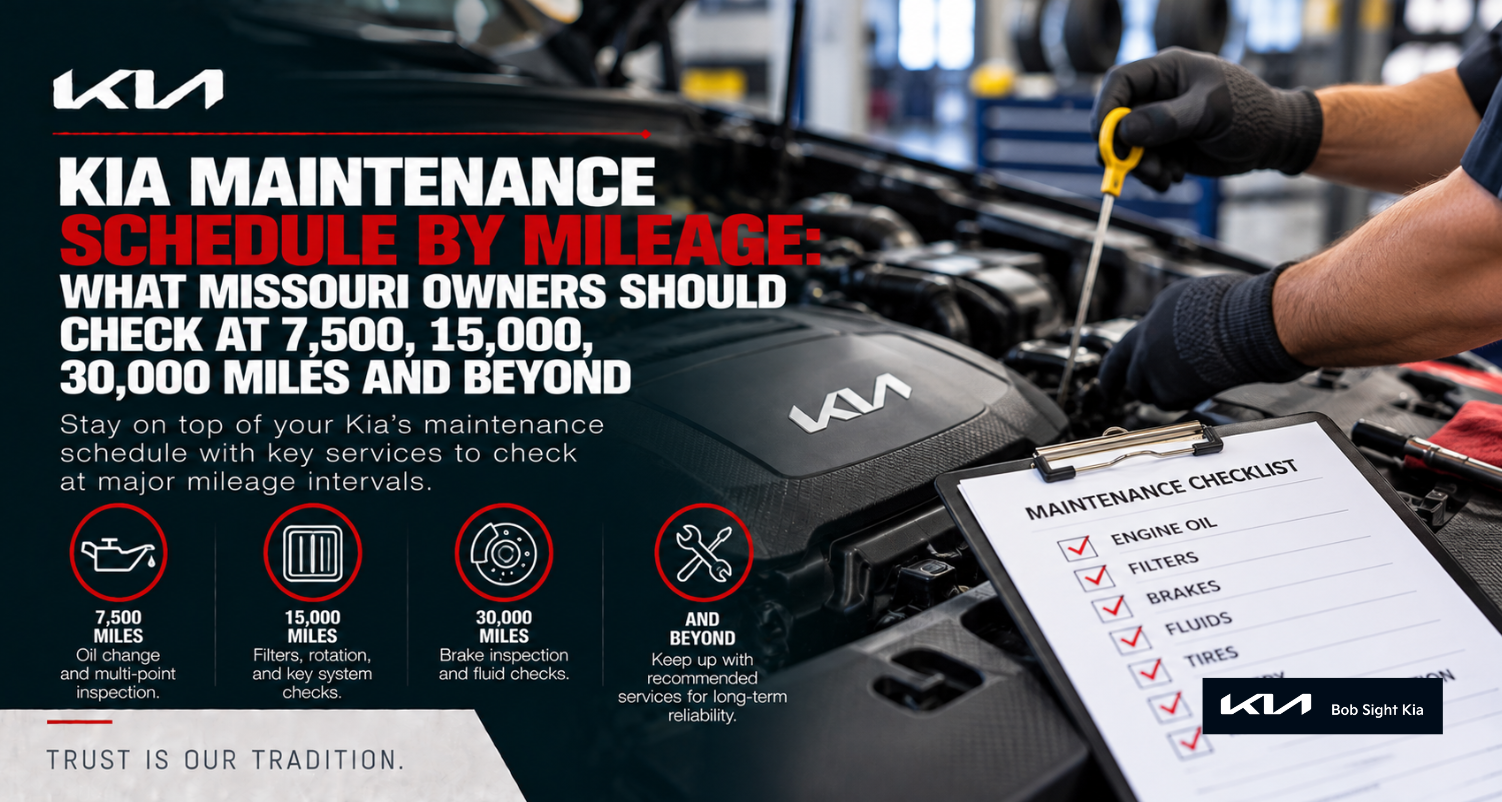
See Kia maintenance by mileage, including 7,500, 15,000, and 30,000-mile checkpoints for Independence and Missouri drivers.

Kia Maintenance Schedule by Mileage: What Missouri Owners Should Check at 7,500, 15,000, 30,000 Miles and Beyond

Kia Maintenance Schedule by Mileage: What Missouri Owners Should Check at 7,500, 15,000, 30,000 Miles and Beyond Your Kia maintenance schedule should follow the requirements for your exact vehicle, with mileage milestones helping you plan ahead. Oil changes, tire rotations, filters, brake inspections, and fluid checks all play a role in ownership, but they do not follow one universal schedule across every Kia model. For drivers in Independence, Blue Springs, Grain Valley, and throughout the Kansas City Metro, daily driving conditions also matter. Short trips, traffic on I-70, winter road treatments, and dusty construction areas can affect which maintenance schedule applies. Bob Sight Kia in Independence also offers an ownership benefit worth including in your service planning: lifetime oil changes and tire rotations every 5,000 miles with eligible new Kia purchases, performed exclusively at Bob Sight Kia. Ask our team to confirm eligibility and program terms for your vehicle. Battery-electric Kia models do not require engine oil changes. The 7,500-, 15,000-, and 30,000-mile checkpoints discussed below are planning references. They should not delay a service already due under your factory schedule, elapsed-time requirements, severe-use schedule, or applicable dealership maintenance program. Schedule Kia maintenance at Bob Sight Kia in Independence In This Guide You'll Learn Understanding the difference between factory requirements, dealership benefits, and condition-based repairs makes Kia maintenance easier to manage. This guide covers: How to identify the correct maintenance schedule for your Kia How Bob Sight Kia's 5,000-mile lifetime maintenance benefit fits into ownership What to review around 7,500, 15,000, and 30,000 miles How Missouri driving conditions can affect service timing Which items to monitor between appointments How gasoline, hybrid, plug-in hybrid, and electric maintenance differs How to plan service beyond the first 30,000 miles Does Every Kia Follow the Same Maintenance Schedule? No. Kia maintenance requirements vary by model year, engine, powertrain, drivetrain, and operating conditions. Even two vehicles with the same model name can have different service requirements when their engines or powertrains differ. A gasoline Kia Sportage and a Sportage Hybrid should each follow their own maintenance information. A battery-electric Kia has a different set of needs because it does not have a gasoline engine, engine oil filter, or spark plugs. The correct starting point is your owner's manual and its scheduled maintenance section. Kia's Owner's Portal also provides access to vehicle information and maintenance milestones. Confirm that the information matches your model year and configuration. When a maintenance item lists both mileage and time, follow whichever limit comes first as directed by the schedule. A low-mileage Kia may reach a calendar deadline before reaching the listed mileage. A frequent commuter may reach the mileage limit much sooner. Keep these three categories separate when reviewing recommendations: Factory scheduled maintenance: Inspections and replacements specified by Kia for your vehicle and operating conditions. Dealership maintenance benefits: Services available under an applicable program, including Bob Sight Kia's lifetime oil changes and tire rotations every 5,000 miles with eligible new Kia purchases. Condition-based service: Work recommended because an inspection identifies wear, damage, contamination, or a developing concern. Understanding which category applies helps you ask useful questions and maintain accurate records. How Bob Sight Kia's Lifetime Oil Changes and Tire Rotations Fit Your Plan Eligible new Kia purchases at Bob Sight Kia include lifetime oil changes and tire rotations every 5,000 miles, performed exclusively at our Independence dealership. This benefit gives qualifying owners a recurring service checkpoint to include in their ownership calendar. For an eligible gasoline or hybrid Kia, those visits provide an opportunity to keep up with covered oil and tire services while discussing other maintenance that may be due. Confirm your enrollment, vehicle eligibility, and applicable program terms with the dealership. The 5,000-mile benefit does not make every other maintenance item due at 5,000-mile intervals. Filters, coolant, spark plugs, brake fluid, and drivetrain components retain their own vehicle-specific requirements. Likewise, a factory time limit or severe-use requirement may call for attention before the next program mileage checkpoint. Do not interpret the benefit as coverage for every maintenance item or repair. Ask which services are included and which additional recommendations come from Kia's schedule or the condition of your vehicle. If you own a battery-electric Kia, engine oil changes do not apply. Ask our team which program benefits apply to your specific vehicle rather than assuming the same services apply to every powertrain. Plan your next Kia service appointment What Should Kia Owners Review Around 7,500 Miles? Around 7,500 miles, review your service history and upcoming factory requirements rather than assuming every Kia needs an identical service package. If you participate in Bob Sight Kia's applicable 5,000-mile maintenance benefit, you may already have completed an earlier oil-change and tire-rotation visit. For gasoline engines, including those in hybrids and plug-in hybrids, oil service must use the correct oil specification and filter for the vehicle. Do not select oil solely because another Kia owner uses it. Engine requirements can differ across models and years. Tire maintenance also deserves attention. Rotation requirements and patterns depend on the vehicle and tire configuration. Directional tires or differing front and rear tire sizes can affect the appropriate procedure. This checkpoint is also useful for reviewing tire pressure, tread condition, brake behavior, visible leaks, lighting, and wiper performance. An inspection may identify an issue that deserves attention, but inspection does not automatically mean replacement. Check your odometer and service date. Compare both with your vehicle's maintenance schedule. Review completed work. Include any earlier 5,000-mile program visit. Identify services actually due. Use the factory schedule and applicable driving conditions. Discuss symptoms. Mention new noises, warning lights, vibration, or changes in starting and braking. Save the service record. Record the date, mileage, and work completed. For owners making frequent short trips along Noland Road or US-40, this is also a good time to review the severe-use definitions in the owner's manual. What Changes Around 15,000 Miles? The 15,000-mile checkpoint is a useful time to review recurring maintenance, filter condition, tires, and brakes against your Kia's actual requirements. It is not a universal replacement deadline for every component. If your vehicle qualifies for Bob Sight Kia's lifetime maintenance program, 15,000 miles is also a recurring 5,000-mile program checkpoint. Confirm the appropriate timing with the service team and keep the factory schedule in view for additional requirements. The cabin air filter is one item worth reviewing. It filters air entering the passenger compartment through the climate-control system. Dust, pollen, leaves, and other debris can accumulate over time, and a restricted filter can reduce airflow. Replacement should follow the schedule and condition of the filter. Driving through construction areas or dusty environments may justify closer attention. Reduced airflow can also have causes beyond the filter, so persistent climate-control concerns deserve diagnosis. Tires should be checked for uneven wear and damage. Edge wear, center wear, or a change in steering behavior can prompt evaluation of inflation, alignment, suspension, or other contributing factors. Brake-pad replacement depends on measured wear and condition. A driver spending substantial time in Independence traffic may experience different brake wear from someone traveling mainly on uninterrupted highways. Mileage alone cannot determine how much usable brake material remains. What Should Be Reviewed Around 30,000 Miles? At approximately 30,000 miles, compare your service records with Kia's schedule to identify recurring maintenance and any additional items due. Avoid treating a generic 30,000-mile package as a factory requirement for every Kia. Engine air-filter service may be part of the discussion for a gasoline or hybrid vehicle, depending on its schedule and filter condition. This filter serves the engine and is separate from the cabin air filter. Battery-electric vehicles do not have an engine combustion-air filter. Other items may include inspections of belts, cooling-system components, steering, suspension, axle boots, or drivetrain components where specified. Their inspection and replacement requirements depend on your vehicle. Fluid service also requires a specific explanation. Ask which fluid is being recommended, whether Kia specifies the service at the current mileage or age, and whether severe-use conditions or an inspection finding affect the recommendation. At this stage, review the maintenance history as a whole: Have recurring oil and tire services been completed when applicable? Are any time-based requirements due? Were previous inspection findings resolved? Do filters need inspection or replacement under the schedule? Are tire wear and brake measurements being tracked? Does the severe-use schedule change any upcoming requirements? For eligible program participants, 30,000 miles is another 5,000-mile maintenance checkpoint. Additional work should still be matched to factory requirements and actual condition. What Counts as Severe Driving in Missouri? Severe-use conditions can include ordinary driving routines, so review Kia's definitions before assuming the normal schedule applies. The relevant conditions and affected maintenance items are listed in your vehicle's manual. Depending on the Kia, those conditions can include repeated short trips, extensive idling, heavy traffic, dusty roads, salt-treated roads, very cold weather, and towing or other demanding use. A commute through I-70 congestion can involve substantial engine-running time without many miles accumulating. Repeated short errands around Independence can create a different operating pattern from a longer trip at steady speed. Missouri winters also make the severe-use section worth reviewing. Some Kia manuals identify very cold weather and roads treated with salt or other corrosive materials among the relevant conditions. Do not assume every maintenance item changes to the same shorter interval. Severe-use tables identify which items are affected and which conditions apply to them. When discussing your maintenance plan, describe your actual routine: typical trip length, time spent idling, traffic, dusty-road use, and any towing within the vehicle's approved limits. Those details help the service team review the appropriate schedule. What Should You Check Between Service Appointments? Monitor your Kia between appointments because wear, warning lights, and vehicle symptoms do not wait for a mileage milestone. Scheduled maintenance works best alongside regular owner checks. Follow the owner-maintenance guidance in your manual. For vehicles with an engine, this can include checking engine oil as directed. Tire pressure, exterior lighting, wipers, and visible leaks also deserve attention. Check cold tire pressure. Use the vehicle's tire placard and manual rather than the maximum pressure molded into the tire sidewall. Inspect visible tire condition. Look for uneven wear, cuts, bulges, cracking, or other damage. Watch for unexplained fluid loss. Repeated topping off should not replace investigating a leak. Notice braking changes. Grinding, pulling, vibration, or altered pedal feel warrants attention. Check lights and wipers. Maintain visibility during rain, snow, and shorter winter days. Respond to warning indicators. Follow the manual's instructions for the specific warning. Record symptoms. Note when a concern occurs and the conditions surrounding it. Some warnings require stopping safely and obtaining assistance rather than continuing to drive. Do not wait for the next routine appointment when the manual calls for immediate action. How Do Gasoline, Hybrid, and Electric Kia Maintenance Needs Differ? Your powertrain determines which maintenance items apply, so a gasoline checklist should not be copied directly to every Kia. Shared model names do not guarantee shared service requirements. Gasoline Kia Vehicles Gasoline vehicles require engine-related maintenance, including oil and filter service, along with scheduled attention to items such as spark plugs and engine air filters. Exact intervals and specifications depend on the engine. Hybrid and Plug-In Hybrid Kia Vehicles Hybrids and plug-in hybrids still have gasoline engines and require applicable engine maintenance. Driving on electric power for part of a trip does not eliminate oil service or calendar-based requirements. Follow the schedule for the hybrid or plug-in hybrid configuration. Hybrid-specific components may have their own inspection or service requirements. Do not substitute the schedule from a gasoline version of the same model. Battery-Electric Kia Vehicles Battery-electric Kia vehicles do not require engine oil changes or spark plugs. They still need maintenance involving tires, brakes, cabin filters, steering, suspension, cooling systems, and other applicable components. Regenerative braking can reduce friction-brake use during some driving, but conventional brake components still require attention. Follow the EV's maintenance schedule rather than assuming reduced brake use eliminates inspection needs. Planning Maintenance Beyond 30,000 Miles Beyond 30,000 miles, continue recurring maintenance and add higher-mileage or time-based work as your Kia's schedule requires. There is no single replacement list that applies to every Kia at 60,000, 90,000, or 100,000 miles. Items such as coolant, spark plugs, belts, and drivetrain fluids can have substantially different requirements across vehicles. Check the exact schedule before assuming a service is due or can be postponed. Vehicle age matters alongside mileage. A seven-year-old Kia with relatively low mileage may need different attention from a newer Kia with the same odometer reading. Tires, batteries, rubber components, and other parts can deteriorate with time. Keep records showing the service date, mileage, work completed, and relevant inspection results. Records help prevent duplicate work and make it easier to track changes in tire wear, brake measurements, and recurring concerns. If you purchased a used Kia without complete records, discuss the missing history with the service team. The goal is to establish what can be verified and determine an appropriate maintenance plan for that vehicle. Frequently Asked Questions About Kia Maintenance Schedules Does every Kia need maintenance every 7,500 miles? No. Kia maintenance intervals vary by model year, engine, powertrain, maintenance item, and driving conditions. Use the schedule for your exact vehicle and follow mileage or time limits as specified. Does Bob Sight Kia offer lifetime oil changes and tire rotations? Bob Sight Kia in Independence advertises lifetime oil changes and tire rotations every 5,000 miles with eligible new Kia purchases, performed exclusively at the dealership. Ask the team to confirm your vehicle's eligibility and applicable program terms. Battery-electric vehicles do not require engine oil changes. What Kia maintenance should I review around 15,000 miles? Review recurring oil and filter service where applicable, tire maintenance, brake inspections, fluid checks, and any cabin air-filter service specified for your vehicle. Reaching 15,000 miles does not create the same service requirements for every Kia. What should be done to a Kia at 30,000 miles? Review your Kia's maintenance schedule and service history to identify recurring maintenance and any additional inspections or replacements due. Engine air filters, cabin filters, fluids, and other components have vehicle-specific requirements rather than one universal 30,000-mile replacement rule. What counts as severe driving for a Kia? Depending on the vehicle's manual, severe-use conditions can include repeated short trips, extensive idling, heavy traffic, dusty or salt-treated roads, very cold weather, and towing or other demanding use. Follow the definitions and maintenance requirements for your exact Kia. Schedule Kia Maintenance in Independence, Missouri Bob Sight Kia can help you review your vehicle's maintenance requirements and plan your next service visit. Have your current mileage, model year, powertrain information, and service records available when discussing what is due. If you are searching for Kia maintenance near me in Independence, Blue Springs, Grain Valley, Raytown, or the Kansas City Metro, start with a plan built around your actual vehicle and driving routine. Remember to ask about lifetime oil changes and tire rotations every 5,000 miles with eligible new Kia purchases at Bob Sight Kia. Confirm the program terms and continue following all other applicable factory maintenance requirements. Schedule your next Kia maintenance appointment Helpful Links Schedule Kia Service Kia Service Specials Kia Parts Department Explore New Kia Vehicles Bob Sight Kia Proud to Be Part of the Bob Sight Auto Group Bob Sight Kia in Independence is proud to be part of the Bob Sight Auto Group. Explore our dealerships in Missouri and Kansas for vehicle shopping, service, and ownership resources. Bob Sight Honda in Lawrence, Kansas Bob Sight Chrysler Dodge Jeep Ram in Lawrence, Kansas Bob Sight Ford in Lee's Summit, Missouri Bob Sight Kia in Independence, Missouri Trust Is Our Tradition.
Explore Kia Seltos cargo space, AWD, fuel economy, and city-driving practicality for Independence and Kansas City drivers.

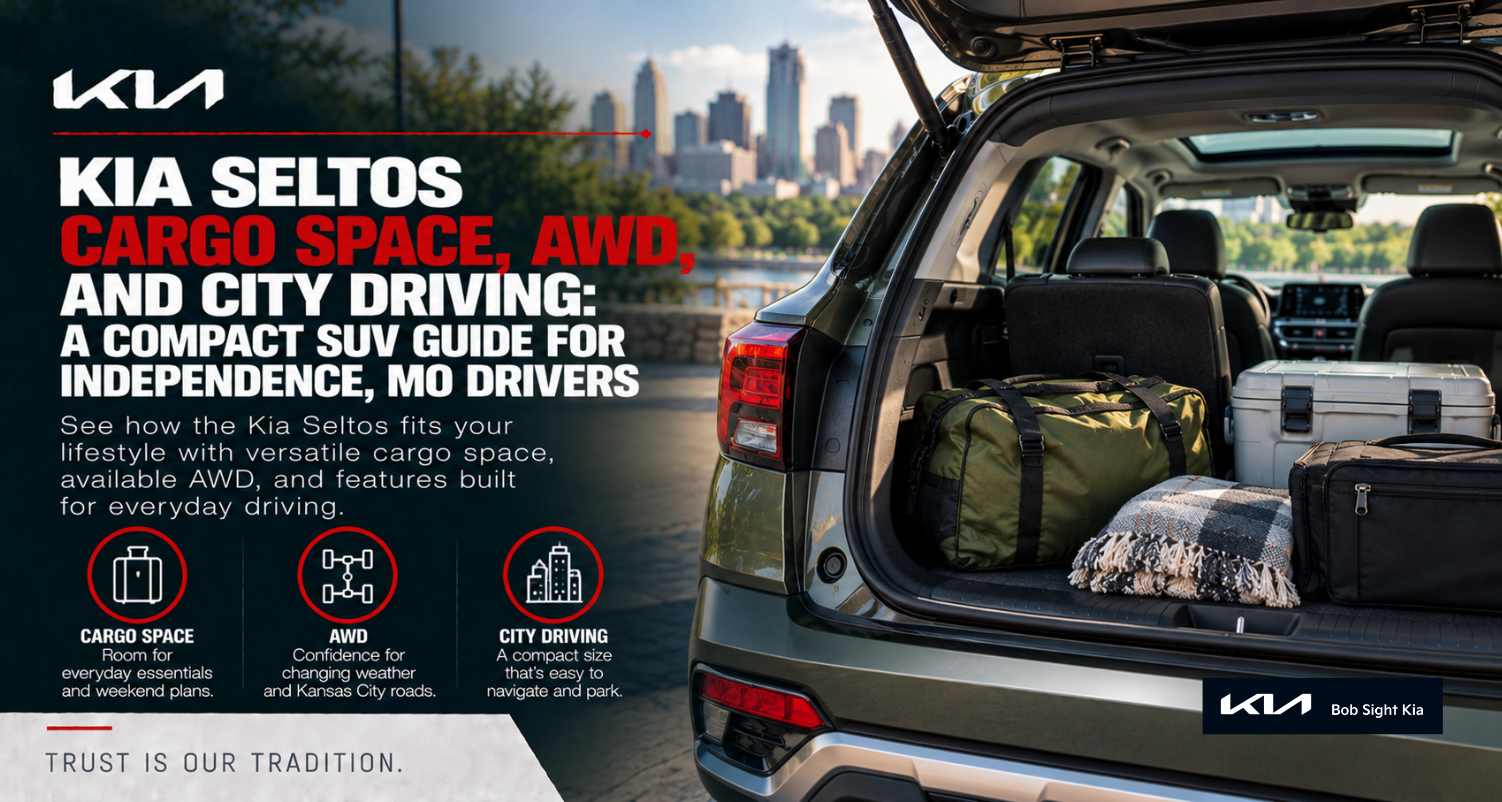
Kia Seltos Cargo Space, AWD, and City Driving: A Compact SUV Guide for Independence, MO Drivers

Kia Seltos Cargo Space, AWD, and City Driving: A Compact SUV Guide for Independence, MO Drivers The Kia Seltos gives Independence drivers the maneuverability of a compact SUV while still providing useful cargo capacity, available all-wheel drive, and enough everyday versatility for commuting, errands, passengers, and weekend travel. For drivers navigating Noland Road, I-70, US-40, Blue Springs, downtown Kansas City, and busy suburban parking areas, the Seltos can offer a practical middle ground between a sedan and a larger SUV. The 2026 Seltos provides up to 62.8 cubic feet of cargo room behind the first row, offers available torque-vectoring all-wheel drive with Lock Mode, and can be equipped with a 190-horsepower turbocharged engine. Explore Kia Seltos inventory at Bob Sight Kia In This Guide You'll Learn This Kia Seltos guide focuses on how the compact SUV works for everyday life in Independence and across the Kansas City Metro rather than providing a broad overview of every available feature. How much cargo space the Kia Seltos provides How available all-wheel drive works and when it may be useful How the Seltos fits city and suburban driving around Kansas City How standard and turbocharged powertrains differ Why compact exterior dimensions can help with everyday maneuverability How passengers and cargo can share the cabin What Independence drivers should evaluate during a Seltos test drive How Much Cargo Space Does the Kia Seltos Have? The 2026 Kia Seltos provides up to 62.8 cubic feet of cargo room behind the first row when the rear seating is folded, giving drivers substantial flexibility within a compact SUV footprint. That maximum capacity can be useful when carrying larger shopping loads, luggage, recreational gear, household items, or equipment that would be difficult to fit into a traditional sedan trunk. Kia also emphasizes that cargo should be evenly distributed, properly secured, and never stacked higher than the seatback. The maximum number tells only part of the story. Most Independence drivers will not spend every day with the rear seats folded. A typical week may involve commuting alone in the morning, transporting passengers in the afternoon, loading groceries after work, and carrying sports equipment or luggage on the weekend. The usefulness of the Seltos comes from being able to adapt the rear area as those needs change. A compact SUV cargo area also provides a different loading experience from a sedan trunk. Taller or bulkier objects can often be easier to position through the rear liftgate, and folding rear seating can create additional length when necessary. A driver who occasionally transports boxes, folding chairs, pet supplies, small pieces of furniture, or home-improvement purchases may appreciate having a more flexible opening than a conventional trunk provides. Families should think about cargo shape rather than volume alone. A stroller, grocery bags, sports equipment, suitcase, cooler, and backpack all occupy space differently. Two items may use the same theoretical volume but require completely different floor dimensions or vertical clearance. That is why measuring the objects you carry most often can be more useful than relying entirely on cubic-foot specifications. The Seltos also offers an available Smart Power Liftgate on selected configurations, which can make loading more convenient when your hands are occupied with bags or gear. For someone making frequent stops around Independence Center, grocery stores along US-40, or shopping areas throughout eastern Jackson County, small convenience features can become meaningful because they are used repeatedly throughout the week. Seltos Cargo Consideration Why It Matters Up to 62.8 cu. ft. behind the first row Provides flexibility for larger loads when rear seating is not needed Rear liftgate access Makes taller and bulkier items easier to load than many sedan trunks Folding rear seating Allows drivers to adjust passenger and cargo priorities Available Smart Power Liftgate Can simplify loading when carrying bags or equipment How Does Available AWD Work on the Kia Seltos? The 2026 Kia Seltos offers available torque-vectoring all-wheel drive with Lock Mode, giving drivers another traction option when road conditions become wet, snowy, muddy, or otherwise less predictable. Kia explains that AWD Lock Mode can distribute power 50/50 between the front and rear wheels at the push of a button in appropriate low-traction conditions. The system can be useful for Missouri drivers who travel during winter weather, heavy rain, or other conditions where additional traction while accelerating may be valuable. A commuter leaving Independence before roads are fully treated after overnight snow may encounter neighborhood streets that are more slippery than I-70 or other major corridors. Available AWD gives Seltos shoppers a choice that can better align with that type of driving schedule. AWD should not be confused with unlimited winter capability. Tires still determine how the vehicle contacts the pavement, and all-wheel drive cannot eliminate the effects of ice or reduce stopping distance to what you would experience on a dry road. Drivers should maintain appropriate tire pressure and tread, slow down when conditions require it, and leave additional following distance regardless of drivetrain. The Kia Seltos AWD system can also be useful beyond winter precipitation. Kia notes that Lock Mode is designed for conditions that can include wet pavement, snow-covered roads, unpaved roads, sand, mud, and steeper grades. Most Independence owners may rarely encounter all of those conditions, but the system provides additional flexibility for drivers whose routines extend beyond dry suburban pavement. Before prioritizing AWD, think about your actual week. A driver who works remotely during severe weather and primarily uses well-treated roads may value fuel economy or another feature more highly. Someone who has a fixed early-morning schedule, drives throughout Jackson County regardless of weather, or regularly leaves paved roads may place AWD much higher on the list. For shoppers comparing Seltos configurations, remember that AWD availability varies by trim and package. The 2026 EX offers available AWD, while the SX includes AWD with its turbocharged powertrain. Checking the exact vehicle rather than assuming every Seltos has the same drivetrain can prevent confusion during the shopping process. Why Does the Kia Seltos Work Well for Independence City Driving? The Kia Seltos can fit city and suburban driving well because it combines an elevated compact-SUV layout with dimensions that remain manageable in parking lots, neighborhood streets, and congested commercial areas. Drivers do not always need a large SUV to gain useful cargo access, available AWD, and flexible rear seating. For many Independence commuters, the Seltos can provide SUV practicality without creating the same parking and maneuvering considerations as a larger three-row model. Think about a normal Saturday in Independence. You might leave a neighborhood near Little Blue Parkway, drive toward Independence Center, navigate a crowded shopping-center parking lot, stop for groceries, and later travel toward Blue Springs or Lee's Summit. Those trips involve more low-speed turns, parking maneuvers, merging, and short-distance acceleration than long stretches of open highway. A compact SUV can be useful in that environment because drivers still benefit from a hatch-style cargo area and a more upright seating position without carrying more exterior vehicle than they need. The Seltos can also make sense for someone moving out of a sedan who wants additional versatility but does not routinely need three seating rows. Parking deserves more attention than it usually gets during vehicle shopping. You may park several times in a normal day but only use maximum cargo capacity occasionally. During a test drive, pull into a normal parking space, back into another, make a three-point turn, and drive through a tighter parking aisle. Test the vehicle in the situations you will repeat every week rather than evaluating it only on an open road. Visibility also matters in urban and suburban traffic. Adjust the driver's seat and mirrors properly, then evaluate how easily you can see pedestrians, adjacent traffic, curbs, and vehicles around the Seltos. Selected trims add technology such as Blind-Spot Detection, Rear Cross-Traffic Collision-Avoidance Assist, rear parking sensors, and additional driver-assistance features. These systems support the driver but do not replace visual checks or careful operation. The result is a vehicle category that can make sense for people who spend more time navigating real Kansas City traffic than driving across remote terrain. A compact SUV does not need to behave like a large adventure vehicle to be useful. For many owners, everyday maneuverability, cargo access, efficient operation, and flexible seating are the capabilities that matter most. 2026 Kia Seltos Standard Engine vs. Turbo: What Is the Difference? The 2026 Kia Seltos offers two distinct performance approaches, with a 2.0-liter four-cylinder producing 147 horsepower in mainstream trims and an available 1.6-liter turbocharged four-cylinder producing 190 horsepower and 195 lb.-ft. of torque in the SX. The standard powertrain focuses on everyday efficiency, while the turbocharged configuration provides stronger acceleration and additional performance. The LX, S, and EX configurations use the 2.0-liter engine with an Intelligent Variable Transmission. For a driver primarily commuting around Independence, running errands, and making regular highway trips, this powertrain is designed around practical daily transportation. Kia lists EPA-estimated highway fuel economy of up to 34 mpg for selected 2026 Seltos configurations using the standard engine. The SX changes the personality of the Seltos. Its turbocharged 1.6-liter engine produces 190 horsepower and 195 lb.-ft. of torque and is paired with an eight-speed automatic transmission. AWD is included on that configuration. Kia lists an EPA-estimated 27 mpg highway figure for the 2026 SX. For Kansas City drivers, the decision comes down to priorities. Someone who spends considerable time commuting and wants to prioritize efficiency may be satisfied with the standard engine. A shopper who values stronger acceleration when entering I-70, passing at highway speeds, or driving with passengers and cargo may prefer the turbocharged SX. 2026 Seltos Powertrain Standard 2.0L 1.6L Turbo Horsepower 147 hp 190 hp Torque 132 lb.-ft. 195 lb.-ft. Transmission Intelligent Variable Transmission 8-speed automatic AWD Available on selected configurations Included on SX Primary Focus Everyday efficiency and commuting Stronger acceleration and performance Do not choose by specification alone. Drive both powertrains if they are available and relevant to your budget and needs. Some drivers value stronger acceleration enough to accept a lower fuel-economy rating, while others would rarely use the additional output and would rather prioritize everyday efficiency. How Practical Is the Kia Seltos for Passengers and Everyday Cargo? The Seltos is most practical for drivers who want five-passenger flexibility and an adaptable rear cargo area without moving into a larger midsize or three-row SUV. It works well when passenger and cargo needs change throughout the week because the rear seating can remain available for people or be folded when more carrying space is needed. A commuter may spend Monday through Friday driving alone, which leaves the entire passenger cabin available when cargo needs arise. On the weekend, the rear seats may be occupied by family or friends. That pattern is common among compact-SUV owners because they want more versatility than a sedan without routinely filling a larger SUV. Families with younger children should evaluate how car seats or boosters fit in the specific seating positions they intend to use. Always follow the vehicle owner's manual and child-restraint manufacturer's instructions rather than assuming a restraint is compatible based only on visible seat width. Once installed correctly, check whether front-seat occupants can still achieve comfortable seating positions. Adult passengers should also test the rear seat. A specification sheet cannot tell you whether a particular person's leg position, headroom, or seat comfort will work for an hour-long drive across the Kansas City Metro. Sit behind the driver's normal position and evaluate the space rather than leaving the front seat artificially far forward. When cargo is involved, think about the mix of people and belongings. A four-person household heading to a weekend activity in Blue Springs may need passenger seating plus sports bags and folding chairs. A solo owner making a home-improvement run may fold the rear seats and prioritize maximum cargo room. Both uses can occur in the same vehicle within a few days. The available 62.8 cubic feet behind the first row becomes most meaningful in those occasional maximum-cargo situations. For everyday use, however, the more important trait may simply be that the Seltos lets drivers reconfigure the interior when needs change instead of forcing them to choose permanently between passenger room and utility. Is Seltos AWD Worth Considering for Kansas City Winters? Seltos AWD can be useful for Kansas City drivers who regularly travel during snow, freezing precipitation, heavy rain, or other low-traction conditions, but proper tires and safe driving remain more important than the AWD badge alone. Kia's available torque-vectoring AWD system with Lock Mode can provide additional traction when conditions require it, and the Lock Mode is designed to distribute power between the front and rear wheels when selected. Missouri winters are not defined by constant deep snow. Drivers are often dealing with a mix of cold rain, overnight freezing, patchy ice, light snow, slush, and roads that have been treated at different times. A major highway may be clear while a residential street or parking lot remains slick. That variation is where drivers may appreciate having an AWD option. However, AWD does not improve every part of winter driving equally. It can support acceleration when traction is limited, but braking still depends on tire grip and road conditions. If you enter an icy curve too quickly or follow another vehicle too closely, having all four wheels driven cannot override the available friction between the tires and pavement. Tire condition should therefore be part of any AWD conversation. Check tread, pressure, visible damage, and consistent wear. On an AWD vehicle, maintaining appropriately matched tires is important because all four corners work together through the driveline. Follow Kia's tire rotation and maintenance guidance for the specific Seltos you own. Use your schedule to decide whether AWD deserves priority: Consider when you drive. Early-morning commuters may encounter untreated roads more often. Review your normal routes. Neighborhood streets, hills, and less-traveled roads may differ from major highways. Think about schedule flexibility. Drivers who can delay travel during poor weather may need AWD less often. Evaluate tires equally. AWD should complement good tire maintenance, not replace it. Compare exact trims. Drivetrain availability and equipment vary across Seltos configurations. A driver commuting from Grain Valley or Blue Springs into Independence regardless of weather may evaluate AWD differently from someone who works primarily from home. Neither decision is universally correct. The goal is to match the drivetrain with your actual driving rather than paying for or skipping AWD based solely on the fact that you live in Missouri. How Does the Kia Seltos Fit a Kansas City Commute? The Kia Seltos can fit a Kansas City commute well because shoppers can choose between efficiency-focused configurations and a more powerful turbocharged model while retaining compact-SUV cargo versatility. Drivers commuting from Independence toward downtown Kansas City often encounter a mix of neighborhood streets, freeway merging, congestion, construction, and parking, which means no single specification determines commuter suitability. Fuel economy can matter to drivers covering substantial mileage. Selected 2026 Seltos configurations are EPA-estimated at up to 34 mpg highway, while actual mileage will vary with equipment, weather, traffic, driving habits, and vehicle condition. A driver making the same I-70 commute five days per week may value that efficiency more strongly than someone whose workplace is only a few miles from home. Acceleration may matter more to another shopper. Merging onto I-70 during traffic, entering US-40, or passing at highway speed can make engine response a noticeable part of the commute. The available 190-horsepower turbocharged engine gives the SX significantly more output than the 147-horsepower standard engine. Technology can also affect daily comfort. Depending on trim, the Seltos offers available dual 10.25-inch displays, navigation, Kia Connect, heated and ventilated front seating, wireless phone charging, USB-C charging access, Smart Cruise Control with Stop & Go, and Highway Driving Assist. Equipment varies, so shoppers should verify the exact configuration rather than assuming every Seltos includes the same features. Commuter comfort is personal. Before deciding, sit in the driver's seat for more than a few minutes. Adjust the seat, steering wheel, mirrors, and climate controls. Connect your phone. Drive at highway speed. Spend time in traffic if possible. The most useful commuter vehicle is the one that remains comfortable and easy to operate during the routine you repeat hundreds of times each year. How Should Independence Drivers Test a Kia Seltos Before Buying? A useful Kia Seltos test drive should include city streets, parking maneuvers, highway-style acceleration, passenger-space checks, and a close look at the cargo area. Because the Seltos is designed to balance compact dimensions with SUV utility, shoppers should test both sides of that equation rather than focusing only on acceleration or technology. Begin in the driver's seat and adjust everything properly. Make sure you can reach the steering wheel and pedals comfortably and that the seating position provides clear outward visibility. Test mirror placement and look over your shoulder before relying on available blind-spot technology. Driver-assistance features are designed to support the driver, not replace awareness. Next, drive through the kind of environment where the Seltos may spend much of its life. Navigate a parking lot, make several tight turns, pull into a standard space, and back out again. Drivers who live or work near crowded shopping areas may perform these maneuvers far more often than they ever use maximum horsepower. Then find an appropriate higher-speed road. Evaluate how the standard or turbocharged powertrain accelerates, how the transmission responds, and whether the vehicle feels comfortable at normal highway speeds. If AWD is important to you, confirm the specific Seltos you are driving actually includes the system. Use this test-drive checklist: Adjust the driver's seat normally. Do not compromise your own position to make another area appear larger. Check the second row. Sit behind your normal driver's position and evaluate passenger room. Open the cargo area. Visualize groceries, luggage, strollers, sports gear, or other regular items. Fold the rear seats. See how the maximum cargo configuration would work for larger loads. Drive at low speeds. Evaluate steering, parking, and visibility. Test highway acceleration. Make sure the selected engine fits your normal commute. Try the technology. Connect your phone and use the features you expect to rely on daily. Confirm the drivetrain. Verify whether the vehicle is front-wheel drive or AWD. Shoppers visiting Bob Sight Kia from Independence, Raytown, Blue Springs, Grain Valley, Liberty, or Lee's Summit can use this process to evaluate whether the Seltos feels appropriately sized for their routine. The goal is not simply to confirm that you like the SUV. It is to determine whether its size and configuration solve your everyday transportation needs. Quick Facts About the 2026 Kia Seltos The 2026 Kia Seltos combines compact-SUV flexibility with available AWD, two engine choices, and up to 62.8 cubic feet of maximum cargo room. These quick specifications provide useful reference points for Independence drivers comparing Seltos configurations. Maximum cargo room behind the first row: 62.8 cubic feet Standard engine: 2.0-liter four-cylinder Standard engine output: 147 horsepower and 132 lb.-ft. of torque Available turbo engine: 1.6-liter turbocharged four-cylinder Turbo engine output: 190 horsepower and 195 lb.-ft. of torque Standard-engine transmission: Intelligent Variable Transmission Turbocharged SX transmission: eight-speed automatic Available torque-vectoring all-wheel drive with Lock Mode AWD Lock Mode can distribute power 50/50 between front and rear wheels when engaged in appropriate conditions Selected standard-engine configurations offer up to an EPA-estimated 34 mpg highway 2026 Seltos SX is EPA-estimated at 27 mpg highway Nine driver-assistance technologies are standard according to Kia's 2026 model information Available Smart Power Liftgate on selected configurations Available heated and ventilated front seating on selected configurations Available dual 10.25-inch panoramic display setup on selected configurations These specifications should be evaluated by trim rather than treated as though every Seltos includes every feature. A standard-engine front-wheel-drive model has a different ownership focus from a turbocharged AWD SX. The strongest choice depends on whether efficiency, traction, acceleration, comfort equipment, or technology carries more weight in your routine. Ownership Planning for a Kia Seltos in Independence, Missouri Long-term Seltos ownership is easier to plan when drivers choose the drivetrain and powertrain that match their normal use and maintain the vehicle according to its specific Kia maintenance requirements. A compact SUV used primarily for commuting has different priorities from one that regularly handles winter travel, heavy cargo, or frequent weekend trips. Tire maintenance deserves consistent attention because tires affect efficiency, traction, steering, and braking. Missouri temperature changes can cause tire-pressure readings to vary throughout the year, particularly when fall temperatures drop quickly. Check pressure against the placard on the vehicle and monitor tread wear regularly. AWD owners should be particularly attentive to maintaining consistent tire condition across all four positions. Rotate tires according to the applicable maintenance guidance and investigate unusual wear rather than letting one tire become significantly different from the others. AWD can support traction, but it works best as part of a properly maintained vehicle. Drivers selecting the turbocharged SX should follow the maintenance requirements for that exact engine and drivetrain rather than assuming service is identical to the 2.0-liter Seltos. Oil specifications, service procedures, and maintenance schedules should always come from information applicable to the exact vehicle. The same principle applies when comparing current Seltos models with older model years. City driving can also influence maintenance patterns. Repeated short trips, stop-and-go traffic, frequent braking, and extended idling can place different demands on a vehicle than long highway drives. If most of your mileage comes from short trips around Independence rather than open Interstate travel, mention your driving pattern when discussing maintenance needs. Bob Sight Kia owners can use the online Kia service scheduler when routine maintenance or inspection is due. Keeping service records from the beginning can also help track tires, brakes, battery condition, fluid maintenance, and other ownership items as the Seltos accumulates mileage. Frequently Asked Questions About the Kia Seltos How much cargo space does the 2026 Kia Seltos have? The 2026 Kia Seltos provides up to 62.8 cubic feet of maximum cargo space behind the first row with the rear seating folded. That gives drivers substantial flexibility for a compact SUV when passenger seating is not required. Maximum cargo volume is most useful for larger loads such as luggage, boxes, recreational gear, or household items. During normal daily driving, many owners will keep the rear seats available for passengers, so practical cargo usability depends on the seating configuration being used at the time. Independence shoppers should bring measurements for large items they carry frequently. A stroller, sports bag, cooler, or other bulky object can reveal more about everyday cargo usefulness than a cubic-foot number alone. Folding and raising the seats during a dealership visit can also show how easily the Seltos transitions between passenger and cargo duty. Does the Kia Seltos come with all-wheel drive? The 2026 Kia Seltos offers available torque-vectoring all-wheel drive, and AWD is standard on the SX configuration. Kia's AWD system includes a Lock Mode designed to support traction in conditions such as wet pavement, snow-covered roads, unpaved surfaces, sand, mud, and steeper grades. When AWD Lock Mode is selected in appropriate conditions, the system can distribute power between the front and rear wheels. Drivers should still adjust speed and following distance for road conditions because AWD cannot overcome limited tire grip during braking or cornering. For Kansas City-area drivers, AWD can be useful when travel schedules require driving during winter weather or before roads are fully treated. Shoppers who primarily drive well-maintained roads and have more schedule flexibility may determine that another Seltos configuration better fits their priorities. Is the Kia Seltos good for driving around Independence and Kansas City? The Seltos can be a practical choice for Independence and Kansas City driving because it combines compact-SUV maneuverability, flexible cargo space, available AWD, and multiple powertrain choices. It can work well for commuters who want more utility than a sedan without moving into a larger SUV. City and suburban drivers regularly deal with crowded parking lots, changing traffic speeds, tight turns, and frequent errands. A manageable compact SUV can make those everyday situations easier while retaining a rear liftgate and folding seating for larger loads. During a test drive, evaluate the Seltos in those exact situations. Park it, back it out of a space, merge onto a faster road, and drive through normal traffic. Real-world testing around Independence can be far more informative than evaluating the vehicle only on an open highway. What is the difference between the standard and turbocharged Kia Seltos engines? The standard 2026 Kia Seltos engine is a 2.0-liter four-cylinder producing 147 horsepower and 132 lb.-ft. of torque, while the available 1.6-liter turbocharged engine produces 190 horsepower and 195 lb.-ft. of torque. The standard engine uses an Intelligent Variable Transmission, while the turbocharged SX uses an eight-speed automatic. The standard engine is oriented toward everyday transportation and stronger fuel-economy potential. Selected configurations offer up to an EPA-estimated 34 mpg highway. The turbocharged SX provides noticeably more output and comes with AWD, but Kia lists a lower EPA-estimated highway fuel economy figure for that configuration. Kansas City commuters should choose based on their priorities rather than assuming more horsepower automatically makes the better vehicle. Drivers who value efficiency may prefer the standard powertrain, while shoppers who want stronger highway acceleration may appreciate the turbocharged SX. Where can I see a Kia Seltos near Kansas City? Kansas City-area shoppers can check Kia Seltos availability at Bob Sight Kia in Independence, Missouri. Comparing available configurations in person can help drivers evaluate cargo space, front-wheel drive versus AWD, engine choices, passenger room, and available technology. Before visiting, identify the features that matter most to your routine. If AWD is essential, verify which available vehicles include it. If fuel economy carries more weight, focus on configurations equipped with the standard 2.0-liter engine. If stronger acceleration is a priority, consider testing the turbocharged SX as well. Drivers from Blue Springs, Grain Valley, Raytown, Liberty, Lee's Summit, and throughout the Kansas City Metro can browse Kia Seltos inventory at Bob Sight Kia before visiting Independence. Comparing the exact vehicles available can make it easier to find a configuration that fits everyday driving. See How the Kia Seltos Fits Everyday Independence Driving The Kia Seltos stands out as a compact SUV for drivers who want useful cargo flexibility, available AWD, and city-friendly dimensions without moving into a larger vehicle than their daily routine requires. Its maximum 62.8 cubic feet of cargo capacity gives drivers room to adapt the interior for larger loads, while available torque-vectoring AWD adds another option for changing Missouri road conditions. The powertrain choice helps further define the Seltos. Standard 2.0-liter models emphasize everyday efficiency and provide up to an EPA-estimated 34 mpg highway in selected configurations, while the turbocharged SX increases output to 190 horsepower and 195 lb.-ft. of torque. That gives commuters the ability to prioritize either stronger efficiency potential or additional performance. For Independence drivers, the Seltos makes the most sense when evaluated in everyday situations. Think about parking near Independence Center, merging onto I-70, carrying groceries, transporting a few passengers, navigating winter weather, and loading gear for a weekend outside the city. Those routine scenarios provide a better measure of compact-SUV usefulness than a single specification. Bob Sight Kia in Independence can help Kansas City-area shoppers compare Seltos trims, drivetrains, engines, cargo configurations, and available technology. Take the time to fold the seats, inspect the cargo area, sit in the rear, drive at highway speed, and maneuver through a parking lot. A hands-on comparison can show whether the Seltos provides the balance of compact size and SUV versatility that fits your everyday life. Helpful Links Shop Kia Seltos Inventory Explore New Kia Vehicles Value Your Trade Explore Kia Financing Schedule Kia Service Proud to Be Part of the Bob Sight Auto Group Bob Sight Kia in Independence is proud to be part of the Bob Sight Auto Group, serving drivers throughout the Kansas City Metro with new and used vehicles, automotive service, parts support, and collision resources. Whether you are researching a Kia Seltos for commuting around Independence, comparing another Kia model, or maintaining the vehicle you already own, the Bob Sight Auto Group provides local automotive resources throughout Missouri and Kansas. Trust Is Our Tradition. Bob Sight Honda Bob Sight CDJR Bob Sight Ford Bob Sight Kia Bob Sight Collision Center

Prepare your Kia for holiday travel with tire, battery, brake, fluid, and winter checks for Independence and Kansas City drivers.

Kia Holiday Road Trip Checklist: Tires, Battery, Brakes, Fluids, and Winter Prep for Kansas City Drivers

Kia Holiday Road Trip Checklist: Tires, Battery, Brakes, Fluids, and Winter Prep for Kansas City Drivers Preparing your Kia for a holiday road trip means checking the systems most likely to affect safety, reliability, visibility, and comfort before winter travel begins. For drivers in Independence, Missouri, and throughout the Kansas City Metro, that means paying close attention to tires, the 12-volt battery, brakes, fluids, wiper performance, exterior lighting, and cold-weather readiness before loading the vehicle with passengers and luggage. Holiday travel often combines colder temperatures, heavier traffic, longer highway drives, and changing road conditions, so a pre-trip inspection can help catch maintenance concerns before they interrupt a drive across Missouri, Kansas, or farther from home. Schedule Kia service before your holiday road trip In This Guide You'll Learn This holiday road-trip checklist focuses on practical Kia maintenance items Kansas City drivers can review before winter travel. How to inspect tire pressure, tread, and overall tire condition Why cold weather can reveal a weak 12-volt battery Which brake warning signs deserve attention before a road trip Which fluids and under-hood items should be checked How wipers, lights, and defrosters affect winter visibility What to inspect before carrying extra passengers and luggage How to prepare your Kia for Interstate travel during Missouri winter weather Why Should You Prepare Your Kia Before a Holiday Road Trip? A holiday road-trip inspection helps identify maintenance concerns before they become problems far from home, when cold weather, heavy traffic, and extended driving can place additional demands on your Kia. A vehicle that feels completely normal during short trips around Independence may behave differently after several continuous hours on I-70, I-35, I-49, or another regional highway. Longer drives increase the importance of tire condition, dependable battery performance, predictable brakes, functioning climate control, and proper fluid levels. Holiday travel also changes how many families use their vehicles. A normal weekday may involve one driver and a light cargo load, while a December trip can include several passengers, suitcases, gifts, winter clothing, coolers, and other gear. Increased vehicle weight can affect braking distance, acceleration, tire loading, and overall handling. None of that means a properly maintained Kia cannot handle holiday travel. It simply makes pre-trip preparation more valuable. Kansas City weather adds another variable. Late fall and winter can bring cold mornings, freezing rain, snow, wet pavement, strong winds, and quick temperature swings. A road can be dry in Independence and noticeably different an hour later as you travel toward another part of Missouri or Kansas. Drivers should prepare for the conditions they could encounter along the entire trip rather than only the forecast at the departure point. A pre-trip check also gives you time to address concerns on your own schedule. Discovering worn tires, weak wiper blades, a battery nearing the end of its useful life, or a brake issue several days before departure gives you more flexibility than discovering it the night before leaving. The objective is not to replace parts unnecessarily. It is to know the condition of the vehicle before asking it to handle a longer and potentially more demanding drive. Drivers around Independence, Blue Springs, Grain Valley, Raytown, Liberty, and Lee's Summit can use the week before holiday travel as a natural maintenance checkpoint. Review your Kia's maintenance information, check items you can safely inspect yourself, and schedule professional service if something feels, sounds, or looks different than normal. How Should You Check Your Kia Tires Before a Holiday Road Trip? Your Kia's tires should be checked for proper inflation, adequate tread, even wear, visible damage, and overall condition before a winter road trip. Tires affect acceleration, braking, steering, and road grip, making them one of the most important pre-trip maintenance items. Cold weather can also reduce tire pressure, so a tire that appeared properly inflated during warmer weather may show a lower reading after a significant temperature drop. Tire pressure should be checked when the tires are cold and compared with the vehicle manufacturer's recommended pressure listed on the tire information placard, usually found on the driver's door jamb. Do not use the maximum pressure printed on the tire sidewall as the normal inflation target. The placard specification is based on the vehicle and tire configuration, while the sidewall figure identifies a different limit. Pressure naturally changes with temperature. As outdoor temperatures fall, the air inside the tire contracts and the measured pressure may decrease. Kansas City drivers often notice this during the first strong cold snap of the season when the tire-pressure monitoring system may activate. If a warning appears, check the pressures rather than simply adding air without measuring each tire. Tread condition matters just as much as inflation. Inspect the tread across the width of each tire and look for uneven wear, unusually smooth areas, cuts, cracking, bulges, exposed cords, or embedded objects. Uneven wear can sometimes indicate incorrect inflation, alignment issues, suspension concerns, or inconsistent tire rotation. A tire that looks noticeably different from the other three deserves attention before a long trip. Use this process before holiday travel: Check pressure when the tires are cold. Compare each tire with the pressure listed on the Kia's tire placard. Inspect tread depth. Make sure the tread is appropriate for the road and weather conditions you expect. Look for uneven wear. Compare the inside, center, and outside sections of the tread. Inspect for damage. Look for cuts, cracking, bulges, punctures, or other visible concerns. Check all four tires. Do not assume similar appearance means identical pressure or condition. Review the spare or mobility equipment. Know what your specific Kia provides and how to access it. For Independence drivers heading west toward Kansas City or east on I-70, tire condition becomes more important as speeds and travel distance increase. Wet pavement, snow, and cold temperatures can reduce available traction, so tire maintenance should be considered part of the safety plan rather than simply a fuel-economy concern. Why Does Your Kia Battery Matter More During Cold Weather? Cold weather can expose a weak 12-volt battery because low temperatures reduce available battery output at the same time the vehicle may require more energy to start and operate electrical systems. A battery that seemed adequate during warm weather may begin cranking more slowly after the first colder mornings in Jackson County. Holiday travel is a poor time to discover that the battery has been weakening gradually. Drivers should pay attention to changes in starting behavior. Slow cranking, repeated hesitation before the engine starts, dim exterior or interior lights, flickering electronics, or an intermittent electrical concern can justify a battery and charging-system inspection. These symptoms can have more than one cause, so testing is more useful than assuming the battery needs replacement based solely on age. Modern Kia vehicles rely on multiple electronic systems, and electrical demand increases during winter. Headlights may be used more often because daylight hours are shorter. Heated seats, rear-window defrosters, climate control, blower motors, phone charging, infotainment, and other accessories can all be operating at the same time. A healthy electrical system is therefore particularly useful on a long winter drive. Battery condition should be evaluated along with the terminals and charging system. Corrosion or loose connections can interfere with electrical performance even when the battery itself is still functional. A technician can test battery state and charging performance to determine whether the system is operating within specification. If your Kia has an electrified powertrain, such as a hybrid or electric model, do not assume every battery-related maintenance concern is the same. High-voltage traction batteries and the low-voltage electrical system serve different purposes. Follow the owner's manual and Kia service information for your specific vehicle rather than applying a generic battery rule from a gasoline-only model. For Kansas City families leaving early in the morning for a holiday drive, dependable starting becomes especially important. A weak battery that fails in your driveway is inconvenient. The same issue at a rest stop several hours away in freezing weather can become much more disruptive. Testing a battery that has shown any warning signs before departure can provide useful information when you still have time to address the concern. What Brake Checks Should You Make Before Winter Travel? Your Kia's brakes should provide smooth, predictable stopping without grinding, persistent squealing, unusual vibration, pulling, warning lights, or significant changes in pedal feel. Holiday traffic can involve frequent speed changes, sudden congestion, wet pavement, and heavier vehicle loads, so predictable braking performance matters before you begin a longer trip. Brake pads are wear components, and there is no single mileage that determines when every Kia needs replacement. Driving style, traffic conditions, vehicle weight, road environment, and previous maintenance all influence wear. A Kia used primarily for stop-and-go driving around Independence may experience different brake wear than one that accumulates much of its mileage on open highways. Listen for persistent changes. A brief sound after overnight moisture can have several explanations, but consistent squealing, grinding, scraping, or metallic noise deserves inspection. Grinding can indicate severe pad wear or another condition involving unwanted metal contact. Waiting until braking performance becomes dramatically worse is not a good maintenance strategy. Pedal feel is another important clue. If the brake pedal suddenly travels farther than normal, feels unusually soft, feels harder to press, pulsates, or requires noticeably more effort, schedule an inspection. Steering-wheel vibration during braking may also indicate a brake or rotor concern. Pulling to one side can have several causes, including brakes, tires, suspension, or road surface conditions, so diagnosis is better than guessing. Before holiday travel, think about how your Kia will be loaded. Passengers, suitcases, gifts, and other cargo increase vehicle mass, and additional mass can affect stopping distance. Leave more following distance in heavy Kansas City traffic and increase that distance again when pavement is wet, icy, or snow-covered. If your Kia has developed a brake symptom before a road trip, have it evaluated rather than assuming it will remain unchanged. Drivers can schedule Kia brake service at Bob Sight Kia before heading out of Independence for longer holiday travel. Which Fluids Should You Check Before a Kia Road Trip? Before a holiday road trip, drivers should review engine oil, engine coolant, windshield washer fluid, and any other service fluids applicable to their specific Kia and powertrain. Fluid requirements can vary by model, engine, transmission, hybrid system, and model year, so always follow the owner's manual or Kia service information for your exact vehicle rather than relying on a universal specification. Engine oil is one of the first items to review on gasoline-powered and applicable hybrid Kia models. If an oil change is due according to the maintenance schedule, taking care of it before a long trip may be more convenient than postponing service until after adding hundreds of highway miles. If your Kia allows owner-level oil checks, follow the procedure described in the owner's manual because some engines and configurations have specific checking requirements. Coolant helps regulate engine temperature during both hot and cold weather. Drivers sometimes associate cooling-system maintenance only with summer heat, but the cooling system remains important during winter. The correct coolant mixture also helps protect against freezing and supports proper temperature management. If you see a low-coolant warning, visible leakage, unusual temperature behavior, or repeated coolant loss, have the system inspected rather than simply topping it off repeatedly. Windshield washer fluid becomes particularly important during Midwest winter travel. Wet roads, road-treatment residue, dirt, slush, and spray from other vehicles can coat the windshield quickly. Make sure the reservoir is filled with an appropriate washer fluid for the temperatures you expect to encounter. Plain water can freeze in cold weather and is not a suitable substitute for winter conditions. Brake fluid and transmission-related fluids should also be maintained according to Kia recommendations for the specific model. These systems generally are not treated as casual roadside top-off items. If you suspect a leak, see a warning indicator, or notice an unusual fluid spot under the vehicle, have the concern inspected before leaving on a road trip. Fluid or System What to Review Why It Matters on a Road Trip Engine Oil Service status and proper level where owner checking is applicable Supports engine lubrication during extended driving Engine Coolant Level, leaks, warnings, and correct coolant type Supports temperature control and freeze protection Windshield Washer Fluid Reservoir level and cold-weather suitability Helps maintain visibility in road spray and winter grime Brake Fluid Condition and system inspection as required Supports hydraulic braking performance Other Powertrain Fluids Follow model-specific Kia maintenance guidance Requirements vary by engine, transmission, and drivetrain Drivers preparing for a trip from Independence to another part of Missouri, Kansas, or beyond should address leaks before departure. A small fluid spot in the garage may be easy to overlook during everyday driving, but longer highway operation can make an unresolved problem much more inconvenient. How Should You Prepare Wipers, Lights, and Defrosters for Winter Driving? Good winter visibility depends on effective wiper blades, properly functioning exterior lights, a working windshield defroster, and enough cold-weather washer fluid to keep the windshield clear. These systems may receive less attention than tires or brakes, but visibility can become one of the biggest challenges during snow, freezing rain, nighttime driving, and wet Interstate traffic. Inspect the wiper blades before leaving. Look for cracked rubber, torn edges, skipping, streaking, chatter, or areas the blades fail to clear. A blade that seems acceptable on a dry morning may perform poorly during sustained rain or highway road spray. If the wipers leave large streaks or reduce rather than improve visibility, replacement before a trip is worth considering. Check the front and rear washer systems where equipped. Make sure fluid sprays correctly and does not merely dribble at the bottom of the glass. Winter road residue can accumulate rapidly behind trucks and other vehicles, particularly when roads have been treated. A full reservoir and functional spray system allow drivers to clear the windshield without waiting for the next fuel stop. Exterior lights should be checked as well. Headlights, brake lights, taillights, turn signals, hazard lights, and license-plate lighting all contribute to your visibility and to other drivers seeing your Kia. Winter travel often begins before sunrise or continues after dark, making functional lighting more important than during a short daytime commute. The front defroster and rear-window defogger should be tested before departure. Do not wait for the morning of the trip to discover that airflow is weak or the rear glass does not clear properly. Climate-control operation also matters for passenger comfort during a long drive. If the system is not heating normally or a blower issue has developed, investigate it before several family members spend hours in the vehicle. For Kansas City commuters accustomed to familiar routes, reduced visibility may feel manageable because they know the roads. Road trips are different. Unfamiliar exits, lane changes, construction zones, and nighttime travel all require clear outward visibility. Preparing these basic systems supports safer decision-making when conditions become less predictable. What Should You Check Under the Hood Before Leaving Kansas City? A pre-trip under-hood inspection should focus on obvious changes such as leaks, damaged components, loose connections, unusual residue, worn visible belts where applicable, and anything that looks different from your Kia's normal condition. Drivers do not need to perform advanced mechanical diagnosis at home, but noticing an obvious concern before departure can provide time for professional inspection. Begin only when the vehicle is safely parked and cooled according to the procedures in the owner's manual. Do not open pressurized cooling-system components when hot. Look around the engine compartment for signs of fluid leakage, disconnected components, frayed wiring, debris, or anything that appears out of place. If you are unfamiliar with the engine compartment, avoid touching components simply to see whether they are tight. Visible hoses and belts, where applicable, should not show obvious cracking, severe deterioration, or damage. Modern Kia vehicles can use different belt layouts and powertrain designs, so do not assume every model has the same service points. Hybrid and electrified vehicles also include high-voltage components that should not be serviced by untrained owners. Look under the vehicle after it has been parked for several hours. Water from air-conditioning condensation can be normal, but colored, oily, sweet-smelling, or persistent fluid spots may justify further inspection. If you are unsure what a fluid is, avoid assuming it is harmless simply because the vehicle currently drives normally. A pre-trip under-hood check is also a good time to verify that maintenance is current. If your oil change, inspection, or another scheduled item is approaching, handling it before the road trip can reduce the likelihood of arriving home already overdue for service. Follow the maintenance information for the exact model year, engine, and drivetrain. Drivers who prefer not to inspect these systems themselves can have a professional review the vehicle before traveling. Bob Sight Kia in Independence can inspect common pre-trip maintenance areas and help identify whether a concern needs attention before you add substantial holiday mileage. How Should You Prepare Your Kia for Missouri Winter Road Conditions? Preparing a Kia for Missouri winter driving means combining proper vehicle maintenance with realistic planning for snow, ice, cold pavement, reduced visibility, and changing road conditions. No vehicle technology can eliminate the physical limits of traction. AWD, traction control, stability control, and driver-assistance systems can support the driver, but tires, speed, following distance, and judgment remain central to winter safety. Start with the tires because every acceleration, steering, and braking action ultimately depends on the contact patches between the tires and road. Correct inflation and adequate tread are important throughout the year, but cold and precipitation make those factors more noticeable. Drivers with all-wheel-drive Kia models should pay close attention to consistent tire size, type, and wear across all four positions. Increase following distance when roads are wet, snowy, or icy. A Kia may accelerate confidently even when available braking traction remains limited. This is a common misunderstanding with AWD vehicles. All-wheel drive can assist acceleration by distributing power, but it does not allow the vehicle to stop on ice as though the road were dry. Use speed appropriate for the conditions rather than simply matching the posted speed limit. Bridges, overpasses, ramps, and shaded areas can freeze before surrounding pavement. Kansas City drivers leaving Independence on I-70 may encounter one road condition locally and another farther along the route as elevation, precipitation, or road treatment changes. Before traveling in questionable weather, check the route and forecast for the entire drive. A clear morning in Jackson County does not guarantee clear conditions several hours away. Build time into the schedule so you do not feel pressured to maintain an unsafe speed just because holiday plans are running late. A winter-prepared vehicle also includes basic emergency supplies. Depending on your trip, consider appropriate warm clothing, gloves, blankets, phone charging equipment, a flashlight, water, basic first-aid items, and other supplies suited to the conditions. Keep them accessible rather than buried underneath luggage at the bottom of the cargo area. How Should You Pack Your Kia for a Holiday Road Trip? Holiday road-trip packing should keep heavy items low and secure, preserve driver visibility, respect cargo and passenger limits, and leave frequently needed items accessible without creating loose objects around the cabin. A properly organized load can improve comfort and reduce distractions while helping the vehicle handle more predictably. Begin with passenger count. Confirm which seating positions will be occupied before loading gifts or luggage. In a three-row model such as the Kia Telluride, Sorento, or Carnival, the number of occupied rear seats can dramatically change available cargo room. Set the seats first and then plan the load around the configuration you will actually use. Place heavier luggage toward the floor and avoid stacking heavy objects high enough that they could move into the passenger area during hard braking. Secure cargo when appropriate and follow the vehicle's instructions regarding cargo placement and load limits. Do not exceed the Kia's specified carrying capacity simply because additional objects physically fit. Separate road-trip items from destination items. Suitcases can remain farther back, while medications, phone chargers, snacks, children's supplies, winter clothing, and emergency equipment should be easier to access. This prevents the common problem of unloading the entire cargo area at a rest stop because one frequently used item is buried underneath luggage. Use this loading sequence: Set the passenger configuration first. Keep all required seats accessible and properly positioned. Load the heaviest bags low. Avoid unnecessarily raising the vehicle's center of gravity. Secure large or rigid items. Prevent them from shifting during braking and turns. Protect rear visibility. Avoid stacking luggage so high that it blocks the driver's view. Keep travel essentials accessible. Separate them from bags that will stay packed until arrival. Check doors and liftgate clearance. Make sure nothing interferes with proper closing. Recheck tire pressure if the vehicle is heavily loaded. Follow Kia guidance for your specific model. Holiday shopping can also increase cargo during the return trip. A vehicle that was carefully packed when leaving Independence may have additional gifts or purchases on the way home. Leave some flexibility rather than using every inch of cargo space before the trip even begins. Quick Facts for a Kia Holiday Road Trip A successful holiday road trip starts with confirming that your Kia's tires, battery, brakes, fluids, visibility systems, and scheduled maintenance are ready for longer winter driving. The checklist does not need to be complicated, but it should be completed early enough that any problems can be addressed before departure. Check tire pressure when the tires are cold. Use the tire pressure listed on the vehicle placard, not the maximum sidewall pressure. Inspect all four tires for tread wear, cuts, cracks, bulges, or other damage. Pay attention to slow starting or other signs of a weak 12-volt battery. Investigate persistent brake squealing, grinding, vibration, or pedal changes. Review oil and coolant status according to your specific Kia's maintenance information. Fill the washer reservoir with fluid suitable for expected winter temperatures. Check wiper blades, headlights, brake lights, turn signals, and hazard lights. Test the windshield defroster and rear defogger before departure. Inspect for visible leaks before a long drive. Secure luggage and heavy cargo. Do not let cargo block rear visibility or passenger movement. Increase following distance in rain, snow, ice, or heavy holiday traffic. Check weather and road conditions for the entire route, not just Independence. Follow your specific Kia model's owner's manual and maintenance schedule. These steps are useful whether your trip is a short drive across the Kansas City Metro or several hundred miles on Interstate highways. The farther you travel from home, the more useful it becomes to know that routine maintenance items have already been reviewed. Ownership Planning: Use Holiday Travel as a Maintenance Checkpoint Holiday travel can serve as a useful seasonal maintenance checkpoint because it naturally occurs when colder temperatures, winter weather, increased mileage, and family transportation demands begin to overlap. Instead of treating every maintenance item as a separate task, drivers can use the weeks before holiday trips to review several systems at once. Start with your Kia's maintenance schedule and current mileage. Determine whether routine service is already due or will become due during the trip. If you are within a short distance of a scheduled maintenance milestone and expect to add substantial highway mileage, completing the service before departure may simplify ownership planning. Keep records of what was checked or replaced. Knowing when tires were installed, when the battery was tested, when brake pads were inspected, and when routine maintenance was performed helps create a clearer picture of the vehicle's condition in future seasons. This is useful for both newer Kia models and vehicles that have accumulated more years and mileage. Winter also provides a natural opportunity to monitor tire pressure more frequently. Significant temperature changes can affect pressure readings, which may trigger a tire-pressure monitoring warning. Rather than waiting for the light, drivers can build tire-pressure checks into fuel stops or seasonal maintenance routines. Families who rely on one Kia for commuting, school transportation, errands, and holiday travel may benefit most from preventative planning. The vehicle has little downtime in that type of household. Catching a weak battery or worn wiper blade several days before departure is much easier than reacting when the vehicle is packed and everyone is ready to leave. Bob Sight Kia in Independence can help drivers keep maintenance organized throughout the year. Use the Kia service scheduler when your vehicle is due for routine maintenance, inspection, or another service concern before holiday travel. Frequently Asked Questions About Kia Holiday Road-Trip Preparation What should I check on my Kia before a long road trip? Before a long road trip, check your Kia's tires, 12-volt battery, brakes, fluids, wipers, exterior lighting, climate controls, and maintenance status. These systems directly affect safety, reliability, visibility, and comfort during extended travel. The exact service items may vary by model year and powertrain, so consult the maintenance information for your specific Kia. Also think about how the vehicle will be used during the trip. A Kia carrying several passengers and luggage may behave differently from the same vehicle during a light weekday commute. Tire condition and pressure, braking performance, and secure cargo placement become even more important when the vehicle is loaded. For Kansas City drivers, complete this check early enough to schedule service if something needs attention. A warning light, new noise, slow battery crank, leaking fluid, or badly worn tire is easier to address in Independence than several hours into a holiday drive. Does cold weather lower Kia tire pressure? Cold temperatures can lower measured tire pressure because the air inside the tire contracts as temperature drops. This is why some Kansas City drivers first notice a tire-pressure warning during the first major cold snap of the season. Check the tires when they are cold and compare the readings with the recommended pressure on the vehicle's tire placard. Do not inflate tires based on the maximum pressure printed on the tire sidewall. The Kia's placard provides the recommended cold-tire inflation information for the vehicle. If one tire repeatedly loses pressure while the others remain stable, have it inspected for a leak rather than repeatedly adding air. Independence weather can change quickly during late fall and winter, so regular pressure checks are useful before road trips. A tire that was properly inflated during warmer October weather may show a noticeably different pressure after a December temperature drop. Should I have my Kia battery tested before a winter road trip? A battery test is worth considering before winter travel if the vehicle is cranking slowly, the battery is older, electrical behavior has changed, or you simply want to confirm its condition before a longer trip. Cold temperatures can reduce available battery output, which is why weak batteries often become more noticeable during winter. A proper test can provide more information than battery age alone. Electrical starting concerns can involve the battery, connections, charging system, or another component, so testing helps avoid replacing parts based only on an assumption. Corroded terminals or loose connections can also affect performance. For families leaving Independence early on a cold holiday morning, battery reliability is worth confirming before departure. Being proactive can reduce the chance of discovering a weak electrical system at a hotel, restaurant, fuel stop, or family member's home far from Kansas City. Should I get my Kia brakes inspected before holiday travel? A brake inspection is a good idea before holiday travel if you have noticed persistent squealing, grinding, vibration, pulling, warning lights, longer stopping distances, or changes in brake pedal feel. Brake pad replacement should be based on actual wear and inspection findings rather than one universal mileage interval. Holiday travel often means more people and cargo in the vehicle, and added mass can increase stopping distance. Heavy traffic can also create more frequent braking than a normal highway commute. Predictable braking becomes particularly important in rain, snow, freezing temperatures, or congested Interstate traffic. If braking feels different before leaving Independence, have the system evaluated rather than hoping the concern disappears. Drivers can schedule brake service at Bob Sight Kia before beginning a longer drive through Missouri or Kansas. Where can I schedule Kia service before a holiday road trip near Kansas City? Kansas City-area drivers can schedule Kia service at Bob Sight Kia in Independence, Missouri, before beginning holiday travel. A service visit can help review maintenance items such as tires, battery condition, brakes, fluids, wipers, and other vehicle-specific concerns before adding significant road-trip mileage. When scheduling, mention any symptoms you have noticed rather than simply requesting a generic inspection. Slow starting, unusual brake noise, tire-pressure changes, vibration, fluid spots, weak heat, or dashboard warnings can help the service team understand what needs additional attention. Drivers from Blue Springs, Grain Valley, Raytown, Liberty, Lee's Summit, and surrounding Kansas City communities can use the Bob Sight Kia online service scheduler to request an appointment before holiday travel. Scheduling ahead can provide more flexibility during busy travel weeks. Prepare Your Kia for Holiday Travel From Independence, Missouri A Kia holiday road-trip checklist should focus on the systems that help your vehicle start reliably, maintain traction, stop predictably, stay visible, and remain comfortable throughout winter travel. Tires, battery condition, brakes, fluids, wipers, lights, defrosters, and basic maintenance all deserve attention before your family begins a longer drive. For Independence drivers, winter road-trip preparation is also about recognizing how quickly conditions can change outside the Kansas City Metro. Dry streets at home can become wet, snowy, or icy farther along the route. Short local trips can become several hours of continuous highway driving. A lightly loaded commuter vehicle can become a fully packed family SUV once luggage and passengers are added. Preparing early gives you time to respond to what you find. Low tire pressure can be corrected. Worn blades can be replaced. A weak battery can be tested. Brake symptoms can be inspected. Maintenance that is already due can be handled before travel instead of waiting until after the vehicle has accumulated additional mileage. Bob Sight Kia in Independence can help drivers prepare their Kia vehicles for holiday travel throughout Kansas City, eastern Jackson County, and beyond. Whether you are headed across Missouri, into Kansas, or several states away, starting with a properly maintained vehicle can make the trip easier to manage. Review your Kia's condition, follow the maintenance information for your exact model, pack carefully, and give yourself enough time to adjust to winter road conditions throughout the journey. Helpful Links Schedule Kia Service Kia Service and Parts Specials Kia Parts Department Bob Sight Kia Explore New Kia Vehicles Proud to Be Part of the Bob Sight Auto Group Bob Sight Kia in Independence is proud to be part of the Bob Sight Auto Group, serving drivers throughout the Kansas City Metro with vehicle sales, automotive service, parts support, and collision resources. Whether you are preparing your Kia for holiday travel, maintaining your everyday commuter, or researching another vehicle for your family, the Bob Sight Auto Group provides local automotive resources throughout Missouri and Kansas. Trust Is Our Tradition. Bob Sight Honda Bob Sight CDJR Bob Sight Ford Bob Sight Kia Bob Sight Collision Center

Explore Kia Telluride third-row and cargo space, seating flexibility, and road-trip practicality for Independence and Kansas City families.

Kia Telluride Family SUV Guide: Third-Row Space, Cargo Flexibility, and Road-Trip Comfort for Kansas City Families

Used Kia Sorento Buying Guide: Mileage, AWD, Third-Row Space, and What to Check in Independence, MO Buying a used Kia Sorento in Independence, Missouri, means looking beyond the model year and asking how the SUV was driven, maintained, equipped, and cared for before it reached the used-car lot. Mileage matters, but it is only one part of the decision. A well-maintained Sorento with documented service history may be a stronger choice than a lower-mileage example with inconsistent maintenance, while features such as available all-wheel drive, third-row seating, driver-assistance technology, and interior configuration can make a major difference for families and commuters around the Kansas City Metro. Shop used vehicles at Bob Sight Kia in Independence In This Guide You'll Learn This used Kia Sorento buying guide focuses on the practical details Independence and Kansas City shoppers should evaluate before choosing a pre-owned Sorento. How to evaluate mileage on a used Kia Sorento Why maintenance history can matter as much as the odometer How to decide whether available AWD fits your Missouri driving needs What to check when evaluating Sorento third-row space How model year, trim, and powertrain differences affect your decision What to inspect during a used Sorento test drive Which vehicle-history and service records are worth reviewing How Much Mileage Is Too Much on a Used Kia Sorento? There is no single mileage number that automatically makes a used Kia Sorento a good or bad purchase because maintenance history, previous use, vehicle age, and overall condition all matter. A Sorento with higher mileage that has been serviced consistently may deserve more consideration than a lower-mileage SUV with gaps in its maintenance record. Independence shoppers should treat mileage as one data point rather than the final verdict on a used vehicle. Start by comparing the odometer reading with the age of the Sorento. A relatively new vehicle with unusually high mileage may have spent significant time on highways, while an older Sorento with very low mileage may have been driven infrequently or primarily on short trips. Neither pattern is automatically negative. Highway mileage can involve fewer stop-and-go cycles, while short trips may create more frequent starts, braking events, and temperature changes. The important question is whether the vehicle appears to have received appropriate maintenance throughout that use. Condition should support what the odometer tells you. Look at the driver's seat, steering wheel, pedals, door handles, cargo area, and other high-contact surfaces. Heavy interior wear on a low-mileage vehicle can justify asking more questions about how the SUV was used. Conversely, a higher-mileage Sorento with a clean interior, consistent records, and evidence of routine maintenance may have been carefully owned. For shoppers in Independence, Blue Springs, Grain Valley, and the Kansas City Metro, think about how much mileage you plan to add after purchase. A driver commuting daily on I-70 may accumulate miles quickly, while someone using the Sorento primarily for school transportation and weekend errands may add mileage more slowly. Your future driving habits should influence how much importance you place on the vehicle's current odometer reading. Instead of asking only, "How many miles are too many?" ask a broader set of questions. How often was the vehicle serviced? Are there records? Does it drive smoothly? Are the tires wearing evenly? Have fluids and wear items been maintained? Does the vehicle's overall condition make sense for its mileage? Those questions provide a much stronger foundation for a used Kia Sorento purchase. Why Is Maintenance History So Important When Buying a Used Sorento? A documented maintenance history can tell you whether a used Kia Sorento received routine attention throughout its previous ownership, which is often more useful than mileage alone. Oil changes, tire rotations, brake inspections, fluid checks, battery service, and other routine maintenance can all affect how confidently you approach a pre-owned vehicle. A complete history is not always available, but any records that can be verified are worth reviewing. Maintenance history helps create context. If a Sorento has accumulated substantial mileage but shows regular service over time, that history may indicate the previous owner stayed engaged with maintenance. If there are long gaps with no documentation, ask whether additional records are available elsewhere. A missing record does not prove that maintenance was skipped, but it does mean you have less information about the vehicle's past. Service history can also reveal whether major wear items have already been addressed. Tires, brake pads, batteries, filters, and other components wear over time. Knowing whether these items were recently replaced can help you understand the vehicle's current maintenance position. It can also help prevent assumptions based only on the age of the vehicle. Drivers around Independence should think about Missouri weather when reviewing records. Seasonal temperature changes, winter road treatments, summer heat, and repeated short trips can affect different vehicle systems. A Sorento that has spent years navigating Jackson County winters may benefit from careful inspection of tires, brakes, underbody areas, battery condition, and other components affected by climate and road conditions. When reviewing a used Sorento, follow a simple process: Ask for available maintenance records. Look for consistent service rather than focusing on a single visit. Compare records with mileage. Make sure maintenance entries reasonably correspond with odometer progression. Look for repeated concerns. Multiple visits for the same symptom may deserve additional investigation. Check recent wear-item service. Tires, brakes, batteries, filters, and fluids may affect near-term ownership planning. Ask what has been inspected recently. A current inspection can help fill gaps that older records cannot. If you purchase a used Sorento, maintaining your own records from the beginning is a smart ownership habit. Bob Sight Kia owners can use the online service scheduler when routine maintenance or inspection is needed after purchase. Should You Buy a Used Kia Sorento With AWD? A used Kia Sorento with available all-wheel drive can make sense for Missouri drivers who regularly travel in snow, rain, changing road conditions, or on routes where additional traction is useful, but AWD should not automatically be treated as mandatory. The better choice depends on your commute, weather tolerance, tire maintenance, and how frequently you drive before roads are fully treated after winter weather. All-wheel drive can help distribute power to more than one axle when traction demands change. That can be useful when pulling away on slick pavement or traveling through variable road conditions. For a commuter leaving Independence early in the morning before neighborhood streets are cleared, available AWD may be more valuable than it is for someone who can delay travel until conditions improve. AWD does not replace proper tires or careful driving. Tires provide the actual contact with the road, so tread depth, tire pressure, tire type, and overall condition remain central to wet- and winter-weather performance. AWD can help a vehicle accelerate, but it does not eliminate longer stopping distances on snow or ice. A front-wheel-drive Sorento with well-maintained tires may fit many Kansas City drivers perfectly well. Used Sorento shoppers should also inspect all four tires closely when considering an AWD model. Ideally, the tires should be appropriately matched in size, type, and wear. Uneven tire wear can suggest alignment issues, suspension concerns, improper rotation, or previous replacement of only one or two tires. Because AWD systems depend on coordinated operation across the driveline, consistent tire condition deserves attention. Use your actual routine to decide whether AWD is worth prioritizing. If you regularly commute from Blue Springs, Grain Valley, Liberty, or another part of the Metro into Kansas City regardless of winter conditions, it may be a meaningful feature. If most of your driving stays on treated roads and you have flexibility during severe weather, front-wheel drive may meet your needs while potentially simplifying your search. Used Sorento Consideration Front-Wheel Drive Available All-Wheel Drive Typical Daily Commuting Works well for many paved-road drivers Useful when conditions change frequently Missouri Winter Driving Proper tires remain critical Can provide additional traction when accelerating Tire Inspection Check tread and wear patterns Pay close attention to matching tire condition across all four wheels Best Fit Drivers focused mainly on normal road use Drivers who regularly travel in variable weather How Useful Is the Third Row in a Used Kia Sorento? The Kia Sorento's available third-row seating can make it a practical choice for families who occasionally need additional passenger capacity without moving into a larger three-row SUV. The usefulness of that third row depends on passenger size, frequency of use, cargo requirements, and the specific model year and configuration being considered. Used shoppers should physically test the rear seating rather than relying on the fact that the vehicle is labeled as a three-row SUV. For many households, the third row serves as occasional seating rather than a place where adults ride every day. Children, teenagers, visiting relatives, or extra passengers may use the rear row for short trips around Independence, school pickups, or weekend activities. Families expecting adults to spend significant time in the third row should pay closer attention to entry, legroom, headroom, and how easily the second-row seats move. Cargo space also changes when the third row is in use. A Sorento may provide enough room for family travel when the rear seats are folded, but luggage capacity can feel different once all seating positions are occupied. Before purchasing, think about your busiest real-world scenario. If your family travels with six people plus suitcases, sports equipment, a stroller, or a cooler, evaluate that combination rather than considering seating and cargo separately. This matters for Kansas City families because one vehicle often handles several roles in the same week. Monday may involve commuting on I-70, Wednesday could mean school pickup and soccer practice, and Saturday might include shopping near Independence Center or a drive to Lee's Summit. A third row that folds when not needed gives families flexibility without committing to a larger SUV every day. During your used Sorento evaluation, ask every regular passenger to test their likely seating position. Adjust the driver's seat first, then the second row, then check the third row. Open the liftgate with all rows in position and visualize your normal cargo. This takes only a few minutes but can reveal whether the Sorento's three-row layout actually fits your household. Which Used Kia Sorento Model Year or Trim Should You Choose? The best used Kia Sorento model year and trim depends on the combination of features, powertrain, technology, seating, and drivetrain you want rather than simply choosing the newest Sorento within your search. The Sorento has changed over time, and equipment can vary significantly between model years and trims. Shoppers should therefore compare the exact vehicle rather than assume every Sorento with the same badge offers identical features. Start with the features you use every day. If smartphone connectivity, heated seats, driver-assistance systems, a larger infotainment display, power seating, or a specific seating layout are priorities, confirm those features on the individual Sorento. Used-vehicle listings can sometimes summarize equipment broadly, while trim features can change from year to year. Physically checking the vehicle is the safest way to know what is included. Powertrain differences deserve the same attention. Depending on model year and configuration, used Sorento inventory can include different engines, transmissions, drivetrains, and electrified options. A driver primarily commuting between Independence and Kansas City may prioritize efficiency and smooth everyday performance. Someone who regularly travels with several passengers or wants stronger acceleration may focus on a different configuration. Trim level should support your needs rather than becoming the goal by itself. A higher trim may include desirable comfort and technology features, but a lower trim with the right mileage, service history, condition, and equipment may be a better overall fit for your household. Used shopping rewards flexibility because two vehicles from the same model year can have very different ownership histories. When narrowing your options, use this step-by-step approach: Choose your must-have features. Decide whether AWD, third-row seating, heated seats, specific safety technology, or another feature is essential. Identify your preferred powertrain. Compare the exact engine and drivetrain available on each Sorento. Review mileage and maintenance together. Do not rank vehicles by odometer alone. Compare condition. Look at interior wear, body condition, tires, brakes, and overall presentation. Drive the strongest candidates. Real-world driving can reveal differences that listings cannot. Review vehicle history. Use available documentation to understand previous ownership and reported events. This approach helps Independence shoppers avoid becoming overly focused on a single trim badge. The strongest used Sorento is the one whose history, condition, configuration, and features work together for your daily needs. What Should You Inspect Before Buying a Used Kia Sorento? A used Kia Sorento inspection should cover tires, brakes, body condition, lights, interior electronics, climate control, seating functions, cargo features, and the way the SUV behaves during a test drive. Used vehicles naturally show some wear, but the goal is to distinguish normal use from conditions that deserve further evaluation. Take your time and inspect the Sorento before becoming focused on one cosmetic feature or trim level. Begin outside. Walk around the vehicle in good lighting and look at panel alignment, paint consistency, glass, lamps, wheels, and tires. Minor cosmetic marks are common on used vehicles, but larger differences between panels may justify asking about prior repairs. Inspect the tires for tread depth and even wear. One tire wearing much faster along an edge can indicate alignment, suspension, inflation, or driving-related issues. Move inside and operate everything you expect to use. Test the infotainment screen, backup camera, climate controls, USB ports, seat adjustments, windows, locks, liftgate, steering-wheel controls, and available driver-assistance features. Fold and raise the second and third rows several times. If the Sorento has a feature that matters enough to influence your purchase, confirm that it works rather than assuming it does. Pay attention to the condition of frequently touched surfaces. Worn seat bolsters, heavily scratched cargo trim, damaged floor coverings, or missing interior pieces can indicate how the vehicle was used. Normal wear is not necessarily a reason to avoid a Sorento, but it should make sense relative to the vehicle's age and mileage. Finally, check the cargo area in the configuration you plan to use most often. Fold the third row, raise it again, and inspect under the cargo floor if accessible. Families around Jackson County may use the Sorento for groceries, sports equipment, luggage, pets, school supplies, and weekend projects. Testing that space before purchase can prevent discovering later that your normal gear does not fit the way you expected. What Should You Look for During a Used Kia Sorento Test Drive? A used Kia Sorento test drive should evaluate acceleration, braking, steering, transmission behavior, ride quality, visibility, cabin noise, warning lights, and the operation of major comfort and technology features. A quick loop around the dealership may confirm that the vehicle moves, but a thoughtful test drive can tell you much more about whether it fits your daily routine. Start slowly. Pay attention as the vehicle moves away from a stop, shifts through lower speeds, and responds to light throttle. Listen for unusual sounds and notice whether acceleration feels consistent. The goal is not to diagnose every possible mechanical issue yourself. It is to notice anything that feels abrupt, inconsistent, noisy, or different enough to justify additional inspection. Test the brakes in a safe setting. Braking should feel predictable without unusual vibration, grinding, or pulling. A slight sound after a vehicle has been sitting can have several causes, but persistent brake noise deserves attention. If the steering wheel shakes during braking or the vehicle pulls noticeably, mention it before moving forward with the purchase. Find a faster road if the route allows. Highway-style driving can reveal road noise, steering stability, acceleration response, and ride comfort that may not appear at neighborhood speeds. For an Independence commuter who regularly merges onto I-70, evaluating the Sorento at normal highway speeds is far more relevant than spending the entire test drive below 35 mph. Use the following checklist during the drive: Accelerate normally from several stops. Look for smooth, predictable response. Brake at different speeds. Pay attention to noise, vibration, and pedal feel. Make several turns. Listen for unusual noises and evaluate steering response. Drive over typical road surfaces. Notice rattles, suspension behavior, and cabin noise. Test highway merging if possible. Make sure the powertrain feels appropriate for your normal routes. Check driver visibility. Evaluate mirrors, blind spots, camera systems, and seating position. Watch the instrument cluster. Warning lights should not be ignored. Do not rush the drive because another Sorento is available if the first one does not feel right. Used inventory varies, and comparing more than one vehicle can help you separate normal Sorento characteristics from something specific to an individual SUV. How Should You Review a Used Sorento Vehicle History Report? A vehicle history report can help identify reported ownership changes, mileage progression, service entries, title information, and reported damage, but it should be used together with a physical inspection and test drive rather than as a replacement for them. The report gives you another layer of information about the vehicle's past. It does not guarantee that every event or repair was reported. Begin with mileage consistency. Odometer readings should generally progress logically over time. If the mileage pattern contains an unusual change or missing period, ask for clarification. Next, review the number of previous owners and the length of each ownership period. Multiple owners are not automatically negative, but they may make complete maintenance documentation harder to assemble. Reported accidents or damage deserve careful review rather than an automatic yes or no decision. Ask what was repaired, whether documentation is available, and whether the current condition shows evidence of proper repair. A professional inspection can be particularly helpful if the report shows a significant previous event. Service entries can provide additional value. They may show oil changes, tire service, brake work, inspections, or other maintenance. Not every service facility reports information to every history provider, so missing entries should not automatically be interpreted as skipped maintenance. Ask whether additional records are available from the previous owner, dealership, or service center. Used Kia shoppers around Kansas City should think of the history report as one part of a larger picture: Vehicle history report Maintenance documentation Current inspection findings Physical condition Tire and brake condition Test-drive behavior Feature and trim verification When those pieces support one another, shoppers can make a much more informed decision than they could by relying on mileage or model year alone. Quick Facts for Buying a Used Kia Sorento in Independence, MO The strongest used Kia Sorento candidates combine appropriate mileage, consistent maintenance, useful features, good current condition, and a configuration that matches how you actually plan to use the SUV. These quick reminders can help Independence shoppers stay focused while comparing multiple used Sorento options. There is no universal mileage cutoff that determines whether a used Sorento is worth considering. Maintenance history can be as important as mileage. Compare vehicle age and odometer reading rather than viewing mileage in isolation. Available AWD may appeal to Missouri drivers who regularly travel in changing weather. AWD does not replace proper tires or safe winter-driving habits. Third-row usefulness depends on passenger size, frequency of use, and cargo needs. Features and powertrains can vary significantly by model year and trim. Review all four tires for tread condition and uneven wear. Test braking, steering, acceleration, and transmission behavior during the drive. Operate the infotainment, climate controls, seating, cameras, and other major features before purchase. Review available vehicle-history and service records. Choose based on overall condition and fit rather than trim level alone. These points are particularly useful when comparing several vehicles online. Two Sorentos may appear similar in photos but differ significantly in mileage, drivetrain, service history, third-row condition, technology, and tire life. Looking beyond the headline details can help you narrow your list before visiting the dealership. Ownership Planning After Buying a Used Kia Sorento Used Kia Sorento ownership is easier to manage when you establish a maintenance baseline shortly after purchase and keep records from that point forward. Even when a vehicle comes with strong service documentation, knowing its current tire, brake, fluid, battery, and routine maintenance condition can help you plan future service instead of reacting to it. Begin by reviewing the maintenance information applicable to your specific Sorento model year, engine, drivetrain, and usage. Used Sorentos can vary considerably in configuration, so maintenance should be based on the exact vehicle rather than a generic schedule copied from another model year. If previous records show recent work, keep that documentation with your own maintenance history. Tires deserve regular attention in Missouri. Temperature swings can change tire pressure, while winter road conditions make tread condition particularly important. AWD Sorento owners should pay close attention to even tire wear and appropriate tire matching. Front-wheel-drive owners should also rotate tires as recommended and monitor tread patterns for signs of alignment or suspension concerns. Brake condition matters for local driving as well. Frequent traffic around Independence, I-70, Noland Road, Blue Springs, and Kansas City can create repeated braking cycles. Listen for persistent changes in brake sound or feel and have the system inspected rather than assuming every noise is normal. The same principle applies to batteries, wipers, lights, climate control, and other systems you rely on during changing Midwest weather. Keep records from your first service visit onward. Documentation can help you remember when tires were installed, when the battery was replaced, when brake components were inspected, and which maintenance items are due next. If you later trade or sell the Sorento, a documented history can also help demonstrate how the vehicle was cared for during your ownership. Bob Sight Kia drivers can review Kia service and parts specials and schedule maintenance when needed. The objective is not to replace parts unnecessarily. It is to understand the condition of the used Sorento you purchased and build a predictable maintenance routine around it. Frequently Asked Questions About Buying a Used Kia Sorento Is a used Kia Sorento a good family SUV for Independence drivers? A used Kia Sorento can be a practical family SUV for Independence drivers who want flexible seating, available three-row capability, manageable exterior dimensions, and a range of available features. Its suitability depends on the specific model year, seating arrangement, condition, and equipment. Families should evaluate the exact vehicle instead of assuming every Sorento offers the same interior configuration. The third row can be useful for school transportation, occasional extra passengers, and family activities. When the rear row is not needed, folding it can create additional room for groceries, sports equipment, luggage, or other cargo. This flexibility can suit households that want more passenger capacity without moving into a much larger SUV. For families around Independence, Blue Springs, Grain Valley, and Lee's Summit, the most useful test is to bring your real routine into the shopping process. Have children or regular passengers try the seats, check car-seat compatibility according to the appropriate instructions, and visualize the cargo you normally carry. The best family SUV is the one that works with your actual household rather than simply offering the longest feature list. Is high mileage bad on a used Kia Sorento? Higher mileage does not automatically make a used Kia Sorento a poor choice because maintenance history, condition, driving type, and vehicle age all affect how that mileage should be interpreted. A properly maintained higher-mileage Sorento may deserve consideration alongside lower-mileage alternatives. The odometer should begin the evaluation, not end it. Review available service records and compare the mileage with the age of the vehicle. A Sorento that accumulated miles primarily through longer highway trips may have experienced a different type of use than one driven mainly on short urban trips. Neither pattern guarantees condition, which is why inspection remains important. Kansas City shoppers should also think about their own mileage plans. If you expect to add substantial mileage commuting from eastern Jackson County into Kansas City, starting mileage may carry more weight in your decision. If your annual driving is relatively low, you may evaluate the same Sorento differently. Should I choose AWD on a used Kia Sorento in Missouri? AWD can be worthwhile for Missouri Sorento owners who regularly travel in snow, rain, or variable road conditions, but many drivers can also be well served by front-wheel drive and properly maintained tires. Your work schedule and typical routes should influence the decision more than the idea that every Midwest SUV automatically needs AWD. If you must commute during winter weather before side streets and neighborhood roads are cleared, AWD may provide additional traction when accelerating. Drivers who can delay trips until major roads are treated may place less importance on the feature. In either case, safe driving and tire condition remain critical. When shopping for an AWD Sorento near Independence, inspect all four tires for consistent size and wear. Ask about tire rotation history when documentation is available. A used AWD vehicle should be evaluated as a complete system rather than focusing on the AWD badge alone. Is the Kia Sorento third row big enough for adults? The usefulness of a Sorento third row for adults depends on passenger height, trip length, seating position, and the specific model year and configuration. Families expecting adults to ride in the rear regularly should test the third row in person before purchasing. A seat that works comfortably for a short Independence errand may feel different during a longer highway trip. Second-row position also affects third-row comfort. Move the seats into realistic positions rather than maximizing rear space just for the test. Then ask the people likely to use the third row to enter, sit, buckle in, and exit on their own. For many Kansas City families, the Sorento's third row is useful as flexible occasional seating. If your household needs three adult-friendly rows every day, compare the Sorento with larger three-row options as well. Choosing based on your most common use can prevent frustration later. Where can I shop for a used Kia Sorento near Kansas City? Shoppers can search used vehicles at Bob Sight Kia in Independence, Missouri, serving drivers throughout the Kansas City Metro and eastern Jackson County. Used inventory changes regularly, so checking current availability before visiting can help you identify Sorento options that match your preferred mileage, drivetrain, seating, and features. Review each vehicle individually rather than assuming two Sorentos from the same model year are equivalent. Previous ownership, mileage, maintenance records, trim level, AWD availability, technology, tire condition, and interior wear can all differ. Those differences are central to used-vehicle shopping. Drivers from Blue Springs, Grain Valley, Raytown, Liberty, Lee's Summit, and Kansas City can browse used inventory at Bob Sight Kia before making the trip to Independence. Creating a short list ahead of time makes it easier to compare the strongest candidates side by side. Shop for a Used Kia Sorento in Independence With the Right Questions The best way to shop for a used Kia Sorento is to evaluate the entire vehicle rather than making the decision from mileage, model year, or trim level alone. Maintenance history, AWD condition, third-row usability, tires, brakes, interior equipment, vehicle history, and test-drive behavior should all contribute to the decision. Used SUVs have individual histories, which means two similar-looking Sorentos can offer very different ownership prospects. For Kansas City-area families, the Sorento's flexible size is part of its appeal. It can handle commuting along I-70, school transportation in Independence, weekend activities in Blue Springs, shopping trips around Jackson County, and occasional three-row passenger needs without automatically moving into a larger SUV. The key is finding a specific used Sorento whose history and configuration support those uses. Take enough time to compare candidates carefully. Review documentation, test the seating, inspect the cargo area, drive at both neighborhood and highway speeds, and confirm the features you care about. If AWD is important, evaluate the tire condition and exact drivetrain. If the third row is important, put real passengers in it. If long-term mileage matters, focus on maintenance and current condition instead of treating the odometer as the only measure of value. Bob Sight Kia in Independence can help shoppers compare available used Sorento options alongside other pre-owned vehicles that fit their needs. Whether you are moving from a sedan into your first three-row SUV or replacing another family vehicle, a thoughtful used-Sorento inspection can help you choose an SUV that fits the way you actually drive throughout Independence and the Kansas City Metro. Helpful Links Shop Used Vehicles Explore New Kia Sorento Inventory Value Your Trade Explore Kia Financing Schedule Kia Service Proud to Be Part of the Bob Sight Auto Group Bob Sight Kia in Independence is proud to be part of the Bob Sight Auto Group, serving drivers throughout the Kansas City Metro with new and used vehicles, automotive service, parts support, and collision resources. Whether you are comparing a used Kia Sorento for your family, maintaining your current vehicle, or exploring other automotive options across the region, the Bob Sight Auto Group provides local resources for drivers throughout Missouri and Kansas. Trust Is Our Tradition. Bob Sight Honda Bob Sight CDJR Bob Sight Ford Bob Sight Kia Bob Sight Collision Center

Shop smarter for a used Kia Sorento in Independence, MO with tips on mileage, AWD, third-row space, maintenance history, and inspections.

Used Kia Sorento Buying Guide: Mileage, AWD, Third-Row Space, and What to Check in Independence, MO

Used Kia Sorento Buying Guide: Mileage, AWD, Third-Row Space, and What to Check in Independence, MO Buying a used Kia Sorento in Independence, Missouri, means looking beyond the model year and asking how the SUV was driven, maintained, equipped, and cared for before it reached the used-car lot. Mileage matters, but it is only one part of the decision. A well-maintained Sorento with documented service history may be a stronger choice than a lower-mileage example with inconsistent maintenance, while features such as available all-wheel drive, third-row seating, driver-assistance technology, and interior configuration can make a major difference for families and commuters around the Kansas City Metro. Shop used vehicles at Bob Sight Kia in Independence In This Guide You'll Learn This used Kia Sorento buying guide focuses on the practical details Independence and Kansas City shoppers should evaluate before choosing a pre-owned Sorento. How to evaluate mileage on a used Kia Sorento Why maintenance history can matter as much as the odometer How to decide whether available AWD fits your Missouri driving needs What to check when evaluating Sorento third-row space How model year, trim, and powertrain differences affect your decision What to inspect during a used Sorento test drive Which vehicle-history and service records are worth reviewing How Much Mileage Is Too Much on a Used Kia Sorento? There is no single mileage number that automatically makes a used Kia Sorento a good or bad purchase because maintenance history, previous use, vehicle age, and overall condition all matter. A Sorento with higher mileage that has been serviced consistently may deserve more consideration than a lower-mileage SUV with gaps in its maintenance record. Independence shoppers should treat mileage as one data point rather than the final verdict on a used vehicle. Start by comparing the odometer reading with the age of the Sorento. A relatively new vehicle with unusually high mileage may have spent significant time on highways, while an older Sorento with very low mileage may have been driven infrequently or primarily on short trips. Neither pattern is automatically negative. Highway mileage can involve fewer stop-and-go cycles, while short trips may create more frequent starts, braking events, and temperature changes. The important question is whether the vehicle appears to have received appropriate maintenance throughout that use. Condition should support what the odometer tells you. Look at the driver's seat, steering wheel, pedals, door handles, cargo area, and other high-contact surfaces. Heavy interior wear on a low-mileage vehicle can justify asking more questions about how the SUV was used. Conversely, a higher-mileage Sorento with a clean interior, consistent records, and evidence of routine maintenance may have been carefully owned. For shoppers in Independence, Blue Springs, Grain Valley, and the Kansas City Metro, think about how much mileage you plan to add after purchase. A driver commuting daily on I-70 may accumulate miles quickly, while someone using the Sorento primarily for school transportation and weekend errands may add mileage more slowly. Your future driving habits should influence how much importance you place on the vehicle's current odometer reading. Instead of asking only, "How many miles are too many?" ask a broader set of questions. How often was the vehicle serviced? Are there records? Does it drive smoothly? Are the tires wearing evenly? Have fluids and wear items been maintained? Does the vehicle's overall condition make sense for its mileage? Those questions provide a much stronger foundation for a used Kia Sorento purchase. Why Is Maintenance History So Important When Buying a Used Sorento? A documented maintenance history can tell you whether a used Kia Sorento received routine attention throughout its previous ownership, which is often more useful than mileage alone. Oil changes, tire rotations, brake inspections, fluid checks, battery service, and other routine maintenance can all affect how confidently you approach a pre-owned vehicle. A complete history is not always available, but any records that can be verified are worth reviewing. Maintenance history helps create context. If a Sorento has accumulated substantial mileage but shows regular service over time, that history may indicate the previous owner stayed engaged with maintenance. If there are long gaps with no documentation, ask whether additional records are available elsewhere. A missing record does not prove that maintenance was skipped, but it does mean you have less information about the vehicle's past. Service history can also reveal whether major wear items have already been addressed. Tires, brake pads, batteries, filters, and other components wear over time. Knowing whether these items were recently replaced can help you understand the vehicle's current maintenance position. It can also help prevent assumptions based only on the age of the vehicle. Drivers around Independence should think about Missouri weather when reviewing records. Seasonal temperature changes, winter road treatments, summer heat, and repeated short trips can affect different vehicle systems. A Sorento that has spent years navigating Jackson County winters may benefit from careful inspection of tires, brakes, underbody areas, battery condition, and other components affected by climate and road conditions. When reviewing a used Sorento, follow a simple process: Ask for available maintenance records. Look for consistent service rather than focusing on a single visit. Compare records with mileage. Make sure maintenance entries reasonably correspond with odometer progression. Look for repeated concerns. Multiple visits for the same symptom may deserve additional investigation. Check recent wear-item service. Tires, brakes, batteries, filters, and fluids may affect near-term ownership planning. Ask what has been inspected recently. A current inspection can help fill gaps that older records cannot. If you purchase a used Sorento, maintaining your own records from the beginning is a smart ownership habit. Bob Sight Kia owners can use the online service scheduler when routine maintenance or inspection is needed after purchase. Should You Buy a Used Kia Sorento With AWD? A used Kia Sorento with available all-wheel drive can make sense for Missouri drivers who regularly travel in snow, rain, changing road conditions, or on routes where additional traction is useful, but AWD should not automatically be treated as mandatory. The better choice depends on your commute, weather tolerance, tire maintenance, and how frequently you drive before roads are fully treated after winter weather. All-wheel drive can help distribute power to more than one axle when traction demands change. That can be useful when pulling away on slick pavement or traveling through variable road conditions. For a commuter leaving Independence early in the morning before neighborhood streets are cleared, available AWD may be more valuable than it is for someone who can delay travel until conditions improve. AWD does not replace proper tires or careful driving. Tires provide the actual contact with the road, so tread depth, tire pressure, tire type, and overall condition remain central to wet- and winter-weather performance. AWD can help a vehicle accelerate, but it does not eliminate longer stopping distances on snow or ice. A front-wheel-drive Sorento with well-maintained tires may fit many Kansas City drivers perfectly well. Used Sorento shoppers should also inspect all four tires closely when considering an AWD model. Ideally, the tires should be appropriately matched in size, type, and wear. Uneven tire wear can suggest alignment issues, suspension concerns, improper rotation, or previous replacement of only one or two tires. Because AWD systems depend on coordinated operation across the driveline, consistent tire condition deserves attention. Use your actual routine to decide whether AWD is worth prioritizing. If you regularly commute from Blue Springs, Grain Valley, Liberty, or another part of the Metro into Kansas City regardless of winter conditions, it may be a meaningful feature. If most of your driving stays on treated roads and you have flexibility during severe weather, front-wheel drive may meet your needs while potentially simplifying your search. Used Sorento Consideration Front-Wheel Drive Available All-Wheel Drive Typical Daily Commuting Works well for many paved-road drivers Useful when conditions change frequently Missouri Winter Driving Proper tires remain critical Can provide additional traction when accelerating Tire Inspection Check tread and wear patterns Pay close attention to matching tire condition across all four wheels Best Fit Drivers focused mainly on normal road use Drivers who regularly travel in variable weather How Useful Is the Third Row in a Used Kia Sorento? The Kia Sorento's available third-row seating can make it a practical choice for families who occasionally need additional passenger capacity without moving into a larger three-row SUV. The usefulness of that third row depends on passenger size, frequency of use, cargo requirements, and the specific model year and configuration being considered. Used shoppers should physically test the rear seating rather than relying on the fact that the vehicle is labeled as a three-row SUV. For many households, the third row serves as occasional seating rather than a place where adults ride every day. Children, teenagers, visiting relatives, or extra passengers may use the rear row for short trips around Independence, school pickups, or weekend activities. Families expecting adults to spend significant time in the third row should pay closer attention to entry, legroom, headroom, and how easily the second-row seats move. Cargo space also changes when the third row is in use. A Sorento may provide enough room for family travel when the rear seats are folded, but luggage capacity can feel different once all seating positions are occupied. Before purchasing, think about your busiest real-world scenario. If your family travels with six people plus suitcases, sports equipment, a stroller, or a cooler, evaluate that combination rather than considering seating and cargo separately. This matters for Kansas City families because one vehicle often handles several roles in the same week. Monday may involve commuting on I-70, Wednesday could mean school pickup and soccer practice, and Saturday might include shopping near Independence Center or a drive to Lee's Summit. A third row that folds when not needed gives families flexibility without committing to a larger SUV every day. During your used Sorento evaluation, ask every regular passenger to test their likely seating position. Adjust the driver's seat first, then the second row, then check the third row. Open the liftgate with all rows in position and visualize your normal cargo. This takes only a few minutes but can reveal whether the Sorento's three-row layout actually fits your household. Which Used Kia Sorento Model Year or Trim Should You Choose? The best used Kia Sorento model year and trim depends on the combination of features, powertrain, technology, seating, and drivetrain you want rather than simply choosing the newest Sorento within your search. The Sorento has changed over time, and equipment can vary significantly between model years and trims. Shoppers should therefore compare the exact vehicle rather than assume every Sorento with the same badge offers identical features. Start with the features you use every day. If smartphone connectivity, heated seats, driver-assistance systems, a larger infotainment display, power seating, or a specific seating layout are priorities, confirm those features on the individual Sorento. Used-vehicle listings can sometimes summarize equipment broadly, while trim features can change from year to year. Physically checking the vehicle is the safest way to know what is included. Powertrain differences deserve the same attention. Depending on model year and configuration, used Sorento inventory can include different engines, transmissions, drivetrains, and electrified options. A driver primarily commuting between Independence and Kansas City may prioritize efficiency and smooth everyday performance. Someone who regularly travels with several passengers or wants stronger acceleration may focus on a different configuration. Trim level should support your needs rather than becoming the goal by itself. A higher trim may include desirable comfort and technology features, but a lower trim with the right mileage, service history, condition, and equipment may be a better overall fit for your household. Used shopping rewards flexibility because two vehicles from the same model year can have very different ownership histories. When narrowing your options, use this step-by-step approach: Choose your must-have features. Decide whether AWD, third-row seating, heated seats, specific safety technology, or another feature is essential. Identify your preferred powertrain. Compare the exact engine and drivetrain available on each Sorento. Review mileage and maintenance together. Do not rank vehicles by odometer alone. Compare condition. Look at interior wear, body condition, tires, brakes, and overall presentation. Drive the strongest candidates. Real-world driving can reveal differences that listings cannot. Review vehicle history. Use available documentation to understand previous ownership and reported events. This approach helps Independence shoppers avoid becoming overly focused on a single trim badge. The strongest used Sorento is the one whose history, condition, configuration, and features work together for your daily needs. What Should You Inspect Before Buying a Used Kia Sorento? A used Kia Sorento inspection should cover tires, brakes, body condition, lights, interior electronics, climate control, seating functions, cargo features, and the way the SUV behaves during a test drive. Used vehicles naturally show some wear, but the goal is to distinguish normal use from conditions that deserve further evaluation. Take your time and inspect the Sorento before becoming focused on one cosmetic feature or trim level. Begin outside. Walk around the vehicle in good lighting and look at panel alignment, paint consistency, glass, lamps, wheels, and tires. Minor cosmetic marks are common on used vehicles, but larger differences between panels may justify asking about prior repairs. Inspect the tires for tread depth and even wear. One tire wearing much faster along an edge can indicate alignment, suspension, inflation, or driving-related issues. Move inside and operate everything you expect to use. Test the infotainment screen, backup camera, climate controls, USB ports, seat adjustments, windows, locks, liftgate, steering-wheel controls, and available driver-assistance features. Fold and raise the second and third rows several times. If the Sorento has a feature that matters enough to influence your purchase, confirm that it works rather than assuming it does. Pay attention to the condition of frequently touched surfaces. Worn seat bolsters, heavily scratched cargo trim, damaged floor coverings, or missing interior pieces can indicate how the vehicle was used. Normal wear is not necessarily a reason to avoid a Sorento, but it should make sense relative to the vehicle's age and mileage. Finally, check the cargo area in the configuration you plan to use most often. Fold the third row, raise it again, and inspect under the cargo floor if accessible. Families around Jackson County may use the Sorento for groceries, sports equipment, luggage, pets, school supplies, and weekend projects. Testing that space before purchase can prevent discovering later that your normal gear does not fit the way you expected. What Should You Look for During a Used Kia Sorento Test Drive? A used Kia Sorento test drive should evaluate acceleration, braking, steering, transmission behavior, ride quality, visibility, cabin noise, warning lights, and the operation of major comfort and technology features. A quick loop around the dealership may confirm that the vehicle moves, but a thoughtful test drive can tell you much more about whether it fits your daily routine. Start slowly. Pay attention as the vehicle moves away from a stop, shifts through lower speeds, and responds to light throttle. Listen for unusual sounds and notice whether acceleration feels consistent. The goal is not to diagnose every possible mechanical issue yourself. It is to notice anything that feels abrupt, inconsistent, noisy, or different enough to justify additional inspection. Test the brakes in a safe setting. Braking should feel predictable without unusual vibration, grinding, or pulling. A slight sound after a vehicle has been sitting can have several causes, but persistent brake noise deserves attention. If the steering wheel shakes during braking or the vehicle pulls noticeably, mention it before moving forward with the purchase. Find a faster road if the route allows. Highway-style driving can reveal road noise, steering stability, acceleration response, and ride comfort that may not appear at neighborhood speeds. For an Independence commuter who regularly merges onto I-70, evaluating the Sorento at normal highway speeds is far more relevant than spending the entire test drive below 35 mph. Use the following checklist during the drive: Accelerate normally from several stops. Look for smooth, predictable response. Brake at different speeds. Pay attention to noise, vibration, and pedal feel. Make several turns. Listen for unusual noises and evaluate steering response. Drive over typical road surfaces. Notice rattles, suspension behavior, and cabin noise. Test highway merging if possible. Make sure the powertrain feels appropriate for your normal routes. Check driver visibility. Evaluate mirrors, blind spots, camera systems, and seating position. Watch the instrument cluster. Warning lights should not be ignored. Do not rush the drive because another Sorento is available if the first one does not feel right. Used inventory varies, and comparing more than one vehicle can help you separate normal Sorento characteristics from something specific to an individual SUV. How Should You Review a Used Sorento Vehicle History Report? A vehicle history report can help identify reported ownership changes, mileage progression, service entries, title information, and reported damage, but it should be used together with a physical inspection and test drive rather than as a replacement for them. The report gives you another layer of information about the vehicle's past. It does not guarantee that every event or repair was reported. Begin with mileage consistency. Odometer readings should generally progress logically over time. If the mileage pattern contains an unusual change or missing period, ask for clarification. Next, review the number of previous owners and the length of each ownership period. Multiple owners are not automatically negative, but they may make complete maintenance documentation harder to assemble. Reported accidents or damage deserve careful review rather than an automatic yes or no decision. Ask what was repaired, whether documentation is available, and whether the current condition shows evidence of proper repair. A professional inspection can be particularly helpful if the report shows a significant previous event. Service entries can provide additional value. They may show oil changes, tire service, brake work, inspections, or other maintenance. Not every service facility reports information to every history provider, so missing entries should not automatically be interpreted as skipped maintenance. Ask whether additional records are available from the previous owner, dealership, or service center. Used Kia shoppers around Kansas City should think of the history report as one part of a larger picture: Vehicle history report Maintenance documentation Current inspection findings Physical condition Tire and brake condition Test-drive behavior Feature and trim verification When those pieces support one another, shoppers can make a much more informed decision than they could by relying on mileage or model year alone. Quick Facts for Buying a Used Kia Sorento in Independence, MO The strongest used Kia Sorento candidates combine appropriate mileage, consistent maintenance, useful features, good current condition, and a configuration that matches how you actually plan to use the SUV. These quick reminders can help Independence shoppers stay focused while comparing multiple used Sorento options. There is no universal mileage cutoff that determines whether a used Sorento is worth considering. Maintenance history can be as important as mileage. Compare vehicle age and odometer reading rather than viewing mileage in isolation. Available AWD may appeal to Missouri drivers who regularly travel in changing weather. AWD does not replace proper tires or safe winter-driving habits. Third-row usefulness depends on passenger size, frequency of use, and cargo needs. Features and powertrains can vary significantly by model year and trim. Review all four tires for tread condition and uneven wear. Test braking, steering, acceleration, and transmission behavior during the drive. Operate the infotainment, climate controls, seating, cameras, and other major features before purchase. Review available vehicle-history and service records. Choose based on overall condition and fit rather than trim level alone. These points are particularly useful when comparing several vehicles online. Two Sorentos may appear similar in photos but differ significantly in mileage, drivetrain, service history, third-row condition, technology, and tire life. Looking beyond the headline details can help you narrow your list before visiting the dealership. Ownership Planning After Buying a Used Kia Sorento Used Kia Sorento ownership is easier to manage when you establish a maintenance baseline shortly after purchase and keep records from that point forward. Even when a vehicle comes with strong service documentation, knowing its current tire, brake, fluid, battery, and routine maintenance condition can help you plan future service instead of reacting to it. Begin by reviewing the maintenance information applicable to your specific Sorento model year, engine, drivetrain, and usage. Used Sorentos can vary considerably in configuration, so maintenance should be based on the exact vehicle rather than a generic schedule copied from another model year. If previous records show recent work, keep that documentation with your own maintenance history. Tires deserve regular attention in Missouri. Temperature swings can change tire pressure, while winter road conditions make tread condition particularly important. AWD Sorento owners should pay close attention to even tire wear and appropriate tire matching. Front-wheel-drive owners should also rotate tires as recommended and monitor tread patterns for signs of alignment or suspension concerns. Brake condition matters for local driving as well. Frequent traffic around Independence, I-70, Noland Road, Blue Springs, and Kansas City can create repeated braking cycles. Listen for persistent changes in brake sound or feel and have the system inspected rather than assuming every noise is normal. The same principle applies to batteries, wipers, lights, climate control, and other systems you rely on during changing Midwest weather. Keep records from your first service visit onward. Documentation can help you remember when tires were installed, when the battery was replaced, when brake components were inspected, and which maintenance items are due next. If you later trade or sell the Sorento, a documented history can also help demonstrate how the vehicle was cared for during your ownership. Bob Sight Kia drivers can review Kia service and parts specials and schedule maintenance when needed. The objective is not to replace parts unnecessarily. It is to understand the condition of the used Sorento you purchased and build a predictable maintenance routine around it. Frequently Asked Questions About Buying a Used Kia Sorento Is a used Kia Sorento a good family SUV for Independence drivers? A used Kia Sorento can be a practical family SUV for Independence drivers who want flexible seating, available three-row capability, manageable exterior dimensions, and a range of available features. Its suitability depends on the specific model year, seating arrangement, condition, and equipment. Families should evaluate the exact vehicle instead of assuming every Sorento offers the same interior configuration. The third row can be useful for school transportation, occasional extra passengers, and family activities. When the rear row is not needed, folding it can create additional room for groceries, sports equipment, luggage, or other cargo. This flexibility can suit households that want more passenger capacity without moving into a much larger SUV. For families around Independence, Blue Springs, Grain Valley, and Lee's Summit, the most useful test is to bring your real routine into the shopping process. Have children or regular passengers try the seats, check car-seat compatibility according to the appropriate instructions, and visualize the cargo you normally carry. The best family SUV is the one that works with your actual household rather than simply offering the longest feature list. Is high mileage bad on a used Kia Sorento? Higher mileage does not automatically make a used Kia Sorento a poor choice because maintenance history, condition, driving type, and vehicle age all affect how that mileage should be interpreted. A properly maintained higher-mileage Sorento may deserve consideration alongside lower-mileage alternatives. The odometer should begin the evaluation, not end it. Review available service records and compare the mileage with the age of the vehicle. A Sorento that accumulated miles primarily through longer highway trips may have experienced a different type of use than one driven mainly on short urban trips. Neither pattern guarantees condition, which is why inspection remains important. Kansas City shoppers should also think about their own mileage plans. If you expect to add substantial mileage commuting from eastern Jackson County into Kansas City, starting mileage may carry more weight in your decision. If your annual driving is relatively low, you may evaluate the same Sorento differently. Should I choose AWD on a used Kia Sorento in Missouri? AWD can be worthwhile for Missouri Sorento owners who regularly travel in snow, rain, or variable road conditions, but many drivers can also be well served by front-wheel drive and properly maintained tires. Your work schedule and typical routes should influence the decision more than the idea that every Midwest SUV automatically needs AWD. If you must commute during winter weather before side streets and neighborhood roads are cleared, AWD may provide additional traction when accelerating. Drivers who can delay trips until major roads are treated may place less importance on the feature. In either case, safe driving and tire condition remain critical. When shopping for an AWD Sorento near Independence, inspect all four tires for consistent size and wear. Ask about tire rotation history when documentation is available. A used AWD vehicle should be evaluated as a complete system rather than focusing on the AWD badge alone. Is the Kia Sorento third row big enough for adults? The usefulness of a Sorento third row for adults depends on passenger height, trip length, seating position, and the specific model year and configuration. Families expecting adults to ride in the rear regularly should test the third row in person before purchasing. A seat that works comfortably for a short Independence errand may feel different during a longer highway trip. Second-row position also affects third-row comfort. Move the seats into realistic positions rather than maximizing rear space just for the test. Then ask the people likely to use the third row to enter, sit, buckle in, and exit on their own. For many Kansas City families, the Sorento's third row is useful as flexible occasional seating. If your household needs three adult-friendly rows every day, compare the Sorento with larger three-row options as well. Choosing based on your most common use can prevent frustration later. Where can I shop for a used Kia Sorento near Kansas City? Shoppers can search used vehicles at Bob Sight Kia in Independence, Missouri, serving drivers throughout the Kansas City Metro and eastern Jackson County. Used inventory changes regularly, so checking current availability before visiting can help you identify Sorento options that match your preferred mileage, drivetrain, seating, and features. Review each vehicle individually rather than assuming two Sorentos from the same model year are equivalent. Previous ownership, mileage, maintenance records, trim level, AWD availability, technology, tire condition, and interior wear can all differ. Those differences are central to used-vehicle shopping. Drivers from Blue Springs, Grain Valley, Raytown, Liberty, Lee's Summit, and Kansas City can browse used inventory at Bob Sight Kia before making the trip to Independence. Creating a short list ahead of time makes it easier to compare the strongest candidates side by side. Shop for a Used Kia Sorento in Independence With the Right Questions The best way to shop for a used Kia Sorento is to evaluate the entire vehicle rather than making the decision from mileage, model year, or trim level alone. Maintenance history, AWD condition, third-row usability, tires, brakes, interior equipment, vehicle history, and test-drive behavior should all contribute to the decision. Used SUVs have individual histories, which means two similar-looking Sorentos can offer very different ownership prospects. For Kansas City-area families, the Sorento's flexible size is part of its appeal. It can handle commuting along I-70, school transportation in Independence, weekend activities in Blue Springs, shopping trips around Jackson County, and occasional three-row passenger needs without automatically moving into a larger SUV. The key is finding a specific used Sorento whose history and configuration support those uses. Take enough time to compare candidates carefully. Review documentation, test the seating, inspect the cargo area, drive at both neighborhood and highway speeds, and confirm the features you care about. If AWD is important, evaluate the tire condition and exact drivetrain. If the third row is important, put real passengers in it. If long-term mileage matters, focus on maintenance and current condition instead of treating the odometer as the only measure of value. Bob Sight Kia in Independence can help shoppers compare available used Sorento options alongside other pre-owned vehicles that fit their needs. Whether you are moving from a sedan into your first three-row SUV or replacing another family vehicle, a thoughtful used-Sorento inspection can help you choose an SUV that fits the way you actually drive throughout Independence and the Kansas City Metro. Helpful Links Shop Used Vehicles Explore New Kia Sorento Inventory Value Your Trade Explore Kia Financing Schedule Kia Service Proud to Be Part of the Bob Sight Auto Group Bob Sight Kia in Independence is proud to be part of the Bob Sight Auto Group, serving drivers throughout the Kansas City Metro with new and used vehicles, automotive service, parts support, and collision resources. Whether you are comparing a used Kia Sorento for your family, maintaining your current vehicle, or exploring other automotive options across the region, the Bob Sight Auto Group provides local resources for drivers throughout Missouri and Kansas. Trust Is Our Tradition. Bob Sight Honda Bob Sight CDJR Bob Sight Ford Bob Sight Kia Bob Sight Collision Center

Compare Kia K4 vs. Kia K5 passenger space, fuel economy, performance, and daily driving features for Independence and Kansas City commuters.

Kia K4 vs. Kia K5: Passenger Space, Fuel Economy, and Daily Driving for Kansas City Commuters

Kia K4 vs. Kia K5: Passenger Space, Fuel Economy, and Daily Driving for Kansas City Commuters The Kia K4 and Kia K5 give Kansas City commuters two very different sedan choices, with the K4 emphasizing efficient everyday driving and surprisingly generous rear-seat space while the K5 offers a larger midsize footprint, stronger available performance, and available all-wheel drive. For drivers shopping at Bob Sight Kia in Independence, Missouri, the better fit often comes down to how much time you spend commuting, how many passengers regularly ride with you, whether winter traction matters, and how much performance you want from your sedan. Both models can work well for daily driving across Independence, Blue Springs, Lee's Summit, Raytown, and the greater Kansas City Metro, but their strengths are not identical. Explore new Kia sedans at Bob Sight Kia In This Guide You'll Learn This comparison focuses on the parts of Kia K4 vs. Kia K5 ownership that matter most during real Kansas City commuting rather than simply comparing trim names or styling. How the Kia K4 and Kia K5 differ in passenger space Which sedan offers stronger fuel-economy potential How their engines and driving characteristics compare Why available Kia K5 all-wheel drive may matter during Missouri winters How rear-seat comfort can affect commuters, families, and carpools Which sedan may fit long highway commutes versus shorter city driving How to compare the K4 and K5 during a test drive in Independence Kia K4 vs. Kia K5: What Is the Main Difference? The Kia K4 is a compact sedan designed around efficient everyday transportation and generous interior usability, while the Kia K5 is a midsize sedan with a larger overall presence, stronger available power, and available all-wheel drive. That basic distinction is the best place to begin because it affects nearly every other part of the comparison. A commuter primarily focused on fuel economy, maneuverability, and practical passenger room may approach the K4 differently from someone who wants more power, a larger midsize-sedan feel, or additional drivetrain choices. The 2026 Kia K4 is offered in LX, LXS, EX, GT-Line, and GT-Line Turbo trims. Most versions use a 2.0-liter four-cylinder engine producing 147 horsepower, while the GT-Line Turbo uses a 1.6-liter turbocharged four-cylinder producing 190 horsepower and 195 lb.-ft. of torque. Kia lists front-wheel drive across the K4 lineup. The standard-engine K4 is paired with an Intelligent Variable Transmission, while the GT-Line Turbo uses an eight-speed automatic transmission. The 2026 Kia K5 moves into midsize-sedan territory. Its standard 2.5-liter four-cylinder produces 191 horsepower and 181 lb.-ft. of torque, while the performance-oriented K5 GT uses a 2.5-liter turbocharged engine producing 290 horsepower and 311 lb.-ft. of torque. Kia also offers all-wheel drive on the K5 GT-Line, giving Kansas City drivers an option that the K4 sedan does not currently provide. For a commuter traveling between Independence and downtown Kansas City on I-70, those distinctions can influence the ownership experience every day. The K4 can appeal to someone who wants a smaller sedan that is easy to maneuver around parking lots, garages, and crowded commercial areas. The K5 may appeal more to a driver who spends significant time on faster highways, carries adults regularly, or wants additional acceleration and available AWD. The important point is that Kia K4 vs. Kia K5 is not simply a comparison between a less expensive sedan and a more upscale sedan. They serve somewhat different driving priorities. Choosing between them becomes easier once you identify whether efficiency, passenger use, performance, traction, or overall midsize comfort matters most. How Does Passenger Space Compare Between the Kia K4 and Kia K5? The Kia K4 is notably roomy for a compact sedan, while the Kia K5 provides the broader feel expected from a midsize model and offers 105.3 cubic feet of passenger volume. The K4 provides 42.3 inches of front legroom and 38.0 inches of rear legroom, dimensions that make its rear seat a meaningful part of the comparison rather than an afterthought. Kia describes the K4 as offering class-leading second-row legroom, which can make it appealing for commuters who regularly carry passengers. That rear-seat measurement matters in everyday Kansas City use. A driver may spend most weekdays alone, but weekends can involve friends, children, coworkers, or family members. If a commuter in Blue Springs occasionally drives coworkers into Kansas City or handles school pickup in Independence, rear-seat space becomes more important than it might seem while shopping alone. The K4's 38.0 inches of rear legroom gives it a strong advantage for shoppers who assume a compact sedan will automatically feel tight in back. The K5 approaches interior space differently. Kia lists 105.3 cubic feet of passenger room for the 2026 model and positions it as a roomy midsize sedan. The wider body and midsize proportions can create a more substantial cabin feel for drivers and passengers, particularly across the shoulders. Kia also offers features such as available second-row vents, heated and ventilated front seats on selected trims, and an available panoramic sunroof, depending on configuration. Passenger space should also be evaluated by who actually rides in the car. A household with taller teenagers may value rear legroom differently from a commuter who occasionally drives one adult passenger. Someone who frequently travels with three or four adults may care more about cabin width and overall midsize comfort. Someone who usually drives alone but wants a useful rear seat may find the K4's efficient use of interior space highly practical. When comparing the two at Bob Sight Kia in Independence, sit in both front and rear seats. Adjust the driver's seat to your normal position first, then move directly behind it. That simple test can reveal more about passenger space than looking at exterior dimensions alone. Which Gets Better Fuel Economy, the Kia K4 or Kia K5? The 2026 Kia K4 offers stronger fuel-economy potential in its standard configurations, making it particularly relevant for commuters who put substantial mileage on their vehicles throughout the Kansas City Metro. Kia lists EPA estimates of 29 mpg city, 39 mpg highway, and 33 mpg combined for the K4 LX, LXS, EX, and GT-Line. The more powerful K4 GT-Line Turbo is rated at 26 mpg city, 33 mpg highway, and 28 mpg combined. The 2026 Kia K5 remains competitive for a larger midsize sedan. Kia lists up to an EPA-estimated 37 mpg highway for certain standard K5 configurations, while other trims vary based on drivetrain, wheels, equipment, and performance level. The GT, which uses the 290-horsepower turbocharged engine, is rated lower than the efficiency-oriented versions because it prioritizes substantially more performance. Commuter Consideration 2026 Kia K4 2026 Kia K5 Standard Engine Focus Efficiency and everyday driving More standard horsepower and midsize performance EPA Highway Estimate Up to 39 mpg Up to 37 mpg on selected configurations Performance Option 190-hp GT-Line Turbo 290-hp K5 GT Available AWD No Yes, on selected configuration Daily Driving Emphasis Efficiency and maneuverability Comfort, power, and drivetrain choice For commuters, the difference becomes more meaningful as annual mileage increases. Someone traveling from Grain Valley or Blue Springs into Kansas City five days a week may put far more highway miles on a sedan than someone whose daily routine remains within Independence. Over time, a few miles per gallon can become noticeable simply because the vehicle is driven so often. Fuel economy should still be compared trim by trim rather than model by model. Choosing a K4 GT-Line Turbo because you want stronger acceleration changes the efficiency comparison. Choosing a K5 GT for its 290-horsepower turbocharged engine changes it even more. The most useful comparison is therefore between the exact configurations you would realistically buy, not between the highest fuel-economy K4 and the highest-performance K5. How Do the Kia K4 and Kia K5 Feel During Daily Kansas City Driving? The Kia K4 is positioned as a lighter, efficient compact sedan for everyday commuting, while the K5 provides a larger midsize driving experience with more standard power and broader performance options. Kansas City commuters should consider how each car behaves during the type of driving they do most often. A vehicle that feels ideal during a short test drive around Independence may feel different after an hour of highway commuting, stop-and-go traffic, or repeated merging. The K4's standard 2.0-liter engine produces 147 horsepower and 132 lb.-ft. of torque. It is paired with Kia's Intelligent Variable Transmission and front-wheel drive. Drivers wanting a stronger response can move to the GT-Line Turbo, where the 1.6-liter turbocharged engine produces 190 horsepower and 195 lb.-ft. of torque and works with an eight-speed automatic transmission. Kia also gives the GT-Line models a sport-tuned multi-link rear suspension, which changes the driving focus compared with the more efficiency-oriented trims. The K5 begins with more standard power. Its naturally aspirated 2.5-liter four-cylinder produces 191 horsepower and 181 lb.-ft. of torque with an eight-speed automatic transmission. The K5 GT significantly increases performance with a turbocharged 2.5-liter producing 290 horsepower and 311 lb.-ft. of torque through an eight-speed wet dual-clutch transmission. Kia also equips the GT with a sport-tuned suspension and offers performance-oriented Pirelli P Zero tires. For everyday commuting, however, maximum horsepower is not always the deciding factor. A driver spending most mornings in traffic near the I-70 and I-435 interchange may value smooth low-speed operation and efficiency more than high-output acceleration. Someone who frequently merges onto US-40, I-470, or higher-speed stretches of interstate may place greater value on stronger passing response. The best approach is to drive both vehicles over more than a short residential loop. Accelerate onto a faster road, spend time at lower speeds, test visibility, and see how easily you can judge the corners while parking. Daily satisfaction often comes from those small characteristics rather than a specification that looks impressive on paper. Does Available K5 All-Wheel Drive Matter for Missouri Commuters? The Kia K5 has an important advantage for shoppers who specifically want all-wheel drive because selected K5 configurations offer AWD, while the 2026 K4 sedan is front-wheel drive. Kia's available K5 AWD system can actively distribute torque between the front and rear axles to help provide additional traction and control in changing conditions. The K5 GT-Line AWD also includes Snow Mode. Available AWD can be appealing during Missouri winters, but it should be understood correctly. All-wheel drive can help a vehicle accelerate when traction is limited, but it does not eliminate the effects of ice, snow, cold pavement, or reduced visibility. Tires remain critical because they provide the actual contact between the vehicle and the road. AWD also does not allow drivers to ignore stopping distance or drive faster than conditions safely permit. For someone commuting before roads are fully cleared after overnight snowfall, the K5 GT-Line AWD may provide an additional layer of confidence. This may matter for drivers traveling from eastern Jackson County toward downtown Kansas City before sunrise or navigating neighborhood streets that are treated later than major highways. The K4's front-wheel-drive layout can still work well for many Missouri drivers, but it does not provide the same drivetrain choice. Use this process when deciding whether AWD deserves priority: Review your actual commute. Consider whether you regularly drive before snow and ice treatment is complete. Think about your schedule flexibility. Drivers who can delay travel during poor weather may value AWD differently from essential workers with fixed start times. Consider tire maintenance. Proper tire pressure and adequate tread remain essential with either drivetrain. Compare efficiency. AWD equipment can affect fuel consumption, so compare the exact K5 configuration you are considering. Test the vehicle year-round. AWD should complement the overall sedan you prefer rather than become the only deciding factor. For some commuters, AWD will be a meaningful reason to move toward the K5. For others, the K4's efficiency, rear-seat space, and simpler front-wheel-drive layout may align better with how they actually drive. Which Sedan Works Better for Long Kansas City Commutes? The K4 can be a strong choice for commuters prioritizing fuel efficiency and easy maneuverability, while the K5 may better fit drivers who value additional power, a larger midsize feel, and available comfort features during longer drives. The right answer depends less on the number of miles alone and more on what those miles look like. Consider a commuter traveling from Blue Springs or Grain Valley into downtown Kansas City. The trip can involve neighborhood streets, highway merging, long stretches on I-70, and congestion near major interchanges. In that situation, the K4's available 39-mpg highway estimate can be attractive because highway efficiency becomes relevant every weekday. The K4 also remains compact enough to feel manageable when parking in crowded garages or tighter urban spaces. A similar commuter may prefer the K5 because of its larger-car feel and stronger powertrain choices. A driver spending extended periods at highway speeds may appreciate the K5's 191-horsepower standard engine, available acoustic-laminated front-door glass on selected trims, available driver-assistance technology, and available seating comfort features. Selected K5 trims also offer Highway Driving Assist, Navigation-Based Smart Cruise Control with Stop & Go, and a larger dual panoramic display setup. Long commutes also make seat comfort more important. A seat that feels fine during a ten-minute test drive may feel different after 45 minutes. Drivers should adjust seat height, lumbar support where equipped, steering wheel position, mirrors, and climate controls before evaluating either sedan. Technology should also be tested with your own phone because wireless Apple CarPlay and Android Auto compatibility can become part of the everyday routine. Neither vehicle automatically becomes the stronger commuter simply because of its size. Someone who values efficiency and easy parking may genuinely prefer the K4 after driving both. Another shopper may find that the K5's power, available AWD, cabin feel, and available comfort equipment justify moving into the midsize sedan. Matching the vehicle to the commute is more useful than assuming bigger or smaller is inherently better. How Should You Compare the K4 and K5 During a Test Drive? A useful Kia K4 vs. Kia K5 test drive should recreate the situations you face during a normal week instead of focusing only on acceleration or exterior styling. The goal is to determine which sedan requires less compromise during commuting, passenger use, parking, and everyday errands. Testing both vehicles back to back can make differences in cabin space, visibility, seating position, acceleration, and overall size easier to recognize. Start by setting the driver's seat exactly where you would use it. Check forward visibility, mirror coverage, steering-wheel reach, access to climate controls, and the placement of the center display. Then move to the rear seat behind your own driving position. The K4's 38.0 inches of rear legroom can surprise shoppers who assume the smaller sedan automatically has a less useful rear seat. Next, evaluate normal driving rather than immediately testing maximum acceleration. Drive through lower-speed streets, stop at several traffic lights, and make ordinary turns. If possible, use a route that includes a faster road so you can evaluate merging and passing response. Compare the K4's standard engine with the K5's 191-horsepower engine, or compare the turbocharged versions if performance is important to you. A practical comparison can follow these steps: Set your normal seating position. Do not leave the dealership with a poorly adjusted seat and judge comfort from that setup. Check the rear seat. Sit behind your own driver's position and evaluate legroom, headroom, and entry. Test low-speed maneuvering. Make a few parking-lot turns and park both sedans. Evaluate highway merging. Compare throttle response and transmission behavior during normal acceleration. Try the technology. Connect your phone and use the infotainment system the way you would on a commute. Compare cabin noise and ride comfort. Pay attention to the differences at steady road speeds. Review the exact trim. Features can vary significantly between a K4 LX, K4 GT-Line Turbo, K5 GT-Line AWD, and K5 GT. Drivers visiting Bob Sight Kia from Independence, Raytown, Liberty, Blue Springs, or Lee's Summit should compare trims that realistically fit their ownership priorities. Comparing an efficiency-focused K4 against a performance-focused K5 GT can be useful, but it is not the same decision as comparing two everyday commuter trims. Quick Facts: Kia K4 vs. Kia K5 for Kansas City Commuters The K4 generally places more emphasis on efficiency and compact-sedan practicality, while the K5 offers more standard power, available AWD, and a broader performance range. These quick facts can help narrow the comparison before you explore specific trims. The 2026 Kia K4 is a compact sedan with seating for five passengers. The K4 provides 42.3 inches of front legroom and 38.0 inches of rear legroom. The K4 has 14.6 cubic feet of SAE trunk volume. Standard-engine K4 trims are EPA-estimated at up to 29 mpg city, 39 mpg highway, and 33 mpg combined. The K4 GT-Line Turbo produces 190 horsepower and 195 lb.-ft. of torque. The 2026 Kia K5 is a midsize sedan with 105.3 cubic feet of passenger room. The standard K5 2.5-liter engine produces 191 horsepower and 181 lb.-ft. of torque. The K5 GT produces 290 horsepower and 311 lb.-ft. of torque. Selected K5 configurations offer all-wheel drive. The K5 GT-Line AWD includes Snow Mode. The K4 sedan is front-wheel drive across its current lineup. Both models offer advanced driver-assistance and connectivity features that vary by trim. The numbers become most useful when connected to your routine. A commuter who drives hundreds of highway miles each week may focus heavily on the K4's fuel economy. A driver who wants available AWD for Missouri winter commuting may quickly narrow the decision toward the K5. Someone who carries rear passengers frequently may be surprised by how competitive the K4 feels despite its compact classification. Rather than treating this as a simple small-versus-large sedan decision, use the specifications to eliminate features you do not need and identify the ones that will affect you every day. That creates a much more useful comparison than selecting a car based on one headline specification. Ownership Planning for a K4 or K5 in the Kansas City Metro Long-term ownership planning should consider fuel use, maintenance, tire needs, passenger habits, winter driving, and how your commute could change over time. A sedan that fits today's drive to work should ideally remain practical if your job location, household, or daily responsibilities change. For K4 owners, efficiency may be one of the strongest long-term advantages. Drivers who rack up significant mileage around the Kansas City Metro can benefit from choosing a configuration focused on fuel economy rather than performance. The K4's useful rear-seat space also gives it flexibility if a solo commuter later begins transporting children, coworkers, or family members more frequently. K5 ownership introduces different considerations. Choosing a GT-Line AWD means maintaining an all-wheel-drive vehicle and paying closer attention to maintaining consistent tire condition across all four wheels. Choosing a K5 GT brings substantially more power and performance-focused hardware, which may matter more to an enthusiast than to someone simply commuting along US-40 every morning. Seasonal planning matters for both vehicles. Missouri temperature swings can affect tire pressure, battery performance, wiper effectiveness, and other everyday systems. Drivers should follow the maintenance schedule for their specific model and configuration rather than assuming every Kia sedan has identical requirements. Bob Sight Kia owners can schedule Kia service online when routine maintenance or inspection is due. Think about ownership in terms of several years rather than the first few weeks. If your commute could expand, fuel economy may become more valuable. If your household is growing, passenger space may rise in importance. If your job requires travel during poor weather, available AWD may become a stronger consideration. Choosing the sedan that aligns with those likely needs can reduce the urge to replace a vehicle simply because your routine changed. Frequently Asked Questions About the Kia K4 vs. Kia K5 Is the Kia K4 or Kia K5 better for commuting in Kansas City? The Kia K4 can be a strong fit for commuters prioritizing fuel economy and maneuverability, while the Kia K5 may suit commuters who want more power, a larger midsize feel, or available all-wheel drive. The better choice depends on the type of commute rather than simply the number of miles driven. A driver making a long highway commute from Blue Springs or Grain Valley may place greater value on the K4's available 39-mpg highway EPA estimate. Someone who frequently travels through winter weather or wants stronger highway acceleration may prefer the K5's available AWD or more powerful engine choices. For Independence shoppers, driving both on roads that resemble your normal route is the most useful way to decide. Evaluate seating comfort, acceleration, visibility, road noise, parking ease, and technology rather than focusing on only one specification. Which has more rear-seat legroom, the Kia K4 or Kia K5? The 2026 Kia K4 provides 38.0 inches of rear legroom, making rear-seat space one of its notable strengths within the compact-sedan category. Kia promotes the K4 as offering class-leading second-row legroom. The K5 is the larger midsize sedan and offers 105.3 cubic feet of overall passenger room, but overall cabin size and one individual legroom measurement are not the same thing. Drivers should evaluate shoulder room, seating position, roofline, seat shape, and entry as well as the published measurements. If you regularly carry adult passengers between Independence and Kansas City, sit in the rear of both vehicles before deciding. The K4 may feel roomier than expected, while the K5's broader midsize proportions may appeal to households that regularly carry several adults. Which gets better gas mileage, the Kia K4 or Kia K5? The 2026 Kia K4 offers the stronger maximum highway fuel-economy figure, with standard-engine trims rated at up to 39 mpg highway. Those trims are also EPA-estimated at 29 mpg city and 33 mpg combined. The K5 offers up to an EPA-estimated 37 mpg highway on selected configurations. Actual mileage varies with trim, driving habits, traffic, weather, vehicle condition, and other factors. Performance-focused versions of either sedan generally prioritize power over maximum efficiency. For Kansas City commuters, compare the exact trim you would purchase. A standard K4 and a K5 GT represent very different priorities, while an efficiency-oriented K4 and a standard-engine K5 create a more relevant daily-driving comparison. Does the Kia K4 come with all-wheel drive? The 2026 Kia K4 sedan is currently offered with front-wheel drive, while selected Kia K5 configurations offer all-wheel drive. This gives the K5 an additional drivetrain option for drivers who specifically want AWD for changing Missouri road conditions. The K5 GT-Line AWD also includes Snow Mode, which is intended to support driving in lower-traction conditions. AWD should still be paired with properly maintained tires and appropriate driving behavior because it cannot overcome the basic limits of road traction. If your Independence commute requires you to travel before roads are fully cleared after winter weather, this difference may matter. If you can work remotely, adjust your schedule, or primarily drive on treated roads, you may place more value on the K4's efficiency than on AWD availability. Where can I compare the Kia K4 and Kia K5 near Kansas City? Kansas City-area drivers can compare Kia K4 and Kia K5 availability at Bob Sight Kia in Independence, Missouri. Looking at both models during the same visit can make differences in seating position, interior width, technology, exterior size, and driving feel much easier to identify. Before visiting, review the exact trims available because equipment varies significantly. A K4 EX does not provide the same driving experience as a K4 GT-Line Turbo, and a standard K5 differs considerably from a K5 GT-Line AWD or K5 GT. Comparing similar-use trims creates the most meaningful decision. Shoppers from Blue Springs, Raytown, Grain Valley, Liberty, Lee's Summit, and surrounding Kansas City communities can review Kia K4 inventory and Kia K5 inventory before visiting Bob Sight Kia. Compare the Kia K4 and Kia K5 at Bob Sight Kia in Independence The Kia K4 and Kia K5 both work well as Kansas City commuter sedans, but they solve different daily-driving priorities. The K4 stands out for efficient commuting, compact dimensions, useful rear-seat legroom, and an available turbocharged option. The K5 moves into midsize territory with more standard horsepower, available all-wheel drive, additional performance potential, and a broader range of comfort-focused configurations. A driver traveling from Independence to Kansas City each weekday may value the K4's fuel economy and easier maneuverability. A commuter who wants more highway power or AWD for winter driving may lean toward the K5. Families and carpool drivers should also compare the rear seats carefully because exterior vehicle class does not always tell the full story about usable passenger space. Bob Sight Kia in Independence can help shoppers compare the K4 and K5 based on their actual commute rather than treating the decision as a generic sedan comparison. Sit in both rows, test the technology, drive at highway speed, evaluate parking visibility, and compare the trims that realistically fit your needs. That process can reveal whether efficiency and compact-sedan practicality or midsize comfort and greater performance flexibility matter more during everyday Kansas City driving. Helpful Links Shop Kia K4 Inventory Shop Kia K5 Inventory Explore New Kia Vehicles Value Your Trade Explore Kia Financing Proud to Be Part of the Bob Sight Auto Group Bob Sight Kia in Independence is proud to be part of the Bob Sight Auto Group, serving drivers across the Kansas City Metro with vehicle sales, service, parts, and collision support. Whether you are comparing the Kia K4 and Kia K5 for a daily commute, researching another Kia model, or maintaining the vehicle you already own, the Bob Sight Auto Group provides local automotive resources across Missouri and Kansas. Trust Is Our Tradition. Bob Sight Honda Bob Sight CDJR Bob Sight Ford Bob Sight Kia Bob Sight Collision Center

Know when Kia brake pads need replacement, common warning signs, and brake wear factors for Independence and Kansas City drivers.

When Should Kia Brake Pads Be Replaced? Warning Signs and Brake Wear for Independence Drivers

When Should Kia Brake Pads Be Replaced? Warning Signs and Brake Wear for Independence Drivers Kia brake pads should be replaced when they become worn enough that braking performance, rotor protection, or safe stopping can be affected, rather than according to one universal mileage interval. Driving habits, traffic conditions, vehicle weight, road conditions, and the type of driving you do around Independence and the Kansas City Metro can all influence how quickly brake pads wear. Drivers who spend a lot of time in stop-and-go traffic along I-70, US-40, or busy streets near Independence Center may use their brakes differently from someone whose routine involves longer stretches of highway driving. Regular brake inspections are therefore one of the best ways to determine when your Kia actually needs new brake pads. Schedule Kia brake service at Bob Sight Kia in Independence In This Guide You'll Learn This guide explains the warning signs of worn Kia brake pads, what affects brake wear, and how Independence drivers can decide when it is time to schedule a brake inspection. Why Kia brake pads do not have one universal replacement mileage Common warning signs that brake pads may be wearing out How brake pad thickness relates to replacement timing Why Kansas City traffic can affect brake wear How brake pads, rotors, calipers, and brake fluid work together What happens during a Kia brake inspection How to plan brake maintenance before longer trips or seasonal driving When Should Kia Brake Pads Be Replaced? Kia brake pads should generally be replaced based on their remaining friction material, braking behavior, and inspection results rather than automatically at a specific mileage. Brake pads are wear components, meaning they gradually lose friction material every time the brakes are applied. Two identical Kia vehicles can therefore require brake pad replacement at very different mileage depending on how they are driven. A driver commuting through frequent traffic lights and congestion in Independence may experience faster brake wear than someone who spends most of the week cruising at a steady speed. This is why mileage should be treated as a reminder to inspect the braking system rather than a guaranteed replacement schedule. A Kia with frequent city use, school drop-offs, short errands, or repeated stop-and-go driving may use its brake pads more aggressively. Highway driving generally requires fewer braking events, although sudden stops, heavy traffic, hills, and vehicle loading can still affect wear. Even the driver's habits matter because gradual braking usually generates different wear patterns than repeatedly braking hard at the last moment. The most reliable approach is to have brake pad thickness and the surrounding brake components inspected periodically. A technician can evaluate how much friction material remains, whether the inner and outer pads are wearing evenly, and whether the rotors show signs of scoring, excessive heat, or uneven contact. Caliper operation can also affect how quickly pads wear. If one pad is substantially more worn than another, the issue may involve more than simply installing a new set of pads. Independence drivers should also pay attention between scheduled maintenance visits. Changes in pedal feel, stopping behavior, brake noise, vibration, or warning lights deserve attention even if the vehicle has relatively low mileage. If something about braking suddenly feels different while driving near Noland Road, US-24, I-70, or anywhere else around Jackson County, scheduling a professional inspection is a better strategy than waiting for an assumed mileage milestone. What Are the Most Common Signs of Worn Kia Brake Pads? Common signs that Kia brake pads may need attention include squealing or grinding noises, increased stopping distance, brake pedal changes, vibration during braking, and visible brake wear warnings. Not every sound automatically means the brake pads must be replaced, but a noticeable change in how the braking system sounds or feels should not be ignored. Brakes are a safety-critical system, so unusual symptoms deserve inspection rather than guesswork. A high-pitched squeal during braking can occur when a wear indicator contacts the brake rotor or when certain operating conditions cause vibration between braking surfaces. Occasional noise can also result from moisture, road debris, temperature changes, or surface rust after the vehicle has been parked. The concern increases when squealing becomes persistent, occurs during most stops, or is accompanied by a change in braking performance. Grinding is more urgent because it can indicate that the friction material has worn significantly or that another braking component is contacting the rotor abnormally. Pedal feel also matters. If your Kia suddenly requires more pedal travel, feels unusually soft, feels harder than normal, or seems to require more effort to slow down, have the braking system inspected. A pulling sensation under braking can indicate uneven braking force, although tires, suspension components, alignment, or road conditions can sometimes produce similar sensations. Steering wheel or pedal vibration during braking may point toward rotor irregularities or other brake-system concerns rather than brake pads alone. Independence drivers should use the following warning signs as reasons to schedule an inspection: Listen for persistent squealing, scraping, or grinding when braking. Notice whether the vehicle seems to take longer to slow down. Pay attention to changes in brake pedal feel or travel. Watch for vibration through the steering wheel or brake pedal. Take brake or ABS warning lights seriously. Schedule an inspection if braking behavior changes suddenly or consistently. If you notice any of these symptoms during a commute through Blue Springs, Raytown, Lee's Summit, or Independence, avoid assuming the cause based on noise alone. A proper inspection can identify whether the issue involves brake pads, rotors, calipers, brake fluid, tires, or another component of the braking system. How Does Brake Pad Thickness Affect Replacement Timing? Brake pad thickness is one of the most useful measurements for determining brake wear because it shows how much friction material remains between the braking surface and the pad backing plate. New brake pads begin with substantially more friction material than worn pads, and that material gradually decreases as the vehicle is driven. A technician can measure remaining thickness during an inspection and use that information along with wear patterns and braking performance to determine whether replacement is needed. The friction material is the portion of the pad designed to press against the brake rotor when the brake pedal is applied. That contact creates friction, which converts the vehicle's motion into heat and slows the vehicle. As the friction material gets thinner, there is less usable material remaining before the pad reaches the end of its service life. Waiting until virtually no friction material remains can increase the risk of damaging the rotor and other components. Brake-pad replacement decisions should not rely on thickness alone, however. A pad may have some friction material remaining while still showing abnormal wear, cracking, contamination, glazing, or uneven contact. Inner and outer pads can also wear at different rates if a caliper slide, piston, or related component is not operating correctly. That is why visually checking only the outside pad through the wheel does not always provide a complete picture of brake condition. For drivers searching for Kia brake pad replacement in Independence, Missouri, the more useful question is not simply how many miles are on the vehicle. Ask how much usable pad material remains and whether the entire braking system is wearing evenly. A professional inspection at Bob Sight Kia can evaluate the pads alongside the rotors, calipers, hardware, and other components that influence braking performance. This creates a more complete maintenance decision than replacing parts according to mileage alone. Why Can Kansas City Driving Cause Brake Pads to Wear at Different Rates? Brake pad wear around the Kansas City Metro can vary significantly because stop-and-go traffic, short urban trips, hills, weather changes, and driving habits all change how often and how aggressively the brakes are used. A vehicle that repeatedly accelerates and stops through city traffic may accumulate brake wear differently from one covering the same number of miles on open highways. Mileage therefore tells only part of the brake-maintenance story. Consider two Kia owners who each drive 10,000 miles in a year. One spends much of that mileage commuting along relatively open highway routes, while the other makes repeated short trips through Independence, school zones, shopping areas, and busy intersections. The second vehicle may experience far more braking events even though both odometers increase by the same amount. Frequent deceleration creates repeated friction and heat cycles at the brake pads and rotors. Kansas City weather also adds variables. Rain can reduce road traction, winter moisture can contribute to surface corrosion on exposed braking components, and temperature swings can change how the vehicle behaves at the beginning of a drive. Road salt and winter debris can accumulate around suspension, wheel, and brake components. None of these conditions automatically means brake pads will fail early, but they make periodic visual inspections valuable for drivers who keep their vehicles through several Missouri seasons. Driving style plays a major role as well. Leaving more following distance allows a driver to slow gradually instead of applying the brakes heavily at the last moment. Anticipating traffic lights and congestion can reduce repeated hard stops. On a busy afternoon near the I-70 and I-470 corridors, simply allowing additional space ahead can reduce how often aggressive braking is required. These differences explain why a fixed mileage estimate cannot predict brake-pad life for every Kia in Independence. The best maintenance plan combines routine inspections with awareness of your actual driving conditions. Drivers who regularly face dense Kansas City traffic, frequent short trips, heavy passenger loads, or repeated urban stopping may want to pay closer attention to brake condition than drivers whose routes involve less braking. Brake Pads vs. Rotors: What Is the Difference? Brake pads are replaceable friction components that press against brake rotors, while the rotors are metal discs attached to the wheel hubs that provide the surface the pads clamp against to slow the vehicle. The two components work together every time you press the brake pedal. Understanding the difference can help Kia owners make sense of a brake inspection and understand why sometimes pads are replaced alone while other repairs may involve both pads and rotors. When the driver presses the brake pedal, hydraulic pressure helps the brake caliper move the brake pads toward the rotor. Friction between the pads and rotor slows wheel rotation and creates heat. The pads are designed to wear gradually as part of normal operation. Rotors are more durable, but they are also subject to wear and can develop scoring, thickness variation, heat spots, corrosion, or other surface problems over time. A worn brake pad does not automatically mean every rotor needs replacement. A technician should examine rotor condition and determine whether it remains serviceable. At the same time, continuing to drive after brake pads are excessively worn can damage a rotor that might otherwise have remained usable longer. This is one reason addressing brake-pad wear before grinding begins can help protect more of the braking system. Brake Component Primary Function What Technicians Check Brake Pads Create friction against the rotor Thickness, even wear, glazing, cracking, contamination Brake Rotors Provide the braking surface Surface condition, wear, scoring, heat damage, thickness Brake Calipers Apply the pads to the rotors Movement, leaks, piston operation, slide operation Brake Fluid Transfers hydraulic force through the system Condition, level, leaks, maintenance requirements For Kia owners in Independence, understanding these components can also make service recommendations easier to evaluate. If a brake inspection identifies worn pads plus rotor damage, ask which condition was observed and how it affects the repair recommendation. A brake service should be based on the condition of the system rather than automatically assuming every component needs replacement. What Happens During a Kia Brake Inspection? A Kia brake inspection should evaluate more than whether the vehicle still stops because technicians need to examine brake pad wear, rotor condition, caliper operation, brake-fluid concerns, and other components that affect braking performance. A vehicle can continue stopping while a component is beginning to wear abnormally. Identifying that wear before a severe symptom develops can make brake maintenance easier to plan. The inspection process often begins with the symptoms reported by the driver. If you hear a noise only during the first stop of the morning, only while turning, or only after highway driving, tell the technician. Details such as speed, weather, pedal feel, and whether the sound comes from the front or rear can help narrow down the concern. A vague description such as "the brakes sound weird" gives less diagnostic information than describing when and how the symptom occurs. A brake inspection may then include several steps: Review the driver's concern. Explain noises, vibration, pedal changes, or stopping differences you have noticed. Inspect brake pad condition. Remaining friction material and wear patterns can be evaluated. Check rotor surfaces. Rotors can be inspected for scoring, heat damage, corrosion, or other visible concerns. Inspect caliper operation and hardware. Uneven pad wear can sometimes point toward a problem with movement or contact. Check for leaks or fluid-related concerns. Hydraulic braking components should not be ignored during a comprehensive evaluation. Discuss findings before repairs. Ask what is worn, what requires attention now, and what can continue to be monitored. This process is useful whether your Kia is used primarily for commuting along I-70, family driving around Blue Springs, or short errands throughout Independence. It also allows technicians to distinguish normal brake wear from a symptom caused by another component. Drivers can schedule Kia service online when a brake inspection is needed. Should You Replace Kia Brake Pads Before They Start Grinding? Brake pads should ideally be inspected and replaced before persistent grinding develops because grinding can indicate that the friction material is severely worn or that metal components are contacting surfaces they should not. Waiting for grinding to become the replacement signal can increase the possibility of additional brake-system damage. Earlier inspection gives drivers more information and more time to plan appropriate service. A squeal and a grind are not the same sound. Squealing is generally higher-pitched and can have several possible causes, including brake wear indicators, vibration, moisture, or surface conditions. Grinding is typically harsher and should be treated more urgently. If braking suddenly sounds metallic or rough, continuing to drive extensively without inspection is not a good maintenance strategy. Rotor protection is one reason timing matters. Brake pads are designed as wear items, while rotors provide the braking surface the pads contact. When the pad's usable friction material becomes excessively thin, the relationship between those components changes. Addressing brake wear before severe contact develops can reduce the likelihood that a simple wear issue turns into a more extensive repair involving additional components. Drivers should also remember that brake symptoms do not always develop in a predictable order. One vehicle may produce noticeable noise while another may show changes in braking feel first. Some drivers may notice no dramatic warning until an inspection reveals significant wear. Relying exclusively on sound therefore is not a substitute for periodic inspection. If your Kia begins grinding while traveling near Independence Center, along Noland Road, or elsewhere in the Kansas City Metro, arrange for the braking system to be evaluated promptly. If the vehicle's braking performance feels significantly reduced or unsafe, avoid continuing to drive it. Safety should take priority over trying to reach a preferred service destination under uncertain braking conditions. How Can Kia Owners Help Reduce Unnecessary Brake Wear? Kia owners can help reduce unnecessary brake wear by maintaining appropriate following distance, anticipating traffic, avoiding repeated aggressive stops, and keeping the vehicle's braking and tire systems properly maintained. Brake pads will always wear because friction is required to stop the vehicle, but driving technique can influence how quickly that wear occurs. Smooth, predictable braking can also make everyday driving more comfortable for passengers. Following distance is one of the simplest factors drivers can control. When you leave adequate space between your Kia and the vehicle ahead, you have more time to slow gradually instead of braking sharply. This can be useful during rush-hour traffic on I-70 or when approaching congestion near busy Independence shopping corridors. Constantly accelerating toward stopped traffic and then braking heavily creates more frequent heat cycles than anticipating the slowdown earlier. Vehicle loading matters as well. A Kia carrying several passengers and a full cargo area requires the braking system to manage more mass than the same vehicle with only the driver aboard. This does not mean families should avoid using their Kia's passenger or cargo capacity. It simply means drivers should account for increased weight by allowing additional following distance and braking smoothly. Tires also affect the overall stopping process. Even perfectly maintained brakes depend on the tires to maintain contact with the road. Proper inflation, adequate tread, and appropriate tire condition are therefore part of braking safety. During Missouri rain, winter precipitation, or cold weather, reduced road traction can increase stopping distance even when the brake system itself is operating normally. Routine inspection ties all of these habits together. Rather than trying to maximize brake-pad life at all costs, focus on predictable braking performance and appropriate maintenance. Brake pads are designed to wear. The goal is to identify normal wear at the right time, catch abnormal wear early, and maintain the entire braking system so it works consistently throughout everyday Kansas City driving. Quick Facts About Kia Brake Pad Replacement Kia brake-pad replacement timing depends primarily on actual wear and brake condition rather than one fixed mileage number for every vehicle. Drivers can make better maintenance decisions by combining routine inspections with awareness of braking symptoms and everyday driving conditions. Brake pads are normal wear components and gradually lose friction material during use. There is no single universal replacement mileage that applies to every Kia and every driving pattern. Frequent city and stop-and-go driving can create more braking events than steady highway travel. Persistent squealing can justify inspection even if braking still feels normal. Grinding should be addressed promptly because it may indicate severe wear or abnormal contact. Brake-pad thickness is an important measurement, but technicians should also evaluate wear patterns. Uneven pad wear can indicate a concern involving calipers, hardware, or another component. Brake rotors and pads work together but do not automatically require replacement at the same time. Changes in pedal feel, stopping distance, vibration, or warning lights deserve professional evaluation. Tire condition and road traction also influence how effectively a vehicle can stop. For Independence drivers, these facts are more useful than choosing an arbitrary replacement interval. A Kia used daily in traffic around Jackson County may experience a very different brake-wear pattern from one driven primarily on longer highway trips. Inspection allows maintenance decisions to be based on the actual vehicle instead of a generic estimate. Ownership Planning for Kia Brake Maintenance in Independence The best long-term brake-maintenance strategy is to include brake inspections in your overall Kia ownership plan instead of waiting until severe noise or reduced braking performance appears. Brake pads are easier to monitor when their condition is checked periodically alongside other routine vehicle maintenance. This can also help drivers understand whether wear is progressing normally or whether one wheel is wearing differently from the others. Seasonal changes provide useful opportunities to think about braking condition. Before winter, drivers may already be checking tires, battery condition, wiper blades, and other systems affected by cold weather. Adding brake inspection to that maintenance conversation can be useful because winter roads increase the importance of predictable braking and healthy tires. Spring can also be a good time to look for corrosion or wear after months of exposure to moisture, road treatment, and fluctuating temperatures. Long trips deserve similar planning. If you are preparing to leave Independence for a road trip and the vehicle has developed brake noise, vibration, or another symptom, addressing it before departure is more useful than hoping the issue remains unchanged for hundreds of miles. Heavy luggage and additional passengers can increase vehicle weight, while unfamiliar routes may involve hills, congestion, or repeated braking. Keep maintenance records as well. Knowing when brake pads, rotors, tires, and brake fluid were previously inspected or serviced provides useful context at future appointments. Documentation can make it easier to identify how quickly components are wearing and whether a pattern has changed over time. Bob Sight Kia owners can also review available service and parts specials when planning maintenance. Brake service should still be based on the actual condition of the vehicle, but organizing maintenance ahead of time can make ownership more predictable. The goal is not to replace brake pads early without reason. It is to know their condition before they become an urgent repair. Frequently Asked Questions About Kia Brake Pad Replacement How many miles do Kia brake pads usually last? There is no single mileage at which every Kia needs brake-pad replacement because brake wear depends heavily on driving conditions and vehicle use. Two Kia vehicles with similar mileage can have significantly different remaining brake-pad material. Stop-and-go driving, aggressive braking, traffic density, passenger and cargo weight, road conditions, and individual driving habits all influence wear. Mileage is still useful as maintenance context. If a vehicle has accumulated substantial mileage since its last brake inspection, it makes sense to have pad condition checked even if no obvious symptom has appeared. The inspection provides actual information about remaining friction material and wear patterns rather than relying on a generalized mileage estimate. Independence drivers who spend considerable time navigating traffic lights, school zones, shopping districts, and Kansas City congestion may experience a different wear pattern from drivers who primarily use open highway routes. Ask for the condition of the pads to be evaluated during routine service so you can track wear over time. Why are my Kia brakes squeaking if the pads are not worn out? Brake squeaking can occur for reasons other than worn-out pads, including moisture, light surface corrosion, brake dust, vibration, temperature changes, or characteristics of the pad and rotor surfaces. Noise alone does not prove that brake pads need replacement. Persistent or worsening noise should still be inspected because wear indicators or other brake conditions can also cause squealing. For example, a Kia parked outside overnight may develop light surface oxidation on the brake rotors after rain or humid weather. The first few stops may make noise as the pads clean that surface. A brief morning squeak that disappears can therefore be different from a sound that occurs every time the brake pedal is applied. Missouri's changing weather can make occasional brake noise more noticeable, but drivers should not dismiss persistent symptoms as weather-related without inspection. If squealing continues during normal driving around Independence or Blue Springs, schedule a brake evaluation so the source can be identified. Do Kia brake pads and rotors need to be replaced together? Brake pads and rotors do not automatically have to be replaced together because each component should be evaluated based on its condition and service requirements. Pads are designed to wear as friction material is consumed. Rotors are also subject to wear, but their replacement needs depend on factors such as thickness, surface condition, heat damage, scoring, and manufacturer specifications. If brake pads are replaced while the rotors remain in appropriate condition, the technician may determine that rotor replacement is unnecessary. In other cases, damaged or excessively worn rotors may need attention at the same time as the pads. The correct approach depends on inspection findings rather than a blanket rule. When discussing Kia brake service in Independence, ask what the technician observed on both the pads and rotors. Understanding which component is worn and why a particular repair is recommended helps drivers make better-informed maintenance decisions. Can I keep driving if my Kia brakes are grinding? Persistent grinding should be treated as a reason for prompt brake-system inspection rather than something to continue driving on indefinitely. Grinding can indicate severe brake-pad wear or another condition involving abnormal contact within the braking system. Continuing to drive may increase damage and can affect braking performance. If the vehicle still appears to stop, that does not confirm that the braking system is in good condition. Braking components can deteriorate while the vehicle retains some stopping capability. Waiting for braking performance to become dramatically worse is not a safe maintenance strategy. If grinding is accompanied by significantly reduced stopping ability, a brake warning light, unusual pedal behavior, or another serious symptom while driving in the Kansas City Metro, prioritize safety. Avoid continuing to operate a vehicle that does not feel safe to stop and have the condition properly evaluated. Where can I schedule Kia brake service near Kansas City? Drivers can schedule Kia brake service at Bob Sight Kia in Independence, Missouri, serving Kia owners throughout eastern Jackson County and the Kansas City Metro. An inspection can help determine whether the pads are worn, whether the rotors need attention, and whether another braking component is responsible for a noise or performance concern. Before your appointment, note when the symptom occurs. Tell the service team whether you hear the noise during light braking, hard braking, the first stop of the day, highway driving, or every stop. Also mention vibration, pulling, pedal changes, or warning lights. These details can make the diagnostic process more efficient. Drivers from Blue Springs, Raytown, Grain Valley, Lee's Summit, Liberty, and surrounding communities can use the Bob Sight Kia online service scheduler to request an appointment. Brake service should be based on the condition of your specific vehicle rather than a generic replacement schedule. Schedule Kia Brake Service in Independence, Missouri If your Kia is squealing, grinding, vibrating, taking longer to stop, or showing another change in braking behavior, a professional brake inspection can identify whether the pads or another component need attention. Brake-pad replacement is most effective when it is based on actual wear rather than waiting for a severe symptom or following a mileage estimate that may not match your driving habits. Driving conditions around Independence and the Kansas City Metro can place very different demands on braking systems. Frequent traffic along I-70, short trips through eastern Jackson County, school pickups, crowded shopping areas, and changing Missouri weather all create different braking patterns. Understanding those patterns helps drivers recognize why their vehicle may require brake service sooner or later than another Kia with similar mileage. Bob Sight Kia in Independence can inspect brake-pad condition, rotor surfaces, calipers, and related components to help determine what your Kia actually needs. Routine inspection also gives owners an opportunity to track wear before braking symptoms become disruptive. Whether you commute from Blue Springs, drive into Kansas City, or spend most of your time close to home in Independence, maintaining predictable braking performance should remain part of your long-term ownership plan. Helpful Links Schedule Kia Service Kia Service and Parts Specials Kia Parts Department Bob Sight Kia Explore New Kia Vehicles Proud to Be Part of the Bob Sight Auto Group Bob Sight Kia in Independence is proud to be part of the Bob Sight Auto Group, serving drivers throughout the Kansas City Metro with vehicle sales, service, parts, and collision support. Whether you are maintaining your current Kia, researching your next vehicle, or looking for automotive resources close to home, the Bob Sight Auto Group serves communities throughout the greater Kansas City and Lawrence areas with a long-standing commitment to local drivers. Trust Is Our Tradition. Bob Sight Honda Bob Sight CDJR Bob Sight Ford Bob Sight Kia Bob Sight Collision Center

See 2026 Kia Carnival Hybrid cargo space, seating flexibility, and family packing options for Independence and Kansas City drivers.

2026 Kia Carnival Hybrid Cargo Space and Seating Flexibility: A Family Packing Guide for Kansas City Drivers

2026 Kia Carnival Hybrid Cargo Space and Seating Flexibility: A Family Packing Guide for Kansas City Drivers The 2026 Kia Carnival Hybrid gives Kansas City families a flexible combination of three-row seating and substantial cargo capacity, making it easier to adapt the cabin for school days, sports practices, errands, and longer family trips. With up to eight-passenger seating in its standard configurations, available seven-passenger seating on the SX Prestige, sliding and removable second-row seating in applicable configurations, and a 60/40 split-folding third row, the Carnival Hybrid can change with the day's passenger and cargo needs. Families shopping at Bob Sight Kia in Independence, Missouri, can use those configurations to think beyond a simple cargo-space number and consider how the vehicle will actually work when carrying kids, luggage, strollers, groceries, sports equipment, and other everyday gear. Explore new Kia Carnival Hybrid inventory at Bob Sight Kia In This Guide You'll Learn This family packing guide focuses on how the Carnival Hybrid's interior dimensions and seating features translate into everyday usability around Independence and the Kansas City Metro. How much cargo space the 2026 Kia Carnival Hybrid provides How seven-passenger and eight-passenger configurations differ How the second and third rows can help families balance passengers and cargo How to plan for strollers, groceries, sports gear, and luggage What families should consider before choosing a seating configuration How passenger space affects comfort on longer Kansas City drives How to test the Carnival Hybrid's interior before choosing one How Much Cargo Space Does the 2026 Kia Carnival Hybrid Have? The 2026 Kia Carnival Hybrid provides 40.2 cubic feet of minimum SAE cargo volume and up to 145.1 cubic feet of maximum SAE cargo volume. Those numbers place the Carnival Hybrid in a useful position for families who need three rows of passenger space without giving up the ability to carry substantial amounts of gear. The minimum measurement is useful when thinking about everyday cargo capacity with the passenger cabin configured for people, while the maximum measurement demonstrates what becomes possible when the interior is arranged to prioritize cargo. For Kansas City families, the difference between those configurations matters because passenger and cargo requirements can change dramatically from one trip to another. Cargo measurements are useful starting points, but cubic feet do not tell the entire story. A family may need space for a folded stroller, a week's groceries, backpacks, sports bags, or suitcases rather than perfectly shaped boxes. The Carnival Hybrid's tall, enclosed cargo area and configurable rear seating allow families to work with differently shaped items instead of relying solely on a numerical volume figure. A Saturday that begins with youth sports in Blue Springs and ends with a grocery run in Independence can require several different types of cargo at the same time. The 60/40 split-folding third-row design adds another layer of flexibility. Rather than treating the third row as either completely occupied or completely folded, families can adjust part of the row when they need additional cargo room while retaining some rear passenger seating. That can be helpful when transporting a longer piece of equipment, extra luggage, or bulky shopping items while another passenger still needs third-row space. Kia also advises that cargo should be evenly distributed, properly secured, and not piled higher than the seatback. 2026 Carnival Hybrid Interior Measurement Specification Family Use Minimum SAE Cargo Volume 40.2 cu. ft. Everyday family gear with passenger seating in use Maximum SAE Cargo Volume 145.1 cu. ft. Large cargo loads when the cabin is configured for maximum space Second-Row Legroom 40.5 in. Room for passengers on daily and longer trips Third-Row Legroom 35.6 in. Usable three-row passenger accommodation Maximum Seating Up to 8 passengers Useful for larger families and carpools How Does 2026 Kia Carnival Hybrid Seating Flexibility Work? The 2026 Kia Carnival Hybrid is designed to let families adjust the second and third rows around changing passenger and cargo requirements. Eight-passenger seating is standard across the LXS, EX, SX, and SX Prestige trims, while the SX Prestige offers an available seven-passenger seating package with VIP Lounge Seats. Kia also lists sliding and removable second-row seats across the lineup, excluding configurations equipped with VIP seats. That distinction is important because the best configuration depends on whether your family values maximum cargo adaptability or a more specialized second-row passenger experience. In eight-passenger configurations, Kia's Slide-Flex seating concept can provide useful flexibility for family routines. The second-row middle seat can move forward or backward, which can help parents position a younger passenger closer to the front or adjust the arrangement around other passengers. The second-row side seats can slide as well, helping create access to the third row. For households regularly switching between family use and carpools around Independence, Blue Springs, and Lee's Summit, those small adjustments can make the cabin easier to organize. The available seven-passenger SX Prestige Seat Package changes the focus of the second row. It includes VIP Lounge Seats with features designed around second-row comfort, including sliding and reclining capability, heated and ventilated seating, and leg extensions. Families considering this configuration should think carefully about how frequently they expect to maximize cargo space versus how strongly they value second-row comfort. The seven-passenger layout is not simply an eight-passenger version with one fewer seat because its second-row arrangement serves a different ownership priority. The third row provides another important part of the equation. Its 60/40 split-folding design allows families to change the passenger-to-cargo balance without always giving up the entire rear row. That flexibility can be useful when one child needs a third-row seat but the family also needs extra room for equipment or luggage. Instead of choosing between "people mode" and "cargo mode," families can create intermediate configurations that better match the day's plans. How Should Kansas City Families Pack the Carnival Hybrid for Everyday Life? The easiest way to pack a Kia Carnival Hybrid is to organize the cabin according to which items need to remain accessible and which can stay in the rear cargo area until the destination. Everyday family cargo often includes items that are used at different points during a trip, so simply fitting everything inside is not always the most practical approach. Backpacks, diaper bags, coats, sports equipment, groceries, and strollers all have different access needs. A little planning can make the Carnival Hybrid's flexible interior considerably more useful. Consider a typical weekday in eastern Jackson County. A family might leave home with backpacks and work bags, make a school drop-off, stop for groceries, and then head to an evening practice in Blue Springs or Independence. If sports bags are buried beneath grocery bags, the available cargo capacity is not being used efficiently even if everything technically fits. Keeping frequently accessed items closer to the liftgate or appropriate seating position can reduce the amount of unloading and rearranging required throughout the day. A practical family packing process can look like this: Count passengers first. Determine exactly which second- and third-row seats need to remain available before loading cargo. Separate daily-access items. Keep backpacks, diaper bags, coats, and other frequently used items within convenient reach without allowing them to interfere with passengers. Load large items before small ones. Position strollers, sports equipment, suitcases, or other bulky pieces first so smaller bags can fill remaining usable spaces. Use the split third row strategically. If fewer rear seats are needed, fold the appropriate portion to create additional cargo room while preserving passenger seating. Secure the load. Keep cargo evenly distributed and properly secured so objects do not shift during braking, turns, or highway driving. This approach becomes more important during busy weekends. Families traveling between Independence, Grain Valley, Raytown, and Kansas City may combine errands and activities into one trip rather than returning home between stops. Planning the interior around the sequence of those stops can make the vehicle feel more organized without requiring maximum cargo mode every time. What Do 40.2 Cubic Feet and 145.1 Cubic Feet Mean for a Family? The Carnival Hybrid's 40.2-to-145.1-cubic-foot cargo range shows how dramatically the interior can change depending on how much passenger seating a family needs. The 40.2-cubic-foot minimum figure represents a useful starting point for everyday family transportation, while the maximum figure reflects a cabin configured much more heavily toward carrying cargo. Families should therefore evaluate both measurements rather than focusing only on the largest advertised number. A household using all three rows regularly will care more about the cargo area available while those seats are occupied. This is where real-world items matter. A folded stroller can consume a very different shape of space than grocery bags, and sports equipment can require length rather than simple volume. Holiday travel adds suitcases, coolers, gifts, coats, and children's gear. The useful question is not merely "How many cubic feet does it have?" but "Can the seating and cargo area be configured around what our family actually carries?" The maximum cargo measurement becomes more relevant when passenger requirements decrease. A parent transporting home-improvement supplies, helping a college student move belongings, carrying larger recreational gear, or preparing for a major shopping trip may want to prioritize cargo room temporarily. The removable second-row seating available in applicable configurations is important in this scenario because it provides another way to increase usable space. Families choosing the VIP Lounge Seat configuration should remember that its second-row setup has different cargo-flexibility considerations. Shape also matters in the Kansas City Metro. A family might need a narrow but long area for certain sports equipment, a broad floor for boxes, or enough vertical room for taller cargo. The 60/40 third row lets drivers create a mixed configuration rather than automatically folding the entire row. That versatility is one reason physically testing your normal family gear can reveal more than comparing specification sheets alone. Is the Eight-Passenger or Seven-Passenger Carnival Hybrid Better for Your Family? Eight-passenger seating generally prioritizes passenger capacity and seating flexibility, while the available seven-passenger SX Prestige configuration prioritizes a more specialized second-row comfort experience. Neither arrangement fits every household in the same way. Families should base the decision on how many people normally ride in the vehicle, how frequently the third row is used, and whether removable second-row seating or VIP-style second-row accommodations better match their routine. Consideration 8-Passenger Configuration Available 7-Passenger SX Prestige Configuration Maximum Passenger Capacity 8 7 Second-Row Focus Flexible family seating VIP Lounge Seat comfort Carpool Use Additional seating position Lower maximum passenger count Cargo Planning Removable second-row seats in applicable non-VIP configuration Different considerations due to VIP seating Best Question to Ask How often do we need eight seats? How much do we value second-row comfort? An eight-passenger layout may make sense for a household that regularly carries several children, grandparents, friends, or teammates. Even if all eight positions are not occupied every day, having the extra position can be useful when plans change unexpectedly. Families involved in school carpools around Independence or weekend activities across Jackson County may find that occasional eighth seat more valuable than expected. It can also reduce the need to take a second vehicle when an extra passenger joins the trip. The available seven-passenger configuration takes a different approach. Its VIP Lounge Seats can appeal to families who frequently carry older children, adults, or grandparents in the second row and want additional passenger-focused amenities. The choice therefore should not be reduced to seven versus eight seats on paper. It is a decision about how the middle of the cabin will function throughout ownership. Before choosing, sit family members in their likely positions and walk through a normal trip. Consider who will use the third row, who needs help buckling in, how often passengers move between rows, and how much cargo typically comes along. That short exercise can quickly show which layout better matches everyday life. How Much Passenger Room Does the Carnival Hybrid Provide Across Three Rows? The 2026 Kia Carnival Hybrid provides 41.1 inches of front legroom, 40.5 inches in the second row, and 35.6 inches in the third row. Those measurements are important because cargo flexibility is only useful for a family vehicle when passengers can also be accommodated comfortably. Second-row shoulder room measures 63.2 inches, while third-row shoulder room measures 59.5 inches. Looking at passenger dimensions alongside cargo volume provides a more complete picture of how the cabin may work for a particular household. Third-row usability deserves close attention when shopping for any three-row family vehicle. Some families reserve the rear row primarily for children, while others regularly transport teenagers, grandparents, visiting relatives, or adult friends. A specification such as 35.6 inches of third-row legroom gives shoppers a useful reference point, but seating comfort is personal. Passenger height, seating position, and the position of the row ahead can all affect how the space feels in practice. For a short drive from Independence Center to home, passenger requirements may be different from a longer weekend trip across the Kansas City Metro. A seating arrangement that feels perfectly acceptable for a 15-minute ride may deserve more scrutiny if the family regularly takes multi-hour road trips. This is why families should evaluate each row rather than spending the entire test drive in the front seats. Have the people who will actually use the second and third rows try them. Families using child restraints should also evaluate the specific restraint, seating position, and installation requirements rather than assuming that a particular seat will work based only on dimensions. Follow the vehicle owner's manual and the child-restraint manufacturer's instructions when installing and using a child restraint. The goal is to choose a cabin arrangement that works safely and practically for the people who will actually ride in it. How Can Families Test Cargo Space Before Buying a Carnival Hybrid? The most useful cargo-space test is to recreate your family's normal passenger and packing situation before choosing a Carnival Hybrid configuration. Published measurements tell you the available volume, but your stroller, sports bags, luggage, mobility equipment, and other large items have specific dimensions. Testing representative gear can reveal whether the layout works without constant seat rearrangement. It can also help families decide whether eight-passenger seating or the available seven-passenger configuration better matches their priorities. Start by identifying the largest objects that travel with your family regularly. For parents of younger children, that may be a stroller or travel system. For a household with athletes, it might be baseball bags, hockey equipment, folding chairs, or a wagon. Families who travel frequently may want to recreate a typical luggage load rather than assuming several suitcases will fit in the way they imagine. Use this process during your evaluation: Set the seats for your normal passenger count. Do not begin in maximum cargo mode unless that is how you normally travel. Check third-row access. Have family members enter and exit the rear row as they would during an ordinary trip. Measure your largest gear. Record the height, width, and depth of bulky items before visiting the dealership. Test a mixed passenger-and-cargo arrangement. Consider what happens when the third row is partially occupied rather than completely empty. Compare seating configurations. If considering different Carnival Hybrid layouts, evaluate how the second-row design changes cargo flexibility and passenger comfort. Think about tomorrow, not only today. Consider how growing children, changing activities, and future travel habits may alter your space requirements. This exercise is useful for families coming from Blue Springs, Liberty, Grain Valley, or other parts of the Kansas City area to Bob Sight Kia in Independence. Knowing your measurements and normal passenger count beforehand makes it easier to evaluate the vehicle based on real needs rather than trying to visualize everything during a showroom visit. How Does the Carnival Hybrid Fit Kansas City Road-Trip Packing? The Carnival Hybrid's combination of three-row seating, 40.2 cubic feet of minimum cargo volume, and configurable rear seating gives families several ways to balance passengers and luggage for longer trips. Road-trip packing is different from daily commuting because families may need clothing, coolers, entertainment items, blankets, chargers, and destination-specific gear at the same time. The goal is to preserve passenger comfort while using the cargo area efficiently. The Carnival Hybrid's flexible rear seating can help families create a configuration based on the number of people traveling. Start with the items that will not be needed until arrival. Suitcases and other destination gear can usually be placed farther into the cargo area, while snacks, jackets, children's items, and travel necessities should remain easier to reach. Avoid stacking loose objects where they could become hazards during sudden braking. Kia's guidance to distribute and secure cargo properly is relevant whether you are driving a few miles through Independence or spending hours on the highway. Long-distance passenger comfort should also influence packing decisions. Filling every open space around passengers may technically increase how much gear fits, but it can make a long drive uncomfortable and cluttered. Keeping footwells and passenger areas clear helps preserve the usefulness of the Carnival Hybrid's 40.5 inches of second-row legroom and 35.6 inches of third-row legroom. Families traveling through Kansas City traffic before reaching open highway will appreciate having important items organized rather than buried under other cargo. Roof-mounted cargo may be another consideration for some families. Kia lists a 165-pound roof-rack load specification for the 2026 Carnival Hybrid, but owners should verify equipment compatibility and follow the vehicle and accessory instructions before loading anything on the roof. Moving certain properly secured items outside the passenger cabin can sometimes preserve interior room, but load limits and installation requirements matter. Never assume an accessory or cargo arrangement is appropriate simply because it physically fits. Quick Facts About the 2026 Kia Carnival Hybrid The 2026 Carnival Hybrid combines substantial interior cargo capacity with flexible three-row seating and a hybrid powertrain designed for family transportation. These quick specifications provide a useful reference when comparing the vehicle with your household's passenger and packing needs. Minimum SAE cargo volume: 40.2 cubic feet Maximum SAE cargo volume: 145.1 cubic feet Standard seating capacity: eight passengers Available SX Prestige configuration: seven passengers with VIP Lounge Seats Front legroom: 41.1 inches Second-row legroom: 40.5 inches Third-row legroom: 35.6 inches Third-row seating: 60/40 split-folding design Second-row sliding and removable seats are offered in non-VIP configurations Powertrain: 1.6-liter turbocharged four-cylinder engine with a full parallel hybrid system Total combined output: approximately 242 horsepower EPA-estimated fuel economy: 34 mpg city, 31 mpg highway, and 32 mpg combined Drivetrain: front-wheel drive Roof-rack load specification: 165 pounds These specifications are most useful when viewed together. Maximum cargo volume does not describe the layout when eight people are aboard, and passenger capacity alone does not show how much flexibility exists when fewer seats are needed. Families shopping in Independence should consider passenger count, cargo type, second-row preferences, and daily driving patterns as one connected decision. Ownership Planning for a Kia Carnival Hybrid in the Kansas City Metro Long-term Carnival Hybrid ownership is easier to plan when families choose the seating configuration around their most common use rather than the occasional maximum-capacity scenario. A household that needs eight seats several times every week has different priorities from one that usually carries four people but frequently transports bulky gear. Thinking through that difference before purchasing can reduce the amount of daily seat rearranging required later. Seasonal routines are worth considering as well. Missouri winters can add bulky coats, boots, emergency supplies, and other cold-weather gear to an already full cabin. Spring and fall may mean sports equipment and folding chairs, while summer can bring vacation luggage, coolers, and outdoor equipment. A family whose cargo needs change throughout the year may place a higher value on flexible seating than a household with a highly consistent daily routine. The hybrid powertrain also adds another dimension to ownership planning. The 2026 Carnival Hybrid uses a 1.6-liter turbocharged gasoline direct-injection engine paired with a full parallel hybrid system. Kia lists total combined output at approximately 242 horsepower and EPA-estimated fuel economy of 34 mpg city, 31 mpg highway, and 32 mpg combined. For families spending substantial time in Independence and Kansas City stop-and-go traffic, those efficiency figures may be relevant alongside the vehicle's passenger and cargo capabilities. Maintenance should remain part of the ownership plan rather than becoming an afterthought. Following the maintenance information for the vehicle, checking tires and fluids, and addressing warning indicators promptly can help support dependable family transportation. Bob Sight Kia owners can use the dealership's online service scheduler when maintenance is due. Keeping maintenance organized can be particularly useful for a family vehicle that handles school transportation, commuting, errands, and road trips throughout the year. Frequently Asked Questions About 2026 Kia Carnival Hybrid Cargo Space and Seating How much cargo space does the 2026 Kia Carnival Hybrid have? The 2026 Kia Carnival Hybrid provides 40.2 cubic feet of minimum SAE cargo volume and up to 145.1 cubic feet of maximum SAE cargo volume. The amount of usable space available on a particular trip depends on how the passenger cabin is configured. Families using more seating positions will naturally have different cargo options from families configuring more of the interior for cargo. Both measurements are therefore important when evaluating the vehicle. The minimum figure is useful for understanding everyday family practicality, while the maximum figure shows how much the interior can expand when cargo becomes the priority. A household should not automatically assume it will regularly use the maximum configuration. If the third row is occupied every day, the more useful question is how the remaining cargo area works with the family's actual belongings. For Independence and Kansas City families, consider measuring bulky items before shopping. A stroller, sports wagon, large suitcase, or piece of recreational equipment can reveal more about real-world usability than cubic-foot numbers alone. Bringing those measurements to Bob Sight Kia can make the comparison much easier. Does the 2026 Kia Carnival Hybrid seat seven or eight people? The 2026 Kia Carnival Hybrid offers up to eight-passenger seating, while an available SX Prestige Seat Package provides a seven-passenger configuration with VIP Lounge Seats. Eight-passenger seating is standard on the LXS, EX, SX, and SX Prestige according to Kia's 2026 feature information. The available seven-passenger arrangement changes the second-row experience rather than simply removing a seat. Families should compare both approaches based on their normal passenger requirements. An eight-passenger configuration can be useful for larger households and families that frequently carpool. The additional seating position may also be valuable when relatives or friends travel together. If that eighth seat would rarely be occupied, however, a household may place greater value on the passenger-focused features of the available seven-seat setup. Kansas City families should evaluate this decision using their real passenger mix. Think about school pickups, weekend activities, grandparents, friends, and longer trips rather than only the number of people in the immediate household. Seating capacity often becomes most valuable on the days when the family's routine changes. Can the second-row seats in the Kia Carnival Hybrid be removed? Kia lists removable second-row seating for the 2026 Carnival Hybrid in applicable configurations, while VIP Lounge Seat configurations have different seating considerations. Kia also describes its sliding and removable second-row seats as a way to increase seating flexibility and maximize cargo space. Shoppers should confirm the exact equipment on the specific trim and seating package they are considering. Removable seating can be useful for households that occasionally need a much larger cargo area. The feature allows the vehicle to serve different roles without requiring the family to permanently give up passenger capacity. That versatility can matter for large shopping trips, moving bulky belongings, or carrying recreational equipment. Before purchasing a Carnival Hybrid near Kansas City, ask to see how the exact second-row configuration operates. Physically moving, sliding, or accessing the seats provides a much better understanding than reading a feature list. The goal is to determine whether the process works comfortably with your family's routine. Is the Kia Carnival Hybrid practical for family road trips from Kansas City? The Carnival Hybrid's three-row seating, flexible rear cabin, and 40.2-to-145.1-cubic-foot cargo range provide multiple ways to organize passengers and luggage for family travel. Its suitability for a particular road trip depends on passenger count, the amount and shape of luggage, and which seating positions must remain occupied. Families should plan the configuration before loading rather than filling the rear area randomly. Long trips also make passenger dimensions more important. The Carnival Hybrid provides 40.5 inches of second-row legroom and 35.6 inches in the third row. Families expecting adults or taller teenagers to spend extended periods in the rear should test those seating positions before choosing the vehicle. For families leaving Independence and traveling through the Kansas City Metro before heading out on I-70 or another regional route, organization can make the beginning and end of the trip easier. Keep frequently needed items accessible and secure larger luggage properly. A well-planned seating and cargo arrangement can preserve passenger comfort without wasting usable storage space. Where can I see a 2026 Kia Carnival Hybrid near Kansas City? Kansas City-area shoppers can check Kia Carnival Hybrid availability at Bob Sight Kia in Independence, Missouri. Reviewing inventory before visiting can help families identify available trims and seating configurations that match their needs. Because equipment can vary by vehicle, checking the specific model is more useful than assuming every Carnival Hybrid has the same second-row setup. During a visit, evaluate more than the driver's seat. Open the rear liftgate, operate the second-row seating, access the third row, and have family members sit where they would normally ride. If cargo space is a major purchasing factor, bring measurements for the largest items you carry regularly. Families traveling from Blue Springs, Raytown, Grain Valley, Liberty, Lee's Summit, or elsewhere in the Kansas City Metro can also contact Bob Sight Kia about scheduling a test drive. A real-world interior evaluation can help determine whether the Carnival Hybrid's combination of seating and cargo flexibility matches the way your family actually travels. Find the Right Carnival Hybrid Configuration for Your Kansas City Family The right 2026 Kia Carnival Hybrid configuration is the one that accommodates your family's normal passenger count while leaving practical room for the gear you carry most often. Maximum cargo capacity is useful, but families should also consider how much room remains when the second and third rows are doing their primary job of carrying people. The Carnival Hybrid's 40.2 cubic feet of minimum cargo space, 145.1 cubic feet of maximum cargo space, and configurable rear seating provide several ways to strike that balance. Local driving habits make that flexibility valuable. A weekday in Independence may involve commuting, school transportation, errands, and an evening activity, while a weekend could involve a longer drive across Jackson County or a family trip outside the Kansas City Metro. Those scenarios place very different demands on the same vehicle. Choosing a cabin arrangement around those recurring situations can make the Carnival Hybrid easier to live with over time. Bob Sight Kia in Independence can help families compare available Carnival Hybrid configurations and see how the seating works in person. Rather than choosing solely from a specification sheet, take time to evaluate third-row access, second-row movement, cargo dimensions, and the way your normal family gear would fit. That practical evaluation can make it easier to choose a Carnival Hybrid that works not only for the test drive, but also for years of Kansas City family life. Helpful Links Shop Kia Carnival Hybrid Inventory Explore New Kia Vehicles Value Your Trade Explore Kia Financing Schedule Kia Service Proud to Be Part of the Bob Sight Auto Group Bob Sight Kia in Independence is proud to be part of the Bob Sight Auto Group, serving drivers and families throughout the Kansas City Metro with automotive sales, service, parts, and collision support. Whether you are researching a Kia Carnival Hybrid for family transportation, maintaining your current vehicle, or comparing options across the Bob Sight family of dealerships, our goal is to provide useful local resources and a straightforward automotive experience built around the tradition of serving area drivers. Bob Sight Kia - Independence, MO Bob Sight Ford - Lee's Summit, MO Bob Sight Honda - Lawrence, KS Bob Sight CDJR - Lawrence, KS Bob Sight Collision Center - Lee's Summit, MO

Clean pre-owned vehicles parked on the dealership lot at Bob Sight Kia in Independence MO

Used Cars Independence MO: Best Options Available Now

How to Shop for Used Cars in Independence, MO Shopping for used cars in Independence, MO requires a strategic approach that combines smart budget planning, thorough vehicle history research, and partnering with a trusted local dealership. Whether you are searching for a reliable daily commuter for trips along Interstate 70, a spacious pre-owned SUV for family routines around Jackson County, or an affordable first car for a student, the pre-owned market offers exceptional value. At Bob Sight Kia, we guide local shoppers through every step of the pre-owned buying process. Located conveniently near Noland Road, our dealership provides transparent pricing, thoroughly inspected used inventory, flexible auto financing options, and a stress-free shopping environment for drivers across Independence, Blue Springs, Lee's Summit, and Raytown. Browse Pre-Owned Vehicles for Sale at Bob Sight Kia in Independence, MO In This Guide You'll Learn This comprehensive pre-owned buying guide walks you through everything you need to know about shopping for used cars in Independence and the Kansas City Metro: How to establish a realistic pre-owned vehicle budget including taxes, insurance, and ownership costs Key differences between standard used cars and Certified Pre-Owned (CPO) Kia models Critical vehicle history details to inspect on CARFAX and AutoCheck reports Step-by-step guidance for conducting a thorough test drive around Jackson County How to evaluate trade-in value and apply vehicle equity toward your purchase Comparing dealership purchases with private seller transactions in Missouri Auto financing strategies for securing competitive rates regardless of your credit tier Long-term ownership tips for maintaining your pre-owned car at Bob Sight Kia Establishing a Realistic Used Car Budget for Jackson County Drivers Setting a clear, comprehensive budget before browsing used car inventory is the foundational step to securing a smart purchase in Independence, MO. Many car shoppers focus solely on the sticker price, but a successful pre-owned buying strategy accounts for total out-of-the-door costs and ongoing monthly operating expenses. In Jackson County, factor in Missouri sales tax, licensing and title registration fees, auto insurance premiums, and routine preventative maintenance into your overall financial plan. A proven rule of thumb for auto financing is keeping your total monthly vehicle payment at or below 15% to 20% of your take-home monthly income. For example, if your household monthly take-home pay is $4,000, your total monthly auto expenses (including loan principal, interest, and insurance) should ideally remain under $600 to $800. Setting aside funds for initial drive-off costs or utilizing a trade-in credit reduces the total loan amount, directly lowering your monthly payment and reducing overall interest charges over your loan term. At Bob Sight Kia, our team prioritizes financial transparency. We provide upfront pricing clarity without hidden fees or unexpected line items. Whether you are shopping for a pre-owned Kia Sportage, a used Kia Sorento, or a reliable pre-owned sedan under $15,000, our online payment calculator and finance specialists near E 23rd St S help you map out exact monthly figures before you make any commitments. Standard Used Cars vs. Certified Pre-Owned Kia: Which Is Right for You? Understanding the distinction between standard used cars and Certified Pre-Owned (CPO) Kia inventory helps you choose the exact balance of price and protection for your needs. While standard pre-owned vehicles provide incredible upfront affordability across various makes and models, Kia Certified Pre-Owned vehicles deliver factory-backed warranty peace of mind that rivals buying a brand-new car. A standard pre-owned vehicle at Bob Sight Kia undergoes a comprehensive multi-point mechanical inspection by our factory-trained technicians to ensure safety, drivability, and structural integrity. These vehicles represent a diverse selection of popular sedans, trucks, and crossovers from top manufacturers, ideal for budget-conscious buyers seeking dependable transport around Raytown, Grain Valley, or Sugar Creek. Conversely, a Certified Pre-Owned Kia must satisfy strict factory standards established by the manufacturer. The vehicle must be less than 6 model years old, have fewer than 80,000 miles, and pass an exhaustive 165-point quality assurance inspection covering engine performance, electrical systems, brake mechanics, and cosmetic standards. Review the comparison below to see how these two pre-owned categories stack up: Feature / Specification Standard Used Vehicle Kia Certified Pre-Owned (CPO) Inspection Requirement Multi-point dealer safety check Rigorous 165-point OEM inspection Powertrain Warranty Available dealer options or remaining warranty 10-Year/100,000-Mile CPO Powertrain Warranty Roadside Assistance Optional add-on coverage 24/7 Unlimited Mile Roadside Assistance included Vehicle Age & Mileage Limits Varies across inventory Under 6 model years and under 80,000 miles Vehicle History Report Complimentary CARFAX Report included Complimentary CARFAX Report included Upfront Purchase Cost Typically lower baseline price point Slight premium for factory certification perks If long-term warranty coverage and factory protection are your top priorities, exploring our Certified Pre-Owned Kia inventory near Liberty and North Kansas City provides extraordinary value and peace of mind. Essential Steps for Analyzing Vehicle History Reports Reviewing a detailed vehicle history report is a crucial step when evaluating used cars for sale in Independence to uncover past ownership details. At Bob Sight Kia, we provide complimentary CARFAX vehicle history reports for our pre-owned inventory, ensuring complete transparency before you take a test drive. When analyzing a vehicle history report, focus on several key indicators: Ownership History & Usage Type: Check whether the vehicle had a single owner or multiple previous owners. Reports also clarify whether the vehicle was used as a personal vehicle, a corporate fleet vehicle, or a lease return. Single-owner lease returns frequently feature lower mileage and meticulous maintenance records. Accident & Damage History: Verify that the vehicle has a clean title free from severe accident records, structural frame damage, airbag deployments, or flood history. Minor cosmetic repair records are common, but severe structural damage should be avoided. Detailed Maintenance Records: A consistent service history—showing regular synthetic oil changes, brake pad replacements, tire rotations, and fluid flushes—proves the previous owner cared for the mechanical health of the vehicle. Title Status & Lien Check: Ensure the title is clear of salvage, rebuilt, or lemon-law brandings. A clear title guarantees smooth registration and titling with the Missouri Department of Revenue. Our sales advisors at Bob Sight Kia walk you through every line item on the vehicle history report, answering your questions and confirming that the car meets our high quality standards before it enters our lot on Noland Road. How to Conduct a Comprehensive Used Car Test Drive A thorough test drive involves more than a quick trip around the block; it is your hands-on opportunity to test real-world handling, comfort, and mechanical performance across local road conditions. When testing a pre-owned vehicle near Independence Center or along US-40, evaluate how the car responds across various speed ranges and pavement surfaces. Follow this multi-point checklist during your test drive with Bob Sight Kia: Initial Cold Start & Idle Inspection: Turn the key or push the start button with the audio system turned off. Listen closely for smooth engine cranking, steady idling without sputtering, and verify that no dashboard warning lights (such as the Check Engine or ABS light) remain illuminated. Steering & Wheel Alignment Check: Drive on a straight, level stretch of road like I-470. Hold the steering wheel gently to ensure the vehicle tracks straight without pulling heavily to the left or right, which could indicate alignment or suspension wear. Brake Pedal Response & Stopping Power: Test the brakes at low and moderate speeds. The brake pedal should feel firm and responsive without feeling spongy, pulsating, or producing high-pitched squeal or grinding noises. Transmission Shifting & Acceleration: Accelerate smoothly onto I-70 to evaluate transmission gear changes. Whether equipped with an automatic, manual, or Intelligent Variable Transmission (IVT), gear shifts should feel prompt and seamless without hesitation or clunking. Cabin Comfort & Technology Checks: While parked, test all interior electronics, including heating and defroster systems, air conditioning, power windows, touchscreen displays, backup cameras, and bluetooth connectivity. Taking time to evaluate these operational factors ensures that your chosen pre-owned vehicle delivers everyday driving satisfaction across Jackson County. Maximizing Your Trade-In Value in Independence, MO Leveraging your current vehicle as a trade-in is one of the most effective ways to lower out-of-pocket costs and reduce loan financing on a used car. Trading in your vehicle at Bob Sight Kia eliminates the stress, advertising expenses, and safety concerns associated with selling a car privately to strangers online. To maximize your trade-in value, take a few simple prep steps before visiting our dealership near Noland Road. Clean the vehicle thoroughly inside and out, gather all original maintenance records and title documents, and bring all master keys and owner manuals. Our professional appraisal team conducts a transparent on-site evaluation, comparing real-time market data across the Kansas City Metro to offer top dollar for your trade-in. Additionally, trading in a vehicle in Missouri offers significant tax advantages. Under state law, the value of your trade-in is subtracted from the purchase price of your new-to-you used vehicle before sales tax is calculated. For example, if you purchase a pre-owned SUV for $20,000 and receive $8,000 for your trade-in, you pay Missouri sales tax only on the $12,000 net difference, saving you hundreds of dollars at registration. Why Buying Pre-Owned from a Local Dealership Beats Private Sellers Purchasing a used car from an established local dealership like Bob Sight Kia offers consumer protections, vehicle reconditioning, and financing options that private seller transactions simply cannot match. While private online listings might occasionally appear slightly cheaper upfront, they carry substantial legal and mechanical risks. Private seller transactions are legally executed as-is. Once cash changes hands, any undiscovered mechanical defects, transmission failures, or hidden frame damage become entirely your financial burden. Private sellers do not offer multi-point mechanical inspections, vehicle reconditioning, warranty options, or financing assistance. Furthermore, handling title transfers, lien payoffs, and bill-of-sale paperwork independently can lead to administrative headaches at the DMV. By contrast, Bob Sight Kia inspects, services, and detail-cleans every pre-owned car before offering it for sale. We handle all Missouri title documentation, offer dealer-backed warranties, provide transparent financing, and maintain a dedicated service department to care for your car long after the purchase. Partnering with a trusted local dealership protects your investment and ensures complete legal transparency. Auto Financing Strategies for Pre-Owned Car Buyers Securing competitive auto financing on a pre-owned car involves understanding your credit score, comparing loan terms, and working with an experienced finance department. At Bob Sight Kia, our finance team works with local Kansas City banks, regional credit unions, and national automotive lenders to tailor competitive financing solutions for every shopper. To optimize your auto loan approval, consider these key financing strategies: Know Your Credit Tier: Request a copy of your credit report prior to shopping to understand your standing. Prime credit scores qualify for lower interest rates, but buyers with rebuilding credit can still secure competitive approvals. Apply a Strong Down Payment: Aim for a down payment of 10% to 20% using cash equity or your trade-in. A larger down payment reduces the principal balance, lowers your monthly payment, and improves loan approval terms. Choose an Optimal Loan Term: While 60 or 72-month loan terms lower your monthly payment, shorter loan terms (such as 36 or 48 months) feature lower overall interest charges over the life of the loan. Get Pre-Approved Online: Submitting a secure online finance application with Bob Sight Kia allows our team to pre-arrange loan options before you arrive, streamlining your visit. Our dedicated finance department takes time to explain every term, interest rate, and monthly structure clearly, ensuring you feel completely confident in your auto loan agreement. Kia Pre-Owned Shopping Quick Facts for Independence Buyers Review these essential facts summarizing key advantages of shopping for used cars at Bob Sight Kia in Independence: Extensive Selection: Wide variety of pre-owned Kia models, Certified Pre-Owned inventory, and quality used cars from top manufacturers. Complimentary History Reports: Free CARFAX vehicle history reports provided for complete transparency on every pre-owned model. Certified Quality Protection: Kia CPO models feature a 10-Year/100,000-Mile Powertrain Limited Warranty and 165-point inspection. Missouri Tax Benefits: Trade-in equity reduces taxable purchase amount, lowering state sales tax burdens. Full Customer Care: On-site finance department and factory-certified service center near Noland Road. Shopping for a pre-owned vehicle should be an exciting, enjoyable experience. Visit Bob Sight Kia today to explore our pre-owned inventory and take a test drive. Ownership Planning & Long-Term Value in Missouri Protecting the long-term value and reliability of your pre-owned vehicle requires consistent preventative maintenance and seasonal care. Cars operating across Jackson County face changing weather patterns, including freezing winter temperatures, road salt along I-70, and humid summer heat. Staying diligent with routine service keeps your pre-owned car running efficiently for years to come. Adhering to factory service intervals—such as synthetic oil changes using approved SAE 0W-20 or 5W-30 viscosities, tire rotations every 7,500 miles, brake inspections, and battery tests—prevents minor wear from developing into costly mechanical repairs. Servicing your vehicle at Bob Sight Kia ensures all work is performed by factory-certified technicians using genuine OEM parts and recorded in centralized service databases. Maintaining complete service records protects your car's resale equity, ensuring that when you decide to trade up in the future, your vehicle commands top market value. Our dedicated team in Independence is committed to supporting your entire automotive journey from initial test drive through years of dependable driving. Frequently Asked Questions About Shopping for Used Cars What should I look for when shopping for used cars in Independence, MO? When shopping for used cars in Independence, focus on vehicle history reports, detailed mechanical inspection records, overall cosmetic condition, and total ownership costs. Verifying a clean CARFAX report ensures the vehicle has no hidden accident history or title issues, while choosing a reputable dealership like Bob Sight Kia guarantees that every pre-owned car has undergone a rigorous multi-point safety inspection. Pay close attention to overall maintenance consistency, tire tread condition, brake responsiveness, and fluid cleanliness during your inspection. Taking a comprehensive test drive across local roads like US-40 and I-470 allows you to test real-world transmission shifting, alignment, and cabin tech functions. Working with an established dealership near Noland Road provides added security, offering clear pricing, verified vehicle reconditioning, and dealer-backed warranty options that private sellers cannot provide. What is the difference between a standard used car and a Certified Pre-Owned Kia? A standard used car is sold as-is or with a limited dealer warranty based on its age and mileage. A Certified Pre-Owned (CPO) Kia must meet strict factory criteria, including being less than 6 model years old with under 80,000 miles, passing a meticulous 165-point inspection, and coming backed by a 10-year/100,000-mile CPO powertrain limited warranty plus 24/7 roadside assistance. Standard used cars encompass a broader range of makes, models, price points, and mileage levels, providing exceptional budget flexibility for buyers seeking basic transport. CPO models cater to buyers who want near-new vehicle quality and long-term factory warranty protection at a pre-owned price point. Both options at Bob Sight Kia include complimentary CARFAX history reports and full mechanical checks, ensuring you can choose the exact pre-owned category that fits your household preferences. Can I get financing for a used car at Bob Sight Kia near Kansas City? Yes, Bob Sight Kia offers comprehensive auto financing solutions for pre-owned vehicle buyers across Jackson County. Our finance department works with local Kansas City banks, credit unions, and national lenders to secure competitive interest rates and flexible repayment terms tailored to your credit profile and monthly household budget. Whether you have prime credit, are a first-time buyer, or are working to rebuild your credit score, our team presents transparent financing options without judgment or pressure. Applying a cash down payment or trading in your current vehicle helps secure favorable loan terms. You can start the financing process from home by filling out our secure online pre-approval application, saving you time when you visit our dealership in Independence. Should I trade in my current vehicle when buying a used car in Independence? Trading in your current vehicle is one of the most effective ways to lower your out-of-pocket costs and reduce your monthly payment on a used car. The equity from your trade-in acts as an immediate down payment, shrinking your overall financing total while providing convenient sales tax savings under Missouri state tax regulations. In Missouri, sales tax is calculated only on the net price difference between your new-to-you used car and your trade-in value. This tax credit directly lowers your upfront drive-off expenses when registering your vehicle. Trading in your car at Bob Sight Kia also saves you the time, advertising hassle, and safety concerns of selling a vehicle privately. We manage all title transfers and payoff paperwork on-site for a seamless transition. Why is buying a used car from a local dealership safer than buying from a private seller? Buying from a local dealership like Bob Sight Kia offers legal consumer protections, transparent pricing, verified vehicle reconditioning, and access to dealer financing. Private sales carry significant risk because vehicles are sold strictly as-is without mechanical warranties, vehicle history guarantees, or dedicated service department backing if issues arise. Private seller transactions carry potential risks regarding unpaid liens, title processing errors, or hidden mechanical defects that only become apparent days after the purchase. Furthermore, private transactions require upfront cash or independent bank financing arrangement. Bob Sight Kia reconditions every pre-owned vehicle, resolves outstanding title liens, offers extended service coverage, and provides on-site financing and service support, giving you total peace of mind. Why Buying Pre-Owned Locally at Bob Sight Kia Matters Choosing to purchase your pre-owned vehicle from a local, family-focused dealership like Bob Sight Kia ensures personalized customer care, ongoing service support, and local community investment. Buying locally means partnering with a team that lives and works in Jackson County, understands local driving demands, and prioritizes your satisfaction above all else. Our commitment to local drivers extends far beyond the sale date. Our modern service center near Noland Road provides factory-certified maintenance, transparent pricing, and convenient online scheduling to keep your pre-owned vehicle running reliably. Supporting local businesses directly strengthens our Independence, Blue Springs, Lee's Summit, and Raytown communities. Visit Bob Sight Kia today to explore our pre-owned inventory, take a test drive, and experience why local buyers trust us for quality used cars, transparent financing, and exceptional customer service. Helpful Links Explore Pre-Owned Vehicles for Sale in Independence, MO Browse Kia Certified Pre-Owned Inventory at Bob Sight Kia Value Your Trade-In Online for Maximum Equity Apply for Pre-Owned Auto Financing Pre-Approval View Current Used Car Specials at Bob Sight Kia Proud to Be Part of the Bob Sight Auto Group Bob Sight Kia is proud to be part of the Bob Sight Auto Group, serving drivers across Missouri and Kansas for generations. Built on a foundation of honesty, customer dedication, and community involvement, the Bob Sight Auto Group offers exceptional vehicle sales, competitive leasing options, and professional automotive service across all our dealership locations. Whether you are looking for a new Kia in Independence or exploring our partner stores throughout the region, you can count on receiving top-tier service and unwavering transparency every step of the way. Bob Sight Kia - Independence, MO Bob Sight Honda - Lawrence, KS Bob Sight CDJR - Lawrence, KS Bob Sight Ford - Lee's Summit, MO Bob Sight Collision Center - Lee's Summit, MO

Shopping for new and used vehicles near Liberty, Missouri, with Bob Sight Kia in Independence

Kia Dealer Near Liberty, MO: New and Used Inventory, Trade-In, Financing, and Service Guide

Kia Dealer Near Liberty, MO: New and Used Inventory, Trade-In, Financing, and Service Guide Shop New Kia Vehicles Near Liberty, MO Finding a Kia dealer near Liberty, Missouri, involves more than locating the closest showroom. The right dealership should make it easy to research new and used vehicles, compare models, value your trade, explore financing options, schedule a test drive, and maintain your vehicle after the purchase. Bob Sight Kia in Independence serves drivers from Liberty and communities throughout the Kansas City metro. Liberty shoppers can begin nearly every part of the process online, from browsing current inventory to submitting a finance application. That preparation can make an in-person dealership visit more focused and productive. This guide explains how Liberty drivers can shop for their next Kia, what to compare before choosing a vehicle, how trade-in and financing steps work, and why long-term service support should be part of the dealership decision. In This Guide You'll Learn You will learn how to shop new and used Kia inventory near Liberty while preparing for your trade-in, financing, test drive, and future service needs. How to browse new and used Kia inventory online What to compare when selecting a Kia model and trim How to prepare your current vehicle for a trade-in evaluation Which documents may be useful during the financing process How to plan a meaningful Kia test drive Why service and parts support matter after the purchase How to prepare for a visit from Liberty to Bob Sight Kia Why Liberty Drivers Shop at Bob Sight Kia in Independence Bob Sight Kia gives Liberty shoppers access to new and used inventory, trade-in resources, financing assistance, test drives, and Kia service in one dealership relationship. Liberty drivers often shop throughout the Kansas City metro when searching for a specific model, trim, drivetrain, color, or feature package. Expanding the search to Independence can provide additional options without requiring shoppers to manage separate dealerships for every stage of ownership. Bob Sight Kia allows customers to begin their research online before traveling from Liberty. Current inventory pages can help you identify vehicles that fit your passenger, cargo, performance, technology, and budget requirements. You can also estimate a trade-in value and complete financing steps before arriving. The dealership relationship continues after the sale. Access to Kia-trained service support, maintenance scheduling, parts resources, and available service offers can help owners plan for routine care. This continuity can be useful when you want one location to maintain records and understand your Kia's service history. Drivers searching online for a "Kia dealer near me" should consider the complete experience rather than selecting a location based only on distance. Inventory selection, transparent vehicle information, convenient digital tools, communication, and service access can all influence the value of the dealership relationship. Shopping New Kia Inventory Near Liberty, MO Liberty shoppers can compare new Kia models online before visiting Bob Sight Kia for a closer look and test drive. Kia offers vehicles for a wide range of driving needs. A commuter may prioritize fuel efficiency, maneuverability, and technology, while a growing family may need flexible seating, cargo room, all-wheel drive, or additional driver-assistance features. The Kia K4 can appeal to drivers seeking a modern compact sedan for daily travel around Liberty and Kansas City. SUV shoppers may compare the Kia Seltos, Sportage, Sorento, and Telluride based on passenger space, cargo flexibility, powertrain choices, and available features. The Kia Carnival MPV is another option for families prioritizing passenger access and interior versatility. Electrified shoppers may also find hybrid, plug-in hybrid, or electric models depending on current inventory and model availability. When browsing new Kia inventory at Bob Sight Kia, compare the complete configuration rather than looking only at the model name. Two vehicles from the same model line may have different drivetrains, engines, seating arrangements, wheel sizes, technology packages, and convenience features. Important details to compare include: Trim level and included equipment Front-wheel drive or all-wheel drive Gasoline, hybrid, plug-in hybrid, or electric powertrain Passenger capacity and third-row availability Cargo space with different seating positions Infotainment and smartphone connectivity Driver-assistance and parking features Wheel size, tire type, and ride characteristics Interior materials, colors, and comfort features Inventory changes as vehicles are sold or delivered, so confirm availability before traveling from Liberty. If a specific vehicle is important to you, contact Bob Sight Kia and provide the model, trim, color, or stock information shown online. How to Choose the Right Kia Model and Trim The best Kia for a Liberty driver is the model and trim that fits everyday use, not simply the vehicle with the longest feature list. Start by considering how many people regularly ride in the vehicle. A third row may be important for a larger family, but a smaller two-row SUV may be easier to park and more efficient for a commuter who rarely carries additional passengers. Next, evaluate cargo needs. Sports equipment, strollers, pet supplies, work materials, groceries, and luggage can require different combinations of floor space, seat-folding flexibility, and liftgate access. Bring commonly used items or measure them before the dealership visit if cargo fit is a major concern. Drivetrain is another consideration. Available all-wheel drive can support traction during rain, snow, and changing Missouri weather, but it does not replace proper tires or careful driving. Front-wheel drive may be a suitable choice for drivers who want a simpler configuration and do not need the added traction capability. Powertrain decisions should reflect your travel patterns. A hybrid may be appealing for repeated city trips and stop-and-go traffic, while a conventional gas model may fit drivers who prefer its configuration, availability, or driving characteristics. Electric and plug-in hybrid shoppers should also evaluate home charging access and longer-distance travel needs. Use this process to narrow your Kia options: List your required passenger and cargo capacity. Estimate your weekly city and highway mileage. Identify features you consider essential. Separate required features from optional preferences. Compare the trims that include your priority equipment. Review available drivetrains and powertrains. Select two or three vehicles for an in-person comparison. This approach helps prevent paying for features you do not expect to use while ensuring the vehicle includes the equipment that matters to your household. Finding a Used Kia or Pre-Owned Vehicle Near Liberty Used inventory can give Liberty shoppers access to multiple model years, brands, mileage levels, configurations, and ownership options. A pre-owned vehicle may be a good fit if you want a discontinued configuration, a different feature combination, or a broader selection beyond the current new Kia lineup. Bob Sight Kia offers used vehicles from Kia and other manufacturers, with availability changing as vehicles are acquired and sold. Begin by exploring used vehicle inventory at Bob Sight Kia. Filters can help narrow the results by year, make, model, mileage, body style, drivetrain, and other available criteria. Do not evaluate a used vehicle based only on its model year and odometer reading. Maintenance history, prior use, physical condition, tire wear, accident history, ownership records, and equipment can all influence whether it is the right choice. During an in-person review, inspect the exterior in good lighting. Look for inconsistent paint, panel alignment, windshield damage, wheel condition, tire wear, and signs of corrosion or previous repair. Inside, check seat condition, controls, displays, climate settings, charging ports, safety belts, cargo areas, and folding-seat mechanisms. A test drive should include low-speed streets, normal acceleration, braking, turns, and a stretch of higher-speed travel when practical. Listen for unusual sounds and pay attention to steering alignment, transmission behavior, brake response, ride quality, visibility, and warning lights. Ask for available vehicle history information and service records. Confirm which keys, manuals, charging equipment, accessories, and removable cargo components are included. If the vehicle has remaining warranty coverage, ask how that coverage applies to the specific vehicle and ownership situation. Preparing Your Vehicle for a Trade-In A complete and accurately described trade-in can help Liberty shoppers understand how their current vehicle may contribute to the next purchase. You can begin with the Bob Sight Kia trade-in tool. An online estimate provides a useful starting point, but the final value generally depends on an in-person inspection and verification of the vehicle's condition, equipment, mileage, history, and ownership documentation. Factors that may influence trade-in value include model demand, age, mileage, mechanical condition, cosmetic condition, tires, warning lights, accident history, service records, trim level, drivetrain, and included equipment. You do not need to complete every cosmetic repair before an appraisal. Major repairs or bodywork may cost more than the value they add to the trade. Cleaning the interior, removing personal belongings, and gathering relevant documents can make the evaluation easier without creating unnecessary expense. Prepare for a trade-in evaluation with these steps: Remove personal belongings from the cabin, console, trunk, and cargo area. Collect all available keys, remotes, manuals, and accessories. Gather maintenance receipts and repair records. Confirm the current mileage and note any warning lights. Locate the title or current loan information. Describe the vehicle's condition and history accurately. Bring identification and any documents requested by the dealership. If you still owe money on the vehicle, the remaining loan balance and trade value are separate figures. The dealership can request payoff information and explain how any difference may affect the transaction. Keep the trade-in, vehicle purchase, and financing details clear while reviewing the paperwork. Understanding each component individually makes it easier to evaluate the complete offer. Exploring Kia Financing Options Near Liberty Preparing for financing before visiting the dealership can help you compare vehicles using a realistic ownership plan. Financing involves more than selecting a monthly payment. The vehicle amount, trade-in value, down payment, annual percentage rate, loan length, taxes, fees, optional products, and credit profile can all affect the total cost. Liberty shoppers can visit the Bob Sight Kia finance center to learn about dealership financing resources. A finance application can help the team review potential options based on the information provided and applicable lender requirements. Before applying, review your credit reports for errors and gather accurate employment, residence, and income information. A preapproval from a bank or credit union may provide another reference point, but dealership financing can also give shoppers access to participating lenders and available manufacturer programs. Financing programs and eligibility can change, so avoid assuming an offer will apply based only on an advertisement. Read the complete terms and ask which model, trim, credit tier, loan length, or purchase date requirements apply. Documents that may be useful include: A valid driver's license or accepted identification Proof of current residence Employment and income information Insurance information Trade-in title or loan payoff details Information about a co-applicant, when applicable Ask questions before signing. Review the amount financed, loan term, interest rate, payment schedule, optional products, and total obligation. If you do not understand an item, request an explanation rather than making an assumption. Planning a Useful Kia Test Drive A focused test drive helps Liberty shoppers determine whether a Kia fits their comfort, visibility, technology, and everyday driving needs. Start by adjusting the driver's seat, steering wheel, mirrors, and climate controls. Confirm that you can reach the pedals comfortably and see the instrument display without obstruction. Check visibility through the windshield, side windows, rear glass, and mirrors. Drive at different speeds when road and traffic conditions permit. Evaluate acceleration from a stop, transmission response, braking, steering effort, road noise, suspension comfort, and lane positioning. If you are comparing gas and hybrid versions, drive them over similar roads to understand the differences. Technology should be tested while the vehicle is parked. Pairing a phone, exploring the infotainment system, checking camera views, and locating physical controls can reveal whether the interface feels intuitive. Families should evaluate more than the front seats. Sit in the second and third rows, check child-seat attachment points, examine door openings, and test how the seats fold. Verify whether passengers can enter and exit without excessive difficulty. Open the cargo area and consider how your usual gear would fit. If you regularly carry a stroller, sports equipment, mobility device, pet crate, or work supplies, bring measurements or the item itself when practical. Before visiting, use the dealership's test-drive request form and identify the vehicle you want to drive. Confirm availability so the dealership can prepare the correct model or used vehicle. Kia Service and Parts Support After Your Purchase The dealership relationship should support your Kia after the sale through maintenance scheduling, inspections, diagnostics, and parts resources. Every vehicle requires ongoing care. Oil and filter changes, tire rotations, brake inspections, battery tests, filters, fluids, wiper blades, alignments, and other services may be required depending on the model and powertrain. Maintenance schedules can vary. A gas-powered Kia has different service needs from a hybrid or fully electric model. Driving conditions may also affect service intervals. Frequent short trips, stop-and-go traffic, extended idling, extreme temperatures, dusty conditions, towing, and heavy vehicle loads can place additional demands on a vehicle. Using a Kia service department can provide access to technicians familiar with Kia systems, diagnostic procedures, maintenance guidance, recalls, and service information. Keeping repair orders also creates a record that may be helpful for future maintenance, warranty questions, or resale. Liberty owners can schedule service online and describe the maintenance or concern before arriving. Include the model, year, mileage, symptoms, and any warning lights. Accurate information helps the service team plan the appointment. Before each visit, review available service and parts specials. Offers change, and eligibility may depend on the service, vehicle, appointment timing, or other terms. Confirm the promotion before work begins. Long-term service access matters when comparing dealerships. Buying from a dealership that also offers convenient maintenance resources can simplify ownership and reduce the need to establish a separate service relationship later. Planning Your Visit From Liberty to Bob Sight Kia Liberty shoppers can make their trip to Bob Sight Kia more productive by confirming vehicle availability and completing research before leaving home. Travel conditions around the Kansas City metro can vary based on traffic, construction, weather, and time of day. Review your preferred route and allow enough time for vehicle comparisons, a test drive, trade-in evaluation, and financing questions. Before visiting, contact the dealership to confirm that the vehicle you want to see is still available. Online inventory updates regularly, but a vehicle may be sold, reserved, moved, or awaiting final preparation. Bring your driver's license, insurance information, trade-in documents, and any financing materials relevant to your visit. If another household member is involved in the decision, consider bringing that person so everyone can evaluate passenger space and comfort. A useful dealership visit plan includes: Choose two or three vehicles from the online inventory. Confirm their availability with Bob Sight Kia. Submit a test-drive request. Complete the trade-in tool if you have a current vehicle. Gather financing and identification documents. Prepare questions about features, warranties, and maintenance. Allow enough time to compare vehicles without rushing. Liberty residents may also want to review weather conditions before a winter visit. Snow, ice, rain, or strong winds can affect travel and may change how a vehicle feels during a test drive. Quick Facts for Liberty Kia Shoppers Liberty drivers can complete much of the Kia shopping process online before visiting Bob Sight Kia in Independence. New Kia inventory can be filtered online by model and available features. Used inventory includes changing selections of Kia and other brands. Vehicle availability should be confirmed before traveling. An online trade estimate is a starting point, not necessarily the final appraisal. Financing terms depend on the complete application and lender approval. A test drive should include comfort, visibility, braking, acceleration, and technology checks. Kia maintenance needs vary by model, powertrain, mileage, and vehicle use. Current service offers should be reviewed before each appointment. All-wheel drive supports traction but does not replace proper tires or careful driving. Maintenance records may support future service planning and resale documentation. Frequently Asked Questions Where can I find a Kia dealer near Liberty, MO? Bob Sight Kia is located in Independence and serves Kia shoppers from Liberty and the surrounding Kansas City metro. Liberty drivers can browse inventory, value a trade, explore financing, and request a test drive online before visiting. Confirm the availability of any specific vehicle before traveling. Inventory can change as vehicles are delivered, sold, reserved, or prepared for display. You can also contact the dealership with questions about a particular model, trim, drivetrain, or feature. Can I shop for a new Kia online before visiting from Liberty? Yes. Bob Sight Kia provides online access to current new Kia inventory. You can compare available models, trim levels, colors, equipment, and vehicle information. Online research can help you create a short list before arriving. This gives you more time to focus on vehicle condition, comfort, technology, and the test drive. Contact the dealership to verify availability and confirm that the vehicle is ready to view. Does Bob Sight Kia offer used vehicles near Liberty? Yes. Bob Sight Kia offers a changing selection of used Kia models and pre-owned vehicles from other manufacturers. Used inventory can vary by year, mileage, condition, equipment, drivetrain, and vehicle history. Review the listing carefully and ask for available history information. Complete an in-person inspection and test drive before deciding whether a particular used vehicle fits your needs. Can I trade in my current vehicle at Bob Sight Kia? Yes. You can begin with the online trade-in tool and provide information about your current vehicle. The final value generally depends on an in-person inspection, verified mileage, condition, equipment, history, and market factors. Bring available keys, service records, title information, and loan payoff details. If you have an active loan, the dealership can explain how the payoff and trade value relate to the proposed transaction. Can Liberty drivers schedule Kia service at Bob Sight Kia? Yes. Liberty drivers can schedule maintenance and repair appointments through the Bob Sight Kia website. Provide the vehicle's year, model, mileage, and a clear description of the requested service or concern. Mention warning lights, unusual noises, leaks, or recent repairs when scheduling. Check the current service and parts specials page before the visit and confirm offer eligibility with the service advisor. Visit Bob Sight Kia Near Liberty, MO Bob Sight Kia helps Liberty drivers shop for new and used vehicles while providing trade-in, financing, test-drive, service, and parts resources in Independence. Begin by browsing current inventory and identifying the models or used vehicles that fit your household. Compare passenger space, cargo flexibility, powertrain, drivetrain, technology, and comfort before scheduling a test drive. If you have a vehicle to trade, complete the online tool and gather your keys, records, title information, and loan details. Financing resources are also available online to help you prepare before visiting. Bob Sight Kia serves drivers from Liberty, Independence, Blue Springs, Lee's Summit, Raytown, Sugar Creek, Grain Valley, Oak Grove, Jackson County, and communities throughout the Greater Kansas City area. Helpful Links Shop New Kia Inventory Shop Used Vehicle Inventory Value Your Trade Explore Kia Financing Resources Schedule Kia Service Proud to Be Part of the Bob Sight Auto Group Bob Sight Kia is proud to be part of the family-owned Bob Sight Auto Group, serving vehicle shoppers and owners throughout the Kansas City region and Northeast Kansas. Families researching new or used vehicles can rely on Bob Sight Auto Group for new and pre-owned vehicle sales, trade-in resources, auto financing, certified service, parts, and collision repair. Bob Sight Kia - Independence, MO Bob Sight Ford - Lee’s Summit, MO Bob Sight Honda - Lawrence, KS Bob Sight CDJR - Lawrence, KS Bob Sight Collision Center - Lee’s Summit, MO

Kia service specials and maintenance planning at Bob Sight Kia in Independence, Missouri

Kia Service Specials in Independence, MO: How to Find Offers, Check Eligibility, and Plan Maintenance

Kia Service Specials in Independence, MO: How to Find Offers, Check Eligibility, and Plan Maintenance View Current Kia Service and Parts Specials at Bob Sight Kia Kia service specials can help Independence drivers plan routine vehicle care while taking advantage of available dealership offers. The challenge is knowing where to find current specials, which services they cover, whether your Kia qualifies, and what terms apply before your appointment. Service offers may change throughout the year, so drivers should avoid relying on an old advertisement, saved screenshot, or expired social media post. The most reliable approach is to review the current service and parts specials published by Bob Sight Kia, read the offer details, and confirm eligibility when scheduling your visit. This guide explains how to find Kia service specials in Independence, Missouri, how to evaluate the details, and how to coordinate available offers with your vehicle's actual maintenance needs. It also covers appointment planning for drivers traveling from Blue Springs, Lee's Summit, Liberty, Raytown, Grain Valley, Sugar Creek, Oak Grove, and communities throughout the Kansas City metro. In This Guide You'll Learn You will learn where to find current Kia service specials, how to interpret offer terms, and how to use available savings without postponing necessary maintenance. Where Bob Sight Kia publishes current service and parts offers Why service specials change and how to verify expiration dates How to check vehicle, service, and appointment eligibility Which maintenance categories may have dealership offers How to match service specials with your Kia maintenance schedule What information to gather before scheduling an appointment How to avoid relying on expired or incomplete promotions What Are Kia Service Specials? Kia service specials are limited offers that may apply to qualifying maintenance, repairs, inspections, parts, or service packages at a participating dealership. Dealership service departments may publish offers for different types of vehicle care throughout the year. These specials can vary based on season, parts availability, manufacturer programs, dealership participation, and local maintenance needs. A service special is not automatically valid for every Kia model, service, part, or appointment. An offer may apply only to a particular maintenance category, qualifying vehicle, specified part, or service completed within a stated period. Some offers may require advance presentation, while others may need to be mentioned when the appointment is scheduled. Drivers should read the full terms instead of relying only on the headline. A promotion title may describe the general service category, but the accompanying details explain what is included, which vehicles qualify, when the offer ends, and whether additional restrictions apply. Service specials can be valuable planning tools, but they should not be treated as a replacement for the maintenance schedule. Your Kia's mileage, age, driving conditions, warning lights, and inspection results should determine which services are needed. The available offer may then help support the cost of qualifying work. Where to Find Kia Service Specials in Independence, MO The best place to find current Bob Sight Kia service offers is the dealership's official service and parts specials page. Bob Sight Kia maintains a dedicated webpage for available maintenance and parts offers. Checking the official page helps reduce the risk of using an outdated advertisement from a third-party coupon site, an old email, or a social media post that is no longer current. Start with the Bob Sight Kia service and parts specials page. Review the available offers, expiration information, service descriptions, and qualifying conditions. Because specials can change, check the page shortly before scheduling rather than assuming an offer you saw several weeks ago is still active. You may also learn about service offers through dealership emails, social media posts, or conversations with a service advisor. These can be useful reminders, but the official specials page and service department should be used to confirm the current details. Follow these steps when searching for a Kia service offer: Visit the official Bob Sight Kia service and parts specials page. Look for an offer related to the maintenance or repair your vehicle needs. Read the full description instead of stopping at the promotional headline. Check the expiration date and any appointment timing requirements. Review model, part, mileage, and service eligibility. Save or print the offer if the instructions require it. Mention the special when scheduling and confirm it with the service advisor. If you are uncertain whether an offer applies, ask before the appointment. A service advisor can review the promotion, your vehicle information, and the requested work. This is more reliable than arriving with an expired or inapplicable offer and expecting it to apply automatically. How to Read the Terms of a Kia Service Offer The fine print explains whether a service special applies to your vehicle, appointment, requested maintenance, and selected parts. Offer terms protect both the customer and dealership by defining what is included. Before scheduling, identify the service named in the promotion and determine whether the offer covers labor, parts, an inspection, a package, or a combination of those items. Check whether the offer is limited to certain Kia models, model years, engines, drivetrains, or types of parts. For example, oil capacity and filter requirements can differ by engine. Tire offers may depend on brand, size, availability, or installation requirements. Battery offers may apply only to qualifying replacement batteries. Expiration dates also matter. Some specials require the service to be completed before the listed date, not merely scheduled before it. If your appointment falls after the expiration date, ask whether the offer will remain valid. Do not assume scheduling during the promotional period guarantees eligibility. Look for language regarding taxes, disposal fees, shop supplies, additional parts, diagnostic work, and combining promotions. A service special may not cover repairs identified during an inspection. It may also be limited to one offer per customer or vehicle and may not be combined with another discount. Important details to review include: The exact service, part, or maintenance package included Eligible Kia models, engines, or vehicle configurations Required appointment or completion dates Whether the offer must be presented in advance Parts, fluids, labor, or quantities included Items that may result in an additional charge Restrictions on combining offers Whether prior purchases or completed services qualify If any term is unclear, contact the dealership before authorizing work. A clear conversation at the beginning of the appointment can prevent confusion when the repair order is reviewed. Matching Service Specials to Your Kia Maintenance Schedule The right service special is one that supports maintenance your Kia currently needs, not an offer that encourages unnecessary work. Your Kia owner's manual and maintenance schedule provide the foundation for routine care. Service timing may depend on mileage, time, engine type, driving conditions, and vehicle use. The maintenance requirements for a Kia Sportage may differ from those of a Telluride, Sorento Hybrid, Carnival, K4, or EV model. Many Kansas City drivers may also fall under severe-use maintenance guidance. Conditions such as frequent short trips, repeated stop-and-go traffic, extended idling, dusty roads, towing, extreme temperatures, and regular operation with heavy passenger or cargo loads can affect service intervals. Before choosing a special, review your maintenance records and current mileage. Determine which services have already been completed and which inspections are approaching. If you recently replaced the cabin air filter, for example, an offer related to that service may not be useful simply because it is available. A service advisor can help compare your records with Kia maintenance recommendations. The advisor may also identify open recalls, recommended inspections, or maintenance items associated with your vehicle's mileage. Recall work is separate from a promotional service offer and should be discussed directly with the dealership. Use the following process to connect specials with your maintenance plan: Check your Kia's current mileage and note any dashboard reminders. Review recent repair orders and maintenance receipts. Consult the maintenance information for your exact model and powertrain. List the services that are currently due or approaching. Compare that list with the offers on the dealership specials page. Ask whether the available promotion applies to your vehicle. Schedule needed work before the offer expires, when practical. Do not delay safety-related repairs or urgent diagnostics while waiting for a promotion. Brake concerns, overheating, low oil pressure, steering problems, charging-system warnings, severe tire damage, or flashing warning lights may require prompt attention. Common Types of Kia Service and Parts Specials Kia service offers may cover routine maintenance, tires, batteries, brakes, filters, inspections, or qualifying parts, but available promotions can change. Oil and filter service is one of the most common maintenance categories drivers search for. The correct oil specification, filter, and capacity depend on the Kia model and engine. Hybrid vehicles still have gasoline engines that require oil changes, while fully electric vehicles have different maintenance needs. Tire-related specials may involve qualifying tire purchases, rotations, balances, alignments, or inspections. Eligibility may depend on tire brand, size, installation, and availability. Before selecting tires, confirm the correct size, load rating, speed rating, and compatibility with your Kia. Battery offers may apply to qualifying replacement batteries or installation services. Missouri temperature changes can expose a weakening battery, and testing can help determine whether a slow start is related to the battery, charging system, starter, or another electrical issue. Brake service promotions may relate to qualifying pads, rotors, inspections, or other components. A brake special should not replace diagnosis. Squealing, grinding, pulling, vibration, warning lights, or changes in pedal feel should be evaluated to determine what the vehicle actually needs. Other specials may involve cabin air filters, engine air filters, wiper blades, fluid services, multipoint inspections, or seasonal preparation. Availability varies, which is why drivers should review the current dealership page instead of expecting a permanent list of offers. The presence of a service special does not mean every related component needs replacement. Inspection results, maintenance history, measurements, fluid condition, and manufacturer guidance should support the recommendation. How to Schedule Service With an Available Offer Mention the service special while scheduling so the dealership can review eligibility and prepare for the requested work. Online scheduling allows drivers to request an appointment at a convenient time. When completing the appointment form, select or describe the service your Kia needs. If there is a comments field, include the name of the offer you plan to use. You can schedule Kia service online at Bob Sight Kia. Appointment availability can vary, so schedule in advance when your maintenance date is approaching or when an offer has a specific expiration date. Gathering the right information can make the process more efficient. Have your Kia's year, model, mileage, and vehicle identification number available. Note any dashboard warnings, unusual sounds, recent repairs, or changes in performance. Before the appointment, prepare the following: Your vehicle's year, model, trim, engine, and current mileage The service or symptom you want evaluated A copy, screenshot, or description of the service special Relevant maintenance records or recent repair orders Your preferred appointment date and transportation needs Questions about eligibility, included services, or offer restrictions When you arrive, show the offer to the service advisor before work begins. Ask the advisor to confirm that it applies to the repair order. If an inspection identifies additional needs, request an explanation and review the updated estimate before authorizing more work. Using Service Specials Without Delaying Necessary Repairs Service specials should support timely vehicle care, not encourage drivers to postpone maintenance or safety repairs until a promotion appears. It can be reasonable to plan nonurgent maintenance around an available offer when the timing aligns with your Kia's service needs. However, postponing required maintenance can contribute to wear, reduced performance, lower fuel efficiency, or more extensive repairs. Warning lights deserve prompt attention. A steady check-engine light may indicate a range of issues, while a flashing check-engine light can signal a condition that may cause further damage. Oil-pressure, overheating, brake, charging-system, and steering warnings can also indicate problems that should not wait for a coupon. Tire damage should be handled based on condition rather than promotional timing. A tire with exposed cords, a sidewall bulge, severe cracking, rapid pressure loss, or inadequate tread may be unsafe. The same principle applies to grinding brakes, fluid leaks, overheating, or significant steering changes. If no current special matches the required service, ask whether another qualifying offer is available. The answer may still be no, but confirming with the dealership is better than delaying work or applying an unrelated promotion. Drivers should also distinguish maintenance from diagnosis. A special for a routine service may not include the diagnostic labor required to investigate an intermittent warning light, vibration, electrical concern, or unusual noise. Describe the symptom accurately when scheduling so the appointment includes enough time for evaluation. Planning Kia Service Around Kansas City Driving Conditions Independence and Kansas City driving conditions can affect maintenance needs, so service planning should account for temperature changes, traffic, potholes, road treatments, and seasonal travel. Cold weather can reduce tire pressure, weaken an aging battery, thicken fluids, and increase demand on heating and defrosting systems. Summer heat can place additional stress on batteries, cooling systems, air conditioning, tires, and engine fluids. Potholes and rough pavement can affect tire condition, wheel alignment, suspension components, and steering response. If your Kia begins pulling to one side, the steering wheel sits off-center, or the tires develop uneven wear, an inspection may be appropriate. Stop-and-go travel around Independence and the Greater Kansas City area can increase idling and repeated braking. Short trips may prevent the engine from reaching full operating temperature for long periods. These patterns can influence the maintenance guidance that applies to your vehicle. Drivers traveling from Blue Springs, Lee's Summit, Raytown, Grain Valley, Oak Grove, Liberty, or Sugar Creek should consider travel time when booking an appointment. Combining several due maintenance items into one properly planned visit may be more convenient than making separate trips. Seasonal planning can also help. Review tires, batteries, wipers, lights, brakes, and climate-control operation before winter. Before summer road trips, check fluid levels, cooling-system condition, tire pressure, tread depth, and any approaching maintenance intervals. Service specials may align with seasonal needs, but maintenance decisions should remain based on vehicle condition and Kia recommendations. Checking current offers before each appointment can help you identify a relevant opportunity without allowing the promotion to determine whether the service is necessary. Quick Facts About Kia Service Specials Current offer details, eligibility, and expiration dates should always be confirmed before service begins. Bob Sight Kia publishes current offers on its official service and parts specials page. Available specials can change throughout the year. An old advertisement may no longer be valid. Offers may apply only to qualifying services, parts, vehicles, or appointment dates. Some promotions must be presented or mentioned before work begins. A scheduled appointment may need to occur before the expiration date. Service specials may not be combined with other offers. Routine maintenance needs vary by Kia model, powertrain, mileage, and driving conditions. Hybrid Kia models still require gasoline-engine maintenance. Urgent repairs should not be postponed while waiting for a promotion. Frequently Asked Questions About Kia Service Specials Where can I find current Kia service specials in Independence, MO? Visit the official Bob Sight Kia service and parts specials page. It is the best starting point for reviewing currently published dealership offers. Because promotions may change, check the page near the time you plan to schedule service. Avoid relying solely on an old email, screenshot, search result, or social media post. If you have questions about an offer, contact the service department and provide your vehicle information before the appointment. Do I need to print a Kia service coupon? The requirements can vary by offer. Some specials may be displayed on a phone, mentioned during scheduling, or attached to the repair order by a service advisor. Review the individual offer terms to determine whether it must be printed or presented. Saving a screenshot can also help identify the promotion you viewed. Confirm the special before authorizing work so you understand whether it applies to your service. Can I combine multiple Kia service specials? Many dealership offers cannot be combined with other discounts or promotions. The exact restriction should appear in the terms associated with the special. If your vehicle needs several services, ask which available offer provides the applicable benefit. Do not assume multiple promotions can be applied to the same repair order. A service advisor can explain how the offer applies before work begins. Can a service special be used after its expiration date? An expired offer may no longer be valid. Some promotions require the service to be completed by the listed date rather than simply scheduled before it. If appointment availability places your visit after the expiration date, ask the service department whether the offer can still be honored. Eligibility should be confirmed rather than assumed. Current offers may replace expired promotions, so review the specials page again before your appointment. Should I wait for a service special before scheduling maintenance? No. Maintenance and repairs should be completed based on your Kia's schedule, condition, mileage, warning lights, and driving environment. A relevant special can support a service that is already needed, but waiting too long may contribute to additional wear or create a safety concern. Contact the service department promptly if your Kia has a warning light, fluid leak, overheating concern, brake problem, damaged tire, or major change in performance. Find Kia Service Offers at Bob Sight Kia in Independence Bob Sight Kia makes it easy to review current service specials and schedule maintenance for your Kia in Independence, Missouri. Before your next appointment, check the official specials page, review your maintenance records, and identify the services your vehicle needs. Read the offer details carefully and confirm eligibility with a service advisor. The Bob Sight Kia service department assists drivers from Independence, Blue Springs, Lee's Summit, Kansas City, Liberty, Raytown, Sugar Creek, Grain Valley, Oak Grove, and surrounding Jackson County communities. Whether your Kia needs routine maintenance, tire care, battery testing, brake service, or diagnosis, planning ahead can make the appointment more efficient. Available specials may change, so return to the service and parts specials page before each visit. When you find a relevant offer, schedule your appointment and mention the promotion in advance. Helpful Links View Kia Service and Parts Specials Schedule Kia Service Shop Genuine Kia Parts Visit Bob Sight Kia Browse New Kia Inventory Proud to Be Part of the Bob Sight Auto Group Bob Sight Kia is proud to be part of the family-owned Bob Sight Auto Group, serving vehicle shoppers and owners throughout the Kansas City region and Northeast Kansas. Families researching new or used vehicles can rely on Bob Sight Auto Group for new and pre-owned vehicle sales, trade-in resources, auto financing, certified service, parts, and collision repair. Bob Sight Kia - Independence, MO Bob Sight Ford - Lee’s Summit, MO Bob Sight Honda - Lawrence, KS Bob Sight CDJR - Lawrence, KS Bob Sight Collision Center - Lee’s Summit, MO

2026 Kia Sorento gas vs. hybrid reliability and ownership cost comparison for Kansas City families at Bob Sight Kia

2026 Kia Sorento Gas vs. Hybrid: Long-Term Reliability and Ownership Cost Factors for Kansas City Families

2026 Kia Sorento Gas vs. Hybrid: Long-Term Reliability and Ownership Cost Factors for Kansas City Families Shop New Kia Sorento SUVs at Bob Sight Kia Choosing between the 2026 Kia Sorento gas and Sorento Hybrid involves more than comparing fuel economy. Kansas City families should also consider powertrain design, daily driving patterns, maintenance requirements, warranty coverage, seasonal conditions, and the expenses that may develop over several years of ownership. The right choice depends on how your household actually drives. A Sorento Hybrid may be attractive for frequent trips through Independence, stop-and-go commuting, school drop-offs, and errands around the Kansas City metro. A gas-powered Sorento may better suit families who prioritize a broader selection of configurations, straightforward highway travel, or the capability available with certain turbocharged models. This guide explains the major long-term reliability and ownership cost factors without assuming that one powertrain is automatically best for every driver. You can also explore new Kia Sorento Hybrid inventory available through Bob Sight Kia in Independence, Missouri. In This Guide You'll Learn You will learn how the 2026 Sorento gas and hybrid powertrains differ, what each requires to maintain, and which ownership factors matter most for Kansas City driving. How the Sorento gas and hybrid powertrains operate What may influence long-term reliability How city and highway driving affect fuel consumption Which routine maintenance services both versions require How regenerative braking can affect brake use What to review in Kia warranty coverage How to estimate ownership costs for your household 2026 Kia Sorento Gas vs. Hybrid at a Glance The gas Sorento offers a wider range of conventional powertrain choices, while the Sorento Hybrid combines a turbocharged engine with an electric motor to reduce fuel use during many everyday driving situations. The standard gas-powered 2026 Kia Sorento uses a 2.5-liter four-cylinder engine paired with an eight-speed automatic transmission. It produces 191 horsepower and 181 pound-feet of torque. Kia also offers a turbocharged 2.5-liter engine on select configurations. That engine produces 281 horsepower and 311 pound-feet of torque and works with an eight-speed wet dual-clutch transmission. The 2026 Kia Sorento Hybrid uses a turbocharged 1.6-liter gasoline engine, an electric motor, and a high-voltage hybrid battery. The system produces a combined 227 horsepower and 258 pound-feet of torque and uses a six-speed automatic transmission. Depending on the selected trim and availability, shoppers may find front-wheel-drive or all-wheel-drive configurations. Ownership Factor 2026 Sorento Gas 2026 Sorento Hybrid Powertrain design Gasoline engine with conventional or dual-clutch automatic transmission, depending on engine Turbocharged gasoline engine, electric motor, hybrid battery, and six-speed automatic Primary advantage Broader range of configurations and available turbocharged performance Reduced fuel consumption during many city and mixed-driving routines Best driving pattern Highway travel, varied family use, and drivers prioritizing available performance Stop-and-go commuting, local errands, and frequent low-speed driving Braking system Traditional friction braking Regenerative braking supported by conventional friction brakes Additional components Fewer electrified powertrain components Electric motor, high-voltage battery, inverter, and hybrid control equipment Fuel use Varies by engine, drivetrain, trim, load, and driving conditions Generally lower during city and mixed driving, with results varying by configuration and use Fuel economy estimates and equipment can differ by trim and drivetrain. Drivers should compare the window sticker and current specifications for the exact vehicle they are considering rather than relying on a single estimate for the entire model range. How Powertrain Design Can Affect Long-Term Reliability Neither Sorento powertrain is automatically more reliable because long-term results depend on maintenance, operating conditions, driving habits, and the specific configuration. A gas Sorento has a familiar mechanical layout. The naturally aspirated 2.5-liter engine does not use a turbocharger, electric drive motor, or high-voltage hybrid battery. Some shoppers prefer this conventional design because it has fewer electrified systems to consider over a long ownership period. The available turbocharged gas engine adds performance and torque but also includes a turbocharger and a dual-clutch transmission. Owners should follow the correct oil specification, service intervals, and operating guidance for their vehicle. Consistent maintenance is important for protecting turbocharger lubrication, cooling, and transmission performance. The Sorento Hybrid has more powertrain components, including an electric motor, hybrid battery, power electronics, and associated cooling equipment. Additional components do not automatically mean the vehicle will be less dependable. Hybrid operation can reduce gasoline-engine idling, assist acceleration, and recover energy while slowing down. Reliability discussions should account for more than the number of components. A properly maintained hybrid system may operate for many years, while a poorly maintained conventional vehicle can develop avoidable problems. Service history, fluid condition, correct replacement parts, warning-light diagnosis, and timely repairs remain important with either version. Drivers planning to keep a Sorento well beyond the initial ownership period should build maintenance into their budget from the beginning. Records from a Kia service department can also help future technicians understand what has already been inspected or replaced. Fuel Use for Kansas City Commuting and Family Travel The Sorento Hybrid is most likely to deliver meaningful fuel savings for drivers who regularly encounter city traffic, while the difference may narrow during steady highway travel. Hybrid systems can use the electric motor to assist the gasoline engine during acceleration and low-speed operation. They can also shut the engine off during certain stops and recover energy through regenerative braking. These functions can be useful during commutes on local streets in Independence, school pickup lines, shopping trips, and congested routes into Kansas City. Highway driving changes the equation. At sustained speeds, the gasoline engine may operate more frequently, leaving fewer opportunities for electric assistance and regenerative braking. A household that spends most of its time on I-70, I-435, or other open highways may experience a smaller fuel-cost difference than a household making repeated short urban trips. Cold weather can also affect efficiency. The engine may run longer to warm the cabin, maintain operating temperature, and support defrosting. Battery performance and tire pressure can change as temperatures fall. Hot Missouri weather can increase air-conditioning demand, while cargo, passengers, roof-mounted accessories, and all-wheel drive may also influence fuel use. Use this process to estimate which powertrain better matches your routine: Record your typical weekly mileage instead of relying on an occasional road trip. Separate city, suburban, and highway miles as accurately as possible. Note how often you encounter extended idling or stop-and-go traffic. Account for school trips, sports travel, weekend errands, and seasonal vacations. Compare official fuel economy information for the exact trims and drivetrains under consideration. Estimate annual fuel use with a realistic local fuel-cost range. Repeat the calculation using several years of expected ownership. This approach produces a more useful estimate than selecting the vehicle with the highest published fuel economy figure. Your route, weather, driving style, and annual mileage all affect the real result. Maintenance Requirements for Gas and Hybrid Sorento Models Both versions require scheduled maintenance, and the Sorento Hybrid still needs engine oil, filters, inspections, tires, fluids, and conventional mechanical service. A hybrid is not an electric vehicle. Its gasoline engine still requires oil and filter changes according to the applicable maintenance schedule. It also has an engine cooling system, air filter, ignition components, fuel system, and exhaust system. The hybrid adds systems that should be inspected and serviced by technicians familiar with high-voltage Kia vehicles. These may include the hybrid battery, electrical connections, power electronics, and dedicated cooling components. Owners should not attempt to open or repair high-voltage components themselves. The gas Sorento also requires configuration-specific care. A turbocharged engine and dual-clutch transmission may have different operating characteristics and service requirements from the standard engine and conventional automatic transmission. The owner's manual and maintenance schedule for the exact vehicle should guide service decisions. Maintenance Area Gas Sorento Sorento Hybrid Engine oil and filter Required Required Engine air and cabin filters Required Required Tire rotation and inspection Required Required Brake inspection Required Required, even with regenerative braking Transmission inspection or service Depends on engine and transmission configuration Applies to the six-speed automatic Cooling-system inspection Engine cooling system Engine and hybrid-related cooling equipment High-voltage system inspection Not applicable Applicable Software and diagnostic checks May apply May apply to vehicle and hybrid control systems Driving conditions may change when services are due. Repeated short trips, heavy traffic, extensive idling, dusty roads, extreme temperatures, towing, and frequent operation with a full passenger or cargo load can place additional demands on the vehicle. Owners should review the normal and severe-use guidance supplied with their Sorento. Bob Sight Kia drivers can schedule Kia service in Independence for maintenance, warning-light diagnosis, tire care, and powertrain inspections. Regenerative Braking, Tires, AWD, and Missouri Weather Regenerative braking may reduce friction-brake use, but tires, brake components, alignment, and all-wheel-drive maintenance still influence long-term ownership costs. When a Sorento Hybrid slows down, its electric motor can operate as a generator and return energy to the high-voltage battery. This process can reduce how often the conventional brake pads must provide all the stopping force. Actual brake wear depends on driving style, traffic, terrain, vehicle load, and how frequently the friction brakes engage. Reduced friction-brake use does not eliminate brake service. Brake rotors, pads, calipers, fluid, and related hardware still require inspection. Moisture, road treatment materials, and periods of limited friction-brake use can contribute to corrosion. An inspection can identify uneven wear, sticking components, vibration, or reduced braking performance. Tires are another important cost factor for both versions. Tire pressure commonly drops as temperatures fall, which can reduce efficiency and create uneven wear. Potholes and damaged pavement around the Kansas City metro can also affect alignment, wheels, suspension components, and tire life. All-wheel drive can provide additional traction when accelerating on rain, snow, or loose surfaces, but it does not shorten stopping distance. Drivers still need tires with appropriate tread depth and condition. Replacing tires with compatible sizes and similar wear levels is also important for proper all-wheel-drive operation. A seasonal ownership plan should include: Check tire pressure when temperatures change significantly. Inspect tread depth and look for uneven shoulder or center wear. Rotate tires at the recommended intervals. Schedule an alignment inspection after a substantial pothole impact. Test the battery and inspect wiper blades before winter. Confirm that the heater, defroster, and climate controls operate correctly. Have brake components inspected even if the vehicle stops normally. Kia Warranty and Hybrid Battery Coverage Kia warranty coverage can reduce exposure to certain repair costs, but every owner should review the time limits, mileage limits, exclusions, and maintenance responsibilities for the exact vehicle. Kia's new-vehicle warranty program includes a 10-year or 100,000-mile limited powertrain warranty, a 5-year or 60,000-mile limited basic warranty, a 5-year or 100,000-mile limited anti-perforation warranty, and a 5-year or 60,000-mile roadside assistance plan. Coverage is limited, and the applicable time or mileage limit is generally determined by whichever occurs first. Hybrid shoppers should also review the Hybrid System Warranty section of the official warranty materials. Confirm which components are included, how coverage applies to the high-voltage battery, and whether any terms differ based on ownership status, vehicle use, or other conditions. Warranty coverage is not a substitute for maintenance. Damage caused by neglected service, improper fluids, unauthorized modifications, collisions, environmental exposure, or other excluded conditions may not qualify. Owners should keep repair orders and maintenance receipts even when work is performed outside the dealership. Used-vehicle shoppers should not assume every remaining portion of the original warranty transfers with identical terms. Ask a Kia representative to explain the coverage associated with the vehicle identification number and ownership situation before purchasing. Long-Term Ownership Cost Factors Beyond Fuel Economy The least expensive Sorento to fuel is not necessarily the least expensive Sorento to own because total cost also includes financing, insurance, maintenance, tires, repairs, depreciation, and resale value. A hybrid may reduce fuel consumption, but the financial value of those savings depends on annual mileage and the type of driving completed. A low-mileage household may take longer to realize a meaningful difference. A high-mileage commuter dealing with frequent urban traffic may see a stronger benefit. Insurance can vary based on trim, driver history, location, coverage level, safety equipment, repair procedures, and replacement value. Request insurance estimates for the exact gas and hybrid vehicles being considered rather than assuming the premiums will be the same. Tires can also affect long-term expenses. Larger wheels may use different tire sizes than smaller-wheel configurations. Wheel size, tire type, brand, load rating, alignment, rotation habits, and driving conditions can all influence replacement frequency and cost. Depreciation and resale value depend on market demand, mileage, condition, accident history, service records, equipment, color, and regional preferences. Fuel-efficient vehicles may attract certain used-vehicle shoppers, while other buyers may prioritize conventional powertrains or additional performance. Build a complete ownership comparison with these categories: Determine the expected length of ownership. Estimate annual mileage using your current driving records. Calculate fuel use for city, highway, and mixed driving. Compare insurance estimates for the exact trims. Review scheduled maintenance requirements and severe-use conditions. Consider tire size, drivetrain, and expected replacement needs. Account for financing terms and the value of a trade-in. Consider likely resale value, vehicle condition, and accumulated mileage. You can use the Bob Sight Kia trade-in tool to begin estimating the value of your current vehicle. Shoppers can also visit the Bob Sight Kia finance center to learn about available financing options. Quick Facts About the 2026 Kia Sorento Gas and Hybrid The most useful facts are the ones that connect powertrain specifications to how your family will use the SUV. The standard gas Sorento uses a 2.5-liter four-cylinder engine with 191 horsepower. An available turbocharged 2.5-liter gas engine produces 281 horsepower. The Sorento Hybrid combines a turbocharged 1.6-liter engine with an electric motor. The hybrid system produces a combined 227 horsepower and 258 pound-feet of torque. The Sorento Hybrid is not a plug-in vehicle and does not require routine external charging. Both versions still require regular inspections, tires, filters, fluids, and engine maintenance. Regenerative braking can reduce friction-brake use but does not eliminate brake inspections. Fuel economy varies by trim, drivetrain, load, traffic, temperature, and driving behavior. All-wheel drive supports traction but does not replace proper tires or careful winter driving. Warranty coverage has limits and exclusions that should be reviewed before purchase. Ownership Planning: Which Sorento Fits Your Kansas City Family? Choose the Sorento Hybrid if your routine includes substantial city driving and fuel efficiency is a major priority; choose a gas Sorento if you favor its broader configurations, conventional operation, or available turbocharged performance. The Sorento Hybrid may be a strong match for parents making repeated short trips in Independence, commuters moving through congested Kansas City traffic, and households that keep vehicles long enough for accumulated fuel savings to matter. It also offers smooth electric assistance during many low-speed driving situations. The standard gas Sorento may appeal to drivers who want a familiar naturally aspirated engine and conventional automatic transmission. It can also make sense for households with lower annual mileage, frequent steady-speed highway travel, or a purchase plan in which the hybrid's fuel savings are less significant. The turbocharged gas Sorento is worth considering for drivers who prioritize stronger acceleration and torque. However, shoppers should evaluate that powertrain separately from the standard gas engine because its output, transmission, driving character, and service considerations are different. A test drive should include more than a short loop around the dealership. Compare acceleration from a stop, low-speed smoothness, highway merging, visibility, braking response, ride quality, seating access, cargo space, and climate-control operation. If possible, drive gas and hybrid versions over similar roads. Families traveling from Blue Springs, Lee's Summit, Liberty, Raytown, Grain Valley, Sugar Creek, Oak Grove, and other Jackson County communities can visit Bob Sight Kia in Independence to compare available configurations in person. Frequently Asked Questions Is the 2026 Kia Sorento Hybrid more reliable than the gas Sorento? No universal answer applies to every owner. Reliability depends on maintenance, driving conditions, mileage, manufacturing variation, repair history, and how the vehicle is used. The standard gas model has fewer electrified powertrain components, while the hybrid can reduce engine idling and use regenerative braking. Each design has different strengths and service considerations. Following Kia's maintenance guidance, addressing warning lights promptly, and keeping complete service records are more useful reliability strategies than assuming one powertrain will always last longer. Does the Kia Sorento Hybrid still need oil changes? Yes. The Sorento Hybrid includes a gasoline engine, so it requires engine oil and filter changes according to the maintenance schedule that applies to the vehicle and its operating conditions. Hybrid operation may allow the gasoline engine to shut off during certain driving situations, but that does not eliminate oil aging, contamination, or scheduled maintenance. Owners should use the specified oil and filter and should not extend intervals solely because the vehicle sometimes operates with electric assistance. Will regenerative braking make Sorento Hybrid brakes last longer? Regenerative braking may reduce the workload placed on conventional brake pads and rotors, which can support longer component life in some driving patterns. Actual wear varies. Hard stops, hills, vehicle load, road conditions, corrosion, and driving habits determine how frequently the friction brakes engage. The brake system still needs regular inspection because reduced pad use does not prevent fluid deterioration, corrosion, sticking hardware, or damage from road conditions. Is the Sorento Hybrid better for Kansas City highway driving? The Sorento Hybrid can operate efficiently on the highway, but its largest advantage may occur in city and mixed driving where electric assistance and regenerative braking are used more frequently. Drivers who spend most of their time at steady highway speeds should compare official fuel economy information for the exact gas and hybrid trims. The difference in annual fuel use may be smaller than it is for an urban commuter. Wind, speed, temperature, elevation changes, passenger load, cargo, tires, and all-wheel drive can influence highway fuel economy in either version. Do I need to plug in the 2026 Kia Sorento Hybrid? No. The regular Sorento Hybrid is designed to recharge its hybrid battery through the gasoline engine and regenerative braking. It does not require routine connection to an external charging station. This can make the hybrid convenient for drivers who want electrified assistance without installing home-charging equipment or planning daily charging sessions. Kia may offer other electrified Sorento configurations with different charging requirements, so verify the exact model name and powertrain before purchasing. How should I compare the ownership costs of a gas Sorento and Sorento Hybrid? Start with annual mileage, city-to-highway driving ratio, expected ownership period, insurance estimates, financing, scheduled maintenance, tires, and likely fuel consumption. Use the specifications and fuel economy information for the exact trim and drivetrain. Comparing a front-wheel-drive hybrid with an all-wheel-drive turbocharged gas model without accounting for equipment differences can produce a misleading result. A Bob Sight Kia product specialist can help you compare available vehicles, but your own mileage and driving routine should remain the foundation of the decision. Compare the 2026 Kia Sorento Gas and Hybrid at Bob Sight Kia The best way to choose between the gas and hybrid Sorento is to compare exact configurations, review their ownership requirements, and drive both powertrains under similar conditions. Bob Sight Kia helps Kansas City families evaluate Sorento seating, cargo flexibility, technology, drivetrain choices, and long-term ownership considerations. Our Independence location is convenient for drivers from Blue Springs, Lee's Summit, Kansas City, Liberty, Raytown, Grain Valley, Sugar Creek, Oak Grove, and surrounding communities. Bring a realistic description of your commute, annual mileage, passenger needs, highway use, and expected ownership period. These details can help narrow the choice between the standard gas engine, available turbocharged engine, and Sorento Hybrid powertrain. Browse current inventory online, value your trade, explore financing resources, or schedule a test drive. Inventory and configurations can change, so contact Bob Sight Kia to confirm current vehicle availability and specifications. Helpful Links Visit Bob Sight Kia Shop New Kia Sorento Inventory Shop New Kia Sorento Hybrid Inventory Schedule a Test Drive View Kia Service and Parts Specials Proud to Be Part of the Bob Sight Auto Group Bob Sight Kia is proud to be part of the family-owned Bob Sight Auto Group, serving vehicle shoppers and owners throughout the Kansas City region and Northeast Kansas. Families researching new or used vehicles can rely on Bob Sight Auto Group for new and pre-owned vehicle sales, trade-in resources, auto financing, certified service, parts, and collision repair. Bob Sight Kia - Independence, MO Bob Sight Ford - Lee’s Summit, MO Bob Sight Honda - Lawrence, KS Bob Sight CDJR - Lawrence, KS Bob Sight Collision Center - Lee’s Summit, MO

Contact Us

Fill out this form below and we'll contact you shortly
*Required Fields