
Today: 8:30AM - 6:00PM
Blog / Bob Sight Independence Kia Service

Blog

All Bob Sight Independence Kia Service Independence Kia Dealer Bob Sight Kia Bob Sight Kia News New Inventory Independence Kia Service Kia Dealerships Near Me Car Buying Tips Local Kia Service New Kia Models New Models Liberty Car Service Local Kia Dealerships Service & Maintenance New Telluride New Kia Sportage Kia K4 Kia Sorento Blue Springs Car Buyers Independence Used Cars 2026 New Kia Sportage Missouri Vehicle Tips Pre-Owned Vehicle Inventory Pre-Owned Kia Inventory Kia Maintenance & Repair Kia Carnival Kia parts Car Shopping K5 Kia Buying Guides Kansas City Metro Auto Kia Model Comparisons Maintenance SUV Research Used Cars Used Vehicles 2026 Kia Sorento Kia Finance Finance 2026 Kia Sorento Hybrid New Kia Sportage Hybrid Servicio y Mantenimiento 2027 Kia Sportage Seasonal Car Care Family Vehicles Hybrid Kia K4 Hatcback New Kia K5 Inventory Seltos Compra de Autos Modelos Kia Noticias del Concesionario Safety Comunidad Local Events Kia Sedan Features
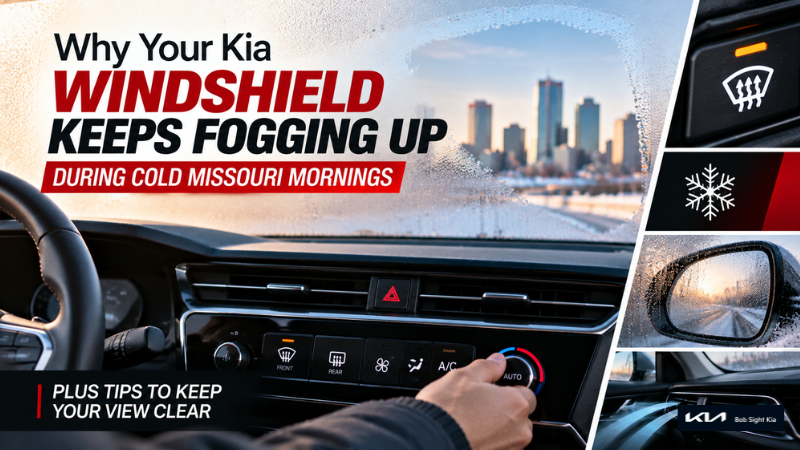
Foggy vehicle windshield on cold winter morning in Independence MO showing climate control defroster clearing inner glass

Why Your Kia Windshield Keeps Fogging Up Cold Missouri Mornings

Why Your Kia Windshield Keeps Fogging Up During Cold Missouri Mornings Cold Missouri mornings can bring an unexpected problem for Kia drivers: a windshield that fogs up before the morning commute even begins. Whether you are leaving your driveway in Independence, heading toward Blue Springs, or traveling into Kansas City, interior windshield condensation can make it difficult to see the road clearly. Windshield fogging occurs when moisture in the air comes into contact with glass at a temperature low enough for condensation to form. During fall and winter, the combination of cold outdoor temperatures, warm cabin air, wet floor mats, and changing humidity levels can make this problem more noticeable. While occasional condensation is normal, a windshield that repeatedly fogs up or takes an unusually long time to clear may indicate a problem with your Kia's climate control system, cabin air filter, or moisture management. At Bob Sight Kia in Independence, Missouri, our service department helps drivers address heating, ventilation, air conditioning, and other seasonal maintenance concerns. Understanding what causes windshield fogging and how to use your Kia's defroster correctly can help you maintain better visibility throughout the colder months. Schedule Kia HVAC and Defroster Service at Bob Sight Kia In This Guide You'll Learn Understanding how moisture interacts with your vehicle's glass and climate control system can make cold-weather driving more manageable. This guide explains: Why interior and exterior windshield condensation develops during cold weather How humidity and temperature changes affect your Kia's windows Which climate control settings help clear interior windshield fog How cabin air filters and HVAC components can affect defroster performance Why clear windshield glass matters for Kia driver-assistance technology How to clean interior automotive glass without leaving residue When persistent fogging may require professional inspection Why Windshields Fog Up During Missouri Winters Windshield condensation develops when moisture in the air reaches a surface cold enough for water vapor to change into liquid droplets. This process is closely related to the dew point, which is the temperature at which air becomes saturated with water vapor under its current conditions. During winter, the windshield of a parked Kia can become very cold. When warmer, moisture-containing cabin air comes into contact with the interior glass, the air immediately next to the windshield cools. If that air reaches its dew point, water vapor condenses into tiny droplets on the glass. These droplets scatter light and create the cloudy appearance commonly described as windshield fog. Where Does the Moisture Inside Your Kia Come From? Moisture can enter or accumulate inside your vehicle in several ways. Even a properly functioning Kia can experience interior condensation under the right conditions. Common sources of cabin humidity include: Moisture released through normal breathing by drivers and passengers Wet shoes, coats, and umbrellas brought inside the vehicle Rainwater or melting snow collecting on floor mats Damp carpeting or upholstery that has not completely dried Outside humidity entering when doors or windows are opened Moisture entering through damaged weatherstripping or other water leaks For example, a Kia Sportage parked overnight in Independence may have a cold windshield by morning. When several passengers enter the vehicle with wet jackets or shoes, the additional moisture can increase cabin humidity and contribute to condensation. This is why windshield fogging may become more noticeable during school drop-offs, family trips, or commutes with multiple passengers. Why Temperature Changes Matter Missouri weather can shift considerably between afternoon and overnight temperatures. A mild afternoon may be followed by freezing conditions the next morning. These changes affect the temperature of your vehicle's glass and the amount of moisture that can remain in the air without condensing. Warm air can contain more water vapor before becoming saturated than colder air. When humid cabin air cools against the windshield, condensation becomes more likely. Understanding this relationship helps explain why your Kia may have clear windows one morning and significant interior fogging the next, even when nothing appears to have changed with the vehicle. Interior vs. Exterior Windshield Fogging: How to Tell the Difference Before adjusting your climate controls, determine whether the condensation is on the inside or outside of the windshield. The location of the moisture matters because the most effective clearing method can differ. Interior Windshield Fogging Interior condensation commonly occurs when humid cabin air meets cold windshield glass. It is frequently associated with cold mornings, wet clothing, melting snow, or inadequate cabin ventilation. Signs of interior fogging include: Cloudiness that remains after using the windshield wipers Condensation that becomes more noticeable after passengers enter Fogging that improves when the front defroster is activated Moisture collecting on other interior windows Interior fogging is generally addressed by directing appropriately conditioned air toward the windshield, increasing ventilation, and reducing cabin humidity. Exterior Windshield Fogging Exterior condensation develops when the outside surface of the windshield is cooler than the dew point of the surrounding outdoor air. This can occur during humid weather when the air conditioning system has cooled the windshield. Exterior fogging may be more noticeable during humid mornings or when outdoor temperatures change quickly. Windshield wipers can remove exterior condensation temporarily. Adjusting the climate control settings to reduce excessive windshield cooling may also help prevent it from returning. Why You Should Avoid Wiping Interior Fog With Your Hand Using your hand or sleeve to wipe interior condensation may temporarily improve visibility, but it can also leave oils and streaks on the glass. These residues can scatter sunlight and oncoming headlights, making visibility more difficult under certain lighting conditions. A clean microfiber cloth can be useful when the vehicle is safely parked, but the climate control system should be used to manage ongoing condensation. How to Defog Your Kia Windshield on a Cold Morning Your Kia's front defroster is designed to direct airflow toward the windshield to help remove condensation and improve visibility. The exact operation depends on your vehicle's model, model year, and climate control equipment. Some vehicles automatically adjust airflow, temperature, fresh air intake, and air conditioning operation when defrost mode is selected. For model-specific instructions, consult your Kia owner's manual. Step 1: Turn On the Front Windshield Defroster Start the vehicle and select the front windshield defrost setting. This directs airflow toward the windshield rather than concentrating it on the dashboard vents or floor. Depending on the vehicle, the system may automatically increase fan speed or change other climate settings to help clear the glass. Step 2: Select an Appropriate Warm Temperature During cold weather, warm air can help raise the temperature of the interior windshield surface. As the glass warms, condensation becomes less likely to remain on the surface. Using warm air with sufficient airflow is generally effective for clearing interior fog during winter conditions. You do not necessarily need to select the highest available temperature. Follow the recommended defrost settings for your vehicle and adjust them as needed. Step 3: Use Fresh Air Instead of Recirculation Air recirculation allows the climate system to reuse air already inside the passenger compartment. Although this can be useful for cooling the cabin or temporarily limiting outside odors, prolonged recirculation during cold weather may allow moisture from passengers to accumulate. Fresh air mode introduces outside air into the ventilation system. During many cold-weather conditions, bringing in outside air and warming it can help reduce interior humidity and improve windshield clearing. Some Kia models automatically switch away from recirculation when front defrost is selected. Step 4: Allow the A/C System to Assist When Available Air conditioning can help remove moisture from the air passing through the climate control system. When the A/C system operates, moisture may condense on the evaporator and drain away from the ventilation system. This can help provide drier air for windshield clearing. However, the A/C compressor does not necessarily operate under every temperature condition. Some vehicles limit compressor operation when outdoor temperatures are very low. Your Kia may automatically manage A/C operation during defrost mode. An illuminated A/C indicator does not always mean the compressor is actively running. Follow your vehicle's climate control instructions rather than assuming the compressor must operate continuously for the windshield to clear. Step 5: Increase Ventilation if Necessary If the cabin contains significant moisture, briefly opening a window may help exchange humid interior air with outside air when conditions allow. This can be useful when several passengers have entered the vehicle with wet clothing or when condensation is developing rapidly. However, opening a window is not required for every fogging situation, and its effectiveness depends on outdoor humidity and temperature. Step 6: Wait Until Visibility Is Clear Before Driving Do not begin driving with a windshield that significantly obstructs your view. Allow the defroster enough time to clear the necessary viewing area before entering traffic. The amount of time required varies based on temperature, humidity, ice accumulation, and HVAC performance. If the windshield does not clear normally, the climate control system may need inspection. How Kia Automatic Defogging Systems Work Some Kia vehicles are equipped with automatic defogging features designed to help reduce windshield condensation. Depending on the model and equipment, these systems may use sensors and climate control adjustments to respond to conditions associated with interior windshield fogging. When the system detects a need for additional defogging, it may adjust airflow direction, fan speed, fresh air intake, or air conditioning operation. The specific features and operating conditions vary by vehicle. Does Every Kia Have Automatic Defogging? No. Automatic defogging equipment and operation vary by model, year, trim level, and climate control configuration. Some Kia vehicles have automatic climate control and dedicated defogging features, while others rely primarily on manually selected defrost settings. Consult your owner's manual to determine whether your vehicle includes an automatic defogging system and how it operates. What if Automatic Defogging Is Not Working? If your Kia has an automatic defogging feature and it does not appear to respond as expected, first review the owner's manual for the system's operating conditions. Some functions may be limited under particular temperature or climate settings. If the system repeatedly fails to clear condensation or displays a warning, professional inspection may be appropriate. Possible concerns can include sensor issues, airflow restrictions, climate control faults, or other HVAC problems. Mechanical Problems That Can Cause Persistent Windshield Fogging Occasional condensation is normal, but persistent fogging that does not improve with appropriate climate settings may indicate an underlying maintenance or mechanical concern. Several different components can affect how efficiently your Kia removes moisture from the passenger compartment. Clogged Cabin Air Filter The cabin air filter helps remove dust, pollen, and other airborne particles from air entering the passenger compartment. As the filter collects debris, airflow through the ventilation system may become restricted. If the restriction becomes significant, the defroster may deliver less airflow to the windshield, slowing the clearing process. A dirty cabin air filter does not automatically cause windshield condensation, but reduced airflow can make existing fogging more difficult to clear. Blocked A/C Condensate Drain When an air conditioning system removes moisture from the air, condensation typically collects and drains outside the vehicle. If the condensate drain becomes blocked, water may accumulate where it should not. Depending on the vehicle and the severity of the problem, this may contribute to damp interior carpeting or moisture-related odors. A damp passenger-side floor is not proof of a blocked drain, but it is a symptom worth investigating. Heater Core Leak The heater core is a heat exchanger that uses engine coolant to help warm the passenger compartment in many gasoline-powered vehicles. If the heater core develops a leak, coolant may enter the HVAC housing or passenger compartment. Possible symptoms include: A sweet or unusual odor when the heater operates A greasy or persistent film forming on the inside of the windshield Unexpected coolant loss Damp carpeting near the dashboard Reduced heating performance These symptoms can have other causes, so a professional diagnosis is necessary before concluding that the heater core has failed. If you suspect a coolant leak, arrange an inspection promptly. If the engine begins overheating, stop driving safely and follow the warnings in your owner's manual. Recirculation Door or Climate Control Actuator Problems Climate control systems use doors and actuators to manage airflow direction and, on many vehicles, the balance between fresh and recirculated air. If a door or actuator becomes stuck or stops responding correctly, the ventilation system may not operate as intended. For example, a system that remains in recirculation mode may have difficulty reducing interior humidity during cold weather. Other symptoms can include airflow coming from the wrong vents, unusual clicking noises behind the dashboard, or temperature controls that do not respond normally. Damaged Door or Window Weatherstripping Weatherstripping helps prevent rainwater and outside moisture from entering the passenger compartment. Worn or damaged seals around doors, windows, or an equipped sunroof can allow water to reach interior carpeting or trim. When that moisture remains trapped, cabin humidity may stay elevated even after the vehicle has warmed up. If your Kia frequently develops interior condensation and you notice damp carpets or water stains, checking for water intrusion is an important part of the diagnosis. Why Your Kia Cabin Air Filter Matters for Defroster Performance A properly functioning cabin air filter supports the ventilation system by filtering airborne contaminants while allowing air to move through the HVAC system. Over time, dust, leaves, pollen, and road debris can accumulate in the filter. For drivers traveling throughout Independence, Blue Springs, Raytown, and the Kansas City metro, seasonal debris and everyday road conditions can contribute to filter contamination. How a Dirty Filter Affects Airflow When the cabin air filter becomes heavily restricted, the blower may have difficulty moving the expected volume of air through the ventilation system. This can affect airflow from dashboard vents, floor outlets, and windshield defroster openings. Reduced airflow may make it take longer to warm the windshield or remove condensation. However, persistent fogging can have several causes, and replacing the filter will not resolve every HVAC or moisture problem. When Should You Replace Your Kia Cabin Air Filter? The correct cabin air filter replacement interval depends on your Kia's model, model year, maintenance schedule, and operating conditions. Vehicles driven frequently in dusty environments or areas with significant airborne debris may require more frequent inspection. Signs that a cabin air filter may need attention include reduced ventilation airflow, visible contamination, or persistent odors from the vents. Follow your owner's manual for the recommended maintenance interval and have the filter inspected when airflow problems develop. Where Is the Cabin Air Filter Located? Many Kia vehicles have a cabin air filter accessible through or near the glove compartment area. However, filter location and replacement procedures vary by model. Consult your owner's manual or a service professional before attempting replacement. Schedule Kia Cabin Air Filter and HVAC Service How Windshield Fogging Can Affect Kia Drive Wise Safety Features Many Kia vehicles offer driver-assistance technologies that use cameras, radar, or other sensors to monitor driving conditions. Depending on the model and equipment, Kia Drive Wise features may include Forward Collision-Avoidance Assist, Lane Keeping Assist, Lane Following Assist, and other available systems. Some camera-based features rely on a forward-facing camera positioned near the upper windshield. Why Clear Glass Matters for Forward-Facing Cameras Cameras need an adequately clear view to interpret lane markings, vehicles, and other objects. Fog, frost, ice, dirt, or other obstructions in the camera's viewing area can affect performance. Depending on the system and conditions, your Kia may display a warning or temporarily limit certain driver-assistance functions. However, not every windshield fogging event will disable these features. The specific response depends on the vehicle, camera placement, severity of the obstruction, and system design. What Should You Do if a Camera Warning Appears? If your Kia displays a message indicating that a camera or driver-assistance feature is obstructed, follow the instructions in your owner's manual. Clear the windshield and remove any visible frost, condensation, or debris from accessible glass surfaces. Do not attempt to disassemble or clean internal camera components yourself. If the warning remains after visibility has been restored, professional diagnosis may be necessary. Driver-assistance systems are designed to support attentive driving. They do not replace the driver's responsibility to maintain visibility and control of the vehicle. How to Clean the Inside of Your Kia Windshield to Reduce Fogging Keeping the interior windshield clean can improve visibility and make condensation easier to manage. Over time, dust, fingerprints, airborne residue, and films from interior materials can accumulate on automotive glass. These contaminants can create haze and streaks that become more noticeable when sunlight or headlights shine through the windshield. Step 1: Park in a Suitable Location Choose a shaded location or garage where the glass is not excessively hot. Cleaning glass in direct sunlight can cause some products to evaporate quickly, making streaks more difficult to avoid. Step 2: Remove Loose Dust Use a clean, dry microfiber cloth to gently remove dust and loose debris from the interior windshield. Pay attention to the lower corners where dust may collect near the dashboard. Step 3: Apply an Automotive-Safe Glass Cleaner Use a glass cleaning product appropriate for automotive interior surfaces. If your vehicle has aftermarket window film or other specialized coatings, confirm that the cleaner is compatible with those materials. Applying the cleaner to a microfiber cloth rather than spraying directly onto the dashboard can help protect nearby electronics and interior trim. Step 4: Clean the Glass in Overlapping Sections Wipe the glass using overlapping strokes, working across the windshield to remove visible residue. Use a separate clean cloth when necessary to avoid spreading dirt or oily deposits. Step 5: Buff Away Remaining Streaks Finish with a clean, dry microfiber cloth to remove remaining moisture and streaks. Check the glass from different viewing angles to identify any haze that remains. Should You Use an Anti-Fog Glass Treatment? Some automotive products are designed to reduce the formation of visible condensation on interior glass. Results vary by product and conditions. Before using an anti-fog treatment, confirm that it is suitable for your vehicle's glass, coatings, and any applicable camera-related restrictions. Avoid applying products to camera housings or other sensitive components. Glass treatments should supplement proper ventilation and moisture control rather than replace them. Quick Facts About Kia Windshield Fogging in Cold Weather Condensation: Interior fog forms when humid cabin air contacts glass cold enough to reach the air's dew point. Front Defrost: Directs airflow toward the windshield to help remove condensation and improve visibility. Fresh Air Mode: Can help reduce accumulated cabin humidity during many cold-weather conditions. Air Conditioning: Can remove moisture from ventilation air when the system is operating under suitable conditions. Cabin Air Filter: A heavily restricted filter can reduce airflow and slow windshield clearing. Automatic Defogging: Available equipment and operating behavior vary by Kia model and year. Glass Cleaning: Removing interior residue can improve clarity and reduce distracting haze. Persistent Fogging: May indicate trapped interior moisture, restricted ventilation, or another HVAC-related concern. Preparing Your Kia's Climate Control System for Winter Windshield visibility is an important part of winter vehicle preparation. Before temperatures regularly fall below freezing, consider checking how your Kia's heating and defrost systems operate. A properly functioning climate control system should direct airflow to the appropriate vents and respond to temperature and fan adjustments. If the system is slow to clear the windshield, produces unusual odors, or has noticeably weak airflow, an inspection may help identify the cause. Check Your Defroster Before the First Freeze Test the front defroster before winter weather becomes severe. Make sure airflow reaches the windshield and that the climate controls respond as expected. If your vehicle has a rear-window defogger, verify that it operates according to the owner's manual. Inspect the Cabin for Trapped Moisture Look for damp carpeting, wet floor mats, water stains, or persistent musty odors. Remove accumulated water or melting snow from removable floor mats when practical. If carpeting remains damp without an obvious explanation, professional inspection may be needed to locate the source. Review Cabin Air Filter Maintenance Check your Kia maintenance schedule to determine whether the cabin air filter is due for inspection or replacement. If airflow has weakened or unusual odors have developed, ask your service advisor whether the filter or another HVAC component may need attention. Address Unusual Heating or Cooling Symptoms Changes in cabin temperature, inconsistent airflow, unusual noises, or repeated windshield fogging can sometimes indicate problems with climate control components. Having these concerns evaluated before winter can help you understand whether maintenance or repairs are needed. Drivers can also review available maintenance offers through the Bob Sight Kia Service Specials page. Frequently Asked Questions About Kia Windshield Fogging Why does my Kia turn on the A/C when I select front defrost? Some Kia climate control systems automatically select air conditioning when front defrost mode is activated because A/C operation can help remove moisture from the ventilation air. Drying the air can improve the system's ability to clear interior windshield condensation. However, the compressor may not operate under every temperature condition, even if the A/C indicator is illuminated. The vehicle's climate control system manages compressor operation according to its design and operating conditions. Consult your owner's manual for details about how your Kia handles defrost and air conditioning functions. Should I use hot or cold air to clear my Kia windshield? During cold weather, warm air directed toward the windshield generally helps clear interior condensation by warming the glass and supporting evaporation. Using fresh air and appropriate climate control settings can also help reduce interior humidity. Exterior fogging may require a different approach because it forms on the outside of the windshield. For best results, use your vehicle's front defrost setting and follow the manufacturer's instructions. Why does my Kia windshield smell sweet or develop a greasy film? A sweet odor combined with an unusual greasy film on the interior windshield can be associated with a heater core or coolant leak in vehicles that use engine coolant for cabin heating. Other sources of interior residue and odors are also possible. If these symptoms occur, arrange a professional inspection rather than assuming the heater core is the confirmed cause. If the vehicle also displays an overheating warning or experiences significant coolant loss, stop driving safely and follow the owner's manual instructions. Can a dirty cabin air filter cause my Kia windshield to fog up? A heavily clogged cabin air filter can reduce airflow through the HVAC system, potentially making it more difficult for the defroster to clear condensation. However, the filter is not the only possible cause of persistent fogging. High cabin humidity, wet carpeting, ventilation settings, and mechanical HVAC problems may also contribute. Inspecting the cabin air filter is a reasonable step when airflow becomes weak or windshield clearing takes longer than expected. Why does my Kia windshield fog up when passengers get inside? Passengers release moisture into the cabin through normal breathing. When several people enter a cold vehicle, the added humidity can condense on the windshield and other windows. Wet clothing and shoes may introduce additional moisture. Using front defrost, allowing appropriate fresh air ventilation, and removing excess moisture from the cabin can help reduce this problem. What should I do if my Kia windshield fogs up while driving? If condensation begins affecting visibility, activate the front windshield defroster and follow the climate control instructions for your vehicle. Fresh air ventilation and appropriate temperature settings may help clear interior fog. Do not attempt to wipe the windshield with your hand while driving. If your view becomes significantly obstructed or the fog does not clear promptly, slow down as appropriate and pull over in a safe location before continuing. Never continue driving when you cannot see the roadway clearly. Why does my Kia windshield keep fogging up even after I clean it? Cleaning removes surface residue, but it does not eliminate the moisture that causes condensation. If the windshield continues fogging, inspect the cabin for damp carpeting, wet floor mats, or other moisture sources. Review your ventilation settings and make sure the front defroster operates properly. Persistent fogging despite correct settings may warrant an HVAC or water-intrusion inspection. Can windshield fog affect Kia driver-assistance features? Yes. Depending on the vehicle and the location of the condensation, fog or other obstructions can interfere with camera-based driver-assistance features. Some systems may display warnings or temporarily limit functionality when the camera's view is obstructed. However, the exact response varies by model and system. Keep the windshield clear, follow any displayed warnings, and consult your owner's manual for information about the driver-assistance features installed on your Kia. Schedule Kia HVAC and Defroster Service in Independence, MO A foggy windshield is often the result of normal temperature and humidity changes, but recurring condensation can also point to a maintenance concern. If your Kia's defroster has weak airflow, the windshield repeatedly fogs despite correct climate settings, or you notice unusual odors or interior moisture, a service inspection can help identify the underlying problem. Bob Sight Kia serves drivers throughout Independence, Blue Springs, Lee's Summit, Raytown, Sugar Creek, Grain Valley, and the greater Kansas City metro. Our service department can assist with climate control concerns, cabin air filter maintenance, and other vehicle service needs. Visit Bob Sight Kia at 1700 S Noland Road, Independence, MO 64055, or schedule an appointment online. Schedule Service at Bob Sight Kia Helpful Kia Service and Shopping Links Schedule Kia Service in Independence, MO Explore Kia Service Specials Browse New Kia Vehicles Shop Used Vehicles at Bob Sight Kia Value Your Trade Online Proud to Be Part of the Bob Sight Auto Group Bob Sight Kia is proud to be part of the Bob Sight Auto Group, serving drivers across Missouri and Kansas with automotive sales, financing, and service resources. Whether you are shopping for a vehicle, exploring pre-owned inventory, or scheduling maintenance, our dealership family is committed to helping drivers find the automotive services and information they need. Bob Sight Kia | Independence, MO Bob Sight Honda | Lawrence, KS Bob Sight CDJR | Lawrence, KS Bob Sight Ford | Lee's Summit, MO Trust Is Our Tradition.
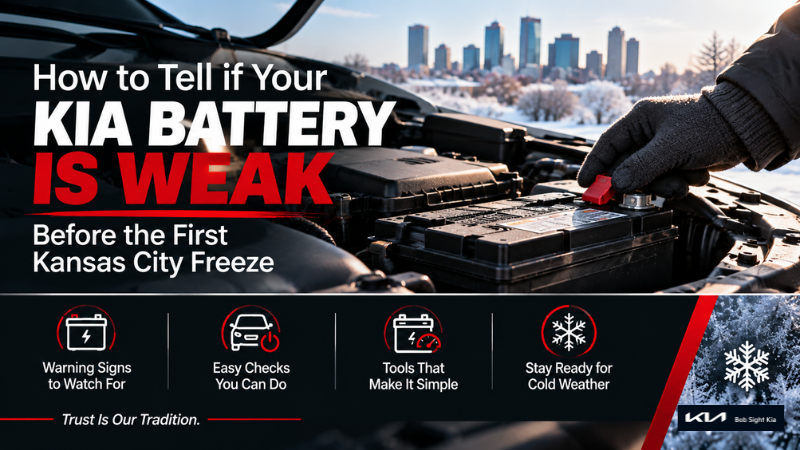
Certified Kia service technician testing 12-volt automotive battery health under hood in Independence MO

How to Tell if Your Kia Battery Is Weak Before First Kansas City Freeze

How to Tell if Your Kia Battery Is Weak Before the First Kansas City Freeze Cold mornings in Independence, Missouri, can make an aging car battery work harder than usual. If your Kia has been starting slowly, making clicking noises, or showing unusual electrical symptoms, it may be time to have the battery checked before winter temperatures arrive. Cold weather affects the amount of power a battery can deliver, while the engine may require more energy to start. A battery that performed normally throughout the summer can begin showing problems when temperatures drop. For drivers in Independence, Blue Springs, Lee's Summit, Raytown, and the greater Kansas City metro, recognizing these warning signs early can help reduce the chance of an unexpected no-start situation. At Bob Sight Kia, our service team helps local drivers maintain their vehicles throughout Missouri's changing seasons. Understanding how your battery works and when to request testing is a practical part of preparing your Kia for winter. Schedule Kia Battery Service at Bob Sight Kia What You'll Learn About Kia Battery Health How cold temperatures affect your Kia's 12-volt battery Common warning signs of a weak or discharged battery How short trips and driving habits affect battery performance What you can safely inspect at home Why choosing the correct replacement battery matters When to schedule professional battery and charging-system testing Why Cold Weather Can Make Your Kia Battery Struggle Cold weather slows the chemical reactions inside a conventional 12-volt lead-acid battery. As temperatures fall, the battery becomes less capable of delivering the electrical current needed to start the engine. According to AAA, freezing temperatures can significantly reduce a battery's available capacity. At the same time, colder engine oil can increase the amount of power needed to turn the engine over during startup. This combination creates additional strain on batteries that are already aging, undercharged, or experiencing internal wear. Why Battery Problems Often Appear After Summer Although winter is when many drivers discover battery problems, summer heat can contribute to the deterioration that causes them. High temperatures can accelerate internal corrosion and other chemical changes inside a lead-acid battery. Depending on the battery's construction, prolonged heat may also contribute to electrolyte loss. A battery weakened during a hot Kansas City summer may still provide enough power to start your Kia during mild fall weather. Once overnight temperatures begin approaching freezing, the reduced starting capacity becomes more noticeable. Cold weather does not automatically destroy a healthy battery. Instead, it can reveal weaknesses that were already developing. Five Warning Signs Your Kia Battery May Be Weak Battery problems do not always begin with a vehicle that refuses to start. Many drivers notice smaller changes in starting performance or electrical behavior first. 1. Your Kia Cranks More Slowly Than Normal One of the most recognizable signs of a weak battery is a slow engine crank. You may notice that the engine turns over more slowly than usual before starting. This can become more noticeable after your vehicle has been parked overnight during cold weather. Although a weak battery is one possible cause, starter problems, poor electrical connections, and other mechanical issues can produce similar symptoms. Testing helps identify the actual problem. 2. You Hear Clicking When Trying to Start the Engine A rapid clicking sound when attempting to start your Kia can indicate that the electrical system does not have enough available power to operate the starter properly. A discharged battery, corroded terminals, or loose electrical connections are possible causes. A single click without engine cranking can also point toward a starter-related problem. Rather than repeatedly attempting to start the vehicle, consider having the battery and starting system inspected. 3. Your Interior Lights or Electronics Behave Differently Low system voltage can sometimes cause unusual electrical behavior, including dim interior lights, unexpected infotainment resets, or other electronic interruptions during startup. However, these symptoms are not exclusive to battery problems. Wiring, charging-system, and individual component faults can also affect electrical performance. If several electrical symptoms begin appearing together, a professional inspection can help determine whether the battery is involved. 4. Your Battery or Charging-System Warning Light Appears The battery-shaped warning light on your dashboard generally relates to the vehicle's charging system. It does not automatically mean the battery itself needs replacement. If this warning light remains illuminated while driving, the alternator, charging controls, wiring, or another electrical component may not be functioning properly. A charging-system warning should be addressed promptly. If the system is not charging correctly, the vehicle may eventually lose electrical power or stop running. 5. Idle Stop and Go Stops Operating Some Kia vehicles are equipped with Idle Stop and Go technology, which can automatically shut off the engine during certain stops and restart it when needed. The system considers multiple operating conditions before activating. Battery state of charge is one factor, but cabin temperature demands, engine temperature, and other conditions can also affect operation. If Idle Stop and Go stops functioning along with slow starting or other electrical symptoms, battery testing may be worthwhile. How Short Trips Can Affect Your Kia Battery Frequent short drives can make it more difficult for a vehicle's charging system to replenish the energy used during engine startup. For example, drivers who primarily use their Kia for short trips around Independence, Raytown, or Sugar Creek may spend relatively little time driving between starts. The battery must provide power to start the engine, while the charging system works to restore that energy once the engine is running. When driving time is limited, the battery may not always return to a full state of charge. Repeated partial discharge can contribute to battery wear over time. Does Highway Driving Help Recharge a Weak Battery? Driving gives a properly functioning charging system an opportunity to replenish battery charge. However, there is no universal driving distance or time that guarantees a full recharge. Battery condition, temperature, electrical demand, and charging-system operation all affect how quickly a battery can recover. If your Kia frequently needs jump-starting or continues to crank slowly after normal driving, a longer trip is not a reliable solution. A battery test and charging-system inspection can help determine whether the battery needs charging, replacement, or further diagnosis. How to Check Your Kia Battery at Home You can look for several visible warning signs without performing complicated electrical testing. Before inspecting the battery, consult your Kia owner's manual for its location and any model-specific safety instructions. Not every Kia has a conventional 12-volt battery in the same location. Hybrid and electric models may have different battery arrangements and service procedures. Start With a Visual Inspection Park your Kia on level ground, switch the vehicle off, and engage the parking brake. Locate the 12-volt battery using your owner's manual. Look for visible damage, including cracks, swelling, or leaks. Check accessible terminals for corrosion or obvious connection problems without touching damaged components. If you notice damage, leaking fluid, or significant corrosion, arrange professional inspection rather than attempting repairs yourself. Do not attempt to open a sealed battery or handle leaking battery fluid. Battery electrolyte can be hazardous, and electrical connections should be serviced using appropriate safety procedures. Can You Test Battery Voltage With a Multimeter? A digital multimeter can provide useful information about the state of charge of a conventional 12-volt lead-acid battery when used correctly. After the battery has been at rest, a fully charged conventional lead-acid battery commonly measures approximately 12.6 volts or slightly higher, depending on its type and conditions. A substantially lower reading may indicate that the battery needs charging or further testing. However, voltage alone cannot confirm battery health. A battery can show a reasonable resting voltage while still being unable to deliver sufficient current during engine startup. For this reason, professional battery testing is more informative than relying on a single voltage measurement. Why Professional Kia Battery Testing Matters Professional battery testing helps determine whether a battery is simply undercharged or has lost enough performance to justify replacement. Depending on the vehicle and diagnostic equipment, a technician may evaluate battery voltage, state of charge, available starting performance, and the operation of the charging system. Testing can also help identify problems that resemble battery failure, including poor electrical connections or charging-system faults. Cold battery temperature can affect test results, so technicians may need to account for temperature and battery condition when evaluating performance. At Bob Sight Kia in Independence, drivers can schedule service to discuss starting problems, electrical concerns, or preventive winter battery maintenance. Schedule a Kia Battery Inspection AGM, EFB, and Conventional Batteries: Which Does Your Kia Need? Not every Kia uses the same type of 12-volt battery. The correct replacement depends on the vehicle's model, model year, engine or powertrain configuration, and original equipment requirements. Common automotive battery technologies include conventional flooded lead-acid batteries, Enhanced Flooded Batteries (EFB), and Absorbent Glass Mat (AGM) batteries. Conventional Flooded Lead-Acid Batteries Traditional flooded lead-acid batteries have been used in passenger vehicles for many years. They provide electrical energy for starting and other vehicle systems. Their suitability depends on the vehicle's electrical requirements and manufacturer specifications. Enhanced Flooded Batteries EFB batteries are designed to offer improved cycling performance compared with many conventional flooded batteries. They may be used in vehicles with increased electrical demands or certain engine stop-start systems. Absorbent Glass Mat Batteries AGM batteries use absorbent fiberglass separators to hold the electrolyte. They are designed to support demanding electrical applications and repeated charge-discharge cycles. Some Kia models may require AGM batteries, but AGM technology should not be assumed to be necessary for every Kia with Idle Stop and Go or every hybrid vehicle. Why Matching the Factory Battery Specification Matters When replacing a battery, the correct type, physical size, terminal configuration, and electrical ratings are important. Cold Cranking Amps (CCA) describe a battery's ability to provide starting current under standardized cold-temperature testing conditions. Reserve capacity is another specification that may be relevant to the vehicle's requirements. Installing a battery that does not meet the manufacturer's specifications can contribute to poor performance or compatibility problems. Consult your owner's manual or a qualified Kia service professional to identify the correct replacement battery for your vehicle. How Long Does a Kia Battery Usually Last in Missouri? Many conventional automotive 12-volt batteries last approximately three to five years, although actual service life varies. Battery quality, driving habits, climate, charging-system condition, and how often the vehicle is used can all affect longevity. In the Kansas City area, batteries experience both hot summer temperatures and freezing winter conditions. These seasonal changes can place additional demands on the battery over time. If your Kia's battery is approaching three years of service, periodic testing can provide useful information about its condition. An older battery does not automatically need replacement. Likewise, a newer battery can develop problems if it is repeatedly discharged or exposed to unfavorable conditions. Testing is the most practical way to make an informed replacement decision. How to Prepare Your Kia Battery for Winter Preparing for winter does not require complicated maintenance. A few preventive habits can help reduce unnecessary battery strain and make it easier to identify problems before cold weather arrives. Have an aging battery tested. If your battery is several years old or has shown starting problems, schedule an inspection before temperatures regularly fall below freezing. Limit unnecessary electrical use while parked. Avoid leaving interior lights or accessories operating for extended periods when the vehicle is off. Pay attention to starting behavior. Slow cranking, repeated clicking, or intermittent no-start conditions deserve attention. Address charging-system warnings promptly. A charging problem can leave the battery discharged even when the battery itself is in good condition. Consider a compatible battery maintainer for extended storage. If your Kia will remain parked for several weeks, consult the owner's manual about an appropriate maintenance charger and connection procedure. Follow your Kia maintenance recommendations. Proper engine oil, regular inspections, and timely repairs support reliable cold-weather operation. Parking in a garage may also help reduce exposure to very low temperatures. However, wind chill does not make an inanimate battery colder than the actual surrounding air temperature. Should You Replace Your Kia Battery Before Winter? Replacing a battery before winter may be appropriate if testing shows that it can no longer meet the vehicle's starting requirements. Replacement may also be necessary when a battery has visible damage, repeated failures, or internal deterioration confirmed through testing. However, replacing a battery solely because it is a certain age may not always be necessary. A professional inspection can help distinguish between an aging battery that remains serviceable and one that is likely to create starting problems. If the battery is healthy but frequently discharged, the underlying issue may involve driving habits, electrical draw, or the charging system. Other Winter Maintenance Items Worth Checking Your battery is only one part of preparing your Kia for Missouri winter driving. Before colder weather arrives, consider reviewing the condition of your tires, windshield wipers, engine oil, coolant, and other important maintenance items. Using the engine oil grade specified for your particular Kia helps support proper lubrication during cold starts. Tire pressure should also be checked regularly because pressure changes with temperature. Windshield wipers and washer fluid are important for maintaining visibility during snow, sleet, and freezing precipitation. Drivers commuting along Interstate 70, Highway 291, and other Kansas City-area roads can benefit from addressing these maintenance concerns before severe weather makes travel more difficult. For additional maintenance needs, visit the Bob Sight Kia Service Specials page to review available offers. Frequently Asked Questions About Kia Batteries Why does my Kia struggle to start when it's cold outside? Cold temperatures reduce the available starting performance of a conventional lead-acid battery while increasing the amount of power an engine may require to start. If the battery is aging, discharged, or experiencing internal wear, the reduced performance may become noticeable during freezing weather. However, starter problems, electrical connections, and other mechanical issues can also cause difficult starting. Testing is recommended when the problem continues. Does a clicking sound mean my Kia battery is dead? Not necessarily. Rapid clicking can occur when there is insufficient electrical power available to operate the starter properly. A weak or discharged battery is a common possibility, but poor cable connections and starter-related problems can produce similar symptoms. A battery and starting-system inspection can help identify the cause. Can I safely jump-start my Kia? Many conventional gasoline-powered Kia vehicles can be jump-started when the correct procedures are followed. However, jump-starting instructions vary by model and powertrain. Some hybrid and electric vehicles have special 12-volt battery procedures or designated jump-start terminals. Always consult your vehicle's owner's manual before attempting a jump-start. Never attempt to jump-start a battery that appears frozen, leaking, or physically damaged. If you are uncertain about the procedure, roadside assistance is a safer option. Will replacing my Kia battery reset my vehicle settings? Disconnecting a 12-volt battery can reset certain electronic settings on some vehicles. Depending on the Kia model and model year, this may affect clock settings, window functions, stored information, or other electronic features. Some vehicles also have battery replacement or initialization procedures that should be followed. Consult your owner's manual or a qualified service professional for instructions specific to your Kia. Can a completely discharged Kia battery freeze? Yes. A severely discharged conventional lead-acid battery can become more vulnerable to freezing because the electrolyte's composition changes as the battery loses charge. Freezing can damage internal components or the battery case. If you suspect a battery is frozen, do not attempt to charge or jump-start it. Have the battery inspected and follow appropriate safety procedures. How often should I have my Kia battery tested? Testing becomes increasingly useful as a battery ages or begins showing symptoms such as slow cranking, intermittent starting problems, or repeated discharge. Many drivers choose to include battery testing in their regular maintenance routine, particularly before winter. The appropriate testing interval depends on the battery's condition, age, and operating history. Can I replace my Kia battery myself? Battery replacement procedures vary by vehicle. Some conventional Kia models have relatively accessible 12-volt batteries, while others may require additional precautions, equipment, or initialization procedures. Hybrid and electric vehicles can have more specialized electrical systems. Before attempting replacement, consult the owner's manual and confirm the correct battery specification. Professional replacement is a practical option when the procedure is unfamiliar or the battery is difficult to access. Schedule Kia Battery Service in Independence, MO If your Kia has been slow to start, has needed repeated jump-starts, or is showing unusual electrical symptoms, having the battery checked before winter can help you understand what your vehicle needs. Bob Sight Kia serves drivers throughout Independence, Blue Springs, Lee's Summit, Raytown, Sugar Creek, Grain Valley, and the greater Kansas City metro. Our service department can assist with battery concerns and other maintenance needs to help you prepare for changing Missouri weather. Visit Bob Sight Kia at 1700 S Noland Road, Independence, MO 64055, or use our online scheduling tool to request a service appointment. Schedule Service at Bob Sight Kia Helpful Kia Service and Shopping Links Schedule Kia Service in Independence, MO View Kia Service Specials Browse New Kia Inventory Shop Used Vehicles at Bob Sight Kia Value Your Trade Explore the Bob Sight Auto Group Bob Sight Kia is part of the Bob Sight Auto Group, serving drivers across the Kansas City metro and northeast Kansas. Our dealership locations offer vehicle sales, service, and automotive resources for drivers throughout the region. Bob Sight Kia | Independence, MO Bob Sight Ford | Lee's Summit, MO Bob Sight Honda | Lawrence, KS Bob Sight CDJR | Lawrence, KS Trust Is Our Tradition.

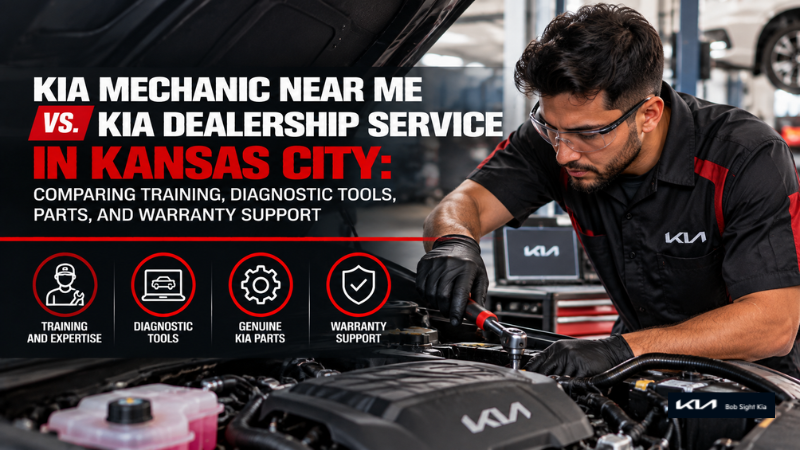
Kia technician using diagnostic equipment during Kia dealership service in Independence, Missouri

Kia Mechanic Near Me vs. Kia Dealership Service in Kansas City: Comparing Training, Diagnostic Tools, Parts, and Warranty Support

Kia Mechanic Near Me vs. Kia Dealership Service in Kansas City: Comparing Training, Diagnostic Tools, Parts, and Warranty Support Schedule Kia service at Bob Sight Kia in Independence, Missouri. Choosing between a local mechanic and a Kia dealership service department depends on the repair, your vehicle's age, warranty coverage, diagnostic needs, and the type of parts or documentation you prefer. An independent repair shop may be convenient for basic maintenance, while a Kia dealership can provide brand-specific resources that become more important for warranty concerns, recalls, software-related issues, and complex diagnostics. Drivers searching for a "Kia mechanic near me" may encounter independent garages, national repair chains, mobile mechanics, and authorized Kia dealerships. These options can differ in technician experience, diagnostic equipment, parts access, repair procedures, warranty support, and familiarity with current Kia systems. This guide helps Kia owners in Independence, Blue Springs, Lee's Summit, Kansas City, Raytown, Sugar Creek, Liberty, Grain Valley, Oak Grove, Jackson County, and the Greater Kansas City Metro compare their options. It explains when an independent mechanic may fit the situation, when Kia dealership service may be the stronger choice, and what questions to ask before authorizing work. In This Guide You'll Learn How independent mechanics and Kia dealership service departments differ Why Kia-specific training and diagnostic resources may matter How genuine Kia parts compare with aftermarket alternatives Where to go for warranty repairs, recalls, and service campaigns What maintenance records should include How to compare service estimates beyond the total cost When to schedule service at Bob Sight Kia in Independence Kia Mechanic vs. Kia Dealership Service Quick Facts An independent mechanic can be a practical option for many routine services, while a Kia dealership is often the more direct choice for Kia-specific diagnostics, warranty repairs, recalls, software procedures, and brand-specific technical support. The correct option depends on what the vehicle needs. Independent Mechanic May service vehicles from many different manufacturers Can often perform routine maintenance and common mechanical repairs May offer original-equipment, aftermarket, or remanufactured parts May be conveniently located near a driver's home or workplace Equipment and Kia-specific experience can vary significantly by shop Kia Dealership Service Department Focuses on Kia vehicles and Kia repair procedures Has access to manufacturer-specific service information and resources Can complete eligible Kia warranty repairs and recall work Offers genuine Kia parts designed for specific applications Can review vehicle identification number information for applicable campaigns Neither option should be selected based on a single factor. Drivers should compare technician qualifications, diagnostic capabilities, parts, estimate details, warranties on completed work, scheduling availability, and the shop's experience with the specific Kia model and concern. What Does "Kia Mechanic Near Me" Actually Mean? A search for a Kia mechanic near me can return several types of service providers, and they may not offer the same Kia-specific capabilities. The search result may include an independent neighborhood garage, a repair chain, a tire store, a mobile technician, or an authorized Kia dealership. Some independent technicians have extensive experience working on Kia vehicles. Others may service Kia models only occasionally. A shop's general reputation does not automatically reveal whether its technicians are familiar with the exact engine, transmission, hybrid system, driver-assistance technology, or electrical concern affecting your vehicle. Before scheduling with an independent mechanic, ask whether the shop regularly works on your Kia model and model year. A technician familiar with an older Kia Forte may not have the same experience with a newer Sportage Hybrid, Sorento Plug-In Hybrid, Carnival MPV, EV6, or EV9. The phrase "Kia mechanic" also does not necessarily mean the shop is authorized to perform Kia warranty or recall work. Independent shops can complete many maintenance and repair services, but manufacturer-paid warranty repairs and safety recalls generally need to be handled through an authorized Kia dealership. Drivers around Independence may find an independent mechanic convenient for basic services close to home. The decision becomes more technical when a warning light, intermittent electrical concern, software issue, hybrid-system message, driver-assistance fault, or warranty question is involved. Use the search results as a starting point, then verify the shop's capabilities directly. Ask who will diagnose the vehicle, what equipment will be used, which parts are planned, and what warranty applies to the completed repair. Comparing Kia-Specific Training and Repair Experience Kia dealership technicians work within a service environment built around Kia vehicles, while independent mechanics often divide their training and repair work among many manufacturers. That difference may affect diagnostic speed, familiarity with recurring concerns, and access to current repair procedures. Modern vehicles combine mechanical components with computers, sensors, cameras, communication networks, software, and driver-assistance technology. A problem that appears mechanical may have an electrical or software-related cause. Replacing a component without identifying the underlying issue can lead to repeated repairs. A Kia dealership service department has access to Kia-focused service information and procedures. This can be useful when diagnosing a concern involving the powertrain, infotainment system, advanced safety features, hybrid equipment, charging components, or communication between vehicle modules. Independent mechanics may also have strong technical experience and professional training. Some specialize in Asian manufacturers or maintain advanced industry certifications. The important step is verifying that the individual shop has current experience with your vehicle and the equipment required for the repair. Ask these questions before choosing a service provider: Do you regularly work on my Kia model and model year? Experience with the same generation and powertrain is more useful than general familiarity. Who will diagnose the concern? Ask about the technician's experience and training. Do you have access to current service procedures? Modern repair information can change as new guidance becomes available. Can your equipment communicate with all relevant vehicle systems? A basic code reader may not access every module. Can you complete required programming or calibration? Some repairs require more than installing a component. What happens if the first repair does not resolve the problem? Understand the diagnostic and workmanship policies. For an oil change, tire rotation, conventional brake service, or other routine work, several qualified providers may be capable of completing the service. For a complex or intermittent concern, Kia-specific experience may become a more important part of the decision. Diagnostic Tools, Software, and Modern Kia Technology A Kia dealership may have an advantage when a repair requires manufacturer-specific diagnostic information, software procedures, module communication, or calibration. A warning light can identify the system that detected a problem, but it does not always identify the failed component or underlying cause. Generic scan tools can read many standardized diagnostic trouble codes. More advanced tools may access additional systems, live data, programming functions, and testing procedures. Capabilities vary by tool, software subscription, vehicle, and repair shop. Modern Kia vehicles may include multiple electronic control modules managing the engine, transmission, braking, steering, airbags, climate system, infotainment equipment, hybrid components, battery systems, cameras, and driver-assistance features. These modules exchange information, so one fault can create symptoms in another system. A complete diagnosis may require reviewing fault codes, service information, live sensor data, wiring diagrams, test results, vehicle history, and current software information. Simply replacing the component named in a code description may not correct damaged wiring, poor connections, voltage problems, communication faults, or another underlying condition. Calibration may also be required after certain repairs. Cameras, radar sensors, steering components, windshield-related systems, or suspension work may need specific procedures to help supported systems operate as intended. Ask whether the shop can complete the calibration or whether the vehicle will need to be sent elsewhere. Consider Kia dealership service when the vehicle has: An intermittent warning light that another repair has not resolved Multiple warning messages appearing together An infotainment or connectivity concern A driver-assistance system warning A hybrid, plug-in hybrid, or electric-vehicle system message A possible software or module communication problem A concern that may be covered by warranty A recall or service campaign requiring Kia procedures Drivers should describe the symptoms in detail regardless of where they schedule service. Note when the problem occurs, how long it lasts, the vehicle's speed, outside temperature, road conditions, fuel or charge level, and whether any warning messages appear. Genuine Kia Parts vs. Aftermarket Parts Kia dealership service typically uses genuine Kia parts, while independent shops may offer original-equipment, aftermarket, used, or remanufactured alternatives. The best choice depends on the component, vehicle, repair objective, warranty coverage, and quality of the available replacement. Genuine Kia parts are selected for specific Kia applications. This can simplify compatibility questions involving fit, electrical connections, communication, materials, and installation requirements. The service advisor can also explain the warranty that applies to the part and dealership repair. Aftermarket parts are produced by companies other than the vehicle manufacturer. Quality can range from reputable replacements to lower-cost components with different materials, specifications, or expected service life. The word "aftermarket" alone does not describe the quality of the part. An independent shop should identify the proposed part before beginning the repair. Ask for the manufacturer, part number, warranty, labor coverage, and reason that part was selected. If several choices are available, request an explanation of their differences. Parts selection can be more important for sensors, electrical components, emissions equipment, safety-related systems, engine-management parts, and items that must communicate with vehicle modules. A component that physically fits may still require programming, initialization, or calibration. Use this process to compare parts recommendations: Ask whether the part is genuine Kia, original-equipment, aftermarket, used, or remanufactured. Request the specific part brand and part number. Confirm whether additional hardware or programming is included. Review the part and labor warranties separately. Ask what happens if the part does not correct the concern. Keep the final invoice and warranty documentation. Drivers who prefer genuine Kia parts can visit the Bob Sight Kia parts department or ask the service department to explain the parts planned for a repair. The most useful estimate clearly identifies what will be installed and what protection applies afterward. Warranty Repairs, Recalls, and Kia Service Campaigns An authorized Kia dealership is generally the correct destination for eligible Kia warranty repairs, safety recalls, and manufacturer service campaigns. These services may require Kia-specific procedures, documentation, parts, software, and claim authorization. If a vehicle is within an applicable warranty period, do not assume every concern is covered. Coverage can depend on the component, vehicle age, mileage, maintenance history, cause of failure, and warranty terms. A Kia service advisor can review the vehicle information and explain the next diagnostic steps. Safety recalls are issued to address identified safety-related defects or compliance concerns. Recall eligibility is tied to the vehicle identification number. Two Kia vehicles of the same model year may not have the same recall status because production dates, components, and configurations can differ. A service campaign is not always the same as a safety recall. Campaigns may address product improvements or specific operating concerns for eligible vehicles. Availability and procedures depend on the vehicle identification number and current manufacturer information. An independent shop may identify a condition that appears related to a recall or warranty concern, but the covered work generally must be completed and documented by an authorized Kia dealership. Contacting the dealership before authorizing an outside repair may help avoid paying for work that should first be evaluated for possible coverage. When scheduling, have the following information available: Vehicle identification number Current mileage Registration or ownership information Description of the concern Dates and conditions when the issue occurred Warning messages or dashboard indicators Previous repair invoices Relevant maintenance records Drivers in Independence, Sugar Creek, Raytown, Blue Springs, and surrounding Jackson County communities can contact Bob Sight Kia to ask whether a vehicle has applicable recall or campaign information. Eligibility should always be confirmed using the exact vehicle identification number. Routine Kia Maintenance and Service Records Routine maintenance can be completed by different qualified providers, but the work should follow the correct specifications and be documented carefully. Choosing an independent mechanic does not remove the owner's responsibility to complete required maintenance at the appropriate time or mileage. The maintenance schedule can vary by model, model year, powertrain, mileage, time, and operating conditions. A Kia used for repeated short trips, heavy traffic, extensive idling, dusty roads, severe temperatures, towing, or other demanding conditions may require different attention than a vehicle used for steady highway driving. Routine services may include: Engine oil and filter replacement Tire rotation and pressure checks Brake inspections Fluid inspections and replacement when specified Engine and cabin air filter replacement Battery and charging-system testing Cooling-system inspections Belt, hose, and suspension inspections Wiper and exterior-light checks Keep invoices showing the service date, mileage, work performed, fluid specifications, part numbers, and service provider. A receipt that only shows a total may not provide enough detail to demonstrate what maintenance was completed. Drivers who perform maintenance themselves should keep receipts for oil, filters, fluids, and other parts. Record the date, mileage, product specifications, and service performed. Follow safe procedures and do not attempt work beyond your training or equipment. Dealership maintenance can simplify recordkeeping because service history completed at the dealership remains connected to its repair records. This can be helpful when reviewing past work, diagnosing a recurring concern, preparing for a trade-in, or planning future maintenance. Eligible Kia owners should also review the requirements of Bob Sight Kia's Lifetime Oil Changes and Tire Rotations program. Program benefits are subject to eligibility and maintenance requirements, so confirm the terms that apply to the specific vehicle. How to Compare Kia Service Estimates A service estimate should be evaluated by the work included, diagnostic process, parts, labor, warranties, and repair outcome rather than by the total alone. Two estimates with different totals may not describe the same repair. One estimate may include diagnostic testing, genuine parts, replacement hardware, programming, calibration, fluid replacement, disposal fees, and a road test. Another may cover only a replacement component and installation. Comparing the final numbers without comparing the scope can lead to an incomplete decision. Ask each service provider to separate diagnostic charges, parts, labor, taxes, shop supplies, programming, calibration, and optional recommendations. Confirm whether the estimate is based on completed testing or an initial description of the symptoms. Drivers should also distinguish between an inspection and a diagnosis. An inspection may identify visible wear or obvious damage. A diagnosis attempts to determine why a symptom or warning is occurring. Complex electrical, drivability, or intermittent problems may require additional testing time. Review these questions before authorizing work: What testing supports the recommended repair? Which parts will be installed? Are programming or calibration included? What part and labor warranties apply? Are any recommendations urgent or safety-related? Which services can be planned for a later visit? Will additional work require separate approval? How will replaced parts and completed work be documented? Blue Springs, Lee's Summit, and Kansas City drivers comparing service options can review current Bob Sight Kia service specials and the Price Match Promise. Offers, qualifications, covered services, and program terms can change, so confirm the current details for the maintenance or repair being considered. A clear estimate should allow you to understand what the technician found, why the repair was recommended, and what result the proposed work is intended to produce. When to Choose an Independent Mechanic or Kia Dealership An independent mechanic may be suitable for straightforward maintenance and common repairs, while Kia dealership service may be preferable for warranty work, recalls, advanced diagnostics, software procedures, and Kia-specific concerns. The right choice can change from one service visit to the next. An Independent Mechanic May Fit When: The shop has demonstrated experience with your Kia model The service is routine and does not require Kia-specific programming The vehicle is outside applicable warranty coverage You understand which parts will be installed The shop provides detailed records and warranty information The location or scheduling better fits your routine Kia Dealership Service May Fit When: The vehicle may have an eligible warranty concern A recall or service campaign may apply The repair requires Kia-specific diagnostic resources Software, programming, initialization, or calibration may be required The concern involves a hybrid or electric powertrain The issue is intermittent or has not been resolved elsewhere You prefer genuine Kia parts and dealership repair documentation Owners do not need to use the same provider for every service. A driver may use a trusted independent shop for certain routine maintenance while relying on a Kia dealership for recalls, warranty questions, software concerns, or complex diagnostics. The priority should be matching the repair to the provider's capabilities. Verify experience, equipment, parts, documentation, and warranty support before approving the work. Ownership Planning and Preventive Kia Service Preventive maintenance is easier to plan when owners track mileage, time, driving conditions, past service, and upcoming seasonal needs. Waiting for a warning light or breakdown can reduce the number of convenient service options available. Create a maintenance file containing the owner's manual, service records, tire information, battery replacement history, warranty documents, and previous repair invoices. Digital copies can make these records easier to access when scheduling service or preparing for a trade appraisal. Review maintenance needs before major seasonal changes. Missouri summers can place additional demands on air conditioning and cooling systems, while winter temperatures can reveal weak batteries, low tire pressure, worn wipers, and reduced washer-fluid performance. Before a long drive from Independence, inspect tires, lights, wipers, fluid levels, and visible leaks. If the vehicle has an active warning light, unusual noise, vibration, braking concern, or fluid loss, schedule an evaluation before beginning the trip. Follow these ownership-planning steps: Record the current mileage. Compare it with the maintenance information for your vehicle. Review previous invoices. Identify services already completed and recurring concerns. Inspect seasonal items. Check tires, battery condition, wipers, lights, and climate performance. Prioritize safety concerns. Address braking, steering, tire, visibility, or warning-light issues promptly. Plan routine services together. Combining appropriate maintenance may reduce repeated visits. Keep detailed documentation. Save invoices, inspection results, and warranty information. A consistent service history can help technicians understand the vehicle and may support owner confidence during a future sale or trade. It also reduces the chance of repeating work because the previous service cannot be verified. Frequently Asked Questions About Kia Mechanics and Dealership Service Do I have to take my Kia to a dealership for every oil change? No. Routine maintenance can generally be completed by a qualified independent provider, a Kia dealership, or the owner when proper procedures and specifications are followed. The important factors are completing maintenance at the appropriate intervals, using the correct oil and filter specifications, and retaining detailed records. Maintenance requirements can vary by model, powertrain, mileage, time, and driving conditions. Independence-area drivers may choose Bob Sight Kia for oil changes when they prefer Kia-focused service, dealership records, multipoint inspections, and access to eligible maintenance-program benefits. Confirm current program requirements for the specific vehicle. Can an independent mechanic perform Kia warranty repairs? Eligible manufacturer warranty repairs are generally completed through an authorized Kia dealership. Warranty coverage depends on the vehicle, mileage, time, component, cause of failure, and applicable terms. An independent mechanic may identify a possible issue, but Kia warranty diagnosis, authorization, documentation, and payment typically require dealership involvement. If your Kia may still have coverage, contact Bob Sight Kia before authorizing a major outside repair. The service team can review vehicle information and explain the appropriate diagnostic process. Where should I take my Kia for recall work? Kia recall work should be scheduled with an authorized Kia dealership. Recall eligibility is determined using the vehicle identification number. The dealership follows the applicable manufacturer procedure and documents completion of the recall for the vehicle. Kia owners in Independence, Blue Springs, Lee's Summit, Kansas City, Raytown, Sugar Creek, and surrounding communities can contact Bob Sight Kia to ask about recall information and appointment availability. Are genuine Kia parts better than aftermarket parts? Genuine Kia parts provide application-specific compatibility, while aftermarket-part quality and specifications can vary by manufacturer. A reputable aftermarket part may be appropriate for some repairs, but owners should ask about its manufacturer, part number, materials, warranty, and compatibility. Electrical, safety, emissions, and communication-related components may require additional attention. Bob Sight Kia can explain the genuine Kia parts planned for dealership service. Drivers should compare both the part warranty and labor warranty before approving any repair. Is Kia dealership service always more expensive than an independent mechanic? Not necessarily. Service estimates depend on the diagnosis, labor included, parts selected, required equipment, programming, calibration, and warranty coverage. A lower estimate may not include the same testing, parts, procedures, or warranty protection. Compare itemized estimates and ask each provider to explain what is included before making a decision. Kansas City-area drivers can review Bob Sight Kia service specials and the Price Match Promise when comparing eligible services. Current offers and program requirements should be confirmed before scheduling. Schedule Kia Service in Independence, Missouri Bob Sight Kia provides Kia-focused maintenance, diagnostics, repair support, genuine Kia parts, recall service, and warranty assistance for drivers throughout the Kansas City Metro. The service team can help owners understand current maintenance needs and determine the next step for a warning light, unusual symptom, recall notice, or repair concern. When scheduling, provide the model, model year, mileage, vehicle identification number, and a detailed description of the issue. Mention when the symptom occurs and whether another shop has already performed testing or repairs. Bob Sight Kia serves Kia owners from Independence, Blue Springs, Lee's Summit, Kansas City, Raytown, Sugar Creek, Liberty, Grain Valley, Oak Grove, Jackson County, and surrounding Missouri communities. If you are searching for a Kia mechanic near me, compare the provider's experience, equipment, parts, documentation, and ability to support the specific service your vehicle needs. For Kia-specific diagnostics, warranty questions, recalls, and manufacturer procedures, schedule an appointment with Bob Sight Kia in Independence. Helpful Links Schedule Kia Service View Kia Service Specials Review the Price Match Promise Explore Genuine Kia Parts Learn About Lifetime Oil Changes and Tire Rotations Proud to Be Part of the Bob Sight Auto Group Bob Sight Kia is proud to be part of the family-owned Bob Sight Auto Group, serving vehicle shoppers and owners throughout the Kansas City region and Northeast Kansas. Families researching new or used vehicles can rely on Bob Sight Auto Group for new and pre-owned vehicle sales, trade-in resources, auto financing, certified service, parts, and collision repair. Bob Sight Kia - Independence, MO Bob Sight Ford - Lee’s Summit, MO Bob Sight Honda - Lawrence, KS Bob Sight CDJR - Lawrence, KS Bob Sight Collision Center - Lee’s Summit, MO

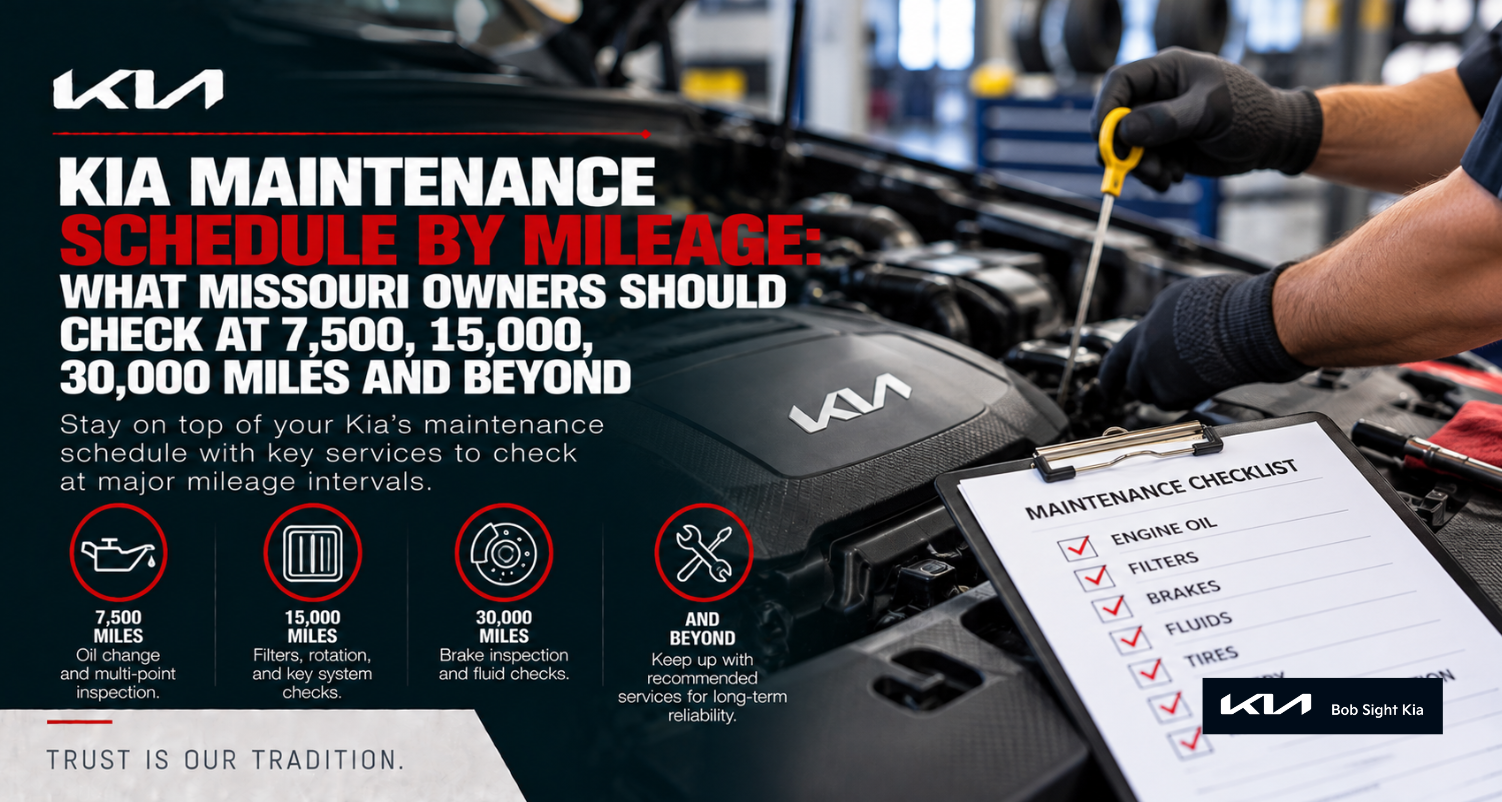
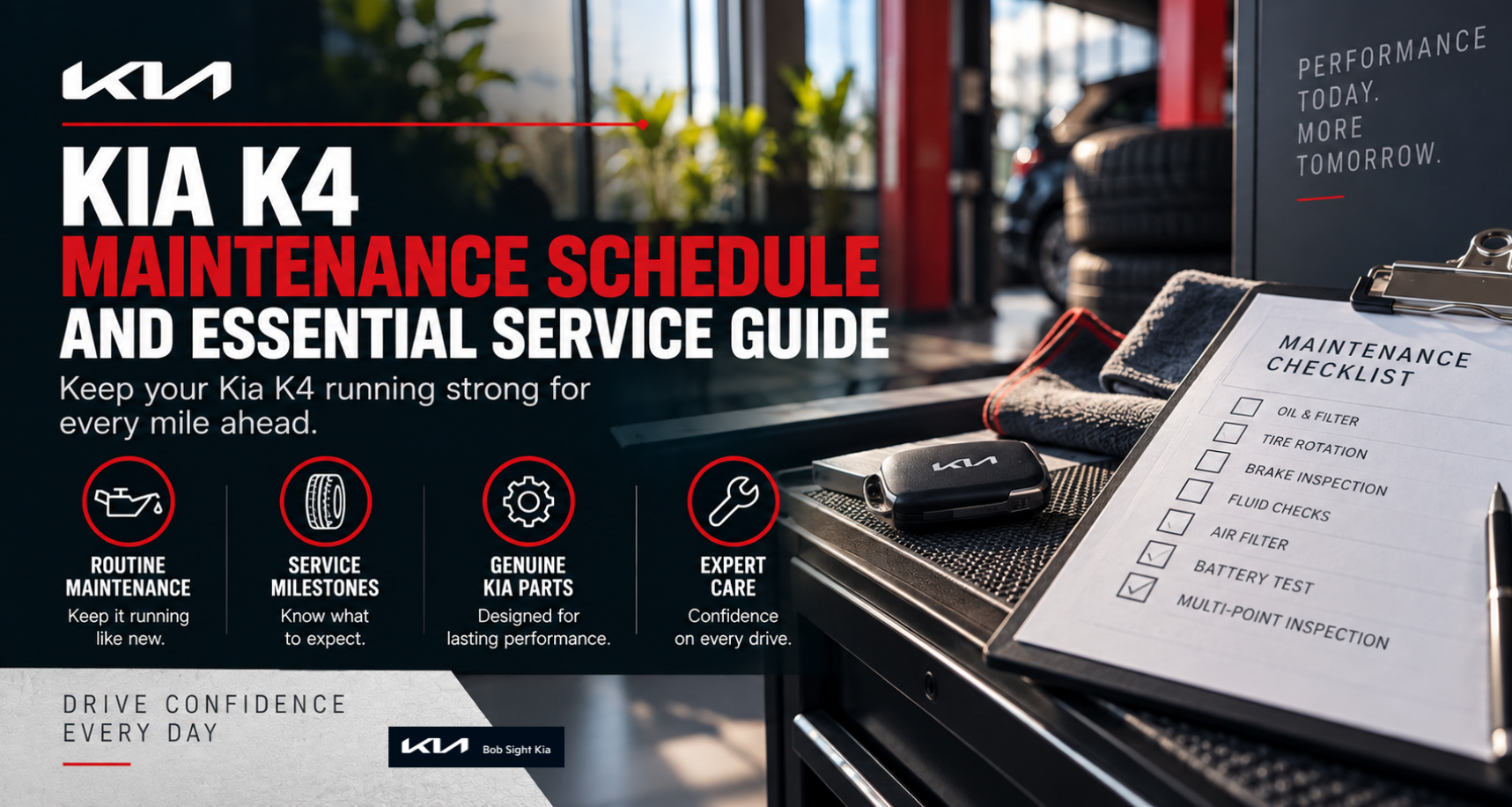
See Kia maintenance by mileage, including 7,500, 15,000, and 30,000-mile checkpoints for Independence and Missouri drivers.

Kia Maintenance Schedule by Mileage: What Missouri Owners Should Check at 7,500, 15,000, 30,000 Miles and Beyond

Kia Maintenance Schedule by Mileage: What Missouri Owners Should Check at 7,500, 15,000, 30,000 Miles and Beyond Your Kia maintenance schedule should follow the requirements for your exact vehicle, with mileage milestones helping you plan ahead. Oil changes, tire rotations, filters, brake inspections, and fluid checks all play a role in ownership, but they do not follow one universal schedule across every Kia model. For drivers in Independence, Blue Springs, Grain Valley, and throughout the Kansas City Metro, daily driving conditions also matter. Short trips, traffic on I-70, winter road treatments, and dusty construction areas can affect which maintenance schedule applies. Bob Sight Kia in Independence also offers an ownership benefit worth including in your service planning: lifetime oil changes and tire rotations every 5,000 miles with eligible new Kia purchases, performed exclusively at Bob Sight Kia. Ask our team to confirm eligibility and program terms for your vehicle. Battery-electric Kia models do not require engine oil changes. The 7,500-, 15,000-, and 30,000-mile checkpoints discussed below are planning references. They should not delay a service already due under your factory schedule, elapsed-time requirements, severe-use schedule, or applicable dealership maintenance program. Schedule Kia maintenance at Bob Sight Kia in Independence In This Guide You'll Learn Understanding the difference between factory requirements, dealership benefits, and condition-based repairs makes Kia maintenance easier to manage. This guide covers: How to identify the correct maintenance schedule for your Kia How Bob Sight Kia's 5,000-mile lifetime maintenance benefit fits into ownership What to review around 7,500, 15,000, and 30,000 miles How Missouri driving conditions can affect service timing Which items to monitor between appointments How gasoline, hybrid, plug-in hybrid, and electric maintenance differs How to plan service beyond the first 30,000 miles Does Every Kia Follow the Same Maintenance Schedule? No. Kia maintenance requirements vary by model year, engine, powertrain, drivetrain, and operating conditions. Even two vehicles with the same model name can have different service requirements when their engines or powertrains differ. A gasoline Kia Sportage and a Sportage Hybrid should each follow their own maintenance information. A battery-electric Kia has a different set of needs because it does not have a gasoline engine, engine oil filter, or spark plugs. The correct starting point is your owner's manual and its scheduled maintenance section. Kia's Owner's Portal also provides access to vehicle information and maintenance milestones. Confirm that the information matches your model year and configuration. When a maintenance item lists both mileage and time, follow whichever limit comes first as directed by the schedule. A low-mileage Kia may reach a calendar deadline before reaching the listed mileage. A frequent commuter may reach the mileage limit much sooner. Keep these three categories separate when reviewing recommendations: Factory scheduled maintenance: Inspections and replacements specified by Kia for your vehicle and operating conditions. Dealership maintenance benefits: Services available under an applicable program, including Bob Sight Kia's lifetime oil changes and tire rotations every 5,000 miles with eligible new Kia purchases. Condition-based service: Work recommended because an inspection identifies wear, damage, contamination, or a developing concern. Understanding which category applies helps you ask useful questions and maintain accurate records. How Bob Sight Kia's Lifetime Oil Changes and Tire Rotations Fit Your Plan Eligible new Kia purchases at Bob Sight Kia include lifetime oil changes and tire rotations every 5,000 miles, performed exclusively at our Independence dealership. This benefit gives qualifying owners a recurring service checkpoint to include in their ownership calendar. For an eligible gasoline or hybrid Kia, those visits provide an opportunity to keep up with covered oil and tire services while discussing other maintenance that may be due. Confirm your enrollment, vehicle eligibility, and applicable program terms with the dealership. The 5,000-mile benefit does not make every other maintenance item due at 5,000-mile intervals. Filters, coolant, spark plugs, brake fluid, and drivetrain components retain their own vehicle-specific requirements. Likewise, a factory time limit or severe-use requirement may call for attention before the next program mileage checkpoint. Do not interpret the benefit as coverage for every maintenance item or repair. Ask which services are included and which additional recommendations come from Kia's schedule or the condition of your vehicle. If you own a battery-electric Kia, engine oil changes do not apply. Ask our team which program benefits apply to your specific vehicle rather than assuming the same services apply to every powertrain. Plan your next Kia service appointment What Should Kia Owners Review Around 7,500 Miles? Around 7,500 miles, review your service history and upcoming factory requirements rather than assuming every Kia needs an identical service package. If you participate in Bob Sight Kia's applicable 5,000-mile maintenance benefit, you may already have completed an earlier oil-change and tire-rotation visit. For gasoline engines, including those in hybrids and plug-in hybrids, oil service must use the correct oil specification and filter for the vehicle. Do not select oil solely because another Kia owner uses it. Engine requirements can differ across models and years. Tire maintenance also deserves attention. Rotation requirements and patterns depend on the vehicle and tire configuration. Directional tires or differing front and rear tire sizes can affect the appropriate procedure. This checkpoint is also useful for reviewing tire pressure, tread condition, brake behavior, visible leaks, lighting, and wiper performance. An inspection may identify an issue that deserves attention, but inspection does not automatically mean replacement. Check your odometer and service date. Compare both with your vehicle's maintenance schedule. Review completed work. Include any earlier 5,000-mile program visit. Identify services actually due. Use the factory schedule and applicable driving conditions. Discuss symptoms. Mention new noises, warning lights, vibration, or changes in starting and braking. Save the service record. Record the date, mileage, and work completed. For owners making frequent short trips along Noland Road or US-40, this is also a good time to review the severe-use definitions in the owner's manual. What Changes Around 15,000 Miles? The 15,000-mile checkpoint is a useful time to review recurring maintenance, filter condition, tires, and brakes against your Kia's actual requirements. It is not a universal replacement deadline for every component. If your vehicle qualifies for Bob Sight Kia's lifetime maintenance program, 15,000 miles is also a recurring 5,000-mile program checkpoint. Confirm the appropriate timing with the service team and keep the factory schedule in view for additional requirements. The cabin air filter is one item worth reviewing. It filters air entering the passenger compartment through the climate-control system. Dust, pollen, leaves, and other debris can accumulate over time, and a restricted filter can reduce airflow. Replacement should follow the schedule and condition of the filter. Driving through construction areas or dusty environments may justify closer attention. Reduced airflow can also have causes beyond the filter, so persistent climate-control concerns deserve diagnosis. Tires should be checked for uneven wear and damage. Edge wear, center wear, or a change in steering behavior can prompt evaluation of inflation, alignment, suspension, or other contributing factors. Brake-pad replacement depends on measured wear and condition. A driver spending substantial time in Independence traffic may experience different brake wear from someone traveling mainly on uninterrupted highways. Mileage alone cannot determine how much usable brake material remains. What Should Be Reviewed Around 30,000 Miles? At approximately 30,000 miles, compare your service records with Kia's schedule to identify recurring maintenance and any additional items due. Avoid treating a generic 30,000-mile package as a factory requirement for every Kia. Engine air-filter service may be part of the discussion for a gasoline or hybrid vehicle, depending on its schedule and filter condition. This filter serves the engine and is separate from the cabin air filter. Battery-electric vehicles do not have an engine combustion-air filter. Other items may include inspections of belts, cooling-system components, steering, suspension, axle boots, or drivetrain components where specified. Their inspection and replacement requirements depend on your vehicle. Fluid service also requires a specific explanation. Ask which fluid is being recommended, whether Kia specifies the service at the current mileage or age, and whether severe-use conditions or an inspection finding affect the recommendation. At this stage, review the maintenance history as a whole: Have recurring oil and tire services been completed when applicable? Are any time-based requirements due? Were previous inspection findings resolved? Do filters need inspection or replacement under the schedule? Are tire wear and brake measurements being tracked? Does the severe-use schedule change any upcoming requirements? For eligible program participants, 30,000 miles is another 5,000-mile maintenance checkpoint. Additional work should still be matched to factory requirements and actual condition. What Counts as Severe Driving in Missouri? Severe-use conditions can include ordinary driving routines, so review Kia's definitions before assuming the normal schedule applies. The relevant conditions and affected maintenance items are listed in your vehicle's manual. Depending on the Kia, those conditions can include repeated short trips, extensive idling, heavy traffic, dusty roads, salt-treated roads, very cold weather, and towing or other demanding use. A commute through I-70 congestion can involve substantial engine-running time without many miles accumulating. Repeated short errands around Independence can create a different operating pattern from a longer trip at steady speed. Missouri winters also make the severe-use section worth reviewing. Some Kia manuals identify very cold weather and roads treated with salt or other corrosive materials among the relevant conditions. Do not assume every maintenance item changes to the same shorter interval. Severe-use tables identify which items are affected and which conditions apply to them. When discussing your maintenance plan, describe your actual routine: typical trip length, time spent idling, traffic, dusty-road use, and any towing within the vehicle's approved limits. Those details help the service team review the appropriate schedule. What Should You Check Between Service Appointments? Monitor your Kia between appointments because wear, warning lights, and vehicle symptoms do not wait for a mileage milestone. Scheduled maintenance works best alongside regular owner checks. Follow the owner-maintenance guidance in your manual. For vehicles with an engine, this can include checking engine oil as directed. Tire pressure, exterior lighting, wipers, and visible leaks also deserve attention. Check cold tire pressure. Use the vehicle's tire placard and manual rather than the maximum pressure molded into the tire sidewall. Inspect visible tire condition. Look for uneven wear, cuts, bulges, cracking, or other damage. Watch for unexplained fluid loss. Repeated topping off should not replace investigating a leak. Notice braking changes. Grinding, pulling, vibration, or altered pedal feel warrants attention. Check lights and wipers. Maintain visibility during rain, snow, and shorter winter days. Respond to warning indicators. Follow the manual's instructions for the specific warning. Record symptoms. Note when a concern occurs and the conditions surrounding it. Some warnings require stopping safely and obtaining assistance rather than continuing to drive. Do not wait for the next routine appointment when the manual calls for immediate action. How Do Gasoline, Hybrid, and Electric Kia Maintenance Needs Differ? Your powertrain determines which maintenance items apply, so a gasoline checklist should not be copied directly to every Kia. Shared model names do not guarantee shared service requirements. Gasoline Kia Vehicles Gasoline vehicles require engine-related maintenance, including oil and filter service, along with scheduled attention to items such as spark plugs and engine air filters. Exact intervals and specifications depend on the engine. Hybrid and Plug-In Hybrid Kia Vehicles Hybrids and plug-in hybrids still have gasoline engines and require applicable engine maintenance. Driving on electric power for part of a trip does not eliminate oil service or calendar-based requirements. Follow the schedule for the hybrid or plug-in hybrid configuration. Hybrid-specific components may have their own inspection or service requirements. Do not substitute the schedule from a gasoline version of the same model. Battery-Electric Kia Vehicles Battery-electric Kia vehicles do not require engine oil changes or spark plugs. They still need maintenance involving tires, brakes, cabin filters, steering, suspension, cooling systems, and other applicable components. Regenerative braking can reduce friction-brake use during some driving, but conventional brake components still require attention. Follow the EV's maintenance schedule rather than assuming reduced brake use eliminates inspection needs. Planning Maintenance Beyond 30,000 Miles Beyond 30,000 miles, continue recurring maintenance and add higher-mileage or time-based work as your Kia's schedule requires. There is no single replacement list that applies to every Kia at 60,000, 90,000, or 100,000 miles. Items such as coolant, spark plugs, belts, and drivetrain fluids can have substantially different requirements across vehicles. Check the exact schedule before assuming a service is due or can be postponed. Vehicle age matters alongside mileage. A seven-year-old Kia with relatively low mileage may need different attention from a newer Kia with the same odometer reading. Tires, batteries, rubber components, and other parts can deteriorate with time. Keep records showing the service date, mileage, work completed, and relevant inspection results. Records help prevent duplicate work and make it easier to track changes in tire wear, brake measurements, and recurring concerns. If you purchased a used Kia without complete records, discuss the missing history with the service team. The goal is to establish what can be verified and determine an appropriate maintenance plan for that vehicle. Frequently Asked Questions About Kia Maintenance Schedules Does every Kia need maintenance every 7,500 miles? No. Kia maintenance intervals vary by model year, engine, powertrain, maintenance item, and driving conditions. Use the schedule for your exact vehicle and follow mileage or time limits as specified. Does Bob Sight Kia offer lifetime oil changes and tire rotations? Bob Sight Kia in Independence advertises lifetime oil changes and tire rotations every 5,000 miles with eligible new Kia purchases, performed exclusively at the dealership. Ask the team to confirm your vehicle's eligibility and applicable program terms. Battery-electric vehicles do not require engine oil changes. What Kia maintenance should I review around 15,000 miles? Review recurring oil and filter service where applicable, tire maintenance, brake inspections, fluid checks, and any cabin air-filter service specified for your vehicle. Reaching 15,000 miles does not create the same service requirements for every Kia. What should be done to a Kia at 30,000 miles? Review your Kia's maintenance schedule and service history to identify recurring maintenance and any additional inspections or replacements due. Engine air filters, cabin filters, fluids, and other components have vehicle-specific requirements rather than one universal 30,000-mile replacement rule. What counts as severe driving for a Kia? Depending on the vehicle's manual, severe-use conditions can include repeated short trips, extensive idling, heavy traffic, dusty or salt-treated roads, very cold weather, and towing or other demanding use. Follow the definitions and maintenance requirements for your exact Kia. Schedule Kia Maintenance in Independence, Missouri Bob Sight Kia can help you review your vehicle's maintenance requirements and plan your next service visit. Have your current mileage, model year, powertrain information, and service records available when discussing what is due. If you are searching for Kia maintenance near me in Independence, Blue Springs, Grain Valley, Raytown, or the Kansas City Metro, start with a plan built around your actual vehicle and driving routine. Remember to ask about lifetime oil changes and tire rotations every 5,000 miles with eligible new Kia purchases at Bob Sight Kia. Confirm the program terms and continue following all other applicable factory maintenance requirements. Schedule your next Kia maintenance appointment Helpful Links Schedule Kia Service Kia Service Specials Kia Parts Department Explore New Kia Vehicles Bob Sight Kia Proud to Be Part of the Bob Sight Auto Group Bob Sight Kia in Independence is proud to be part of the Bob Sight Auto Group. Explore our dealerships in Missouri and Kansas for vehicle shopping, service, and ownership resources. Bob Sight Honda in Lawrence, Kansas Bob Sight Chrysler Dodge Jeep Ram in Lawrence, Kansas Bob Sight Ford in Lee's Summit, Missouri Bob Sight Kia in Independence, Missouri Trust Is Our Tradition.

Know when Kia brake pads need replacement, common warning signs, and brake wear factors for Independence and Kansas City drivers.

When Should Kia Brake Pads Be Replaced? Warning Signs and Brake Wear for Independence Drivers

When Should Kia Brake Pads Be Replaced? Warning Signs and Brake Wear for Independence Drivers Kia brake pads should be replaced when they become worn enough that braking performance, rotor protection, or safe stopping can be affected, rather than according to one universal mileage interval. Driving habits, traffic conditions, vehicle weight, road conditions, and the type of driving you do around Independence and the Kansas City Metro can all influence how quickly brake pads wear. Drivers who spend a lot of time in stop-and-go traffic along I-70, US-40, or busy streets near Independence Center may use their brakes differently from someone whose routine involves longer stretches of highway driving. Regular brake inspections are therefore one of the best ways to determine when your Kia actually needs new brake pads. Schedule Kia brake service at Bob Sight Kia in Independence In This Guide You'll Learn This guide explains the warning signs of worn Kia brake pads, what affects brake wear, and how Independence drivers can decide when it is time to schedule a brake inspection. Why Kia brake pads do not have one universal replacement mileage Common warning signs that brake pads may be wearing out How brake pad thickness relates to replacement timing Why Kansas City traffic can affect brake wear How brake pads, rotors, calipers, and brake fluid work together What happens during a Kia brake inspection How to plan brake maintenance before longer trips or seasonal driving When Should Kia Brake Pads Be Replaced? Kia brake pads should generally be replaced based on their remaining friction material, braking behavior, and inspection results rather than automatically at a specific mileage. Brake pads are wear components, meaning they gradually lose friction material every time the brakes are applied. Two identical Kia vehicles can therefore require brake pad replacement at very different mileage depending on how they are driven. A driver commuting through frequent traffic lights and congestion in Independence may experience faster brake wear than someone who spends most of the week cruising at a steady speed. This is why mileage should be treated as a reminder to inspect the braking system rather than a guaranteed replacement schedule. A Kia with frequent city use, school drop-offs, short errands, or repeated stop-and-go driving may use its brake pads more aggressively. Highway driving generally requires fewer braking events, although sudden stops, heavy traffic, hills, and vehicle loading can still affect wear. Even the driver's habits matter because gradual braking usually generates different wear patterns than repeatedly braking hard at the last moment. The most reliable approach is to have brake pad thickness and the surrounding brake components inspected periodically. A technician can evaluate how much friction material remains, whether the inner and outer pads are wearing evenly, and whether the rotors show signs of scoring, excessive heat, or uneven contact. Caliper operation can also affect how quickly pads wear. If one pad is substantially more worn than another, the issue may involve more than simply installing a new set of pads. Independence drivers should also pay attention between scheduled maintenance visits. Changes in pedal feel, stopping behavior, brake noise, vibration, or warning lights deserve attention even if the vehicle has relatively low mileage. If something about braking suddenly feels different while driving near Noland Road, US-24, I-70, or anywhere else around Jackson County, scheduling a professional inspection is a better strategy than waiting for an assumed mileage milestone. What Are the Most Common Signs of Worn Kia Brake Pads? Common signs that Kia brake pads may need attention include squealing or grinding noises, increased stopping distance, brake pedal changes, vibration during braking, and visible brake wear warnings. Not every sound automatically means the brake pads must be replaced, but a noticeable change in how the braking system sounds or feels should not be ignored. Brakes are a safety-critical system, so unusual symptoms deserve inspection rather than guesswork. A high-pitched squeal during braking can occur when a wear indicator contacts the brake rotor or when certain operating conditions cause vibration between braking surfaces. Occasional noise can also result from moisture, road debris, temperature changes, or surface rust after the vehicle has been parked. The concern increases when squealing becomes persistent, occurs during most stops, or is accompanied by a change in braking performance. Grinding is more urgent because it can indicate that the friction material has worn significantly or that another braking component is contacting the rotor abnormally. Pedal feel also matters. If your Kia suddenly requires more pedal travel, feels unusually soft, feels harder than normal, or seems to require more effort to slow down, have the braking system inspected. A pulling sensation under braking can indicate uneven braking force, although tires, suspension components, alignment, or road conditions can sometimes produce similar sensations. Steering wheel or pedal vibration during braking may point toward rotor irregularities or other brake-system concerns rather than brake pads alone. Independence drivers should use the following warning signs as reasons to schedule an inspection: Listen for persistent squealing, scraping, or grinding when braking. Notice whether the vehicle seems to take longer to slow down. Pay attention to changes in brake pedal feel or travel. Watch for vibration through the steering wheel or brake pedal. Take brake or ABS warning lights seriously. Schedule an inspection if braking behavior changes suddenly or consistently. If you notice any of these symptoms during a commute through Blue Springs, Raytown, Lee's Summit, or Independence, avoid assuming the cause based on noise alone. A proper inspection can identify whether the issue involves brake pads, rotors, calipers, brake fluid, tires, or another component of the braking system. How Does Brake Pad Thickness Affect Replacement Timing? Brake pad thickness is one of the most useful measurements for determining brake wear because it shows how much friction material remains between the braking surface and the pad backing plate. New brake pads begin with substantially more friction material than worn pads, and that material gradually decreases as the vehicle is driven. A technician can measure remaining thickness during an inspection and use that information along with wear patterns and braking performance to determine whether replacement is needed. The friction material is the portion of the pad designed to press against the brake rotor when the brake pedal is applied. That contact creates friction, which converts the vehicle's motion into heat and slows the vehicle. As the friction material gets thinner, there is less usable material remaining before the pad reaches the end of its service life. Waiting until virtually no friction material remains can increase the risk of damaging the rotor and other components. Brake-pad replacement decisions should not rely on thickness alone, however. A pad may have some friction material remaining while still showing abnormal wear, cracking, contamination, glazing, or uneven contact. Inner and outer pads can also wear at different rates if a caliper slide, piston, or related component is not operating correctly. That is why visually checking only the outside pad through the wheel does not always provide a complete picture of brake condition. For drivers searching for Kia brake pad replacement in Independence, Missouri, the more useful question is not simply how many miles are on the vehicle. Ask how much usable pad material remains and whether the entire braking system is wearing evenly. A professional inspection at Bob Sight Kia can evaluate the pads alongside the rotors, calipers, hardware, and other components that influence braking performance. This creates a more complete maintenance decision than replacing parts according to mileage alone. Why Can Kansas City Driving Cause Brake Pads to Wear at Different Rates? Brake pad wear around the Kansas City Metro can vary significantly because stop-and-go traffic, short urban trips, hills, weather changes, and driving habits all change how often and how aggressively the brakes are used. A vehicle that repeatedly accelerates and stops through city traffic may accumulate brake wear differently from one covering the same number of miles on open highways. Mileage therefore tells only part of the brake-maintenance story. Consider two Kia owners who each drive 10,000 miles in a year. One spends much of that mileage commuting along relatively open highway routes, while the other makes repeated short trips through Independence, school zones, shopping areas, and busy intersections. The second vehicle may experience far more braking events even though both odometers increase by the same amount. Frequent deceleration creates repeated friction and heat cycles at the brake pads and rotors. Kansas City weather also adds variables. Rain can reduce road traction, winter moisture can contribute to surface corrosion on exposed braking components, and temperature swings can change how the vehicle behaves at the beginning of a drive. Road salt and winter debris can accumulate around suspension, wheel, and brake components. None of these conditions automatically means brake pads will fail early, but they make periodic visual inspections valuable for drivers who keep their vehicles through several Missouri seasons. Driving style plays a major role as well. Leaving more following distance allows a driver to slow gradually instead of applying the brakes heavily at the last moment. Anticipating traffic lights and congestion can reduce repeated hard stops. On a busy afternoon near the I-70 and I-470 corridors, simply allowing additional space ahead can reduce how often aggressive braking is required. These differences explain why a fixed mileage estimate cannot predict brake-pad life for every Kia in Independence. The best maintenance plan combines routine inspections with awareness of your actual driving conditions. Drivers who regularly face dense Kansas City traffic, frequent short trips, heavy passenger loads, or repeated urban stopping may want to pay closer attention to brake condition than drivers whose routes involve less braking. Brake Pads vs. Rotors: What Is the Difference? Brake pads are replaceable friction components that press against brake rotors, while the rotors are metal discs attached to the wheel hubs that provide the surface the pads clamp against to slow the vehicle. The two components work together every time you press the brake pedal. Understanding the difference can help Kia owners make sense of a brake inspection and understand why sometimes pads are replaced alone while other repairs may involve both pads and rotors. When the driver presses the brake pedal, hydraulic pressure helps the brake caliper move the brake pads toward the rotor. Friction between the pads and rotor slows wheel rotation and creates heat. The pads are designed to wear gradually as part of normal operation. Rotors are more durable, but they are also subject to wear and can develop scoring, thickness variation, heat spots, corrosion, or other surface problems over time. A worn brake pad does not automatically mean every rotor needs replacement. A technician should examine rotor condition and determine whether it remains serviceable. At the same time, continuing to drive after brake pads are excessively worn can damage a rotor that might otherwise have remained usable longer. This is one reason addressing brake-pad wear before grinding begins can help protect more of the braking system. Brake Component Primary Function What Technicians Check Brake Pads Create friction against the rotor Thickness, even wear, glazing, cracking, contamination Brake Rotors Provide the braking surface Surface condition, wear, scoring, heat damage, thickness Brake Calipers Apply the pads to the rotors Movement, leaks, piston operation, slide operation Brake Fluid Transfers hydraulic force through the system Condition, level, leaks, maintenance requirements For Kia owners in Independence, understanding these components can also make service recommendations easier to evaluate. If a brake inspection identifies worn pads plus rotor damage, ask which condition was observed and how it affects the repair recommendation. A brake service should be based on the condition of the system rather than automatically assuming every component needs replacement. What Happens During a Kia Brake Inspection? A Kia brake inspection should evaluate more than whether the vehicle still stops because technicians need to examine brake pad wear, rotor condition, caliper operation, brake-fluid concerns, and other components that affect braking performance. A vehicle can continue stopping while a component is beginning to wear abnormally. Identifying that wear before a severe symptom develops can make brake maintenance easier to plan. The inspection process often begins with the symptoms reported by the driver. If you hear a noise only during the first stop of the morning, only while turning, or only after highway driving, tell the technician. Details such as speed, weather, pedal feel, and whether the sound comes from the front or rear can help narrow down the concern. A vague description such as "the brakes sound weird" gives less diagnostic information than describing when and how the symptom occurs. A brake inspection may then include several steps: Review the driver's concern. Explain noises, vibration, pedal changes, or stopping differences you have noticed. Inspect brake pad condition. Remaining friction material and wear patterns can be evaluated. Check rotor surfaces. Rotors can be inspected for scoring, heat damage, corrosion, or other visible concerns. Inspect caliper operation and hardware. Uneven pad wear can sometimes point toward a problem with movement or contact. Check for leaks or fluid-related concerns. Hydraulic braking components should not be ignored during a comprehensive evaluation. Discuss findings before repairs. Ask what is worn, what requires attention now, and what can continue to be monitored. This process is useful whether your Kia is used primarily for commuting along I-70, family driving around Blue Springs, or short errands throughout Independence. It also allows technicians to distinguish normal brake wear from a symptom caused by another component. Drivers can schedule Kia service online when a brake inspection is needed. Should You Replace Kia Brake Pads Before They Start Grinding? Brake pads should ideally be inspected and replaced before persistent grinding develops because grinding can indicate that the friction material is severely worn or that metal components are contacting surfaces they should not. Waiting for grinding to become the replacement signal can increase the possibility of additional brake-system damage. Earlier inspection gives drivers more information and more time to plan appropriate service. A squeal and a grind are not the same sound. Squealing is generally higher-pitched and can have several possible causes, including brake wear indicators, vibration, moisture, or surface conditions. Grinding is typically harsher and should be treated more urgently. If braking suddenly sounds metallic or rough, continuing to drive extensively without inspection is not a good maintenance strategy. Rotor protection is one reason timing matters. Brake pads are designed as wear items, while rotors provide the braking surface the pads contact. When the pad's usable friction material becomes excessively thin, the relationship between those components changes. Addressing brake wear before severe contact develops can reduce the likelihood that a simple wear issue turns into a more extensive repair involving additional components. Drivers should also remember that brake symptoms do not always develop in a predictable order. One vehicle may produce noticeable noise while another may show changes in braking feel first. Some drivers may notice no dramatic warning until an inspection reveals significant wear. Relying exclusively on sound therefore is not a substitute for periodic inspection. If your Kia begins grinding while traveling near Independence Center, along Noland Road, or elsewhere in the Kansas City Metro, arrange for the braking system to be evaluated promptly. If the vehicle's braking performance feels significantly reduced or unsafe, avoid continuing to drive it. Safety should take priority over trying to reach a preferred service destination under uncertain braking conditions. How Can Kia Owners Help Reduce Unnecessary Brake Wear? Kia owners can help reduce unnecessary brake wear by maintaining appropriate following distance, anticipating traffic, avoiding repeated aggressive stops, and keeping the vehicle's braking and tire systems properly maintained. Brake pads will always wear because friction is required to stop the vehicle, but driving technique can influence how quickly that wear occurs. Smooth, predictable braking can also make everyday driving more comfortable for passengers. Following distance is one of the simplest factors drivers can control. When you leave adequate space between your Kia and the vehicle ahead, you have more time to slow gradually instead of braking sharply. This can be useful during rush-hour traffic on I-70 or when approaching congestion near busy Independence shopping corridors. Constantly accelerating toward stopped traffic and then braking heavily creates more frequent heat cycles than anticipating the slowdown earlier. Vehicle loading matters as well. A Kia carrying several passengers and a full cargo area requires the braking system to manage more mass than the same vehicle with only the driver aboard. This does not mean families should avoid using their Kia's passenger or cargo capacity. It simply means drivers should account for increased weight by allowing additional following distance and braking smoothly. Tires also affect the overall stopping process. Even perfectly maintained brakes depend on the tires to maintain contact with the road. Proper inflation, adequate tread, and appropriate tire condition are therefore part of braking safety. During Missouri rain, winter precipitation, or cold weather, reduced road traction can increase stopping distance even when the brake system itself is operating normally. Routine inspection ties all of these habits together. Rather than trying to maximize brake-pad life at all costs, focus on predictable braking performance and appropriate maintenance. Brake pads are designed to wear. The goal is to identify normal wear at the right time, catch abnormal wear early, and maintain the entire braking system so it works consistently throughout everyday Kansas City driving. Quick Facts About Kia Brake Pad Replacement Kia brake-pad replacement timing depends primarily on actual wear and brake condition rather than one fixed mileage number for every vehicle. Drivers can make better maintenance decisions by combining routine inspections with awareness of braking symptoms and everyday driving conditions. Brake pads are normal wear components and gradually lose friction material during use. There is no single universal replacement mileage that applies to every Kia and every driving pattern. Frequent city and stop-and-go driving can create more braking events than steady highway travel. Persistent squealing can justify inspection even if braking still feels normal. Grinding should be addressed promptly because it may indicate severe wear or abnormal contact. Brake-pad thickness is an important measurement, but technicians should also evaluate wear patterns. Uneven pad wear can indicate a concern involving calipers, hardware, or another component. Brake rotors and pads work together but do not automatically require replacement at the same time. Changes in pedal feel, stopping distance, vibration, or warning lights deserve professional evaluation. Tire condition and road traction also influence how effectively a vehicle can stop. For Independence drivers, these facts are more useful than choosing an arbitrary replacement interval. A Kia used daily in traffic around Jackson County may experience a very different brake-wear pattern from one driven primarily on longer highway trips. Inspection allows maintenance decisions to be based on the actual vehicle instead of a generic estimate. Ownership Planning for Kia Brake Maintenance in Independence The best long-term brake-maintenance strategy is to include brake inspections in your overall Kia ownership plan instead of waiting until severe noise or reduced braking performance appears. Brake pads are easier to monitor when their condition is checked periodically alongside other routine vehicle maintenance. This can also help drivers understand whether wear is progressing normally or whether one wheel is wearing differently from the others. Seasonal changes provide useful opportunities to think about braking condition. Before winter, drivers may already be checking tires, battery condition, wiper blades, and other systems affected by cold weather. Adding brake inspection to that maintenance conversation can be useful because winter roads increase the importance of predictable braking and healthy tires. Spring can also be a good time to look for corrosion or wear after months of exposure to moisture, road treatment, and fluctuating temperatures. Long trips deserve similar planning. If you are preparing to leave Independence for a road trip and the vehicle has developed brake noise, vibration, or another symptom, addressing it before departure is more useful than hoping the issue remains unchanged for hundreds of miles. Heavy luggage and additional passengers can increase vehicle weight, while unfamiliar routes may involve hills, congestion, or repeated braking. Keep maintenance records as well. Knowing when brake pads, rotors, tires, and brake fluid were previously inspected or serviced provides useful context at future appointments. Documentation can make it easier to identify how quickly components are wearing and whether a pattern has changed over time. Bob Sight Kia owners can also review available service and parts specials when planning maintenance. Brake service should still be based on the actual condition of the vehicle, but organizing maintenance ahead of time can make ownership more predictable. The goal is not to replace brake pads early without reason. It is to know their condition before they become an urgent repair. Frequently Asked Questions About Kia Brake Pad Replacement How many miles do Kia brake pads usually last? There is no single mileage at which every Kia needs brake-pad replacement because brake wear depends heavily on driving conditions and vehicle use. Two Kia vehicles with similar mileage can have significantly different remaining brake-pad material. Stop-and-go driving, aggressive braking, traffic density, passenger and cargo weight, road conditions, and individual driving habits all influence wear. Mileage is still useful as maintenance context. If a vehicle has accumulated substantial mileage since its last brake inspection, it makes sense to have pad condition checked even if no obvious symptom has appeared. The inspection provides actual information about remaining friction material and wear patterns rather than relying on a generalized mileage estimate. Independence drivers who spend considerable time navigating traffic lights, school zones, shopping districts, and Kansas City congestion may experience a different wear pattern from drivers who primarily use open highway routes. Ask for the condition of the pads to be evaluated during routine service so you can track wear over time. Why are my Kia brakes squeaking if the pads are not worn out? Brake squeaking can occur for reasons other than worn-out pads, including moisture, light surface corrosion, brake dust, vibration, temperature changes, or characteristics of the pad and rotor surfaces. Noise alone does not prove that brake pads need replacement. Persistent or worsening noise should still be inspected because wear indicators or other brake conditions can also cause squealing. For example, a Kia parked outside overnight may develop light surface oxidation on the brake rotors after rain or humid weather. The first few stops may make noise as the pads clean that surface. A brief morning squeak that disappears can therefore be different from a sound that occurs every time the brake pedal is applied. Missouri's changing weather can make occasional brake noise more noticeable, but drivers should not dismiss persistent symptoms as weather-related without inspection. If squealing continues during normal driving around Independence or Blue Springs, schedule a brake evaluation so the source can be identified. Do Kia brake pads and rotors need to be replaced together? Brake pads and rotors do not automatically have to be replaced together because each component should be evaluated based on its condition and service requirements. Pads are designed to wear as friction material is consumed. Rotors are also subject to wear, but their replacement needs depend on factors such as thickness, surface condition, heat damage, scoring, and manufacturer specifications. If brake pads are replaced while the rotors remain in appropriate condition, the technician may determine that rotor replacement is unnecessary. In other cases, damaged or excessively worn rotors may need attention at the same time as the pads. The correct approach depends on inspection findings rather than a blanket rule. When discussing Kia brake service in Independence, ask what the technician observed on both the pads and rotors. Understanding which component is worn and why a particular repair is recommended helps drivers make better-informed maintenance decisions. Can I keep driving if my Kia brakes are grinding? Persistent grinding should be treated as a reason for prompt brake-system inspection rather than something to continue driving on indefinitely. Grinding can indicate severe brake-pad wear or another condition involving abnormal contact within the braking system. Continuing to drive may increase damage and can affect braking performance. If the vehicle still appears to stop, that does not confirm that the braking system is in good condition. Braking components can deteriorate while the vehicle retains some stopping capability. Waiting for braking performance to become dramatically worse is not a safe maintenance strategy. If grinding is accompanied by significantly reduced stopping ability, a brake warning light, unusual pedal behavior, or another serious symptom while driving in the Kansas City Metro, prioritize safety. Avoid continuing to operate a vehicle that does not feel safe to stop and have the condition properly evaluated. Where can I schedule Kia brake service near Kansas City? Drivers can schedule Kia brake service at Bob Sight Kia in Independence, Missouri, serving Kia owners throughout eastern Jackson County and the Kansas City Metro. An inspection can help determine whether the pads are worn, whether the rotors need attention, and whether another braking component is responsible for a noise or performance concern. Before your appointment, note when the symptom occurs. Tell the service team whether you hear the noise during light braking, hard braking, the first stop of the day, highway driving, or every stop. Also mention vibration, pulling, pedal changes, or warning lights. These details can make the diagnostic process more efficient. Drivers from Blue Springs, Raytown, Grain Valley, Lee's Summit, Liberty, and surrounding communities can use the Bob Sight Kia online service scheduler to request an appointment. Brake service should be based on the condition of your specific vehicle rather than a generic replacement schedule. Schedule Kia Brake Service in Independence, Missouri If your Kia is squealing, grinding, vibrating, taking longer to stop, or showing another change in braking behavior, a professional brake inspection can identify whether the pads or another component need attention. Brake-pad replacement is most effective when it is based on actual wear rather than waiting for a severe symptom or following a mileage estimate that may not match your driving habits. Driving conditions around Independence and the Kansas City Metro can place very different demands on braking systems. Frequent traffic along I-70, short trips through eastern Jackson County, school pickups, crowded shopping areas, and changing Missouri weather all create different braking patterns. Understanding those patterns helps drivers recognize why their vehicle may require brake service sooner or later than another Kia with similar mileage. Bob Sight Kia in Independence can inspect brake-pad condition, rotor surfaces, calipers, and related components to help determine what your Kia actually needs. Routine inspection also gives owners an opportunity to track wear before braking symptoms become disruptive. Whether you commute from Blue Springs, drive into Kansas City, or spend most of your time close to home in Independence, maintaining predictable braking performance should remain part of your long-term ownership plan. Helpful Links Schedule Kia Service Kia Service and Parts Specials Kia Parts Department Bob Sight Kia Explore New Kia Vehicles Proud to Be Part of the Bob Sight Auto Group Bob Sight Kia in Independence is proud to be part of the Bob Sight Auto Group, serving drivers throughout the Kansas City Metro with vehicle sales, service, parts, and collision support. Whether you are maintaining your current Kia, researching your next vehicle, or looking for automotive resources close to home, the Bob Sight Auto Group serves communities throughout the greater Kansas City and Lawrence areas with a long-standing commitment to local drivers. Trust Is Our Tradition. Bob Sight Honda Bob Sight CDJR Bob Sight Ford Bob Sight Kia Bob Sight Collision Center

Shopping for new and used vehicles near Liberty, Missouri, with Bob Sight Kia in Independence

Kia Dealer Near Liberty, MO: New and Used Inventory, Trade-In, Financing, and Service Guide

Kia Dealer Near Liberty, MO: New and Used Inventory, Trade-In, Financing, and Service Guide Shop New Kia Vehicles Near Liberty, MO Finding a Kia dealer near Liberty, Missouri, involves more than locating the closest showroom. The right dealership should make it easy to research new and used vehicles, compare models, value your trade, explore financing options, schedule a test drive, and maintain your vehicle after the purchase. Bob Sight Kia in Independence serves drivers from Liberty and communities throughout the Kansas City metro. Liberty shoppers can begin nearly every part of the process online, from browsing current inventory to submitting a finance application. That preparation can make an in-person dealership visit more focused and productive. This guide explains how Liberty drivers can shop for their next Kia, what to compare before choosing a vehicle, how trade-in and financing steps work, and why long-term service support should be part of the dealership decision. In This Guide You'll Learn You will learn how to shop new and used Kia inventory near Liberty while preparing for your trade-in, financing, test drive, and future service needs. How to browse new and used Kia inventory online What to compare when selecting a Kia model and trim How to prepare your current vehicle for a trade-in evaluation Which documents may be useful during the financing process How to plan a meaningful Kia test drive Why service and parts support matter after the purchase How to prepare for a visit from Liberty to Bob Sight Kia Why Liberty Drivers Shop at Bob Sight Kia in Independence Bob Sight Kia gives Liberty shoppers access to new and used inventory, trade-in resources, financing assistance, test drives, and Kia service in one dealership relationship. Liberty drivers often shop throughout the Kansas City metro when searching for a specific model, trim, drivetrain, color, or feature package. Expanding the search to Independence can provide additional options without requiring shoppers to manage separate dealerships for every stage of ownership. Bob Sight Kia allows customers to begin their research online before traveling from Liberty. Current inventory pages can help you identify vehicles that fit your passenger, cargo, performance, technology, and budget requirements. You can also estimate a trade-in value and complete financing steps before arriving. The dealership relationship continues after the sale. Access to Kia-trained service support, maintenance scheduling, parts resources, and available service offers can help owners plan for routine care. This continuity can be useful when you want one location to maintain records and understand your Kia's service history. Drivers searching online for a "Kia dealer near me" should consider the complete experience rather than selecting a location based only on distance. Inventory selection, transparent vehicle information, convenient digital tools, communication, and service access can all influence the value of the dealership relationship. Shopping New Kia Inventory Near Liberty, MO Liberty shoppers can compare new Kia models online before visiting Bob Sight Kia for a closer look and test drive. Kia offers vehicles for a wide range of driving needs. A commuter may prioritize fuel efficiency, maneuverability, and technology, while a growing family may need flexible seating, cargo room, all-wheel drive, or additional driver-assistance features. The Kia K4 can appeal to drivers seeking a modern compact sedan for daily travel around Liberty and Kansas City. SUV shoppers may compare the Kia Seltos, Sportage, Sorento, and Telluride based on passenger space, cargo flexibility, powertrain choices, and available features. The Kia Carnival MPV is another option for families prioritizing passenger access and interior versatility. Electrified shoppers may also find hybrid, plug-in hybrid, or electric models depending on current inventory and model availability. When browsing new Kia inventory at Bob Sight Kia, compare the complete configuration rather than looking only at the model name. Two vehicles from the same model line may have different drivetrains, engines, seating arrangements, wheel sizes, technology packages, and convenience features. Important details to compare include: Trim level and included equipment Front-wheel drive or all-wheel drive Gasoline, hybrid, plug-in hybrid, or electric powertrain Passenger capacity and third-row availability Cargo space with different seating positions Infotainment and smartphone connectivity Driver-assistance and parking features Wheel size, tire type, and ride characteristics Interior materials, colors, and comfort features Inventory changes as vehicles are sold or delivered, so confirm availability before traveling from Liberty. If a specific vehicle is important to you, contact Bob Sight Kia and provide the model, trim, color, or stock information shown online. How to Choose the Right Kia Model and Trim The best Kia for a Liberty driver is the model and trim that fits everyday use, not simply the vehicle with the longest feature list. Start by considering how many people regularly ride in the vehicle. A third row may be important for a larger family, but a smaller two-row SUV may be easier to park and more efficient for a commuter who rarely carries additional passengers. Next, evaluate cargo needs. Sports equipment, strollers, pet supplies, work materials, groceries, and luggage can require different combinations of floor space, seat-folding flexibility, and liftgate access. Bring commonly used items or measure them before the dealership visit if cargo fit is a major concern. Drivetrain is another consideration. Available all-wheel drive can support traction during rain, snow, and changing Missouri weather, but it does not replace proper tires or careful driving. Front-wheel drive may be a suitable choice for drivers who want a simpler configuration and do not need the added traction capability. Powertrain decisions should reflect your travel patterns. A hybrid may be appealing for repeated city trips and stop-and-go traffic, while a conventional gas model may fit drivers who prefer its configuration, availability, or driving characteristics. Electric and plug-in hybrid shoppers should also evaluate home charging access and longer-distance travel needs. Use this process to narrow your Kia options: List your required passenger and cargo capacity. Estimate your weekly city and highway mileage. Identify features you consider essential. Separate required features from optional preferences. Compare the trims that include your priority equipment. Review available drivetrains and powertrains. Select two or three vehicles for an in-person comparison. This approach helps prevent paying for features you do not expect to use while ensuring the vehicle includes the equipment that matters to your household. Finding a Used Kia or Pre-Owned Vehicle Near Liberty Used inventory can give Liberty shoppers access to multiple model years, brands, mileage levels, configurations, and ownership options. A pre-owned vehicle may be a good fit if you want a discontinued configuration, a different feature combination, or a broader selection beyond the current new Kia lineup. Bob Sight Kia offers used vehicles from Kia and other manufacturers, with availability changing as vehicles are acquired and sold. Begin by exploring used vehicle inventory at Bob Sight Kia. Filters can help narrow the results by year, make, model, mileage, body style, drivetrain, and other available criteria. Do not evaluate a used vehicle based only on its model year and odometer reading. Maintenance history, prior use, physical condition, tire wear, accident history, ownership records, and equipment can all influence whether it is the right choice. During an in-person review, inspect the exterior in good lighting. Look for inconsistent paint, panel alignment, windshield damage, wheel condition, tire wear, and signs of corrosion or previous repair. Inside, check seat condition, controls, displays, climate settings, charging ports, safety belts, cargo areas, and folding-seat mechanisms. A test drive should include low-speed streets, normal acceleration, braking, turns, and a stretch of higher-speed travel when practical. Listen for unusual sounds and pay attention to steering alignment, transmission behavior, brake response, ride quality, visibility, and warning lights. Ask for available vehicle history information and service records. Confirm which keys, manuals, charging equipment, accessories, and removable cargo components are included. If the vehicle has remaining warranty coverage, ask how that coverage applies to the specific vehicle and ownership situation. Preparing Your Vehicle for a Trade-In A complete and accurately described trade-in can help Liberty shoppers understand how their current vehicle may contribute to the next purchase. You can begin with the Bob Sight Kia trade-in tool. An online estimate provides a useful starting point, but the final value generally depends on an in-person inspection and verification of the vehicle's condition, equipment, mileage, history, and ownership documentation. Factors that may influence trade-in value include model demand, age, mileage, mechanical condition, cosmetic condition, tires, warning lights, accident history, service records, trim level, drivetrain, and included equipment. You do not need to complete every cosmetic repair before an appraisal. Major repairs or bodywork may cost more than the value they add to the trade. Cleaning the interior, removing personal belongings, and gathering relevant documents can make the evaluation easier without creating unnecessary expense. Prepare for a trade-in evaluation with these steps: Remove personal belongings from the cabin, console, trunk, and cargo area. Collect all available keys, remotes, manuals, and accessories. Gather maintenance receipts and repair records. Confirm the current mileage and note any warning lights. Locate the title or current loan information. Describe the vehicle's condition and history accurately. Bring identification and any documents requested by the dealership. If you still owe money on the vehicle, the remaining loan balance and trade value are separate figures. The dealership can request payoff information and explain how any difference may affect the transaction. Keep the trade-in, vehicle purchase, and financing details clear while reviewing the paperwork. Understanding each component individually makes it easier to evaluate the complete offer. Exploring Kia Financing Options Near Liberty Preparing for financing before visiting the dealership can help you compare vehicles using a realistic ownership plan. Financing involves more than selecting a monthly payment. The vehicle amount, trade-in value, down payment, annual percentage rate, loan length, taxes, fees, optional products, and credit profile can all affect the total cost. Liberty shoppers can visit the Bob Sight Kia finance center to learn about dealership financing resources. A finance application can help the team review potential options based on the information provided and applicable lender requirements. Before applying, review your credit reports for errors and gather accurate employment, residence, and income information. A preapproval from a bank or credit union may provide another reference point, but dealership financing can also give shoppers access to participating lenders and available manufacturer programs. Financing programs and eligibility can change, so avoid assuming an offer will apply based only on an advertisement. Read the complete terms and ask which model, trim, credit tier, loan length, or purchase date requirements apply. Documents that may be useful include: A valid driver's license or accepted identification Proof of current residence Employment and income information Insurance information Trade-in title or loan payoff details Information about a co-applicant, when applicable Ask questions before signing. Review the amount financed, loan term, interest rate, payment schedule, optional products, and total obligation. If you do not understand an item, request an explanation rather than making an assumption. Planning a Useful Kia Test Drive A focused test drive helps Liberty shoppers determine whether a Kia fits their comfort, visibility, technology, and everyday driving needs. Start by adjusting the driver's seat, steering wheel, mirrors, and climate controls. Confirm that you can reach the pedals comfortably and see the instrument display without obstruction. Check visibility through the windshield, side windows, rear glass, and mirrors. Drive at different speeds when road and traffic conditions permit. Evaluate acceleration from a stop, transmission response, braking, steering effort, road noise, suspension comfort, and lane positioning. If you are comparing gas and hybrid versions, drive them over similar roads to understand the differences. Technology should be tested while the vehicle is parked. Pairing a phone, exploring the infotainment system, checking camera views, and locating physical controls can reveal whether the interface feels intuitive. Families should evaluate more than the front seats. Sit in the second and third rows, check child-seat attachment points, examine door openings, and test how the seats fold. Verify whether passengers can enter and exit without excessive difficulty. Open the cargo area and consider how your usual gear would fit. If you regularly carry a stroller, sports equipment, mobility device, pet crate, or work supplies, bring measurements or the item itself when practical. Before visiting, use the dealership's test-drive request form and identify the vehicle you want to drive. Confirm availability so the dealership can prepare the correct model or used vehicle. Kia Service and Parts Support After Your Purchase The dealership relationship should support your Kia after the sale through maintenance scheduling, inspections, diagnostics, and parts resources. Every vehicle requires ongoing care. Oil and filter changes, tire rotations, brake inspections, battery tests, filters, fluids, wiper blades, alignments, and other services may be required depending on the model and powertrain. Maintenance schedules can vary. A gas-powered Kia has different service needs from a hybrid or fully electric model. Driving conditions may also affect service intervals. Frequent short trips, stop-and-go traffic, extended idling, extreme temperatures, dusty conditions, towing, and heavy vehicle loads can place additional demands on a vehicle. Using a Kia service department can provide access to technicians familiar with Kia systems, diagnostic procedures, maintenance guidance, recalls, and service information. Keeping repair orders also creates a record that may be helpful for future maintenance, warranty questions, or resale. Liberty owners can schedule service online and describe the maintenance or concern before arriving. Include the model, year, mileage, symptoms, and any warning lights. Accurate information helps the service team plan the appointment. Before each visit, review available service and parts specials. Offers change, and eligibility may depend on the service, vehicle, appointment timing, or other terms. Confirm the promotion before work begins. Long-term service access matters when comparing dealerships. Buying from a dealership that also offers convenient maintenance resources can simplify ownership and reduce the need to establish a separate service relationship later. Planning Your Visit From Liberty to Bob Sight Kia Liberty shoppers can make their trip to Bob Sight Kia more productive by confirming vehicle availability and completing research before leaving home. Travel conditions around the Kansas City metro can vary based on traffic, construction, weather, and time of day. Review your preferred route and allow enough time for vehicle comparisons, a test drive, trade-in evaluation, and financing questions. Before visiting, contact the dealership to confirm that the vehicle you want to see is still available. Online inventory updates regularly, but a vehicle may be sold, reserved, moved, or awaiting final preparation. Bring your driver's license, insurance information, trade-in documents, and any financing materials relevant to your visit. If another household member is involved in the decision, consider bringing that person so everyone can evaluate passenger space and comfort. A useful dealership visit plan includes: Choose two or three vehicles from the online inventory. Confirm their availability with Bob Sight Kia. Submit a test-drive request. Complete the trade-in tool if you have a current vehicle. Gather financing and identification documents. Prepare questions about features, warranties, and maintenance. Allow enough time to compare vehicles without rushing. Liberty residents may also want to review weather conditions before a winter visit. Snow, ice, rain, or strong winds can affect travel and may change how a vehicle feels during a test drive. Quick Facts for Liberty Kia Shoppers Liberty drivers can complete much of the Kia shopping process online before visiting Bob Sight Kia in Independence. New Kia inventory can be filtered online by model and available features. Used inventory includes changing selections of Kia and other brands. Vehicle availability should be confirmed before traveling. An online trade estimate is a starting point, not necessarily the final appraisal. Financing terms depend on the complete application and lender approval. A test drive should include comfort, visibility, braking, acceleration, and technology checks. Kia maintenance needs vary by model, powertrain, mileage, and vehicle use. Current service offers should be reviewed before each appointment. All-wheel drive supports traction but does not replace proper tires or careful driving. Maintenance records may support future service planning and resale documentation. Frequently Asked Questions Where can I find a Kia dealer near Liberty, MO? Bob Sight Kia is located in Independence and serves Kia shoppers from Liberty and the surrounding Kansas City metro. Liberty drivers can browse inventory, value a trade, explore financing, and request a test drive online before visiting. Confirm the availability of any specific vehicle before traveling. Inventory can change as vehicles are delivered, sold, reserved, or prepared for display. You can also contact the dealership with questions about a particular model, trim, drivetrain, or feature. Can I shop for a new Kia online before visiting from Liberty? Yes. Bob Sight Kia provides online access to current new Kia inventory. You can compare available models, trim levels, colors, equipment, and vehicle information. Online research can help you create a short list before arriving. This gives you more time to focus on vehicle condition, comfort, technology, and the test drive. Contact the dealership to verify availability and confirm that the vehicle is ready to view. Does Bob Sight Kia offer used vehicles near Liberty? Yes. Bob Sight Kia offers a changing selection of used Kia models and pre-owned vehicles from other manufacturers. Used inventory can vary by year, mileage, condition, equipment, drivetrain, and vehicle history. Review the listing carefully and ask for available history information. Complete an in-person inspection and test drive before deciding whether a particular used vehicle fits your needs. Can I trade in my current vehicle at Bob Sight Kia? Yes. You can begin with the online trade-in tool and provide information about your current vehicle. The final value generally depends on an in-person inspection, verified mileage, condition, equipment, history, and market factors. Bring available keys, service records, title information, and loan payoff details. If you have an active loan, the dealership can explain how the payoff and trade value relate to the proposed transaction. Can Liberty drivers schedule Kia service at Bob Sight Kia? Yes. Liberty drivers can schedule maintenance and repair appointments through the Bob Sight Kia website. Provide the vehicle's year, model, mileage, and a clear description of the requested service or concern. Mention warning lights, unusual noises, leaks, or recent repairs when scheduling. Check the current service and parts specials page before the visit and confirm offer eligibility with the service advisor. Visit Bob Sight Kia Near Liberty, MO Bob Sight Kia helps Liberty drivers shop for new and used vehicles while providing trade-in, financing, test-drive, service, and parts resources in Independence. Begin by browsing current inventory and identifying the models or used vehicles that fit your household. Compare passenger space, cargo flexibility, powertrain, drivetrain, technology, and comfort before scheduling a test drive. If you have a vehicle to trade, complete the online tool and gather your keys, records, title information, and loan details. Financing resources are also available online to help you prepare before visiting. Bob Sight Kia serves drivers from Liberty, Independence, Blue Springs, Lee's Summit, Raytown, Sugar Creek, Grain Valley, Oak Grove, Jackson County, and communities throughout the Greater Kansas City area. Helpful Links Shop New Kia Inventory Shop Used Vehicle Inventory Value Your Trade Explore Kia Financing Resources Schedule Kia Service Proud to Be Part of the Bob Sight Auto Group Bob Sight Kia is proud to be part of the family-owned Bob Sight Auto Group, serving vehicle shoppers and owners throughout the Kansas City region and Northeast Kansas. Families researching new or used vehicles can rely on Bob Sight Auto Group for new and pre-owned vehicle sales, trade-in resources, auto financing, certified service, parts, and collision repair. Bob Sight Kia - Independence, MO Bob Sight Ford - Lee’s Summit, MO Bob Sight Honda - Lawrence, KS Bob Sight CDJR - Lawrence, KS Bob Sight Collision Center - Lee’s Summit, MO

Kia dashboard defroster controls clearing a fogged windshield during cold weather near Independence, Missouri

Kia Heater or Defroster Not Working in Independence, MO? Common Causes and When to Schedule Service

Kia Heater or Defroster Not Working in Independence, MO? Common Causes and When to Schedule Service Schedule Kia heater or defroster service at Bob Sight Kia A Kia heater or defroster that is not working properly can affect both comfort and visibility during cold, damp weather in Independence, Missouri. Weak heat, limited airflow, persistent windshield fog, or a rear window that will not clear may point to an incorrect climate setting, low coolant, a thermostat problem, restricted airflow, an electrical fault, or another heating and ventilation concern. Because several systems work together, the symptom alone may not identify the exact cause. Drivers throughout Independence, Blue Springs, Raytown, Grain Valley, Sugar Creek, and the Kansas City Metro rely on their climate-control systems during freezing winter mornings and sudden temperature changes. A heater that produces only cool air can make the cabin uncomfortable, but a defroster problem creates a more immediate safety concern when condensation, frost, or ice interferes with the driver's view. At Bob Sight Kia in Independence, Missouri, trained technicians can inspect Kia heating, ventilation, cooling, and electrical components to determine why the system is not operating as expected. This guide explains common causes, how the front and rear defrosters differ, what drivers can check safely, and when professional Kia service should be scheduled. In This Guide You Will Learn This guide explains the most common reasons a Kia heater or defroster may stop working properly. It also identifies symptoms that can help technicians distinguish an airflow concern from a coolant, thermostat, heater-core, control, or electrical problem. How the Kia cabin heater and front defroster work Why the rear-window defroster uses a different system What low coolant or a thermostat problem may cause How blower motors, filters, vents, and climate controls affect airflow Why windshield fog may remain even when the heater produces warm air What drivers can inspect without taking unsafe repair steps When limited visibility or overheating symptoms require immediate attention Climate-control equipment can differ by Kia model, model year, trim, engine, and powertrain. A gasoline-powered Kia may use engine coolant as the primary heat source, while hybrid, plug-in hybrid, and electric models may use additional or different heating components. The owner's manual for the specific vehicle should remain the primary reference for operating instructions and warnings. This article is intended to help Kia owners recognize symptoms and communicate them clearly when scheduling service. It is not a substitute for hands-on diagnosis. Coolant systems can become extremely hot and pressurized, while electrical defroster circuits can require model-specific testing. How a Kia Heater and Front Defroster Work In many gasoline-powered Kia models, the cabin heater uses heat carried by engine coolant, while the front defroster directs conditioned air toward the windshield. Air temperature, airflow volume, vent direction, humidity removal, and engine operating temperature must work together for the system to clear glass effectively. As a gasoline engine reaches normal operating temperature, coolant absorbs engine heat and circulates through the cooling system. A portion of that heated coolant travels through a small heat exchanger commonly called the heater core. The climate-control blower moves cabin air across the heater core and sends the warmed air through the selected vents. The front windshield defrost or defog setting changes where that air is directed. It typically sends a large share of airflow toward the windshield and may activate the air-conditioning system to remove moisture from the cabin air. Air conditioning is useful in winter because drying humid air can clear interior fog more effectively than heat alone. A blend door inside the HVAC housing helps regulate air temperature by controlling how air moves through or around the heated portion of the system. A mode door controls whether air exits through the dashboard vents, floor vents, windshield outlets, or a combination. Electric actuators move these doors in many modern vehicles. HVAC stands for heating, ventilation, and air conditioning. The term describes the complete system responsible for cabin temperature, airflow, humidity management, and vent selection. A heater complaint may therefore originate from the engine cooling system, the airflow system, the electronic controls, or a combination of components. A driver leaving Blue Springs before sunrise may notice that the vents blow normally but never become warm during the trip toward Independence. Another driver may feel warm air at the floor while the windshield outlets receive very little airflow. Those symptoms sound similar at first, but they can lead technicians toward different diagnostic paths. Front Defroster vs. Rear Defroster: Why the Difference Matters The front windshield defroster uses the vehicle's HVAC airflow, while the rear-window defroster normally uses electrical heating conductors attached to the glass. A failure affecting one system may have no effect on the other, so drivers should identify which window is not clearing. The front defroster relies on the blower, vents, climate controls, air doors, and available heat. It may also use the air-conditioning compressor or other dehumidification strategy to reduce moisture. If the blower does not run, the air is cold, or the mode door does not direct air toward the windshield, front defrosting performance can suffer. The rear defroster uses thin conductive lines across the rear window. When activated, electrical current passes through those conductors and creates heat that helps remove fog, frost, and thin ice. On equipped models, heated outside mirrors may operate with the rear-window defroster. Kia owner guidance commonly notes that the rear defroster operates while the vehicle is on and turns itself off after a set period. This automatic shutoff helps manage electrical demand and prevents the system from remaining active unnecessarily. Drivers may need to reactivate it if fog or frost returns after the cycle ends. Damage to an individual grid line can leave a narrow uncleared strip across the rear window. A disconnected electrical tab, fuse concern, switch problem, wiring fault, or damaged grid may prevent a larger section or the entire window from heating. Abrasive cleaners, sharp scraping tools, adhesive removal, or careless cargo loading can damage the conductors attached to the glass. System How It Clears the Glass Possible Problem Areas Front Windshield Defroster Directs heated and dehumidified airflow toward the windshield Blower, coolant temperature, heater core, air doors, controls, vents, or air-conditioning operation Rear-Window Defroster Uses electrical conductors bonded to the rear glass Fuse, relay, switch, wiring, connector tab, or damaged grid lines Heated Outside Mirrors Uses electric heating elements on equipped vehicles Mirror heating element, wiring, connector, or shared defroster circuit This distinction is valuable when scheduling service at Bob Sight Kia. Telling the service team that the front windshield receives cold air, the blower does not operate, or only part of the rear glass clears provides more useful information than saying the defroster is broken. Common Reasons a Kia Heater Is Not Blowing Warm Air A Kia heater may blow cool or only slightly warm air because the engine has not reached operating temperature, coolant is low, the thermostat is not regulating temperature correctly, the heater core is restricted, or an HVAC door is not directing air properly. The correct diagnosis depends on engine temperature, coolant condition, airflow, warning indicators, and whether the symptom changes while driving. On a cold Independence morning, a gasoline engine needs time to warm. Short trips may end before the cooling system reaches a stable operating temperature, particularly when outside temperatures are very low. However, the air should normally become warmer as the engine reaches its expected temperature range. Low coolant can reduce the amount of heated fluid reaching the heater core. Coolant may become low because of a leak, improper previous service, or another cooling-system concern. Drivers should never remove a radiator or pressurized coolant cap while the engine is hot because escaping coolant and steam can cause severe burns. A thermostat controls coolant flow according to engine temperature. If it remains stuck open, the engine may take too long to warm or may run cooler than intended during winter driving. The cabin heater may then produce weak heat, particularly during a commute at steady speed on I-70 or I-435. A restricted heater core can limit the transfer of heat into the cabin. Internal deposits, contamination, or reduced coolant flow may contribute to the restriction. A leaking heater core can create other symptoms, including a sweet odor, damp carpeting, window film, or unexplained coolant loss. A temperature blend-door problem can create cold air even when the engine and coolant are warm. The HVAC system may have heat available, but the door or actuator may not route the air through the heated section correctly. Some drivers notice clicking behind the dashboard, inconsistent temperatures, or a difference between driver and passenger zones. Symptom Possible Cause Useful Detail to Report Heat remains weak during a long drive Thermostat, coolant, heater core, or temperature-control concern Whether the engine-temperature display reaches its normal range Heat changes when accelerating Possible coolant-flow or coolant-level concern Whether the temperature changes at idle versus highway speed One side is warm and the other is cold Blend-door, actuator, sensor, or dual-zone control concern Which vents and temperature zones are affected Sweet odor or damp carpeting Possible coolant or heater-core leak Where the odor or moisture is strongest Engine-temperature warning appears Potential cooling-system or overheating concern Stop safely and arrange inspection rather than continuing to drive Hybrid, plug-in hybrid, and electric Kia models may use different heating strategies, pumps, coolant circuits, or electric heating components. Owners should not assume that every no-heat symptom follows the same diagnostic path as a conventional gasoline model. Vehicle-specific service information is important. Why Airflow May Be Weak or Missing From the Vents Weak or missing airflow may result from a clogged cabin air filter, blower-motor problem, blower-control fault, obstructed intake, damaged air door, or an electrical issue. Air temperature and airflow are separate concerns, so drivers should note whether the air is cold, weak, misdirected, or completely absent. The blower motor pushes air through the HVAC housing and into the cabin. If it stops operating, no meaningful airflow may come from the vents even though the cooling system contains hot coolant. A blower that works only on certain settings may point technicians toward a control module, resistor, switch, wiring, or motor concern, depending on the vehicle. A cabin air filter helps capture dust, pollen, and other airborne material before air enters the passenger compartment. When heavily restricted, it can reduce airflow through the vents. The filter generally does not determine whether the air becomes hot, but reduced airflow can make the heater and defroster seem ineffective. Leaves, snow, ice, or debris near an exterior air intake may also limit ventilation. Drivers should clear accumulated snow from the base of the windshield before operating the system. Heavy snow should also be brushed from the rear window before the electric defroster is activated. A mode-door problem can send air to the wrong outlets. The blower may sound normal, yet little air reaches the windshield because most of it is being directed toward the floor or dashboard vents. Clicking, repeated tapping, or air that does not change direction when a new mode is selected may provide an important diagnostic clue. Use this safe preliminary airflow check before scheduling service: Start the vehicle in a well-ventilated outdoor area. Never idle a vehicle inside a closed garage because exhaust gases can create a deadly carbon monoxide hazard. Increase the fan through each setting. Listen for changes in blower speed and note whether airflow increases. Select each vent mode. Check the dashboard, floor, and windshield outlets to see whether the air changes direction. Set the temperature from cool to warm. Note whether the air temperature changes after the vehicle reaches normal operating temperature. Inspect accessible air intakes for snow or debris. Do not insert tools into vents or attempt to disassemble the dashboard. Check the maintenance history. Determine when the cabin air filter was last inspected or replaced. Record unusual noises or odors. Clicking, squealing, burning smells, or sweet odors should be reported to the service department. Weak airflow on a cold morning near Independence Center may seem like a minor comfort problem, but it can become a visibility concern if the windshield will not clear. If fog continues to obstruct the driver's view, move to a safe location and avoid continuing until visibility can be maintained. Why a Kia Windshield May Keep Fogging Up A windshield may continue fogging when humid cabin air contacts cold glass and the climate-control system cannot remove moisture quickly enough. Incorrect settings, recirculation mode, weak airflow, wet interior materials, air-conditioning problems, coolant leaks, or excessive cabin moisture can all contribute. Interior fog forms when moisture in the cabin condenses on a colder glass surface. Passengers' breath, wet shoes, snow-covered clothing, damp floor mats, and water tracked into the vehicle can raise humidity. A full vehicle traveling through the Kansas City Metro may fog more quickly than the same vehicle with one occupant. The front defrost setting should direct air toward the windshield. Many systems also activate air conditioning because the evaporator can remove moisture from the air before it is reheated and sent toward the glass. This is why air-conditioning performance can affect winter defogging even when cold cabin air is not desired. Recirculation mode keeps reusing air already inside the vehicle. That setting can help cool a cabin during summer, but it may trap moisture during cold weather. Selecting fresh outside air can support defogging when the outside air is colder but less humid than the air inside. A dirty interior windshield can collect a film that encourages moisture to spread unevenly. Cleaning the inside of the glass with a suitable nonabrasive automotive glass cleaner may improve clarity. Drivers should avoid applying products that leave an oily residue. Persistent fog accompanied by a sweet odor, oily windshield film, low coolant, or damp carpet may indicate a coolant or heater-core concern. That combination deserves professional inspection. Simply wiping the windshield may temporarily improve visibility without correcting the source of the moisture. Follow these steps when interior fog develops: Select the windshield defrost or defog mode. Use the settings described in the owner's manual for the specific Kia. Increase the fan speed. Stronger airflow can move more conditioned air across the glass. Select a warm temperature. Warm, dry air helps raise the glass temperature and remove condensation. Allow the air-conditioning system to operate if activated by the vehicle. It can help remove moisture from the airflow. Turn off recirculation when appropriate. Fresh outside air may reduce trapped cabin humidity. Remove wet items when practical. Dry soaked floor mats, clothing, umbrellas, and other moisture sources. Stop safely if visibility remains limited. Do not continue driving when the windshield cannot be kept clear. Drivers approaching the I-70 and Highway 291 interchange need a clear view of surrounding traffic, lane markings, and merging vehicles. A windshield that repeatedly fogs despite correct settings may indicate an HVAC problem that should be inspected before the next period of freezing or damp weather. Rear Defroster Problems and Electrical Warning Signs A rear defroster that does not clear the glass may have a damaged grid, separated connector, fuse issue, control problem, or wiring fault. If only one narrow section remains fogged, an individual conductive line may be damaged, while complete failure may indicate a broader circuit concern. The thin horizontal lines on the rear glass are part of the electrical heating grid. They are functional components rather than decorative markings. Current flows through the conductors and creates enough heat to remove fog, frost, or a thin layer of ice. Drivers should not scrape the inside of the rear glass with sharp tools. Abrasive cleaners and aggressive removal of stickers or adhesive can also damage the conductors. When cleaning, use products and methods appropriate for glass with an attached defroster grid. A small electrical tab generally connects wiring to the grid near the edge of the glass. Cargo, cleaning, window tint work, or impact can loosen or damage that connection. A technician can inspect the tab and test whether voltage is reaching the grid. If the indicator light does not illuminate when the rear-defroster button is pressed, the problem may involve the switch, fuse, control circuit, or power supply. If the indicator illuminates but the glass remains completely fogged, electrical testing can help determine where current is interrupted. Drivers may notice heated mirrors are also not clearing on Kia models equipped with mirror defrosters. Because those elements may operate with the rear defroster, simultaneous failure can provide another useful clue. Feature availability varies, so consult the owner's manual to confirm how the mirrors operate. Do not replace a fuse with one of a higher amperage rating. Fuses protect wiring and components from excessive current, and installing an incorrect fuse can create electrical damage or fire risk. If a correct replacement fuse fails again, the circuit should be inspected rather than repeatedly reset. When a Heater Problem May Signal a Cooling-System Concern A sudden loss of cabin heat can sometimes accompany a low-coolant or engine-cooling problem, particularly when warning lights, unusual temperature readings, steam, leaks, or a sweet odor are also present. These symptoms require more caution than a simple comfort complaint. Heated coolant must reach the heater core for many gasoline-powered vehicles to produce warm cabin air. If coolant becomes low, air may enter portions of the system and heater performance may become inconsistent. Drivers may notice that the air changes temperature during acceleration, cornering, or extended idling. Coolant does not normally disappear without a reason. A low level may point to leakage from a hose, connection, radiator, water pump, reservoir, heater core, or another cooling-system component. Evidence may include colored residue, drops beneath the vehicle, steam, or a distinctive sweet smell. An overheating engine may display a warning light, message, or abnormal temperature indication. Continuing to drive an overheating vehicle can cause serious engine damage. Follow the owner's manual, move to a safe location, turn off the vehicle when appropriate, and seek professional assistance. Never open a hot pressurized coolant cap. The cooling system can contain scalding fluid and steam even after the vehicle has stopped. Visual inspection of the ground beneath the vehicle or the exterior of an accessible translucent reservoir should only be performed when it can be done safely and according to owner-manual guidance. A thermostat stuck open can create the opposite temperature problem. Instead of overheating, the engine may run cooler than intended or warm very slowly. The temperature display may remain below its usual position, and heater output may weaken during highway driving in cold weather. An Independence driver traveling east toward Grain Valley may first notice reduced heat before any other symptom becomes obvious. Reporting when the heat failed, how the engine-temperature display behaved, and whether any odors or leaks appeared can help the service team plan the diagnosis. Quick Facts About Kia Heater and Defroster Problems Kia heater and defroster concerns can originate from separate mechanical, airflow, moisture-control, and electrical systems. Identifying which vents, windows, fan settings, temperatures, and operating conditions are affected can make diagnosis more efficient. The cabin heater in many gasoline-powered Kia vehicles uses heat from engine coolant. The front defroster uses HVAC airflow directed toward the windshield. Air conditioning may operate during defrost mode to remove moisture from the air. The rear defroster uses electrical conductors attached to the rear glass. Low coolant can reduce heat and may indicate a leak that requires inspection. A thermostat stuck open may cause slow warm-up and weak heat during cold weather. A clogged cabin air filter can reduce airflow but does not usually cause the air itself to remain cold. A blower problem may affect every vent and defrost mode. A blend-door or actuator concern can create incorrect or uneven temperatures. Wet carpeting and interior moisture can make windshield fogging worse. Sharp tools and abrasive cleaners can damage rear-defroster grid lines. Limited windshield visibility makes the vehicle unsafe to continue driving. The most useful first question is whether the problem involves heat, airflow, vent direction, moisture removal, or an electrical grid. A vehicle that blows strongly but stays cold has a different symptom from one that produces warm air with almost no airflow. A rear window that clears everywhere except one horizontal strip also points toward a different concern. Conditions around Independence can change quickly during winter. A clear afternoon may be followed by freezing overnight temperatures, while wet shoes and snow-covered coats add cabin moisture. Testing the heater and defrosters before severe weather arrives can prevent discovering a problem during an urgent morning commute. Owners should also remember that equipment varies across Kia cars, SUVs, hybrids, plug-in hybrids, and electric vehicles. The correct operating procedure and diagnostic path depend on the specific model. Keep the owner's manual available and provide the vehicle identification number when arranging service. When to Schedule Kia Heater or Defroster Service Schedule professional Kia service when correct climate settings do not restore heat or visibility, the blower behaves abnormally, coolant symptoms appear, the rear grid fails, or the problem returns repeatedly. Immediate attention is warranted when the windshield cannot be kept clear or the vehicle displays an overheating warning. A single slow warm-up after the vehicle has been parked outside in severe cold may not indicate a failure. Repeatedly weak heat after a full commute, however, deserves further evaluation. The same is true when heat changes suddenly with engine speed or disappears without explanation. Blower concerns should be inspected when the fan fails on every setting, works intermittently, operates only at certain speeds, or produces unusual squealing or scraping sounds. A burning odor should not be ignored. Turn the system off when safe and arrange an inspection. Rear-defroster service is appropriate when the indicator does not illuminate, the complete window stays fogged, individual grid sections remain uncleared, or heated mirrors fail at the same time on an equipped model. Electrical testing can identify whether power reaches the system and where continuity has been lost. Use this service-scheduling checklist: Identify the affected system. Specify the cabin heater, front windshield defroster, rear defroster, heated mirrors, or multiple systems. Describe the airflow. Report whether it is strong, weak, intermittent, misdirected, or absent. Describe the temperature. Explain whether the air remains cold, becomes warm slowly, or changes while driving. Note the operating conditions. Include outside temperature, engine warm-up time, fan setting, and whether the vehicle was moving or idling. Report warning indicators. Mention temperature warnings, low-coolant messages, electrical warnings, or check-engine lights. Report odors, moisture, or leaks. Include sweet odors, damp carpet, windshield film, steam, or spots beneath the vehicle. Share recent service history. Mention coolant service, battery replacement, HVAC repairs, windshield work, window tint, or cabin-filter replacement. Providing these details helps technicians reproduce the concern and select the appropriate tests. A precise description is more useful than trying to diagnose the failed part at home. Bob Sight Kia owners can use the online service scheduler to arrange an inspection in Independence. Ownership Planning for Reliable Heating and Defrosting Seasonal inspections, correct coolant maintenance, cabin air-filter care, clean glass, and early attention to warning signs can support dependable Kia heater and defroster performance. Preventive planning is more convenient than discovering a visibility problem during the first freezing morning of the season. Coolant should be inspected and serviced according to the maintenance guidance for the specific Kia. Different models can require different coolant formulations, capacities, and service procedures. Mixing incompatible coolant or using an unapproved product can reduce protection and create cooling-system problems. The cabin air filter should also be inspected at the recommended interval and sooner when operating conditions create heavy dust or debris. A filter exposed to construction dust, pollen, leaves, or frequent stop-and-go traffic may become restricted. Replacement intervals should follow the owner's manual and actual filter condition. Keep the inside and outside of the windshield clean. Replace damaged wiper blades, maintain washer fluid suitable for seasonal temperatures, and remove snow from exterior air intakes. These simple steps help the defroster work with a clear surface and unobstructed airflow. Inspect rear glass carefully after tint work, sticker removal, or cargo contact. If a narrow horizontal section stops clearing, schedule inspection before attempting a repair with household tools. Grid repairs require careful surface preparation and conductive materials intended for that use. Drivers should test climate functions before winter weather becomes severe. Select the heater, windshield defrost, rear defroster, and each fan setting during an ordinary drive. Confirm that airflow changes direction, heat develops normally, and the rear glass begins clearing. Bob Sight Kia serves drivers from Independence, Blue Springs, Raytown, Liberty, Sugar Creek, Grain Valley, Oak Grove, Lee's Summit, and across the Kansas City Metro. Planning service before a forecasted freeze can provide more flexibility than waiting until a heater or defroster fails during urgent travel. Frequently Asked Questions About Kia Heater and Defroster Problems Why is my Kia blowing cold air when the heater is on? A Kia may blow cold air because the engine is still warming, coolant is low, the thermostat is not regulating temperature correctly, the heater core has restricted flow, or a temperature-control door is not moving properly. The cause cannot be confirmed from the symptom alone because several systems influence cabin heat. Observe whether the air warms after the engine reaches its normal operating temperature. Also note whether heat changes at idle, during acceleration, or at highway speed. Those details can help a technician distinguish normal warm-up from a cooling-system or HVAC concern. If cold air is accompanied by an overheating warning, steam, coolant odor, visible leakage, or an abnormal temperature reading, move to a safe location and follow the owner's manual. Do not remove a hot coolant cap. Arrange professional inspection before continuing normal driving. Why is my Kia heater working but the windshield is not clearing? The windshield may stay fogged if airflow is not reaching the glass, the cabin contains excessive moisture, recirculation is trapping humid air, or the system is not dehumidifying effectively. Warm air alone may not clear condensation when cabin humidity remains high. Select the front defrost mode, increase fan speed, and use the settings recommended in the vehicle's owner's manual. Allow the air-conditioning function to operate if the vehicle activates it during defrost mode because it can help remove moisture from the air. Wet carpeting, snow-covered clothing, damp floor mats, or a coolant leak can continue adding moisture. If correct settings do not maintain clear glass, stop driving when safe and schedule service. Clear outward visibility is required for safe travel around Independence and the Kansas City Metro. Why does only part of my Kia rear window defrost? A narrow section that remains fogged may indicate a damaged electrical conductor in the rear-window defroster grid. The horizontal grid lines carry current across the glass, and a break can prevent one section from heating. Damage may occur from sharp objects, abrasive cleaning, sticker removal, cargo contact, or window work. Avoid scraping the inside surface or applying an unapproved repair material. Additional damage can make professional repair more difficult. If the complete rear window fails to clear, the problem may involve power, a fuse, a switch, wiring, a connector tab, or the control circuit. Heated mirrors that fail at the same time may provide another clue on equipped vehicles. A technician can test the circuit safely. Can a dirty cabin air filter stop my Kia heater from working? A heavily restricted cabin air filter can reduce airflow, but it does not normally prevent the engine coolant or heating element from producing heat. Drivers may interpret weak airflow as poor heater performance because very little warm air reaches the cabin. A restricted filter can also reduce the volume of air directed toward the windshield. This can make defogging and defrosting take longer during cold or damp weather. Filter condition therefore matters even when another component controls air temperature. Check the maintenance history to determine when the filter was last inspected. Replacement timing varies with the vehicle and operating conditions. Drivers exposed to dust, pollen, leaves, or construction debris may need inspection sooner than those driving in cleaner environments. Where can I schedule Kia heater or defroster service near me in Independence, MO? Kia owners can schedule heater, HVAC, and defroster service at Bob Sight Kia on South Noland Road in Independence, Missouri. The service department works with Kia owners from Blue Springs, Raytown, Grain Valley, Sugar Creek, Liberty, Oak Grove, and surrounding Kansas City Metro communities. Before the appointment, record which system is affected, how the fan behaves, whether the air becomes warm, and what weather conditions were present. Photos or video of intermittent warning messages, unusual vent behavior, or rear-grid clearing patterns may also help describe the concern. Use the Bob Sight Kia online service scheduler to request an appointment. If the engine is overheating or visibility cannot be maintained, avoid normal driving and arrange appropriate assistance rather than attempting to reach the dealership in an unsafe condition. Schedule Kia Heater or Defroster Service in Independence, MO A heater or defroster concern should be addressed before it compromises visibility, passenger comfort, or engine-cooling performance. The problem may be as simple as an incorrect climate setting or restricted cabin filter, but it may also involve coolant loss, a thermostat, heater core, blower motor, actuator, wiring, or rear-window grid. Local driving conditions make dependable climate control important. Freezing mornings, damp air, snow-covered clothing, and temperature swings across Jackson County can create frost and condensation quickly. Drivers need consistent heat and clear glass when merging onto I-70, navigating Highway 291, or traveling through busy Independence intersections. Professional diagnosis helps separate similar symptoms. A technician can inspect coolant condition, operating temperature, airflow, actuator response, blower performance, electrical circuits, and rear-grid continuity based on the specific Kia model. This approach avoids replacing components based only on assumptions. Bob Sight Kia provides service resources for Kia owners throughout Independence and the Kansas City Metro. Scheduling before severe winter weather arrives can help identify a weak heater, unreliable blower, damaged rear grid, or developing cooling-system concern before it interrupts an important trip. If your Kia is not producing heat, the windshield will not stay clear, or the rear defroster leaves fogged sections across the glass, schedule an inspection at Bob Sight Kia. Clear visibility and dependable climate control are essential parts of safe, comfortable Missouri driving. Helpful Links Schedule Kia Service in Independence, MO View Kia Service and Parts Specials Explore Genuine Kia Parts Learn About Lifetime Oil Changes and Tire Rotations Visit Bob Sight Kia in Independence, MO Proud to Be Part of the Bob Sight Auto Group Bob Sight Kia is proud to be part of the family-owned Bob Sight Auto Group, serving vehicle shoppers and owners throughout the Kansas City region and Northeast Kansas. Families researching new or used vehicles can rely on Bob Sight Auto Group for new and pre-owned vehicle sales, trade-in resources, auto financing, certified service, parts, and collision repair. Bob Sight Kia - Independence, MO Bob Sight Ford - Lee’s Summit, MO Bob Sight Honda - Lawrence, KS Bob Sight CDJR - Lawrence, KS Bob Sight Collision Center - Lee’s Summit, MO

Kia service technician inspecting tire tread at Bob Sight Kia in Independence, Missouri

Kia Tire Service Guide for Independence, MO Drivers

Kia Tire Service Guide for Independence, MO Drivers Your Kia’s tires affect nearly every drive through Independence and the Kansas City Metro. They influence steering response, braking, ride comfort, traction, fuel efficiency, and how confidently your vehicle handles changing Missouri weather. Routine Kia tire service can also help tires wear more evenly and reduce the chance that preventable damage interrupts your commute. Drivers searching for Kia tire service near me can visit Bob Sight Kia in Independence, Missouri, for tire inspections, rotations, balancing, alignment service, and replacement guidance. Our service center is located at 1700 South Noland Road and serves Kia owners from Independence, Blue Springs, Lee’s Summit, Raytown, Grain Valley, Sugar Creek, Liberty, Oak Grove, and communities across Jackson County. This guide explains when to schedule tire service, how to check your tires at home, what common wear patterns mean, and how Missouri driving conditions can affect tire performance. Why Is Routine Kia Tire Service Important? Routine Kia tire service supports safer handling, more predictable braking, a smoother ride, and longer-lasting tires. Tires are your vehicle’s direct point of contact with the road. When tire pressure, tread depth, balance, or alignment is incorrect, the vehicle may not respond as designed. Regular tire maintenance gives a technician an opportunity to identify wear before it becomes a more expensive or inconvenient problem. A simple inspection may uncover low pressure, a puncture, sidewall damage, uneven tread, or an alignment concern. Addressing these issues early can help protect the tire and other related components. Properly maintained tires can support: More consistent traction on dry and wet roads Predictable steering and braking response More even tread wear Reduced vibration at highway speeds Better ride quality Improved fuel efficiency Longer useful tire life Tire condition becomes even more important during heavy rain, summer heat, freezing temperatures, and sudden winter weather. Independence drivers regularly encounter all of these conditions throughout the year. Routine tire care also provides a chance to review how your tires are wearing relative to your driving habits. Frequent stop-and-go traffic, highway commuting, potholes, construction areas, and heavily loaded trips may all affect tire life. How Often Should Kia Tires Be Rotated? Kia owners should follow the tire rotation interval listed in the maintenance schedule for their exact model, year, powertrain, and tire configuration. Many drivers coordinate tire rotations with scheduled maintenance visits, but the correct interval should always come from the vehicle’s owner’s manual. Tire rotation changes each tire’s position on the vehicle. Front and rear tires often perform different jobs and may wear at different rates. On many vehicles, the front tires handle a larger share of steering and braking forces. Rotating the tires according to the recommended pattern can help distribute wear more evenly. The proper rotation pattern may depend on: Front-wheel drive, all-wheel drive, or rear-wheel drive Directional or non-directional tires Matching or staggered tire sizes Full-size spare tire availability Tire manufacturer instructions Vehicle-specific maintenance requirements Not every tire can be moved to every position. Directional tires, for example, are designed to rotate in a particular direction. Vehicles with different front and rear tire sizes may have additional restrictions. A Kia service technician can identify the proper pattern for your vehicle. You may need a tire inspection before the normal maintenance interval if you notice vibration, pulling, uneven wear, pressure loss, or unusual road noise. Tire service intervals should be treated as a baseline, not a reason to ignore a developing symptom. Owners can review vehicle-specific information through the official Kia owner’s manual resource or ask the service team at Bob Sight Kia for guidance. How Do You Check Tire Pressure Correctly? Check tire pressure when the tires are cold and use the pressure listed on the vehicle’s tire information label, not the number printed on the tire sidewall. The placard is commonly located on the driver’s doorjamb and lists the recommended cold inflation pressure for the original tire configuration. The pressure molded into a tire’s sidewall represents tire information and limits. It is not the normal inflation target for your particular Kia. Always use the vehicle manufacturer’s recommended pressure unless a qualified professional has provided configuration-specific instructions. Follow these steps to check tire pressure: Park the vehicle and allow the tires to cool. Locate the tire information placard on the driver’s doorjamb. Remove the valve cap from the first tire. Press a reliable tire pressure gauge firmly onto the valve stem. Compare the reading with the recommended cold pressure. Add air if the pressure is low. Release a small amount of air if the pressure is too high. Recheck the tire to confirm the final reading. Replace the valve cap and repeat the process on the remaining tires. Check the spare tire if your Kia includes one. The National Highway Traffic Safety Administration recommends checking tire pressure regularly, including before longer trips. A monthly check is a useful habit because tires can gradually lose air even when no obvious puncture is present. Temperature changes also affect tire pressure. A noticeable drop in outdoor temperature may cause the tire pressure monitoring system light to appear. Adding air based on the vehicle placard can correct normal seasonal pressure loss, but a tire that repeatedly loses air should be inspected for a puncture, valve issue, wheel damage, or sealing problem. Do not rely only on appearance. A tire may be underinflated without looking visibly low. A pressure gauge provides a much more reliable assessment. What Do Common Kia Tire Wear Patterns Mean? Uneven tire wear can point to pressure problems, alignment concerns, balance issues, worn suspension components, or delayed rotations. The location and shape of the wear provide useful clues, but a professional inspection is the best way to determine the cause. Wear Along Both Outer Edges Wear on both shoulders of a tire can be associated with underinflation. Driving while a tire is underinflated may cause the outer portions of the tread to carry more of the load. It can also increase heat buildup and rolling resistance. Wear Through the Center Excessive center tread wear may be linked to overinflation. When a tire carries too much pressure, the center of the tread may make greater contact with the road than the shoulders. Wear on One Edge Heavy wear on the inner or outer edge may indicate an alignment or suspension concern. A vehicle that pulls to one side or has an off-center steering wheel should be inspected. Cupping or Scalloped Wear Alternating high and low areas around the tread may be associated with balance problems, worn suspension parts, or another condition that allows the tire to move irregularly against the road. Flat Spots A localized flat area can develop after hard braking, prolonged storage, or certain tire and suspension conditions. Some temporary flat spotting may improve as the tire warms, while persistent vibration requires attention. Rapid Wear on One or Two Tires If one tire is wearing much faster than the others, do not assume rotation alone will solve the problem. A technician should check inflation, alignment, balance, suspension condition, and tire damage. Drivers can perform a quick visual check at home, but tread wear should be evaluated across the full width and circumference of each tire. Inner-edge wear may be difficult to see without the vehicle being lifted. When Does a Kia Need Wheel Alignment Service? Your Kia may need an alignment inspection when it pulls, the steering wheel sits off-center, or the tires develop uneven edge wear. Wheel alignment refers to the angles at which the wheels meet the road. Those angles help the tires track correctly and maintain consistent contact with the pavement. Alignment can change after hitting a pothole, striking a curb, driving through road construction, or encountering other impacts. Normal wear in steering and suspension components can also contribute to alignment changes over time. Common signs of a potential alignment problem include: The vehicle pulls left or right on a reasonably level road The steering wheel appears crooked while driving straight One tire edge wears faster than the other The vehicle feels less stable than normal Steering response has changed New tires begin wearing unevenly A vehicle may still need an alignment even if the driver does not feel a strong pull. Small changes can appear first as unusual tread wear. That is one reason tire inspections are useful during routine maintenance. An alignment is different from tire balancing. Alignment adjusts wheel angles, while balancing addresses weight distribution around the tire and wheel assembly. A Kia can need one service without needing the other, or it may benefit from both. Independence and Kansas City-area roads can be challenging after winter freeze-and-thaw cycles. Potholes along local streets or major routes such as I-70, I-435, Missouri Route 291, and U.S. Route 40 may place additional stress on tires, wheels, and suspension components. What Is Tire Balancing and When Is It Needed? Tire balancing helps the wheel and tire assembly rotate evenly and can reduce vibration, irregular wear, and stress on related components. During balancing service, a technician measures weight distribution and installs small wheel weights where needed. A tire and wheel assembly can become imbalanced as the tire wears. Balance can also change after tire installation, wheel repairs, impact damage, or the loss of a wheel weight. Possible signs of an imbalance include: Steering wheel vibration at certain speeds Vibration felt through the seat or floor Uneven or cupped tread wear A change in ride smoothness Vibration that becomes more noticeable on the highway Vibration has several possible causes, so balancing should not be treated as an automatic diagnosis. Tire damage, bent wheels, alignment concerns, suspension wear, debris buildup, and drivetrain issues can create similar symptoms. If your Kia begins vibrating after hitting a pothole or road hazard, safely reduce speed and arrange an inspection. A hard impact can damage more than balance. It may affect the tire structure, wheel, alignment, or suspension. Balancing is commonly performed when new tires are installed. It may also be recommended when a tire is repaired and remounted or when symptoms indicate that the assembly no longer rotates smoothly. When Should Kia Tires Be Replaced? Kia tires should be replaced when tread is worn to an unsafe or legally insufficient level, damage cannot be safely repaired, age has become a concern, or the tires no longer meet the vehicle’s needs. Tire replacement should be based on condition, age, performance, and professional evaluation rather than mileage alone. Replacement may be necessary when you find: Tread worn to the built-in wear indicators Cracks, cuts, bulges, bubbles, or exposed material A puncture outside a repairable tread area Repeated air loss Uneven wear that has significantly reduced usable tread Damage caused by driving while underinflated Age-related deterioration Persistent vibration linked to tire damage Treadwear indicators are raised bars located within the tread grooves. When the surrounding tread wears level with these bars, replacement is needed. Drivers should not wait for completely smooth tread. Wet-weather and winter traction can decline before the tire reaches its final wear limit. Tire age matters because rubber and internal materials change over time. The Department of Transportation identification code on the sidewall includes the tire’s production date. The final four digits identify the week and year of manufacture. For example, a code ending in 2425 indicates production during the 24th week of 2025. Age guidelines can vary by manufacturer, tire design, vehicle use, storage, climate, and condition. Ask a qualified technician to evaluate older tires rather than relying on appearance alone. If only one or two tires require replacement, the correct placement and compatibility depend on the vehicle and drivetrain. All-wheel-drive Kia models may have limits on acceptable tread-depth differences because the tires work together as part of the drivetrain. Consult the owner’s manual and a Kia service professional before mixing tires with substantially different wear levels. Are All-Season Tires Enough for Independence, Missouri? Quality all-season tires meet the needs of many Independence drivers, but all-weather or winter tires may provide added cold-weather capability for certain driving routines. The best choice depends on road conditions, commute timing, driving frequency, and whether you can delay travel during severe weather. All-season tires are designed to provide balanced performance in a range of conditions. They are a common choice for drivers who travel mainly on treated city streets and highways. However, their snow and ice performance varies by model. All-weather tires generally provide stronger winter capability than traditional all-season designs while remaining suitable for year-round use. Tires carrying the three-peak mountain snowflake symbol meet a specific performance standard for severe snow conditions. Dedicated winter tires use tread compounds and patterns designed for cold temperatures, snow, and ice. They may be worthwhile for: Drivers who must commute before roads are cleared Healthcare, public safety, and other essential workers Households that frequently travel on untreated roads Drivers who make regular winter trips outside the metro Owners who want the strongest available cold-weather traction All-wheel drive can help a vehicle accelerate in low-traction conditions, but it does not replace appropriate tires. Braking and cornering still depend heavily on tire grip. A front-wheel-drive vehicle with suitable winter tires may provide more controlled stopping than an all-wheel-drive vehicle on worn or unsuitable tires. Missouri drivers should also consider rain performance. Adequate tread helps move water away from the tire’s contact area. Worn tread can increase the risk of hydroplaning, making routine inspections valuable throughout the year rather than only before winter. How Can Independence Drivers Help Their Tires Last Longer? Maintaining correct pressure, scheduling rotations, correcting alignment problems, and avoiding unnecessary impacts can help extend tire life. Tire longevity depends on many factors, but consistent maintenance gives each tire a better opportunity to wear evenly. Use this tire-care routine: Check tire pressure at least monthly and before long trips. Use the cold pressure listed on the vehicle placard. Inspect the tread and sidewalls for visible damage. Schedule rotations according to the vehicle maintenance schedule. Investigate pulling, vibration, or steering changes promptly. Have alignment checked when uneven wear appears. Avoid striking curbs and slow down for unavoidable road hazards. Do not exceed the vehicle’s load rating. Keep service records for rotations, alignments, and repairs. Arrange seasonal inspections before demanding travel periods. Driving style can also influence tire life. Hard acceleration, abrupt braking, aggressive cornering, and high-speed impacts create additional stress and heat. Smooth inputs generally support more even wear. Vehicle loading matters as well. Carrying excessive weight can increase tire stress and change handling. Consult the tire and loading label or owner’s manual before carrying a heavy load or towing. Do not ignore a pressure warning light after adding air. If the same tire loses pressure again, it needs an inspection. Continuing to drive on an underinflated tire can create heat and internal damage that may not be visible from outside. Can a Punctured Kia Tire Be Repaired? Some punctures in the main tread area can be repaired, but sidewall damage, shoulder punctures, large holes, and tires driven while severely underinflated may require replacement. A technician must remove and inspect the tire to determine whether a safe repair is possible. A proper evaluation considers: The location of the puncture The size and angle of the damage Whether the tire was driven while low or flat Internal liner and structural condition Existing repairs Tread depth and overall tire age An external plug alone does not allow a technician to inspect the inside of the tire. Industry-accepted repair procedures commonly involve removing the tire from the wheel, inspecting it internally, and sealing both the injury channel and inner liner when the damage qualifies. If a tire suddenly loses pressure while driving: Hold the steering wheel firmly. Avoid abrupt braking or sharp steering. Reduce speed gradually. Move to a safe location away from traffic. Activate the hazard lights. Use roadside assistance if changing the tire would be unsafe. Have the damaged tire professionally inspected. Never crawl under a vehicle supported only by an emergency jack. Follow the vehicle owner’s manual for spare tire and lifting instructions. Why Choose Bob Sight Kia for Tire Service? Bob Sight Kia provides Kia-focused tire care, convenient online scheduling, and service guidance tailored to local driving conditions. Our service team can inspect your tires while considering how pressure, tread, balance, alignment, suspension condition, and driving habits work together. Available tire-related services may include: Tire inspections Tire rotations Wheel balancing Wheel alignment service Pressure checks and adjustments Tire pressure monitoring system evaluation Repairability assessments Replacement tire guidance Seasonal tire evaluations Using a Kia dealership for tire service can be convenient because technicians can evaluate the tires alongside the vehicle’s steering, suspension, braking, and electronic systems. The service department also has access to vehicle-specific information and manufacturer-informed procedures. Before booking, review the current Kia service and parts specials. Offers and eligibility can change, so read the current terms and confirm details with the dealership. Drivers can schedule Kia tire service online at a convenient time. When making the appointment, describe any pulling, vibration, pressure loss, noise, or recent road impact so the service team understands the concern. Frequently Asked Questions About Kia Tire Service Regular pressure checks, rotations, inspections, balancing, and alignment care form the foundation of Kia tire maintenance. The following answers address common questions from Independence-area drivers. How often should I check the tire pressure on my Kia? Checking tire pressure at least once a month and before longer trips is a practical routine. Measure pressure when the tires are cold and use the specification on the driver’s doorjamb label. If one tire repeatedly loses pressure, schedule an inspection rather than continuing to add air. How do I know if my Kia needs a tire rotation? Follow the maintenance schedule for your exact Kia model and year. You should also request an inspection if the front and rear tires appear to be wearing at different rates, you notice unusual road noise, or you are unsure when the last rotation was completed. What is the difference between balancing and alignment? Balancing corrects uneven weight distribution in a tire and wheel assembly. Alignment adjusts the angles at which the wheels meet the road. Vibration may suggest a balance issue, while pulling or one-sided tread wear may indicate an alignment concern, though a professional inspection is needed for an accurate diagnosis. Can all-wheel drive prevent tire slipping in winter? All-wheel drive can help a Kia accelerate when traction is limited, but it cannot replace suitable tires or careful driving. Turning and braking still depend on available tire grip. Adequate tread depth and a tire designed for the conditions remain important. Where can I get Kia tire service near me in Independence? Bob Sight Kia offers tire service at 1700 South Noland Road in Independence, Missouri. The dealership serves drivers from Blue Springs, Lee’s Summit, Raytown, Grain Valley, Sugar Creek, Liberty, Oak Grove, Jackson County, and the Greater Kansas City Metro. Schedule Kia Tire Service in Independence, MO Schedule tire service when your Kia needs a rotation, pressure check, balance, alignment inspection, repair assessment, or replacement tires. Taking action when symptoms first appear can help protect tire life and maintain predictable vehicle performance. Bob Sight Kia is conveniently located on South Noland Road near I-70 and is accessible to drivers throughout eastern Jackson County. Whether you drive a Kia Sportage, Sorento, Telluride, Seltos, Carnival, K4, K5, Niro, EV6, or EV9, our team can help you understand the tire requirements for your vehicle. Visit the Bob Sight Kia Service Center to learn more, or use our online service scheduler to request an appointment. Trust Is Our Tradition. Helpful Links Schedule Kia Service Explore the Bob Sight Kia Service Center View Service and Parts Specials Learn About Lifetime Oil Changes and Tire Rotations Find Your Kia Owner’s Manual Proud to Be Part of the Bob Sight Auto Group Bob Sight Kia is proud to be part of the family-owned Bob Sight Auto Group, serving vehicle shoppers and owners throughout the Kansas City region and Northeast Kansas. Families researching new or used vehicles can rely on Bob Sight Auto Group for new and pre-owned vehicle sales, trade-in resources, auto financing, certified service, parts, and collision repair. Bob Sight Kia - Independence, MO Bob Sight Ford - Lee’s Summit, MO Bob Sight Honda - Lawrence, KS Bob Sight CDJR - Lawrence, KS Bob Sight Collision Center - Lee’s Summit, MO

Kia service technician performing warranty maintenance in a professional service bay at Bob Sight Kia in Independence Missouri

Is Dealership Service Better for Kia Warranty Maintenance?

Is Dealership Service Better for Kia Warranty Maintenance? Schedule Kia warranty maintenance at Bob Sight Kia Dealership service is often the most convenient and well-documented choice for Kia warranty maintenance because Kia-trained technicians can follow model-specific procedures, access current service information, install Genuine Kia Parts, and maintain organized service records. Federal warranty protections generally allow owners to obtain routine maintenance from an independent repair facility, but the work must still be completed correctly, on schedule, and with fluids and parts that satisfy Kia’s specifications. For Kia owners in Independence, Blue Springs, Lee’s Summit, Raytown, Grain Valley, Liberty, Sugar Creek, Oak Grove, and throughout the Kansas City Metro, the better service choice depends on the type of work being performed. Routine maintenance, a manufacturer warranty repair, a safety recall, and service completed under a separately offered dealership benefit are not the same thing. Each may involve different procedures and eligibility requirements. This guide explains when dealership service provides an advantage, when an independent repair shop may be appropriate, what documentation Kia owners should keep, and how maintenance decisions can affect warranty-related questions. It also explains why following the maintenance schedule matters more than simply choosing the closest repair facility. In This Guide You’ll Learn This guide covers the practical and warranty-related factors Kia owners should consider before choosing a service provider. Whether Kia owners must use a dealership for routine warranty maintenance Why Kia-trained technicians can provide a service advantage How Genuine Kia Parts and approved fluids support proper maintenance Why maintenance records matter during a warranty claim How warranty repairs differ from routine maintenance When an independent repair shop may be a reasonable option How dealership ownership benefits can have separate service requirements Do You Have to Use a Kia Dealership to Keep Your Warranty? You generally do not have to use a Kia dealership for every routine maintenance service to keep a manufacturer warranty in effect. Federal warranty rules generally prevent a manufacturer or dealer from denying warranty coverage solely because routine maintenance was performed by an independent repair shop. However, owners remain responsible for completing required maintenance correctly and keeping supporting records. Routine maintenance includes services such as engine-oil changes, filter replacement, tire rotations, fluid checks, and inspections. These services are different from a repair performed under the Kia New Vehicle Limited Warranty. An independent facility may complete routine maintenance, but the work should follow the schedule and specifications for the exact Kia model, model year, engine, drivetrain, and operating conditions. Warranty coverage can still be affected if improper maintenance, an incorrect fluid, a defective replacement part, or faulty workmanship causes damage. For example, using engine oil with the wrong viscosity or failing to install the correct amount could contribute to an engine problem. A warranty provider may evaluate whether the maintenance or installed part caused the specific failure under review. The Federal Trade Commission advises consumers that dealers generally cannot deny warranty coverage merely because routine maintenance or repairs were completed elsewhere. The FTC also emphasizes that owners should keep maintenance records. Receipts, repair orders, dates, mileage readings, part numbers, fluid specifications, and inspection results can help show that required vehicle care was completed. A separate maintenance plan, dealership benefit, or service contract may have different requirements from the manufacturer warranty. For example, a dealership-provided ownership program may require participating customers to complete specified maintenance at that dealership to remain eligible. Owners should review the written terms of every program instead of assuming that manufacturer warranty rules and dealership benefit requirements are identical. The simplest answer is that dealership service is usually not legally required for every routine maintenance visit, but it can make warranty maintenance easier to document and coordinate. Kia owners should consult their warranty booklet, owner’s manual, maintenance schedule, and any separate program agreements that apply to their vehicle. Why Dealership Service Can Be Better for Kia Warranty Maintenance Dealership service can be better for Kia warranty maintenance because the service department works directly with Kia-specific procedures, diagnostic systems, technical information, parts catalogs, and warranty processes. This specialization can reduce uncertainty when a vehicle requires model-specific maintenance or develops a concern that may qualify for warranty coverage. Kia-trained technicians regularly work with Kia engines, transmissions, hybrid systems, electric-vehicle systems, infotainment technology, driver-assistance equipment, and vehicle networks. Familiarity with a manufacturer’s systems can make it easier to recognize common symptoms and follow the correct diagnostic path. A technician who works across many unrelated brands may not encounter the same Kia-specific issue as frequently. Authorized Kia service departments can access current service procedures and manufacturer communications. These resources may include technical service bulletins, updated diagnostic instructions, software information, torque specifications, fluid requirements, and repair procedures. A technical service bulletin is manufacturer guidance that helps technicians diagnose or repair a known vehicle condition. It is not automatically the same as a safety recall or warranty extension. Dealership service also creates a direct path between maintenance and warranty evaluation. If a technician discovers a concern during an oil change or inspection, the dealership can determine whether the issue may fall under warranty coverage, a recall, a service campaign, or customer-paid maintenance. Additional authorization and diagnosis may still be required. For a Kia owner commuting along I-70, I-435, US-40, or Missouri Route 291, convenience matters when a vehicle develops a warning light or unusual symptom. Having maintenance history available through the same dealership can help the advisor understand what services were completed previously. That continuity can reduce the time an owner spends gathering records from several facilities. Dealership service is not a guarantee that every visit will be faster or that every repair will be covered. Warranty eligibility depends on the vehicle, coverage period, mileage, failure, exclusions, and diagnosis. The advantage is that Kia-specific maintenance and warranty processes can be handled through one service relationship. Dealership Service vs. an Independent Repair Shop A Kia dealership offers manufacturer-specific expertise and direct warranty coordination, while an independent repair shop may provide convenient routine maintenance based on its training, equipment, and experience. Both can perform quality work when technicians follow the correct procedures. Kia owners should compare capabilities rather than relying only on the type of business. Service Consideration Kia Dealership Independent Repair Shop Kia-Specific Training Access to Kia-focused training and procedures Varies by technician and facility Warranty Repairs Can process eligible Kia manufacturer warranty repairs Generally cannot submit Kia manufacturer warranty repairs directly Safety Recalls Can complete authorized Kia recall remedies Generally refers recall work to an authorized Kia dealership Parts Direct access to Genuine Kia Parts May use OEM, aftermarket, remanufactured, or customer-selected parts Diagnostic Information Access to Kia service information and manufacturer systems Access varies by subscriptions, equipment, and experience Service Records Records maintained within the dealership service system Owner may need to organize records from multiple sources Routine Maintenance Completed according to Kia-specific requirements Can be appropriate when Kia specifications are followed An independent repair shop may be a reasonable option for routine maintenance if the facility understands the vehicle, uses the correct specifications, documents the work, and has appropriate equipment. Owners should ask whether the shop regularly services modern Kia vehicles and whether it can document part numbers and fluid standards on the invoice. A dealership becomes more important when the vehicle needs a manufacturer warranty repair, recall remedy, software update, or diagnosis involving Kia-specific systems. Hybrid and electric Kia vehicles may also require specialized high-voltage training and safety equipment. Owners should confirm that any facility working on an electrified vehicle is qualified for the task. The best provider is one that completes the work correctly and communicates clearly. A convenient location near Independence Center does not compensate for incorrect oil, missing documentation, or incomplete diagnosis. The same principle applies to any service provider, including a dealership. How Kia-Trained Technicians Support Warranty Maintenance Kia-trained technicians support warranty maintenance by applying procedures developed for Kia vehicles and using diagnostic information tied to the specific model and system. This matters as vehicles add turbocharged engines, hybrid components, high-voltage batteries, advanced driver-assistance systems, digital controls, and connected technology. A modern Kia service visit may involve more than replacing a filter or draining oil. Technicians may need to check diagnostic trouble codes, review software information, inspect sensors, verify fluid condition, measure tire wear, test a battery, or evaluate electronic systems. The correct approach depends on the vehicle identification number and reported symptoms. Kia models can use different engine-oil viscosities and performance standards. A naturally aspirated engine, turbocharged engine, hybrid powertrain, and older Kia engine should not be assumed to have identical requirements. The owner’s manual and service information identify the correct SAE viscosity and applicable API or ILSAC standards. API refers to the American Petroleum Institute classification used to identify engine-oil performance categories. ILSAC refers to standards developed through the International Lubricant Standardization and Approval Committee. Using oil that meets the required viscosity and performance category helps support lubrication, fuel economy, emissions-system compatibility, and engine protection. Technicians also use torque specifications for drain plugs, wheels, filters, suspension fasteners, and other components. Excessive torque can damage threads or distort parts, while insufficient torque can allow movement or leakage. Model-specific procedures reduce the need to rely on general assumptions. For Kia owners traveling between Blue Springs and Independence, a familiar service team can help establish a maintenance pattern. Advisors can review prior recommendations, upcoming intervals, and changes in vehicle condition. That history can be useful when a new sound, vibration, warning, or performance concern appears. Why Genuine Kia Parts and Correct Fluids Matter Genuine Kia Parts and fluids that meet Kia specifications can simplify warranty maintenance because their fit, function, and application are designed for the vehicle. Federal warranty protections generally allow the use of compatible aftermarket parts, but an incorrect or defective part can create performance problems and complicate a warranty claim if it causes damage. An oil filter must provide the correct dimensions, sealing surfaces, bypass-valve operation, and filtration performance for the engine. A filter that appears to fit may still differ internally. The same principle applies to air filters, cabin filters, ignition components, belts, sensors, brake components, and electrical parts. Engine oil must meet both viscosity and performance requirements. For example, an owner should not substitute 5W-30 simply because another vehicle uses it when the Kia manual specifies a different viscosity. The numbers describe how the oil flows at lower and higher operating temperatures, but they do not communicate every additive or certification requirement. Coolant chemistry is also vehicle-specific. Mixing incompatible coolant formulas can reduce corrosion protection or create deposits within the cooling system. Transmission fluid, brake fluid, gear oil, and hybrid-system coolant must also meet the appropriate specifications. Aftermarket parts can be appropriate when they are correctly designed, properly installed, and suitable for the application. The important question is not simply whether a part came in a Kia box. Owners should know what part and fluid were used, why they were selected, and whether the invoice provides enough detail to document compliance. Bob Sight Kia has direct access to Genuine Kia Parts and model-specific parts information. This can be useful when a Kia Sportage, Sorento, Telluride, Seltos, Carnival, K4, K5, Niro, EV6, or EV9 requires maintenance or repair. The vehicle identification number helps the parts department confirm the appropriate application. Maintenance Records Can Protect Your Warranty Position Complete maintenance records help demonstrate that a Kia received required care at the correct mileage and time intervals. Warranty administrators may request evidence when evaluating whether maintenance history contributed to a failure. A receipt showing only a total amount may not provide enough useful detail. A strong maintenance record should identify the vehicle, service date, mileage, work completed, parts used, and fluids installed. For an oil change, the invoice should ideally show the oil viscosity, quantity, performance specification, and filter. For tire service, it should document rotation, pressure adjustment, condition, or alignment findings when applicable. Dealership records are usually stored within the dealership’s service system. That makes it easier to review prior repair orders and maintenance recommendations. Owners should still keep personal copies because they may move, sell the vehicle, visit another dealership, or need records when an electronic account is unavailable. Independent-shop receipts should be saved in the same organized way. Owners completing their own maintenance should retain receipts for fluids, filters, parts, and tools, along with the date and vehicle mileage. Photos and a maintenance log can provide additional support, but they do not replace the need to perform the work correctly. Follow these steps to build a useful maintenance file: Keep the warranty booklet and current maintenance schedule with your vehicle records. Save every repair order and receipt by date and mileage. Confirm that invoices list the parts, fluids, and specifications used. Record declined services and schedule them when they become due. Keep recall, warranty, diagnostic, and maintenance records in separate labeled sections. A driver completing frequent trips between Grain Valley and Kansas City may reach mileage-based intervals sooner than expected. Another owner who drives short distances around Sugar Creek may reach time-based intervals first. Organized records help both owners understand what has been completed and what is approaching. Warranty Repairs Are Different From Routine Maintenance A manufacturer warranty repair addresses a covered defect or malfunction, while routine maintenance addresses normal vehicle care and wear. Confusing these categories can create unrealistic expectations. Warranty coverage does not normally pay for every service a vehicle needs. Routine maintenance includes oil changes, tire rotations, filters, inspections, fluid replacement, and other scheduled services. Wear items such as tires, brake pads, wiper blades, and bulbs are also generally treated differently from covered defects, although separate warranties or service contracts may apply in some situations. A warranty repair begins with diagnosis. A warning light or symptom does not automatically identify the failed component or confirm coverage. A technician may need to reproduce the condition, scan modules, perform tests, inspect related systems, and compare results with Kia procedures. Coverage depends on the exact warranty, vehicle age, mileage, original in-service date, component, diagnosis, and exclusions. Kia’s new-vehicle warranty program includes several limited warranties with different terms. The 10-year or 100,000-mile limited powertrain warranty, for example, is not a blanket warranty covering every part for that entire period. Safety recalls are another separate category. A recall remedy addresses a specific safety-related condition identified by the manufacturer and the National Highway Traffic Safety Administration. Authorized Kia dealerships complete eligible recall remedies according to Kia instructions, generally without charging the owner for the recall repair. If a Kia develops a warning light or drivability concern, owners should schedule diagnosis instead of assuming the next routine maintenance service will resolve it. Continuing to drive with overheating, low oil pressure, a flashing check-engine light, a brake warning, or another serious condition can cause additional damage or create a safety risk. How Severe Driving Conditions Affect Kia Maintenance Many Kansas City driving routines can qualify as severe operating conditions under manufacturer maintenance guidance, which may require more frequent attention than the normal schedule. Severe service does not necessarily mean harsh or careless driving. It describes operating patterns that place additional demands on vehicle systems. Repeated short trips may prevent engine oil, coolant, and exhaust components from reaching full operating temperature. Stop-and-go traffic increases idle time and repeated acceleration. Dust, road salt, temperature extremes, towing, heavy loads, and extensive low-speed operation can also affect maintenance needs. A commuter traveling along I-70 may experience highway driving mixed with congestion near major interchanges. A parent completing several short school and activity trips around Independence may accumulate relatively few miles while still creating frequent cold starts. Each pattern can influence how maintenance should be scheduled. Missouri’s seasonal conditions add another layer. Summer heat places stress on batteries and cooling systems, while winter cold reduces battery output and tire pressure. Freeze-thaw cycles contribute to potholes that can affect tires, wheels, alignment, steering, and suspension components. Kia owners should review both the normal and severe maintenance schedules for their exact model. If driving conditions match the severe-use definitions, following the more frequent interval can support long-term reliability. Guessing based on a universal mileage number may not reflect the vehicle’s actual requirements. A Kia dealership can review the model, mileage, service history, and driving pattern before recommending maintenance. Owners should ask why a service is due and where it appears in Kia guidance. Clear explanations help separate manufacturer-recommended maintenance from optional services based on vehicle condition. Dealership Maintenance for Kia Hybrids and Electric Vehicles Dealership service can be particularly valuable for Kia hybrid, plug-in hybrid, and electric vehicles because these models use high-voltage systems, specialized cooling circuits, regenerative braking, and vehicle-specific diagnostic procedures. Routine tire and cabin-filter service may appear familiar, but other systems require specialized knowledge and safety precautions. A Kia hybrid combines a gasoline engine with an electric motor, battery, power electronics, and regenerative braking. A plug-in hybrid adds external charging capability and a larger battery. A battery-electric vehicle such as the Kia EV6, EV9, or Niro EV uses electric motors instead of a gasoline engine. High-voltage systems require appropriate training, insulated equipment, and defined safety procedures. Orange cables and high-voltage components should not be handled by someone without the proper qualifications. Even after the vehicle is switched off, stored electrical energy can remain within the system. Electric vehicles do not require engine-oil changes, but they still need maintenance. Tires, brakes, suspension, steering, climate systems, cabin filters, wiper blades, low-voltage batteries, cooling systems, and reduction-gear components require inspection or service according to the model’s schedule. Regenerative braking reduces some use of the friction brakes by converting motion into electrical energy. Brake pads may last longer under certain driving patterns, but brake components can still wear or corrode. Missouri moisture, road salt, and limited friction-brake use make physical brake inspections important. Software and diagnostic updates can also affect electrified vehicles. Kia dealership technicians can review whether manufacturer information applies to the vehicle identification number. This is useful for owners commuting through the Kansas City Metro or preparing an EV for a longer regional trip. Separate Dealership Benefits May Have Their Own Rules A dealership-provided maintenance benefit can require service at the participating dealership even though federal warranty protections generally allow routine maintenance elsewhere. The manufacturer warranty and the dealership benefit are separate agreements. Owners should follow the written requirements for each one. Bob Sight Kia offers qualifying ownership benefits that may include lifetime oil changes and tire rotations. Eligibility, vehicle qualifications, maintenance obligations, exclusions, and other conditions are controlled by the current written program terms. Customers should review those terms before relying on the benefit. Bob Sight Kia’s program requires participating owners to complete required maintenance with the dealership. That requirement applies to eligibility for the dealership-provided benefit rather than changing federal rules governing the Kia manufacturer warranty. Missing required dealership maintenance could affect the separate benefit even if the manufacturer warranty remains subject to its own terms. Service contracts and prepaid maintenance plans can also contain provider, authorization, recordkeeping, and maintenance requirements. A service contract is not automatically the same as a manufacturer warranty. Owners should identify who administers the contract and where covered service may be completed. Before choosing a service location, review these documents: The Kia warranty and consumer-information booklet The owner’s manual and maintenance schedule Any Kia Maintenance Plan agreement Any dealership-provided ownership benefit terms Any optional vehicle service contract or protection plan Keeping these agreements separate prevents confusion. An advisor at Bob Sight Kia can help explain which document applies to a particular maintenance visit or repair concern. Written terms remain the controlling source when program requirements differ. Quick Facts About Kia Warranty Maintenance Kia owners generally have flexibility when choosing where routine maintenance is performed, but dealership service provides useful advantages for Kia-specific documentation, diagnostics, warranty repairs, and recalls. Proper maintenance and complete records remain important regardless of the facility selected. Routine maintenance and manufacturer warranty repairs are different types of service. Kia owners generally do not have to use a dealership for every routine maintenance visit. Maintenance must still be completed correctly and according to Kia specifications. Incorrect parts, fluids, or workmanship can cause damage and affect related warranty coverage. Dealerships can process eligible Kia manufacturer warranty repairs. Authorized Kia dealerships complete applicable Kia safety recall remedies. Kia-trained technicians work with Kia-specific service procedures and diagnostic information. Genuine Kia Parts are designed for the intended Kia application. Owners should retain invoices showing dates, mileage, parts, fluids, and completed work. Severe driving conditions may require more frequent maintenance. Hybrid and electric Kia models have specialized service requirements. Dealership benefits and service contracts may have requirements separate from the manufacturer warranty. The correct service decision depends on the work being performed. An independent shop may handle properly documented routine maintenance, while a Kia dealership is generally the appropriate destination for a manufacturer warranty repair, recall, Kia-specific software concern, or high-voltage diagnosis. Ownership Planning for Kia Warranty and Maintenance A strong Kia ownership plan connects the maintenance schedule, driving conditions, service records, warranty terms, and dealership benefits. Owners should review these items before a service becomes urgent. Planning makes it easier to avoid missed intervals and incomplete documentation. Start by locating the maintenance schedule for the exact Kia model and model year. Do not assume that a Kia Telluride, Sportage Hybrid, K4, EV9, and Sorento Plug-In Hybrid have identical requirements. Engine, transmission, battery, cooling, and drivetrain designs create different service needs. Next, identify whether the vehicle’s regular use matches Kia’s severe-service definitions. Repeated short trips, idling, traffic congestion, temperature extremes, dusty roads, towing, and heavy loading may influence intervals. Independence-area driving can include several of these conditions during the same season. Schedule maintenance before a long trip or major weather change. A battery test, tire inspection, fluid check, and brake evaluation can reveal developing concerns before winter. Cooling-system and air-conditioning performance become important before the hottest Missouri weather arrives. Review every completed repair order before leaving the service facility. Confirm that the mileage is correct, requested work is listed, fluid and part information is documented, and future recommendations are understandable. Ask questions when a description is unclear. Finally, keep digital and paper copies of important records. The Kia Owners Portal may provide access to maintenance milestones, warranty information, owner’s manuals, recall information, and service scheduling for eligible vehicles. Personal copies provide an additional layer of organization. Frequently Asked Questions About Kia Warranty Maintenance Will using an independent mechanic void my Kia warranty? Using an independent mechanic for routine maintenance generally does not automatically void your Kia manufacturer warranty. The work must still be completed correctly and according to the vehicle’s maintenance and technical requirements. Owners should keep detailed records of every service. A manufacturer may evaluate whether an incorrect part, improper fluid, skipped maintenance, or faulty workmanship caused the failure being claimed. If outside work caused damage, coverage for that related damage may be denied. That does not necessarily cancel every unrelated warranty protection on the vehicle. An Independence driver using an independent shop should request an itemized invoice showing the date, mileage, oil viscosity, specifications, filter, parts, and work completed. Store the invoice with the vehicle’s warranty records. This documentation can be important if a future engine or drivetrain concern requires review. Should warranty repairs be completed at a Kia dealership? Eligible Kia manufacturer warranty repairs should generally be diagnosed and completed through an authorized Kia dealership. The dealership can verify coverage, follow Kia repair procedures, obtain authorization, and submit the warranty claim. Coverage is not determined solely by the presence of a warning light. The technician must identify the cause of the concern and determine whether a covered defect is responsible. Vehicle age, mileage, original in-service date, component, prior repairs, modifications, maintenance history, and exclusions may all affect the decision. Some diagnostic or repair costs may not be covered when the condition falls outside the warranty. Kia owners near Blue Springs, Raytown, or Grain Valley can schedule diagnosis at Bob Sight Kia in Independence. Bring maintenance records and describe when the symptom occurs. Clear information about sounds, warning messages, temperatures, speeds, or recent work can help the diagnostic process. Do I need receipts for Kia warranty maintenance? Yes, Kia owners should keep receipts and repair orders for all routine maintenance and repairs. Records help demonstrate that required care was completed at the appropriate time or mileage. They also help technicians understand the vehicle’s history. A useful receipt includes the vehicle identification number when possible, date, mileage, services performed, parts installed, and fluids used. Generic receipts with limited detail may be harder to use during a warranty review. Owners performing maintenance themselves should retain supply receipts and create a dated mileage log. Dealership service can simplify recordkeeping because prior repair orders remain available through the dealership system. Owners should still save personal copies. This is helpful if the vehicle is serviced at another Kia dealership during a trip or later transferred to a new owner. Are oil changes covered by the Kia warranty? Routine oil changes are maintenance services and are generally not paid for by the Kia manufacturer warranty. A warranty covers defined defects or malfunctions under its terms, while oil changes are part of normal ownership. A separate maintenance plan or dealership benefit may cover qualifying oil-change services. The correct oil-change interval depends on the Kia model, engine, mileage, time, and operating conditions. Owners should use the viscosity and API or ILSAC performance standard specified for the vehicle. Using a universal interval or an oil selected only by price may not satisfy the vehicle’s needs. Bob Sight Kia offers qualifying ownership benefits that may include lifetime oil changes and tire rotations under current written terms. Participants must follow the program’s maintenance requirements, including completing required maintenance with the dealership. Ask the service team to confirm eligibility and conditions for the specific vehicle. Where can I schedule Kia warranty maintenance near Kansas City? Kia owners can schedule warranty maintenance and service at Bob Sight Kia in Independence, Missouri. The service department supports drivers from Blue Springs, Lee’s Summit, Raytown, Liberty, Sugar Creek, Grain Valley, Oak Grove, and the Kansas City Metro. Appointment availability varies. When scheduling, provide the Kia model, model year, mileage, vehicle identification number, and reason for the visit. Mention warning lights, unusual sounds, performance changes, recent repairs, and warranty questions. This information helps the service team prepare for the appointment. Bring relevant maintenance records when the vehicle has been serviced elsewhere. The advisor can review the concern and explain whether the visit involves routine maintenance, diagnosis, recall work, or a possible warranty repair. Final coverage decisions depend on the applicable terms and completed diagnosis. Schedule Kia Warranty Maintenance in Independence, MO Dealership service is often the most straightforward choice for Kia warranty maintenance because it combines Kia-specific expertise, accurate service information, Genuine Kia Parts, organized records, and direct warranty support. Kia owners may have flexibility for routine maintenance, but convenience and continuity can make an authorized Kia dealership the better long-term option. Local service matters when your Kia supports daily travel across Independence and the Kansas City Metro. Commuting on I-70, navigating traffic near Independence Center, completing school trips through Blue Springs, and driving through Missouri weather all place demands on the vehicle. A maintenance plan should reflect those real operating conditions. Bob Sight Kia can help owners understand upcoming maintenance, severe-service recommendations, warranty questions, recall information, and vehicle-specific requirements. Our service team works with Kia vehicles every day and can review maintenance history before recommending the next step. Schedule your next Kia service appointment before a warning or missed interval creates uncertainty. Bring your records, ask questions, and review the completed repair order. Consistent maintenance provides the strongest foundation for reliability, warranty documentation, and long-term ownership. At Bob Sight Kia in Independence, we serve Kia drivers throughout Jackson County and the Kansas City Metro. Whether you drive a Sportage, Sorento, Telluride, Seltos, Carnival, K4, K5, Niro, EV6, or EV9, our team is ready to support your ownership needs. Trust Is Our Tradition. Helpful Links Schedule Kia Service View Parts and Service Specials Shop Genuine Kia Parts Explore Lifetime Oil Changes and Tire Rotations Visit Bob Sight Kia Proud to Be Part of the Bob Sight Auto Group Bob Sight Kia is proud to serve Independence and the Kansas City Metro as part of the Bob Sight Auto Group. Our family of dealerships helps drivers shop for vehicles, plan maintenance, and access automotive support across Missouri and Kansas. Each location shares a commitment to helpful guidance and long-term customer relationships. The Bob Sight Auto Group includes Bob Sight Kia in Independence, Missouri; Bob Sight Ford in Lee’s Summit, Missouri; Bob Sight Honda in Lawrence, Kansas; and Bob Sight CDJR in Lawrence, Kansas. Drivers can also turn to the Bob Sight Collision Center in Lee’s Summit for collision-repair support. Whether you need routine Kia maintenance, help with a warranty concern, or guidance about long-term vehicle care, the Bob Sight team is ready to help. For generations of local drivers, Trust Is Our Tradition.

Close-up of a Kia SUV wheel on a snowy Kansas City road for a winter weather model guide from Bob Sight Kia in Independence Missouri

Best Kia SUV for Kansas City Winter Weather

Which Kia SUV Is Best for Kansas City Winter Weather? Explore new Kia SUVs at Bob Sight Kia The 2027 Kia Telluride with available all-wheel drive is the best Kia SUV for many Kansas City families facing winter weather, while the 2026 Kia Sportage, Sorento, Seltos, and EV9 each serve different winter-driving needs. Families who need three spacious rows may prefer the Telluride, commuters can benefit from the Sportage, drivers balancing passenger space and maneuverability may choose the Sorento, and urban drivers may appreciate the compact Seltos. The all-electric EV9 adds an available all-wheel-drive option for families prepared to plan winter charging and range. Winter driving around Independence, Blue Springs, Lee’s Summit, Raytown, Grain Valley, and the wider Kansas City Metro can involve freezing rain, light snow, slush, black ice, potholes, and rapid temperature changes. Choosing the right SUV requires more than looking for the largest vehicle or the most powerful engine. Tires, ground clearance, drivetrain configuration, visibility, driver-assistance technology, and winter maintenance all affect how a vehicle performs when road conditions deteriorate. This guide compares the winter-driving strengths of Kia’s 2026 SUV lineup while covering the redesigned 2027 Kia Telluride as requested. Exact features vary by trim, powertrain, and drivetrain, so shoppers should verify equipment on the individual vehicle they are considering. In This Guide You’ll Learn This guide explains which Kia SUV may work best for your household and how to prepare it for Kansas City winter driving. Which Kia SUV is the strongest overall choice for Missouri winter weather How all-wheel drive helps on snow, slush, and wet pavement Why winter tires can matter more than vehicle size How the 2026 Kia Sportage, Sorento, Seltos, and EV9 compare What makes the 2027 Kia Telluride useful for winter family travel How hybrid and electric Kia SUVs behave during cold weather What maintenance should be completed before temperatures fall Best Kia SUVs for Kansas City Winter Weather at a Glance The best Kia SUV for Kansas City winter weather depends on whether you prioritize family space, commuting efficiency, maneuverability, or electric driving. The 2027 Kia Telluride is the strongest overall family choice, while the 2026 Kia Sportage is a practical two-row option. The 2026 Kia Sorento serves drivers needing three rows in a more manageable footprint. Kia SUV Best Winter Use Winter Advantage 2027 Kia Telluride Large families and winter road trips Available AWD, three-row space, and available X-Line or X-Pro capability 2026 Kia Sportage Daily commuting and two-row versatility Available AWD, useful cargo space, and multiple powertrain choices 2026 Kia Sorento Flexible three-row family driving Available AWD, available turbo power, and several electrified options 2026 Kia Seltos Urban driving and smaller households Compact size, available AWD, and easy maneuverability 2026 Kia EV9 Electric three-row winter travel Available dual-motor AWD and strong low-speed electric response 2026 Kia Niro Efficient commuting on treated roads Compact dimensions and efficient electrified powertrains The Telluride rises to the top for many families because it combines available all-wheel drive with passenger space, cargo flexibility, elevated ground clearance, and family-oriented technology. A driver regularly transporting children between Independence and Lee’s Summit may value those qualities when snow begins accumulating or roads become covered in slush. The Sportage may be the better answer for a smaller household. It is easier to maneuver than a large three-row SUV while still offering useful passenger and cargo space. Available all-wheel drive can provide additional traction when leaving a snowy neighborhood or entering traffic along Missouri Route 291. The Sorento fits between the Sportage and Telluride in both size and mission. Its available third row can handle occasional extra passengers without requiring the footprint of the larger Telluride. This can make it a versatile choice for drivers who need family flexibility but still spend significant time in parking lots, school lanes, and urban traffic. Why the 2027 Kia Telluride Is the Best Overall Winter Family SUV The 2027 Kia Telluride is the best overall Kia SUV for many Kansas City families because it combines available all-wheel drive, three-row seating, generous passenger room, and available adventure-oriented configurations. It is designed to support daily family transportation and longer winter trips without forcing shoppers into a smaller cabin. Available equipment varies across Telluride trims. The 2027 Telluride offers available all-wheel drive, which can distribute power based on driving conditions and detected wheel slip. AWD can improve acceleration from a stop on snow-covered pavement and help the vehicle maintain forward progress on slippery inclines. It does not shorten braking distances on ice, so appropriate tires and conservative driving remain essential. Kia offers X-Line and X-Pro configurations for drivers seeking a more rugged setup. These versions can add design, wheel, tire, ground-clearance, or capability changes depending on the exact trim. The 2027 Telluride X-Pro SX Prestige is positioned as the most adventure-oriented configuration within the lineup. Shoppers should review the individual window sticker because equipment can vary even when two vehicles share the Telluride name. Passenger space also matters during winter. Coats, boots, gloves, blankets, backpacks, sports equipment, and emergency supplies take up more room than warm-weather essentials. The Telluride’s available eight-passenger capacity and flexible cargo area help families carry winter gear without crowding the cabin. A family traveling from Independence to activities in Liberty or Lee’s Summit may encounter several types of road conditions during one trip. Main highways may be treated while neighborhood streets remain snow-covered. Bridges and elevated ramps can freeze before surrounding pavement. The Telluride’s available AWD and elevated driving position can add confidence, but the driver must continue monitoring surface conditions. The redesigned 2027 Telluride is also available in gasoline and hybrid forms, giving families more than one ownership path. Powertrain output, fuel-economy estimates, towing capability, and trim availability differ between versions. Shoppers should select the model based on passenger needs and normal driving rather than assuming the highest-output configuration is always best for winter. Why the 2026 Kia Sportage Is a Strong Winter Commuter The 2026 Kia Sportage is one of the best Kia SUVs for winter commuters because it offers available all-wheel drive, a practical two-row cabin, useful cargo capacity, and multiple powertrain choices. It is large enough for family routines but compact enough for crowded parking areas and daily Kansas City traffic. This balance can make it easier to use year-round. Available Active All-Wheel Drive can help the Sportage respond when traction changes. On a snowy morning, the system can support acceleration as a driver leaves an untreated residential street and transitions onto a cleared road. AWD operation is automatic, so the driver does not need to manually engage a traditional four-wheel-drive transfer case. Selected Sportage configurations provide additional ground clearance compared with front-wheel-drive versions. Ground clearance is the distance between the lowest relevant point under the vehicle and the road surface. Extra clearance can help when moving through moderate snow, but it does not make a crossover suitable for driving through deep drifts or roads that authorities have closed. The Sportage lineup includes gasoline, hybrid, and plug-in hybrid choices. The 2026 Sportage Hybrid pairs a turbocharged gasoline engine with electric assistance, while the plug-in hybrid adds a larger battery that can be charged externally. Electrified models can deliver useful low-speed torque, but winter temperature reduces battery efficiency and may increase engine use. A commuter traveling from Blue Springs toward downtown Kansas City may appreciate the Sportage Hybrid’s balance of efficiency and available AWD. Stop-and-go traffic can create opportunities for regenerative braking, which captures some energy during deceleration. Heating the cabin and defrosting the windshield require energy, so real-world winter efficiency may be lower than mild-weather results. The Sportage is also a practical choice for drivers who need room for groceries, work equipment, a stroller, or sports gear without using a third row. Rear-seat passengers have useful space, and the cargo area remains accessible through the liftgate. For many two-row shoppers, the Sportage provides the most balanced combination of size, winter traction, and everyday usability. Why the 2026 Kia Sorento Works for Flexible Three-Row Winter Driving The 2026 Kia Sorento is a strong winter choice for drivers who want available three-row seating and all-wheel drive without moving into a larger SUV. It fills the space between the two-row Sportage and the larger Telluride. The Sorento lineup also provides gasoline, hybrid, and plug-in hybrid powertrain choices. Gasoline Sorento configurations include an available turbocharged engine producing up to 281 horsepower. That output can provide confident highway merging while carrying passengers and cargo. Strong acceleration can be useful, but drivers should apply the accelerator smoothly on snow or ice because abrupt torque can overwhelm available tire grip. The Sorento Plug-In Hybrid includes standard all-wheel drive and Terrain Mode capability. Terrain settings can modify power delivery and vehicle-system responses for selected conditions. A Snow setting cannot create traction where none exists, but it may help deliver power more progressively and reduce unnecessary wheelspin. The available third row is useful for families that sometimes transport additional passengers. It is generally better suited to occasional use or smaller passengers than the roomier third row of the Telluride. When the third row is folded, the Sorento provides more cargo space for winter travel supplies, sports equipment, or luggage. A family in Grain Valley may use the Sorento for weekday commuting and weekend trips across the Kansas City Metro. Its manageable dimensions are helpful in school pickup lanes and busy shopping areas, while available AWD supports winter travel. The Sorento can also be easier to park than a larger three-row SUV. Drivers should compare the different Sorento powertrains carefully. A gasoline model, conventional hybrid, and plug-in hybrid have different outputs, efficiency estimates, cargo considerations, and ownership routines. Plug-in hybrid drivers gain the most benefit when they can charge regularly, while conventional hybrid drivers do not need to connect the vehicle to an external charger. Why the 2026 Kia Seltos Fits Urban Winter Driving The 2026 Kia Seltos is a useful winter-weather choice for drivers who want compact dimensions, available all-wheel drive, and practical crossover versatility. Its smaller footprint can simplify parking and maneuvering around Independence, Raytown, and other busy suburban areas. It can also provide more cargo flexibility than a traditional compact sedan. Available AWD supports traction when streets are wet, snowy, or covered in loose slush. The Seltos is not intended to function as a dedicated off-road vehicle, but its crossover ride height and available drivetrain can suit ordinary Missouri winter conditions. Drivers should avoid assuming that compact size means reduced winter capability. Maneuverability is one of the Seltos model’s strongest advantages. Snowbanks and reduced lane visibility can make parking lots feel tighter during winter. A smaller SUV may be easier to position around plowed snow, crowded school lanes, and narrow residential streets than a larger three-row model. Selected Seltos configurations offer a turbocharged engine with stronger acceleration than the standard powertrain. Drivers deciding between engines should consider their normal routes and priorities. A household completing mostly short local trips may value simplicity, while someone regularly merging onto I-70 may prefer the turbocharged response. Cabin and cargo space remain important even in a compact SUV. A small household may have enough room for grocery bags, winter coats, an emergency kit, and routine gear without needing a larger vehicle. Families using child restraints should bring their current seats and confirm rear-seat fit before choosing a configuration. The Seltos can be a smart option for a first-time SUV shopper, student, commuter, or smaller household. Its available AWD does not replace winter tires or safe driving habits. When fitted with proper tires and maintained correctly, it offers a practical way to gain crossover utility without selecting more vehicle than the household needs. How the 2026 Kia EV9 Handles Cold-Weather Family Travel The 2026 Kia EV9 is the best Kia SUV for Kansas City families who want three-row electric transportation with available dual-motor all-wheel drive. AWD EV9 configurations use electric motors to provide power at both axles. Electric motors deliver immediate torque, which can support smooth response when managed carefully on slippery roads. The EV9’s large cabin makes it useful for families carrying passengers and winter equipment. Available three-row seating allows it to perform many of the same family duties as a gasoline SUV. Its flat battery placement also contributes to a low center of gravity, although overall vehicle weight and momentum still require careful braking on slick pavement. Cold weather affects electric-vehicle efficiency because battery chemistry works less efficiently at low temperatures and cabin heat requires energy. Highway speeds, strong wind, snow, and low tire pressure can reduce driving range further. Winter EV planning should use a conservative range estimate instead of relying entirely on mild-weather figures. Preconditioning can warm the battery and cabin while the EV9 remains connected to a charger. This process can reduce the amount of stored battery energy needed to reach a comfortable cabin temperature after departure. Availability and operation depend on vehicle equipment, settings, charging conditions, and software configuration. Charging plans should account for winter conditions. A driver traveling from Independence to a distant destination should identify more than one compatible charging location and preserve a larger energy reserve than during mild weather. Snow, ice, charging-station availability, and slower travel can change the plan unexpectedly. Home charging gives many EV9 owners the most convenient routine. A properly installed Level 2 charging setup can replenish the battery overnight, subject to electrical capacity and charging conditions. Shoppers should evaluate their home, commute, travel patterns, and charging access before selecting an EV9 as their primary winter vehicle. Is the 2026 Kia Niro a Good Winter SUV? The 2026 Kia Niro can work well on treated Kansas City roads, but it is not the strongest Kia choice for shoppers who place all-wheel drive at the top of their winter checklist. The Niro family emphasizes efficiency and compact versatility. Its hybrid, plug-in hybrid, and electric variants use front-wheel-drive configurations. Front-wheel drive can provide dependable winter performance when paired with suitable tires because the engine or primary drive components place weight near the driven wheels. Many Kansas City drivers use front-wheel-drive vehicles successfully throughout winter. The limitation appears when deeper snow, steep untreated streets, or frequent rural travel demand additional traction. The Niro’s compact dimensions are useful in city driving. It is easy to maneuver in busy lots near Independence Center and along commercial areas around Noland Road. Its efficient powertrains can also support year-round commuting, although cold weather may reduce hybrid and electric efficiency. The Niro is best suited to drivers whose routes are plowed and treated promptly. A commuter using major roads may find it entirely practical, while someone living on a steep or poorly maintained road may prefer an AWD Sportage, Sorento, Seltos, Telluride, or EV9. Route conditions should guide the decision. Winter tires can meaningfully improve a front-wheel-drive Niro’s braking, turning, and acceleration on cold surfaces. Tires designed for winter use remain flexible at lower temperatures and use tread patterns intended to manage snow and slush. A tire professional can help determine whether dedicated winter tires make sense for the driver’s route and schedule. The Niro should not be dismissed simply because it lacks AWD. It offers an efficient ownership path for drivers whose winter exposure is moderate. However, shoppers seeking the most versatile Kia SUV for unpredictable Kansas City winter weather will generally find a better match among Kia’s AWD-capable models. All-Wheel Drive vs. Front-Wheel Drive in Missouri Snow All-wheel drive helps a Kia SUV accelerate and maintain forward progress on slippery surfaces, but winter tires have a greater direct effect on braking and cornering grip. AWD and tires serve different purposes. The strongest winter setup combines an appropriate drivetrain with properly selected, maintained tires. All-wheel drive automatically sends engine or motor torque to multiple wheels according to system design and detected conditions. If one tire begins to slip, the vehicle can adjust power distribution and may use brake-based traction control. This can help when starting on a snowy incline, leaving an unplowed parking space, or crossing a slushy intersection. AWD does not allow a vehicle to ignore the laws of traction. Braking depends on the grip available between all four tires and the road. A heavy AWD SUV traveling too quickly can require more distance to stop than a lighter front-wheel-drive vehicle equipped with high-quality winter tires. Front-wheel drive sends power to the front tires, which also steer the vehicle. This arrangement can perform effectively in light snow when the tires have sufficient tread and the driver uses smooth inputs. It may be less capable when climbing a steep, untreated road or moving through deeper snow. Drivers comparing drivetrains should follow this process: Identify whether neighborhood and work routes are cleared early or remain untreated for extended periods. Consider hills, bridges, rural roads, and parking areas encountered during a normal week. Determine whether travel can be delayed during severe weather. Compare AWD availability on the exact Kia models and trims under consideration. Choose tires based on temperature, precipitation, mileage, and storage options. A healthcare worker leaving before snowplows begin may benefit more from AWD and winter tires than a remote employee who can wait for roads to clear. A driver living near flat, heavily treated streets may be comfortable with front-wheel drive and quality all-season tires. Winter capability should match actual exposure rather than a generalized idea of what every Missouri driver needs. Winter Tires, Ground Clearance, and Drive Modes Winter tires, sufficient ground clearance, and appropriate vehicle settings work together to improve cold-weather usability. No single feature makes a Kia SUV invulnerable to ice or deep snow. Drivers should understand what each component can and cannot do. Winter tires use rubber compounds designed to remain more flexible in low temperatures. Their tread patterns include biting edges and channels that help manage snow, slush, and water. All-season tires offer year-round convenience, but their cold-weather grip varies by model, tread depth, and condition. Ground clearance helps prevent accumulated snow from contacting the underside of the vehicle. More clearance can be useful on residential streets where plows leave ridges near driveways. It does not protect against hidden ice, deep drifts, or objects concealed beneath snow. Snow or Terrain driving modes may alter throttle response, transmission behavior, traction-control logic, or AWD operation. A gentler accelerator response can make it easier to apply power without spinning the tires. Drivers should review the owner’s manual because the exact function varies by vehicle and powertrain. Electronic stability control can apply individual brakes or reduce engine power when it detects that the vehicle is not following the intended direction. Traction control limits excessive wheelspin during acceleration. These systems support the driver, but they cannot overcome excessive speed or inadequate tire grip. Before winter, inspect all four tires for tread depth, cracks, uneven wear, and damage. Confirm that they match in size and meet the vehicle manufacturer’s requirements. AWD systems can be sensitive to significant tire circumference differences, so replacing only one worn or damaged tire may require additional evaluation. Winter Safety Technology to Look for in a Kia SUV Useful winter technology includes heated visibility features, camera systems, collision-avoidance assistance, blind-spot monitoring, and driver alerts. These systems can improve awareness and comfort, but snow, road salt, frost, and ice can obstruct sensors. The driver remains responsible for controlling the vehicle. Available Kia Drive Wise systems may include Forward Collision-Avoidance Assist, Blind-Spot Collision-Avoidance Assist, Rear Cross-Traffic Collision-Avoidance Assist, Lane Keeping Assist, Lane Following Assist, and Smart Cruise Control. Exact technology varies by model and trim. Shoppers should review the window sticker and request a demonstration. Forward-facing cameras often rely on visible lane markings. Snow-covered roads, faded paint, glare, fog, and heavy precipitation can limit what the camera recognizes. Radar sensors can also be affected when ice or packed snow covers the sensor area. Heated side mirrors and rear-window defrosting help clear moisture, frost, and light ice. Available heated windshields or wiper areas can improve wiper performance on some vehicles. These features should supplement proper scraping and clearing rather than being used to melt heavy accumulation. Surround-view and blind-spot camera systems can support low-speed maneuvering, but lenses must remain clean. Road spray quickly coats cameras during winter travel along I-70 and I-435. Drivers should inspect camera and sensor areas before relying on the displayed image. Remote-start or cabin-preconditioning features can improve comfort and visibility before departure. Gasoline vehicles should never be started in an enclosed garage because exhaust contains carbon monoxide. EV owners can precondition while connected to a charger when supported by the vehicle and charging setup. Quick Facts About Choosing a Kia SUV for Winter The 2027 Telluride is the strongest overall family choice, while the 2026 Sportage offers one of the best combinations of winter capability and everyday maneuverability. The Sorento, Seltos, EV9, and Niro each fill more specialized roles. The correct choice depends on route, passenger count, and drivetrain needs. The 2027 Kia Telluride is a strong choice for large families and winter road trips. The 2026 Kia Sportage works well for two-row commuting and family versatility. The 2026 Kia Sorento offers available three-row seating in a smaller footprint than the Telluride. The 2026 Kia Seltos provides compact dimensions and available AWD. The 2026 Kia EV9 offers available dual-motor AWD in an electric three-row SUV. The 2026 Kia Niro prioritizes efficiency but does not provide an AWD option. AWD primarily improves acceleration and forward progress on slippery surfaces. Winter tires improve acceleration, braking, and cornering grip in cold conditions. Ground clearance helps with accumulated snow but does not eliminate winter-driving limits. Driver-assistance cameras and sensors may be obstructed by snow, salt, or ice. Cold weather can reduce hybrid and electric efficiency. Tire pressure commonly falls when temperatures drop. These facts provide a starting point, but trim-level details can change the recommendation. A front-wheel-drive Sportage and an AWD Sportage do not offer the same traction characteristics. Checking the drivetrain, tires, and included equipment on the exact vehicle is essential. Winter Ownership Planning for Your Kia SUV A dependable winter ownership plan includes tire care, battery testing, fluid checks, brake inspection, working visibility equipment, and an emergency kit. Winter preparation should occur before the first major freeze. Waiting until a storm arrives can make appointments, tires, batteries, and supplies harder to obtain. Tire pressure should be checked when tires are cold and compared with the specification on the driver-door label. The maximum pressure printed on the tire sidewall is not the normal inflation target. Significant underinflation can affect handling, tread wear, efficiency, and heat buildup. The 12-volt battery should be tested before winter, even on a hybrid or electric vehicle. Electrified vehicles still use a low-voltage battery to activate important systems and complete startup procedures. A battery weakened by summer heat may fail when cold temperatures reduce available output. Engine coolant should provide the correct freeze and corrosion protection for the specific Kia model. Drivers should use only the coolant type specified by Kia and should not mix incompatible coolant formulas. Engine oil must also meet the viscosity and performance standards listed in the owner’s manual. Winter windshield washer fluid should be rated for temperatures expected in Missouri. Wiper blades should clear the glass without streaking, skipping, or leaving unwiped sections. Headlights, brake lights, turn signals, and hazard lights should be checked because winter travel often occurs in reduced visibility. Bob Sight Kia provides maintenance and winter inspection support for Kia owners in Independence and surrounding communities. Qualifying ownership programs may require customers to complete required maintenance with the dealership. Drivers should review the current written terms to understand eligibility and ongoing requirements. Keep a winter emergency kit with a flashlight, phone-charging cable, blanket, gloves, scraper, small shovel, reflective markers, and appropriate emergency supplies. Secure every item so it cannot become a projectile during sudden braking. Adjust the kit based on passenger ages, medical needs, and the distance normally traveled. Frequently Asked Questions About Kia SUVs and Winter Weather Which Kia SUV is best for snow in Kansas City? The 2027 Kia Telluride with available AWD is the best Kia SUV for snow for many Kansas City families. It combines three-row seating, passenger space, useful ground clearance, and available X-Line or X-Pro capability. The Sportage may be a better choice for drivers who do not need three rows. The Telluride’s size provides room for passengers, winter clothing, emergency supplies, and luggage. Its available AWD can support acceleration on snow-covered roads. Proper tires remain necessary because AWD does not reduce every winter-driving risk. A family traveling from Independence to Liberty may benefit from the Telluride’s space and all-weather configuration. A solo commuter using treated roads may find the AWD Sportage or Seltos easier to maneuver. The best answer depends on the household rather than snow capability alone. Does all-wheel drive make a Kia SUV safe on ice? All-wheel drive can help a Kia SUV begin moving on ice, but it cannot guarantee safe braking or cornering. All four tires rely on the same limited road grip. Drivers must reduce speed and increase following distance. Black ice can form on bridges, ramps, shaded roads, and untreated surfaces even when nearby pavement appears clear. Temperatures near freezing can create rapidly changing conditions. AWD may not provide enough feedback to reveal how little braking grip remains. Approach elevated sections of I-70, I-435, and Missouri Route 291 carefully during freezing weather. Avoid abrupt acceleration, steering, and braking. If travel authorities recommend staying off the road, vehicle capability should not be treated as a reason to ignore that guidance. Does a Kia SUV need winter tires in Missouri? Not every Kia SUV owner needs dedicated winter tires, but they can provide valuable cold-weather grip for drivers who cannot delay travel during snow or ice. Many drivers use quality all-season tires successfully on treated Kansas City roads. Route conditions and schedule flexibility should determine the choice. Winter tires are designed to remain flexible in low temperatures and provide tread features for snow and slush. They benefit front-wheel-drive and all-wheel-drive vehicles. Four matching winter tires should be used because mixing tire types can create uneven handling. A healthcare worker commuting before roads are plowed may benefit more from winter tires than someone who works from home during storms. Drivers in hilly or less frequently treated areas should also consider them. Bob Sight Kia can help owners evaluate tire condition and seasonal needs. Which 2026 Kia SUV is best for a winter commute? The 2026 Kia Sportage with available AWD is the best all-around winter commuter for many Kansas City drivers. It combines manageable dimensions, useful cargo capacity, available all-wheel drive, and several powertrain options. The smaller Seltos is another strong option for urban driving. The Sportage is easier to park than a large three-row SUV but provides more passenger and cargo versatility than many compact vehicles. Hybrid availability can support commuting efficiency. Cold temperatures and cabin-heating demands may reduce winter fuel economy. Drivers traveling from Blue Springs or Grain Valley toward Independence can compare gasoline and hybrid Sportage configurations. A test drive should include highway acceleration, braking, parking, and rough pavement. The exact trim should be checked for AWD and desired heated features. Is the Kia EV9 good for Kansas City winters? The 2026 Kia EV9 can be a capable Kansas City winter vehicle when equipped with available dual-motor AWD and appropriate tires. It provides three-row passenger space and electric power. Owners must plan for reduced cold-weather range. Battery efficiency, cabin heating, speed, wind, and tire pressure all affect winter energy consumption. Preconditioning while connected to a charger can help prepare the cabin and battery before departure. Drivers should preserve a larger charging reserve during severe weather. Home charging can make winter EV ownership more convenient for Independence-area families. Longer trips require advance planning and backup charging locations. Shoppers should evaluate their commute, garage access, electrical setup, and travel patterns before choosing the EV9. Find the Right Kia SUV for Kansas City Winter Driving The best winter Kia SUV is the one that matches your passenger needs, normal route, available drivetrain, and ability to wait for roads to improve. The 2027 Telluride is the strongest overall family choice, while the 2026 Sportage offers an excellent two-row balance. The 2026 Sorento, Seltos, EV9, and Niro provide additional options for different households. Shopping locally makes it easier to evaluate a vehicle in the same environment where it will be driven. A test drive in Independence can include city traffic, highway access, parking maneuvers, and familiar road surfaces. These conditions reveal more about everyday usability than a list of features alone. Before purchasing, verify the exact drivetrain, tire size, wheel package, heated features, driver-assistance systems, seating configuration, and powertrain. Ask for a demonstration of drive modes and controls. Sit in every row and confirm that winter gear fits without blocking visibility. Bob Sight Kia serves drivers from Independence, Blue Springs, Lee’s Summit, Raytown, Liberty, Sugar Creek, Grain Valley, Oak Grove, and throughout the Kansas City Metro. Our team can help you compare available Kia SUVs and identify the model that fits your daily routine. Explore the current selection and schedule a test drive before winter weather arrives. Choosing the right SUV and maintaining it properly can help make cold-weather travel more predictable. At Bob Sight Kia, Trust Is Our Tradition. Helpful Links Shop New Kia Vehicles Shop Kia Seltos Inventory Shop Kia Sportage Inventory Shop Kia Sorento Inventory Shop Kia Telluride Inventory Proud to Be Part of the Bob Sight Auto Group Bob Sight Kia is proud to serve Independence and the Kansas City Metro as part of the Bob Sight Auto Group. Our family of dealerships helps drivers shop for vehicles, plan maintenance, and access automotive support across Missouri and Kansas. Each location shares a commitment to helpful guidance and long-term customer relationships. The Bob Sight Auto Group includes Bob Sight Kia in Independence, Missouri; Bob Sight Ford in Lee’s Summit, Missouri; Bob Sight Honda in Lawrence, Kansas; and Bob Sight CDJR in Lawrence, Kansas. Drivers can also turn to the Bob Sight Collision Center in Lee’s Summit for collision-repair support. Whether you are comparing AWD Kia SUVs, preparing your current vehicle for winter, or planning your next family vehicle, the Bob Sight team is ready to help. For generations of local drivers, Trust Is Our Tradition.

Kia K4 maintenance service scene for Kansas City drivers at Bob Sight Kia in Independence, Missouri

Kia K4 Maintenance Schedule: Essential Service Guide for Kansas City Drivers

Kia K4 Maintenance Schedule and Essential Service Guide for Kansas City Drivers Schedule Kia K4 service at Bob Sight Kia in Independence, Missouri Following the Kia K4 maintenance schedule helps protect everyday performance, tire life, braking, reliability, and long-term ownership. For current K4 models under normal driving conditions, Kia generally organizes scheduled maintenance around 8,000-mile or 12-month intervals, whichever comes first, while certain severe driving conditions can require more frequent service. That distinction is important for drivers around Independence and the Kansas City Metro because short trips, heavy traffic, stop-and-go driving, very cold weather, and salt-treated roads are among the conditions Kia identifies when determining whether more frequent maintenance may be appropriate. A maintenance schedule should not be treated as a generic checklist that applies identically to every K4. The Kia K4 is available with different powertrains, and some components have different service requirements depending on engine and transmission. Your exact model year, engine, mileage, driving conditions, vehicle alerts, and owner's documentation should always take priority when determining what your individual K4 needs. This guide explains the major K4 maintenance milestones, what commonly happens at each stage, which items differ by powertrain, and why Kansas City driving can affect your service routine. It is designed to help K4 owners understand the schedule rather than simply memorize a list of mileage numbers. In This Guide You'll Learn The Kia K4 maintenance schedule combines recurring services with inspections and longer-term replacement intervals. Understanding the difference between an inspection and a required replacement can make it much easier to plan maintenance throughout ownership. What happens around the first 8,000-mile K4 service interval How often Kia recommends rotating K4 tires When engine oil and the oil filter are normally serviced Why some Kansas City driving can qualify as severe usage When the climate control and engine air filters are typically replaced When brake fluid becomes a scheduled replacement item Why spark plug intervals differ between K4 powertrains Which maintenance items owners should monitor between dealership visits How to build a long-term K4 service routine around commuting and seasonal Missouri driving What Is the Kia K4 Maintenance Schedule? Under Kia's normal maintenance schedule for current K4 models, many recurring maintenance items are organized around 8,000-mile or 12-month intervals, whichever comes first. Engine oil and filter service and tire rotation are key recurring items, while other components are inspected or replaced at different milestones. The phrase "whichever comes first" is important. A K4 that reaches 8,000 miles in eight months may be ready for its mileage-based maintenance before a year has passed. A K4 driven only 5,000 miles during an entire year may still reach a time-based service point. Mileage is therefore only one part of maintenance planning. Kia also distinguishes between "inspect" and "replace" in its maintenance schedule. An inspection means the component should be evaluated and adjusted, cleaned, corrected, or replaced if necessary. A replacement interval means Kia specifies changing that component or fluid at the stated mileage or time. That distinction prevents owners from assuming every item listed during a maintenance visit automatically needs replacement. Brake components, suspension parts, steering components, hoses, tires, and other systems may be inspected repeatedly throughout ownership so developing wear can be identified before it becomes a larger concern. For someone commuting from Independence toward Kansas City on I-70, mileage can accumulate much faster than expected. Another owner who primarily makes short trips around Independence may accumulate fewer miles but operate the engine under conditions Kia classifies differently. Both owners need maintenance, but the appropriate timing may not always be identical. What Should Be Done Around 8,000 Miles on a Kia K4? Around 8,000 miles or 12 months under normal operating conditions, a Kia K4 reaches an important recurring maintenance milestone that includes engine oil and filter service, tire rotation, and several inspections. This interval establishes the basic rhythm owners will see repeatedly throughout the normal maintenance schedule. Engine oil performs several jobs inside the engine. It lubricates moving components, helps manage heat, carries contaminants toward the filter, and provides protection against wear. Oil gradually deteriorates through heat, time, engine operation, and contamination, which is why replacing both the oil and filter is part of routine gasoline-engine maintenance. Tire rotation is also recommended every 8,000 miles or 12 months under the normal schedule, or sooner if irregular wear develops. Tires do not necessarily wear evenly at all four positions because steering, braking, drivetrain forces, alignment, road conditions, and vehicle loading can influence tread wear. Moving tires to appropriate positions can help promote more even wear over time. The 8,000-mile service interval also creates an opportunity to inspect other vehicle systems. The exact list should follow the maintenance schedule for your K4, but recurring inspections can help evaluate brakes, tires, steering and suspension components, fluid condition, and other items that contribute to dependable operation. For a K4 regularly driven between Independence, Blue Springs, Lee's Summit, Raytown, and Kansas City, 8,000 miles may arrive surprisingly quickly. Commuters should watch mileage rather than waiting for a particular season or assuming annual service will always occur before the mileage threshold. How Often Does a Kia K4 Need an Oil Change? Under the normal maintenance schedule for current Kia K4 models, engine oil and the engine oil filter are replaced at 8,000-mile or 12-month intervals, whichever comes first, while qualifying severe usage can require more frequent service. Owners should also pay attention to the K4's Oil Life Management System when equipped and follow vehicle-specific alerts and owner's documentation. The Oil Life Management System can estimate oil life using driving history. This is useful because two K4s with similar odometer readings can experience different operating conditions. If oil deteriorates more quickly because of how the vehicle is driven, the system can alert the owner before the maximum normal interval. Kia also instructs owners to check engine oil level regularly. An oil-life monitor is designed to estimate oil condition and service timing, but it does not eliminate the need to maintain the correct oil level. The system also assumes the recommended engine oil is being used. If the recommended oil specification is not used, Kia directs owners toward the severe-usage oil replacement schedule. Using the proper specification therefore matters for more than simply choosing between conventional and synthetic terminology. The engine is designed around particular lubricant requirements, and the owner's documentation should be used when determining the correct oil for the specific K4 powertrain. After an oil change, the Oil Life Management System should also be reset when applicable. Otherwise, the remaining oil-life calculation may no longer correspond with the fresh oil in the engine. If you have your K4 serviced professionally, confirming that the maintenance indicator has been properly reset can prevent confusion later. Does Kansas City Driving Count as Severe Usage for a Kia K4? Some Kansas City driving patterns can meet Kia's definition of severe usage, including repeated short trips, heavy traffic, stop-and-go driving, very cold weather, and travel on salt-treated roads. Whether your K4 actually requires the severe maintenance schedule depends on how regularly it experiences the conditions Kia identifies. "Severe" does not necessarily mean aggressive or abusive driving. In automotive maintenance, severe usage refers to operating conditions that can place additional demands on certain components or cause fluids and filters to deteriorate more quickly. A perfectly careful driver can still operate under severe conditions simply because of commute length, traffic, climate, or road environment. Kia identifies repeated trips shorter than approximately five miles in normal temperatures or ten miles in freezing temperatures as one severe-use condition. Extensive idling, low-speed driving, heavy traffic, repeated stop-and-go operation, rough or dusty roads, salt-treated roads, and very cold weather also appear among the listed conditions. That makes the distinction relevant in Independence. A K4 owner making frequent short trips around Noland Road, Independence Center, school pickup lines, and nearby neighborhoods may operate differently from someone who starts the vehicle and spends most of the trip cruising steadily on I-70. Winter driving adds another consideration when road salt and freezing temperatures become part of normal travel. For qualifying severe usage, Kia specifies engine oil and filter replacement as frequently as every 5,000 miles or six months for certain listed severe-use conditions. Other components may also require more frequent inspection or replacement. Owners should compare their actual driving with the severe-use definitions in the owner's manual rather than automatically assuming either schedule applies. How Should You Plan Kia K4 Maintenance Step by Step? The easiest way to manage Kia K4 maintenance is to combine mileage tracking, time-based intervals, vehicle alerts, owner inspections, and seasonal planning. A simple process can prevent routine service from becoming something you only think about after a warning light or noticeable problem appears. Confirm your exact K4 model year and powertrain. Engine and transmission configuration can affect specific maintenance requirements. Review your current mileage. Compare the odometer with the maintenance schedule rather than relying on memory. Track elapsed time. Remember that many intervals use mileage or months, whichever occurs first. Evaluate your driving conditions. Determine whether repeated short trips, stop-and-go traffic, cold weather, salt-treated roads, or other severe-use conditions regularly apply. Watch the Oil Life Management System and vehicle alerts. Do not ignore a maintenance notification simply because you have not reached the maximum normal interval. Check tires and fluids between services. Maintenance is not limited to dealership appointments. Keep service records. Documentation makes it easier to understand what has already been completed and what is approaching next. This method works well for Kansas City commuters because annual mileage can change. Someone may begin ownership working from home and later start commuting five days a week. A move from Independence to Blue Springs or a new job in downtown Kansas City can also significantly change annual mileage. Service planning should change when vehicle usage changes. A maintenance schedule is not simply a calendar created on the day you purchase the K4. It is a framework that should be compared with the way the vehicle is actually being driven throughout ownership. Drivers who prefer professional maintenance can schedule Kia K4 service at Bob Sight Kia in Independence. Bringing previous service information and mentioning changes in your driving pattern can help provide useful context during a maintenance visit. When Do Kia K4 Filters and Brake Fluid Need Service? The K4 maintenance schedule includes different intervals for the climate control air filter, engine air cleaner filter, and brake fluid rather than replacing all filters and fluids at every visit. Knowing these longer-term intervals can help owners anticipate maintenance beyond routine oil changes and tire rotations. Under the normal schedule for current K4 models, the climate control air filter is inspected around 8,000 miles and replaced around 16,000 miles, with that inspect-and-replace pattern continuing at subsequent intervals. This filter helps remove particles from air entering the passenger compartment through the heating and air-conditioning system. The engine air cleaner filter follows a different pattern. It is inspected at earlier intervals and normally replaced around 24,000 miles, then again at later corresponding intervals. Driving in dusty conditions can require more frequent replacement, which is another reason vehicle usage matters when interpreting the schedule. Brake fluid is inspected regularly and, under the normal schedule, is replaced around 48,000 miles or 48 months. Brake fluid is part of the hydraulic braking system and should not be confused with brake-pad wear. Brake pads can wear at very different rates depending on driving style, traffic, mileage, terrain, and operating conditions. A K4 spending much of its time in Kansas City stop-and-go traffic may experience braking demands differently from a vehicle accumulating mostly steady highway miles. Kia calls for brake-system inspections as part of scheduled maintenance so wear can be evaluated based on actual vehicle condition rather than an assumed universal brake-pad replacement mileage. What Changes at 16,000, 24,000, and 48,000 Miles? Kia K4 maintenance builds on the recurring 8,000-mile service rhythm, with additional filter, fluid, and powertrain-specific items appearing as mileage increases. Thinking in milestones can make the schedule easier to understand than viewing it as one long maintenance chart. Approximate Normal-Service Milestone Key K4 Maintenance Items 8,000 miles / 12 months Engine oil and filter service, tire rotation, scheduled inspections 16,000 miles / 24 months Recurring oil and tire service plus climate control air filter replacement and applicable inspections 24,000 miles / 36 months Recurring service plus normal engine air cleaner filter replacement and applicable inspections 32,000 miles / 48 months Recurring service, climate control air filter replacement, and applicable inspections 48,000 miles / 48 months or applicable mileage/time point Brake fluid replacement under the normal schedule, recurring maintenance, and powertrain-specific items This chart is intended as a planning overview rather than a replacement for the maintenance schedule associated with your exact K4. Individual inspection items and powertrain-specific requirements should still be followed according to the owner's documentation. The 48,000-mile range is particularly important because powertrain differences begin to matter more. Current K4 models equipped with the Smartstream 1.6-liter turbocharged GDI engine have a different spark-plug replacement interval than models using the Smartstream 2.0-liter engine. For the 1.6-liter turbocharged engine, Kia specifies spark plug replacement at 48,000 miles under the normal schedule. For the 2.0-liter engine, the normal spark-plug replacement interval extends to 96,000 miles. This is a clear example of why copying a maintenance schedule from another K4 without confirming the engine can lead to incorrect service planning. As mileage grows, owners should become increasingly familiar with their vehicle's maintenance history. Knowing whether filters, brake fluid, spark plugs, tires, and other items have already been serviced makes future maintenance much easier to plan. What Should Kia K4 Owners Check Between Scheduled Services? K4 owners should monitor tires, fluid levels, exterior lighting, wipers, warning indicators, and changes in vehicle behavior between scheduled maintenance visits. Routine owner checks can identify developing concerns before the next scheduled mileage interval arrives. Start with tires. Check inflation when the tires are cold and use the pressure specification provided for the vehicle rather than the maximum pressure printed on the tire sidewall. Tire pressure can fall as outside temperatures decrease, which makes this particularly important during the transition from fall into winter in Missouri. Inspect tread and look for obvious damage, cuts, bulges, or uneven wear. Kia recommends tire rotation every 8,000 miles or 12 months under normal conditions, or sooner when irregular wear develops. Uneven wear can sometimes indicate pressure, balance, alignment, suspension, or driving-condition concerns that deserve inspection. Engine oil level should also be checked regularly. Do not assume an oil-life indicator is an oil-level sensor. Oil life and oil quantity are different measurements, and maintaining the proper level remains an owner responsibility. Pay attention to visibility items as well. Wiper blades that streak across the windshield may be inconvenient during a light Independence rain but become much more significant during a highway storm on I-70. Washer fluid, exterior lights, and windshield condition all contribute to safe visibility. Finally, notice changes in how the K4 feels. New vibration, pulling, unusual noises, changes in braking response, warning indicators, difficult starting, or unexpected changes in steering should not automatically wait for the next scheduled service. Mileage intervals provide a maintenance framework, but vehicle condition can create a reason for earlier inspection. How Can You Prepare a Kia K4 for Missouri Winter Driving? Preparing a Kia K4 for Missouri winter driving should include checking tires, battery condition, wipers, fluids, brakes, exterior lighting, and scheduled maintenance before colder weather becomes routine. Winter preparation complements the regular Kia K4 maintenance schedule rather than replacing it. Begin with the tires because temperature affects inflation pressure. A significant drop in outside temperature can reduce tire pressure, and an underinflated tire can affect handling, tread wear, and efficiency. Inspect tread condition at the same time and address irregular wear before snow or ice makes traction more challenging. Battery performance deserves attention before winter as well. Cold temperatures increase the importance of dependable starting performance, and a battery that seemed adequate during warm weather may reveal weakness after temperatures fall. Battery testing can help evaluate condition before a cold morning leaves you unexpectedly unable to start the vehicle. Visibility should also be part of the checklist. Replace worn wiper blades, keep washer fluid appropriate for seasonal temperatures, verify exterior lights, and make sure the windshield can be cleared effectively. Missouri winter travel can involve snow, freezing rain, road spray, darkness, and salt residue, sometimes during the same week. Drivers should also consider whether their routine includes conditions Kia categorizes as severe usage. Very cold weather and driving on salt-treated roads appear in Kia's severe-use definitions. A K4 driven regularly through Kansas City winter traffic may therefore need maintenance planning that differs from a vehicle operated primarily in moderate conditions. A seasonal inspection can be useful even when no warning light is illuminated. Preventive maintenance is about identifying wear and preparing for upcoming conditions rather than waiting until a component fails. Why Tire Rotations Matter on a Kia K4 Kia recommends rotating K4 tires every 8,000 miles or 12 months under normal conditions because rotation helps promote more even tread wear. Kia also recommends rotating sooner if irregular wear develops, making tire condition just as important as the mileage number. Front and rear tires perform different jobs. Steering forces affect the front tires, braking can distribute loads unevenly, and drivetrain forces can influence how tread wears. Rotation changes tire positions so one set of tires does not remain in the same wear pattern throughout its entire life. Kia recommends checking tire balance during rotation and inspecting for uneven wear or damage. Abnormal wear can be associated with incorrect pressure, alignment issues, wheel imbalance, severe braking, or aggressive cornering. Visible bulges, exposed cord, or other significant tire damage require attention regardless of scheduled mileage. For K4 drivers around Independence, road conditions can change throughout the year. Freeze-thaw cycles can contribute to potholes, construction can create rough pavement, and daily travel across I-70 or local streets can expose tires to repeated impacts. If the steering wheel begins vibrating or the vehicle develops unusual tire wear, waiting until the next scheduled rotation may not be the best approach. Tire rotation appointments are also a useful opportunity to inspect the brakes because the wheels are already being addressed. Kia recommends inspecting disc brake pads for wear when tires are rotated. Combining related inspections can make routine maintenance more useful than simply checking a box on the service schedule. Kia K4 Maintenance Quick Facts Current Kia K4 maintenance follows a predictable pattern under normal conditions, but the exact schedule depends on powertrain, vehicle age, mileage, and how the vehicle is driven. These quick facts can help owners understand the major milestones without replacing their vehicle-specific maintenance information. Normal recurring interval: Many scheduled items are organized around 8,000 miles or 12 months, whichever comes first. Engine oil and filter: Replaced at recurring normal-service intervals for current gasoline K4 models. Tire rotation: Every 8,000 miles or 12 months under normal conditions, or sooner if irregular wear develops. Severe-use oil service: Certain qualifying conditions can call for oil and filter replacement every 5,000 miles or six months. Climate control air filter: Normally replaced at alternating 16,000-mile intervals after intermediate inspections. Engine air cleaner filter: Normally replaced around 24,000-mile intervals under the normal schedule. Brake fluid: Inspected regularly and replaced around 48,000 miles or 48 months under the normal schedule. 1.6L turbo spark plugs: Normally replaced at 48,000 miles. 2.0L engine spark plugs: Normally replaced at 96,000 miles. Owner responsibility: Continue monitoring engine oil level, tire pressure, tire condition, lights, wipers, fluids, and warning indicators between scheduled visits. Owners should always verify these intervals against the maintenance information for their exact K4. Kia can update vehicle information across model years, and different powertrains can require different procedures. The owner's manual and vehicle-specific maintenance information remain the final reference. Kia K4 Ownership Planning for Independence and Kansas City Drivers A good Kia K4 ownership plan combines scheduled maintenance with seasonal inspections and accurate service records. This approach is particularly useful for Kansas City-area drivers because annual mileage and driving conditions can vary significantly from one owner to another. Start by estimating how quickly you accumulate mileage. A commuter traveling from Independence into Kansas City several days per week may reach 8,000-mile service milestones more than once in a year. Someone who works close to home may reach the 12-month time limit first. Neither owner should ignore the schedule simply because the other reaches maintenance differently. Then account for seasonal conditions. Spring storms place attention on tires and wipers, summer heat can make cooling and air-conditioning performance more noticeable, and fall is a useful time to prepare the battery and tires for colder temperatures. Winter brings cold starts, road salt, changing tire pressure, and potentially slick roads. Keep maintenance documentation organized as the vehicle ages. Record oil and filter changes, tire rotations, filters, brake fluid, spark plugs, tire replacements, battery replacement, and other repairs. Good records reduce uncertainty when later mileage milestones arrive and can help you avoid accidentally repeating or overlooking maintenance. Bob Sight Kia in Independence can serve as a local maintenance resource for K4 owners throughout eastern Jackson County and the Kansas City Metro. Drivers can use the dealership's service and parts specials when planning eligible maintenance and schedule service online when an appointment is needed. The goal of a maintenance schedule is not to make ownership complicated. It creates a predictable framework so the K4 can be inspected and serviced before routine wear becomes an unexpected interruption to commuting, family responsibilities, or travel. Frequently Asked Questions About the Kia K4 Maintenance Schedule How often should I service my Kia K4? Under normal operating conditions, many current Kia K4 maintenance items are organized around 8,000 miles or 12 months, whichever comes first. Engine oil and filter service and tire rotation are key recurring items, while filters, brake fluid, spark plugs, and other components follow their own inspection or replacement intervals. Your exact schedule depends on the K4's model year, engine, mileage, time, and driving conditions. Owners who regularly operate under Kia's severe-use conditions may need certain services more frequently than the normal schedule indicates. For an Independence commuter driving frequently on I-70, mileage may determine service timing. A driver making repeated short local trips may reach the time interval first and may also need to consider whether the severe-use schedule applies. Check the maintenance information for your specific vehicle rather than relying on mileage alone. How often should a Kia K4 get an oil change? Current K4 models under normal driving conditions generally have engine oil and filter replacement at 8,000 miles or 12 months, whichever comes first, while qualifying severe usage can require shorter intervals. Kia specifies oil and filter replacement as frequently as 5,000 miles or six months for certain severe-use conditions. The vehicle's Oil Life Management System, when equipped, can also alert the driver when oil deterioration indicates earlier service. Owners should not ignore that alert simply because the odometer has not reached the maximum normal interval. Heavy traffic, stop-and-go operation, repeated short trips, very cold weather, and salt-treated roads are among the conditions owners around Kansas City should compare with Kia's severe-use definitions. The correct interval should reflect the way your individual K4 is actually driven. How often should I rotate the tires on my Kia K4? Kia recommends tire rotation every 8,000 miles or 12 months under normal conditions, or sooner if irregular tire wear develops. Regular rotation helps promote more even tread wear across the vehicle. During rotation, tires should also be checked for proper inflation, balance, damage, and abnormal wear. Kia recommends inspecting disc brake pads for wear when the tires are rotated, making this recurring service a useful opportunity to evaluate more than the tread alone. Independence and Kansas City drivers should pay additional attention after hitting significant potholes or noticing vibration, pulling, or unusual wear. Those symptoms can justify inspection before the next scheduled tire rotation. Does my Kia K4 need more frequent maintenance if I drive in Kansas City traffic? It may, because Kia identifies heavy traffic and frequent stop-and-go driving among the conditions considered when determining severe usage. Other listed conditions include repeated short trips, very cold weather, rough or dusty roads, and roads treated with salt or corrosive materials. Not every trip through Kansas City automatically means your K4 requires the severe schedule. The question is whether your normal driving routinely involves the conditions Kia identifies. Owners should compare their typical use with the definitions in their vehicle's maintenance information. A K4 used for daily commuting through congested parts of the metro may have a different maintenance profile from a K4 accumulating most of its mileage during steady highway travel. Discussing your normal driving conditions during service can help provide context when maintenance is planned. Where can I schedule Kia K4 maintenance near Kansas City? Kia K4 owners near Kansas City can schedule maintenance at Bob Sight Kia in Independence, Missouri. The dealership serves Kia drivers from Independence, Blue Springs, Lee's Summit, Raytown, Grain Valley, Sugar Creek, and communities throughout the Kansas City Metro. When scheduling service, provide the K4's current mileage and mention any warning indicators, unusual noises, tire concerns, or changes in vehicle behavior. If you recently purchased the vehicle used, bringing available maintenance records can also help establish what service has already been completed. Drivers can schedule Kia service online before visiting. Following a consistent service routine can make maintenance easier to anticipate as mileage accumulates. Stay Ahead of Your Kia K4 Maintenance in Kansas City The Kia K4 maintenance schedule is easiest to manage when you treat it as an ongoing ownership plan rather than a list you check only when the dashboard reminds you. Normal service revolves around recurring mileage and time intervals, while filters, brake fluid, spark plugs, tires, and other components have their own inspection and replacement points. Driving conditions matter just as much as the odometer. Short Independence errands, congested Kansas City commutes, winter cold, road salt, and repeated stop-and-go travel can influence which maintenance schedule applies. Understanding that distinction helps owners avoid stretching normal-service intervals into situations where Kia recommends more frequent attention. The K4's specific powertrain matters too. A 2.0-liter K4 and a 1.6-liter turbocharged K4 do not have identical long-term maintenance requirements, which is why vehicle-specific documentation should always be checked before a major service milestone. For owners around Independence, Blue Springs, Lee's Summit, Raytown, Grain Valley, and the Kansas City Metro, planning service before it becomes urgent can make everyday ownership easier. Keep records, watch mileage, pay attention to vehicle alerts, inspect basic items between appointments, and adjust your maintenance plan when your driving routine changes. Bob Sight Kia in Independence is available as a local Kia service resource when your K4 reaches its next maintenance milestone. Consistent maintenance does not guarantee that a vehicle will never need a repair, but it provides the foundation for monitoring wear, addressing scheduled items, and keeping your K4 prepared for the daily miles ahead. Helpful Links Schedule Kia Service Kia Service & Parts Specials Shop Kia Parts Shop Kia K4 Inventory Shop New Kia Vehicles Proud to Be Part of the Bob Sight Auto Group Bob Sight Kia in Independence is proud to be part of the Bob Sight Auto Group, serving Kia owners throughout Independence and the Kansas City Metro with vehicle shopping, maintenance, parts, and long-term automotive resources. Whether your K4 is approaching its first scheduled service or has already accumulated years of commuting miles, having a consistent maintenance plan can make ownership easier to manage. Trust Is Our Tradition. The Bob Sight family includes Bob Sight Kia in Independence, Bob Sight Ford in Lee's Summit, Bob Sight Honda in Lawrence, Bob Sight CDJR in Lawrence, and the Bob Sight Collision Center in Lee's Summit. Together, these locations provide automotive resources for drivers across the Kansas City region and surrounding communities.

Bob Sight Kia service technician conducting a digital cold weather battery check in Independence MO

Kia Battery Check Independence MO: Pre-Winter Service Guide

How Often Should a Kia Battery Be Checked Before Winter? A Kia battery should be professionally tested at least once in early autumn before freezing temperatures arrive across Jackson County, and ideally twice per year during scheduled maintenance. Winter weather across the Kansas City Metro places tremendous physical and electrical demands on automotive starting systems. Sudden drops in outdoor temperature can instantly reduce a battery's cold-cranking capacity by up to 50 percent while engine oil thickens, requiring significantly more electrical energy to start your vehicle. At Bob Sight Kia, our service department near Noland Road helps local drivers in Independence, Blue Springs, Lee's Summit, and Raytown stay ahead of unexpected vehicle breakdowns with quick digital battery health tests, professional terminal cleaning, and factory-certified replacement battery installations. Schedule Your Pre-Winter Kia Battery Inspection at Bob Sight Kia In This Guide You'll Learn This comprehensive cold-weather battery guide walks you through essential maintenance schedules and winter care strategies for your Kia vehicle: Recommended inspection intervals for Kia car batteries ahead of Midwest winter weather How extreme summer heat damages internal battery components before winter cold hits Key warning signs indicating your battery is near the end of its functional life Step-by-step breakdown of a professional digital battery test at Bob Sight Kia Comparing AGM vs standard flooded lead-acid batteries for modern Kia models Preventative care steps for keeping battery terminals clean and free of corrosion How winter electrical demands from heaters, defrosters, and seat warmers affect charging Long-term vehicle maintenance strategies to ensure reliable starting performance year-round Recommended Battery Testing Frequency for Jackson County Drivers Automotive service experts recommend inspecting your Kia battery twice per year, with a primary focus on a comprehensive pre-winter health test in early autumn. While many vehicle owners assume winter cold is the primary cause of battery failure, summer heat is actually what causes chemical breakdown inside lead-acid batteries. High ambient temperatures during Missouri July and August days evaporate internal electrolyte fluids and accelerate grid corrosion. When cold weather hits in November, weakened batteries simply lack the necessary power reserve to start the engine, leading to unexpected morning stalls. For drivers navigating daily commutes along Interstate 70, US-40, or I-470, a battery check should be part of every routine oil change visit. If your battery is more than three years old, increasing inspection frequency to every three to four months is highly advisable. Having a technician test state-of-charge, voltage retention, and cold-cranking amps (CCA) ensures you are never stranded in a cold parking lot at Independence Center or during early morning commutes across eastern Jackson County. Checking your battery early in the autumn season allows ample time to select an OEM-recommended replacement if needed. At Bob Sight Kia, our service center near E 23rd St S uses specialized diagnostic equipment to evaluate your battery under simulated electrical loads, giving you an accurate picture of remaining battery life before freezing winter weather arrives. How Winter Weather Affects Your Kia Battery Performance Freezing Midwest temperatures create a challenging combination of reduced battery chemical output and increased engine starting resistance. At 32 degrees Fahrenheit, a standard 12-volt car battery loses approximately 20 percent of its total starting power. When temperatures plunge to 0 degrees Fahrenheit, available battery output drops by roughly 50 percent. At the exact same time, engine oil becomes viscous and slow-flowing, forcing the starter motor to draw significantly more amperage to turn over internal engine components. Furthermore, winter driving habits place heavier demands on your vehicle's electrical system. Drivers routinely operate high-draw accessories simultaneously, including front and rear glass defrosters, cabin heating fans, heated seats, heated steering wheels, and headlight units during shorter winter daylight hours. If your commute consists of short trips around Raytown or Grain Valley, your alternator may not have sufficient runtime to fully replenish the energy drawn during startup. To help visualize how cold weather impacts starting power and electrical demand, review the temperature reference table below: Outdoor Temperature Available Battery Starting Power Engine Starting Effort Required Battery Risk Level 80°F (Ideal Operating Temp) 100% Full Power Output Normal Baseline Effort Low Risk 32°F (Freezing Point) 80% Power Capacity Available Increased Oil Viscosity / Moderate Effort Moderate for Older Batteries 0°F (Extreme Winter Cold) 50% Power Capacity Available High Resistance / Double Effort High Risk for 3+ Year Old Batteries Below -10°F (Severe Freeze) Less than 40% Power Output Extreme Mechanical Strain Critical Risk of Freezing Discharged Units Understanding this relationship explains why batteries that seemed functional in September often fail completely on the first freezing morning in December. Regular testing at Bob Sight Kia ensures your battery maintains the cold-cranking capacity needed for reliable Midwest driving. Clear Warning Signs That Your Kia Battery Needs Immediate Service Recognizing early warning indicators of a degrading battery allows you to address power issues before being stranded on a freezing morning in Independence. Modern Kia vehicles rely heavily on stable electrical voltage to power advanced engine management computers, safety sensors, and infotainment systems. Subtle electrical glitches are frequently early indicators of battery health decline. Key warning signs to monitor in your Kia Telluride, Sorento, Sportage, or K4 include: Slow or Hesitant Engine Crank: When turning the key or pressing the push-button start, the engine turns over sluggishly or takes longer than usual to catch. Dimming Interior or Headlight Output: Headlights flicker or appear noticeably dimmer while idling at stoplights near Sterling Avenue, returning to full brightness only when accelerating. Clicking Sounds Upon Ignition: Hearing a rapid clicking noise when attempting to start the vehicle indicates the starter solenoid is receiving insufficient voltage from the battery. Dashboard Battery Warning Light: The red battery-shaped illumination light remains lit on your instrument panel, indicating a charging system malfunction or failing battery. Corrosion Build-Up or Swollen Casing: White, blue, or powdery green crust accumulates on the battery terminals, or the plastic battery case appears bulged due to internal heat damage. If you notice any of these warning signs while driving in Liberty or Sugar Creek, visit Bob Sight Kia immediately for a quick diagnostic health check. What Happens During a Professional Battery Inspection at Bob Sight Kia A professional battery inspection at Bob Sight Kia involves an advanced multi-step evaluation using factory-certified diagnostic equipment. Rather than relying on simple voltage meters that measure surface charge, our technicians evaluate battery performance under active electrical load conditions. The inspection process includes several thorough steps: Visual Terminal and Casing Inspection: Technicians check the plastic battery housing for cracks, leaks, or swelling. We inspect cable clamps, hold-down brackets, and terminal posts for corrosion or looseness. Digital Conductance & Voltage Testing: Using specialized Kia diagnostic tools, we measure exact open-circuit voltage and internal resistance to determine overall charge capacity. Cold-Cranking Amp (CCA) Measurement: We test the battery's actual CCA rating against manufacturer specifications. If a battery rated for 600 CCA measures only 300 CCA, replacement is necessary prior to winter. Alternator & Starter System Check: Our team verifies that your alternator is outputting proper charging voltage (typically 13.8 to 14.4 volts) to ensure your new or existing battery recharges correctly while driving. Terminal Cleaning and Protection Application: If corrosion is present, we clean the posts with specialized solutions and apply protective anti-corrosion coating to prevent future buildup. This process takes only a short time during your routine visit to our service department near Noland Road, giving you complete confidence in your vehicle's starting reliability. AGM vs. Flooded Lead-Acid Batteries: Choosing the Right Replacement Selecting the correct replacement battery type is critical for modern Kia models equipped with stop-start engine technology and complex electronics. Kia utilizes two primary battery types across its vehicle lineup: Standard Flooded Lead-Acid and Absorbent Glass Mat (AGM) batteries. Standard flooded lead-acid batteries are economical options suitable for older vehicles with basic electrical requirements. However, modern Kia vehicles equipped with Idle Stop & Go (ISG) systems or high-draw electronics require AGM batteries. AGM batteries feature specialized fiberglass mats that absorb electrolyte fluid, providing higher energy density, faster recharge rates, and superior resistance to vibration and extreme temperature swings. Installing a standard flooded battery in a vehicle designed for an AGM unit leads to rapid battery discharge, premature failure, and potential electrical system errors. At Bob Sight Kia, our service advisors match exact OEM part numbers, group sizes, and CCA ratings specified for your model, ensuring optimal performance across Jackson County. Preventative Battery Care Tips for Midwest Winters Taking simple preventative steps helps prolong battery life and ensures reliable starting performance throughout winter months. In addition to professional inspections at Bob Sight Kia, adopting smart vehicle habits reduces unnecessary electrical drain. Follow these practical maintenance tips during cold weather: Avoid Frequent Short Trips: Driving less than 10 minutes prevents the alternator from fully recharging the battery after starting. Combine errands into longer drives along I-70 to maintain full charge levels. Turn Off Accessories Before Shutting Down: Turn off seat warmers, climate control fans, defrosters, and radio units before turning off the engine. This reduces electrical drag during your next cold start. Park in an Enclosed Garage When Available: Parking indoors or in sheltered areas protects your engine bay from freezing winds, helping maintain higher ambient battery temperatures overnight. Keep Terminals Clean and Tight: Ensure battery cable connections remain tight and free of oxidation. Loose connections restrict electrical flow, preventing proper starting and charging. Incorporating these steps into your routine preserves battery health and protects your electrical system through changing Midwest seasons. Kia Pre-Winter Battery Care Quick Facts Review these essential facts summarizing cold-weather battery care for your Kia vehicle: Testing Frequency: Test your battery at least twice yearly, with a mandatory pre-winter check in early autumn. Average Battery Lifespan: Standard batteries last three to five years under typical Midwest driving conditions. Temperature Impact: Freezing temperatures cut available battery power by 20 to 50 percent while increasing engine starting effort. Digital Testing Advantage: Professional load testing at Bob Sight Kia detects internal degradation before battery failure occurs. Factory Replacement: Replacing old batteries with genuine OEM parts preserves your factory electrical system and warranty coverage. Staying proactive with battery testing prevents cold-weather starting problems. Visit Bob Sight Kia in Independence today for a fast, professional battery health check. Ownership Planning & Long-Term Value in Jackson County Incorporating routine battery checks into your long-term vehicle maintenance plan ensures reliable transportation and protects your vehicle's overall resale equity. Modern Kia sedans, hybrids, and SUVs are engineered for years of dependable service when properly maintained according to factory guidelines. Allowing a weak battery to remain in service strains other costly electrical components. A struggling battery forces the starter motor to draw excessive current and causes the alternator to work continuously at maximum capacity, leading to premature wear on both systems. Investing in timely battery replacements at Bob Sight Kia avoids expensive secondary repair costs. Our dedicated service team near Noland Road keeps complete electronic maintenance records for every visit, documenting proper service for future resale or trade-in evaluations. Servicing your vehicle locally builds a trusted relationship with technicians who care about keeping your family safe on Missouri roads. Frequently Asked Questions About Kia Pre-Winter Battery Care How often should a Kia battery be checked before winter in Independence, MO? A Kia battery should be tested at least once in early autumn before freezing temperatures arrive across Jackson County, and ideally twice per year during routine maintenance visits. Having a factory-trained technician conduct a voltage and cold-cranking amp check in late September or October identifies hidden battery degradation early, ensuring reliable engine starts during severe Midwest winter weather. Summer heat breaks down internal battery chemistry long before winter arrives, meaning a battery that functioned adequately in August may fail on the first freezing morning in November. Regular testing provides clear advanced warning of declining capacity. At Bob Sight Kia, battery checks are quick, non-invasive, and included during routine service inspections near Noland Road, keeping local drivers informed and prepared. What are the warning signs that a Kia battery is failing? Common warning signs of a failing Kia battery include slow engine cranking upon startup, flickering dashboard or interior lighting, clicking sounds when turning the ignition key, and a battery check warning light on your display. Physical signs such as corrosion buildup on battery terminals or a swollen battery casing also indicate immediate replacement is needed at Bob Sight Kia. You may also notice that power windows operate more slowly or that electronic features like Idle Stop & Go fail to activate regularly. These symptoms indicate the vehicle computer is limiting non-essential functions to conserve electrical power. Ignoring these subtle warning signs often leads to total battery failure. Visiting our service center near E 23rd St S at the first sign of electrical sluggishness prevents unexpected stalls. How long does a standard Kia car battery typically last in Midwest weather? In Midwest weather conditions, a standard original equipment Kia battery typically lasts between three and five years. Intense summer heat during Missouri July and August months accelerates internal chemical degradation, while extreme winter cold puts maximum electrical strain on the battery, causing older units to fail abruptly. Vehicles equipped with advanced electronic accessories, remote starting systems, or heavy stop-and-go commuting routines along I-70 may require battery replacement closer to the three-year mark. Garaged vehicles with lighter driving demands may reach five years of reliable service. Because battery performance declines gradually, scheduling regular battery tests after your vehicle reaches three years of age is the best way to prevent sudden breakdowns. Can freezing temperatures damage a weak car battery? Yes, freezing temperatures significantly reduce a car battery's available starting power while simultaneously forcing the engine to work harder to turn over thick winter engine oil. A fully charged battery will not freeze until temperatures drop far below zero, but a discharged or weak battery can freeze at much milder temperatures, causing permanent internal plate damage. When a weak battery loses charge, the internal liquid electrolyte solution becomes primarily water, which expands as it freezes. This expansion can crack internal lead plates and rupture the plastic outer casing, rendering the battery completely unusable. Replacing a weak battery prior to severe winter freezes protects your starting system and avoids emergency towing costs during winter storms in Independence. Does Bob Sight Kia offer free battery testing in Independence, MO? Yes, Bob Sight Kia provides complimentary battery health inspections as part of our multi-point vehicle inspection process during routine service visits near Noland Road. Our factory-certified service team uses advanced digital diagnostic tools to measure your battery's exact charge capacity, cold-cranking amps, and overall health reserve. If your battery requires replacement, our parts department stocks genuine OEM Kia batteries designed specifically for your model's electrical requirements, backed by comprehensive manufacturer warranty coverage. You can schedule a battery inspection online or visit our service desk directly to ensure your vehicle is fully prepared for upcoming winter weather across Jackson County. Why Servicing Locally at Bob Sight Kia Matters Choosing to service your Kia with a dedicated local dealership like Bob Sight Kia ensures your vehicle receives expert care from factory-trained technicians who understand Midwest driving conditions. Local ownership means building a direct relationship with a service team that lives in Jackson County and prioritizes your safety and satisfaction above all else. Our state-of-the-art service facility near Noland Road is equipped with specialized Kia diagnostic equipment, genuine OEM replacement batteries, and factory parts necessary to maintain your vehicle according to manufacturer standards. Beyond technical expertise, we offer convenient service hours, online appointment scheduling, and comfortable waiting amenities. Supporting local businesses strengthens our Independence, Blue Springs, Lee's Summit, and Raytown communities. Visit Bob Sight Kia today for your pre-winter battery check and experience the comfort of working with a trusted local team. Helpful Links Schedule a Pre-Winter Battery Inspection Online View Current Kia Service & Parts Specials Order Genuine OEM Kia Batteries & Parts Value Your Current Vehicle Trade-In Online Explore New Kia Inventory in Independence, MO Proud to Be Part of the Bob Sight Auto Group Bob Sight Kia is proud to be part of the Bob Sight Auto Group, serving drivers across Missouri and Kansas for generations. Built on a foundation of honesty, customer dedication, and community involvement, the Bob Sight Auto Group offers exceptional vehicle sales, competitive leasing options, and professional automotive service across all our dealership locations. Whether you are looking for a new Kia in Independence or exploring our partner stores throughout the region, you can count on receiving top-tier service and unwavering transparency every step of the way. Bob Sight Kia - Independence, MO Bob Sight Honda - Lawrence, KS Bob Sight CDJR - Lawrence, KS Bob Sight Ford - Lee's Summit, MO Bob Sight Collision Center - Lee's Summit, MO

Contact Us

Fill out this form below and we'll contact you shortly
*Required Fields