
Today: Closed
Blog / Service & Maintenance

Blog

All Service & Maintenance Independence Kia Dealer Bob Sight Kia Bob Sight Kia News Bob Sight Independence Kia Service New Inventory Independence Kia Service Kia Dealerships Near Me Car Buying Tips Local Kia Service New Kia Models New Models Liberty Car Service Local Kia Dealerships New Telluride New Kia Sportage Kia K4 Kia Sorento Blue Springs Car Buyers Independence Used Cars 2026 New Kia Sportage Missouri Vehicle Tips Pre-Owned Vehicle Inventory Pre-Owned Kia Inventory Kia Maintenance & Repair Kia Carnival Kia parts Car Shopping K5 Kia Buying Guides Kansas City Metro Auto Kia Model Comparisons Maintenance SUV Research Used Cars Used Vehicles 2026 Kia Sorento Kia Finance Finance 2026 Kia Sorento Hybrid New Kia Sportage Hybrid Servicio y Mantenimiento 2027 Kia Sportage Seasonal Car Care Family Vehicles Hybrid Kia K4 Hatcback New Kia K5 Inventory Seltos Compra de Autos Modelos Kia Noticias del Concesionario Safety Comunidad Local Events Kia Sedan Features
Certified Kia service technician testing 12-volt automotive battery health under hood in Independence MO

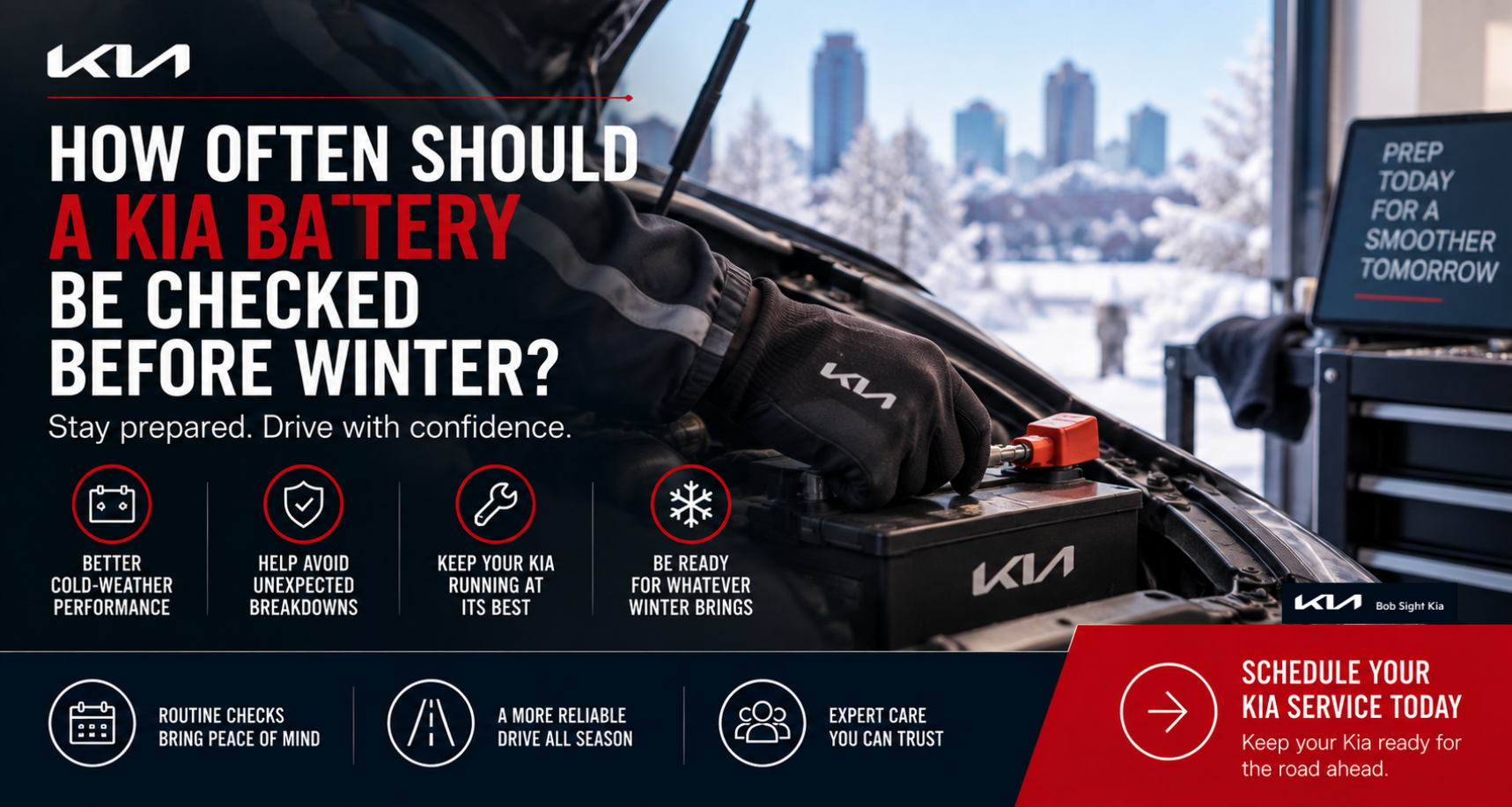
How to Tell if Your Kia Battery Is Weak Before First Kansas City Freeze

How to Tell if Your Kia Battery Is Weak Before the First Kansas City Freeze Cold mornings in Independence, Missouri, can make an aging car battery work harder than usual. If your Kia has been starting slowly, making clicking noises, or showing unusual electrical symptoms, it may be time to have the battery checked before winter temperatures arrive. Cold weather affects the amount of power a battery can deliver, while the engine may require more energy to start. A battery that performed normally throughout the summer can begin showing problems when temperatures drop. For drivers in Independence, Blue Springs, Lee's Summit, Raytown, and the greater Kansas City metro, recognizing these warning signs early can help reduce the chance of an unexpected no-start situation. At Bob Sight Kia, our service team helps local drivers maintain their vehicles throughout Missouri's changing seasons. Understanding how your battery works and when to request testing is a practical part of preparing your Kia for winter. Schedule Kia Battery Service at Bob Sight Kia What You'll Learn About Kia Battery Health How cold temperatures affect your Kia's 12-volt battery Common warning signs of a weak or discharged battery How short trips and driving habits affect battery performance What you can safely inspect at home Why choosing the correct replacement battery matters When to schedule professional battery and charging-system testing Why Cold Weather Can Make Your Kia Battery Struggle Cold weather slows the chemical reactions inside a conventional 12-volt lead-acid battery. As temperatures fall, the battery becomes less capable of delivering the electrical current needed to start the engine. According to AAA, freezing temperatures can significantly reduce a battery's available capacity. At the same time, colder engine oil can increase the amount of power needed to turn the engine over during startup. This combination creates additional strain on batteries that are already aging, undercharged, or experiencing internal wear. Why Battery Problems Often Appear After Summer Although winter is when many drivers discover battery problems, summer heat can contribute to the deterioration that causes them. High temperatures can accelerate internal corrosion and other chemical changes inside a lead-acid battery. Depending on the battery's construction, prolonged heat may also contribute to electrolyte loss. A battery weakened during a hot Kansas City summer may still provide enough power to start your Kia during mild fall weather. Once overnight temperatures begin approaching freezing, the reduced starting capacity becomes more noticeable. Cold weather does not automatically destroy a healthy battery. Instead, it can reveal weaknesses that were already developing. Five Warning Signs Your Kia Battery May Be Weak Battery problems do not always begin with a vehicle that refuses to start. Many drivers notice smaller changes in starting performance or electrical behavior first. 1. Your Kia Cranks More Slowly Than Normal One of the most recognizable signs of a weak battery is a slow engine crank. You may notice that the engine turns over more slowly than usual before starting. This can become more noticeable after your vehicle has been parked overnight during cold weather. Although a weak battery is one possible cause, starter problems, poor electrical connections, and other mechanical issues can produce similar symptoms. Testing helps identify the actual problem. 2. You Hear Clicking When Trying to Start the Engine A rapid clicking sound when attempting to start your Kia can indicate that the electrical system does not have enough available power to operate the starter properly. A discharged battery, corroded terminals, or loose electrical connections are possible causes. A single click without engine cranking can also point toward a starter-related problem. Rather than repeatedly attempting to start the vehicle, consider having the battery and starting system inspected. 3. Your Interior Lights or Electronics Behave Differently Low system voltage can sometimes cause unusual electrical behavior, including dim interior lights, unexpected infotainment resets, or other electronic interruptions during startup. However, these symptoms are not exclusive to battery problems. Wiring, charging-system, and individual component faults can also affect electrical performance. If several electrical symptoms begin appearing together, a professional inspection can help determine whether the battery is involved. 4. Your Battery or Charging-System Warning Light Appears The battery-shaped warning light on your dashboard generally relates to the vehicle's charging system. It does not automatically mean the battery itself needs replacement. If this warning light remains illuminated while driving, the alternator, charging controls, wiring, or another electrical component may not be functioning properly. A charging-system warning should be addressed promptly. If the system is not charging correctly, the vehicle may eventually lose electrical power or stop running. 5. Idle Stop and Go Stops Operating Some Kia vehicles are equipped with Idle Stop and Go technology, which can automatically shut off the engine during certain stops and restart it when needed. The system considers multiple operating conditions before activating. Battery state of charge is one factor, but cabin temperature demands, engine temperature, and other conditions can also affect operation. If Idle Stop and Go stops functioning along with slow starting or other electrical symptoms, battery testing may be worthwhile. How Short Trips Can Affect Your Kia Battery Frequent short drives can make it more difficult for a vehicle's charging system to replenish the energy used during engine startup. For example, drivers who primarily use their Kia for short trips around Independence, Raytown, or Sugar Creek may spend relatively little time driving between starts. The battery must provide power to start the engine, while the charging system works to restore that energy once the engine is running. When driving time is limited, the battery may not always return to a full state of charge. Repeated partial discharge can contribute to battery wear over time. Does Highway Driving Help Recharge a Weak Battery? Driving gives a properly functioning charging system an opportunity to replenish battery charge. However, there is no universal driving distance or time that guarantees a full recharge. Battery condition, temperature, electrical demand, and charging-system operation all affect how quickly a battery can recover. If your Kia frequently needs jump-starting or continues to crank slowly after normal driving, a longer trip is not a reliable solution. A battery test and charging-system inspection can help determine whether the battery needs charging, replacement, or further diagnosis. How to Check Your Kia Battery at Home You can look for several visible warning signs without performing complicated electrical testing. Before inspecting the battery, consult your Kia owner's manual for its location and any model-specific safety instructions. Not every Kia has a conventional 12-volt battery in the same location. Hybrid and electric models may have different battery arrangements and service procedures. Start With a Visual Inspection Park your Kia on level ground, switch the vehicle off, and engage the parking brake. Locate the 12-volt battery using your owner's manual. Look for visible damage, including cracks, swelling, or leaks. Check accessible terminals for corrosion or obvious connection problems without touching damaged components. If you notice damage, leaking fluid, or significant corrosion, arrange professional inspection rather than attempting repairs yourself. Do not attempt to open a sealed battery or handle leaking battery fluid. Battery electrolyte can be hazardous, and electrical connections should be serviced using appropriate safety procedures. Can You Test Battery Voltage With a Multimeter? A digital multimeter can provide useful information about the state of charge of a conventional 12-volt lead-acid battery when used correctly. After the battery has been at rest, a fully charged conventional lead-acid battery commonly measures approximately 12.6 volts or slightly higher, depending on its type and conditions. A substantially lower reading may indicate that the battery needs charging or further testing. However, voltage alone cannot confirm battery health. A battery can show a reasonable resting voltage while still being unable to deliver sufficient current during engine startup. For this reason, professional battery testing is more informative than relying on a single voltage measurement. Why Professional Kia Battery Testing Matters Professional battery testing helps determine whether a battery is simply undercharged or has lost enough performance to justify replacement. Depending on the vehicle and diagnostic equipment, a technician may evaluate battery voltage, state of charge, available starting performance, and the operation of the charging system. Testing can also help identify problems that resemble battery failure, including poor electrical connections or charging-system faults. Cold battery temperature can affect test results, so technicians may need to account for temperature and battery condition when evaluating performance. At Bob Sight Kia in Independence, drivers can schedule service to discuss starting problems, electrical concerns, or preventive winter battery maintenance. Schedule a Kia Battery Inspection AGM, EFB, and Conventional Batteries: Which Does Your Kia Need? Not every Kia uses the same type of 12-volt battery. The correct replacement depends on the vehicle's model, model year, engine or powertrain configuration, and original equipment requirements. Common automotive battery technologies include conventional flooded lead-acid batteries, Enhanced Flooded Batteries (EFB), and Absorbent Glass Mat (AGM) batteries. Conventional Flooded Lead-Acid Batteries Traditional flooded lead-acid batteries have been used in passenger vehicles for many years. They provide electrical energy for starting and other vehicle systems. Their suitability depends on the vehicle's electrical requirements and manufacturer specifications. Enhanced Flooded Batteries EFB batteries are designed to offer improved cycling performance compared with many conventional flooded batteries. They may be used in vehicles with increased electrical demands or certain engine stop-start systems. Absorbent Glass Mat Batteries AGM batteries use absorbent fiberglass separators to hold the electrolyte. They are designed to support demanding electrical applications and repeated charge-discharge cycles. Some Kia models may require AGM batteries, but AGM technology should not be assumed to be necessary for every Kia with Idle Stop and Go or every hybrid vehicle. Why Matching the Factory Battery Specification Matters When replacing a battery, the correct type, physical size, terminal configuration, and electrical ratings are important. Cold Cranking Amps (CCA) describe a battery's ability to provide starting current under standardized cold-temperature testing conditions. Reserve capacity is another specification that may be relevant to the vehicle's requirements. Installing a battery that does not meet the manufacturer's specifications can contribute to poor performance or compatibility problems. Consult your owner's manual or a qualified Kia service professional to identify the correct replacement battery for your vehicle. How Long Does a Kia Battery Usually Last in Missouri? Many conventional automotive 12-volt batteries last approximately three to five years, although actual service life varies. Battery quality, driving habits, climate, charging-system condition, and how often the vehicle is used can all affect longevity. In the Kansas City area, batteries experience both hot summer temperatures and freezing winter conditions. These seasonal changes can place additional demands on the battery over time. If your Kia's battery is approaching three years of service, periodic testing can provide useful information about its condition. An older battery does not automatically need replacement. Likewise, a newer battery can develop problems if it is repeatedly discharged or exposed to unfavorable conditions. Testing is the most practical way to make an informed replacement decision. How to Prepare Your Kia Battery for Winter Preparing for winter does not require complicated maintenance. A few preventive habits can help reduce unnecessary battery strain and make it easier to identify problems before cold weather arrives. Have an aging battery tested. If your battery is several years old or has shown starting problems, schedule an inspection before temperatures regularly fall below freezing. Limit unnecessary electrical use while parked. Avoid leaving interior lights or accessories operating for extended periods when the vehicle is off. Pay attention to starting behavior. Slow cranking, repeated clicking, or intermittent no-start conditions deserve attention. Address charging-system warnings promptly. A charging problem can leave the battery discharged even when the battery itself is in good condition. Consider a compatible battery maintainer for extended storage. If your Kia will remain parked for several weeks, consult the owner's manual about an appropriate maintenance charger and connection procedure. Follow your Kia maintenance recommendations. Proper engine oil, regular inspections, and timely repairs support reliable cold-weather operation. Parking in a garage may also help reduce exposure to very low temperatures. However, wind chill does not make an inanimate battery colder than the actual surrounding air temperature. Should You Replace Your Kia Battery Before Winter? Replacing a battery before winter may be appropriate if testing shows that it can no longer meet the vehicle's starting requirements. Replacement may also be necessary when a battery has visible damage, repeated failures, or internal deterioration confirmed through testing. However, replacing a battery solely because it is a certain age may not always be necessary. A professional inspection can help distinguish between an aging battery that remains serviceable and one that is likely to create starting problems. If the battery is healthy but frequently discharged, the underlying issue may involve driving habits, electrical draw, or the charging system. Other Winter Maintenance Items Worth Checking Your battery is only one part of preparing your Kia for Missouri winter driving. Before colder weather arrives, consider reviewing the condition of your tires, windshield wipers, engine oil, coolant, and other important maintenance items. Using the engine oil grade specified for your particular Kia helps support proper lubrication during cold starts. Tire pressure should also be checked regularly because pressure changes with temperature. Windshield wipers and washer fluid are important for maintaining visibility during snow, sleet, and freezing precipitation. Drivers commuting along Interstate 70, Highway 291, and other Kansas City-area roads can benefit from addressing these maintenance concerns before severe weather makes travel more difficult. For additional maintenance needs, visit the Bob Sight Kia Service Specials page to review available offers. Frequently Asked Questions About Kia Batteries Why does my Kia struggle to start when it's cold outside? Cold temperatures reduce the available starting performance of a conventional lead-acid battery while increasing the amount of power an engine may require to start. If the battery is aging, discharged, or experiencing internal wear, the reduced performance may become noticeable during freezing weather. However, starter problems, electrical connections, and other mechanical issues can also cause difficult starting. Testing is recommended when the problem continues. Does a clicking sound mean my Kia battery is dead? Not necessarily. Rapid clicking can occur when there is insufficient electrical power available to operate the starter properly. A weak or discharged battery is a common possibility, but poor cable connections and starter-related problems can produce similar symptoms. A battery and starting-system inspection can help identify the cause. Can I safely jump-start my Kia? Many conventional gasoline-powered Kia vehicles can be jump-started when the correct procedures are followed. However, jump-starting instructions vary by model and powertrain. Some hybrid and electric vehicles have special 12-volt battery procedures or designated jump-start terminals. Always consult your vehicle's owner's manual before attempting a jump-start. Never attempt to jump-start a battery that appears frozen, leaking, or physically damaged. If you are uncertain about the procedure, roadside assistance is a safer option. Will replacing my Kia battery reset my vehicle settings? Disconnecting a 12-volt battery can reset certain electronic settings on some vehicles. Depending on the Kia model and model year, this may affect clock settings, window functions, stored information, or other electronic features. Some vehicles also have battery replacement or initialization procedures that should be followed. Consult your owner's manual or a qualified service professional for instructions specific to your Kia. Can a completely discharged Kia battery freeze? Yes. A severely discharged conventional lead-acid battery can become more vulnerable to freezing because the electrolyte's composition changes as the battery loses charge. Freezing can damage internal components or the battery case. If you suspect a battery is frozen, do not attempt to charge or jump-start it. Have the battery inspected and follow appropriate safety procedures. How often should I have my Kia battery tested? Testing becomes increasingly useful as a battery ages or begins showing symptoms such as slow cranking, intermittent starting problems, or repeated discharge. Many drivers choose to include battery testing in their regular maintenance routine, particularly before winter. The appropriate testing interval depends on the battery's condition, age, and operating history. Can I replace my Kia battery myself? Battery replacement procedures vary by vehicle. Some conventional Kia models have relatively accessible 12-volt batteries, while others may require additional precautions, equipment, or initialization procedures. Hybrid and electric vehicles can have more specialized electrical systems. Before attempting replacement, consult the owner's manual and confirm the correct battery specification. Professional replacement is a practical option when the procedure is unfamiliar or the battery is difficult to access. Schedule Kia Battery Service in Independence, MO If your Kia has been slow to start, has needed repeated jump-starts, or is showing unusual electrical symptoms, having the battery checked before winter can help you understand what your vehicle needs. Bob Sight Kia serves drivers throughout Independence, Blue Springs, Lee's Summit, Raytown, Sugar Creek, Grain Valley, and the greater Kansas City metro. Our service department can assist with battery concerns and other maintenance needs to help you prepare for changing Missouri weather. Visit Bob Sight Kia at 1700 S Noland Road, Independence, MO 64055, or use our online scheduling tool to request a service appointment. Schedule Service at Bob Sight Kia Helpful Kia Service and Shopping Links Schedule Kia Service in Independence, MO View Kia Service Specials Browse New Kia Inventory Shop Used Vehicles at Bob Sight Kia Value Your Trade Explore the Bob Sight Auto Group Bob Sight Kia is part of the Bob Sight Auto Group, serving drivers across the Kansas City metro and northeast Kansas. Our dealership locations offer vehicle sales, service, and automotive resources for drivers throughout the region. Bob Sight Kia | Independence, MO Bob Sight Ford | Lee's Summit, MO Bob Sight Honda | Lawrence, KS Bob Sight CDJR | Lawrence, KS Trust Is Our Tradition.
Frustrated by morning low tire pressure alerts? Learn the science behind cold weather PSI drops and how to keep your Kia safe in Jackson County.

Why Your Kia Tire Pressure Drops Overnight During Missouri Winters

Why Your Kia Tire Pressure Drops Overnight During Missouri Winters If you have ever started your Kia on a cold Missouri morning and noticed the tire pressure warning light on your dashboard, you are not alone. Falling overnight temperatures can cause tire pressure to decrease, even when your tires do not have a puncture or other mechanical problem. For drivers in Independence, Blue Springs, Lee's Summit, Raytown, and the greater Kansas City metro, changing temperatures are a familiar part of fall and winter driving. A warm afternoon can quickly turn into a freezing night, leaving your tires with less pressure than they had the day before. Understanding why this happens, how your Kia's Tire Pressure Monitoring System (TPMS) works, and when to have your tires inspected can help you maintain proper inflation throughout the winter. At Bob Sight Kia in Independence, Missouri, our service department helps drivers with tire maintenance, inspections, and other seasonal vehicle care needs. Schedule Kia Tire Service in Independence, MO What You'll Learn About Winter Tire Pressure Why tire pressure decreases when temperatures fall How your Kia's tire pressure warning system works How to check and adjust tire pressure correctly When low pressure may indicate a puncture or slow leak How underinflation affects tire wear and vehicle handling What Kia AWD owners should know about tire maintenance When to schedule a professional tire inspection Why Does Tire Pressure Drop When It Gets Cold? Tire pressure changes with temperature because the gas inside a tire responds to changes in heat. As temperatures decrease, the gas molecules move more slowly, reducing the pressure they exert inside the tire. A commonly used automotive guideline is that tire pressure changes by approximately 1 PSI for every 10-degree Fahrenheit change in temperature. The actual change depends on the tire's starting pressure and other conditions. For example, if your Kia's tires measure 35 PSI during a 50-degree afternoon in Independence, a drop to 20 degrees overnight could lower the pressure by approximately 3 PSI. This does not necessarily mean air escaped from the tires. The pressure may have changed because the tires and the gas inside them became colder. Why Missouri Temperature Changes Make TPMS Warnings Common During fall and winter, the Kansas City metro can experience significant temperature differences between daytime and overnight conditions. These changes can affect tire pressure while your Kia is parked in a driveway, garage, or outdoor parking lot. If the tires were already slightly below their recommended cold inflation pressure, a sudden temperature drop may be enough to activate the dashboard warning light. Even when the warning disappears later in the day, checking the tires with an accurate pressure gauge remains important. How Your Kia Tire Pressure Monitoring System Works Your Kia's Tire Pressure Monitoring System is designed to alert you when tire pressure becomes significantly low. Depending on the model and model year, the system may use sensors that measure pressure at individual wheels. Some Kia vehicles also provide individual tire pressure readings through the instrument cluster. When the system detects pressure below its warning threshold, a yellow tire-shaped symbol with an exclamation point may illuminate on the dashboard. Federal TPMS requirements use a threshold based on pressure being 25 percent below the manufacturer's recommended cold inflation pressure or a specified minimum pressure, whichever is higher. The actual warning behavior can vary by vehicle and system design. Because TPMS is intended to warn drivers about significantly low pressure, it should not replace routine checks with a tire pressure gauge. Why Your TPMS Light May Turn Off After Driving As your Kia moves, normal tire flexing generates heat. This causes the gas inside the tires to warm, which can increase the measured pressure. If the pressure rises above the warning threshold, the TPMS light may turn off. However, this does not necessarily mean the tires have returned to the correct cold inflation pressure. Once the vehicle is parked and the tires cool again, pressure may decrease and the warning may return. The best solution is to check the pressure when the tires are cold and adjust it according to your Kia's recommended specifications. How to Check Your Kia Tire Pressure Correctly Checking tire pressure regularly is one of the simplest ways to maintain your tires and recognize potential problems before they become more serious. The National Highway Traffic Safety Administration recommends checking tire pressure at least once a month when the tires are cold. A tire is generally considered cold when the vehicle has not been driven for at least three hours. Always consult your owner's manual for model-specific instructions. Step 1: Find Your Kia's Recommended Tire Pressure Open the driver's door and locate the Tire and Loading Information label, typically found on the driver's doorjamb or nearby pillar. This label provides the manufacturer's recommended cold inflation pressure for your vehicle. The recommended pressure may differ between the front and rear tires, depending on the model. Do not use the maximum pressure molded into the tire sidewall as your normal inflation target. That number is not the same as the vehicle manufacturer's recommended operating pressure. Step 2: Measure Pressure With an Accurate Gauge Remove the valve stem cap and press a tire pressure gauge firmly against the valve. Read the pressure and compare it with the recommended cold PSI listed on your vehicle's tire information label. Repeat the process for each tire. If your Kia has a spare tire that requires inflation, check its pressure according to the owner's manual as well. Step 3: Add Air When Needed If a tire is below the recommended pressure, use an air compressor to add air gradually. Check the pressure again after adding air to avoid overinflation. If the tires are warm because you have already driven, follow the owner's manual guidance and recheck the pressure when the tires are cold. Do not release air from a warm tire simply because its pressure is higher than the cold inflation recommendation. Tire pressure normally increases as tires warm during driving. Step 4: Replace the Valve Stem Caps After checking the pressure, reinstall the valve stem caps. Valve caps help protect the valve opening from dirt, road debris, and moisture. Keeping the valves clean is a simple part of maintaining your tires during Missouri's winter months. Step 5: Check Whether the Warning Light Clears After correcting tire pressure, the TPMS warning may clear once the system recognizes the updated readings. Some Kia models may require driving for the system to update, while other vehicles have different procedures. Consult your Kia owner's manual rather than relying on a universal driving speed or reset time. If the warning remains illuminated after proper inflation, or if it flashes and then stays on, arrange a professional inspection. How to Tell the Difference Between Cold Weather Pressure Loss and a Tire Leak Cold temperatures can reduce pressure in all four tires, but a puncture or other mechanical problem can also cause pressure loss. One way to identify a possible issue is to compare the pressure readings across your tires. Signs of Normal Temperature-Related Pressure Changes Several tires show similar pressure reductions after a temperature drop. Pressure changes correspond with colder outdoor conditions. The tires maintain pressure after being adjusted to the recommended cold PSI. No visible damage or repeated pressure loss is present. These signs may suggest that the change is temperature-related, although they do not completely rule out a leak. Signs Your Kia May Have a Slow Tire Leak One tire repeatedly loses more pressure than the others. You need to add air to the same tire every few days. A nail, screw, or other object is visible in the tread. The tire has visible sidewall damage, bulging, or an unusual shape. Pressure continues decreasing even after proper inflation. Possible causes include tread punctures, valve problems, wheel damage, or leakage around the tire bead where the tire meets the wheel. Winter potholes and road debris around Independence and the Kansas City metro can contribute to these problems. If one tire consistently loses pressure, a professional inspection can help determine whether it can be repaired or needs replacement. Why Driving With Low Tire Pressure Can Be Dangerous Proper tire inflation supports vehicle handling, tire durability, and fuel efficiency. When a tire is underinflated, its sidewall can flex more than intended during driving. Excessive flexing can increase internal heat buildup and contribute to premature tire damage. Underinflation can also affect steering response, tire wear patterns, and vehicle stability. These concerns become more important during winter when drivers may already be dealing with snow, slush, ice, and reduced traction. Uneven Tire Wear Underinflated tires may experience increased wear near the outer shoulders of the tread. Over time, uneven wear can shorten the useful life of the tires and reduce their ability to perform as intended. Maintaining proper inflation helps support more consistent tread contact and wear. Changes in Handling and Braking Incorrect tire pressure can affect how a vehicle responds to steering and braking inputs. However, tire pressure is only one factor in winter traction. Tire condition, tread depth, tire design, road surface, and driving speed also play important roles. Proper inflation does not eliminate the risks associated with icy or snow-covered roads. Reduced Fuel Efficiency Underinflated tires can increase rolling resistance, which may require the vehicle to use more energy while driving. Maintaining the manufacturer's recommended pressure helps support efficient vehicle operation. For Kia drivers commuting between Independence, Blue Springs, and Kansas City, routine tire checks are a practical part of maintaining the vehicle throughout the year. Should You Add Extra Tire Pressure During Winter? In normal circumstances, the goal is to maintain the manufacturer's recommended cold tire pressure listed on your Kia's tire information placard. It is not necessary to automatically add several extra PSI simply because winter is approaching. If you check your tires outdoors after they have been parked long enough to cool, adjust them to the recommended cold inflation pressure. There is one important distinction: if you inflate tires inside a warm garage before driving into much colder outdoor temperatures, the pressure may decrease as the tires cool. Your owner's manual may provide guidance for accounting for that temperature difference. Avoid guessing at an extra inflation amount. Use the instructions appropriate for your vehicle and recheck the tires under cold outdoor conditions. Does Nitrogen Prevent Tire Pressure Drops in Winter? Some tire shops offer nitrogen inflation as an alternative to conventional compressed air. Nitrogen can reduce the rate of gradual pressure loss through tire materials under certain conditions. However, nitrogen-filled tires still experience pressure changes when temperatures rise or fall. Research from Consumer Reports has found that the practical difference in pressure retention between nitrogen and conventional air is relatively small for everyday passenger vehicle use. Regular compressed air is suitable for normal tire maintenance when used according to the vehicle manufacturer's recommendations. Whether your tires contain nitrogen or compressed air, you should continue checking their pressure regularly. Proper inflation matters more than the choice between these two inflation gases for most everyday Kia drivers. Kia All-Wheel Drive and Proper Tire Pressure If your Kia is equipped with all-wheel drive, maintaining the correct tire pressure and monitoring tread wear are important parts of routine maintenance. Models such as the Kia Sportage AWD and Sorento AWD use systems that distribute driving power based on vehicle operating conditions. Incorrect tire pressure can affect tire rolling characteristics and vehicle handling. Significant differences in tire size or tread wear may also create concerns for certain AWD systems. However, minor tire pressure differences do not automatically mean the AWD system will engage incorrectly or experience mechanical damage. The most practical approach is to follow the recommended cold inflation pressures for each axle and maintain tires according to the vehicle manufacturer's instructions. Why Tire Rotation Matters for AWD Kia Vehicles Regular tire rotation helps distribute wear across the tires. Depending on driving conditions and vehicle design, front and rear tires may wear at different rates. Rotating the tires at the intervals specified in your Kia maintenance schedule can help promote more even tread wear. The correct rotation pattern and service interval may vary by model, tire configuration, and drivetrain. If you are unsure when your tires were last rotated, a service appointment is a good opportunity to review their condition. How Often Should You Check Tire Pressure During Missouri Winters? NHTSA recommends checking tire pressure at least once a month. During periods of significant temperature changes, checking more frequently can help you identify pressure reductions before the dashboard warning activates. Consider checking your tires after a substantial overnight temperature drop, before a longer road trip, or whenever the TPMS warning appears. A reliable tire pressure gauge is a useful item to keep in your vehicle. Even if your Kia displays individual tire pressure readings, checking the tires with a gauge provides an additional way to monitor inflation. Don't Forget Tire Tread Depth Before Winter Tire pressure is important, but it is not the only factor affecting winter driving performance. Tread depth plays a major role in how effectively tires move water and slush away from the contact area. As tires wear, their ability to maintain traction in wet and snowy conditions can decline. The federal minimum tread depth for many passenger vehicle tires is 2/32 of an inch. However, winter traction can become less effective before tires reach that minimum. Drivers who frequently encounter snow or slush may benefit from discussing tire replacement before tread depth becomes critically low. Also inspect tires for cracking, bulges, uneven wear, and other visible damage. A professional tire inspection can help you understand whether your current tires are suitable for the conditions you expect to encounter. Frequently Asked Questions About Kia Tire Pressure in Winter Why does my Kia tire pressure light come on every cold morning? Cold overnight temperatures can reduce the pressure inside your tires. If the tires were already near the TPMS warning threshold, a temperature drop may cause the warning light to illuminate. Check all tires when cold and inflate them to the recommended pressure listed on the driver's doorjamb label. If the warning continues returning after proper inflation, have the tires inspected for leaks or other problems. Why does my tire pressure light turn off after driving? As your tires warm during driving, the internal pressure can increase. That increase may cause the warning light to turn off if the pressure rises above the system's warning threshold. However, the tires may still be underinflated when cold. Check and adjust their cold pressure rather than relying on the warning light disappearing. Can I drive my Kia with the low tire pressure light on? A low tire pressure warning should be addressed promptly. If the tire is visibly flat, severely underinflated, damaged, or causing unusual vehicle handling, do not continue driving. Stop in a safe location and arrange appropriate assistance. If the tires appear normal, check their pressure as soon as it is safe to do so. Do not assume that a tire is safe simply because it does not look flat. Whether continued driving is appropriate depends on the actual pressure, tire condition, and vehicle behavior. Should all four Kia tires have the same PSI? Not necessarily. Some vehicles have different recommended pressures for front and rear tires. Always follow the specifications listed on your Kia's Tire and Loading Information label. Do not assume that every Kia model uses the same pressure or that all four tires must always have identical readings. Why does only one of my Kia tires keep losing air? If one tire repeatedly loses pressure while the others remain stable, a slow leak may be present. Possible causes include a puncture, valve stem issue, wheel damage, or leakage around the tire bead. Have the tire inspected to determine whether it can be repaired safely. Does nitrogen keep Kia tires from losing pressure in cold weather? No. Nitrogen-filled tires still experience temperature-related pressure changes. Nitrogen may reduce gradual pressure loss through tire materials, but it does not eliminate the need for regular inflation checks. Conventional compressed air is suitable for normal tire maintenance when used correctly. How long should I drive to reset my Kia TPMS light? The procedure depends on the Kia model and model year. Some systems recognize corrected pressure after driving, while others may require different steps. Consult your owner's manual for the correct procedure. If the warning remains active after proper inflation, schedule a tire or TPMS inspection. Can potholes cause slow tire leaks? Yes. Hitting a pothole can damage a tire, wheel, or the sealing area between the tire and wheel. Damage may result in immediate pressure loss or a slower leak that becomes noticeable over time. If your Kia begins losing pressure after hitting a pothole, have the affected tire and wheel inspected. Schedule Kia Tire Service in Independence, MO Cold weather tire pressure changes are common throughout Missouri, but recurring warnings should not be ignored. Checking your tires regularly, following the recommended cold inflation pressure, and addressing possible leaks can help maintain your Kia's tire condition throughout winter. Bob Sight Kia serves drivers from Independence, Blue Springs, Lee's Summit, Raytown, Sugar Creek, Grain Valley, and the greater Kansas City metro. If your Kia's TPMS warning keeps returning, one tire repeatedly loses pressure, or you have questions about tire maintenance, our service department can help you determine the next steps. Visit Bob Sight Kia at 1700 S Noland Road, Independence, MO 64055, or schedule your service appointment online. Schedule Tire Service at Bob Sight Kia Helpful Kia Service and Shopping Links Schedule Kia Service in Independence, MO Explore Kia Service Specials Browse New Kia Inventory Shop Used Vehicles Value Your Trade at Bob Sight Kia Explore the Bob Sight Auto Group Bob Sight Kia is part of the Bob Sight Auto Group, serving drivers throughout the Kansas City metro and northeast Kansas with automotive sales and service resources. Bob Sight Kia | Independence, MO Bob Sight Ford | Lee's Summit, MO Bob Sight Honda | Lawrence, KS Bob Sight CDJR | Lawrence, KS Trust Is Our Tradition.
Know when Kia brake pads need replacement, common warning signs, and brake wear factors for Independence and Kansas City drivers.

When Should Kia Brake Pads Be Replaced? Warning Signs and Brake Wear for Independence Drivers

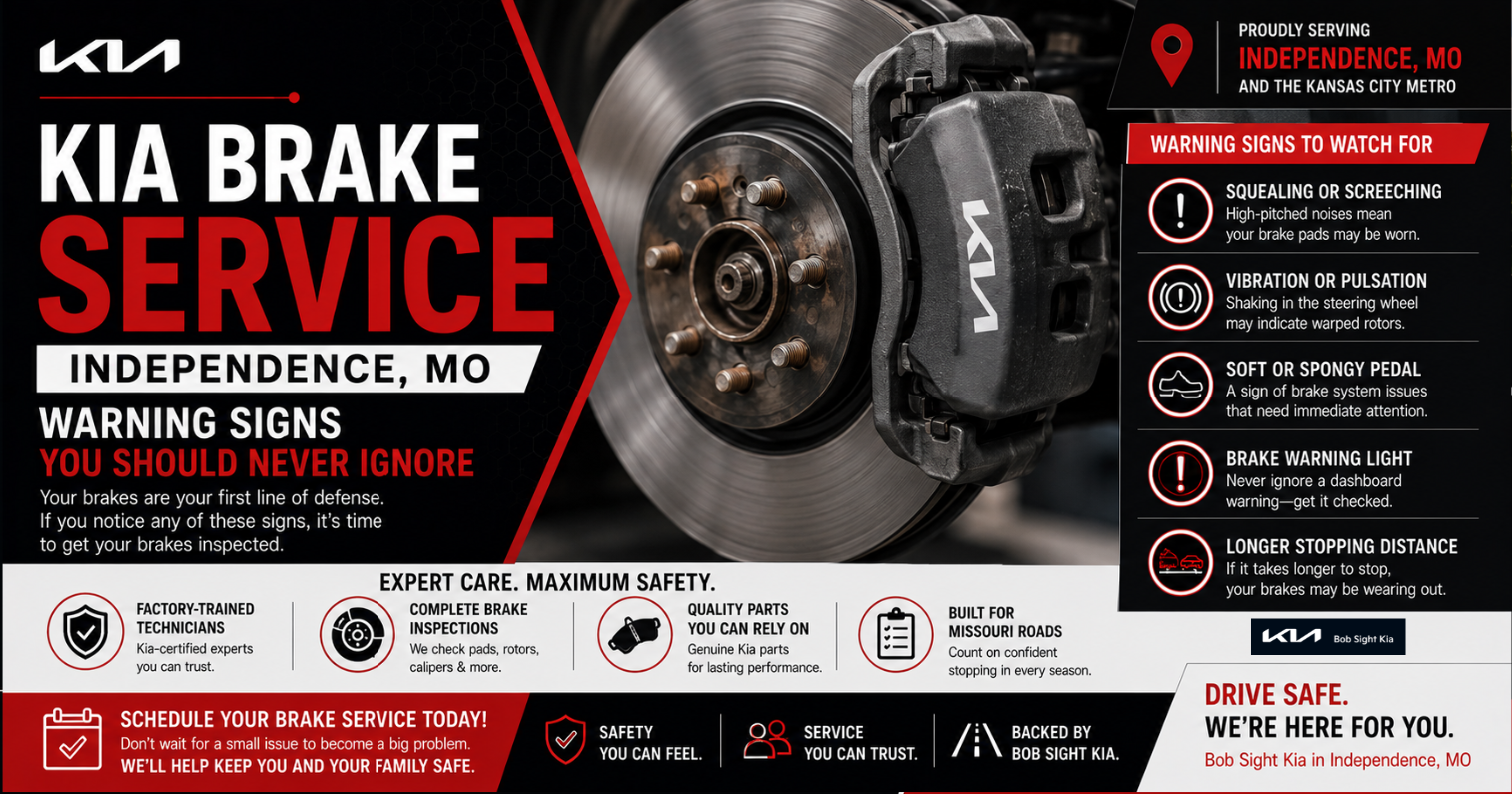
When Should Kia Brake Pads Be Replaced? Warning Signs and Brake Wear for Independence Drivers Kia brake pads should be replaced when they become worn enough that braking performance, rotor protection, or safe stopping can be affected, rather than according to one universal mileage interval. Driving habits, traffic conditions, vehicle weight, road conditions, and the type of driving you do around Independence and the Kansas City Metro can all influence how quickly brake pads wear. Drivers who spend a lot of time in stop-and-go traffic along I-70, US-40, or busy streets near Independence Center may use their brakes differently from someone whose routine involves longer stretches of highway driving. Regular brake inspections are therefore one of the best ways to determine when your Kia actually needs new brake pads. Schedule Kia brake service at Bob Sight Kia in Independence In This Guide You'll Learn This guide explains the warning signs of worn Kia brake pads, what affects brake wear, and how Independence drivers can decide when it is time to schedule a brake inspection. Why Kia brake pads do not have one universal replacement mileage Common warning signs that brake pads may be wearing out How brake pad thickness relates to replacement timing Why Kansas City traffic can affect brake wear How brake pads, rotors, calipers, and brake fluid work together What happens during a Kia brake inspection How to plan brake maintenance before longer trips or seasonal driving When Should Kia Brake Pads Be Replaced? Kia brake pads should generally be replaced based on their remaining friction material, braking behavior, and inspection results rather than automatically at a specific mileage. Brake pads are wear components, meaning they gradually lose friction material every time the brakes are applied. Two identical Kia vehicles can therefore require brake pad replacement at very different mileage depending on how they are driven. A driver commuting through frequent traffic lights and congestion in Independence may experience faster brake wear than someone who spends most of the week cruising at a steady speed. This is why mileage should be treated as a reminder to inspect the braking system rather than a guaranteed replacement schedule. A Kia with frequent city use, school drop-offs, short errands, or repeated stop-and-go driving may use its brake pads more aggressively. Highway driving generally requires fewer braking events, although sudden stops, heavy traffic, hills, and vehicle loading can still affect wear. Even the driver's habits matter because gradual braking usually generates different wear patterns than repeatedly braking hard at the last moment. The most reliable approach is to have brake pad thickness and the surrounding brake components inspected periodically. A technician can evaluate how much friction material remains, whether the inner and outer pads are wearing evenly, and whether the rotors show signs of scoring, excessive heat, or uneven contact. Caliper operation can also affect how quickly pads wear. If one pad is substantially more worn than another, the issue may involve more than simply installing a new set of pads. Independence drivers should also pay attention between scheduled maintenance visits. Changes in pedal feel, stopping behavior, brake noise, vibration, or warning lights deserve attention even if the vehicle has relatively low mileage. If something about braking suddenly feels different while driving near Noland Road, US-24, I-70, or anywhere else around Jackson County, scheduling a professional inspection is a better strategy than waiting for an assumed mileage milestone. What Are the Most Common Signs of Worn Kia Brake Pads? Common signs that Kia brake pads may need attention include squealing or grinding noises, increased stopping distance, brake pedal changes, vibration during braking, and visible brake wear warnings. Not every sound automatically means the brake pads must be replaced, but a noticeable change in how the braking system sounds or feels should not be ignored. Brakes are a safety-critical system, so unusual symptoms deserve inspection rather than guesswork. A high-pitched squeal during braking can occur when a wear indicator contacts the brake rotor or when certain operating conditions cause vibration between braking surfaces. Occasional noise can also result from moisture, road debris, temperature changes, or surface rust after the vehicle has been parked. The concern increases when squealing becomes persistent, occurs during most stops, or is accompanied by a change in braking performance. Grinding is more urgent because it can indicate that the friction material has worn significantly or that another braking component is contacting the rotor abnormally. Pedal feel also matters. If your Kia suddenly requires more pedal travel, feels unusually soft, feels harder than normal, or seems to require more effort to slow down, have the braking system inspected. A pulling sensation under braking can indicate uneven braking force, although tires, suspension components, alignment, or road conditions can sometimes produce similar sensations. Steering wheel or pedal vibration during braking may point toward rotor irregularities or other brake-system concerns rather than brake pads alone. Independence drivers should use the following warning signs as reasons to schedule an inspection: Listen for persistent squealing, scraping, or grinding when braking. Notice whether the vehicle seems to take longer to slow down. Pay attention to changes in brake pedal feel or travel. Watch for vibration through the steering wheel or brake pedal. Take brake or ABS warning lights seriously. Schedule an inspection if braking behavior changes suddenly or consistently. If you notice any of these symptoms during a commute through Blue Springs, Raytown, Lee's Summit, or Independence, avoid assuming the cause based on noise alone. A proper inspection can identify whether the issue involves brake pads, rotors, calipers, brake fluid, tires, or another component of the braking system. How Does Brake Pad Thickness Affect Replacement Timing? Brake pad thickness is one of the most useful measurements for determining brake wear because it shows how much friction material remains between the braking surface and the pad backing plate. New brake pads begin with substantially more friction material than worn pads, and that material gradually decreases as the vehicle is driven. A technician can measure remaining thickness during an inspection and use that information along with wear patterns and braking performance to determine whether replacement is needed. The friction material is the portion of the pad designed to press against the brake rotor when the brake pedal is applied. That contact creates friction, which converts the vehicle's motion into heat and slows the vehicle. As the friction material gets thinner, there is less usable material remaining before the pad reaches the end of its service life. Waiting until virtually no friction material remains can increase the risk of damaging the rotor and other components. Brake-pad replacement decisions should not rely on thickness alone, however. A pad may have some friction material remaining while still showing abnormal wear, cracking, contamination, glazing, or uneven contact. Inner and outer pads can also wear at different rates if a caliper slide, piston, or related component is not operating correctly. That is why visually checking only the outside pad through the wheel does not always provide a complete picture of brake condition. For drivers searching for Kia brake pad replacement in Independence, Missouri, the more useful question is not simply how many miles are on the vehicle. Ask how much usable pad material remains and whether the entire braking system is wearing evenly. A professional inspection at Bob Sight Kia can evaluate the pads alongside the rotors, calipers, hardware, and other components that influence braking performance. This creates a more complete maintenance decision than replacing parts according to mileage alone. Why Can Kansas City Driving Cause Brake Pads to Wear at Different Rates? Brake pad wear around the Kansas City Metro can vary significantly because stop-and-go traffic, short urban trips, hills, weather changes, and driving habits all change how often and how aggressively the brakes are used. A vehicle that repeatedly accelerates and stops through city traffic may accumulate brake wear differently from one covering the same number of miles on open highways. Mileage therefore tells only part of the brake-maintenance story. Consider two Kia owners who each drive 10,000 miles in a year. One spends much of that mileage commuting along relatively open highway routes, while the other makes repeated short trips through Independence, school zones, shopping areas, and busy intersections. The second vehicle may experience far more braking events even though both odometers increase by the same amount. Frequent deceleration creates repeated friction and heat cycles at the brake pads and rotors. Kansas City weather also adds variables. Rain can reduce road traction, winter moisture can contribute to surface corrosion on exposed braking components, and temperature swings can change how the vehicle behaves at the beginning of a drive. Road salt and winter debris can accumulate around suspension, wheel, and brake components. None of these conditions automatically means brake pads will fail early, but they make periodic visual inspections valuable for drivers who keep their vehicles through several Missouri seasons. Driving style plays a major role as well. Leaving more following distance allows a driver to slow gradually instead of applying the brakes heavily at the last moment. Anticipating traffic lights and congestion can reduce repeated hard stops. On a busy afternoon near the I-70 and I-470 corridors, simply allowing additional space ahead can reduce how often aggressive braking is required. These differences explain why a fixed mileage estimate cannot predict brake-pad life for every Kia in Independence. The best maintenance plan combines routine inspections with awareness of your actual driving conditions. Drivers who regularly face dense Kansas City traffic, frequent short trips, heavy passenger loads, or repeated urban stopping may want to pay closer attention to brake condition than drivers whose routes involve less braking. Brake Pads vs. Rotors: What Is the Difference? Brake pads are replaceable friction components that press against brake rotors, while the rotors are metal discs attached to the wheel hubs that provide the surface the pads clamp against to slow the vehicle. The two components work together every time you press the brake pedal. Understanding the difference can help Kia owners make sense of a brake inspection and understand why sometimes pads are replaced alone while other repairs may involve both pads and rotors. When the driver presses the brake pedal, hydraulic pressure helps the brake caliper move the brake pads toward the rotor. Friction between the pads and rotor slows wheel rotation and creates heat. The pads are designed to wear gradually as part of normal operation. Rotors are more durable, but they are also subject to wear and can develop scoring, thickness variation, heat spots, corrosion, or other surface problems over time. A worn brake pad does not automatically mean every rotor needs replacement. A technician should examine rotor condition and determine whether it remains serviceable. At the same time, continuing to drive after brake pads are excessively worn can damage a rotor that might otherwise have remained usable longer. This is one reason addressing brake-pad wear before grinding begins can help protect more of the braking system. Brake Component Primary Function What Technicians Check Brake Pads Create friction against the rotor Thickness, even wear, glazing, cracking, contamination Brake Rotors Provide the braking surface Surface condition, wear, scoring, heat damage, thickness Brake Calipers Apply the pads to the rotors Movement, leaks, piston operation, slide operation Brake Fluid Transfers hydraulic force through the system Condition, level, leaks, maintenance requirements For Kia owners in Independence, understanding these components can also make service recommendations easier to evaluate. If a brake inspection identifies worn pads plus rotor damage, ask which condition was observed and how it affects the repair recommendation. A brake service should be based on the condition of the system rather than automatically assuming every component needs replacement. What Happens During a Kia Brake Inspection? A Kia brake inspection should evaluate more than whether the vehicle still stops because technicians need to examine brake pad wear, rotor condition, caliper operation, brake-fluid concerns, and other components that affect braking performance. A vehicle can continue stopping while a component is beginning to wear abnormally. Identifying that wear before a severe symptom develops can make brake maintenance easier to plan. The inspection process often begins with the symptoms reported by the driver. If you hear a noise only during the first stop of the morning, only while turning, or only after highway driving, tell the technician. Details such as speed, weather, pedal feel, and whether the sound comes from the front or rear can help narrow down the concern. A vague description such as "the brakes sound weird" gives less diagnostic information than describing when and how the symptom occurs. A brake inspection may then include several steps: Review the driver's concern. Explain noises, vibration, pedal changes, or stopping differences you have noticed. Inspect brake pad condition. Remaining friction material and wear patterns can be evaluated. Check rotor surfaces. Rotors can be inspected for scoring, heat damage, corrosion, or other visible concerns. Inspect caliper operation and hardware. Uneven pad wear can sometimes point toward a problem with movement or contact. Check for leaks or fluid-related concerns. Hydraulic braking components should not be ignored during a comprehensive evaluation. Discuss findings before repairs. Ask what is worn, what requires attention now, and what can continue to be monitored. This process is useful whether your Kia is used primarily for commuting along I-70, family driving around Blue Springs, or short errands throughout Independence. It also allows technicians to distinguish normal brake wear from a symptom caused by another component. Drivers can schedule Kia service online when a brake inspection is needed. Should You Replace Kia Brake Pads Before They Start Grinding? Brake pads should ideally be inspected and replaced before persistent grinding develops because grinding can indicate that the friction material is severely worn or that metal components are contacting surfaces they should not. Waiting for grinding to become the replacement signal can increase the possibility of additional brake-system damage. Earlier inspection gives drivers more information and more time to plan appropriate service. A squeal and a grind are not the same sound. Squealing is generally higher-pitched and can have several possible causes, including brake wear indicators, vibration, moisture, or surface conditions. Grinding is typically harsher and should be treated more urgently. If braking suddenly sounds metallic or rough, continuing to drive extensively without inspection is not a good maintenance strategy. Rotor protection is one reason timing matters. Brake pads are designed as wear items, while rotors provide the braking surface the pads contact. When the pad's usable friction material becomes excessively thin, the relationship between those components changes. Addressing brake wear before severe contact develops can reduce the likelihood that a simple wear issue turns into a more extensive repair involving additional components. Drivers should also remember that brake symptoms do not always develop in a predictable order. One vehicle may produce noticeable noise while another may show changes in braking feel first. Some drivers may notice no dramatic warning until an inspection reveals significant wear. Relying exclusively on sound therefore is not a substitute for periodic inspection. If your Kia begins grinding while traveling near Independence Center, along Noland Road, or elsewhere in the Kansas City Metro, arrange for the braking system to be evaluated promptly. If the vehicle's braking performance feels significantly reduced or unsafe, avoid continuing to drive it. Safety should take priority over trying to reach a preferred service destination under uncertain braking conditions. How Can Kia Owners Help Reduce Unnecessary Brake Wear? Kia owners can help reduce unnecessary brake wear by maintaining appropriate following distance, anticipating traffic, avoiding repeated aggressive stops, and keeping the vehicle's braking and tire systems properly maintained. Brake pads will always wear because friction is required to stop the vehicle, but driving technique can influence how quickly that wear occurs. Smooth, predictable braking can also make everyday driving more comfortable for passengers. Following distance is one of the simplest factors drivers can control. When you leave adequate space between your Kia and the vehicle ahead, you have more time to slow gradually instead of braking sharply. This can be useful during rush-hour traffic on I-70 or when approaching congestion near busy Independence shopping corridors. Constantly accelerating toward stopped traffic and then braking heavily creates more frequent heat cycles than anticipating the slowdown earlier. Vehicle loading matters as well. A Kia carrying several passengers and a full cargo area requires the braking system to manage more mass than the same vehicle with only the driver aboard. This does not mean families should avoid using their Kia's passenger or cargo capacity. It simply means drivers should account for increased weight by allowing additional following distance and braking smoothly. Tires also affect the overall stopping process. Even perfectly maintained brakes depend on the tires to maintain contact with the road. Proper inflation, adequate tread, and appropriate tire condition are therefore part of braking safety. During Missouri rain, winter precipitation, or cold weather, reduced road traction can increase stopping distance even when the brake system itself is operating normally. Routine inspection ties all of these habits together. Rather than trying to maximize brake-pad life at all costs, focus on predictable braking performance and appropriate maintenance. Brake pads are designed to wear. The goal is to identify normal wear at the right time, catch abnormal wear early, and maintain the entire braking system so it works consistently throughout everyday Kansas City driving. Quick Facts About Kia Brake Pad Replacement Kia brake-pad replacement timing depends primarily on actual wear and brake condition rather than one fixed mileage number for every vehicle. Drivers can make better maintenance decisions by combining routine inspections with awareness of braking symptoms and everyday driving conditions. Brake pads are normal wear components and gradually lose friction material during use. There is no single universal replacement mileage that applies to every Kia and every driving pattern. Frequent city and stop-and-go driving can create more braking events than steady highway travel. Persistent squealing can justify inspection even if braking still feels normal. Grinding should be addressed promptly because it may indicate severe wear or abnormal contact. Brake-pad thickness is an important measurement, but technicians should also evaluate wear patterns. Uneven pad wear can indicate a concern involving calipers, hardware, or another component. Brake rotors and pads work together but do not automatically require replacement at the same time. Changes in pedal feel, stopping distance, vibration, or warning lights deserve professional evaluation. Tire condition and road traction also influence how effectively a vehicle can stop. For Independence drivers, these facts are more useful than choosing an arbitrary replacement interval. A Kia used daily in traffic around Jackson County may experience a very different brake-wear pattern from one driven primarily on longer highway trips. Inspection allows maintenance decisions to be based on the actual vehicle instead of a generic estimate. Ownership Planning for Kia Brake Maintenance in Independence The best long-term brake-maintenance strategy is to include brake inspections in your overall Kia ownership plan instead of waiting until severe noise or reduced braking performance appears. Brake pads are easier to monitor when their condition is checked periodically alongside other routine vehicle maintenance. This can also help drivers understand whether wear is progressing normally or whether one wheel is wearing differently from the others. Seasonal changes provide useful opportunities to think about braking condition. Before winter, drivers may already be checking tires, battery condition, wiper blades, and other systems affected by cold weather. Adding brake inspection to that maintenance conversation can be useful because winter roads increase the importance of predictable braking and healthy tires. Spring can also be a good time to look for corrosion or wear after months of exposure to moisture, road treatment, and fluctuating temperatures. Long trips deserve similar planning. If you are preparing to leave Independence for a road trip and the vehicle has developed brake noise, vibration, or another symptom, addressing it before departure is more useful than hoping the issue remains unchanged for hundreds of miles. Heavy luggage and additional passengers can increase vehicle weight, while unfamiliar routes may involve hills, congestion, or repeated braking. Keep maintenance records as well. Knowing when brake pads, rotors, tires, and brake fluid were previously inspected or serviced provides useful context at future appointments. Documentation can make it easier to identify how quickly components are wearing and whether a pattern has changed over time. Bob Sight Kia owners can also review available service and parts specials when planning maintenance. Brake service should still be based on the actual condition of the vehicle, but organizing maintenance ahead of time can make ownership more predictable. The goal is not to replace brake pads early without reason. It is to know their condition before they become an urgent repair. Frequently Asked Questions About Kia Brake Pad Replacement How many miles do Kia brake pads usually last? There is no single mileage at which every Kia needs brake-pad replacement because brake wear depends heavily on driving conditions and vehicle use. Two Kia vehicles with similar mileage can have significantly different remaining brake-pad material. Stop-and-go driving, aggressive braking, traffic density, passenger and cargo weight, road conditions, and individual driving habits all influence wear. Mileage is still useful as maintenance context. If a vehicle has accumulated substantial mileage since its last brake inspection, it makes sense to have pad condition checked even if no obvious symptom has appeared. The inspection provides actual information about remaining friction material and wear patterns rather than relying on a generalized mileage estimate. Independence drivers who spend considerable time navigating traffic lights, school zones, shopping districts, and Kansas City congestion may experience a different wear pattern from drivers who primarily use open highway routes. Ask for the condition of the pads to be evaluated during routine service so you can track wear over time. Why are my Kia brakes squeaking if the pads are not worn out? Brake squeaking can occur for reasons other than worn-out pads, including moisture, light surface corrosion, brake dust, vibration, temperature changes, or characteristics of the pad and rotor surfaces. Noise alone does not prove that brake pads need replacement. Persistent or worsening noise should still be inspected because wear indicators or other brake conditions can also cause squealing. For example, a Kia parked outside overnight may develop light surface oxidation on the brake rotors after rain or humid weather. The first few stops may make noise as the pads clean that surface. A brief morning squeak that disappears can therefore be different from a sound that occurs every time the brake pedal is applied. Missouri's changing weather can make occasional brake noise more noticeable, but drivers should not dismiss persistent symptoms as weather-related without inspection. If squealing continues during normal driving around Independence or Blue Springs, schedule a brake evaluation so the source can be identified. Do Kia brake pads and rotors need to be replaced together? Brake pads and rotors do not automatically have to be replaced together because each component should be evaluated based on its condition and service requirements. Pads are designed to wear as friction material is consumed. Rotors are also subject to wear, but their replacement needs depend on factors such as thickness, surface condition, heat damage, scoring, and manufacturer specifications. If brake pads are replaced while the rotors remain in appropriate condition, the technician may determine that rotor replacement is unnecessary. In other cases, damaged or excessively worn rotors may need attention at the same time as the pads. The correct approach depends on inspection findings rather than a blanket rule. When discussing Kia brake service in Independence, ask what the technician observed on both the pads and rotors. Understanding which component is worn and why a particular repair is recommended helps drivers make better-informed maintenance decisions. Can I keep driving if my Kia brakes are grinding? Persistent grinding should be treated as a reason for prompt brake-system inspection rather than something to continue driving on indefinitely. Grinding can indicate severe brake-pad wear or another condition involving abnormal contact within the braking system. Continuing to drive may increase damage and can affect braking performance. If the vehicle still appears to stop, that does not confirm that the braking system is in good condition. Braking components can deteriorate while the vehicle retains some stopping capability. Waiting for braking performance to become dramatically worse is not a safe maintenance strategy. If grinding is accompanied by significantly reduced stopping ability, a brake warning light, unusual pedal behavior, or another serious symptom while driving in the Kansas City Metro, prioritize safety. Avoid continuing to operate a vehicle that does not feel safe to stop and have the condition properly evaluated. Where can I schedule Kia brake service near Kansas City? Drivers can schedule Kia brake service at Bob Sight Kia in Independence, Missouri, serving Kia owners throughout eastern Jackson County and the Kansas City Metro. An inspection can help determine whether the pads are worn, whether the rotors need attention, and whether another braking component is responsible for a noise or performance concern. Before your appointment, note when the symptom occurs. Tell the service team whether you hear the noise during light braking, hard braking, the first stop of the day, highway driving, or every stop. Also mention vibration, pulling, pedal changes, or warning lights. These details can make the diagnostic process more efficient. Drivers from Blue Springs, Raytown, Grain Valley, Lee's Summit, Liberty, and surrounding communities can use the Bob Sight Kia online service scheduler to request an appointment. Brake service should be based on the condition of your specific vehicle rather than a generic replacement schedule. Schedule Kia Brake Service in Independence, Missouri If your Kia is squealing, grinding, vibrating, taking longer to stop, or showing another change in braking behavior, a professional brake inspection can identify whether the pads or another component need attention. Brake-pad replacement is most effective when it is based on actual wear rather than waiting for a severe symptom or following a mileage estimate that may not match your driving habits. Driving conditions around Independence and the Kansas City Metro can place very different demands on braking systems. Frequent traffic along I-70, short trips through eastern Jackson County, school pickups, crowded shopping areas, and changing Missouri weather all create different braking patterns. Understanding those patterns helps drivers recognize why their vehicle may require brake service sooner or later than another Kia with similar mileage. Bob Sight Kia in Independence can inspect brake-pad condition, rotor surfaces, calipers, and related components to help determine what your Kia actually needs. Routine inspection also gives owners an opportunity to track wear before braking symptoms become disruptive. Whether you commute from Blue Springs, drive into Kansas City, or spend most of your time close to home in Independence, maintaining predictable braking performance should remain part of your long-term ownership plan. Helpful Links Schedule Kia Service Kia Service and Parts Specials Kia Parts Department Bob Sight Kia Explore New Kia Vehicles Proud to Be Part of the Bob Sight Auto Group Bob Sight Kia in Independence is proud to be part of the Bob Sight Auto Group, serving drivers throughout the Kansas City Metro with vehicle sales, service, parts, and collision support. Whether you are maintaining your current Kia, researching your next vehicle, or looking for automotive resources close to home, the Bob Sight Auto Group serves communities throughout the greater Kansas City and Lawrence areas with a long-standing commitment to local drivers. Trust Is Our Tradition. Bob Sight Honda Bob Sight CDJR Bob Sight Ford Bob Sight Kia Bob Sight Collision Center

Kia service technician inspecting tire tread at Bob Sight Kia in Independence, Missouri

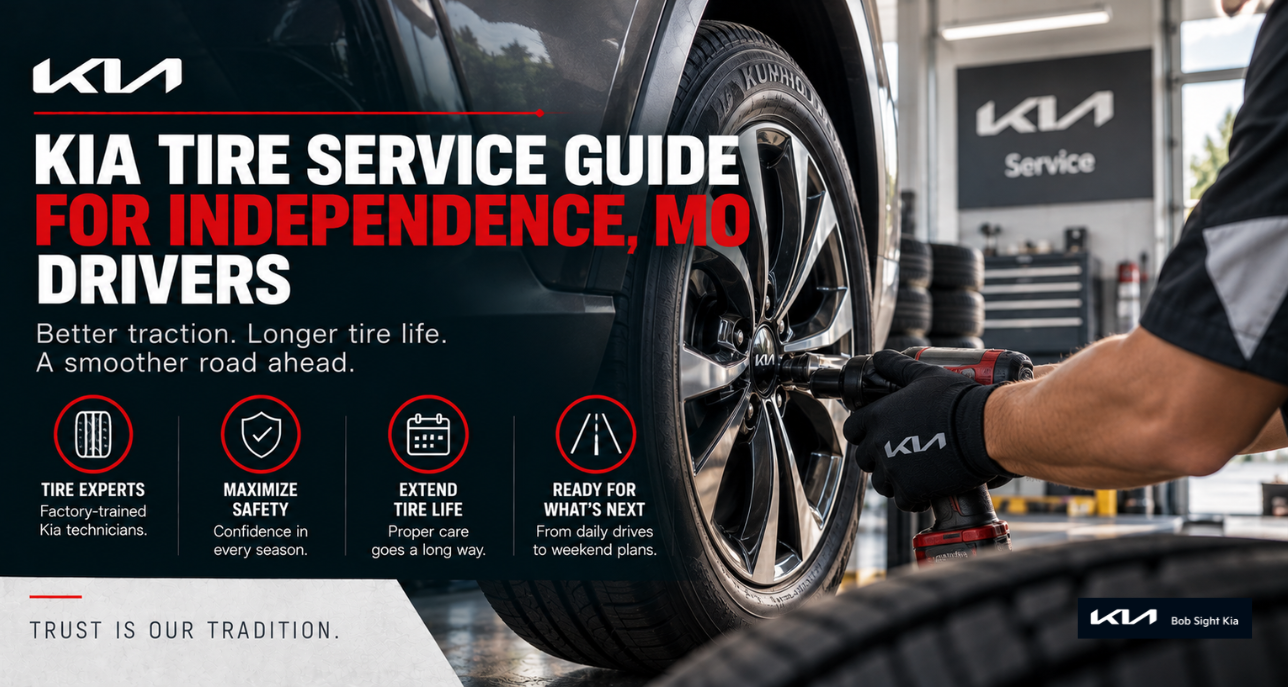
Kia Tire Service Guide for Independence, MO Drivers

Kia Tire Service Guide for Independence, MO Drivers Your Kia’s tires affect nearly every drive through Independence and the Kansas City Metro. They influence steering response, braking, ride comfort, traction, fuel efficiency, and how confidently your vehicle handles changing Missouri weather. Routine Kia tire service can also help tires wear more evenly and reduce the chance that preventable damage interrupts your commute. Drivers searching for Kia tire service near me can visit Bob Sight Kia in Independence, Missouri, for tire inspections, rotations, balancing, alignment service, and replacement guidance. Our service center is located at 1700 South Noland Road and serves Kia owners from Independence, Blue Springs, Lee’s Summit, Raytown, Grain Valley, Sugar Creek, Liberty, Oak Grove, and communities across Jackson County. This guide explains when to schedule tire service, how to check your tires at home, what common wear patterns mean, and how Missouri driving conditions can affect tire performance. Why Is Routine Kia Tire Service Important? Routine Kia tire service supports safer handling, more predictable braking, a smoother ride, and longer-lasting tires. Tires are your vehicle’s direct point of contact with the road. When tire pressure, tread depth, balance, or alignment is incorrect, the vehicle may not respond as designed. Regular tire maintenance gives a technician an opportunity to identify wear before it becomes a more expensive or inconvenient problem. A simple inspection may uncover low pressure, a puncture, sidewall damage, uneven tread, or an alignment concern. Addressing these issues early can help protect the tire and other related components. Properly maintained tires can support: More consistent traction on dry and wet roads Predictable steering and braking response More even tread wear Reduced vibration at highway speeds Better ride quality Improved fuel efficiency Longer useful tire life Tire condition becomes even more important during heavy rain, summer heat, freezing temperatures, and sudden winter weather. Independence drivers regularly encounter all of these conditions throughout the year. Routine tire care also provides a chance to review how your tires are wearing relative to your driving habits. Frequent stop-and-go traffic, highway commuting, potholes, construction areas, and heavily loaded trips may all affect tire life. How Often Should Kia Tires Be Rotated? Kia owners should follow the tire rotation interval listed in the maintenance schedule for their exact model, year, powertrain, and tire configuration. Many drivers coordinate tire rotations with scheduled maintenance visits, but the correct interval should always come from the vehicle’s owner’s manual. Tire rotation changes each tire’s position on the vehicle. Front and rear tires often perform different jobs and may wear at different rates. On many vehicles, the front tires handle a larger share of steering and braking forces. Rotating the tires according to the recommended pattern can help distribute wear more evenly. The proper rotation pattern may depend on: Front-wheel drive, all-wheel drive, or rear-wheel drive Directional or non-directional tires Matching or staggered tire sizes Full-size spare tire availability Tire manufacturer instructions Vehicle-specific maintenance requirements Not every tire can be moved to every position. Directional tires, for example, are designed to rotate in a particular direction. Vehicles with different front and rear tire sizes may have additional restrictions. A Kia service technician can identify the proper pattern for your vehicle. You may need a tire inspection before the normal maintenance interval if you notice vibration, pulling, uneven wear, pressure loss, or unusual road noise. Tire service intervals should be treated as a baseline, not a reason to ignore a developing symptom. Owners can review vehicle-specific information through the official Kia owner’s manual resource or ask the service team at Bob Sight Kia for guidance. How Do You Check Tire Pressure Correctly? Check tire pressure when the tires are cold and use the pressure listed on the vehicle’s tire information label, not the number printed on the tire sidewall. The placard is commonly located on the driver’s doorjamb and lists the recommended cold inflation pressure for the original tire configuration. The pressure molded into a tire’s sidewall represents tire information and limits. It is not the normal inflation target for your particular Kia. Always use the vehicle manufacturer’s recommended pressure unless a qualified professional has provided configuration-specific instructions. Follow these steps to check tire pressure: Park the vehicle and allow the tires to cool. Locate the tire information placard on the driver’s doorjamb. Remove the valve cap from the first tire. Press a reliable tire pressure gauge firmly onto the valve stem. Compare the reading with the recommended cold pressure. Add air if the pressure is low. Release a small amount of air if the pressure is too high. Recheck the tire to confirm the final reading. Replace the valve cap and repeat the process on the remaining tires. Check the spare tire if your Kia includes one. The National Highway Traffic Safety Administration recommends checking tire pressure regularly, including before longer trips. A monthly check is a useful habit because tires can gradually lose air even when no obvious puncture is present. Temperature changes also affect tire pressure. A noticeable drop in outdoor temperature may cause the tire pressure monitoring system light to appear. Adding air based on the vehicle placard can correct normal seasonal pressure loss, but a tire that repeatedly loses air should be inspected for a puncture, valve issue, wheel damage, or sealing problem. Do not rely only on appearance. A tire may be underinflated without looking visibly low. A pressure gauge provides a much more reliable assessment. What Do Common Kia Tire Wear Patterns Mean? Uneven tire wear can point to pressure problems, alignment concerns, balance issues, worn suspension components, or delayed rotations. The location and shape of the wear provide useful clues, but a professional inspection is the best way to determine the cause. Wear Along Both Outer Edges Wear on both shoulders of a tire can be associated with underinflation. Driving while a tire is underinflated may cause the outer portions of the tread to carry more of the load. It can also increase heat buildup and rolling resistance. Wear Through the Center Excessive center tread wear may be linked to overinflation. When a tire carries too much pressure, the center of the tread may make greater contact with the road than the shoulders. Wear on One Edge Heavy wear on the inner or outer edge may indicate an alignment or suspension concern. A vehicle that pulls to one side or has an off-center steering wheel should be inspected. Cupping or Scalloped Wear Alternating high and low areas around the tread may be associated with balance problems, worn suspension parts, or another condition that allows the tire to move irregularly against the road. Flat Spots A localized flat area can develop after hard braking, prolonged storage, or certain tire and suspension conditions. Some temporary flat spotting may improve as the tire warms, while persistent vibration requires attention. Rapid Wear on One or Two Tires If one tire is wearing much faster than the others, do not assume rotation alone will solve the problem. A technician should check inflation, alignment, balance, suspension condition, and tire damage. Drivers can perform a quick visual check at home, but tread wear should be evaluated across the full width and circumference of each tire. Inner-edge wear may be difficult to see without the vehicle being lifted. When Does a Kia Need Wheel Alignment Service? Your Kia may need an alignment inspection when it pulls, the steering wheel sits off-center, or the tires develop uneven edge wear. Wheel alignment refers to the angles at which the wheels meet the road. Those angles help the tires track correctly and maintain consistent contact with the pavement. Alignment can change after hitting a pothole, striking a curb, driving through road construction, or encountering other impacts. Normal wear in steering and suspension components can also contribute to alignment changes over time. Common signs of a potential alignment problem include: The vehicle pulls left or right on a reasonably level road The steering wheel appears crooked while driving straight One tire edge wears faster than the other The vehicle feels less stable than normal Steering response has changed New tires begin wearing unevenly A vehicle may still need an alignment even if the driver does not feel a strong pull. Small changes can appear first as unusual tread wear. That is one reason tire inspections are useful during routine maintenance. An alignment is different from tire balancing. Alignment adjusts wheel angles, while balancing addresses weight distribution around the tire and wheel assembly. A Kia can need one service without needing the other, or it may benefit from both. Independence and Kansas City-area roads can be challenging after winter freeze-and-thaw cycles. Potholes along local streets or major routes such as I-70, I-435, Missouri Route 291, and U.S. Route 40 may place additional stress on tires, wheels, and suspension components. What Is Tire Balancing and When Is It Needed? Tire balancing helps the wheel and tire assembly rotate evenly and can reduce vibration, irregular wear, and stress on related components. During balancing service, a technician measures weight distribution and installs small wheel weights where needed. A tire and wheel assembly can become imbalanced as the tire wears. Balance can also change after tire installation, wheel repairs, impact damage, or the loss of a wheel weight. Possible signs of an imbalance include: Steering wheel vibration at certain speeds Vibration felt through the seat or floor Uneven or cupped tread wear A change in ride smoothness Vibration that becomes more noticeable on the highway Vibration has several possible causes, so balancing should not be treated as an automatic diagnosis. Tire damage, bent wheels, alignment concerns, suspension wear, debris buildup, and drivetrain issues can create similar symptoms. If your Kia begins vibrating after hitting a pothole or road hazard, safely reduce speed and arrange an inspection. A hard impact can damage more than balance. It may affect the tire structure, wheel, alignment, or suspension. Balancing is commonly performed when new tires are installed. It may also be recommended when a tire is repaired and remounted or when symptoms indicate that the assembly no longer rotates smoothly. When Should Kia Tires Be Replaced? Kia tires should be replaced when tread is worn to an unsafe or legally insufficient level, damage cannot be safely repaired, age has become a concern, or the tires no longer meet the vehicle’s needs. Tire replacement should be based on condition, age, performance, and professional evaluation rather than mileage alone. Replacement may be necessary when you find: Tread worn to the built-in wear indicators Cracks, cuts, bulges, bubbles, or exposed material A puncture outside a repairable tread area Repeated air loss Uneven wear that has significantly reduced usable tread Damage caused by driving while underinflated Age-related deterioration Persistent vibration linked to tire damage Treadwear indicators are raised bars located within the tread grooves. When the surrounding tread wears level with these bars, replacement is needed. Drivers should not wait for completely smooth tread. Wet-weather and winter traction can decline before the tire reaches its final wear limit. Tire age matters because rubber and internal materials change over time. The Department of Transportation identification code on the sidewall includes the tire’s production date. The final four digits identify the week and year of manufacture. For example, a code ending in 2425 indicates production during the 24th week of 2025. Age guidelines can vary by manufacturer, tire design, vehicle use, storage, climate, and condition. Ask a qualified technician to evaluate older tires rather than relying on appearance alone. If only one or two tires require replacement, the correct placement and compatibility depend on the vehicle and drivetrain. All-wheel-drive Kia models may have limits on acceptable tread-depth differences because the tires work together as part of the drivetrain. Consult the owner’s manual and a Kia service professional before mixing tires with substantially different wear levels. Are All-Season Tires Enough for Independence, Missouri? Quality all-season tires meet the needs of many Independence drivers, but all-weather or winter tires may provide added cold-weather capability for certain driving routines. The best choice depends on road conditions, commute timing, driving frequency, and whether you can delay travel during severe weather. All-season tires are designed to provide balanced performance in a range of conditions. They are a common choice for drivers who travel mainly on treated city streets and highways. However, their snow and ice performance varies by model. All-weather tires generally provide stronger winter capability than traditional all-season designs while remaining suitable for year-round use. Tires carrying the three-peak mountain snowflake symbol meet a specific performance standard for severe snow conditions. Dedicated winter tires use tread compounds and patterns designed for cold temperatures, snow, and ice. They may be worthwhile for: Drivers who must commute before roads are cleared Healthcare, public safety, and other essential workers Households that frequently travel on untreated roads Drivers who make regular winter trips outside the metro Owners who want the strongest available cold-weather traction All-wheel drive can help a vehicle accelerate in low-traction conditions, but it does not replace appropriate tires. Braking and cornering still depend heavily on tire grip. A front-wheel-drive vehicle with suitable winter tires may provide more controlled stopping than an all-wheel-drive vehicle on worn or unsuitable tires. Missouri drivers should also consider rain performance. Adequate tread helps move water away from the tire’s contact area. Worn tread can increase the risk of hydroplaning, making routine inspections valuable throughout the year rather than only before winter. How Can Independence Drivers Help Their Tires Last Longer? Maintaining correct pressure, scheduling rotations, correcting alignment problems, and avoiding unnecessary impacts can help extend tire life. Tire longevity depends on many factors, but consistent maintenance gives each tire a better opportunity to wear evenly. Use this tire-care routine: Check tire pressure at least monthly and before long trips. Use the cold pressure listed on the vehicle placard. Inspect the tread and sidewalls for visible damage. Schedule rotations according to the vehicle maintenance schedule. Investigate pulling, vibration, or steering changes promptly. Have alignment checked when uneven wear appears. Avoid striking curbs and slow down for unavoidable road hazards. Do not exceed the vehicle’s load rating. Keep service records for rotations, alignments, and repairs. Arrange seasonal inspections before demanding travel periods. Driving style can also influence tire life. Hard acceleration, abrupt braking, aggressive cornering, and high-speed impacts create additional stress and heat. Smooth inputs generally support more even wear. Vehicle loading matters as well. Carrying excessive weight can increase tire stress and change handling. Consult the tire and loading label or owner’s manual before carrying a heavy load or towing. Do not ignore a pressure warning light after adding air. If the same tire loses pressure again, it needs an inspection. Continuing to drive on an underinflated tire can create heat and internal damage that may not be visible from outside. Can a Punctured Kia Tire Be Repaired? Some punctures in the main tread area can be repaired, but sidewall damage, shoulder punctures, large holes, and tires driven while severely underinflated may require replacement. A technician must remove and inspect the tire to determine whether a safe repair is possible. A proper evaluation considers: The location of the puncture The size and angle of the damage Whether the tire was driven while low or flat Internal liner and structural condition Existing repairs Tread depth and overall tire age An external plug alone does not allow a technician to inspect the inside of the tire. Industry-accepted repair procedures commonly involve removing the tire from the wheel, inspecting it internally, and sealing both the injury channel and inner liner when the damage qualifies. If a tire suddenly loses pressure while driving: Hold the steering wheel firmly. Avoid abrupt braking or sharp steering. Reduce speed gradually. Move to a safe location away from traffic. Activate the hazard lights. Use roadside assistance if changing the tire would be unsafe. Have the damaged tire professionally inspected. Never crawl under a vehicle supported only by an emergency jack. Follow the vehicle owner’s manual for spare tire and lifting instructions. Why Choose Bob Sight Kia for Tire Service? Bob Sight Kia provides Kia-focused tire care, convenient online scheduling, and service guidance tailored to local driving conditions. Our service team can inspect your tires while considering how pressure, tread, balance, alignment, suspension condition, and driving habits work together. Available tire-related services may include: Tire inspections Tire rotations Wheel balancing Wheel alignment service Pressure checks and adjustments Tire pressure monitoring system evaluation Repairability assessments Replacement tire guidance Seasonal tire evaluations Using a Kia dealership for tire service can be convenient because technicians can evaluate the tires alongside the vehicle’s steering, suspension, braking, and electronic systems. The service department also has access to vehicle-specific information and manufacturer-informed procedures. Before booking, review the current Kia service and parts specials. Offers and eligibility can change, so read the current terms and confirm details with the dealership. Drivers can schedule Kia tire service online at a convenient time. When making the appointment, describe any pulling, vibration, pressure loss, noise, or recent road impact so the service team understands the concern. Frequently Asked Questions About Kia Tire Service Regular pressure checks, rotations, inspections, balancing, and alignment care form the foundation of Kia tire maintenance. The following answers address common questions from Independence-area drivers. How often should I check the tire pressure on my Kia? Checking tire pressure at least once a month and before longer trips is a practical routine. Measure pressure when the tires are cold and use the specification on the driver’s doorjamb label. If one tire repeatedly loses pressure, schedule an inspection rather than continuing to add air. How do I know if my Kia needs a tire rotation? Follow the maintenance schedule for your exact Kia model and year. You should also request an inspection if the front and rear tires appear to be wearing at different rates, you notice unusual road noise, or you are unsure when the last rotation was completed. What is the difference between balancing and alignment? Balancing corrects uneven weight distribution in a tire and wheel assembly. Alignment adjusts the angles at which the wheels meet the road. Vibration may suggest a balance issue, while pulling or one-sided tread wear may indicate an alignment concern, though a professional inspection is needed for an accurate diagnosis. Can all-wheel drive prevent tire slipping in winter? All-wheel drive can help a Kia accelerate when traction is limited, but it cannot replace suitable tires or careful driving. Turning and braking still depend on available tire grip. Adequate tread depth and a tire designed for the conditions remain important. Where can I get Kia tire service near me in Independence? Bob Sight Kia offers tire service at 1700 South Noland Road in Independence, Missouri. The dealership serves drivers from Blue Springs, Lee’s Summit, Raytown, Grain Valley, Sugar Creek, Liberty, Oak Grove, Jackson County, and the Greater Kansas City Metro. Schedule Kia Tire Service in Independence, MO Schedule tire service when your Kia needs a rotation, pressure check, balance, alignment inspection, repair assessment, or replacement tires. Taking action when symptoms first appear can help protect tire life and maintain predictable vehicle performance. Bob Sight Kia is conveniently located on South Noland Road near I-70 and is accessible to drivers throughout eastern Jackson County. Whether you drive a Kia Sportage, Sorento, Telluride, Seltos, Carnival, K4, K5, Niro, EV6, or EV9, our team can help you understand the tire requirements for your vehicle. Visit the Bob Sight Kia Service Center to learn more, or use our online service scheduler to request an appointment. Trust Is Our Tradition. Helpful Links Schedule Kia Service Explore the Bob Sight Kia Service Center View Service and Parts Specials Learn About Lifetime Oil Changes and Tire Rotations Find Your Kia Owner’s Manual Proud to Be Part of the Bob Sight Auto Group Bob Sight Kia is proud to be part of the family-owned Bob Sight Auto Group, serving vehicle shoppers and owners throughout the Kansas City region and Northeast Kansas. Families researching new or used vehicles can rely on Bob Sight Auto Group for new and pre-owned vehicle sales, trade-in resources, auto financing, certified service, parts, and collision repair. Bob Sight Kia - Independence, MO Bob Sight Ford - Lee’s Summit, MO Bob Sight Honda - Lawrence, KS Bob Sight CDJR - Lawrence, KS Bob Sight Collision Center - Lee’s Summit, MO

Bob Sight Kia service technician conducting a digital cold weather battery check in Independence MO

Kia Battery Check Independence MO: Pre-Winter Service Guide

How Often Should a Kia Battery Be Checked Before Winter? A Kia battery should be professionally tested at least once in early autumn before freezing temperatures arrive across Jackson County, and ideally twice per year during scheduled maintenance. Winter weather across the Kansas City Metro places tremendous physical and electrical demands on automotive starting systems. Sudden drops in outdoor temperature can instantly reduce a battery's cold-cranking capacity by up to 50 percent while engine oil thickens, requiring significantly more electrical energy to start your vehicle. At Bob Sight Kia, our service department near Noland Road helps local drivers in Independence, Blue Springs, Lee's Summit, and Raytown stay ahead of unexpected vehicle breakdowns with quick digital battery health tests, professional terminal cleaning, and factory-certified replacement battery installations. Schedule Your Pre-Winter Kia Battery Inspection at Bob Sight Kia In This Guide You'll Learn This comprehensive cold-weather battery guide walks you through essential maintenance schedules and winter care strategies for your Kia vehicle: Recommended inspection intervals for Kia car batteries ahead of Midwest winter weather How extreme summer heat damages internal battery components before winter cold hits Key warning signs indicating your battery is near the end of its functional life Step-by-step breakdown of a professional digital battery test at Bob Sight Kia Comparing AGM vs standard flooded lead-acid batteries for modern Kia models Preventative care steps for keeping battery terminals clean and free of corrosion How winter electrical demands from heaters, defrosters, and seat warmers affect charging Long-term vehicle maintenance strategies to ensure reliable starting performance year-round Recommended Battery Testing Frequency for Jackson County Drivers Automotive service experts recommend inspecting your Kia battery twice per year, with a primary focus on a comprehensive pre-winter health test in early autumn. While many vehicle owners assume winter cold is the primary cause of battery failure, summer heat is actually what causes chemical breakdown inside lead-acid batteries. High ambient temperatures during Missouri July and August days evaporate internal electrolyte fluids and accelerate grid corrosion. When cold weather hits in November, weakened batteries simply lack the necessary power reserve to start the engine, leading to unexpected morning stalls. For drivers navigating daily commutes along Interstate 70, US-40, or I-470, a battery check should be part of every routine oil change visit. If your battery is more than three years old, increasing inspection frequency to every three to four months is highly advisable. Having a technician test state-of-charge, voltage retention, and cold-cranking amps (CCA) ensures you are never stranded in a cold parking lot at Independence Center or during early morning commutes across eastern Jackson County. Checking your battery early in the autumn season allows ample time to select an OEM-recommended replacement if needed. At Bob Sight Kia, our service center near E 23rd St S uses specialized diagnostic equipment to evaluate your battery under simulated electrical loads, giving you an accurate picture of remaining battery life before freezing winter weather arrives. How Winter Weather Affects Your Kia Battery Performance Freezing Midwest temperatures create a challenging combination of reduced battery chemical output and increased engine starting resistance. At 32 degrees Fahrenheit, a standard 12-volt car battery loses approximately 20 percent of its total starting power. When temperatures plunge to 0 degrees Fahrenheit, available battery output drops by roughly 50 percent. At the exact same time, engine oil becomes viscous and slow-flowing, forcing the starter motor to draw significantly more amperage to turn over internal engine components. Furthermore, winter driving habits place heavier demands on your vehicle's electrical system. Drivers routinely operate high-draw accessories simultaneously, including front and rear glass defrosters, cabin heating fans, heated seats, heated steering wheels, and headlight units during shorter winter daylight hours. If your commute consists of short trips around Raytown or Grain Valley, your alternator may not have sufficient runtime to fully replenish the energy drawn during startup. To help visualize how cold weather impacts starting power and electrical demand, review the temperature reference table below: Outdoor Temperature Available Battery Starting Power Engine Starting Effort Required Battery Risk Level 80°F (Ideal Operating Temp) 100% Full Power Output Normal Baseline Effort Low Risk 32°F (Freezing Point) 80% Power Capacity Available Increased Oil Viscosity / Moderate Effort Moderate for Older Batteries 0°F (Extreme Winter Cold) 50% Power Capacity Available High Resistance / Double Effort High Risk for 3+ Year Old Batteries Below -10°F (Severe Freeze) Less than 40% Power Output Extreme Mechanical Strain Critical Risk of Freezing Discharged Units Understanding this relationship explains why batteries that seemed functional in September often fail completely on the first freezing morning in December. Regular testing at Bob Sight Kia ensures your battery maintains the cold-cranking capacity needed for reliable Midwest driving. Clear Warning Signs That Your Kia Battery Needs Immediate Service Recognizing early warning indicators of a degrading battery allows you to address power issues before being stranded on a freezing morning in Independence. Modern Kia vehicles rely heavily on stable electrical voltage to power advanced engine management computers, safety sensors, and infotainment systems. Subtle electrical glitches are frequently early indicators of battery health decline. Key warning signs to monitor in your Kia Telluride, Sorento, Sportage, or K4 include: Slow or Hesitant Engine Crank: When turning the key or pressing the push-button start, the engine turns over sluggishly or takes longer than usual to catch. Dimming Interior or Headlight Output: Headlights flicker or appear noticeably dimmer while idling at stoplights near Sterling Avenue, returning to full brightness only when accelerating. Clicking Sounds Upon Ignition: Hearing a rapid clicking noise when attempting to start the vehicle indicates the starter solenoid is receiving insufficient voltage from the battery. Dashboard Battery Warning Light: The red battery-shaped illumination light remains lit on your instrument panel, indicating a charging system malfunction or failing battery. Corrosion Build-Up or Swollen Casing: White, blue, or powdery green crust accumulates on the battery terminals, or the plastic battery case appears bulged due to internal heat damage. If you notice any of these warning signs while driving in Liberty or Sugar Creek, visit Bob Sight Kia immediately for a quick diagnostic health check. What Happens During a Professional Battery Inspection at Bob Sight Kia A professional battery inspection at Bob Sight Kia involves an advanced multi-step evaluation using factory-certified diagnostic equipment. Rather than relying on simple voltage meters that measure surface charge, our technicians evaluate battery performance under active electrical load conditions. The inspection process includes several thorough steps: Visual Terminal and Casing Inspection: Technicians check the plastic battery housing for cracks, leaks, or swelling. We inspect cable clamps, hold-down brackets, and terminal posts for corrosion or looseness. Digital Conductance & Voltage Testing: Using specialized Kia diagnostic tools, we measure exact open-circuit voltage and internal resistance to determine overall charge capacity. Cold-Cranking Amp (CCA) Measurement: We test the battery's actual CCA rating against manufacturer specifications. If a battery rated for 600 CCA measures only 300 CCA, replacement is necessary prior to winter. Alternator & Starter System Check: Our team verifies that your alternator is outputting proper charging voltage (typically 13.8 to 14.4 volts) to ensure your new or existing battery recharges correctly while driving. Terminal Cleaning and Protection Application: If corrosion is present, we clean the posts with specialized solutions and apply protective anti-corrosion coating to prevent future buildup. This process takes only a short time during your routine visit to our service department near Noland Road, giving you complete confidence in your vehicle's starting reliability. AGM vs. Flooded Lead-Acid Batteries: Choosing the Right Replacement Selecting the correct replacement battery type is critical for modern Kia models equipped with stop-start engine technology and complex electronics. Kia utilizes two primary battery types across its vehicle lineup: Standard Flooded Lead-Acid and Absorbent Glass Mat (AGM) batteries. Standard flooded lead-acid batteries are economical options suitable for older vehicles with basic electrical requirements. However, modern Kia vehicles equipped with Idle Stop & Go (ISG) systems or high-draw electronics require AGM batteries. AGM batteries feature specialized fiberglass mats that absorb electrolyte fluid, providing higher energy density, faster recharge rates, and superior resistance to vibration and extreme temperature swings. Installing a standard flooded battery in a vehicle designed for an AGM unit leads to rapid battery discharge, premature failure, and potential electrical system errors. At Bob Sight Kia, our service advisors match exact OEM part numbers, group sizes, and CCA ratings specified for your model, ensuring optimal performance across Jackson County. Preventative Battery Care Tips for Midwest Winters Taking simple preventative steps helps prolong battery life and ensures reliable starting performance throughout winter months. In addition to professional inspections at Bob Sight Kia, adopting smart vehicle habits reduces unnecessary electrical drain. Follow these practical maintenance tips during cold weather: Avoid Frequent Short Trips: Driving less than 10 minutes prevents the alternator from fully recharging the battery after starting. Combine errands into longer drives along I-70 to maintain full charge levels. Turn Off Accessories Before Shutting Down: Turn off seat warmers, climate control fans, defrosters, and radio units before turning off the engine. This reduces electrical drag during your next cold start. Park in an Enclosed Garage When Available: Parking indoors or in sheltered areas protects your engine bay from freezing winds, helping maintain higher ambient battery temperatures overnight. Keep Terminals Clean and Tight: Ensure battery cable connections remain tight and free of oxidation. Loose connections restrict electrical flow, preventing proper starting and charging. Incorporating these steps into your routine preserves battery health and protects your electrical system through changing Midwest seasons. Kia Pre-Winter Battery Care Quick Facts Review these essential facts summarizing cold-weather battery care for your Kia vehicle: Testing Frequency: Test your battery at least twice yearly, with a mandatory pre-winter check in early autumn. Average Battery Lifespan: Standard batteries last three to five years under typical Midwest driving conditions. Temperature Impact: Freezing temperatures cut available battery power by 20 to 50 percent while increasing engine starting effort. Digital Testing Advantage: Professional load testing at Bob Sight Kia detects internal degradation before battery failure occurs. Factory Replacement: Replacing old batteries with genuine OEM parts preserves your factory electrical system and warranty coverage. Staying proactive with battery testing prevents cold-weather starting problems. Visit Bob Sight Kia in Independence today for a fast, professional battery health check. Ownership Planning & Long-Term Value in Jackson County Incorporating routine battery checks into your long-term vehicle maintenance plan ensures reliable transportation and protects your vehicle's overall resale equity. Modern Kia sedans, hybrids, and SUVs are engineered for years of dependable service when properly maintained according to factory guidelines. Allowing a weak battery to remain in service strains other costly electrical components. A struggling battery forces the starter motor to draw excessive current and causes the alternator to work continuously at maximum capacity, leading to premature wear on both systems. Investing in timely battery replacements at Bob Sight Kia avoids expensive secondary repair costs. Our dedicated service team near Noland Road keeps complete electronic maintenance records for every visit, documenting proper service for future resale or trade-in evaluations. Servicing your vehicle locally builds a trusted relationship with technicians who care about keeping your family safe on Missouri roads. Frequently Asked Questions About Kia Pre-Winter Battery Care How often should a Kia battery be checked before winter in Independence, MO? A Kia battery should be tested at least once in early autumn before freezing temperatures arrive across Jackson County, and ideally twice per year during routine maintenance visits. Having a factory-trained technician conduct a voltage and cold-cranking amp check in late September or October identifies hidden battery degradation early, ensuring reliable engine starts during severe Midwest winter weather. Summer heat breaks down internal battery chemistry long before winter arrives, meaning a battery that functioned adequately in August may fail on the first freezing morning in November. Regular testing provides clear advanced warning of declining capacity. At Bob Sight Kia, battery checks are quick, non-invasive, and included during routine service inspections near Noland Road, keeping local drivers informed and prepared. What are the warning signs that a Kia battery is failing? Common warning signs of a failing Kia battery include slow engine cranking upon startup, flickering dashboard or interior lighting, clicking sounds when turning the ignition key, and a battery check warning light on your display. Physical signs such as corrosion buildup on battery terminals or a swollen battery casing also indicate immediate replacement is needed at Bob Sight Kia. You may also notice that power windows operate more slowly or that electronic features like Idle Stop & Go fail to activate regularly. These symptoms indicate the vehicle computer is limiting non-essential functions to conserve electrical power. Ignoring these subtle warning signs often leads to total battery failure. Visiting our service center near E 23rd St S at the first sign of electrical sluggishness prevents unexpected stalls. How long does a standard Kia car battery typically last in Midwest weather? In Midwest weather conditions, a standard original equipment Kia battery typically lasts between three and five years. Intense summer heat during Missouri July and August months accelerates internal chemical degradation, while extreme winter cold puts maximum electrical strain on the battery, causing older units to fail abruptly. Vehicles equipped with advanced electronic accessories, remote starting systems, or heavy stop-and-go commuting routines along I-70 may require battery replacement closer to the three-year mark. Garaged vehicles with lighter driving demands may reach five years of reliable service. Because battery performance declines gradually, scheduling regular battery tests after your vehicle reaches three years of age is the best way to prevent sudden breakdowns. Can freezing temperatures damage a weak car battery? Yes, freezing temperatures significantly reduce a car battery's available starting power while simultaneously forcing the engine to work harder to turn over thick winter engine oil. A fully charged battery will not freeze until temperatures drop far below zero, but a discharged or weak battery can freeze at much milder temperatures, causing permanent internal plate damage. When a weak battery loses charge, the internal liquid electrolyte solution becomes primarily water, which expands as it freezes. This expansion can crack internal lead plates and rupture the plastic outer casing, rendering the battery completely unusable. Replacing a weak battery prior to severe winter freezes protects your starting system and avoids emergency towing costs during winter storms in Independence. Does Bob Sight Kia offer free battery testing in Independence, MO? Yes, Bob Sight Kia provides complimentary battery health inspections as part of our multi-point vehicle inspection process during routine service visits near Noland Road. Our factory-certified service team uses advanced digital diagnostic tools to measure your battery's exact charge capacity, cold-cranking amps, and overall health reserve. If your battery requires replacement, our parts department stocks genuine OEM Kia batteries designed specifically for your model's electrical requirements, backed by comprehensive manufacturer warranty coverage. You can schedule a battery inspection online or visit our service desk directly to ensure your vehicle is fully prepared for upcoming winter weather across Jackson County. Why Servicing Locally at Bob Sight Kia Matters Choosing to service your Kia with a dedicated local dealership like Bob Sight Kia ensures your vehicle receives expert care from factory-trained technicians who understand Midwest driving conditions. Local ownership means building a direct relationship with a service team that lives in Jackson County and prioritizes your safety and satisfaction above all else. Our state-of-the-art service facility near Noland Road is equipped with specialized Kia diagnostic equipment, genuine OEM replacement batteries, and factory parts necessary to maintain your vehicle according to manufacturer standards. Beyond technical expertise, we offer convenient service hours, online appointment scheduling, and comfortable waiting amenities. Supporting local businesses strengthens our Independence, Blue Springs, Lee's Summit, and Raytown communities. Visit Bob Sight Kia today for your pre-winter battery check and experience the comfort of working with a trusted local team. Helpful Links Schedule a Pre-Winter Battery Inspection Online View Current Kia Service & Parts Specials Order Genuine OEM Kia Batteries & Parts Value Your Current Vehicle Trade-In Online Explore New Kia Inventory in Independence, MO Proud to Be Part of the Bob Sight Auto Group Bob Sight Kia is proud to be part of the Bob Sight Auto Group, serving drivers across Missouri and Kansas for generations. Built on a foundation of honesty, customer dedication, and community involvement, the Bob Sight Auto Group offers exceptional vehicle sales, competitive leasing options, and professional automotive service across all our dealership locations. Whether you are looking for a new Kia in Independence or exploring our partner stores throughout the region, you can count on receiving top-tier service and unwavering transparency every step of the way. Bob Sight Kia - Independence, MO Bob Sight Honda - Lawrence, KS Bob Sight CDJR - Lawrence, KS Bob Sight Ford - Lee's Summit, MO Bob Sight Collision Center - Lee's Summit, MO

Bob Sight Kia service technician performing synthetic oil change and filter replacement in Independence MO

How Often Does Your Kia Need an Oil Change in Kansas City for Kansas City Metro Drivers

How Often Does Your Kia Need an Oil Change in Kansas City for Kansas City Metro Drivers Most modern Kia vehicles operating in the Kansas City metro area require a full synthetic oil change every 5,000 to 7,500 miles or every six months to maintain peak engine health and preserve factory warranty protection. While standard factory owner manuals list baseline intervals of 7,500 to 10,000 miles under ideal driving conditions, real-world Missouri driving habits frequently fall under manufacturer "severe service" guidelines. Navigating daily rush-hour stop-and-go traffic along Interstate 70, merging onto I-435, or coping with sub-zero winter cold starts in Independence strains motor oil significantly faster than continuous open-highway driving. At Bob Sight Kia, our factory-trained service team is dedicated to helping drivers across Independence, Lee's Summit, Blue Springs, Raytown, and the greater Kansas City area establish the ideal maintenance schedule for their specific driving routine. Schedule Certified Kia Oil Change Service at Bob Sight Kia in Independence, MO In This Guide You'll Learn Maintaining clean motor oil is the single most vital service required to protect your vehicle engine against thermal breakdown, sludge accumulation, and costly internal component wear. Here is what this detailed guide covers: How Missouri seasonal weather swings directly accelerate motor oil oxidation and thermal breakdown. Key differences between standard factory maintenance schedules and real-world severe driving condition intervals. Why modern Kia engines require OW-20 or 5W-30 full synthetic oil to preserve 10-Year/100,000-Mile warranty coverage. Step-by-step methods to check your vehicle engine oil level and evaluate oil condition at home. Comparing certified dealership oil changes against fast-lube chains and independent auto repair facilities. Understanding how intelligent Kia Oil Life Monitoring systems calculate real-world service alerts. Essential complementary multi-point checks that should accompany every routine oil change visit. 1. Understanding Baseline Kia Factory Oil Change Guidelines Baseline factory maintenance guidelines for modern gasoline-powered Kia models recommend a full synthetic oil change every 7,500 miles or 12 months under mild, ideal driving conditions. This standard interval represents the absolute maximum distance a vehicle should travel before fresh motor oil and a genuine OEM oil filter are installed. Adhering to at least this baseline frequency is mandatory for keeping your factory 10-Year/100,000-Mile Powertrain Limited Warranty active and fully enforceable across Jackson County. When fresh synthetic oil circulates through your engine, it creates a microscopic lubricating film over moving metallic surfaces, reducing friction between pistons, camshafts, and crankshaft bearings. Over time, heat, fuel dilution, and airborne microscopic debris alter the chemical structure of the oil, gradually diminishing its protective viscosity. Commuters traveling long distances on flat highways at steady speeds between Grain Valley, Blue Springs, and Liberty experience minimal thermal stress, allowing oil to remain clean closer to the full 7,500-mile mark. However, relying solely on maximum factory intervals without accounting for regional climate factors can expose your engine to subtle, cumulative wear. Even if your vehicle logs low annual mileage, motor oil naturally absorbs environmental moisture, unburned fuel vapors, and combustion byproducts over time. For this reason, the factory maintenance calendar enforces a six-month or twelve-month time limit regardless of total miles recorded on your digital odometer. 2. How Missouri Climate and Extreme Weather Shorten Motor Oil Lifespan Extreme seasonal weather swings in Missouri subject motor oil to severe thermal stress, requiring local drivers to follow a more proactive 5,000-mile oil change schedule. Weather conditions across Eastern Jackson County vary dramatically throughout the year, ranging from sub-zero winter cold snaps to scorching, humid summer heatwaves over 95 degrees Fahrenheit. These drastic ambient temperature changes directly impact how engine oil flows, lubricates, and resists internal oxidation during daily operation. During freezing winter mornings in Independence, Sugar Creek, and Raytown, thick motor oil resists initial movement, forcing starter motors to work harder while engine components operate with minimal initial lubrication. Short trips under ten miles—such as quick errands near Independence Center or local school runs—do not allow the engine block to reach full operating temperature long enough to burn off condensation. Moisture accumulated inside the crankcase mixes with oil deposits, creating thick, corrosive engine sludge that clogs narrow oil passages. Conversely, summer traffic delays on Highway 40, Highway 291, or I-70 expose motor oil to elevated thermal loads. High engine temperatures accelerate oil thinning and evaporation, reducing the protective oil film required to shield turbochargers and cylinder walls. Changing your motor oil every 5,000 miles or six months ensures fresh, heat-resistant synthetic fluid protects your engine against both freezing condensation and high-temperature thermal breakdown. 3. Identifying "Severe Driving Conditions" in the Kansas City Metro Most Kansas City metro commuters operate under manufacturer "severe driving" conditions due to frequent short trips, heavy traffic idling, and road salt exposure. Automotive owner manuals define severe driving not as extreme off-road driving, but as everyday suburban traffic patterns that place heightened mechanical stress on engine lubricants. Identifying these local driving factors helps owners make informed decisions about their maintenance cadence. Kia official factory manuals specify that service intervals should be reduced to 5,000 miles or six months if your driving routine regularly includes any of the following real-world scenarios: Driving Condition Real-World Kansas City Scenario Impact on Engine Oil Health Frequent Short Trips Driving under 8 miles in freezing weather around Blue Springs or Raytown Prevents oil from heating enough to burn off fuel and moisture contamination Extensive Engine Idling Stop-and-go rush-hour traffic jams on I-70 West or I-435 during peak hours Increases engine operating hours without adding odometer distance Corrosive Salt Exposure Driving on salt-treated roads during Jackson County winter storms Accelerates exterior engine component corrosion and air filter debris accumulation Rough / Dusty Roads Navigating unpaved rural roads or heavy construction zones near Highway 291 Introduces fine airborne silica particles that contaminate engine oil filters Heavy Hauling or Towing Pulling recreational trailers, boats, or fully loaded passenger SUVs Generates extreme internal oil temperatures that break down fluid viscosity Because the vast majority of Jackson County drivers experience at least two or three of these severe factors weekly, sticking to a 5,000-mile synthetic oil change interval provides the safest, most effective defense against premature engine wear. Proactive service prevents costly internal damage while maintaining maximum fuel economy on daily commutes. 4. Full Synthetic vs Conventional Oil: Why Modern Kia Engines Require Synthetic Modern Kia engines are engineered specifically for full synthetic OW-20 or 5W-30 oil to deliver superior thermal protection, optimal fuel efficiency, and complete warranty compliance. Advanced powertrain engineering incorporates tight internal mechanical tolerances, variable valve timing, and gasoline direct injection (GDI) technology. Utilizing outdated conventional oil in these high-precision engines causes rapid thermal breakdown, carbon buildup on intake valves, and hazardous oil sludge accumulation. Full synthetic motor oil is chemically synthesized from pure base stocks, creating uniform molecular structures that resist breakdown under high heat and extreme pressure. Synthetic formulas flow instantly during sub-zero cold starts in Missouri, lubricating vital overhead camshafts and turbocharger bearings seconds before conventional oil can even begin moving. Furthermore, full synthetic lubricants contain specialized detergent additives that actively suspend microscopic carbon soot until it reaches the oil filter. Kia requires full synthetic motor oil for all vehicles to keep factory warranty protections fully active. Using low-grade conventional or semi-synthetic oil can lead to premature engine failure, lower EPA-rated fuel economy, and denied warranty claims if mechanical issues arise. Investing in high-grade synthetic oil during every service visit guarantees that your engine operates at peak efficiency year after year. 5. Step-by-Step Guide to Checking Your Kia Oil Level at Home Checking your engine oil level monthly at home allows you to monitor fluid consumption, detect early leaks, and verify oil cleanliness between service visits. Even modern engines consume tiny amounts of oil during normal operation, especially during long highway trips across Missouri. Taking five minutes every month to inspect your dipstick ensures your engine never runs low on vital lubrication. Park on a Level Surface and Warm the Engine: Park your vehicle on a flat driveway in Independence, run the engine until it reaches normal operating temperature, turn off the ignition, and wait 5 to 10 minutes for oil to drain back into the pan. Locate and Withdraw the Dipstick: Pop the hood, locate the brightly colored engine oil dipstick handle, pull the dipstick out smoothly, and wipe the metal tip completely clean with a fresh lint-free paper towel. Reinsert the Dipstick Fully: Push the dipstick back into its tube until it seats fully, wait two seconds, and pull it back out smoothly to inspect the oil level line. Examine the Oil Level Markings: Verify that the oil level sits clearly between the "Full" (F) and "Low" (L) dots; if the fluid sits near or below the lower dot, add one quart of the exact synthetic viscosity specified on your oil filler cap. Inspect Oil Color and Smell: Check the fluid appearance; fresh synthetic oil displays an amber color, while extremely dark, gritty, or milky oil smelling strongly of gasoline indicates an immediate need for professional service. Performing this simple routine check prevents severe low-oil engine damage. If you notice your oil level dropping rapidly between 5,000-mile service intervals, visit Bob Sight Kia promptly so certified technicians can inspect your engine for minor valve cover or oil pan gasket leaks. 6. The Role of Kia Intelligent Oil Life Monitoring Systems Modern Kia vehicles feature computer-driven Oil Life Monitoring systems that calculate oil degradation based on real-world driving conditions, engine temperatures, and idle time. Rather than relying solely on a fixed odometer reading, this intelligent system continuously analyzes how your vehicle is driven daily across the Kansas City metro area. The onboard computer tracks engine load, cold starts, short trips, ambient temperatures, and highway cruising speeds to calculate remaining oil life percentage accurately. When the monitoring system detects that your oil is nearing the end of its protective lifespan, a maintenance reminder populates on your digital instrument cluster and sends a notification through the Kia Connect smartphone application. If your daily commute involves heavy stop-and-go traffic along I-70 or extended idling during cold winter mornings, the system will prompt you for service closer to 5,000 miles. Conversely, consistent long-distance highway travel at optimal operating temperatures allows the system to extend service prompts closer to the standard 7,500-mile mark. However, electronic monitoring systems cannot measure physical oil volume or detect visual contamination from blown head gaskets or dirt intrusion. Therefore, drivers should treat digital service reminders as a helpful safety net while continuing to perform monthly physical dipstick checks. Following both digital prompts and visual inspections guarantees maximum engine longevity. 7. Step-by-Step Guide to a Professional Dealership Oil Change Visit A certified dealership oil change at Bob Sight Kia combines factory-spec synthetic oil replacement with comprehensive multi-point safety inspections. Bringing your vehicle to an authorized service facility guarantees that your car receives specialized technical care that quick-lube chains simply cannot match. Factory-trained technicians handle every step of the service procedure using specialized tools and genuine OEM parts. Vehicle Arrival and Service Reception: Drive into our temperature-controlled service bay at Bob Sight Kia in Independence, where a service advisor checks your vehicle in, verifies active recall status, and reviews your maintenance history. Engine Inspection and Oil Drainage: Certified technicians raise the vehicle on a hydraulic lift, remove underbody splash shields, and drain old motor oil completely into specialized containment units. Genuine OEM Filter Replacement: Technicians remove the spent filter and install a fresh, genuine Kia OEM oil filter featuring exact anti-drainback valves and factory bypass spring tensions. Precision Refill with Full Synthetic Oil: The engine is refilled with the exact volume and viscosity of premium full synthetic oil specified by the manufacturer for your exact model engine. Comprehensive Multi-Point Safety Inspection: Technicians conduct a 21-point vehicle inspection covering brake pad thickness, tire tread depth, battery health, coolant concentration, wiper blades, and suspension linkages. Maintenance System Reset and Road Test: Technicians reset your digital dash oil life monitor, place a service reminder cling on your windshield, and perform a quick quality verification test before returning your clean vehicle. This structured service procedure provides total peace of mind for every mile driven across Missouri. Utilizing online scheduling tools like our schedule service tool allows you to book convenient appointment times that fit your daily schedule effortlessly. 8. Certified Dealership Care vs Independent Fast-Lube Chains Choosing an authorized Kia dealership over independent fast-lube outlets guarantees genuine OEM filters, correct fluid specifications, Master Technician expertise, and protected warranty records. Quick-lube centers frequently use low-cost universal oil filters that lack internal anti-drainback valves, leading to dry engine starts and severe valve train clatter over time. Furthermore, non-certified technicians may install incorrect oil weights or overtighten drain plugs, damaging delicate aluminum oil pans. Service Standard Bob Sight Kia Certified Service Independent Fast-Lube Outlets Technician Qualifications Kia Master Certified & Factory-Trained Experts Entry-Level General Technicians Oil Filter Quality 100% Genuine OEM Filters with Anti-Drainback Valves Generic Universal Aftermarket Filters Oil Specification Accuracy Exact Factory-Approved Synthetic Viscosities Bulk Synthetic Blends or Generic Oils Warranty Documentation Automatic Digital VIN Log directly tied to Kia Corporate Manual Paper Receipts Subject to Loss Facility & Recall Checks Automatic Inspection for Open Factory Recalls & TSBs No Access to Proprietary Kia Recall Databases Servicing your vehicle at Bob Sight Kia guarantees that every oil change record is stored permanently in Kia's national database. If you ever require warranty work under your 10-Year/100,000-Mile coverage, your maintenance history is instantly verifiable without searching through shoe boxes of paper receipts. Additionally, taking advantage of rotating dealer service promotions keeps certified care exceptionally affordable. Exploring current service and parts specials guarantees your vehicle receives top-tier factory service while keeping routine ownership expenses low across Jackson County. Quick Facts: Kia Oil Change Frequency in Kansas City Baseline Interval: 7,500 miles or 12 months under ideal, mild driving conditions with full synthetic oil. Severe Driving Interval: 5,000 miles or 6 months for Kansas City commuters facing short trips, severe weather, or heavy traffic. Mandatory Oil Type: Full synthetic OW-20 or 5W-30 oil required to preserve factory warranty protection. OEM Filter Protection: Genuine Kia oil filters prevent dry starts with built-in anti-drainback valves. Dipstick Verification: Monthly home oil checks ensure proper fluid levels and catch subtle leaks early. Following these simple maintenance guidelines protects your engine, optimizes fuel economy, and preserves long-term resale value across the Kansas City metro area. Ownership Planning for Kansas City Metro Drivers Proactive ownership planning is the most effective way to lower overall vehicle operating costs and maintain mechanical reliability over hundreds of thousands of miles. Missouri climate conditions deliver dramatic seasonal swings, ranging from freezing winter ice and road salt application along I-70 to intense summer heat that strains cooling systems. Aligning your oil change schedule with seasonal shifts ensures your engine remains protected through every environmental challenge. A smart strategy for local drivers is scheduling a pre-winter oil change in late autumn and a pre-summer oil change in late spring. Changing your oil before freezing winter weather arrives ensures fresh, low-viscosity synthetic oil flows effortlessly during sub-zero morning cold starts. Similarly, installing fresh synthetic oil before summer heatwaves arrive ensures maximum thermal breakdown resistance when idling in heavy rush-hour traffic near Independence Center or along I-435. Finally, combining routine oil changes with tire rotations every 5,000 to 7,500 miles maximizes tire tread life and protects all-wheel-drive transfer cases against uneven tire circumference strain. Utilizing genuine OEM filters, keeping detailed maintenance records, and partnering with certified technicians at Bob Sight Kia keeps your vehicle running smoothly, efficiently, and dependably year after year. Frequently Asked Questions How often should I change the oil in my Kia if I drive in Kansas City traffic daily? If you drive daily in heavy Kansas City traffic, you should change your oil every 5,000 miles or every six months using full synthetic oil. Stop-and-go driving along major corridors like I-70, I-435, and Highway 40 causes extensive engine idling, which accumulates engine operating hours without adding significant mileage to your odometer. Extensive idling increases internal engine temperatures and accelerates oil degradation, reducing the fluid's ability to lubricate vital components effectively. Furthermore, short daily commutes under 10 miles in cold winter weather prevent the engine from reaching full operating temperature, allowing condensation and unburned fuel to contaminate the oil supply. Following a 5,000-mile severe service schedule protects your engine against sludge accumulation, preserves fuel efficiency, and keeps your 10-Year/100,000-Mile Powertrain Limited Warranty fully active across Independence and surrounding suburban communities. What happens if I delay my Kia oil change past the recommended interval? Delaying your oil change allows motor oil to break down, forming thick engine sludge that clogs narrow oil passages, increases friction, and risks catastrophic internal engine damage. As synthetic oil ages past its protective lifespan, its detergent additives deplete, allowing unburned fuel, soot, and moisture to form gummy varnish on internal components. Over time, oil sludge starves vital engine parts—such as overhead camshafts, timing chain tensioners, and turbocharger bearings—of essential lubrication. This increased friction leads to valve train noise, decreased fuel economy, engine overheating, and eventual component failure that can cost thousands of dollars to repair. Additionally, skipping or delaying scheduled oil changes can jeopardize your factory warranty coverage. Sticking to a consistent 5,000 to 7,500-mile service schedule at Bob Sight Kia guarantees that your engine remains clean, efficient, and fully protected under factory warranty terms. Can I use conventional oil instead of full synthetic oil in my new Kia? No, modern Kia engines are engineered specifically for full synthetic oil, and using conventional oil can cause rapid thermal breakdown, carbon buildup, and potential warranty cancellation. Precision engineering in modern GDI and turbocharged Kia engines requires high-grade synthetic lubricants that maintain precise viscosity under extreme heat and pressure. Conventional motor oil lacks the refined chemical structure and advanced detergent packages needed to protect high-tech engines. Using conventional oil can lead to heavy carbon deposits on intake valves, clogged oil filter passages, decreased fuel economy, and severe dry-start wear during freezing Missouri winters. Kia factory maintenance guidelines mandate full synthetic OW-20 or 5W-30 motor oil for all recent model years. Servicing your vehicle at Bob Sight Kia in Independence guarantees that certified technicians fill your engine with factory-approved synthetic oil tailored to your exact model specifications. How do I know if my Kia is due for an oil change near Independence, MO? You can tell your Kia is due for an oil change by checking your digital dashboard service reminder, inspecting the dipstick, or noting if 5,000 miles or six months have passed since your last visit. Modern Kia models display a dashboard maintenance notification or send a alert via the Kia Connect smartphone app when oil life drops low. Physical warning signs that indicate an urgent need for fresh oil include dark, gritty fluid on the dipstick, persistent engine ticking or valve clatter upon startup, reduced fuel economy, or a burning oil smell inside the cabin. If your dashboard oil pressure warning light illuminates, you should pull over safely and turn off the engine immediately. Bringing your vehicle to Bob Sight Kia for a quick inspection allows certified technicians to check your oil level, evaluate fluid condition, and perform a complimentary multi-point safety inspection to keep your vehicle running smoothly across Eastern Jackson County. Why Bob Sight Kia Is Your Trusted Partner for Engine Maintenance Choosing Bob Sight Kia for your routine oil changes and engine maintenance means partnering with a local, family-owned dealership deeply committed to serving Independence and the greater Kansas City area. For generations, our automotive group has built its reputation on honest guidance, total pricing transparency, and outstanding customer care. We treat every guest who enters our service drive like a valued neighbor. Our state-of-the-art service center features modern hydraulic lifts, specialized Kia factory tools, and a complete inventory of genuine OEM filters and approved synthetic lubricants. Factory-trained Master Technicians handle every oil change procedure with exact precision, ensuring correct filter torque, proper fluid capacity, and thorough multi-point safety checks during every appointment. We are dedicated to making your service experience comfortable, fast, and stress-free. From easy online scheduling and comfortable waiting lounges with Wi-Fi to transparent pricing disclosures and rotating maintenance promotions, our team is here to support you through every mile of vehicle ownership. Visit Bob Sight Kia in Independence, MO today and experience certified customer service excellence firsthand. Helpful Links Explore these useful resources on our website to assist with your service and vehicle care needs: Schedule Certified Kia Oil Change Service Online Browse Current Parts and Service Specials Order Genuine Kia OEM Parts & Filters Search New Kia Vehicles in Independence, MO Calculate Your Vehicle Trade-In Value Proud to Be Part of the Bob Sight Auto Group Bob Sight Kia is proud to be a member of the Bob Sight Auto Group, serving drivers across Missouri and Kansas for generations with commitment, integrity, and exceptional service. Whether you are looking for new vehicles, quality pre-owned models, professional service, or certified collision repair, our family of dealerships is dedicated to meeting all your automotive needs across the Kansas City metro area. Bob Sight Kia - Independence, MO Bob Sight Ford - Lee's Summit, MO Bob Sight Honda - Lawrence, KS Bob Sight CDJR - Lawrence, KS Bob Sight Collision Center - Lee's Summit, MO

Bob Sight Kia service technician inspecting tire tread depth and battery condition for winter maintenance in Independence MO

Looking Ahead to Winter: Kia Winter Maintenance Checklist for Kansas City Metro Drivers

Looking Ahead to Winter: Kia Winter Maintenance Checklist for Kansas City Metro Drivers Preparing your vehicle for freezing Midwest temperatures requires a comprehensive seasonal inspection covering battery health, tire traction, fluid viscosity, and heating systems across Jackson County. Navigating icy commutes along Interstate 70, handling winter slush near Independence Center, or driving down Highway 291 in sub-zero temperatures puts severe stress on your engine, electrical setup, and braking components. At Bob Sight Kia, our factory-trained service team is dedicated to keeping drivers in Independence, Lee's Summit, Blue Springs, Raytown, and the greater Kansas City area safe, warm, and confident on the road all winter long. Schedule Certified Kia Winter Maintenance at Bob Sight Kia in Independence, MO In This Guide You'll Learn Proactive winter preparation prevents unexpected breakdowns, protects internal engine components, and maintains optimal driving safety. Here is what this detailed guide covers: How freezing Missouri temperatures impact cold-cranking amps, battery chemistry, and electrical reliability. Step-by-step methods for inspecting tire tread depth, maintaining proper tire pressure, and choosing winter tires. Key differences between standard oil weights and low-viscosity synthetic engine oils for sub-zero starts. Understanding optimal 50/50 ethylene-glycol coolant mixtures and windshield washer anti-freeze protection. Critical brake pad, rotor, and suspension checks required for stopping safely on icy or slushy roads. How to test climate control defrosters, replace cabin air filters, and install winter wiper blades. Step-by-step instructions for assembling a functional vehicle winter emergency kit for Midwest highways. 1. Why Early Winter Preparation Matters for Independence Drivers Scheduling seasonal maintenance before the first hard freeze in Jackson County prevents cold-weather starting failures, preserves battery power, and ensures maximum tire traction on slick pavement. Winter weather in Eastern Jackson County brings sudden temperature drops, freezing rain, heavy snowfall, and dangerous black ice across major commuter corridors like I-70 and US-40. Waiting until a severe winter storm hits often leaves drivers stranded with dead batteries, frozen wiper lines, or inadequate tire grip when trying to get to work or school. Sub-zero winter blasts severely test every mechanical system inside modern gas, hybrid, and electric Kia models. Cold air causes engine oil to thicken, demands higher electrical output to crank cold engines, and causes tire pressure to drop rapidly. Commuters traveling between Raytown, Sugar Creek, and downtown Kansas City face extra hazards from road salt and chemical de-icers that accelerate chassis corrosion if proper protective steps are not taken prior to winter. Completing a thorough winter checkup early in the autumn gives local owners peace of mind and keeps service costs manageable. Addressing minor component wear before freezing weather arrives prevents minor issues from compounding into expensive winter repairs. Partnering with certified technicians ensures your vehicle receives factory-approved fluids, genuine OEM components, and specialized care tailored specifically for cold Midwest driving conditions. 2. Battery Health and Cold-Cranking Capacity Testing Testing your battery's cold-cranking amps (CCA) before winter is essential because freezing temperatures reduce battery chemical efficiency by up to 50 percent while demanding more starting power. A battery that performs adequately during mild summer months can fail suddenly during the first frosty morning in Independence. Engine starter motors require significantly higher electrical current to turn over cold engine oil, placing immense strain on aging battery plates and internal fluid capacity. During a professional electrical inspection at Bob Sight Kia, certified technicians conduct a comprehensive digital load test to measure total voltage output and cold-cranking reserve capacities. They also inspect battery terminals and cable connections for white or greenish corrosion buildup, which increases electrical resistance and prevents proper charging. Cleaning terminal connections and applying protective anti-corrosion grease ensures steady voltage flow throughout the winter season. If your battery is more than three years old, replacing it proactively before sub-zero winter temperatures arrive protects you from being stranded in icy parking lots near Independence Center. Drivers operating advanced Kia hybrids or electric vehicles like the EV6 or EV9 should also have their 12-volt auxiliary systems and high-voltage battery thermal management controls checked. Maintaining healthy battery systems guarantees instant engine starts and reliable operation for electronic safety systems during severe winter weather. 3. Tire Tread Inspection, Pressure Maintenance, and Winter Tire Selection Maintaining proper tire inflation and ensuring a minimum tread depth of 6/32 of an inch are critical for channeling snow, slush, and water away from the contact patch on slippery Missouri roads. Ambient outdoor temperatures directly affect tire pressure, with air pressure dropping approximately one to two pounds per square inch (PSI) for every 10-degree Fahrenheit drop in outside temperature. Driving on underinflated tires reduces fuel economy, causes uneven tread wear, and severely degrades steering response on icy highway ramps along Highway 291. Checking tire tread depth regularly using a depth gauge ensures your tires can bite into packed snow and slush without hydroplaning. While legal minimum tread limits are set at 2/32 of an inch, winter driving demands significantly deeper tread grooves to maintain adequate traction. If your tires show uneven wear patterns or shallow tread, scheduling a tire rotation and computerized wheel alignment restores handling stability and extends overall tread life. For drivers who commute frequently along open highway stretches in Grain Valley, Blue Springs, or Liberty, switching to dedicated winter tires offers unmatched cold-weather grip. Winter tires feature specialized soft rubber compounds that remain flexible in sub-freezing temperatures, alongside dense siping patterns designed to grip packed snow and ice. Local drivers can consult with our parts team to find OEM-recommended tire packages engineered specifically for their vehicle trim. 4. Step-by-Step Guide to Essential Winter Fluid Checks Verifying proper engine oil viscosity, coolant concentration levels, brake fluid purity, and low-temperature washer fluid prevents severe internal engine damage and visibility loss during winter storms. Fluids act as the lifeblood of your vehicle, and each fluid type behaves differently when exposed to frigid Midwest air. Following a methodical fluid inspection process keeps your engine, braking, and visibility systems operating perfectly throughout the coldest months of the year. Verify Engine Oil Grade and Viscosity: Check that your engine contains full synthetic oil (such as OW-20 or 5W-30 depending on model specifications) that flows easily during cold morning starts to protect vital internal engine components immediately upon turning the key. Test Engine Coolant and Antifreeze Concentration: Use a refractometer or hydrometer to confirm an exact 50/50 mixture of genuine Kia long-life ethylene-glycol coolant and distilled water, protecting the radiator and engine block against freezing down to -34 degrees Fahrenheit. Inspect Brake Fluid for Moisture Accumulation: Test brake fluid for moisture contamination, as absorbed water can freeze inside brake lines or cause internal corrosion, leading to a spongy brake pedal or reduced stopping power on icy roads. Fill Washer Reservoir with Sub-Zero De-Icing Fluid: Drain summer washing fluids and completely fill the reservoir with a winter-grade washer fluid rated for -20 degrees Fahrenheit or lower to melt windshield frost and prevent frozen fluid nozzles while driving on I-70. Check Transmission and Differential Fluids: Inspect driveline lubricants, especially on all-wheel-drive models, to ensure proper fluid levels and viscosity for smooth power transfer through snow and ice. Executing these vital fluid checks protects internal engine and transmission components from catastrophic cold-weather wear. Utilizing certified service facilities ensures your vehicle receives factory-specified fluids engineered to maintain exact viscosity tolerances. Keeping fluids topped off and clean guarantees optimal winter reliability across Jackson County. 5. Brake System Performance and Suspension Checks on Icy Roads Conducting a thorough brake and suspension evaluation ensures short, controlled stopping distances and predictable chassis stability when braking on slick pavement. Winter road conditions reduce tire traction dramatically, making smooth, precise braking performance essential for avoiding rear-end collisions during heavy traffic stops along Truman Road or Noland Road. Worn brake pads, warped rotors, or sticking calipers compromise stopping control and increase braking distances on icy road surfaces. During a comprehensive brake inspection, certified mechanics measure brake pad friction material thickness, inspect rotors for scoring or rust buildup, and verify that caliper slide pins move freely. Road salt and winter moisture can cause rust to form on brake components, leading to uneven pad wear or brake drag. Cleaning caliper slides and replacing worn pads with genuine Kia OEM brake components restores factory braking response and prevents premature rotor damage. Suspension components also play a vital role in maintaining tire contact with uneven, pothole-marked winter roads across the Kansas City metro. Struts, shocks, sway bar links, and control arm bushings must absorb impacts while maintaining proper wheel alignment geometry. Replacing worn suspension parts eliminates unwanted body sway and helps keep your vehicle planted firmly when navigating icy curves or sudden lane adjustments on regional interstates. 6. Heating, Defroster, Cabin Air Filter, and Wiper Blade Maintenance Inspecting climate control heating elements, rear window defrosters, cabin air filters, and heavy-duty winter wiper blades guarantees a warm cabin and clear visual awareness during snowfall. Clear visibility is your primary line of defense when navigating hazardous winter driving conditions in Eastern Jackson County. Streaking wiper blades or a slow-defrosting windshield compromise your ability to see pedestrians, brake lights, and lane markings clearly during heavy snow or freezing rain. Visibility & Heating System Common Winter Failures Recommended Preventive Maintenance Windshield Wiper Blades Streaking, Rubber Splitting, Ice Buildup on Frames Install Heavy-Duty Beam-Style Winter Wiper Blades Cabin Air Filter Reduced Heating Airflow, Musty Odors, Foggy Windows Replace Clogged Air Filter with Fresh OEM Filter Front & Rear Defrosters Inoperative Heating Grid Lines, Slow Moisture Clearing Inspect Heating Grid Element Continuity & Electrical Fuses HVAC Blower Motor Squeaking Noise, Weak Fan Speed, No Air Delivery Test Blower Motor Speeds & Climate Control Actuators Replacing standard windshield wipers with flexible, beam-style winter blades prevents ice and packed snow from building up inside the wiper frame. Beam-style blades apply uniform pressure across curved windshield glass, wiping away road spray and slush cleanly without leaving dangerous blind spots. Combining fresh winter blades with a clean cabin air filter ensures strong airflow through heater vents, allowing defrosters to clear glass rapidly on freezing mornings. Checking rear window heating grids and side mirror heaters is equally important for maintaining total visual awareness when backing out of driveways or changing lanes on busy roads. If defrosters operate slowly or fail to clear fog, certified technicians can inspect electrical relays, fuse panels, and heating elements to resolve issues quickly. Maintaining a warm, clear cabin keeps you comfortable and focused during difficult winter commutes. 7. All-Wheel Drive System Checks for Winter Traction Inspecting all-wheel-drive (AWD) coupling units, transfer cases, and rear differentials ensures instant torque distribution to wheels with traction when driving through snow. Modern Kia SUVs like the Telluride, Sorento, Sportage, and Seltos offer advanced Dynamax all-wheel-drive systems engineered to monitor road conditions and balance power between front and rear axles automatically. Proper maintenance guarantees that these sophisticated driveline components engage seamlessly on slick, snow-covered roads. Servicing all-wheel-drive systems involves checking fluid levels and condition inside the front transfer case and rear differential assemblies. Over time, gear oil degrades and loses its protective viscosity, especially under heavy loads or severe temperature changes. Changing driveline fluids at factory-recommended service intervals protects internal gears and bearings from friction wear, ensuring long-term reliability through harsh Midwest winters. Additionally, electronic AWD control modules rely on precise speed sensor inputs from all four wheels to detect wheel slippage instantly. Certified technicians use specialized Kia diagnostic equipment to check for stored fault codes and verify electronic sensor calibrations. Having an fully operational AWD system gives drivers total confidence when accelerating from stops or climbing steep, icy hills in suburban Independence neighborhoods. 8. Step-by-Step Guide to Assembling a Winter Emergency Kit Packing a dedicated vehicle emergency kit ensures driver and passenger safety in the event of unexpected highway delays, mechanical breakdowns, or accidental slide-offs. Even well-maintained vehicles can experience unexpected issues during severe winter weather, or become trapped behind traffic accidents on interstate highways like I-70 or I-435. Having proper emergency supplies stored inside your trunk keeps you warm, safe, and prepared until roadside assistance arrives. Pack High-Thermal Insulation Items: Store heavy fleece blankets, thermal sleeping bags, insulated gloves, knit hats, extra socks, and hand warmer packets in a waterproof storage tote inside your vehicle trunk. Assemble Light and Signaling Tools: Include a high-lumen LED flashlight with fresh extra batteries, reflective emergency safety vests, road flares, or LED emergency beacon lights to keep your vehicle visible to other drivers at night. Include Traction and Excavation Equipment: Carry a compact folding snow shovel, a sturdy ice scraper with a brass or rigid plastic edge, and a bag of sand, floor dry, or non-clumping kitty litter to provide instant tire traction on icy driveways. Gather Essential Mechanical and Power Tools: Pack a set of heavy-duty 8-gauge jumper cables or a portable lithium-ion jump-start power bank, basic hand tools, and a roll of heavy-duty duct tape for minor roadside repairs. Store Non-Perishable Food and Hydration: Keep non-perishable high-protein snack bars, dried fruit, nuts, and several bottles of drinking water inside the vehicle cabin, taking care not to let plastic water bottles freeze solid. Storing these critical safety items in an easily accessible trunk container ensures you are ready for severe weather emergencies. Reviewing kit contents annually before winter allows you to replace expired snacks, test flashlight batteries, and refresh clothing items. Preparation transforms scary winter breakdowns into manageable, safe situations for you and your family. Quick Facts: Kia Winter Maintenance Checklist Battery Capacity: Freezing outdoor air reduces battery capacity by up to 50 percent; professional load testing prevents sudden winter starting failures. Tire Pressure Loss: Tire pressure drops 1 to 2 PSI for every 10-degree drop in outside temperature; maintain proper inflation to preserve grip and fuel economy. Optimal Tread Depth: Ensure tire tread depth measures at least 6/32 of an inch to clear snow and slush effectively on icy Missouri roads. Synthetic Engine Oil: Full synthetic OW-20 engine oil flows rapidly during sub-zero cold starts, reducing internal friction and starter wear. Ethylene-Glycol Coolant: A precise 50/50 coolant and water mix protects engine blocks against internal freezing down to -34 degrees Fahrenheit. Following this seasonal checklist ensures your vehicle remains dependable, efficient, and safe through every winter storm in Eastern Jackson County. Ownership Planning for Missouri Winter Driving Proactive winter ownership planning protects your mechanical investment and preserves long-term vehicle trade-in equity. Missouri winters are notorious for unpredictable swings between freezing ice, heavy snowstorms, and muddy thaws. Establishing a consistent winter care routine—including frequent undercarriage car washes to remove road salt and de-icing chemicals—prevents rust formation on brake lines, exhaust pipes, and structural frame components. Planning your service appointments well in advance of peak winter months avoids last-minute scheduling delays at local service departments. Autumn is the ideal window to schedule oil changes, tire rotations, brake checks, and battery tests before winter weather arrives. Utilizing online scheduling tools like the schedule service tool at Bob Sight Kia allows you to select convenient appointment times that fit your daily calendar. Finally, keeping comprehensive service records and using genuine Kia OEM parts preserves factory warranty protection and enhances future vehicle value. Taking advantage of seasonal savings through service and parts specials keeps winter maintenance costs low. Thoughtful seasonal care guarantees that your Kia continues delivering comfortable, reliable performance through every Midwest winter season. Frequently Asked Questions Why is a battery test important before winter in Independence, MO? A battery test before winter is critical because cold temperatures severely degrade battery chemical capacity while demanding significantly more power to crank cold engine oil. Freezing air reduces a battery's available starting power by up to 50 percent, meaning an aging battery that started fine during summer can fail completely during the first freezing morning in Jackson County. Professional battery testing at Bob Sight Kia measures cold-cranking amps and internal resistance to determine if your battery can withstand winter starting demands. Technicians also clean battery posts and cable connections, removing corrosion that restricts electrical flow and prevents the alternator from fully charging the battery during short daily drives. Replacing a weak battery before sub-zero winter temperatures arrive protects you from being stranded in icy parking lots near Independence Center or along highway corridors like I-70. Routine electrical checks give drivers complete confidence during cold morning commutes across the Kansas City metro area. Should I switch to synthetic oil for winter driving in Missouri? Yes, switching to full synthetic oil with a low cold-viscosity rating like OW-20 guarantees rapid oil circulation during sub-zero cold engine starts. Conventional motor oil thickens significantly in freezing temperatures, causing engine components to run without proper lubrication for critical seconds after startup, which accelerates internal engine wear. Full synthetic oil remains fluid even in extreme sub-zero weather, flowing quickly to lubricate pistons, camshafts, and bearings immediately upon starting your engine. Synthetic oil also maintains its protective thermal properties longer, resisting oil breakdown and sludge formation during short winter drives where the engine may not reach full operating temperature. Servicing your vehicle at Bob Sight Kia guarantees that certified technicians fill your engine with factory-approved synthetic oil tailored to your exact engine specifications. Maintaining clean, high-grade synthetic oil protects your engine and supports maximum fuel economy all winter long. What tread depth do I need on my tires for winter driving on I-70? Tires should have a minimum tread depth of 6/32 of an inch to safely maintain traction, grip packed snow, and prevent hydroplaning on slushy highways. While legal minimum tread limits are set at 2/32 of an inch, shallow tread grooves cannot effectively channel heavy snow, slush, or freezing water away from the tire contact patch on fast-moving roads like I-70. Driving on worn tires dramatically increases braking distances and compromises steering control on icy pavement or wet highway ramps near Highway 291. Checking tread depth regularly with a depth gauge or having technicians measure tread during routine tire rotations ensures your tires offer adequate cold-weather grip. If your current tires are worn below safe winter thresholds, the parts specialists at Bob Sight Kia can help you select replacement all-season or dedicated winter tires engineered specifically for your Kia model. Proper tire selection keeps your family safe during hazardous winter travel across Eastern Jackson County. How does winter weather affect electric and hybrid Kia models? Freezing winter temperatures temporarily reduce electric vehicle driving range and hybrid battery efficiency because cold air slows battery chemical reactions and requires cabin heating energy. Lithium-ion batteries operate most efficiently in moderate temperatures, so running high-voltage cabin heaters in sub-zero weather draws energy directly from the traction battery pack. To maximize range during winter, drivers can utilize pre-conditioning features through Kia Connect while the vehicle is still plugged into a home charger, warming the battery and cabin using grid power. Utilizing heated seats and a heated steering wheel rather than blasting cabin heat also conserves battery energy for driving range during long commutes along I-435. Bringing your hybrid or EV to Bob Sight Kia for a pre-winter inspection ensures that high-voltage coolant systems, heat pumps, and 12-volt auxiliary batteries are operating perfectly. Certified technicians verify that thermal management systems keep your electric or hybrid vehicle performing efficiently all winter long. Why Bob Sight Kia Is Your Trusted Partner for Winter Service Choosing Bob Sight Kia for your seasonal vehicle maintenance means partnering with a family-owned dealership deeply committed to the safety and well-being of Independence drivers. For generations, our service center has provided transparent, high-quality automotive care built on honest advice, certified technical expertise, and fair pricing. We treat every customer who visits our service drive like a valued neighbor. Our state-of-the-art service facility features modern diagnostic technology, specialized Kia factory tools, and a complete inventory of genuine OEM parts designed specifically for your vehicle. Factory-trained Master Technicians handle every winter service procedure—from routine battery load tests and synthetic oil changes to complex brake repairs and all-wheel-drive servicing—with exact precision and care. We are dedicated to making your service experience comfortable, convenient, and completely stress-free. From online service scheduling and comfortable waiting lounges to clear pricing disclosures and helpful service advice, our team is here to support you through every mile of winter driving. Visit Bob Sight Kia in Independence, MO today to get your vehicle fully freeze-ready for the months ahead. Helpful Links Explore these useful resources on our website to assist with your winter service and vehicle research needs: Schedule Certified Kia Winter Maintenance Online Browse Current Parts and Service Specials Order Genuine Kia OEM Parts & Winter Accessories Explore New All-Wheel Drive Kia SUVs Calculate Your Vehicle Trade-In Value Proud to Be Part of the Bob Sight Auto Group Bob Sight Kia is proud to be a member of the Bob Sight Auto Group, serving drivers across Missouri and Kansas for generations with commitment, integrity, and exceptional service. Whether you are looking for new vehicles, quality pre-owned models, professional service, or certified collision repair, our family of dealerships is dedicated to meeting all your automotive needs across the Kansas City metro area. Bob Sight Kia - Independence, MO Bob Sight Ford - Lee's Summit, MO Bob Sight Honda - Lawrence, KS Bob Sight CDJR - Lawrence, KS Bob Sight Collision Center - Lee's Summit, MO

Bob Sight Kia service advisor assisting a customer during a first service check-in at the Independence MO service center

What to Expect During Your First Kia Service Appointment at Bob Sight Kia

What to Expect During Your First Kia Service Appointment at Bob Sight Kia Schedule Your First Kia Service Appointment at Bob Sight Kia in Independence MO Scheduling your initial maintenance visit ensures your new or pre-owned vehicle maintains peak fuel efficiency, factory reliability, and full warranty compliance across Jackson County. Drivers living in Independence, Missouri, subject their vehicles to demanding daily driving conditions, ranging from stop-and-go morning traffic on Interstate 70 to sudden winter freezes and humid Midwest summer commutes. Completing your first routine service appointment on time allows certified technicians to verify initial component wear, inspect critical fluid levels, and execute essential maintenance procedures recommended by Kia factory engineers. At Bob Sight Kia, our service team is dedicated to providing a transparent, efficient, and welcoming service experience for every first-time visitor. Whether you recently purchased a new Kia Telluride, Sportage, or K4, this comprehensive guide explains every step of your initial service appointment so you can arrive with complete confidence. In This Guide You'll Learn This comprehensive service guide covers everything first-time vehicle owners need to know about visiting the Bob Sight Kia service department in Independence: How to prepare your vehicle and documentation before arriving for your first scheduled maintenance visit. What happens during initial check-in with your dedicated Kia service advisor. A step-by-step breakdown of routine first-service procedures including oil changes, tire rotations, and fluid top-offs. How factory-trained technicians execute a comprehensive multi-point vehicle health inspection. Plain-language definitions of critical service terms like full synthetic oil viscosity, tire wear patterns, and brake lining thickness. A step-by-step guide to utilizing dealership amenities including local shuttle service and pickup options. A direct comparison table highlighting the advantages of factory-certified dealership service versus independent repair shops. Long-term maintenance planning strategies to preserve factory warranty coverage and trade-in value on Missouri roads. Preparing for Your First Kia Service Visit in Independence, Missouri Preparing for your first Kia service appointment involves gathering basic vehicle documentation, noting any driving observations, and selecting a convenient arrival time. Taking a few simple preparatory steps before driving to our Independence dealership streamlines the check-in process and ensures your service advisor addresses all your vehicle needs. Most initial service visits occur at 5,000 to 7,500 miles or six months of driving, depending on factory specifications for your specific Kia model and engine setup. Reviewing your owner manual maintenance schedule beforehand gives you a clear baseline understanding of required services. Before leaving your home in Lee's Summit, Blue Springs, or Raytown, gather essential documentation including your vehicle registration, current mileage reading, insurance card, and any specialized warranty papers. If you have experienced subtle driving changes—such as minor tire vibrations when merging onto Highway 291 or a slight squeak when braking on US-40—write down these details so your advisor can inform the service technician. Additionally, make sure to remove valuable personal items, sports equipment, or loose items from the front cabin area so technicians can access service ports and floor mats easily. Utilizing our user-friendly online service scheduling tool allows you to select an arrival window that fits your personal schedule without phone delays. When booking online, you can request specific services, choose your preferred service advisor, and indicate whether you plan to relax in our comfortable customer lounge or utilize our local shuttle service. Preparing your questions in advance ensures open communication between you and our service department, establishing a strong foundation for ongoing vehicle care throughout your ownership journey. Arriving at the Bob Sight Kia Service Center: Check-In and Service Advisor Consultation Upon arriving at Bob Sight Kia, you will pull directly into our climate-controlled service drive where a dedicated service advisor greets you immediately. Our service drive is designed to keep you sheltered from rain, snow, or summer heat as soon as you arrive at our Independence facility. Once you bring your vehicle to a stop inside the designated lane, an advisor will welcome you, record your current odometer mileage, and verify your contact details. This initial greeting sets a welcoming, professional tone for your service appointment. During the initial consultation, your service advisor will review your vehicle's factory-recommended maintenance schedule based on current mileage and age. They will discuss the planned service items line-by-line, explaining what maintenance will be performed and confirming whether you have experienced any specific driving concerns across Jackson County. If your vehicle is due for routine factory recall updates or software calibrations, your advisor will identify these items automatically through our connected Kia factory database and include them in your visit at zero charge. After confirming the scope of work, your advisor will provide a clear, transparent estimate of the time required to complete all inspections and maintenance tasks. You will receive a copy of the initial service order before your vehicle is escorted into our state-of-the-art service bays. From there, you can relax in our quiet customer waiting lounge—complete with complimentary Wi-Fi, fresh coffee, comfortable seating, and charging stations—or utilize our local shuttle service to run errands around Independence Center while our factory-certified technicians work on your car. Step-by-Step Breakdown of First Factory Scheduled Kia Maintenance First scheduled factory maintenance focuses on replacing engine oil, installing a fresh OEM filter, rotating tires, and inspecting vital mechanical components. Performing these foundational maintenance items on schedule removes break-in microscopic metal debris, prevents uneven tire tread wear, and ensures all mechanical assemblies function according to factory engineering standards. Following a systematic procedure ensures no detail is overlooked while your vehicle is on the service lift. Perform full synthetic engine oil and filter change: Drain worn engine oil, remove the factory oil filter, and refill the crankcase with premium full synthetic oil meeting exact Kia viscosity specifications (such as 0W-20 or 5W-30). Execute four-wheel tire rotation and pressure calibration: Remove all four wheels and rotate them according to specified directional patterns to promote uniform tread wear, adjusting tire air pressure to match driver door jamb specifications. Inspect and top off essential vehicle fluids: Check fluid levels and purity for windshield washer fluid, engine coolant, brake fluid, and power steering fluid, adding factory-approved fluids as needed. Inspect brake system hardware and friction pads: Measure front and rear brake pad lining thickness using precision digital calipers and inspect brake rotors, calipers, and hydraulic lines for signs of wear or leakage. Check engine air intake filter and cabin air filter condition: Remove filter elements to inspect for accumulated dirt, dust, or road debris, replacing them if restricted to maintain cabin air quality and engine efficiency. Perform battery terminal and charging system health test: Test cold-cranking ampers (CCA) battery output and clean battery terminal posts to ensure reliable engine starting during freezing Missouri winter weather. Completing these multi-point service steps protects internal engine clearances and preserves smooth power delivery during high-speed commuting along Interstate 70. Our factory-certified technicians utilize specialized Kia tools and genuine OEM replacement parts to guarantee exact mechanical fitment and original factory performance throughout your service visit. Understanding the Comprehensive Kia Multi-Point Inspection Process A Kia multi-point inspection is a thorough digital health check where technicians evaluate dozens of safety and performance components using a color-coded rating system. The multi-point inspection acts as an early warning system for your vehicle, identifying minor wear issues before they develop into inconvenient mechanical breakdowns on local roads. Technicians systematically examine under-hood components, steering linkages, suspension struts, exhaust systems, and underbody protection panels. Results from the multi-point inspection are categorized using a straightforward green, yellow, and red color system on your final digital report. Green indicates the component is in excellent condition and operating within factory specifications. Yellow signals that the component shows moderate wear and will require attention or replacement during an upcoming service visit. Red alerts you that immediate service or replacement is recommended to maintain vehicle safety, prevent mechanical damage, or preserve factory warranty compliance. Your service advisor will review the multi-point inspection report with you in detail upon completion of the service. You will receive a clear digital copy sent directly to your smartphone or email, complete with photos or video notes taken by the technician while your vehicle was on the lift. This complete transparency ensures you stay fully informed about your vehicle's mechanical condition without feeling pressured into unnecessary repairs. Plain-Language Definitions of Essential Kia Service and Maintenance Terminology Understanding common automotive service terms helps car owners communicate effectively with service advisors and make informed maintenance decisions. Service estimates and factory inspection reports contain specialized technical phrases. Plain-language definitions of essential maintenance terms clarify how routine service protects your vehicle on Midwest roads: Full Synthetic Oil Viscosity: A refined lubricant engineered to maintain consistent fluid thickness across extreme temperature ranges. Formulations like 0W-20 flow quickly during freezing winter morning starts in Independence while resisting heat breakdown during hot summer highway cruising. Tire Rotation Pattern: The systematic process of moving tires from one wheel position to another (e.g., front-to-rear or cross-forward) to balance tread wear across all four tires, extending total tire lifespan and protecting all-wheel-drive transfer cases. Brake Pad Lining Thickness: The remaining friction material depth measured in millimeters on brake pads. New brake pads typically measure 10mm to 12mm, while pads worn down to 3mm or less require prompt replacement to ensure safe stopping distances on wet or icy pavement. OEM Parts (Original Equipment Manufacturer): Replacement parts manufactured directly by or for Kia that match original factory specifications, materials, and engineering tolerances, preserving original vehicle reliability and warranty validity. Comparing Dealership Service vs Independent Repair Shops in Jackson County Servicing your vehicle at a certified dealership ensures work is performed by factory-trained master technicians using specialized tools and genuine OEM parts backed by factory warranty. While independent repair shops offer general automotive maintenance, they lack direct factory access to proprietary Kia diagnostic software, technical service bulletins, and specialized repair tools. Entrusting your new or pre-owned Kia to Bob Sight Kia guarantees that every procedure adheres strictly to factory engineering guidelines. The comparison matrix below highlights distinct operational differences between servicing your vehicle at Bob Sight Kia versus a generic independent repair shop in Jackson County: Service Feature / Standard Bob Sight Kia Service Center Independent Repair Shops Technician Certification Kia Factory Master Trained & Certified General ASE / Non-Specialized Technicians Diagnostic Equipment Proprietary Kia Factory Diagnostic Software Generic Multi-Brand Diagnostic Scanners Parts Quality 100% Genuine OEM Kia Replacement Parts Aftermarket or Generic Fitment Parts Warranty Claim Authorization Direct Factory Warranty Processing On-Site Cannot Perform or Authorize Factory Warranty Repairs Recall & Software Updates Automatic Factory Recall & Software Verification No Direct Access to Factory Software Updates Customer Amenities Comfortable Lounge, Wi-Fi, Shuttle & Pickup Varies (Often Limited Waiting Facilities) Choosing factory-certified dealership service preserves your vehicle's official warranty records, protects its resale trade-in value, and ensures your complex digital driver-assist safety systems remain correctly calibrated. Our commitment to specialized Kia care provides complete peace of mind during every maintenance visit. Step-by-Step Guide to Utilizing Kia Pickup, Delivery, and Shuttle Amenities Bob Sight Kia offers convenient local transportation options including courtesy shuttle services and pickup and delivery arrangements to make servicing your vehicle stress-free. We understand that busy work schedules, school drop-offs, and family commitments in Raytown, Blue Springs, and Lee's Summit can make waiting at a dealership inconvenient. Applying a structured scheduling process allows you to take advantage of our customer mobility programs seamlessly. Select your mobility preference when scheduling online: Choose between waiting in our customer lounge, requesting local courtesy shuttle transport, or booking premium pickup and delivery service. Confirm your transportation address with your service advisor: Verify your home or office address in Independence or surrounding areas during check-in so our shuttle drivers can plan efficient pickup routes. Receive automated SMS notifications regarding driver status: Receive real-time text message updates informing you when your shuttle driver or pickup valet is en route to your location. Review digital inspection reports while at work or home: Approve estimated maintenance work directly from your smartphone or laptop while our team completes your vehicle service. Enjoy seamless return transport upon service completion: Our shuttle driver will return you directly to the dealership to collect your freshly serviced and washed Kia vehicle. These thoughtful transportation amenities eliminate workweek disruptions, allowing local car owners to maintain their vehicles on schedule without sacrificing personal or professional time. Contact our service coordination team to verify shuttle boundary maps across Jackson County prior to your appointment. First Kia Maintenance Schedule and Inspection Quick Reference Adhering to factory-recommended service intervals keeps your vehicle operating smoothly while preventing premature wear on vital mechanical assemblies. The quick-reference guide below outlines typical service items required during early Kia maintenance milestones under normal driving conditions in Western Missouri: 7,500 Miles / 6 Months: Replace full synthetic engine oil and OEM oil filter, rotate all four tires, inspect brake pads and rotors, top off washer fluid, and perform initial multi-point health check. 15,000 Miles / 12 Months: Replace engine oil and filter, rotate tires, replace cabin air filter, inspect cooling system hoses, check steering gearbox, and inspect suspension ball joints. 22,500 Miles / 18 Months: Replace engine oil and filter, rotate tires, inspect brake lines and hydraulic connections, check exhaust system heat shields, and test battery output. 30,000 Miles / 24 Months: Replace engine oil and filter, rotate tires, replace engine air intake filter, replace cabin air filter, inspect drive belts, and perform complete brake fluid flush. Drivers who frequently navigate heavy stop-and-go commuter traffic along Interstate 470 or operate vehicles in extreme winter cold may follow severe maintenance schedules recommending slightly shorter intervals. Your Bob Sight Kia service advisor will help customize a maintenance timeline based on your specific daily driving habits in Independence. Quick Facts About First-Time Kia Service in Independence Reviewing essential quick facts highlights why routine initial service is vital for preserving vehicle performance, safety, and warranty protection. The summary points below detail key facts every first-time service customer should know: Warranty Protection Requirement: Documenting routine factory maintenance at regular intervals protects your original 10-year/100,000-mile factory powertrain warranty against claim denials. Genuine OEM Parts Guarantee: Every service performed at Bob Sight Kia utilizes genuine factory replacement parts engineered specifically for your exact vehicle model and trim. Factory Master Technicians: Our service team consists of factory-certified master technicians who undergo continuous training on the latest Kia mechanical and electrical systems. Complimentary Multi-Point Inspection: Every service visit includes a free digital health check with color-coded reports sent directly to your phone. Online Service Specials: Customers can access updated service and parts specials online to save on routine maintenance items like oil changes and tire rotations. These key service facts demonstrate why local drivers trust Bob Sight Kia for all their automotive maintenance needs. Having certified care paired with transparent pricing ensures a rewarding ownership experience from day one. Long-Term Ownership Planning and Seasonal Maintenance Strategy for Missouri Drivers Developing a long-term seasonal maintenance plan protects your Kia against Missouri's dramatic weather fluctuations while maximizing vehicle trade-in equity. Weather conditions across Jackson County range from summer humidity and scorching asphalt temperatures to freezing winter ice storms and heavy road salt application. Proactive care addresses seasonal environmental stress before it causes permanent damage to mechanical or aesthetic components. Preparing your vehicle for winter in late autumn involves testing battery cold-cranking capacity, inspecting wiper blade rubber, checking tire tread depth for snow traction, and verifying engine coolant freezing protection levels. Winter road salt applied along Highway 291 and Interstate 70 can cause underbody corrosion if left unwashed; scheduling regular undercarriage rinses at our dealership protects brake lines and suspension arms. In late spring, changing cabin air filters removes trapped seasonal pollen, ensuring clean cabin air during humid summer commutes. Maintaining complete, organized service records at Bob Sight Kia creates a documented history of professional maintenance that substantially boosts your vehicle's valuation when you decide to trade it in down the road. Prospective pre-owned buyers and dealership appraisers place high financial value on vehicles featuring documented factory service records. Investing in routine maintenance today yields lower long-term repair costs and higher future equity retention. Frequently Asked Questions About First Kia Service Visits How long does a first routine Kia service appointment typically take at Bob Sight Kia? A standard first routine service appointment—including synthetic oil change, tire rotation, fluid top-offs, and multi-point inspection—typically takes approximately 45 to 60 minutes to complete. Our service team works efficiently in dedicated quick-service bays to minimize your wait time while maintaining rigorous factory quality control standards. If your vehicle requires additional service items, such as factory recall software updates or specific driving concern diagnostics, your service advisor will inform you of the extended time estimate during initial check-in. You can relax comfortably in our customer lounge with free Wi-Fi and coffee or utilize our local shuttle service to run errands nearby in Independence. Scheduling your appointment online in advance allows our parts department to prep required filter elements and oil supplies prior to your arrival, ensuring the fastest possible turn-around time for your busy day. Do I need to take my vehicle to a Kia dealership to keep my 10-year warranty valid? While federal law permits you to have routine maintenance performed at any qualified shop, servicing your vehicle at a certified Kia dealership guarantees official factory record keeping and eliminates warranty claim disputes. Dealership service entries are logged directly into Kia's centralized national warranty database, providing instant proof of proper maintenance across all Kia locations nationwide. If you choose an independent shop, you must retain every detailed paper receipt, invoice, and parts receipt showing exact oil specifications used during every service interval. If a powertrain warranty claim arises in the future, missing or vague records from independent shops can complicate warranty authorization processes. Servicing your vehicle at Bob Sight Kia eliminates record-keeping hassles entirely while ensuring your car receives genuine OEM parts and factory master technician care on every visit. What should I bring with me to my first Kia service appointment? Bring your vehicle registration, current insurance card, driver's license, and a list of any specific driving observations or questions you want to discuss with your service advisor. Having your registration handy simplifies verifying contact details and owner database profiles during initial check-in. If you have noticed any subtle vehicle behavior changes—such as minor brake noise, steering pull on Interstate 70, or infotainment screen questions—having written notes ensures your advisor notes these items on the official technician work order. Additionally, remember to bring your Smart Key fob and wheel lock key if your vehicle is equipped with locking lug nuts, allowing technicians to remove wheels easily during tire rotation procedures. How do I know when my Kia is due for its first oil change and service? Your Kia is due for its first service at the mileage or time interval specified in your owner manual, typically occurring at 5,000 to 7,500 miles or 6 months of driving. Modern Kia vehicles also feature an automated instrument cluster service reminder that displays a notification icon when scheduled maintenance approaches. If your daily driving routine involves severe driving conditions—such as frequent short trips under 5 miles in cold weather, extensive idling in stop-and-go traffic along Highway 291, or driving in dusty conditions—factory guidelines recommend following shorter service intervals. Your Bob Sight Kia service advisor will review your specific driving patterns and recommend an ideal maintenance schedule tailored to your commute across Jackson County. Why Servicing Your Kia Locally at Bob Sight Kia Matters Servicing your vehicle locally at Bob Sight Kia connects you with a dedicated, family-owned dealership group that prioritizes customer trust, technical excellence, and community support. For generations, the Bob Sight Auto Group has served vehicle owners across Independence, Lee's Summit, Blue Springs, Raytown, and the greater Kansas City area. Our service philosophy centers on complete honesty, clear communication, and delivering exceptional technical quality on every visit. Our state-of-the-art service facility features factory-trained master technicians equipped with specialized diagnostic software, precision alignment machines, and complete inventories of genuine OEM parts. Whether you require routine synthetic oil changes, tire rotations, brake service, or complex warranty repairs, our team handles your vehicle with professional care and attention to detail. Comfortable lounge amenities, transparent digital inspection reports, and flexible transportation options make vehicle maintenance stress-free. Conveniently located in Independence, Missouri, Bob Sight Kia offers effortless access for drivers coming from across the Kansas City metro via Interstate 70 and Highway 291. We invite you to experience the difference factory-certified care makes for your vehicle. Schedule your first service appointment online today with the trusted team at Bob Sight Kia! Helpful Links Schedule Service Online at Bob Sight Kia Browse Current Service and Parts Specials Order Genuine OEM Kia Parts Online Value Your Current Vehicle Trade-In Online Explore New Kia Vehicle Inventory Proud to Be Part of the Bob Sight Auto Group Bob Sight Kia is proud to be a member of the Bob Sight Auto Group, serving drivers across Missouri and Kansas with high-quality automotive sales, financing, and service. Explore all of our dealership locations and specialized automotive services below: Bob Sight Ford Bob Sight Honda Bob Sight CDJR Bob Sight Kia Bob Sight Collision Center

Bob Sight Kia graphic promoting brake service in Independence, MO, highlighting common warning signs of brake problems including squealing brakes, vibration while braking, a soft brake pedal, brake warning lights, and longer stopping distances while emphasizing certified brake inspections, genuine Kia parts, and expert brake repair for safer driving.

Kia Brake Service Independence MO: Warning Signs You Should Never Ignore for Kansas City Metro Drivers

Kia Brake Service Independence MO: Warning Signs You Should Never Ignore Kia Brake Service Independence MO: Warning Signs You Should Never Ignore for Kansas City Metro Drivers Schedule certified Kia brake service in Independence, MO at Bob Sight Kia to ensure peak stopping performance and highway safety today. Maintaining responsive stopping power is the most critical safety aspect of operating your vehicle across the Kansas City metropolitan area. Whether commuting daily along Interstate 70 toward downtown Kansas City, navigating congested stop-and-go traffic on Highway 291 near the Independence Center, or taking family trips through Jackson County, your braking system endures continuous mechanical friction, heat, and hydraulic pressure. Recognizing early warning signs of brake wear prevents minor maintenance issues from turning into hazardous driving situations or costly emergency repairs. At Bob Sight Kia, located in Independence, Missouri, our factory-certified service technicians specialize in comprehensive brake inspections, hydraulic system maintenance, pad replacements, and rotor reconditioning. Understanding how your braking system functions, identifying symptoms of component degradation, and adhering to recommended inspection schedules ensures your Kia Sorento, Sportage, Telluride, or K4 delivers consistent, reliable stopping performance in all Midwest driving conditions. IN THIS GUIDE YOU'LL LEARN: In this detailed maintenance guide, our Kia service specialists break down critical brake system warning signs, technical inspection procedures, and long-term care strategies for local drivers. The top warning signs indicating your Kia requires immediate brake inspection and service. How local Missouri driving conditions and seasonal weather accelerate brake component wear. Key technical differences between routine brake pad replacement, rotor resurfacing, and complete hydraulic fluid service. A detailed comparison between authorized dealership brake service and generic independent repair shops. A step-by-step guide to what happens during a professional multi-point brake inspection. Proactive maintenance habits and service strategies to maximize the lifespan of your brake pads and rotors. 1. Auditory Brake Warning Signs: High-Pitched Squealing and Metallic Grinding High-pitched squealing or harsh metallic grinding while pressing the brake pedal indicates that your brake pads have worn down to critical safety thresholds. Modern Kia brake pads feature built-in metallic wear indicators designed to emit a persistent squeal when friction material drops below approximately 2 to 3 millimeters. Ignoring this initial auditory warning leads to complete friction material depletion, causing the metal backing plate to grind directly against the iron brake rotor surface. When metal-on-metal contact occurs during sudden deceleration along congested corridors like I-470 near Raytown or Lee's Summit, severe heat buildup damages the rotor surface. This creates deep mechanical grooves and gouges that render the rotor un-resurfacable, requiring total replacement. Furthermore, metallic grinding drastically increases stopping distance, putting you and your passengers at risk during sudden highway stops. Addressing squealing sounds immediately at our service center prevents costly rotor damage and restores factory stopping distance. In addition to wear indicators, environmental moisture can occasionally cause minor morning brake squeak. After heavy rainstorms or high humidity overnight near Blue Springs Lake, a thin layer of surface rust forms on iron rotors, which wears off after two or three gentle stops. However, continuous squealing that persists throughout your commute indicates physical pad depletion requiring immediate attention. Scheduling a prompt inspection at Bob Sight Kia keeps your vehicle operating safely. 2. Tactile Brake Symptoms: Pedal Softness, Pulsation, and Steering Wheel Vibration A spongy brake pedal, vibration through the steering wheel, or pulsating pedal feel under deceleration indicates hydraulic fluid degradation or warped brake rotors. When you press down on the brake pedal, hydraulic brake fluid transfers mechanical force through sealed lines to actuate the brake calipers. If air enters the hydraulic lines or if moisture contamination lowers the boiling point of DOT 3 or DOT 4 brake fluid, the pedal feels soft or sinks slowly to the floorboard during application near busy intersections along US Highway 40. Pedal pulsation or steering wheel wobble during braking typically signals thermal distortion, commonly known as warped brake rotors. Heavy braking down steep hills, towing trailers with a Kia Telluride, or sudden stops in heavy stop-and-go traffic generate extreme localized friction heat. This thermal stress causes subtle variations in rotor thickness across its surface. As the brake pads clamp onto these uneven high and low spots, kinetic feedback travels back through the suspension geometry, manifesting as rapid steering wheel shaking. Resolving tactile brake symptoms requires precise diagnostic measurement using digital micrometer tools to evaluate rotor thickness variation and lateral runout. If the remaining rotor thickness remains above minimum factory safety specifications, our technicians can precision-turn the rotors on a lathe to restore a flat surface. If hydraulic fluid degradation is detected, performing a complete system flush eliminates air bubbles and moisture contamination, restoring firm, immediate pedal response. 3. Visual and Directional Alerts: Pulling to One Side and Warning Indicator Lights If your vehicle pulls noticeably to one side while braking or illuminates a dashboard brake warning icon, a stuck caliper piston or hydraulic imbalance requires immediate diagnostic evaluation. Under normal operating conditions, hydraulic pressure is distributed evenly to both front brake assemblies, allowing your vehicle to track straight during rapid deceleration. A seized slider pin or stuck caliper piston prevents equal clamping force, causing the vehicle to pull toward the side with stronger engagement when driving along Truman Road or Noland Road. Dashboard warning lights provide electronic alerts regarding brake system health. The red brake warning light indicates either that the mechanical parking brake is engaged, brake fluid levels in the master cylinder reservoir have dropped below minimum safety lines, or hydraulic pressure loss has occurred. A lit Anti-lock Braking System (ABS) icon signals a fault within the electronic wheel speed sensors, ABS hydraulic control unit, or traction control module, which disables anti-skid safety intervention during slippery road conditions. Driving with compromised ABS or hydraulic pressure imbalance significantly increases the risk of loss of control during winter ice storms or sudden summer downpours in Jackson County. When dashboard warning lights illuminate or directional pulling occurs, continuing to drive can cause severe uneven tire wear and mechanical strain on suspension bushings. Bringing your vehicle to an authorized service facility allows certified technicians to pull diagnostic trouble codes and inspect hydraulic caliper operation. How Missouri Driving Conditions and Weather Accelerate Brake System Wear Frequent stop-and-go traffic along major Kansas City corridors combined with extreme seasonal weather variations accelerates physical brake pad wear and hydraulic contamination in Missouri. Commuting through daily rush-hour congestion on I-70 forces continuous application of friction material, generating elevated sustained operating temperatures. Excessive heat accelerates the chemical breakdown of friction compounds, reducing brake pad lifespan compared to rural highway driving. Midwest winter weather introduces additional hazards to braking components. Jackson County road crews frequently apply road salt, liquid magnesium chloride, and abrasive sand to de-ice roadways during winter storms. This chemical mixture splashes onto brake calipers, slider pins, and anti-rattle clips, promoting corrosion and rust formation. Corroded slider pins restrict caliper movement, causing brake pads to drag against the rotor continuously even when your foot is off the pedal, resulting in premature wear and decreased fuel economy. Summer heat waves present contrasting challenges. Ambient temperatures exceeding 90 degrees Fahrenheit reduce the thermal dissipation efficiency of ventilated brake rotors. When combined with heavy vehicle loads or towing cargo, elevated operating temperatures can cause temporary brake fade—a condition where friction materials glaze over and temporarily lose grip. Adhering to regular preventative maintenance ensures your braking system remains protected against environmental corrosion and thermal degradation throughout every season. Dealership Brake Service vs. Independent Repair Shops: Technical Comparison Choosing authorized Kia dealership brake service guarantees that your vehicle receives factory-engineered OEM friction materials, specialized Kia diagnostic tools, and certified technical expertise. While general independent repair facilities handle multi-brand basic maintenance, authorized Kia service centers adhere strictly to manufacturer engineering standards, torque specifications, and system calibration routines tailored directly to your specific model year and trim level. The table below provides a detailed technical comparison between Bob Sight Kia certified brake service and standard independent auto repair facilities: Service Metric / Technical Standard Bob Sight Kia Authorized Service Generic Independent Repair Shop Friction Material Quality Genuine OEM Kia Pads Formulated for Specific Model Noise & Heat Specs Generic Aftermarket Pads with Variable Friction Coefficients Rotor Resurfacing & Replacement Precision Machining to Exact Factory Lateral Runout Tolerances Universal Lathe Turning or Low-Grade Aftermarket Replacement Rotors Technician Training Standards Factory-Trained & Kia Certified Master Technicians General ASE or Non-Certified Mechanics Diagnostic Tool Integration Proprietary Kia KDS Diagnostic System for ABS & Electronic Parking Brake Recalibration Universal Multi-Brand Scanners Lacking Factory Module Calibration Codes Warranty & Safety Protection Backed by Nationwide Kia Parts & Labor Warranty; Maintains Factory Coverage Varying Shop Warranties; Potential Risk to Factory Warranty Compliance Installing genuine OEM Kia brake pads ensures optimal noise damping, minimal brake dust accumulation, and precise thermal dissipation matching original factory performance. Furthermore, modern Kia vehicles equipped with Electronic Parking Brakes (EPB) require specialized service modes accessible via factory diagnostic software to retract electronic caliper actuators safely. Independent shops attempting manual retraction without software intervention risk damaging delicate internal gear drives, resulting in expensive electronic caliper replacements. Step-by-Step Guide: What Happens During a Professional Kia Brake Inspection A comprehensive multi-point brake inspection at Bob Sight Kia evaluates physical wear, hydraulic integrity, and electronic sensor performance to guarantee total stopping reliability. Our certified technicians follow a rigorous diagnostic process designed to catch minor wear patterns before they compromise vehicle safety or damage adjacent wheel components. Follow these five detailed steps executed during a professional Kia brake inspection: Physical Friction Measurement: Technicians remove all four wheels to measure remaining inner and outer brake pad lining thickness using digital vernier calipers, ensuring pads exceed the minimum 3mm safety limit. Rotor Inspection and Micro-Measurement: Rotors are inspected for thermal scoring, rust ridge buildup, and structural cracks, followed by digital micrometer readings to verify minimum discard thickness specs. Hydraulic Fluid and Hose Evaluation: The master cylinder reservoir fluid is tested for copper content and moisture contamination, while flexible rubber brake hoses are inspected for dry rot, swelling, or leaks. Caliper Hardware and Slider Pin Servicing: Caliper assemblies are unbolted to inspect guide pins, rubber dust boots, and hardware clips, applying high-temperature ceramic lubricant to ensure smooth floating action. Electronic Diagnostics and Road Testing: Technicians connect diagnostic tools to scan for ABS and traction control trouble codes, concluding with a functional road test to verify firm pedal response and straight tracking. This structured inspection approach provides complete clarity regarding your braking system's physical condition. If service or component replacements are recommended, our service advisors explain findings clearly, providing detailed estimates before any work begins. Proactive Maintenance Steps to Extend the Lifespan of Your Kia Brakes Adopting smooth driving habits and adhering to regular preventative service intervals significantly extends the operational lifespan of your brake pads and rotors. Minor adjustments to daily driving routines reduce unnecessary friction heat generation and mechanical stress across all braking components. Implement these four practical steps to maximize your vehicle's brake component longevity: Practice Coasting and Anticipatory Driving: Anticipate traffic flow along busy routes like I-70 by lifting off the accelerator early, allowing engine braking to slow the vehicle gradually before applying friction brakes. Flush Brake Fluid Every 2 Years or 24,000 Miles: Replace hygroscopic brake fluid periodically to remove accumulated moisture, protecting internal master cylinder seals and ABS hydraulic valves from internal corrosion. You can review current savings offers on our service and parts specials page before booking. Avoid Unnecessary Heavy Vehicle Loading: Remove excess heavy cargo from your trunk or cargo area when not in use, as additional vehicle mass increases kinetic energy that friction brakes must convert into heat. Schedule Seasonal Wheel Cleaning: Wash away accumulated road salt, mud, and corrosive metallic brake dust from wheel rims and caliper assemblies after winter storms in Jackson County. Following these simple guidelines protects your investment while ensuring consistent, quiet braking performance. Sourcing replacement parts directly through our authorized Kia parts department guarantees every component installed meets strict factory quality standards. Quick Facts: Kia Brake Service and Safety Highlights Regular brake inspections and timely component replacements are essential to maintaining factory vehicle safety ratings and optimal performance. Here are key technical facts every Kia owner in Independence should know about brake system maintenance. Average Pad Lifespan: Standard Kia brake pads typically last between 30,000 and 60,000 miles depending on driving habits and city traffic frequency. Minimum Safe Pad Thickness: Friction material measuring 3mm or less requires immediate replacement to prevent rotor scoring and stopping distance degradation. Hygroscopic Fluid Properties: Conventional glycol-based brake fluid absorbs atmospheric moisture over time, lowering boiling points and increasing corrosion risks. Regenerative Braking Advantages: Kia Hybrid and EV models (such as the Niro, Sportage HEV, and EV6) utilize electric motor deceleration, significantly reducing physical pad wear. Factory Warranty Assurance: Servicing your vehicle at an authorized dealership using OEM components maintains your 10-Year/100,000-Mile Limited Powertrain Warranty compliance. These key facts highlight why routine brake maintenance should remain a top priority for every driver across the Kansas City metro. Keeping your braking system in peak condition ensures worry-free driving through every season. Long-Term Ownership Planning and Braking System Reliability Integrating routine brake inspections into your long-term ownership plan safeguards your vehicle's resale value and guarantees long-term mechanical reliability. Vehicle ownership involves establishing a consistent maintenance routine that addresses mechanical wear before it impacts overall driving comfort or vehicle safety. When planning for long-term vehicle care, coordinate brake inspections alongside regular tire rotations and oil change intervals. Having technicians inspect pad thickness and rotor condition every 5,000 to 7,500 miles ensures that wear patterns are detected early. If you are preparing to upgrade your vehicle in the future, maintaining complete dealership service records demonstrates meticulous care to prospective buyers or trade-in appraisers. Drivers evaluating their current vehicle value can utilize our online trade-in tool to see how routine maintenance preserves equity. Prioritizing certified care keeps your vehicle operating as engineered by the factory. Our team at Bob Sight Kia is committed to delivering exceptional service, competitive pricing, and technical expertise to drivers throughout Independence, Blue Springs, Lee's Summit, and surrounding communities. Frequently Asked Questions About Kia Brake Service in Independence, MO How often should I get my Kia brakes inspected in Independence, MO? You should have your Kia braking system inspected by a certified technician at least twice a year, or every 7,500 miles during routine tire rotations. Regular inspections allow technicians to measure friction material thickness, evaluate rotor surface condition, and inspect hydraulic lines before minor wear develops into a safety hazard or damages expensive caliper components. For drivers who frequently commute in heavy stop-and-go traffic along I-70, tow trailers with a Kia Telluride, or navigate steep hilly terrain in local neighborhoods, more frequent inspections every 5,000 miles are recommended. Severe driving conditions accelerate pad wear and thermal stress, making early detection vital to maintaining factory safety standards. A helpful tip from our service advisors: whenever you bring your vehicle in for seasonal service or an oil change at Bob Sight Kia, ask our technicians to perform a quick visual brake check. Catching thin brake pads early allows you to schedule service at your convenience before metal wear indicators begin squealing. What causes my steering wheel to shake when braking at highway speeds? Steering wheel vibration during highway braking is almost always caused by thermal warping or lateral runout variations across your front brake rotors. When brakes are applied repeatedly during high-speed traffic deceleration along I-470 or Highway 291, localized friction heat can cause the cast-iron rotor structure to warp slightly out of flat alignment. As the brake pads clamp onto the uneven rotor surface, rapid pressure surges transfer through the brake caliper, steering knuckles, and tie rods, creating a physical wobble felt directly in your hands on the steering wheel. Continuing to drive with warped rotors places unnecessary stress on front suspension bushings and causes uneven tire tread wear over time. A service bay insight: if remaining rotor thickness exceeds factory safety minimums, our technicians can precision-turn the rotors on an on-car lathe to restore a microscopic flat surface. If the rotors are worn below minimum discard specifications, replacing them with new genuine OEM Kia rotors completely restores smooth, wobble-free stopping power. How long do genuine OEM Kia brake pads typically last? Genuine OEM Kia brake pads generally last between 30,000 and 60,000 miles under standard Midwest driving conditions. Physical pad longevity depends heavily on individual driving habits, overall vehicle weight, aggressive braking patterns, and the proportion of city versus highway driving on your daily route across Jackson County. Kia hybrid and electric vehicles, such as the Sportage Hybrid, Sorento PHEV, and EV6, often experience significantly extended brake pad lifespan—sometimes exceeding 70,000 to 80,000 miles. This extended longevity is due to regenerative braking systems, which utilize the electric drive motor to slow the vehicle down while capturing energy, reserving physical friction brakes for complete stops or hard emergency braking. To maximize pad life regardless of model type, avoid sudden late braking when approaching stoplights near Independence Center. Easing into brake pedal application gradually reduces peak friction heat and preserves pad compound thickness for thousands of additional miles. Can I replace just the brake pads without replacing or resurfacing the rotors? Installing new brake pads over old, grooved rotors—a practice known as "pad slapping"—is strongly discouraged because it compromises stopping performance and causes noisy operation. Used brake rotors develop microscopic ridges, heat spots, and uneven wear grooves matching the old pad profile. New brake pads feature a perfectly flat friction surface that cannot seat properly against uneven rotor faces. When new pads contact un-machined rotors, only a fraction of the friction material touches the iron surface. This reduced contact area increases stopping distances, generates excessive heat, and leads to premature squealing or pedal pulsation within a few hundred miles of installation. Proper brake service always requires either precision lathe resurfacing or complete rotor replacement alongside new pad installation. Pro-tip for car owners: at Bob Sight Kia, every full brake replacement includes proper rotor conditioning, caliper guide pin lubrication, anti-rattle hardware replacement, and a complete system bed-in procedure. This comprehensive service guarantees quiet, fade-free braking performance backed by factory warranty protection. Why Jackson County Drivers Trust Bob Sight Kia for Certified Service Bob Sight Kia has earned the trust of drivers across Independence, Blue Springs, Lee's Summit, and Raytown through decades of honest service, technical excellence, and transparent customer care. As a family-owned dealership deeply rooted in the Kansas City metro, we prioritize customer safety and long-term satisfaction above all else. Our service department is committed to delivering professional automotive repair free from unnecessary upsells or confusing technical jargon. Our facility features modern service bays equipped with specialized Kia diagnostic tools, precision rotor lathes, and factory-certified master technicians who know every detail of your vehicle's engineering. We use only genuine OEM parts designed specifically for your model, ensuring your vehicle maintains its factory safety ratings and performance specifications. Whether you require a routine brake inspection, fluid service, or complete system overhaul, our team provides prompt, reliable care. Experience the peace of mind that comes with certified automotive service. Visit Bob Sight Kia in Independence today or easily schedule your service appointment online to keep your vehicle stopping safely on every Missouri road. Helpful Links Schedule Certified Kia Brake Service Online Explore Current Service and Parts Specials Order Genuine OEM Kia Brake Parts Online Browse New Kia Inventory in Independence, MO Value Your Trade-In Vehicle Online PROUD TO BE PART OF THE BOB SIGHT AUTO GROUP Bob Sight Kia is proud to be part of the Bob Sight Auto Group, serving drivers across Missouri and Kansas with quality vehicles, certified auto repair, and exceptional customer service. Explore our family of dealerships and service locations throughout the region: Bob Sight Honda Bob Sight CDJR Bob Sight Ford Bob Sight Kia Bob Sight Collision Center

Bob Sight Kia graphic promoting Kia dealership service near you, featuring a factory-trained technician performing routine maintenance. Highlights how certified Kia service helps prevent costly repairs, lowers long-term ownership costs, protects your warranty, maintains vehicle value, and provides expert maintenance for Kansas City area drivers.

Kia Service Near Me: Why Dealership Maintenance Saves Money Long Term

Kia Service Near Me: Why Dealership Maintenance Saves Money Long Term Bob Sight Kia in Independence, MO provides certified Kia service near me that helps Kansas City metro drivers save significant money long term through precision preventive care, genuine OEM parts, and factory warranty protection. While third-party quick-lube shops or independent garages may seem attractive for a quick maintenance visit, generic servicing often leads to premature component wear, improper fluid usage, and unexpected mechanical repairs down the road. Whether you commute daily down Interstate 70, navigate suburban traffic near the Independence Center, or travel through Lee's Summit and Blue Springs, investing in factory-certified maintenance preserves fuel efficiency and protects your vehicle's resale value. Our state-of-the-art service center near Noland Road serves vehicle owners across Jackson County with factory-trained technicians and specialized diagnostic care. Schedule Certified Kia Service at Bob Sight Kia Today In This Guide You'll Learn Here is what you will discover in this detailed guide on how certified dealership maintenance saves money over the lifespan of your vehicle: Why generic quick-lube services often lead to expensive long-term mechanical repairs and premature engine wear. How genuine OEM Kia parts and factory-certified fluid viscosities protect complex engine and transmission components. How adhering to factory maintenance schedules protects your 10-Year/100,000-Mile Powertrain Limited Warranty coverage. A step-by-step walkthrough of what occurs during a comprehensive multi-point maintenance visit at Bob Sight Kia. A detailed comparison between long-term dealership maintenance costs and independent repair shop risks. Plain-language explanations of technical automotive service concepts including fluid shear stability, API SP standards, and multi-point diagnostics. Frequently asked questions regarding maintenance intervals, price match guarantees, recall updates, and local service amenities. The Hidden Costs of Generic Service vs. Certified Dealership Value Generic service shops frequently create hidden long-term costs by using universal bulk fluids, low-grade aftermarket filters, and uncalibrated tools that accelerate wear on modern Kia powertrains. While an independent garage might offer a lower initial price on a basic oil change or brake job, using parts that do not conform to exact factory engineering tolerances can compromise vehicle performance. Understanding how generic service shortcuts affect complex automotive systems helps local drivers appreciate the true financial value of certified dealership care. Modern Kia engines incorporate tight manufacturing tolerances, variable valve timing actuators, direct-injection high-pressure fuel pumps, and delicate turbocharger bearings. Generic oil filters used by third-party shops often lack critical internal silicone anti-drainback valves and heavy-duty bypass springs. During cold morning restarts in Liberty or Raytown, an inferior filter allows engine oil to drain back into the oil pan, causing dry metal-on-metal friction during the initial seconds of ignition before oil pressure builds. Furthermore, independent mechanics must service dozens of different vehicle makes and models daily, making it difficult for them to stay current on model-specific service bulletins, technical updates, and exact fluid certifications. Using generic multi-vehicle transmission fluids or incorrect engine oil weights degrades thermal stability and leads to internal clutch slippage or valve sludge buildup. Over tens of thousands of miles, these minor compromises accumulate into severe mechanical failures that cost thousands of dollars to repair. At Bob Sight Kia, our service bay is staffed exclusively by factory-certified technicians who specialize in Kia engineering every day. We utilize specialized factory diagnostic hardware capable of flashing software updates directly to your vehicle's electronic control modules during routine visits. Investing in certified care eliminates mechanical guesswork, keeping your vehicle operating efficiently while preventing costly premature repairs. How Genuine OEM Kia Parts and Certified Fluids Protect Your Engine Genuine OEM Kia parts and factory-certified fluids protect your engine by maintaining exact engineering tolerances, thermal shear stability, and chemical compatibility. Every original component installed on your crossover, sedan, or EV is designed to meet strict factory durability standards. Refusing to compromise on component quality ensures that your vehicle delivers smooth, reliable performance throughout its operational lifespan. Engine oil standards have evolved rapidly to protect modern gasoline direct-injection (GDI) and turbocharged engines. Factory-certified full synthetic motor oils meeting API SP and ILSAC GF-6A industry standards contain specialized detergent and anti-wear additive packages engineered to prevent Low-Speed Pre-Ignition (LSPI). LSPI is an abnormal combustion event that can shatter piston rings in small-displacement turbocharged engines. Using generic non-certified oil puts high-tech engines at risk of severe internal damage. Proper fluid viscosity, such as 0W-20 or 5W-30 synthetic oil, guarantees instant lubrication during freezing winter restarts in Grain Valley while retaining a durable protective film during hot summer heat waves along Highway 291. Certified technicians refill your engine with exact factory-specified oil volumes and install genuine Kia oil filters featuring heavy-duty synthetic filter media. This precise care prevents oil starvation and maintains optimal fuel economy. The same commitment to quality applies to braking and suspension components. Genuine Kia brake pads utilize proprietary friction compounds designed to minimize rotor wear, reduce brake dust, and eliminate annoying cabin squeals. Installing factory brake hardware ensures predictable stopping distances on high-speed highways like I-70, protecting both your passengers and your financial investment. Protecting Your 10-Year/100,000-Mile Warranty and Trade-In Equity Servicing your vehicle at an authorized Kia dealership protects your 10-Year/100,000-Mile Powertrain Limited Warranty and commands premium resale value when you decide to trade in. Kia surrounds new vehicle owners with an industry-leading factory warranty package that covers major internal engine components, transmission assemblies, transfer cases, and drive axles against manufacturing defects for a full decade. To keep this comprehensive factory warranty fully valid, vehicle owners must perform routine maintenance according to factory mileage and time intervals using approved fluids and OEM-certified components. While federal law allows owners to service vehicles at independent shops, proving warranty compliance after a major mechanical failure requires producing meticulous paper receipts for every oil change and filter purchase. Servicing your vehicle at Bob Sight Kia automatically logs every maintenance task into Kia's centralized digital database, eliminating warranty claim disputes entirely. Additionally, maintaining an unbroken digital service history linked directly to your vehicle's Identification Number (VIN) significantly increases trade-in equity. Prospective pre-owned buyers and dealership appraisers place a high monetary premium on used cars with documented dealership care. When you decide to upgrade your Telluride, Sorento, or Sportage in the future, having complete dealership maintenance records allows you to command top market trade-in value. For local drivers who purchase their new vehicle at Bob Sight Kia, taking advantage of our exclusive lifetime oil changes and tire rotations program provides even greater financial savings. Having routine engine maintenance covered for as long as you own the vehicle eliminates out-of-pocket routine service expenses. This program makes prioritizing vehicle health simple, affordable, and highly rewarding for Kansas City metro drivers. Step-by-Step Guide: What Happens During a Certified Dealership Service Visit A certified dealership service visit involves a systematic multi-point procedure designed to refresh vital engine fluids, inspect safety systems, and verify digital health. Entrusting your vehicle to Bob Sight Kia guarantees that every service item is completed methodically by factory-trained specialists. Below is a six-step walkthrough of what occurs during a routine maintenance appointment at our Independence service bay. Digital Service Check-In and KDS Computer Scan: Your service advisor checks in your vehicle, records current mileage, installs protective interior covers, and connects the Kia Diagnostic System (KDS) computer to scan for active electronic fault codes and open factory recall campaigns. Vehicle Hoist Elevation and Used Fluid Drainage: The vehicle is elevated on a hydraulic lift, underbody splash shields are removed, and spent engine oil is drained completely into specialized collection systems. OEM Filter Installation and Drain Plug Torquing: The old oil filter is replaced with a genuine Kia OEM filter containing a silicone anti-drainback valve, a new crush washer is fitted to the drain plug, and the plug is torqued securely to factory foot-pound specs. Fresh Synthetic Oil Refill and Reservoir Top-Off: The engine is refilled with exact volumes of premium full synthetic motor oil, while windshield washer fluid, engine coolant, and brake fluid reservoirs are inspected and topped off. Comprehensive Tire, Brake, and Battery Multi-Point Inspection: Technicians measure tire tread depths across all ribs, inspect brake pad lining thickness in millimeters, evaluate suspension linkages, and run an automated digital battery load test. Final Quality Verification and Maintenance Monitor Reset: The engine is run to verify a leak-free seal, tire inflation pressures are set to door-jamb specs, the dashboard maintenance reminder is reset, and a detailed digital multi-point report is provided to the owner. Comparing Long-Term Costs: Dealership Service vs. Independent Repair Risk Comparing long-term maintenance costs demonstrates that certified dealership care delivers superior overall value by eliminating premature component wear, protecting warranties, and preserving vehicle equity. While third-party shops may offer slightly lower prices on upfront labor, the long-term financial risks of non-certified service far outweigh minor short-term savings. Below is a side-by-side comparison between dealership care and independent repair facilities. Factory-certified technicians at Bob Sight Kia complete rigorous ongoing training programs administered directly by Kia engineers. Independent mechanics must service dozens of different vehicle makes daily, making it difficult for them to master the specific electronic systems, hybrid high-voltage networks, and software updates unique to modern Kia vehicles. Our specialized focus ensures accurate diagnostic troubleshooting and fast repair turnarounds. Service & Ownership Factor Bob Sight Kia Certified Service Independent Third-Party Repair Shop Technician Expertise Factory-trained and certified Kia specialists. General mechanics servicing all vehicle makes. Parts & Fluid Quality Genuine OEM Kia parts and factory-certified oils. Generic aftermarket parts and bulk universal oils. Diagnostic Technology Factory KDS computers & direct software updates. Universal multi-brand scan tools with limited features. Warranty Record Keeping Automatic centralized digital logging with Kia. Manual receipts requiring self-documentation by owner. Long-Term Ownership Cost Lower total cost via preventive care & equity. Higher risk of premature wear & voided warranties. Recall & Campaign Service Automatic recall checks and free factory updates. Cannot perform official factory recall work. Furthermore, Bob Sight Kia utilizes specialized factory diagnostic hardware capable of flashing software updates directly to your vehicle's engine and transmission control modules. Independent shops using universal scan tools cannot access proprietary factory software patches. Receiving regular software updates during routine service visits optimizes shift quality, engine efficiency, and active safety system performance. Finally, participating in the Kia Service Price Match Promise guarantees that you receive competitive pricing on routine maintenance and top OEM tire brands including Michelin, Goodyear, Continental, and Hankook. Our dealership matches valid local estimates from competitor facilities, giving local buyers factory-certified care at the best possible price in Jackson County. Understanding Service Terminology: API SP, Fluid Shear, and Multi-Point Diagnostics Grasping essential automotive maintenance terminology empowers vehicle owners to make informed decisions regarding fluid replacements and component care. Automotive technical terms can seem confusing without plain-language explanations. Below are definitions of key service concepts every Missouri driver should understand. API SP / ILSAC GF-6A Standards: API SP and ILSAC GF-6A are the latest global engine oil industry performance certifications designed specifically to protect modern gasoline direct-injection (GDI) and turbocharged engines. These advanced oil standards contain specialized detergent and anti-wear additive formulations that prevent Low-Speed Pre-Ignition (LSPI), a destructive abnormal combustion event that can shatter piston rings in small-displacement turbocharged engines. Fluid Shear Stability: Fluid shear stability refers to a lubricant's chemical ability to resist permanent viscosity loss when subjected to high mechanical pressure and thermal stress between moving engine parts. High-quality synthetic oils maintain shear stability under extreme heat, ensuring that motor oil does not thin out or lose its protective film during heavy highway commuting along Highway 350. Multi-Point Digital Inspection: A multi-point digital inspection is a systematic vehicle assessment where technicians evaluate tires, brakes, battery health, suspension linkages, belts, and fluid clarity. Inspected items are documented in a digital report color-coded as Green (Passed), Yellow (Attention Soon), or Red (Immediate Repair Required), allowing owners to prioritize safety-critical maintenance with total clarity. Mastering these basic technical terms removes ambiguity during your service visits. Recognizing why API SP certified synthetic oil is required protects your engine against internal damage. Understanding multi-point inspection reports ensures you can budget for upcoming preventive care with total confidence. Step-by-Step Guide: How to Maintain Vehicle Health Between Dealership Visits Maintaining vehicle health between scheduled dealership visits involves simple monthly checks of tire pressure, fluid clarity, battery terminals, and windshield wipers. Taking five minutes every month to perform basic driveway checks allows you to catch minor issues before they develop into expensive mechanical repairs. Below is a six-step DIY inspection routine for local vehicle owners. Check Cold Tire Inflation Pressure Monthly: Measure tire inflation pressure in the morning using a digital gauge, adjusting levels to match the cold PSI specification printed on the driver-side door jamb placard. Inspect Engine Oil Dipstick Level and Fluid Clarity: Park on a flat surface, pull the oil dipstick, wipe clean, reinsert fully, and verify that the oil level sits between the MIN and MAX marks without dark oxidation or burnt smells. Inspect Windshield Washer Fluid and Wiper Blades: Keep washer fluid reservoirs filled with freeze-resistant fluid and replace streak-prone wiper blades before heavy spring rainstorms strike Independence. Check Battery Terminals for Corrosion Buildup: Visually inspect 12-volt battery terminal clamps for white or bluish crusty sulfate powder, wiping terminals clean to maintain strong electrical conductivity. Examine Exterior Lighting and Signal Bulbs: Walk around your vehicle while hazard flashers and headlights are turned on to verify that all front, rear, side, and brake light bulbs illuminate clearly. Monitor Dashboard Warning Lights and Gauges: Pay attention to any illuminated check engine lights, tire pressure warnings, or unusual engine temperature gauge readings, scheduling prompt service if alerts appear. Quick Facts: Kia Service Standards, Intervals, and Amenities Following factory service standards, adhering to recommended mileage intervals, and taking advantage of dealership amenities guarantees a rewarding ownership experience. Summarized below are essential operational facts and service guidelines for Kia vehicle owners in Missouri. Standard Service Interval: Every 7,500 miles or 12 months for normal driving conditions using full synthetic motor oil. Severe Driving Interval: Every 5,000 miles or 6 months for heavy stop-and-go commuting, short winter trips, or towing. OEM Parts Guarantee: All maintenance repairs utilize genuine Kia replacement parts backed by factory parts warranties. Kia Service Price Match Promise: Matches valid local estimates on eligible maintenance services and top OEM tire brands. Customer Amenities: Modern waiting lounge featuring complimentary Wi-Fi, fresh coffee, quiet workstations, and local shuttle service in Independence. These key facts emphasize the exact engineering standards required to keep your vehicle performing at its best. Adhering to regular factory maintenance schedules and taking advantage of local price match guarantees ensures you receive top-tier care at competitive prices. Bringing your vehicle to an authorized dealership guarantees expert attention on every visit. Ownership Planning: Maximizing Reliability, Resale Value, and Equity Long-term ownership planning involves pairing disciplined factory maintenance with proactive seasonal protection to maximize vehicle reliability and preserve trade-in equity. Operating a vehicle across Jackson County subjects engine components, suspension linkages, and body finishes to continuous environmental wear. Establishing structured care habits protects your automotive investment over hundreds of thousands of miles. Protecting internal mechanical health starts with staying strictly on schedule for synthetic oil changes, fluid flushes, and filter replacements. Clean engine oil prevents friction wear on camshaft lobes, cylinder walls, and crankshaft bearings while keeping hydraulic timing actuators operating smoothly. Skipping oil changes allows acidic sludge to accumulate inside engine passages, leading to premature valve wear and costly engine rebuilds down the road. Additionally, caring for your vehicle's exterior finish and undercarriage preserves cosmetic and structural equity. Regular underbody washes after winter snowstorms remove trapped road salt and liquid de-icing brine from brake lines, exhaust hardware, and suspension linkages. Preserving a clean, rust-free undercarriage and undamaged paint finish significantly enhances vehicle trade-in valuation when you decide to upgrade in the future. Maintaining complete digital service records at Bob Sight Kia's certified service center provides verified proof of meticulous vehicle care. Prospective pre-owned buyers and dealership appraisers pay a premium for vehicles with documented dealership service histories. Disciplined ownership habits keep your car operating safely while protecting your long-term financial investment. Frequently Asked Questions Why does searching "Kia service near me" and choosing Bob Sight Kia save money long term? Searching "Kia service near me" and choosing Bob Sight Kia saves money long term because factory-certified technicians use genuine OEM parts, exact fluid specifications, and specialized diagnostic software that prevents premature mechanical wear. Generic quick-lube shops often use inferior universal oil filters and non-certified bulk fluids that accelerate engine wear, degrade fuel economy, and cause expensive component failures over time. In addition to preventing unexpected breakdown costs, servicing at an authorized dealership protects your 10-Year/100,000-Mile Powertrain Warranty. All maintenance tasks are logged automatically into Kia's central database, eliminating warranty claim disputes. Furthermore, documented dealership care maximizes trade-in value when you upgrade vehicles, delivering thousands of dollars in added resale equity. Drivers in Independence, Blue Springs, and Lee's Summit also benefit from our Kia Service Price Match Promise and competitive maintenance specials. We match local competitor estimates on routine services and OEM tires, ensuring you receive factory-certified care at unbeatable prices. It represents the smartest financial strategy for long-term vehicle ownership. How often should I bring my vehicle in for certified Kia service in Independence, MO? You should bring your vehicle in for certified Kia service every 7,500 miles or 12 months, whichever comes first, under normal Midwest driving conditions. Standard service visits include full synthetic engine oil and filter replacement, tire rotation and pressure adjustment, brake pad lining inspections, fluid level top-offs, and a comprehensive multi-point battery test. However, if your daily commute involves heavy stop-and-go urban traffic along I-70, frequent engine idling, short trips under five miles in cold weather, or towing trailers, your vehicle qualifies under severe driving guidelines. Severe driving conditions recommend shortening synthetic oil service intervals to every 5,000 miles or six months to prevent oil oxidation and carbon sludge accumulation. Local drivers can easily reserve a service slot using our online service scheduler. Our modern service center is staffed by certified technicians equipped with factory diagnostic tools, ensuring fast turnaround times, precise service, and long-term vehicle dependability. What is the Kia Service Price Match Promise at Bob Sight Kia? The Kia Service Price Match Promise guarantees that Bob Sight Kia will match eligible local competitor estimates on routine maintenance services and top OEM tire brands. If you receive a lower written estimate from an eligible local service facility in the Kansas City area for an identical maintenance procedure or tire model, our dealership will match the price to ensure you get maximum value. Our Price Match Promise applies to eligible maintenance services and top tire brands including Michelin, Goodyear, Continental, Hankook, Kumho, Pirelli, Yokohama, Bridgestone, Toyo, and Uniroyal. This guarantee allows local car owners to receive factory-certified service from factory-trained technicians using genuine OEM parts at independent shop prices. To take advantage of our Price Match Promise, simply present a valid printed or digital estimate from a local service center to your service advisor during check-in. Our team verifies part numbers and applies eligible promotional discounts immediately. It eliminates the need to compromise on service quality to save money. Can I get my Kia serviced at Bob Sight Kia if I purchased it from another dealership? Yes, you can bring your Kia to Bob Sight Kia for certified routine maintenance, recall work, and factory warranty repairs regardless of where you originally purchased the vehicle. As an authorized factory dealership, our service center honors all official Kia new vehicle warranties, Certified Pre-Owned warranties, extended service contracts, and safety recall campaigns for all Kia models. Our factory-trained technicians utilize genuine OEM replacement parts, specialized diagnostic equipment, and factory technical bulletins to service your vehicle to exact manufacturer standards. When you check in for service, our team automatically checks factory databases for active software updates or open recall campaigns, performing necessary updates at no cost to you. Shoppers residing in Raytown, Liberty, or Sugar Creek who purchased their cars elsewhere are welcome to experience our customer-focused care, comfortable amenities, and competitive pricing. We are committed to earning your trust and becoming your preferred local service center for all future automotive needs. Why Local Service at Bob Sight Kia Matters for Independence Drivers Servicing your vehicle locally at Bob Sight Kia in Independence, MO guarantees expert factory-certified care, genuine OEM parts, and a long-standing community commitment to customer satisfaction. Choosing a local family-owned dealership for your routine maintenance ensures your car is cared for by certified technicians who understand the exact technical specifications of your Kia model. Our state-of-the-art facility features specialized diagnostic equipment, genuine Kia filters, and premium synthetic lubricants designed specifically for your powertrain. Unlike quick-lube chains or third-party repair shops that frequently use generic bulk oil and cheap aftermarket filters, Bob Sight Kia never compromises on quality. Generic oil filters often lack critical internal bypass valves and anti-drainback seals, leading to dry metal-on-metal engine starts and improper oil filtration. Our service department uses exclusively factory-approved filters and OEM components that preserve oil pressure, maintain cooling integrity, and protect your 10-Year/100,000-Mile warranty. Furthermore, local dealership service offers unmatched convenience, transparent communication, and comfortable customer amenities. While your vehicle is inspected, you can relax in our quiet customer lounge with complimentary Wi-Fi and refreshments, or utilize our convenient local shuttle service to get back to your home or office in Independence, Blue Springs, or Lee's Summit. Schedule your routine Kia service near me at Bob Sight Kia today to experience premium customer care and keep your vehicle performing at its best. Helpful Links Explore these key links on our website to schedule your next service appointment, browse current parts specials, or explore new inventory: Schedule Certified Kia Routine Maintenance Online Browse Current Service and Parts Specials Order Genuine Kia OEM Parts Online Explore Our Kia Service Price Match Promise Search New Kia Vehicle Inventory in Independence PROUD TO BE PART OF THE BOB SIGHT AUTO GROUP Bob Sight Kia is a proud member of the Bob Sight Auto Group, a family-owned automotive network dedicated to serving drivers across Missouri and Kansas for generations. Grounded in integrity, transparency, and outstanding customer service, our auto group provides comprehensive inventory choices, competitive financing options, and factory-certified service across multiple locations in the region. Explore our entire dealer group network below: Bob Sight Kia (Independence, MO) Bob Sight Ford (Lee's Summit, MO) Bob Sight Honda (Lawrence, KS) Bob Sight CDJR (Lawrence, KS) Bob Sight Collision Center (Lee's Summit, MO)

Bob Sight Kia graphic promoting the Kia maintenance schedule in Independence, MO, featuring a factory-trained technician performing routine service on a Kia SUV. Highlights scheduled maintenance, certified Kia technicians, genuine Kia parts, preventive maintenance, long-term reliability, and expert service to help drivers protect their investment.

Kia Maintenance Schedule Independence MO for Long-Term Reliability

Kia Maintenance Schedule Independence MO for Long-Term Reliability Bob Sight Kia in Independence, MO provides the complete Kia maintenance schedule guide to help Kansas City drivers maximize vehicle longevity, fuel efficiency, and long-term mechanical reliability. Operating a vehicle across Eastern Jackson County subjects your powertrain, braking system, suspension, and engine fluids to severe thermal cycling, ranging from sub-zero winter restarts to blistering summer heat waves. Whether you commute daily down Interstate 70, run errands along Noland Road, or navigate frequent stop-and-go suburban traffic near the Independence Center, following a disciplined factory maintenance schedule is essential for protecting your investment. Our state-of-the-art service center serves vehicle owners in Independence, Lee's Summit, Blue Springs, Raytown, and Liberty with factory-trained technicians and genuine OEM parts. Schedule Your Kia Maintenance Service in Independence MO Today In This Guide You'll Learn Here is what you will discover in this detailed guide to Kia maintenance schedules and long-term reliability in Independence, MO: How adhering to factory-mandated mileage intervals protects your 10-Year/100,000-Mile Powertrain Warranty. Key differences between normal driving conditions and severe Midwest driving schedules across Jackson County. A complete breakdown of major service milestones at 7,500, 15,000, 30,000, 60,000, and 100,000 miles. Why full synthetic motor oil meeting API SP and ILSAC GF-6A standards is critical for modern Kia direct-injection engines. A step-by-step walkthrough of what occurs during a comprehensive multi-point maintenance appointment at Bob Sight Kia. A side-by-side technical specification matrix detailing fluid capacities, service intervals, and system checks across key models. Frequently asked questions regarding maintenance costs, severe driving definitions, Price Match Promise deals, and local service amenities. Why Adhering to the Kia Maintenance Schedule Matters in Jackson County Adhering to the Kia maintenance schedule in Independence, MO prevents costly unexpected repairs, optimizes fuel economy, and ensures full 10-Year/100,000-Mile Powertrain Warranty compliance. Driving across the Kansas City metro area presents diverse operational challenges that stress vital automotive systems. High-speed highway commuting along I-470, heavy stop-and-go suburban traffic on Highway 291, and severe seasonal weather shifts accelerate fluid breakdown and component friction wear. At Bob Sight Kia, we emphasize that preventive maintenance is significantly less expensive than reactive mechanical repairs. Modern Kia vehicles utilize tight manufacturing tolerances, variable valve timing actuators, direct-injection high-pressure fuel pumps, and sophisticated electronic control networks. Allowing engine oil to oxidize or transmission fluid to break down thermally starves critical components of lubrication, causing internal friction that leads to premature engine or transmission failure. Furthermore, maintaining complete digital service records at an authorized factory dealership preserves full warranty protection and enhances future trade-in equity. Kia backs new vehicles with an industry-leading 10-Year/100,000-Mile Powertrain Limited Warranty, which requires documented service using approved fluids and genuine OEM replacement parts. Keeping a complete digital maintenance history at our Independence facility verifies meticulous vehicle care, commanding top market value when you eventually upgrade. Local dealership service also provides peace of mind through specialized factory expertise and advanced diagnostic hardware. Our factory-certified technicians complete ongoing technical training directly from Kia, ensuring they understand the exact engineering parameters of your specific Telluride, Sportage, Sorento, or K4 sedan. We use specialized diagnostic systems capable of flashing factory software updates directly to your vehicle's engine and transmission control modules during routine visits. Normal vs. Severe Driving Conditions: Which Schedule Fits Your Commute? Determining whether your driving habits fit Kia normal or severe maintenance schedules depends on daily trip distances, traffic congestion, towing frequency, and seasonal weather exposure across Missouri. While factory owner manuals outline baseline maintenance schedules for ideal driving conditions, many drivers in Jackson County actually operate under severe driving conditions due to local commuting patterns and climate shifts. Normal driving conditions assume consistent highway cruising at steady speeds on paved roads in mild weather, with minimal idling or cargo weight. Under normal schedules, full synthetic engine oil and filter changes, tire rotations, and multi-point inspections occur every 7,500 miles or 12 months. This schedule works well for drivers who complete long, uninterrupted highway commutes along I-70 between Kansas City and Columbia. Conversely, severe driving conditions apply if your routine commuting involves short trips under five miles in freezing weather, extended engine idling in heavy traffic, frequent stop-and-go suburban driving, towing trailers, or driving on dusty gravel roads. Severe maintenance guidelines recommend shortening synthetic engine oil service intervals to every 5,000 miles or six months. Shortening service intervals prevents carbon sludge accumulation, fuel dilution in crankcase oil, and excessive thermal breakdown during hot summer heat waves. Consulting with our certified service advisors at Bob Sight Kia helps you evaluate your personal driving routine accurately. We analyze your daily route, vehicle model, engine type (naturally aspirated, turbocharged, or hybrid), and towing requirements to establish a customized maintenance plan. Protecting your engine against severe driving stress guarantees smooth, reliable performance throughout your vehicle's operational lifespan. Breakdown of Major Kia Maintenance Schedule Milestones Kia maintenance schedule milestones occur systematically at 7,500, 15,000, 30,000, 60,000, and 100,000 miles to refresh vital fluids and inspect wear-sensitive mechanical components. Following these structured service intervals ensures that your crossover, sedan, or EV receives appropriate preventive care at every stage of vehicle maturity. Below is a detailed breakdown of what occurs at each major maintenance milestone. 7,500-Mile / 12-Month Service Interval: This baseline service includes replacing engine oil and filter with OEM-approved full synthetic oil, rotating all four tires, adjusting tire cold inflation pressures, and conducting a comprehensive digital multi-point inspection. Technicians measure brake friction pad thickness, evaluate 12-volt battery Cold-Cranking Amps (CCA), check windshield wiper blades, and top off under-hood fluids including washer fluid and engine coolant. 15,000-Mile / 24-Month Service Interval: In addition to synthetic oil service and tire rotation, the 15,000-mile service includes replacing the HEPA cabin air filter to preserve HVAC cooling velocity and remove airborne allergens. Technicians inspect the engine air filter, examine drive shafts, CV boots, steering gearboxes, brake lines, and fuel system vapor hoses. Front and rear suspension components, exhaust heat shields, and all-wheel-drive transfer case fluid levels are also verified. 30,000-Mile / 48-Month Service Interval: The 30,000-mile service marks a major maintenance milestone, encompassing all 7,500- and 15,000-mile service items plus replacing the engine air filter to ensure clean airflow into the engine intake manifold. Technicians inspect automatic transmission fluid condition, check front and rear differential gear oils on AWD models, inspect brake fluid for moisture contamination, and evaluate cooling system hoses for rubber softening or cracking. 60,000-Mile / 96-Month & 100,000-Mile Milestones: At 60,000 miles, comprehensive drive belt inspections, brake fluid flushes, and full transmission fluid evaluations are conducted. At 96,000 to 100,000 miles, iridium or platinum spark plugs are replaced on gasoline models to ensure crisp combustion ignition, engine coolant is completely flushed and refilled, and timing chain tensioners or drive belts are thoroughly inspected for long-term operational health. Step-by-Step Guide: What Happens During a Certified Kia Service Appointment A certified Kia service appointment involves a systematic multi-point procedure covering digital vehicle scans, precision fluid changes, safety checks, and factory software updates. Entrusting your vehicle to Bob Sight Kia guarantees that every service task is completed methodically by factory-trained specialists. Below is a six-step walkthrough of what occurs during a routine maintenance appointment at our Independence service bay. Digital Service Check-In and KDS Computer Scan: Your service advisor checks in your vehicle, records current mileage, installs protective seat and floor covers, and connects the Kia Diagnostic System (KDS) computer to scan for electronic fault codes and open software updates. Vehicle Hoist Elevation and Used Oil Drainage: The vehicle is elevated on a hydraulic lift, underbody splash shields are removed, and spent engine oil is drained completely into specialized collection systems. Genuine OEM Filter Installation and Drain Plug Torquing: The old oil filter is replaced with a genuine Kia OEM filter containing a silicone anti-drainback valve, a new crush washer is fitted to the drain plug, and the plug is torqued securely to factory foot-pound specs. Fresh Synthetic Oil Refill and Reservoir Top-Off: The engine is refilled with exact volumes of premium full synthetic motor oil, while windshield washer fluid, engine coolant, and brake fluid reservoirs are inspected and topped off. Comprehensive Tire, Brake, and Battery Multi-Point Inspection: Technicians measure tire tread depths across all ribs, inspect brake pad lining thickness in millimeters, evaluate suspension linkages, and run an automated digital battery load test. Quality Control Check and Service Reminder Reset: The engine is run to verify a leak-free seal, tire inflation pressures are set to door-jamb specs, the dashboard maintenance monitor is reset, and a detailed digital multi-point report is provided to the owner. Technical Specifications and Maintenance Matrix across Popular Kia Models Reviewing technical maintenance specifications across popular Kia models helps owners understand exact fluid requirements, tire rotation patterns, and spark plug replacement intervals. Modern Kia crossovers, sedans, and EVs feature specific engineering guidelines designed to maximize thermal efficiency and component longevity. Below is a side-by-side technical maintenance matrix for key models. Kia Model & Powertrain Engine Oil Viscosity & Grade Oil Change Interval Spark Plug Replacement Tire Rotation Interval Kia K4 2.0L 4-Cylinder 0W-20 Full Synthetic (API SP) 7,500 Miles / 12 Months 96,000 Miles 7,500 Miles / 12 Months Kia Sportage 2.5L Gas 0W-20 Full Synthetic (API SP) 7,500 Miles / 12 Months 96,000 Miles 7,500 Miles / 12 Months Kia Sorento 2.5L Turbo 0W-20 or 5W-30 Synthetic (API SP) 5,000 to 7,500 Miles 48,000 Miles (Turbo) 7,500 Miles / 12 Months Kia Telluride 3.8L V6 5W-30 Full Synthetic (API SP) 7,500 Miles / 12 Months 96,000 Miles 7,500 Miles / 12 Months Kia EV9 Electric e-AWD N/A (Reduction Gear Fluid) Inspect 15k / Change 75k N/A (No Spark Plugs) 7,500 Miles / 12 Months As shown in the technical matrix, turbocharged engines like the 2.5L Turbo in the Sorento require shorter spark plug replacement intervals (every 48,000 miles) due to higher combustion cylinder pressures and thermal stress. All-electric models like the EV9 eliminate engine oil and spark plug service entirely, focusing maintenance primarily on tire rotations, brake fluid checks, reduction gear fluid inspections, and cabin air filter replacements. Adhering to these exact factory parameters ensures optimal vehicle longevity. Understanding Automotive Jargon: Viscosity, API SP, Brake Friction, and Multi-Point Diagnostics Grasping essential automotive maintenance terminology empowers vehicle owners to make informed decisions regarding fluid replacements and component care. Automotive technical terms can seem confusing without plain-language explanations. Below are definitions of key service concepts every Missouri driver should understand. API SP / ILSAC GF-6A Standards: API SP and ILSAC GF-6A are the latest global engine oil industry performance certifications designed specifically to protect modern gasoline direct-injection (GDI) and turbocharged engines. These advanced oil standards contain specialized detergent and anti-wear additive formulations that prevent Low-Speed Pre-Ignition (LSPI), an destructive abnormal combustion event that can shatter piston rings in small-displacement turbocharged engines. Brake Pad Lining Threshold: The brake pad lining threshold represents the minimum safe thickness of friction material bonded to metal brake pad backing plates. While new brake pads measure roughly 10mm to 12mm in thickness, pads worn below 3mm lack sufficient thermal mass to dissipate braking heat, leading to brake fade and metal-on-metal rotor damage. Replacing worn pads proactively preserves stopping safety and rotor life. Multi-Point Digital Inspection: A multi-point digital inspection is a systematic vehicle assessment where technicians evaluate tires, brakes, battery health, suspension linkages, belts, and fluid clarity. Inspected items are documented in a digital report color-coded as Green (Passed), Yellow (Attention Soon), or Red (Immediate Repair Required), allowing owners to prioritize safety-critical maintenance with total clarity. Mastering these basic technical terms removes ambiguity during your service visits. Recognizing why API SP certified synthetic oil is required protects your engine against internal damage. Understanding brake lining thresholds ensures your family stops safely during emergency highway situations. Step-by-Step Guide: How to Maintain Vehicle Health Between Scheduled Visits Maintaining vehicle health between scheduled dealership visits involves simple monthly checks of tire pressure, fluid clarity, battery terminals, and windshield wipers. Taking five minutes every month to perform basic driveway checks allows you to catch minor issues before they develop into expensive mechanical repairs. Below is a six-step DIY inspection routine for local vehicle owners. Check Cold Tire Inflation Pressure Monthly: Measure tire inflation pressure in the morning using a digital gauge, adjusting levels to match the cold PSI specification printed on the driver-side door jamb placard. Inspect Engine Oil Dipstick Level and Fluid Clarity: Park on a flat surface, pull the oil dipstick, wipe clean, reinsert fully, and verify that the oil level sits between the MIN and MAX marks without dark oxidation or burnt smells. Inspect Windshield Washer Fluid and Wiper Blades: Keep washer fluid reservoirs filled with freeze-resistant fluid and replace streak-prone wiper blades before heavy spring rainstorms strike Independence. Check Battery Terminals for Corrosion Buildup: Visually inspect 12-volt battery terminal clamps for white or bluish crusty sulfate powder, wiping terminals clean to maintain strong electrical conductivity. Examine Exterior Lighting and Signal Bulbs: Walk around your vehicle while hazard flashers and headlights are turned on to verify that all front, rear, side, and brake light bulbs illuminate clearly. Monitor Dashboard Warning Lights and Gauges: Pay attention to any illuminated check engine lights, tire pressure warnings, or unusual engine temperature gauge readings, scheduling prompt service if alerts appear. Quick Facts: Kia Maintenance Guidelines and Price Match Deals Adhering to factory service guidelines, utilizing genuine OEM parts, and taking advantage of local price match programs guarantees exceptional ownership value. Summarized below are essential facts and service standards for Kia maintenance in Independence, MO. Standard Service Interval: Every 7,500 miles or 12 months for normal driving conditions using full synthetic motor oil. Severe Driving Interval: Every 5,000 miles or 6 months for heavy stop-and-go commuting, short winter trips, or towing. Kia Service Price Match Promise: Matches valid local estimates on eligible maintenance services and top OEM tire brands including Michelin, Goodyear, Continental, and Hankook. 10-Year/100,000-Mile Warranty Compliance: Documented maintenance at authorized dealerships preserves full factory powertrain warranty protection. Lifetime Maintenance Program: Available to qualifying buyers at Bob Sight Kia, covering routine oil changes and tire rotations for as long as you own the vehicle. These key facts emphasize the exact engineering standards required to keep your vehicle performing at its best. Adhering to regular factory maintenance schedules and taking advantage of local price match guarantees ensures you receive top-tier care at competitive prices. Bringing your vehicle to an authorized dealership guarantees expert attention on every visit. Ownership Planning: Maximizing Reliability, Resale Value, and Equity Long-term ownership planning involves pairing disciplined factory maintenance with proactive seasonal protection to maximize vehicle reliability and preserve trade-in equity. Operating a vehicle across Jackson County subjects engine components, suspension linkages, and body finishes to continuous environmental wear. Establishing structured care habits protects your automotive investment over hundreds of thousands of miles. Protecting internal mechanical health starts with staying strictly on schedule for synthetic oil changes, fluid flushes, and filter replacements. Clean engine oil prevents friction wear on camshaft lobes, cylinder walls, and crankshaft bearings while keeping hydraulic timing actuators operating smoothly. Skipping oil changes allows acidic sludge to accumulate inside engine passages, leading to premature valve wear and costly engine rebuilds down the road. Additionally, caring for your vehicle's exterior finish and undercarriage preserves cosmetic and structural equity. Regular underbody washes after winter snowstorms remove trapped road salt and liquid de-icing brine from brake lines, exhaust hardware, and suspension linkages. Preserving a clean, rust-free undercarriage and undamaged paint finish significantly enhances vehicle trade-in valuation when you decide to upgrade in the future. Maintaining complete digital service records at Bob Sight Kia's certified service center provides verified proof of meticulous vehicle care. Prospective pre-owned buyers and dealership appraisers pay a premium for vehicles with documented dealership service histories. Disciplined ownership habits keep your car operating safely while protecting your long-term financial investment. Frequently Asked Questions How often should I bring my Kia in for routine maintenance in Independence, MO? You should bring your Kia in for routine maintenance every 7,500 miles or 12 months, whichever comes first, under normal Midwest driving conditions. Standard routine service visits include full synthetic engine oil and filter replacement, tire rotation and pressure adjustment, brake pad lining inspections, fluid level top-offs, and a comprehensive multi-point battery test. Adhering to this 7,500-mile schedule maintains engine health, optimizes fuel economy, and keeps factory warranty coverage fully active. However, if your daily commute involves heavy stop-and-go urban traffic along I-70, frequent engine idling, short trips under five miles in cold weather, or towing trailers, your vehicle qualifies under severe driving guidelines. Severe driving conditions recommend shortening synthetic oil service intervals to every 5,000 miles or six months to prevent oil oxidation and carbon sludge accumulation. Consulting with our service advisors helps tailor a schedule suited to your route. Drivers living in Independence, Blue Springs, or Lee's Summit can easily schedule routine maintenance using our online service scheduler. Our modern service center is staffed by certified technicians equipped with factory diagnostic tools, ensuring fast turnaround times, precise service, and long-term vehicle dependability. Is full synthetic oil required for my Kia maintenance schedule? Yes, full synthetic motor oil meeting API SP and ILSAC GF-6A industry standards is strongly recommended for modern Kia engines to ensure thermal stability and warranty compliance. Modern Kia gasoline direct-injection (GDI) and turbocharged engines generate intense internal heat that causes conventional mineral oil to oxidize, thin, and form carbon deposits on intake valves and turbocharger bearings. Full synthetic oil maintains uniform molecular stability across extreme heat and sub-zero cold. Synthesized from high-purity base stocks, full synthetic motor oil contains specialized detergent and anti-wear additives designed to prevent Low-Speed Pre-Ignition (LSPI) in small-displacement turbocharged engines. Synthetic oil flows rapidly upon cold morning restarts, instantly lubricating top-end valvetrains and reducing engine wear during critical startup seconds. While synthetic oil carries a slightly higher initial cost per service, its superior durability allows for safe 7,500-mile service intervals while maximizing fuel economy. Over tens of thousands of miles, the operational savings and enhanced engine protection provided by full synthetic oil far outweigh the price difference, making it an essential investment for long-term vehicle health. What is covered under the Kia 10-Year/100,000-Mile Powertrain Warranty? The Kia 10-Year/100,000-Mile Powertrain Limited Warranty covers major internal engine components, transmission assemblies, transfer cases, and drive axle systems against manufacturing defects. Covered components include cylinder blocks, heads, internal timing chains, water pumps, oil pumps, torque converters, transmission control units, front and rear axle shafts, and constant velocity joints. This factory warranty guarantees that covered repairs are completed using genuine OEM parts at authorized dealerships. To keep your 10-Year/100,000-Mile Powertrain Warranty fully valid, you must perform routine maintenance according to factory mileage and time intervals using approved fluid specifications. While you are not legally required to perform all service at a dealership, maintaining complete digital service records at Bob Sight Kia provides automated, verified proof of compliance that eliminates warranty claim disputes. In addition to powertrain coverage, every new Kia includes a 5-Year/60,000-Mile Bumper-to-Bumper Limited Warranty covering electrical systems, air conditioning, audio hardware, and suspension components. Complimentary 24/7 Roadside Assistance is also included for five years with unlimited mileage, offering flat tire changes, battery jump-starts, and emergency towing across Missouri and North America. Can I service my Kia at Bob Sight Kia if I bought it from another dealership? Yes, you can bring your Kia to Bob Sight Kia for certified routine maintenance, recall work, and factory warranty repairs regardless of where you originally purchased the vehicle. As an authorized factory dealership, our service center honors all official Kia new vehicle warranties, Certified Pre-Owned warranties, extended service contracts, and safety recall campaigns for all Kia models. Our factory-trained technicians utilize genuine OEM replacement parts, specialized diagnostic equipment, and factory technical bulletins to service your vehicle to exact manufacturer standards. When you check in for service, our team automatically checks factory databases for active software updates or open recall campaigns, performing necessary updates at no cost to you. Shoppers residing in Raytown, Liberty, or Sugar Creek who purchased their cars elsewhere are welcome to experience our customer-focused care, comfortable amenities, and competitive pricing. We are committed to earning your trust and becoming your preferred local service center for all future automotive needs. Why Local Maintenance at Bob Sight Kia Matters for Independence Drivers Servicing your vehicle locally at Bob Sight Kia in Independence, MO guarantees expert factory-certified care, genuine OEM parts, and a long-standing community commitment to customer satisfaction. Choosing a local family-owned dealership for your routine maintenance ensures your car is cared for by certified technicians who understand the exact technical specifications of your Kia model. Our state-of-the-art facility features specialized diagnostic equipment, genuine Kia filters, and premium synthetic lubricants designed specifically for your powertrain. Unlike quick-lube chains or third-party repair shops that frequently use generic bulk oil and cheap aftermarket filters, Bob Sight Kia never compromises on quality. Generic oil filters often lack critical internal bypass valves and anti-drainback seals, leading to dry metal-on-metal engine starts and improper oil filtration. Our service department uses exclusively factory-approved filters and OEM components that preserve oil pressure, maintain cooling integrity, and protect your 10-Year/100,000-Mile warranty. Furthermore, local dealership service offers unmatched convenience, transparent communication, and comfortable customer amenities. While your vehicle is inspected, you can relax in our quiet customer lounge with complimentary Wi-Fi and refreshments, or utilize our convenient local shuttle service to get back to your home or office in Independence, Blue Springs, or Lee's Summit. Schedule your routine Kia maintenance at Bob Sight Kia today to experience premium customer care and keep your vehicle performing at its best. Helpful Links Explore these key links on our website to schedule your next service appointment, browse current parts specials, or explore new inventory: Schedule Certified Kia Routine Maintenance Online Browse Current Service and Parts Specials Order Genuine Kia OEM Parts Online Explore Our Kia Service Price Match Promise Search New Kia Vehicle Inventory in Independence PROUD TO BE PART OF THE BOB SIGHT AUTO GROUP Bob Sight Kia is a proud member of the Bob Sight Auto Group, a family-owned automotive network dedicated to serving drivers across Missouri and Kansas for generations. Grounded in integrity, transparency, and outstanding customer service, our auto group provides comprehensive inventory choices, competitive financing options, and factory-certified service across multiple locations in the region. Explore our entire dealer group network below: Bob Sight Kia (Independence, MO) Bob Sight Ford (Lee's Summit, MO) Bob Sight Honda (Lawrence, KS) Bob Sight CDJR (Lawrence, KS) Bob Sight Collision Center (Lee's Summit, MO)

Bob Sight Kia graphic promoting Kia battery service before summer heat, featuring a factory-trained technician testing a vehicle battery and highlighting battery testing, breakdown prevention, genuine Kia batteries, expert installation, and routine maintenance to help Missouri drivers stay reliable during hot weather.

Kia Battery Service Near Me Before Summer Heat Damages Your Battery

Kia Battery Service Near Me Before Summer Heat Damages Your Battery Bob Sight Kia in Independence, MO is your premier destination for certified Kia battery service near me to test, inspect, and replace your 12-volt battery before extreme summer heat causes unexpected battery failure. While many drivers associate dead batteries strictly with freezing winter mornings, intense summer heat across the Kansas City metro area is actually the primary cause of internal battery structure failure. Whether you commute daily along Interstate 70, run errands near the Independence Center, or travel through Lee's Summit and Blue Springs, proactive battery maintenance protects your vehicle against unexpected starting failures. Our factory-trained service technicians deliver complete battery load testing, terminal corrosion cleaning, and genuine OEM replacement battery installations tailored to your driving habits in Jackson County. Schedule Certified Kia Battery Service at Bob Sight Kia Today In This Guide You'll Learn Here is what you will discover in this detailed guide to Kia battery service and summer heat protection in the Kansas City metro area: Why high summer ambient temperatures degrade internal 12-volt battery chemistry and cause liquid electrolyte evaporation. Key warning signs that indicate your 12-volt car battery is failing due to severe thermal stress. How digital battery load testing measures cold-cranking amps (CCA) and internal electrical resistance. A step-by-step walkthrough of what occurs during a professional certified battery inspection and replacement service. A detailed comparison between standard flooded lead-acid batteries and AGM (Absorbent Glass Mat) battery technology. How short suburban trips and high electrical accessory loads accelerate battery wear during Missouri summer heatwaves. Step-by-step instructions for inspecting battery terminals and cleaning sulfate corrosion safely at home. Frequently asked questions regarding battery lifespan, factory warranty coverage, price match guarantees, and local service options. The Science of Summer Heat: How High Temperatures Destroy 12-Volt Batteries Intense summer heat destroys 12-volt car batteries by accelerating internal plate corrosion, evaporating liquid electrolyte, and causing permanent battery capacity loss. While winter cold slows chemical reactions and makes engine cranking sluggish, extreme summer temperatures under the hood actually bake the battery structure. Under-hood temperatures in peak summer heat frequently exceed 140 to 160 degrees Fahrenheit, subjecting internal lead plates to continuous thermal oxidation. Understanding how heat alters battery chemistry helps drivers recognize why summer battery testing is critical across Jackson County. Inside a standard flooded lead-acid battery, positive lead dioxide plates and negative sponge lead plates sit submerged in an electrolyte solution of sulfuric acid and water. When under-hood temperatures spike during heavy traffic stops along Noland Road or Highway 291, water inside the electrolyte solution evaporates rapidly. As water level drops, the tops of the internal lead plates become exposed to air, causing rapid plate oxidation and shedding of active lead materials that sink to the bottom of the battery case. Furthermore, elevated temperatures speed up chemical reactions, causing internal grid corrosion to occur at nearly double the normal rate for every 15-degree Fahrenheit rise in ambient temperature. This accelerated corrosion causes the lead alloy grid structure to expand and fracture, leading to short circuits between internal cell plates. A battery that suffers severe grid expansion during a hot summer wave in Liberty or Raytown will often fail without warning on the first mild autumn morning. Modern Kia vehicles rely heavily on stable 12-volt battery voltage to power sophisticated onboard computers, electronic steering systems, radar sensors, and digital infotainment displays. When a heat-damaged battery experiences internal voltage drops or high electrical resistance, sensitive electronic control units can trigger erratic dashboard warning lights or enter fail-safe operational modes. Maintaining a fresh, fully charged battery ensures these delicate digital networks function seamlessly year-round. Recognizing the Warning Signs of a Heat-Damaged or Failing Battery Common warning signs of a heat-damaged or failing 12-volt battery include slow engine cranking, dim interior lighting, white corrosion buildup around terminals, and a swollen battery case. Identifying these early symptoms of electrical degradation allows drivers in Independence and Sugar Creek to schedule certified service before getting stranded in a busy parking lot or along the shoulder of I-470. A primary indicator of battery distress is slow or labored engine cranking upon starting the vehicle. When you push the engine start button or turn the ignition key, the starter motor draws immense electrical current from the battery to turn over the engine crankshaft. If internal lead plates are corroded or electrolyte levels are low, the battery cannot supply sufficient Cold-Cranking Amps (CCA), resulting in a slow, hesitant "ratter-ratter" cranking sound before the engine fires up. Another physical warning sign is a swollen or bloated battery case visible beneath the hood. Extreme under-hood heat and internal overcharging cause hydrogen gas to expand inside the sealed battery plastic shell, bowing the outer side walls outward. A swollen battery case indicates severe internal structural deformation and immediate cell failure risk, requiring immediate replacement at an authorized facility. Additionally, commuters may observe electrical anomalies inside the cabin, such as flickering dashboard instrument displays, slow power window operation, or dim headlight illumination at engine idle. As battery voltage drops, the alternator must work harder to compensate for electrical loads, placing extra mechanical drag on the engine serpentine belt. Prompt testing at Bob Sight Kia identifies whether your battery or charging system requires attention. Understanding Cold-Cranking Amps, Reserve Capacity, and Battery Health Testing Digital battery health testing measures Cold-Cranking Amps (CCA), Reserve Capacity (RC), and internal electrical resistance to determine a battery's true functional condition. Surface voltage readings taken with a basic multimeter can be misleading because a failing battery may still display 12.6 volts when resting, only to collapse under the heavy electrical load of starting an engine. Professional testing evaluates internal plate integrity under simulated starting loads. Cold-Cranking Amps (CCA) represent the electrical current in amperes that a fully charged 12-volt battery can deliver at 0 degrees Fahrenheit for 30 seconds while maintaining a minimum voltage of 7.2 volts. While CCA measures cold performance, a battery's rated CCA number serves as its primary power rating benchmark. During a digital battery load test, specialized diagnostic computers compare the battery's actual measured CCA output against its factory rated specification to calculate remaining health percentages. Reserve Capacity (RC) measures the total time in minutes that a fully charged battery can run essential vehicle electrical accessories (like headlights, windshield wipers, and defrost systems) if the engine alternator fails entirely. Heat degradation reduces total Reserve Capacity by destroying active plate surface area, leaving your vehicle with little safety margin if electrical charging demands spike during severe summer thunderstorms. At Bob Sight Kia, our service department utilizes advanced handheld battery analyzers that send high-frequency AC signals through the battery cells to measure internal conductance and resistance. This non-destructive digital test generates a detailed printout showing exact CCA output, battery voltage, and clear recommendation status (Good, Recharge, or Replace). This transparent diagnostic process gives local owners complete clarity regarding battery health. Step-by-Step Guide: What Happens During a Certified Kia Battery Service A certified Kia battery service involves a systematic multi-point procedure covering digital load testing, terminal terminal cleaning, charging system verification, and precision installation. Entrusting your vehicle to factory-trained technicians ensures that electronic memory settings remain protected and replacement batteries are installed according to strict OEM standards. Below is a step-by-step walkthrough of a routine battery service appointment at Bob Sight Kia. Digital Battery and Charging System Scan: The technician connects an advanced battery analyzer to measure real-time Cold-Cranking Amps, state of charge, internal resistance, and alternator charging output. Installation of Memory Saver Power Supply: A temporary auxiliary power supply is connected to the vehicle OBD-II port to preserve electronic clock settings, radio presets, driver seat memory, and engine computer calibration parameters during battery disconnection. Safe Disconnection and Old Battery Removal: The technician disconnects the negative ground cable first, followed by the positive cable, unbolts the hold-down bracket, and safely hoists the old heavy battery out of the engine bay. Cleaning and Neutralizing Terminal Corrosion: Corroded terminal clamps and battery tray surfaces are treated with a specialized neutralizing chemical spray and scrubbed with wire brushes to remove white lead-sulfate deposits. Precision Installation of Genuine Kia OEM Battery: A brand-new genuine Kia battery with exact factory CCA ratings and dimensions is secured into the tray, and terminal connections are torqued securely to prevent loose electrical contacts. Application of Protective Terminal Coating and System Reset: Anti-corrosion felt washers and protective spray sealant are applied to terminal posts, memory saver tools are disconnected, and the dashboard battery monitor is recalibrated. Comparing Battery Technologies: Standard Flooded Lead-Acid vs AGM Batteries Absorbent Glass Mat (AGM) batteries outperform standard flooded lead-acid batteries in high-heat environments by providing higher vibration resistance, lower chemical degradation, and faster recharge acceptance. Selecting the correct replacement battery type ensures that your vehicle's electrical system receives stable power tailored to its specific factory design. Comparing these two battery construction methods highlights key performance advantages. Standard flooded lead-acid batteries utilize free-flowing liquid electrolyte surrounding suspended lead plates. While cost-effective, flooded batteries are vulnerable to liquid evaporation during intense summer heat, plate sulfation, and vibration damage from rough road surfaces along Highway 350. They require regular inspection of water levels in non-sealed configurations and carry shorter overall lifespans in extreme climates. AGM (Absorbent Glass Mat) batteries represent a major advancement in battery engineering. Instead of free liquid, AGM batteries utilize ultra-thin fiberglass felt mat separators that absorb and hold the electrolyte solution against the lead plates like a sponge. This sealed, non-spillable design prevents liquid evaporation, offers extreme vibration resistance against spring potholes, and delivers up to three times the cycle life of traditional flooded batteries. Performance Feature Standard Flooded Lead-Acid Battery Absorbent Glass Mat (AGM) Battery Electrolyte Construction Free-flowing liquid acid solution. Acid absorbed in fine fiberglass mat separators. Heat & Evaporation Resistance High risk of fluid evaporation in severe heat. Sealed recombination design prevents fluid loss. Vibration & Impact Durability Standard plate vibration resistance. Up to 15x higher vibration resistance against rough roads. Recharge Acceptance Speed Standard recharge acceptance rates. Up to 5x faster recharge acceptance from alternator. Auto Start-Stop System Fitment Not recommended for frequent cycling. Mandatory for vehicles equipped with Idle Stop & Go. For modern Kia vehicles equipped with Idle Stop & Go (ISG) auto-start-stop systems, AGM or Enhanced Flooded Batteries (EFB) are required from the factory. ISG systems turn off the engine at traffic lights to conserve fuel, requiring the battery to power headlights, climate fans, and audio systems while continuously restarting the engine dozens of times per commute. Installing an AGM battery guarantees heavy-duty deep-cycling endurance during hot summer driving. Investing in a premium genuine Kia replacement battery delivers exceptional long-term value. Backed by robust nationwide replacement warranties, original equipment batteries are engineered to meet the exact Cold-Cranking Amp demands and reserve dimensions of your crossover, sedan, or EV. Our parts team ensures you receive the exact factory-specified battery for your model. Local Driving Habits in Jackson County That Accelerate Battery Strain Local driving habits in Jackson County, including frequent short trips, extended idling in suburban traffic, and high electrical accessory usage, place extra strain on 12-volt batteries during summer. While long highway drives allow the alternator to recharge the battery fully, short suburban stop-and-go trips prevent the battery from recovering electrical energy lost during engine startup. Understanding these operational stress factors helps drivers adjust care routines. Making short driving trips under three miles, such as quick runs to local schools, grocery stores, or shopping centers around Blue Springs or Grain Valley, drains battery reserves over time. Starting an engine requires a massive burst of electrical power; if the vehicle is turned off after only a few minutes of driving, the alternator does not have sufficient time to restore the battery state of charge. Over several weeks of short-trip driving in summer heat, the battery remains perpetually undercharged, accelerating sulfation. Additionally, running high-draw electrical accessories simultaneously during extreme heat waves forces the electrical system to operate near capacity. Operating dual-zone air conditioning fans, ventilated seats, touchscreen navigation displays, wireless phone chargers, and headlights while idling at traffic lights on US-50 draws heavy current. If engine idle RPM drops, the alternator output decreases, forcing the 12-volt battery to supplement power demands. Furthermore, leaving vehicles parked outside in direct sunlight on asphalt driveways exposes the battery bay to continuous radiant heat. Parking in a garage or shaded area whenever possible lowers under-hood temperatures, protecting electrolyte chemistry. Combining shaded parking with periodic extended highway drives along I-70 keeps your battery fully charged and healthy throughout summer. Step-by-Step Guide: How to Inspect and Clean Battery Terminals at Home Inspecting and cleaning battery terminals at home is a simple ten-minute maintenance habit that removes resistive corrosion and ensures strong electrical conductivity. White or bluish crusty powder around battery terminal posts indicates sulfate corrosion caused by escaping hydrogen gas reacting with lead and copper fittings. Following these six safety steps keeps your battery connections clean between regular service appointments. Safety First - Wear Eye Protection and Rubber Gloves: Put on protective safety glasses and chemical-resistant gloves to protect your eyes and skin from caustic lead-sulfate powder and acidic residues. Pop Hood and Inspect Battery for Physical Leaks: Visually inspect the battery casing for cracks, fluid leaks, or severe case swelling; if physical damage or fluid leaks are visible, do not clean and visit a service center immediately. Disconnect Battery Cables Starting with Negative Terminal: Using a 10mm wrench, loosen the negative (-) black cable clamp nut and remove the clamp first, then loosen and remove the positive (+) red cable clamp. Apply Baking Soda and Water Neutralizing Solution: Mix two tablespoons of household baking soda with a cup of warm water, pour the mixture over corroded terminals, and allow it to foam up to neutralize acid deposits. Scrub Terminals and Cable Clamps with a Wire Brush: Use a specialized battery terminal wire brush to scrub away all neutralized corrosion until raw, shiny metal surfaces are exposed on both posts and cable clamps. Rinse, Dry, Reconnect Cables, and Apply Protective Sealant: Rinse with clean water, dry thoroughly with paper towels, reconnect positive (+) cable first then negative (-) cable, tighten nuts securely, and spray with anti-corrosion terminal sealant. Quick Facts: Kia Battery Service Guidelines and Warranty Coverage Adhering to factory battery testing guidelines and utilizing genuine replacement parts guarantees dependable engine starts and long-term electrical reliability. Summarized below are essential technical facts and service standards for Kia battery care in Independence, MO. Average Battery Lifespan: Average 12-volt battery lifespan in Midwest climate conditions ranges between 3 to 5 years due to severe summer heat degradation. Recommended Testing Frequency: Complimentary battery load testing conducted during every routine synthetic oil change appointment every 7,500 miles. Genuine OEM Replacement Warranty: Genuine Kia replacement batteries feature a 36-Month Free Replacement Warranty and limited proration coverage thereafter. Idle Stop & Go (ISG) Requirements: Vehicles with ISG require factory-specified AGM or EFB battery technology to preserve auto-start-stop functionality. Complimentary Battery Recycling: Bob Sight Kia provides environmentally safe recycling for all spent automotive lead-acid batteries. These key facts emphasize the technical precision required to maintain modern automotive electrical systems. Adhering to regular digital testing schedules and choosing factory-backed replacement batteries eliminates starting uncertainty. Bringing your vehicle to an authorized dealership guarantees these exact standards are met on every visit. Ownership Planning: Protecting Electrical Reliability Across Midwest Seasons Long-term ownership planning involves pairing seasonal battery maintenance with proactive electrical system care to prevent unexpected roadside breakdowns across Missouri. Seasonal climate shifts in Jackson County place fluctuating demands on your electrical system, transitioning from high summer air conditioning loads to severe winter starting demands. Developing structured maintenance habits ensures your vehicle remains dependable year-round. During spring or summer service visits, certified technicians do far more than simply test battery Cold-Cranking Amps. Technicians conduct complete visual inspections of alternator drive belts, inspect starter motor connections, and verify charging voltage output under load. Catching a slipping serpentine belt or a failing alternator voltage regulator during routine maintenance prevents sudden electrical shutdowns while driving down I-70. Additionally, keeping a complete record of documented battery replacements and electrical inspections at an authorized dealership enhances vehicle resale equity. Potential pre-owned car buyers value vehicles with documented service histories from factory-certified facilities, proving that sensitive electronic systems have been protected with genuine OEM components. Maintaining complete records at Bob Sight Kia's service department provides verified proof of meticulous care. For drivers who purchased a new vehicle at Bob Sight Kia, taking advantage of our lifetime oil changes and tire rotations program provides ongoing savings while incorporating complimentary battery checks during every visit. Regular maintenance visits allow technicians to monitor battery degradation curves over time, recommending replacement before internal cell failure occurs. This proactive approach keeps your vehicle starting smoothly every day. Frequently Asked Questions How often should I get my car battery tested near me in Independence, MO? You should get your car battery tested at least twice a year, ideally before summer heat waves arrive and before the first winter freeze in Independence, MO. In Midwest climates, extreme summer temperatures cause internal plate corrosion and electrolyte evaporation, while winter cold slows chemical reactions and increases engine cranking resistance. Routine bi-annual testing identifies declining Cold-Cranking Amps before your battery fails completely. At Bob Sight Kia, our service team performs a complimentary digital battery health check during every routine synthetic oil change appointment every 7,500 miles. Our advanced battery analyzers print out a detailed diagnostic report showing exact measured Cold-Cranking Amps (CCA), state of charge, and internal electrical resistance. This transparent documentation allows local drivers to track battery degradation over time and replace aging batteries proactively. If your battery is over three years old, resides outdoors continuously, or is subjected to frequent short suburban driving trips around Noland Road or Little Blue Parkway, scheduling frequent tests is strongly recommended. Testing your battery before embarking on long family road trips provides complete peace of mind and prevents unexpected travel delays. What should I do if my Kia battery dies and needs a jump-start? If your Kia battery dies, you should utilize Kia 24/7 Roadside Assistance or safely jump-start the vehicle using heavy-duty booster cables connected to a secondary 12-volt power source. All new Kia vehicles include 5 years or unlimited miles of complimentary Roadside Assistance, offering fast dispatch for battery jump-starts, flat tires, and lockout service across Missouri and North America. If performing a manual jump-start, park the donor vehicle close without touching bumpers, turn off both ignitions, and connect booster cables in the strict safety sequence: connect the red positive (+) cable clamp to the dead battery positive terminal, connect the opposite red clamp to the donor battery positive terminal, connect the black negative (-) clamp to the donor battery negative terminal, and connect the final black negative clamp to an unpainted metal engine ground point on the dead vehicle (away from the battery). Start the donor vehicle, let it run for a few minutes, then start the dead vehicle. Once running, disconnect cables in exact reverse order and drive the vehicle continuously for at least 30 minutes to allow the alternator to recharge the battery. Visit Bob Sight Kia immediately after a jump-start to have your battery tested, as a dead battery often indicates permanent internal cell damage requiring replacement. How long does a genuine Kia replacement battery last in Missouri? A genuine Kia replacement battery typically lasts between three to five years under normal Midwest driving conditions in Missouri. Battery longevity depends heavily on local weather exposure, annual driving distances, accessory usage, and proper terminal maintenance. Summer heatwaves in Jackson County represent the single largest factor shortening overall battery lifespan. Genuine Kia replacement batteries are engineered to match original factory engineering specifications, featuring heavy-duty lead alloy grids and high-density active paste formulations designed for thermal endurance. Every genuine Kia battery includes an outstanding 36-Month Free Replacement Warranty, offering 100 percent coverage during the first three years of ownership followed by limited prorated coverage thereafter. Drivers can maximize replacement battery lifespan by keeping terminal connections clean, securing hold-down brackets tightly against vibration, avoiding extended accessory usage while the engine is turned off, and parking in garages or shaded areas during summer. Adhering to these simple care habits preserves internal plate health for years of reliable starting power. Can a dying 12-volt battery affect my vehicle's gas mileage or electronics? Yes, a dying 12-volt battery can lower gas mileage and cause electronic glitches because the engine alternator must work continuously at high electrical output to charge a failing battery. When a battery develops internal cell resistance or short circuits, it can no longer store electrical charge efficiently, forcing the alternator to run at maximum capacity constantly. Driving with the alternator operating under maximum mechanical resistance places extra drag on the engine crankshaft via the serpentine belt, forcing the engine to burn additional gasoline to maintain target vehicle speeds. Additionally, fluctuating voltage from a failing battery can disrupt sensitive electronic systems, causing touchscreen infotainment resets, erratic blind-spot sensor alerts, or sluggish transmission shift logic. Replacing a weak, heat-damaged battery restores stable system voltage, reduces unnecessary mechanical drag on the engine, and protects sensitive electronic control modules. Ensuring your 12-volt battery remains healthy optimizes fuel efficiency and guarantees that all digital safety features operate as designed. Why Local Battery Service at Bob Sight Kia Matters for Independence Drivers Servicing your battery locally at Bob Sight Kia in Independence, MO guarantees expert factory-certified care, genuine OEM parts, and a long-standing community commitment to customer satisfaction. Entrusting your vehicle to a trusted local family-owned dealership ensures that your battery is tested, selected, and installed by certified technicians who understand the exact electrical requirements of your Kia model. Our state-of-the-art service facility utilizes specialized diagnostic analyzers, memory-saver power tools, and genuine Kia replacement batteries. Unlike third-party auto parts stores or quick-lube shops that frequently install generic universal batteries with incorrect terminal orientations or lower Cold-Cranking Amp ratings, Bob Sight Kia never compromises on quality. Generic batteries may fit physically in the tray but lack proper Reserve Capacity or vibration resistance required for modern crossovers, sedans, and EVs. Our service department installs exclusively factory-approved batteries that preserve electronic calibrations and protect your 10-Year/100,000-Mile warranty. Furthermore, local dealership service offers unmatched convenience, transparent communication, and comfortable customer amenities. While your vehicle is inspected, you can relax in our quiet customer lounge with complimentary Wi-Fi and refreshments, or utilize our convenient local shuttle service to get back to your home or office in Independence, Blue Springs, or Lee's Summit. Schedule your Kia battery service near me at Bob Sight Kia today to experience premium customer care and keep your vehicle starting smoothly. Helpful Links Explore these essential links on our website to schedule your next battery service appointment, browse current parts specials, or explore new inventory: Schedule Certified Kia Battery Service Online Browse Current Service and Parts Specials Order Genuine Kia OEM Batteries & Parts Online Explore Our Kia Service Price Match Promise Search New Kia Vehicle Inventory in Independence PROUD TO BE PART OF THE BOB SIGHT AUTO GROUP Bob Sight Kia is a proud member of the Bob Sight Auto Group, a family-owned automotive network dedicated to serving drivers across Missouri and Kansas for generations. Grounded in integrity, transparency, and outstanding customer service, our auto group provides comprehensive inventory choices, competitive financing options, and factory-certified service across multiple locations in the region. Explore our entire dealer group network below: Bob Sight Kia (Independence, MO) Bob Sight Ford (Lee's Summit, MO) Bob Sight Honda (Lawrence, KS) Bob Sight CDJR (Lawrence, KS) Bob Sight Collision Center (Lee's Summit, MO)

Contact Us

Fill out this form below and we'll contact you shortly
*Required Fields