

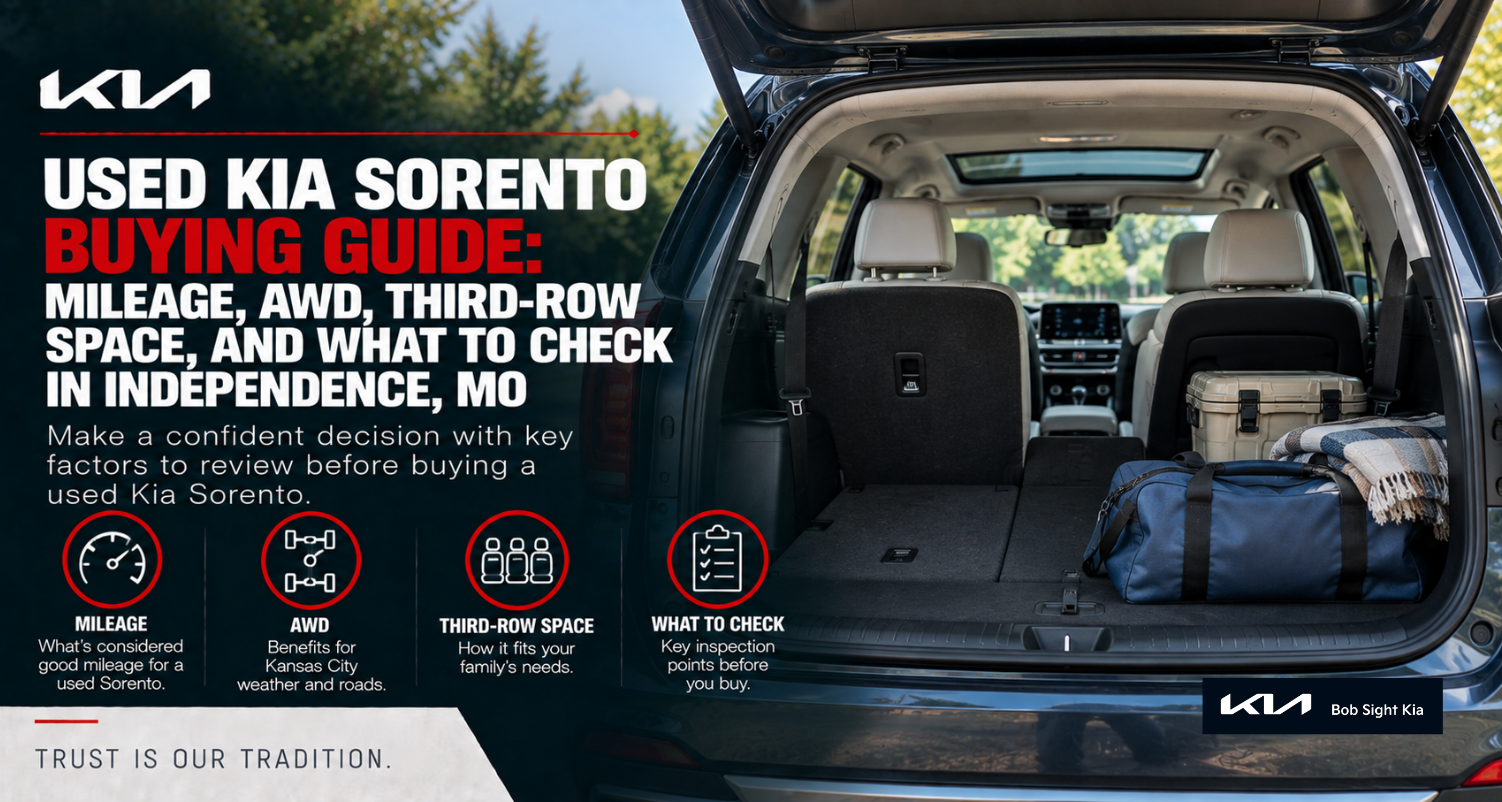
Used Kia Sorento Buying Guide: Mileage, AWD, Third-Row Space, and What to Check in Independence, MO Buying a used Kia Sorento in Independence, Missouri, means looking beyond the model year and asking how the SUV was driven, maintained, equipped, and cared for before it reached the used-car lot. Mileage matters, but it is only one part of the decision. A well-maintained Sorento with documented service history may be a stronger choice than a lower-mileage example with inconsistent maintenance, while features such as available all-wheel drive, third-row seating, driver-assistance technology, and interior configuration can make a major difference for families and commuters around the Kansas City Metro. Shop used vehicles at Bob Sight Kia in Independence In This Guide You'll Learn This used Kia Sorento buying guide focuses on the practical details Independence and Kansas City shoppers should evaluate before choosing a pre-owned Sorento. How to evaluate mileage on a used Kia Sorento Why maintenance history can matter as much as the odometer How to decide whether available AWD fits your Missouri driving needs What to check when evaluating Sorento third-row space How model year, trim, and powertrain differences affect your decision What to inspect during a used Sorento test drive Which vehicle-history and service records are worth reviewing How Much Mileage Is Too Much on a Used Kia Sorento? There is no single mileage number that automatically makes a used Kia Sorento a good or bad purchase because maintenance history, previous use, vehicle age, and overall condition all matter. A Sorento with higher mileage that has been serviced consistently may deserve more consideration than a lower-mileage SUV with gaps in its maintenance record. Independence shoppers should treat mileage as one data point rather than the final verdict on a used vehicle. Start by comparing the odometer reading with the age of the Sorento. A relatively new vehicle with unusually high mileage may have spent significant time on highways, while an older Sorento with very low mileage may have been driven infrequently or primarily on short trips. Neither pattern is automatically negative. Highway mileage can involve fewer stop-and-go cycles, while short trips may create more frequent starts, braking events, and temperature changes. The important question is whether the vehicle appears to have received appropriate maintenance throughout that use. Condition should support what the odometer tells you. Look at the driver's seat, steering wheel, pedals, door handles, cargo area, and other high-contact surfaces. Heavy interior wear on a low-mileage vehicle can justify asking more questions about how the SUV was used. Conversely, a higher-mileage Sorento with a clean interior, consistent records, and evidence of routine maintenance may have been carefully owned. For shoppers in Independence, Blue Springs, Grain Valley, and the Kansas City Metro, think about how much mileage you plan to add after purchase. A driver commuting daily on I-70 may accumulate miles quickly, while someone using the Sorento primarily for school transportation and weekend errands may add mileage more slowly. Your future driving habits should influence how much importance you place on the vehicle's current odometer reading. Instead of asking only, "How many miles are too many?" ask a broader set of questions. How often was the vehicle serviced? Are there records? Does it drive smoothly? Are the tires wearing evenly? Have fluids and wear items been maintained? Does the vehicle's overall condition make sense for its mileage? Those questions provide a much stronger foundation for a used Kia Sorento purchase. Why Is Maintenance History So Important When Buying a Used Sorento? A documented maintenance history can tell you whether a used Kia Sorento received routine attention throughout its previous ownership, which is often more useful than mileage alone. Oil changes, tire rotations, brake inspections, fluid checks, battery service, and other routine maintenance can all affect how confidently you approach a pre-owned vehicle. A complete history is not always available, but any records that can be verified are worth reviewing. Maintenance history helps create context. If a Sorento has accumulated substantial mileage but shows regular service over time, that history may indicate the previous owner stayed engaged with maintenance. If there are long gaps with no documentation, ask whether additional records are available elsewhere. A missing record does not prove that maintenance was skipped, but it does mean you have less information about the vehicle's past. Service history can also reveal whether major wear items have already been addressed. Tires, brake pads, batteries, filters, and other components wear over time. Knowing whether these items were recently replaced can help you understand the vehicle's current maintenance position. It can also help prevent assumptions based only on the age of the vehicle. Drivers around Independence should think about Missouri weather when reviewing records. Seasonal temperature changes, winter road treatments, summer heat, and repeated short trips can affect different vehicle systems. A Sorento that has spent years navigating Jackson County winters may benefit from careful inspection of tires, brakes, underbody areas, battery condition, and other components affected by climate and road conditions. When reviewing a used Sorento, follow a simple process: Ask for available maintenance records. Look for consistent service rather than focusing on a single visit. Compare records with mileage. Make sure maintenance entries reasonably correspond with odometer progression. Look for repeated concerns. Multiple visits for the same symptom may deserve additional investigation. Check recent wear-item service. Tires, brakes, batteries, filters, and fluids may affect near-term ownership planning. Ask what has been inspected recently. A current inspection can help fill gaps that older records cannot. If you purchase a used Sorento, maintaining your own records from the beginning is a smart ownership habit. Bob Sight Kia owners can use the online service scheduler when routine maintenance or inspection is needed after purchase. Should You Buy a Used Kia Sorento With AWD? A used Kia Sorento with available all-wheel drive can make sense for Missouri drivers who regularly travel in snow, rain, changing road conditions, or on routes where additional traction is useful, but AWD should not automatically be treated as mandatory. The better choice depends on your commute, weather tolerance, tire maintenance, and how frequently you drive before roads are fully treated after winter weather. All-wheel drive can help distribute power to more than one axle when traction demands change. That can be useful when pulling away on slick pavement or traveling through variable road conditions. For a commuter leaving Independence early in the morning before neighborhood streets are cleared, available AWD may be more valuable than it is for someone who can delay travel until conditions improve. AWD does not replace proper tires or careful driving. Tires provide the actual contact with the road, so tread depth, tire pressure, tire type, and overall condition remain central to wet- and winter-weather performance. AWD can help a vehicle accelerate, but it does not eliminate longer stopping distances on snow or ice. A front-wheel-drive Sorento with well-maintained tires may fit many Kansas City drivers perfectly well. Used Sorento shoppers should also inspect all four tires closely when considering an AWD model. Ideally, the tires should be appropriately matched in size, type, and wear. Uneven tire wear can suggest alignment issues, suspension concerns, improper rotation, or previous replacement of only one or two tires. Because AWD systems depend on coordinated operation across the driveline, consistent tire condition deserves attention. Use your actual routine to decide whether AWD is worth prioritizing. If you regularly commute from Blue Springs, Grain Valley, Liberty, or another part of the Metro into Kansas City regardless of winter conditions, it may be a meaningful feature. If most of your driving stays on treated roads and you have flexibility during severe weather, front-wheel drive may meet your needs while potentially simplifying your search. Used Sorento Consideration Front-Wheel Drive Available All-Wheel Drive Typical Daily Commuting Works well for many paved-road drivers Useful when conditions change frequently Missouri Winter Driving Proper tires remain critical Can provide additional traction when accelerating Tire Inspection Check tread and wear patterns Pay close attention to matching tire condition across all four wheels Best Fit Drivers focused mainly on normal road use Drivers who regularly travel in variable weather How Useful Is the Third Row in a Used Kia Sorento? The Kia Sorento's available third-row seating can make it a practical choice for families who occasionally need additional passenger capacity without moving into a larger three-row SUV. The usefulness of that third row depends on passenger size, frequency of use, cargo requirements, and the specific model year and configuration being considered. Used shoppers should physically test the rear seating rather than relying on the fact that the vehicle is labeled as a three-row SUV. For many households, the third row serves as occasional seating rather than a place where adults ride every day. Children, teenagers, visiting relatives, or extra passengers may use the rear row for short trips around Independence, school pickups, or weekend activities. Families expecting adults to spend significant time in the third row should pay closer attention to entry, legroom, headroom, and how easily the second-row seats move. Cargo space also changes when the third row is in use. A Sorento may provide enough room for family travel when the rear seats are folded, but luggage capacity can feel different once all seating positions are occupied. Before purchasing, think about your busiest real-world scenario. If your family travels with six people plus suitcases, sports equipment, a stroller, or a cooler, evaluate that combination rather than considering seating and cargo separately. This matters for Kansas City families because one vehicle often handles several roles in the same week. Monday may involve commuting on I-70, Wednesday could mean school pickup and soccer practice, and Saturday might include shopping near Independence Center or a drive to Lee's Summit. A third row that folds when not needed gives families flexibility without committing to a larger SUV every day. During your used Sorento evaluation, ask every regular passenger to test their likely seating position. Adjust the driver's seat first, then the second row, then check the third row. Open the liftgate with all rows in position and visualize your normal cargo. This takes only a few minutes but can reveal whether the Sorento's three-row layout actually fits your household. Which Used Kia Sorento Model Year or Trim Should You Choose? The best used Kia Sorento model year and trim depends on the combination of features, powertrain, technology, seating, and drivetrain you want rather than simply choosing the newest Sorento within your search. The Sorento has changed over time, and equipment can vary significantly between model years and trims. Shoppers should therefore compare the exact vehicle rather than assume every Sorento with the same badge offers identical features. Start with the features you use every day. If smartphone connectivity, heated seats, driver-assistance systems, a larger infotainment display, power seating, or a specific seating layout are priorities, confirm those features on the individual Sorento. Used-vehicle listings can sometimes summarize equipment broadly, while trim features can change from year to year. Physically checking the vehicle is the safest way to know what is included. Powertrain differences deserve the same attention. Depending on model year and configuration, used Sorento inventory can include different engines, transmissions, drivetrains, and electrified options. A driver primarily commuting between Independence and Kansas City may prioritize efficiency and smooth everyday performance. Someone who regularly travels with several passengers or wants stronger acceleration may focus on a different configuration. Trim level should support your needs rather than becoming the goal by itself. A higher trim may include desirable comfort and technology features, but a lower trim with the right mileage, service history, condition, and equipment may be a better overall fit for your household. Used shopping rewards flexibility because two vehicles from the same model year can have very different ownership histories. When narrowing your options, use this step-by-step approach: Choose your must-have features. Decide whether AWD, third-row seating, heated seats, specific safety technology, or another feature is essential. Identify your preferred powertrain. Compare the exact engine and drivetrain available on each Sorento. Review mileage and maintenance together. Do not rank vehicles by odometer alone. Compare condition. Look at interior wear, body condition, tires, brakes, and overall presentation. Drive the strongest candidates. Real-world driving can reveal differences that listings cannot. Review vehicle history. Use available documentation to understand previous ownership and reported events. This approach helps Independence shoppers avoid becoming overly focused on a single trim badge. The strongest used Sorento is the one whose history, condition, configuration, and features work together for your daily needs. What Should You Inspect Before Buying a Used Kia Sorento? A used Kia Sorento inspection should cover tires, brakes, body condition, lights, interior electronics, climate control, seating functions, cargo features, and the way the SUV behaves during a test drive. Used vehicles naturally show some wear, but the goal is to distinguish normal use from conditions that deserve further evaluation. Take your time and inspect the Sorento before becoming focused on one cosmetic feature or trim level. Begin outside. Walk around the vehicle in good lighting and look at panel alignment, paint consistency, glass, lamps, wheels, and tires. Minor cosmetic marks are common on used vehicles, but larger differences between panels may justify asking about prior repairs. Inspect the tires for tread depth and even wear. One tire wearing much faster along an edge can indicate alignment, suspension, inflation, or driving-related issues. Move inside and operate everything you expect to use. Test the infotainment screen, backup camera, climate controls, USB ports, seat adjustments, windows, locks, liftgate, steering-wheel controls, and available driver-assistance features. Fold and raise the second and third rows several times. If the Sorento has a feature that matters enough to influence your purchase, confirm that it works rather than assuming it does. Pay attention to the condition of frequently touched surfaces. Worn seat bolsters, heavily scratched cargo trim, damaged floor coverings, or missing interior pieces can indicate how the vehicle was used. Normal wear is not necessarily a reason to avoid a Sorento, but it should make sense relative to the vehicle's age and mileage. Finally, check the cargo area in the configuration you plan to use most often. Fold the third row, raise it again, and inspect under the cargo floor if accessible. Families around Jackson County may use the Sorento for groceries, sports equipment, luggage, pets, school supplies, and weekend projects. Testing that space before purchase can prevent discovering later that your normal gear does not fit the way you expected. What Should You Look for During a Used Kia Sorento Test Drive? A used Kia Sorento test drive should evaluate acceleration, braking, steering, transmission behavior, ride quality, visibility, cabin noise, warning lights, and the operation of major comfort and technology features. A quick loop around the dealership may confirm that the vehicle moves, but a thoughtful test drive can tell you much more about whether it fits your daily routine. Start slowly. Pay attention as the vehicle moves away from a stop, shifts through lower speeds, and responds to light throttle. Listen for unusual sounds and notice whether acceleration feels consistent. The goal is not to diagnose every possible mechanical issue yourself. It is to notice anything that feels abrupt, inconsistent, noisy, or different enough to justify additional inspection. Test the brakes in a safe setting. Braking should feel predictable without unusual vibration, grinding, or pulling. A slight sound after a vehicle has been sitting can have several causes, but persistent brake noise deserves attention. If the steering wheel shakes during braking or the vehicle pulls noticeably, mention it before moving forward with the purchase. Find a faster road if the route allows. Highway-style driving can reveal road noise, steering stability, acceleration response, and ride comfort that may not appear at neighborhood speeds. For an Independence commuter who regularly merges onto I-70, evaluating the Sorento at normal highway speeds is far more relevant than spending the entire test drive below 35 mph. Use the following checklist during the drive: Accelerate normally from several stops. Look for smooth, predictable response. Brake at different speeds. Pay attention to noise, vibration, and pedal feel. Make several turns. Listen for unusual noises and evaluate steering response. Drive over typical road surfaces. Notice rattles, suspension behavior, and cabin noise. Test highway merging if possible. Make sure the powertrain feels appropriate for your normal routes. Check driver visibility. Evaluate mirrors, blind spots, camera systems, and seating position. Watch the instrument cluster. Warning lights should not be ignored. Do not rush the drive because another Sorento is available if the first one does not feel right. Used inventory varies, and comparing more than one vehicle can help you separate normal Sorento characteristics from something specific to an individual SUV. How Should You Review a Used Sorento Vehicle History Report? A vehicle history report can help identify reported ownership changes, mileage progression, service entries, title information, and reported damage, but it should be used together with a physical inspection and test drive rather than as a replacement for them. The report gives you another layer of information about the vehicle's past. It does not guarantee that every event or repair was reported. Begin with mileage consistency. Odometer readings should generally progress logically over time. If the mileage pattern contains an unusual change or missing period, ask for clarification. Next, review the number of previous owners and the length of each ownership period. Multiple owners are not automatically negative, but they may make complete maintenance documentation harder to assemble. Reported accidents or damage deserve careful review rather than an automatic yes or no decision. Ask what was repaired, whether documentation is available, and whether the current condition shows evidence of proper repair. A professional inspection can be particularly helpful if the report shows a significant previous event. Service entries can provide additional value. They may show oil changes, tire service, brake work, inspections, or other maintenance. Not every service facility reports information to every history provider, so missing entries should not automatically be interpreted as skipped maintenance. Ask whether additional records are available from the previous owner, dealership, or service center. Used Kia shoppers around Kansas City should think of the history report as one part of a larger picture: Vehicle history report Maintenance documentation Current inspection findings Physical condition Tire and brake condition Test-drive behavior Feature and trim verification When those pieces support one another, shoppers can make a much more informed decision than they could by relying on mileage or model year alone. Quick Facts for Buying a Used Kia Sorento in Independence, MO The strongest used Kia Sorento candidates combine appropriate mileage, consistent maintenance, useful features, good current condition, and a configuration that matches how you actually plan to use the SUV. These quick reminders can help Independence shoppers stay focused while comparing multiple used Sorento options. There is no universal mileage cutoff that determines whether a used Sorento is worth considering. Maintenance history can be as important as mileage. Compare vehicle age and odometer reading rather than viewing mileage in isolation. Available AWD may appeal to Missouri drivers who regularly travel in changing weather. AWD does not replace proper tires or safe winter-driving habits. Third-row usefulness depends on passenger size, frequency of use, and cargo needs. Features and powertrains can vary significantly by model year and trim. Review all four tires for tread condition and uneven wear. Test braking, steering, acceleration, and transmission behavior during the drive. Operate the infotainment, climate controls, seating, cameras, and other major features before purchase. Review available vehicle-history and service records. Choose based on overall condition and fit rather than trim level alone. These points are particularly useful when comparing several vehicles online. Two Sorentos may appear similar in photos but differ significantly in mileage, drivetrain, service history, third-row condition, technology, and tire life. Looking beyond the headline details can help you narrow your list before visiting the dealership. Ownership Planning After Buying a Used Kia Sorento Used Kia Sorento ownership is easier to manage when you establish a maintenance baseline shortly after purchase and keep records from that point forward. Even when a vehicle comes with strong service documentation, knowing its current tire, brake, fluid, battery, and routine maintenance condition can help you plan future service instead of reacting to it. Begin by reviewing the maintenance information applicable to your specific Sorento model year, engine, drivetrain, and usage. Used Sorentos can vary considerably in configuration, so maintenance should be based on the exact vehicle rather than a generic schedule copied from another model year. If previous records show recent work, keep that documentation with your own maintenance history. Tires deserve regular attention in Missouri. Temperature swings can change tire pressure, while winter road conditions make tread condition particularly important. AWD Sorento owners should pay close attention to even tire wear and appropriate tire matching. Front-wheel-drive owners should also rotate tires as recommended and monitor tread patterns for signs of alignment or suspension concerns. Brake condition matters for local driving as well. Frequent traffic around Independence, I-70, Noland Road, Blue Springs, and Kansas City can create repeated braking cycles. Listen for persistent changes in brake sound or feel and have the system inspected rather than assuming every noise is normal. The same principle applies to batteries, wipers, lights, climate control, and other systems you rely on during changing Midwest weather. Keep records from your first service visit onward. Documentation can help you remember when tires were installed, when the battery was replaced, when brake components were inspected, and which maintenance items are due next. If you later trade or sell the Sorento, a documented history can also help demonstrate how the vehicle was cared for during your ownership. Bob Sight Kia drivers can review Kia service and parts specials and schedule maintenance when needed. The objective is not to replace parts unnecessarily. It is to understand the condition of the used Sorento you purchased and build a predictable maintenance routine around it. Frequently Asked Questions About Buying a Used Kia Sorento Is a used Kia Sorento a good family SUV for Independence drivers? A used Kia Sorento can be a practical family SUV for Independence drivers who want flexible seating, available three-row capability, manageable exterior dimensions, and a range of available features. Its suitability depends on the specific model year, seating arrangement, condition, and equipment. Families should evaluate the exact vehicle instead of assuming every Sorento offers the same interior configuration. The third row can be useful for school transportation, occasional extra passengers, and family activities. When the rear row is not needed, folding it can create additional room for groceries, sports equipment, luggage, or other cargo. This flexibility can suit households that want more passenger capacity without moving into a much larger SUV. For families around Independence, Blue Springs, Grain Valley, and Lee's Summit, the most useful test is to bring your real routine into the shopping process. Have children or regular passengers try the seats, check car-seat compatibility according to the appropriate instructions, and visualize the cargo you normally carry. The best family SUV is the one that works with your actual household rather than simply offering the longest feature list. Is high mileage bad on a used Kia Sorento? Higher mileage does not automatically make a used Kia Sorento a poor choice because maintenance history, condition, driving type, and vehicle age all affect how that mileage should be interpreted. A properly maintained higher-mileage Sorento may deserve consideration alongside lower-mileage alternatives. The odometer should begin the evaluation, not end it. Review available service records and compare the mileage with the age of the vehicle. A Sorento that accumulated miles primarily through longer highway trips may have experienced a different type of use than one driven mainly on short urban trips. Neither pattern guarantees condition, which is why inspection remains important. Kansas City shoppers should also think about their own mileage plans. If you expect to add substantial mileage commuting from eastern Jackson County into Kansas City, starting mileage may carry more weight in your decision. If your annual driving is relatively low, you may evaluate the same Sorento differently. Should I choose AWD on a used Kia Sorento in Missouri? AWD can be worthwhile for Missouri Sorento owners who regularly travel in snow, rain, or variable road conditions, but many drivers can also be well served by front-wheel drive and properly maintained tires. Your work schedule and typical routes should influence the decision more than the idea that every Midwest SUV automatically needs AWD. If you must commute during winter weather before side streets and neighborhood roads are cleared, AWD may provide additional traction when accelerating. Drivers who can delay trips until major roads are treated may place less importance on the feature. In either case, safe driving and tire condition remain critical. When shopping for an AWD Sorento near Independence, inspect all four tires for consistent size and wear. Ask about tire rotation history when documentation is available. A used AWD vehicle should be evaluated as a complete system rather than focusing on the AWD badge alone. Is the Kia Sorento third row big enough for adults? The usefulness of a Sorento third row for adults depends on passenger height, trip length, seating position, and the specific model year and configuration. Families expecting adults to ride in the rear regularly should test the third row in person before purchasing. A seat that works comfortably for a short Independence errand may feel different during a longer highway trip. Second-row position also affects third-row comfort. Move the seats into realistic positions rather than maximizing rear space just for the test. Then ask the people likely to use the third row to enter, sit, buckle in, and exit on their own. For many Kansas City families, the Sorento's third row is useful as flexible occasional seating. If your household needs three adult-friendly rows every day, compare the Sorento with larger three-row options as well. Choosing based on your most common use can prevent frustration later. Where can I shop for a used Kia Sorento near Kansas City? Shoppers can search used vehicles at Bob Sight Kia in Independence, Missouri, serving drivers throughout the Kansas City Metro and eastern Jackson County. Used inventory changes regularly, so checking current availability before visiting can help you identify Sorento options that match your preferred mileage, drivetrain, seating, and features. Review each vehicle individually rather than assuming two Sorentos from the same model year are equivalent. Previous ownership, mileage, maintenance records, trim level, AWD availability, technology, tire condition, and interior wear can all differ. Those differences are central to used-vehicle shopping. Drivers from Blue Springs, Grain Valley, Raytown, Liberty, Lee's Summit, and Kansas City can browse used inventory at Bob Sight Kia before making the trip to Independence. Creating a short list ahead of time makes it easier to compare the strongest candidates side by side. Shop for a Used Kia Sorento in Independence With the Right Questions The best way to shop for a used Kia Sorento is to evaluate the entire vehicle rather than making the decision from mileage, model year, or trim level alone. Maintenance history, AWD condition, third-row usability, tires, brakes, interior equipment, vehicle history, and test-drive behavior should all contribute to the decision. Used SUVs have individual histories, which means two similar-looking Sorentos can offer very different ownership prospects. For Kansas City-area families, the Sorento's flexible size is part of its appeal. It can handle commuting along I-70, school transportation in Independence, weekend activities in Blue Springs, shopping trips around Jackson County, and occasional three-row passenger needs without automatically moving into a larger SUV. The key is finding a specific used Sorento whose history and configuration support those uses. Take enough time to compare candidates carefully. Review documentation, test the seating, inspect the cargo area, drive at both neighborhood and highway speeds, and confirm the features you care about. If AWD is important, evaluate the tire condition and exact drivetrain. If the third row is important, put real passengers in it. If long-term mileage matters, focus on maintenance and current condition instead of treating the odometer as the only measure of value. Bob Sight Kia in Independence can help shoppers compare available used Sorento options alongside other pre-owned vehicles that fit their needs. Whether you are moving from a sedan into your first three-row SUV or replacing another family vehicle, a thoughtful used-Sorento inspection can help you choose an SUV that fits the way you actually drive throughout Independence and the Kansas City Metro. Helpful Links Shop Used Vehicles Explore New Kia Sorento Inventory Value Your Trade Explore Kia Financing Schedule Kia Service Proud to Be Part of the Bob Sight Auto Group Bob Sight Kia in Independence is proud to be part of the Bob Sight Auto Group, serving drivers throughout the Kansas City Metro with new and used vehicles, automotive service, parts support, and collision resources. Whether you are comparing a used Kia Sorento for your family, maintaining your current vehicle, or exploring other automotive options across the region, the Bob Sight Auto Group provides local resources for drivers throughout Missouri and Kansas. Trust Is Our Tradition. Bob Sight Honda Bob Sight CDJR Bob Sight Ford Bob Sight Kia Bob Sight Collision Center










 Warranties include 10-year/100,000-mile powertrain and 5-year/60,000-mile basic. All warranties and roadside assistance are limited. See retailer for warranty details.