
Today: Closed

Blog

All Independence Kia Dealer Bob Sight Kia Bob Sight Kia News Bob Sight Independence Kia Service New Inventory Independence Kia Service Kia Dealerships Near Me Car Buying Tips Local Kia Service New Kia Models New Models Liberty Car Service Local Kia Dealerships Service & Maintenance New Telluride New Kia Sportage Kia K4 Kia Sorento Blue Springs Car Buyers Independence Used Cars 2026 New Kia Sportage Missouri Vehicle Tips Pre-Owned Vehicle Inventory Pre-Owned Kia Inventory Kia Maintenance & Repair Kia Carnival Kia parts Car Shopping K5 Kia Buying Guides Kansas City Metro Auto Kia Model Comparisons Maintenance SUV Research Used Cars Used Vehicles 2026 Kia Sorento Kia Finance Finance 2026 Kia Sorento Hybrid New Kia Sportage Hybrid Servicio y Mantenimiento 2027 Kia Sportage Seasonal Car Care Family Vehicles Hybrid Kia K4 Hatcback New Kia K5 Inventory Seltos Compra de Autos Modelos Kia Noticias del Concesionario Safety Comunidad Local Events Kia Sedan Features
Know when Kia brake pads need replacement, common warning signs, and brake wear factors for Independence and Kansas City drivers.

When Should Kia Brake Pads Be Replaced? Warning Signs and Brake Wear for Independence Drivers

When Should Kia Brake Pads Be Replaced? Warning Signs and Brake Wear for Independence Drivers Kia brake pads should be replaced when they become worn enough that braking performance, rotor protection, or safe stopping can be affected, rather than according to one universal mileage interval. Driving habits, traffic conditions, vehicle weight, road conditions, and the type of driving you do around Independence and the Kansas City Metro can all influence how quickly brake pads wear. Drivers who spend a lot of time in stop-and-go traffic along I-70, US-40, or busy streets near Independence Center may use their brakes differently from someone whose routine involves longer stretches of highway driving. Regular brake inspections are therefore one of the best ways to determine when your Kia actually needs new brake pads. Schedule Kia brake service at Bob Sight Kia in Independence In This Guide You'll Learn This guide explains the warning signs of worn Kia brake pads, what affects brake wear, and how Independence drivers can decide when it is time to schedule a brake inspection. Why Kia brake pads do not have one universal replacement mileage Common warning signs that brake pads may be wearing out How brake pad thickness relates to replacement timing Why Kansas City traffic can affect brake wear How brake pads, rotors, calipers, and brake fluid work together What happens during a Kia brake inspection How to plan brake maintenance before longer trips or seasonal driving When Should Kia Brake Pads Be Replaced? Kia brake pads should generally be replaced based on their remaining friction material, braking behavior, and inspection results rather than automatically at a specific mileage. Brake pads are wear components, meaning they gradually lose friction material every time the brakes are applied. Two identical Kia vehicles can therefore require brake pad replacement at very different mileage depending on how they are driven. A driver commuting through frequent traffic lights and congestion in Independence may experience faster brake wear than someone who spends most of the week cruising at a steady speed. This is why mileage should be treated as a reminder to inspect the braking system rather than a guaranteed replacement schedule. A Kia with frequent city use, school drop-offs, short errands, or repeated stop-and-go driving may use its brake pads more aggressively. Highway driving generally requires fewer braking events, although sudden stops, heavy traffic, hills, and vehicle loading can still affect wear. Even the driver's habits matter because gradual braking usually generates different wear patterns than repeatedly braking hard at the last moment. The most reliable approach is to have brake pad thickness and the surrounding brake components inspected periodically. A technician can evaluate how much friction material remains, whether the inner and outer pads are wearing evenly, and whether the rotors show signs of scoring, excessive heat, or uneven contact. Caliper operation can also affect how quickly pads wear. If one pad is substantially more worn than another, the issue may involve more than simply installing a new set of pads. Independence drivers should also pay attention between scheduled maintenance visits. Changes in pedal feel, stopping behavior, brake noise, vibration, or warning lights deserve attention even if the vehicle has relatively low mileage. If something about braking suddenly feels different while driving near Noland Road, US-24, I-70, or anywhere else around Jackson County, scheduling a professional inspection is a better strategy than waiting for an assumed mileage milestone. What Are the Most Common Signs of Worn Kia Brake Pads? Common signs that Kia brake pads may need attention include squealing or grinding noises, increased stopping distance, brake pedal changes, vibration during braking, and visible brake wear warnings. Not every sound automatically means the brake pads must be replaced, but a noticeable change in how the braking system sounds or feels should not be ignored. Brakes are a safety-critical system, so unusual symptoms deserve inspection rather than guesswork. A high-pitched squeal during braking can occur when a wear indicator contacts the brake rotor or when certain operating conditions cause vibration between braking surfaces. Occasional noise can also result from moisture, road debris, temperature changes, or surface rust after the vehicle has been parked. The concern increases when squealing becomes persistent, occurs during most stops, or is accompanied by a change in braking performance. Grinding is more urgent because it can indicate that the friction material has worn significantly or that another braking component is contacting the rotor abnormally. Pedal feel also matters. If your Kia suddenly requires more pedal travel, feels unusually soft, feels harder than normal, or seems to require more effort to slow down, have the braking system inspected. A pulling sensation under braking can indicate uneven braking force, although tires, suspension components, alignment, or road conditions can sometimes produce similar sensations. Steering wheel or pedal vibration during braking may point toward rotor irregularities or other brake-system concerns rather than brake pads alone. Independence drivers should use the following warning signs as reasons to schedule an inspection: Listen for persistent squealing, scraping, or grinding when braking. Notice whether the vehicle seems to take longer to slow down. Pay attention to changes in brake pedal feel or travel. Watch for vibration through the steering wheel or brake pedal. Take brake or ABS warning lights seriously. Schedule an inspection if braking behavior changes suddenly or consistently. If you notice any of these symptoms during a commute through Blue Springs, Raytown, Lee's Summit, or Independence, avoid assuming the cause based on noise alone. A proper inspection can identify whether the issue involves brake pads, rotors, calipers, brake fluid, tires, or another component of the braking system. How Does Brake Pad Thickness Affect Replacement Timing? Brake pad thickness is one of the most useful measurements for determining brake wear because it shows how much friction material remains between the braking surface and the pad backing plate. New brake pads begin with substantially more friction material than worn pads, and that material gradually decreases as the vehicle is driven. A technician can measure remaining thickness during an inspection and use that information along with wear patterns and braking performance to determine whether replacement is needed. The friction material is the portion of the pad designed to press against the brake rotor when the brake pedal is applied. That contact creates friction, which converts the vehicle's motion into heat and slows the vehicle. As the friction material gets thinner, there is less usable material remaining before the pad reaches the end of its service life. Waiting until virtually no friction material remains can increase the risk of damaging the rotor and other components. Brake-pad replacement decisions should not rely on thickness alone, however. A pad may have some friction material remaining while still showing abnormal wear, cracking, contamination, glazing, or uneven contact. Inner and outer pads can also wear at different rates if a caliper slide, piston, or related component is not operating correctly. That is why visually checking only the outside pad through the wheel does not always provide a complete picture of brake condition. For drivers searching for Kia brake pad replacement in Independence, Missouri, the more useful question is not simply how many miles are on the vehicle. Ask how much usable pad material remains and whether the entire braking system is wearing evenly. A professional inspection at Bob Sight Kia can evaluate the pads alongside the rotors, calipers, hardware, and other components that influence braking performance. This creates a more complete maintenance decision than replacing parts according to mileage alone. Why Can Kansas City Driving Cause Brake Pads to Wear at Different Rates? Brake pad wear around the Kansas City Metro can vary significantly because stop-and-go traffic, short urban trips, hills, weather changes, and driving habits all change how often and how aggressively the brakes are used. A vehicle that repeatedly accelerates and stops through city traffic may accumulate brake wear differently from one covering the same number of miles on open highways. Mileage therefore tells only part of the brake-maintenance story. Consider two Kia owners who each drive 10,000 miles in a year. One spends much of that mileage commuting along relatively open highway routes, while the other makes repeated short trips through Independence, school zones, shopping areas, and busy intersections. The second vehicle may experience far more braking events even though both odometers increase by the same amount. Frequent deceleration creates repeated friction and heat cycles at the brake pads and rotors. Kansas City weather also adds variables. Rain can reduce road traction, winter moisture can contribute to surface corrosion on exposed braking components, and temperature swings can change how the vehicle behaves at the beginning of a drive. Road salt and winter debris can accumulate around suspension, wheel, and brake components. None of these conditions automatically means brake pads will fail early, but they make periodic visual inspections valuable for drivers who keep their vehicles through several Missouri seasons. Driving style plays a major role as well. Leaving more following distance allows a driver to slow gradually instead of applying the brakes heavily at the last moment. Anticipating traffic lights and congestion can reduce repeated hard stops. On a busy afternoon near the I-70 and I-470 corridors, simply allowing additional space ahead can reduce how often aggressive braking is required. These differences explain why a fixed mileage estimate cannot predict brake-pad life for every Kia in Independence. The best maintenance plan combines routine inspections with awareness of your actual driving conditions. Drivers who regularly face dense Kansas City traffic, frequent short trips, heavy passenger loads, or repeated urban stopping may want to pay closer attention to brake condition than drivers whose routes involve less braking. Brake Pads vs. Rotors: What Is the Difference? Brake pads are replaceable friction components that press against brake rotors, while the rotors are metal discs attached to the wheel hubs that provide the surface the pads clamp against to slow the vehicle. The two components work together every time you press the brake pedal. Understanding the difference can help Kia owners make sense of a brake inspection and understand why sometimes pads are replaced alone while other repairs may involve both pads and rotors. When the driver presses the brake pedal, hydraulic pressure helps the brake caliper move the brake pads toward the rotor. Friction between the pads and rotor slows wheel rotation and creates heat. The pads are designed to wear gradually as part of normal operation. Rotors are more durable, but they are also subject to wear and can develop scoring, thickness variation, heat spots, corrosion, or other surface problems over time. A worn brake pad does not automatically mean every rotor needs replacement. A technician should examine rotor condition and determine whether it remains serviceable. At the same time, continuing to drive after brake pads are excessively worn can damage a rotor that might otherwise have remained usable longer. This is one reason addressing brake-pad wear before grinding begins can help protect more of the braking system. Brake Component Primary Function What Technicians Check Brake Pads Create friction against the rotor Thickness, even wear, glazing, cracking, contamination Brake Rotors Provide the braking surface Surface condition, wear, scoring, heat damage, thickness Brake Calipers Apply the pads to the rotors Movement, leaks, piston operation, slide operation Brake Fluid Transfers hydraulic force through the system Condition, level, leaks, maintenance requirements For Kia owners in Independence, understanding these components can also make service recommendations easier to evaluate. If a brake inspection identifies worn pads plus rotor damage, ask which condition was observed and how it affects the repair recommendation. A brake service should be based on the condition of the system rather than automatically assuming every component needs replacement. What Happens During a Kia Brake Inspection? A Kia brake inspection should evaluate more than whether the vehicle still stops because technicians need to examine brake pad wear, rotor condition, caliper operation, brake-fluid concerns, and other components that affect braking performance. A vehicle can continue stopping while a component is beginning to wear abnormally. Identifying that wear before a severe symptom develops can make brake maintenance easier to plan. The inspection process often begins with the symptoms reported by the driver. If you hear a noise only during the first stop of the morning, only while turning, or only after highway driving, tell the technician. Details such as speed, weather, pedal feel, and whether the sound comes from the front or rear can help narrow down the concern. A vague description such as "the brakes sound weird" gives less diagnostic information than describing when and how the symptom occurs. A brake inspection may then include several steps: Review the driver's concern. Explain noises, vibration, pedal changes, or stopping differences you have noticed. Inspect brake pad condition. Remaining friction material and wear patterns can be evaluated. Check rotor surfaces. Rotors can be inspected for scoring, heat damage, corrosion, or other visible concerns. Inspect caliper operation and hardware. Uneven pad wear can sometimes point toward a problem with movement or contact. Check for leaks or fluid-related concerns. Hydraulic braking components should not be ignored during a comprehensive evaluation. Discuss findings before repairs. Ask what is worn, what requires attention now, and what can continue to be monitored. This process is useful whether your Kia is used primarily for commuting along I-70, family driving around Blue Springs, or short errands throughout Independence. It also allows technicians to distinguish normal brake wear from a symptom caused by another component. Drivers can schedule Kia service online when a brake inspection is needed. Should You Replace Kia Brake Pads Before They Start Grinding? Brake pads should ideally be inspected and replaced before persistent grinding develops because grinding can indicate that the friction material is severely worn or that metal components are contacting surfaces they should not. Waiting for grinding to become the replacement signal can increase the possibility of additional brake-system damage. Earlier inspection gives drivers more information and more time to plan appropriate service. A squeal and a grind are not the same sound. Squealing is generally higher-pitched and can have several possible causes, including brake wear indicators, vibration, moisture, or surface conditions. Grinding is typically harsher and should be treated more urgently. If braking suddenly sounds metallic or rough, continuing to drive extensively without inspection is not a good maintenance strategy. Rotor protection is one reason timing matters. Brake pads are designed as wear items, while rotors provide the braking surface the pads contact. When the pad's usable friction material becomes excessively thin, the relationship between those components changes. Addressing brake wear before severe contact develops can reduce the likelihood that a simple wear issue turns into a more extensive repair involving additional components. Drivers should also remember that brake symptoms do not always develop in a predictable order. One vehicle may produce noticeable noise while another may show changes in braking feel first. Some drivers may notice no dramatic warning until an inspection reveals significant wear. Relying exclusively on sound therefore is not a substitute for periodic inspection. If your Kia begins grinding while traveling near Independence Center, along Noland Road, or elsewhere in the Kansas City Metro, arrange for the braking system to be evaluated promptly. If the vehicle's braking performance feels significantly reduced or unsafe, avoid continuing to drive it. Safety should take priority over trying to reach a preferred service destination under uncertain braking conditions. How Can Kia Owners Help Reduce Unnecessary Brake Wear? Kia owners can help reduce unnecessary brake wear by maintaining appropriate following distance, anticipating traffic, avoiding repeated aggressive stops, and keeping the vehicle's braking and tire systems properly maintained. Brake pads will always wear because friction is required to stop the vehicle, but driving technique can influence how quickly that wear occurs. Smooth, predictable braking can also make everyday driving more comfortable for passengers. Following distance is one of the simplest factors drivers can control. When you leave adequate space between your Kia and the vehicle ahead, you have more time to slow gradually instead of braking sharply. This can be useful during rush-hour traffic on I-70 or when approaching congestion near busy Independence shopping corridors. Constantly accelerating toward stopped traffic and then braking heavily creates more frequent heat cycles than anticipating the slowdown earlier. Vehicle loading matters as well. A Kia carrying several passengers and a full cargo area requires the braking system to manage more mass than the same vehicle with only the driver aboard. This does not mean families should avoid using their Kia's passenger or cargo capacity. It simply means drivers should account for increased weight by allowing additional following distance and braking smoothly. Tires also affect the overall stopping process. Even perfectly maintained brakes depend on the tires to maintain contact with the road. Proper inflation, adequate tread, and appropriate tire condition are therefore part of braking safety. During Missouri rain, winter precipitation, or cold weather, reduced road traction can increase stopping distance even when the brake system itself is operating normally. Routine inspection ties all of these habits together. Rather than trying to maximize brake-pad life at all costs, focus on predictable braking performance and appropriate maintenance. Brake pads are designed to wear. The goal is to identify normal wear at the right time, catch abnormal wear early, and maintain the entire braking system so it works consistently throughout everyday Kansas City driving. Quick Facts About Kia Brake Pad Replacement Kia brake-pad replacement timing depends primarily on actual wear and brake condition rather than one fixed mileage number for every vehicle. Drivers can make better maintenance decisions by combining routine inspections with awareness of braking symptoms and everyday driving conditions. Brake pads are normal wear components and gradually lose friction material during use. There is no single universal replacement mileage that applies to every Kia and every driving pattern. Frequent city and stop-and-go driving can create more braking events than steady highway travel. Persistent squealing can justify inspection even if braking still feels normal. Grinding should be addressed promptly because it may indicate severe wear or abnormal contact. Brake-pad thickness is an important measurement, but technicians should also evaluate wear patterns. Uneven pad wear can indicate a concern involving calipers, hardware, or another component. Brake rotors and pads work together but do not automatically require replacement at the same time. Changes in pedal feel, stopping distance, vibration, or warning lights deserve professional evaluation. Tire condition and road traction also influence how effectively a vehicle can stop. For Independence drivers, these facts are more useful than choosing an arbitrary replacement interval. A Kia used daily in traffic around Jackson County may experience a very different brake-wear pattern from one driven primarily on longer highway trips. Inspection allows maintenance decisions to be based on the actual vehicle instead of a generic estimate. Ownership Planning for Kia Brake Maintenance in Independence The best long-term brake-maintenance strategy is to include brake inspections in your overall Kia ownership plan instead of waiting until severe noise or reduced braking performance appears. Brake pads are easier to monitor when their condition is checked periodically alongside other routine vehicle maintenance. This can also help drivers understand whether wear is progressing normally or whether one wheel is wearing differently from the others. Seasonal changes provide useful opportunities to think about braking condition. Before winter, drivers may already be checking tires, battery condition, wiper blades, and other systems affected by cold weather. Adding brake inspection to that maintenance conversation can be useful because winter roads increase the importance of predictable braking and healthy tires. Spring can also be a good time to look for corrosion or wear after months of exposure to moisture, road treatment, and fluctuating temperatures. Long trips deserve similar planning. If you are preparing to leave Independence for a road trip and the vehicle has developed brake noise, vibration, or another symptom, addressing it before departure is more useful than hoping the issue remains unchanged for hundreds of miles. Heavy luggage and additional passengers can increase vehicle weight, while unfamiliar routes may involve hills, congestion, or repeated braking. Keep maintenance records as well. Knowing when brake pads, rotors, tires, and brake fluid were previously inspected or serviced provides useful context at future appointments. Documentation can make it easier to identify how quickly components are wearing and whether a pattern has changed over time. Bob Sight Kia owners can also review available service and parts specials when planning maintenance. Brake service should still be based on the actual condition of the vehicle, but organizing maintenance ahead of time can make ownership more predictable. The goal is not to replace brake pads early without reason. It is to know their condition before they become an urgent repair. Frequently Asked Questions About Kia Brake Pad Replacement How many miles do Kia brake pads usually last? There is no single mileage at which every Kia needs brake-pad replacement because brake wear depends heavily on driving conditions and vehicle use. Two Kia vehicles with similar mileage can have significantly different remaining brake-pad material. Stop-and-go driving, aggressive braking, traffic density, passenger and cargo weight, road conditions, and individual driving habits all influence wear. Mileage is still useful as maintenance context. If a vehicle has accumulated substantial mileage since its last brake inspection, it makes sense to have pad condition checked even if no obvious symptom has appeared. The inspection provides actual information about remaining friction material and wear patterns rather than relying on a generalized mileage estimate. Independence drivers who spend considerable time navigating traffic lights, school zones, shopping districts, and Kansas City congestion may experience a different wear pattern from drivers who primarily use open highway routes. Ask for the condition of the pads to be evaluated during routine service so you can track wear over time. Why are my Kia brakes squeaking if the pads are not worn out? Brake squeaking can occur for reasons other than worn-out pads, including moisture, light surface corrosion, brake dust, vibration, temperature changes, or characteristics of the pad and rotor surfaces. Noise alone does not prove that brake pads need replacement. Persistent or worsening noise should still be inspected because wear indicators or other brake conditions can also cause squealing. For example, a Kia parked outside overnight may develop light surface oxidation on the brake rotors after rain or humid weather. The first few stops may make noise as the pads clean that surface. A brief morning squeak that disappears can therefore be different from a sound that occurs every time the brake pedal is applied. Missouri's changing weather can make occasional brake noise more noticeable, but drivers should not dismiss persistent symptoms as weather-related without inspection. If squealing continues during normal driving around Independence or Blue Springs, schedule a brake evaluation so the source can be identified. Do Kia brake pads and rotors need to be replaced together? Brake pads and rotors do not automatically have to be replaced together because each component should be evaluated based on its condition and service requirements. Pads are designed to wear as friction material is consumed. Rotors are also subject to wear, but their replacement needs depend on factors such as thickness, surface condition, heat damage, scoring, and manufacturer specifications. If brake pads are replaced while the rotors remain in appropriate condition, the technician may determine that rotor replacement is unnecessary. In other cases, damaged or excessively worn rotors may need attention at the same time as the pads. The correct approach depends on inspection findings rather than a blanket rule. When discussing Kia brake service in Independence, ask what the technician observed on both the pads and rotors. Understanding which component is worn and why a particular repair is recommended helps drivers make better-informed maintenance decisions. Can I keep driving if my Kia brakes are grinding? Persistent grinding should be treated as a reason for prompt brake-system inspection rather than something to continue driving on indefinitely. Grinding can indicate severe brake-pad wear or another condition involving abnormal contact within the braking system. Continuing to drive may increase damage and can affect braking performance. If the vehicle still appears to stop, that does not confirm that the braking system is in good condition. Braking components can deteriorate while the vehicle retains some stopping capability. Waiting for braking performance to become dramatically worse is not a safe maintenance strategy. If grinding is accompanied by significantly reduced stopping ability, a brake warning light, unusual pedal behavior, or another serious symptom while driving in the Kansas City Metro, prioritize safety. Avoid continuing to operate a vehicle that does not feel safe to stop and have the condition properly evaluated. Where can I schedule Kia brake service near Kansas City? Drivers can schedule Kia brake service at Bob Sight Kia in Independence, Missouri, serving Kia owners throughout eastern Jackson County and the Kansas City Metro. An inspection can help determine whether the pads are worn, whether the rotors need attention, and whether another braking component is responsible for a noise or performance concern. Before your appointment, note when the symptom occurs. Tell the service team whether you hear the noise during light braking, hard braking, the first stop of the day, highway driving, or every stop. Also mention vibration, pulling, pedal changes, or warning lights. These details can make the diagnostic process more efficient. Drivers from Blue Springs, Raytown, Grain Valley, Lee's Summit, Liberty, and surrounding communities can use the Bob Sight Kia online service scheduler to request an appointment. Brake service should be based on the condition of your specific vehicle rather than a generic replacement schedule. Schedule Kia Brake Service in Independence, Missouri If your Kia is squealing, grinding, vibrating, taking longer to stop, or showing another change in braking behavior, a professional brake inspection can identify whether the pads or another component need attention. Brake-pad replacement is most effective when it is based on actual wear rather than waiting for a severe symptom or following a mileage estimate that may not match your driving habits. Driving conditions around Independence and the Kansas City Metro can place very different demands on braking systems. Frequent traffic along I-70, short trips through eastern Jackson County, school pickups, crowded shopping areas, and changing Missouri weather all create different braking patterns. Understanding those patterns helps drivers recognize why their vehicle may require brake service sooner or later than another Kia with similar mileage. Bob Sight Kia in Independence can inspect brake-pad condition, rotor surfaces, calipers, and related components to help determine what your Kia actually needs. Routine inspection also gives owners an opportunity to track wear before braking symptoms become disruptive. Whether you commute from Blue Springs, drive into Kansas City, or spend most of your time close to home in Independence, maintaining predictable braking performance should remain part of your long-term ownership plan. Helpful Links Schedule Kia Service Kia Service and Parts Specials Kia Parts Department Bob Sight Kia Explore New Kia Vehicles Proud to Be Part of the Bob Sight Auto Group Bob Sight Kia in Independence is proud to be part of the Bob Sight Auto Group, serving drivers throughout the Kansas City Metro with vehicle sales, service, parts, and collision support. Whether you are maintaining your current Kia, researching your next vehicle, or looking for automotive resources close to home, the Bob Sight Auto Group serves communities throughout the greater Kansas City and Lawrence areas with a long-standing commitment to local drivers. Trust Is Our Tradition. Bob Sight Honda Bob Sight CDJR Bob Sight Ford Bob Sight Kia Bob Sight Collision Center
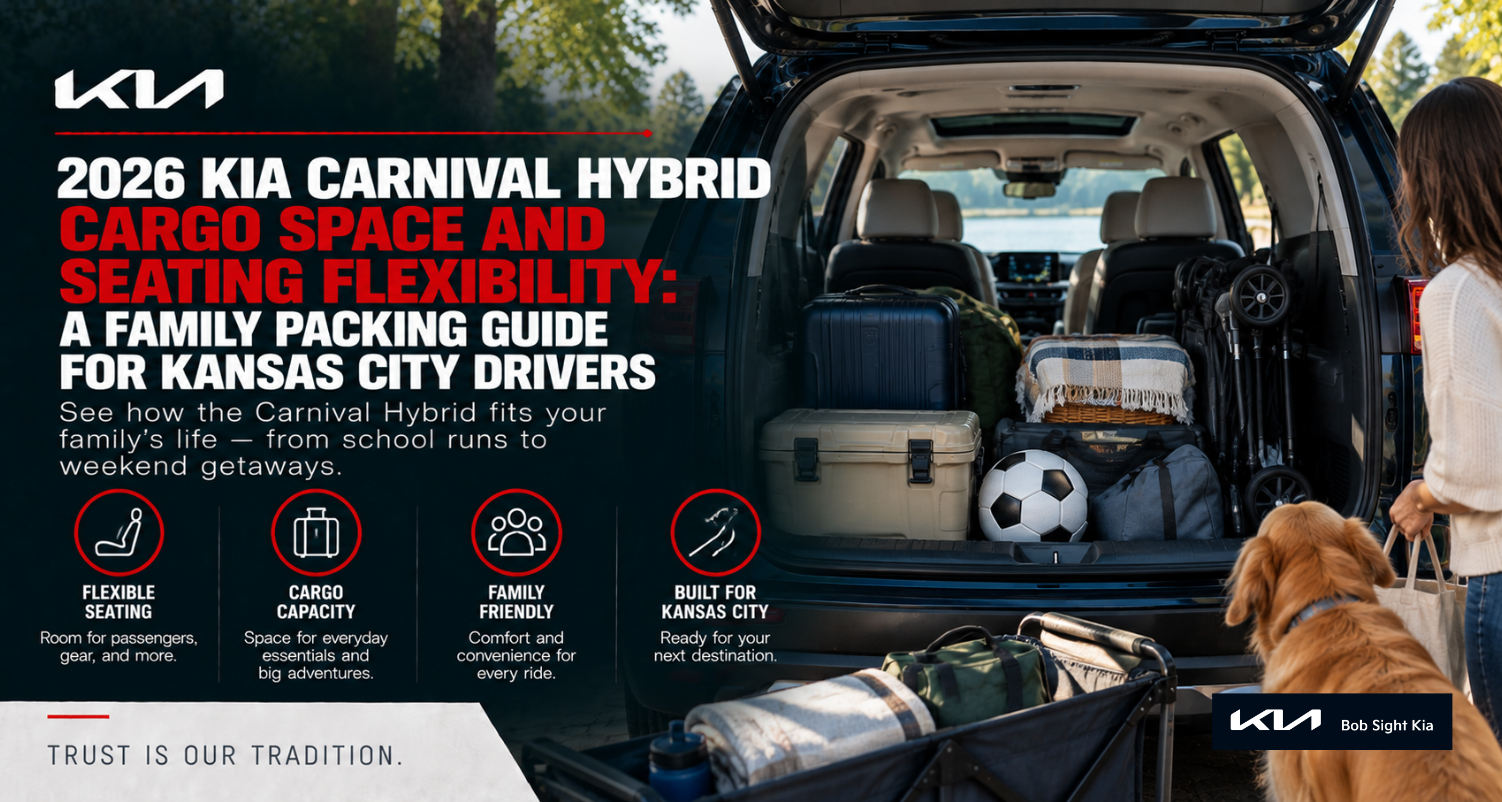
See 2026 Kia Carnival Hybrid cargo space, seating flexibility, and family packing options for Independence and Kansas City drivers.

2026 Kia Carnival Hybrid Cargo Space and Seating Flexibility: A Family Packing Guide for Kansas City Drivers

2026 Kia Carnival Hybrid Cargo Space and Seating Flexibility: A Family Packing Guide for Kansas City Drivers The 2026 Kia Carnival Hybrid gives Kansas City families a flexible combination of three-row seating and substantial cargo capacity, making it easier to adapt the cabin for school days, sports practices, errands, and longer family trips. With up to eight-passenger seating in its standard configurations, available seven-passenger seating on the SX Prestige, sliding and removable second-row seating in applicable configurations, and a 60/40 split-folding third row, the Carnival Hybrid can change with the day's passenger and cargo needs. Families shopping at Bob Sight Kia in Independence, Missouri, can use those configurations to think beyond a simple cargo-space number and consider how the vehicle will actually work when carrying kids, luggage, strollers, groceries, sports equipment, and other everyday gear. Explore new Kia Carnival Hybrid inventory at Bob Sight Kia In This Guide You'll Learn This family packing guide focuses on how the Carnival Hybrid's interior dimensions and seating features translate into everyday usability around Independence and the Kansas City Metro. How much cargo space the 2026 Kia Carnival Hybrid provides How seven-passenger and eight-passenger configurations differ How the second and third rows can help families balance passengers and cargo How to plan for strollers, groceries, sports gear, and luggage What families should consider before choosing a seating configuration How passenger space affects comfort on longer Kansas City drives How to test the Carnival Hybrid's interior before choosing one How Much Cargo Space Does the 2026 Kia Carnival Hybrid Have? The 2026 Kia Carnival Hybrid provides 40.2 cubic feet of minimum SAE cargo volume and up to 145.1 cubic feet of maximum SAE cargo volume. Those numbers place the Carnival Hybrid in a useful position for families who need three rows of passenger space without giving up the ability to carry substantial amounts of gear. The minimum measurement is useful when thinking about everyday cargo capacity with the passenger cabin configured for people, while the maximum measurement demonstrates what becomes possible when the interior is arranged to prioritize cargo. For Kansas City families, the difference between those configurations matters because passenger and cargo requirements can change dramatically from one trip to another. Cargo measurements are useful starting points, but cubic feet do not tell the entire story. A family may need space for a folded stroller, a week's groceries, backpacks, sports bags, or suitcases rather than perfectly shaped boxes. The Carnival Hybrid's tall, enclosed cargo area and configurable rear seating allow families to work with differently shaped items instead of relying solely on a numerical volume figure. A Saturday that begins with youth sports in Blue Springs and ends with a grocery run in Independence can require several different types of cargo at the same time. The 60/40 split-folding third-row design adds another layer of flexibility. Rather than treating the third row as either completely occupied or completely folded, families can adjust part of the row when they need additional cargo room while retaining some rear passenger seating. That can be helpful when transporting a longer piece of equipment, extra luggage, or bulky shopping items while another passenger still needs third-row space. Kia also advises that cargo should be evenly distributed, properly secured, and not piled higher than the seatback. 2026 Carnival Hybrid Interior Measurement Specification Family Use Minimum SAE Cargo Volume 40.2 cu. ft. Everyday family gear with passenger seating in use Maximum SAE Cargo Volume 145.1 cu. ft. Large cargo loads when the cabin is configured for maximum space Second-Row Legroom 40.5 in. Room for passengers on daily and longer trips Third-Row Legroom 35.6 in. Usable three-row passenger accommodation Maximum Seating Up to 8 passengers Useful for larger families and carpools How Does 2026 Kia Carnival Hybrid Seating Flexibility Work? The 2026 Kia Carnival Hybrid is designed to let families adjust the second and third rows around changing passenger and cargo requirements. Eight-passenger seating is standard across the LXS, EX, SX, and SX Prestige trims, while the SX Prestige offers an available seven-passenger seating package with VIP Lounge Seats. Kia also lists sliding and removable second-row seats across the lineup, excluding configurations equipped with VIP seats. That distinction is important because the best configuration depends on whether your family values maximum cargo adaptability or a more specialized second-row passenger experience. In eight-passenger configurations, Kia's Slide-Flex seating concept can provide useful flexibility for family routines. The second-row middle seat can move forward or backward, which can help parents position a younger passenger closer to the front or adjust the arrangement around other passengers. The second-row side seats can slide as well, helping create access to the third row. For households regularly switching between family use and carpools around Independence, Blue Springs, and Lee's Summit, those small adjustments can make the cabin easier to organize. The available seven-passenger SX Prestige Seat Package changes the focus of the second row. It includes VIP Lounge Seats with features designed around second-row comfort, including sliding and reclining capability, heated and ventilated seating, and leg extensions. Families considering this configuration should think carefully about how frequently they expect to maximize cargo space versus how strongly they value second-row comfort. The seven-passenger layout is not simply an eight-passenger version with one fewer seat because its second-row arrangement serves a different ownership priority. The third row provides another important part of the equation. Its 60/40 split-folding design allows families to change the passenger-to-cargo balance without always giving up the entire rear row. That flexibility can be useful when one child needs a third-row seat but the family also needs extra room for equipment or luggage. Instead of choosing between "people mode" and "cargo mode," families can create intermediate configurations that better match the day's plans. How Should Kansas City Families Pack the Carnival Hybrid for Everyday Life? The easiest way to pack a Kia Carnival Hybrid is to organize the cabin according to which items need to remain accessible and which can stay in the rear cargo area until the destination. Everyday family cargo often includes items that are used at different points during a trip, so simply fitting everything inside is not always the most practical approach. Backpacks, diaper bags, coats, sports equipment, groceries, and strollers all have different access needs. A little planning can make the Carnival Hybrid's flexible interior considerably more useful. Consider a typical weekday in eastern Jackson County. A family might leave home with backpacks and work bags, make a school drop-off, stop for groceries, and then head to an evening practice in Blue Springs or Independence. If sports bags are buried beneath grocery bags, the available cargo capacity is not being used efficiently even if everything technically fits. Keeping frequently accessed items closer to the liftgate or appropriate seating position can reduce the amount of unloading and rearranging required throughout the day. A practical family packing process can look like this: Count passengers first. Determine exactly which second- and third-row seats need to remain available before loading cargo. Separate daily-access items. Keep backpacks, diaper bags, coats, and other frequently used items within convenient reach without allowing them to interfere with passengers. Load large items before small ones. Position strollers, sports equipment, suitcases, or other bulky pieces first so smaller bags can fill remaining usable spaces. Use the split third row strategically. If fewer rear seats are needed, fold the appropriate portion to create additional cargo room while preserving passenger seating. Secure the load. Keep cargo evenly distributed and properly secured so objects do not shift during braking, turns, or highway driving. This approach becomes more important during busy weekends. Families traveling between Independence, Grain Valley, Raytown, and Kansas City may combine errands and activities into one trip rather than returning home between stops. Planning the interior around the sequence of those stops can make the vehicle feel more organized without requiring maximum cargo mode every time. What Do 40.2 Cubic Feet and 145.1 Cubic Feet Mean for a Family? The Carnival Hybrid's 40.2-to-145.1-cubic-foot cargo range shows how dramatically the interior can change depending on how much passenger seating a family needs. The 40.2-cubic-foot minimum figure represents a useful starting point for everyday family transportation, while the maximum figure reflects a cabin configured much more heavily toward carrying cargo. Families should therefore evaluate both measurements rather than focusing only on the largest advertised number. A household using all three rows regularly will care more about the cargo area available while those seats are occupied. This is where real-world items matter. A folded stroller can consume a very different shape of space than grocery bags, and sports equipment can require length rather than simple volume. Holiday travel adds suitcases, coolers, gifts, coats, and children's gear. The useful question is not merely "How many cubic feet does it have?" but "Can the seating and cargo area be configured around what our family actually carries?" The maximum cargo measurement becomes more relevant when passenger requirements decrease. A parent transporting home-improvement supplies, helping a college student move belongings, carrying larger recreational gear, or preparing for a major shopping trip may want to prioritize cargo room temporarily. The removable second-row seating available in applicable configurations is important in this scenario because it provides another way to increase usable space. Families choosing the VIP Lounge Seat configuration should remember that its second-row setup has different cargo-flexibility considerations. Shape also matters in the Kansas City Metro. A family might need a narrow but long area for certain sports equipment, a broad floor for boxes, or enough vertical room for taller cargo. The 60/40 third row lets drivers create a mixed configuration rather than automatically folding the entire row. That versatility is one reason physically testing your normal family gear can reveal more than comparing specification sheets alone. Is the Eight-Passenger or Seven-Passenger Carnival Hybrid Better for Your Family? Eight-passenger seating generally prioritizes passenger capacity and seating flexibility, while the available seven-passenger SX Prestige configuration prioritizes a more specialized second-row comfort experience. Neither arrangement fits every household in the same way. Families should base the decision on how many people normally ride in the vehicle, how frequently the third row is used, and whether removable second-row seating or VIP-style second-row accommodations better match their routine. Consideration 8-Passenger Configuration Available 7-Passenger SX Prestige Configuration Maximum Passenger Capacity 8 7 Second-Row Focus Flexible family seating VIP Lounge Seat comfort Carpool Use Additional seating position Lower maximum passenger count Cargo Planning Removable second-row seats in applicable non-VIP configuration Different considerations due to VIP seating Best Question to Ask How often do we need eight seats? How much do we value second-row comfort? An eight-passenger layout may make sense for a household that regularly carries several children, grandparents, friends, or teammates. Even if all eight positions are not occupied every day, having the extra position can be useful when plans change unexpectedly. Families involved in school carpools around Independence or weekend activities across Jackson County may find that occasional eighth seat more valuable than expected. It can also reduce the need to take a second vehicle when an extra passenger joins the trip. The available seven-passenger configuration takes a different approach. Its VIP Lounge Seats can appeal to families who frequently carry older children, adults, or grandparents in the second row and want additional passenger-focused amenities. The choice therefore should not be reduced to seven versus eight seats on paper. It is a decision about how the middle of the cabin will function throughout ownership. Before choosing, sit family members in their likely positions and walk through a normal trip. Consider who will use the third row, who needs help buckling in, how often passengers move between rows, and how much cargo typically comes along. That short exercise can quickly show which layout better matches everyday life. How Much Passenger Room Does the Carnival Hybrid Provide Across Three Rows? The 2026 Kia Carnival Hybrid provides 41.1 inches of front legroom, 40.5 inches in the second row, and 35.6 inches in the third row. Those measurements are important because cargo flexibility is only useful for a family vehicle when passengers can also be accommodated comfortably. Second-row shoulder room measures 63.2 inches, while third-row shoulder room measures 59.5 inches. Looking at passenger dimensions alongside cargo volume provides a more complete picture of how the cabin may work for a particular household. Third-row usability deserves close attention when shopping for any three-row family vehicle. Some families reserve the rear row primarily for children, while others regularly transport teenagers, grandparents, visiting relatives, or adult friends. A specification such as 35.6 inches of third-row legroom gives shoppers a useful reference point, but seating comfort is personal. Passenger height, seating position, and the position of the row ahead can all affect how the space feels in practice. For a short drive from Independence Center to home, passenger requirements may be different from a longer weekend trip across the Kansas City Metro. A seating arrangement that feels perfectly acceptable for a 15-minute ride may deserve more scrutiny if the family regularly takes multi-hour road trips. This is why families should evaluate each row rather than spending the entire test drive in the front seats. Have the people who will actually use the second and third rows try them. Families using child restraints should also evaluate the specific restraint, seating position, and installation requirements rather than assuming that a particular seat will work based only on dimensions. Follow the vehicle owner's manual and the child-restraint manufacturer's instructions when installing and using a child restraint. The goal is to choose a cabin arrangement that works safely and practically for the people who will actually ride in it. How Can Families Test Cargo Space Before Buying a Carnival Hybrid? The most useful cargo-space test is to recreate your family's normal passenger and packing situation before choosing a Carnival Hybrid configuration. Published measurements tell you the available volume, but your stroller, sports bags, luggage, mobility equipment, and other large items have specific dimensions. Testing representative gear can reveal whether the layout works without constant seat rearrangement. It can also help families decide whether eight-passenger seating or the available seven-passenger configuration better matches their priorities. Start by identifying the largest objects that travel with your family regularly. For parents of younger children, that may be a stroller or travel system. For a household with athletes, it might be baseball bags, hockey equipment, folding chairs, or a wagon. Families who travel frequently may want to recreate a typical luggage load rather than assuming several suitcases will fit in the way they imagine. Use this process during your evaluation: Set the seats for your normal passenger count. Do not begin in maximum cargo mode unless that is how you normally travel. Check third-row access. Have family members enter and exit the rear row as they would during an ordinary trip. Measure your largest gear. Record the height, width, and depth of bulky items before visiting the dealership. Test a mixed passenger-and-cargo arrangement. Consider what happens when the third row is partially occupied rather than completely empty. Compare seating configurations. If considering different Carnival Hybrid layouts, evaluate how the second-row design changes cargo flexibility and passenger comfort. Think about tomorrow, not only today. Consider how growing children, changing activities, and future travel habits may alter your space requirements. This exercise is useful for families coming from Blue Springs, Liberty, Grain Valley, or other parts of the Kansas City area to Bob Sight Kia in Independence. Knowing your measurements and normal passenger count beforehand makes it easier to evaluate the vehicle based on real needs rather than trying to visualize everything during a showroom visit. How Does the Carnival Hybrid Fit Kansas City Road-Trip Packing? The Carnival Hybrid's combination of three-row seating, 40.2 cubic feet of minimum cargo volume, and configurable rear seating gives families several ways to balance passengers and luggage for longer trips. Road-trip packing is different from daily commuting because families may need clothing, coolers, entertainment items, blankets, chargers, and destination-specific gear at the same time. The goal is to preserve passenger comfort while using the cargo area efficiently. The Carnival Hybrid's flexible rear seating can help families create a configuration based on the number of people traveling. Start with the items that will not be needed until arrival. Suitcases and other destination gear can usually be placed farther into the cargo area, while snacks, jackets, children's items, and travel necessities should remain easier to reach. Avoid stacking loose objects where they could become hazards during sudden braking. Kia's guidance to distribute and secure cargo properly is relevant whether you are driving a few miles through Independence or spending hours on the highway. Long-distance passenger comfort should also influence packing decisions. Filling every open space around passengers may technically increase how much gear fits, but it can make a long drive uncomfortable and cluttered. Keeping footwells and passenger areas clear helps preserve the usefulness of the Carnival Hybrid's 40.5 inches of second-row legroom and 35.6 inches of third-row legroom. Families traveling through Kansas City traffic before reaching open highway will appreciate having important items organized rather than buried under other cargo. Roof-mounted cargo may be another consideration for some families. Kia lists a 165-pound roof-rack load specification for the 2026 Carnival Hybrid, but owners should verify equipment compatibility and follow the vehicle and accessory instructions before loading anything on the roof. Moving certain properly secured items outside the passenger cabin can sometimes preserve interior room, but load limits and installation requirements matter. Never assume an accessory or cargo arrangement is appropriate simply because it physically fits. Quick Facts About the 2026 Kia Carnival Hybrid The 2026 Carnival Hybrid combines substantial interior cargo capacity with flexible three-row seating and a hybrid powertrain designed for family transportation. These quick specifications provide a useful reference when comparing the vehicle with your household's passenger and packing needs. Minimum SAE cargo volume: 40.2 cubic feet Maximum SAE cargo volume: 145.1 cubic feet Standard seating capacity: eight passengers Available SX Prestige configuration: seven passengers with VIP Lounge Seats Front legroom: 41.1 inches Second-row legroom: 40.5 inches Third-row legroom: 35.6 inches Third-row seating: 60/40 split-folding design Second-row sliding and removable seats are offered in non-VIP configurations Powertrain: 1.6-liter turbocharged four-cylinder engine with a full parallel hybrid system Total combined output: approximately 242 horsepower EPA-estimated fuel economy: 34 mpg city, 31 mpg highway, and 32 mpg combined Drivetrain: front-wheel drive Roof-rack load specification: 165 pounds These specifications are most useful when viewed together. Maximum cargo volume does not describe the layout when eight people are aboard, and passenger capacity alone does not show how much flexibility exists when fewer seats are needed. Families shopping in Independence should consider passenger count, cargo type, second-row preferences, and daily driving patterns as one connected decision. Ownership Planning for a Kia Carnival Hybrid in the Kansas City Metro Long-term Carnival Hybrid ownership is easier to plan when families choose the seating configuration around their most common use rather than the occasional maximum-capacity scenario. A household that needs eight seats several times every week has different priorities from one that usually carries four people but frequently transports bulky gear. Thinking through that difference before purchasing can reduce the amount of daily seat rearranging required later. Seasonal routines are worth considering as well. Missouri winters can add bulky coats, boots, emergency supplies, and other cold-weather gear to an already full cabin. Spring and fall may mean sports equipment and folding chairs, while summer can bring vacation luggage, coolers, and outdoor equipment. A family whose cargo needs change throughout the year may place a higher value on flexible seating than a household with a highly consistent daily routine. The hybrid powertrain also adds another dimension to ownership planning. The 2026 Carnival Hybrid uses a 1.6-liter turbocharged gasoline direct-injection engine paired with a full parallel hybrid system. Kia lists total combined output at approximately 242 horsepower and EPA-estimated fuel economy of 34 mpg city, 31 mpg highway, and 32 mpg combined. For families spending substantial time in Independence and Kansas City stop-and-go traffic, those efficiency figures may be relevant alongside the vehicle's passenger and cargo capabilities. Maintenance should remain part of the ownership plan rather than becoming an afterthought. Following the maintenance information for the vehicle, checking tires and fluids, and addressing warning indicators promptly can help support dependable family transportation. Bob Sight Kia owners can use the dealership's online service scheduler when maintenance is due. Keeping maintenance organized can be particularly useful for a family vehicle that handles school transportation, commuting, errands, and road trips throughout the year. Frequently Asked Questions About 2026 Kia Carnival Hybrid Cargo Space and Seating How much cargo space does the 2026 Kia Carnival Hybrid have? The 2026 Kia Carnival Hybrid provides 40.2 cubic feet of minimum SAE cargo volume and up to 145.1 cubic feet of maximum SAE cargo volume. The amount of usable space available on a particular trip depends on how the passenger cabin is configured. Families using more seating positions will naturally have different cargo options from families configuring more of the interior for cargo. Both measurements are therefore important when evaluating the vehicle. The minimum figure is useful for understanding everyday family practicality, while the maximum figure shows how much the interior can expand when cargo becomes the priority. A household should not automatically assume it will regularly use the maximum configuration. If the third row is occupied every day, the more useful question is how the remaining cargo area works with the family's actual belongings. For Independence and Kansas City families, consider measuring bulky items before shopping. A stroller, sports wagon, large suitcase, or piece of recreational equipment can reveal more about real-world usability than cubic-foot numbers alone. Bringing those measurements to Bob Sight Kia can make the comparison much easier. Does the 2026 Kia Carnival Hybrid seat seven or eight people? The 2026 Kia Carnival Hybrid offers up to eight-passenger seating, while an available SX Prestige Seat Package provides a seven-passenger configuration with VIP Lounge Seats. Eight-passenger seating is standard on the LXS, EX, SX, and SX Prestige according to Kia's 2026 feature information. The available seven-passenger arrangement changes the second-row experience rather than simply removing a seat. Families should compare both approaches based on their normal passenger requirements. An eight-passenger configuration can be useful for larger households and families that frequently carpool. The additional seating position may also be valuable when relatives or friends travel together. If that eighth seat would rarely be occupied, however, a household may place greater value on the passenger-focused features of the available seven-seat setup. Kansas City families should evaluate this decision using their real passenger mix. Think about school pickups, weekend activities, grandparents, friends, and longer trips rather than only the number of people in the immediate household. Seating capacity often becomes most valuable on the days when the family's routine changes. Can the second-row seats in the Kia Carnival Hybrid be removed? Kia lists removable second-row seating for the 2026 Carnival Hybrid in applicable configurations, while VIP Lounge Seat configurations have different seating considerations. Kia also describes its sliding and removable second-row seats as a way to increase seating flexibility and maximize cargo space. Shoppers should confirm the exact equipment on the specific trim and seating package they are considering. Removable seating can be useful for households that occasionally need a much larger cargo area. The feature allows the vehicle to serve different roles without requiring the family to permanently give up passenger capacity. That versatility can matter for large shopping trips, moving bulky belongings, or carrying recreational equipment. Before purchasing a Carnival Hybrid near Kansas City, ask to see how the exact second-row configuration operates. Physically moving, sliding, or accessing the seats provides a much better understanding than reading a feature list. The goal is to determine whether the process works comfortably with your family's routine. Is the Kia Carnival Hybrid practical for family road trips from Kansas City? The Carnival Hybrid's three-row seating, flexible rear cabin, and 40.2-to-145.1-cubic-foot cargo range provide multiple ways to organize passengers and luggage for family travel. Its suitability for a particular road trip depends on passenger count, the amount and shape of luggage, and which seating positions must remain occupied. Families should plan the configuration before loading rather than filling the rear area randomly. Long trips also make passenger dimensions more important. The Carnival Hybrid provides 40.5 inches of second-row legroom and 35.6 inches in the third row. Families expecting adults or taller teenagers to spend extended periods in the rear should test those seating positions before choosing the vehicle. For families leaving Independence and traveling through the Kansas City Metro before heading out on I-70 or another regional route, organization can make the beginning and end of the trip easier. Keep frequently needed items accessible and secure larger luggage properly. A well-planned seating and cargo arrangement can preserve passenger comfort without wasting usable storage space. Where can I see a 2026 Kia Carnival Hybrid near Kansas City? Kansas City-area shoppers can check Kia Carnival Hybrid availability at Bob Sight Kia in Independence, Missouri. Reviewing inventory before visiting can help families identify available trims and seating configurations that match their needs. Because equipment can vary by vehicle, checking the specific model is more useful than assuming every Carnival Hybrid has the same second-row setup. During a visit, evaluate more than the driver's seat. Open the rear liftgate, operate the second-row seating, access the third row, and have family members sit where they would normally ride. If cargo space is a major purchasing factor, bring measurements for the largest items you carry regularly. Families traveling from Blue Springs, Raytown, Grain Valley, Liberty, Lee's Summit, or elsewhere in the Kansas City Metro can also contact Bob Sight Kia about scheduling a test drive. A real-world interior evaluation can help determine whether the Carnival Hybrid's combination of seating and cargo flexibility matches the way your family actually travels. Find the Right Carnival Hybrid Configuration for Your Kansas City Family The right 2026 Kia Carnival Hybrid configuration is the one that accommodates your family's normal passenger count while leaving practical room for the gear you carry most often. Maximum cargo capacity is useful, but families should also consider how much room remains when the second and third rows are doing their primary job of carrying people. The Carnival Hybrid's 40.2 cubic feet of minimum cargo space, 145.1 cubic feet of maximum cargo space, and configurable rear seating provide several ways to strike that balance. Local driving habits make that flexibility valuable. A weekday in Independence may involve commuting, school transportation, errands, and an evening activity, while a weekend could involve a longer drive across Jackson County or a family trip outside the Kansas City Metro. Those scenarios place very different demands on the same vehicle. Choosing a cabin arrangement around those recurring situations can make the Carnival Hybrid easier to live with over time. Bob Sight Kia in Independence can help families compare available Carnival Hybrid configurations and see how the seating works in person. Rather than choosing solely from a specification sheet, take time to evaluate third-row access, second-row movement, cargo dimensions, and the way your normal family gear would fit. That practical evaluation can make it easier to choose a Carnival Hybrid that works not only for the test drive, but also for years of Kansas City family life. Helpful Links Shop Kia Carnival Hybrid Inventory Explore New Kia Vehicles Value Your Trade Explore Kia Financing Schedule Kia Service Proud to Be Part of the Bob Sight Auto Group Bob Sight Kia in Independence is proud to be part of the Bob Sight Auto Group, serving drivers and families throughout the Kansas City Metro with automotive sales, service, parts, and collision support. Whether you are researching a Kia Carnival Hybrid for family transportation, maintaining your current vehicle, or comparing options across the Bob Sight family of dealerships, our goal is to provide useful local resources and a straightforward automotive experience built around the tradition of serving area drivers. Bob Sight Kia - Independence, MO Bob Sight Ford - Lee's Summit, MO Bob Sight Honda - Lawrence, KS Bob Sight CDJR - Lawrence, KS Bob Sight Collision Center - Lee's Summit, MO

Clean pre-owned vehicles parked on the dealership lot at Bob Sight Kia in Independence MO

Used Cars Independence MO: Best Options Available Now

How to Shop for Used Cars in Independence, MO Shopping for used cars in Independence, MO requires a strategic approach that combines smart budget planning, thorough vehicle history research, and partnering with a trusted local dealership. Whether you are searching for a reliable daily commuter for trips along Interstate 70, a spacious pre-owned SUV for family routines around Jackson County, or an affordable first car for a student, the pre-owned market offers exceptional value. At Bob Sight Kia, we guide local shoppers through every step of the pre-owned buying process. Located conveniently near Noland Road, our dealership provides transparent pricing, thoroughly inspected used inventory, flexible auto financing options, and a stress-free shopping environment for drivers across Independence, Blue Springs, Lee's Summit, and Raytown. Browse Pre-Owned Vehicles for Sale at Bob Sight Kia in Independence, MO In This Guide You'll Learn This comprehensive pre-owned buying guide walks you through everything you need to know about shopping for used cars in Independence and the Kansas City Metro: How to establish a realistic pre-owned vehicle budget including taxes, insurance, and ownership costs Key differences between standard used cars and Certified Pre-Owned (CPO) Kia models Critical vehicle history details to inspect on CARFAX and AutoCheck reports Step-by-step guidance for conducting a thorough test drive around Jackson County How to evaluate trade-in value and apply vehicle equity toward your purchase Comparing dealership purchases with private seller transactions in Missouri Auto financing strategies for securing competitive rates regardless of your credit tier Long-term ownership tips for maintaining your pre-owned car at Bob Sight Kia Establishing a Realistic Used Car Budget for Jackson County Drivers Setting a clear, comprehensive budget before browsing used car inventory is the foundational step to securing a smart purchase in Independence, MO. Many car shoppers focus solely on the sticker price, but a successful pre-owned buying strategy accounts for total out-of-the-door costs and ongoing monthly operating expenses. In Jackson County, factor in Missouri sales tax, licensing and title registration fees, auto insurance premiums, and routine preventative maintenance into your overall financial plan. A proven rule of thumb for auto financing is keeping your total monthly vehicle payment at or below 15% to 20% of your take-home monthly income. For example, if your household monthly take-home pay is $4,000, your total monthly auto expenses (including loan principal, interest, and insurance) should ideally remain under $600 to $800. Setting aside funds for initial drive-off costs or utilizing a trade-in credit reduces the total loan amount, directly lowering your monthly payment and reducing overall interest charges over your loan term. At Bob Sight Kia, our team prioritizes financial transparency. We provide upfront pricing clarity without hidden fees or unexpected line items. Whether you are shopping for a pre-owned Kia Sportage, a used Kia Sorento, or a reliable pre-owned sedan under $15,000, our online payment calculator and finance specialists near E 23rd St S help you map out exact monthly figures before you make any commitments. Standard Used Cars vs. Certified Pre-Owned Kia: Which Is Right for You? Understanding the distinction between standard used cars and Certified Pre-Owned (CPO) Kia inventory helps you choose the exact balance of price and protection for your needs. While standard pre-owned vehicles provide incredible upfront affordability across various makes and models, Kia Certified Pre-Owned vehicles deliver factory-backed warranty peace of mind that rivals buying a brand-new car. A standard pre-owned vehicle at Bob Sight Kia undergoes a comprehensive multi-point mechanical inspection by our factory-trained technicians to ensure safety, drivability, and structural integrity. These vehicles represent a diverse selection of popular sedans, trucks, and crossovers from top manufacturers, ideal for budget-conscious buyers seeking dependable transport around Raytown, Grain Valley, or Sugar Creek. Conversely, a Certified Pre-Owned Kia must satisfy strict factory standards established by the manufacturer. The vehicle must be less than 6 model years old, have fewer than 80,000 miles, and pass an exhaustive 165-point quality assurance inspection covering engine performance, electrical systems, brake mechanics, and cosmetic standards. Review the comparison below to see how these two pre-owned categories stack up: Feature / Specification Standard Used Vehicle Kia Certified Pre-Owned (CPO) Inspection Requirement Multi-point dealer safety check Rigorous 165-point OEM inspection Powertrain Warranty Available dealer options or remaining warranty 10-Year/100,000-Mile CPO Powertrain Warranty Roadside Assistance Optional add-on coverage 24/7 Unlimited Mile Roadside Assistance included Vehicle Age & Mileage Limits Varies across inventory Under 6 model years and under 80,000 miles Vehicle History Report Complimentary CARFAX Report included Complimentary CARFAX Report included Upfront Purchase Cost Typically lower baseline price point Slight premium for factory certification perks If long-term warranty coverage and factory protection are your top priorities, exploring our Certified Pre-Owned Kia inventory near Liberty and North Kansas City provides extraordinary value and peace of mind. Essential Steps for Analyzing Vehicle History Reports Reviewing a detailed vehicle history report is a crucial step when evaluating used cars for sale in Independence to uncover past ownership details. At Bob Sight Kia, we provide complimentary CARFAX vehicle history reports for our pre-owned inventory, ensuring complete transparency before you take a test drive. When analyzing a vehicle history report, focus on several key indicators: Ownership History & Usage Type: Check whether the vehicle had a single owner or multiple previous owners. Reports also clarify whether the vehicle was used as a personal vehicle, a corporate fleet vehicle, or a lease return. Single-owner lease returns frequently feature lower mileage and meticulous maintenance records. Accident & Damage History: Verify that the vehicle has a clean title free from severe accident records, structural frame damage, airbag deployments, or flood history. Minor cosmetic repair records are common, but severe structural damage should be avoided. Detailed Maintenance Records: A consistent service history—showing regular synthetic oil changes, brake pad replacements, tire rotations, and fluid flushes—proves the previous owner cared for the mechanical health of the vehicle. Title Status & Lien Check: Ensure the title is clear of salvage, rebuilt, or lemon-law brandings. A clear title guarantees smooth registration and titling with the Missouri Department of Revenue. Our sales advisors at Bob Sight Kia walk you through every line item on the vehicle history report, answering your questions and confirming that the car meets our high quality standards before it enters our lot on Noland Road. How to Conduct a Comprehensive Used Car Test Drive A thorough test drive involves more than a quick trip around the block; it is your hands-on opportunity to test real-world handling, comfort, and mechanical performance across local road conditions. When testing a pre-owned vehicle near Independence Center or along US-40, evaluate how the car responds across various speed ranges and pavement surfaces. Follow this multi-point checklist during your test drive with Bob Sight Kia: Initial Cold Start & Idle Inspection: Turn the key or push the start button with the audio system turned off. Listen closely for smooth engine cranking, steady idling without sputtering, and verify that no dashboard warning lights (such as the Check Engine or ABS light) remain illuminated. Steering & Wheel Alignment Check: Drive on a straight, level stretch of road like I-470. Hold the steering wheel gently to ensure the vehicle tracks straight without pulling heavily to the left or right, which could indicate alignment or suspension wear. Brake Pedal Response & Stopping Power: Test the brakes at low and moderate speeds. The brake pedal should feel firm and responsive without feeling spongy, pulsating, or producing high-pitched squeal or grinding noises. Transmission Shifting & Acceleration: Accelerate smoothly onto I-70 to evaluate transmission gear changes. Whether equipped with an automatic, manual, or Intelligent Variable Transmission (IVT), gear shifts should feel prompt and seamless without hesitation or clunking. Cabin Comfort & Technology Checks: While parked, test all interior electronics, including heating and defroster systems, air conditioning, power windows, touchscreen displays, backup cameras, and bluetooth connectivity. Taking time to evaluate these operational factors ensures that your chosen pre-owned vehicle delivers everyday driving satisfaction across Jackson County. Maximizing Your Trade-In Value in Independence, MO Leveraging your current vehicle as a trade-in is one of the most effective ways to lower out-of-pocket costs and reduce loan financing on a used car. Trading in your vehicle at Bob Sight Kia eliminates the stress, advertising expenses, and safety concerns associated with selling a car privately to strangers online. To maximize your trade-in value, take a few simple prep steps before visiting our dealership near Noland Road. Clean the vehicle thoroughly inside and out, gather all original maintenance records and title documents, and bring all master keys and owner manuals. Our professional appraisal team conducts a transparent on-site evaluation, comparing real-time market data across the Kansas City Metro to offer top dollar for your trade-in. Additionally, trading in a vehicle in Missouri offers significant tax advantages. Under state law, the value of your trade-in is subtracted from the purchase price of your new-to-you used vehicle before sales tax is calculated. For example, if you purchase a pre-owned SUV for $20,000 and receive $8,000 for your trade-in, you pay Missouri sales tax only on the $12,000 net difference, saving you hundreds of dollars at registration. Why Buying Pre-Owned from a Local Dealership Beats Private Sellers Purchasing a used car from an established local dealership like Bob Sight Kia offers consumer protections, vehicle reconditioning, and financing options that private seller transactions simply cannot match. While private online listings might occasionally appear slightly cheaper upfront, they carry substantial legal and mechanical risks. Private seller transactions are legally executed as-is. Once cash changes hands, any undiscovered mechanical defects, transmission failures, or hidden frame damage become entirely your financial burden. Private sellers do not offer multi-point mechanical inspections, vehicle reconditioning, warranty options, or financing assistance. Furthermore, handling title transfers, lien payoffs, and bill-of-sale paperwork independently can lead to administrative headaches at the DMV. By contrast, Bob Sight Kia inspects, services, and detail-cleans every pre-owned car before offering it for sale. We handle all Missouri title documentation, offer dealer-backed warranties, provide transparent financing, and maintain a dedicated service department to care for your car long after the purchase. Partnering with a trusted local dealership protects your investment and ensures complete legal transparency. Auto Financing Strategies for Pre-Owned Car Buyers Securing competitive auto financing on a pre-owned car involves understanding your credit score, comparing loan terms, and working with an experienced finance department. At Bob Sight Kia, our finance team works with local Kansas City banks, regional credit unions, and national automotive lenders to tailor competitive financing solutions for every shopper. To optimize your auto loan approval, consider these key financing strategies: Know Your Credit Tier: Request a copy of your credit report prior to shopping to understand your standing. Prime credit scores qualify for lower interest rates, but buyers with rebuilding credit can still secure competitive approvals. Apply a Strong Down Payment: Aim for a down payment of 10% to 20% using cash equity or your trade-in. A larger down payment reduces the principal balance, lowers your monthly payment, and improves loan approval terms. Choose an Optimal Loan Term: While 60 or 72-month loan terms lower your monthly payment, shorter loan terms (such as 36 or 48 months) feature lower overall interest charges over the life of the loan. Get Pre-Approved Online: Submitting a secure online finance application with Bob Sight Kia allows our team to pre-arrange loan options before you arrive, streamlining your visit. Our dedicated finance department takes time to explain every term, interest rate, and monthly structure clearly, ensuring you feel completely confident in your auto loan agreement. Kia Pre-Owned Shopping Quick Facts for Independence Buyers Review these essential facts summarizing key advantages of shopping for used cars at Bob Sight Kia in Independence: Extensive Selection: Wide variety of pre-owned Kia models, Certified Pre-Owned inventory, and quality used cars from top manufacturers. Complimentary History Reports: Free CARFAX vehicle history reports provided for complete transparency on every pre-owned model. Certified Quality Protection: Kia CPO models feature a 10-Year/100,000-Mile Powertrain Limited Warranty and 165-point inspection. Missouri Tax Benefits: Trade-in equity reduces taxable purchase amount, lowering state sales tax burdens. Full Customer Care: On-site finance department and factory-certified service center near Noland Road. Shopping for a pre-owned vehicle should be an exciting, enjoyable experience. Visit Bob Sight Kia today to explore our pre-owned inventory and take a test drive. Ownership Planning & Long-Term Value in Missouri Protecting the long-term value and reliability of your pre-owned vehicle requires consistent preventative maintenance and seasonal care. Cars operating across Jackson County face changing weather patterns, including freezing winter temperatures, road salt along I-70, and humid summer heat. Staying diligent with routine service keeps your pre-owned car running efficiently for years to come. Adhering to factory service intervals—such as synthetic oil changes using approved SAE 0W-20 or 5W-30 viscosities, tire rotations every 7,500 miles, brake inspections, and battery tests—prevents minor wear from developing into costly mechanical repairs. Servicing your vehicle at Bob Sight Kia ensures all work is performed by factory-certified technicians using genuine OEM parts and recorded in centralized service databases. Maintaining complete service records protects your car's resale equity, ensuring that when you decide to trade up in the future, your vehicle commands top market value. Our dedicated team in Independence is committed to supporting your entire automotive journey from initial test drive through years of dependable driving. Frequently Asked Questions About Shopping for Used Cars What should I look for when shopping for used cars in Independence, MO? When shopping for used cars in Independence, focus on vehicle history reports, detailed mechanical inspection records, overall cosmetic condition, and total ownership costs. Verifying a clean CARFAX report ensures the vehicle has no hidden accident history or title issues, while choosing a reputable dealership like Bob Sight Kia guarantees that every pre-owned car has undergone a rigorous multi-point safety inspection. Pay close attention to overall maintenance consistency, tire tread condition, brake responsiveness, and fluid cleanliness during your inspection. Taking a comprehensive test drive across local roads like US-40 and I-470 allows you to test real-world transmission shifting, alignment, and cabin tech functions. Working with an established dealership near Noland Road provides added security, offering clear pricing, verified vehicle reconditioning, and dealer-backed warranty options that private sellers cannot provide. What is the difference between a standard used car and a Certified Pre-Owned Kia? A standard used car is sold as-is or with a limited dealer warranty based on its age and mileage. A Certified Pre-Owned (CPO) Kia must meet strict factory criteria, including being less than 6 model years old with under 80,000 miles, passing a meticulous 165-point inspection, and coming backed by a 10-year/100,000-mile CPO powertrain limited warranty plus 24/7 roadside assistance. Standard used cars encompass a broader range of makes, models, price points, and mileage levels, providing exceptional budget flexibility for buyers seeking basic transport. CPO models cater to buyers who want near-new vehicle quality and long-term factory warranty protection at a pre-owned price point. Both options at Bob Sight Kia include complimentary CARFAX history reports and full mechanical checks, ensuring you can choose the exact pre-owned category that fits your household preferences. Can I get financing for a used car at Bob Sight Kia near Kansas City? Yes, Bob Sight Kia offers comprehensive auto financing solutions for pre-owned vehicle buyers across Jackson County. Our finance department works with local Kansas City banks, credit unions, and national lenders to secure competitive interest rates and flexible repayment terms tailored to your credit profile and monthly household budget. Whether you have prime credit, are a first-time buyer, or are working to rebuild your credit score, our team presents transparent financing options without judgment or pressure. Applying a cash down payment or trading in your current vehicle helps secure favorable loan terms. You can start the financing process from home by filling out our secure online pre-approval application, saving you time when you visit our dealership in Independence. Should I trade in my current vehicle when buying a used car in Independence? Trading in your current vehicle is one of the most effective ways to lower your out-of-pocket costs and reduce your monthly payment on a used car. The equity from your trade-in acts as an immediate down payment, shrinking your overall financing total while providing convenient sales tax savings under Missouri state tax regulations. In Missouri, sales tax is calculated only on the net price difference between your new-to-you used car and your trade-in value. This tax credit directly lowers your upfront drive-off expenses when registering your vehicle. Trading in your car at Bob Sight Kia also saves you the time, advertising hassle, and safety concerns of selling a vehicle privately. We manage all title transfers and payoff paperwork on-site for a seamless transition. Why is buying a used car from a local dealership safer than buying from a private seller? Buying from a local dealership like Bob Sight Kia offers legal consumer protections, transparent pricing, verified vehicle reconditioning, and access to dealer financing. Private sales carry significant risk because vehicles are sold strictly as-is without mechanical warranties, vehicle history guarantees, or dedicated service department backing if issues arise. Private seller transactions carry potential risks regarding unpaid liens, title processing errors, or hidden mechanical defects that only become apparent days after the purchase. Furthermore, private transactions require upfront cash or independent bank financing arrangement. Bob Sight Kia reconditions every pre-owned vehicle, resolves outstanding title liens, offers extended service coverage, and provides on-site financing and service support, giving you total peace of mind. Why Buying Pre-Owned Locally at Bob Sight Kia Matters Choosing to purchase your pre-owned vehicle from a local, family-focused dealership like Bob Sight Kia ensures personalized customer care, ongoing service support, and local community investment. Buying locally means partnering with a team that lives and works in Jackson County, understands local driving demands, and prioritizes your satisfaction above all else. Our commitment to local drivers extends far beyond the sale date. Our modern service center near Noland Road provides factory-certified maintenance, transparent pricing, and convenient online scheduling to keep your pre-owned vehicle running reliably. Supporting local businesses directly strengthens our Independence, Blue Springs, Lee's Summit, and Raytown communities. Visit Bob Sight Kia today to explore our pre-owned inventory, take a test drive, and experience why local buyers trust us for quality used cars, transparent financing, and exceptional customer service. Helpful Links Explore Pre-Owned Vehicles for Sale in Independence, MO Browse Kia Certified Pre-Owned Inventory at Bob Sight Kia Value Your Trade-In Online for Maximum Equity Apply for Pre-Owned Auto Financing Pre-Approval View Current Used Car Specials at Bob Sight Kia Proud to Be Part of the Bob Sight Auto Group Bob Sight Kia is proud to be part of the Bob Sight Auto Group, serving drivers across Missouri and Kansas for generations. Built on a foundation of honesty, customer dedication, and community involvement, the Bob Sight Auto Group offers exceptional vehicle sales, competitive leasing options, and professional automotive service across all our dealership locations. Whether you are looking for a new Kia in Independence or exploring our partner stores throughout the region, you can count on receiving top-tier service and unwavering transparency every step of the way. Bob Sight Kia - Independence, MO Bob Sight Honda - Lawrence, KS Bob Sight CDJR - Lawrence, KS Bob Sight Ford - Lee's Summit, MO Bob Sight Collision Center - Lee's Summit, MO

Shopping for new and used vehicles near Liberty, Missouri, with Bob Sight Kia in Independence

Kia Dealer Near Liberty, MO: New and Used Inventory, Trade-In, Financing, and Service Guide

Kia Dealer Near Liberty, MO: New and Used Inventory, Trade-In, Financing, and Service Guide Shop New Kia Vehicles Near Liberty, MO Finding a Kia dealer near Liberty, Missouri, involves more than locating the closest showroom. The right dealership should make it easy to research new and used vehicles, compare models, value your trade, explore financing options, schedule a test drive, and maintain your vehicle after the purchase. Bob Sight Kia in Independence serves drivers from Liberty and communities throughout the Kansas City metro. Liberty shoppers can begin nearly every part of the process online, from browsing current inventory to submitting a finance application. That preparation can make an in-person dealership visit more focused and productive. This guide explains how Liberty drivers can shop for their next Kia, what to compare before choosing a vehicle, how trade-in and financing steps work, and why long-term service support should be part of the dealership decision. In This Guide You'll Learn You will learn how to shop new and used Kia inventory near Liberty while preparing for your trade-in, financing, test drive, and future service needs. How to browse new and used Kia inventory online What to compare when selecting a Kia model and trim How to prepare your current vehicle for a trade-in evaluation Which documents may be useful during the financing process How to plan a meaningful Kia test drive Why service and parts support matter after the purchase How to prepare for a visit from Liberty to Bob Sight Kia Why Liberty Drivers Shop at Bob Sight Kia in Independence Bob Sight Kia gives Liberty shoppers access to new and used inventory, trade-in resources, financing assistance, test drives, and Kia service in one dealership relationship. Liberty drivers often shop throughout the Kansas City metro when searching for a specific model, trim, drivetrain, color, or feature package. Expanding the search to Independence can provide additional options without requiring shoppers to manage separate dealerships for every stage of ownership. Bob Sight Kia allows customers to begin their research online before traveling from Liberty. Current inventory pages can help you identify vehicles that fit your passenger, cargo, performance, technology, and budget requirements. You can also estimate a trade-in value and complete financing steps before arriving. The dealership relationship continues after the sale. Access to Kia-trained service support, maintenance scheduling, parts resources, and available service offers can help owners plan for routine care. This continuity can be useful when you want one location to maintain records and understand your Kia's service history. Drivers searching online for a "Kia dealer near me" should consider the complete experience rather than selecting a location based only on distance. Inventory selection, transparent vehicle information, convenient digital tools, communication, and service access can all influence the value of the dealership relationship. Shopping New Kia Inventory Near Liberty, MO Liberty shoppers can compare new Kia models online before visiting Bob Sight Kia for a closer look and test drive. Kia offers vehicles for a wide range of driving needs. A commuter may prioritize fuel efficiency, maneuverability, and technology, while a growing family may need flexible seating, cargo room, all-wheel drive, or additional driver-assistance features. The Kia K4 can appeal to drivers seeking a modern compact sedan for daily travel around Liberty and Kansas City. SUV shoppers may compare the Kia Seltos, Sportage, Sorento, and Telluride based on passenger space, cargo flexibility, powertrain choices, and available features. The Kia Carnival MPV is another option for families prioritizing passenger access and interior versatility. Electrified shoppers may also find hybrid, plug-in hybrid, or electric models depending on current inventory and model availability. When browsing new Kia inventory at Bob Sight Kia, compare the complete configuration rather than looking only at the model name. Two vehicles from the same model line may have different drivetrains, engines, seating arrangements, wheel sizes, technology packages, and convenience features. Important details to compare include: Trim level and included equipment Front-wheel drive or all-wheel drive Gasoline, hybrid, plug-in hybrid, or electric powertrain Passenger capacity and third-row availability Cargo space with different seating positions Infotainment and smartphone connectivity Driver-assistance and parking features Wheel size, tire type, and ride characteristics Interior materials, colors, and comfort features Inventory changes as vehicles are sold or delivered, so confirm availability before traveling from Liberty. If a specific vehicle is important to you, contact Bob Sight Kia and provide the model, trim, color, or stock information shown online. How to Choose the Right Kia Model and Trim The best Kia for a Liberty driver is the model and trim that fits everyday use, not simply the vehicle with the longest feature list. Start by considering how many people regularly ride in the vehicle. A third row may be important for a larger family, but a smaller two-row SUV may be easier to park and more efficient for a commuter who rarely carries additional passengers. Next, evaluate cargo needs. Sports equipment, strollers, pet supplies, work materials, groceries, and luggage can require different combinations of floor space, seat-folding flexibility, and liftgate access. Bring commonly used items or measure them before the dealership visit if cargo fit is a major concern. Drivetrain is another consideration. Available all-wheel drive can support traction during rain, snow, and changing Missouri weather, but it does not replace proper tires or careful driving. Front-wheel drive may be a suitable choice for drivers who want a simpler configuration and do not need the added traction capability. Powertrain decisions should reflect your travel patterns. A hybrid may be appealing for repeated city trips and stop-and-go traffic, while a conventional gas model may fit drivers who prefer its configuration, availability, or driving characteristics. Electric and plug-in hybrid shoppers should also evaluate home charging access and longer-distance travel needs. Use this process to narrow your Kia options: List your required passenger and cargo capacity. Estimate your weekly city and highway mileage. Identify features you consider essential. Separate required features from optional preferences. Compare the trims that include your priority equipment. Review available drivetrains and powertrains. Select two or three vehicles for an in-person comparison. This approach helps prevent paying for features you do not expect to use while ensuring the vehicle includes the equipment that matters to your household. Finding a Used Kia or Pre-Owned Vehicle Near Liberty Used inventory can give Liberty shoppers access to multiple model years, brands, mileage levels, configurations, and ownership options. A pre-owned vehicle may be a good fit if you want a discontinued configuration, a different feature combination, or a broader selection beyond the current new Kia lineup. Bob Sight Kia offers used vehicles from Kia and other manufacturers, with availability changing as vehicles are acquired and sold. Begin by exploring used vehicle inventory at Bob Sight Kia. Filters can help narrow the results by year, make, model, mileage, body style, drivetrain, and other available criteria. Do not evaluate a used vehicle based only on its model year and odometer reading. Maintenance history, prior use, physical condition, tire wear, accident history, ownership records, and equipment can all influence whether it is the right choice. During an in-person review, inspect the exterior in good lighting. Look for inconsistent paint, panel alignment, windshield damage, wheel condition, tire wear, and signs of corrosion or previous repair. Inside, check seat condition, controls, displays, climate settings, charging ports, safety belts, cargo areas, and folding-seat mechanisms. A test drive should include low-speed streets, normal acceleration, braking, turns, and a stretch of higher-speed travel when practical. Listen for unusual sounds and pay attention to steering alignment, transmission behavior, brake response, ride quality, visibility, and warning lights. Ask for available vehicle history information and service records. Confirm which keys, manuals, charging equipment, accessories, and removable cargo components are included. If the vehicle has remaining warranty coverage, ask how that coverage applies to the specific vehicle and ownership situation. Preparing Your Vehicle for a Trade-In A complete and accurately described trade-in can help Liberty shoppers understand how their current vehicle may contribute to the next purchase. You can begin with the Bob Sight Kia trade-in tool. An online estimate provides a useful starting point, but the final value generally depends on an in-person inspection and verification of the vehicle's condition, equipment, mileage, history, and ownership documentation. Factors that may influence trade-in value include model demand, age, mileage, mechanical condition, cosmetic condition, tires, warning lights, accident history, service records, trim level, drivetrain, and included equipment. You do not need to complete every cosmetic repair before an appraisal. Major repairs or bodywork may cost more than the value they add to the trade. Cleaning the interior, removing personal belongings, and gathering relevant documents can make the evaluation easier without creating unnecessary expense. Prepare for a trade-in evaluation with these steps: Remove personal belongings from the cabin, console, trunk, and cargo area. Collect all available keys, remotes, manuals, and accessories. Gather maintenance receipts and repair records. Confirm the current mileage and note any warning lights. Locate the title or current loan information. Describe the vehicle's condition and history accurately. Bring identification and any documents requested by the dealership. If you still owe money on the vehicle, the remaining loan balance and trade value are separate figures. The dealership can request payoff information and explain how any difference may affect the transaction. Keep the trade-in, vehicle purchase, and financing details clear while reviewing the paperwork. Understanding each component individually makes it easier to evaluate the complete offer. Exploring Kia Financing Options Near Liberty Preparing for financing before visiting the dealership can help you compare vehicles using a realistic ownership plan. Financing involves more than selecting a monthly payment. The vehicle amount, trade-in value, down payment, annual percentage rate, loan length, taxes, fees, optional products, and credit profile can all affect the total cost. Liberty shoppers can visit the Bob Sight Kia finance center to learn about dealership financing resources. A finance application can help the team review potential options based on the information provided and applicable lender requirements. Before applying, review your credit reports for errors and gather accurate employment, residence, and income information. A preapproval from a bank or credit union may provide another reference point, but dealership financing can also give shoppers access to participating lenders and available manufacturer programs. Financing programs and eligibility can change, so avoid assuming an offer will apply based only on an advertisement. Read the complete terms and ask which model, trim, credit tier, loan length, or purchase date requirements apply. Documents that may be useful include: A valid driver's license or accepted identification Proof of current residence Employment and income information Insurance information Trade-in title or loan payoff details Information about a co-applicant, when applicable Ask questions before signing. Review the amount financed, loan term, interest rate, payment schedule, optional products, and total obligation. If you do not understand an item, request an explanation rather than making an assumption. Planning a Useful Kia Test Drive A focused test drive helps Liberty shoppers determine whether a Kia fits their comfort, visibility, technology, and everyday driving needs. Start by adjusting the driver's seat, steering wheel, mirrors, and climate controls. Confirm that you can reach the pedals comfortably and see the instrument display without obstruction. Check visibility through the windshield, side windows, rear glass, and mirrors. Drive at different speeds when road and traffic conditions permit. Evaluate acceleration from a stop, transmission response, braking, steering effort, road noise, suspension comfort, and lane positioning. If you are comparing gas and hybrid versions, drive them over similar roads to understand the differences. Technology should be tested while the vehicle is parked. Pairing a phone, exploring the infotainment system, checking camera views, and locating physical controls can reveal whether the interface feels intuitive. Families should evaluate more than the front seats. Sit in the second and third rows, check child-seat attachment points, examine door openings, and test how the seats fold. Verify whether passengers can enter and exit without excessive difficulty. Open the cargo area and consider how your usual gear would fit. If you regularly carry a stroller, sports equipment, mobility device, pet crate, or work supplies, bring measurements or the item itself when practical. Before visiting, use the dealership's test-drive request form and identify the vehicle you want to drive. Confirm availability so the dealership can prepare the correct model or used vehicle. Kia Service and Parts Support After Your Purchase The dealership relationship should support your Kia after the sale through maintenance scheduling, inspections, diagnostics, and parts resources. Every vehicle requires ongoing care. Oil and filter changes, tire rotations, brake inspections, battery tests, filters, fluids, wiper blades, alignments, and other services may be required depending on the model and powertrain. Maintenance schedules can vary. A gas-powered Kia has different service needs from a hybrid or fully electric model. Driving conditions may also affect service intervals. Frequent short trips, stop-and-go traffic, extended idling, extreme temperatures, dusty conditions, towing, and heavy vehicle loads can place additional demands on a vehicle. Using a Kia service department can provide access to technicians familiar with Kia systems, diagnostic procedures, maintenance guidance, recalls, and service information. Keeping repair orders also creates a record that may be helpful for future maintenance, warranty questions, or resale. Liberty owners can schedule service online and describe the maintenance or concern before arriving. Include the model, year, mileage, symptoms, and any warning lights. Accurate information helps the service team plan the appointment. Before each visit, review available service and parts specials. Offers change, and eligibility may depend on the service, vehicle, appointment timing, or other terms. Confirm the promotion before work begins. Long-term service access matters when comparing dealerships. Buying from a dealership that also offers convenient maintenance resources can simplify ownership and reduce the need to establish a separate service relationship later. Planning Your Visit From Liberty to Bob Sight Kia Liberty shoppers can make their trip to Bob Sight Kia more productive by confirming vehicle availability and completing research before leaving home. Travel conditions around the Kansas City metro can vary based on traffic, construction, weather, and time of day. Review your preferred route and allow enough time for vehicle comparisons, a test drive, trade-in evaluation, and financing questions. Before visiting, contact the dealership to confirm that the vehicle you want to see is still available. Online inventory updates regularly, but a vehicle may be sold, reserved, moved, or awaiting final preparation. Bring your driver's license, insurance information, trade-in documents, and any financing materials relevant to your visit. If another household member is involved in the decision, consider bringing that person so everyone can evaluate passenger space and comfort. A useful dealership visit plan includes: Choose two or three vehicles from the online inventory. Confirm their availability with Bob Sight Kia. Submit a test-drive request. Complete the trade-in tool if you have a current vehicle. Gather financing and identification documents. Prepare questions about features, warranties, and maintenance. Allow enough time to compare vehicles without rushing. Liberty residents may also want to review weather conditions before a winter visit. Snow, ice, rain, or strong winds can affect travel and may change how a vehicle feels during a test drive. Quick Facts for Liberty Kia Shoppers Liberty drivers can complete much of the Kia shopping process online before visiting Bob Sight Kia in Independence. New Kia inventory can be filtered online by model and available features. Used inventory includes changing selections of Kia and other brands. Vehicle availability should be confirmed before traveling. An online trade estimate is a starting point, not necessarily the final appraisal. Financing terms depend on the complete application and lender approval. A test drive should include comfort, visibility, braking, acceleration, and technology checks. Kia maintenance needs vary by model, powertrain, mileage, and vehicle use. Current service offers should be reviewed before each appointment. All-wheel drive supports traction but does not replace proper tires or careful driving. Maintenance records may support future service planning and resale documentation. Frequently Asked Questions Where can I find a Kia dealer near Liberty, MO? Bob Sight Kia is located in Independence and serves Kia shoppers from Liberty and the surrounding Kansas City metro. Liberty drivers can browse inventory, value a trade, explore financing, and request a test drive online before visiting. Confirm the availability of any specific vehicle before traveling. Inventory can change as vehicles are delivered, sold, reserved, or prepared for display. You can also contact the dealership with questions about a particular model, trim, drivetrain, or feature. Can I shop for a new Kia online before visiting from Liberty? Yes. Bob Sight Kia provides online access to current new Kia inventory. You can compare available models, trim levels, colors, equipment, and vehicle information. Online research can help you create a short list before arriving. This gives you more time to focus on vehicle condition, comfort, technology, and the test drive. Contact the dealership to verify availability and confirm that the vehicle is ready to view. Does Bob Sight Kia offer used vehicles near Liberty? Yes. Bob Sight Kia offers a changing selection of used Kia models and pre-owned vehicles from other manufacturers. Used inventory can vary by year, mileage, condition, equipment, drivetrain, and vehicle history. Review the listing carefully and ask for available history information. Complete an in-person inspection and test drive before deciding whether a particular used vehicle fits your needs. Can I trade in my current vehicle at Bob Sight Kia? Yes. You can begin with the online trade-in tool and provide information about your current vehicle. The final value generally depends on an in-person inspection, verified mileage, condition, equipment, history, and market factors. Bring available keys, service records, title information, and loan payoff details. If you have an active loan, the dealership can explain how the payoff and trade value relate to the proposed transaction. Can Liberty drivers schedule Kia service at Bob Sight Kia? Yes. Liberty drivers can schedule maintenance and repair appointments through the Bob Sight Kia website. Provide the vehicle's year, model, mileage, and a clear description of the requested service or concern. Mention warning lights, unusual noises, leaks, or recent repairs when scheduling. Check the current service and parts specials page before the visit and confirm offer eligibility with the service advisor. Visit Bob Sight Kia Near Liberty, MO Bob Sight Kia helps Liberty drivers shop for new and used vehicles while providing trade-in, financing, test-drive, service, and parts resources in Independence. Begin by browsing current inventory and identifying the models or used vehicles that fit your household. Compare passenger space, cargo flexibility, powertrain, drivetrain, technology, and comfort before scheduling a test drive. If you have a vehicle to trade, complete the online tool and gather your keys, records, title information, and loan details. Financing resources are also available online to help you prepare before visiting. Bob Sight Kia serves drivers from Liberty, Independence, Blue Springs, Lee's Summit, Raytown, Sugar Creek, Grain Valley, Oak Grove, Jackson County, and communities throughout the Greater Kansas City area. Helpful Links Shop New Kia Inventory Shop Used Vehicle Inventory Value Your Trade Explore Kia Financing Resources Schedule Kia Service Proud to Be Part of the Bob Sight Auto Group Bob Sight Kia is proud to be part of the family-owned Bob Sight Auto Group, serving vehicle shoppers and owners throughout the Kansas City region and Northeast Kansas. Families researching new or used vehicles can rely on Bob Sight Auto Group for new and pre-owned vehicle sales, trade-in resources, auto financing, certified service, parts, and collision repair. Bob Sight Kia - Independence, MO Bob Sight Ford - Lee’s Summit, MO Bob Sight Honda - Lawrence, KS Bob Sight CDJR - Lawrence, KS Bob Sight Collision Center - Lee’s Summit, MO

Kia service specials and maintenance planning at Bob Sight Kia in Independence, Missouri

Kia Service Specials in Independence, MO: How to Find Offers, Check Eligibility, and Plan Maintenance

Kia Service Specials in Independence, MO: How to Find Offers, Check Eligibility, and Plan Maintenance View Current Kia Service and Parts Specials at Bob Sight Kia Kia service specials can help Independence drivers plan routine vehicle care while taking advantage of available dealership offers. The challenge is knowing where to find current specials, which services they cover, whether your Kia qualifies, and what terms apply before your appointment. Service offers may change throughout the year, so drivers should avoid relying on an old advertisement, saved screenshot, or expired social media post. The most reliable approach is to review the current service and parts specials published by Bob Sight Kia, read the offer details, and confirm eligibility when scheduling your visit. This guide explains how to find Kia service specials in Independence, Missouri, how to evaluate the details, and how to coordinate available offers with your vehicle's actual maintenance needs. It also covers appointment planning for drivers traveling from Blue Springs, Lee's Summit, Liberty, Raytown, Grain Valley, Sugar Creek, Oak Grove, and communities throughout the Kansas City metro. In This Guide You'll Learn You will learn where to find current Kia service specials, how to interpret offer terms, and how to use available savings without postponing necessary maintenance. Where Bob Sight Kia publishes current service and parts offers Why service specials change and how to verify expiration dates How to check vehicle, service, and appointment eligibility Which maintenance categories may have dealership offers How to match service specials with your Kia maintenance schedule What information to gather before scheduling an appointment How to avoid relying on expired or incomplete promotions What Are Kia Service Specials? Kia service specials are limited offers that may apply to qualifying maintenance, repairs, inspections, parts, or service packages at a participating dealership. Dealership service departments may publish offers for different types of vehicle care throughout the year. These specials can vary based on season, parts availability, manufacturer programs, dealership participation, and local maintenance needs. A service special is not automatically valid for every Kia model, service, part, or appointment. An offer may apply only to a particular maintenance category, qualifying vehicle, specified part, or service completed within a stated period. Some offers may require advance presentation, while others may need to be mentioned when the appointment is scheduled. Drivers should read the full terms instead of relying only on the headline. A promotion title may describe the general service category, but the accompanying details explain what is included, which vehicles qualify, when the offer ends, and whether additional restrictions apply. Service specials can be valuable planning tools, but they should not be treated as a replacement for the maintenance schedule. Your Kia's mileage, age, driving conditions, warning lights, and inspection results should determine which services are needed. The available offer may then help support the cost of qualifying work. Where to Find Kia Service Specials in Independence, MO The best place to find current Bob Sight Kia service offers is the dealership's official service and parts specials page. Bob Sight Kia maintains a dedicated webpage for available maintenance and parts offers. Checking the official page helps reduce the risk of using an outdated advertisement from a third-party coupon site, an old email, or a social media post that is no longer current. Start with the Bob Sight Kia service and parts specials page. Review the available offers, expiration information, service descriptions, and qualifying conditions. Because specials can change, check the page shortly before scheduling rather than assuming an offer you saw several weeks ago is still active. You may also learn about service offers through dealership emails, social media posts, or conversations with a service advisor. These can be useful reminders, but the official specials page and service department should be used to confirm the current details. Follow these steps when searching for a Kia service offer: Visit the official Bob Sight Kia service and parts specials page. Look for an offer related to the maintenance or repair your vehicle needs. Read the full description instead of stopping at the promotional headline. Check the expiration date and any appointment timing requirements. Review model, part, mileage, and service eligibility. Save or print the offer if the instructions require it. Mention the special when scheduling and confirm it with the service advisor. If you are uncertain whether an offer applies, ask before the appointment. A service advisor can review the promotion, your vehicle information, and the requested work. This is more reliable than arriving with an expired or inapplicable offer and expecting it to apply automatically. How to Read the Terms of a Kia Service Offer The fine print explains whether a service special applies to your vehicle, appointment, requested maintenance, and selected parts. Offer terms protect both the customer and dealership by defining what is included. Before scheduling, identify the service named in the promotion and determine whether the offer covers labor, parts, an inspection, a package, or a combination of those items. Check whether the offer is limited to certain Kia models, model years, engines, drivetrains, or types of parts. For example, oil capacity and filter requirements can differ by engine. Tire offers may depend on brand, size, availability, or installation requirements. Battery offers may apply only to qualifying replacement batteries. Expiration dates also matter. Some specials require the service to be completed before the listed date, not merely scheduled before it. If your appointment falls after the expiration date, ask whether the offer will remain valid. Do not assume scheduling during the promotional period guarantees eligibility. Look for language regarding taxes, disposal fees, shop supplies, additional parts, diagnostic work, and combining promotions. A service special may not cover repairs identified during an inspection. It may also be limited to one offer per customer or vehicle and may not be combined with another discount. Important details to review include: The exact service, part, or maintenance package included Eligible Kia models, engines, or vehicle configurations Required appointment or completion dates Whether the offer must be presented in advance Parts, fluids, labor, or quantities included Items that may result in an additional charge Restrictions on combining offers Whether prior purchases or completed services qualify If any term is unclear, contact the dealership before authorizing work. A clear conversation at the beginning of the appointment can prevent confusion when the repair order is reviewed. Matching Service Specials to Your Kia Maintenance Schedule The right service special is one that supports maintenance your Kia currently needs, not an offer that encourages unnecessary work. Your Kia owner's manual and maintenance schedule provide the foundation for routine care. Service timing may depend on mileage, time, engine type, driving conditions, and vehicle use. The maintenance requirements for a Kia Sportage may differ from those of a Telluride, Sorento Hybrid, Carnival, K4, or EV model. Many Kansas City drivers may also fall under severe-use maintenance guidance. Conditions such as frequent short trips, repeated stop-and-go traffic, extended idling, dusty roads, towing, extreme temperatures, and regular operation with heavy passenger or cargo loads can affect service intervals. Before choosing a special, review your maintenance records and current mileage. Determine which services have already been completed and which inspections are approaching. If you recently replaced the cabin air filter, for example, an offer related to that service may not be useful simply because it is available. A service advisor can help compare your records with Kia maintenance recommendations. The advisor may also identify open recalls, recommended inspections, or maintenance items associated with your vehicle's mileage. Recall work is separate from a promotional service offer and should be discussed directly with the dealership. Use the following process to connect specials with your maintenance plan: Check your Kia's current mileage and note any dashboard reminders. Review recent repair orders and maintenance receipts. Consult the maintenance information for your exact model and powertrain. List the services that are currently due or approaching. Compare that list with the offers on the dealership specials page. Ask whether the available promotion applies to your vehicle. Schedule needed work before the offer expires, when practical. Do not delay safety-related repairs or urgent diagnostics while waiting for a promotion. Brake concerns, overheating, low oil pressure, steering problems, charging-system warnings, severe tire damage, or flashing warning lights may require prompt attention. Common Types of Kia Service and Parts Specials Kia service offers may cover routine maintenance, tires, batteries, brakes, filters, inspections, or qualifying parts, but available promotions can change. Oil and filter service is one of the most common maintenance categories drivers search for. The correct oil specification, filter, and capacity depend on the Kia model and engine. Hybrid vehicles still have gasoline engines that require oil changes, while fully electric vehicles have different maintenance needs. Tire-related specials may involve qualifying tire purchases, rotations, balances, alignments, or inspections. Eligibility may depend on tire brand, size, installation, and availability. Before selecting tires, confirm the correct size, load rating, speed rating, and compatibility with your Kia. Battery offers may apply to qualifying replacement batteries or installation services. Missouri temperature changes can expose a weakening battery, and testing can help determine whether a slow start is related to the battery, charging system, starter, or another electrical issue. Brake service promotions may relate to qualifying pads, rotors, inspections, or other components. A brake special should not replace diagnosis. Squealing, grinding, pulling, vibration, warning lights, or changes in pedal feel should be evaluated to determine what the vehicle actually needs. Other specials may involve cabin air filters, engine air filters, wiper blades, fluid services, multipoint inspections, or seasonal preparation. Availability varies, which is why drivers should review the current dealership page instead of expecting a permanent list of offers. The presence of a service special does not mean every related component needs replacement. Inspection results, maintenance history, measurements, fluid condition, and manufacturer guidance should support the recommendation. How to Schedule Service With an Available Offer Mention the service special while scheduling so the dealership can review eligibility and prepare for the requested work. Online scheduling allows drivers to request an appointment at a convenient time. When completing the appointment form, select or describe the service your Kia needs. If there is a comments field, include the name of the offer you plan to use. You can schedule Kia service online at Bob Sight Kia. Appointment availability can vary, so schedule in advance when your maintenance date is approaching or when an offer has a specific expiration date. Gathering the right information can make the process more efficient. Have your Kia's year, model, mileage, and vehicle identification number available. Note any dashboard warnings, unusual sounds, recent repairs, or changes in performance. Before the appointment, prepare the following: Your vehicle's year, model, trim, engine, and current mileage The service or symptom you want evaluated A copy, screenshot, or description of the service special Relevant maintenance records or recent repair orders Your preferred appointment date and transportation needs Questions about eligibility, included services, or offer restrictions When you arrive, show the offer to the service advisor before work begins. Ask the advisor to confirm that it applies to the repair order. If an inspection identifies additional needs, request an explanation and review the updated estimate before authorizing more work. Using Service Specials Without Delaying Necessary Repairs Service specials should support timely vehicle care, not encourage drivers to postpone maintenance or safety repairs until a promotion appears. It can be reasonable to plan nonurgent maintenance around an available offer when the timing aligns with your Kia's service needs. However, postponing required maintenance can contribute to wear, reduced performance, lower fuel efficiency, or more extensive repairs. Warning lights deserve prompt attention. A steady check-engine light may indicate a range of issues, while a flashing check-engine light can signal a condition that may cause further damage. Oil-pressure, overheating, brake, charging-system, and steering warnings can also indicate problems that should not wait for a coupon. Tire damage should be handled based on condition rather than promotional timing. A tire with exposed cords, a sidewall bulge, severe cracking, rapid pressure loss, or inadequate tread may be unsafe. The same principle applies to grinding brakes, fluid leaks, overheating, or significant steering changes. If no current special matches the required service, ask whether another qualifying offer is available. The answer may still be no, but confirming with the dealership is better than delaying work or applying an unrelated promotion. Drivers should also distinguish maintenance from diagnosis. A special for a routine service may not include the diagnostic labor required to investigate an intermittent warning light, vibration, electrical concern, or unusual noise. Describe the symptom accurately when scheduling so the appointment includes enough time for evaluation. Planning Kia Service Around Kansas City Driving Conditions Independence and Kansas City driving conditions can affect maintenance needs, so service planning should account for temperature changes, traffic, potholes, road treatments, and seasonal travel. Cold weather can reduce tire pressure, weaken an aging battery, thicken fluids, and increase demand on heating and defrosting systems. Summer heat can place additional stress on batteries, cooling systems, air conditioning, tires, and engine fluids. Potholes and rough pavement can affect tire condition, wheel alignment, suspension components, and steering response. If your Kia begins pulling to one side, the steering wheel sits off-center, or the tires develop uneven wear, an inspection may be appropriate. Stop-and-go travel around Independence and the Greater Kansas City area can increase idling and repeated braking. Short trips may prevent the engine from reaching full operating temperature for long periods. These patterns can influence the maintenance guidance that applies to your vehicle. Drivers traveling from Blue Springs, Lee's Summit, Raytown, Grain Valley, Oak Grove, Liberty, or Sugar Creek should consider travel time when booking an appointment. Combining several due maintenance items into one properly planned visit may be more convenient than making separate trips. Seasonal planning can also help. Review tires, batteries, wipers, lights, brakes, and climate-control operation before winter. Before summer road trips, check fluid levels, cooling-system condition, tire pressure, tread depth, and any approaching maintenance intervals. Service specials may align with seasonal needs, but maintenance decisions should remain based on vehicle condition and Kia recommendations. Checking current offers before each appointment can help you identify a relevant opportunity without allowing the promotion to determine whether the service is necessary. Quick Facts About Kia Service Specials Current offer details, eligibility, and expiration dates should always be confirmed before service begins. Bob Sight Kia publishes current offers on its official service and parts specials page. Available specials can change throughout the year. An old advertisement may no longer be valid. Offers may apply only to qualifying services, parts, vehicles, or appointment dates. Some promotions must be presented or mentioned before work begins. A scheduled appointment may need to occur before the expiration date. Service specials may not be combined with other offers. Routine maintenance needs vary by Kia model, powertrain, mileage, and driving conditions. Hybrid Kia models still require gasoline-engine maintenance. Urgent repairs should not be postponed while waiting for a promotion. Frequently Asked Questions About Kia Service Specials Where can I find current Kia service specials in Independence, MO? Visit the official Bob Sight Kia service and parts specials page. It is the best starting point for reviewing currently published dealership offers. Because promotions may change, check the page near the time you plan to schedule service. Avoid relying solely on an old email, screenshot, search result, or social media post. If you have questions about an offer, contact the service department and provide your vehicle information before the appointment. Do I need to print a Kia service coupon? The requirements can vary by offer. Some specials may be displayed on a phone, mentioned during scheduling, or attached to the repair order by a service advisor. Review the individual offer terms to determine whether it must be printed or presented. Saving a screenshot can also help identify the promotion you viewed. Confirm the special before authorizing work so you understand whether it applies to your service. Can I combine multiple Kia service specials? Many dealership offers cannot be combined with other discounts or promotions. The exact restriction should appear in the terms associated with the special. If your vehicle needs several services, ask which available offer provides the applicable benefit. Do not assume multiple promotions can be applied to the same repair order. A service advisor can explain how the offer applies before work begins. Can a service special be used after its expiration date? An expired offer may no longer be valid. Some promotions require the service to be completed by the listed date rather than simply scheduled before it. If appointment availability places your visit after the expiration date, ask the service department whether the offer can still be honored. Eligibility should be confirmed rather than assumed. Current offers may replace expired promotions, so review the specials page again before your appointment. Should I wait for a service special before scheduling maintenance? No. Maintenance and repairs should be completed based on your Kia's schedule, condition, mileage, warning lights, and driving environment. A relevant special can support a service that is already needed, but waiting too long may contribute to additional wear or create a safety concern. Contact the service department promptly if your Kia has a warning light, fluid leak, overheating concern, brake problem, damaged tire, or major change in performance. Find Kia Service Offers at Bob Sight Kia in Independence Bob Sight Kia makes it easy to review current service specials and schedule maintenance for your Kia in Independence, Missouri. Before your next appointment, check the official specials page, review your maintenance records, and identify the services your vehicle needs. Read the offer details carefully and confirm eligibility with a service advisor. The Bob Sight Kia service department assists drivers from Independence, Blue Springs, Lee's Summit, Kansas City, Liberty, Raytown, Sugar Creek, Grain Valley, Oak Grove, and surrounding Jackson County communities. Whether your Kia needs routine maintenance, tire care, battery testing, brake service, or diagnosis, planning ahead can make the appointment more efficient. Available specials may change, so return to the service and parts specials page before each visit. When you find a relevant offer, schedule your appointment and mention the promotion in advance. Helpful Links View Kia Service and Parts Specials Schedule Kia Service Shop Genuine Kia Parts Visit Bob Sight Kia Browse New Kia Inventory Proud to Be Part of the Bob Sight Auto Group Bob Sight Kia is proud to be part of the family-owned Bob Sight Auto Group, serving vehicle shoppers and owners throughout the Kansas City region and Northeast Kansas. Families researching new or used vehicles can rely on Bob Sight Auto Group for new and pre-owned vehicle sales, trade-in resources, auto financing, certified service, parts, and collision repair. Bob Sight Kia - Independence, MO Bob Sight Ford - Lee’s Summit, MO Bob Sight Honda - Lawrence, KS Bob Sight CDJR - Lawrence, KS Bob Sight Collision Center - Lee’s Summit, MO

2026 Kia Sorento gas vs. hybrid reliability and ownership cost comparison for Kansas City families at Bob Sight Kia

2026 Kia Sorento Gas vs. Hybrid: Long-Term Reliability and Ownership Cost Factors for Kansas City Families

2026 Kia Sorento Gas vs. Hybrid: Long-Term Reliability and Ownership Cost Factors for Kansas City Families Shop New Kia Sorento SUVs at Bob Sight Kia Choosing between the 2026 Kia Sorento gas and Sorento Hybrid involves more than comparing fuel economy. Kansas City families should also consider powertrain design, daily driving patterns, maintenance requirements, warranty coverage, seasonal conditions, and the expenses that may develop over several years of ownership. The right choice depends on how your household actually drives. A Sorento Hybrid may be attractive for frequent trips through Independence, stop-and-go commuting, school drop-offs, and errands around the Kansas City metro. A gas-powered Sorento may better suit families who prioritize a broader selection of configurations, straightforward highway travel, or the capability available with certain turbocharged models. This guide explains the major long-term reliability and ownership cost factors without assuming that one powertrain is automatically best for every driver. You can also explore new Kia Sorento Hybrid inventory available through Bob Sight Kia in Independence, Missouri. In This Guide You'll Learn You will learn how the 2026 Sorento gas and hybrid powertrains differ, what each requires to maintain, and which ownership factors matter most for Kansas City driving. How the Sorento gas and hybrid powertrains operate What may influence long-term reliability How city and highway driving affect fuel consumption Which routine maintenance services both versions require How regenerative braking can affect brake use What to review in Kia warranty coverage How to estimate ownership costs for your household 2026 Kia Sorento Gas vs. Hybrid at a Glance The gas Sorento offers a wider range of conventional powertrain choices, while the Sorento Hybrid combines a turbocharged engine with an electric motor to reduce fuel use during many everyday driving situations. The standard gas-powered 2026 Kia Sorento uses a 2.5-liter four-cylinder engine paired with an eight-speed automatic transmission. It produces 191 horsepower and 181 pound-feet of torque. Kia also offers a turbocharged 2.5-liter engine on select configurations. That engine produces 281 horsepower and 311 pound-feet of torque and works with an eight-speed wet dual-clutch transmission. The 2026 Kia Sorento Hybrid uses a turbocharged 1.6-liter gasoline engine, an electric motor, and a high-voltage hybrid battery. The system produces a combined 227 horsepower and 258 pound-feet of torque and uses a six-speed automatic transmission. Depending on the selected trim and availability, shoppers may find front-wheel-drive or all-wheel-drive configurations. Ownership Factor 2026 Sorento Gas 2026 Sorento Hybrid Powertrain design Gasoline engine with conventional or dual-clutch automatic transmission, depending on engine Turbocharged gasoline engine, electric motor, hybrid battery, and six-speed automatic Primary advantage Broader range of configurations and available turbocharged performance Reduced fuel consumption during many city and mixed-driving routines Best driving pattern Highway travel, varied family use, and drivers prioritizing available performance Stop-and-go commuting, local errands, and frequent low-speed driving Braking system Traditional friction braking Regenerative braking supported by conventional friction brakes Additional components Fewer electrified powertrain components Electric motor, high-voltage battery, inverter, and hybrid control equipment Fuel use Varies by engine, drivetrain, trim, load, and driving conditions Generally lower during city and mixed driving, with results varying by configuration and use Fuel economy estimates and equipment can differ by trim and drivetrain. Drivers should compare the window sticker and current specifications for the exact vehicle they are considering rather than relying on a single estimate for the entire model range. How Powertrain Design Can Affect Long-Term Reliability Neither Sorento powertrain is automatically more reliable because long-term results depend on maintenance, operating conditions, driving habits, and the specific configuration. A gas Sorento has a familiar mechanical layout. The naturally aspirated 2.5-liter engine does not use a turbocharger, electric drive motor, or high-voltage hybrid battery. Some shoppers prefer this conventional design because it has fewer electrified systems to consider over a long ownership period. The available turbocharged gas engine adds performance and torque but also includes a turbocharger and a dual-clutch transmission. Owners should follow the correct oil specification, service intervals, and operating guidance for their vehicle. Consistent maintenance is important for protecting turbocharger lubrication, cooling, and transmission performance. The Sorento Hybrid has more powertrain components, including an electric motor, hybrid battery, power electronics, and associated cooling equipment. Additional components do not automatically mean the vehicle will be less dependable. Hybrid operation can reduce gasoline-engine idling, assist acceleration, and recover energy while slowing down. Reliability discussions should account for more than the number of components. A properly maintained hybrid system may operate for many years, while a poorly maintained conventional vehicle can develop avoidable problems. Service history, fluid condition, correct replacement parts, warning-light diagnosis, and timely repairs remain important with either version. Drivers planning to keep a Sorento well beyond the initial ownership period should build maintenance into their budget from the beginning. Records from a Kia service department can also help future technicians understand what has already been inspected or replaced. Fuel Use for Kansas City Commuting and Family Travel The Sorento Hybrid is most likely to deliver meaningful fuel savings for drivers who regularly encounter city traffic, while the difference may narrow during steady highway travel. Hybrid systems can use the electric motor to assist the gasoline engine during acceleration and low-speed operation. They can also shut the engine off during certain stops and recover energy through regenerative braking. These functions can be useful during commutes on local streets in Independence, school pickup lines, shopping trips, and congested routes into Kansas City. Highway driving changes the equation. At sustained speeds, the gasoline engine may operate more frequently, leaving fewer opportunities for electric assistance and regenerative braking. A household that spends most of its time on I-70, I-435, or other open highways may experience a smaller fuel-cost difference than a household making repeated short urban trips. Cold weather can also affect efficiency. The engine may run longer to warm the cabin, maintain operating temperature, and support defrosting. Battery performance and tire pressure can change as temperatures fall. Hot Missouri weather can increase air-conditioning demand, while cargo, passengers, roof-mounted accessories, and all-wheel drive may also influence fuel use. Use this process to estimate which powertrain better matches your routine: Record your typical weekly mileage instead of relying on an occasional road trip. Separate city, suburban, and highway miles as accurately as possible. Note how often you encounter extended idling or stop-and-go traffic. Account for school trips, sports travel, weekend errands, and seasonal vacations. Compare official fuel economy information for the exact trims and drivetrains under consideration. Estimate annual fuel use with a realistic local fuel-cost range. Repeat the calculation using several years of expected ownership. This approach produces a more useful estimate than selecting the vehicle with the highest published fuel economy figure. Your route, weather, driving style, and annual mileage all affect the real result. Maintenance Requirements for Gas and Hybrid Sorento Models Both versions require scheduled maintenance, and the Sorento Hybrid still needs engine oil, filters, inspections, tires, fluids, and conventional mechanical service. A hybrid is not an electric vehicle. Its gasoline engine still requires oil and filter changes according to the applicable maintenance schedule. It also has an engine cooling system, air filter, ignition components, fuel system, and exhaust system. The hybrid adds systems that should be inspected and serviced by technicians familiar with high-voltage Kia vehicles. These may include the hybrid battery, electrical connections, power electronics, and dedicated cooling components. Owners should not attempt to open or repair high-voltage components themselves. The gas Sorento also requires configuration-specific care. A turbocharged engine and dual-clutch transmission may have different operating characteristics and service requirements from the standard engine and conventional automatic transmission. The owner's manual and maintenance schedule for the exact vehicle should guide service decisions. Maintenance Area Gas Sorento Sorento Hybrid Engine oil and filter Required Required Engine air and cabin filters Required Required Tire rotation and inspection Required Required Brake inspection Required Required, even with regenerative braking Transmission inspection or service Depends on engine and transmission configuration Applies to the six-speed automatic Cooling-system inspection Engine cooling system Engine and hybrid-related cooling equipment High-voltage system inspection Not applicable Applicable Software and diagnostic checks May apply May apply to vehicle and hybrid control systems Driving conditions may change when services are due. Repeated short trips, heavy traffic, extensive idling, dusty roads, extreme temperatures, towing, and frequent operation with a full passenger or cargo load can place additional demands on the vehicle. Owners should review the normal and severe-use guidance supplied with their Sorento. Bob Sight Kia drivers can schedule Kia service in Independence for maintenance, warning-light diagnosis, tire care, and powertrain inspections. Regenerative Braking, Tires, AWD, and Missouri Weather Regenerative braking may reduce friction-brake use, but tires, brake components, alignment, and all-wheel-drive maintenance still influence long-term ownership costs. When a Sorento Hybrid slows down, its electric motor can operate as a generator and return energy to the high-voltage battery. This process can reduce how often the conventional brake pads must provide all the stopping force. Actual brake wear depends on driving style, traffic, terrain, vehicle load, and how frequently the friction brakes engage. Reduced friction-brake use does not eliminate brake service. Brake rotors, pads, calipers, fluid, and related hardware still require inspection. Moisture, road treatment materials, and periods of limited friction-brake use can contribute to corrosion. An inspection can identify uneven wear, sticking components, vibration, or reduced braking performance. Tires are another important cost factor for both versions. Tire pressure commonly drops as temperatures fall, which can reduce efficiency and create uneven wear. Potholes and damaged pavement around the Kansas City metro can also affect alignment, wheels, suspension components, and tire life. All-wheel drive can provide additional traction when accelerating on rain, snow, or loose surfaces, but it does not shorten stopping distance. Drivers still need tires with appropriate tread depth and condition. Replacing tires with compatible sizes and similar wear levels is also important for proper all-wheel-drive operation. A seasonal ownership plan should include: Check tire pressure when temperatures change significantly. Inspect tread depth and look for uneven shoulder or center wear. Rotate tires at the recommended intervals. Schedule an alignment inspection after a substantial pothole impact. Test the battery and inspect wiper blades before winter. Confirm that the heater, defroster, and climate controls operate correctly. Have brake components inspected even if the vehicle stops normally. Kia Warranty and Hybrid Battery Coverage Kia warranty coverage can reduce exposure to certain repair costs, but every owner should review the time limits, mileage limits, exclusions, and maintenance responsibilities for the exact vehicle. Kia's new-vehicle warranty program includes a 10-year or 100,000-mile limited powertrain warranty, a 5-year or 60,000-mile limited basic warranty, a 5-year or 100,000-mile limited anti-perforation warranty, and a 5-year or 60,000-mile roadside assistance plan. Coverage is limited, and the applicable time or mileage limit is generally determined by whichever occurs first. Hybrid shoppers should also review the Hybrid System Warranty section of the official warranty materials. Confirm which components are included, how coverage applies to the high-voltage battery, and whether any terms differ based on ownership status, vehicle use, or other conditions. Warranty coverage is not a substitute for maintenance. Damage caused by neglected service, improper fluids, unauthorized modifications, collisions, environmental exposure, or other excluded conditions may not qualify. Owners should keep repair orders and maintenance receipts even when work is performed outside the dealership. Used-vehicle shoppers should not assume every remaining portion of the original warranty transfers with identical terms. Ask a Kia representative to explain the coverage associated with the vehicle identification number and ownership situation before purchasing. Long-Term Ownership Cost Factors Beyond Fuel Economy The least expensive Sorento to fuel is not necessarily the least expensive Sorento to own because total cost also includes financing, insurance, maintenance, tires, repairs, depreciation, and resale value. A hybrid may reduce fuel consumption, but the financial value of those savings depends on annual mileage and the type of driving completed. A low-mileage household may take longer to realize a meaningful difference. A high-mileage commuter dealing with frequent urban traffic may see a stronger benefit. Insurance can vary based on trim, driver history, location, coverage level, safety equipment, repair procedures, and replacement value. Request insurance estimates for the exact gas and hybrid vehicles being considered rather than assuming the premiums will be the same. Tires can also affect long-term expenses. Larger wheels may use different tire sizes than smaller-wheel configurations. Wheel size, tire type, brand, load rating, alignment, rotation habits, and driving conditions can all influence replacement frequency and cost. Depreciation and resale value depend on market demand, mileage, condition, accident history, service records, equipment, color, and regional preferences. Fuel-efficient vehicles may attract certain used-vehicle shoppers, while other buyers may prioritize conventional powertrains or additional performance. Build a complete ownership comparison with these categories: Determine the expected length of ownership. Estimate annual mileage using your current driving records. Calculate fuel use for city, highway, and mixed driving. Compare insurance estimates for the exact trims. Review scheduled maintenance requirements and severe-use conditions. Consider tire size, drivetrain, and expected replacement needs. Account for financing terms and the value of a trade-in. Consider likely resale value, vehicle condition, and accumulated mileage. You can use the Bob Sight Kia trade-in tool to begin estimating the value of your current vehicle. Shoppers can also visit the Bob Sight Kia finance center to learn about available financing options. Quick Facts About the 2026 Kia Sorento Gas and Hybrid The most useful facts are the ones that connect powertrain specifications to how your family will use the SUV. The standard gas Sorento uses a 2.5-liter four-cylinder engine with 191 horsepower. An available turbocharged 2.5-liter gas engine produces 281 horsepower. The Sorento Hybrid combines a turbocharged 1.6-liter engine with an electric motor. The hybrid system produces a combined 227 horsepower and 258 pound-feet of torque. The Sorento Hybrid is not a plug-in vehicle and does not require routine external charging. Both versions still require regular inspections, tires, filters, fluids, and engine maintenance. Regenerative braking can reduce friction-brake use but does not eliminate brake inspections. Fuel economy varies by trim, drivetrain, load, traffic, temperature, and driving behavior. All-wheel drive supports traction but does not replace proper tires or careful winter driving. Warranty coverage has limits and exclusions that should be reviewed before purchase. Ownership Planning: Which Sorento Fits Your Kansas City Family? Choose the Sorento Hybrid if your routine includes substantial city driving and fuel efficiency is a major priority; choose a gas Sorento if you favor its broader configurations, conventional operation, or available turbocharged performance. The Sorento Hybrid may be a strong match for parents making repeated short trips in Independence, commuters moving through congested Kansas City traffic, and households that keep vehicles long enough for accumulated fuel savings to matter. It also offers smooth electric assistance during many low-speed driving situations. The standard gas Sorento may appeal to drivers who want a familiar naturally aspirated engine and conventional automatic transmission. It can also make sense for households with lower annual mileage, frequent steady-speed highway travel, or a purchase plan in which the hybrid's fuel savings are less significant. The turbocharged gas Sorento is worth considering for drivers who prioritize stronger acceleration and torque. However, shoppers should evaluate that powertrain separately from the standard gas engine because its output, transmission, driving character, and service considerations are different. A test drive should include more than a short loop around the dealership. Compare acceleration from a stop, low-speed smoothness, highway merging, visibility, braking response, ride quality, seating access, cargo space, and climate-control operation. If possible, drive gas and hybrid versions over similar roads. Families traveling from Blue Springs, Lee's Summit, Liberty, Raytown, Grain Valley, Sugar Creek, Oak Grove, and other Jackson County communities can visit Bob Sight Kia in Independence to compare available configurations in person. Frequently Asked Questions Is the 2026 Kia Sorento Hybrid more reliable than the gas Sorento? No universal answer applies to every owner. Reliability depends on maintenance, driving conditions, mileage, manufacturing variation, repair history, and how the vehicle is used. The standard gas model has fewer electrified powertrain components, while the hybrid can reduce engine idling and use regenerative braking. Each design has different strengths and service considerations. Following Kia's maintenance guidance, addressing warning lights promptly, and keeping complete service records are more useful reliability strategies than assuming one powertrain will always last longer. Does the Kia Sorento Hybrid still need oil changes? Yes. The Sorento Hybrid includes a gasoline engine, so it requires engine oil and filter changes according to the maintenance schedule that applies to the vehicle and its operating conditions. Hybrid operation may allow the gasoline engine to shut off during certain driving situations, but that does not eliminate oil aging, contamination, or scheduled maintenance. Owners should use the specified oil and filter and should not extend intervals solely because the vehicle sometimes operates with electric assistance. Will regenerative braking make Sorento Hybrid brakes last longer? Regenerative braking may reduce the workload placed on conventional brake pads and rotors, which can support longer component life in some driving patterns. Actual wear varies. Hard stops, hills, vehicle load, road conditions, corrosion, and driving habits determine how frequently the friction brakes engage. The brake system still needs regular inspection because reduced pad use does not prevent fluid deterioration, corrosion, sticking hardware, or damage from road conditions. Is the Sorento Hybrid better for Kansas City highway driving? The Sorento Hybrid can operate efficiently on the highway, but its largest advantage may occur in city and mixed driving where electric assistance and regenerative braking are used more frequently. Drivers who spend most of their time at steady highway speeds should compare official fuel economy information for the exact gas and hybrid trims. The difference in annual fuel use may be smaller than it is for an urban commuter. Wind, speed, temperature, elevation changes, passenger load, cargo, tires, and all-wheel drive can influence highway fuel economy in either version. Do I need to plug in the 2026 Kia Sorento Hybrid? No. The regular Sorento Hybrid is designed to recharge its hybrid battery through the gasoline engine and regenerative braking. It does not require routine connection to an external charging station. This can make the hybrid convenient for drivers who want electrified assistance without installing home-charging equipment or planning daily charging sessions. Kia may offer other electrified Sorento configurations with different charging requirements, so verify the exact model name and powertrain before purchasing. How should I compare the ownership costs of a gas Sorento and Sorento Hybrid? Start with annual mileage, city-to-highway driving ratio, expected ownership period, insurance estimates, financing, scheduled maintenance, tires, and likely fuel consumption. Use the specifications and fuel economy information for the exact trim and drivetrain. Comparing a front-wheel-drive hybrid with an all-wheel-drive turbocharged gas model without accounting for equipment differences can produce a misleading result. A Bob Sight Kia product specialist can help you compare available vehicles, but your own mileage and driving routine should remain the foundation of the decision. Compare the 2026 Kia Sorento Gas and Hybrid at Bob Sight Kia The best way to choose between the gas and hybrid Sorento is to compare exact configurations, review their ownership requirements, and drive both powertrains under similar conditions. Bob Sight Kia helps Kansas City families evaluate Sorento seating, cargo flexibility, technology, drivetrain choices, and long-term ownership considerations. Our Independence location is convenient for drivers from Blue Springs, Lee's Summit, Kansas City, Liberty, Raytown, Grain Valley, Sugar Creek, Oak Grove, and surrounding communities. Bring a realistic description of your commute, annual mileage, passenger needs, highway use, and expected ownership period. These details can help narrow the choice between the standard gas engine, available turbocharged engine, and Sorento Hybrid powertrain. Browse current inventory online, value your trade, explore financing resources, or schedule a test drive. Inventory and configurations can change, so contact Bob Sight Kia to confirm current vehicle availability and specifications. Helpful Links Visit Bob Sight Kia Shop New Kia Sorento Inventory Shop New Kia Sorento Hybrid Inventory Schedule a Test Drive View Kia Service and Parts Specials Proud to Be Part of the Bob Sight Auto Group Bob Sight Kia is proud to be part of the family-owned Bob Sight Auto Group, serving vehicle shoppers and owners throughout the Kansas City region and Northeast Kansas. Families researching new or used vehicles can rely on Bob Sight Auto Group for new and pre-owned vehicle sales, trade-in resources, auto financing, certified service, parts, and collision repair. Bob Sight Kia - Independence, MO Bob Sight Ford - Lee’s Summit, MO Bob Sight Honda - Lawrence, KS Bob Sight CDJR - Lawrence, KS Bob Sight Collision Center - Lee’s Summit, MO

Interior, cargo, and performance details comparing the 2026 Kia K4 Hatchback with the 2026 Toyota Corolla Hatchback

2026 Kia K4 Hatchback vs. 2026 Toyota Corolla Hatchback: Space, Power, and Technology for Kansas City Drivers

2026 Kia K4 Hatchback vs. 2026 Toyota Corolla Hatchback: Space, Power, and Technology for Kansas City Drivers Explore new Kia K4 inventory at Bob Sight Kia The 2026 Kia K4 Hatchback and 2026 Toyota Corolla Hatchback give Kansas City drivers two compact alternatives to a traditional sedan or small SUV. Both offer rear hatch access, foldable rear seats, front-wheel drive, modern connectivity, and driver-assistance technology. Their differences become clearer when shoppers compare passenger space, cargo capacity, engine choices, transmission behavior, displays, and everyday driving priorities. The Toyota Corolla Hatchback uses one standard 2.0-liter engine focused on balanced daily operation. The Kia K4 Hatchback offers a 2.0-liter engine in its EX and GT-Line trims, plus an available turbocharged 1.6-liter engine in the GT-Line Turbo. The K4 Hatchback also provides considerably more rear-seat legroom and greater cargo volume behind the second row, making it appealing to drivers who want hatchback maneuverability without giving up practical passenger space. At Bob Sight Kia in Independence, Missouri, shoppers from Blue Springs, Raytown, Grain Valley, Sugar Creek, Liberty, Oak Grove, Lee's Summit, and the Kansas City Metro can explore the 2026 Kia K4 lineup. This comparison explains how the K4 Hatchback and Corolla Hatchback approach performance, comfort, cargo utility, and technology so shoppers can decide which design better fits their routine. In This Guide You Will Learn This comparison examines the 2026 Kia K4 Hatchback and 2026 Toyota Corolla Hatchback using the categories that matter most during daily ownership. It focuses on how specifications translate into passenger comfort, highway performance, cargo flexibility, technology use, and Kansas City commuting. How the standard and available engines compare Which hatchback offers more rear passenger space How cargo capacity and hatch access affect daily utility What drivers may notice about the IVT, CVT, and eight-speed automatic How their infotainment and digital displays differ Which driver-assistance features shoppers should compare How to test-drive both hatchbacks for Kansas City conditions The best hatchback depends on more than a single specification. A driver who usually travels alone may prioritize engine response, exterior size, or front-seat comfort. A household carrying adult rear passengers, children, work equipment, or sports gear may care more about back-seat room and cargo volume. Trim and equipment availability also matter. The K4 Hatchback is offered in EX, GT-Line, and GT-Line Turbo configurations, while the Corolla Hatchback lineup uses its own trim structure and available packages. Shoppers should compare the equipment installed on the specific vehicles they are considering rather than assuming every feature is standard. 2026 Kia K4 Hatchback vs. Toyota Corolla Hatchback at a Glance The Kia K4 Hatchback emphasizes passenger space, cargo flexibility, display technology, and an available turbocharged engine, while the Toyota Corolla Hatchback uses a single 2.0-liter powertrain in a smaller overall package. Both are front-wheel-drive compact hatchbacks designed for everyday roads. The standard K4 Hatchback powertrain combines a naturally aspirated 2.0-liter four-cylinder engine with Kia's Intelligent Variable Transmission. It produces 147 horsepower and 132 pound-feet of torque. The available K4 Hatchback GT-Line Turbo changes the experience with a turbocharged 1.6-liter engine, 190 horsepower, 195 pound-feet of torque, and an eight-speed automatic transmission. The Corolla Hatchback uses a naturally aspirated 2.0-liter Dynamic Force four-cylinder engine producing 169 horsepower and 151 pound-feet of torque. It pairs that engine with Toyota's Dynamic-Shift Continuously Variable Transmission. Unlike the K4 Hatchback, the conventional Corolla Hatchback does not offer a higher-output turbocharged trim for shoppers who want more acceleration. Comparison Area 2026 Kia K4 Hatchback 2026 Toyota Corolla Hatchback Standard Engine 2.0-liter four-cylinder 2.0-liter four-cylinder Standard Horsepower 147 horsepower 169 horsepower Standard Torque 132 pound-feet 151 pound-feet Standard Transmission Intelligent Variable Transmission Dynamic-Shift Continuously Variable Transmission Available Performance Engine 1.6-liter turbocharged four-cylinder No turbocharged engine in the conventional hatchback lineup Available Turbo Output 190 horsepower and 195 pound-feet of torque Not applicable Turbo Transmission Eight-speed automatic Not applicable Drivetrain Front-wheel drive Front-wheel drive The Corolla Hatchback has the stronger standard engine on paper, while the K4 Hatchback offers the most powerful available engine of the two. This creates two different comparison paths. Shoppers can compare the standard K4 trims with the Corolla Hatchback or evaluate the K4 GT-Line Turbo as the performance-focused alternative. Engine Performance and Kansas City Highway Driving The Corolla Hatchback produces more power than the standard K4 Hatchback, but the K4 GT-Line Turbo delivers the strongest horsepower and torque in this comparison. Kansas City drivers should decide whether smooth daily operation, standard-engine output, or available turbocharged response matters most. The standard K4 Hatchback's 2.0-liter engine produces 147 horsepower and works with an IVT. An Intelligent Variable Transmission adjusts its operating ratio continuously rather than shifting through a fixed set of conventional gears. This arrangement is designed to provide smooth power delivery during commuting, errands, and steady highway travel. The Corolla Hatchback's 2.0-liter Dynamic Force engine produces 169 horsepower and 151 pound-feet of torque. Its Dynamic-Shift CVT uses a physical launch gear to support initial acceleration before transitioning to continuously variable operation. Drivers may notice a different response from a stop compared with a conventional CVT design. The K4 Hatchback GT-Line Turbo changes the performance comparison. Its 1.6-liter turbocharged engine generates 190 horsepower and 195 pound-feet of torque. Turbocharging forces additional air into the engine, allowing it to produce greater output from a smaller displacement. Torque contributes to the pulling force drivers feel during acceleration. The GT-Line Turbo's 195 pound-feet can provide stronger response when entering I-70, passing on I-435, or accelerating with passengers and cargo. Its eight-speed automatic also produces conventional gear changes rather than continuously varying the drive ratio. Use this process to identify the better powertrain: List the roads you use most often. Separate local Independence trips from highway commuting and regional travel. Consider the typical passenger and cargo load. Additional weight can affect acceleration in every vehicle. Decide whether you prefer smooth variable operation or conventional gear changes. The K4 GT-Line Turbo is the only option here with an eight-speed automatic. Drive from a complete stop. Compare throttle response and how each transmission delivers power. Use a safe highway entrance. Evaluate how confidently each vehicle reaches traffic speed. Test moderate passing response. Notice how quickly each powertrain responds after the vehicle is already moving. Choose based on normal use. Avoid prioritizing performance you will rarely use or dismissing power you would appreciate every day. A commuter traveling between Independence and downtown Kansas City may find any of the available powertrains capable of the route. The meaningful question is how each one feels under real traffic conditions. A back-to-back test drive can reveal differences that horsepower figures alone cannot show. Rear-Seat Space and Passenger Comfort The 2026 Kia K4 Hatchback provides substantially more rear-seat legroom than the 2026 Toyota Corolla Hatchback. This difference may be decisive for households that regularly carry adults, teenagers, children, or rear-facing child restraints. The K4 Hatchback provides approximately 38 inches of rear legroom. The Corolla Hatchback lists approximately 29.9 inches. A difference of more than eight inches can affect knee room, ease of entry, and comfort during longer drives across the Kansas City Metro. Rear legroom is measured according to manufacturer procedures, but a specification does not tell the entire story. Front-seat position, seat shape, roofline, door opening, and floor design also influence comfort. Shoppers should place the front seat in a normal driving position before evaluating the space behind it. Families should inspect child-restraint access carefully. Check how widely the rear doors open, whether the seat can be installed according to its instructions, and how much front-passenger space remains. Never assume a child seat fits safely based only on a legroom number. The Corolla Hatchback's tighter rear area may still work for drivers who use the back seat occasionally. Someone who primarily commutes alone and wants a smaller hatchback may decide rear space is less important. The correct choice depends on how often the seats will be occupied and by whom. Passenger-Space Priority K4 Hatchback Consideration Corolla Hatchback Consideration Adult Rear Passengers Approximately 38 inches of rear legroom Approximately 29.9 inches of rear legroom Growing Teenagers Additional knee and leg space may support longer trips Best evaluated in person with the front seats adjusted Child-Seat Installation More rear legroom may provide added working space Physical fit must be tested with the intended seat Occasional Rear-Seat Use Offers additional flexibility May be sufficient for shoppers who rarely carry passengers A driver from Grain Valley who transports coworkers or family members into Kansas City may appreciate the K4 Hatchback's larger second row. A shopper who views the back seat primarily as additional cargo space may place more weight on exterior dimensions, styling, or engine response. Cargo Space and Hatchback Utility The Kia K4 Hatchback offers more cargo volume behind the second row than the Toyota Corolla Hatchback. The K4 provides approximately 22.2 cubic feet behind the rear seats, while the Corolla Hatchback provides approximately 17.8 cubic feet. That difference can matter when loading groceries, luggage, sports equipment, pet supplies, or work bags without folding the rear seats. A larger space behind the second row allows the vehicle to carry more while preserving all available passenger seating. Cubic-foot measurements do not describe the complete cargo experience. Hatch opening width, floor height, wheel-well intrusion, roofline, seat-folding design, and the shape of the items being loaded can all affect usability. Shoppers should inspect the physical space instead of relying only on published volume. Bring measurements for items that must fit regularly. A stroller, pet crate, folding wheelchair, golf bag, musical instrument, or set of athletic bags can reveal practical differences. It is better to test an essential item before choosing the vehicle than discover a poor fit after purchase. Both hatchbacks allow the rear seats to fold for longer or bulkier cargo. Folding seats increases flexibility but reduces available passenger capacity. Drivers who frequently need both rear seating and cargo room should prioritize the space available with the seats upright. Follow this cargo-comparison checklist: Open each hatch. Compare opening height, width, handle placement, and lift effort. Inspect the cargo floor. Look for steps, narrow areas, underfloor storage, and loading height. Place essential items inside. Use real cargo or accurate measurements. Fold the rear seats. Check the process and note whether the resulting floor fits longer items. Restore the seats. Confirm that seatbelts and head restraints return to the correct position. Check rear visibility. Make sure normal cargo will not unnecessarily block the driver's view. Consider weekly use. Choose the layout that fits ordinary errands, passengers, and equipment. A Kansas City shopper who wants hatchback utility as an alternative to a small SUV may find the K4's additional cargo capacity valuable. A driver who carries only a few bags and prefers a more compact cargo area may find the Corolla sufficient. The difference becomes most useful when connected to real ownership habits. Infotainment, Displays, and Everyday Technology The K4 Hatchback emphasizes a wide digital cabin with nearly 30 inches of available combined display area, while the Corolla Hatchback offers an available 10.5-inch multimedia screen and an available 12.3-inch digital gauge cluster. Both vehicles support modern connectivity, but their dashboard layouts and control strategies differ. The K4 Hatchback's available panoramic display arrangement integrates a digital instrument screen, climate-related display area, and central infotainment screen into a wide visual presentation. Depending on trim and package, shoppers may find navigation, Kia Connect services, camera technology, wireless smartphone integration, and additional convenience features. The Corolla Hatchback provides an eight-inch Toyota Audio Multimedia touchscreen on applicable configurations, with an available 10.5-inch screen on selected trims. An available 12.3-inch digital gauge cluster can place customizable vehicle information and alerts in front of the driver. Screen size is only one part of usability. Menu structure, responsiveness, physical controls, voice functions, steering-wheel buttons, and screen placement affect how the technology feels during everyday driving. A smaller interface that feels intuitive may be more useful to one driver than a larger system with unfamiliar controls. Bring a compatible smartphone and test the functions you use regularly. Connect Apple CarPlay or Android Auto, place a call while parked, open a navigation application, select an audio source, and locate common vehicle settings. Confirm whether the connection is wired or wireless on the specific trim. Charging access also matters. Count the number and type of USB ports, confirm which ports transfer data, and check whether rear passengers have convenient access. Available wireless charging can reduce cable use, although phone size, case design, and placement can affect performance. A commuter following navigation from Independence to Overland Park or another part of the Kansas City Metro may value a wide central display. Another shopper may prefer the Corolla's separate multimedia and gauge interfaces. The better system is the one the driver can operate with minimal distraction. Driver-Assistance and Parking Technology Both hatchbacks offer driver-assistance technology, but shoppers should compare the exact systems included on each trim. Feature names may sound similar while operating differently, and availability can depend on configuration or package. The Kia K4 Hatchback offers Kia Drive Wise technology that may include Forward Collision-Avoidance Assist, Lane Keeping Assist, Lane Following Assist, Blind-Spot Collision Warning or avoidance technology, Rear Cross-Traffic Collision-Avoidance Assist, Smart Cruise Control, and available Highway Driving Assist. Equipment should be confirmed on the individual vehicle. The Corolla Hatchback includes Toyota Safety Sense technology with systems such as a Pre-Collision System, Lane Departure Alert, Lane Tracing Assist, Road Sign Assist, Automatic High Beams, and Dynamic Radar Cruise Control. Exact functionality should be reviewed using Toyota's information for the specific trim. Forward-collision systems can support driver awareness and may provide braking assistance under defined conditions. They cannot prevent every collision and do not replace attentive driving. Lane-support systems also require visible road markings and appropriate conditions to operate as intended. Parking assistance and camera clarity deserve hands-on testing. Compare the rearview image, guidelines, sensor alerts, and available multi-camera technology. Busy lots near Independence Center or crowded neighborhood streets can make visibility and parking support meaningful daily features. Use this technology-evaluation process: Ask for the full feature list. Confirm which systems are standard, available, or installed. Locate the controls. Learn how assistance settings can be activated or adjusted. Inspect the camera image. Check clarity during daylight and ask about low-light operation. Review instrument alerts. Make sure visual and audible notifications are understandable. Discuss operating limits. Understand how weather, dirt, glare, and blocked sensors can affect performance. Keep responsibility with the driver. Assistance features support rather than replace safe vehicle operation. Missouri weather can cover cameras and sensors with rain, road grime, frost, or snow. Owners should keep sensor areas clean according to manufacturer guidance. A driver-assistance feature cannot function properly when its view of the road is obstructed. Ride Comfort, Maneuverability, and Daily Commuting The K4 Hatchback provides more passenger and cargo room, while the Corolla Hatchback's smaller dimensions may appeal to drivers prioritizing a compact urban footprint. The better daily commuter depends on route, parking conditions, passenger use, and preferred powertrain response. The Corolla Hatchback has a wheelbase of approximately 103.9 inches and an overall length of approximately 172 inches. The K4 Hatchback uses a wheelbase of approximately 107.1 inches and measures approximately 174 inches in length. The K4 is slightly longer overall and places its wheels farther apart. A longer wheelbase can support passenger room and may contribute to a settled highway feel. A shorter wheelbase can make a vehicle feel more compact when navigating tight parking areas. Steering calibration, tires, suspension tuning, and wheel size also influence maneuverability and ride comfort. The K4 GT-Line models use a multi-link rear suspension, which employs several links to manage rear-wheel movement. This design can help balance ride comfort and handling. Shoppers should compare actual vehicles because wheel and tire choices may change how road imperfections are transmitted into the cabin. Drive both hatchbacks on similar roads whenever possible. Include patched pavement, expansion joints, lower-speed turns, a parking exercise, and a safe highway segment. Listen for tire and wind noise while noting seat support and steering effort. Daily-Driving Priority K4 Hatchback Corolla Hatchback Rear Passenger Space Clear advantage in published rear legroom Better suited to occasional rear-seat use Cargo Behind Rear Seats Approximately 22.2 cubic feet Approximately 17.8 cubic feet Standard Engine Output 147 horsepower 169 horsepower Available Performance 190-horsepower GT-Line Turbo Single conventional engine choice Exterior Footprint Longer wheelbase with additional interior room Slightly shorter overall package A Raytown commuter who regularly transports family members may place more weight on the K4's rear room. Someone who drives alone and parks in confined areas may give greater consideration to the Corolla's dimensions. A direct test drive connects these measurements to actual use. Quick Facts About the K4 Hatchback and Corolla Hatchback The K4 Hatchback leads in rear legroom, cargo capacity, and available engine output, while the Corolla Hatchback provides more horsepower than the standard K4 engine. Both use front-wheel drive and offer modern safety, connectivity, and hatchback practicality. The standard K4 Hatchback engine produces 147 horsepower. The Corolla Hatchback engine produces 169 horsepower. The K4 GT-Line Turbo produces 190 horsepower and 195 pound-feet of torque. The standard K4 uses an Intelligent Variable Transmission. The Corolla uses a Dynamic-Shift Continuously Variable Transmission. The K4 GT-Line Turbo uses an eight-speed automatic transmission. The K4 Hatchback provides approximately 38 inches of rear legroom. The Corolla Hatchback provides approximately 29.9 inches of rear legroom. The K4 offers approximately 22.2 cubic feet of cargo space behind the second row. The Corolla offers approximately 17.8 cubic feet behind the second row. Both hatchbacks allow the rear seatbacks to fold for added cargo flexibility. Feature availability varies by trim and package. These specifications create clear advantages for different priorities. The Corolla's standard engine has more horsepower than the K4's standard engine. The K4 counters with substantially more passenger and cargo space plus the availability of a stronger turbocharged engine. Shoppers should resist choosing from one number alone. Horsepower does not describe transmission behavior, while cargo volume does not describe the shape of the cargo opening. Test each vehicle with real passengers, real equipment, and realistic driving conditions. The K4 Hatchback's broader range also creates more internal choice. EX and GT-Line trims suit shoppers considering the standard powertrain, while the GT-Line Turbo serves drivers seeking stronger acceleration. Comparing the K4 trims before evaluating the Toyota can make the final decision more precise. Which Hatchback Fits Different Kansas City Drivers? The K4 Hatchback is the stronger fit for shoppers prioritizing rear-seat space, cargo volume, display technology, or available turbo power, while the Corolla Hatchback may suit drivers wanting a smaller package with stronger standard horsepower. The decision should reflect everyday use rather than brand familiarity alone. The K4 Hatchback may better serve growing households and drivers who regularly carry passengers. Its published rear legroom advantage is significant, and its additional cargo capacity helps preserve passenger seating while loading everyday items. These qualities can make it function as an alternative to a compact SUV. The GT-Line Turbo may appeal to commuters who want hatchback practicality with more energetic acceleration. Its 190-horsepower engine and 195 pound-feet of torque provide a clear output advantage. The eight-speed automatic may also appeal to drivers who prefer conventional gear changes. The Corolla Hatchback may fit shoppers who rarely use the rear seat and want a smaller overall vehicle. Its 169-horsepower standard engine provides more output than the standard K4 powertrain. Its Dynamic-Shift CVT and compact dimensions create a different everyday-driving character. Consider the K4 Hatchback if you regularly need: Comfortable space for adult rear passengers More cargo volume with the rear seats upright An available turbocharged engine An available eight-speed automatic transmission A wide digital display arrangement Hatchback utility that approaches small-SUV practicality Consider the Corolla Hatchback if your priorities include: A slightly shorter exterior length More horsepower from the standard engine Occasional rather than frequent rear-seat use Toyota's multimedia and driver-assistance interfaces A single primary powertrain choice that simplifies comparison Neither list replaces an in-person evaluation. A vehicle can appear ideal by category and still have a seating position, control layout, or driving response that does not suit the shopper. Schedule enough time to inspect and drive the leading candidates. Ownership Planning Before Choosing a Compact Hatchback Long-term hatchback ownership planning should include maintenance, insurance, tire care, passenger needs, warranty terms, and seasonal Missouri driving. Choosing the right vehicle means considering how it will fit daily life after the initial test drive. Review the maintenance schedule for the exact model, engine, and transmission. The naturally aspirated K4, turbocharged K4, and Corolla use different powertrain components and manufacturer requirements. Follow the applicable owner's manual rather than assuming every compact hatchback follows the same service plan. Drivers considering the K4 GT-Line Turbo should understand the importance of correct engine oil, timely service, and proper maintenance documentation. Turbocharged engines operate with additional heat and rely on consistent lubrication. Use the oil specification and interval identified for the specific vehicle. Insurance should also be compared by exact trim. Engine output, safety equipment, repair costs, driver history, location, coverage, and many other factors can affect a quote. Requesting estimates before making a final decision provides a clearer ownership picture. Missouri temperature changes can affect tire pressure and battery performance. Check tire pressure as seasons change and inspect tread before winter. Front-wheel drive does not eliminate the need for tires suited to the weather and maintained at the correct pressure. Warranty coverage should be reviewed using the written terms for each vehicle. Ask when coverage begins, which components are included, what mileage or time limits apply, and which maintenance records should be retained. Avoid relying on a broad warranty statement without reading the applicable limitations. Bob Sight Kia owners can use the online Kia service scheduler for maintenance and inspections in Independence. Planning service around work and family schedules can make long-term ownership easier for drivers throughout Jackson County. Frequently Asked Questions About the K4 Hatchback vs. Corolla Hatchback Which has more cargo space, the Kia K4 Hatchback or Toyota Corolla Hatchback? The 2026 Kia K4 Hatchback provides more cargo space behind the rear seats than the 2026 Toyota Corolla Hatchback. The K4 offers approximately 22.2 cubic feet, while the Corolla Hatchback provides approximately 17.8 cubic feet. This difference allows the K4 to carry more cargo without folding the rear seats. That may be valuable for shoppers who regularly transport passengers along with groceries, luggage, work equipment, sports gear, or pet supplies. Cargo shape remains important. Kansas City shoppers should inspect the hatch opening, floor height, wheel-well intrusion, and seat-folding design. Bringing measurements for essential items can confirm which layout works better. Which is more powerful, the Kia K4 Hatchback or Corolla Hatchback? The Corolla Hatchback has more standard horsepower, while the K4 Hatchback offers the most powerful available engine. The Corolla produces 169 horsepower, compared with 147 horsepower from the standard K4 engine. The K4 GT-Line Turbo produces 190 horsepower and 195 pound-feet of torque. It also uses an eight-speed automatic transmission, distinguishing it from the variable transmissions used by the other powertrains in this comparison. Drivers should test acceleration on roads resembling their normal Kansas City routine. Standard horsepower, available torque, transmission behavior, passenger load, and personal preference all influence which powertrain feels better. Which hatchback has more rear-seat room? The Kia K4 Hatchback has considerably more published rear-seat legroom. It provides approximately 38 inches, while the Corolla Hatchback lists approximately 29.9 inches. The difference can benefit adult passengers, growing teenagers, and households installing child restraints. Shoppers should adjust the front seats normally and sit in the rear of both vehicles before deciding. A driver who rarely uses the back seat may place less importance on this advantage. A family traveling frequently between Independence and other Kansas City Metro communities may find the K4's additional room more useful. Is the Kia K4 Hatchback or Corolla Hatchback better for commuting? Both can serve as practical commuters, but the better choice depends on passenger use, cargo needs, preferred acceleration, and technology priorities. The Corolla provides stronger standard horsepower in a slightly shorter package, while the K4 offers more space and a turbocharged option. A solo commuter may focus on front-seat comfort, maneuverability, and powertrain response. A driver participating in carpools or handling family transportation may benefit more from the K4 Hatchback's rear legroom and cargo capacity. Test both vehicles on comparable routes. Include low-speed streets, parking, a highway entrance, steady cruising, and rough pavement when conditions allow. The right commuter should feel comfortable and predictable throughout the entire route. Where can I shop for a Kia K4 Hatchback near me in Independence, MO? Kansas City Metro shoppers can explore available Kia K4 models at Bob Sight Kia on South Noland Road in Independence, Missouri. The dealership serves drivers from Blue Springs, Raytown, Grain Valley, Sugar Creek, Liberty, Oak Grove, Lee's Summit, and nearby communities. Inventory can change, so shoppers should review the online selection or contact Bob Sight Kia before visiting. Confirm whether the available vehicle is a K4 sedan or K4 Hatchback and ask which trim and powertrain it uses. A visit allows shoppers to compare passenger room, cargo access, technology, and driving response in person. Testing the standard engine and GT-Line Turbo can also clarify which version of the K4 Hatchback best fits the driver. Compare the 2026 Kia K4 Hatchback at Bob Sight Kia The 2026 Kia K4 Hatchback stands out against the 2026 Toyota Corolla Hatchback with more rear-seat legroom, greater cargo capacity, a wider range of powertrain choices, and an available 190-horsepower turbocharged engine. The Corolla Hatchback counters with more standard horsepower and a slightly shorter overall package. For Kansas City drivers who regularly carry passengers or want hatchback utility without moving to an SUV, the K4's space advantage may be decisive. Its approximately 38 inches of rear legroom and 22.2 cubic feet of cargo volume provide practical flexibility for commuting, errands, family transportation, and weekend travel. The K4 lineup also allows shoppers to choose their preferred performance level. The standard 2.0-liter engine supports everyday driving, while the GT-Line Turbo adds stronger torque and an eight-speed automatic. This range gives shoppers more ways to match the vehicle to their routine. A careful test drive remains essential. Compare seat comfort, outward visibility, touchscreen operation, camera clarity, acceleration, braking, ride quality, and cargo access. Bring regular passengers or cargo measurements when those factors will influence the decision. Bob Sight Kia is located at 1700 South Noland Road in Independence, Missouri, with access from I-70 and Highway 291. Visit us to explore available Kia K4 models and determine whether the K4 Hatchback's combination of space, technology, and available turbo performance fits your Kansas City driving. Helpful Links Shop New Kia K4 Inventory Explore All New Kia Vehicles Schedule a Kia Test Drive Value Your Current Trade-In Get Pre-Approved for Kia Financing Proud to Be Part of the Bob Sight Auto Group Bob Sight Kia is proud to be part of the family-owned Bob Sight Auto Group, serving vehicle shoppers and owners throughout the Kansas City region and Northeast Kansas. Families researching new or used vehicles can rely on Bob Sight Auto Group for new and pre-owned vehicle sales, trade-in resources, auto financing, certified service, parts, and collision repair. Bob Sight Kia - Independence, MO Bob Sight Ford - Lee’s Summit, MO Bob Sight Honda - Lawrence, KS Bob Sight CDJR - Lawrence, KS Bob Sight Collision Center - Lee’s Summit, MO

Kansas City shopper reviewing Kia test-drive, trade-in, and financing information before visiting Bob Sight Kia

How to Prepare for a Kia Dealership Visit Near Kansas City: Test Drive, Trade-In, and Financing Checklist

How to Prepare for a Kia Dealership Visit Near Kansas City: Test Drive, Trade-In, and Financing Checklist Schedule a Kia test drive at Bob Sight Kia in Independence, MO Preparing for a Kia dealership visit near Kansas City can make it easier to compare vehicles, complete a meaningful test drive, evaluate a trade-in, and discuss financing options. Shoppers do not need to make every decision before arriving, but researching models, gathering useful documents, and identifying their priorities can create a more focused visit. This preparation is valuable whether you are exploring a new Kia, comparing used vehicles, or replacing a current car that no longer fits your routine. Bob Sight Kia is located on South Noland Road in Independence, Missouri, with convenient access for shoppers traveling from Blue Springs, Raytown, Grain Valley, Sugar Creek, Liberty, Lee's Summit, and throughout the Kansas City Metro. Planning ahead can help you spend more time evaluating vehicles and less time searching for information that could have been organized before the appointment. This guide covers the practical steps to take before visiting a Kia dealership, including inventory research, test-drive preparation, trade-in planning, financing documents, vehicle comparison, and ownership questions. It also explains which parts of the process can be started online before traveling to Bob Sight Kia in Independence, Missouri. In This Guide You Will Learn This Kia dealership visit checklist helps Kansas City shoppers prepare for each stage of the vehicle-shopping process. The goal is to arrive with enough information to make useful comparisons while remaining open to alternatives that may fit your driving needs better. How to narrow your Kia model and trim choices before visiting What to bring for a Kia test drive and dealership appointment How to prepare a current vehicle for trade-in evaluation Which financing documents may be requested How to compare window stickers, features, and vehicle configurations What questions to ask about warranties, service, and ownership support Which online tools can save time before your dealership visit A successful dealership visit does not require choosing a specific vehicle before you arrive. Online research helps create a useful starting point, but seating comfort, visibility, cargo access, technology, and driving behavior still need to be evaluated in person. A vehicle that looks ideal on a screen may feel different from behind the wheel. Shoppers should also distinguish between preferences and requirements. A preferred exterior color may be flexible, while passenger capacity, cargo room, drivetrain, child-seat fit, or accessibility needs may be essential. Writing these priorities down can prevent less important details from distracting from the features that affect daily ownership. Research Kia Models and Inventory Before Your Visit Begin by identifying two or three Kia models that fit your passenger, cargo, commuting, and ownership needs. Reviewing inventory before visiting helps you understand which models, trims, colors, and powertrains may be available for an in-person comparison. A commuter traveling between Independence and downtown Kansas City may prioritize efficiency, comfortable seating, driver-assistance technology, and easy parking. Kia cars and compact vehicles may fit those needs well. A household carrying children, pets, athletic equipment, or road-trip luggage may place more importance on rear-seat space and cargo access. Kia offers vehicles across several size and powertrain categories. Shoppers may compare a K4 or K5 for sedan-style commuting, a Soul or Seltos for compact versatility, a Sportage for two-row SUV space, a Sorento for flexible three-row capability, or a Telluride for additional passenger room. Carnival models may appeal to families prioritizing sliding-door access and passenger flexibility. Hybrid, plug-in hybrid, and electric Kia vehicles introduce another decision. The best powertrain depends on commute distance, charging access, regional travel, passenger needs, and driving habits. Shoppers should confirm that a particular powertrain is actually available for the model and trim they are considering. Use the following process to narrow your initial vehicle list: Count the seats you regularly use. Consider adult passengers, children, car seats, and occasional guests. List the cargo you carry most often. Include strollers, sports equipment, mobility devices, tools, luggage, or pet supplies. Review your normal routes. Think about neighborhood streets, I-70 commuting, Highway 291 traffic, and longer regional travel. Choose a preferred vehicle size. Decide whether easy parking, maximum interior room, or a balance of both matters most. Compare available powertrains. Consider gasoline, hybrid, plug-in hybrid, or electric choices when offered. Select two or three candidates. Keep the list focused enough for meaningful in-person comparison. Check current inventory. Confirm that examples of your preferred models or similar alternatives are available. Inventory can change as vehicles arrive, are reserved, or are purchased. Contacting Bob Sight Kia before leaving home can help confirm whether a specific vehicle remains available. If the exact configuration is unavailable, ask whether a similar trim can demonstrate the seating, technology, or driving characteristics you want to evaluate. What to Bring to a Kia Dealership Appointment Bring a valid driver's license, insurance information, your vehicle-priority list, and any items needed to test passenger or cargo fit. Additional documents may be useful if you plan to discuss financing or trade in a current vehicle during the same appointment. A current driver's license is normally needed before a test drive. The dealership may also request proof of insurance or other identifying information according to its policies. Bringing these items prevents an avoidable delay after you have found a vehicle you want to drive. Families may benefit from bringing a child restraint, stroller, athletic bag, or measurements for essential cargo. You do not need to fill the vehicle with every item you own, but testing one or two important objects can answer questions that cargo-volume specifications cannot. Follow proper child-restraint installation guidance and never place a child in an unsecured seat for a fit test. If another household member will regularly drive the vehicle, invite that person when possible. Differences in height, mobility, seating preference, and visibility can affect whether a vehicle works for everyone. Two drivers may also notice different aspects of steering, acceleration, control placement, and seat comfort. Item to Bring Why It May Be Useful Valid Driver's License Typically needed before completing a test drive Insurance Information May be requested during the test-drive or purchase process Vehicle Priority List Keeps essential needs separate from flexible preferences Trade-In Documents Helps organize ownership and vehicle information Financing Documents May support an application when financing is discussed Essential Cargo or Measurements Confirms that the vehicle fits real household needs Phone and Charging Cable Allows testing of smartphone integration and USB ports Keep sensitive documents secure and share them only when they are needed for an authorized dealership or lender process. Requirements can vary according to the transaction and applicant. Contacting the dealership in advance is the best way to confirm which documents apply to your situation. How to Prepare for a Meaningful Kia Test Drive A useful Kia test drive should recreate the types of traffic, speeds, parking situations, and passenger needs you experience around Kansas City. The purpose is not simply to confirm that the vehicle moves properly. It is to determine whether the seating, visibility, controls, performance, and ride fit your normal routine. Before leaving the dealership, adjust the driver's seat, steering wheel, mirrors, and climate controls. Do not begin in an uncomfortable position and assume it will improve later. Check whether controls can be reached naturally and whether the instrument display remains visible through the steering wheel. Evaluate visibility in every direction. Look at the windshield pillars, side mirrors, rear window, camera views, and blind-spot areas. Visibility affects highway merging, lane changes, school traffic, parking near Independence Center, and maneuvering through crowded lots. A local route can reveal low-speed steering and braking, while nearby highway access can demonstrate acceleration, lane tracking, cabin noise, and driver-assistance features. When road and traffic conditions permit, include a combination of surface streets and a safe highway segment. Follow dealership instructions and all traffic laws during the drive. Use this step-by-step test-drive checklist: Inspect entry and exit. Notice door opening, step-in height, head clearance, and seat accessibility. Set the driving position. Adjust the seat, steering wheel, mirrors, and safety settings before moving. Test low-speed control. Evaluate steering effort, brake response, turning radius, and parking visibility. Check acceleration. Observe how the vehicle responds when entering traffic without exceeding legal speeds. Drive at a steady speed. Listen for wind, road, and tire noise while checking ride comfort. Use familiar technology. Test the touchscreen, cameras, smartphone integration, and steering-wheel controls. Evaluate passenger space. Sit in the rear seats and check legroom, headroom, and door access. Inspect the cargo area. Open the liftgate or trunk, fold seats, and test any adjustable cargo features. Repeat key checks in another model. A direct comparison makes differences easier to recognize. Take notes immediately after each drive. The feel of two vehicles can blend together after several comparisons. Record seat comfort, visibility, control layout, ride quality, acceleration, cargo access, and any questions that need follow-up. How to Prepare Your Current Vehicle for a Trade-In Evaluation Bring basic ownership information, all available keys, and an honest summary of your current vehicle's condition when requesting a trade-in evaluation. A trade-in value is the amount a dealership may offer for your vehicle to be applied toward another vehicle transaction. Start by gathering the current registration, title information when applicable, loan or payoff information if money is still owed, service records, and all key fobs. Requirements depend on ownership status and state documentation, so confirm what Bob Sight Kia needs before your visit. Remove personal belongings from the cabin, cargo area, center console, door pockets, and trunk. A basic cleaning can make the vehicle easier to inspect, but extensive cosmetic work is not always necessary. Avoid concealing known damage or warning indicators. Be prepared to discuss mileage, accident history, mechanical concerns, tire condition, recent maintenance, and optional equipment. Transparency allows the appraisal team to evaluate the vehicle accurately. Vehicle history, condition, market demand, trim, drivetrain, and service needs can all influence the appraisal. If the vehicle has a loan, bring current lender information and the account details needed to request a payoff amount. A payoff is the amount required to satisfy the existing loan at a particular point in time. It may differ from the balance shown on an older statement because interest and other adjustments can change the amount. Drivers can begin the process through the Bob Sight Kia trade-in tool. An online estimate can provide a starting point, while the in-person appraisal confirms vehicle identity, mileage, equipment, and physical condition. Do not evaluate a vehicle choice solely through a monthly payment or trade difference. Review each part of the transaction clearly, including the vehicle selected, trade-in appraisal, financing terms, and applicable paperwork. Understanding each component separately makes comparison easier. Which Financing Documents May Be Useful? Kia financing applicants may be asked for identification, income information, residence details, insurance information, and documentation related to a trade-in or existing loan. Exact requirements vary according to the applicant, lender, transaction, and credit profile. Financing is the process of borrowing funds to purchase a vehicle and repaying them according to agreed terms. A lender typically evaluates information such as credit history, income, current obligations, loan structure, and the vehicle being financed. Approval and terms are determined by the lender. Shoppers may be asked to provide a valid driver's license, Social Security number or taxpayer identification information, current address, previous address when applicable, employment details, and proof of income. Accepted income documentation can vary, so ask the finance department which records apply before sharing sensitive information. Additional documentation may be necessary for self-employed applicants, recent job changes, variable income, limited credit history, or other individual circumstances. Bringing organized information does not guarantee approval, but it can help prevent delays when a lender requests verification. Possible Financing Information Purpose Government-Issued Identification Supports identity verification Current Address Information Supports residence verification Employment and Income Details Helps a lender evaluate repayment ability Insurance Information May be required before vehicle delivery Trade-In Loan Information Allows an accurate payoff request Co-Applicant Information Required when another person applies jointly Bob Sight Kia provides an online financing pre-approval application for shoppers who want to begin before visiting. Pre-approval generally means a lender has reviewed submitted information and identified potential financing terms, subject to applicable conditions and final verification. Protect personal information throughout the process. Use secure dealership forms rather than sending sensitive records through unverified channels. Ask questions whenever a requested document or form is unclear. How to Compare Kia Trims, Features, and Window Stickers Compare the exact equipment on individual vehicles because trim names alone may not reveal every installed feature or package. Two Kia vehicles with the same model name can differ in drivetrain, seating materials, displays, driver-assistance technology, convenience equipment, and exterior details. A window sticker for a new vehicle identifies the model, trim, powertrain, standard equipment, factory-installed options, destination information, and other required vehicle details. Used vehicles may have an equipment listing rather than the original window sticker. In either case, confirm the features on the physical vehicle. Begin with the features that affect daily function. Seating capacity, cargo access, drivetrain, towing capability when relevant, child-restraint compatibility, and powertrain type often matter more than cosmetic details. Once those needs are satisfied, compare comfort and convenience features. Technology should be tested rather than viewed only on a feature list. Pair a compatible phone, examine the camera image, adjust the climate controls, explore the driver display, and test charging ports. Make sure the system feels intuitive enough for regular use. Driver-assistance terminology can also vary by feature. Forward Collision-Avoidance Assist, Lane Keeping Assist, Lane Following Assist, Blind-Spot Collision-Avoidance Assist, Smart Cruise Control, and Highway Driving Assist perform different functions. Ask which systems are installed and review their operating limitations. Follow this comparison method: Confirm the full model and trim name. Include the engine, drivetrain, and powertrain type. Identify essential equipment. Verify every feature that cannot be compromised. Separate standard and optional features. Do not assume equipment shown on another vehicle is included. Test electronic features. Confirm screens, cameras, ports, seats, liftgates, and driver-assistance controls. Compare passenger and cargo use. Evaluate both measurements and physical access. Document meaningful differences. Keep notes or photos of allowed information for later review. A shopper traveling from Liberty may initially plan to compare only two trims of one model. After sitting in the vehicles, that shopper may determine that a different Kia model fits rear-seat or cargo needs better. Preparation creates direction without preventing a more suitable discovery. Questions to Ask About Warranty, Service, and Ownership Ask how warranty coverage, recommended maintenance, service scheduling, parts support, and ownership resources apply to the specific Kia you are considering. These questions help connect the purchase decision with the years of ownership that follow. Warranty terms can depend on whether the vehicle is new, used, or Kia Certified Pre-Owned. Coverage may also depend on the original in-service date, mileage, ownership status, component, and compliance with written terms. Request the warranty information that applies to the vehicle rather than relying on a general statement. Ask when the vehicle's first scheduled maintenance may be due and which driving conditions affect service timing. Frequent short trips, stop-and-go traffic, extended idling, towing, dusty roads, and temperature extremes can influence maintenance needs. The owner's manual and applicable Kia service information provide the correct schedule. Used-vehicle shoppers should ask what inspection or reconditioning was completed. Review available service records and discuss known upcoming maintenance. Tire tread, brake condition, battery health, fluids, filters, and warning indicators can all affect initial ownership planning. Useful ownership questions include: What warranty coverage applies to this specific vehicle? When did the applicable coverage begin? Which maintenance interval should I follow for my driving pattern? What inspection or reconditioning has been completed? How can I schedule service online? Are Genuine Kia Parts available through the parts department? What information should I keep with my service records? Which convenience resources are available after purchase? Bob Sight Kia offers online service scheduling and access to a Kia parts department for future ownership needs. Planning where routine service will be completed can be useful for commuters balancing work, school, and family schedules around Jackson County. Quick Facts for Your Kia Dealership Visit A productive Kia dealership visit begins with a short vehicle list, clear priorities, useful documents, and enough time for a real comparison. Completing initial research online can help shoppers focus on fit, driving behavior, equipment, and ownership support during the appointment. Choose two or three Kia models or trims to compare. Confirm availability before traveling to the dealership. Bring a valid driver's license for the test drive. Bring insurance information and any requested identification. Write down essential vehicle requirements and flexible preferences. Bring important cargo measurements or fit-test items. Gather registration, title, key, and loan details for a trade-in. Prepare employment, income, and residence information if applying for financing. Drive vehicles on comparable routes whenever possible. Test technology and safety features on the actual vehicle. Ask which warranty terms apply to the specific vehicle. Review the entire decision rather than focusing on one number. Shoppers do not need to memorize every specification. A simple written checklist can keep the visit organized and prevent important questions from being forgotten. Leave room on the list for notes from each test drive. Contact the dealership when you are uncertain about documents or vehicle availability. Requirements can vary by transaction, and an advance conversation can prevent unnecessary trips. This is useful for shoppers traveling from Oak Grove, Liberty, Lee's Summit, or other parts of the Kansas City Metro. Preparation should reduce pressure rather than create it. The purpose is to understand your needs, compare relevant vehicles, and gather enough information to make a confident decision. It is reasonable to ask follow-up questions or revisit a vehicle before moving forward. Ownership Planning Before Choosing Your Kia Consider maintenance, insurance, passenger needs, commute patterns, parking, and seasonal Missouri driving before selecting a Kia. A vehicle should support the complete ownership experience, not only feel appealing during a short dealership visit. Estimate how many miles you drive during a normal week and identify the routes that make up most of that travel. A daily I-70 commute creates different priorities from short neighborhood trips or frequent regional travel. Seating comfort, fuel or energy use, driver assistance, and cabin noise may become more important as time behind the wheel increases. Review insurance options for the specific model and trim before finalizing the decision. Insurance rates depend on many personal and vehicle-related factors, so one shopper's cost may not predict another's. Confirming coverage requirements early can help prevent a delay before vehicle delivery. Think through home parking and charging needs. Measure a garage when vehicle size is a concern. Shoppers considering a plug-in hybrid or electric Kia should evaluate home and public charging access, electrical capacity, commute length, and regional travel patterns. Missouri seasons also affect ownership. Winter temperatures influence batteries and tire pressure, summer heat increases demand on climate-control systems, and spring storms can create standing water and debris. Choosing the correct drivetrain and maintaining suitable tires are more important than assuming one feature eliminates every weather concern. Plan routine service before the first maintenance reminder appears. Keep maintenance documentation and learn how to schedule appointments online. Owners can use the Bob Sight Kia service scheduler when maintenance or inspections are needed. Long-term planning may confirm that your original vehicle choice is correct or point you toward a different model. A shopper focused on exterior size may realize cargo space matters more. Another may discover that a smaller Kia provides all the passenger room needed while making daily parking easier. Frequently Asked Questions About Visiting a Kia Dealership Near Kansas City Do I need an appointment to visit Bob Sight Kia? An appointment can help Bob Sight Kia prepare for your visit, although shoppers may also contact the dealership about current availability and visit options. Scheduling is particularly useful when you want to test-drive a specific model, trim, or used vehicle. Inventory can change throughout the day. Confirming availability before traveling can reduce the chance that a particular vehicle is unavailable when you arrive. The dealership may also identify a similar alternative for comparison. An appointment is helpful for shoppers traveling from Blue Springs, Grain Valley, Liberty, or Lee's Summit. It allows the visit to begin with a clear purpose and gives you time to gather the documents or fit-test items you want to bring. What should I bring for a Kia test drive near Kansas City? Bring a valid driver's license, requested insurance information, and a list of the features you want to evaluate. A phone, charging cable, cargo measurements, or essential family equipment may also make the test more useful. Adjust the vehicle before driving and take time to evaluate visibility, seating, acceleration, braking, controls, and technology. When possible, use a route that includes conditions similar to your normal driving while following dealership instructions. Kansas City drivers may want to evaluate both low-speed maneuverability and highway response. A vehicle that feels comfortable in a parking lot should also feel stable and predictable when entering faster traffic. What documents should I bring when trading in a vehicle? Bring current registration, ownership or title information when applicable, all available keys, and lender information if the vehicle has an outstanding loan. Exact requirements depend on ownership status and the transaction. Service records may help explain how the vehicle has been maintained. Remove personal belongings and be prepared to discuss mileage, accident history, equipment, mechanical concerns, and current condition. Drivers can start with the Bob Sight Kia online trade-in tool before visiting. The physical appraisal then confirms the vehicle's identity, mileage, equipment, and condition. Can I apply for Kia financing before visiting the dealership? Yes, shoppers can begin through the Bob Sight Kia online pre-approval application. Starting online may help organize financing information before selecting or finalizing a vehicle. A lender may request identity, residence, employment, income, and other information based on the application. Approval and available terms depend on the lender's review and applicable conditions. Use secure dealership forms for sensitive information. Contact the Bob Sight Kia finance department if you are unsure which documents may be needed for your individual circumstances. Where is Bob Sight Kia located for Kansas City Metro shoppers? Bob Sight Kia is located at 1700 South Noland Road in Independence, Missouri. The dealership serves shoppers throughout Independence, Blue Springs, Raytown, Grain Valley, Sugar Creek, Liberty, Oak Grove, Lee's Summit, and the Kansas City Metro. The location is accessible from I-70 and major Independence roads. Shoppers should review current directions and travel conditions before leaving, particularly during construction or severe Missouri weather. Contacting the dealership before the visit can help confirm inventory availability, appointment details, and which documents to bring. This is useful when traveling across Jackson County to compare vehicles. Plan Your Visit to Bob Sight Kia in Independence, MO Preparing for your Kia dealership visit can make every stage more focused, from the first test drive through trade-in, financing, and ownership planning. Start with a short vehicle list, confirm availability, and write down the needs that will determine whether a vehicle fits your household. Bring the documents needed for the activities you plan to complete. A driver's license supports the test-drive process, trade-in records help organize an appraisal, and financing information may prevent delays during a credit application. Contact Bob Sight Kia when you are unsure which documents apply. Use the dealership visit to test details that cannot be confirmed online. Seating comfort, outward visibility, cargo access, control placement, road noise, ride quality, and technology operation require hands-on evaluation. Comparing vehicles on similar routes produces more useful impressions. Bob Sight Kia serves drivers from Independence and communities throughout the Kansas City Metro. Our location on South Noland Road provides local shoppers with access to new Kia vehicles, used inventory, trade-in resources, financing assistance, service scheduling, and Kia parts support. Whether you are beginning your research or arriving with a specific Kia in mind, preparation helps you ask stronger questions and recognize meaningful differences. Schedule a test drive, organize your documents, and give yourself enough time to choose a vehicle that supports your daily Kansas City driving. Helpful Links Shop New Kia Vehicles in Independence, MO Explore Used Vehicles at Bob Sight Kia Schedule a Kia Test Drive Value Your Current Trade-In Get Pre-Approved for Kia Financing Proud to Be Part of the Bob Sight Auto Group Bob Sight Kia is proud to be part of the family-owned Bob Sight Auto Group, serving vehicle shoppers and owners throughout the Kansas City region and Northeast Kansas. Families researching new or used vehicles can rely on Bob Sight Auto Group for new and pre-owned vehicle sales, trade-in resources, auto financing, certified service, parts, and collision repair. Bob Sight Kia - Independence, MO Bob Sight Ford - Lee’s Summit, MO Bob Sight Honda - Lawrence, KS Bob Sight CDJR - Lawrence, KS Bob Sight Collision Center - Lee’s Summit, MO

Kia dashboard defroster controls clearing a fogged windshield during cold weather near Independence, Missouri

Kia Heater or Defroster Not Working in Independence, MO? Common Causes and When to Schedule Service

Kia Heater or Defroster Not Working in Independence, MO? Common Causes and When to Schedule Service Schedule Kia heater or defroster service at Bob Sight Kia A Kia heater or defroster that is not working properly can affect both comfort and visibility during cold, damp weather in Independence, Missouri. Weak heat, limited airflow, persistent windshield fog, or a rear window that will not clear may point to an incorrect climate setting, low coolant, a thermostat problem, restricted airflow, an electrical fault, or another heating and ventilation concern. Because several systems work together, the symptom alone may not identify the exact cause. Drivers throughout Independence, Blue Springs, Raytown, Grain Valley, Sugar Creek, and the Kansas City Metro rely on their climate-control systems during freezing winter mornings and sudden temperature changes. A heater that produces only cool air can make the cabin uncomfortable, but a defroster problem creates a more immediate safety concern when condensation, frost, or ice interferes with the driver's view. At Bob Sight Kia in Independence, Missouri, trained technicians can inspect Kia heating, ventilation, cooling, and electrical components to determine why the system is not operating as expected. This guide explains common causes, how the front and rear defrosters differ, what drivers can check safely, and when professional Kia service should be scheduled. In This Guide You Will Learn This guide explains the most common reasons a Kia heater or defroster may stop working properly. It also identifies symptoms that can help technicians distinguish an airflow concern from a coolant, thermostat, heater-core, control, or electrical problem. How the Kia cabin heater and front defroster work Why the rear-window defroster uses a different system What low coolant or a thermostat problem may cause How blower motors, filters, vents, and climate controls affect airflow Why windshield fog may remain even when the heater produces warm air What drivers can inspect without taking unsafe repair steps When limited visibility or overheating symptoms require immediate attention Climate-control equipment can differ by Kia model, model year, trim, engine, and powertrain. A gasoline-powered Kia may use engine coolant as the primary heat source, while hybrid, plug-in hybrid, and electric models may use additional or different heating components. The owner's manual for the specific vehicle should remain the primary reference for operating instructions and warnings. This article is intended to help Kia owners recognize symptoms and communicate them clearly when scheduling service. It is not a substitute for hands-on diagnosis. Coolant systems can become extremely hot and pressurized, while electrical defroster circuits can require model-specific testing. How a Kia Heater and Front Defroster Work In many gasoline-powered Kia models, the cabin heater uses heat carried by engine coolant, while the front defroster directs conditioned air toward the windshield. Air temperature, airflow volume, vent direction, humidity removal, and engine operating temperature must work together for the system to clear glass effectively. As a gasoline engine reaches normal operating temperature, coolant absorbs engine heat and circulates through the cooling system. A portion of that heated coolant travels through a small heat exchanger commonly called the heater core. The climate-control blower moves cabin air across the heater core and sends the warmed air through the selected vents. The front windshield defrost or defog setting changes where that air is directed. It typically sends a large share of airflow toward the windshield and may activate the air-conditioning system to remove moisture from the cabin air. Air conditioning is useful in winter because drying humid air can clear interior fog more effectively than heat alone. A blend door inside the HVAC housing helps regulate air temperature by controlling how air moves through or around the heated portion of the system. A mode door controls whether air exits through the dashboard vents, floor vents, windshield outlets, or a combination. Electric actuators move these doors in many modern vehicles. HVAC stands for heating, ventilation, and air conditioning. The term describes the complete system responsible for cabin temperature, airflow, humidity management, and vent selection. A heater complaint may therefore originate from the engine cooling system, the airflow system, the electronic controls, or a combination of components. A driver leaving Blue Springs before sunrise may notice that the vents blow normally but never become warm during the trip toward Independence. Another driver may feel warm air at the floor while the windshield outlets receive very little airflow. Those symptoms sound similar at first, but they can lead technicians toward different diagnostic paths. Front Defroster vs. Rear Defroster: Why the Difference Matters The front windshield defroster uses the vehicle's HVAC airflow, while the rear-window defroster normally uses electrical heating conductors attached to the glass. A failure affecting one system may have no effect on the other, so drivers should identify which window is not clearing. The front defroster relies on the blower, vents, climate controls, air doors, and available heat. It may also use the air-conditioning compressor or other dehumidification strategy to reduce moisture. If the blower does not run, the air is cold, or the mode door does not direct air toward the windshield, front defrosting performance can suffer. The rear defroster uses thin conductive lines across the rear window. When activated, electrical current passes through those conductors and creates heat that helps remove fog, frost, and thin ice. On equipped models, heated outside mirrors may operate with the rear-window defroster. Kia owner guidance commonly notes that the rear defroster operates while the vehicle is on and turns itself off after a set period. This automatic shutoff helps manage electrical demand and prevents the system from remaining active unnecessarily. Drivers may need to reactivate it if fog or frost returns after the cycle ends. Damage to an individual grid line can leave a narrow uncleared strip across the rear window. A disconnected electrical tab, fuse concern, switch problem, wiring fault, or damaged grid may prevent a larger section or the entire window from heating. Abrasive cleaners, sharp scraping tools, adhesive removal, or careless cargo loading can damage the conductors attached to the glass. System How It Clears the Glass Possible Problem Areas Front Windshield Defroster Directs heated and dehumidified airflow toward the windshield Blower, coolant temperature, heater core, air doors, controls, vents, or air-conditioning operation Rear-Window Defroster Uses electrical conductors bonded to the rear glass Fuse, relay, switch, wiring, connector tab, or damaged grid lines Heated Outside Mirrors Uses electric heating elements on equipped vehicles Mirror heating element, wiring, connector, or shared defroster circuit This distinction is valuable when scheduling service at Bob Sight Kia. Telling the service team that the front windshield receives cold air, the blower does not operate, or only part of the rear glass clears provides more useful information than saying the defroster is broken. Common Reasons a Kia Heater Is Not Blowing Warm Air A Kia heater may blow cool or only slightly warm air because the engine has not reached operating temperature, coolant is low, the thermostat is not regulating temperature correctly, the heater core is restricted, or an HVAC door is not directing air properly. The correct diagnosis depends on engine temperature, coolant condition, airflow, warning indicators, and whether the symptom changes while driving. On a cold Independence morning, a gasoline engine needs time to warm. Short trips may end before the cooling system reaches a stable operating temperature, particularly when outside temperatures are very low. However, the air should normally become warmer as the engine reaches its expected temperature range. Low coolant can reduce the amount of heated fluid reaching the heater core. Coolant may become low because of a leak, improper previous service, or another cooling-system concern. Drivers should never remove a radiator or pressurized coolant cap while the engine is hot because escaping coolant and steam can cause severe burns. A thermostat controls coolant flow according to engine temperature. If it remains stuck open, the engine may take too long to warm or may run cooler than intended during winter driving. The cabin heater may then produce weak heat, particularly during a commute at steady speed on I-70 or I-435. A restricted heater core can limit the transfer of heat into the cabin. Internal deposits, contamination, or reduced coolant flow may contribute to the restriction. A leaking heater core can create other symptoms, including a sweet odor, damp carpeting, window film, or unexplained coolant loss. A temperature blend-door problem can create cold air even when the engine and coolant are warm. The HVAC system may have heat available, but the door or actuator may not route the air through the heated section correctly. Some drivers notice clicking behind the dashboard, inconsistent temperatures, or a difference between driver and passenger zones. Symptom Possible Cause Useful Detail to Report Heat remains weak during a long drive Thermostat, coolant, heater core, or temperature-control concern Whether the engine-temperature display reaches its normal range Heat changes when accelerating Possible coolant-flow or coolant-level concern Whether the temperature changes at idle versus highway speed One side is warm and the other is cold Blend-door, actuator, sensor, or dual-zone control concern Which vents and temperature zones are affected Sweet odor or damp carpeting Possible coolant or heater-core leak Where the odor or moisture is strongest Engine-temperature warning appears Potential cooling-system or overheating concern Stop safely and arrange inspection rather than continuing to drive Hybrid, plug-in hybrid, and electric Kia models may use different heating strategies, pumps, coolant circuits, or electric heating components. Owners should not assume that every no-heat symptom follows the same diagnostic path as a conventional gasoline model. Vehicle-specific service information is important. Why Airflow May Be Weak or Missing From the Vents Weak or missing airflow may result from a clogged cabin air filter, blower-motor problem, blower-control fault, obstructed intake, damaged air door, or an electrical issue. Air temperature and airflow are separate concerns, so drivers should note whether the air is cold, weak, misdirected, or completely absent. The blower motor pushes air through the HVAC housing and into the cabin. If it stops operating, no meaningful airflow may come from the vents even though the cooling system contains hot coolant. A blower that works only on certain settings may point technicians toward a control module, resistor, switch, wiring, or motor concern, depending on the vehicle. A cabin air filter helps capture dust, pollen, and other airborne material before air enters the passenger compartment. When heavily restricted, it can reduce airflow through the vents. The filter generally does not determine whether the air becomes hot, but reduced airflow can make the heater and defroster seem ineffective. Leaves, snow, ice, or debris near an exterior air intake may also limit ventilation. Drivers should clear accumulated snow from the base of the windshield before operating the system. Heavy snow should also be brushed from the rear window before the electric defroster is activated. A mode-door problem can send air to the wrong outlets. The blower may sound normal, yet little air reaches the windshield because most of it is being directed toward the floor or dashboard vents. Clicking, repeated tapping, or air that does not change direction when a new mode is selected may provide an important diagnostic clue. Use this safe preliminary airflow check before scheduling service: Start the vehicle in a well-ventilated outdoor area. Never idle a vehicle inside a closed garage because exhaust gases can create a deadly carbon monoxide hazard. Increase the fan through each setting. Listen for changes in blower speed and note whether airflow increases. Select each vent mode. Check the dashboard, floor, and windshield outlets to see whether the air changes direction. Set the temperature from cool to warm. Note whether the air temperature changes after the vehicle reaches normal operating temperature. Inspect accessible air intakes for snow or debris. Do not insert tools into vents or attempt to disassemble the dashboard. Check the maintenance history. Determine when the cabin air filter was last inspected or replaced. Record unusual noises or odors. Clicking, squealing, burning smells, or sweet odors should be reported to the service department. Weak airflow on a cold morning near Independence Center may seem like a minor comfort problem, but it can become a visibility concern if the windshield will not clear. If fog continues to obstruct the driver's view, move to a safe location and avoid continuing until visibility can be maintained. Why a Kia Windshield May Keep Fogging Up A windshield may continue fogging when humid cabin air contacts cold glass and the climate-control system cannot remove moisture quickly enough. Incorrect settings, recirculation mode, weak airflow, wet interior materials, air-conditioning problems, coolant leaks, or excessive cabin moisture can all contribute. Interior fog forms when moisture in the cabin condenses on a colder glass surface. Passengers' breath, wet shoes, snow-covered clothing, damp floor mats, and water tracked into the vehicle can raise humidity. A full vehicle traveling through the Kansas City Metro may fog more quickly than the same vehicle with one occupant. The front defrost setting should direct air toward the windshield. Many systems also activate air conditioning because the evaporator can remove moisture from the air before it is reheated and sent toward the glass. This is why air-conditioning performance can affect winter defogging even when cold cabin air is not desired. Recirculation mode keeps reusing air already inside the vehicle. That setting can help cool a cabin during summer, but it may trap moisture during cold weather. Selecting fresh outside air can support defogging when the outside air is colder but less humid than the air inside. A dirty interior windshield can collect a film that encourages moisture to spread unevenly. Cleaning the inside of the glass with a suitable nonabrasive automotive glass cleaner may improve clarity. Drivers should avoid applying products that leave an oily residue. Persistent fog accompanied by a sweet odor, oily windshield film, low coolant, or damp carpet may indicate a coolant or heater-core concern. That combination deserves professional inspection. Simply wiping the windshield may temporarily improve visibility without correcting the source of the moisture. Follow these steps when interior fog develops: Select the windshield defrost or defog mode. Use the settings described in the owner's manual for the specific Kia. Increase the fan speed. Stronger airflow can move more conditioned air across the glass. Select a warm temperature. Warm, dry air helps raise the glass temperature and remove condensation. Allow the air-conditioning system to operate if activated by the vehicle. It can help remove moisture from the airflow. Turn off recirculation when appropriate. Fresh outside air may reduce trapped cabin humidity. Remove wet items when practical. Dry soaked floor mats, clothing, umbrellas, and other moisture sources. Stop safely if visibility remains limited. Do not continue driving when the windshield cannot be kept clear. Drivers approaching the I-70 and Highway 291 interchange need a clear view of surrounding traffic, lane markings, and merging vehicles. A windshield that repeatedly fogs despite correct settings may indicate an HVAC problem that should be inspected before the next period of freezing or damp weather. Rear Defroster Problems and Electrical Warning Signs A rear defroster that does not clear the glass may have a damaged grid, separated connector, fuse issue, control problem, or wiring fault. If only one narrow section remains fogged, an individual conductive line may be damaged, while complete failure may indicate a broader circuit concern. The thin horizontal lines on the rear glass are part of the electrical heating grid. They are functional components rather than decorative markings. Current flows through the conductors and creates enough heat to remove fog, frost, or a thin layer of ice. Drivers should not scrape the inside of the rear glass with sharp tools. Abrasive cleaners and aggressive removal of stickers or adhesive can also damage the conductors. When cleaning, use products and methods appropriate for glass with an attached defroster grid. A small electrical tab generally connects wiring to the grid near the edge of the glass. Cargo, cleaning, window tint work, or impact can loosen or damage that connection. A technician can inspect the tab and test whether voltage is reaching the grid. If the indicator light does not illuminate when the rear-defroster button is pressed, the problem may involve the switch, fuse, control circuit, or power supply. If the indicator illuminates but the glass remains completely fogged, electrical testing can help determine where current is interrupted. Drivers may notice heated mirrors are also not clearing on Kia models equipped with mirror defrosters. Because those elements may operate with the rear defroster, simultaneous failure can provide another useful clue. Feature availability varies, so consult the owner's manual to confirm how the mirrors operate. Do not replace a fuse with one of a higher amperage rating. Fuses protect wiring and components from excessive current, and installing an incorrect fuse can create electrical damage or fire risk. If a correct replacement fuse fails again, the circuit should be inspected rather than repeatedly reset. When a Heater Problem May Signal a Cooling-System Concern A sudden loss of cabin heat can sometimes accompany a low-coolant or engine-cooling problem, particularly when warning lights, unusual temperature readings, steam, leaks, or a sweet odor are also present. These symptoms require more caution than a simple comfort complaint. Heated coolant must reach the heater core for many gasoline-powered vehicles to produce warm cabin air. If coolant becomes low, air may enter portions of the system and heater performance may become inconsistent. Drivers may notice that the air changes temperature during acceleration, cornering, or extended idling. Coolant does not normally disappear without a reason. A low level may point to leakage from a hose, connection, radiator, water pump, reservoir, heater core, or another cooling-system component. Evidence may include colored residue, drops beneath the vehicle, steam, or a distinctive sweet smell. An overheating engine may display a warning light, message, or abnormal temperature indication. Continuing to drive an overheating vehicle can cause serious engine damage. Follow the owner's manual, move to a safe location, turn off the vehicle when appropriate, and seek professional assistance. Never open a hot pressurized coolant cap. The cooling system can contain scalding fluid and steam even after the vehicle has stopped. Visual inspection of the ground beneath the vehicle or the exterior of an accessible translucent reservoir should only be performed when it can be done safely and according to owner-manual guidance. A thermostat stuck open can create the opposite temperature problem. Instead of overheating, the engine may run cooler than intended or warm very slowly. The temperature display may remain below its usual position, and heater output may weaken during highway driving in cold weather. An Independence driver traveling east toward Grain Valley may first notice reduced heat before any other symptom becomes obvious. Reporting when the heat failed, how the engine-temperature display behaved, and whether any odors or leaks appeared can help the service team plan the diagnosis. Quick Facts About Kia Heater and Defroster Problems Kia heater and defroster concerns can originate from separate mechanical, airflow, moisture-control, and electrical systems. Identifying which vents, windows, fan settings, temperatures, and operating conditions are affected can make diagnosis more efficient. The cabin heater in many gasoline-powered Kia vehicles uses heat from engine coolant. The front defroster uses HVAC airflow directed toward the windshield. Air conditioning may operate during defrost mode to remove moisture from the air. The rear defroster uses electrical conductors attached to the rear glass. Low coolant can reduce heat and may indicate a leak that requires inspection. A thermostat stuck open may cause slow warm-up and weak heat during cold weather. A clogged cabin air filter can reduce airflow but does not usually cause the air itself to remain cold. A blower problem may affect every vent and defrost mode. A blend-door or actuator concern can create incorrect or uneven temperatures. Wet carpeting and interior moisture can make windshield fogging worse. Sharp tools and abrasive cleaners can damage rear-defroster grid lines. Limited windshield visibility makes the vehicle unsafe to continue driving. The most useful first question is whether the problem involves heat, airflow, vent direction, moisture removal, or an electrical grid. A vehicle that blows strongly but stays cold has a different symptom from one that produces warm air with almost no airflow. A rear window that clears everywhere except one horizontal strip also points toward a different concern. Conditions around Independence can change quickly during winter. A clear afternoon may be followed by freezing overnight temperatures, while wet shoes and snow-covered coats add cabin moisture. Testing the heater and defrosters before severe weather arrives can prevent discovering a problem during an urgent morning commute. Owners should also remember that equipment varies across Kia cars, SUVs, hybrids, plug-in hybrids, and electric vehicles. The correct operating procedure and diagnostic path depend on the specific model. Keep the owner's manual available and provide the vehicle identification number when arranging service. When to Schedule Kia Heater or Defroster Service Schedule professional Kia service when correct climate settings do not restore heat or visibility, the blower behaves abnormally, coolant symptoms appear, the rear grid fails, or the problem returns repeatedly. Immediate attention is warranted when the windshield cannot be kept clear or the vehicle displays an overheating warning. A single slow warm-up after the vehicle has been parked outside in severe cold may not indicate a failure. Repeatedly weak heat after a full commute, however, deserves further evaluation. The same is true when heat changes suddenly with engine speed or disappears without explanation. Blower concerns should be inspected when the fan fails on every setting, works intermittently, operates only at certain speeds, or produces unusual squealing or scraping sounds. A burning odor should not be ignored. Turn the system off when safe and arrange an inspection. Rear-defroster service is appropriate when the indicator does not illuminate, the complete window stays fogged, individual grid sections remain uncleared, or heated mirrors fail at the same time on an equipped model. Electrical testing can identify whether power reaches the system and where continuity has been lost. Use this service-scheduling checklist: Identify the affected system. Specify the cabin heater, front windshield defroster, rear defroster, heated mirrors, or multiple systems. Describe the airflow. Report whether it is strong, weak, intermittent, misdirected, or absent. Describe the temperature. Explain whether the air remains cold, becomes warm slowly, or changes while driving. Note the operating conditions. Include outside temperature, engine warm-up time, fan setting, and whether the vehicle was moving or idling. Report warning indicators. Mention temperature warnings, low-coolant messages, electrical warnings, or check-engine lights. Report odors, moisture, or leaks. Include sweet odors, damp carpet, windshield film, steam, or spots beneath the vehicle. Share recent service history. Mention coolant service, battery replacement, HVAC repairs, windshield work, window tint, or cabin-filter replacement. Providing these details helps technicians reproduce the concern and select the appropriate tests. A precise description is more useful than trying to diagnose the failed part at home. Bob Sight Kia owners can use the online service scheduler to arrange an inspection in Independence. Ownership Planning for Reliable Heating and Defrosting Seasonal inspections, correct coolant maintenance, cabin air-filter care, clean glass, and early attention to warning signs can support dependable Kia heater and defroster performance. Preventive planning is more convenient than discovering a visibility problem during the first freezing morning of the season. Coolant should be inspected and serviced according to the maintenance guidance for the specific Kia. Different models can require different coolant formulations, capacities, and service procedures. Mixing incompatible coolant or using an unapproved product can reduce protection and create cooling-system problems. The cabin air filter should also be inspected at the recommended interval and sooner when operating conditions create heavy dust or debris. A filter exposed to construction dust, pollen, leaves, or frequent stop-and-go traffic may become restricted. Replacement intervals should follow the owner's manual and actual filter condition. Keep the inside and outside of the windshield clean. Replace damaged wiper blades, maintain washer fluid suitable for seasonal temperatures, and remove snow from exterior air intakes. These simple steps help the defroster work with a clear surface and unobstructed airflow. Inspect rear glass carefully after tint work, sticker removal, or cargo contact. If a narrow horizontal section stops clearing, schedule inspection before attempting a repair with household tools. Grid repairs require careful surface preparation and conductive materials intended for that use. Drivers should test climate functions before winter weather becomes severe. Select the heater, windshield defrost, rear defroster, and each fan setting during an ordinary drive. Confirm that airflow changes direction, heat develops normally, and the rear glass begins clearing. Bob Sight Kia serves drivers from Independence, Blue Springs, Raytown, Liberty, Sugar Creek, Grain Valley, Oak Grove, Lee's Summit, and across the Kansas City Metro. Planning service before a forecasted freeze can provide more flexibility than waiting until a heater or defroster fails during urgent travel. Frequently Asked Questions About Kia Heater and Defroster Problems Why is my Kia blowing cold air when the heater is on? A Kia may blow cold air because the engine is still warming, coolant is low, the thermostat is not regulating temperature correctly, the heater core has restricted flow, or a temperature-control door is not moving properly. The cause cannot be confirmed from the symptom alone because several systems influence cabin heat. Observe whether the air warms after the engine reaches its normal operating temperature. Also note whether heat changes at idle, during acceleration, or at highway speed. Those details can help a technician distinguish normal warm-up from a cooling-system or HVAC concern. If cold air is accompanied by an overheating warning, steam, coolant odor, visible leakage, or an abnormal temperature reading, move to a safe location and follow the owner's manual. Do not remove a hot coolant cap. Arrange professional inspection before continuing normal driving. Why is my Kia heater working but the windshield is not clearing? The windshield may stay fogged if airflow is not reaching the glass, the cabin contains excessive moisture, recirculation is trapping humid air, or the system is not dehumidifying effectively. Warm air alone may not clear condensation when cabin humidity remains high. Select the front defrost mode, increase fan speed, and use the settings recommended in the vehicle's owner's manual. Allow the air-conditioning function to operate if the vehicle activates it during defrost mode because it can help remove moisture from the air. Wet carpeting, snow-covered clothing, damp floor mats, or a coolant leak can continue adding moisture. If correct settings do not maintain clear glass, stop driving when safe and schedule service. Clear outward visibility is required for safe travel around Independence and the Kansas City Metro. Why does only part of my Kia rear window defrost? A narrow section that remains fogged may indicate a damaged electrical conductor in the rear-window defroster grid. The horizontal grid lines carry current across the glass, and a break can prevent one section from heating. Damage may occur from sharp objects, abrasive cleaning, sticker removal, cargo contact, or window work. Avoid scraping the inside surface or applying an unapproved repair material. Additional damage can make professional repair more difficult. If the complete rear window fails to clear, the problem may involve power, a fuse, a switch, wiring, a connector tab, or the control circuit. Heated mirrors that fail at the same time may provide another clue on equipped vehicles. A technician can test the circuit safely. Can a dirty cabin air filter stop my Kia heater from working? A heavily restricted cabin air filter can reduce airflow, but it does not normally prevent the engine coolant or heating element from producing heat. Drivers may interpret weak airflow as poor heater performance because very little warm air reaches the cabin. A restricted filter can also reduce the volume of air directed toward the windshield. This can make defogging and defrosting take longer during cold or damp weather. Filter condition therefore matters even when another component controls air temperature. Check the maintenance history to determine when the filter was last inspected. Replacement timing varies with the vehicle and operating conditions. Drivers exposed to dust, pollen, leaves, or construction debris may need inspection sooner than those driving in cleaner environments. Where can I schedule Kia heater or defroster service near me in Independence, MO? Kia owners can schedule heater, HVAC, and defroster service at Bob Sight Kia on South Noland Road in Independence, Missouri. The service department works with Kia owners from Blue Springs, Raytown, Grain Valley, Sugar Creek, Liberty, Oak Grove, and surrounding Kansas City Metro communities. Before the appointment, record which system is affected, how the fan behaves, whether the air becomes warm, and what weather conditions were present. Photos or video of intermittent warning messages, unusual vent behavior, or rear-grid clearing patterns may also help describe the concern. Use the Bob Sight Kia online service scheduler to request an appointment. If the engine is overheating or visibility cannot be maintained, avoid normal driving and arrange appropriate assistance rather than attempting to reach the dealership in an unsafe condition. Schedule Kia Heater or Defroster Service in Independence, MO A heater or defroster concern should be addressed before it compromises visibility, passenger comfort, or engine-cooling performance. The problem may be as simple as an incorrect climate setting or restricted cabin filter, but it may also involve coolant loss, a thermostat, heater core, blower motor, actuator, wiring, or rear-window grid. Local driving conditions make dependable climate control important. Freezing mornings, damp air, snow-covered clothing, and temperature swings across Jackson County can create frost and condensation quickly. Drivers need consistent heat and clear glass when merging onto I-70, navigating Highway 291, or traveling through busy Independence intersections. Professional diagnosis helps separate similar symptoms. A technician can inspect coolant condition, operating temperature, airflow, actuator response, blower performance, electrical circuits, and rear-grid continuity based on the specific Kia model. This approach avoids replacing components based only on assumptions. Bob Sight Kia provides service resources for Kia owners throughout Independence and the Kansas City Metro. Scheduling before severe winter weather arrives can help identify a weak heater, unreliable blower, damaged rear grid, or developing cooling-system concern before it interrupts an important trip. If your Kia is not producing heat, the windshield will not stay clear, or the rear defroster leaves fogged sections across the glass, schedule an inspection at Bob Sight Kia. Clear visibility and dependable climate control are essential parts of safe, comfortable Missouri driving. Helpful Links Schedule Kia Service in Independence, MO View Kia Service and Parts Specials Explore Genuine Kia Parts Learn About Lifetime Oil Changes and Tire Rotations Visit Bob Sight Kia in Independence, MO Proud to Be Part of the Bob Sight Auto Group Bob Sight Kia is proud to be part of the family-owned Bob Sight Auto Group, serving vehicle shoppers and owners throughout the Kansas City region and Northeast Kansas. Families researching new or used vehicles can rely on Bob Sight Auto Group for new and pre-owned vehicle sales, trade-in resources, auto financing, certified service, parts, and collision repair. Bob Sight Kia - Independence, MO Bob Sight Ford - Lee’s Summit, MO Bob Sight Honda - Lawrence, KS Bob Sight CDJR - Lawrence, KS Bob Sight Collision Center - Lee’s Summit, MO

Used Kia Sportage interior for 2022 vs. 2023 and newer model-year comparison at Bob Sight Kia in Independence, MO.

Used Kia Sportage Model-Year Guide: 2022 vs. 2023 and Newer Models for Independence, MO

Used Kia Sportage Model-Year Guide: 2022 vs. 2023 and Newer Models for Independence, MO Shop used vehicles at Bob Sight Kia in Independence, MO Used Kia Sportage shoppers in Independence, Missouri, should understand that the 2022 and 2023 models belong to two different vehicle generations. The 2022 Sportage represents the final year of the smaller fourth-generation design, while Kia completely redesigned the Sportage for 2023 with a longer wheelbase, more passenger room, greater cargo capacity, updated technology, and a new standard gasoline powertrain. These changes can make the two model groups feel considerably different even when their mileage and overall condition appear similar. For drivers traveling between Independence, Blue Springs, Raytown, Grain Valley, and downtown Kansas City, choosing the right generation depends on more than selecting the newest model available. A 2022 Sportage may appeal to shoppers who prefer compact exterior dimensions, traditional controls, and the possibility of a turbocharged SX configuration. A 2023 or newer Sportage may better serve households that prioritize rear-seat space, cargo flexibility, larger digital displays, and newer driver-assistance technology. At Bob Sight Kia in Independence, Missouri, used-SUV shoppers can compare available vehicles based on model year, trim, drivetrain, mileage, condition, and service history. This guide explains the most important generational differences so Kansas City Metro drivers can evaluate each Sportage as an individual vehicle rather than assuming every model year provides the same ownership experience. In This Guide You Will Learn This used Kia Sportage model-year guide explains how the 2022 model compares with the redesigned 2023 and newer models. It focuses on the differences that can affect daily driving, passenger comfort, cargo use, technology, maintenance planning, and long-term ownership around Independence and the Kansas City Metro. Why the 2023 Kia Sportage represents a major generational change How exterior dimensions and passenger space differ What changed in cargo capacity and everyday utility How the gasoline engines and transmissions compare Which technology and driver-assistance features to verify How front-wheel drive and all-wheel drive affect the decision What to inspect when comparing two used Sportage models Model year provides useful context, but it should never replace a review of the specific SUV. Trim level, optional equipment, maintenance history, accident history, tire condition, and prior use can create important differences between two vehicles from the same year. A newer model is not automatically the better choice if an older Sportage has been maintained more consistently and better matches the buyer's needs. This comparison centers primarily on gasoline-powered Sportage models because the conventional gasoline version is available on both sides of the generational change. The redesigned generation also introduced Sportage Hybrid and Sportage Plug-In Hybrid options, but those vehicles use different powertrains and require a separate comparison. Shoppers should confirm the exact engine, trim, and drivetrain listed for every vehicle they consider. What Changed Between the 2022 and 2023 Kia Sportage? The 2023 Kia Sportage was a complete redesign rather than a minor annual update. Kia moved the Sportage into a new generation with a larger body, a longer wheelbase, more interior room, updated styling, expanded technology, and a different standard engine and transmission combination. The 2022 Sportage belongs to the fourth generation sold in the United States. It has a compact footprint that can feel convenient in parking areas, older residential neighborhoods, and crowded shopping centers. Its design may suit drivers who want an SUV seating position and cargo hatch without moving into a vehicle that feels substantially larger than a compact car. The 2023 redesign increased the Sportage's overall length and stretched the wheelbase. Wheelbase means the distance between the centers of the front and rear wheels. A longer wheelbase can create more room between the axles for rear passengers and may contribute to a more settled ride over highway expansion joints and uneven pavement. The redesign is visible inside as well. Depending on trim and equipment, 2023 and newer models may feature a sweeping panoramic display layout, newer infotainment software, revised dashboard controls, and a more spacious second row. The cabin has a more contemporary appearance than the 2022 model, although some drivers may prefer the older model's more traditional control arrangement. Generation is different from model year. A model year identifies when a vehicle was marketed, while a vehicle generation describes a broader engineering and design platform shared across several years. The 2022 and 2023 Sportage models sit on opposite sides of that boundary, which is why their differences are more extensive than shoppers might expect from two consecutive years. For an Independence driver replacing an older sedan, either generation may provide the desired SUV versatility. A household carrying growing children, athletic equipment, or frequent road-trip luggage may find the extra room in the 2023 redesign more valuable. Someone prioritizing easy maneuverability near Independence Center or along busy sections of Noland Road may prefer the smaller dimensions of the 2022 model. Exterior Size, Passenger Space, and Cargo Capacity The redesigned 2023 Sportage is larger than the 2022 model and provides substantially more cargo capacity and rear passenger room. This is one of the most meaningful differences for Kansas City families, pet owners, commuters, and drivers who routinely carry bulky equipment. The 2022 Sportage has a 105.1-inch wheelbase and measures approximately 176.4 inches in overall length. The 2023 Sportage stretches the wheelbase to 108.5 inches and the overall length to approximately 183 inches. That increase of more than six inches in overall length makes the newer generation roomier but also changes how it fits into garages and parking spaces. Rear-seat legroom increased from approximately 38.2 inches in the 2022 model to approximately 41.3 inches in the redesigned 2023 Sportage. An increase of roughly three inches can be noticeable when adult passengers or growing teenagers regularly occupy the second row. It may also provide caregivers with more working space when securing a child in a properly installed car seat. Cargo capacity changed significantly as well. The 2022 Sportage provides approximately 30.7 cubic feet behind the second row and up to approximately 60.1 cubic feet with the rear seatbacks folded. The 2023 Sportage offers up to approximately 39.6 cubic feet behind the second row and approximately 74.1 cubic feet with the rear seats folded, depending on configuration. Dimension or Capacity 2022 Kia Sportage 2023 Kia Sportage Vehicle Generation Fourth generation Fifth generation redesign Wheelbase Approximately 105.1 inches Approximately 108.5 inches Overall Length Approximately 176.4 inches Approximately 183 inches Rear Legroom Approximately 38.2 inches Approximately 41.3 inches Cargo Space Behind Second Row Approximately 30.7 cubic feet Up to approximately 39.6 cubic feet Maximum Cargo Space Approximately 60.1 cubic feet Approximately 74.1 cubic feet Cargo specifications provide a helpful starting point, but shape and access also matter. Shoppers should open the liftgate, examine the floor height, fold the rear seats, and consider the objects they carry regularly. A stroller, mobility device, dog crate, golf bag, or set of folding chairs may reveal more about practical usability than a cubic-foot measurement alone. A Blue Springs family traveling west on I-70 for school, work, and activities may appreciate the additional capacity of the redesigned generation. A commuter who rarely uses the rear seat and wants an easier fit in a smaller garage may find the 2022 Sportage completely adequate. The best size is the one that supports normal use without creating unnecessary inconvenience. Engine and Transmission Differences by Generation The 2022 and 2023 gasoline-powered Sportage models use different standard engines and transmissions. The 2022 model uses a 2.4-liter four-cylinder engine with a six-speed automatic, while the redesigned 2023 model uses a 2.5-liter four-cylinder engine with an eight-speed automatic. Most 2022 Sportage trims use a naturally aspirated 2.4-liter Gasoline Direct Injection four-cylinder engine producing 181 horsepower and 175 pound-feet of torque. Gasoline Direct Injection, often shortened to GDI, delivers fuel directly into the combustion chamber at high pressure. The engine works with a conventional six-speed automatic transmission. The 2022 Sportage SX Turbo is an important exception. It uses a turbocharged 2.0-liter four-cylinder engine producing substantially more horsepower and torque than the standard engine. Shoppers seeking an older Sportage with stronger acceleration may find the SX Turbo appealing, but they should confirm maintenance history and understand that its performance and equipment differ from other 2022 trims. For 2023, the standard gasoline Sportage moved to a naturally aspirated 2.5-liter four-cylinder engine producing 187 horsepower and 178 pound-feet of torque. Kia paired it with an eight-speed automatic transmission. The additional transmission ratios help the vehicle select a gear suited to acceleration, steady cruising, or changing traffic conditions. Powertrain Detail 2022 Sportage 2023 Sportage Standard Gasoline Engine 2.4-liter GDI four-cylinder 2.5-liter GDI four-cylinder Standard Horsepower 181 horsepower 187 horsepower Standard Torque 175 pound-feet 178 pound-feet Standard Transmission Six-speed automatic Eight-speed automatic Performance Alternative Available 2.0-liter turbo in SX Turbo Hybrid and plug-in hybrid models introduced separately The standard horsepower difference between 2022 and 2023 is modest, so shoppers should not expect the redesign alone to create a dramatic acceleration advantage. The transmission tuning, vehicle size, drivetrain, tire selection, and cargo load can all affect how each SUV feels. A back-to-back test drive is more informative than comparing horsepower figures in isolation. During a test drive near Highway 291 or I-70, pay attention to response from a complete stop, transmission behavior during moderate acceleration, and engine sound while entering faster traffic. The best powertrain is not necessarily the one with the largest output. It is the one that responds predictably, operates smoothly, and matches the driver's expectations. Technology and Driver-Assistance Features to Compare The 2023 redesign introduced a more modern cabin and expanded technology availability, but equipment still varies by trim and option package. Used Sportage shoppers should test the specific vehicle rather than assuming every 2023 or newer model includes the largest screens or every driver-assistance feature. The 2022 Sportage offers a straightforward interior with an infotainment touchscreen, physical controls, smartphone integration on many configurations, and available convenience features. Depending on trim, shoppers may find heated or ventilated seats, premium audio, navigation, a panoramic sunroof, blind-spot assistance, rear cross-traffic alerts, and parking technology. The redesigned 2023 generation introduced a different dashboard architecture. Available configurations can include a panoramic curved display that visually combines a digital instrument cluster and a large center touchscreen. Lower trims may use a different screen arrangement, so photos or trim names should not substitute for examining the actual cabin. Driver-assistance features also developed between the generations. Depending on trim and equipment, newer models may provide systems such as Forward Collision-Avoidance Assist, Lane Keeping Assist, Lane Following Assist, Blind-Spot Collision-Avoidance Assist, Rear Cross-Traffic Collision-Avoidance Assist, Smart Cruise Control, and available Highway Driving Assist. These systems support driver awareness, but they do not replace attentive driving. Camera and radar performance can be affected by dirt, snow, heavy rain, glare, or blocked sensors. Missouri winter grime and road treatment can collect around cameras and sensors, making routine cleaning an important part of ownership. Use this process to compare technology in two used Sportage models: Confirm the exact trim and installed packages. Review the window sticker or vehicle-equipment listing when available. Start the vehicle and check for warning messages. Make sure the displays initialize correctly and no unexplained alerts remain illuminated. Pair a compatible phone. Test calling, audio, Apple CarPlay, Android Auto, and available navigation functions. Inspect every camera view. Look for a clear image without severe distortion, flickering, or damaged lenses. Test climate and seat controls. Confirm heating, ventilation, fan speeds, and temperature adjustments work properly. Review driver-assistance settings. Ask which features are installed and how they can be adjusted. Test charging connections. Inspect USB ports and wireless charging equipment if included. A driver commuting from Grain Valley to Kansas City may value smartphone integration and available adaptive cruise technology. A household using the Sportage primarily for short trips around Independence may prioritize simple controls and a clear backup camera. The right technology package depends on which features will be used consistently. Front-Wheel Drive vs. All-Wheel Drive in a Used Kia Sportage Both generations offer front-wheel-drive and all-wheel-drive configurations, so shoppers must verify the drivetrain of the individual vehicle. All-wheel drive can support traction during acceleration on slick surfaces, while front-wheel drive may suit drivers who primarily travel on treated streets and prioritize mechanical simplicity. Front-wheel drive sends engine power to the front wheels. Because the engine's weight is positioned over those wheels, a front-wheel-drive Sportage can provide dependable traction for many everyday situations. Drivers who stay mainly on Noland Road, I-70, Highway 291, and other regularly maintained routes may find it meets their needs. All-wheel drive can distribute power beyond the front axle when additional traction is needed. This may help a Sportage move from a stop on wet pavement, light snow, slush, loose gravel, or an inclined driveway. It can be useful for early-morning commuters who travel before neighborhood streets have been fully treated. AWD does not shorten braking distance by itself. Safe stopping continues to depend on tire condition, brake health, vehicle speed, following distance, and road surface. A front-wheel-drive Sportage with quality tires may perform more predictably than an AWD model with worn or mismatched tires. The redesigned 2023 Sportage also brought increased ground clearance to certain AWD configurations. Ground clearance measures the distance between the road surface and a vehicle's lowest relevant underbody point. Added clearance can help with deeper snow, uneven gravel, or rough entrances, but it does not transform a compact crossover into a dedicated off-road vehicle. When evaluating an AWD Sportage, check all four tires carefully. Significant differences in tire brand, size, tread depth, or wear can affect the way an AWD system operates. Ask whether the tires were replaced as a complete set and whether rotations were performed consistently. A driver living on a steep residential street near Raytown or traveling frequently on rural roads outside the Kansas City Metro may place greater value on AWD. A commuter using cleared urban routes may decide front-wheel drive is sufficient. The correct choice depends on the roads traveled, the times those roads are used, and the owner's approach to seasonal tire care. How to Inspect and Compare Used Sportage Model Years Compare condition and maintenance history before allowing model year alone to determine the better used Kia Sportage. A carefully maintained 2022 model may provide more ownership confidence than a newer vehicle with neglected service, damaged tires, unexplained warning lights, or incomplete records. Begin with the vehicle-history report and available maintenance documentation. Look for routine oil changes, tire rotations, brake service, battery replacement, and other scheduled care. A history report is useful, but it may not contain every service event or describe the current mechanical condition. Inspect the exterior in consistent lighting. Check for differences in paint color, uneven body-panel gaps, damaged trim, cracked lighting, windshield chips, and wheel damage. Normal cosmetic wear is expected on a used SUV, but the pattern and severity of that wear can help shoppers ask better questions. Move inside and test every major control. Examine seat bolsters, carpeting, door panels, cargo trim, headliner, and rear-seat areas. Extensive wear does not always indicate a mechanical problem, but it can reveal how the vehicle was used and whether its condition aligns with the listed mileage. Follow this step-by-step model-year comparison process: Verify the model year, trim, engine, and drivetrain. Do not rely only on exterior badges or a general inventory description. Review mileage in context. Consider vehicle age, maintenance history, condition, and how the SUV was driven. Inspect all four tires. Look for low tread, sidewall damage, mismatched tires, or uneven wear that may indicate alignment concerns. Check brake operation. Listen for grinding or squealing and note vibration, pulling, or an unusually soft pedal. Test the powertrain from a cold start when possible. Listen for unusual noises and observe whether warning lights turn off normally. Drive at several speeds. Include local streets and a safe highway segment that resembles your normal commute. Test cargo and passenger fit. Bring measurements for child seats, pet crates, mobility equipment, or other essential items. Ask about inspection and reconditioning. Understand what the dealership evaluated or replaced before offering the vehicle for sale. Discuss upcoming maintenance. Ask whether tires, brakes, fluids, filters, or other scheduled items may need attention soon. During the drive, notice steering alignment, braking response, transmission operation, suspension noise, cabin vibration, and highway tracking. A Sportage should feel stable and predictable. If something feels unusual, ask for clarification before making a decision. Shoppers comparing vehicles near Independence Center or South Noland Road should also test low-speed maneuverability and parking visibility. The larger 2023 design may feel more spacious inside, while the smaller 2022 model may feel easier to place in a confined parking space. Both impressions are relevant to long-term satisfaction. Quick Facts About 2022 vs. 2023 and Newer Kia Sportage Models The 2023 model year is the dividing line between two substantially different Kia Sportage generations. The 2022 model is smaller and offers a familiar fourth-generation layout, while the 2023 redesign adds passenger space, cargo volume, updated technology, and a new standard gasoline powertrain. The 2022 Sportage is the final model year of the fourth generation. The 2023 Sportage begins the larger fifth-generation design. The 2023 model has a wheelbase approximately 3.4 inches longer than the 2022 model. The redesigned generation provides approximately three additional inches of rear legroom. Cargo capacity increased substantially for the 2023 redesign. The 2022 standard engine is a 2.4-liter four-cylinder with a six-speed automatic. The 2023 standard gasoline engine is a 2.5-liter four-cylinder with an eight-speed automatic. The 2022 SX Turbo provides a performance-oriented engine not shared by every trim. Front-wheel drive and all-wheel drive can be found in both generations. Technology and safety equipment vary by trim, package, and model year. Condition and maintenance history remain more important than model year alone. These facts help narrow the search, but they should lead to a vehicle-specific comparison. A used Sportage listing may not show every package, driver-assistance feature, or maintenance event. Reviewing the equipment and driving the vehicle remain necessary steps. Shoppers should also avoid treating all 2023 and newer Sportage models as identical. Equipment can change across model years, trims, refreshes, and powertrain types. Gasoline, hybrid, and plug-in hybrid versions use different mechanical systems, so confirm which version appears in the used inventory. For a Kansas City commuter, the most useful quick comparison is simple. Choose the 2022 generation when smaller dimensions and traditional controls fit the priority. Consider the 2023 and newer generation when rear-seat room, cargo volume, and modern cabin technology carry more weight. Ownership Planning for a Used Kia Sportage in Missouri Used Kia Sportage ownership planning should account for maintenance history, future service needs, tire condition, warranty status, and seasonal Missouri driving. The model year helps identify the vehicle's generation, but long-term reliability depends heavily on how the individual SUV has been maintained. Ask for the owner's manual and confirm the maintenance schedule that applies to the engine and drivetrain. Service intervals can vary according to model year, driving pattern, and operating conditions. Frequent short trips, extended idling, dusty roads, heavy traffic, and repeated cold starts may place a vehicle under more demanding service conditions. Missouri temperature swings make battery and tire care important. Tire pressure can fall as outside temperatures decrease, and summer heat can accelerate battery wear. Drivers should check tire pressure when seasons change and have the battery evaluated if starting becomes slow or electrical behavior changes. Winter road treatment can also leave residue on wheels, suspension components, and the underbody. Routine washing during and after winter can help remove salt and grime. Shoppers examining a used Sportage should look beneath the vehicle when possible and ask about any visible corrosion or damaged protective panels. Warranty coverage requires careful verification. Remaining factory coverage depends on the vehicle's original in-service date, mileage, ownership status, and applicable Kia warranty terms. Kia Certified Pre-Owned coverage follows separate requirements, so shoppers should not assume that every used Kia receives the same protection. Before purchasing, ask for the warranty terms that apply to the specific vehicle in writing. Confirm what coverage remains, which components are included, when coverage expires, and what maintenance documentation may be required. Plain-language explanations are useful, but written terms govern the coverage. Owners can use the Bob Sight Kia service scheduler for routine maintenance and inspections in Independence. Building a relationship with a Kia service department can make it easier to track service history, address warning lights, and plan seasonal maintenance around a Kansas City driving schedule. Frequently Asked Questions About Used Kia Sportage Model Years Is the 2023 Kia Sportage much larger than the 2022 model? Yes, the redesigned 2023 Kia Sportage is meaningfully larger than the 2022 model. Its overall length increased by more than six inches, and its wheelbase grew from approximately 105.1 inches to approximately 108.5 inches. Those changes helped Kia create more passenger and cargo room. The size difference is most noticeable in the second row and cargo area. Rear legroom increased by approximately three inches, while the available cargo space behind the second row expanded considerably. Families carrying passengers, strollers, sports equipment, or travel bags may find the newer generation more accommodating. The larger exterior can also change maneuverability. A shopper who parks in a narrow garage or frequently visits crowded lots around Independence may prefer the smaller 2022 footprint. Test-driving and parking both generations can reveal whether the additional interior space is worth the increase in exterior length. Which used Kia Sportage model year is best for Kansas City families? The best used Kia Sportage model year depends on the family's passenger, cargo, technology, and ownership priorities. The 2023 and newer generation generally offers more rear-seat space and greater cargo capacity, making it a strong candidate for growing households. A 2022 Sportage may still fit a smaller family well. It provides an SUV seating position, a rear liftgate, folding rear seats, and manageable exterior dimensions. Families who do not require maximum cargo volume may prefer its compact proportions and more traditional cabin layout. Bring the equipment used during a normal week when comparing vehicles. Check child-seat placement, stroller fit, sports bags, pet supplies, and rear-passenger comfort. A real fit test at Bob Sight Kia can provide a more useful answer than selecting a model year from specifications alone. Should I choose a 2022 Sportage SX Turbo or a newer standard Sportage? Choose based on whether performance or newer-generation space and technology matter more to you. The 2022 SX Turbo uses a more powerful turbocharged engine, while a standard 2023 or newer gasoline Sportage emphasizes a larger cabin, greater cargo capacity, and updated technology. The SX Turbo may appeal to a driver who values acceleration and higher-level equipment from the earlier generation. Shoppers should review its maintenance history carefully because turbocharged engines depend on proper lubrication, timely oil service, and appropriate operating care. A newer standard Sportage may better fit a household carrying adult rear passengers or bulky cargo. Test both under similar conditions, including a safe I-70 entrance, steady highway travel, and lower-speed streets around Independence. The better vehicle will be the one that balances condition, performance, space, and ownership needs. Is AWD necessary in a used Kia Sportage near me in Independence, MO? AWD is not necessary for every Independence driver, but it may provide useful traction support during rain, snow, slush, and travel on loose surfaces. Front-wheel drive remains practical for many commuters using regularly maintained streets and highways. All-wheel drive helps distribute power when traction is limited, but it does not guarantee shorter stopping distances. Tires, brakes, speed, and following distance continue to determine how safely a vehicle can stop. Proper all-season or winter-capable tires remain essential regardless of drivetrain. Consider when and where you drive. An early-morning commuter leaving before neighborhood streets are treated may value AWD more than someone who can delay travel until roads improve. Drivers should also examine all four tires for matching size, similar tread depth, and consistent wear. Where can I compare used Kia Sportage models in Independence, Missouri? Used Kia Sportage shoppers can compare available vehicles at Bob Sight Kia on South Noland Road in Independence, Missouri. The dealership serves drivers from Blue Springs, Raytown, Lee's Summit, Liberty, Sugar Creek, Grain Valley, Oak Grove, and surrounding Kansas City Metro communities. Inventory changes as vehicles are purchased and new trade-ins become available. Reviewing the online used inventory can help shoppers identify current model years, trims, mileage ranges, and drivetrain options before visiting. Contacting the dealership can also confirm whether a particular Sportage is available for a test drive. When comparing vehicles, ask to review equipment, inspection information, service history, warranty status, and upcoming maintenance needs. Driving more than one Sportage can help reveal how the generations differ in passenger space, technology, visibility, and road behavior. Find the Right Used Kia Sportage at Bob Sight Kia The best used Kia Sportage is the one that combines the right generation, condition, equipment, and ownership history for your needs. The 2022 model offers smaller exterior dimensions and a familiar fourth-generation design, while the 2023 and newer generation provides additional passenger room, cargo capacity, and updated cabin technology. Buying locally makes it easier to compare the vehicles in the same environment where they will be driven. A test drive around Independence can include neighborhood streets, busier sections of Noland Road, and nearby highway access. That variety helps shoppers evaluate acceleration, visibility, braking, comfort, and maneuverability. Local dealership support can remain useful after the purchase. Maintenance records, Kia-specific service knowledge, parts access, and online service scheduling can simplify long-term ownership. Drivers who plan their maintenance around Missouri seasons can also prepare for temperature changes, winter road treatments, summer heat, and demanding commuter traffic. Bob Sight Kia helps used-SUV shoppers compare available vehicles without assuming that newer automatically means better. A well-maintained 2022 Sportage may be the right fit for one driver, while a redesigned 2023 or newer model may better serve another household. Condition, features, and daily usability should guide the final decision. Visit Bob Sight Kia at 1700 South Noland Road in Independence, Missouri, to explore used vehicle options near the Kansas City Metro. Comparing multiple model years in person can help you choose a Sportage that fits your passengers, cargo, commute, and long-term plans. Helpful Links Shop Used Vehicles at Bob Sight Kia Value Your Current Trade-In Get Pre-Approved for Financing Explore Kia Financing Resources Schedule Kia Service Online Proud to Be Part of the Bob Sight Auto Group Bob Sight Kia is proud to be part of the family-owned Bob Sight Auto Group, serving vehicle shoppers and owners throughout the Kansas City region and Northeast Kansas. Families researching new or used vehicles can rely on Bob Sight Auto Group for new and pre-owned vehicle sales, trade-in resources, auto financing, certified service, parts, and collision repair. Bob Sight Kia - Independence, MO Bob Sight Ford - Lee’s Summit, MO Bob Sight Honda - Lawrence, KS Bob Sight CDJR - Lawrence, KS Bob Sight Collision Center - Lee’s Summit, MO

2026 Kia K4 Hatchback GT-Line and GT-Line Turbo comparison for Kansas City drivers at Bob Sight Kia

2026 Kia K4 Hatchback GT-Line vs. GT-Line Turbo: Which Trim Fits Kansas City Drivers?

2026 Kia K4 Hatchback GT-Line vs. GT-Line Turbo: Which Trim Fits Kansas City Drivers? The 2026 Kia K4 Hatchback gives Kansas City drivers two sport-inspired trims to consider: the GT-Line and GT-Line Turbo. Both combine flexible hatchback cargo access, a modern digital cabin, distinctive styling, and practical dimensions for navigating Independence and the surrounding Kansas City Metro. The most important difference is found beneath the hood, where the GT-Line prioritizes smooth everyday performance and the GT-Line Turbo delivers considerably more horsepower and torque. Choosing between these two Kia K4 Hatchback trims depends on how and where you drive. A commuter traveling between Independence and downtown Kansas City may prioritize comfortable operation and predictable power delivery. A driver who frequently merges onto I-70, travels across I-435, or enjoys more responsive acceleration may find the turbocharged model better suited to those needs. At Bob Sight Kia in Independence, Missouri, shoppers can compare available Kia K4 models and determine which combination of performance, technology, comfort, and hatchback versatility works for their daily routine. Understanding the differences before visiting can make the test-drive and vehicle-selection process more productive. Explore new Kia K4 inventory at Bob Sight Kia In This Guide You Will Learn This guide compares the 2026 Kia K4 Hatchback GT-Line and GT-Line Turbo for drivers shopping near Kansas City. Rather than treating the trims as two nearly identical vehicles, it explains how their engines, transmissions, driving characteristics, and available features may affect everyday ownership. The right trim is not necessarily the one with the most power or the longest list of available equipment. It is the one that matches your commute, driving preferences, passenger needs, and expectations for long-term ownership. Comparing the trims by real-world use can help you avoid paying for performance you may not need or overlooking capability you would appreciate. The main differences between the GT-Line and GT-Line Turbo How their engines and transmissions compare Which trim better fits city and highway driving How the two trims may feel during a test drive What technology, comfort, and safety features to compare How hatchback cargo access supports daily Kansas City life Which trim may suit different types of Missouri drivers How to evaluate available K4 Hatchback models near Independence 2026 Kia K4 Hatchback GT-Line vs. GT-Line Turbo at a Glance The GT-Line is the more comfort-focused everyday choice, while the GT-Line Turbo is designed for drivers who want quicker acceleration and a more responsive powertrain. Both trims give shoppers a sport-inspired version of Kia’s compact hatchback with a flexible cargo area and a modern passenger compartment. The 2026 Kia K4 Hatchback GT-Line uses a naturally aspirated 2.0-liter four-cylinder engine producing 147 horsepower and 132 pound-feet of torque. It pairs that engine with an Intelligent Variable Transmission, commonly called an IVT. This combination is designed to deliver smooth and consistent performance for commuting, errands, and routine travel. The GT-Line Turbo replaces that powertrain with a turbocharged 1.6-liter four-cylinder engine producing 190 horsepower and 195 pound-feet of torque. It also uses an eight-speed automatic transmission instead of the IVT. The additional horsepower and torque create stronger acceleration when merging, passing, or traveling with passengers and cargo. Comparison Point 2026 K4 Hatchback GT-Line 2026 K4 Hatchback GT-Line Turbo Engine 2.0-liter four-cylinder Turbocharged 1.6-liter four-cylinder Horsepower 147 horsepower 190 horsepower Torque 132 pound-feet 195 pound-feet Transmission Intelligent Variable Transmission Eight-speed automatic transmission Driving Character Smooth and practical Quicker and more responsive Best Fit Everyday commuting and local driving Drivers who prioritize stronger performance Neither trim is automatically better for every shopper. The GT-Line provides plenty of capability for normal city, suburban, and highway driving. The GT-Line Turbo adds performance for drivers who will use and appreciate its stronger response. How Do the GT-Line and GT-Line Turbo Powertrains Compare? The largest difference between these Kia K4 Hatchback trims is how quickly and forcefully they respond when the driver presses the accelerator. The GT-Line’s naturally aspirated engine provides predictable power, while the GT-Line Turbo develops more torque across a broader range of driving situations. A naturally aspirated engine draws air into the combustion chamber without assistance from a turbocharger. In the GT-Line, this creates a straightforward power-delivery style suited to routine transportation. Acceleration builds progressively, which can feel smooth when leaving stoplights, moving through residential areas, or maintaining a steady speed on I-70. The GT-Line’s Intelligent Variable Transmission does not rely on a fixed set of traditional gears. It continuously adjusts its operating ratio to balance acceleration and efficient engine operation. Drivers who prioritize smoothness during stop-and-go traffic may appreciate how the IVT delivers power without frequent conventional gear changes. The GT-Line Turbo uses exhaust gases to power a turbocharger that forces additional air into the engine. This allows the 1.6-liter engine to produce more horsepower and substantially more torque than the 2.0-liter engine in the GT-Line. The result is quicker response when entering a highway, passing slower traffic, or accelerating while carrying multiple passengers. Its eight-speed automatic transmission also produces the recognizable gear changes many drivers expect from a traditional automatic. This can make acceleration feel more direct and engaging. Drivers who enjoy feeling the vehicle move through its gears may prefer this character over the smoother behavior of an IVT. Torque is an important distinction because it contributes to the pulling force a driver feels during acceleration. The increase from 132 pound-feet in the GT-Line to 195 pound-feet in the GT-Line Turbo is meaningful. It can make the Turbo feel more confident even when the driver is not using all 190 horsepower. Which K4 Hatchback Trim Fits Daily Kansas City Driving? The GT-Line fits relaxed everyday driving well, while the GT-Line Turbo better serves drivers who regularly encounter demanding highway merges or prefer stronger acceleration. Kansas City Metro travel often includes local streets, busy intersections, construction zones, interstate ramps, and stretches of steady highway driving within the same trip. The GT-Line may be the natural choice for someone who primarily travels around Independence, Blue Springs, Raytown, Sugar Creek, or nearby Jackson County communities. Its powertrain is appropriate for school transportation, shopping, work commutes, appointments, and other ordinary trips. It also retains the sport-inspired styling and hatchback utility that draw shoppers to the K4 Hatchback. A driver commuting west on I-70 toward downtown Kansas City may have different priorities. Highway entrances can require decisive acceleration, particularly when traffic is already moving quickly. The GT-Line Turbo’s additional torque may make those situations feel easier by helping the vehicle reach traffic speed more promptly. The Turbo may also appeal to drivers traveling regularly on I-435, Highway 291, U.S. 40, or U.S. 50. Its stronger passing response can be useful when traffic speeds change or when a driver needs to move around a slower vehicle. Additional power does not replace safe judgment, but it can make the vehicle feel less strained when acceleration is requested. Consider which of these descriptions sounds more like your routine: Choose the GT-Line if you mostly drive local streets and maintain consistent highway speeds. Consider the GT-Line Turbo if you frequently use busy highway entrances or value quicker passing response. Choose the GT-Line if smooth and predictable operation is more important than maximum power. Consider the GT-Line Turbo if you want your commuter vehicle to feel more energetic. Choose based on your normal driving, not an occasional trip that represents only a small part of ownership. Kansas City traffic can be unpredictable, but not every driver needs the most powerful option. Someone who rarely accelerates aggressively may find the GT-Line provides the right balance. A driver who notices and values powertrain response may prefer the GT-Line Turbo every time the road opens. How Do the GT-Line and GT-Line Turbo Feel Behind the Wheel? The GT-Line should feel smooth and controlled, while the GT-Line Turbo delivers a more immediate and energetic response. The difference is likely to become clearer during a back-to-back test drive than it appears when reading specifications online. In the GT-Line, acceleration should build gradually as the IVT adjusts to the driver’s input. This character can be comfortable during heavy traffic, neighborhood driving, and routine errands. It allows the K4 Hatchback to function as a practical daily vehicle without requiring the driver to manage an aggressive powertrain. The GT-Line Turbo should feel stronger earlier in the acceleration process. Its higher torque output gives the driver more immediate response when leaving a stop or increasing speed. The eight-speed automatic transmission can also make the driving experience feel more familiar to shoppers accustomed to traditional automatic gear changes. Both GT-Line versions use a multi-link rear suspension. A multi-link suspension uses several separate links to control wheel movement, which can help balance handling and ride comfort. This design supports the K4 Hatchback’s sport-inspired positioning while keeping the vehicle appropriate for everyday roads. Drivers may also appreciate steering-wheel-mounted paddle shifters when they want greater control over transmission response. Paddle shifters allow the driver to request simulated or actual gear changes without moving a hand to the center console. They can be useful on curving roads or when preparing to pass, although many owners may leave the transmission in its automatic setting most of the time. Neither trim is intended to sacrifice practicality for extreme performance. The GT-Line Turbo simply adds a stronger engine and a different transmission character to the same basic hatchback formula. This makes it possible to choose a more responsive K4 without giving up passenger room or rear cargo access. What Technology, Comfort, and Cargo Features Should Shoppers Compare? Both trims provide a modern cabin, but shoppers should compare the equipment installed on each individual vehicle because some features may depend on packages and configuration. A trim name identifies the basic model, but it does not always show every feature included on a particular K4 Hatchback. The K4 Hatchback offers a wide digital display area that organizes infotainment, vehicle information, and available climate controls. Wireless Apple CarPlay and Android Auto allow compatible smartphones to connect without requiring a cable for every trip. Drivers can access supported navigation, calling, messaging, music, and podcast applications through the vehicle’s central screen. Available comfort equipment may include heated and ventilated front seats, a heated steering wheel, driver-seat memory settings, upgraded seat materials, and a wide sunroof. Heated features can make winter mornings in Independence more comfortable, while ventilated seating may help during humid Missouri summers. Shoppers should also compare available audio, parking, camera, and highway-driving technology. One vehicle may include a package that adds features not installed on another vehicle of the same basic trim. Reviewing the window sticker is the simplest way to verify the exact factory equipment. The hatchback layout is a shared advantage. Rather than loading cargo through a traditional sedan trunk opening, owners can raise the entire rear hatch. This creates a taller and more accessible opening for groceries, luggage, sports equipment, pet supplies, work materials, or household purchases. Folding the rear seats expands the amount of usable space for longer items. That flexibility can make the K4 Hatchback appealing to shoppers who want more cargo versatility but do not need the height or overall footprint of an SUV. It may also provide an easier transition for someone downsizing from a crossover. Before choosing a vehicle, test the cargo area with your actual lifestyle in mind. Consider the stroller, golf clubs, athletic bags, folding chairs, work equipment, or luggage you carry regularly. Cargo measurements are helpful, but the shape of the opening and the way the rear seats fold can matter just as much. Which 2026 Kia K4 Hatchback Trim Should You Choose? Choose the GT-Line for balanced everyday usability or the GT-Line Turbo for stronger acceleration and a more engaging powertrain. The decision becomes easier when shoppers focus on their real habits instead of simply choosing the highest trim available. Who Should Choose the Kia K4 Hatchback GT-Line? The GT-Line may be the better match for commuters who want sport-inspired styling without requiring turbocharged performance. It delivers the appearance, technology, hatchback access, and passenger usability that make the K4 appealing while using a powertrain focused on smooth daily operation. It can work well for Independence residents who primarily travel on local roads or maintain predictable highway speeds. Drivers running errands along Noland Road, commuting to Blue Springs, or traveling between nearby Jackson County communities may find its 147-horsepower engine sufficient for their routine. The GT-Line may also make sense for shoppers who prioritize available cabin features over additional power. If your decision centers on seating comfort, connectivity, cargo access, or driver-assistance technology, compare the equipment on individual vehicles before assuming the Turbo is necessary. Drivers who prefer smooth and predictable acceleration Commuters whose routes are primarily local or suburban Shoppers who want GT-Line styling without a turbocharged engine Small households that need flexible cargo access Drivers moving from a compact sedan into a hatchback People who prioritize technology and comfort over maximum horsepower Who Should Choose the Kia K4 Hatchback GT-Line Turbo? The GT-Line Turbo is intended for drivers who want the strongest available K4 Hatchback performance. Its 190-horsepower engine and 195 pound-feet of torque provide a noticeable advantage during acceleration. That extra response can be useful even when the vehicle is not being driven aggressively. Drivers who regularly enter I-70 from shorter ramps, travel across the Kansas City Metro, or carry passengers and cargo may appreciate the additional torque. Vehicle weight affects acceleration, so a more powerful engine can feel more confident when the hatchback is fully loaded for a trip. The Turbo may also be the better emotional choice for someone who enjoys driving. A vehicle can be practical and still feel engaging. The stronger engine and eight-speed automatic help the GT-Line Turbo offer that combination without requiring the size of a performance-oriented SUV. Drivers who value quick and responsive acceleration Commuters who frequently use I-70, I-435, or Highway 291 Shoppers who prefer a traditional eight-speed automatic Owners who regularly carry passengers and cargo together Drivers who want the most performance-focused K4 Hatchback trim People who want everyday practicality with added driving energy How to Compare the K4 Hatchback GT-Line and GT-Line Turbo During a Test Drive Drive both trims on similar roads so you can directly compare acceleration, transmission behavior, comfort, visibility, and road noise. A short loop through a parking lot may reveal basic comfort, but it may not demonstrate why one powertrain is a better fit. A useful comparison should recreate the types of conditions you encounter during a normal week. Include lower-speed streets, several complete stops, a safe highway entrance, and a steady stretch at normal highway speed when possible. Driving both vehicles on the same route makes the differences easier to recognize. Pay attention to more than speed. Notice how quickly each trim responds when you press the accelerator, how smoothly the transmission operates, and whether the seat and steering position remain comfortable. Also compare outward visibility, screen placement, physical controls, and cabin noise. Adjust the seat, steering wheel, and mirrors. Begin each drive from a comfortable and consistent position. Start on lower-speed streets. Compare how the trims respond when leaving a stop and moving through ordinary traffic. Evaluate the transmissions. Notice the smooth operation of the GT-Line’s IVT and the traditional shifts of the Turbo’s eight-speed automatic. Use a safe highway entrance. Compare how confidently each vehicle reaches the speed of surrounding traffic. Request moderate passing power. When conditions allow, notice how quickly each engine responds at highway speed. Listen to the cabin. Compare engine, tire, and wind noise during steady travel. Test the technology. Connect your phone and try the displays, cameras, audio controls, and available safety settings. Examine the cargo area. Open the hatch, fold the rear seats, and consider the items you carry frequently. Repeat the route in the other trim. A direct comparison is more useful than testing the vehicles on different days or roads. After both drives, consider which differences you noticed without being prompted. If the Turbo’s quicker response immediately improved your confidence or enjoyment, it may be worth prioritizing. If the GT-Line felt comfortable and capable in every situation, its powertrain may already meet your needs. Drivers can contact Bob Sight Kia to ask about available K4 models and arrange a visit to the dealership on South Noland Road in Independence. How to Plan for Long-Term Kia K4 Hatchback Ownership Long-term ownership planning should include maintenance, financing, insurance, and the features you will continue using after the excitement of the initial purchase. Choosing the right trim is only one part of selecting a vehicle that will remain a good fit. Drivers considering the GT-Line Turbo may want to compare insurance estimates for both trims before making a final decision. Insurance costs depend on many personal and vehicle-related factors, but a more powerful engine can affect some quotes. Obtaining estimates in advance provides a clearer picture of the total ownership decision. Both engines require regular maintenance performed according to Kia’s recommendations. Engine oil, filters, tires, brakes, fluids, and other components all contribute to reliable operation. Turbocharged engines also depend on proper lubrication and timely service, making consistent maintenance particularly important. Missouri weather creates seasonal considerations for either trim. Temperature changes can affect tire pressure, battery performance, and fluid behavior. Winter road treatments may also make routine washing and underbody care useful, while summer heat places additional demand on the battery and climate-control system. Owners can use Bob Sight Kia’s online service scheduler when routine maintenance is due. Working with a Kia service department also gives owners access to technicians familiar with Kia systems, current service information, and model-specific maintenance procedures. Financing and trade-in planning can begin before selecting an individual vehicle. Shoppers may complete a Kia financing pre-approval application and review their current vehicle’s estimated trade-in value. These steps can help organize the purchase process before arriving at the dealership. Determine whether the standard or turbocharged engine better fits your driving. Compare the installed equipment on available vehicles. Request insurance estimates for the trims you are considering. Evaluate your current vehicle’s trade-in position. Review financing options based on your individual qualifications. Test-drive both trims under similar conditions. Plan for routine service and seasonal Missouri maintenance. Frequently Asked Questions About the 2026 Kia K4 Hatchback Trims What is the main difference between the 2026 Kia K4 Hatchback GT-Line and GT-Line Turbo? The main difference is the powertrain. The GT-Line uses a 147-horsepower 2.0-liter four-cylinder engine paired with an Intelligent Variable Transmission. The GT-Line Turbo uses a 190-horsepower turbocharged 1.6-liter engine paired with an eight-speed automatic transmission. The GT-Line produces 132 pound-feet of torque, while the GT-Line Turbo produces 195 pound-feet. This difference gives the Turbo stronger response when accelerating from a stop, merging onto a highway, or passing at higher speeds. Both trims retain the practical hatchback layout and sport-inspired GT-Line character. Shoppers should compare individual vehicles because available packages and installed equipment can create additional differences beyond the engines and transmissions. Is the Kia K4 Hatchback GT-Line powerful enough for highway driving? Yes, the K4 Hatchback GT-Line is capable of routine highway commuting and regional travel. Its 2.0-liter engine is designed to handle city, suburban, and highway conditions while delivering smooth and predictable power. A commuter traveling between Independence and Kansas City can use the GT-Line for regular I-70 driving. Drivers should still allow appropriate space when entering traffic and adjust their driving for congestion, construction, weather, and road conditions. The GT-Line Turbo may be more appealing to someone who wants quicker highway merging or passing response. That does not make the GT-Line inadequate. It simply means the two trims serve different performance preferences. Does the K4 Hatchback GT-Line Turbo require different driving habits? The GT-Line Turbo does not require an entirely different driving style, but its stronger torque may respond more quickly to accelerator input. Drivers may notice that less pedal movement is needed to build speed compared with the naturally aspirated GT-Line. Smooth acceleration remains useful for passenger comfort, traction, and efficient operation. The additional power should be used responsibly and adjusted for wet pavement, snow, heavy traffic, and changing Missouri road conditions. Owners should also follow Kia’s maintenance recommendations. Timely oil changes and proper fluid care are important for every engine, and consistent maintenance helps a turbocharged engine continue operating as designed. Is the 2026 Kia K4 Hatchback practical for Kansas City families? The K4 Hatchback can be practical for individuals, couples, and smaller families that want passenger room with flexible rear cargo access. Its hatch allows owners to load items through a taller opening than a conventional sedan trunk. The rear area can accommodate groceries, school supplies, work bags, sports equipment, luggage, and other everyday items. Folding the rear seatbacks creates additional flexibility when longer cargo needs to be transported. Families should bring commonly used child seats or measure bulky equipment before making a decision. A hands-on evaluation can confirm whether the passenger and cargo areas fit the household better than a sedan or whether a Kia SUV would be more appropriate. Where can I compare Kia K4 Hatchback trims near me in Independence, Missouri? Drivers can compare available Kia K4 models at Bob Sight Kia on South Noland Road in Independence, Missouri. The dealership serves shoppers from Blue Springs, Lee’s Summit, Raytown, Liberty, Sugar Creek, Grain Valley, Oak Grove, and communities throughout the Kansas City Metro. Shopping locally allows drivers to examine available configurations, review window stickers, compare installed packages, and test-drive different powertrains. This is important because the GT-Line and GT-Line Turbo may feel more different on the road than they appear in an online feature list. Shoppers can begin by browsing new Kia K4 inventory in Independence. Inventory and vehicle availability can change, so contacting the dealership can help confirm whether a particular trim or configuration is available for comparison. Compare the 2026 Kia K4 Hatchback at Bob Sight Kia The GT-Line offers an appealing balance of style, technology, versatility, and everyday performance, while the GT-Line Turbo adds the stronger acceleration sought by performance-focused drivers. The better trim depends on what you expect from your vehicle during daily Kansas City driving. If most of your trips involve local streets, routine commuting, errands, and steady highway travel, the GT-Line may provide everything you need. If you frequently merge into fast traffic, carry passengers and cargo, prefer a traditional automatic transmission, or simply enjoy stronger acceleration, the GT-Line Turbo may be the more satisfying choice. The best comparison happens from the driver’s seat. Drive both trims on similar roads, test the technology, examine the cargo area, and review the equipment installed on each vehicle. Those steps provide a clearer answer than choosing based on horsepower alone. Bob Sight Kia is located at 1700 South Noland Road in Independence, Missouri, with convenient access from I-70 and Highway 291. Our team can help Kansas City Metro shoppers compare available Kia K4 models and identify the configuration that fits their driving habits, passenger needs, and ownership priorities. Helpful Links Shop New Kia K4 Inventory in Independence, MO Explore All New Kia Vehicles Get Pre-Approved for Kia Financing Schedule Kia Service Online Contact Bob Sight Kia Proud to Be Part of the Bob Sight Auto Group Bob Sight Kia is proud to be part of the Bob Sight Auto Group, serving drivers across Missouri and Kansas with trusted automotive sales, financing resources, maintenance support, and collision repair services. Our family-owned dealership group is committed to helping local drivers throughout the vehicle-shopping and ownership process. Bob Sight Kia in Independence, MO Bob Sight Ford in Lee’s Summit, MO Bob Sight Honda in Lawrence, KS Bob Sight CDJR in Lawrence, KS Bob Sight Collision Center in Lee’s Summit, MO

Kansas City-area shopper reviewing Kia financing options with a specialist at Bob Sight Kia in Independence, Missouri

Kia Financing Deals in Kansas City: A Shopper’s Guide

Kia Financing Deals in Kansas City: A Shopper’s Guide Finding the right Kia is only one part of the vehicle-shopping process. The financing structure you choose can also influence your monthly payment, total interest cost, and overall ownership budget. Understanding common financing terms before visiting a dealership can help you compare options with greater confidence. Drivers searching for Kia financing deals in Kansas City can work with the finance team at Bob Sight Kia in Independence, Missouri. Our dealership serves shoppers from Independence, Blue Springs, Lee’s Summit, Raytown, Grain Valley, Sugar Creek, Liberty, Oak Grove, Jackson County, and the Greater Kansas City Metro. This guide explains how Kia financing offers work, which factors affect approval and interest rates, how trade-in value changes the amount financed, and what to review before signing a vehicle contract. Because vehicle offers, lender programs, eligibility requirements, and inventory change, shoppers should confirm current details directly with the dealership. What Are Kia Financing Deals? Kia financing deals are purchase programs that may provide qualified shoppers with promotional interest rates, customer incentives, or other terms on eligible vehicles. These offers are designed to help shoppers finance a new Kia under specific program conditions. A financing deal is not always the same as a vehicle discount. One program may reduce the interest rate, while another may provide purchase assistance or customer cash. In some cases, shoppers may need to choose between promotional financing and a separate incentive. The best option depends on the vehicle, approval terms, amount financed, loan length, and total cost. Common types of automotive offers include: Promotional annual percentage rates for qualified applicants Customer cash or purchase incentives Model-specific financing programs Loyalty or competitive-owner programs when available Military or other eligibility-based offers Lease programs with model-specific terms Dealership discounts on select inventory Not every buyer or vehicle qualifies for every program. Promotional rates may require approved credit through a designated lender, and individual offers may have different expiration dates or eligibility rules. Taxes, registration expenses, optional products, and other charges may also affect the final amount. Rather than evaluating an offer only by its headline rate or advertised savings, compare the complete transaction. Ask how the offer changes the amount financed, monthly payment, total payments, and total interest over the life of the loan. Bob Sight Kia maintains a page for current new Kia offers and incentives. Review the current disclosures and contact the dealership to confirm availability for the specific vehicle you are considering. How Does Kia Financing Work? Kia financing allows an approved buyer to borrow money for a vehicle and repay it through scheduled payments over an agreed loan term. The lender pays the financed portion of the transaction, and the buyer agrees to repay the principal plus applicable interest and charges. The basic financing process usually includes: Selecting a vehicle that fits your needs and budget Completing a credit application Providing requested identity, income, residence, and employment information Reviewing available lender decisions and terms Applying a down payment, trade-in value, or both Selecting an appropriate loan structure Reviewing the retail installment contract Signing the completed documents Making payments according to the lender’s instructions The amount financed normally begins with the agreed vehicle price and eligible additional costs. A cash down payment, positive trade equity, or applicable incentive may reduce that amount. Interest is then determined by factors such as the annual percentage rate, loan length, and payment structure. Approval terms are individualized. Two shoppers looking at the same Kia may receive different offers because their credit profiles, income, down payments, loan terms, and lender requirements differ. The finance team at Bob Sight Kia can present available options and explain how each structure affects the transaction. Shoppers can begin from home by completing the dealership’s online preapproval application. What Is the Difference Between Interest Rate and APR? The interest rate describes the cost of borrowing the principal, while the annual percentage rate provides a broader yearly measure that may reflect certain finance charges. Because the two numbers serve different purposes, shoppers should review the APR when comparing auto loan offers. A lower monthly payment does not automatically mean a lower-cost loan. The payment may be reduced by extending the repayment period, which can increase the total interest paid. Comparing APR, term length, amount financed, and total of payments provides a clearer picture. Important financing figures include: Vehicle price: The agreed price before financing calculations Down payment: Money paid upfront to reduce the amount borrowed Trade allowance: The value assigned to the vehicle being traded Trade payoff: The amount still owed on the current vehicle Amount financed: The balance financed through the lender Interest rate: The rate used to calculate interest APR: A standardized measure of borrowing cost Loan term: The number of months used to repay the loan Finance charge: The total cost of credit stated in the contract Total of payments: The combined amount of scheduled payments The Consumer Financial Protection Bureau encourages auto shoppers to compare the total cost of loan options rather than focusing only on the monthly payment. A payment that looks manageable may come with a longer obligation and a higher overall borrowing cost. Ask the finance representative to explain any number you do not understand. Do not rely on verbal estimates when the completed written agreement provides the actual terms. What Factors Affect Kia Financing Approval? Credit history, income, existing debt, down payment, vehicle choice, and loan term can all affect Kia financing approval. Lenders use multiple factors to evaluate whether a proposed loan fits their guidelines. Credit scores may influence the rate and terms offered, but they are not the only consideration. Lenders may also review credit history, payment patterns, recent inquiries, debt obligations, employment, residence stability, and the relationship between income and proposed payment. Factors commonly considered include: Credit score and credit-report history Income and ability to repay Current monthly debt obligations Length and stability of employment Residence history Requested loan amount Vehicle age, mileage, and value Down payment or trade equity Requested loan term Presence of a qualified co-applicant A larger down payment may reduce the amount a lender is asked to finance. Choosing a more affordable vehicle may also improve the relationship between the loan amount and the applicant’s financial profile. Neither action guarantees approval, but both may affect available options. Shoppers should provide accurate information on the credit application. A lender or dealership may request documents such as identification, proof of income, proof of residence, insurance information, or references. Requirements vary by applicant and lender. If your credit history is limited or has past challenges, speak openly with the finance team. The goal should be to identify realistic choices within your budget rather than stretch toward a payment that may become difficult to maintain. Does Getting Preapproved Help Before Shopping? Preapproval can help Kansas City shoppers understand a possible budget and financing range before selecting a Kia. It may also make it easier to compare vehicles based on the amount you are comfortable financing. Preapproval is generally an initial lender decision based on the information available at that time. Final approval may still depend on verification, the selected vehicle, loan-to-value requirements, insurance, and other lender conditions. Potential benefits of starting with preapproval include: A clearer estimate of your borrowing range More focused vehicle selection A better understanding of possible loan terms Less paperwork after choosing a vehicle An opportunity to identify credit-report questions early A more complete monthly budget before the test drive Before submitting an application, review your estimated transportation budget. Include more than the vehicle payment. Insurance, fuel or charging, maintenance, registration, parking, and personal property taxes may all affect the true monthly cost of ownership. To prepare for preapproval: Review your household income and recurring obligations. Check your credit reports for incorrect information. Determine how much cash you want to use upfront. Estimate the value and payoff of your trade. Choose a comfortable monthly transportation budget. Gather any documents the lender may request. Submit complete and accurate application information. You can use the online payment calculator to explore general scenarios. Calculator results are estimates and should not be treated as a financing offer or final approval. How Does a Trade-In Affect Kia Financing? A trade-in can reduce the amount financed when its value exceeds any outstanding loan payoff. If you still owe money on the vehicle, the difference between its appraised value and payoff determines whether you have positive or negative equity. Positive equity means the trade value is greater than the payoff. That difference may be applied to the next transaction. Negative equity means the payoff is greater than the trade value. Depending on lender approval and transaction details, negative equity may need to be paid separately or included in the new amount financed. For example, consider the following general situations: Vehicle owned outright: The eligible trade value may reduce the amount you need to finance. Positive equity: The trade value exceeds the payoff, leaving an amount that may be applied to the purchase. Break-even position: The trade value and payoff are close to equal. Negative equity: The payoff exceeds the trade value, creating a balance that must be addressed. Rolling negative equity into another loan can increase the new balance and total borrowing cost. It may also make it harder to build equity in the replacement vehicle. Ask for a clear written explanation of how the trade payoff is handled. Trade value depends on condition, mileage, age, equipment, history, mechanical condition, and current market demand. An online estimate can provide a starting point, but a physical appraisal is normally required for a final value. Kansas City-area drivers can begin with the Bob Sight Kia trade appraisal tool. Bring your current registration, title information when applicable, loan-account details, keys, and service records to make the appraisal process easier. Should You Choose a Shorter or Longer Auto Loan? A shorter loan term usually creates a higher monthly payment but may reduce total interest, while a longer term can lower the payment but may increase the total borrowing cost. The right term should balance monthly affordability with long-term financial goals. A longer term may make a particular vehicle appear more affordable because the principal is divided across more payments. However, the borrower may remain in debt longer and pay more interest. A slower payoff can also increase the time before the vehicle develops meaningful positive equity. A shorter loan may offer: Less total interest under comparable rate assumptions Faster equity building An earlier end to monthly payments Less time exposed to an upside-down loan balance A longer loan may offer: A lower scheduled monthly payment More room in the immediate household budget Access to a vehicle with features needed for work or family use Do not choose a loan term based only on the lowest available payment. Review the total of payments and the finance charge shown in the contract. Compare how much the same vehicle could cost under different terms. If you plan to make extra payments, ask the lender how additional amounts are applied and review the contract for relevant terms. Never assume all lenders process extra payments in the same way. Is Financing or Leasing a Kia Better? Financing is generally better for drivers who want long-term ownership, while leasing may suit shoppers who prefer a newer vehicle on a shorter cycle and can follow mileage and condition requirements. The choice depends on driving habits, ownership goals, and budget. Financing May Be a Good Fit If You: Want to own the Kia after completing the loan Drive more than typical lease mileage allowances Plan to keep the vehicle for many years Want the freedom to sell or trade when you choose Prefer not to manage lease-end wear guidelines Want to customize the vehicle within legal and warranty limits Leasing May Be a Good Fit If You: Prefer driving a newer vehicle every few years Have predictable annual mileage Take good care of vehicle interiors and exteriors Are comfortable returning or purchasing the vehicle at lease end Understand mileage, disposition, and wear-related terms A lease payment may be lower than a finance payment for the same vehicle, but the transactions are fundamentally different. Financing payments work toward ownership. Lease payments cover the agreed use and expected depreciation of the vehicle during the lease period, along with applicable rent charges, taxes, and fees. Review the allowed mileage, excess-mileage charge, maintenance expectations, insurance requirements, potential disposition fee, and purchase option before entering a lease. Shoppers can review additional considerations through the Bob Sight Kia buying versus leasing resource. How Do You Compare Kia Financing Offers? Compare Kia financing offers by reviewing the same vehicle price, down payment, loan term, APR, amount financed, and total cost. Changing multiple variables at once can make one offer look better even when it costs more overall. Use this process when evaluating options: Confirm the exact vehicle and agreed selling price. Identify each incentive included in the transaction. Verify whether an incentive can be combined with promotional financing. Use the same down payment for each comparison. Use the same trade value and payoff figures. Compare APRs over equal loan terms. Review the amount financed. Compare monthly payments and total payments. Review optional products separately. Read the completed contract before signing. Ask whether the quoted payment includes estimated taxes, registration costs, applicable fees, and any selected optional products. A payment based on an incomplete amount may change once the full transaction is calculated. Optional protection products and services should be clearly identified. Review what each product covers, how long the coverage lasts, the exclusions, the cost, and whether it is included in the amount financed. Ask questions before accepting or declining any option. Current Kia programs may vary by model and trim. A Kia Sportage, Sorento, Telluride, Seltos, Carnival, K4, K5, Niro, EV6, or EV9 may have different incentives at the same time. Inventory status and lender criteria can also affect availability. What Should You Bring to the Kia Finance Department? Bring identification, insurance information, income details, address history, and documents for any trade-in when visiting the Kia finance department. Having the correct information available can help prevent delays. Your specific situation may require different documents, but a useful checklist includes: Valid driver’s license or accepted identification Current automobile insurance information Recent proof of income when requested Current address and previous address information Employer name and contact information Down payment method Trade-in registration Trade-in title when applicable Trade lender and payoff-account information All keys and remotes for the trade-in Eligibility documentation for a qualifying incentive Co-applicant information when applicable Contact the dealership before your appointment if you are unsure which documents are required. Requirements can vary depending on lender, applicant, vehicle, and program. Do not submit inaccurate income, employment, residence, or identity information. The credit application and purchase documents should reflect the true transaction. Why Finance a Kia at Bob Sight Kia in Independence? Bob Sight Kia gives Kansas City-area shoppers one place to compare vehicles, trade-in options, available financing programs, and ownership resources. Our finance team can explain lender decisions and help shoppers review available structures without reducing the conversation to a single monthly payment. Bob Sight Kia is located at 1700 South Noland Road in Independence, near I-70 and convenient to drivers traveling from communities throughout eastern Jackson County. Our location supports shoppers from Blue Springs, Lee’s Summit, Raytown, Grain Valley, Sugar Creek, Oak Grove, Liberty, and Kansas City. Online resources allow shoppers to complete several steps before visiting: Browse the new Kia inventory Explore the pre-owned vehicle inventory Review current new Kia offers Estimate a vehicle’s trade-in value Use the online payment calculator Submit a preapproval application Because vehicle programs can change, the current specials page and finance team are the best sources for offer details. Confirm the expiration date, eligible vehicle, approval requirements, and whether the offer can be combined with other programs. Frequently Asked Questions About Kia Financing Kia financing terms are based on the applicant, selected vehicle, lender criteria, and programs available at the time of purchase. These answers address common questions from Kansas City-area shoppers. What credit score is needed to finance a Kia? There is no single credit score that guarantees approval or determines every available term. Lenders may consider credit history, income, debt, down payment, requested loan amount, vehicle value, employment, and other factors. A completed application is required for an individualized decision. Can I finance a Kia with a trade-in that still has a loan? Yes, in many cases. The dealership will compare the vehicle’s appraised value with the current payoff. Positive equity may reduce the next transaction, while negative equity must be addressed through payment or an approved financing structure. Does preapproval guarantee that I can buy any Kia? No. Preapproval is typically conditional. Final approval may depend on verification, the selected vehicle, amount financed, loan-to-value guidelines, insurance, and other lender requirements. Are Kia financing deals available on every model? Not necessarily. Programs may apply only to certain models, trims, model years, or inventory units. Offers can also have different eligibility requirements and expiration dates. Review the current program details before choosing a vehicle based on an advertised offer. Where can I find Kia financing near me in Kansas City? Bob Sight Kia offers automotive financing support at 1700 South Noland Road in Independence, Missouri. The dealership serves Kia shoppers from Kansas City, Independence, Blue Springs, Lee’s Summit, Raytown, Grain Valley, and surrounding communities. Start Your Kia Financing Process Near Kansas City Start by choosing a realistic total budget, estimating your trade value, and requesting preapproval before comparing available Kia financing options. These steps can help you evaluate offers based on total cost and long-term affordability rather than the monthly payment alone. Visit Bob Sight Kia in Independence, MO, to explore Kia vehicles and speak with the finance team. Whether you are considering a sedan, crossover, three-row SUV, hybrid, plug-in hybrid, or electric Kia, our team can help you review available purchase and lease options. All financing is subject to lender approval. Offers, rates, incentives, vehicle availability, and eligibility requirements may change. Review all terms and disclosures before signing a contract. Trust Is Our Tradition. Helpful Links Apply for Kia Financing Estimate a Monthly Payment Value Your Trade View Current New Kia Offers Shop New Kia Vehicles Proud to Be Part of the Bob Sight Auto Group Bob Sight Kia is proud to be part of the family-owned Bob Sight Auto Group, serving vehicle shoppers and owners throughout the Kansas City region and Northeast Kansas. Families researching new or used vehicles can rely on Bob Sight Auto Group for new and pre-owned vehicle sales, trade-in resources, auto financing, certified service, parts, and collision repair. Bob Sight Kia - Independence, MO Bob Sight Ford - Lee’s Summit, MO Bob Sight Honda - Lawrence, KS Bob Sight CDJR - Lawrence, KS Bob Sight Collision Center - Lee’s Summit, MO

Contact Us

Fill out this form below and we'll contact you shortly
*Required Fields